In enious
April 19-21, 2021
Eduardo Garro (Universitat Politecnica Valencia)
Institute of Telecommunications and Multimedia Applications (iTEAM)
šBiggest R&D institute at UPV.
šFocused on Information and Communication Technologies (ICT).
šDivided into 9 research groups with more than 160 researchers.
Mobile Communications Group (MCG)
šBiggest university research group in Spain on wireless communications with ~30
researchers.
šMore than 25 years of experience in the mobile communications field.
šStrong presence in 5G-PPP with 7 projects, being coordinators of three of them
ABOUT US
2
TABLE OF CONTENTS
1. INTRODUCTION TO NG-IoT
2.iNGENIOUS OVERVIEW
3.iNGENIOUS USE CASES
4.iNGENIOUS KEY ENABLERS
5.iNGENIOUS TESTBEDS
6.IMPLEMENTATION
1. MANAGEMENT STRUCTURE
2. GANTT CHART
3. DELIVERABLES & MILESTONES
4.WORK PACKAGES
7.IMPACT PLAN
3
1. INTRODUCTION TO NG-IOT
4
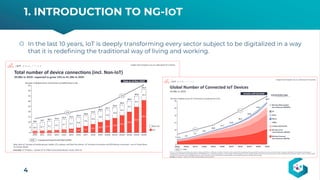
š In the last 10 years, IoT is deeply transforming every sector subject to be digitalized in a way
that it is redefining the traditional way of living and working.
1. INTRODUCTION TO NG-IOT
5
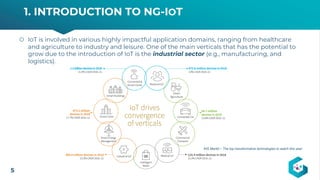
š IoT is involved in various highly impactful application domains, ranging from healthcare
and agriculture to industry and leisure. One of the main verticals that has the potential to
grow due to the introduction of IoT is the industrial sector (e.g., manufacturing, and
logistics).
IHS Markit – The top transformative technologies to watch this year
1. INTRODUCTION TO NG-IOT
6
WHY
?
1. INTRODUCTION TO NG-IOT
7
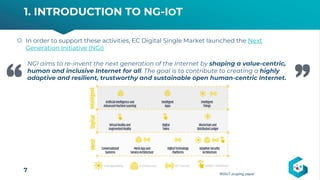
š In order to support these activities, EC Digital Single Market launched the Next
Generation Initiative (NGI)
NGI aims to re-invent the next generation of the Internet by shaping a value-centric,
human and inclusive Internet for all. The goal is to contribute to creating a highly
adaptive and resilient, trustworthy and sustainable open human-centric Internet.
NGIoT scoping paper
1. INTRODUCTION TO NG-IOT
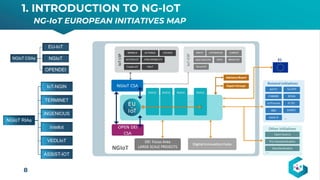
NG-IoT EUROPEAN INITIATIVES MAP
8
NGIoT CSAs
EU-IoT
NGIoT
OPENDEI
NGIoT RIAs
IoT-NGIN
TERMINET
iNGENIOUS
Intellot
VEDLIoT
ASSIST-IOT
2. iNGENIOUS OVERVIEW
9
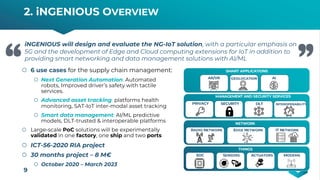
š 6 use cases for the supply chain management:
š Next Generation Automation: Automated
robots, Improved driver’s safety with tactile
services.
š Advanced asset tracking: platforms health
monitoring, SAT-IoT inter-modal asset tracking
š Smart data management: AI/ML predictive
models, DLT-trusted & interoperable platforms
š Large-scale PoC solutions will be experimentally
validated in one factory, one ship and two ports
š ICT-56-2020 RIA project
š 30 months project – 8 M€
š October 2020 – March 2023
iNGENIOUS will design and evaluate the NG-IoT solution, with a particular emphasis on
5G and the development of Edge and Cloud computing extensions for IoT in addition to
providing smart networking and data management solutions with AI/ML
MANAGEMENT AND SECURITY SERVICES
PRIVACY SECURITY DLT INTEROPERABILITY
SMART APPLICATIONS
NETWORK
AR/VR
THINGS
GEOLOCATION AI
RADIO NETWORK IT NETWORK
EDGE NETWORK
SOC SENSORS ACTUATORS MODEMS
2. iNGENIOUS OVERVIEW
10
10
FRANCE
FINLAND
SPAIN
ITALY
POLAND
GERMANY
LUXEMBOURG
IRELAND
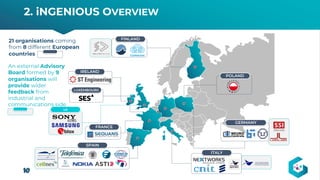
21 organisations coming
from 8 different European
countries
UK
An external Advisory
Board formed by 9
organisations will
provide wider
feedback from
industrial and
communications side
3. iNGENIOUS USE CASES
11
Ship Use Case
gNB & MEC
Automated
Robot+AGV
Factory Use Case
Smart
IoT-SAT GW
Mesh sensor NW Transport Use Case
5GC
(TSN/NWDAF)
SAT GW
gNB &
MEC
Positioning &
Tracking
sensors
MR & Haptic gloves
Remote controlled AGV
AGVs Use Case
Port Entrance
Use Case
Smart IoT-SAT GW
DLT4
DLT3
DLT2
M2M4
DLT1
M2M3
M2M2
M2M1
DLT Use Case
DLT5
M2M5
Cross-DLT
DVL
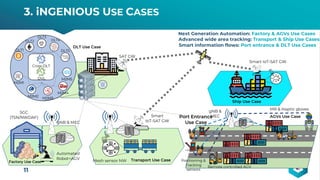
Next Generation Automation: Factory & AGVs Use Cases
Advanced wide area tracking: Transport & Ship Use Cases
Smart information flows: Port entrance & DLT Use Cases
3. iNGENIOUS USE CASES
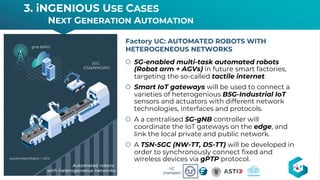
š 5G-enabled multi-task automated robots
(Robot arm + AGVs) in future smart factories,
targeting the so-called tactile internet.
š Smart IoT gateways will be used to connect a
varieties of heterogenious B5G-Industrial IoT
sensors and actuators with different network
technologies, interfaces and protocols.
š A a centralised 5G-gNB controller will
coordinate the IoT gateways on the edge, and
link the local private and public network.
š A TSN-5GC (NW-TT, DS-TT) will be developed in
order to synchronously connect fixed and
wireless devices via gPTP protocol.
Factory UC: AUTOMATED ROBOTS WITH
HETEROGENEOUS NETWORKS
3. iNGENIOUS USE CASES
NEXT GENERATION AUTOMATION
13 UC
champion
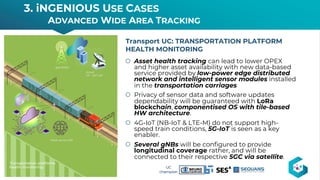
š Asset health tracking can lead to lower OPEX
and higher asset availability with new data-based
service provided by low-power edge distributed
network and intelligent sensor modules installed
in the transportation carriages
š Privacy of sensor data and software updates
dependability will be guaranteed with LoRa
blockchain, componentised OS with tile-based
HW architecture.
š 4G-IoT (NB-IoT & LTE-M) do not support high-
speed train conditions, 5G-IoT is seen as a key
enabler.
š Several gNBs will be configured to provide
longitudinal coverage rather, and will be
connected to their respective 5GC via satellite.
Transport UC: TRANSPORTATION PLATFORM
HEALTH MONITORING
3. iNGENIOUS USE CASES
ADVANCED WIDE AREA TRACKING
14
UC
champion
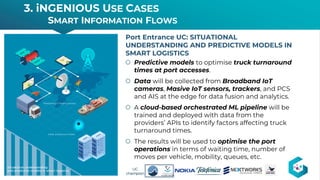
š Predictive models to optimise truck turnaround
times at port accesses.
š Data will be collected from Broadband IoT
cameras, Masive IoT sensors, trackers, and PCS
and AIS at the edge for data fusion and analytics.
š A cloud-based orchestrated ML pipeline will be
trained and deployed with data from the
providers’ APIs to identify factors affecting truck
turnaround times.
š The results will be used to optimise the port
operations in terms of waiting time, number of
moves per vehicle, mobility, queues, etc.
Port Entrance UC: SITUATIONAL
UNDERSTANDING AND PREDICTIVE MODELS IN
SMART LOGISTICS
3. iNGENIOUS USE CASES
SMART INFORMATION FLOWS
15 15
UC
champion
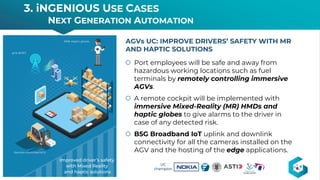
š Port employees will be safe and away from
hazardous working locations such as fuel
terminals by remotely controlling immersive
AGVs.
š A remote cockpit will be implemented with
immersive Mixed-Reality (MR) HMDs and
haptic globes to give alarms to the driver in
case of any detected risk.
š B5G Broadband IoT uplink and downlink
connectivity for all the cameras installed on the
AGV and the hosting of the edge applications.
AGVs UC: IMPROVE DRIVERS’ SAFETY WITH MR
AND HAPTIC SOLUTIONS
3. iNGENIOUS USE CASES
NEXT GENERATION AUTOMATION
16
UC
champion
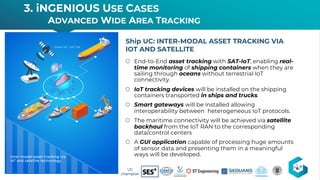
š End-to-End asset tracking with SAT-IoT, enabling real-
time monitoring of shipping containers when they are
sailing through oceans without terrestrial IoT
connectivity.
š IoT tracking devices will be installed on the shipping
containers transported in ships and trucks.
š Smart gateways will be installed allowing
interoperability between heterogeneous IoT protocols.
š The maritime connectivity will be achieved via satellite
backhaul from the IoT RAN to the corresponding
data/control centers
š A GUI application capable of processing huge amounts
of sensor data and presenting them in a meaningful
ways will be developed.
Ship UC: INTER-MODAL ASSET TRACKING VIA
IOT AND SATELLITE
3. iNGENIOUS USE CASES
ADVANCED WIDE AREA TRACKING
17 UC
champion
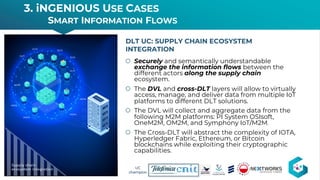
š Securely and semantically understandable
exchange the information flows between the
different actors along the supply chain
ecosystem.
š The DVL and cross-DLT layers will allow to virtually
access, manage, and deliver data from multiple IoT
platforms to different DLT solutions.
š The DVL will collect and aggregate data from the
following M2M platforms: PI System OSIsoft,
OneM2M, OM2M, and Symphony IoT/M2M.
š The Cross-DLT will abstract the complexity of IOTA,
Hyperledger Fabric, Ethereum, or Bitcoin
blockchains while exploiting their cryptographic
capabilities.
DLT UC: SUPPLY CHAIN ECOSYSTEM
INTEGRATION
3. iNGENIOUS USE CASES
SMART INFORMATION FLOWS
18 UC
champion
4. iNGENIOUS CROSS-LAYER ARCHITECTURE
19
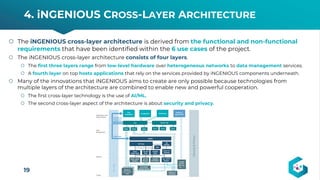
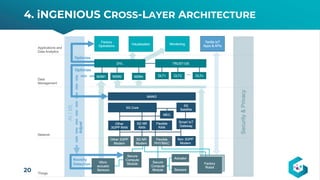
š The iNGENIOUS cross-layer architecture is derived from the functional and non-functional
requirements that have been identified within the 6 use cases of the project.
š The iNGENIOUS cross-layer architecture consists of four layers.
š The first three layers range from low-level hardware over heterogeneous networks to data management services.
š A fourth layer on top hosts applications that rely on the services provided by iNGENIOUS components underneath.
š Many of the innovations that iNGENIOUS aims to create are only possible because technologies from
multiple layers of the architecture are combined to enable new and powerful cooperation.
š The first cross-layer technology is the use of AI/ML.
š The second cross-layer aspect of the architecture is about security and privacy.
4. iNGENIOUS CROSS-LAYER ARCHITECTURE
20
4. iNGENIOUS KEY ENABLERS
NEW HARDWARE AND SENSORS
21
š Next generation sensors must identify unknown
situations and to communicate them
immediately. iNGENIOUS will develop and
validate neuromorphic-enhanced sensors.
š They will provide efficient low-power pre-
classification features, without having to stream
redundant data.
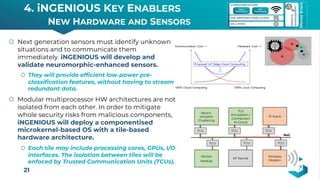
š Modular multiprocessor HW architectures are not
isolated from each other. In order to mitigate
whole security risks from malicious components,
iNGENIOUS will deploy a componentised
microkernel-based OS with a tile-based
hardware architecture.
š Each tile may include processing cores, GPUs, I/O
interfaces. The isolation between tiles will be
enfoced by Trusted Communication Units (TCUs).
M3 Kernel
TCU TCU
NoC
TCU
TCU
Neuro-
morphic
Clustering
TCU
TLS
Encryption /
Connection
to Cloud
IP Stack
TCU
Wireless
Modem
Sensor
Module
OS / RTOS
HW ABSTRACTION LAYER
COMMUNICATION
FIELD
PROTOCOLS
IOT
PROTOCOLS
REMOTE
MANAGEMENT
D
EVICE
S
TACK
22
4. iNGENIOUS KEY ENABLERS
IoT NETWORK LAYER
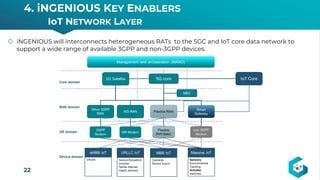
š iNGENIOUS will interconnects heterogeneous RATs to the 5GC and IoT core data network to
support a wide range of available 3GPP and non-3GPP devices.
23
4. iNGENIOUS KEY ENABLERS
B5G-IoT CONNECTIVITY
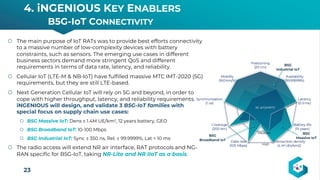
š The main purpose of IoT RATs was to provide best efforts connectivity
to a massive number of low-complexity devices with battery
constraints, such as sensors. The emerging use cases in different
business sectors demand more stringent QoS and different
requirements in terms of data rate, latency, and reliability.
š Cellular IoT (LTE-M & NB-IoT) have fulfilled massive MTC IMT-2020 (5G)
requirements, but they are still LTE-based.
š Next Generation Cellular IoT will rely on 5G and beyond, in order to
cope with higher throughput, latency, and reliability requirements.
iNGENIOUS will design, and validate 3 B5G-IoT families with
special focus on supply chain use cases:
š B5G Massive IoT: Dens ≤ 1.4M UE/km2, 12 years battery, GEO
š B5G Broadband IoT: 10-100 Mbps
š B5G Industrial IoT: Sync ≤ 350 ns, Rel. ≥ 99.9999%, Lat < 10 ms
š The radio access will extend NR air interface, RAT protocols and NG-
RAN specific for B5G-IoT, taking NR-Lite and NR IIoT as a basis.
Positioning
(20 cm)
Availability
(99.99999%)
Latency
(0.5 ms)
Battery life
(15 years)
Connection density
(4 M UEs/km2)
Data rate
(100 Mbps)
Coverage
(200 km)
Synchronisation
(1 us)
Mobility
(160 km/h)
Medium
High
5G IoT/mMTC
B5G
Massive IoT
B5G
Broadband IoT
B5G
Industrial IoT
24
4. iNGENIOUS KEY ENABLERS
INTEROPERABILITY FOR DATA MANEGEMENT
25
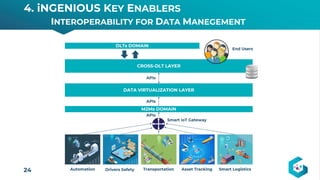
š The digitalization of supply chain scenarios has allowed that information flows generated in the
processes are translated into sets of data thanks to the use of M2M platforms.
š However, they still struggle to manage large amount of data due to the lack of interoperability
between different systems.
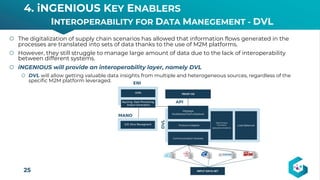
š iNGENIOUS will provide an interoperability layer, namely DVL
š DVL will allow getting valuable data insights from multiple and heterogeneous sources, regardless of the
specific M2M platform leveraged.
4. iNGENIOUS KEY ENABLERS
INTEROPERABILITY FOR DATA MANEGEMENT - DVL
26
4. iNGENIOUS KEY ENABLERS
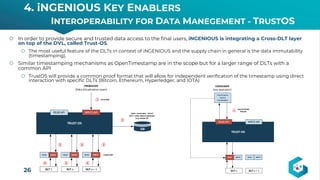
INTEROPERABILITY FOR DATA MANEGEMENT - TRUSTOS
š In order to provide secure and trusted data access to the final users, iNGENIOUS is integrating a Cross-DLT layer
on top of the DVL, called Trust-OS.
š The most useful feature of the DLTs in context of iNGENIOUS and the supply chain in general is the data immutability
(timestamping).
š Similar timestamping mechanisms as OpenTimestamp are in the scope but for a larger range of DLTs with a
common API
š TrustOS will provide a common proof format that will allow for independent verification of the timestamp using direct
interaction with specific DLTs (Bitcoin, Ethereum, Hyperledger, and IOTA)
TRUST-OS
DB
READ API WRITE API
PRODUCER
(Data Virtualization Layer)
DLT 1 DLT n DLT n + 1
READ
event data
1
2
WRITE READ WRITE READ WRITE
3
3
3
Invoked API
4
4 4
Hash + event data +list of
DLTs+ other default attributes
(e.g: unique ID)
TRUST-OS
READ API WRITE API
DLT n DLT n + 1
DataREADING
Request
1
READ WRITE READ WRITE
CONSUMER
(any appication)
Front End for
Events
Visualization
27
4. iNGENIOUS KEY ENABLERS
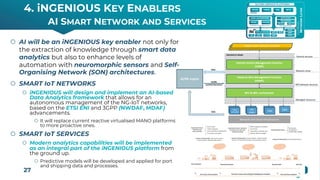
AI SMART NETWORK AND SERVICES
š AI will be an iNGENIOUS key enabler not only for
the extraction of knowledge through smart data
analytics but also to enhance levels of
automation with neuromorphic sensors and Self-
Organising Network (SON) architectures.
š SMART IoT NETWORKS
š iNGENIOUS will design and implement an AI-based
Data Analytics framework that allows for an
autonomous management of the NG-IoT networks,
based on the ETSI ENI and 3GPP (NWDAF, MDAF)
advancements.
š It will replace current reactive virtualised MANO platforms
to more proactive ones.
š SMART IoT SERVICES
š Modern analytics capabilities will be implemented
as an integral part of the iNGENIOUS platform from
the ground up.
š Predictive models will be developed and applied for port
and shipping data and processes.
AI-BASED DATA ANALYTICS
MDAF NWDAF
AI/ML ALGORITHMS
MANO
NFVO VNFM VIM NFVI
SLICING SERVICE PLATFORM
TSN FRAMEWORK
gPTP SLICE
DS-TT NW-TT
TSN BRIDGE
UE
SON ALGORITHMS
NG-RAN UPF
RRM
NR PHY
NSSF
NRF
PCF
SMF
AMF
EDGE
NODES
N
ETWORK
L
AYER
5. iNGENIOUS TESTBEDS
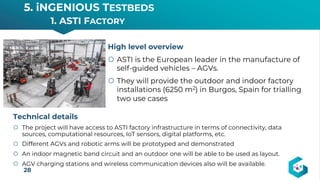
1. ASTI FACTORY
28
High level overview
š ASTI is the European leader in the manufacture of
self-guided vehicles – AGVs.
š They will provide the outdoor and indoor factory
installations (6250 m2) in Burgos, Spain for trialling
two use cases
Technical details
š The project will have access to ASTI factory infrastructure in terms of connectivity, data
sources, computational resources, IoT sensors, digital platforms, etc.
š Different AGVs and robotic arms will be prototyped and demonstrated
š An indoor magnetic band circuit and an outdoor one will be able to be used as layout.
š AGV charging stations and wireless communication devices also will be available.
5. iNGENIOUS TESTBEDS
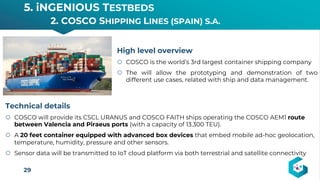
2. COSCO SHIPPING LINES (SPAIN) S.A.
29
High level overview
š COSCO is the world’s 3rd largest container shipping company
š The will allow the prototyping and demonstration of two
different use cases, related with ship and data management.
Technical details
š COSCO will provide its CSCL URANUS and COSCO FAITH ships operating the COSCO AEM1 route
between Valencia and Piraeus ports (with a capacity of 13.300 TEU).
š A 20 feet container equipped with advanced box devices that embed mobile ad-hoc geolocation,
temperature, humidity, pressure and other sensors.
š Sensor data will be transmitted to IoT cloud platform via both terrestrial and satellite connectivity
5. iNGENIOUS TESTBEDS
3. VALENCIA PORT
30
High level overview
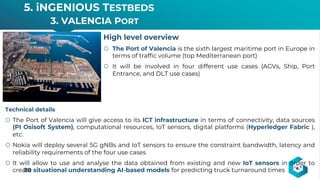
š The Port of Valencia is the sixth largest maritime port in Europe in
terms of traffic volume (top Mediterranean port)
š It will be involved in four different use cases (AGVs, Ship, Port
Entrance, and DLT use cases)
Technical details
š The Port of Valencia will give access to its ICT infrastructure in terms of connectivity, data sources
(PI Osisoft System), computational resources, IoT sensors, digital platforms (Hyperledger Fabric ),
etc.
š Nokia will deploy several 5G gNBs and IoT sensors to ensure the constraint bandwidth, latency and
reliability requirements of the four use cases
š It will allow to use and analyse the data obtained from existing and new IoT sensors in order to
create situational understanding AI-based models for predicting truck turnaround times
5. iNGENIOUS TESTBEDS
4. LIVORNO PORT
31
High level overview
Technical details
š One or several 5G gNBs, depending on the size of the underserved area, will be deployed. They will be connected to their
respective 5GC via satellite
š Data will be collected from distributed sources (supported by the Port of Livorno ICT infrastructure in terms of connectivity,
data sources, computational resources, IoT sensors and digital platforms (PCS-TPCS/PMS-MonI.C.A.)
š The sensor data will be first processed at the edge prior to transmitting to a central processing platform for data fusion and
analytics.
š DVL and Cross-DLT layers will be deployed and tested to ensure both the iNGENIOUS interoperability.
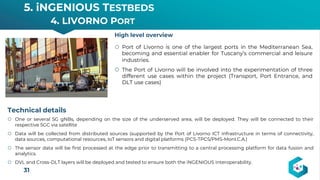
š Port of Livorno is one of the largest ports in the Mediterranean Sea,
becoming and essential enabler for Tuscany’s commercial and leisure
industries.
š The Port of Livorno will be involved into the experimentation of three
different use cases within the project (Transport, Port Entrance, and
DLT use cases)
6. IMPLEMENTATION
PROJECT MANAGEMENT
32
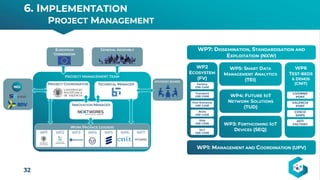
GENERAL ASSEMBLY
PROJECT COORDINATOR
PROJECT MANAGEMENT TEAM
TECHNICAL MANAGER
INNOVATION MANAGER
WORK PACKAGE LEADERS
WP2 WP3 WP4 WP5
WP1 WP6
ADVISORY BOARD
WP7
EUROPEAN
COMMISSION
WP3: FORTHCOMING IOT
DEVICES (SEQ)
WP4: FUTURE IOT
NETWORK SOLUTIONS
(TUD)
WP5: SMART DATA
MANAGEMENT ANALYTICS
(TEI)
WP7: DISSEMINATION, STANDARDISATION AND
EXPLOITATION (NXW)
WP1: MANAGEMENT AND COORDINATION (UPV)
WP2
ECOSYSTEM
(FV)
WP6
TEST-BEDS
& DEMOS
(CNIT)
Factory
USE CASE
Transport
USE CASE
Port Entrance
USE CASE
AGVs
USE CASE
Ship
USE CASE
DLT
USE CASE
LIVORNO
PORT
VALENCIA
PORT
COSCO
SHIPS
ASTI
FACTORY
6. IMPLEMENTATION
GANTT
33
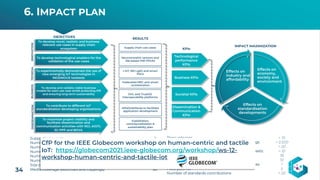
6. IMPACT PLAN
34
To develop novel, realistic and business
relevant use cases in supply chain
ecosystem
To develop technological enablers for the
validation of the use cases
To experimentally demonstrate the use of
new emerging IoT technologies in
iNGENIOUS testbeds
To develop and validate viable business
models for each use case whilst protecting IPR
and ensuring long-term sustainability
To contribute to different IoT
standardisation developing organisations
To maximize project visibility and
facilitate dissemination and
communication activities with NGI, AIOTI,
5G PPP and BDVA
INNOVATION
TECNICAL
BUSINESS
DISESEMINATION
OBJECTIVES
RESULTS
IMPACT MAXIMIZATION
KPIs
Supply chain use cases
Neuromorphic sensors and
tile-based HW FPGAs
I-IoT, NR-Light and smart
PoCs
Federated MEC and smart
orchestration
APIs/interfaces to facilitate
application development
Exploitation,
commercialization &
sustainability plan
DVL and TrustOS
interoperability platforms
Technological
performance
KPIs
Business KPIs
Societal KPIs
Dissemination &
Communication
KPIs
Effects on
economy,
society and
environment
Effects on
standardisation
developments
Effects on
industry and
affordability
Supporting events 2
Number of people participating in consultations 70
Number of workshops 6
Number of webinars/showcasing events 4
Number of webinar and workshop participants 250
Number of attendees in webinars, peer networking events > 1.000
Size of the community (e.g. followers, newsletter subscribers) > 1.000
Media coverage (editorials and clippings) 50
Press releases > 10
Blog posts, tweets including editorial and clippings > 2.500
Journal and conference scientific papers > 20
White papers, newsletters, success stories, factsheets > 10
Public deliverables 18
Keynotes in major conferences/events 10
Summer schools, tutorials, online training modules 1

Filed patents 5
Number of standards contributions > 20
CfP for the IEEE Globecom workshop on human-centric and tactile
IoT: https://globecom2021.ieee-globecom.org/workshop/ws-12-
workshop-human-centric-and-tactile-iot
6. IMPACT PLAN
35
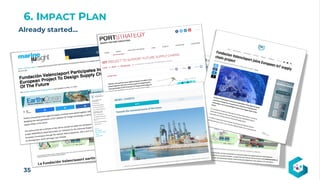
Already started…
This project has received funding from the European Union’s Horizon 2020
research and innovation programme under grant agreement No 957216
STAY UPDATE
AND GET INVOLVED!
www.ingenious-iot.eu
@ingenious_iot
Linkedin group
YouTube channel
Slideshare
EDUARDO GARRO
edgarcre@iteam.upv.es
NURIA MOLNER
numolsiu@iteam.upv.es
DAVID GOMEZ-BARQUERO
dagobar@iteam.upv.es

iNGENIOUS: Next Generation IoT for the Next-Generation Supply Chain

  • 1.
    In enious April 19-21,2021 Eduardo Garro (Universitat Politecnica Valencia)
  • 2.
    Institute of Telecommunicationsand Multimedia Applications (iTEAM) šBiggest R&D institute at UPV. šFocused on Information and Communication Technologies (ICT). šDivided into 9 research groups with more than 160 researchers. Mobile Communications Group (MCG) šBiggest university research group in Spain on wireless communications with ~30 researchers. šMore than 25 years of experience in the mobile communications field. šStrong presence in 5G-PPP with 7 projects, being coordinators of three of them ABOUT US 2
  • 3.
    TABLE OF CONTENTS 1.INTRODUCTION TO NG-IoT 2.iNGENIOUS OVERVIEW 3.iNGENIOUS USE CASES 4.iNGENIOUS KEY ENABLERS 5.iNGENIOUS TESTBEDS 6.IMPLEMENTATION 1. MANAGEMENT STRUCTURE 2. GANTT CHART 3. DELIVERABLES & MILESTONES 4.WORK PACKAGES 7.IMPACT PLAN 3
  • 4.
    1. INTRODUCTION TONG-IOT 4 š In the last 10 years, IoT is deeply transforming every sector subject to be digitalized in a way that it is redefining the traditional way of living and working.
  • 5.
    1. INTRODUCTION TONG-IOT 5 š IoT is involved in various highly impactful application domains, ranging from healthcare and agriculture to industry and leisure. One of the main verticals that has the potential to grow due to the introduction of IoT is the industrial sector (e.g., manufacturing, and logistics). IHS Markit – The top transformative technologies to watch this year
  • 6.
    1. INTRODUCTION TONG-IOT 6 WHY ?
  • 7.
    1. INTRODUCTION TONG-IOT 7 š In order to support these activities, EC Digital Single Market launched the Next Generation Initiative (NGI) NGI aims to re-invent the next generation of the Internet by shaping a value-centric, human and inclusive Internet for all. The goal is to contribute to creating a highly adaptive and resilient, trustworthy and sustainable open human-centric Internet. NGIoT scoping paper
  • 8.
    1. INTRODUCTION TONG-IOT NG-IoT EUROPEAN INITIATIVES MAP 8 NGIoT CSAs EU-IoT NGIoT OPENDEI NGIoT RIAs IoT-NGIN TERMINET iNGENIOUS Intellot VEDLIoT ASSIST-IOT
  • 9.
    2. iNGENIOUS OVERVIEW 9 š6 use cases for the supply chain management: š Next Generation Automation: Automated robots, Improved driver’s safety with tactile services. š Advanced asset tracking: platforms health monitoring, SAT-IoT inter-modal asset tracking š Smart data management: AI/ML predictive models, DLT-trusted & interoperable platforms š Large-scale PoC solutions will be experimentally validated in one factory, one ship and two ports š ICT-56-2020 RIA project š 30 months project – 8 M€ š October 2020 – March 2023 iNGENIOUS will design and evaluate the NG-IoT solution, with a particular emphasis on 5G and the development of Edge and Cloud computing extensions for IoT in addition to providing smart networking and data management solutions with AI/ML MANAGEMENT AND SECURITY SERVICES PRIVACY SECURITY DLT INTEROPERABILITY SMART APPLICATIONS NETWORK AR/VR THINGS GEOLOCATION AI RADIO NETWORK IT NETWORK EDGE NETWORK SOC SENSORS ACTUATORS MODEMS
  • 10.
    2. iNGENIOUS OVERVIEW 10 10 FRANCE FINLAND SPAIN ITALY POLAND GERMANY LUXEMBOURG IRELAND 21organisations coming from 8 different European countries UK An external Advisory Board formed by 9 organisations will provide wider feedback from industrial and communications side
  • 11.
    3. iNGENIOUS USECASES 11 Ship Use Case gNB & MEC Automated Robot+AGV Factory Use Case Smart IoT-SAT GW Mesh sensor NW Transport Use Case 5GC (TSN/NWDAF) SAT GW gNB & MEC Positioning & Tracking sensors MR & Haptic gloves Remote controlled AGV AGVs Use Case Port Entrance Use Case Smart IoT-SAT GW DLT4 DLT3 DLT2 M2M4 DLT1 M2M3 M2M2 M2M1 DLT Use Case DLT5 M2M5 Cross-DLT DVL Next Generation Automation: Factory & AGVs Use Cases Advanced wide area tracking: Transport & Ship Use Cases Smart information flows: Port entrance & DLT Use Cases
  • 12.
  • 13.
    š 5G-enabled multi-taskautomated robots (Robot arm + AGVs) in future smart factories, targeting the so-called tactile internet. š Smart IoT gateways will be used to connect a varieties of heterogenious B5G-Industrial IoT sensors and actuators with different network technologies, interfaces and protocols. š A a centralised 5G-gNB controller will coordinate the IoT gateways on the edge, and link the local private and public network. š A TSN-5GC (NW-TT, DS-TT) will be developed in order to synchronously connect fixed and wireless devices via gPTP protocol. Factory UC: AUTOMATED ROBOTS WITH HETEROGENEOUS NETWORKS 3. iNGENIOUS USE CASES NEXT GENERATION AUTOMATION 13 UC champion
  • 14.
    š Asset healthtracking can lead to lower OPEX and higher asset availability with new data-based service provided by low-power edge distributed network and intelligent sensor modules installed in the transportation carriages š Privacy of sensor data and software updates dependability will be guaranteed with LoRa blockchain, componentised OS with tile-based HW architecture. š 4G-IoT (NB-IoT & LTE-M) do not support high- speed train conditions, 5G-IoT is seen as a key enabler. š Several gNBs will be configured to provide longitudinal coverage rather, and will be connected to their respective 5GC via satellite. Transport UC: TRANSPORTATION PLATFORM HEALTH MONITORING 3. iNGENIOUS USE CASES ADVANCED WIDE AREA TRACKING 14 UC champion
  • 15.
    š Predictive modelsto optimise truck turnaround times at port accesses. š Data will be collected from Broadband IoT cameras, Masive IoT sensors, trackers, and PCS and AIS at the edge for data fusion and analytics. š A cloud-based orchestrated ML pipeline will be trained and deployed with data from the providers’ APIs to identify factors affecting truck turnaround times. š The results will be used to optimise the port operations in terms of waiting time, number of moves per vehicle, mobility, queues, etc. Port Entrance UC: SITUATIONAL UNDERSTANDING AND PREDICTIVE MODELS IN SMART LOGISTICS 3. iNGENIOUS USE CASES SMART INFORMATION FLOWS 15 15 UC champion
  • 16.
    š Port employeeswill be safe and away from hazardous working locations such as fuel terminals by remotely controlling immersive AGVs. š A remote cockpit will be implemented with immersive Mixed-Reality (MR) HMDs and haptic globes to give alarms to the driver in case of any detected risk. š B5G Broadband IoT uplink and downlink connectivity for all the cameras installed on the AGV and the hosting of the edge applications. AGVs UC: IMPROVE DRIVERS’ SAFETY WITH MR AND HAPTIC SOLUTIONS 3. iNGENIOUS USE CASES NEXT GENERATION AUTOMATION 16 UC champion
  • 17.
    š End-to-End assettracking with SAT-IoT, enabling real- time monitoring of shipping containers when they are sailing through oceans without terrestrial IoT connectivity. š IoT tracking devices will be installed on the shipping containers transported in ships and trucks. š Smart gateways will be installed allowing interoperability between heterogeneous IoT protocols. š The maritime connectivity will be achieved via satellite backhaul from the IoT RAN to the corresponding data/control centers š A GUI application capable of processing huge amounts of sensor data and presenting them in a meaningful ways will be developed. Ship UC: INTER-MODAL ASSET TRACKING VIA IOT AND SATELLITE 3. iNGENIOUS USE CASES ADVANCED WIDE AREA TRACKING 17 UC champion
  • 18.
    š Securely andsemantically understandable exchange the information flows between the different actors along the supply chain ecosystem. š The DVL and cross-DLT layers will allow to virtually access, manage, and deliver data from multiple IoT platforms to different DLT solutions. š The DVL will collect and aggregate data from the following M2M platforms: PI System OSIsoft, OneM2M, OM2M, and Symphony IoT/M2M. š The Cross-DLT will abstract the complexity of IOTA, Hyperledger Fabric, Ethereum, or Bitcoin blockchains while exploiting their cryptographic capabilities. DLT UC: SUPPLY CHAIN ECOSYSTEM INTEGRATION 3. iNGENIOUS USE CASES SMART INFORMATION FLOWS 18 UC champion
  • 19.
    4. iNGENIOUS CROSS-LAYERARCHITECTURE 19 š The iNGENIOUS cross-layer architecture is derived from the functional and non-functional requirements that have been identified within the 6 use cases of the project. š The iNGENIOUS cross-layer architecture consists of four layers. š The first three layers range from low-level hardware over heterogeneous networks to data management services. š A fourth layer on top hosts applications that rely on the services provided by iNGENIOUS components underneath. š Many of the innovations that iNGENIOUS aims to create are only possible because technologies from multiple layers of the architecture are combined to enable new and powerful cooperation. š The first cross-layer technology is the use of AI/ML. š The second cross-layer aspect of the architecture is about security and privacy.
  • 20.
    4. iNGENIOUS CROSS-LAYERARCHITECTURE 20
  • 21.
    4. iNGENIOUS KEYENABLERS NEW HARDWARE AND SENSORS 21 š Next generation sensors must identify unknown situations and to communicate them immediately. iNGENIOUS will develop and validate neuromorphic-enhanced sensors. š They will provide efficient low-power pre- classification features, without having to stream redundant data. š Modular multiprocessor HW architectures are not isolated from each other. In order to mitigate whole security risks from malicious components, iNGENIOUS will deploy a componentised microkernel-based OS with a tile-based hardware architecture. š Each tile may include processing cores, GPUs, I/O interfaces. The isolation between tiles will be enfoced by Trusted Communication Units (TCUs). M3 Kernel TCU TCU NoC TCU TCU Neuro- morphic Clustering TCU TLS Encryption / Connection to Cloud IP Stack TCU Wireless Modem Sensor Module OS / RTOS HW ABSTRACTION LAYER COMMUNICATION FIELD PROTOCOLS IOT PROTOCOLS REMOTE MANAGEMENT D EVICE S TACK
  • 22.
    22 4. iNGENIOUS KEYENABLERS IoT NETWORK LAYER š iNGENIOUS will interconnects heterogeneous RATs to the 5GC and IoT core data network to support a wide range of available 3GPP and non-3GPP devices.
  • 23.
    23 4. iNGENIOUS KEYENABLERS B5G-IoT CONNECTIVITY š The main purpose of IoT RATs was to provide best efforts connectivity to a massive number of low-complexity devices with battery constraints, such as sensors. The emerging use cases in different business sectors demand more stringent QoS and different requirements in terms of data rate, latency, and reliability. š Cellular IoT (LTE-M & NB-IoT) have fulfilled massive MTC IMT-2020 (5G) requirements, but they are still LTE-based. š Next Generation Cellular IoT will rely on 5G and beyond, in order to cope with higher throughput, latency, and reliability requirements. iNGENIOUS will design, and validate 3 B5G-IoT families with special focus on supply chain use cases: š B5G Massive IoT: Dens ≤ 1.4M UE/km2, 12 years battery, GEO š B5G Broadband IoT: 10-100 Mbps š B5G Industrial IoT: Sync ≤ 350 ns, Rel. ≥ 99.9999%, Lat < 10 ms š The radio access will extend NR air interface, RAT protocols and NG- RAN specific for B5G-IoT, taking NR-Lite and NR IIoT as a basis. Positioning (20 cm) Availability (99.99999%) Latency (0.5 ms) Battery life (15 years) Connection density (4 M UEs/km2) Data rate (100 Mbps) Coverage (200 km) Synchronisation (1 us) Mobility (160 km/h) Medium High 5G IoT/mMTC B5G Massive IoT B5G Broadband IoT B5G Industrial IoT
  • 24.
    24 4. iNGENIOUS KEYENABLERS INTEROPERABILITY FOR DATA MANEGEMENT
  • 25.
    25 š The digitalizationof supply chain scenarios has allowed that information flows generated in the processes are translated into sets of data thanks to the use of M2M platforms. š However, they still struggle to manage large amount of data due to the lack of interoperability between different systems. š iNGENIOUS will provide an interoperability layer, namely DVL š DVL will allow getting valuable data insights from multiple and heterogeneous sources, regardless of the specific M2M platform leveraged. 4. iNGENIOUS KEY ENABLERS INTEROPERABILITY FOR DATA MANEGEMENT - DVL
  • 26.
    26 4. iNGENIOUS KEYENABLERS INTEROPERABILITY FOR DATA MANEGEMENT - TRUSTOS š In order to provide secure and trusted data access to the final users, iNGENIOUS is integrating a Cross-DLT layer on top of the DVL, called Trust-OS. š The most useful feature of the DLTs in context of iNGENIOUS and the supply chain in general is the data immutability (timestamping). š Similar timestamping mechanisms as OpenTimestamp are in the scope but for a larger range of DLTs with a common API š TrustOS will provide a common proof format that will allow for independent verification of the timestamp using direct interaction with specific DLTs (Bitcoin, Ethereum, Hyperledger, and IOTA) TRUST-OS DB READ API WRITE API PRODUCER (Data Virtualization Layer) DLT 1 DLT n DLT n + 1 READ event data 1 2 WRITE READ WRITE READ WRITE 3 3 3 Invoked API 4 4 4 Hash + event data +list of DLTs+ other default attributes (e.g: unique ID) TRUST-OS READ API WRITE API DLT n DLT n + 1 DataREADING Request 1 READ WRITE READ WRITE CONSUMER (any appication) Front End for Events Visualization
  • 27.
    27 4. iNGENIOUS KEYENABLERS AI SMART NETWORK AND SERVICES š AI will be an iNGENIOUS key enabler not only for the extraction of knowledge through smart data analytics but also to enhance levels of automation with neuromorphic sensors and Self- Organising Network (SON) architectures. š SMART IoT NETWORKS š iNGENIOUS will design and implement an AI-based Data Analytics framework that allows for an autonomous management of the NG-IoT networks, based on the ETSI ENI and 3GPP (NWDAF, MDAF) advancements. š It will replace current reactive virtualised MANO platforms to more proactive ones. š SMART IoT SERVICES š Modern analytics capabilities will be implemented as an integral part of the iNGENIOUS platform from the ground up. š Predictive models will be developed and applied for port and shipping data and processes. AI-BASED DATA ANALYTICS MDAF NWDAF AI/ML ALGORITHMS MANO NFVO VNFM VIM NFVI SLICING SERVICE PLATFORM TSN FRAMEWORK gPTP SLICE DS-TT NW-TT TSN BRIDGE UE SON ALGORITHMS NG-RAN UPF RRM NR PHY NSSF NRF PCF SMF AMF EDGE NODES N ETWORK L AYER
  • 28.
    5. iNGENIOUS TESTBEDS 1.ASTI FACTORY 28 High level overview š ASTI is the European leader in the manufacture of self-guided vehicles – AGVs. š They will provide the outdoor and indoor factory installations (6250 m2) in Burgos, Spain for trialling two use cases Technical details š The project will have access to ASTI factory infrastructure in terms of connectivity, data sources, computational resources, IoT sensors, digital platforms, etc. š Different AGVs and robotic arms will be prototyped and demonstrated š An indoor magnetic band circuit and an outdoor one will be able to be used as layout. š AGV charging stations and wireless communication devices also will be available.
  • 29.
    5. iNGENIOUS TESTBEDS 2.COSCO SHIPPING LINES (SPAIN) S.A. 29 High level overview š COSCO is the world’s 3rd largest container shipping company š The will allow the prototyping and demonstration of two different use cases, related with ship and data management. Technical details š COSCO will provide its CSCL URANUS and COSCO FAITH ships operating the COSCO AEM1 route between Valencia and Piraeus ports (with a capacity of 13.300 TEU). š A 20 feet container equipped with advanced box devices that embed mobile ad-hoc geolocation, temperature, humidity, pressure and other sensors. š Sensor data will be transmitted to IoT cloud platform via both terrestrial and satellite connectivity
  • 30.
    5. iNGENIOUS TESTBEDS 3.VALENCIA PORT 30 High level overview š The Port of Valencia is the sixth largest maritime port in Europe in terms of traffic volume (top Mediterranean port) š It will be involved in four different use cases (AGVs, Ship, Port Entrance, and DLT use cases) Technical details š The Port of Valencia will give access to its ICT infrastructure in terms of connectivity, data sources (PI Osisoft System), computational resources, IoT sensors, digital platforms (Hyperledger Fabric ), etc. š Nokia will deploy several 5G gNBs and IoT sensors to ensure the constraint bandwidth, latency and reliability requirements of the four use cases š It will allow to use and analyse the data obtained from existing and new IoT sensors in order to create situational understanding AI-based models for predicting truck turnaround times
  • 31.
    5. iNGENIOUS TESTBEDS 4.LIVORNO PORT 31 High level overview Technical details š One or several 5G gNBs, depending on the size of the underserved area, will be deployed. They will be connected to their respective 5GC via satellite š Data will be collected from distributed sources (supported by the Port of Livorno ICT infrastructure in terms of connectivity, data sources, computational resources, IoT sensors and digital platforms (PCS-TPCS/PMS-MonI.C.A.) š The sensor data will be first processed at the edge prior to transmitting to a central processing platform for data fusion and analytics. š DVL and Cross-DLT layers will be deployed and tested to ensure both the iNGENIOUS interoperability. š Port of Livorno is one of the largest ports in the Mediterranean Sea, becoming and essential enabler for Tuscany’s commercial and leisure industries. š The Port of Livorno will be involved into the experimentation of three different use cases within the project (Transport, Port Entrance, and DLT use cases)
  • 32.
    6. IMPLEMENTATION PROJECT MANAGEMENT 32 GENERALASSEMBLY PROJECT COORDINATOR PROJECT MANAGEMENT TEAM TECHNICAL MANAGER INNOVATION MANAGER WORK PACKAGE LEADERS WP2 WP3 WP4 WP5 WP1 WP6 ADVISORY BOARD WP7 EUROPEAN COMMISSION WP3: FORTHCOMING IOT DEVICES (SEQ) WP4: FUTURE IOT NETWORK SOLUTIONS (TUD) WP5: SMART DATA MANAGEMENT ANALYTICS (TEI) WP7: DISSEMINATION, STANDARDISATION AND EXPLOITATION (NXW) WP1: MANAGEMENT AND COORDINATION (UPV) WP2 ECOSYSTEM (FV) WP6 TEST-BEDS & DEMOS (CNIT) Factory USE CASE Transport USE CASE Port Entrance USE CASE AGVs USE CASE Ship USE CASE DLT USE CASE LIVORNO PORT VALENCIA PORT COSCO SHIPS ASTI FACTORY
  • 33.
  • 34.
    6. IMPACT PLAN 34 Todevelop novel, realistic and business relevant use cases in supply chain ecosystem To develop technological enablers for the validation of the use cases To experimentally demonstrate the use of new emerging IoT technologies in iNGENIOUS testbeds To develop and validate viable business models for each use case whilst protecting IPR and ensuring long-term sustainability To contribute to different IoT standardisation developing organisations To maximize project visibility and facilitate dissemination and communication activities with NGI, AIOTI, 5G PPP and BDVA INNOVATION TECNICAL BUSINESS DISESEMINATION OBJECTIVES RESULTS IMPACT MAXIMIZATION KPIs Supply chain use cases Neuromorphic sensors and tile-based HW FPGAs I-IoT, NR-Light and smart PoCs Federated MEC and smart orchestration APIs/interfaces to facilitate application development Exploitation, commercialization & sustainability plan DVL and TrustOS interoperability platforms Technological performance KPIs Business KPIs Societal KPIs Dissemination & Communication KPIs Effects on economy, society and environment Effects on standardisation developments Effects on industry and affordability Supporting events 2 Number of people participating in consultations 70 Number of workshops 6 Number of webinars/showcasing events 4 Number of webinar and workshop participants 250 Number of attendees in webinars, peer networking events > 1.000 Size of the community (e.g. followers, newsletter subscribers) > 1.000 Media coverage (editorials and clippings) 50 Press releases > 10 Blog posts, tweets including editorial and clippings > 2.500 Journal and conference scientific papers > 20 White papers, newsletters, success stories, factsheets > 10 Public deliverables 18 Keynotes in major conferences/events 10 Summer schools, tutorials, online training modules 1 Filed patents 5 Number of standards contributions > 20 CfP for the IEEE Globecom workshop on human-centric and tactile IoT: https://globecom2021.ieee-globecom.org/workshop/ws-12- workshop-human-centric-and-tactile-iot
  • 35.
  • 36.
    This project hasreceived funding from the European Union’s Horizon 2020 research and innovation programme under grant agreement No 957216 STAY UPDATE AND GET INVOLVED! www.ingenious-iot.eu @ingenious_iot Linkedin group YouTube channel Slideshare EDUARDO GARRO edgarcre@iteam.upv.es NURIA MOLNER numolsiu@iteam.upv.es DAVID GOMEZ-BARQUERO dagobar@iteam.upv.es