Detectability of free-phase
migrating CO2
A rock physics and seismic modelling feasibility study
Rami Eid, Anton Ziolkowski, Mark Naylor, Gillian Pickup
Outline
 Introduction
 Motivation
 Methodology
 Fluid flow modelling
 Rock physics modelling
 Seismic forward modelling
 Conclusions
Introduction
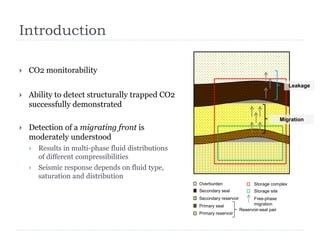
 CO2 monitorability
 Ability to detect structurally trapped CO2
successfully demonstrated
 Detection of a migrating front is
moderately understood
 Results in multi-phase fluid distributions
of different compressibilities
 Seismic response depends on fluid type,
saturation and distribution
Primary seal
Secondary reservoir
Secondary seal
Overburden
Primary reservoir
Storage complex
Reservoir-seal pair
Storage site
Free-phase
migration
Migration
Leakage
Motivation
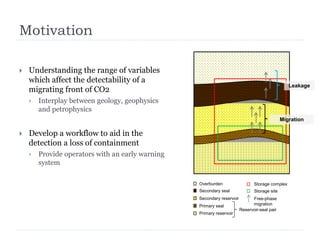
 Understanding the range of variables
which affect the detectability of a
migrating front of CO2
 Interplay between geology, geophysics
and petrophysics
 Develop a workflow to aid in the
detection a loss of containment
 Provide operators with an early warning
system
Primary seal
Secondary reservoir
Secondary seal
Overburden
Primary reservoir
Storage complex
Reservoir-seal pair
Storage site
Free-phase
migration
Migration
Leakage
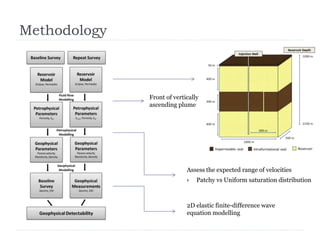
Methodology
Assess the expected range of velocities
 Patchy vs Uniform saturation distribution
2D elastic finite-difference wave
equation modelling
Front of vertically
ascending plume
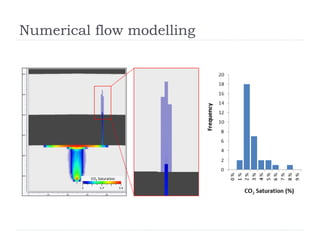
Numerical flow modelling
CO2 Saturation
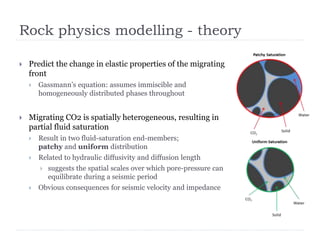
Rock physics modelling - theory
 Predict the change in elastic properties of the migrating
front
 Gassmann’s equation: assumes immiscible and
homogeneously distributed phases throughout
 Migrating CO2 is spatially heterogeneous, resulting in
partial fluid saturation
 Result in two fluid-saturation end-members;
patchy and uniform distribution
 Related to hydraulic diffusivity and diffusion length
 suggests the spatial scales over which pore-pressure can
equilibrate during a seismic period
 Obvious consequences for seismic velocity and impedance
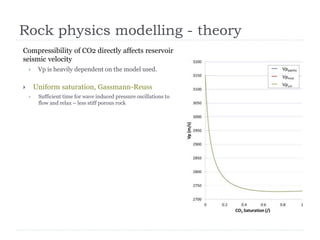
Rock physics modelling - theory
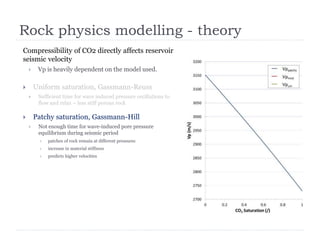
Compressibility of CO2 directly affects reservoir
seismic velocity
 Vp is heavily dependent on the model used.
 Uniform saturation, Gassmann-Reuss
 Sufficient time for wave induced pressure oscillations to
flow and relax – less stiff porous rock
Rock physics modelling - theory
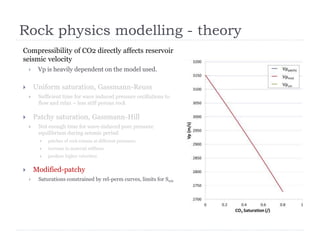
Compressibility of CO2 directly affects reservoir
seismic velocity
 Vp is heavily dependent on the model used.
 Uniform saturation, Gassmann-Reuss
 Sufficient time for wave induced pressure oscillations to
flow and relax – less stiff porous rock
 Patchy saturation, Gassmann-Hill
 Not enough time for wave-induced pore pressure
equilibrium during seismic period
 patches of rock remain at different pressures
 increase in material stiffness
 predicts higher velocities
Rock physics modelling - theory
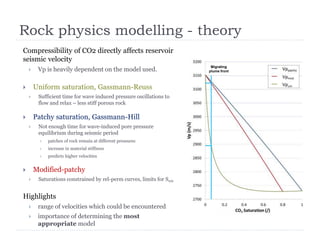
Compressibility of CO2 directly affects reservoir
seismic velocity
 Vp is heavily dependent on the model used.
 Uniform saturation, Gassmann-Reuss
 Sufficient time for wave induced pressure oscillations to
flow and relax – less stiff porous rock
 Patchy saturation, Gassmann-Hill
 Not enough time for wave-induced pore pressure
equilibrium during seismic period
 patches of rock remain at different pressures
 increase in material stiffness
 predicts higher velocities
 Modified-patchy
 Saturations constrained by rel-perm curves, limits for Swir
Compressibility of CO2 directly affects reservoir
seismic velocity
 Vp is heavily dependent on the model used.
 Uniform saturation, Gassmann-Reuss
 Sufficient time for wave induced pressure oscillations to
flow and relax – less stiff porous rock
 Patchy saturation, Gassmann-Hill
 Not enough time for wave-induced pore pressure
equilibrium during seismic period
 patches of rock remain at different pressures
 increase in material stiffness
 predicts higher velocities
 Modified-patchy
 Saturations constrained by rel-perm curves, limits for Swir
Highlights
 range of velocities which could be encountered
 importance of determining the most
appropriate model
Rock physics modelling - theory
Migrating
plume front
Rock physics modelling - application
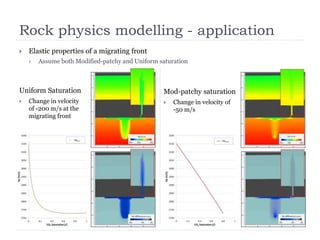
 Elastic properties of a migrating front
 Assume both Modified-patchy and Uniform saturation
Uniform Saturation
 Change in velocity
of -200 m/s at the
migrating front
Mod-patchy saturation
 Change in velocity of
-50 m/s
Seismic forward modelling
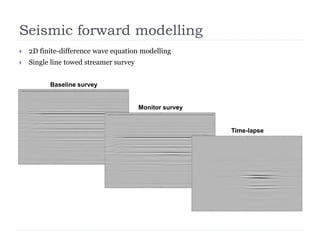
 2D finite-difference wave equation modelling
 Single line towed streamer survey
Baseline survey
Monitor survey
Time-lapse
Seismic forward modelling
Secondary reservoir
Intraformational seal
Primary reservoir
Vp [m/s]
Baseline survey
Seismic forward modelling
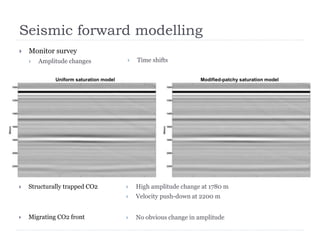
 Monitor survey
 Amplitude changes  Time shifts
 Structurally trapped CO2
 Migrating CO2 front
 High amplitude change at 1780 m
 Velocity push-down at 2200 m
 No obvious change in amplitude
Uniform saturation model Modified-patchy saturation model
Seismic forward modelling
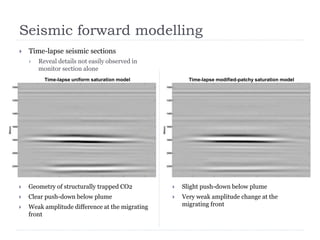
 Geometry of structurally trapped CO2
 Clear push-down below plume
 Weak amplitude difference at the migrating
front
 Time-lapse seismic sections
 Reveal details not easily observed in
monitor section alone
 Slight push-down below plume
 Very weak amplitude change at the
migrating front
Time-lapse uniform saturation model Time-lapse modified-patchy saturation model
Seismic forward modelling
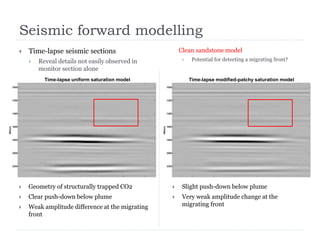
 Geometry of structurally trapped CO2
 Clear push-down below plume
 Weak amplitude difference at the migrating
front
 Time-lapse seismic sections
 Reveal details not easily observed in
monitor section alone
 Slight push-down below plume
 Very weak amplitude change at the
migrating front
Time-lapse uniform saturation model Time-lapse modified-patchy saturation model
Clean sandstone model
 Potential for detecting a migrating front?
Conclusions
 Whilst this may seem like a negative result, CO2 plume rising in clean sandstone is the
hardest end-member to detect
 Factors impacting on detectability:
 Phase of CO2
 Relative-permeability curves
 Heterogeneity: capillary trapping
 Knowledge of migration hotspots
 For site appraisal, it is important to assess factors that
1. affect not only storage security and capacity, but
2. factors that will lead to more favourable detection of a loss of containment
Design and construction of monitoring
surveys – aiding in the detection of a
loss of containment

GHGT_final_RE

  • 1.
    Detectability of free-phase migratingCO2 A rock physics and seismic modelling feasibility study Rami Eid, Anton Ziolkowski, Mark Naylor, Gillian Pickup
  • 2.
    Outline  Introduction  Motivation Methodology  Fluid flow modelling  Rock physics modelling  Seismic forward modelling  Conclusions
  • 3.
    Introduction  CO2 monitorability Ability to detect structurally trapped CO2 successfully demonstrated  Detection of a migrating front is moderately understood  Results in multi-phase fluid distributions of different compressibilities  Seismic response depends on fluid type, saturation and distribution Primary seal Secondary reservoir Secondary seal Overburden Primary reservoir Storage complex Reservoir-seal pair Storage site Free-phase migration Migration Leakage
  • 4.
    Motivation  Understanding therange of variables which affect the detectability of a migrating front of CO2  Interplay between geology, geophysics and petrophysics  Develop a workflow to aid in the detection a loss of containment  Provide operators with an early warning system Primary seal Secondary reservoir Secondary seal Overburden Primary reservoir Storage complex Reservoir-seal pair Storage site Free-phase migration Migration Leakage
  • 5.
    Methodology Assess the expectedrange of velocities  Patchy vs Uniform saturation distribution 2D elastic finite-difference wave equation modelling Front of vertically ascending plume
  • 6.
  • 7.
    Rock physics modelling- theory  Predict the change in elastic properties of the migrating front  Gassmann’s equation: assumes immiscible and homogeneously distributed phases throughout  Migrating CO2 is spatially heterogeneous, resulting in partial fluid saturation  Result in two fluid-saturation end-members; patchy and uniform distribution  Related to hydraulic diffusivity and diffusion length  suggests the spatial scales over which pore-pressure can equilibrate during a seismic period  Obvious consequences for seismic velocity and impedance
  • 8.
    Rock physics modelling- theory Compressibility of CO2 directly affects reservoir seismic velocity  Vp is heavily dependent on the model used.  Uniform saturation, Gassmann-Reuss  Sufficient time for wave induced pressure oscillations to flow and relax – less stiff porous rock
  • 9.
    Rock physics modelling- theory Compressibility of CO2 directly affects reservoir seismic velocity  Vp is heavily dependent on the model used.  Uniform saturation, Gassmann-Reuss  Sufficient time for wave induced pressure oscillations to flow and relax – less stiff porous rock  Patchy saturation, Gassmann-Hill  Not enough time for wave-induced pore pressure equilibrium during seismic period  patches of rock remain at different pressures  increase in material stiffness  predicts higher velocities
  • 10.
    Rock physics modelling- theory Compressibility of CO2 directly affects reservoir seismic velocity  Vp is heavily dependent on the model used.  Uniform saturation, Gassmann-Reuss  Sufficient time for wave induced pressure oscillations to flow and relax – less stiff porous rock  Patchy saturation, Gassmann-Hill  Not enough time for wave-induced pore pressure equilibrium during seismic period  patches of rock remain at different pressures  increase in material stiffness  predicts higher velocities  Modified-patchy  Saturations constrained by rel-perm curves, limits for Swir
  • 11.
    Compressibility of CO2directly affects reservoir seismic velocity  Vp is heavily dependent on the model used.  Uniform saturation, Gassmann-Reuss  Sufficient time for wave induced pressure oscillations to flow and relax – less stiff porous rock  Patchy saturation, Gassmann-Hill  Not enough time for wave-induced pore pressure equilibrium during seismic period  patches of rock remain at different pressures  increase in material stiffness  predicts higher velocities  Modified-patchy  Saturations constrained by rel-perm curves, limits for Swir Highlights  range of velocities which could be encountered  importance of determining the most appropriate model Rock physics modelling - theory Migrating plume front
  • 12.
    Rock physics modelling- application  Elastic properties of a migrating front  Assume both Modified-patchy and Uniform saturation Uniform Saturation  Change in velocity of -200 m/s at the migrating front Mod-patchy saturation  Change in velocity of -50 m/s
  • 13.
    Seismic forward modelling 2D finite-difference wave equation modelling  Single line towed streamer survey Baseline survey Monitor survey Time-lapse
  • 14.
    Seismic forward modelling Secondaryreservoir Intraformational seal Primary reservoir Vp [m/s] Baseline survey
  • 15.
    Seismic forward modelling Monitor survey  Amplitude changes  Time shifts  Structurally trapped CO2  Migrating CO2 front  High amplitude change at 1780 m  Velocity push-down at 2200 m  No obvious change in amplitude Uniform saturation model Modified-patchy saturation model
  • 16.
    Seismic forward modelling Geometry of structurally trapped CO2  Clear push-down below plume  Weak amplitude difference at the migrating front  Time-lapse seismic sections  Reveal details not easily observed in monitor section alone  Slight push-down below plume  Very weak amplitude change at the migrating front Time-lapse uniform saturation model Time-lapse modified-patchy saturation model
  • 17.
    Seismic forward modelling Geometry of structurally trapped CO2  Clear push-down below plume  Weak amplitude difference at the migrating front  Time-lapse seismic sections  Reveal details not easily observed in monitor section alone  Slight push-down below plume  Very weak amplitude change at the migrating front Time-lapse uniform saturation model Time-lapse modified-patchy saturation model Clean sandstone model  Potential for detecting a migrating front?
  • 18.
    Conclusions  Whilst thismay seem like a negative result, CO2 plume rising in clean sandstone is the hardest end-member to detect  Factors impacting on detectability:  Phase of CO2  Relative-permeability curves  Heterogeneity: capillary trapping  Knowledge of migration hotspots  For site appraisal, it is important to assess factors that 1. affect not only storage security and capacity, but 2. factors that will lead to more favourable detection of a loss of containment Design and construction of monitoring surveys – aiding in the detection of a loss of containment

Editor's Notes

  • #4 Co2 monitorability – measurement, monitoring and verification of injected co2 into the subsurface. This is done to demonstrate containment within the intended formation and identify any movement of co2 within the complex. Ability for seismic methods to detect: this is due to change sin acoustic properties in the reservoir to the less dense and compressible co2
  • #5 Develop a workflow: migrating from primary to secondary reservoir Provide operators: allow for remediation activities to be undertaken such that the probability of a leak outside of storage complex is negligible.
  • #6 For the work which I will be presenting today, we will be assessing the range in velocities which could be expected through the application of two saturation end-member fluid distribution models
  • #7 Permedia’s BOS was used to simulate the migration of CO2 in the reservoir. CO2 was injected into secondary reservoir, and upon reaching the zone of weakness, resulted I migration into the secondary reservoir. We injected 0.1MT/yr for 20 years, injection well centre of the model, through 50m perf interval at 2000m.
  • #8 Gassmann’s assumption: this is expected with systems which have come to equilibrium over geological timescales. This is not the case during co2 injection, which results in heterogeneous fluid distribution
  • #12 Explain curve for each eg, uniform, sharp change at low saturations, nothing thereafter, etc
  • #19 We are aware of that, but what we want to do is understand the factors which enhance the ability to detect migrating CO2.