EminentPanelConference,Accra,August7th -9th,2020
The Implementation of the dLRev Management
Software for Improved Revenue Mobilization at Local
Government Level
Governance For Inclusive Development / Support for Decentralisation
Reforms (SfDR), Deutsche Gesellschaft für Internationale
Zusammenarbeit (GIZ) GmbHand the Copenhagen Consensus Center
This is why my topic is important in 7 minutes
MMDAs have important planning and coordination functions, as well as the
responsibility for infrastructure and service delivery in key sectors: waste
management, transport, roads, housing, disaster prevention, births and deaths,
among others, yet:
MMDAs only generate, on average, approximately 20 percent of their total budget from their own
sources;
Most MMDAs issue hand written bills;
Without a formal addressing system, the distribution of the bills poses a challenge;
In some MMDAs the billing is decentralized; sub-districts print own bills and issue them to
taxpayers, causing leakages, and
Some MMDAs outsource revenue collection, which raises concerns about the proprietary nature
of the data collected, the extent to which they can monitor and sanction service providers, the
modalities for procurement, among others.
-
The Implementation of dLRev management
software in a model MMDA in Ghana
1 minute description of the solution
The efficient taxation of properties within their respective jurisdictions is a huge
untapped potential to increase local governments’ internally generated funds.
The dLRev is an open-source data tracking and revenue collection software and is free to use.
The dLRev is a web-based application with a digital address map (local plan) of a district produced using a
geographic information system.
The local plan has a spatial database and with a corresponding fiscal cadastre of revenue items.
The software is currently set-up for property rates and business operating permits.
Analysis is based on the deployment of the dLRev revenue management software in 9 MMDAs, which used
the dLRev software in the fiscal year 2019: Agona West, Cape Coast, Komenda-Edina-Eguafo-Abirem (KEEA),
Suhum, Adenta, Ga South, Bibiani-Anhwiaso-Bekwai, Shama, Prestea Huni - Valley
The model MMDA is essentially a weighted average of the 9 contributing municipalities; the weight based on
the size of the population served by dLRev relative to their respective total population.
-
Total discounted costs (8%) are GHS 489,000 for a single MMDA.
Notes
• Period of analysis is 4 years: one year
of implementation/training + 3 years
revenue collection.
• One-off costs: upload of initial map;
purchase of computing & internet
hardware; data collection.
• Recurrent costs: salaries; internet
connectivity, printing demand notices,
adding ratepayers; revenue collection.
• The annual salaries of the management
team and the printing of demand
notices are the main cost drivers.
0
20000
40000
60000
80000
100000
120000
140000
160000
1
GHS
Years
Implementation and operating costs
(GHS)
Print demand notices
Revenue collection
Internet costs
Hardware costs
Management team
Upload new data
Data collection
Upload local plan
Total discounted benefits (8%) are valued at GHS 4.3 million,
with vast majority (98%) from increased revenues.
There are 4 benefit streams:
• Reduction in data collection costs: from 120 to 20
man-days/10,000 parcels
• Efficiency gains from issuing demand notices:
from 25 to 2 man-days to print
• Efficiency gains from payment: from 40 to 17 days
for client paperwork preparation/submission to
pay collectors
• Better coverage of the tax base: 54% increase in
revenue collected.
-
0
200000
400000
600000
800000
1000000
1200000
1400000
1600000
1800000
Years
Annual benefits
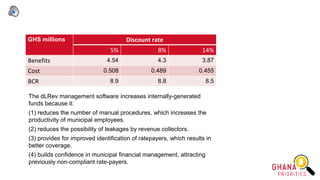
GHS millions Discount rate
5% 8% 14%
Benefits 4.54 4.3 3.87
Cost 0.508 0.489 0.455
BCR 8.9 8.8 8.5
The dLRev management software increases internally-generated
funds because it:
(1) reduces the number of manual procedures, which increases the
productivity of municipal employees.
(2) reduces the possibility of leakages by revenue collectors.
(3) provides for improved identification of ratepayers, which results in
better coverage.
(4) builds confidence in municipal financial management, attracting
previously non-compliant rate-payers.

Ghana Priorities: Digitization

  • 1.
    EminentPanelConference,Accra,August7th -9th,2020 The Implementationof the dLRev Management Software for Improved Revenue Mobilization at Local Government Level Governance For Inclusive Development / Support for Decentralisation Reforms (SfDR), Deutsche Gesellschaft für Internationale Zusammenarbeit (GIZ) GmbHand the Copenhagen Consensus Center
  • 2.
    This is whymy topic is important in 7 minutes MMDAs have important planning and coordination functions, as well as the responsibility for infrastructure and service delivery in key sectors: waste management, transport, roads, housing, disaster prevention, births and deaths, among others, yet: MMDAs only generate, on average, approximately 20 percent of their total budget from their own sources; Most MMDAs issue hand written bills; Without a formal addressing system, the distribution of the bills poses a challenge; In some MMDAs the billing is decentralized; sub-districts print own bills and issue them to taxpayers, causing leakages, and Some MMDAs outsource revenue collection, which raises concerns about the proprietary nature of the data collected, the extent to which they can monitor and sanction service providers, the modalities for procurement, among others. -
  • 3.
    The Implementation ofdLRev management software in a model MMDA in Ghana
  • 4.
    1 minute descriptionof the solution The efficient taxation of properties within their respective jurisdictions is a huge untapped potential to increase local governments’ internally generated funds. The dLRev is an open-source data tracking and revenue collection software and is free to use. The dLRev is a web-based application with a digital address map (local plan) of a district produced using a geographic information system. The local plan has a spatial database and with a corresponding fiscal cadastre of revenue items. The software is currently set-up for property rates and business operating permits. Analysis is based on the deployment of the dLRev revenue management software in 9 MMDAs, which used the dLRev software in the fiscal year 2019: Agona West, Cape Coast, Komenda-Edina-Eguafo-Abirem (KEEA), Suhum, Adenta, Ga South, Bibiani-Anhwiaso-Bekwai, Shama, Prestea Huni - Valley The model MMDA is essentially a weighted average of the 9 contributing municipalities; the weight based on the size of the population served by dLRev relative to their respective total population. -
  • 5.
    Total discounted costs(8%) are GHS 489,000 for a single MMDA. Notes • Period of analysis is 4 years: one year of implementation/training + 3 years revenue collection. • One-off costs: upload of initial map; purchase of computing & internet hardware; data collection. • Recurrent costs: salaries; internet connectivity, printing demand notices, adding ratepayers; revenue collection. • The annual salaries of the management team and the printing of demand notices are the main cost drivers. 0 20000 40000 60000 80000 100000 120000 140000 160000 1 GHS Years Implementation and operating costs (GHS) Print demand notices Revenue collection Internet costs Hardware costs Management team Upload new data Data collection Upload local plan
  • 6.
    Total discounted benefits(8%) are valued at GHS 4.3 million, with vast majority (98%) from increased revenues. There are 4 benefit streams: • Reduction in data collection costs: from 120 to 20 man-days/10,000 parcels • Efficiency gains from issuing demand notices: from 25 to 2 man-days to print • Efficiency gains from payment: from 40 to 17 days for client paperwork preparation/submission to pay collectors • Better coverage of the tax base: 54% increase in revenue collected. - 0 200000 400000 600000 800000 1000000 1200000 1400000 1600000 1800000 Years Annual benefits
  • 7.
    GHS millions Discountrate 5% 8% 14% Benefits 4.54 4.3 3.87 Cost 0.508 0.489 0.455 BCR 8.9 8.8 8.5 The dLRev management software increases internally-generated funds because it: (1) reduces the number of manual procedures, which increases the productivity of municipal employees. (2) reduces the possibility of leakages by revenue collectors. (3) provides for improved identification of ratepayers, which results in better coverage. (4) builds confidence in municipal financial management, attracting previously non-compliant rate-payers.