STUDIES ON BOND STRENGTH CHARACTERISTICS OF
GFRP REBARS IN ALKALI ACTIVATED SLAG CONCRETE
MIXES
GUIDE:
Dr. MANJUNATH R
Assistant Professor
Department of Civil Engineering
B.M.S College of Engineering
SUBMITTED BY,
KARTHIK M
MOHITH KOTNADA
MD FAZAL
MOHAN KUMAR H V
(1BM20CV068)
(1BM20CV094)
(1BM20CV087)
(1BM20CV092)
CONTENTS
▪ INTRODUCTION
▪ OBJECTIVES
▪ METHODOLOGY
▪ EXPERIMENT RESULTS
▪ WORK PENDING
▪ REFERENCE
INTRODUCTION
• Glass Fiber Reinforced Polymer (GFRP) rebars are composite materials used as an alternative to traditional
steel reinforcement in construction. They are made by combining high-strength glass fibers with a polymer
resin, resulting in a corrosion-resistant and lightweight reinforcement option.
• GFRP rebars tensile strength typically ranges from 300 MPa to 1,200 MPa, depending on the specific
composition and manufacturing process.
• Density: Around 1.5 to 2.0 g/cm³, which is significantly lower than the density of steel.
• GFRP rebars are corrosion-resistant, providing a longer service life compared to traditional steel rebars.
• Thermal Conductivity: Low thermal conductivity, usually in the range of 0.2 to 0.3 W/(m·K).
➢ This research delves into the fundamental aspect of the bond strength between GFRP rebars and the alkali-
activated slag concrete, shedding light on the potential advantages and challenges associated with this
innovative combination of materials.
➢ Alkali-activated slag concrete is known for its sustainable properties, as it often involves the activation of
granulated blast furnace slag, a byproduct of the iron and steel industry, through alkali solutions
➢ The findings from this research not only contribute to the knowledge base of structural engineering but also
have practical implications for the construction industry.
➢ The bond strength between reinforcing elements and concrete is a critical parameter that directly influences
the structural performance of a concrete element
INTRODUCTION
OBJECTIVES
➢ To evaluate the workability characteristics of Alkali activated slag concrete mix
Evaluation of mechanical properties of alkali activated slag concrete mix.
Evaluate bond strength characteristics, GFRP rebars and in alkali activated slag concrete mix.
Microstructural characteristic of alkali activated slag concrete mix
METHODOLOGY
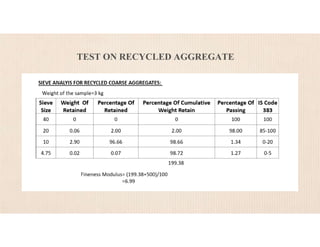
TEST ON RECYCLED AGGREGATE
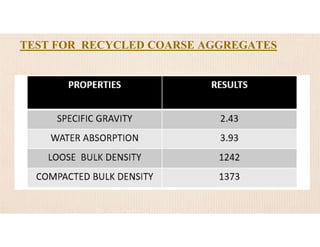
TEST FOR RECYCLED COARSE AGGREGATES
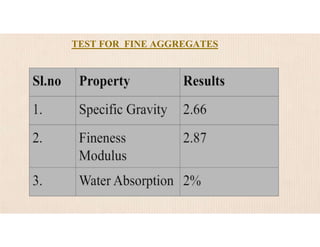
TEST FOR FINE AGGREGATES
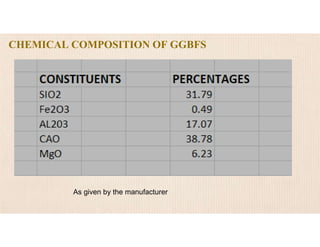
CHEMICAL COMPOSITION OF GGBFS
As given by the manufacturer
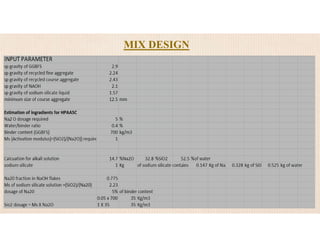
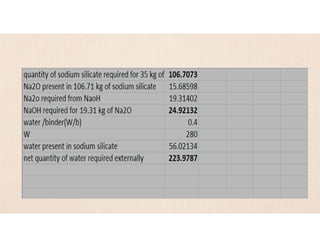
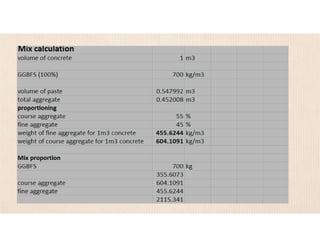
MIX DESIGN
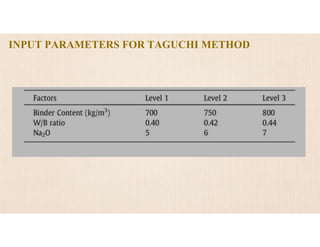
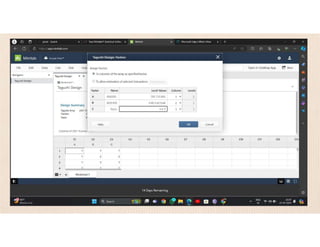
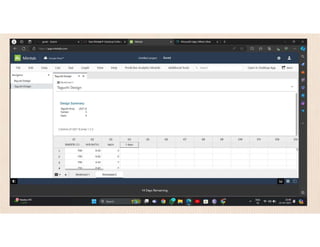
INPUT PARAMETERS FOR TAGUCHI METHOD
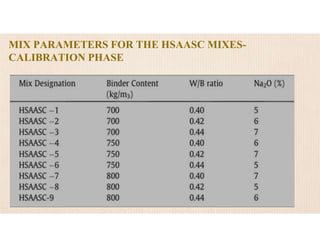
MIX PARAMETERS FOR THE HSAASC MIXES-
CALIBRATION PHASE
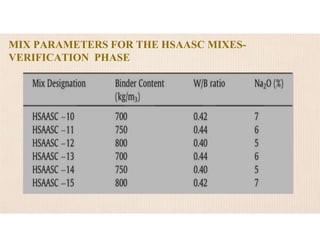
MIX PARAMETERS FOR THE HSAASC MIXES-
VERIFICATION PHASE
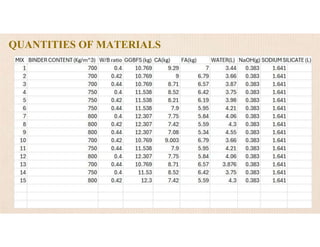
QUANTITIES OF MATERIALS
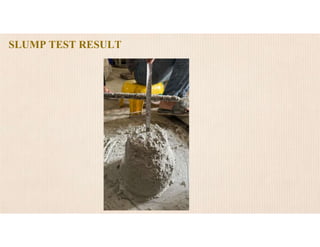
SLUMP TEST RESULT
SLUMP ANAYALSIS
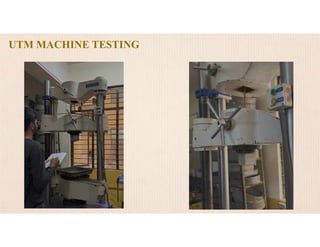
UTM MACHINE TESTING
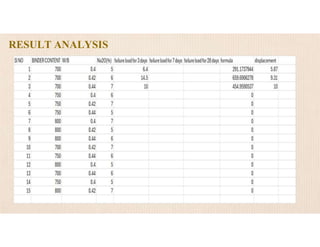
RESULT ANALYSIS
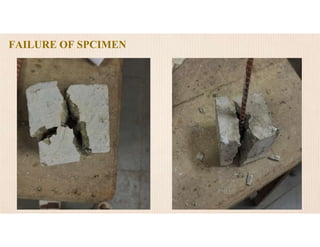
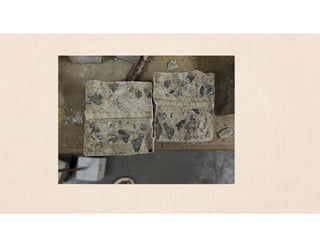
FAILURE OF SPCIMEN
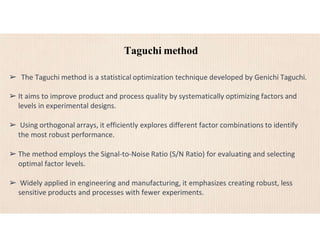
Taguchi method
➢ The Taguchi method is a statistical optimization technique developed by Genichi Taguchi.
➢ It aims to improve product and process quality by systematically optimizing factors and
levels in experimental designs.
➢ Using orthogonal arrays, it efficiently explores different factor combinations to identify
the most robust performance.
➢ The method employs the Signal-to-Noise Ratio (S/N Ratio) for evaluating and selecting
optimal factor levels.
➢ Widely applied in engineering and manufacturing, it emphasizes creating robust, less
sensitive products and processes with fewer experiments.
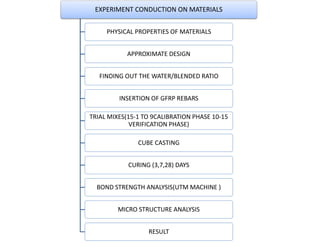
EXPERIMENT CONDUCTION ON MATERIALS
PHYSICAL PROPERTIES OF MATERIALS
APPROXIMATE DESIGN
FINDING OUT THE WATER/BLENDED RATIO
INSERTION OF GFRP REBARS
TRIAL MIXES(15-1 TO 9CALIBRATION PHASE 10-15
VERIFICATION PHASE)
CUBE CASTING
CURING (3,7,28) DAYS
BOND STRENGTH ANALYSIS(UTM MACHINE )
MICRO STRUCTURE ANALYSIS
RESULT
WORK PENDING
REFERENCES
 [1] A. Purdon, The action of alkalis on blast-furnace slag, J. Soc. Chem. Ind. Lond. 59(1940) 191-202.
 [2] T.F. Pacheco, G.J.Castro, S. Jalali, Alkali-activated binders: a review: Part 1.Historical background, terminology,
reaction mechanisms and hydrationproducts, Construct. Build: Mater. 22 (2008) 1305-1314.
 [3] D. Kong, J. Zhang, T. Ni, Research progress on alkali-activated binders andconcrete, J. Chinese Ceram. Soc. 37 (2009)
151-159.
 [4] A. Palomo, P. Krivenko, M. Lodeiro, A review on alkaline activation: Newanalytical perspectives, Materials de
Construction 64 (2014) 140-159.
 [5] A. Palomo, A. Fernández-Jiménez, H.C. Lopez, Railway sleepers-made of alkaliactivated fly ash concrete, Revista
ingeniería de construcción 22 (2007) 75-80
 [6] K. Yang, C. Yang, J. Zhang, Q Pan, L Yu, Y. Bai, First structural use of site-castalkali-activated slag concrete in China,
Struct. Build. 171 (10) (2018) 800-809
 [7] J.S. Kim, J.H. Park, An experimental investigation of bond properties of'einforcements embedded in geopolymer
concrete, International Journal ofStructural and Construction Engineering 9 (2) (2015) 92-95.
 [8] M. Vinothini, G. Mallikarjun, T.D. Gunneswararao, R.D.Seshu, Bond strengthbehaviour of geopolymer concrete,
Malaysian J. Civ. Eng. 27 (3) (2015) 371-
 [9] G. 381. behaviour:case Maranan, A of GFRP Manalo, bars K. in Karunasena geopolymer B. concrete, Benmokrane, J.
Mater. Bond Civ. Eng. stress-slip 27(1)(2014) 1-8
 [10] R Manjunath, M.C. Narasimhan, K.M. Umesh, S. Kumar, U.K. Bala Bharathi,Studies on developing of high
performance, self-compacting alkali activated slag concrete mixes using industrial wastes, Constr. Build. Mater. 198
(2019)133-147
 [11] R. Manjunath, M.C. Narasimhan, Setting Behaviour of Alkali Activated SlagConcrete mixes - Effect of
chemical admixtures, Indian Concrete Journal 92 (9)(2018) 45-51.
 [12] F. Jingchong, Z. Hongguang, S. Jing, L. Zonghui, Y. Sen, Influence of slag contenton the bond strength,
chloride penetration resistance, and interface phaseevolution of concrete repaired with alkali activated slag/fly
ash, Constr. Build,sMater. 263 (2020)
 [12] Ding Y, Ning X, Zhang Y, Pacheco-Torgal F, Aguiar J. Fibres for enhancing ofthe bond capacity between
GFRP rebar and concrete. Constr Build Mater2014;51:303e12.
 [13] Yang J-M, Min K-H, Shin H-O, Yoon Y-S. Effect of steel and synthetic fibers onflexural behavior of high-
strength concrete beams reinforced with FRP bars.Compos Part B Eng 2012;43(3):1077e86.
 [14] Fursa TV, Utsyn GE, Korzenok IN, Petrov MV. Using electric response to mechanical impact for
evaluating the durability of the GFRP-concrete bond during the freeze-thaw process. Compos Part B Eng 1
April 2016;90:392e8.
 [15] Won J-P, Lee S-J, Kim Y-J, Jang C-I, Lee S-W.The effect of exposure to alkaline solution and water on the
strengtheporosity relationship of GFRP rebar. Compos Part B Eng 2008;39(5):764e72.
REFERENCES
THANK YOU

Gfrp re bars major project presentation8th seem

  • 1.
    STUDIES ON BONDSTRENGTH CHARACTERISTICS OF GFRP REBARS IN ALKALI ACTIVATED SLAG CONCRETE MIXES GUIDE: Dr. MANJUNATH R Assistant Professor Department of Civil Engineering B.M.S College of Engineering SUBMITTED BY, KARTHIK M MOHITH KOTNADA MD FAZAL MOHAN KUMAR H V (1BM20CV068) (1BM20CV094) (1BM20CV087) (1BM20CV092)
  • 2.
    CONTENTS ▪ INTRODUCTION ▪ OBJECTIVES ▪METHODOLOGY ▪ EXPERIMENT RESULTS ▪ WORK PENDING ▪ REFERENCE
  • 3.
    INTRODUCTION • Glass FiberReinforced Polymer (GFRP) rebars are composite materials used as an alternative to traditional steel reinforcement in construction. They are made by combining high-strength glass fibers with a polymer resin, resulting in a corrosion-resistant and lightweight reinforcement option. • GFRP rebars tensile strength typically ranges from 300 MPa to 1,200 MPa, depending on the specific composition and manufacturing process. • Density: Around 1.5 to 2.0 g/cm³, which is significantly lower than the density of steel. • GFRP rebars are corrosion-resistant, providing a longer service life compared to traditional steel rebars. • Thermal Conductivity: Low thermal conductivity, usually in the range of 0.2 to 0.3 W/(m·K).
  • 4.
    ➢ This researchdelves into the fundamental aspect of the bond strength between GFRP rebars and the alkali- activated slag concrete, shedding light on the potential advantages and challenges associated with this innovative combination of materials. ➢ Alkali-activated slag concrete is known for its sustainable properties, as it often involves the activation of granulated blast furnace slag, a byproduct of the iron and steel industry, through alkali solutions ➢ The findings from this research not only contribute to the knowledge base of structural engineering but also have practical implications for the construction industry. ➢ The bond strength between reinforcing elements and concrete is a critical parameter that directly influences the structural performance of a concrete element INTRODUCTION
  • 5.
    OBJECTIVES ➢ To evaluatethe workability characteristics of Alkali activated slag concrete mix Evaluation of mechanical properties of alkali activated slag concrete mix. Evaluate bond strength characteristics, GFRP rebars and in alkali activated slag concrete mix. Microstructural characteristic of alkali activated slag concrete mix
  • 6.
  • 7.
  • 8.
    TEST FOR RECYCLEDCOARSE AGGREGATES
  • 9.
    TEST FOR FINEAGGREGATES
  • 10.
    CHEMICAL COMPOSITION OFGGBFS As given by the manufacturer
  • 11.
  • 14.
    INPUT PARAMETERS FORTAGUCHI METHOD
  • 15.
    MIX PARAMETERS FORTHE HSAASC MIXES- CALIBRATION PHASE
  • 16.
    MIX PARAMETERS FORTHE HSAASC MIXES- VERIFICATION PHASE
  • 17.
  • 18.
  • 19.
  • 20.
  • 21.
  • 22.
  • 24.
    Taguchi method ➢ TheTaguchi method is a statistical optimization technique developed by Genichi Taguchi. ➢ It aims to improve product and process quality by systematically optimizing factors and levels in experimental designs. ➢ Using orthogonal arrays, it efficiently explores different factor combinations to identify the most robust performance. ➢ The method employs the Signal-to-Noise Ratio (S/N Ratio) for evaluating and selecting optimal factor levels. ➢ Widely applied in engineering and manufacturing, it emphasizes creating robust, less sensitive products and processes with fewer experiments.
  • 27.
    EXPERIMENT CONDUCTION ONMATERIALS PHYSICAL PROPERTIES OF MATERIALS APPROXIMATE DESIGN FINDING OUT THE WATER/BLENDED RATIO INSERTION OF GFRP REBARS TRIAL MIXES(15-1 TO 9CALIBRATION PHASE 10-15 VERIFICATION PHASE) CUBE CASTING CURING (3,7,28) DAYS BOND STRENGTH ANALYSIS(UTM MACHINE ) MICRO STRUCTURE ANALYSIS RESULT
  • 28.
  • 29.
    REFERENCES  [1] A.Purdon, The action of alkalis on blast-furnace slag, J. Soc. Chem. Ind. Lond. 59(1940) 191-202.  [2] T.F. Pacheco, G.J.Castro, S. Jalali, Alkali-activated binders: a review: Part 1.Historical background, terminology, reaction mechanisms and hydrationproducts, Construct. Build: Mater. 22 (2008) 1305-1314.  [3] D. Kong, J. Zhang, T. Ni, Research progress on alkali-activated binders andconcrete, J. Chinese Ceram. Soc. 37 (2009) 151-159.  [4] A. Palomo, P. Krivenko, M. Lodeiro, A review on alkaline activation: Newanalytical perspectives, Materials de Construction 64 (2014) 140-159.  [5] A. Palomo, A. Fernández-Jiménez, H.C. Lopez, Railway sleepers-made of alkaliactivated fly ash concrete, Revista ingeniería de construcción 22 (2007) 75-80  [6] K. Yang, C. Yang, J. Zhang, Q Pan, L Yu, Y. Bai, First structural use of site-castalkali-activated slag concrete in China, Struct. Build. 171 (10) (2018) 800-809  [7] J.S. Kim, J.H. Park, An experimental investigation of bond properties of'einforcements embedded in geopolymer concrete, International Journal ofStructural and Construction Engineering 9 (2) (2015) 92-95.  [8] M. Vinothini, G. Mallikarjun, T.D. Gunneswararao, R.D.Seshu, Bond strengthbehaviour of geopolymer concrete, Malaysian J. Civ. Eng. 27 (3) (2015) 371-  [9] G. 381. behaviour:case Maranan, A of GFRP Manalo, bars K. in Karunasena geopolymer B. concrete, Benmokrane, J. Mater. Bond Civ. Eng. stress-slip 27(1)(2014) 1-8  [10] R Manjunath, M.C. Narasimhan, K.M. Umesh, S. Kumar, U.K. Bala Bharathi,Studies on developing of high performance, self-compacting alkali activated slag concrete mixes using industrial wastes, Constr. Build. Mater. 198 (2019)133-147
  • 30.
     [11] R.Manjunath, M.C. Narasimhan, Setting Behaviour of Alkali Activated SlagConcrete mixes - Effect of chemical admixtures, Indian Concrete Journal 92 (9)(2018) 45-51.  [12] F. Jingchong, Z. Hongguang, S. Jing, L. Zonghui, Y. Sen, Influence of slag contenton the bond strength, chloride penetration resistance, and interface phaseevolution of concrete repaired with alkali activated slag/fly ash, Constr. Build,sMater. 263 (2020)  [12] Ding Y, Ning X, Zhang Y, Pacheco-Torgal F, Aguiar J. Fibres for enhancing ofthe bond capacity between GFRP rebar and concrete. Constr Build Mater2014;51:303e12.  [13] Yang J-M, Min K-H, Shin H-O, Yoon Y-S. Effect of steel and synthetic fibers onflexural behavior of high- strength concrete beams reinforced with FRP bars.Compos Part B Eng 2012;43(3):1077e86.  [14] Fursa TV, Utsyn GE, Korzenok IN, Petrov MV. Using electric response to mechanical impact for evaluating the durability of the GFRP-concrete bond during the freeze-thaw process. Compos Part B Eng 1 April 2016;90:392e8.  [15] Won J-P, Lee S-J, Kim Y-J, Jang C-I, Lee S-W.The effect of exposure to alkaline solution and water on the strengtheporosity relationship of GFRP rebar. Compos Part B Eng 2008;39(5):764e72. REFERENCES
  • 31.