GETTING AN  INTERNSHIP Patricia V. Acosta  Career Counselor
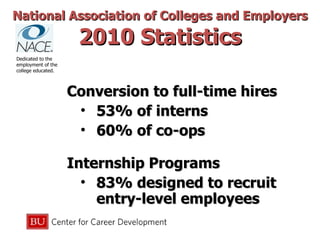
National Association of Colleges and Employers 2010 Statistics Conversion to full-time hires 53% of interns  60% of co-ops  Internship Programs  83% designed to recruit  entry-level employees Dedicated to the employment of the college educated.
Experiential Learning Co-ops BU Internships Undergraduate Research Study Abroad Volunteering Student Activities Part-time Job Job Shadowing
WHAT   is an Internship? Structured, supervised work experience  You will be exposed to a professional environment. Opportunity to sharpen industry knowledge It can be a vehicle to develop workplace competencies. A place to transform academic knowledge into skills Be sure to set goals and reflect on the experience. Internships are typically 10-40 hours per week,  60-200 hours, and can last a few weeks to a few months.
WHERE   can I Do an Internship? businesses  government agencies  educational institutions  social service agencies  media corporations
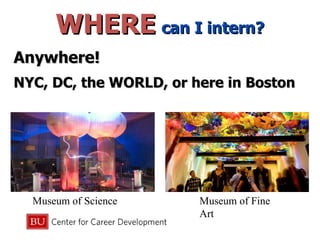
Anywhere!  NYC, DC, the WORLD, or here in Boston WHERE   can I intern? Museum of Science Museum of Fine Art
WHEN   can I Do an Internship? ANYTIME… Fall, Spring, or Summer Begin preparation at least one semester before the internship Some employers may require junior or senior standing or a minimum GPA
WHAT’s  in it for the Employer? Development of supervisory skills Management training for current employees Pool of potential full-time employees Lower financial investment for hiring Fresh perspective for projects Enthusiastic and motivated workers
WHY  should I do an Internship? To gain “real-world” exposure to an industry To explore what you can do with your major, skills, and interests Test drive your career choices and options Develop professional contacts
OUTCOMES  Learn directly from experienced professionals. Strengthen your resume with practical experience. Get the competitive edge with potential employers.
Interns get Hired! According to NACE,  44.6% of 2009 hires came from internship programs . 
Market yourself! Reflect on how  you   will be effective   in this type of position  Consider how you can  apply  the skills  you already have Take inventory of how the  required skills  and qualities   relate to  your   skills and qualities HOW  do I find an Internship?
3-Step   Process  to landing the perfect job or internship Step 1  Self-Assessment Know Yourself Step 2  Exploration   Discover Your Options Step 3  Implementation   Develop the Strategies To Get There
HOW  do I land an Internship? Remember you are a student, this is part of your  education and learning process  To effectively  market yourself , you must be able to  discuss yourself , both on paper and in person, in a positive, comfortable manner You will need: Cover Letter Resume Interview Preparation
Craft a   Cover Letter Relate your experience to the specific job Customize each cover letter for each job Goal: Convince the employer you are worth consideration
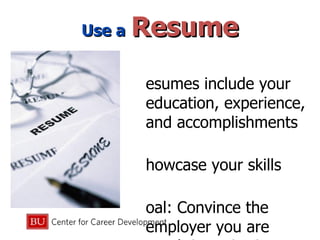
Use a   Resume Resumes include your education, experience, and accomplishments  Showcase your skills Goal: Convince the employer you are worth interviewing
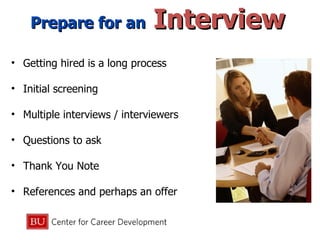
Prepare for an  Interview   Getting hired is a long process Initial screening Multiple interviews / interviewers Questions to ask Thank You Note References and perhaps an offer
Develop your  Network   Career Advisory Network (CAN) Comprised of over 5,000 BU alumni For  information  and  networking  only Do not ask for a job BU Alumni website (login & password required)
Tips   for Success Frequently check  BU CareerLink  for opportunities NETWORK  to find the hidden job market  Attend  Spring Career Expo  for  “face-time”  with employers Join a  professional organization  related to your field Talk to your professors,  your parents, your friends, their  parents, alums, everyone you meet Follow the things that interest you
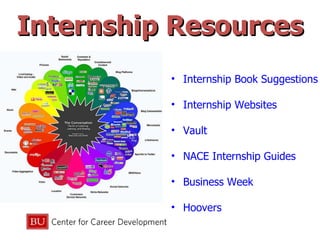
Internship Resources Internship Book Suggestions Internship Websites Vault   NACE Internship Guides Business Week Hoovers
BU  Center for Career Development (CCD) Location 19 Deerfield Street in Kenmore Square (next to the Post Office) Regular Office Hours September–May: Monday-Thursday, 9:00 a.m.- 7:00 p.m.  Friday, 9:00 a.m. to 5:00 p.m. Summer Hours June–August: Monday-Friday, 9:00 a.m. to 5:00 p.m
BU CCD RESOURCES BU CareerLink  Counseling Appointments Resume & Cover Letter Assistance Career/Personality Assessment Career Exploration Group (CEG) Career Resource Library On-Campus Interviewing Employer Information Sessions Career Advisory Network (CAN )

Getting an internship

  • 1.
    GETTING AN INTERNSHIP Patricia V. Acosta Career Counselor
  • 2.
    National Association ofColleges and Employers 2010 Statistics Conversion to full-time hires 53% of interns 60% of co-ops Internship Programs 83% designed to recruit entry-level employees Dedicated to the employment of the college educated.
  • 3.
    Experiential Learning Co-opsBU Internships Undergraduate Research Study Abroad Volunteering Student Activities Part-time Job Job Shadowing
  • 4.
    WHAT is an Internship? Structured, supervised work experience You will be exposed to a professional environment. Opportunity to sharpen industry knowledge It can be a vehicle to develop workplace competencies. A place to transform academic knowledge into skills Be sure to set goals and reflect on the experience. Internships are typically 10-40 hours per week, 60-200 hours, and can last a few weeks to a few months.
  • 5.
    WHERE can I Do an Internship? businesses government agencies educational institutions social service agencies media corporations
  • 6.
    Anywhere! NYC,DC, the WORLD, or here in Boston WHERE can I intern? Museum of Science Museum of Fine Art
  • 7.
    WHEN can I Do an Internship? ANYTIME… Fall, Spring, or Summer Begin preparation at least one semester before the internship Some employers may require junior or senior standing or a minimum GPA
  • 8.
    WHAT’s init for the Employer? Development of supervisory skills Management training for current employees Pool of potential full-time employees Lower financial investment for hiring Fresh perspective for projects Enthusiastic and motivated workers
  • 9.
    WHY shouldI do an Internship? To gain “real-world” exposure to an industry To explore what you can do with your major, skills, and interests Test drive your career choices and options Develop professional contacts
  • 10.
    OUTCOMES Learndirectly from experienced professionals. Strengthen your resume with practical experience. Get the competitive edge with potential employers.
  • 11.
    Interns get Hired!According to NACE, 44.6% of 2009 hires came from internship programs . 
  • 12.
    Market yourself! Reflecton how you will be effective in this type of position Consider how you can apply the skills you already have Take inventory of how the required skills and qualities relate to your skills and qualities HOW do I find an Internship?
  • 13.
    3-Step Process to landing the perfect job or internship Step 1 Self-Assessment Know Yourself Step 2 Exploration Discover Your Options Step 3 Implementation Develop the Strategies To Get There
  • 14.
    HOW doI land an Internship? Remember you are a student, this is part of your education and learning process To effectively market yourself , you must be able to discuss yourself , both on paper and in person, in a positive, comfortable manner You will need: Cover Letter Resume Interview Preparation
  • 15.
    Craft a Cover Letter Relate your experience to the specific job Customize each cover letter for each job Goal: Convince the employer you are worth consideration
  • 16.
    Use a Resume Resumes include your education, experience, and accomplishments Showcase your skills Goal: Convince the employer you are worth interviewing
  • 17.
    Prepare for an Interview Getting hired is a long process Initial screening Multiple interviews / interviewers Questions to ask Thank You Note References and perhaps an offer
  • 18.
    Develop your Network Career Advisory Network (CAN) Comprised of over 5,000 BU alumni For information and networking only Do not ask for a job BU Alumni website (login & password required)
  • 19.
    Tips for Success Frequently check BU CareerLink for opportunities NETWORK to find the hidden job market Attend Spring Career Expo for “face-time” with employers Join a professional organization related to your field Talk to your professors, your parents, your friends, their parents, alums, everyone you meet Follow the things that interest you
  • 20.
    Internship Resources InternshipBook Suggestions Internship Websites Vault NACE Internship Guides Business Week Hoovers
  • 21.
    BU Centerfor Career Development (CCD) Location 19 Deerfield Street in Kenmore Square (next to the Post Office) Regular Office Hours September–May: Monday-Thursday, 9:00 a.m.- 7:00 p.m. Friday, 9:00 a.m. to 5:00 p.m. Summer Hours June–August: Monday-Friday, 9:00 a.m. to 5:00 p.m
  • 22.
    BU CCD RESOURCESBU CareerLink Counseling Appointments Resume & Cover Letter Assistance Career/Personality Assessment Career Exploration Group (CEG) Career Resource Library On-Campus Interviewing Employer Information Sessions Career Advisory Network (CAN )

Editor's Notes

  • #2 We at BU Center for Career Development have learned in the last 10 years that Internships are even more critical than ever before. -Especially for a liberal arts candidate. We work with students to find internships.
  • #4 Way to explore get in to industry Learn about different industries See if it’s a fit. Position self for interview.
  • #5 Thinking About What You Have Learned/Are Learning Meet with your supervisor to establish goals and be clear about what you both expect from the internship. Understand general office work is usually part of the job. Gradually ask for more responsibility and actively look for things to do. If there are other interns in the organization, develop relationships. The decision to leave must take several variables into account, including: Was there a contract? maintain a professional attitude and work with you supervisor. If you decide to leave your internship, do so politely and diplomatically and give the customary two week notice.
  • #7 Search for opportunities that complement your academic program, help you explore a new direction, or challenge you to grow in new ways. Determine your priorities: Do you primarily want career-related experience? The opportunity to travel? Funds to support tuition costs? Sometimes you will have to make choices among these items. If you have thought about these questions ahead of time, you will be better prepared to make a decision.
  • #8 You can do an internship at any point while you are at BU. After graduation. Wait for sophomore term. Internships are available during the summer months as well as during academic semesters. Summer internships might be either full-time or part-time positions. When To Start Looking For an Internship M any employers with formalized, competitive programs begin the selection process several months in advance. …start looking for summer interns between late January and late March. The key to finding an internship that’s right for you is preparation and a timely start in the process.
  • #14 Step 1: Most freshmen don’t know what they want to do when they graduate; your personality type as well as your interests, skills, and values, you will be able to make better choices while you are at BU that will help position you to succeed Step 2: You can learn from all that you do to understand not only what industry or field you want to work in. working alone or in a team? small company or a large corporation? regular or varied schedule? in the field or in an office? Step 3: target your job search and perfect your resume, elevator speech, and interviewing skills.
  • #20 Spring Career Expo George Sherman Union, 775 Commonwealth Avenue. Employers from a variety of industries attend, and they are always happy to speak with students about their organizations. We will always post the list of attending organizations on our website ahead of time.
  • #21 Researching Industries & Companies choose opportunities that are right for you; and target your resume and cover letter more appropriately. Start to learn about an organization by going to its website. You can also use Google to see what others are saying about an organization, or whether an organization has appeared in the news recently. Once you know something about the company, be sure you understand what the internship involves.
  • #22 Career Resource Library The Career Resource Library has a number of resources to assist you in finding an internship. There are general books on searching for an internship, as well as books listing internships in various career fields and in different geographic locations. Stop by the library any time the office is open; no appointment necessary!