
UrbanSense Platform
Porto Living Lab
Cecília Rocha
Research Center for Territory, Transports and Environment
Sofia Sousa
Laboratório de Engenharia de Processos, Ambiente,
Biotecnologia e Energia
Tânia Calçada
Center of Competence for Future Cities of the University of
Porto; Instituto de Telecomunicações
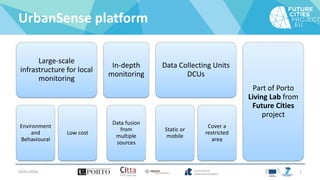
UrbanSense platform
04/01/2016 2
Large-scale
infrastructure for local
monitoring
Environment
and
Behavioural
Low cost
In-depth
monitoring
Data fusion
from
multiple
sources
Data Collecting Units
DCUs
Static or
mobile
Cover a
restricted
area
Part of Porto
Living Lab from
Future Cities
project
Future Cities project goals
Expand Centre of Competence in Future Cities of U. of Porto to
Strengthen Inter-Disciplinary Research and
Knowledge Transfer to Industry in Portuguese Northern Region
04/01/2016 3
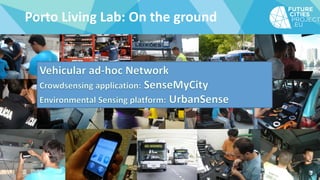
Porto Living Lab: On the ground
04/01/2016 4
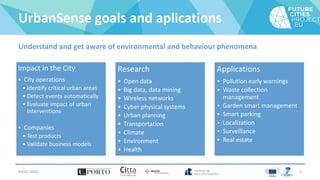
UrbanSense goals and aplications
Understand and get aware of environmental and behaviour phenomena
Impact in the City
• City operations
• Identify critical urban areas
• Detect events automatically
• Evaluate impact of urban
interventions
• Companies
• Test products
• Validate business models
Research
• Open data
• Big data, data mining
• Wireless networks
• Cyber physical systems
• Urban planning
• Transportation
• Climate
• Environment
• Health
Applications
• Pollution early warnings
• Waste collection
management
• Garden smart management
• Smart parking
• Localization
• Surveillance
• Real estate
04/01/2016 5
UrbanSense multi-disciplinar ongoing research
• Health
– asthma and air air pollution - LEPABE-FEUP: Sofia Sousa
– Morbidity vs cold spells or heat waves - CHERG-FLUP: Ana Monteiro
• Traffic and urban planning
– Act in traffic policies to reduce noise and/or air quality – DEC-FEUP: Cecilia Rocha
– Solar radiation vs coatings on roads and facades – DEC-FEUP: Cecilia Rocha
– Smart artistic lighting – KTH: Jose Nuno Sampaio
• Design / social
– Feed data to social meeting points – PINC: Heitor Alvelos / Paula Trigueiros
– Sensor enclosure integration in urban environment – EAUM: Paula Trigueiros
04/01/2016 6
Data Collecting Units overview
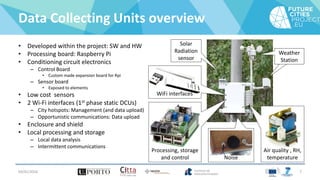
• Developed within the project: SW and HW
• Processing board: Raspberry Pi
• Conditioning circuit electronics
– Control Board
• Custom made expansion board for Rpi
– Sensor board
• Exposed to elements
• Low cost sensors
• 2 Wi-Fi interfaces (1st phase static DCUs)
– City hotspots: Management (and data upload)
– Opportunistic communications: Data upload
• Enclosure and shield
• Local processing and storage
– Local data analysis
– Intermittent communications
04/01/2016 7
Noise
Air quality , RH,
temperature
Processing, storage
and control
Solar
Radiation
sensor
WiFi interfaces
Weather
Station
Sensors configuration overview
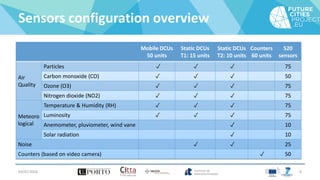
Mobile DCUs
50 units
Static DCUs
T1: 15 units
Static DCUs
T2: 10 units
Counters
60 units
520
sensors
Air
Quality
Particles ✓ ✓ ✓ 75
Carbon monoxide (CO) ✓ ✓ ✓ 50
Ozone (O3) ✓ ✓ ✓ 75
Nitrogen dioxide (NO2) ✓ ✓ ✓ 75
Meteoro
logical
Temperature & Humidity (RH) ✓ ✓ ✓ 75
Luminosity ✓ ✓ ✓ 75
Anemometer, pluviometer, wind vane ✓ 10
Solar radiation ✓ 10
Noise ✓ ✓ 25
Counters (based on video camera) ✓ 50
04/01/2016 8
Sensors – noise, video
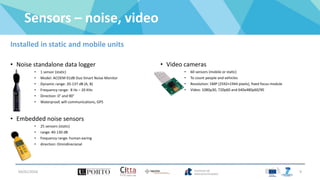
• Noise standalone data logger
• 1 sensor (static)
• Model: ACOEM 01dB Duo Smart Noise Monitor
• Dynamic range: 20-137 dB (A, B)
• Frequency range: 8 Hz – 20 KHz
• Direction: 0° and 90°
• Waterproof, wifi communications, GPS
• Embedded noise sensors
• 25 sensors (static)
• range: 40-130 dB
• frequency range: human earing
• direction: Omnidirecional
Installed in static and mobile units
• Video cameras
• 60 sensors (mobile or static)
• To count people and vehicles
• Resolution: 5MP (2592×1944 pixels), fixed focus module
• Video: 1080p30, 720p60 and 640x480p60/90
04/01/2016 9
Sensors – meteorological
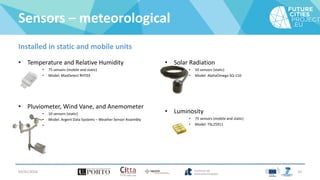
Installed in static and mobile units
• Temperature and Relative Humidity
• 75 sensors (mobile and static)
• Model: MaxDetect RHT03
• Pluviometer, Wind Vane, and Anemometer
• 10 sensors (static)
• Model: Argent Data Systems – Weather Sensor Assembly
•
• Solar Radiation
• 10 sensors (static)
• Model: AlphaOmega SQ-110
• Luminosity
• 75 sensors (mobile and static)
• Model: TSL25911
04/01/2016 10
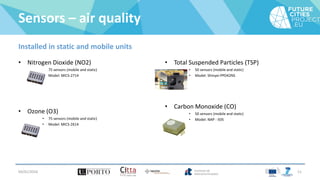
Sensors – air quality
Installed in static and mobile units
• Nitrogen Dioxide (NO2)
• 75 sensors (mobile and static)
• Model: MICS-2714
• Ozone (O3)
• 75 sensors (mobile and static)
• Model: MICS-2614
• Total Suspended Particles (TSP)
• 50 sensors (mobile and static)
• Model: Shinyei PPD42NS
• Carbon Monoxide (CO)
• 50 sensors (mobile and static)
• Model: NAP - 505
04/01/2016 11
Calibration Methodology
Compare measurements of UrbanSense sensors with reference sensors
• Use reference sensors
– Expensive and homologated
– Typically used by environmental scientists
– Partners inside UP borrowed the
equipment
• Collect data in same location and time
• Sensors calibrated from factory and
validated
– Temperature and humidity
– Weather station and solar radiation
04/01/2016 12
• Sensors with a less complex calibration
procedure
– Luminosity
– Noise
• Sensors not yet calibrated
– Particles: ongoing work
– Carbon monoxide (CO): unavailable
reference sensor
Calibration Methodology
Compare measurements of UrbanSense sensors with reference sensors
04/01/2016 13
• Ozone (O3) and Nitrogen Dioxide (NO2)
– Difficult because of lack of detailed manufacturer calibration
information
– Reference equipment's condition the air before take
measurements
– Create a Machine learning model
• Input: Gas sensor measurements
• Input: Temperature and humidity
• Output: gas concentration
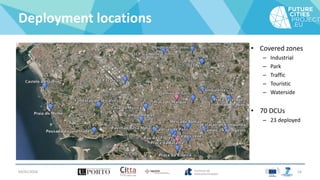
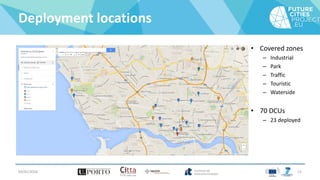
Deployment locations
• Covered zones
– Industrial
– Park
– Traffic
– Touristic
– Waterside
• 70 DCUs
– 23 deployed
04/01/2016 14
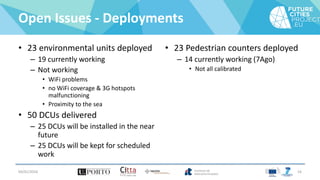
Deployment locations
• Covered zones
– Industrial
– Park
– Traffic
– Touristic
– Waterside
• 70 DCUs
– 23 deployed
04/01/2016 15
Open Issues - Deployments
• 23 environmental units deployed
– 19 currently working
– Not working
• WiFi problems
• no WiFi coverage & 3G hotspots
malfunctioning
• Proximity to the sea
• 50 DCUs delivered
– 25 DCUs will be installed in the near
future
– 25 DCUs will be kept for scheduled
work
• 23 Pedestrian counters deployed
– 14 currently working (7Ago)
• Not all calibrated
04/01/2016 16
Open Issues - Calibration
Sensor calibration framework status
• Models
– Don’t need calibration
• Temperature, humidity, wind direction
– Preliminary calibration models available
• Ozone, NO2, luminosity
– Ongoing work for the first approach
• Noise, particles
– Not addressed (but validated)
• CO, Solar Radiation, rain, wind speed
• Software
– Proof of concept running
– Software architecture under discussion
People involved
• Tiago Lourenço
– Software development
– Gather sensor data
• Sérgio Crisóstomo
– Methodology
– Regression models
– Framework software (API)
• Sofia Sousa
– Air quality and meteorological sensors
• Cecilia Rocha
– Noise data evaluation
04/01/2016 17
Open Issues – Energy and Solar Power
• Energy consumption of individual DCU components
– Measured using a current sensor
– Preliminary results
• Power the DCU using solar energy
– Use solar panel + battery + charge controller
– Charge controller provides battery and solar panel info to Rpi
– First setup deployed with success at FEUP-DEEC rooftop
04/01/2016 18
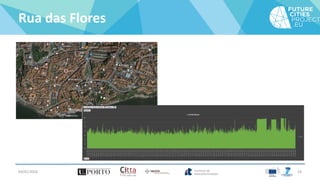
Rua das Flores
04/01/2016 19
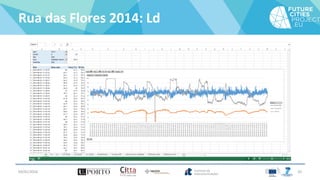
Rua das Flores 2014: Ld
04/01/2016 20
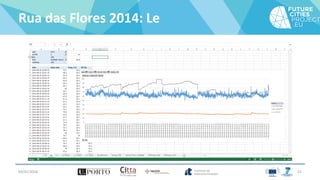
Rua das Flores 2014: Le
04/01/2016 21
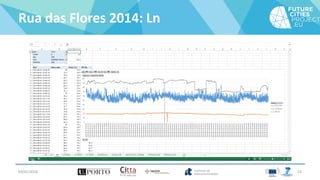
Rua das Flores 2014: Ln
04/01/2016 22
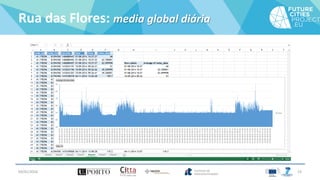
Rua das Flores: media global diária
04/01/2016 23
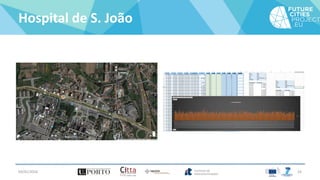
Hospital de S. João
04/01/2016 24
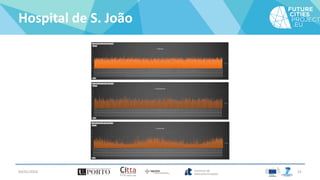
Hospital de S. João
04/01/2016 25

GET2016 - UrbanSense Platform. Porto Living Lab

  • 1.
    UrbanSense Platform Porto LivingLab Cecília Rocha Research Center for Territory, Transports and Environment Sofia Sousa Laboratório de Engenharia de Processos, Ambiente, Biotecnologia e Energia Tânia Calçada Center of Competence for Future Cities of the University of Porto; Instituto de Telecomunicações
  • 2.
    UrbanSense platform 04/01/2016 2 Large-scale infrastructurefor local monitoring Environment and Behavioural Low cost In-depth monitoring Data fusion from multiple sources Data Collecting Units DCUs Static or mobile Cover a restricted area Part of Porto Living Lab from Future Cities project
  • 3.
    Future Cities projectgoals Expand Centre of Competence in Future Cities of U. of Porto to Strengthen Inter-Disciplinary Research and Knowledge Transfer to Industry in Portuguese Northern Region 04/01/2016 3
  • 4.
    Porto Living Lab:On the ground 04/01/2016 4
  • 5.
    UrbanSense goals andaplications Understand and get aware of environmental and behaviour phenomena Impact in the City • City operations • Identify critical urban areas • Detect events automatically • Evaluate impact of urban interventions • Companies • Test products • Validate business models Research • Open data • Big data, data mining • Wireless networks • Cyber physical systems • Urban planning • Transportation • Climate • Environment • Health Applications • Pollution early warnings • Waste collection management • Garden smart management • Smart parking • Localization • Surveillance • Real estate 04/01/2016 5
  • 6.
    UrbanSense multi-disciplinar ongoingresearch • Health – asthma and air air pollution - LEPABE-FEUP: Sofia Sousa – Morbidity vs cold spells or heat waves - CHERG-FLUP: Ana Monteiro • Traffic and urban planning – Act in traffic policies to reduce noise and/or air quality – DEC-FEUP: Cecilia Rocha – Solar radiation vs coatings on roads and facades – DEC-FEUP: Cecilia Rocha – Smart artistic lighting – KTH: Jose Nuno Sampaio • Design / social – Feed data to social meeting points – PINC: Heitor Alvelos / Paula Trigueiros – Sensor enclosure integration in urban environment – EAUM: Paula Trigueiros 04/01/2016 6
  • 7.
    Data Collecting Unitsoverview • Developed within the project: SW and HW • Processing board: Raspberry Pi • Conditioning circuit electronics – Control Board • Custom made expansion board for Rpi – Sensor board • Exposed to elements • Low cost sensors • 2 Wi-Fi interfaces (1st phase static DCUs) – City hotspots: Management (and data upload) – Opportunistic communications: Data upload • Enclosure and shield • Local processing and storage – Local data analysis – Intermittent communications 04/01/2016 7 Noise Air quality , RH, temperature Processing, storage and control Solar Radiation sensor WiFi interfaces Weather Station
  • 8.
    Sensors configuration overview MobileDCUs 50 units Static DCUs T1: 15 units Static DCUs T2: 10 units Counters 60 units 520 sensors Air Quality Particles ✓ ✓ ✓ 75 Carbon monoxide (CO) ✓ ✓ ✓ 50 Ozone (O3) ✓ ✓ ✓ 75 Nitrogen dioxide (NO2) ✓ ✓ ✓ 75 Meteoro logical Temperature & Humidity (RH) ✓ ✓ ✓ 75 Luminosity ✓ ✓ ✓ 75 Anemometer, pluviometer, wind vane ✓ 10 Solar radiation ✓ 10 Noise ✓ ✓ 25 Counters (based on video camera) ✓ 50 04/01/2016 8
  • 9.
    Sensors – noise,video • Noise standalone data logger • 1 sensor (static) • Model: ACOEM 01dB Duo Smart Noise Monitor • Dynamic range: 20-137 dB (A, B) • Frequency range: 8 Hz – 20 KHz • Direction: 0° and 90° • Waterproof, wifi communications, GPS • Embedded noise sensors • 25 sensors (static) • range: 40-130 dB • frequency range: human earing • direction: Omnidirecional Installed in static and mobile units • Video cameras • 60 sensors (mobile or static) • To count people and vehicles • Resolution: 5MP (2592×1944 pixels), fixed focus module • Video: 1080p30, 720p60 and 640x480p60/90 04/01/2016 9
  • 10.
    Sensors – meteorological Installedin static and mobile units • Temperature and Relative Humidity • 75 sensors (mobile and static) • Model: MaxDetect RHT03 • Pluviometer, Wind Vane, and Anemometer • 10 sensors (static) • Model: Argent Data Systems – Weather Sensor Assembly • • Solar Radiation • 10 sensors (static) • Model: AlphaOmega SQ-110 • Luminosity • 75 sensors (mobile and static) • Model: TSL25911 04/01/2016 10
  • 11.
    Sensors – airquality Installed in static and mobile units • Nitrogen Dioxide (NO2) • 75 sensors (mobile and static) • Model: MICS-2714 • Ozone (O3) • 75 sensors (mobile and static) • Model: MICS-2614 • Total Suspended Particles (TSP) • 50 sensors (mobile and static) • Model: Shinyei PPD42NS • Carbon Monoxide (CO) • 50 sensors (mobile and static) • Model: NAP - 505 04/01/2016 11
  • 12.
    Calibration Methodology Compare measurementsof UrbanSense sensors with reference sensors • Use reference sensors – Expensive and homologated – Typically used by environmental scientists – Partners inside UP borrowed the equipment • Collect data in same location and time • Sensors calibrated from factory and validated – Temperature and humidity – Weather station and solar radiation 04/01/2016 12 • Sensors with a less complex calibration procedure – Luminosity – Noise • Sensors not yet calibrated – Particles: ongoing work – Carbon monoxide (CO): unavailable reference sensor
  • 13.
    Calibration Methodology Compare measurementsof UrbanSense sensors with reference sensors 04/01/2016 13 • Ozone (O3) and Nitrogen Dioxide (NO2) – Difficult because of lack of detailed manufacturer calibration information – Reference equipment's condition the air before take measurements – Create a Machine learning model • Input: Gas sensor measurements • Input: Temperature and humidity • Output: gas concentration
  • 14.
    Deployment locations • Coveredzones – Industrial – Park – Traffic – Touristic – Waterside • 70 DCUs – 23 deployed 04/01/2016 14
  • 15.
    Deployment locations • Coveredzones – Industrial – Park – Traffic – Touristic – Waterside • 70 DCUs – 23 deployed 04/01/2016 15
  • 16.
    Open Issues -Deployments • 23 environmental units deployed – 19 currently working – Not working • WiFi problems • no WiFi coverage & 3G hotspots malfunctioning • Proximity to the sea • 50 DCUs delivered – 25 DCUs will be installed in the near future – 25 DCUs will be kept for scheduled work • 23 Pedestrian counters deployed – 14 currently working (7Ago) • Not all calibrated 04/01/2016 16
  • 17.
    Open Issues -Calibration Sensor calibration framework status • Models – Don’t need calibration • Temperature, humidity, wind direction – Preliminary calibration models available • Ozone, NO2, luminosity – Ongoing work for the first approach • Noise, particles – Not addressed (but validated) • CO, Solar Radiation, rain, wind speed • Software – Proof of concept running – Software architecture under discussion People involved • Tiago Lourenço – Software development – Gather sensor data • Sérgio Crisóstomo – Methodology – Regression models – Framework software (API) • Sofia Sousa – Air quality and meteorological sensors • Cecilia Rocha – Noise data evaluation 04/01/2016 17
  • 18.
    Open Issues –Energy and Solar Power • Energy consumption of individual DCU components – Measured using a current sensor – Preliminary results • Power the DCU using solar energy – Use solar panel + battery + charge controller – Charge controller provides battery and solar panel info to Rpi – First setup deployed with success at FEUP-DEEC rooftop 04/01/2016 18
  • 19.
  • 20.
    Rua das Flores2014: Ld 04/01/2016 20
  • 21.
    Rua das Flores2014: Le 04/01/2016 21
  • 22.
    Rua das Flores2014: Ln 04/01/2016 22
  • 23.
    Rua das Flores:media global diária 04/01/2016 23
  • 24.
    Hospital de S.João 04/01/2016 24
  • 25.
    Hospital de S.João 04/01/2016 25