Department of Electronicsand communication
Engineering
Technical Seminar Presentation on
Real-Time Air Quality Monitoring with Edge AI
and Machine Learning Algorithm
Student Name
Student USN
Guide Name
:
:
:
SUDARSHAN H L
1DA21EC146
Dr. CHETHAN S
15/4/2025 1
ABSTRACT:
3
This project isabout monitoring air quality in real-time using smart
technology. We use small devices with sensors to check pollution levels
like PM2.5, CO₂, and NOx. These devices have built-in AI that quickly
processes data without needing the internet. This helps reduce delay,
save internet data, and keep information private. The system was tested
in 50 different places and gave fast and accurate results. It’s a better,
smarter way to keep track of air pollution in cities.
4.
INTRODUCTION:
4
Air pollution isa big problem in many cities and affects our health
and the environment. Traditional systems that monitor air quality
are slow, use a lot of internet, and may not protect our data. To
solve this, we use a new method with Edge AI and IoT sensors.
This system checks the air quality using smart devices that can
think and process data on their own. It measures harmful gases
like PM2.5, CO₂, and NOx in real-time. The goal is to make air
monitoring faster, more accurate, and private, helping people
and the environment stay safe.
5.
LITERATURE REVIEW :
5
1.Topic: Deep Learning Frameworks Benchmarking
Author(s): Shi et al.
Year: 2016
Description:
This study compares popular deep learning frameworks such as TensorFlow, Caffe, and MXNet.
It analyzes their speed, GPU usage, and memory behavior, highlighting the performance
differences across platforms.
2. Topic: GPU Optimization for DL with Tensor Cores
Author(s): Markidis et al.
Year: 2018
Description:
The paper focuses on NVIDIA's Tensor Cores, designed for faster matrix operations using lower
precision (FP16). It shows how these cores improve deep learning performance and energy
efficiency on modern GPUs.
6.
3. Topic: GPUArchitecture Analysis (Volta)
Author(s): Jia et al.
Year: 2018
Description:
This research provides an in-depth analysis of the NVIDIA Volta GPU. It explores its internal
architecture, memory systems, and performance bottlenecks during deep learning workloads
using microbenchmarking techniques.
4. Topic: DL Workflow and Pipeline Bottlenecks
Author(s): Google Brain Team
Year: 2017
Description:
The study discusses the full deep learning pipeline in production using TensorFlow Extended
(TFX). It points out delays in data loading, preprocessing, training, and model serving, suggesting
ways to optimize the entire workflow.
6
7.
7
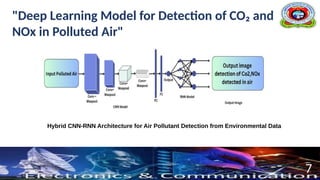
"Deep Learning Modelfor Detection of CO₂ and
NOx in Polluted Air"
Hybrid CNN-RNN Architecture for Air Pollutant Detection from Environmental Data
8.
8
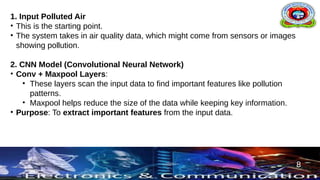
1. Input PollutedAir
• This is the starting point.
• The system takes in air quality data, which might come from sensors or images
showing pollution.
2. CNN Model (Convolutional Neural Network)
• Conv + Maxpool Layers:
• These layers scan the input data to find important features like pollution
patterns.
• Maxpool helps reduce the size of the data while keeping key information.
• Purpose: To extract important features from the input data.
9.
9
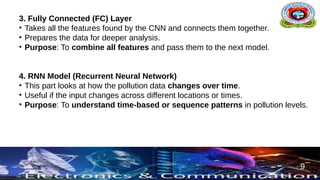
3. Fully Connected(FC) Layer
• Takes all the features found by the CNN and connects them together.
• Prepares the data for deeper analysis.
• Purpose: To combine all features and pass them to the next model.
4. RNN Model (Recurrent Neural Network)
• This part looks at how the pollution data changes over time.
• Useful if the input changes across different locations or times.
• Purpose: To understand time-based or sequence patterns in pollution levels.
10.
10
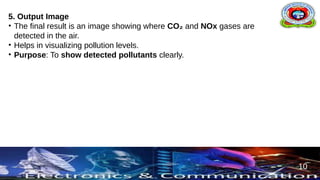
5. Output Image
•The final result is an image showing where CO₂ and NOx gases are
detected in the air.
• Helps in visualizing pollution levels.
• Purpose: To show detected pollutants clearly.
12
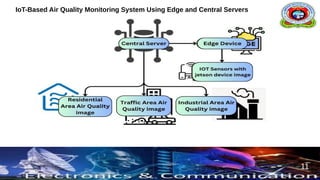
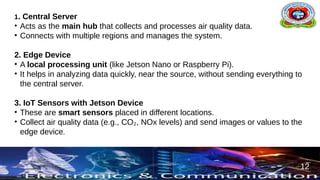
1. Central Server
•Acts as the main hub that collects and processes air quality data.
• Connects with multiple regions and manages the system.
2. Edge Device
• A local processing unit (like Jetson Nano or Raspberry Pi).
• It helps in analyzing data quickly, near the source, without sending everything to
the central server.
3. IoT Sensors with Jetson Device
• These are smart sensors placed in different locations.
• Collect air quality data (e.g., CO₂, NOx levels) and send images or values to the
edge device.
13.
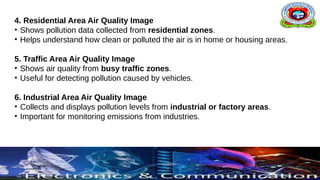
4. Residential AreaAir Quality Image
• Shows pollution data collected from residential zones.
• Helps understand how clean or polluted the air is in home or housing areas.
5. Traffic Area Air Quality Image
• Shows air quality from busy traffic zones.
• Useful for detecting pollution caused by vehicles.
6. Industrial Area Air Quality Image
• Collects and displays pollution levels from industrial or factory areas.
• Important for monitoring emissions from industries.
14.
ADVANTAGES:
13
1.Easy to monitorair pollution levels.
2.Detects harmful gases like CO₂ and NOx.
3.Works in different areas (home, traffic, industry)
4.Fast data processing using edge devices.
5.Helps protect health and the environment.
15.
DISADVANTAGES:
15
1.Covers only alimited number of urban areas.
2.Monitors just PM2.5, CO₂, and NOx pollutants.
3.High cost of NVIDIA Jetson edge devices.
4.Requires frequent maintenance and sensor calibration
5.Limited data sharing between different monitoring locations.
16.
APPLICATIONS:
16
1.Real-time air qualitymonitoring in urban areas.
2.Pollution level alerts for public health safety.
3.Smart city environmental data collection and analysis.
4.Industrial emission tracking and regulatory compliance monitoring.
5.Traffic-related pollution monitoring at busy intersections.
17.
CONCLUSION:.
17
The proposed systemoffers a smart way to monitor air quality.
Using Edge AI and machine learning improves real-time analysis.
It reduces latency and bandwidth compared to cloud systems.
NVIDIA Jetson devices allow fast local data processing.
Federated learning keeps data private while improving model
accuracy.
High correlation with reference monitors shows strong reliability.
This system is ideal for urban pollution tracking.
Future work can expand to more areas and pollutants.
18.
FUTURESCOPE:
18
The system canbe expanded to rural and remote areas.
More types of pollutants like SO₂ and O₃ can be included.
Integration with mobile apps can give instant alerts to users.
Solar-powered sensors can make the system energy-efficient.
AI models can be improved with more training data.
Real-time data sharing can support smart city planning.
Global deployment can help in climate change studies.
Support for multi-language dashboards can increase public
awareness.
19.
REFERENCES:
19
[1]
T.
N
1.Dominici, F., Peng,R. D., Barr, C. D., & Bell, M. L. (2010). Protecting human health from air pollution:
shifting from a single-pollutant to a multipollutant approach. Epidemiology, 21(2), 187–194.
2.Devarakonda, S., Sevusu, P., Liu, H., Liu, R., Iftode, L., & Nath, B. (2013). Real-time air quality monitoring
through mobile sensing in metropolitan areas. Proceedings of the 2nd ACM SIGKDD International Workshop
on Urban Computing.
3.Mrissa, M., Tošić, A., Hrovatin, N., Aslam, S., Dávid, B., Hajdu, L., ... & Kavšek, B. (2022). Privacy-aware
and secure decentralized air quality monitoring. Applied Sciences, 12(4), 2147.
4.Bourechak, A., Zedadra, O., Kouahla, M. N., Guerrieri, A., Seridi, H., & Fortino, G. (2023). At the confluence
of artificial intelligence and edge computing in IoT-based applications: A review. Sensors, 23(3), 1639.
5.Cui, B., Liu, M., Li, S., Jin, Z., Zeng, Y., & Lin, X. (2023). Deep learning methods for atmospheric PM2.5
prediction: A comparative study. Atmospheric Pollution Research, 14(9), 101833.