Big Data – Application of Environmental Sensors
for Building and Sustainable Environment
Dr. Zhi Ning
Deputy Director, Guy Carpenter Climate Change Centre
Assistant Professor, School of Energy and Environment
City University of Hong Kong
EMSD Summit 2016 Innovate HK
2
School of Energy and Environment, City University of Hong Kong
Introduction
3
School of Energy and Environment, City University of Hong Kong
Introduction
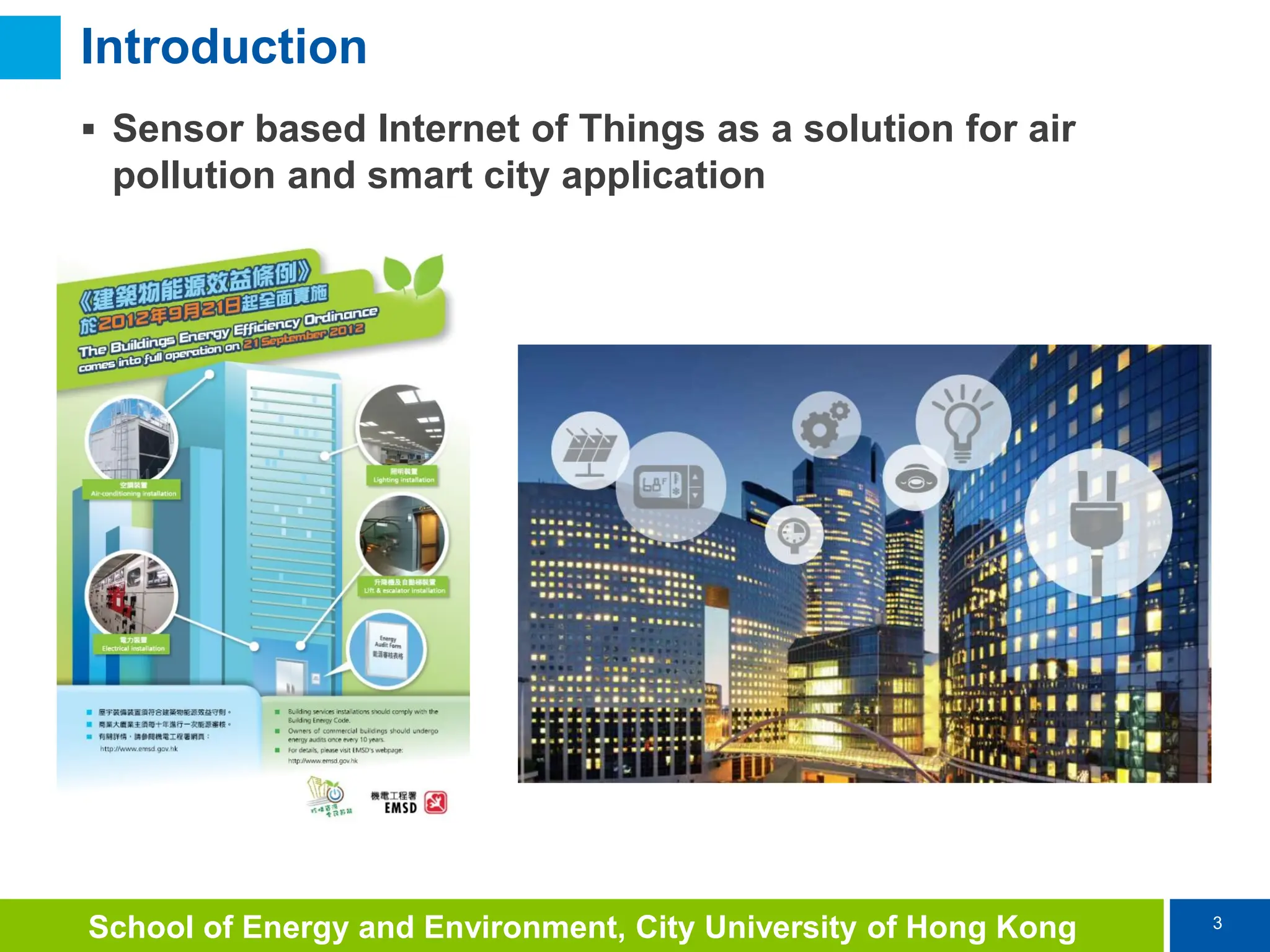
 Sensor based Internet of Things as a solution for air
pollution and smart city application
4
School of Energy and Environment, City University of Hong Kong
Issues with current practice
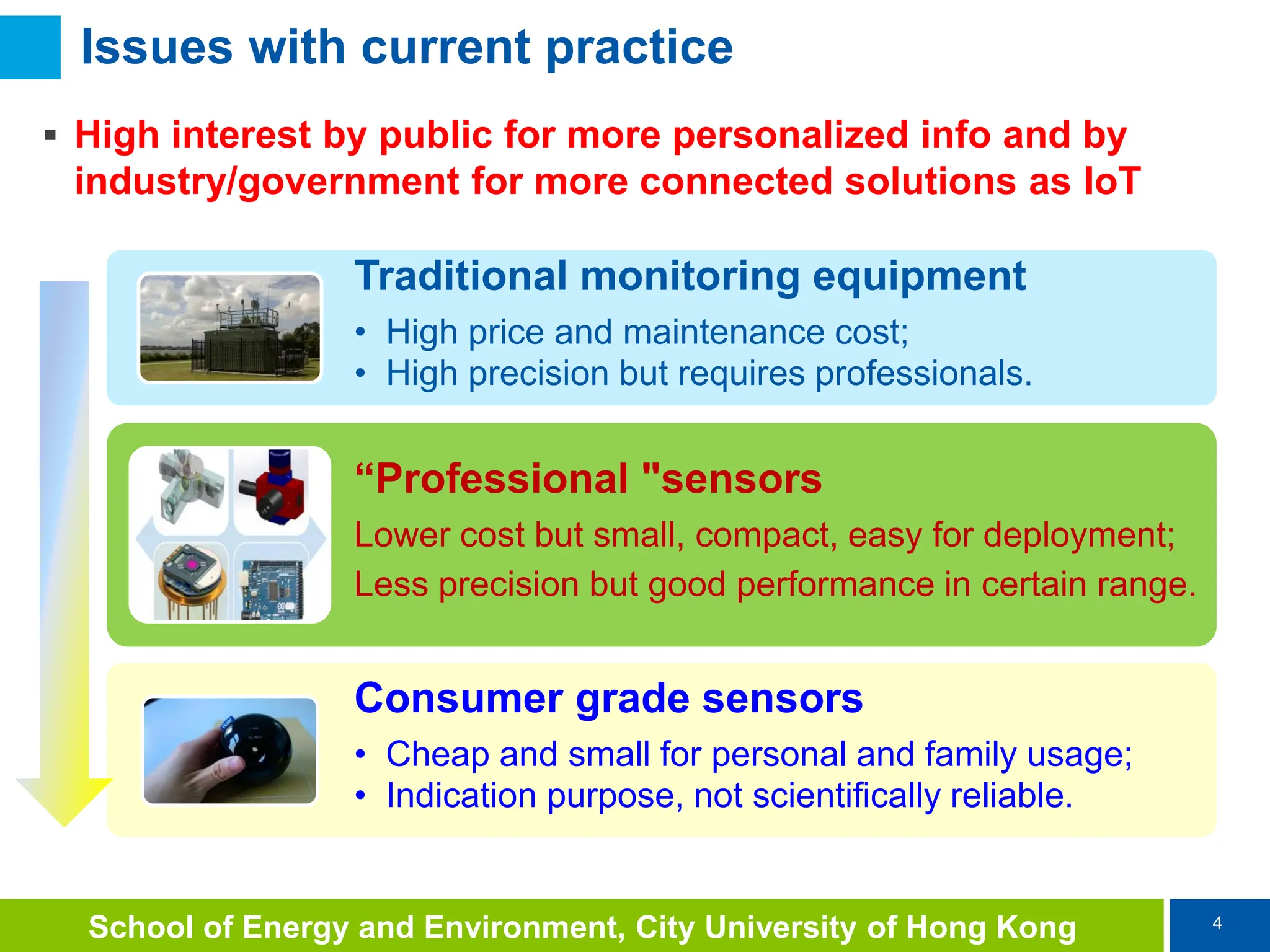
 High interest by public for more personalized info and by
industry/government for more connected solutions as IoT
Traditional monitoring equipment
• High price and maintenance cost;
• High precision but requires professionals.
“Professional "sensors
Lower cost but small, compact, easy for deployment;
Less precision but good performance in certain range.
Consumer grade sensors
• Cheap and small for personal and family usage;
• Indication purpose, not scientifically reliable.
5
School of Energy and Environment, City University of Hong Kong
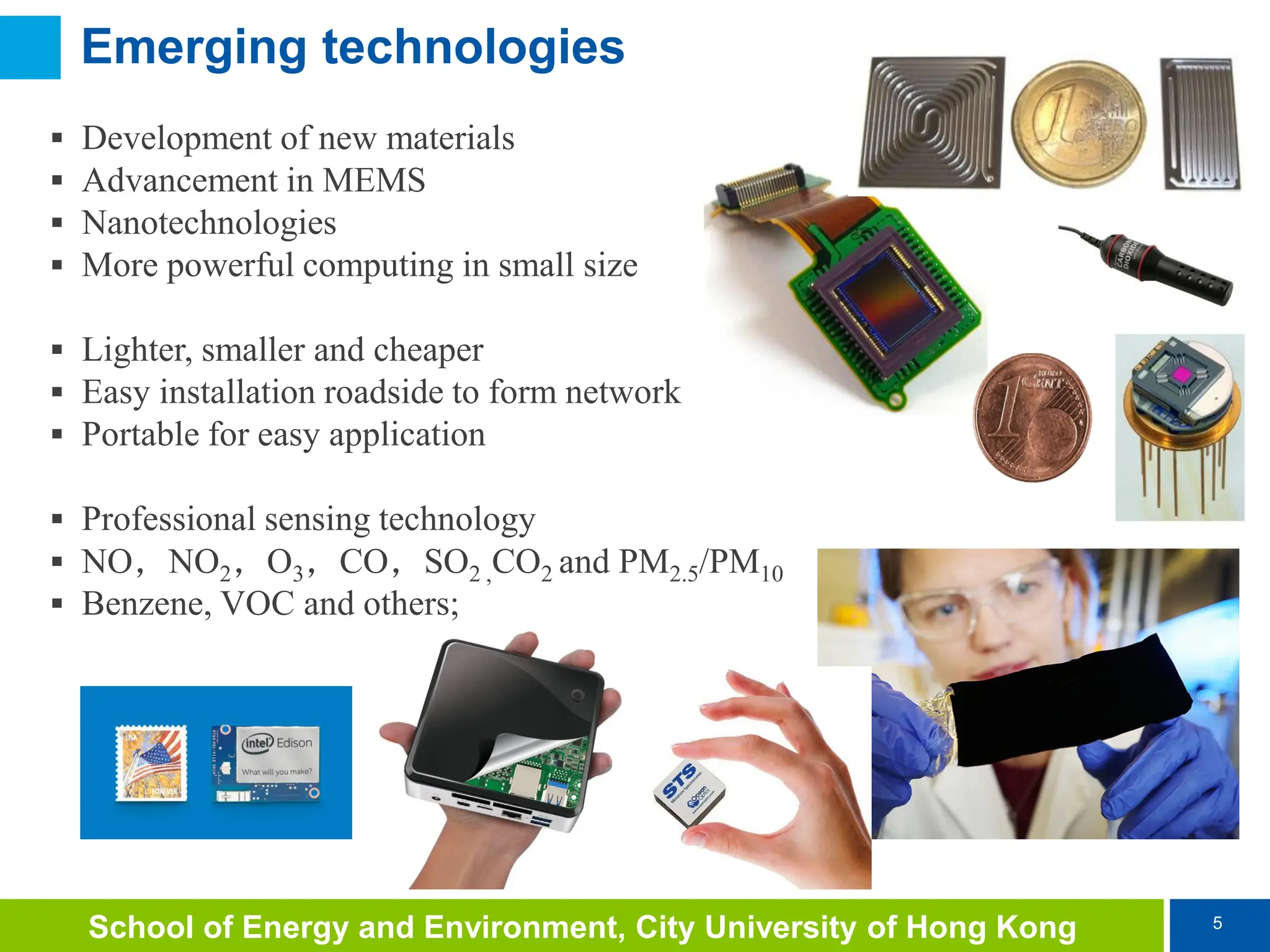
Emerging technologies
 Development of new materials
 Advancement in MEMS
 Nanotechnologies
 More powerful computing in small size
 Lighter, smaller and cheaper
 Easy installation roadside to form network
 Portable for easy application
 Professional sensing technology
 NO,NO2,O3,CO,SO2 ,CO2 and PM2.5/PM10
 Benzene, VOC and others;
6
School of Energy and Environment, City University of Hong Kong
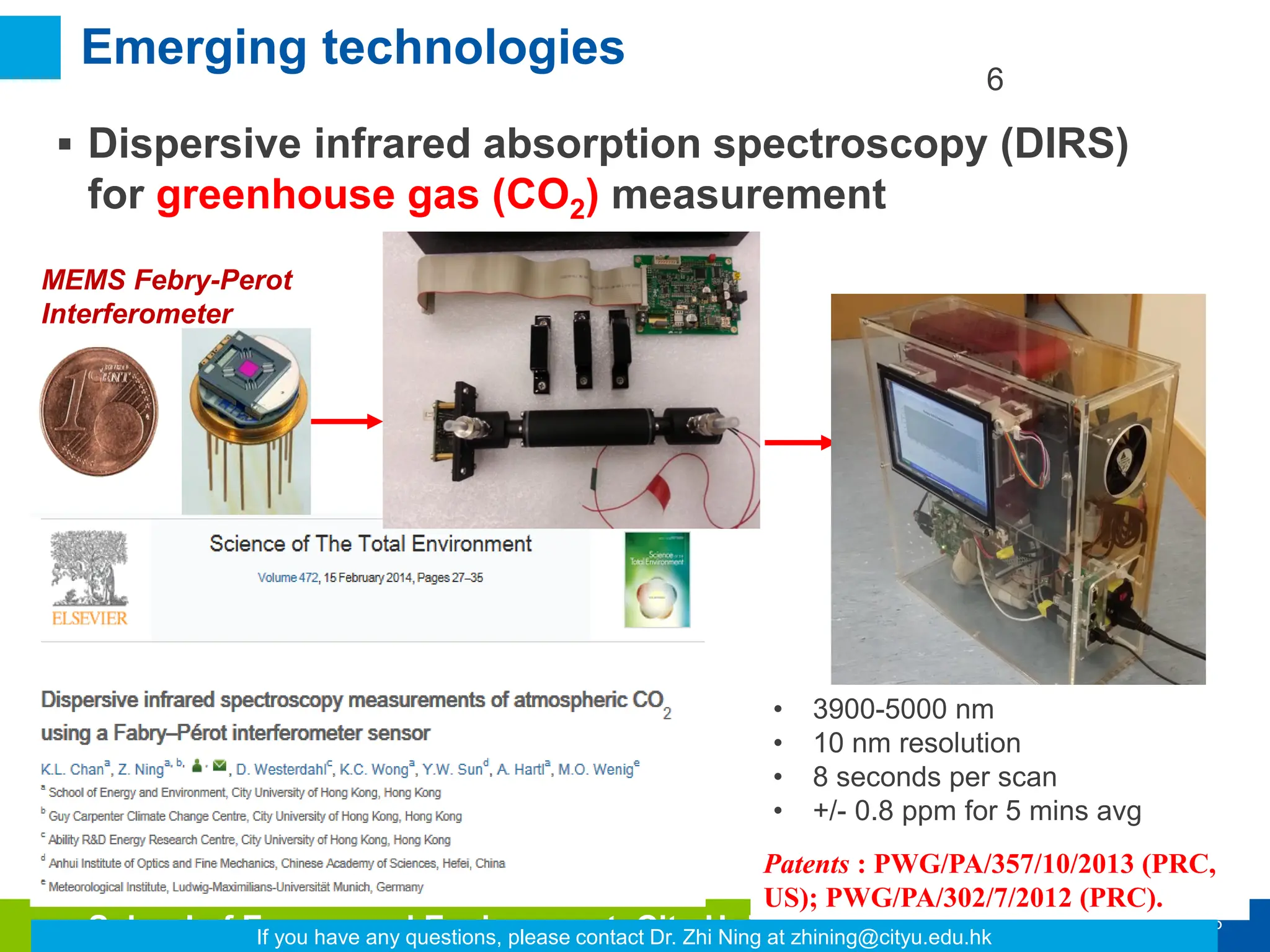
Emerging technologies
Patents : PWG/PA/357/10/2013 (PRC,
US); PWG/PA/302/7/2012 (PRC).
 Dispersive infrared absorption spectroscopy (DIRS)
for greenhouse gas (CO2) measurement
MEMS Febry-Perot
Interferometer
• 3900-5000 nm
• 10 nm resolution
• 8 seconds per scan
• +/- 0.8 ppm for 5 mins avg
6
If you have any questions, please contact Dr. Zhi Ning at zhining@cityu.edu.hk
7
School of Energy and Environment, City University of Hong Kong
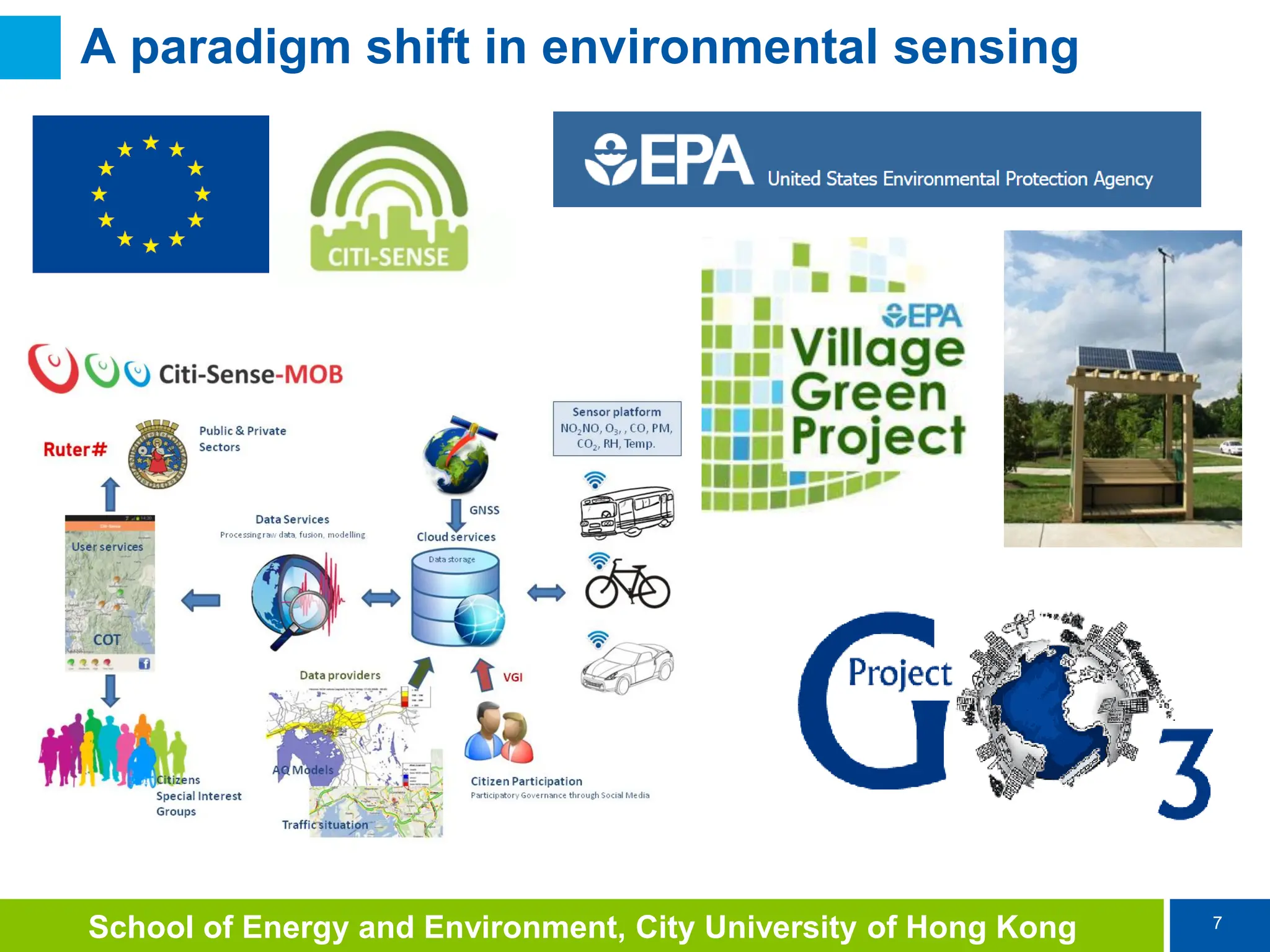
A paradigm shift in environmental sensing
“citizens’ observatories” to empower
citizens to contribute to and participate in
environmental governance,
8
School of Energy and Environment, City University of Hong Kong
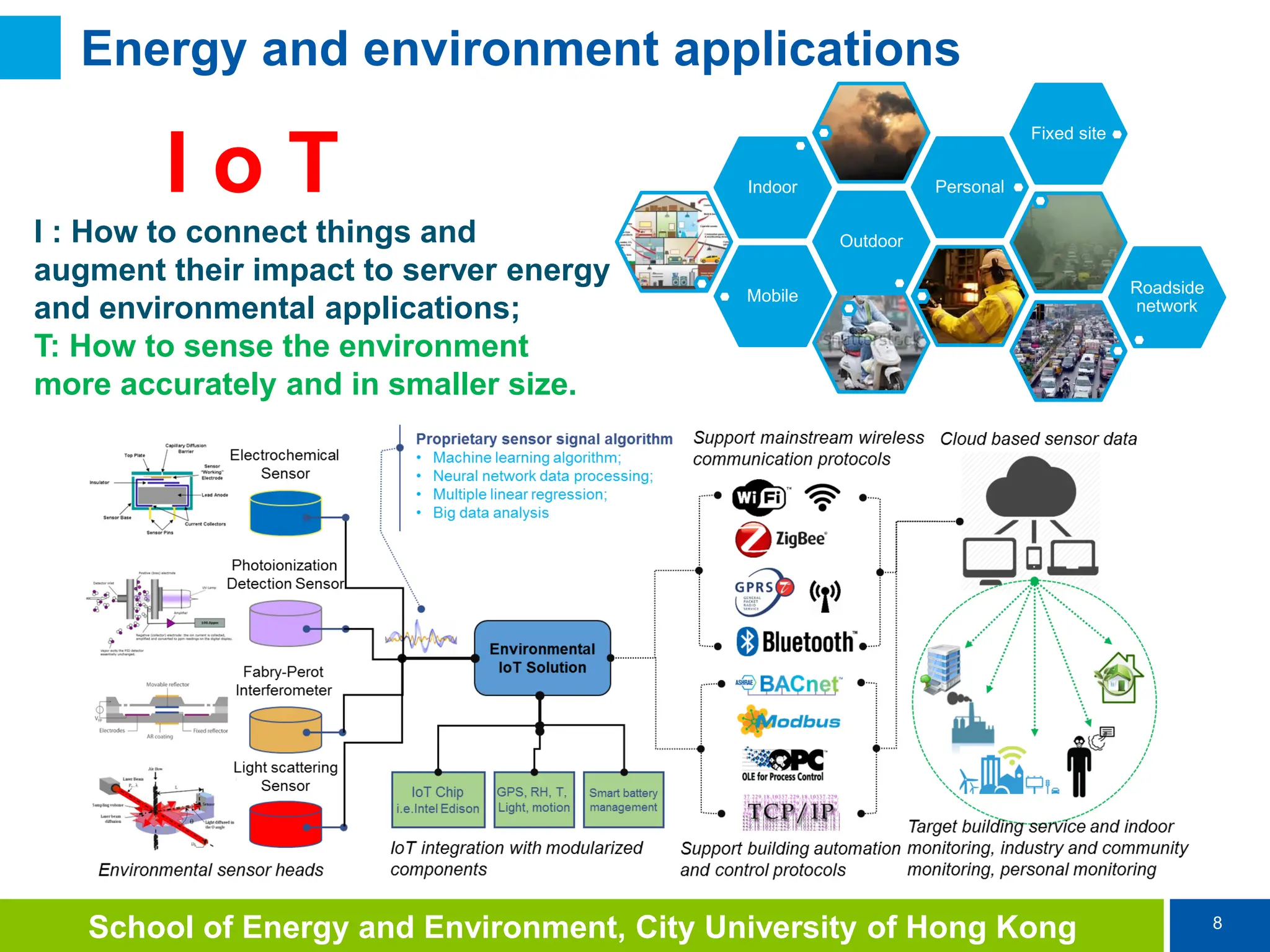
Energy and environment applications
Mobile
Outdoor
Indoor Personal
Fixed site
Roadside
network
I o T
I : How to connect things and
augment their impact to server energy
and environmental applications;
T: How to sense the environment
more accurately and in smaller size.
9
School of Energy and Environment, City University of Hong Kong
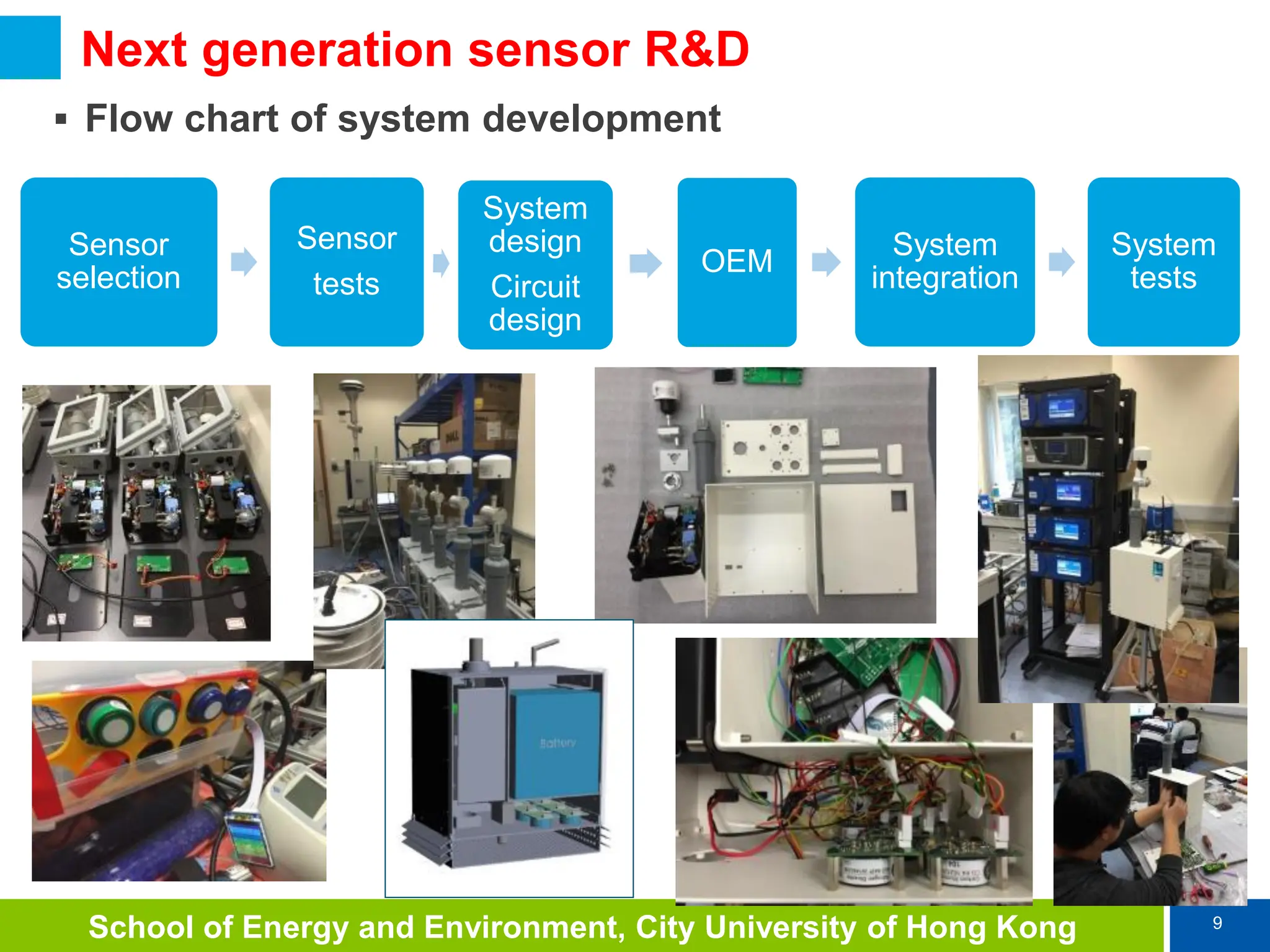
Next generation sensor R&D
 Flow chart of system development
Sensor
selection
Sensor
tests
System
design
Circuit
design
OEM
System
integration
System
tests
10
School of Energy and Environment, City University of Hong Kong
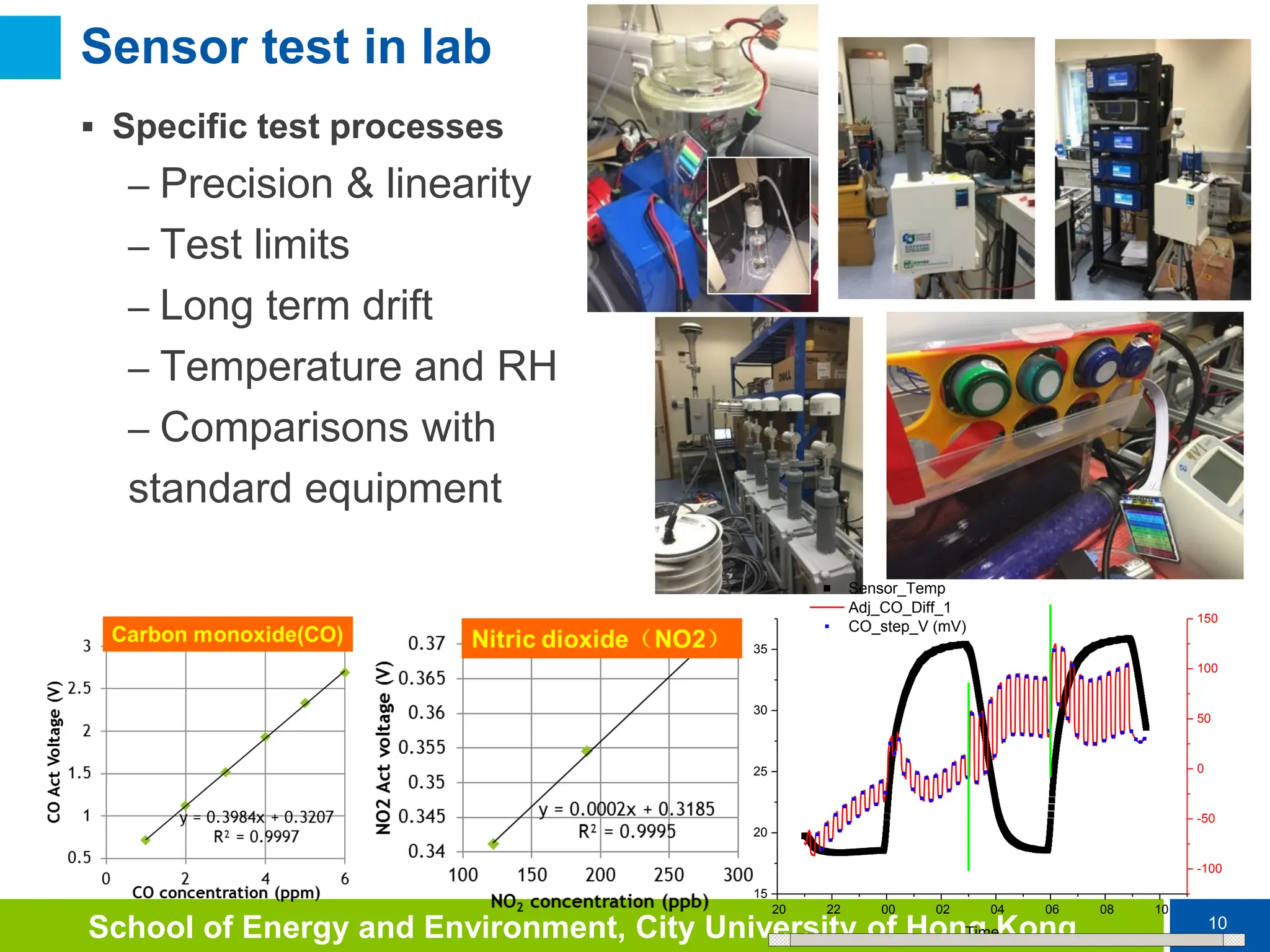
Sensor test in lab
 Specific test processes
– Precision & linearity
– Test limits
– Long term drift
– Temperature and RH
– Comparisons with
standard equipment
20 22 00 02 04 06 08 10
15
20
25
30
35
Sensor_Temp
Adj_CO_Diff_1
CO_step_V (mV)
Time
-100
-50
0
50
100
150
11
School of Energy and Environment, City University of Hong Kong
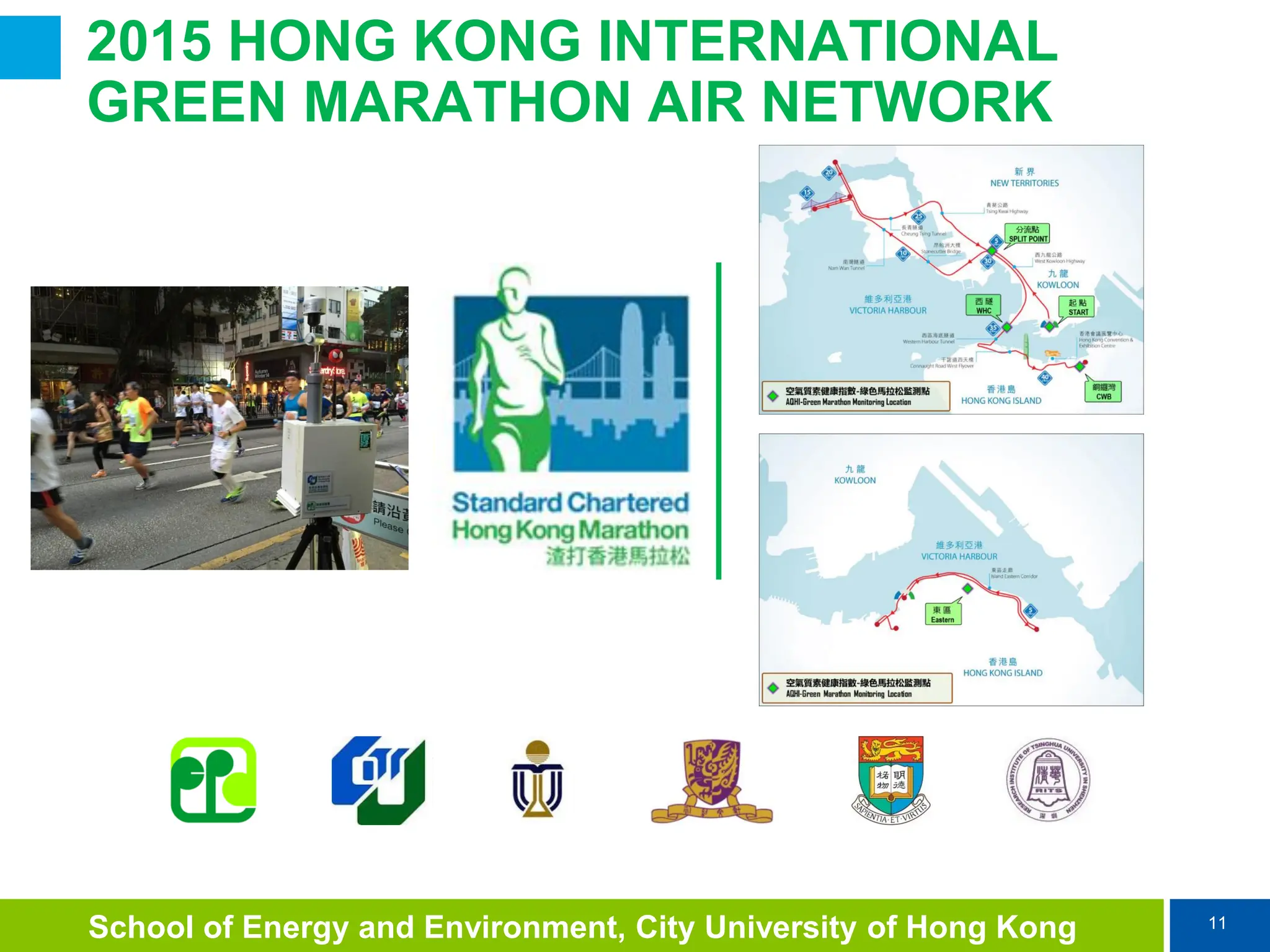
2015 HONG KONG INTERNATIONAL
GREEN MARATHON AIR NETWORK
12
School of Energy and Environment, City University of Hong Kong
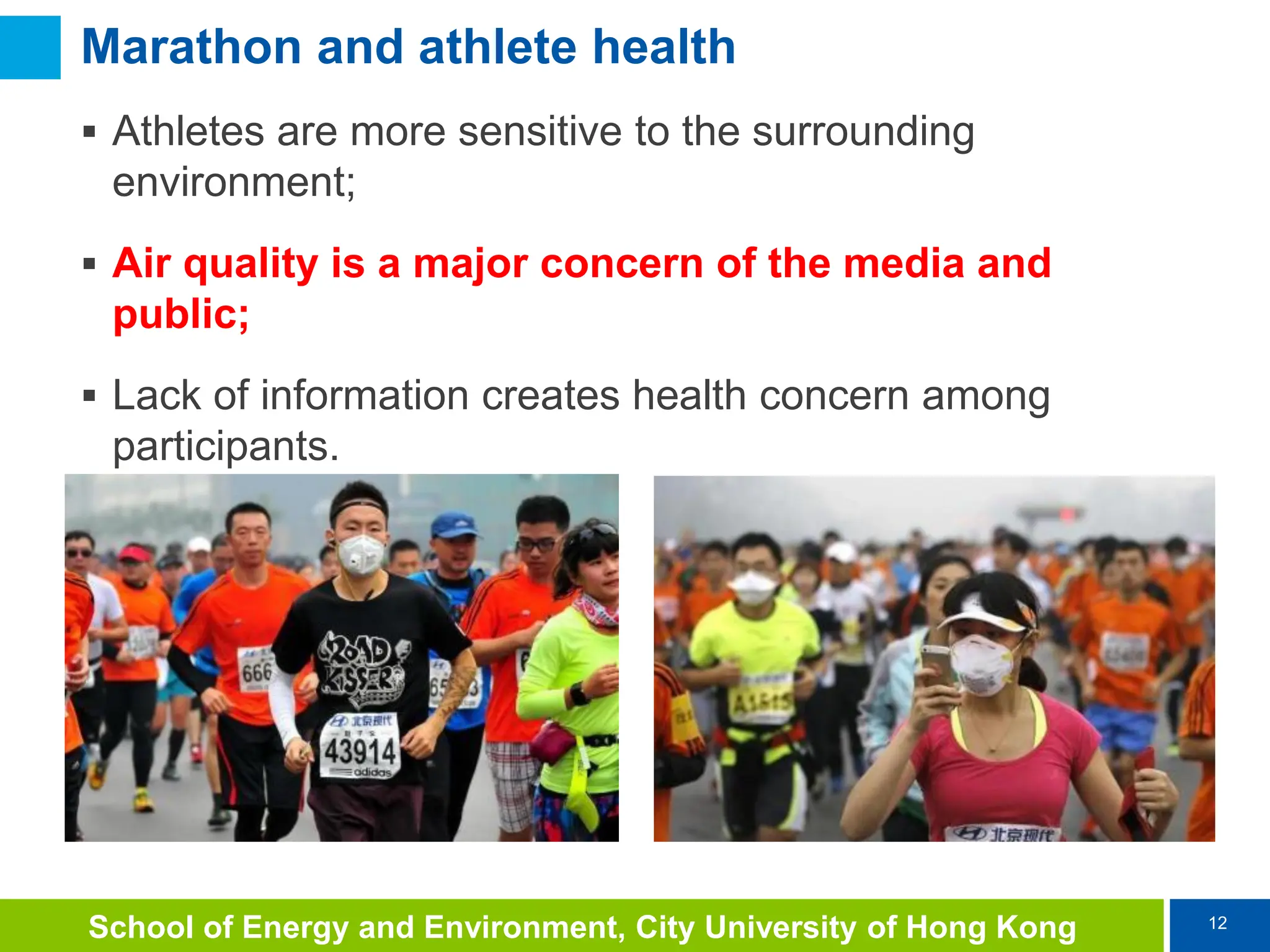
Marathon and athlete health
 Athletes are more sensitive to the surrounding
environment;
 Air quality is a major concern of the media and
public;
 Lack of information creates health concern among
participants.
13
School of Energy and Environment, City University of Hong Kong
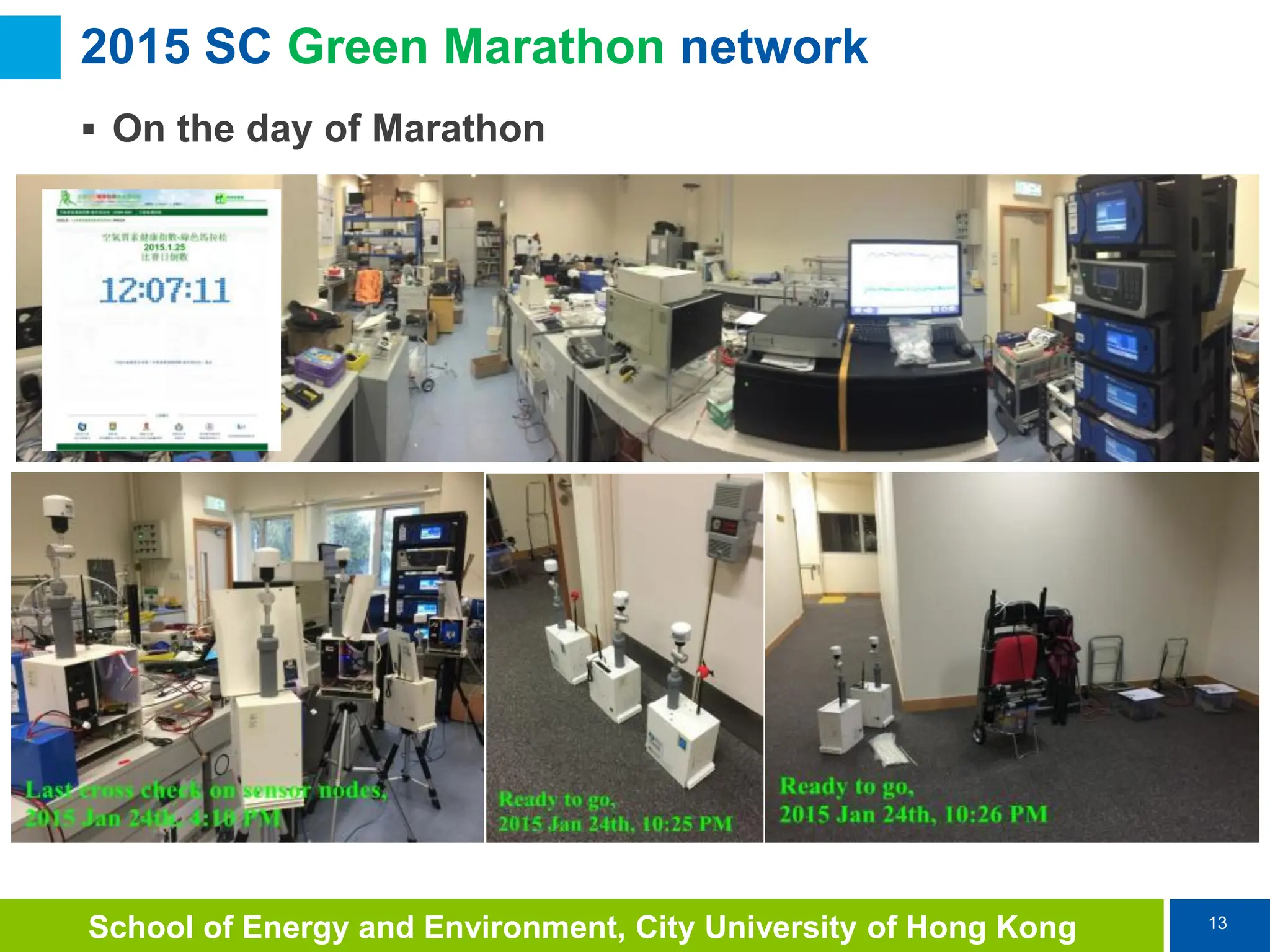
2015 SC Green Marathon network
 On the day of Marathon
14
School of Energy and Environment, City University of Hong Kong
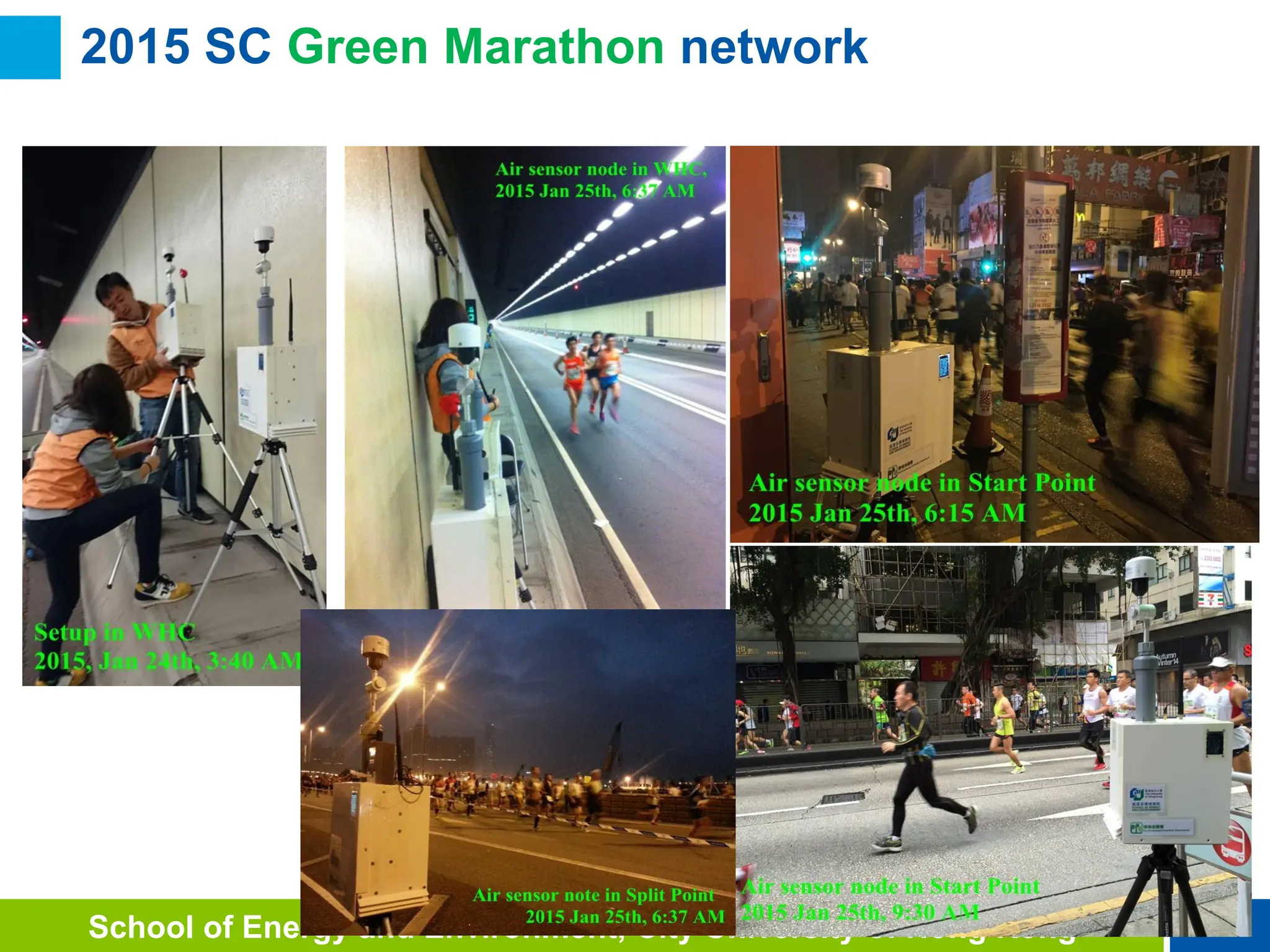
2015 SC Green Marathon network
15
School of Energy and Environment, City University of Hong Kong
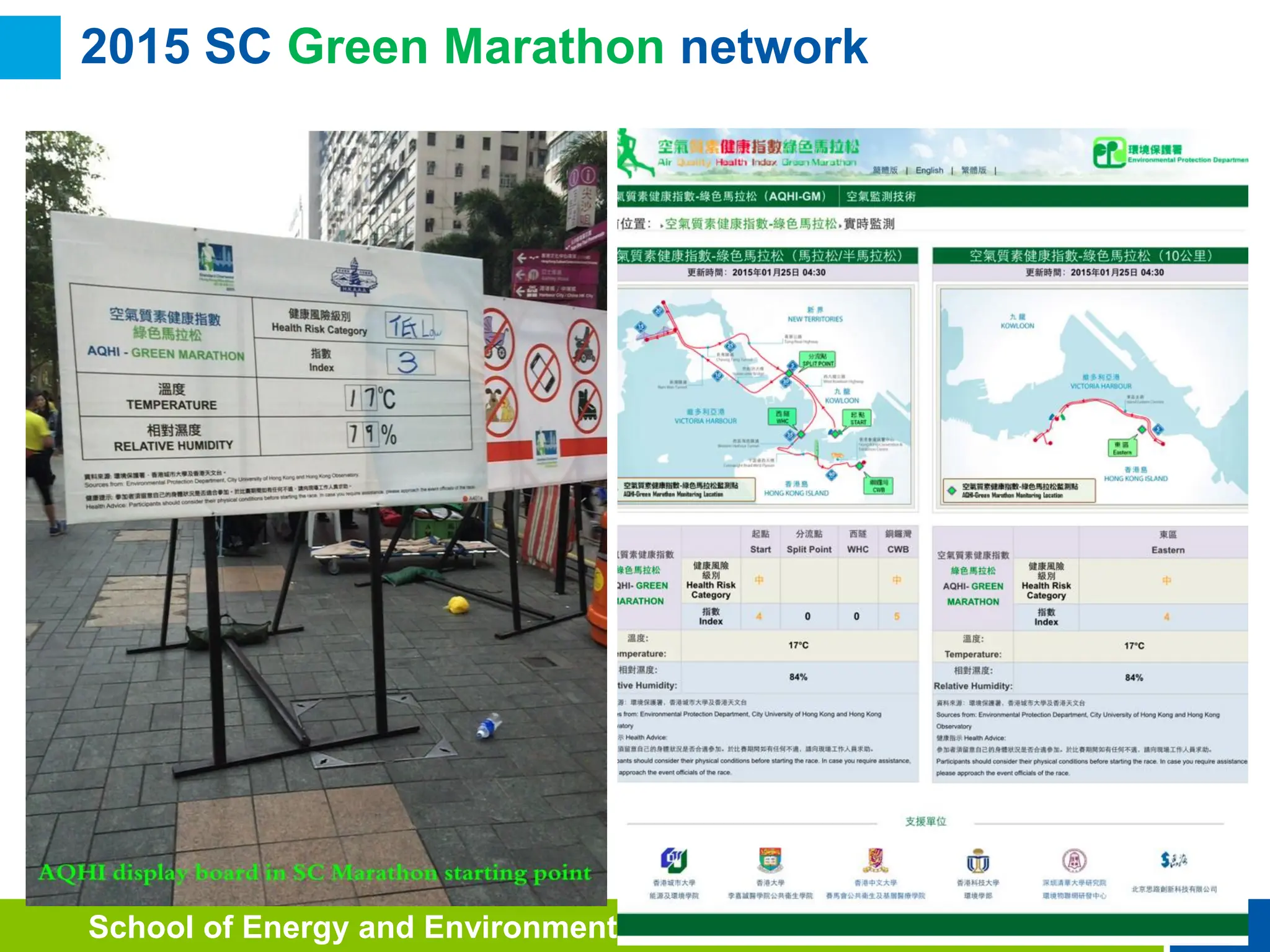
2015 SC Green Marathon network
16
School of Energy and Environment, City University of Hong Kong
0.4
0.6
0.8
1
1.2
3:07 4:19 5:31 6:43 7:55 9:07 10:19 11:31 12:43
CO/
ppm
TST CO
TST CO
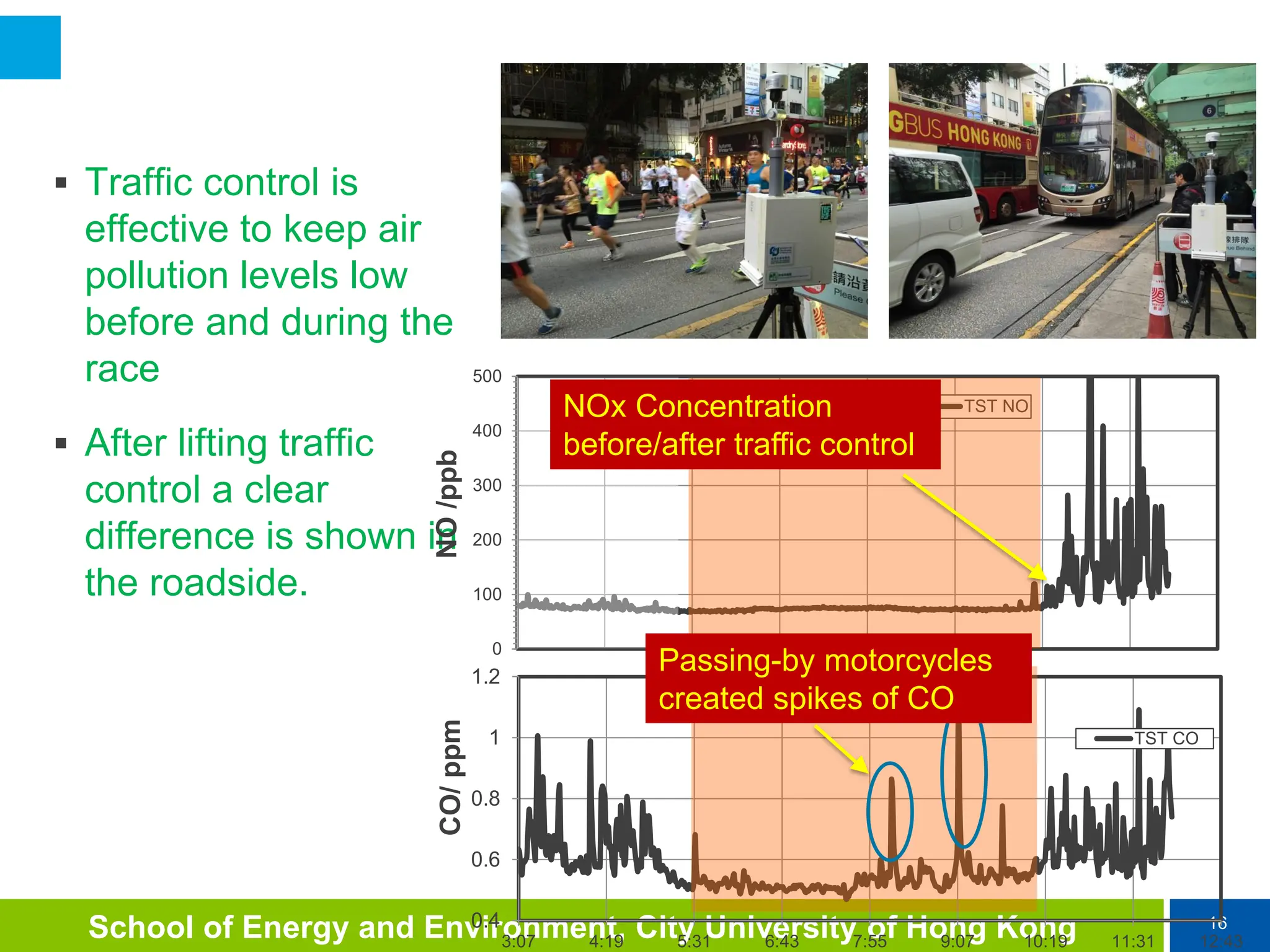
 Traffic control is
effective to keep air
pollution levels low
before and during the
race
 After lifting traffic
control a clear
difference is shown in
the roadside.
0
100
200
300
400
500
NO
/ppb
TST NO
NOx Concentration
before/after traffic control
Passing-by motorcycles
created spikes of CO
17
School of Energy and Environment, City University of Hong Kong
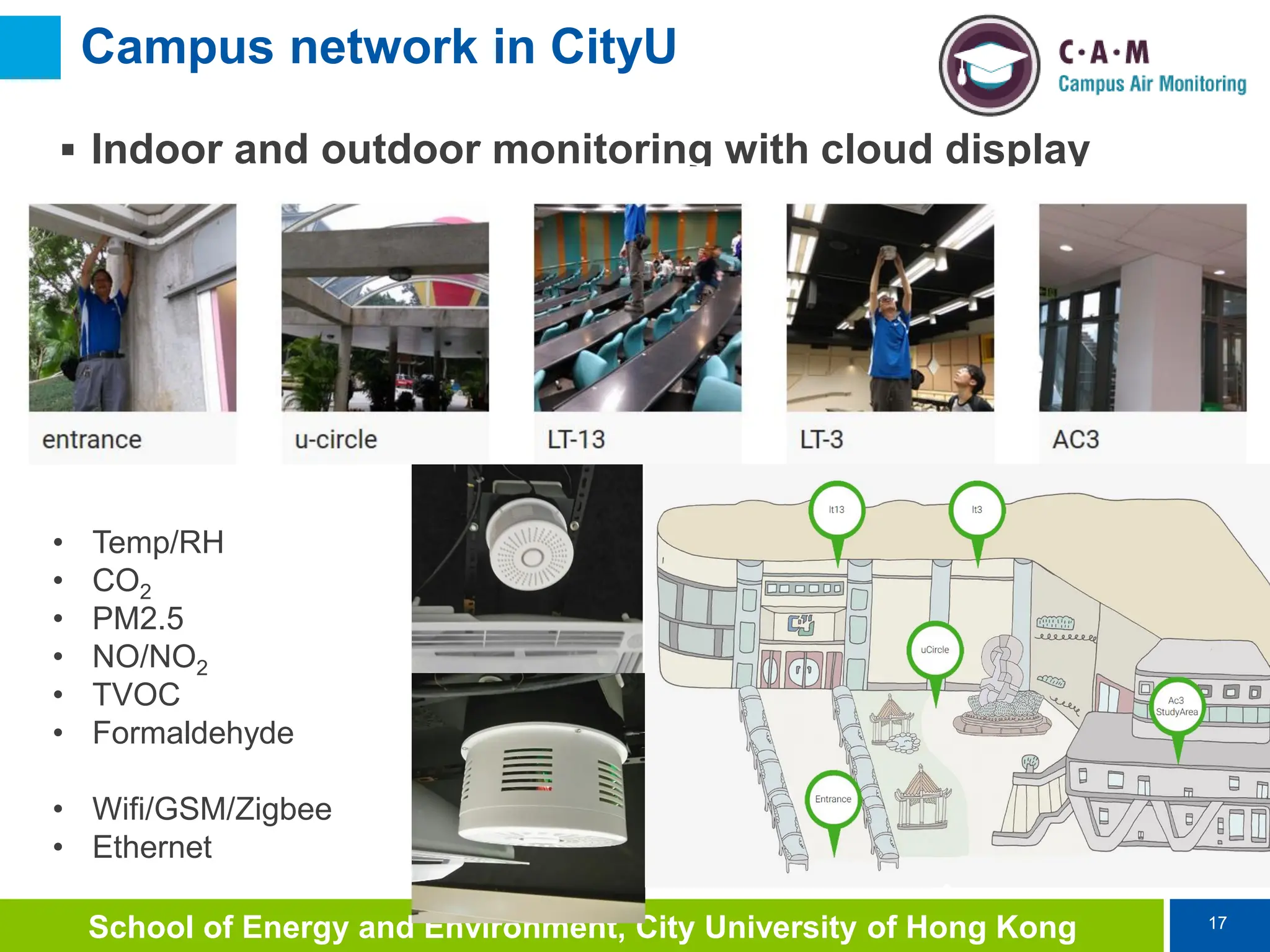
Campus network in CityU
 Indoor and outdoor monitoring with cloud display
• Temp/RH
• CO2
• PM2.5
• NO/NO2
• TVOC
• Formaldehyde
• Wifi/GSM/Zigbee
• Ethernet
18
School of Energy and Environment, City University of Hong Kong
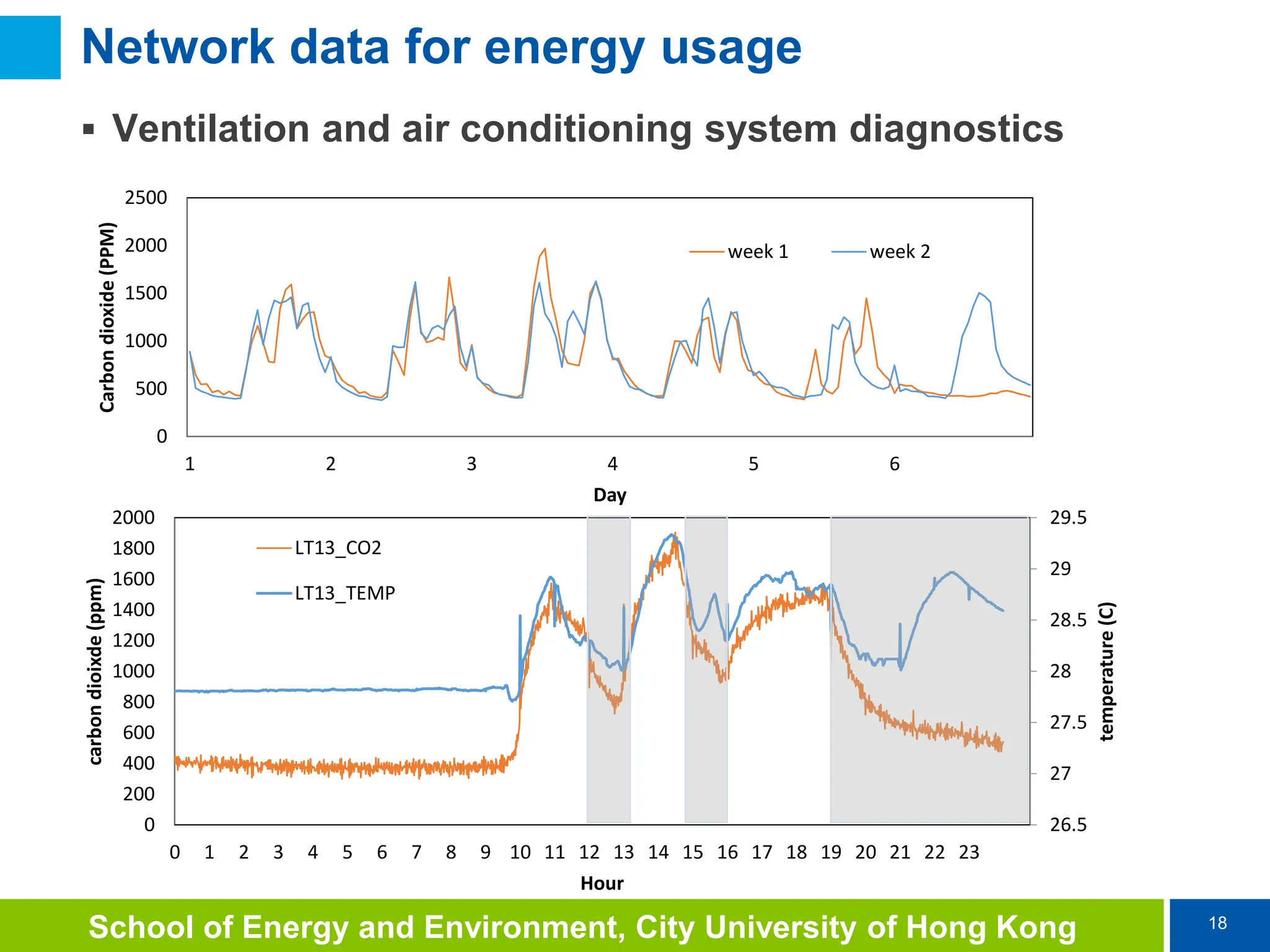
Network data for energy usage
 Ventilation and air conditioning system diagnostics
0
500
1000
1500
2000
2500
1 2 3 4 5 6
Carbon
dioxide
(PPM)
Day
week 1 week 2
26.5
27
27.5
28
28.5
29
29.5
0
200
400
600
800
1000
1200
1400
1600
1800
2000
0 1 2 3 4 5 6 7 8 9 10 11 12 13 14 15 16 17 18 19 20 21 22 23
temperature
(C)
carbon
dioixde
(ppm)
Hour
LT13_CO2
LT13_TEMP
19
School of Energy and Environment, City University of Hong Kong
19
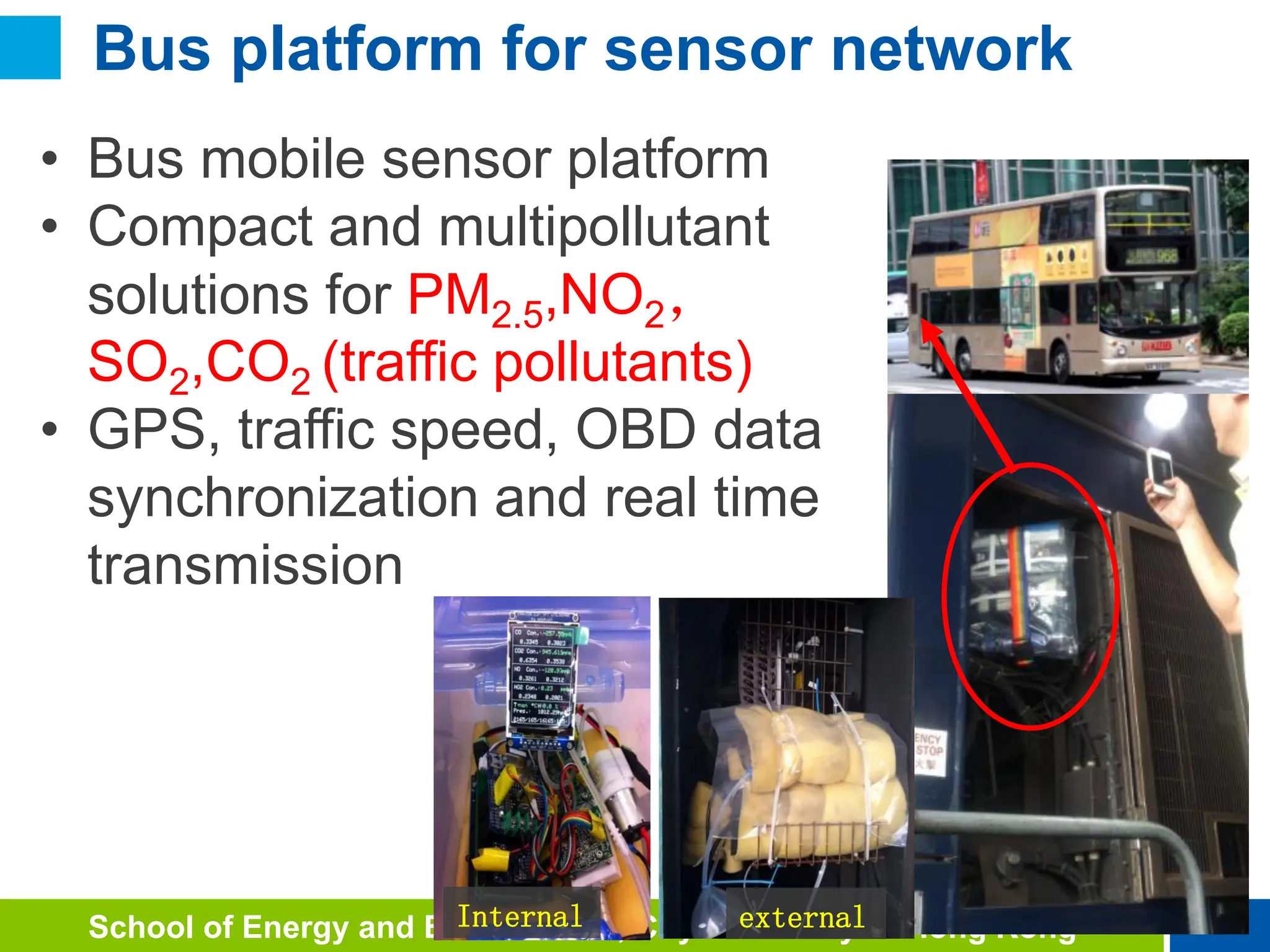
• Bus mobile sensor platform
• Compact and multipollutant
solutions for PM2.5,NO2,
SO2,CO2 (traffic pollutants)
• GPS, traffic speed, OBD data
synchronization and real time
transmission
Internal external
Bus platform for sensor network
20
School of Energy and Environment, City University of Hong Kong
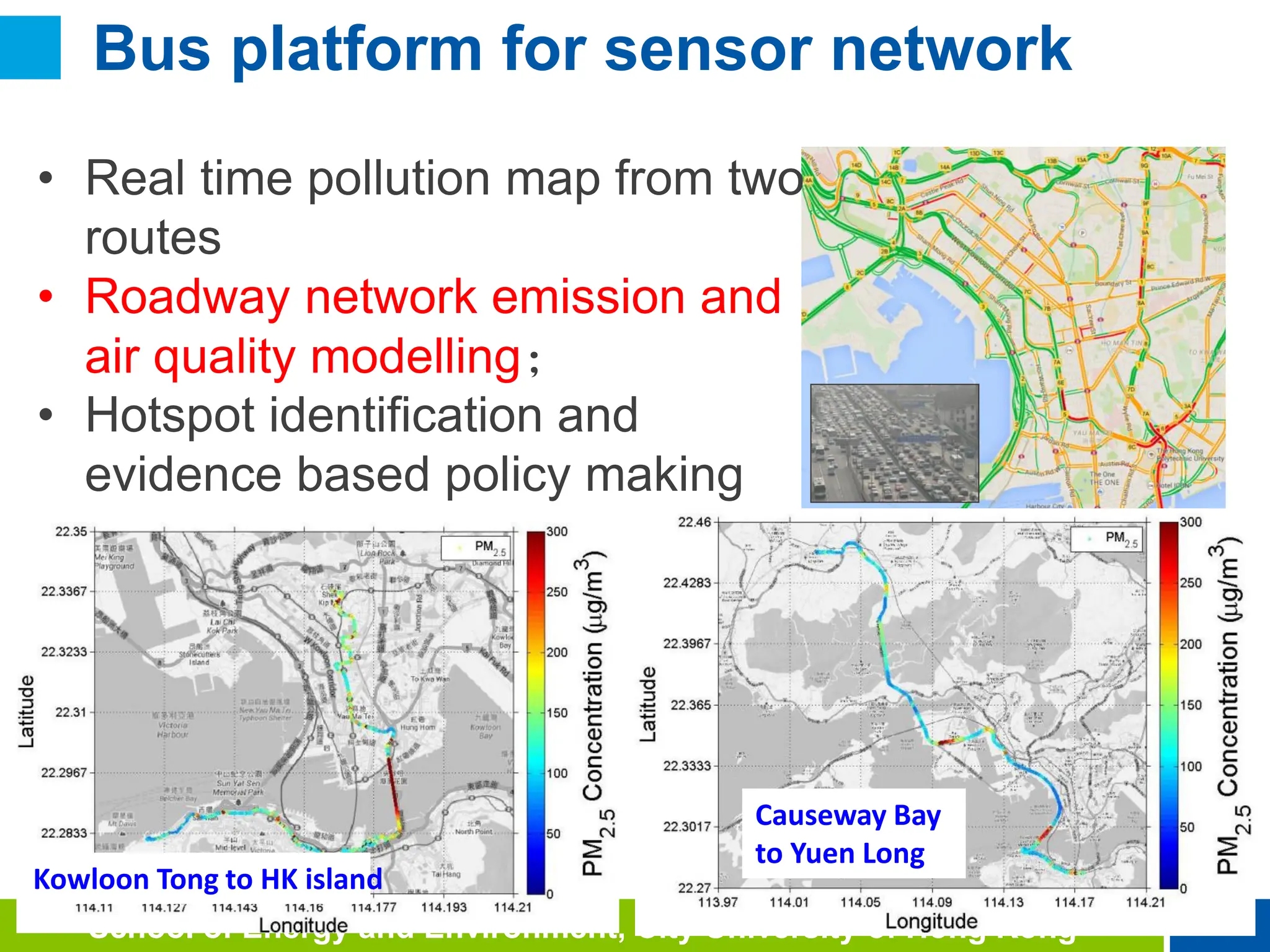
Kowloon Tong to HK island
Causeway Bay
to Yuen Long
• Real time pollution map from two
routes
• Roadway network emission and
air quality modelling;
• Hotspot identification and
evidence based policy making
Bus platform for sensor network
21
School of Energy and Environment, City University of Hong Kong
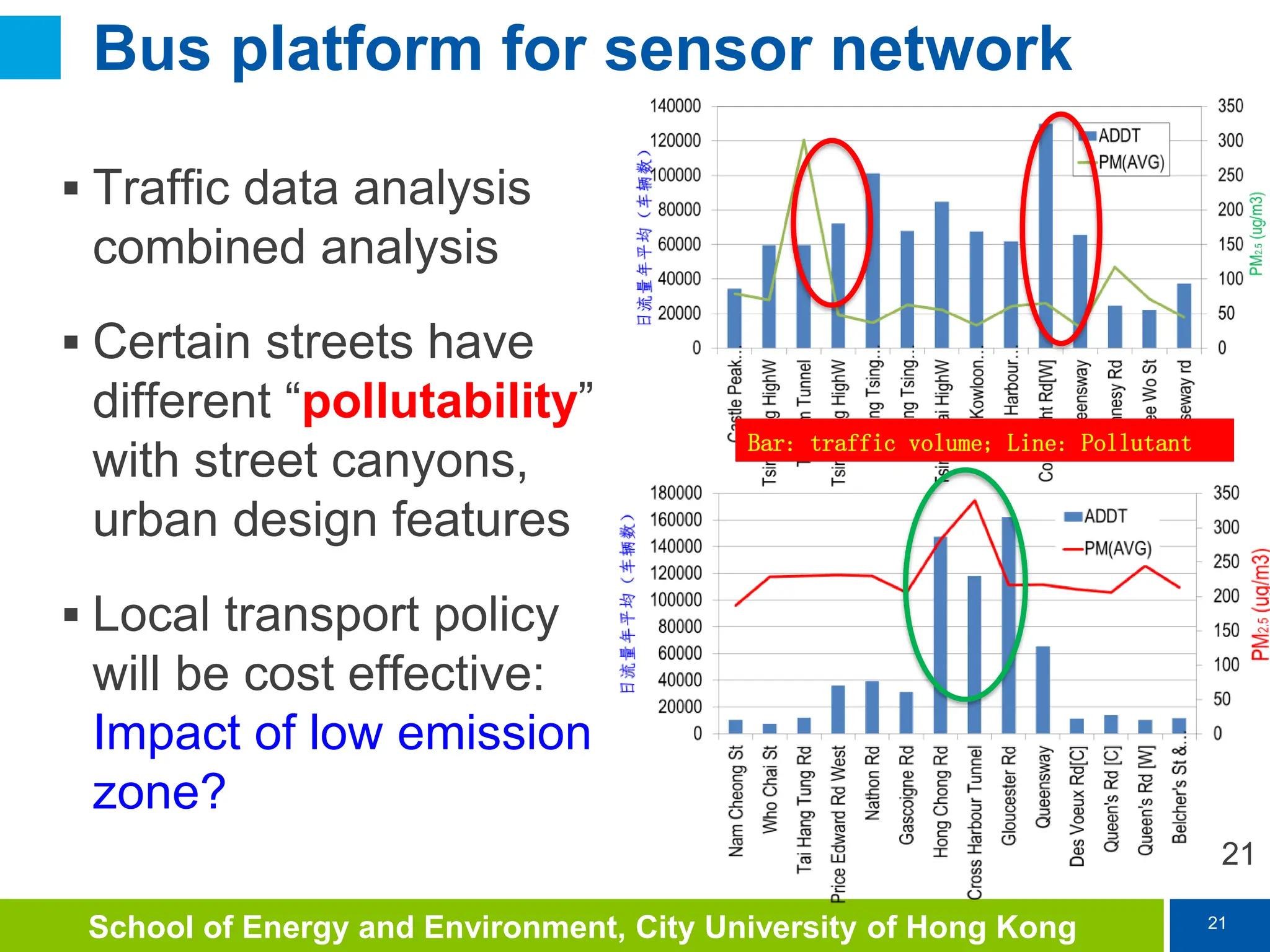
 Traffic data analysis
combined analysis
 Certain streets have
different “pollutability”
with street canyons,
urban design features
 Local transport policy
will be cost effective:
Impact of low emission
zone?
21
Bar: traffic volume; Line: Pollutant
Bus platform for sensor network
22
School of Energy and Environment, City University of Hong Kong
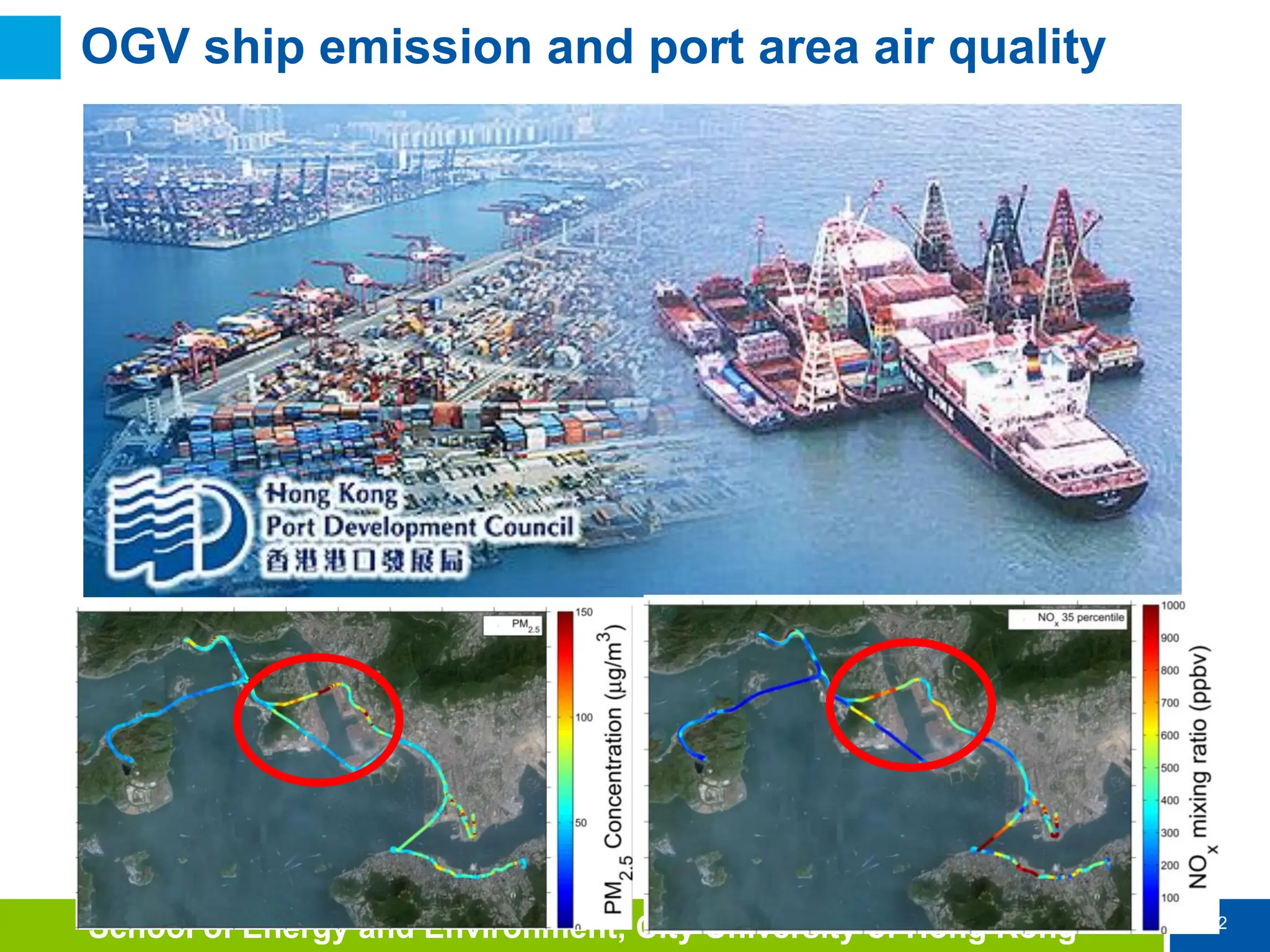
OGV ship emission and port area air quality
23
School of Energy and Environment, City University of Hong Kong
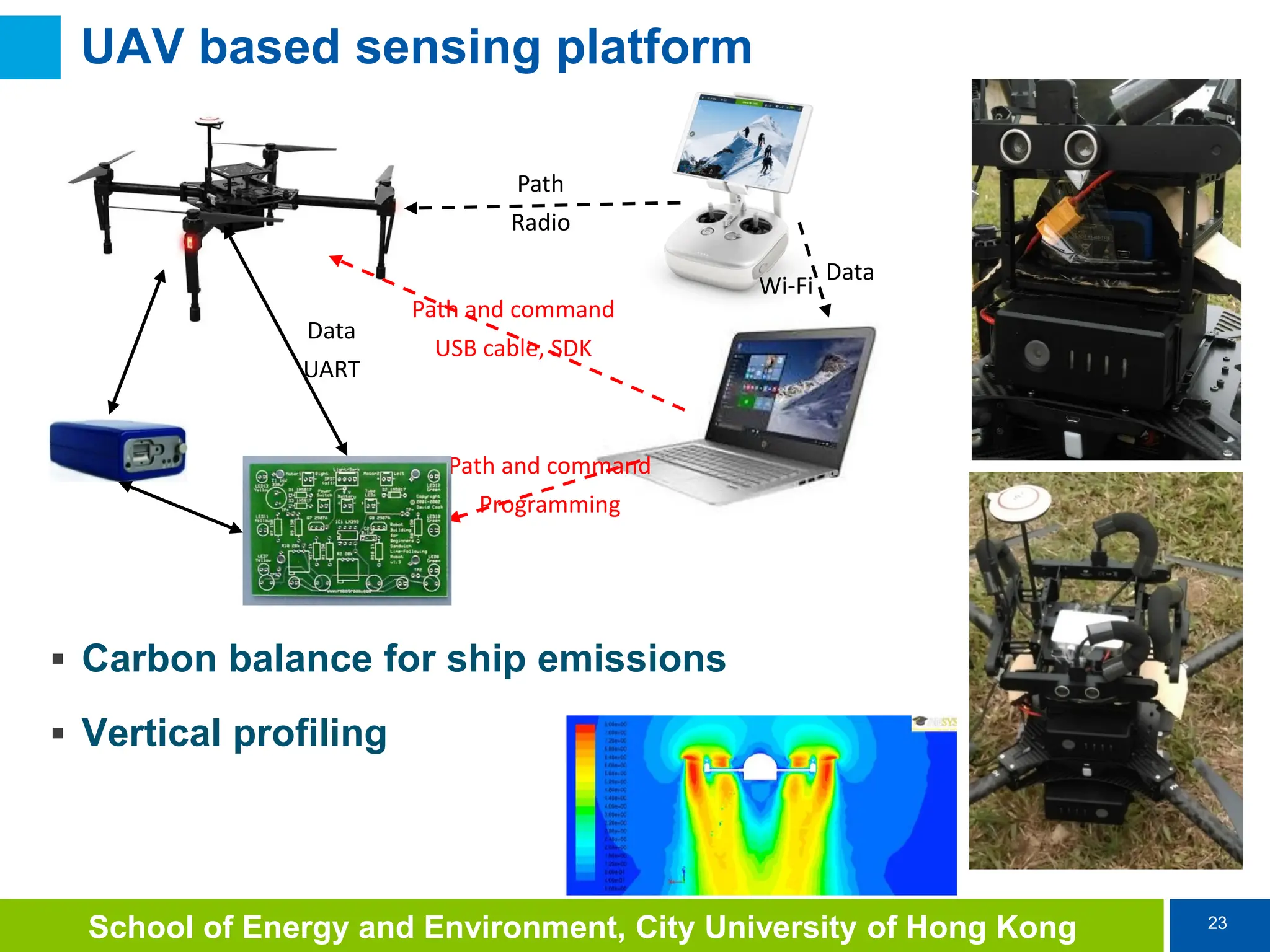
UAV based sensing platform
 Carbon balance for ship emissions
 Vertical profiling
Path
Radio
Path and command
USB cable, SDK
Path and command
Programming
Data
UART
Wi-Fi
Data
24
School of Energy and Environment, City University of Hong Kong
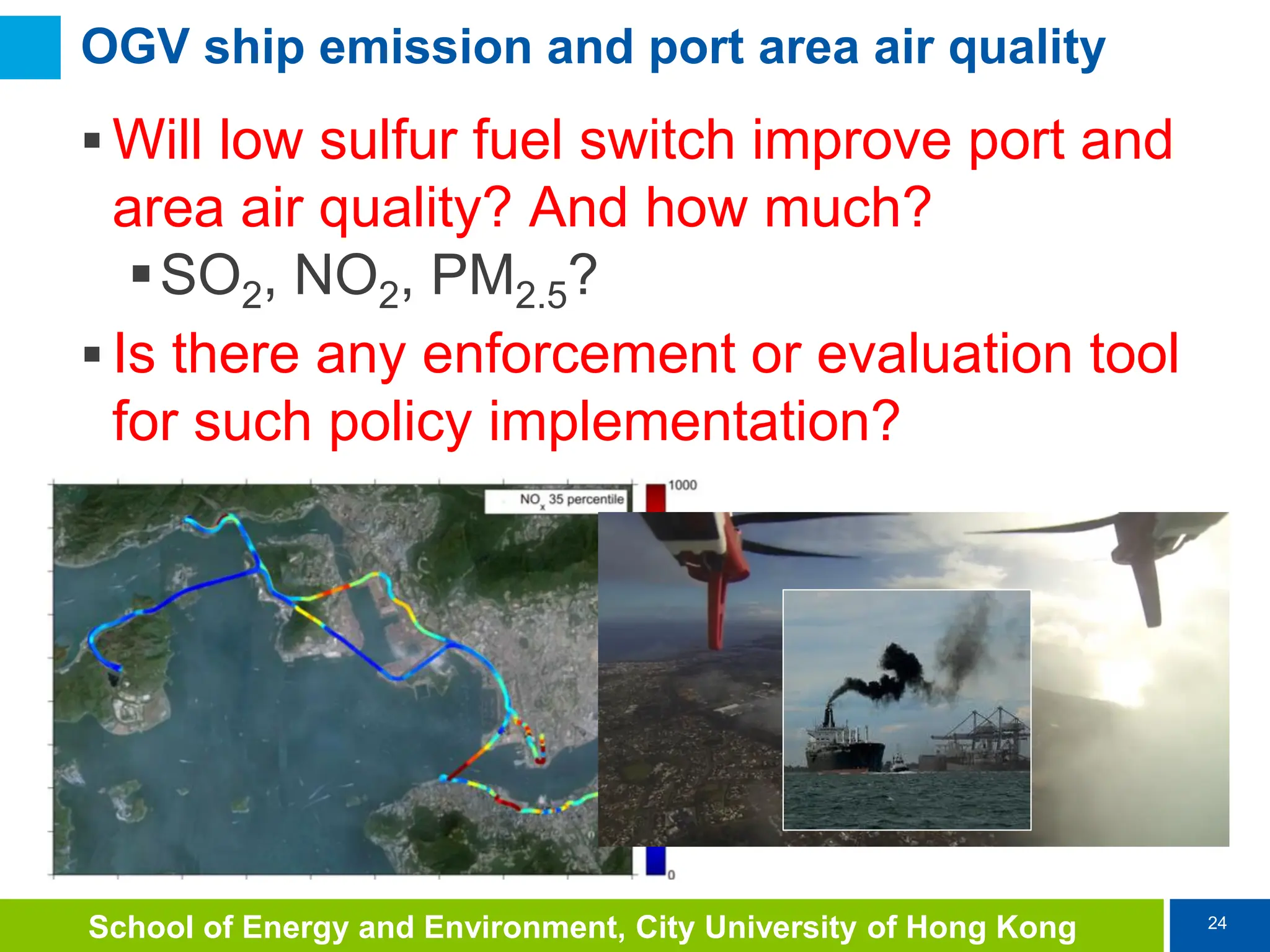
OGV ship emission and port area air quality
 Will low sulfur fuel switch improve port and
area air quality? And how much?
SO2, NO2, PM2.5?
 Is there any enforcement or evaluation tool
for such policy implementation?
25
School of Energy and Environment, City University of Hong Kong
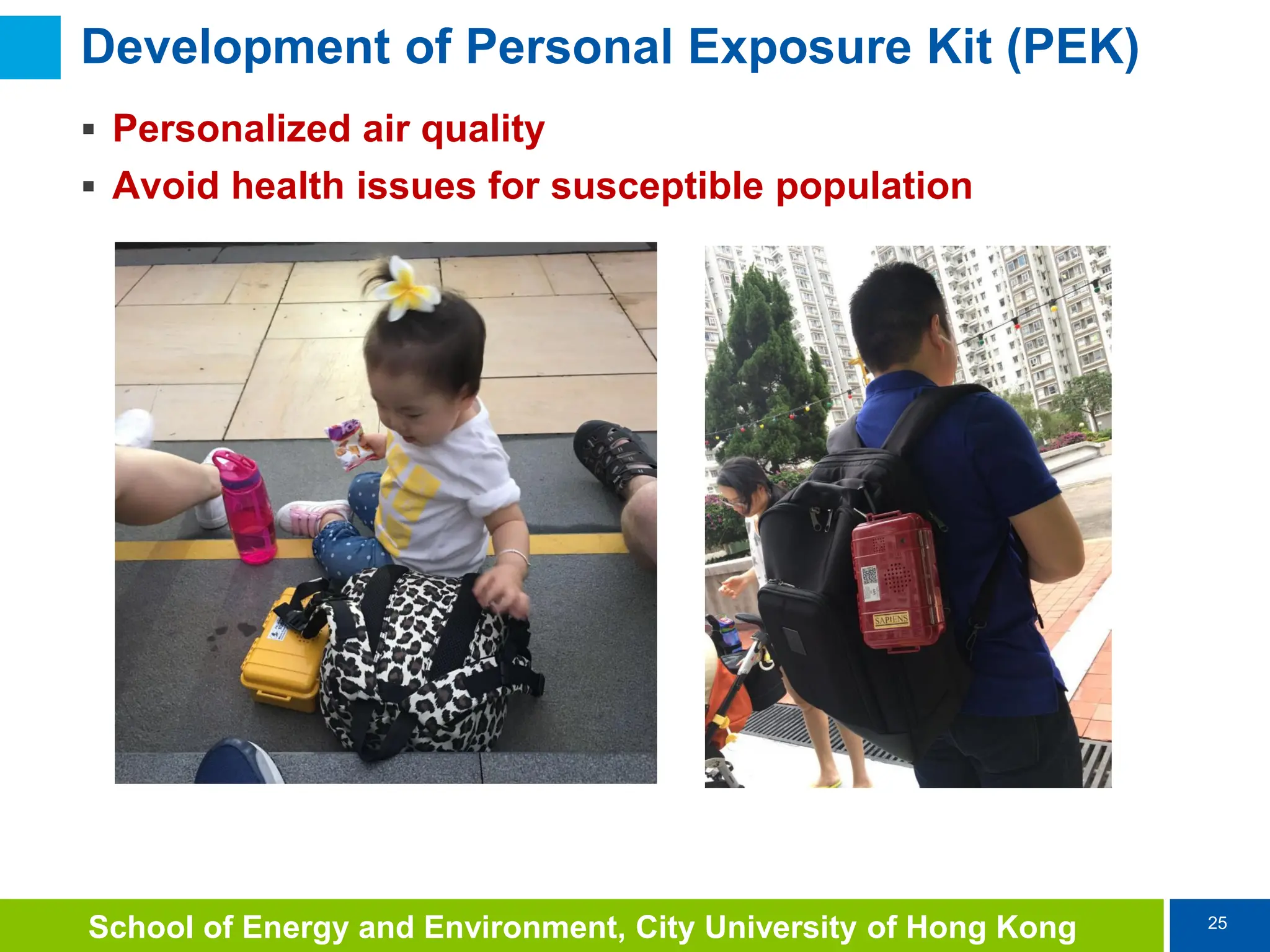
Development of Personal Exposure Kit (PEK)
 Personalized air quality
 Avoid health issues for susceptible population
26
School of Energy and Environment, City University of Hong Kong
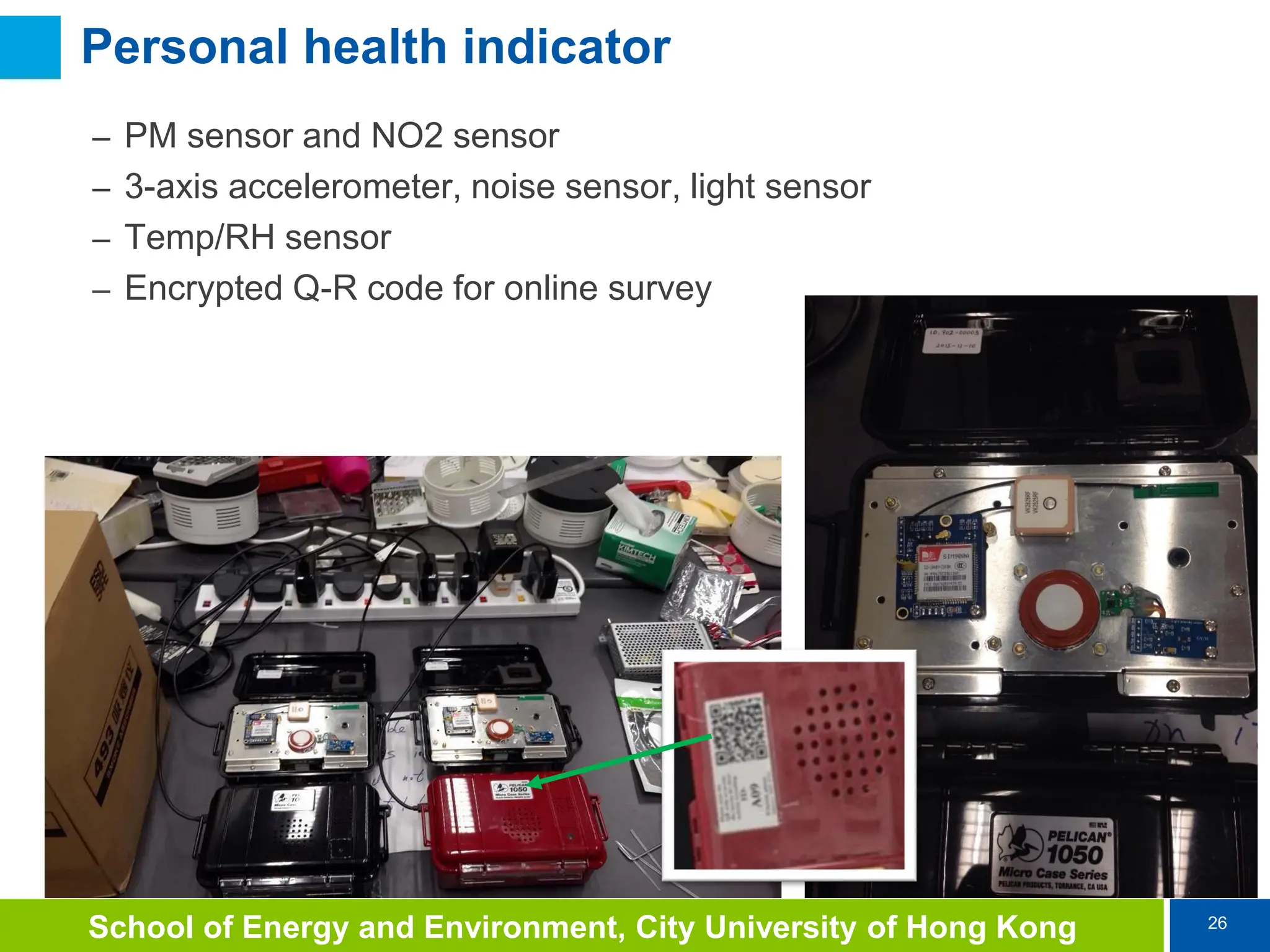
Personal health indicator
– PM sensor and NO2 sensor
– 3-axis accelerometer, noise sensor, light sensor
– Temp/RH sensor
– Encrypted Q-R code for online survey
27
School of Energy and Environment, City University of Hong Kong
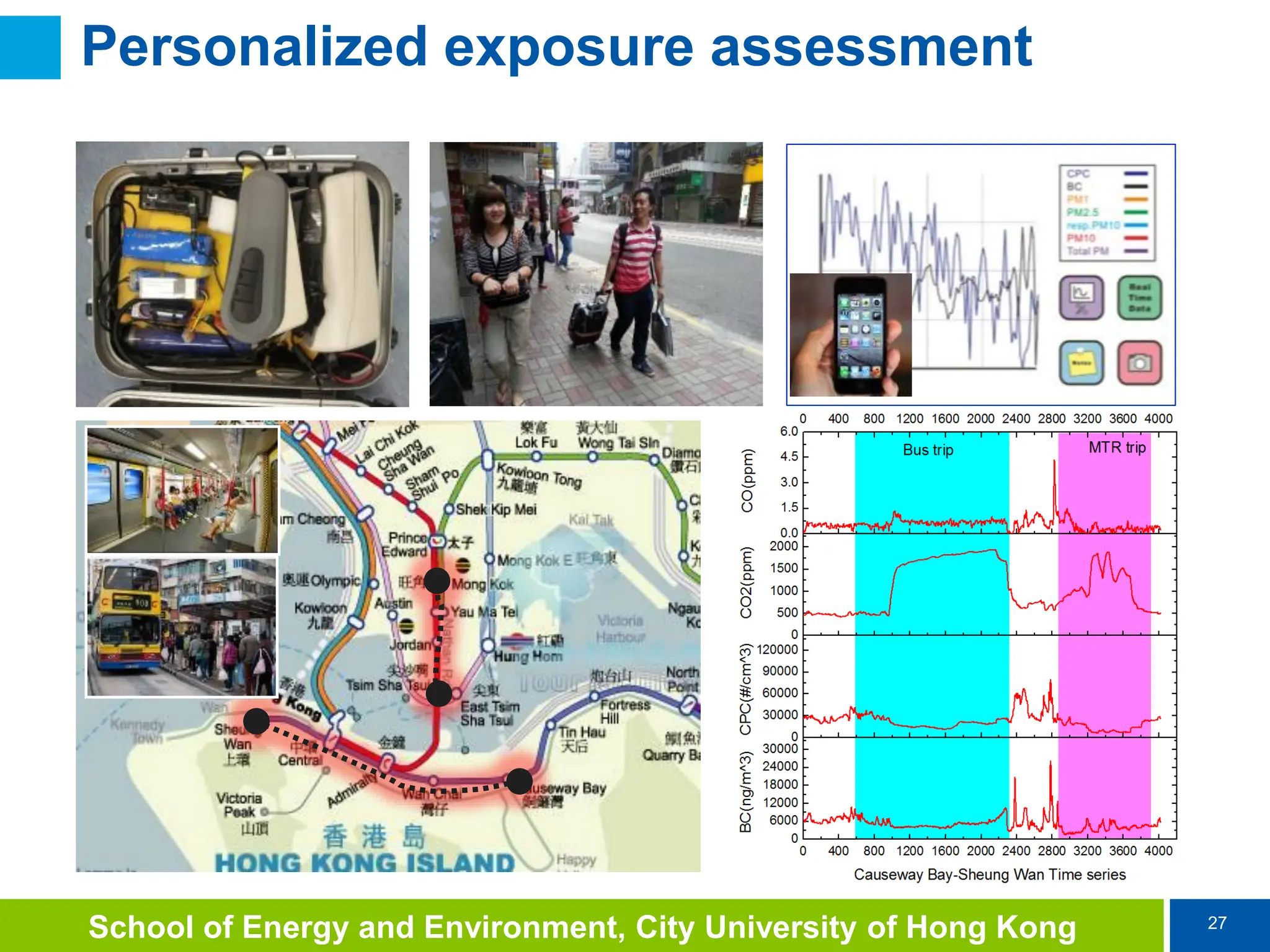
Personalized exposure assessment
28
School of Energy and Environment, City University of Hong Kong
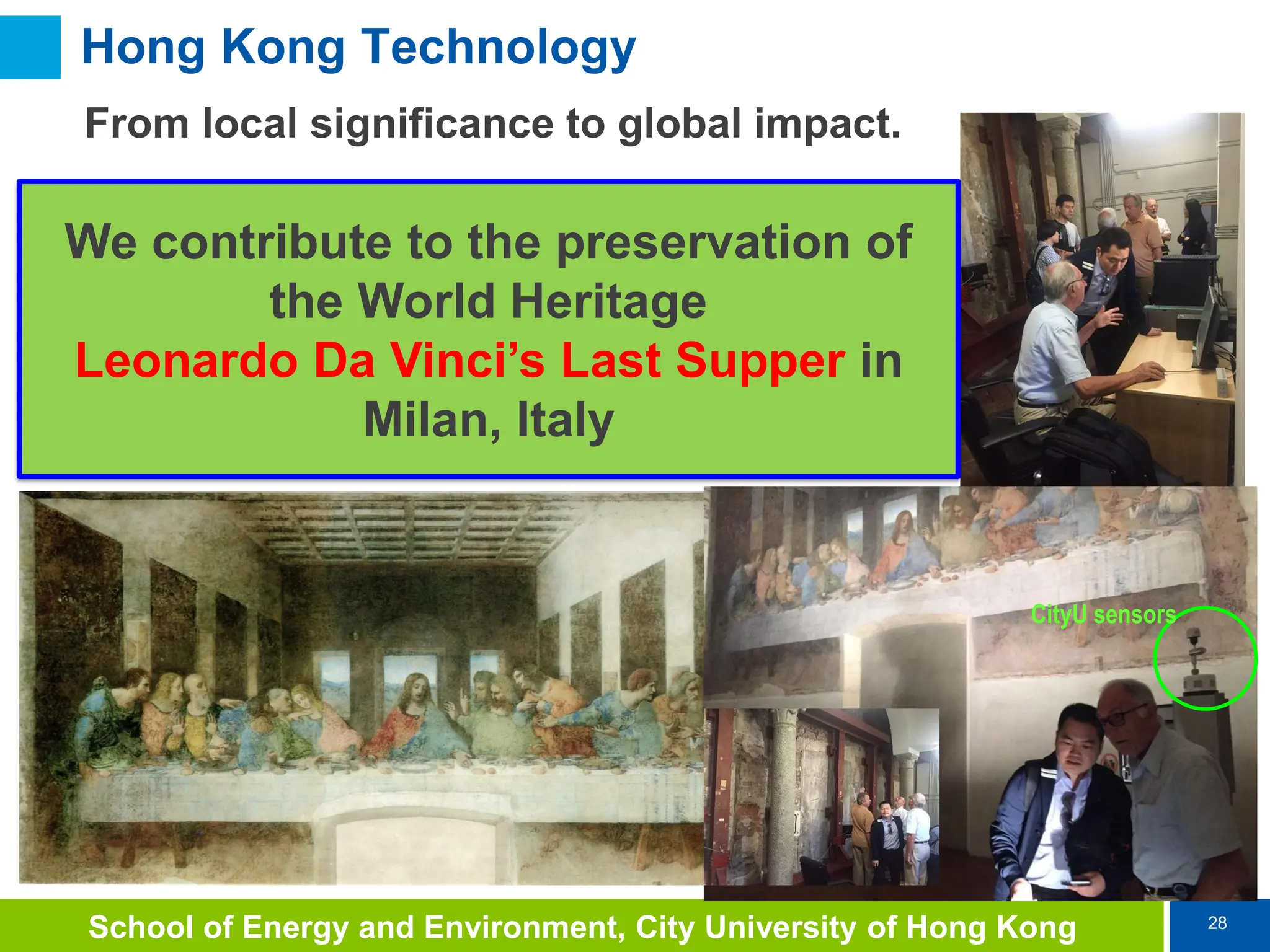
Hong Kong Technology
From local significance to global impact.
CityU sensors
We contribute to the preservation of
the World Heritage
Leonardo Da Vinci’s Last Supper in
Milan, Italy
29
School of Energy and Environment, City University of Hong Kong
Ending remark
 Internet of Things is powerful concept
 Huge potential for application in smart city,
energy, environment;
 Development of the sensing technology as
data source input for IoT;
 Environmental and energy applications.
Thanks!

19_Bigdasdsadsadsadasdasddsadsd Data.pdf

  • 1.
    Big Data –Application of Environmental Sensors for Building and Sustainable Environment Dr. Zhi Ning Deputy Director, Guy Carpenter Climate Change Centre Assistant Professor, School of Energy and Environment City University of Hong Kong EMSD Summit 2016 Innovate HK
  • 2.
    2 School of Energyand Environment, City University of Hong Kong Introduction
  • 3.
    3 School of Energyand Environment, City University of Hong Kong Introduction  Sensor based Internet of Things as a solution for air pollution and smart city application
  • 4.
    4 School of Energyand Environment, City University of Hong Kong Issues with current practice  High interest by public for more personalized info and by industry/government for more connected solutions as IoT Traditional monitoring equipment • High price and maintenance cost; • High precision but requires professionals. “Professional "sensors Lower cost but small, compact, easy for deployment; Less precision but good performance in certain range. Consumer grade sensors • Cheap and small for personal and family usage; • Indication purpose, not scientifically reliable.
  • 5.
    5 School of Energyand Environment, City University of Hong Kong Emerging technologies  Development of new materials  Advancement in MEMS  Nanotechnologies  More powerful computing in small size  Lighter, smaller and cheaper  Easy installation roadside to form network  Portable for easy application  Professional sensing technology  NO,NO2,O3,CO,SO2 ,CO2 and PM2.5/PM10  Benzene, VOC and others;
  • 6.
    6 School of Energyand Environment, City University of Hong Kong Emerging technologies Patents : PWG/PA/357/10/2013 (PRC, US); PWG/PA/302/7/2012 (PRC).  Dispersive infrared absorption spectroscopy (DIRS) for greenhouse gas (CO2) measurement MEMS Febry-Perot Interferometer • 3900-5000 nm • 10 nm resolution • 8 seconds per scan • +/- 0.8 ppm for 5 mins avg 6 If you have any questions, please contact Dr. Zhi Ning at zhining@cityu.edu.hk
  • 7.
    7 School of Energyand Environment, City University of Hong Kong A paradigm shift in environmental sensing “citizens’ observatories” to empower citizens to contribute to and participate in environmental governance,
  • 8.
    8 School of Energyand Environment, City University of Hong Kong Energy and environment applications Mobile Outdoor Indoor Personal Fixed site Roadside network I o T I : How to connect things and augment their impact to server energy and environmental applications; T: How to sense the environment more accurately and in smaller size.
  • 9.
    9 School of Energyand Environment, City University of Hong Kong Next generation sensor R&D  Flow chart of system development Sensor selection Sensor tests System design Circuit design OEM System integration System tests
  • 10.
    10 School of Energyand Environment, City University of Hong Kong Sensor test in lab  Specific test processes – Precision & linearity – Test limits – Long term drift – Temperature and RH – Comparisons with standard equipment 20 22 00 02 04 06 08 10 15 20 25 30 35 Sensor_Temp Adj_CO_Diff_1 CO_step_V (mV) Time -100 -50 0 50 100 150
  • 11.
    11 School of Energyand Environment, City University of Hong Kong 2015 HONG KONG INTERNATIONAL GREEN MARATHON AIR NETWORK
  • 12.
    12 School of Energyand Environment, City University of Hong Kong Marathon and athlete health  Athletes are more sensitive to the surrounding environment;  Air quality is a major concern of the media and public;  Lack of information creates health concern among participants.
  • 13.
    13 School of Energyand Environment, City University of Hong Kong 2015 SC Green Marathon network  On the day of Marathon
  • 14.
    14 School of Energyand Environment, City University of Hong Kong 2015 SC Green Marathon network
  • 15.
    15 School of Energyand Environment, City University of Hong Kong 2015 SC Green Marathon network
  • 16.
    16 School of Energyand Environment, City University of Hong Kong 0.4 0.6 0.8 1 1.2 3:07 4:19 5:31 6:43 7:55 9:07 10:19 11:31 12:43 CO/ ppm TST CO TST CO  Traffic control is effective to keep air pollution levels low before and during the race  After lifting traffic control a clear difference is shown in the roadside. 0 100 200 300 400 500 NO /ppb TST NO NOx Concentration before/after traffic control Passing-by motorcycles created spikes of CO
  • 17.
    17 School of Energyand Environment, City University of Hong Kong Campus network in CityU  Indoor and outdoor monitoring with cloud display • Temp/RH • CO2 • PM2.5 • NO/NO2 • TVOC • Formaldehyde • Wifi/GSM/Zigbee • Ethernet
  • 18.
    18 School of Energyand Environment, City University of Hong Kong Network data for energy usage  Ventilation and air conditioning system diagnostics 0 500 1000 1500 2000 2500 1 2 3 4 5 6 Carbon dioxide (PPM) Day week 1 week 2 26.5 27 27.5 28 28.5 29 29.5 0 200 400 600 800 1000 1200 1400 1600 1800 2000 0 1 2 3 4 5 6 7 8 9 10 11 12 13 14 15 16 17 18 19 20 21 22 23 temperature (C) carbon dioixde (ppm) Hour LT13_CO2 LT13_TEMP
  • 19.
    19 School of Energyand Environment, City University of Hong Kong 19 • Bus mobile sensor platform • Compact and multipollutant solutions for PM2.5,NO2, SO2,CO2 (traffic pollutants) • GPS, traffic speed, OBD data synchronization and real time transmission Internal external Bus platform for sensor network
  • 20.
    20 School of Energyand Environment, City University of Hong Kong Kowloon Tong to HK island Causeway Bay to Yuen Long • Real time pollution map from two routes • Roadway network emission and air quality modelling; • Hotspot identification and evidence based policy making Bus platform for sensor network
  • 21.
    21 School of Energyand Environment, City University of Hong Kong  Traffic data analysis combined analysis  Certain streets have different “pollutability” with street canyons, urban design features  Local transport policy will be cost effective: Impact of low emission zone? 21 Bar: traffic volume; Line: Pollutant Bus platform for sensor network
  • 22.
    22 School of Energyand Environment, City University of Hong Kong OGV ship emission and port area air quality
  • 23.
    23 School of Energyand Environment, City University of Hong Kong UAV based sensing platform  Carbon balance for ship emissions  Vertical profiling Path Radio Path and command USB cable, SDK Path and command Programming Data UART Wi-Fi Data
  • 24.
    24 School of Energyand Environment, City University of Hong Kong OGV ship emission and port area air quality  Will low sulfur fuel switch improve port and area air quality? And how much? SO2, NO2, PM2.5?  Is there any enforcement or evaluation tool for such policy implementation?
  • 25.
    25 School of Energyand Environment, City University of Hong Kong Development of Personal Exposure Kit (PEK)  Personalized air quality  Avoid health issues for susceptible population
  • 26.
    26 School of Energyand Environment, City University of Hong Kong Personal health indicator – PM sensor and NO2 sensor – 3-axis accelerometer, noise sensor, light sensor – Temp/RH sensor – Encrypted Q-R code for online survey
  • 27.
    27 School of Energyand Environment, City University of Hong Kong Personalized exposure assessment
  • 28.
    28 School of Energyand Environment, City University of Hong Kong Hong Kong Technology From local significance to global impact. CityU sensors We contribute to the preservation of the World Heritage Leonardo Da Vinci’s Last Supper in Milan, Italy
  • 29.
    29 School of Energyand Environment, City University of Hong Kong Ending remark  Internet of Things is powerful concept  Huge potential for application in smart city, energy, environment;  Development of the sensing technology as data source input for IoT;  Environmental and energy applications. Thanks!