

Get started with
SIGFOX
Iot Shifts, Barcelona — 2015.10.20
SIGFOX in a nutshell
About SIGFOX
• SIGFOX has invented a radiocommunication
protocol
• SIGFOX is operating a global network
• SIGFOX does not sell hardware components
• SIGFOX does not build connected solutions
Why SIGFOX
• Hub-based technologies are not compatible with
independent devices
• Need for a protocol designed for the IoT, and
not one tweaked to address it.
Ultra Narrow Band
• The SIGFOX protocol relies on the Ultra Narrow
Band technology, and a BPSK modulation
• A message : ~100Hz wide
• Each base station listens to a 200KHz part of the
spectrum
• Hard part: detect message without knowledge
of the precise frequency or schedule
Frequency used
• SIGFOX uses unlicensed sub-GHz bands :
• 868MHz in Europe
• 915MHz in the US
Unlicensed != unregulated
• SIGFOX complies with both ETSI (Europe) &
FCC (US) regulations
• ETSI : 1% duty cycle
• FCC : duration of emission
Core concepts
• Energy efficiency
• Very Long Range
• Out of the box connectivity
• Outdoor + Indoor
• Two-way communication
• Low bandwith, small messages
• Ultra Narrow Band
Energy efficiency
• Tx : ~25/30 mA pendant quelques secondes
• 99.x% of the time, device is silent
• Idle consumption is key
• Idle : a few µA
Very Long Range
• Countryside : 40, 50 kms
• Cities : A few kms
• Direct line of sight : wow !
Out of the box
• Network is serving the devices, not the other
way round
• Device simply sends a frame, message is
detected by n base stations
• Message is validated / deduplicated by our
backend
Outdoor + indoor
• 868MHz has good propagation properties
• But radio waves are not magic
• Consider ~20dB of attenuation indoor, and
~30dB for light underground or tricky buildings
Two-way communication
• No full duplex here
• Default behaviour: wake up, send, back to sleep
• No passive Rx mode
• Device can receive a message upon request
• Every communication is instigated by the device
Low bandwidth
• 100 bits / s
• 12 bytes per message
12 bytes !?
• Yes. Seriously. 12 bytes.
• This is the available payload.
• You can put a lot of info in 96 bits
• 2^96 is a 30ish-digit number.
• 8 billions of billions of billions of possible values
How frequently ?
• 140 times a day
Coverage
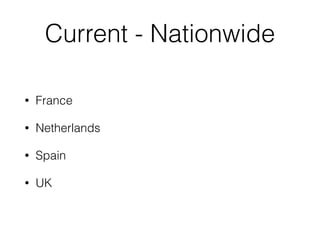
Current - Nationwide
• France
• Netherlands
• Spain
• UK
Rollout in progress
• Belgium
• Denmark
• Italy
• Luxembourg
• Portugal
Rollout in progress
• Belgium
• Denmark
• Italy
• Luxembourg
• Portugal
• USA
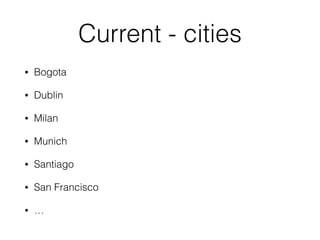
Current - cities
• Bogota
• Dublin
• Milan
• Munich
• Santiago
• San Francisco
• …
USA
• Currently: San Francisco
• Early 2016 : 10 majors cities, including Atlanta,
Boston, Chicago, Dallas, Houston, Los Angeles,
NY
• And we’re just starting :)
Use cases
Good use cases
• Not that talkative devices : small messages
every now and then
• Independent devices
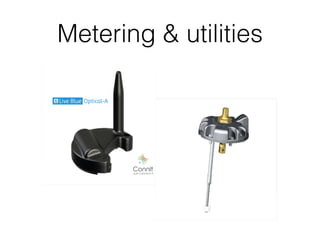
Metering & utilities
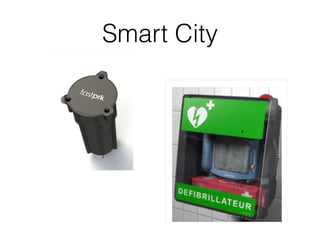
Smart City
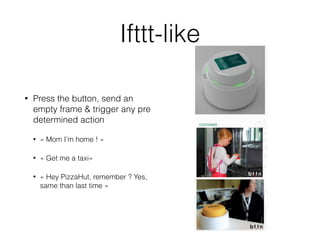
Ifttt-like
• Press the button, send an
empty frame & trigger any pre
determined action
• « Mom I’m home ! »
• « Get me a taxi»
• « Hey PizzaHut, remember ? Yes,
same than last time »
More
• Assisted .. and Predictive Maintenance
• Logistics : GPS Tracking
• Security
• Healthcare, stay-at-home people
DIY Projects
• Connected wine cellar. Because french.
• Connected cat food dispenser. Because cats.
• Kitchen garden: temperature, moisture, …
• GPS Tracking of anything
You ?
• You can build a PoC very quickly
• Lot of funny stuff to make
• And lot of $$$ to make too ;)
• KISS, dumb device means:
• Cheap
• Less prone to failure
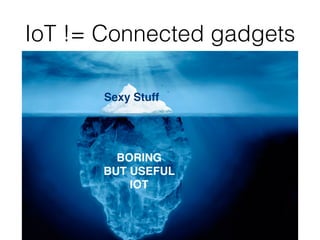
IoT != Connected gadgets
Sexy Stuff
BORING
BUT USEFUL
IOT
Hardware
Hardware SIGFOX
• SIGFOX is not a hardware vendor
• Many established partners offer SIGFOX-ready
chips: Atmel, TI, Silicon Labs, Axsem, Atim, …
• Most Sub-GHz radio transceivers are
compatible, it’s just about a software upgrade.
Prototyping
• Arduino : Snootlab, Atmel
• Raspberry Pi : Yadom
• Can be bought one unit a time
• Get started within minutes
• Not for industrial use
Modules
• Easy to work with : AT commands
• Price range from ~10 to 20€
• Evaluation boards available from
manufacturers : Adeunis, Telecom Design,
Telit, ..
SoC, transceivers
• TI CC1120, Atmel, SiLabs, Axsem, ..
• Cheap
• More complex to work with if not familiar
• Certification needed if you don’t stick to the
provided ref design.
Antenna
• Critical when doing radio
• 868MHz -> best case is 17cm (lambda/2)
• Helicoidal, patch, … antennas possible.
Data management
Get your data
• 3 ways
• View - website
• Pull - HTTP API
• Push - HTTP Callback
Common use case :
push callbacks
• Get notified each time of your devices send a
message
• Can trigger whatever you want : alarm,
notification, data processing, …
• Example here: http://github.com/nicolsc/sigfox-
callback-demo
Downlink
• Message sent to a device can be
• Automatic with a pre configuration
• Sent from your own server
Downlink auto
• Simply set what message you want to send back
• Hardcoded
• Time, Station ID, .. for sync purposes
Downlink callback
• Same mechanism than the uplink callback
• Set up an URL
• An when called, send your 8-byte frame within
the response body
Me
Nicolas Lesconnec
Developer & Maker Evangelist
nicolas.lesconnec@sigfox.com
http://makers.sigfox.com
Twitter: @nlesconnec
Github: @nicolsc

Get started with Sigfox - IoT Shifts 2015

  • 1.
    Get started with SIGFOX IotShifts, Barcelona — 2015.10.20
  • 2.
    SIGFOX in anutshell
  • 3.
    About SIGFOX • SIGFOXhas invented a radiocommunication protocol • SIGFOX is operating a global network • SIGFOX does not sell hardware components • SIGFOX does not build connected solutions
  • 4.
    Why SIGFOX • Hub-basedtechnologies are not compatible with independent devices • Need for a protocol designed for the IoT, and not one tweaked to address it.
  • 5.
    Ultra Narrow Band •The SIGFOX protocol relies on the Ultra Narrow Band technology, and a BPSK modulation • A message : ~100Hz wide • Each base station listens to a 200KHz part of the spectrum • Hard part: detect message without knowledge of the precise frequency or schedule
  • 6.
    Frequency used • SIGFOXuses unlicensed sub-GHz bands : • 868MHz in Europe • 915MHz in the US
  • 7.
    Unlicensed != unregulated •SIGFOX complies with both ETSI (Europe) & FCC (US) regulations • ETSI : 1% duty cycle • FCC : duration of emission
  • 8.
    Core concepts • Energyefficiency • Very Long Range • Out of the box connectivity • Outdoor + Indoor • Two-way communication • Low bandwith, small messages • Ultra Narrow Band
  • 9.
    Energy efficiency • Tx: ~25/30 mA pendant quelques secondes • 99.x% of the time, device is silent • Idle consumption is key • Idle : a few µA
  • 10.
    Very Long Range •Countryside : 40, 50 kms • Cities : A few kms • Direct line of sight : wow !
  • 11.
    Out of thebox • Network is serving the devices, not the other way round • Device simply sends a frame, message is detected by n base stations • Message is validated / deduplicated by our backend
  • 12.
    Outdoor + indoor •868MHz has good propagation properties • But radio waves are not magic • Consider ~20dB of attenuation indoor, and ~30dB for light underground or tricky buildings
  • 13.
    Two-way communication • Nofull duplex here • Default behaviour: wake up, send, back to sleep • No passive Rx mode • Device can receive a message upon request • Every communication is instigated by the device
  • 14.
    Low bandwidth • 100bits / s • 12 bytes per message
  • 15.
    12 bytes !? •Yes. Seriously. 12 bytes. • This is the available payload. • You can put a lot of info in 96 bits • 2^96 is a 30ish-digit number. • 8 billions of billions of billions of possible values
  • 16.
    How frequently ? •140 times a day
  • 17.
  • 18.
    Current - Nationwide •France • Netherlands • Spain • UK
  • 19.
    Rollout in progress •Belgium • Denmark • Italy • Luxembourg • Portugal
  • 20.
    Rollout in progress •Belgium • Denmark • Italy • Luxembourg • Portugal • USA
  • 21.
    Current - cities •Bogota • Dublin • Milan • Munich • Santiago • San Francisco • …
  • 22.
    USA • Currently: SanFrancisco • Early 2016 : 10 majors cities, including Atlanta, Boston, Chicago, Dallas, Houston, Los Angeles, NY • And we’re just starting :)
  • 23.
  • 24.
    Good use cases •Not that talkative devices : small messages every now and then • Independent devices
  • 25.
  • 26.
  • 27.
    Ifttt-like • Press thebutton, send an empty frame & trigger any pre determined action • « Mom I’m home ! » • « Get me a taxi» • « Hey PizzaHut, remember ? Yes, same than last time »
  • 28.
    More • Assisted ..and Predictive Maintenance • Logistics : GPS Tracking • Security • Healthcare, stay-at-home people
  • 29.
    DIY Projects • Connectedwine cellar. Because french. • Connected cat food dispenser. Because cats. • Kitchen garden: temperature, moisture, … • GPS Tracking of anything
  • 30.
    You ? • Youcan build a PoC very quickly • Lot of funny stuff to make • And lot of $$$ to make too ;) • KISS, dumb device means: • Cheap • Less prone to failure
  • 31.
    IoT != Connectedgadgets Sexy Stuff BORING BUT USEFUL IOT
  • 32.
  • 33.
    Hardware SIGFOX • SIGFOXis not a hardware vendor • Many established partners offer SIGFOX-ready chips: Atmel, TI, Silicon Labs, Axsem, Atim, … • Most Sub-GHz radio transceivers are compatible, it’s just about a software upgrade.
  • 34.
    Prototyping • Arduino :Snootlab, Atmel • Raspberry Pi : Yadom • Can be bought one unit a time • Get started within minutes • Not for industrial use
  • 35.
    Modules • Easy towork with : AT commands • Price range from ~10 to 20€ • Evaluation boards available from manufacturers : Adeunis, Telecom Design, Telit, ..
  • 36.
    SoC, transceivers • TICC1120, Atmel, SiLabs, Axsem, .. • Cheap • More complex to work with if not familiar • Certification needed if you don’t stick to the provided ref design.
  • 37.
    Antenna • Critical whendoing radio • 868MHz -> best case is 17cm (lambda/2) • Helicoidal, patch, … antennas possible.
  • 38.
  • 39.
    Get your data •3 ways • View - website • Pull - HTTP API • Push - HTTP Callback
  • 40.
    Common use case: push callbacks • Get notified each time of your devices send a message • Can trigger whatever you want : alarm, notification, data processing, … • Example here: http://github.com/nicolsc/sigfox- callback-demo
  • 41.
    Downlink • Message sentto a device can be • Automatic with a pre configuration • Sent from your own server
  • 42.
    Downlink auto • Simplyset what message you want to send back • Hardcoded • Time, Station ID, .. for sync purposes
  • 43.
    Downlink callback • Samemechanism than the uplink callback • Set up an URL • An when called, send your 8-byte frame within the response body
  • 44.
    Me Nicolas Lesconnec Developer &Maker Evangelist nicolas.lesconnec@sigfox.com http://makers.sigfox.com Twitter: @nlesconnec Github: @nicolsc