Quality Management and
Certification
Enseignante: Hayet Ben Said
E-mail:bensaidhayet@yahoo.fr
Description and Objectives of this course
Understand the key concepts of quality through a historical approach,
its definitions, as well as the study of its principles and tools.
Master the challenges of total quality.
Be able to use tools to promote quality in a company.
Module 1: History and Key Concepts of
Quality
Introduction
Section 1 – The Historical Approach to Quality
Section 2 – The Quality Gurus
Section 3 – Key Concepts of Quality
Module 1: History and Key Concepts of
Quality
• Section 1: The Historical Approach to Quality
1.Pre-industrial Era – Craftsmanship and Guilds
1. In this period, products were made by individual craftsmen who took full
responsibility for the quality of their work. A shoemaker, for example, would
be both the producer and quality controller of the shoes he made. Quality
was maintained through personal pride in craftsmanship. Guilds enforced
high standards by regulating apprenticeships and overseeing the quality of
goods produced within their trade.
Example: A blacksmith in the 17th century would inspect every item they
made and ensure its durability. They could repair or remake items that failed
to meet their personal standards or the guild's criteria.
Module 1: History and Key Concepts of
Quality
2 Industrial Revolution – The Shift to Mass Production
With the advent of factories in the 18th and 19th centuries, individual
craftsmanship gave way to mass production. This led to an increase in
the volume of products, but quality often suffered. In response,
companies began using inspection methods to catch defects at the end
of the production line, but this reactive approach led to higher waste
and inefficiency. Example: In a textile factory during the Industrial
Revolution, inspectors would review finished fabric rolls for any defects
like uneven weaves or missing threads, often leading to costly rework.
Module 1: History and Key Concepts of
Quality
3 Post-World War II – Statistical Quality Control (SQC)
After World War II, especially in Japan, there was a significant shift in
quality philosophy. W. Edwards Deming introduced statistical process
control (SPC), which emphasized measuring and controlling quality
during the production process, rather than just inspecting final products.
This proactive approach dramatically improved efficiency and product
quality.
Example: Toyota adopted Deming’s methods and applied statistical
control to their car manufacturing processes. By measuring quality at
every step of the assembly line, they could make adjustments in real
time, leading to the creation of the Toyota Production System.
Module 1: History and Key Concepts of
Quality
4 Total Quality Management (TQM) – A Holistic Approach
By the late 20th century, the concept of Total Quality Management
(TQM) emerged. TQM is a comprehensive, organization-wide approach
to continuous improvement, aiming to enhance all aspects of a
company's operations. It involves every employee in the quality
process, from executives to factory workers. Example: Motorola’s
adoption of Six Sigma, a data-driven TQM strategy, helped the
company reduce defects in their production processes. This led to
significant cost savings and increased customer satisfaction.
Module 1: History and Key Concepts of
Quality
• Section 2: The Quality Gurus
1 W. Edwards Deming – Continuous Improvement and Statistical
Process Control
1. Deming is best known for introducing the PDCA Cycle and his focus on
continuous improvement. He believed that quality should be a long-term
goal, not just an immediate fix. His work, especially in Japan, led to the rise of
companies like Toyota, which adopted his principles. Example: The PDCA
Cycle (Plan-Do-Check-Act) can be applied to any process. For instance, a
hospital might use it to reduce patient wait times by planning new scheduling
methods (Plan), testing them on a small scale (Do), analyzing the results
(Check), and then implementing successful changes across the board (Act).
Module 1: History and Key Concepts of
Quality
• Section 2: The Quality Gurus
1 W. Edwards Deming – Continuous Improvement and Statistical
Process Control
1. Deming is best known for introducing the PDCA Cycle and his focus on
continuous improvement. He believed that quality should be a long-term
goal, not just an immediate fix. His work, especially in Japan, led to the rise of
companies like Toyota, which adopted his principles. Example: The PDCA
Cycle (Plan-Do-Check-Act) can be applied to any process. For instance, a
hospital might use it to reduce patient wait times by planning new scheduling
methods (Plan), testing them on a small scale (Do), analyzing the results
(Check), and then implementing successful changes across the board (Act).
Module 1: History and Key Concepts of
Quality
2 Joseph M. Juran – The Juran Trilogy
• Juran expanded the focus of quality from the factory floor to all levels of an
organization. His Juran Trilogy—quality planning, quality control, and quality
improvement—provided a systematic approach(The systems approach refers
to a method of analysis, a way of treating a complex system with a global
point of view without focusin) on details. to improving business processes.
Example: A telecommunications company could use Juran’s Trilogy to ensure
quality in their customer service. First, they would plan by setting
performance standards (Quality Planning). Then, they would control by
monitoring actual service performance (Quality Control), and finally, they
would implement improvement strategies like staff training to fix identified
issues (Quality Improvement).
Module 1: History and Key Concepts of
Quality
3 Philip B. Crosby – Zero Defects
• Crosby is famous for his assertion that “quality is free”—meaning that
the cost of preventing defects is lower than the cost of fixing poor-
quality products. His Zero Defects concept encourages a mindset of
doing things right the first time. Example: An airline that adopts
Crosby’s approach might focus on ensuring that every safety check is
performed thoroughly and correctly. By preventing maintenance
issues before flights, they avoid costly delays, emergency repairs, and
potential safety hazards.
Module 1: History and Key Concepts of
Quality
4 Kaoru Ishikawa – The Fishbone Diagram and Quality Circles
•Ishikawa contributed tools like the Fishbone Diagram, also known
as the Ishikawa Diagram, to help identify the root causes of quality
problems. He also promoted Quality Circles, where workers are
encouraged to meet and discuss quality improvements. Example: A
bakery might use an Ishikawa Diagram to investigate why their bread
is often undercooked. They would analyze factors like oven
temperature, baking time, ingredient quality, and staff training,
ultimately solving the problem by adjusting the oven’s heat settings.
Module 1: History and Key Concepts of
Quality
5 Armand V. Feigenbaum – Total Quality Control (TQC)
• Feigenbaum’s Total Quality Control (TQC) emphasizes that quality is
everyone’s responsibility, not just the job of the quality control
department. He argued that all departments—marketing,
engineering, finance—must work together to achieve quality
objectives. Example: In an electronics company, the marketing
department ensures that customer requirements are clearly
communicated to product designers, and engineers design products
that meet these quality standards. The finance department also
ensures that the quality initiatives are adequately funded.
Module 1: History and Key Concepts of
Quality
Section 3: Key Concepts of Quality
1.Quality Assurance (QA) vs. Quality Control (QC)
1. QA is proactive and focuses on preventing defects by ensuring the right processes are followed
during production. QC, on the other hand, is reactive and focuses on identifying and correcting
defects after they occur.
Example: In a pharmaceutical company, QA ensures that the processes used to manufacture
drugs follow strict guidelines, while QC tests the final product to ensure that each batch meets
safety standards.
2.The PDCA Cycle (Plan-Do-Check-Act)
1. This cycle is central to continuous improvement. Organizations can use it to implement and
evaluate changes in their processes.
Example: A restaurant might use the PDCA cycle to improve customer service. They could Plan
by setting goals for reducing order errors, Do by training staff on new procedures, Check by
reviewing customer feedback, and Act by standardizing the successful methods.
Module 1: History and Key Concepts of
Quality
3The Cost of Quality (COQ)
The Cost of Quality refers to the total cost of ensuring quality and the cost incurred when
quality fails. These costs are divided into prevention costs, appraisal costs, and failure
costs.
Example: In the auto industry, preventing a defect by improving the design of a car seat is a
prevention cost, inspecting the seat during production is an appraisal cost, and repairing a
defective seat after it has reached the customer is a failure cost.
4Continuous Improvement (Kaizen)
Kaizen involves small, consistent improvements that compound over time. It’s a philosophy
that encourages all employees to suggest and implement changes.
Example: A retail chain might encourage store employees to suggest ways to improve
customer checkout times. Small changes, such as rearranging items near the counter, could
lead to noticeable improvements in efficiency.
Module 1: History and Key Concepts of
Quality
5 Customer Focus
1. Modern quality management revolves around meeting and exceeding
customer expectations.
Example: Apple has built its reputation on customer focus by designing
products that are both functional and aesthetically pleasing, continually
refining them based on user feedback.
6 Six Sigma
2. Six Sigma is a rigorous data-driven method that seeks to improve quality by
identifying and eliminating defects and minimizing variability in processes.
Example: GE (general electric)used Six Sigma to improve its manufacturing
processes by reducing defects to near-zero levels, which resulted in billions of
dollars in cost savings and increased customer satisfaction.
Module 1: History and Key Concepts of
Quality
Six Sigma is a method that provides organizations tools to
improve the capability of their business processes. This
increase in performance and decrease in process variation
helps lead to defect reduction and improvement in profits,
employee morale, and quality of products or services. See
https://www.youtube.com/watch?v=4EDYfSl-fmc
Module 1: History and Key Concepts of
Quality
• Break
Multiple-Choice Quiz (QCM)
1. Which of the following best describes the role of guilds in the pre-
industrial era?
A) They focused on mass production techniques.
B) They ensured quality through apprenticeships and standards of
craftsmanship.
C) They used statistical quality control methods.
D) They were the first to introduce the concept of continuous
improvement.
Module 1: History and Key Concepts of
Quality
2. What was the major shift in quality control during the
Industrial Revolution?
A) Quality was ensured through statistical process control.
B) Quality management was transferred from craftsmen to
inspectors at the end of the production line.
C) Companies began implementing Total Quality Management.
D) Continuous improvement became the main focus.
Module 1: History and Key Concepts of
Quality
3 Who is credited with introducing the PDCA (Plan-Do-
Check-Act) cycle?
A) Joseph Juran
B) Philip Crosby
C) W. Edwards Deming
D) Kaoru Ishikawa
Module 1: History and Key Concepts of
Quality
4. Which of the following is a key contribution of Joseph M. Juran?
A) The introduction of the PDCA cycle.
B) The concept of “Zero Defects.”
C) The creation of the Fishbone Diagram.
D) The development of the Juran Trilogy: quality planning, quality control, and
quality improvement.
5 What does Philip Crosby mean by “quality is free”?
A) Quality comes at no cost to the company.
B) The cost of preventing defects is lower than the cost of fixing them later.
C) Quality management systems should not be expensive to implement.
D) Companies should aim for low-cost products with high quality.
Module 1: History and Key Concepts of
Quality
6 Which tool is Kaoru Ishikawa known for creating?
A) The PDCA cycle
B) The Fishbone (or Ishikawa) Diagram
C) The Juran Trilogy
D) Six Sigma methodology
Module 1: History and Key Concepts of
Quality
7. What is the main focus of Total Quality Management (TQM)?
• A) Inspecting products after production to ensure they are defect-
free.
B) Continuous improvement involving everyone in the organization.
C) Using statistical tools to control product quality.
D) Reducing production costs through automation.
Module 1: History and Key Concepts of
Quality
8 What is the primary difference between Quality Assurance (QA) and
Quality Control (QC)?
A) QA is reactive, while QC is proactive.
B) QA focuses on preventing defects, while QC focuses on identifying
and correcting defects.
C) QC is used in manufacturing, while QA is used in service industries.
D) QA ensures customer satisfaction, while QC ensures product design
meets specifications.
Module 1: History and Key Concepts of
Quality
9 Which of the following best describes Six Sigma?
A) A method focused on achieving “Zero Defects.”
B) A quality management philosophy that focuses on customer
satisfaction.
C) A data-driven approach that seeks to improve processes by reducing
variation and defects.
D) A set of statistical tools used exclusively in manufacturing industries.
Module 1: History and Key Concepts of
Quality
10 What is the purpose of the PDCA cycle in quality management?
A) To reactively fix issues found during production.
B) To encourage all employees to participate in improving quality.
C) To plan, test, check, and act on improvements in a continuous loop.
D) To manage the costs of quality control.
Module 1: History and Key Concepts of
Quality
11 The concept of Kaizen refers to which of the following?
A) A data-driven approach to reducing defects.
B) The prevention of defects by adhering to strict standards.
C) Continuous, incremental improvement in all aspects of a business.
D) The appraisal of final products to ensure they meet customer
requirements.
Module 1: History and Key Concepts of
Quality
12 What does the "Cost of Quality" (COQ) refer to?
A) The cost of ensuring high-quality products in the market.
B) The financial impact of not meeting customer expectations.
C) The total cost of ensuring quality, including prevention, appraisal,
and failure costs.
D) The cost of replacing defective products under warranty.
Module 1: History and Key Concepts of
Quality
13 Which of the following is the correct order of the Juran Trilogy?
A) Quality control, quality improvement, quality planning
B) Quality planning, quality control, quality improvement
C) Quality improvement, quality control, quality assurance
D) Quality control, quality assurance, quality improvement
Module 1: History and Key Concepts of
Quality
14 What is the primary purpose of the Ishikawa (Fishbone) Diagram?
A) To identify the key metrics for quality control
B) To ensure statistical control of production processes
C) To determine the root causes of a problem
D) To assess customer satisfaction levels
Module 1: History and Key Concepts of
Quality
15. Which quality guru is associated with the concept of "Zero
Defects"?
A) W. Edwards Deming
B) Joseph M. Juran
C) Philip B. Crosby
D) Armand V. Feigenbaum
Module 1: History and Key Concepts of
Quality
16. In which of the following industries did Six Sigma first become
widely used?
A) Automotive
B) Telecommunications
C) Electronics
D) Healthcare
Module 1: History and Key Concepts of
Quality
17. The term "Kaizen" is most closely related to which quality
management principle?
A) Total Quality Control
B) Continuous Improvement
C) Zero Defects
D) Statistical Process Control
Module 1: History and Key Concepts of
Quality
18. What is one of the key principles of Total Quality Management
(TQM)?
A) Only the quality department is responsible for ensuring quality.
B) Quality is only assessed at the end of the production process.
C) Quality is the responsibility of everyone in the organization.
D) The focus is only on product quality, not on customer satisfaction.
Module 1: History and Key Concepts of
Quality
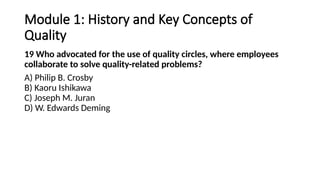
19 Who advocated for the use of quality circles, where employees
collaborate to solve quality-related problems?
A) Philip B. Crosby
B) Kaoru Ishikawa
C) Joseph M. Juran
D) W. Edwards Deming
Module 1: History and Key Concepts of
Quality
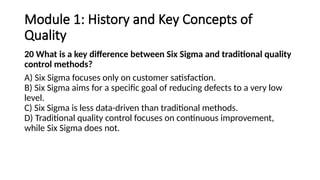
20 What is a key difference between Six Sigma and traditional quality
control methods?
A) Six Sigma focuses only on customer satisfaction.
B) Six Sigma aims for a specific goal of reducing defects to a very low
level.
C) Six Sigma is less data-driven than traditional methods.
D) Traditional quality control focuses on continuous improvement,
while Six Sigma does not.
Module 1: History and Key Concepts of
Quality
21 According to W. Edwards Deming, which of the following is a
critical element for improving quality in an organization?
A) Focus on external failures rather than prevention
B) Sole reliance on inspection for quality control
C) Leadership's responsibility for driving quality improvement
D) Prioritizing production speed over quality
Module 1: History and Key Concepts of
Quality
22 Which of the following best describes the concept of "prevention
costs" in the Cost of Quality (COQ) framework?
A) Costs incurred after a product is delivered to the customer
B) Costs related to inspecting finished goods
C) Costs involved in preventing defects before they occur
D) Costs of reworking defective products
Module 1: History and Key Concepts of
Quality
23. How does Quality Assurance (QA) differ from Quality Control
(QC)?
A) QA focuses on inspecting products after they are made, while QC
focuses on preventing defects.
B) QA focuses on managing processes to prevent defects, while QC
focuses on detecting defects in finished products.
C) QA is performed by workers, while QC is managed by executives.
D) QA and QC are essentially the same, with no practical differences.
Module 1: History and Key Concepts of
Quality
24. Which concept refers to a data-driven approach that seeks to
minimize variation and defects in processes?
A) Kaizen
B) Total Quality Control (TQC)
C) Six Sigma
D) Zero Defects
Module 1: History and Key Concepts of
Quality
25. Which of the following tools is most likely to be used when
identifying the root cause of a quality problem?
A) PDCA Cycle
B) Six Sigma
C) Ishikawa Diagram
D) Juran Trilogy
Module 1: History and Key Concepts of
Quality
26. Which of the following accurately describes the "appraisal costs"
in the Cost of Quality (COQ) model?
A) Costs associated with preventing defects before they happen.
B) Costs incurred to identify and fix defects after production.
C) Costs related to evaluating or inspecting products to ensure they
meet quality standards.
D) Costs incurred by the customer due to a defective product.
Module 1: History and Key Concepts of
Quality
27. What is the main goal of Total Quality Control (TQC) as defined by
Armand V. Feigenbaum?
A) Ensuring that only the quality department is responsible for product
defects
B) Focusing solely on product inspection at the end of the production
line
C) Engaging all departments and employees in the process of quality
improvement
D) Reducing costs by eliminating customer complaints
Module 1: History and Key Concepts of
Quality
28. What is the ultimate goal of the "Zero Defects" philosophy
introduced by Philip Crosby?
A) To focus on customer satisfaction by delivering defect-free products.
B) To minimize defects to a statistically acceptable level.
C) To inspect products at the end of production and fix any problems
found.
D) To improve productivity by reducing costs and ignoring minor
defects.
Module 1: History and Key Concepts of
Quality
• Answers
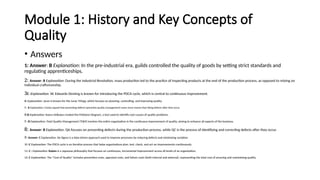
1: Answer: B Explanation: In the pre-industrial era, guilds controlled the quality of goods by setting strict standards and
regulating apprenticeships.
2: Answer: B Explanation: During the Industrial Revolution, mass production led to the practice of inspecting products at the end of the production process, as opposed to relying on
individual craftsmanship.
3C :Explanation: W. Edwards Deming is known for introducing the PDCA cycle, which is central to continuous improvement.
4: Explanation: Juran is known for the Juran Trilogy, which focuses on planning, controlling, and improving quality.
5 : B Explanation: Crosby argued that preventing defects (proactive quality management) saves more money than fixing defects after they occur.
6:B Explanation: Kaoru Ishikawa created the Fishbone Diagram, a tool used to identify root causes of quality problems.
7 : B Explanation: Total Quality Management (TQM) involves the entire organization in the continuous improvement of quality, aiming to enhance all aspects of the business.
8: Answer: B Explanation: QA focuses on preventing defects during the production process, while QC is the process of identifying and correcting defects after they occur.
9: Answer: C Explanation: Six Sigma is a data-driven approach used to improve processes by reducing defects and minimizing variation.
10 :C Explanation: The PDCA cycle is an iterative process that helps organizations plan, test, check, and act on improvements continuously.
11: C : Explanation: Kaizen is a Japanese philosophy that focuses on continuous, incremental improvement across all levels of an organization.
12: C Explanation: The "Cost of Quality" includes prevention costs, appraisal costs, and failure costs (both internal and external), representing the total cost of ensuring and maintaining quality.
Module 1: History and Key Concepts of
Quality
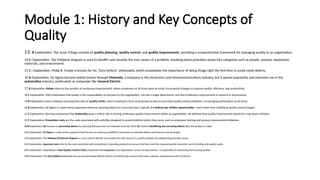
13: B Explanation: The Juran Trilogy consists of quality planning, quality control, and quality improvement, providing a comprehensive framework for managing quality in an organization.
14 C: Explanation: The Fishbone Diagram is used to identify and visualize the root causes of a problem, breaking down potential causes into categories such as people, process, equipment,
materials, and environment.
15 C : Explanation: Philip B. Crosby is known for his “Zero Defects” philosophy, which emphasizes the importance of doing things right the first time to avoid costly defects.
16 A Explanation: Six Sigma became widely known through Motorola, a company in the electronics and telecommunications industry, but it gained popularity and extensive use in the
automotive industry, particularly at companies like General Electric.
17 B Explanation: Kaizen refers to the practice of continuous improvement, where employees at all levels work on small, incremental changes to improve quality, efficiency, and productivity.
18 C Explanation: TQM emphasizes that quality is the responsibility of everyone in the organization, not just a single department, and that continuous improvement is required in all processes.
19 B Explanation: Kaoru Ishikawa promoted the idea of quality circles, where employees form small groups to discuss and solve quality-related problems, encouraging participation at all levels.
20 B Explanation: Six Sigma is a data-driven approach aimed at reducing defects to a very low level, typically 3.4 defects per million opportunities, much lower than traditional quality control targets.
21 C Explanation: Deming emphasized that leadership plays a critical role in driving continuous quality improvement within an organization. He believed that quality improvement should be a top-down initiative.
22 C Explanation: Prevention costs are the costs associated with activities designed to prevent defects before they occur, such as employee training and process improvement initiatives.
23 B Explanation: QA focuses on preventing defects by ensuring that processes are followed correctly, while QC involves identifying and correcting defects after the product is made.
24 C Explanation: Six Sigma is a data-driven approach that focuses on reducing variability in processes to minimize defects and improve overall quality.
25 C Explanation: The Ishikawa (Fishbone) Diagram is a tool used to identify and analyze the root causes of a quality problem by categorizing potential causes.
26 C Explanation: Appraisal costs refer to the costs associated with evaluating or inspecting products to ensure that they meet the required quality standards, such as testing and quality audits.
27 C Explanation: Feigenbaum’s Total Quality Control (TQC) emphasizes that everyone in an organization, across all departments, is responsible for improving and ensuring quality.
28 A Explanation: The Zero Defects philosophy focuses on preventing defects entirely and delivering products that meet customer requirements with no defects.

gestion de la qualite au sein de lorganisation

  • 1.
    Quality Management and Certification Enseignante:Hayet Ben Said E-mail:bensaidhayet@yahoo.fr
  • 2.
    Description and Objectivesof this course Understand the key concepts of quality through a historical approach, its definitions, as well as the study of its principles and tools. Master the challenges of total quality. Be able to use tools to promote quality in a company.
  • 3.
    Module 1: Historyand Key Concepts of Quality Introduction Section 1 – The Historical Approach to Quality Section 2 – The Quality Gurus Section 3 – Key Concepts of Quality
  • 4.
    Module 1: Historyand Key Concepts of Quality • Section 1: The Historical Approach to Quality 1.Pre-industrial Era – Craftsmanship and Guilds 1. In this period, products were made by individual craftsmen who took full responsibility for the quality of their work. A shoemaker, for example, would be both the producer and quality controller of the shoes he made. Quality was maintained through personal pride in craftsmanship. Guilds enforced high standards by regulating apprenticeships and overseeing the quality of goods produced within their trade. Example: A blacksmith in the 17th century would inspect every item they made and ensure its durability. They could repair or remake items that failed to meet their personal standards or the guild's criteria.
  • 5.
    Module 1: Historyand Key Concepts of Quality 2 Industrial Revolution – The Shift to Mass Production With the advent of factories in the 18th and 19th centuries, individual craftsmanship gave way to mass production. This led to an increase in the volume of products, but quality often suffered. In response, companies began using inspection methods to catch defects at the end of the production line, but this reactive approach led to higher waste and inefficiency. Example: In a textile factory during the Industrial Revolution, inspectors would review finished fabric rolls for any defects like uneven weaves or missing threads, often leading to costly rework.
  • 6.
    Module 1: Historyand Key Concepts of Quality 3 Post-World War II – Statistical Quality Control (SQC) After World War II, especially in Japan, there was a significant shift in quality philosophy. W. Edwards Deming introduced statistical process control (SPC), which emphasized measuring and controlling quality during the production process, rather than just inspecting final products. This proactive approach dramatically improved efficiency and product quality. Example: Toyota adopted Deming’s methods and applied statistical control to their car manufacturing processes. By measuring quality at every step of the assembly line, they could make adjustments in real time, leading to the creation of the Toyota Production System.
  • 7.
    Module 1: Historyand Key Concepts of Quality 4 Total Quality Management (TQM) – A Holistic Approach By the late 20th century, the concept of Total Quality Management (TQM) emerged. TQM is a comprehensive, organization-wide approach to continuous improvement, aiming to enhance all aspects of a company's operations. It involves every employee in the quality process, from executives to factory workers. Example: Motorola’s adoption of Six Sigma, a data-driven TQM strategy, helped the company reduce defects in their production processes. This led to significant cost savings and increased customer satisfaction.
  • 8.
    Module 1: Historyand Key Concepts of Quality • Section 2: The Quality Gurus 1 W. Edwards Deming – Continuous Improvement and Statistical Process Control 1. Deming is best known for introducing the PDCA Cycle and his focus on continuous improvement. He believed that quality should be a long-term goal, not just an immediate fix. His work, especially in Japan, led to the rise of companies like Toyota, which adopted his principles. Example: The PDCA Cycle (Plan-Do-Check-Act) can be applied to any process. For instance, a hospital might use it to reduce patient wait times by planning new scheduling methods (Plan), testing them on a small scale (Do), analyzing the results (Check), and then implementing successful changes across the board (Act).
  • 9.
    Module 1: Historyand Key Concepts of Quality • Section 2: The Quality Gurus 1 W. Edwards Deming – Continuous Improvement and Statistical Process Control 1. Deming is best known for introducing the PDCA Cycle and his focus on continuous improvement. He believed that quality should be a long-term goal, not just an immediate fix. His work, especially in Japan, led to the rise of companies like Toyota, which adopted his principles. Example: The PDCA Cycle (Plan-Do-Check-Act) can be applied to any process. For instance, a hospital might use it to reduce patient wait times by planning new scheduling methods (Plan), testing them on a small scale (Do), analyzing the results (Check), and then implementing successful changes across the board (Act).
  • 10.
    Module 1: Historyand Key Concepts of Quality 2 Joseph M. Juran – The Juran Trilogy • Juran expanded the focus of quality from the factory floor to all levels of an organization. His Juran Trilogy—quality planning, quality control, and quality improvement—provided a systematic approach(The systems approach refers to a method of analysis, a way of treating a complex system with a global point of view without focusin) on details. to improving business processes. Example: A telecommunications company could use Juran’s Trilogy to ensure quality in their customer service. First, they would plan by setting performance standards (Quality Planning). Then, they would control by monitoring actual service performance (Quality Control), and finally, they would implement improvement strategies like staff training to fix identified issues (Quality Improvement).
  • 11.
    Module 1: Historyand Key Concepts of Quality 3 Philip B. Crosby – Zero Defects • Crosby is famous for his assertion that “quality is free”—meaning that the cost of preventing defects is lower than the cost of fixing poor- quality products. His Zero Defects concept encourages a mindset of doing things right the first time. Example: An airline that adopts Crosby’s approach might focus on ensuring that every safety check is performed thoroughly and correctly. By preventing maintenance issues before flights, they avoid costly delays, emergency repairs, and potential safety hazards.
  • 12.
    Module 1: Historyand Key Concepts of Quality 4 Kaoru Ishikawa – The Fishbone Diagram and Quality Circles •Ishikawa contributed tools like the Fishbone Diagram, also known as the Ishikawa Diagram, to help identify the root causes of quality problems. He also promoted Quality Circles, where workers are encouraged to meet and discuss quality improvements. Example: A bakery might use an Ishikawa Diagram to investigate why their bread is often undercooked. They would analyze factors like oven temperature, baking time, ingredient quality, and staff training, ultimately solving the problem by adjusting the oven’s heat settings.
  • 13.
    Module 1: Historyand Key Concepts of Quality 5 Armand V. Feigenbaum – Total Quality Control (TQC) • Feigenbaum’s Total Quality Control (TQC) emphasizes that quality is everyone’s responsibility, not just the job of the quality control department. He argued that all departments—marketing, engineering, finance—must work together to achieve quality objectives. Example: In an electronics company, the marketing department ensures that customer requirements are clearly communicated to product designers, and engineers design products that meet these quality standards. The finance department also ensures that the quality initiatives are adequately funded.
  • 14.
    Module 1: Historyand Key Concepts of Quality Section 3: Key Concepts of Quality 1.Quality Assurance (QA) vs. Quality Control (QC) 1. QA is proactive and focuses on preventing defects by ensuring the right processes are followed during production. QC, on the other hand, is reactive and focuses on identifying and correcting defects after they occur. Example: In a pharmaceutical company, QA ensures that the processes used to manufacture drugs follow strict guidelines, while QC tests the final product to ensure that each batch meets safety standards. 2.The PDCA Cycle (Plan-Do-Check-Act) 1. This cycle is central to continuous improvement. Organizations can use it to implement and evaluate changes in their processes. Example: A restaurant might use the PDCA cycle to improve customer service. They could Plan by setting goals for reducing order errors, Do by training staff on new procedures, Check by reviewing customer feedback, and Act by standardizing the successful methods.
  • 15.
    Module 1: Historyand Key Concepts of Quality 3The Cost of Quality (COQ) The Cost of Quality refers to the total cost of ensuring quality and the cost incurred when quality fails. These costs are divided into prevention costs, appraisal costs, and failure costs. Example: In the auto industry, preventing a defect by improving the design of a car seat is a prevention cost, inspecting the seat during production is an appraisal cost, and repairing a defective seat after it has reached the customer is a failure cost. 4Continuous Improvement (Kaizen) Kaizen involves small, consistent improvements that compound over time. It’s a philosophy that encourages all employees to suggest and implement changes. Example: A retail chain might encourage store employees to suggest ways to improve customer checkout times. Small changes, such as rearranging items near the counter, could lead to noticeable improvements in efficiency.
  • 16.
    Module 1: Historyand Key Concepts of Quality 5 Customer Focus 1. Modern quality management revolves around meeting and exceeding customer expectations. Example: Apple has built its reputation on customer focus by designing products that are both functional and aesthetically pleasing, continually refining them based on user feedback. 6 Six Sigma 2. Six Sigma is a rigorous data-driven method that seeks to improve quality by identifying and eliminating defects and minimizing variability in processes. Example: GE (general electric)used Six Sigma to improve its manufacturing processes by reducing defects to near-zero levels, which resulted in billions of dollars in cost savings and increased customer satisfaction.
  • 17.
    Module 1: Historyand Key Concepts of Quality Six Sigma is a method that provides organizations tools to improve the capability of their business processes. This increase in performance and decrease in process variation helps lead to defect reduction and improvement in profits, employee morale, and quality of products or services. See https://www.youtube.com/watch?v=4EDYfSl-fmc
  • 18.
    Module 1: Historyand Key Concepts of Quality • Break Multiple-Choice Quiz (QCM) 1. Which of the following best describes the role of guilds in the pre- industrial era? A) They focused on mass production techniques. B) They ensured quality through apprenticeships and standards of craftsmanship. C) They used statistical quality control methods. D) They were the first to introduce the concept of continuous improvement.
  • 19.
    Module 1: Historyand Key Concepts of Quality 2. What was the major shift in quality control during the Industrial Revolution? A) Quality was ensured through statistical process control. B) Quality management was transferred from craftsmen to inspectors at the end of the production line. C) Companies began implementing Total Quality Management. D) Continuous improvement became the main focus.
  • 20.
    Module 1: Historyand Key Concepts of Quality 3 Who is credited with introducing the PDCA (Plan-Do- Check-Act) cycle? A) Joseph Juran B) Philip Crosby C) W. Edwards Deming D) Kaoru Ishikawa
  • 21.
    Module 1: Historyand Key Concepts of Quality 4. Which of the following is a key contribution of Joseph M. Juran? A) The introduction of the PDCA cycle. B) The concept of “Zero Defects.” C) The creation of the Fishbone Diagram. D) The development of the Juran Trilogy: quality planning, quality control, and quality improvement. 5 What does Philip Crosby mean by “quality is free”? A) Quality comes at no cost to the company. B) The cost of preventing defects is lower than the cost of fixing them later. C) Quality management systems should not be expensive to implement. D) Companies should aim for low-cost products with high quality.
  • 22.
    Module 1: Historyand Key Concepts of Quality 6 Which tool is Kaoru Ishikawa known for creating? A) The PDCA cycle B) The Fishbone (or Ishikawa) Diagram C) The Juran Trilogy D) Six Sigma methodology
  • 23.
    Module 1: Historyand Key Concepts of Quality 7. What is the main focus of Total Quality Management (TQM)? • A) Inspecting products after production to ensure they are defect- free. B) Continuous improvement involving everyone in the organization. C) Using statistical tools to control product quality. D) Reducing production costs through automation.
  • 24.
    Module 1: Historyand Key Concepts of Quality 8 What is the primary difference between Quality Assurance (QA) and Quality Control (QC)? A) QA is reactive, while QC is proactive. B) QA focuses on preventing defects, while QC focuses on identifying and correcting defects. C) QC is used in manufacturing, while QA is used in service industries. D) QA ensures customer satisfaction, while QC ensures product design meets specifications.
  • 25.
    Module 1: Historyand Key Concepts of Quality 9 Which of the following best describes Six Sigma? A) A method focused on achieving “Zero Defects.” B) A quality management philosophy that focuses on customer satisfaction. C) A data-driven approach that seeks to improve processes by reducing variation and defects. D) A set of statistical tools used exclusively in manufacturing industries.
  • 26.
    Module 1: Historyand Key Concepts of Quality 10 What is the purpose of the PDCA cycle in quality management? A) To reactively fix issues found during production. B) To encourage all employees to participate in improving quality. C) To plan, test, check, and act on improvements in a continuous loop. D) To manage the costs of quality control.
  • 27.
    Module 1: Historyand Key Concepts of Quality 11 The concept of Kaizen refers to which of the following? A) A data-driven approach to reducing defects. B) The prevention of defects by adhering to strict standards. C) Continuous, incremental improvement in all aspects of a business. D) The appraisal of final products to ensure they meet customer requirements.
  • 28.
    Module 1: Historyand Key Concepts of Quality 12 What does the "Cost of Quality" (COQ) refer to? A) The cost of ensuring high-quality products in the market. B) The financial impact of not meeting customer expectations. C) The total cost of ensuring quality, including prevention, appraisal, and failure costs. D) The cost of replacing defective products under warranty.
  • 29.
    Module 1: Historyand Key Concepts of Quality 13 Which of the following is the correct order of the Juran Trilogy? A) Quality control, quality improvement, quality planning B) Quality planning, quality control, quality improvement C) Quality improvement, quality control, quality assurance D) Quality control, quality assurance, quality improvement
  • 30.
    Module 1: Historyand Key Concepts of Quality 14 What is the primary purpose of the Ishikawa (Fishbone) Diagram? A) To identify the key metrics for quality control B) To ensure statistical control of production processes C) To determine the root causes of a problem D) To assess customer satisfaction levels
  • 31.
    Module 1: Historyand Key Concepts of Quality 15. Which quality guru is associated with the concept of "Zero Defects"? A) W. Edwards Deming B) Joseph M. Juran C) Philip B. Crosby D) Armand V. Feigenbaum
  • 32.
    Module 1: Historyand Key Concepts of Quality 16. In which of the following industries did Six Sigma first become widely used? A) Automotive B) Telecommunications C) Electronics D) Healthcare
  • 33.
    Module 1: Historyand Key Concepts of Quality 17. The term "Kaizen" is most closely related to which quality management principle? A) Total Quality Control B) Continuous Improvement C) Zero Defects D) Statistical Process Control
  • 34.
    Module 1: Historyand Key Concepts of Quality 18. What is one of the key principles of Total Quality Management (TQM)? A) Only the quality department is responsible for ensuring quality. B) Quality is only assessed at the end of the production process. C) Quality is the responsibility of everyone in the organization. D) The focus is only on product quality, not on customer satisfaction.
  • 35.
    Module 1: Historyand Key Concepts of Quality 19 Who advocated for the use of quality circles, where employees collaborate to solve quality-related problems? A) Philip B. Crosby B) Kaoru Ishikawa C) Joseph M. Juran D) W. Edwards Deming
  • 36.
    Module 1: Historyand Key Concepts of Quality 20 What is a key difference between Six Sigma and traditional quality control methods? A) Six Sigma focuses only on customer satisfaction. B) Six Sigma aims for a specific goal of reducing defects to a very low level. C) Six Sigma is less data-driven than traditional methods. D) Traditional quality control focuses on continuous improvement, while Six Sigma does not.
  • 37.
    Module 1: Historyand Key Concepts of Quality 21 According to W. Edwards Deming, which of the following is a critical element for improving quality in an organization? A) Focus on external failures rather than prevention B) Sole reliance on inspection for quality control C) Leadership's responsibility for driving quality improvement D) Prioritizing production speed over quality
  • 38.
    Module 1: Historyand Key Concepts of Quality 22 Which of the following best describes the concept of "prevention costs" in the Cost of Quality (COQ) framework? A) Costs incurred after a product is delivered to the customer B) Costs related to inspecting finished goods C) Costs involved in preventing defects before they occur D) Costs of reworking defective products
  • 39.
    Module 1: Historyand Key Concepts of Quality 23. How does Quality Assurance (QA) differ from Quality Control (QC)? A) QA focuses on inspecting products after they are made, while QC focuses on preventing defects. B) QA focuses on managing processes to prevent defects, while QC focuses on detecting defects in finished products. C) QA is performed by workers, while QC is managed by executives. D) QA and QC are essentially the same, with no practical differences.
  • 40.
    Module 1: Historyand Key Concepts of Quality 24. Which concept refers to a data-driven approach that seeks to minimize variation and defects in processes? A) Kaizen B) Total Quality Control (TQC) C) Six Sigma D) Zero Defects
  • 41.
    Module 1: Historyand Key Concepts of Quality 25. Which of the following tools is most likely to be used when identifying the root cause of a quality problem? A) PDCA Cycle B) Six Sigma C) Ishikawa Diagram D) Juran Trilogy
  • 42.
    Module 1: Historyand Key Concepts of Quality 26. Which of the following accurately describes the "appraisal costs" in the Cost of Quality (COQ) model? A) Costs associated with preventing defects before they happen. B) Costs incurred to identify and fix defects after production. C) Costs related to evaluating or inspecting products to ensure they meet quality standards. D) Costs incurred by the customer due to a defective product.
  • 43.
    Module 1: Historyand Key Concepts of Quality 27. What is the main goal of Total Quality Control (TQC) as defined by Armand V. Feigenbaum? A) Ensuring that only the quality department is responsible for product defects B) Focusing solely on product inspection at the end of the production line C) Engaging all departments and employees in the process of quality improvement D) Reducing costs by eliminating customer complaints
  • 44.
    Module 1: Historyand Key Concepts of Quality 28. What is the ultimate goal of the "Zero Defects" philosophy introduced by Philip Crosby? A) To focus on customer satisfaction by delivering defect-free products. B) To minimize defects to a statistically acceptable level. C) To inspect products at the end of production and fix any problems found. D) To improve productivity by reducing costs and ignoring minor defects.
  • 45.
    Module 1: Historyand Key Concepts of Quality • Answers 1: Answer: B Explanation: In the pre-industrial era, guilds controlled the quality of goods by setting strict standards and regulating apprenticeships. 2: Answer: B Explanation: During the Industrial Revolution, mass production led to the practice of inspecting products at the end of the production process, as opposed to relying on individual craftsmanship. 3C :Explanation: W. Edwards Deming is known for introducing the PDCA cycle, which is central to continuous improvement. 4: Explanation: Juran is known for the Juran Trilogy, which focuses on planning, controlling, and improving quality. 5 : B Explanation: Crosby argued that preventing defects (proactive quality management) saves more money than fixing defects after they occur. 6:B Explanation: Kaoru Ishikawa created the Fishbone Diagram, a tool used to identify root causes of quality problems. 7 : B Explanation: Total Quality Management (TQM) involves the entire organization in the continuous improvement of quality, aiming to enhance all aspects of the business. 8: Answer: B Explanation: QA focuses on preventing defects during the production process, while QC is the process of identifying and correcting defects after they occur. 9: Answer: C Explanation: Six Sigma is a data-driven approach used to improve processes by reducing defects and minimizing variation. 10 :C Explanation: The PDCA cycle is an iterative process that helps organizations plan, test, check, and act on improvements continuously. 11: C : Explanation: Kaizen is a Japanese philosophy that focuses on continuous, incremental improvement across all levels of an organization. 12: C Explanation: The "Cost of Quality" includes prevention costs, appraisal costs, and failure costs (both internal and external), representing the total cost of ensuring and maintaining quality.
  • 46.
    Module 1: Historyand Key Concepts of Quality 13: B Explanation: The Juran Trilogy consists of quality planning, quality control, and quality improvement, providing a comprehensive framework for managing quality in an organization. 14 C: Explanation: The Fishbone Diagram is used to identify and visualize the root causes of a problem, breaking down potential causes into categories such as people, process, equipment, materials, and environment. 15 C : Explanation: Philip B. Crosby is known for his “Zero Defects” philosophy, which emphasizes the importance of doing things right the first time to avoid costly defects. 16 A Explanation: Six Sigma became widely known through Motorola, a company in the electronics and telecommunications industry, but it gained popularity and extensive use in the automotive industry, particularly at companies like General Electric. 17 B Explanation: Kaizen refers to the practice of continuous improvement, where employees at all levels work on small, incremental changes to improve quality, efficiency, and productivity. 18 C Explanation: TQM emphasizes that quality is the responsibility of everyone in the organization, not just a single department, and that continuous improvement is required in all processes. 19 B Explanation: Kaoru Ishikawa promoted the idea of quality circles, where employees form small groups to discuss and solve quality-related problems, encouraging participation at all levels. 20 B Explanation: Six Sigma is a data-driven approach aimed at reducing defects to a very low level, typically 3.4 defects per million opportunities, much lower than traditional quality control targets. 21 C Explanation: Deming emphasized that leadership plays a critical role in driving continuous quality improvement within an organization. He believed that quality improvement should be a top-down initiative. 22 C Explanation: Prevention costs are the costs associated with activities designed to prevent defects before they occur, such as employee training and process improvement initiatives. 23 B Explanation: QA focuses on preventing defects by ensuring that processes are followed correctly, while QC involves identifying and correcting defects after the product is made. 24 C Explanation: Six Sigma is a data-driven approach that focuses on reducing variability in processes to minimize defects and improve overall quality. 25 C Explanation: The Ishikawa (Fishbone) Diagram is a tool used to identify and analyze the root causes of a quality problem by categorizing potential causes. 26 C Explanation: Appraisal costs refer to the costs associated with evaluating or inspecting products to ensure that they meet the required quality standards, such as testing and quality audits. 27 C Explanation: Feigenbaum’s Total Quality Control (TQC) emphasizes that everyone in an organization, across all departments, is responsible for improving and ensuring quality. 28 A Explanation: The Zero Defects philosophy focuses on preventing defects entirely and delivering products that meet customer requirements with no defects.