German Unification
German Unification
Global History II Chapter 23
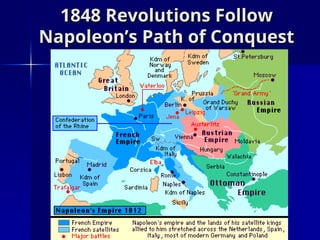
1848 Revolutions Follow
Napoleon’s Path of Conquest
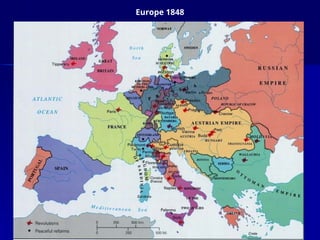
Europe 1848
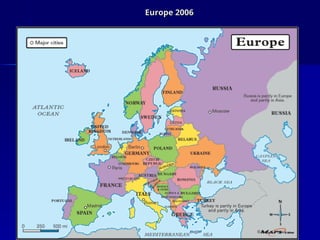
Europe 2006
Europe 2006
Germany: 1815
Germany: 1815
● Creation of the German Confederation
under the presidency of Austria. Prussia and
Austria were the two most powerful German
states. Traditionally Austria was recognized as
the most important. There was a strong
popular movement for unification but neither
Austria nor Prussia was prepared to allow it
happen.
Otto Von Bismarck:
Otto Von Bismarck:
“The Iron Chancellor”
1815-1898
1815-1898
Realpolitik
Realpolitik
 Realistic Politics based on the needs
Realistic Politics based on the needs
of the state
of the state
– Whatever actions necessary to achieve his desired goals.
Whatever actions necessary to achieve his desired goals.
 Power more important than
Power more important than
principles
principles
 “
“Blood and Iron” Philosophy
Blood and Iron” Philosophy
– He wanted to eliminate Austrian influence and bring about unification
He wanted to eliminate Austrian influence and bring about unification
on Prussian terms.
on Prussian terms.
– Expand Germany’s Economy and Industrial base with use of its
Expand Germany’s Economy and Industrial base with use of its
resources.
resources.
– Do not make the same mistakes that were made by the French in 1848-
Do not make the same mistakes that were made by the French in 1848-
1849.
1849.
3 Wars for Unification
 1
1st
st
: An Austrian-Prussian invasion of
: An Austrian-Prussian invasion of Schleswig-Holstein
Schleswig-Holstein led to the end of Danish
led to the end of Danish
control of these provinces. Prussia gained a lot of support especially among
German nationalists who wanted to see these provinces come under German
control.
control.
 2
2nd
nd
:
: Austro-Prussian War results in Prussian control (Annexes) of several northern
Austro-Prussian War results in Prussian control (Annexes) of several northern
German states.
German states.
– Dissolved the old confederation and establishes a new one dominated by
Dissolved the old confederation and establishes a new one dominated by
Prussia
Prussia
– Southern states were left independent, form military alliances with Prussia
Southern states were left independent, form military alliances with Prussia
 3
3rd
rd
:
: Franco-Prussian War
Franco-Prussian War results in the completion of German Unification
results in the completion of German Unification
– William I of Prussia assumes the role of
William I of Prussia assumes the role of Kaiser
Kaiser, or emperor of Germany, with
, or emperor of Germany, with
Otto Von Bismarck as Chancellor.
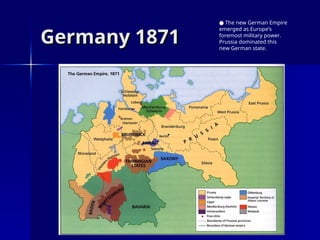
Germany 1871
Germany 1871
● The new German Empire
emerged as Europe’s
foremost military power.
Prussia dominated this
new German state.
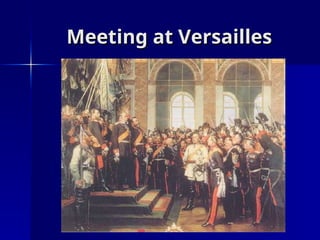
Meeting at Versailles
United German States
 Prussia dominated the new Germany that was
Prussia dominated the new Germany that was
called the
called the Second Reich
Second Reich.
.
 The new constitution drawn up by Bismarck was
The new constitution drawn up by Bismarck was
a Federal system.
a Federal system.
 Each of the twenty-five states had considerable
Each of the twenty-five states had considerable
control over their affairs and decided their own
form of government; e.g. Bavaria and Saxony
were ruled by kings.
 Under the constitution there were to be
Under the constitution there were to be three
three
branches of the Federal government:
The Presidency
The Presidency
 The Presidency
The Presidency which was held by the
which was held by the
King of Prussia
King of Prussia (as German Emperor).
(as German Emperor).
The German Emperor had considerable
powers. He had personal control of the
armed forces.
armed forces. He appointed and
He appointed and
dismissed all ministers including the
Chancellor
Chancellor.
.
The Federal Council
The Federal Council
 The
The Federal Council
Federal Council (or
(or Bundesrat
Bundesrat)
)
represented the different states of the
Empire. It had fifty-eight members.
Seventeen were from Prussia, six from
Bavaria, four from Saxony. It had the
power to change the constitution.
However no change could be made to the
constitution if fourteen delegates
objected. This in practice meant that
Prussia could always stop change.
The Parliament
The Parliament
 The
The Parliament
Parliament or
or Reichstag
Reichstag was elected by
was elected by Universal
Universal
Male Suffrage
Male Suffrage (all males over 25 could vote) and
(all males over 25 could vote) and Secret
Secret
Ballot
Ballot. It voted on the Federal budget and its consent was
. It voted on the Federal budget and its consent was
needed for all legislation. This was the most advanced
system in Europe at this time.
 However, the powers of the Reichstag were limited:
However, the powers of the Reichstag were limited:
– It could not initiate legislation.
It could not initiate legislation.
– It had no say in the appointment or dismissal of the
It had no say in the appointment or dismissal of the
Chancellor or Imperial ministers. The Imperial Chancellor
was appointed by the Emperor.
was appointed by the Emperor. He was in charge of foreign
He was in charge of foreign
policy.
policy.
– The Kaiser (
The Kaiser (in effect Bismarck
in effect Bismarck) could dissolve it any time
) could dissolve it any time
with the agreement of the Bundesrat.
Campaign Against the
Church
Church
 Bismarck Distrusts Catholics-especially clergy-thought loyalty
was with Pope and not Germany
 He Launches Kulturkampf or “battle for civilization”
– Laws passed to make Catholics put loyalty of state above loyalty to
Church
– Other laws would close religious orders, expel Jesuits, marriage by
civil authority
 Plan BACKFIRES-faithful rally behind Church
– Bismarck makes peace with the Church
Campaign Against the
Socialists
Socialists
 Threat-Growing power of Socialism (Social Democratic Party)
Threat-Growing power of Socialism (Social Democratic Party)
– Parliamentary democracy
Parliamentary democracy
– Laws to improve conditions for the working class
Laws to improve conditions for the working class
 Bismarck dissolves the Party, shuts down newspapers, bans
Bismarck dissolves the Party, shuts down newspapers, bans
meetings
meetings
 Plan BACKFIRES again
Plan BACKFIRES again
– To make amends, he sponsors laws to protect workers
To make amends, he sponsors laws to protect workers
– Health, accident, old-age insurance, and retirement benefits
Health, accident, old-age insurance, and retirement benefits
– Bismarck avoids revolution!!!
Bismarck avoids revolution!!!
 Proves
Proves Realpolitik
Realpolitik DOES have a “social reform” element
DOES have a “social reform” element
Bismarck’s Foreign
Bismarck’s Foreign
Alliances
Alliances
 Three Emperors League
Three Emperors League
– 1872 Alliance between Germany, Russia and Austria-Hungary.
1872 Alliance between Germany, Russia and Austria-Hungary.
 Goal of isolating France, who was still upset over the loss of Alsace-
Goal of isolating France, who was still upset over the loss of Alsace-
Lorraine and Revanche to Germany
 Triple Alliance
Triple Alliance
– 1882 When the French occupied Tunisia, Bismarck took advantage of
1882 When the French occupied Tunisia, Bismarck took advantage of
Italian resentment towards France and created the
Italian resentment towards France and created the Triple Alliance
Triple Alliance
between Germany, Italy and Austria- Hungary
 In exchange for Italy's agreement to stay neutral if war broke out between
In exchange for Italy's agreement to stay neutral if war broke out between
Austria-Hungary and Russia, Germany and Austria-Hungary would protect
Italy from France.
Italy from France.
 Reinsurance Treaty
Reinsurance Treaty
– 1887 Russia and Austria-Hungary grew suspicious of each other over
1887 Russia and Austria-Hungary grew suspicious of each other over
conflicts in the Balkans
 Bismarck repaired the damage to his alliances with a
Bismarck repaired the damage to his alliances with a Reinsurance Treaty
Reinsurance Treaty
with Russia, allowing both powers to stay neutral if the other was at war.
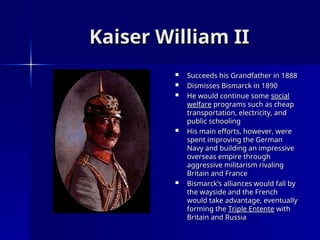
Kaiser William II
Kaiser William II
 Succeeds his Grandfather in 1888
Succeeds his Grandfather in 1888
 Dismisses Bismarck in 1890
Dismisses Bismarck in 1890
 He would continue some
He would continue some social
social
welfare
welfare programs such as cheap
programs such as cheap
transportation, electricity, and
public schooling
public schooling
 His main efforts, however, were
His main efforts, however, were
spent improving the German
Navy and building an impressive
overseas empire through
aggressive militarism rivaling
Britain and France
Britain and France
 Bismarck’s alliances would fall by
Bismarck’s alliances would fall by
the wayside and the French
would take advantage, eventually
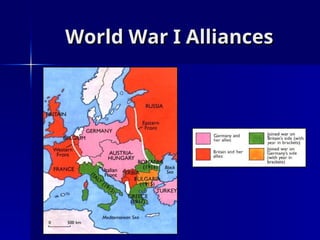
forming the
forming the Triple Entente
Triple Entente with
with
Britain and Russia
Britain and Russia
World War I Alliances

German Unification under mazinee .ppt

  • 1.
    German Unification German Unification GlobalHistory II Chapter 23 Global History II Chapter 23
  • 2.
    1848 Revolutions Follow 1848Revolutions Follow Napoleon’s Path of Conquest Napoleon’s Path of Conquest
  • 3.
  • 4.
  • 5.
    Germany: 1815 Germany: 1815 ●Creation of the German Confederation under the presidency of Austria. Prussia and Austria were the two most powerful German states. Traditionally Austria was recognized as the most important. There was a strong popular movement for unification but neither Austria nor Prussia was prepared to allow it happen.
  • 6.
    Otto Von Bismarck: OttoVon Bismarck: “The Iron Chancellor” “The Iron Chancellor” 1815-1898 1815-1898
  • 7.
    Realpolitik Realpolitik  Realistic Politicsbased on the needs Realistic Politics based on the needs of the state of the state – Whatever actions necessary to achieve his desired goals. Whatever actions necessary to achieve his desired goals.  Power more important than Power more important than principles principles  “ “Blood and Iron” Philosophy Blood and Iron” Philosophy – He wanted to eliminate Austrian influence and bring about unification He wanted to eliminate Austrian influence and bring about unification on Prussian terms. on Prussian terms. – Expand Germany’s Economy and Industrial base with use of its Expand Germany’s Economy and Industrial base with use of its resources. resources. – Do not make the same mistakes that were made by the French in 1848- Do not make the same mistakes that were made by the French in 1848- 1849. 1849.
  • 8.
    3 Wars forUnification 3 Wars for Unification  1 1st st : An Austrian-Prussian invasion of : An Austrian-Prussian invasion of Schleswig-Holstein Schleswig-Holstein led to the end of Danish led to the end of Danish control of these provinces. Prussia gained a lot of support especially among control of these provinces. Prussia gained a lot of support especially among German nationalists who wanted to see these provinces come under German German nationalists who wanted to see these provinces come under German control. control.  2 2nd nd : : Austro-Prussian War results in Prussian control (Annexes) of several northern Austro-Prussian War results in Prussian control (Annexes) of several northern German states. German states. – Dissolved the old confederation and establishes a new one dominated by Dissolved the old confederation and establishes a new one dominated by Prussia Prussia – Southern states were left independent, form military alliances with Prussia Southern states were left independent, form military alliances with Prussia  3 3rd rd : : Franco-Prussian War Franco-Prussian War results in the completion of German Unification results in the completion of German Unification – William I of Prussia assumes the role of William I of Prussia assumes the role of Kaiser Kaiser, or emperor of Germany, with , or emperor of Germany, with Otto Von Bismarck as Chancellor. Otto Von Bismarck as Chancellor.
  • 9.
    Germany 1871 Germany 1871 ●The new German Empire emerged as Europe’s foremost military power. Prussia dominated this new German state.
  • 10.
  • 11.
    United German States UnitedGerman States  Prussia dominated the new Germany that was Prussia dominated the new Germany that was called the called the Second Reich Second Reich. .  The new constitution drawn up by Bismarck was The new constitution drawn up by Bismarck was a Federal system. a Federal system.  Each of the twenty-five states had considerable Each of the twenty-five states had considerable control over their affairs and decided their own control over their affairs and decided their own form of government; e.g. Bavaria and Saxony form of government; e.g. Bavaria and Saxony were ruled by kings. were ruled by kings.  Under the constitution there were to be Under the constitution there were to be three three branches of the Federal government: branches of the Federal government:
  • 12.
    The Presidency The Presidency The Presidency The Presidency which was held by the which was held by the King of Prussia King of Prussia (as German Emperor). (as German Emperor). The German Emperor had considerable The German Emperor had considerable powers. He had personal control of the powers. He had personal control of the armed forces. armed forces. He appointed and He appointed and dismissed all ministers including the dismissed all ministers including the Chancellor Chancellor. .
  • 13.
    The Federal Council TheFederal Council  The The Federal Council Federal Council (or (or Bundesrat Bundesrat) ) represented the different states of the represented the different states of the Empire. It had fifty-eight members. Empire. It had fifty-eight members. Seventeen were from Prussia, six from Seventeen were from Prussia, six from Bavaria, four from Saxony. It had the Bavaria, four from Saxony. It had the power to change the constitution. power to change the constitution. However no change could be made to the However no change could be made to the constitution if fourteen delegates constitution if fourteen delegates objected. This in practice meant that objected. This in practice meant that Prussia could always stop change. Prussia could always stop change.
  • 14.
    The Parliament The Parliament The The Parliament Parliament or or Reichstag Reichstag was elected by was elected by Universal Universal Male Suffrage Male Suffrage (all males over 25 could vote) and (all males over 25 could vote) and Secret Secret Ballot Ballot. It voted on the Federal budget and its consent was . It voted on the Federal budget and its consent was needed for all legislation. This was the most advanced needed for all legislation. This was the most advanced system in Europe at this time. system in Europe at this time.  However, the powers of the Reichstag were limited: However, the powers of the Reichstag were limited: – It could not initiate legislation. It could not initiate legislation. – It had no say in the appointment or dismissal of the It had no say in the appointment or dismissal of the Chancellor or Imperial ministers. The Imperial Chancellor Chancellor or Imperial ministers. The Imperial Chancellor was appointed by the Emperor. was appointed by the Emperor. He was in charge of foreign He was in charge of foreign policy. policy. – The Kaiser ( The Kaiser (in effect Bismarck in effect Bismarck) could dissolve it any time ) could dissolve it any time with the agreement of the Bundesrat. with the agreement of the Bundesrat.
  • 15.
    Campaign Against the CampaignAgainst the Church Church  Bismarck Distrusts Catholics-especially clergy-thought loyalty was with Pope and not Germany  He Launches Kulturkampf or “battle for civilization” – Laws passed to make Catholics put loyalty of state above loyalty to Church – Other laws would close religious orders, expel Jesuits, marriage by civil authority  Plan BACKFIRES-faithful rally behind Church – Bismarck makes peace with the Church
  • 16.
    Campaign Against the CampaignAgainst the Socialists Socialists  Threat-Growing power of Socialism (Social Democratic Party) Threat-Growing power of Socialism (Social Democratic Party) – Parliamentary democracy Parliamentary democracy – Laws to improve conditions for the working class Laws to improve conditions for the working class  Bismarck dissolves the Party, shuts down newspapers, bans Bismarck dissolves the Party, shuts down newspapers, bans meetings meetings  Plan BACKFIRES again Plan BACKFIRES again – To make amends, he sponsors laws to protect workers To make amends, he sponsors laws to protect workers – Health, accident, old-age insurance, and retirement benefits Health, accident, old-age insurance, and retirement benefits – Bismarck avoids revolution!!! Bismarck avoids revolution!!!  Proves Proves Realpolitik Realpolitik DOES have a “social reform” element DOES have a “social reform” element
  • 17.
    Bismarck’s Foreign Bismarck’s Foreign Alliances Alliances Three Emperors League Three Emperors League – 1872 Alliance between Germany, Russia and Austria-Hungary. 1872 Alliance between Germany, Russia and Austria-Hungary.  Goal of isolating France, who was still upset over the loss of Alsace- Goal of isolating France, who was still upset over the loss of Alsace- Lorraine and Revanche to Germany Lorraine and Revanche to Germany  Triple Alliance Triple Alliance – 1882 When the French occupied Tunisia, Bismarck took advantage of 1882 When the French occupied Tunisia, Bismarck took advantage of Italian resentment towards France and created the Italian resentment towards France and created the Triple Alliance Triple Alliance between Germany, Italy and Austria- Hungary between Germany, Italy and Austria- Hungary  In exchange for Italy's agreement to stay neutral if war broke out between In exchange for Italy's agreement to stay neutral if war broke out between Austria-Hungary and Russia, Germany and Austria-Hungary would protect Austria-Hungary and Russia, Germany and Austria-Hungary would protect Italy from France. Italy from France.  Reinsurance Treaty Reinsurance Treaty – 1887 Russia and Austria-Hungary grew suspicious of each other over 1887 Russia and Austria-Hungary grew suspicious of each other over conflicts in the Balkans conflicts in the Balkans  Bismarck repaired the damage to his alliances with a Bismarck repaired the damage to his alliances with a Reinsurance Treaty Reinsurance Treaty with Russia, allowing both powers to stay neutral if the other was at war. with Russia, allowing both powers to stay neutral if the other was at war.
  • 18.
    Kaiser William II KaiserWilliam II  Succeeds his Grandfather in 1888 Succeeds his Grandfather in 1888  Dismisses Bismarck in 1890 Dismisses Bismarck in 1890  He would continue some He would continue some social social welfare welfare programs such as cheap programs such as cheap transportation, electricity, and transportation, electricity, and public schooling public schooling  His main efforts, however, were His main efforts, however, were spent improving the German spent improving the German Navy and building an impressive Navy and building an impressive overseas empire through overseas empire through aggressive militarism rivaling aggressive militarism rivaling Britain and France Britain and France  Bismarck’s alliances would fall by Bismarck’s alliances would fall by the wayside and the French the wayside and the French would take advantage, eventually would take advantage, eventually forming the forming the Triple Entente Triple Entente with with Britain and Russia Britain and Russia
  • 19.
    World War IAlliances World War I Alliances