Geriatric Care
JAMES VALLEY VOCATIONAL TECHNICAL CENTER
MYTHS
• Elderly people are incompetent
and incapable of making decisions
or handling their own affairs.
• Most elderly live in nursing homes
• All elderly people live in poverty
• Older people are lonely and
unhappy
• Elderly do not want to work
• “Old Age” begins a 65
• Retirement ends your active life
Physical Changes of Aging
• Most physical changes that
occur with aging are gradual and
take place over a long period of
time. In addition, the rate and
degree of change varies among
individuals.
• Factors such as disease can increase
the speed and degree of the changes.
Lifestyle, nutrition, economic status,
and social environment can also have
effects.
• If an individual can recognize the
changes as a/an normal part of aging,
the individual can usually learn to
adapt to & cope with change
Integumentary
System
Changes• Production of new skin cells
decreases
• Oil and Sweat glands
become less active
• Circulation decreases
• Hair losses color, and hair loss
occurs
• Skin becomes less elastic & dry
• Itching is common
• Dark yellow or brown colored
spots appear
–Senile lentigines (liver spots)
• Fatty tissue layer of skin
diminishes
• Lines and wrinkles appear
• Nails become thick, tough, and
brittle
• Increased sensitivity to
temperature
Care of Skin
• Use mild soap
• Bath oils or lanolin lotion
• Bath or Shower once or twice a
week
• Brush Hair daily
• Shampoo as often as needed for
cleanliness and comfort
• Care for sore or injuries
immediately
• Socks, sweaters, lap blankets,
and layers of clothing will help
alleviate the feeling of coldness
• Because of the need for oxygen
and nutrients the elderly may
experience:
–Weakness
–Dizziness
–Numbness in hands & feet
–Rapid heart beat
Circulatory System
Care
• With circulatory changes:
–Avoid strenuous exercise or over
exertion
–Periods of rest
–Moderate exercise, according to
individual’s tolerance
• Prevent the formation of a
blood clot (thrombus)
–Support stockings, anti-
embolism hose
–DO NOT wear garters or tight
bands around legs
–If confined to bed
•ROM
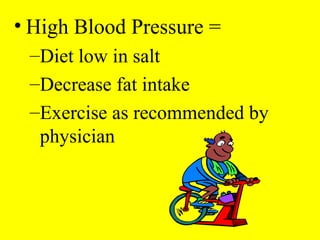
• High Blood Pressure =
–Diet low in salt
–Decrease fat intake
–Exercise as recommended by
physician
Respiratory Changes
• Respiratory muscles become
weaker
• Rib cage more rigid
• Alveoli thinner & less elastic
which decreases exchange of
gases - emphysema
• Bronchioles lose elasticity
• Changes in larynx lead to
higher pitched & weaker voice
• Chronic diseases may decrease
the efficiency of the respiratory
system even more severely
• Changes may cause the elderly
to experience:
–Dyspnea
•Breathing increases in rate
•Difficulty coughing up secretions
•Increases susceptibility to
infections such as a cold or
pneumonia
Respiratory Care
• Alternate activity with periods
of rest
• Proper body alignment &
positioning
• Sleep in semi-fowlers position
–Use 2 or 3 pillows
• Avoid polluted air
• Breath deeply & cough
frequently
• May need continuous oxygen
therapy
Nervous System
Changes
• Blood flow to brain decreases
& there is a progressive loss of
brain cells - - Interferes with
–Thinking - Reacting
–Interpreting - Remembering
• Senses of taste, smell, vision, &
hearing are diminished
• Nerve endings less sensitive
–Decreased ability to respond to
pain and other stimuli
• Decrease in taste& smell
frequently affects appetite
• Changes in vision
–Problems reading small print
–Seeing objects at a distance
–Decrease in peripheral vision
–Decrease in night vision
–Increased sensitivity to glare
–Cataracts
–Glaucoma
• Changes in hearing
–Hearing loss usually gradual
–Person may speak louder than
usual
–Ask for words to be repeated
–Not hear high frequency sounds
–May not hear well in crowded
places
• Decreased sensation to pain &
other stimuli = more susceptible
–Burns
–Frostbite
–Cuts
–Fractures
–Muscle strain and other injuries
Digestive Changes
• Fewer digestive juices and
enzymes produced
• Muscle action becomes slower
& peristalsis decreases
• Teeth are lost
• Liver function decreases
• Dysphagia is frequent complaint
–Less saliva
–Slower gag reflex
–Loss of teeth
–Poor fitting dentures
• Slower digestion of food
–indigestion
• Decrease peristalsis
–Increase flatulence (gas)
–Constipation
• Decrease sensation of taste
–Poor appetite
–Poor diet
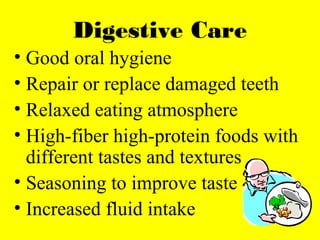
Digestive Care
• Good oral hygiene
• Repair or replace damaged teeth
• Relaxed eating atmosphere
• High-fiber high-protein foods with
different tastes and textures
• Seasoning to improve taste
• Increased fluid intake
Urinary Changes
• Kidneys decrease in size &
become less efficient
• Bladder becomes less efficient
–May not hold as much
–May not empty completely
–incontinence
Urinary Care
• Increase fluid intake
–Decrease before bedtime
• Regular trips to bathroom
• Easy to remove clothing
• Absorbent pads
Endocrine Changes
• Increased production of some
hormones and decreased of
others
• Immune system less effective
• BMR decreases
• Intolerance to glucose
Endocrine Care
• Proper exercise
• Adequate rest
• Medical care for illness
• Balanced diet
• Healthy lifestyle
Reproductive System
Changes
• Decrease of estrogen /
progesterone in female
–Thinning of vaginal wall
–Decrease vaginal secretions
–Inflammation of vagina common
–Weakness in supporting tissue:
•Uterus sags downward
(Uterine prolapse)
–Breasts sag when fat redistributed
• Decrease in Testosterone
–Slow production of sperm
–Response to sexual stimuli slower
–Testes smaller less firm
• Male and Female
–Sexual desire may or may not
decrease
• Advantages of sex in elderly
–Improves muscle tone &
circulation
–Pain from arthritis seems to
decrease
Reproductive Care
• Understand physical and
psychological sexual needs of
the elderly
–Allow married couples to be in
the same room
–Give privacy to consenting
elderly
Psychocosocial
Changes
• Some individual cope with
psychosocial changes, and
others experience extreme
frustration and mental distress
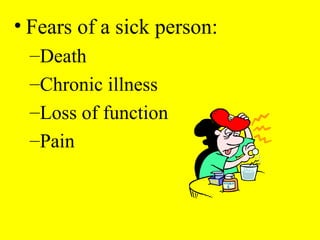
• Fears of a sick person:
–Death
–Chronic illness
–Loss of function
–Pain
• Dealing with fears created by
an illness:
–Listening
–Patience
–Understanding
–Provide support
Confusion and
Disorientation
• Six signs:
–Talking incoherently
–Not knowing their name
–Not recognizing others
–Wandering aimlessly
–Lacking awareness of time or place
–Displaying hostile and
combative behavior
–Hallucinating
–Regressing in behavior
–Paying less attention to
personal hygiene
–Inability to respond to simple
commands or instructions
• Causes of temporary
confusion / disorientation
–Stress and/or depression
–Use of alcohol or chemicals
–Kidney disease
–Respiratory disease
–Liver disease
–Medication
• Diseases:
–CVA
–Arteriosclerosis
–Atherosclerosis
•Cause TIA’s ministrokes which
result in temporary periods of
diminished blood flow to the brain.
• Dementia
–Loss of mental ability
characterized by a decrease in
intellectual ability, loss of
memory, impaired judgement,
personality change, and
disorientation
• Acute dementia
–When the symptoms are caused
by temporary reason:
•High fever, dehydration, hypoxia
• Chronic dementia
–When symptoms are caused by
permanent, irreversible damage to
brain cells
Alzheimer’s Disease
• Form of dementia that causes
progressive changes in brain
cells
Early Stages:
• Memory loss
• Mood & personality changes
• Depression
• Poor judgment
• Confusion regarding time & place
• Inability to plan and follow
through with ADLs
Middle Stages:
• Nigh time restlessness
• Mood swings increase
• Personal hygiene ignored
• Weight fluctuates
• Paranoia & hallucinations
• Full time supervision needed
Late Stages:
• Total disorientation
• Incoherent
• Unable to communicate with
words
• Loses control of bladder &
bowel functions
• Develops seizures
• Loses weight despite eating a
balanced diet
• Becomes totally dependent
• Lapses into a coma
• Dies
• Certain aspects of care
should be followed with any
confused or disorientated
individual. Provide a/an safe
and secure environment,
follow the same routine, keep
activities simple and last for
short periods of time.
Avoid loud noises, crowded
rooms, and excessive
commotion. Promote
awareness of person, time, and
place by providing reality
orientation (RO)
Reality Orientation:
• Address person by name preferred
• Avoid: sweetie, baby, honey
• State your name, correct elderly if
calls you by the wrong name
• Make reference to day, time, place
• Use clocks, calendars, bulletin bd.
• Keep individual oriented to day
night cycles:
–Regular clothes during the day
–Open curtains during the day]
–Close curtains at night
–Pajamas at night
• Speak slowly, clearly / ask clear
& simple questions
• Never rush or hurry the
individual
• Repeat instructions patiently,
allow time for ind. to reaspond
• Encourage conversations about
familiar things or current events
• Encourage use of tv, radio
without overstimulating them
• Be sure ind. uses sensory aids
• Keep familiar objects in view
Avoid moving furniture &
belongings
• Do not agree with incorrect
statements
• Do not hesitate to touch
communicate with person
• Avoid arguments
• Encourage independence and
self help whenever possible
Meeting the Elderly
Needs
• Culture: the values, beliefs,
ideas, customs, and
characteristics that are passed
from one generation to the next.
• Areas affected by an
individual’s culture:
–Language
–Food habits
–Dress
–Work
–Leisure activities
–Health care
• The spiritual beliefs and
practices of an individual is
called their religion. It is
important to accept an
individual’s belief without bias,
and that health care workers not
force their own religious beliefs
on the ind. being cared for.
• Respect and Consideratin of a
persons religious beliefs
–Proper treatment of religious
articles
–Allow person to practice religion
–Honor request for special food
–Provide privacy during clergy
visits
• Abuse
–Physical
–Verbal
–Psychological
–Sexual
• Report any abuse observed to
proper agency
• Reasons elderly do not report
abuse
–Feel they deserve the abuse
–Want to protect abuser
• Ombudsman is a specially
trained individual who works
with the elderly and their
families, health care
providers, and other
concerned individual. To
improve quality of care and
quality of life.

Geriatrics ppt

  • 1.
    Geriatric Care JAMES VALLEYVOCATIONAL TECHNICAL CENTER
  • 2.
    MYTHS • Elderly peopleare incompetent and incapable of making decisions or handling their own affairs. • Most elderly live in nursing homes • All elderly people live in poverty
  • 3.
    • Older peopleare lonely and unhappy • Elderly do not want to work • “Old Age” begins a 65 • Retirement ends your active life
  • 4.
    Physical Changes ofAging • Most physical changes that occur with aging are gradual and take place over a long period of time. In addition, the rate and degree of change varies among individuals.
  • 5.
    • Factors suchas disease can increase the speed and degree of the changes. Lifestyle, nutrition, economic status, and social environment can also have effects. • If an individual can recognize the changes as a/an normal part of aging, the individual can usually learn to adapt to & cope with change
  • 6.
    Integumentary System Changes• Production ofnew skin cells decreases • Oil and Sweat glands become less active • Circulation decreases
  • 7.
    • Hair lossescolor, and hair loss occurs • Skin becomes less elastic & dry • Itching is common • Dark yellow or brown colored spots appear –Senile lentigines (liver spots)
  • 8.
    • Fatty tissuelayer of skin diminishes • Lines and wrinkles appear • Nails become thick, tough, and brittle • Increased sensitivity to temperature
  • 9.
    Care of Skin •Use mild soap • Bath oils or lanolin lotion • Bath or Shower once or twice a week • Brush Hair daily
  • 10.
    • Shampoo asoften as needed for cleanliness and comfort • Care for sore or injuries immediately • Socks, sweaters, lap blankets, and layers of clothing will help alleviate the feeling of coldness
  • 11.
    • Because ofthe need for oxygen and nutrients the elderly may experience: –Weakness –Dizziness –Numbness in hands & feet –Rapid heart beat
  • 12.
    Circulatory System Care • Withcirculatory changes: –Avoid strenuous exercise or over exertion –Periods of rest –Moderate exercise, according to individual’s tolerance
  • 13.
    • Prevent theformation of a blood clot (thrombus) –Support stockings, anti- embolism hose –DO NOT wear garters or tight bands around legs –If confined to bed •ROM
  • 14.
    • High BloodPressure = –Diet low in salt –Decrease fat intake –Exercise as recommended by physician
  • 15.
    Respiratory Changes • Respiratorymuscles become weaker • Rib cage more rigid • Alveoli thinner & less elastic which decreases exchange of gases - emphysema
  • 16.
    • Bronchioles loseelasticity • Changes in larynx lead to higher pitched & weaker voice • Chronic diseases may decrease the efficiency of the respiratory system even more severely
  • 17.
    • Changes maycause the elderly to experience: –Dyspnea •Breathing increases in rate •Difficulty coughing up secretions •Increases susceptibility to infections such as a cold or pneumonia
  • 18.
    Respiratory Care • Alternateactivity with periods of rest • Proper body alignment & positioning • Sleep in semi-fowlers position –Use 2 or 3 pillows
  • 19.
    • Avoid pollutedair • Breath deeply & cough frequently • May need continuous oxygen therapy
  • 20.
    Nervous System Changes • Bloodflow to brain decreases & there is a progressive loss of brain cells - - Interferes with –Thinking - Reacting –Interpreting - Remembering
  • 21.
    • Senses oftaste, smell, vision, & hearing are diminished • Nerve endings less sensitive –Decreased ability to respond to pain and other stimuli • Decrease in taste& smell frequently affects appetite
  • 22.
    • Changes invision –Problems reading small print –Seeing objects at a distance –Decrease in peripheral vision –Decrease in night vision –Increased sensitivity to glare –Cataracts –Glaucoma
  • 23.
    • Changes inhearing –Hearing loss usually gradual –Person may speak louder than usual –Ask for words to be repeated –Not hear high frequency sounds –May not hear well in crowded places
  • 24.
    • Decreased sensationto pain & other stimuli = more susceptible –Burns –Frostbite –Cuts –Fractures –Muscle strain and other injuries
  • 25.
    Digestive Changes • Fewerdigestive juices and enzymes produced • Muscle action becomes slower & peristalsis decreases • Teeth are lost • Liver function decreases
  • 26.
    • Dysphagia isfrequent complaint –Less saliva –Slower gag reflex –Loss of teeth –Poor fitting dentures • Slower digestion of food –indigestion
  • 27.
    • Decrease peristalsis –Increaseflatulence (gas) –Constipation • Decrease sensation of taste –Poor appetite –Poor diet
  • 28.
    Digestive Care • Goodoral hygiene • Repair or replace damaged teeth • Relaxed eating atmosphere • High-fiber high-protein foods with different tastes and textures • Seasoning to improve taste • Increased fluid intake
  • 29.
    Urinary Changes • Kidneysdecrease in size & become less efficient • Bladder becomes less efficient –May not hold as much –May not empty completely –incontinence
  • 30.
    Urinary Care • Increasefluid intake –Decrease before bedtime • Regular trips to bathroom • Easy to remove clothing • Absorbent pads
  • 31.
    Endocrine Changes • Increasedproduction of some hormones and decreased of others • Immune system less effective • BMR decreases • Intolerance to glucose
  • 32.
    Endocrine Care • Properexercise • Adequate rest • Medical care for illness • Balanced diet • Healthy lifestyle
  • 33.
    Reproductive System Changes • Decreaseof estrogen / progesterone in female –Thinning of vaginal wall –Decrease vaginal secretions –Inflammation of vagina common
  • 34.
    –Weakness in supportingtissue: •Uterus sags downward (Uterine prolapse) –Breasts sag when fat redistributed • Decrease in Testosterone –Slow production of sperm –Response to sexual stimuli slower –Testes smaller less firm
  • 35.
    • Male andFemale –Sexual desire may or may not decrease • Advantages of sex in elderly –Improves muscle tone & circulation –Pain from arthritis seems to decrease
  • 36.
    Reproductive Care • Understandphysical and psychological sexual needs of the elderly –Allow married couples to be in the same room –Give privacy to consenting elderly
  • 37.
    Psychocosocial Changes • Some individualcope with psychosocial changes, and others experience extreme frustration and mental distress
  • 38.
    • Fears ofa sick person: –Death –Chronic illness –Loss of function –Pain
  • 39.
    • Dealing withfears created by an illness: –Listening –Patience –Understanding –Provide support
  • 40.
    Confusion and Disorientation • Sixsigns: –Talking incoherently –Not knowing their name –Not recognizing others –Wandering aimlessly –Lacking awareness of time or place
  • 41.
    –Displaying hostile and combativebehavior –Hallucinating –Regressing in behavior –Paying less attention to personal hygiene –Inability to respond to simple commands or instructions
  • 42.
    • Causes oftemporary confusion / disorientation –Stress and/or depression –Use of alcohol or chemicals –Kidney disease –Respiratory disease –Liver disease –Medication
  • 43.
    • Diseases: –CVA –Arteriosclerosis –Atherosclerosis •Cause TIA’sministrokes which result in temporary periods of diminished blood flow to the brain.
  • 44.
    • Dementia –Loss ofmental ability characterized by a decrease in intellectual ability, loss of memory, impaired judgement, personality change, and disorientation
  • 45.
    • Acute dementia –Whenthe symptoms are caused by temporary reason: •High fever, dehydration, hypoxia • Chronic dementia –When symptoms are caused by permanent, irreversible damage to brain cells
  • 46.
    Alzheimer’s Disease • Formof dementia that causes progressive changes in brain cells
  • 47.
    Early Stages: • Memoryloss • Mood & personality changes • Depression • Poor judgment • Confusion regarding time & place • Inability to plan and follow through with ADLs
  • 48.
    Middle Stages: • Nightime restlessness • Mood swings increase • Personal hygiene ignored • Weight fluctuates • Paranoia & hallucinations • Full time supervision needed
  • 49.
    Late Stages: • Totaldisorientation • Incoherent • Unable to communicate with words • Loses control of bladder & bowel functions
  • 50.
    • Develops seizures •Loses weight despite eating a balanced diet • Becomes totally dependent • Lapses into a coma • Dies
  • 51.
    • Certain aspectsof care should be followed with any confused or disorientated individual. Provide a/an safe and secure environment, follow the same routine, keep activities simple and last for short periods of time.
  • 52.
    Avoid loud noises,crowded rooms, and excessive commotion. Promote awareness of person, time, and place by providing reality orientation (RO)
  • 53.
    Reality Orientation: • Addressperson by name preferred • Avoid: sweetie, baby, honey • State your name, correct elderly if calls you by the wrong name • Make reference to day, time, place • Use clocks, calendars, bulletin bd.
  • 54.
    • Keep individualoriented to day night cycles: –Regular clothes during the day –Open curtains during the day] –Close curtains at night –Pajamas at night
  • 55.
    • Speak slowly,clearly / ask clear & simple questions • Never rush or hurry the individual • Repeat instructions patiently, allow time for ind. to reaspond • Encourage conversations about familiar things or current events
  • 56.
    • Encourage useof tv, radio without overstimulating them • Be sure ind. uses sensory aids • Keep familiar objects in view Avoid moving furniture & belongings • Do not agree with incorrect statements
  • 57.
    • Do nothesitate to touch communicate with person • Avoid arguments • Encourage independence and self help whenever possible
  • 58.
    Meeting the Elderly Needs •Culture: the values, beliefs, ideas, customs, and characteristics that are passed from one generation to the next.
  • 59.
    • Areas affectedby an individual’s culture: –Language –Food habits –Dress –Work –Leisure activities –Health care
  • 60.
    • The spiritualbeliefs and practices of an individual is called their religion. It is important to accept an individual’s belief without bias, and that health care workers not force their own religious beliefs on the ind. being cared for.
  • 61.
    • Respect andConsideratin of a persons religious beliefs –Proper treatment of religious articles –Allow person to practice religion –Honor request for special food –Provide privacy during clergy visits
  • 62.
  • 63.
    • Report anyabuse observed to proper agency • Reasons elderly do not report abuse –Feel they deserve the abuse –Want to protect abuser
  • 64.
    • Ombudsman isa specially trained individual who works with the elderly and their families, health care providers, and other concerned individual. To improve quality of care and quality of life.