GeothermalEnergy Conversation and application..pdf
1.
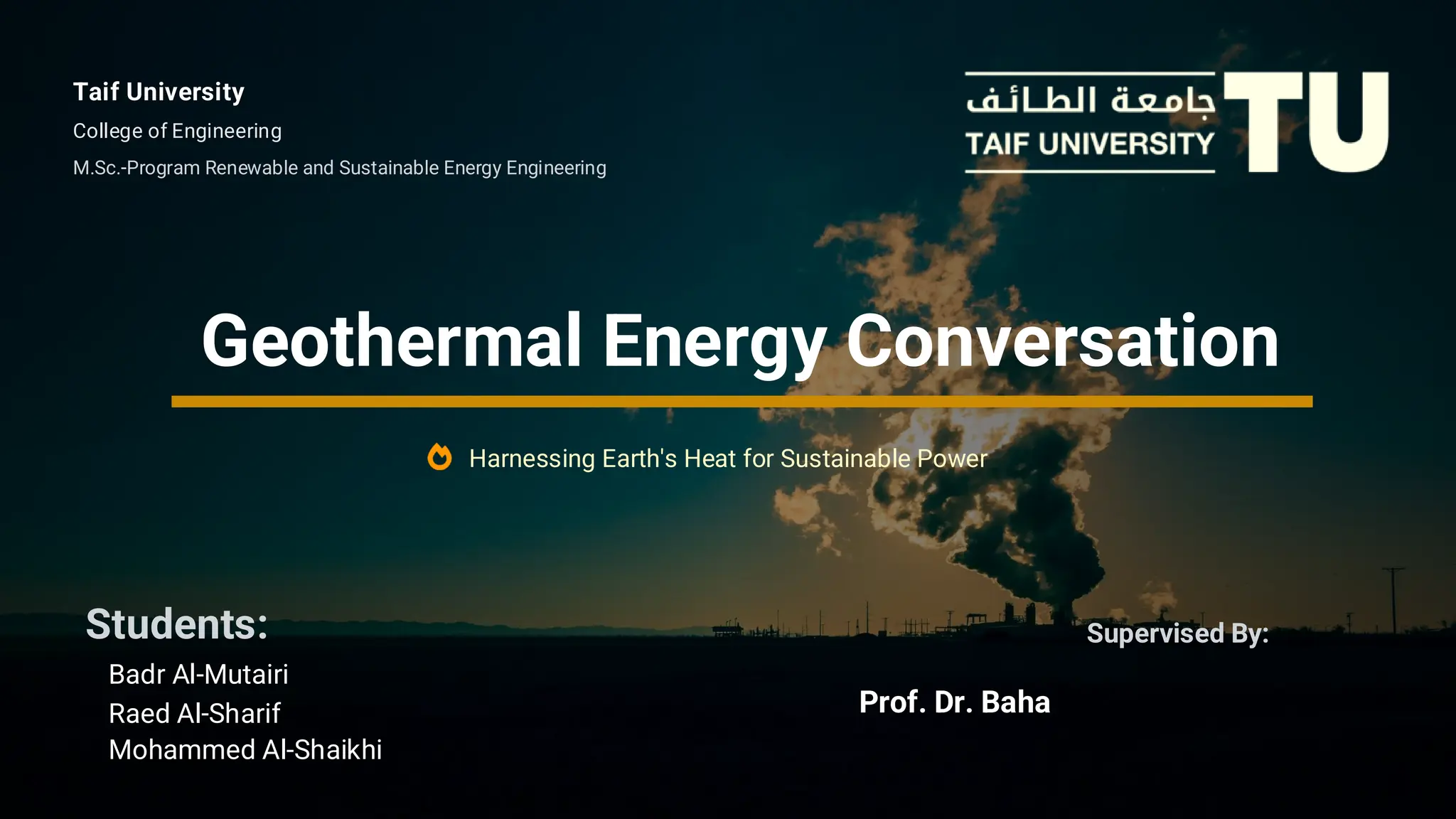
Taif University
College ofEngineering
M.Sc.-Program Renewable and Sustainable Energy Engineering
Geothermal Energy Conversation
Harnessing Earth's Heat for Sustainable Power
Students:
Badr Al-Mutairi
Raed Al-Sharif
Mohammed Al-Shaikhi
Supervised By:
Prof. Dr. Baha
2.
Outline
This presentation exploresthe journey of geothermal energy from its origins deep within the Earth to its transformation into a reliable source of clean
source of clean electricity.
Introduction to Geothermal Energy
Key characteristics and natural manifestations
The Earth's Internal Heat
Origins and transfer of thermal energy
Tapping Geothermal Resources
Extraction methods and infrastructure
Geothermal Power Plants
Types and transformation processes
Advantages of Geothermal Energy
Economic and operational benefits
Environmental Benefits
Clean energy advantages
Challenges and Limitations
Technical and economic constraints
Future Outlook & Conclusion
Innovations and future prospects
Taif University Geothermal Energy Transformation
3.
Introduction to GeothermalEnergy
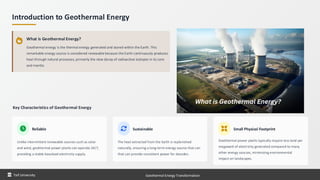
What is Geothermal Energy?
Geothermal energy is the thermal energy generated and stored within the Earth. This
remarkable energy source is considered renewable because the Earth continuously produces
heat through natural processes, primarily the slow decay of radioactive isotopes in its core
and mantle.
Key Characteristics of Geothermal Energy
Reliable
Unlike intermittent renewable sources such as solar
and wind, geothermal power plants can operate 24/7,
providing a stable baseload electricity supply.
Sustainable
The heat extracted from the Earth is replenished
naturally, ensuring a long-term energy source that can
that can provide consistent power for decades.
Small Physical Footprint
Geothermal power plants typically require less land per
megawatt of electricity generated compared to many
other energy sources, minimizing environmental
impact on landscapes.
Taif University Geothermal Energy Transformation
4.
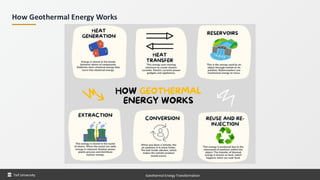
The Earth's InternalHeat
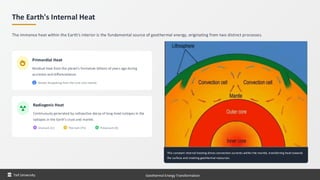
The immense heat within the Earth's interior is the fundamental source of geothermal energy, originating from two distinct processes.
Primordial Heat
Residual heat from the planet's formation billions of years ago during
accretion and differentiation.
Slowly dissipating from the core and mantle.
Radiogenic Heat
Continuously generated by radioactive decay of long-lived isotopes in the
isotopes in the Earth's crust and mantle.
Uranium (U) Thorium (Th) Potassium (K)
This constant internal heating drives convection currents within the mantle, transferring heat towards
the surface and creating geothermal resources.
Taif University Geothermal Energy Transformation
5.
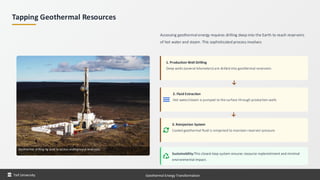
Tapping Geothermal Resources
Geothermaldrilling rig used to access underground reservoirs
Accessing geothermal energy requires drilling deep into the Earth to reach reservoirs
of hot water and steam. This sophisticated process involves:
1. Production Well Drilling
Deep wells (several kilometers) are drilled into geothermal reservoirs
2. Fluid Extraction
Hot water/steam is pumped to the surface through production wells
3. Reinjection System
Cooled geothermal fluid is reinjected to maintain reservoir pressure
Sustainability:This closed-loop system ensures resource replenishment and minimal
environmental impact.
Taif University Geothermal Energy Transformation
Geothermal Power Plants:The Conversations
Geothermal power plants convert the Earth's thermal energy into electricity through
a well-established process:
Geothermal Fluid
Heat Transfer
Turbine Rotation
Electricity
Three Main Types of Plants:
Dry Steam Power Plants
Earliest technology using natural steam directly
Flash Steam Power Plants
Most common type using hot water and pressure drop
Binary Cycle Power Plants
Advanced technology using secondary fluid
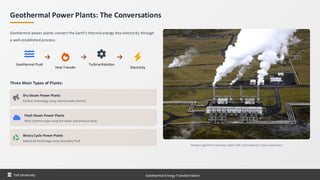
Modern geothermal power plant with characteristic steam emissions
Taif University Geothermal Energy Transformation
8.
Dry Steam PowerPlants
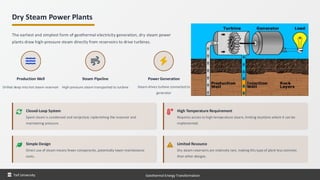
The earliest and simplest form of geothermal electricity generation, dry steam power
plants draw high-pressure steam directly from reservoirs to drive turbines.
Production Well
Drilled deep into hot steam reservoir
Steam Pipeline
High-pressure steam transported to turbine
Power Generation
Steam drives turbine connected to
generator
Closed-Loop System
Spent steam is condensed and reinjected, replenishing the reservoir and
maintaining pressure.
High Temperature Requirement
Requires access to high-temperature steam, limiting locations where it can be
implemented.
Simple Design
Direct use of steam means fewer components, potentially lower maintenance
costs.
Limited Resource
Dry steam reservoirs are relatively rare, making this type of plant less common
than other designs.
Taif University Geothermal Energy Transformation
9.
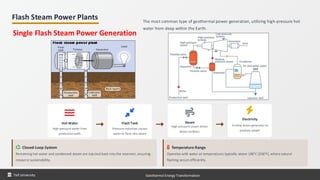
Flash Steam PowerPlants The most common type of geothermal power generation, utilizing high-pressure hot
water from deep within the Earth.
Hot Water
High-pressure water from
production wells
Flash Tank
Pressure reduction causes
water to flash into steam
Steam
High-pressure steam drives
drives turbines
Electricity
Turbine drives generator to
produce power
Closed-Loop System
Remaining hot water and condensed steam are injected back into the reservoir, ensuring
resource sustainability.
Temperature Range
Operates with water at temperatures typically above 180°C (356°F), where natural
flashing occurs efficiently.
Taif University Geothermal Energy Transformation
Single Flash Steam Power Generation
10.
Flash Steam PowerPlants
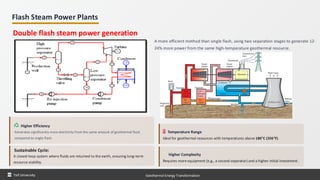
A more efficient method than single flash, using two separation stages to generate 12-
24% more power from the same high-temperature geothermal resource.
Higher Efficiency
Generates significantly more electricity from the same amount of geothermal fluid
compared to single flash.
Temperature Range
Ideal for geothermal resources with temperatures above 180°C (356°F).
Taif University Geothermal Energy Transformation
Double flash steam power generation
Sustainable Cycle:
A closed-loop system where fluids are returned to the earth, ensuring long-term
resource viability.
Higher Complexity
Requires more equipment (e.g., a second separator) and a higher initial investment.
11.
Binary Cycle PowerPlants
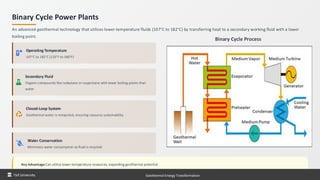
An advanced geothermal technology that utilizes lower-temperature fluids (107°C to 182°C) by transferring heat to a secondary working fluid with a lower
boiling point.
Operating Temperature
107°C to 182°C (225°F to 360°F)
Secondary Fluid
Organic compounds like isobutane or isopentane with lower boiling points than
water
Closed-Loop System
Geothermal water is reinjected, ensuring resource sustainability
Water Conservation
Minimizes water consumption as fluid is recycled
Binary Cycle Process
Key Advantage:Can utilize lower-temperature resources, expanding geothermal potential
Taif University Geothermal Energy Transformation
12.
Hybrid Geothermal PowerPlants
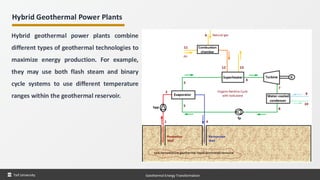
Hybrid geothermal power plants combine
different types of geothermal technologies to
maximize energy production. For example,
they may use both flash steam and binary
cycle systems to use different temperature
ranges within the geothermal reservoir.
Taif University Geothermal Energy Transformation
13.
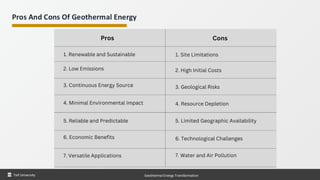
Pros And ConsOf Geothermal Energy
Taif University Geothermal Energy Transformation
14.
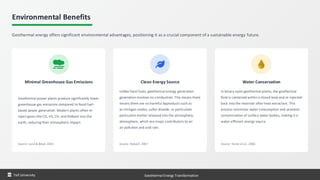
Environmental Benefits
Geothermal energyoffers significant environmental advantages, positioning it as a crucial component of a sustainable energy future.
Minimal Greenhouse Gas Emissions
Geothermal power plants produce significantly lower
greenhouse gas emissions compared to fossil fuel-
based power generation. Modern plants often re-
inject gases like CO, HS, CH, and NHback into the
earth, reducing their atmospheric impact.
Source: Lund & Boyd, 2016
Clean Energy Source
Unlike fossil fuels, geothermal energy generation
generation involves no combustion. This means there
means there are no harmful byproducts such as
as nitrogen oxides, sulfur dioxide, or particulate
particulate matter released into the atmosphere,
atmosphere, which are major contributors to air
air pollution and acid rain.
Source: Rybach, 2007
Water Conservation
In binary cycle geothermal plants, the geothermal
fluid is contained within a closed loop and re-injected
back into the reservoir after heat extraction. This
process minimizes water consumption and prevents
contamination of surface water bodies, making it a
water-efficient energy source.
Source: Tester et al., 2006
Taif University Geothermal Energy Transformation
15.
Challenges and Limitations
Despiteits advantages, geothermal energy faces significant challenges that must be addressed for widespread adoption.
High Initial Investment
Substantial upfront costs for exploration, drilling, and power plant construction.
Often requires significant capital investment before energy production begins.
Location Specific
Geothermal resources are not uniformly distributed globally; they are primarily
concentrated in areas with significant geological activity, such as plate boundaries
or volcanic regions.
Potential for Induced Seismicity
Injection and extraction of fluids can alter subsurface stress fields, potentially
potentially leading to minor seismic events. While typically low magnitude, this
magnitude, this can be a concern for local communities.
Release of Gases
Geothermal fluids can contain dissolved gases including H₂S, CO₂, NH₃, and CH₄.
These gases need to be managed and treated to prevent localized
environmental impacts.
Source: U.S. Department of Energy, Geothermal Energy Association, Majer et al. (2007), DiPippo (2012)
Taif University Geothermal Energy Transformation
16.
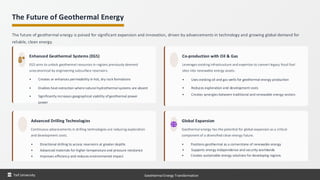
The Future ofGeothermal Energy
The future of geothermal energy is poised for significant expansion and innovation, driven by advancements in technology and growing global demand for
reliable, clean energy.
Enhanced Geothermal Systems (EGS)
EGS aims to unlock geothermal resources in regions previously deemed
uneconomical by engineering subsurface reservoirs.
• Creates or enhances permeability in hot, dry rock formations
• Enables heat extraction where natural hydrothermal systems are absent
• Significantly increases geographical viability of geothermal power
power
Co-production with Oil & Gas
Leverages existing infrastructure and expertise to convert legacy fossil fuel
sites into renewable energy assets.
• Uses existing oil and gas wells for geothermal energy production
• Reduces exploration and development costs
• Creates synergies between traditional and renewable energy sectors
Advanced Drilling Technologies
Continuous advancements in drilling technologies are reducing exploration
and development costs.
• Directional drilling to access reservoirs at greater depths
• Advanced materials for higher temperature and pressure resistance
• Improves efficiency and reduces environmental impact
Global Expansion
Geothermal energy has the potential for global expansion as a critical
component of a diversified clean energy future.
• Positions geothermal as a cornerstone of renewable energy
• Supports energy independence and security worldwide
• Creates sustainable energy solutions for developing regions
Taif University Geothermal Energy Transformation
17.
Conclusion
Key Takeaways
Powerful:Geothermal energyprovides reliable baseload power independent of
weather conditions.
Reliable:Operates continuously, 24/7, providing stable energy supply.
Sustainable:Renewable resource with minimal environmental impact.
Geographically Limited:Resources concentrated in specific regions.
"Geothermal energy stands as a powerful, reliable, and sustainable cornerstone of
cornerstone of renewable energy."
Old Faithful geyser, Yellowstone National Park
Looking Forward
Geothermal energy offers significant advantages for a sustainable energy future. With
continued innovation in Enhanced Geothermal Systems and improved drilling
technologies, this reliable energy source can contribute to a diversified clean energy
mix.
Taif University Geothermal Energy Transformation
18.
References
The information presentedin this slide has been compiled from the following sources:
Government & Industry Reports
U.S. Department of Energy.(n.d.).Geothermal Basics. Retrieved from
[https://www.energy.gov/eere/geothermal/geothermal-
basics](https://www.energy.gov/eere/geothermal/geothermal-basics)
International Renewable Energy Agency (IRENA).(2020).Geothermal Power: Technology
Brief. IRENA.
Geothermal Energy Association (GEA).(n.d.).Geothermal Energy: The Basics. Retrieved
from [https://geo-energy.org/our-impact/geothermal-basics/](https://geo-
energy.org/our-impact/geothermal-basics/)
National Renewable Energy Laboratory (NREL).(n.d.).Geothermal Energy. Retrieved
Retrieved from [https://www.nrel.gov/research/re-
geothermal.html](https://www.nrel.gov/research/re-geothermal.html)
Academic Publications
DiPippo, R.(2012).Geothermal Power Plants: Principles, Applications, Case Studies and
Environmental Impact. Elsevier.
Rybach, L.(2003).Geothermal energy: Renewable energy source. Geothermics, 32(4-6),
463-472.
Additional Resources
International Energy Agency (IEA) - Geothermal Energy. Retrieved from
[https://www.iea.org/geothermal](https://www.iea.org/geothermal)
Thank you for your attention




International Renewable Energy Agency (IRENA).(2020).Geothermal Power: Technology
Brief. IRENA.
Geothermal Energy Association (GEA).(n.d.).Geothermal Energy: The Basics. Retrieved
from [https://geo-energy.org/our-impact/geothermal-basics/](https://geo-
energy.org/our-impact/geothermal-basics/)
National Renewable Energy Laboratory (NREL).(n.d.).Geothermal Energy. Retrieved
Retrieved from [https://www.nrel.gov/research/re-
geothermal.html](https://www.nrel.gov/research/re-geothermal.html)
Academic Publications
DiPippo, R.(2012).Geothermal Power Plants: Principles, Applications, Case Studies and
Environmental Impact. Elsevier.
Rybach, L.(2003).Geothermal energy: Renewable energy source. Geothermics, 32(4-6),
463-472.
Additional Resources
International Energy Agency (IEA) - Geothermal Energy. Retrieved from
[https://www.iea.org/geothermal](https://www.iea.org/geothermal)
Thank you for your attention](https://image.slidesharecdn.com/geothermalenergyconversation-251222070838-684b5528/85/GeothermalEnergy-Conversation-and-application-pdf-18-320.jpg)


![Geothermal Energy [تم حفظه تلقائيا].pptx](https://cdn.slidesharecdn.com/ss_thumbnails/geothermalenergy-230731082531-62f964d6-thumbnail.jpg?width=640&height=640&fit=bounds)


