 GEOMETRIC'S OF TAXIWAY
NITHIN B
1DT23CV412
ICAOAIRCRAFTAPPROACH
CATEGORY
 AIRCRAFT CATEGORY , A -< 91KMPH
 AIRCRAFT CATEGORY ,B - 91-120 KMPH
 AIRCRAFT CATEGORY ,C – 121-140 KMPH
 AIRCRAFT CATEGORY ,D – 141-165 KMPH
 AIRCRAFT CATEGORY ,E – 166-210 KMPH
FOLLOWING ARE THE ELEMENT’S OF THE
GEOMETRIC STANDARD’S FOR TAXIWAY
1. LENGTH OF TAXIWAY
2. LONGITUDINAL GRADIENT
3. RATE OF CHANGE OF LONGITUDINAL GRADIENT
4. SIGHT DISTANCE
5. TURNING RADIUS
6. WIDTH OF SAFETY AREA
7. WIDTH OF TAXIWAY
1. LENGTH OF TAXIWAY
• It should be short as possible.
• No specifications are recommended by any organization.
LONGITUDINAL GRADIENT
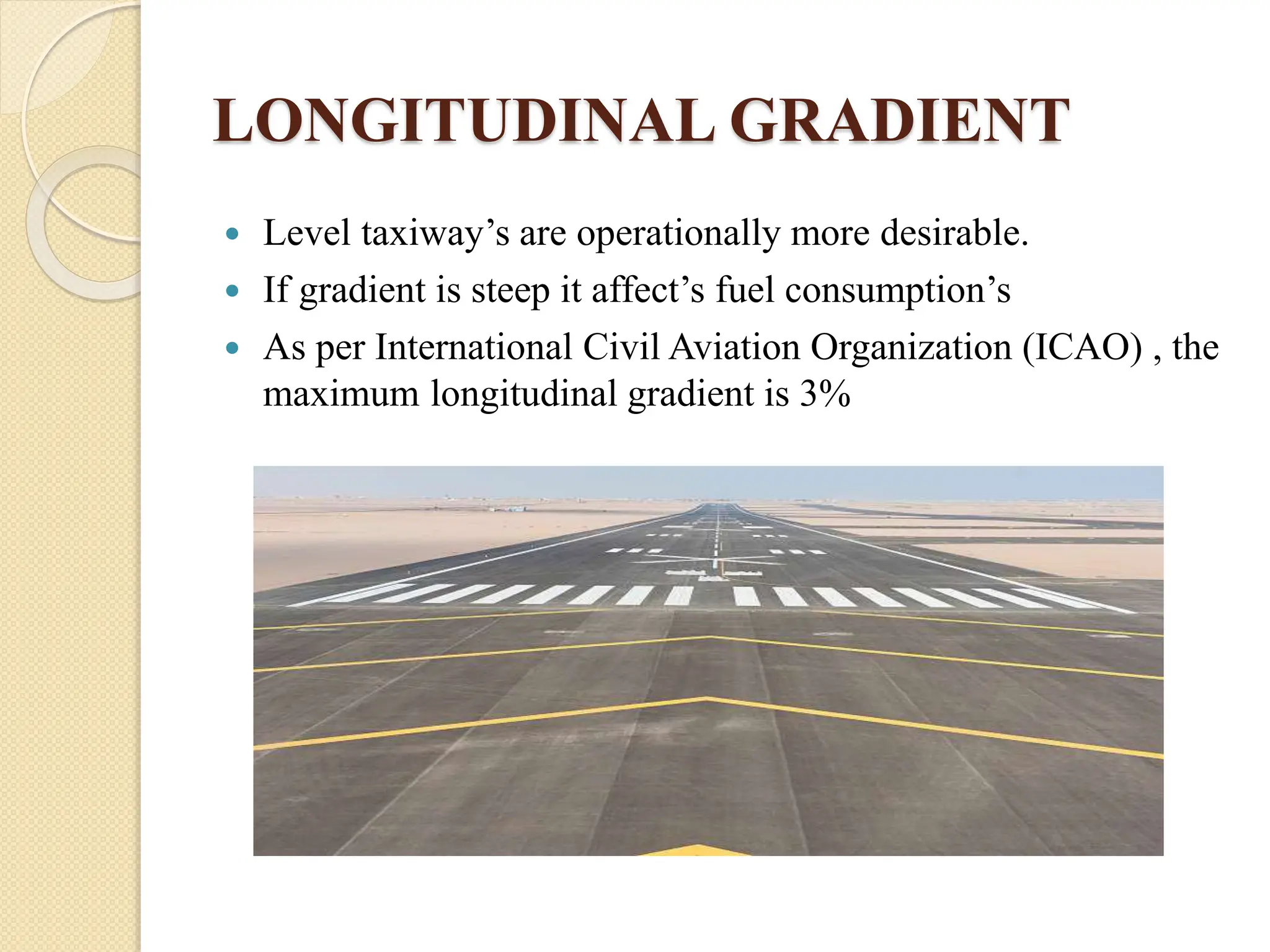
 Level taxiway’s are operationally more desirable.
 If gradient is steep it affect’s fuel consumption’s
 As per International Civil Aviation Organization (ICAO) , the
maximum longitudinal gradient is 3%
RATE OF CHANGE OF LONGITUDINAL
GRADIENT
 Available sight distance on the pavement is affected by rate
of change of longitudinal gradient.
 As per ICAO the maximum change in pavement longitudinal
gradient is 4% for A and B category of airports and 3.33% for
C, D and E category of airports.
 Rate of change should be smooth enough not to cause any
problem to aircraft movement.
 Vertical curves are provided at such junctions
SIGHT DISTANCE
 As speed of aircraft on taxiway is lower than the speed on
runway, the smaller value of sight distance will be sufficient
on the taxiway.
 ICAO recommends that the surface of taxiway must be
visible at least up to a distance of X from any point at a
height of Y above the taxiway surface.
AIRPORT CODE Y X
A 1.5 M 150 M
B 2 M 200 M
C,D & E 3 M 300 M
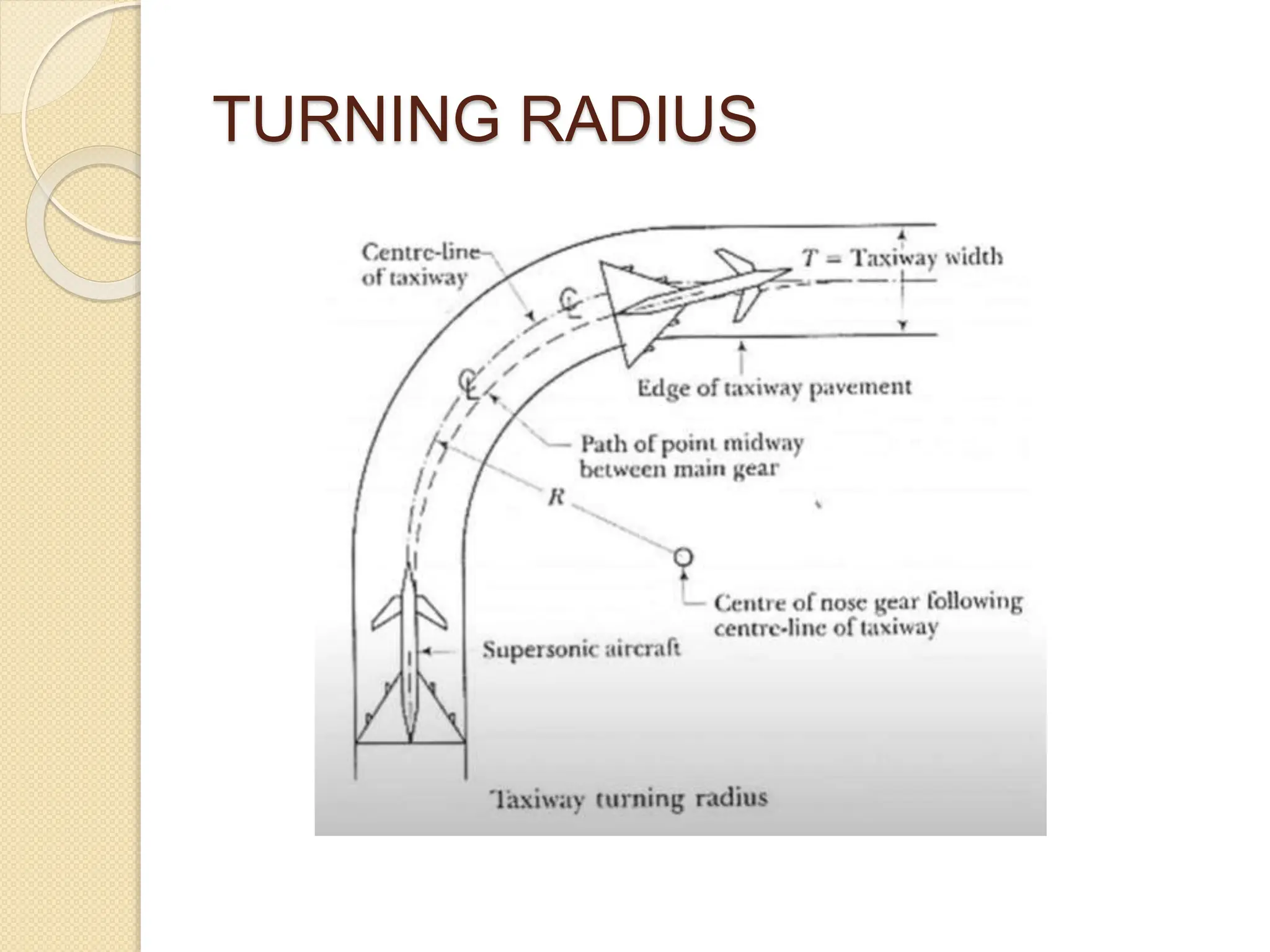
TURNING RADIUS
 Change in aircraft path is done by providing a horizontal
curve.
 Aircraft should negotiate the curve without significantly
reducing the speed.
 Recommended radii corresponding to taxing speeds of small,
subsonic and supersonic airplanes is 60 m, 135 m and 240 m,
respectively.
 Relationship between exit speed and radius of curve
Radius = V2/125f (m)
 where,'V' is in kmph and 'f' is coefficient of friction and
is equal to 0.13
TURNING RADIUS
WIDTH OF SAFETY AREA
Aerodrome code
A B C D E
Pavement &
shoulder’s
- - 25 m 38 m 44 m
Edge safety
margin
1.5 m 2.25 m 3 m 4.5 m 4.5 m
Graded
portion of
strip
22 m 25 m 25 m 38 m 44 m
Safety area is made up of paved shoulder on either side plus the area
which is graded and drained.
WIDTH OF THE TAXIWAY
 Width of taxiway is lower than the runway width.
 The speed of an aircraft on a taxiway is also less
than the runway.
 Varies between 22.5 m and 7.5 m.
THANK YOU

Geometric design of taxiway in airport.pptx

  • 1.
     GEOMETRIC'S OFTAXIWAY NITHIN B 1DT23CV412
  • 2.
    ICAOAIRCRAFTAPPROACH CATEGORY  AIRCRAFT CATEGORY, A -< 91KMPH  AIRCRAFT CATEGORY ,B - 91-120 KMPH  AIRCRAFT CATEGORY ,C – 121-140 KMPH  AIRCRAFT CATEGORY ,D – 141-165 KMPH  AIRCRAFT CATEGORY ,E – 166-210 KMPH
  • 3.
    FOLLOWING ARE THEELEMENT’S OF THE GEOMETRIC STANDARD’S FOR TAXIWAY 1. LENGTH OF TAXIWAY 2. LONGITUDINAL GRADIENT 3. RATE OF CHANGE OF LONGITUDINAL GRADIENT 4. SIGHT DISTANCE 5. TURNING RADIUS 6. WIDTH OF SAFETY AREA 7. WIDTH OF TAXIWAY
  • 4.
    1. LENGTH OFTAXIWAY • It should be short as possible. • No specifications are recommended by any organization.
  • 5.
    LONGITUDINAL GRADIENT  Leveltaxiway’s are operationally more desirable.  If gradient is steep it affect’s fuel consumption’s  As per International Civil Aviation Organization (ICAO) , the maximum longitudinal gradient is 3%
  • 6.
    RATE OF CHANGEOF LONGITUDINAL GRADIENT  Available sight distance on the pavement is affected by rate of change of longitudinal gradient.  As per ICAO the maximum change in pavement longitudinal gradient is 4% for A and B category of airports and 3.33% for C, D and E category of airports.  Rate of change should be smooth enough not to cause any problem to aircraft movement.  Vertical curves are provided at such junctions
  • 7.
    SIGHT DISTANCE  Asspeed of aircraft on taxiway is lower than the speed on runway, the smaller value of sight distance will be sufficient on the taxiway.  ICAO recommends that the surface of taxiway must be visible at least up to a distance of X from any point at a height of Y above the taxiway surface. AIRPORT CODE Y X A 1.5 M 150 M B 2 M 200 M C,D & E 3 M 300 M
  • 8.
    TURNING RADIUS  Changein aircraft path is done by providing a horizontal curve.  Aircraft should negotiate the curve without significantly reducing the speed.  Recommended radii corresponding to taxing speeds of small, subsonic and supersonic airplanes is 60 m, 135 m and 240 m, respectively.  Relationship between exit speed and radius of curve Radius = V2/125f (m)  where,'V' is in kmph and 'f' is coefficient of friction and is equal to 0.13
  • 9.
  • 10.
    WIDTH OF SAFETYAREA Aerodrome code A B C D E Pavement & shoulder’s - - 25 m 38 m 44 m Edge safety margin 1.5 m 2.25 m 3 m 4.5 m 4.5 m Graded portion of strip 22 m 25 m 25 m 38 m 44 m Safety area is made up of paved shoulder on either side plus the area which is graded and drained.
  • 11.
    WIDTH OF THETAXIWAY  Width of taxiway is lower than the runway width.  The speed of an aircraft on a taxiway is also less than the runway.  Varies between 22.5 m and 7.5 m.
  • 12.