GEOAVALANCHE
INTEGRATED AVALANCHE
RISK MANAGEMENT SYSTEM
MYGEOSS
2016
What is GeoAvalanche?
Ecosystem of geospatial applications for snow avalanche data
able to share information through maps and calculate the risk
with a higher level of accuracy and precision
Helps users avoiding to visiting places at high avalanche risk by
increasing their awareness of snow and avalanche conditions
and helps them plan their excursion in safer conditions
It exploits an ATES-based innovative algorithm that merges
elevation models, crowdsourcing and earth observation data to
geoprocessing the risk by doing
• Full-text searching for mountain places or peaks which are present
in OpenStreetMap data
• Navigating different basemaps and then drawing a point or a route
• Uploading a GPX track (much more time consuming depending on
points number)
MYGEOSS
2016
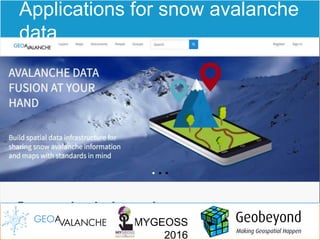
Applications for snow avalanche
data
MYGEOSS
2016
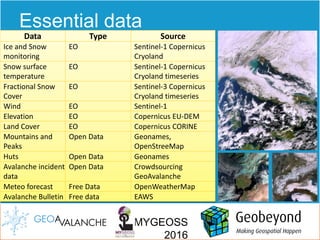
Essential data
Data Type Source
Ice and Snow
monitoring
EO Sentinel-1 Copernicus
Cryoland
Snow surface
temperature
EO Sentinel-1 Copernicus
Cryoland timeseries
Fractional Snow
Cover
EO Sentinel-3 Copernicus
Cryoland timeseries
Wind EO Sentinel-1
Elevation EO Copernicus EU-DEM
Land Cover EO Copernicus CORINE
Mountains and
Peaks
Open Data Geonames,
OpenStreeMap
Huts Open Data Geonames
Avalanche incident
data
Open Data Crowdsourcing
GeoAvalanche
Meteo forecast Free Data OpenWeatherMap
Avalanche Bulletin Free data EAWS
MYGEOSS
2016
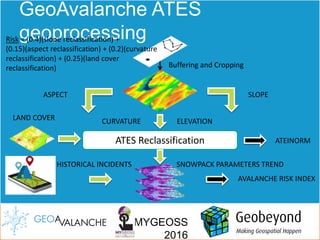
GeoAvalanche ATES
geoprocessing
Buffering and Cropping
SLOPE
ATES Reclassification
ASPECT
ELEVATION
LAND COVER
ATEINORM
HISTORICAL INCIDENTS
AVALANCHE RISK INDEX
SNOWPACK PARAMETERS TREND
Risk = (0.4)(slope reclassification) +
(0.15)(aspect reclassification) + (0.2)(curvature
reclassification) + (0.25)(land cover
reclassification)
CURVATURE
MYGEOSS
2016
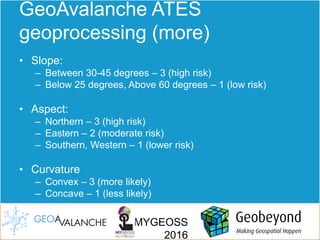
GeoAvalanche ATES
geoprocessing (more)
• Slope:
– Between 30-45 degrees – 3 (high risk)
– Below 25 degrees, Above 60 degrees – 1 (low risk)
• Aspect:
– Northern – 3 (high risk)
– Eastern – 2 (moderate risk)
– Southern, Western – 1 (lower risk)
• Curvature
– Convex – 3 (more likely)
– Concave – 1 (less likely)
MYGEOSS
2016
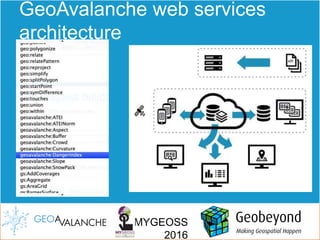
GeoAvalanche web services
architecture
MYGEOSS
2016
Questions?
• http://geoavalanche.org - Public snow avalanche geoportal
• http://geoavalanche.org/incident/ - Crowdsourced snow avalanche
information
• http://geoavalanche.org/mygeoss/public – Public MYGEOSS
application for Avalanche Risk Insight
• https://github.com/geoavalanche - GitHub organization and repositories
• https://www.facebook.com/Geoavalanche/ - Facebook page
• https://twitter.com/geoavalanche - Twitter account
• info@geobeyond.it - How to get support and add new features
• francesco.bartoli@geobeyond.it - Technical leader

GeoAvalanche Avalanche danger index processing

  • 1.
  • 2.
    MYGEOSS 2016 What is GeoAvalanche? Ecosystemof geospatial applications for snow avalanche data able to share information through maps and calculate the risk with a higher level of accuracy and precision Helps users avoiding to visiting places at high avalanche risk by increasing their awareness of snow and avalanche conditions and helps them plan their excursion in safer conditions It exploits an ATES-based innovative algorithm that merges elevation models, crowdsourcing and earth observation data to geoprocessing the risk by doing • Full-text searching for mountain places or peaks which are present in OpenStreetMap data • Navigating different basemaps and then drawing a point or a route • Uploading a GPX track (much more time consuming depending on points number)
  • 3.
  • 4.
    MYGEOSS 2016 Essential data Data TypeSource Ice and Snow monitoring EO Sentinel-1 Copernicus Cryoland Snow surface temperature EO Sentinel-1 Copernicus Cryoland timeseries Fractional Snow Cover EO Sentinel-3 Copernicus Cryoland timeseries Wind EO Sentinel-1 Elevation EO Copernicus EU-DEM Land Cover EO Copernicus CORINE Mountains and Peaks Open Data Geonames, OpenStreeMap Huts Open Data Geonames Avalanche incident data Open Data Crowdsourcing GeoAvalanche Meteo forecast Free Data OpenWeatherMap Avalanche Bulletin Free data EAWS
  • 5.
    MYGEOSS 2016 GeoAvalanche ATES geoprocessing Buffering andCropping SLOPE ATES Reclassification ASPECT ELEVATION LAND COVER ATEINORM HISTORICAL INCIDENTS AVALANCHE RISK INDEX SNOWPACK PARAMETERS TREND Risk = (0.4)(slope reclassification) + (0.15)(aspect reclassification) + (0.2)(curvature reclassification) + (0.25)(land cover reclassification) CURVATURE
  • 6.
    MYGEOSS 2016 GeoAvalanche ATES geoprocessing (more) •Slope: – Between 30-45 degrees – 3 (high risk) – Below 25 degrees, Above 60 degrees – 1 (low risk) • Aspect: – Northern – 3 (high risk) – Eastern – 2 (moderate risk) – Southern, Western – 1 (lower risk) • Curvature – Convex – 3 (more likely) – Concave – 1 (less likely)
  • 7.
  • 8.
    MYGEOSS 2016 Questions? • http://geoavalanche.org -Public snow avalanche geoportal • http://geoavalanche.org/incident/ - Crowdsourced snow avalanche information • http://geoavalanche.org/mygeoss/public – Public MYGEOSS application for Avalanche Risk Insight • https://github.com/geoavalanche - GitHub organization and repositories • https://www.facebook.com/Geoavalanche/ - Facebook page • https://twitter.com/geoavalanche - Twitter account • info@geobeyond.it - How to get support and add new features • francesco.bartoli@geobeyond.it - Technical leader

Editor's Notes