MAY // JUNE 2015
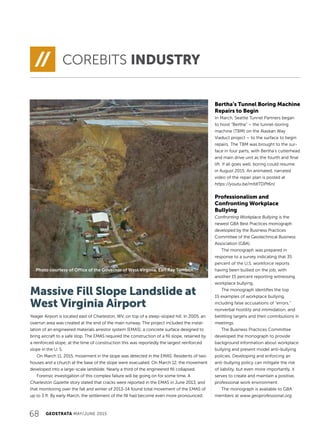
16 Geotechnical Performance-
Based Design at Ports
30 What’s New
in Geo?
PORTS,
HARBORS AND
SHORELINES
Proudly published by the Geo-Institute of ASCE
46 Innovative Use
of Groins
38 Filling
the Bay
Work with engineers worldwide to solve your ground improvement challenges.
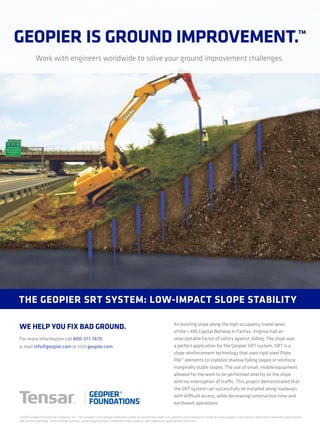
An existing slope along the high occupancy travel lanes
of the I-495 Capital Beltway in Fairfax, Virginia had an
unacceptable factor of safety against sliding. The slope was
a perfect application for the Geopier SRT system. SRT is a
slope reinforcement technology that uses rigid steel Plate
Pile™ elements to stabilize shallow failing slopes or reinforce
marginally stable slopes. The use of small, mobile equipment
allowed for the work to be performed directly on the slope
with no interruption of traffic. This project demonstrated that
the SRT system can successfully be installed along roadways
with difficult access, while decreasing construction time and
earthwork operations.
the Geopier srt system: Low-impact sLope stabiLity
For more information call 800-371-7470,
e-mail info@geopier.com or visit geopier.com.
©2014 Geopier Foundation Company, Inc. The Geopier® technology and brand names are protected under U.S. patents and trademarks listed at www.geopier.com/patents and other trademark applications
and patents pending. Other foreign patents, patent applications, trademark registrations, and trademark applications also exist.
Geopier is Ground improvement.™
we heLp you fix bad Ground.
2 GEOSTRATA MAY/JUNE 2015
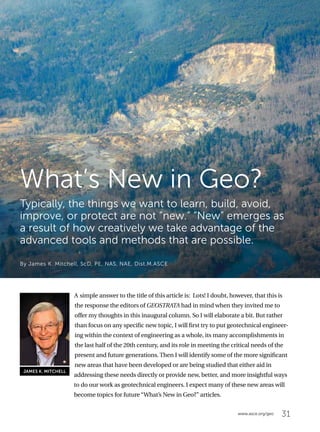
30	What’s New in Geo?
The goal of this new feature is to provide readers a
broad perspective of recent developments in research
and practice within the field of geotechnics that can
foretell the future of our profession.
Introduction by Michael P. McGuire
Article by James K. Mitchell
38	Filling the Bay
Deepening the Oakland inner and outer harbors.
By Nicholas E. Malasavage and David V. Doak
46	Innovative Use of a Groin Structure
Saving cost, shortening the schedule,
and minimizing impacts.
By Ram M. Kasturi and Vincent A. Siefert
54	The New Bedford Marine
Commerce Terminal
When construction of the first American offshore
wind farm support terminal encountered greater
challenges than expected, jet grouting enabled
construction to continue.
By Kevin Dawson
CONNECT WITH US
www.asce.org/geo twitter.com/GeoInstitute facebook.com/GeoInstitute LinkedInGeo GeoInstituteASCE
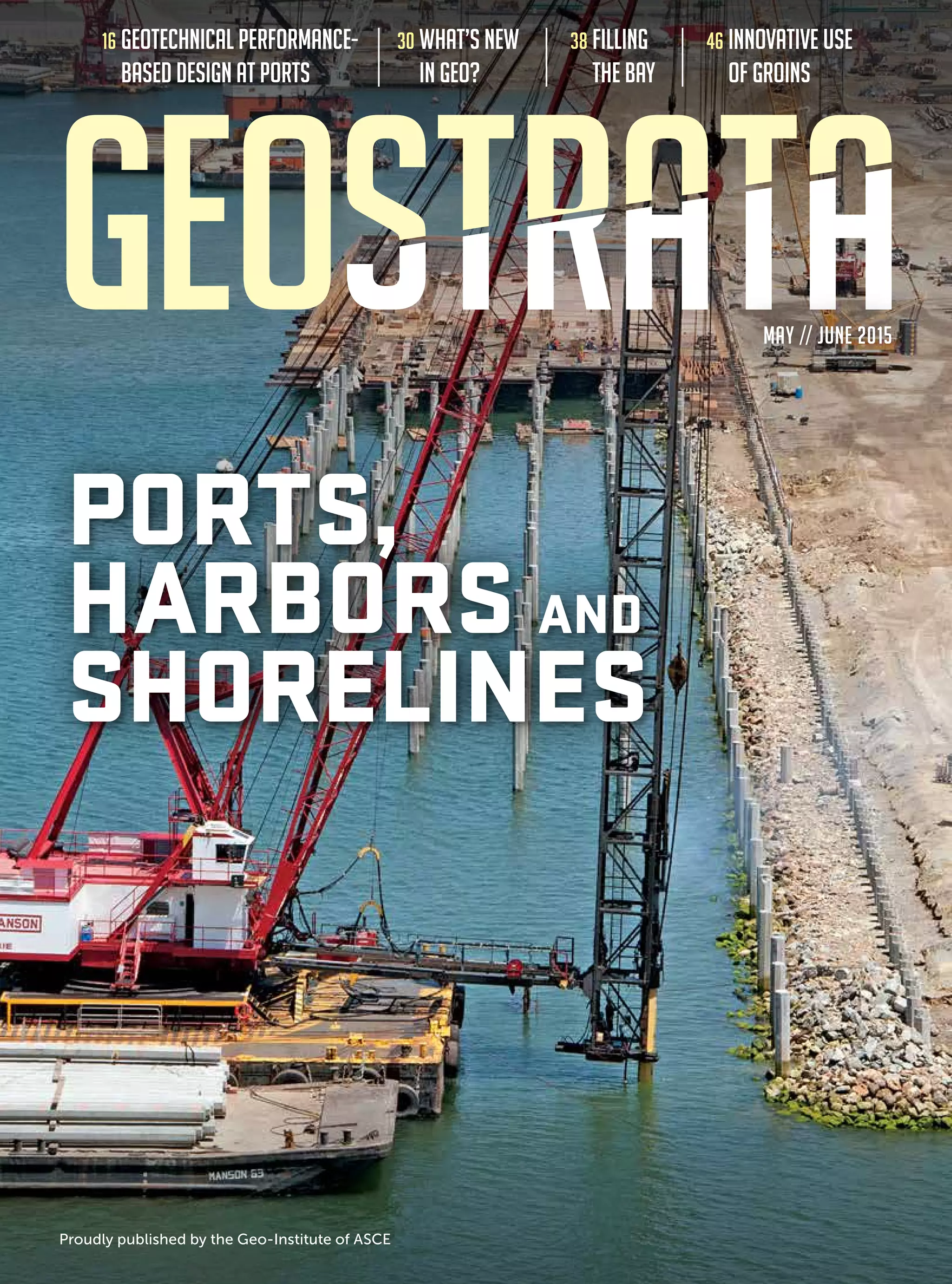
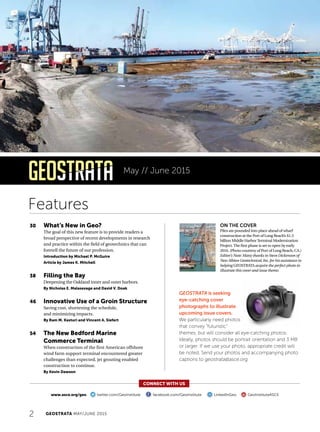
ON THE COVER
Piles are pounded into place ahead of wharf
construction at the Port of Long Beach’s $1.3
billion Middle HarborTerminal Modernization
Project.The first phase is set to open by early
2016. (Photo courtesy of Port of Long Beach, CA.)
Editor’s Note: Many thanks to Steve Dickenson of
New Albion Geotechnical,Inc.for his assistance in
helping GEOSTRATA acquire the perfect photo to
illustrate this cover and issue theme.
May // June 2015
Features
GEOSTRATA is seeking
eye-catching cover
photographs to illustrate
upcoming issue covers.
We particularly need photos
that convey “futuristic”
themes, but will consider all eye-catching photos.
Ideally, photos should be portrait orientation and 3 MB
or larger. If we use your photo, appropriate credit will
be noted. Send your photos and accompanying photo
captions to geostrata@asce.org.
DFP TAPERTUBETM
PILES...
THE BEST HIGH CAPACITY
FRICTION PILES
Project-proven Tapertubes are a dramatic leap forward in
on-the-job pile performance. Superior design and robust
construction means this remarkable product delivers big
advantages over conventional piles or other tapered piles.
Tapertube piles are the only tapered piles available with heavier
wall thicknesses ranging up to 0.500 produced from 50 ksi steel.
Directly driven, no mandrel or butt reinforcement required.
Cast steel conical driving points supplied.
Tapertube size and geometry can be configured to most
effectively meet capacity requirements and soil conditions.
DFP Tapertube Piles...
A Foundation For Success
PO Box 688 | Franklin Lakes, NJ 07417-0688
201-337-5748 | fax: 201-337-9022 | www.pileline.com
4 GEOSTRATA MAY/JUNE 2015
May // June 2015
Departments
6	President’s Letter
By Allen Cadden
8	From the Editorial Board
By Brian Hubel
10	Letters
14	COREBITS PEOPLE
15	COREBITS STUDENTS
16	As I See It: Enhancing Geotechnical
Practice in Support of Performance-
Based Design at Ports
By Stephen E. Dickenson
20	Lessons Learned from GeoLegends:
George J. Tamaro
By Hai (Thomas) Lin, Suguang (Sean) Xiao,
and Hanna Moussa Jabbour
58	The GeoCurmudgeon:
The Smaller They Are…
By John P. Bachner
62	Look Who’s a D.GE
An interview with Elizabeth M. Smith
64	G-I ORGANIZATIONAL
MEMBER NEWS
68	COREBITS INDUSTRY
69	COREBITS EVERYTHING G-I
70	COREBITS CHAPTERS
70	COREBITS CAREER
71	COREBITS CALENDAR
71	What’s Coming in July/August 2015
GEOSTRATA
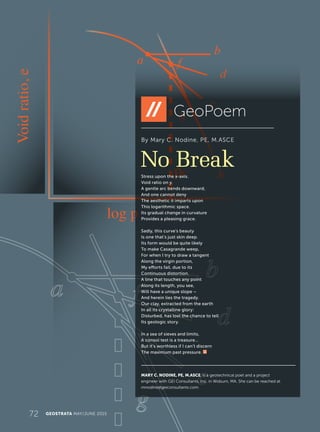
72	GeoPoem: No Break
By Mary C. Nodine
GEOSTRATA is published by the Geo-Institute
and the American Society of Civil Engineers.
EDI TORI A L BOA RD
j James L. Withiam, PhD, PE, D.GE, M.ASCE, D’Appolonia
jlwithiam@dappolonia.com
j J. Tanner Blackburn, PhD, PE, M.ASCE, Hayward Baker
jtblackburn@haywardbaker.com
j Jeff Dunn, PhD, PE, D.GE, GE, M.ASCE, Arup
jeff.dunn@arup.com
j Morgan Eddy, PE, M.ASCE, Steele Foundation, LLC
morgan@steelefoundationllc.com
j Ken Fishman, PhD, PE, M.ASCE, McMahon  Mann
Consulting Engineers
kfishman@mmce.net
j Beth Gross, PhD, PE, M.ASCE, Geosyntec Consultants
bgross@geosyntec.com
j Brian Hubel, PE, GE, M.ASCE, Black  Veatch
Corporation
hubelb@bv.com
j Michael P. McGuire, PhD, PE, M.ASCE, Lafayette College
mcguirem@lafayette.edu
j Peter G. Nicholson, PhD, PE, D.GE, F.ASCE,
Nicholson Geotechnical
peter.hawaii@gmail.com
j William K. Petersen, PE, M.ASCE, Schnabel Engineering
wpetersen@schnabel-eng.com
j Veronica L. Streich, PE, M.ASCE, HNTB Corporation
vstreich@hntb.com
2014-15 G-I BOARD OF
GOVERNORS
j Allen Cadden, PE, D.GE, M.ASCE – President
j Kord Wissmann, PhD, PE, D.GE, M.ASCE –
Vice President
j Garry H. Gregory, PhD, PE, D.GE, M.ASCE – Treasurer
j William M. Camp, III, PE, D.GE, M.ASCE – Past President
j Patrick J. Fox, PhD, PE, D.GE, M.ASCE
j Beth A. Gross, PhD, PE, M.ASCE
j Kancheepuram N. Gunalan, PhD, PE, D.GE, F.ASCE
j Youssef M. A. Hashash, PhD, PE, F.ASCE
j Robert Schweinfurth, A.M.ASCE – Secretary
non-voting Board member
GEOSTRATA STAFF
j Stefan Jaeger – Publisher
j Dianne Vance, CAE – Director of Advertising
dvance@asce.org
j Robert Schweinfurth, A.M.ASCE – G-I Director
rschweinfurth@asce.org
j Jennifer M. Canning – Content Editor
j Elizabeth Cuscino – Content Editor
j Kristie C. Kehoe – Content Coordinator
j Helen Cook – Content Editor
j Sean Richardson – Production Manager
ADVERTISING SALES MANAG E R S
j Amy Hakim, Kelli Nilsson, Brooke King
GEOSTRATA DESIGN
j THOR Design Studio, www.thordesignstudio.com
GEOSTRATA is a forum for the free expression and interchange of
ideas. The opinions and positions stated within are those of the
authors, and not necessarily those of GEOSTRATA, the Geo-
Institute, or the American Society of Civil Engineers (ASCE).
GEOSTRATA—ISSN 1529-2975—is published bi-monthly by ASCE,
1801 Alexander Bell Drive, Reston, VA 20191-4400 and is a free
ASCE/Geo-Institute membership benefit, not available by
subscription. ADDRESS CHANGES: ASCE/G-I members should
e-mail memrec@asce.org, or click on “My Profile” at asce.org.
Copyright © 2015 by the American Society of Civil Engineers. All
rights reserved. Materials may not be reproduced or translated
without written permission from ASCE. Periodicals postage paid at
Herndon, VA, and at additional mailing offices. POSTMASTER: Send
address changes to GEOSTRATA, 1801 Alexander Bell Drive, Reston,
VA 20191-4400.
ISSUE NO. 3 • VOLUME 19
We Have BIG News!
Visit Dataforensics at the GeoCongress Booth 91
to Learn More About the Future of Data Collection
www.Dataforensics.net
Call: 678.406.0106 ext. 2
©2012 Panasonic Corporation of North America. All rights reserved.
Android is a trademark of Google Inc. The Android robot is reproduced or
modified from work created and shared by Google and used according to
terms described in the Creative Commons 3.0 Attribution License.
WE ARE HIRING! Dataforensics has an immediate need for a
Geotechnical Engineer/Software Implementation Specialist.
Contact humanresources@dataforensics.net for consideration
or scan the QR code for details.
INTERPRET ANALYZE PREPARE
We Have BIG News!
Visit Dataforensics at the GeoCongress Booth 91
to Learn More About the Future of Data Collection
www.Dataforensics.net
Call: 678.406.0106 ext. 2
©2012 Panasonic Corporation of North America. All rights reserved.
Android is a trademark of Google Inc. The Android robot is reproduced or
modified from work created and shared by Google and used according to
terms described in the Creative Commons 3.0 Attribution License.
WE ARE HIRING! Dataforensics has an immediate need for a
Geotechnical Engineer/Software Implementation Specialist.
Contact humanresources@dataforensics.net for consideration
or scan the QR code for details.
INTERPRET ANALYZE PREPARE
6 GEOSTRATA MAY/JUNE 2015
As the Recession Winds Down
The Great Recession hit in 2008. We are now well into 2015. Reports vary and
many still talk of a slow recovery. Some are already worrying about the next
recession looming in our future. We all know these things happen in cycles;
and since this one was so long in recovery, the next one must be right around
the corner. I’m not ready to allow this worry to control my future. I prefer
to see the glass as half full. Magazines and newspapers are filled with notes
about new commercial project start-ups, housing starts, and infrastructure
investments. Since the engineering community has weathered the recession better than many,
I’m even hearing more positive chatter about firms focusing on growth and hiring.
As the market heats up and firms see
the need to hire to meet the growing
demand, we will be finding that for
the past seven years the market has
actually been evolving. No matter what
segment of the geoprofession you are
in, the industry did not stand still while
the economy was down. Economic
pressures forced accelerated changes
because we all had to be more efficient
with the limited resources available.
This meant expecting more produc-
tivity from our employees and greater
capabilities from our tools. It may have
also meant that we looked beyond our
traditional market areas to stay busy and
have now expanded our reach, and the
expectation of working in our backyard
has changed.
Having just returned from the
IFCEE event, our 2015 Geo-Congress,
I’m reminded that it’s critical that we
stay current with technologies, and
the challenges and opportunities they
bring to produce better solutions for our
clients and the public. Professionals are
expected to know the current trends,
technological advancements, and sound
design practices. After all, that’s why
our clients hire us and the public puts
their trust in our professional license.
Delivering yesterday’s technologies with
yesterday’s designs will not suffice, and
will not make our clients happy — nor
is it likely to provide repeat business
opportunities. The G-I is here to help
our members meet this challenge.
Beyond purely technical capabilities
and new tools, a project takes team-
work, as I mentioned in a previous
column. Our universities began
responding long ago to the need to work
together, and most require capstone
projects developed by a diverse team
of students. Teams are most effective
when they bring diversity of knowledge,
experience, and viewpoint together
to understand a challenge completely
and vet alternatives that may meet the
project needs. Again, the G-I is here to
help. At the local level or on national
committees, there are so many opportu-
nities to work in just such a diverse team
in a safe environment. These are skills
that you take back to your day job.
An evolution is taking place in the
geoprofession, as it always has. We
may see segments of our businesses
becoming more distinct or segregated,
but the need for the geoprofessional will
remain. No matter what segment, the
same driving forces will exist, and the
most successful firms will understand
and seek out employees who can help
them remain current in our industry,
bring new ideas and experiences to the
firm, and deliver great products on time.
All of this is important, but the most
critical skills any geoprofessional must
have are the ability to communicate and
willingness to serve clients. After all,
they are why we are in this business in
the first place!
Grab the opportunities in front of
you. Enjoy what you are doing. Give. Be
happy. The rest will come easily.
Allen Cadden, PE, D.GE, M.ASCE
Geo-Institute President
acadden@schnabel-eng.com
President’s Letter
ALLEN CADDEN
info@rstinstruments.com
www.rstinstruments.com
TELEPHONE | 604 540 1100 | FAX 604 540 1005
TOLL FREE (NORTH AMERICA) | 1 800 665 5599
WESTERN USA | 831 899 1632
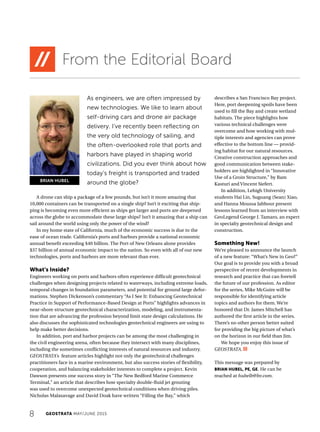
Wireless technology providing continuous data
acquisition with minimum per channel cost.
WIRELESS DATA
ACQUISITION for Geotechnical
Instruments
Y o u r i n s t r u m e n t s Y o u r f i e l d d a t a Y o u r w o r k s t a t i o n Y e s . . . i t i s t h a t e a s y .
L900S Y S T E M
An RSTAR L900 System uses L900 RSTAR Nodes (see left) at the sensor level, deployed in a star topology
from a continuously active L900 RSTAR Hub, which consists of an L900 RTU interfaced to a FlexDAQ
datalogger. The system is based on the 900 MHz, 868 MHz and 2.4 GHz spread spectrum band (country
dependent) with extensive open-country range through use of simple dipole or directional antennae.
900 MHz, 868 MHz, 2.4 GHz
(country dependent)
Spread Spectrum band
ANTENNA
Solar
Panel
Battery
Datalogger
L900 RTU
Ethernet
Spread Spectrum Radio
Wi-fi
Multi-drop
Cellular
Storage Module
USB
RF Modem to RF Base Station
Short Haul Modem
Iridium ISU
CUSTOMER’S
SERVER
or
WORKSTATION
RSTAR HUB
D I A G R A M
DT2011B DATA LOGGER
Monitor a single vibrating wire
sensor and thermistor.
DT2055B DATA LOGGER
Monitor up to 10 sensors.
Can be any mix of vibrating wire
sensors and thermistors.
DT2040 DATA LOGGER
Monitor up to 40 sensors.
Can be any mix of vibrating wire
sensors and thermistors.
DT4205 DATA LOGGER
Monitor up to 10 channels.
Can be any mix of 4-20mA
sensors or thermistors.
DIGITAL TILT LOGGER
Low cost, lithium ‘D’ cell
powered data logger  tilt meter
in a single, compact unit.
RSTAR
L900
NODE
Vibrating
Wire
(ie:Piezometer)
RSTAR
L900
NODE
Thermistor
or
Thermistor
String
RSTAR
L900
NODE
MEMS
Tilt Meter
RSTAR
L900
NODE
4-20mA
Transmitter
Typical RSTAR configuration for the RSTAR L900 System.
Antenna can be
easily attached in field.
Sensor
CONNE
CT WIT
HUS
L900
RSTAR
Node
MIG0296BRST Instruments Ltd. reserves the right to change specifications without notice.
http://www.linkedin.com/company/rst-instruments-ltd-
F E A T U R E S
Excellent Hub-Node range - up to 14 km in open country depending on antenna.
Ultra-low quiescent power. RSTAR Nodes powered by 1 lithium ‘D’ cell (up to 7 years of life).
Simple star routing - no mesh overhead.
Simple network setup: add node serial number to RSTAR Hub list, deploy.
Based on proven flexDAQ experience and technology - up to 255 L900 Nodes per flexDAQ.
Multiple telemetry options such as cell, modem, LAN, radio, satellite (see diagram).
Data accessible at multiple locations via WWW - protected at all stages by encrypted, error-corrected transmission  storage.
W O R K S W I T H
GeoViewerREAL-TIME MONITORING
More info at: www.rstinstruments.com/rstar.html
8 GEOSTRATA MAY/JUNE 2015
From the Editorial Board
A drone can ship a package of a few pounds, but isn’t it more amazing that
10,000 containers can be transported on a single ship? Isn’t it exciting that ship-
ping is becoming even more efficient as ships get larger and ports are deepened
across the globe to accommodate these large ships? Isn’t it amazing that a ship can
sail around the world using only the power of the wind?
In my home state of California, much of the economic success is due to the
ease of ocean trade. California’s ports and harbors provide a national economic
annual benefit exceeding $40 billion. The Port of New Orleans alone provides
$37 billion of annual economic impact to the nation. So even with all of our new
technologies, ports and harbors are more relevant than ever.
What’s Inside?
Engineers working on ports and harbors often experience difficult geotechnical
challenges when designing projects related to waterways, including extreme loads,
temporal changes in foundation parameters, and potential for ground large defor-
mations. Stephen Dickenson’s commentary “As I See It: Enhancing Geotechnical
Practice in Support of Performance-Based Design at Ports” highlights advances in
near-shore structure geotechnical characterization, modeling, and instrumenta-
tion that are advancing the profession beyond limit state design calculations. He
also discusses the sophisticated technologies geotechnical engineers are using to
help make better decisions.
In addition, port and harbor projects can be among the most challenging in
the civil engineering arena, often because they intersect with many disciplines,
including the sometimes conflicting interests of natural resources and industry.
GEOSTRATA’s feature articles highlight not only the geotechnical challenges
practitioners face in a marine environment, but also success stories of flexibility,
cooperation, and balancing stakeholder interests to complete a project. Kevin
Dawson presents one success story in “The New Bedford Marine Commerce
Terminal,” an article that describes how specialty double-fluid jet grouting
was used to overcome unexpected geotechnical conditions when driving piles.
Nicholas Malasavage and David Doak have written “Filling the Bay,” which
describes a San Francisco Bay project.
Here, port deepening spoils have been
used to fill the Bay and create wetland
habitats. The piece highlights how
various technical challenges were
overcome and how working with mul-
tiple interests and agencies can prove
effective to the bottom line — provid-
ing habitat for our natural resources.
Creative construction approaches and
good communication between stake-
holders are highlighted in “Innovative
Use of a Groin Structure,” by Ram
Kasturi and Vincent Siefert.
In addition, Lehigh University
students Hai Lin, Suguang (Sean) Xiao,
and Hanna Moussa Jabbour present
lessons learned from an interview with
GeoLegend George J. Tamaro, an expert
in specialty geotechnical design and
construction.
Something New!
We’re pleased to announce the launch
of a new feature: “What’s New in Geo?”
Our goal is to provide you with a broad
perspective of recent developments in
research and practice that can foretell
the future of our profession. As editor
for the series, Mike McGuire will be
responsible for identifying article
topics and authors for them. We’re
honored that Dr. James Mitchell has
authored the first article in the series.
There’s no other person better suited
for providing the big picture of what’s
on the horizon in our field than Jim.
We hope you enjoy this issue of
GEOSTRATA.
This message was prepared by
BRIAN HUBEL, PE, GE. He can be
reached at hubelb@bv.com.
As engineers, we are often impressed by
new technologies. We like to learn about
self-driving cars and drone air package
delivery. I’ve recently been reflecting on
the very old technology of sailing, and
the often-overlooked role that ports and
harbors have played in shaping world
civilizations. Did you ever think about how
today’s freight is transported and traded
around the globe?BRIAN HUBEL
See how Skyline Steel can help with your next geostructural project.
Visit www.skylinesteel.com or call 888.450.4330.
Skyline Steel Hot Rolled Threaded Bar
In addition to providing the most comprehensive product offering from a single company in the
geotechnical industry, Skyline Steel is a premier supplier of Gr. 75 Hot Rolled Threaded Bar
■ New improved hot-rolled thread form design allows for up to 30% increased thread engagement
■ Available in bar designations #6 through #14; diameters ¾” – 1 ¾”
■ Hot rolled threaded bars conform to ASTM A615 “Standard Specification for Deformed Carbon Steel
Bars for Concrete Reinforcement”, excluding the requirement of: “Legibly rolled surface markings”
■ Multiple stocking locations in the USA with immediate availability
■ Skyline Steel threaded bars may be field cut and coupled at any position along their length
■ Accessories designed and test proven to perfectly complement our threaded bars allowing coupling and
plate positioning with nuts at any location along the bar
■ Ideal for use in concrete reinforcement and rock/soil anchoring applications
©2015SkylineSteel,LLC.SkylineSteelisawholly-ownedsubsidiaryofNucorCorporation,thelargestproducerofsteelintheUnitedStates.
MADE IN U.S.A.
Our Hot Rolled Threaded Bars are manufactured by Nucor. Skyline Steel is a wholly-owned subsidiary of Nucor Corporation,
the largest producer of steel in the United States. Our bar product consists of a minimum of 80% recycled material.
SKYLINE STEEL
10 GEOSTRATA MAY/JUNE 2015
Readers Agree with Macnab’s Common-Sense Approach
Letters
16 GEOSTRATA JANUARY/FEBRUARY 2015
Are We Getting Better?
Sometimes, but Not Always…
As I See It
By Alan Macnab, P.Eng., D.GE
The foundation drilling business has changed
dramatically during my career. Equipment
advances and revolutionary design thinking
brought about many of these changes.
However, we continue to forget successes
of the past, or discount them, when we can’t
clearly understand the mechanisms of the
observed behavior. Terzaghi taught us the
observational method six decades ago, and
although we all know about it, and agree that
it makes sense, precious few of us really use it.
In fact, with the increasing use of codes, and
the tyranny of permitting agencies, I fear that
the observational method is dying. So with this
perspective, please tolerate an old retired guy,
as he reminisces about things he has seen.
In 1973, we placed casing by dropping it in pre-excavated holes, or on rare
occasions driving it with a drop weight called a tappette. Pulling casing was
performed by dead pull using cranes, or sometimes three tripods with multiple
reeved blocks. Buckling of crane booms was not unusual — which, of course, was
very dangerous. Although vibro hammers were first introduced to North America
in 1957, when I started we were just learning where and when to use them.
In 2014, we are finding more and more casing installed by vibro hammer
or with the utilization of oscillators and rotators. The use of casing has been
reduced by the introduction of polymer slurries in the 1980s. Vibro extraction
Karl Terzaghi
17www.asce.org/geo
The research of Dr. Lymon Reese and
others led us to understand that shafts
function largely in side wall friction,
rather than end bearing. Bells began
disappearing except for some specific
applications in places like Chicago and
areas of expansive soils.
or removal of casing by oscillator is very
common, and fortunately we have less
crane boom failure.
In 1973, we entered almost all dry
or cased shafts. This entry was for hand
cleaning and subsequent inspection by
engineering personnel. Belled shafts
were common, which required a great
deal of hand cleaning. The largest bell I
ever saw was 36 ft in diameter!
The research of Dr. Lymon Reese and
others led us to understand that shafts
function largely in side wall friction,
rather than end bearing. Bells began
disappearing except for some specific
applications in places like Chicago and
areas of expansive soils. Rock socket
design, rather than a wire brushed end
bearing in rock, as was previously the
status quo, became more the norm. By
2014, except in places like the Piedmont
regions of the Southeast and Chicago,
shaft entry has virtually disappeared
with the hearty approval of OSHA.
Speaking of end bearing, early in
my career I spent hours under a heavy
girder, anchored with piles which
acted as a load test frame, reading dial
gauges as we performed plate bearing
tests on rock. Full-scale load tests on
piles or shafts, using either anchorage
or dead weight for reaction, were very
difficult, so we scaled up plate load tests.
Full-scale load tests to loads which we
couldn’t have even imagined then are
now possible with O-cells, Statnamic,
and drop weight mechanisms.
In 1973, tiebacks were used in only a
few areas in North America, and in those
areas the work was usually performed
with continuous flight augers. The rest of
us were using raker- and cross-lot braced
excavations. Grouting of tiebacks was by
gravity tremie methods, or even free fall.
Today, we employ duplex drilling meth-
ods and first pressure grouting and now
secondary grouting. Pressure grouting
gives us much higher capacities, and
secondary grouting frees up the drill to
maintain production.
The introduction of small diameter,
cased rotary drilling and duplex, cased
drilling for tiebacks has also assisted
www.GRLengineers.com/pit info@GRLengineers.com
Central Office..... 216.831.6131
California............ 323.441.0965
Colorado ............ 303.666.6127
Florida................ 407.826.9539
Illinois................. 847.221.2750
Louisiana............ 985.640.7961
North Carolina.... 704.593.0992
Ohio.................... 216.831.6131
Pennsylvania...... 610.459.0278
Washington........ 425.381.9690
Quick response... results you can trust
by the Foundation Testing Experts
Pulse Echo Integrity Testing (PIT)
GRL assesses
the integrity
(and depth)
of concrete
foundations
in minutes.
Pulse Echo Pile
Integrity Testing is
standardized by
ASTM D5882.
Integrity Testing is
JANUARY // FEBRUARY 2015
Proudly published by the Geo-Institute of ASCE
28 A Foundation
Engineering Trip
46 Foundation
Engineering… 102
40 Screw Piles and
Helical Anchors
34 Spread Footings
Revisited
FOUNDATIONS
j j I just read Alan Macnab’s “As I See It”
commentary in the January/February
2015 issue of GEOSTRATA and passed
it around to the other engineers in our
small office. They had the same com-
plaint I had. The article was too short. But
it was right on the money.
I am a deep foundation contractor
specializing in pile driving/drilling/
augering with particular interest in
sheeting, shoring, and underpinning
systems for over 40 years. His Earth
Retention Systems Handbook has been
read and re-read by our engineers for a
dozen years.
We spend too much time lately
explaining the obvious to engineers who
have a “new idea” about how structural
and geotechnical designs should com-
bine. Thanks for the fine article.
George M. Morris, PE
President, Macro Enterprises, Ltd.
Massapequa, NY
macroent@optonline.net
j j I really enjoyed reading Alan Macnab’s
“As I See It” commentary in the January/
February GEOSTRATA. I am only 20 years
into my career, but have noticed many of
the same things. While computer tools
are great, too many young engineers
don’t understand that they are just tools;
it’s our mind that solves the problem.
When my mentor Fred Brown retired,
he was gracious enough to pass on his
“Secret Book.” He had recorded all of the
rules-of-thumb and lessons he learned
from observations made during his
40-year career. Things they would never
put in a book now for fear of being sued…
but they still work if you know how to
apply them.
Alan’s commentary is a great reminder
that we stand on the shoulders of those
who came before us. The timing of this
article was great with the tribute to my
firm’s founders; we still use much of
the equipment and methods that they
developed during their career. Thanks for
publishing the reminder of who we are.
Stafford Glashan, PE, M.ASCE
Shannon  Wilson, Inc., Anchorage, AK
SJG@shanwil.com
j j I thank Alan Macnab for his “As I See
It” commentary in the January/February
2015 issue of GEOSTRATA. As always,
sage words from someone who has
experienced a lot. We need to remember
that common sense is a more valuable
tool than numerical modeling sometimes.
Allen W Cadden, PE, D.GE, M.ASCE
President, ASCE Geo-Institute
acadden@schnabel-eng.com
j j It was refreshing to read the “As I
See It” commentary by Alan Macnab
in the January/February 2015 issue
of GEOSTRATA. Alan and I entered
the industry at the same time. My first
employer was the George Hyman
Construction Company of Washington,
DC. Frustrated by its subcontractor’s
performance, Hyman decided to develop
a self-perform capability in excavation
support and foundation construction. I
was fortunate to be hired and mentored
by Hank Kramer, an alumnus of the old
Spencer, White and Prentis, and Harry
Schnabel. Washington DC is a great
city for those who love shoring and
foundation design and construction. Due
to building height restrictions, buildings
are forced ever deeper into the ground to
11www.asce.org/geo
provide parking and other functions.
Alan’s comments regarding the loss
of the observational method in shoring
and foundation design hits the nail on
the head. Hands-on experience with the
ground you are excavating is invaluable
in predicting the soils’ behavior and is far
more reliable than a computer-generated
soil characterization. In addition, the
experience and knowledge of the
sand hogs and pile drivers that actually
perform the work should be incorporated
into any shoring or foundation design.
Alan’s comments on the design,
inspection, and construction of drilled
shafts reminded me of an interesting
project. It required that we request a
code modification to found several
small-diameter drilled shafts on rock
rated at 50 t/sf. When we reached what
we assumed was competent rock, we
requested inspection and approval. A city
inspector arrived at the project with a
ball-peen hammer, pinged the rock a few
times, and declared it 50 t/sf.
One additional technique that has
apparently faded from use is the hand-
dug underpinning pier. These 3 ft x 4
ft pits were used extensively in DC to
support adjacent structures and extended
as deep as 40 ft.
Regarding the thickness of lagging,
I agree with Alan that timber must have
lost significant strength. I was recently
provided with a design that called for
double, 6-in. thick boards for a 9-ft span
between soldier beams.
Alan G. Hobelman, PE
Beverly Hills, CA
ahobelman@roadrunner.com
Thanks for the Poetry
Just a quick note to thank Mary Nodine
for her GeoPoem, “Soil of My Dreams,”
in the March/April 2015 issue. I’m not
normally one for much poetry, but I have
to admit that Mary’s contribution is one
that I always look for and enjoy — her
creative wordsmithing often makes me
laugh. Thanks again for bringing smiles to
many of us!
Kord Wissmann, PhD, PE, D.GE
Geopier Foundation Company,
Davidson, NC
kwissmann@geopier.com
GEOSTRATA welcomes letters
to the editor. Some letters may be edited
to suit style and space guidelines. Please
send them to us at geostrata@asce.org.
Where theory
meets practice.
Earn a masters degree in Applied Geosciences
without interrupting your career. Full-time and
part-time tracks are available. Students can
complete this 12-course geology masters
program in just two to four years.
At Penn’s Master of Science in Applied Geosciences (MSAG) program, we don’t
prepare students to make a difference once they graduate. They start right away.
Through internships, field work, and projects tailored to their individual career goals,
students gain real experience in their field of choice and get a year’s head start on
licensure as a Professional Geologist.
To learn more about the program and read about the difference you can make as
a Penn MSAG student, visit
WWW.upenn.edu/msag.
Check out New Orleans’ newest piece of mind.
Made from Nucor recycled steel, our steel pile is driven deep into the Louisiana earth,
and supports this levee that helps protect millions of the most resilient people in America.
Each and every person committed to rebuild New Orleans stronger, safer, and even more prepared
for the future. So it can be filled back up with a sea of fun-loving people.
www.nucoryamato.com
It’s Our Nature.®
Reddy Named
Researcher
of the Year
Krishna Reddy, PhD, PE, D.GE, F.ASCE,
is a winner of the University of Illinois
at Chicago’s (UIC) Researcher of the
Year Award for 2014, as a Distinguished
Researcher. The award is bestowed
by the University to recognize the
efforts and commitment of researchers
who have demonstrated outstanding
research achievements in their field of
expertise and promoted excellence in research at UIC.
His research focuses on a number of emerging environmental challenges in waste
management, using innovative approaches like phytoremediation, a green technology
utilizing plants to mitigate environmental problems without the need to excavate con-
taminated material and dispose of it elsewhere. His research takes a holistic approach,
striving to maximize the environmental, social, and economic benefits of a project. He
has developed a new Social Sustainability Evaluation Matrix to assess socio-economic
considerations in selecting remedial technologies for site-specific conditions. This Matrix
addresses the challenging issues of social acceptance and equity in remedial decisions.
Dr. Reddy has collaborated with the Chicago Park District and Argonne National
Laboratory on multiple projects, including a field-scale demonstration of phytoreme-
diation at a heavily impacted wetland site in southwest Chicago. This demonstration
provides value to both the research community and the neighborhood, as the restored
wetland will eventually serve as a nature reserve and recreational area for local residents.
Dr. Reddy is the chair of the upcoming Geo-Chicago 2016 conference with the
theme “Sustainability, Energy, and the Geoenvironment.”
He was presented with the award at a reception on February 25, 2015. Honorees
receive a one-time monetary prize and a commemorative award.
Benson Appointed Dean
The University of
Virginia has
announced that
Craig H. Benson,
PhD, PE, D.GE, NAE,
F.ASCE, has been
selected as the 13th
dean of the
University of Virginia
School of Engineering and Applied
Science. Dr. Benson’s appointment is
effective July 1, 2015.
The School of Engineering and
Applied Science is the second-largest of
U.Va’s 11 schools, with 2,688 undergrad-
uate students, 585 graduate students,
and 141 faculty members. The school
offers 10 undergraduate degrees and 10
graduate degrees.
Dr. Benson is coming from the
University of Wisconsin-Madison, where
14 GEOSTRATA MAY/JUNE 2015
COREBITS PEOPLE
he chairs the Department of Civil and
Environmental Engineering and the
Department of Geological Engineering,
co-directs the Office of Sustainability, and
directs sustainability research and educa-
tion. Benson is also an affiliate professor
at the University’s Nelson Institute for
Environmental Studies.
Dr. Benson served as the president of
the G-I Board of Governors in 2012-13
and as the editor-in-chief of the Journal
of Geotechnical and Geoenvironmental
Engineering in 2004-2006.
Engler Joins AGP
Board of Trustees
Theresa Engler,
executive director of
the Deep
Foundations
Institute (DFI), has
been named a board
member of the
Academy of Geo-
Professionals (AGP).
She is the first female AGP Board member.
Engler (formerly Rappaport) has been
the executive director of DFI since 2006
and served as the assistant director from
1998-2006. She will serve as the public
member on the AGP Board. This position
is reserved for someone who represents
the best interests of the general public,
but is not a Diplomate, nor qualified to
become one.
Leahy Receives Pick
and Gavel Award
The Association of American State
Geologists (AASG) has recognized the
executive director of the American
Geosciences Institute, Dr. P. Patrick Leahy,
with its prestigious Pick and Gavel Award.
This award was initiated by AASG in 1999 to
recognize distinguished friends of geology
COREBITS PEOPLE
15www.asce.org/geo
who have made major contributions to
advancing or facilitating the role that
geoscience plays in our society.
“Many of the complex geoscience
issues we face today are of significant
interest to the public,” Leahy said.
“Indeed, earth-science problems often
involve serious conflict, have costly and
long-term consequences, require timely
action on the part of a policymaker, and
reveal significant gaps in our knowledge
and understanding.”
Leahy was honored with a dinner at
the Cosmos Club in Washington D.C. on
March 10, 2015.
2015 Harriet Evelyn Wallace
Scholarship Winners
Announced
The 2015 recipients of Harriet Evelyn
Wallace Scholarship are master’s candi-
dates Emma Reed and Annette Patton.
Emma Reed is attending the University of
Arizona in the Department of Geosciences.
Her research uses geochemical and
banding proxies from coral records to
investigate climate variability. She will be
conducting field work in Australia this
summer to continue this research.
Annette Patton is investigating
the September 2013 Colorado mass
movement events while pursuing her
master’s at Colorado State University in
the Department of Geosciences. She will
be conducting field work in 2015 using
ground-based surveys of the 2013 deposits
and analyzing geospatial data, including
aerial imagery, topographic data, and
historic photos. Her work is particularly
salient because the mass movements
deposited significant sediment loads to
streams, impacted building infrastructures,
and set the stage for investigating ongoing
geologic hazards. Results from her
research will facilitate increased hazard
awareness and public safety.
The Harriet Evelyn Wallace scholarship,
now in its third year, is awarded to women
pursuing graduate degrees in geoscience.
It is a $5,000 award for one academic
year, with the opportunity to renew for an
additional year of support, if the scholar is
qualified. The original bequest was given
by Harriet Evelyn Wallace, who was one of
the founding members of the Geoscience
Information Society (GSIS), a national
organization and American Geosciences
Institute (AGI) member society that
facilitates the exchange of information in
the geosciences.
www.GRLengineers.com/GRLWEAP info@GRLengineers.com
Wave Equation Analysis
by the Foundation Testing Experts
GRL Engineers
use GRLWEAP
to help you:
■ Select a pile
driving system
■ Establish the
driving criterion
Central Office... 216.831.6131
California.......... 323.441.0965
Colorado .......... 303.666.6127
Florida.............. 407.826.9539
Illinois............... 847.221.2750
Louisiana.......... 985.640.7961
North Carolina.. 704.593.0992
Ohio.................. 216.831.6131
Pennsylvania.... 610.459.0278
Texas................ 832.389.1156
Washington...... 425.381.9690
Quick response, results you can trust
COREBITS STUDENTS
SLC Creates
All-Student
Newsletter
The Student Leadership Council
(SLC) has been hard at work this
semester creating its inaugural,
all-student newsletter. The news-
letter will be disseminated quarterly
to Graduate Student Organization
chairs and will focus on topics of
student interest, opportunities,
grants, and more. To keep up with
the SLC and its activities, visit the
SLC’s website at sites.google.com/
site/gigslc.
16 GEOSTRATA MAY/JUNE 2015
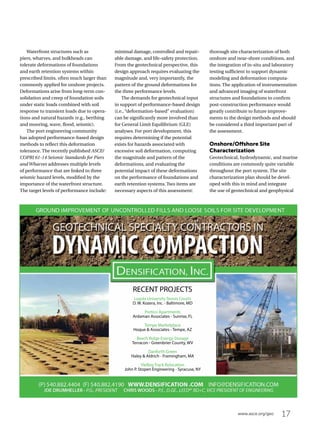
Enhancing Geotechnical
Practice in Support of
Performance-Based Design
at Ports
As I See It
By Stephen E. Dickenson, PhD, PE, D.PE, M.ASCE
Port and harbor projects challenge geotech-
nical engineers with a combination of soft
ground, large loads, exposure to natural haz-
ards, and constructability issues in the marine
environment. Successful designs achieve an
optimal balance of attention to constructability,
efficient operations and lifecycle management,
and sound environmental practices. This
project-specific balance requires thoughtful,
multi-disciplinary engineering where teamwork
and ingenuity are highly valued. With the goal
of promoting creative exchange between
members of the Geo-Institute and the Coasts,
Oceans, Ports, and Rivers Institute (COPRI), this
commentary addresses three issues involving
geotechnical applications at the interface of the
maritime and surface transportation systems.
17www.asce.org/geo
Waterfront structures such as
piers, wharves, and bulkheads can
tolerate deformations of foundations
and earth retention systems within
prescribed limits, often much larger than
commonly applied for onshore projects.
Deformations arise from long-term con-
solidation and creep of foundation soils
under static loads combined with soil
response to transient loads due to opera-
tions and natural hazards (e.g., berthing
and mooring, wave, flood, seismic).
The port engineering community
has adopted performance-based design
methods to reflect this deformation
tolerance. The recently published ASCE/
COPRI 61-14 Seismic Standards for Piers
and Wharves addresses multiple levels
of performance that are linked to three
seismic hazard levels, modified by the
importance of the waterfront structure.
The target levels of performance include:
minimal damage, controlled and repair-
able damage, and life-safety protection.
From the geotechnical perspective, this
design approach requires evaluating the
magnitude and, very importantly, the
pattern of the ground deformations for
the three performance levels.
The demands for geotechnical input
in support of performance-based design
(i.e., “deformation-based” evaluation)
can be significantly more involved than
for General Limit Equilibrium (GLE)
analyses. For port development, this
requires determining if the potential
exists for hazards associated with
excessive soil deformation, computing
the magnitude and pattern of the
deformations, and evaluating the
potential impact of these deformations
on the performance of foundations and
earth retention systems. Two items are
necessary aspects of this assessment:
thorough site characterization of both
onshore and near-shore conditions, and
the integration of in-situ and laboratory
testing sufficient to support dynamic
modeling and deformation computa-
tions. The application of instrumentation
and advanced imaging of waterfront
structures and foundations to confirm
post-construction performance would
greatly contribute to future improve-
ments to the design methods and should
be considered a third important part of
the assessment.
Onshore/Offshore Site
Characterization
Geotechnical, hydrodynamic, and marine
conditions are commonly quite variable
throughout the port system. The site
characterization plan should be devel-
oped with this in mind and integrate
the use of geotechnical and geophysical
Loyola University Tennis Courts
D. W. Kozera, Inc. - Baltimore, MD
Portico Apartments
Ardaman Associates - Sunrise, FL
Tempe Marketplace
Hoque  Associates - Tempe, AZ
Beech Ridge Energy Storage
Terracon - Greenbrier County, WV
Danforth Green
Haley  Aldrich - Framingham, MA
Vielbig Track Relocation
John P. Stopen Engineering - Syracuse, NY
RECENT PROJECTS
18 GEOSTRATA MAY/JUNE 2015
As I See It
tools available for both onshore and marine environments
to provide necessary geologic and geotechnical data. These
data can include surface topography, bathymetry, and vertical
and horizontal variability of soil stratigraphy highlighting
weak, compressible deposits that may negatively impact the
performance of the waterfront structures. Time-dependent
changes in site conditions should be anticipated (e.g., con-
solidation settlement, scour, sea-level rise). While these may
seem generic and well-worn refrains, many geoprofessionals
might be surprised and impressed by the array of geophysical
methods being used in the marine environment to supple-
ment more routine methods of geotechnical site investigation.
Increased use of these offshore technologies would improve
the stratigraphic and properties characterization upon which
performance-based design relies so heavily.
Integration of In-Situ and Laboratory Testing
The general requirements for geotechnical investigations of
port waterfront structures have been highlighted as follows:
The geotechnical properties shall account for
possible temperature-, time-, and stress-
dependent changes (e.g., changes due to
consolidation, scour). The dynamic properties
will account for the intensity (cyclic stress/strain
levels), frequency, and duration of the loads.
Dynamic loads transferred to foundations,
anchors used for mooring systems, and earth
retention systems due to wave action, seismic,
wind, berthing and mooring, and other opera-
tional live loads shall be considered.
G-I members can appreciate the scope of the laboratory
testing required to satisfy these broad goals. The development
of the “optimal” testing program, particularly when dealing
with weak marine soils, is part of the creative process that
melds a command of soil behavior with an understanding of
the geotechnical input parameters required for project-
specific analyses.
Instrumentation to Support Performance
Assessment and Model Calibration
Evaluating the margin of safety against bearing capacity and
slope stability failure using GLE methods is a necessary first
step in the design process; however, safety margins are often
low in the weak soils that are prevalent in the marine envi-
ronment. The factors of safety obtained from GLE methods of
analysis are only indirectly related to ground and structural
deformations that govern overall performance. This has led
to the utilization of sophisticated 2-D and 3-D numerical
geomechanical modeling for estimating the patterns of
deformations of foundation soils, waterfront slopes, and
structures. Substantial advances have recently been made in
modeling pile-supported wharves and bulkheads; however,
the lack of well-documented, instrumented field case histories
has precluded thorough calibration of analysis methods for
simulating dynamic soil-foundation structure interaction of
these structures. The lack of model calibration can lead to a
poor understanding of the uncertainty involved in seismic
analyses and an over-confidence in the analysis results.
The use of instrumentation on and adjacent to port
waterfront structures has generally been limited due to the
extreme environment, construction-induced loads, and
limited longevity of dedicated instrumentation. These imped-
iments notwithstanding, it is believed that the enhanced
use of instrumentation and imaging (ranging from MEMS to
InSAR), and geophysics for monitoring would greatly benefit
performance assessment.
Increasing the reliability of geomechanical modeling in
support of performance-based design at ports will require the
integrated application of site characterization technologies
developed for use in onshore and offshore environments,
in-situ and laboratory testing programs developed with the
modeling requirements firmly in mind, and an improved
understanding of soil-structure interaction during operations
and extreme loads. The creative, multi-disciplinary exchange
encouraged in this commentary will hopefully greatly acceler-
ate innovation in geotechnical engineering at ports.
j STEPHEN E. DICKENSON, PhD, PE, D.PE, M.ASCE, is a principal
engineer at New Albion Geotechnical, Inc. in Reno, NV. Dr. Dickenson
has enjoyed a 25-year professional focus on geotechnical applications
for ports, harbors, and major civil infrastructure in the nearshore envi-
ronment. He is a former chair of the COPRI Ports  Harbors Committee
and the TCLEE Ports Lifelines Committee, and he currently serves on
the ASCE 61-19 Standards Committee for the Seismic Design of Piers
and Wharves, and the COPRI Task-Committee on Seismic Design of
Bulkheads. He can be reached at sed@newalbiongeotechnical.com.
...many geoprofessionals might be surprised and impressed
by the array of geophysical methods being used in the
marine environment to supplement more routine methods of
geotechnical site investigation.
Geokon is
ISO 9001:2008
registered
1• 603 • 448 •1562
info@geokon.com
www.geokon.com
INNOVATION AND QUALITY SINCE 1979Geokon-Incorporatedwww.geokon.com Linked
Battery Life Estimates: 60 Minute Scan Rate*
# of Hops: 1 2 3 4
DAYS(LITHIUM)
NUMBER OF NODES
10 20 30 40 50 60 70 80 90 100
360
720
1080
1440
1800
DAYS(ALKALINE)
120
240
360
480
600
*Environmental factors also effect battery life
SN Nodes Supervisior
S
Obstruction
Obstruction
N
N
N
N
N
N
N
N
N
GGGGGGGGGGGGGGGGGGGGGGGGGGGGGGEEEEEEEEEEEEGEGGGEGEGEGGGEGGEGGGEGEGEGGGEGGEGGGEGEGEGGGEGEEEoooooooooooooooooooooEoEEEoEoEoEEEoEEoEEEoEoEoEEEoEEoEEEoEoEoEEEoEoooooo
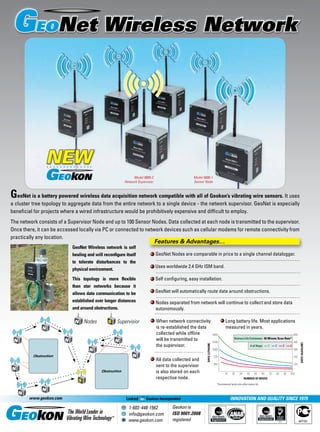
GeoNet Wireless network is self
healing and will reconfigure itself
to tolerate disturbances to the
physical environment.
This topology is more flexible
than star networks because it
allows data communication to be
established over longer distances
and around obstructions.
GeoNet is a battery powered wireless data acquisition network compatible with all of Geokon’s vibrating wire sensors. It uses
a cluster tree topology to aggregate data from the entire network to a single device - the network supervisor. GeoNet is especially
beneficial for projects where a wired infrastructure would be prohibitively expensive and difficult to employ.
The network consists of a Supervisor Node and up to 100 Sensor Nodes. Data collected at each node is transmitted to the supervisor.
Once there, it can be accessed locally via PC or connected to network devices such as cellular modems for remote connectivity from
practically any location.
NEW
Model 8800-2
Network Supervisor
Model 8800-1
Sensor Node
Long battery life. Most applications
measured in years.
Nodes separated from network will continue to collect and store data
autonomously.
Features  Advantages…
When network connectivity
is re-established the data
collected while offline
will be transmitted to
the supervisor.
GeoNet Nodes are comparable in price to a single channel datalogger.
Uses worldwide 2.4 GHz ISM band.
Self configuring, easy installation.
GeoNet will automatically route data around obstructions.
All data collected and
sent to the supervisor
is also stored on each
respective node.
20 GEOSTRATA MAY/JUNE 2015
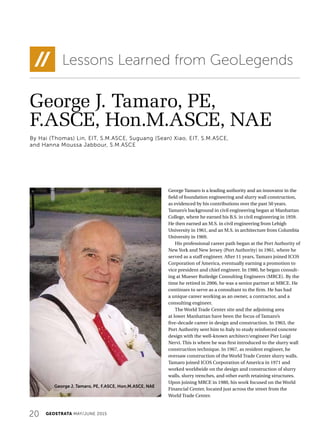
George Tamaro is a leading authority and an innovator in the
field of foundation engineering and slurry wall construction,
as evidenced by his contributions over the past 50 years.
Tamaro’s background in civil engineering began at Manhattan
College, where he earned his B.S. in civil engineering in 1959.
He then earned an M.S. in civil engineering from Lehigh
University in 1961, and an M.S. in architecture from Columbia
University in 1969.
His professional career path began at the Port Authority of
New York and New Jersey (Port Authority) in 1961, where he
served as a staff engineer. After 11 years, Tamaro joined ICOS
Corporation of America, eventually earning a promotion to
vice president and chief engineer. In 1980, he began consult-
ing at Mueser Rutledge Consulting Engineers (MRCE). By the
time he retired in 2006, he was a senior partner at MRCE. He
continues to serve as a consultant to the firm. He has had
a unique career working as an owner, a contractor, and a
consulting engineer.
The World Trade Center site and the adjoining area
at lower Manhattan have been the focus of Tamaro’s
five-decade career in design and construction. In 1963, the
Port Authority sent him to Italy to study reinforced concrete
design with the well-known architect/engineer Pier Luigi
Nervi. This is where he was first introduced to the slurry wall
construction technique. In 1967, as resident engineer, he
oversaw construction of the World Trade Center slurry walls.
Tamaro joined ICOS Corporation of America in 1971 and
worked worldwide on the design and construction of slurry
walls, slurry trenches, and other earth retaining structures.
Upon joining MRCE in 1980, his work focused on the World
Financial Center, located just across the street from the
World Trade Center.
George J. Tamaro, PE,
F.ASCE, Hon.M.ASCE, NAE
Lessons Learned from GeoLegends
By Hai (Thomas) Lin, EIT, S.M.ASCE, Suguang (Sean) Xiao, EIT, S.M.ASCE,
and Hanna Moussa Jabbour, S.M.ASCE
George J. Tamaro, PE, F.ASCE, Hon.M.ASCE, NAE
21www.asce.org/geo
After the terrorist attack of
September 11, 2001, the original,
1967 slurry walls of the World Trade
Center, known as the “bathtub,” were in
jeopardy. Engineers were seriously con-
cerned that the slurry wall “bathtub”
could give way and water would pour
into the basement and rush through
the Port Authority Trans-Hudson
(PATH) rail system. Tamaro was one of
the members of a task force organized
by the City of New York to stabilize the
underground structures, assemble a
construction team to clear the debris,
and to re-support the “bathtub.” Upon
completion of the recovery assignment,
he worked on construction of the
Freedom Tower and the reconstruction
of World Trade Center 7. Tamaro has
also worked worldwide on the design
and construction of tunnels, dams,
and the foundations of major buildings
such as the MesseTurm in Frankfurt,
the Torre Mayor in Mexico City, the
Friedrichstadt Passagen and Sony proj-
ect in Berlin, as well as many others.
Tamaro holds several patents
in slurry wall construction in the
U.S. and Canada. He has drawn
from his wide range of design and
construction experiences to prepare
book chapters, conference papers, and
technical journals. In addition, he is
an active participant in the following
professional organizations: ASCE, the
Geo-Institute, The Moles, The Beavers,
the ASCE Structural Engineering
Institute, Deep Foundations Institute,
the Council on Tall Buildings and the
Urban Habitat, Tau Beta Pi engineering
honor society, and Chi Epsilon civil
engineering honor society.
Throughout his career at MRCE,
Tamaro was a mentor to young staff
and was always concerned with the
development of young engineers
within the firm. He has given back to
engineering schools such as Manhattan
College, Lehigh University, and
Columbia University by guest lecturing,
serving as an adjunct professor, and
also serving on the Board of Advisors
for various engineering programs.
In recognition of his contributions
to civil engineering, Tamaro has
received numerous honors and awards.
ASCE awarded him the Martin S.
Kapp Foundation Engineering Award,
the Homer Gage Balcolm Award,
the Edmund Friedman Professional
Recognition Award, OPAL (Outstanding
Projects and Leadership Award)
Lifetime Award, the Fritz Medal, and
the Ernest E. Howard Award. He also
received the DFI Distinguished Service
Award, The Moles Member Award, the
Ralph B. Peck Medal from ASCE’s
Geo-Institute, the Golden Beaver Award,
the Lynn S. Beedle Distinguished
Engineering Award from Lehigh
University, the National Society of
Professional Engineers Award, Leader
of Industry Award from the Concrete
Industry Board, an Outstanding
Civilian Service Medal from the U.S.
Department of the Army, and was
nominated for the ENR Man of the
Year Award.
Q: What first interested you in
civil engineering?
The father of a high school friend was
an architect, and I became interested in
that field when I saw the work he did.
Also, I was always interested in con-
struction and spent a lot of time with
my father working on repairs and alter-
ations to our home. However, I could
not afford tuition for architectural
studies at local universities. Economics
directed me to civil engineering at
Manhattan College, which was the best
decision that I could ever have made.
My secret in working
successfully overseas is do
not think or act as if you
are superior to the locals.
The locals have a lot of
knowledge to bring to the
table, and you should be
in a collaborative mode at
all times.
22 GEOSTRATA MAY/JUNE 2015
Lessons Learned from GeoLegends
Q: Who has played a critical role in
your career development?
The first person was Professor Lynn
Beedle, my thesis advisor at Lehigh
University. I welcomed his insights into
the research that I was doing and his
guidance and criticism of my reports
and conclusions. The second was
Professor Mario Salvadori, my thesis
advisor at Columbia University. Dr.
Salvadori was a true renaissance man
who seemed to know everything about
everything. I remember his painstaking
review of my thesis; he said he would
continue to critique it until I got it
right. The third person was Dr. James
P. Gould, my former partner at Mueser
Rutledge Consulting Engineers. Jim’s
clarity of thought and insightful vision
— and his ability to lay out a simple
solution to a very complicated problem
— always amazed me. All three men
had the highest intellect and moral
character and encouraged me to work
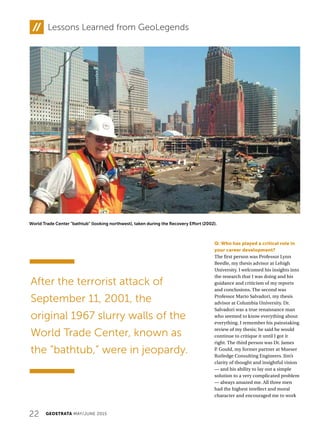
After the terrorist attack of
September 11, 2001, the
original 1967 slurry walls of the
World Trade Center, known as
the “bathtub,” were in jeopardy.
World Trade Center “bathtub” (looking northwest), taken during the Recovery Effort (2002).
SOIL REINFORCEMENT SOLUTIONS
FOR ANY APPLICATION
Whatever soil reinforcement your project needs, Strata provides the system that is the most flexible and
cost effective turnkey solution available. With over 20 years of knowledge and expertise in the grade
change and soil reinforcement industry, we know how to work with your team to achieve the best results
on every project. To see what Strata can offer for your next project, visit geogrid.com or call 800-680-7750.
geogrid.com
StrataGrid®
| StrataSlope®
| StrataWall®
| StrataBase®
| StrataWeb®
| StrataGRS™
24 GEOSTRATA MAY/JUNE 2015
Lessons Learned from GeoLegends
to my limits. All three became very good
friends. Whatever I have achieved in
my career I attribute to their teaching,
patience, guidance, and friendship. I
will always have a fond remembrance
of them.
Q: Some say there’s a gap in
understanding between the practice
of structural and geotechnical engi-
neering. What do you recommend to
bridge this gap?
In my opinion, as part of their devel-
opment as professionals, geotechnical
engineers should be required to work
on structural projects, while structural
engineers should be required to work
on geotechnical projects. Structures in
and on the ground will interact with
the soil; engineers should do likewise!
Both engineering specialties have to
An engineer should be sensitive
to the difference between
accuracy and precision. You can
be very precise in a calculation,
but be absolutely wrong because
you started with the wrong input.
Why measure movements at just a few locations...
WHEN YOU CAN MONITOR EVERY POINT YOU CAN SEE?
High-resolution,
dynamic displacement and
strain measurements from
video recordings
To discuss contracted video-monitoring
measurements or equipment
sales and rentals, contact
amy.dirienzo@respec.com
• Excavation-induced deformations
• Bridge and structure deflections
• Pile driving and load testing
• Dewatering subsidence
• Tunnel liner loading
• Laboratory measurements
3824 Jet Drive
Rapid City, SD 57703
605.394.6400
www.respec.com
25www.asce.org/geo
be collaborative — it is important that
each party understand how the other
thinks and functions. The structural
engineer is dealing with materials
such as steel and concrete, which have
small variability; he expects precision.
Meanwhile, the geotechnical engineer
is dealing with soils that have a wide
range of properties and variability.
Q: How do you deal with large soil
variability during design?
When studying a site, I try to identify
the worst and best case scenarios. I try
to not identify the worst soil condition,
match it with the worst loading
condition, and then superimpose an
exaggerated safety factor to account for
these extremes. Instead, I attempt to
focus on identifying the worst uniform
condition I can expect, how much
cushion will be needed beyond that,
and then how much safety factor will be
required going even further. The safety
factor in a design should be a function
of how well you know the soils and
structure.
Q: How did you get involved with
slurry wall construction, and how
did it impact your future career?
This goes back to meeting Pier Luigi
Nervi, whom I mentioned earlier. Nervi
was the architect/engineer for the
innovative, reinforced concrete roof
used at the George Washington Bridge
Bus Station in New York City, where I
started my engineering career. At that
time, the Port Authority established
a fellowship program that permitted
employees to accumulate professional
development through outside study.
I applied for the fellowship and was
selected to study reinforced concrete
design and construction for a year in
Rome under Nervi’s tutelage. While in
Rome, the Port Authority’s chief engi-
neer asked me to visit and comment on
two slurry wall projects that were being
considered as perimeter walls for the
World Trade Center basement. I wrote
a report about my observations and
became an immediate “expert” on the
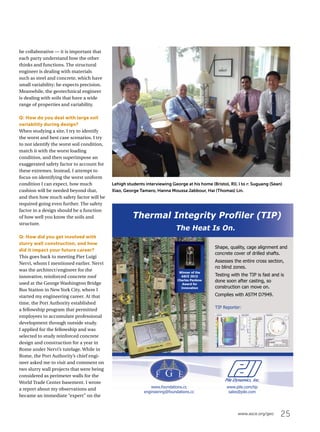
Lehigh students interviewing George at his home (Bristol, RI). l to r: Suguang (Sean)
Xiao, George Tamaro, Hanna Moussa Jabbour, Hai (Thomas) Lin.
Thermal Integrity Profiler (TIP)
The Heat Is On.
Shape, quality, cage alignment and
concrete cover of drilled shafts.
Assesses the entire cross section,
no blind zones.
Testing with the TIP is fast and is
done soon after casting, so
construction can move on.
Complies with ASTM D7949.
www.foundations.cc
engineering@foundations.cc
Winner of the
ASCE 2015
Charles Pankow
Award for
Innovation
TIP Reporter:
www.pile.com/tip
sales@pile.com
26 GEOSTRATA MAY/JUNE 2015
Lessons Learned from GeoLegends
subject, never realizing the effect of that experience on my
career. Back in New York, I was assigned to help in evaluating
ICOS and other slurry wall contractors bidding on the work.
ICOS submitted the low bid for the work and was selected to
construct the slurry wall. Initially, ICOS had an extraordinary
amount of difficulty working in the New York City geology
and construction environment. I was assigned to the project
in the hope that my exposure to slurry wall work, my Italian
language skills, and my experience in Italy would help move
the project along. ICOS completed the project on time, and I
became a slurry wall “expert.”
Q: What does a consultant company do?
MRCE designs and oversees construction of complicated
underground and marine projects. We assist in the planning of
projects, conduct field investigations, make recommendations
for foundation design and construction, design the founda-
tions or structures, assist in contracting for the work, inspect
the work, and provide instrumentation of the structure and/or
the ground works. MRCE does not own or construct the proj-
ect. We also provide forensic and consulting services to clients
encountering technical, cost, and contracting difficulties on
projects. My prime retirement activity is dispute resolution
and investigating distress and failures.
Q: You’ve done quite a lot of business internationally.
What are the challenges of this type of work?
Being a first-generation American helps. I learned Italian as
a child, then German, and lastly English. I was practically
tri-lingual, but I’ve lost the German through non-use. I have
no hesitancy going anywhere overseas to work. I am usually
there because somebody thinks I have something to offer. My
client might be an American developer who would prefer to
work with me rather than with a local engineer. I can serve as
an intermediary between the local engineers and the client.
Or I could be hired to provide contract documents using U.S.
technology and codes. My secret in working successfully
overseas is do not think or act as if you are superior to the
locals. The locals have a lot of knowledge to bring to the table,
and you should be in a collaborative mode at all times.
Q: Back in the 60s, how did you solve engineering prob-
lems without using computers or finite element modeling?
In the 60s, we did not have sophisticated computational
tools. We had to think our way through to the solution of the
problem. We were forced to think about the solution before we
went to pen and paper. The main computational tool at that
time was the slide rule. I believe the slide rule is appropriately
accurate for geotechnical engineering calculations, consider-
ing the wide variety of soil properties and soil strata found at
most sites. Three significant digits are sufficiently precise for
geotechnical work.
Q: Do you think engineers nowadays depend too much
on technology?
One of the problems with young engineers is that they sit at
the computer before they know what the answer should be. It’s
like driving before you know how to operate an automobile,
which is dangerous. An engineer should be sensitive to the
difference between accuracy and precision. You can be very
precise in a calculation, but be absolutely wrong because
you started with the wrong input. Precision and accuracy
are two very different things. We need to seek accuracy, not
precision. Computer output implies an accuracy which may
be ill-founded.
Q: What advice do you have for young geotechnical
engineers?
What I learned from Nervi was to trust your judgment.
When designing, question yourself. Does the answer you get
make sense? Are the proportions reasonable? Is there any
In my opinion, as part
of their development
as professionals,
geotechnical engineers
should be required
to work on structural
projects, while structural
engineers should be
required to work on
geotechnical projects.
Think
TenCate.
Think
Geotechnical
Roadway
Design.
ThinkAhead.
Mirafi®RSi
BeatsTraditional,Old
TechnologyHandsDown.
It’s time to re-think how you build a better road. Western
Transportation Institute and Montana State University
partnered with nine state D.O.T.s to complete an unbiased,
independent, fullscale performance study on unpaved
roadways. The findings are in and the results are astounding.
TenCate Mirafi® RS580i out performed the rest in the world.
TenCate Mirafi® is shown to have the Best Traffic Benefit
Ratio and the Best Base Course Reduction Factor. Both, only
achievable by the best technical minds in the business,
creating the best geosynthetics in the world. Contact us
today and one of our technical engineers can show you how
to build a better road when you Specifi Mirafi®.
RSi – Build the Best
Specifi Mirafi®
800.685.9990
www.mirafi.com
Reduced roadway cost
up to 1/3 using
Mirafi® RS580i means:
 Cost Savings
 Reduced PlacementTime
 Improved“Green”Effect
 Longer Service Use
Scan to read the study
for yourself.
Protective Outdoor Fabrics
Aerospace Composites
Armour Composites
Geosynthetics
Industrial Fabrics
Synthetic Grass
Lessons Learned from GeoLegends
redundancy in your design? Are there
any other loads or geometries that
are more critical than those you have
identified? Lastly, keep the calculations
simple so that they can be checked
quickly and efficiently.
Also, spend time in the field to
develop a sense of what things should
look like. What effect will your project
have on adjacent sites? Understand the
limits of machinery and labor. You need
to know the tools that are going to be
used and what can be done practically.
Talk to the site staff. You can learn a lot
if you keep an open mind. Also, you
need to make sure what you are doing
is constructible. I have seen people put
things on paper that cannot be built.
Q: Is it possible to be both a good
engineer and manager?
Yes, the two are not mutually exclusive;
you do not have to be one or the other.
It’s okay to be both — you just have to
be yourself, and you will be successful.
However, it is essential that an engineer
become as technically skilled as possible
in his formative years before consid-
ering branching into management. It
is impossible to manage engineers if
you do not have commensurate skills
and knowledge and earn the respect of
your technical staff. I prefer a staff of
engineers who lack management skills,
but provide the right answer, to a staff of
engineers who have great management
skills, but give me the wrong answer!
My goal has always been to hire and
advance the most technically skilled
engineers I can find, and then work
with them to develop the necessary
management skills.
Q: What was the most notable
accomplishment made by geotechni-
cal engineers over the last 50 years?
I do not think there is any single
accomplishment that stands out for
recognition. Calculation tools such
as finite element analysis programs
permit us to study complex structures
and soil condition and study the effect
of parameter variations, but judgment
must be exercised to assure that the
results pass the logic test. Remember,
the output is only as good as the model
and the input!
The availability of sophisticated
instrumentation now permits us to
measure the performance of our design
against expectation. Thus, permitting us
to be less conservative on future designs.
The major advancements in
geotechnical engineering have
come from the constructors and
their engineers, who, in response to
competitive pressures, are constantly
developing new tools and technologies.
For example, the development of
slurry wall technology has been an
important advancement initiated by
contractors. Slurry wall technology
permits geotechnical construction to
depths and dimensions that could not
have been achieved previously. There
are so many other technologies, such as
tie-back anchors, reinforced earth, and
geotextiles, which permit us to execute
projects that were inconceivable 50
years ago.
Q: What do you see as the future of
urban geotechnical engineering,
such as in New York City?
In urban areas, the first soil strata you
encounter is soil laid down by man,
usually in an uncontrolled manner. It
is usually fill consisting of soil removed
from other sites, construction debris,
and potentially contaminated waste.
You have to come up with a judgment
as to the material properties, which can
be highly variable.You need to have
some flexibility in your thinking. At one
building site in Manhattan, there were
footings cast on rock at one end, and
150-ft-long piles at the other end.
Adequate site investigation and local
experience is essential to a successful
urban geotechnical engineering practice.
It’s essential to develop as thorough
an understanding of the site ground
conditions as possible, as well as
an understanding of prior use of
the site. The unexpected should be
expected when working in complex
29www.asce.org/geo
urban environments. Utilities, both
non-functioning and active — as well as
abandoned structures — can have major
impact on the success and cost of a
project. Sometimes understanding of the
reviewing authorities’ concerns is more
important than the knowledge of ground
conditions! Finally, knowing the capabil-
ity of the local contractors is important,
as well as staying abreast of state-of-the-
art equipment and techniques.
j HAI (THOMAS) LIN, EIT, S.M.ASCE, is a
PhD student researching on microbial mod-
ification of soil for ground improvement. He
is a member of the G-I Graduate Student
Organization at Lehigh University, where
he serves as the representative to the G-I
Graduate Student Leadership Committee.
He can be contacted at hal310@lehigh.edu.
j SUGUANG (SEAN) XIAO, EIT, S.M.ASCE,
is a PhD student at Lehigh University. His
research focuses on thermal mechanical
behaviors of geothermal energy piles. He
is an active member of the G-I Graduate
Student Organization at Lehigh University
and can be contacted at sux211@lehigh.edu.
j HANNA MOUSSA JABBOUR, S.M.ASCE,
is a master’s student at Lehigh University.
His research focuses on finite element
modelling of installation effect of controlled
modulus columns on surrounding soil.
He is an active member of the G-I
Graduate Student Organization at
Lehigh University and can be contacted
at ham413@lehigh.edu.
8165 Grapic Dr.
Belmont, MI 49306
Phone: (616) 866-0815
Fax: (616) 866-1890
williams@williamsform.com
www.williamsform.com
All-Thread Bar  Multi-Strand Anchors
Williams Tie Backs
30 GEOSTRATA MAY/JUNE 2015
Figure 1. Aerial image of the Oso, WA landslide (courtesy of
the Washington Dept. of Transportation) and elevation differ-
ences based on pre- and post-event lidar surveys (Keaton et
al. 2014) [NSF-sponsored GEER].
I’m pleased to announce the launch
of a new feature in GEOSTRATA:
“What’s New in Geo?” The goal of
this feature is to provide readers a
broad perspective of recent devel-
opments in research and practice
within the field of geotechnics
that can foretell the future of our
profession. As the boundaries of
our field and the tools at our dis-
posal continually expand to meet
present and future challenges,
it’s important that information be
readily available from a reliable
source. The geotechnical solutions at the forefront include
both evolutions of familiar technologies as well as entirely
new creations borne from collaborations with other fields of
science and engineering.
Just since the start of the 21st century, we have witnessed
the emergence of the field of biosoils, geotechnical
performance monitoring using remote sensing, sustainable
geotechnics, and significant advances in coastal engineering
and ground improvement. Furthermore, the business of geo-
technics is perpetually adapting to the changing economic,
political, and environmental landscape. Major stimuli of change
can emerge from abrupt events like Hurricane Katrina or
gradual phenomena like the aging of our infrastructure.
After evaluating several approaches to achieve our goal,
GEOSTRATA’s Editorial Board decided that we will identify and
solicit a distinguished expert for each piece. Thus, articles will
offer: 1) a short overview of the significance of the subject, 2)
a description of the subject’s state-of-the-art and state-of-
the-practice status, 3) a discussion of recent breakthroughs
and trends, and 4) insights on ways students, researchers,
and practitioners can prepare for the future. As editor of
the “What’s New in Geo?” series, I hope you find value and
inspiration in the discussions, which are slated to appear in two
to three issues annually. I’m honored that Dr. James Mitchell
agreed to write the first article, as I cannot think of another
person better suited for providing the big picture of what’s on
the horizon in our field.
Michael P. McGuire, PhD, PE, M.ASCE
What’s New in Geo? Editor
MICHAEL P. MCGUIRE
What’s New in Geo?
31www.asce.org/geo
A simple answer to the title of this article is: Lots! I doubt, however, that this is
the response the editors of GEOSTRATA had in mind when they invited me to
offer my thoughts in this inaugural column. So I will elaborate a bit. But rather
than focus on any specific new topic, I will first try to put geotechnical engineer-
ing within the context of engineering as a whole, its many accomplishments in
the last half of the 20th century, and its role in meeting the critical needs of the
present and future generations. Then I will identify some of the more significant
new areas that have been developed or are being studied that either aid in
addressing these needs directly or provide new, better, and more insightful ways
to do our work as geotechnical engineers. I expect many of these new areas will
become topics for future “What’s New in Geo?” articles.
What’s New in Geo?
Typically, the things we want to learn, build, avoid,
improve, or protect are not “new.” “New” emerges as
a result of how creatively we take advantage of the
advanced tools and methods that are possible.
By James K. Mitchell, ScD, PE, NAS, NAE, Dist.M.ASCE
JAMES K. MITCHELL
32 GEOSTRATA MAY/JUNE 2015
The Role of the Geotechnical Engineer
On the occasion of the 50th anniversary of its founding on
December 5, 1964, the U.S. National Academy of Engineering
took a look back at the most significant engineering achieve-
ments of the past half century with publication of Making a
World of Difference – Engineering Ideas into Reality. These
achievements include: developments in electronics and
computers and the beginning of the Digital Age, harnessing
light and the power of lasers and fiber optics, space exploration,
jet aircraft, meeting environmental challenges, engineering
of medical imaging, the digital highway andWorldWideWeb,
cleaner and more efficient energy, building for safety, biomed-
ical engineering, the shale gas boom, and renewable energy.
While it would be presumptuous to claim that geotechnical
engineering input was essential to all of these, its role was
certainly significant to the success of several of them.
To address the needs of the present and the future, the
National Academy of Engineering in 2008 released Grand
Challenges for Engineering (www.engineeringchallenges.org), a
report listing 14 grand challenges in the form of global problems
Figure 2. GeoTechTools.org is a readily accessible, online information and guidance system for geo-construction information
and technology selection guidance for geotechnical, structural, and pavement engineers. It is useful for a wide range of prob-
lems and applications.
What’s New in Geo?
33www.asce.org/geo
that must be solved “to ensure survival of a livable earth and the
well-being of its inhabitants.” Among the challenges are:
oo Make solar energy economical
oo Provide energy from fusion
oo Develop carbon sequestration methods
oo Manage the nitrogen cycle
oo Provide access to clean water
oo Restore and improve infrastructure
oo Prevent nuclear terror
We “geos” have an important role, both directly and
indirectly, in what must be done to meet these challenges
successfully. The great need worldwide for new infrastructure,
energy resources, and protection against natural disasters, all
provided in a sustainable, economical, and environmentally
responsible manner, means that both the opportunities and
challenges confronting the geotechnical engineering profession
are greater now than ever before.
Our Expanded Scope
When I began my studies in civil engineering over 60 years
ago, the part of civil engineering known today as geotechnical
engineering was termed “soil mechanics and foundation
engineering.” How the field has grown in the years since! In the
decades since 1950, we have seen special emphasis on:
oo In the 1950s: Slope stability, shear strength, soil fabric and
structure, causes of clay sensitivity, compacted clay properties,
pavement design, soil stabilization, and transient loading
oo In the 1960s: Physico-chemical phenomena, rock
mechanics, computer applications, finite element analyses,
soil-structure interaction, soil dynamics, liquefaction, earth
and rockfill dams, pore pressure, effective stress analysis,
offshore and cold regions engineering, and soil mechanics
on the moon
oo In the 1970s: Constitutive modeling, in-situ testing, expan-
sive soils, soil dynamics, centrifuge testing, partly saturated
soils, geotechnical earthquake engineering, tunneling, and
underground construction
oo In the 1980s: Groundwater and geohydrology, geoenviron-
mental engineering, geosynthetics, earth reinforcement, risk
and reliability, and ground improvement
oo In the 1990s: Waste containment, site remediation, seismic
risk mitigation, land reclamation, infrastructure, geophysi-
cal applications, and geographic information systems
oo In the 2000s: Information technology applications,
sustainability, improved ground treatment methods,
sensors, data mining, automated monitoring, enhanced
and extended applications of the observational method,
and asset management
Figure 3. Solar power for electricity generation at a brigade and battalion headquarters building Fort Carson, CO. It supplies about
62 percent of the electrical power required by the building. (Source: www.usace.army.mil)
34 GEOSTRATA MAY/JUNE 2015
Figure 4. An example of natural disaster risk mitigation. Photo is of a portion of the New Orleans Hurricane and Storm Damage and
Risk Reduction System constructed by the U.S. Army Corps of Engineers. (Source: www.usace.army.mil).
Geotechnical problems and the scope of geotechnical
engineering have broadened to the point that we now draw on
several related disciplines for understanding and solving our
problems. They include geography, geology and engineering
geology, rock mechanics, geophysics, geochemistry, geohydrol-
ogy, seismology, soil physics and soil science, civil engineering,
mining and mineral engineering, and petroleum engineering.
Most of today’s large projects are multi-disciplinary in nature;
in fact, many are inter-disciplinary and put us in the challeng-
ing position of seeking solutions that are at, between, or
beyond the boundaries of the more traditional disciplines.
Concurrently with the addition of these many new
technical and scientific components of geotechnics, there
have been important expansions and new things related to the
professional practice of geotechnical engineering. Rudolph
Bonaparte documented and discussed these in a recently
completed series of six excellent GEOSTRATA articles on the
“Business of Geotechnics,” so those aspects of our field are not
considered further here.
Today’s Topics
As part of the data gathering for The Future of Geotechnical
Engineering, a recent report prepared by the Center for
Geotechnical Practice and Research at Virginia Tech, the topi-
cal interests of 263 U.S. Universities Council on Geotechnical
Education and Research (USUCGER) faculty member
researchers were compiled. In terms of the number of faculty
members working on a particular topic within the broad
category of research on the fundamentals of geotechnical
engineering, the following topics are most popular: physical
modeling in geotechnics, geomechanics from micro to macro
scales, in-situ testing and site characterization, numerical
methods in geomechanics, and strength and consolidation
testing. Research on applied topics is most intensive in
geotechnical earthquake engineering, environmental
geotechnics, transportation geotechnics, ground improvement,
soil-structure interaction, retaining structures, slope stability
and reinforcement, and deep foundations.
So, What’s New?
Most of these topics, and most of our current geo-construc-
tion projects, are not “new” in the sense of what we want to
learn, and what we want to build, avoid, improve, or protect.
In my opinion, however, much of “What’s New In Geo?” is a
result of how creatively the profession — researchers, practi-
tioners, and geo-contractors alike — has taken advantage of
the advanced tools and methods made possible by the larger
engineering accomplishments cited in the beginning of this
article. For example, the Digital Age and the Internet have
resulted in:
What’s New in Geo?
36 GEOSTRATA MAY/JUNE 2015
oo New and improved laboratory and in-situ testing systems
with programmable control, data acquisition and pro-
cessing capabilities, and more representative model and
centrifuge testing
oo Readily available computer programs for analysis of soil
behavior, at scales ranging from individual particles using
Discrete Element Methods (DEM) to complex 2-D and 3-D
geo-systems at the macro-scale
oo Imaging methods that enable direct and indirect observation
and study of soil and rock materials and their deformation
and flow behavior under static and dynamic conditions, at
scales ranging upward from near-atomic size to large areas
where lidar and other methods can reveal details of such
features as faults and ground failure details (Figure 1)
oo Laptops, tablets, and smart phones that enable real-time
documentation, sharing, and retrieval of reconnaissance
information
oo New sensors and instrumentation for acquisition, storage,
and real-time display of data for geo-construction opera-
tions control and documentation
oo Readily available online information and guidance
systems such as GeoTechTools.org (Figure 2), which
provide geo-construction information and technology
selection guidance for geotechnical, structural, and
pavement engineers
Turning now to newer sub-disciplinary areas of geotechnical
engineering and construction, I cite four that I think are at the
forefront and poised to make major contributions both to our
field and in helping us address some of the Grand Challenges:
oo Energy Geotechnology has an essential role in many aspects
of fossil fuel energy resource location, recovery, and develop-
ment; in renewable energy development (wind, solar
[Figure 3], tidal); in utilization of nuclear energy; and in
understanding and dealing with associated problems
related to such things as induced seismicity, disposing
and storing of wastes and by-products, environmental
protection, and site restoration. Thermal geotechnics is
assuming an expanded role due to the use of the ground as
both a heat source and heat sink, and for its incorporation
in energy-neutral buildings and other facilities. J. Carlos
Santamarina, in an excellent Commentary in the January/
February 2012 issue of GEOSTRATA, discusses many of the
geotechnical challenges to providing sustainable and envi-
ronmentally acceptable energy supplies in the years ahead.
oo Research on biogeochemical processes in soils and their
applications is opening new doors to a better understanding
of soil properties and behavior.We’re also devising practical
applications, such as new and better methods for con-
taminated site cleanup along with passive uses in ground
strengthening and liquefaction risk mitigation. Editor’s
Note: The next “What’s New in Geo?” article, scheduled for the
September/October 2015 issue of GEOSTRATA, will be written
by Jason DeJong on the subject of biosoils.
oo Sustainability has become a consideration in foundation
engineering, earthwork construction, and ground improve-
ment. Methods are now available to select among alternative
technologies and construction methods using criteria that
compare their quantities of embodied energy and green-
house gas emissions in addition to project performance
requirements and cost.
oo Considerations of risk,reliability,and uncertainty are
becoming ubiquitous in geotechnical engineering. They
were the theme of the July/August 2014 issue of GEOSTRATA.
Uncertainty enters virtually every aspect of our work: from
problem definition, site characterization, and hazard
estimation and mitigation (Figure 4), through analysis,
design, construction, and prediction of performance. Efforts
to better quantify and reduce uncertainty as well as define,
communicate, and incorporate risk into decision making will
continue as major focus areas of geotechnical engineering.
I look forward to learning more about how these new
scientific and technological understandings and tools will help
us to grow and strengthen the fabric of the total discipline that
we call geotechnical engineering.
A Final Caveat
While all these new things enable us to do our work smarter,
faster, better, and with improved understanding of the
materials with which we work, there is one vital, but not so
new component of successful geotechnical engineering that
is now more important than ever before: that, of course, is
sound engineering judgment. Despite all the new tools, data
and information sources, computational aids, and guidance
documents, soils and rocks still come in many forms. Their
properties may change with time and environment, the
boundaries are usually uncertain, no two projects are ever
the same, and surprises often lie beneath the surface. A vast
amount of information on almost any topic is now only a
mouse click away; however, the underlying assumptions
and operational details of our new tools and computational
details are often not transparent. Today’s computers cannot
determine whether information is correct or relevant.
Therefore, it is and will always be our responsibility to ensure
that all elements of what we conclude, recommend, and
undertake pass the test of reasonableness.
j JAMES K. MITCHELL, ScD., PE, NAS, NAE, DIST.M.ASCE, is a
University Distinguished Professor Emeritus at Virginia Tech and
a consulting geotechnical engineer. From 1958 to 1994, he was
on the CEE faculty at the University of California, Berkeley. His
research and consulting activities have focused on soil behavior,
soil stabilization, and ground improvement. He can be reached
at jkm@vt.edu.
What’s New in Geo?
38 GEOSTRATA MAY/JUNE 2015
FILLING THE
PORTS,
HARBORS 
SHORELINES
MAY/JUNE
2015
By Nicholas E. Malasavage, PhD, PE, M.ASCE, and David V. Doak, PE
Deepening the Oakland Inner and Outer Harbors
Figure 1. Aerial view looking southeast at Oakland outer (background), middle (center), and inner harbor (foreground).
39www.asce.org/geo
T
he project to deepen the Oakland Inner and Outer
Harbors from elevation -42 to -50 ft (Note: all
elevations refer to Mean Lower Low Water) was
federally authorized in 1999 to accommodate the
next generation of post-Panamax container ships.
The project, which produced a total of 12.8 million
yds of the deepening material, made disposal a
unique challenge from the perspective of both environmental
and financial cost.
During the project’s feasibility phase, stakeholders
negotiated an agreement with applicable resource agencies
that allowed for the placement of approximately half of the
dredged material at an in-bay location adjacent to the
deepening site. The approximately 180-acre, in-bay site
(Figure 1), known as Middle Harbor, served the former U.S.
Navy Fleet Industrial Supply Center in Oakland, CA, but no lon-
ger served a functional role in the port’s intermodal shipping
system. The creation of the Middle Harbor Enhancement Area
(MHEA) provided considerable cost savings to the project and
was the first permitted action in decades to allow large-volume
filling of the San Francisco Bay.
The permitting of the sub-tidal habitat at MHEA included
the stipulation that two additional wetland projects be devel-
oped with the remainder of the deepening material, in addition
to creating a sustainable aquatic habitat in the middle harbor
site. The additional two wetland projects were the Hamilton
Army Airfield Wetland Restoration project on the western shore
of the San Pablo Bay near Novato, CA, and the Montezuma
Wetland Restoration project in the delta region east of San
Pablo Bay, near Collinsville, CA. Additionally, future projects of
similar size and scope would not proceed until the successful
completion of the MHEA.
BAY
The slower-than-optimal rate
at which federal funding was
provided necessitated a change
in the way the port deepening
project would be dredged.
40 GEOSTRATA MAY/JUNE 2015
Unlike other upland, beneficial-use placement sites in
the San Francisco Bay area, the MHEA was unique in that the
site was not fully isolated by the tidal fluctuations of the San
Francisco Bay. The perimeter containment of the site was
created with a combination of two, stone-armored jetties
totaling 1,900 lft, and an 1,800-lft section of steel sheet pile
wall. Elevation of the containment varied from -10 to +6 ft.
Finished grades after bulk filling also ranged from -10 to +6 ft.
Final design grades range from elevation -15 ft to +2 ft,
making the final configuration almost entirely sub-tidal.
The anticipated result was to provide conditions to support
the propagation of eel grass.
The completion of the MHEA construction is occurring
in two distinct construction contracts, separated by approxi-
mately three years to allow for foundation consolidation and
strength gain. The first contract was completed in October
of 2012, and the second is scheduled to be awarded in 2015,
pending the availability of funds. Since the site was originally
conceived, the schedule for the completed construction was
altered significantly due to a number of factors, including
intermittent federal funding, differences in material
classification from original expectations, and other technical
constraints. Despite these encumbrances, the most recently
executed construction contract provides promise that
similar projects can be successfully executed in the field, and
transcend beyond the laboratory and numerical modeling to
full-scale implementation.
The Design and the Reality
The channel stratigraphy of the Oakland Inner and Outer
harbors is composed of Young Bay Mud, Merritt sand, and
Old Bay Mud. Fills placed at the MHEA were intended to be
sand with minimal amounts of silts and clays to avoid sub-
stantial wait periods to allow for consolidation settlement.
Filling was to occur in two stages: (1) bulk filling and (2)
final filling. The bulk filling stage would raise the site as a flat
grade to approximately -10 ft. The final filling would shape
and sculpt approximately nine sub-tidal peninsulas
(Figure 2) with slopes ranging from 50H:1V to 100H:1V
(horizontal:vertical). The sand substrate at the designed
Figure 2. Sub-tidal peninsulas (design grade) for Middle Harbor Enhancement Area.
41www.asce.org/geo
elevations and grades was specified to provide the water
clarity and tidal circulation necessary to produce conditions
satisfactory for the propagation of eel grass habitat.
However, the slower-than-optimal rate at which federal
funding was provided necessitated a change in the way the
port deepening project would be dredged. Instead, dredging
was implemented to an interim depth to -46 ft, followed by
dredging to the final depth of -50 ft. This redirection greatly
changed the gradation distribution of fill material delivered
to the MHEA site, as well as to the wetland projects under
development. The modified plan also necessitated the MHEA
bulk fill placement to occur in two distinct episodes (initial
and final), with heterogeneous material and the final filling to
occur as planned.
The mixture of materials entering the MHEA site (Figure 3)
provided a unique challenge for achieving target design grades
during the final filling/sculpting stage. During bulk filling of
the site, a number of grain size distributions were placed that
included both clean sands and mixtures that included silts
and clays. Concerns were identified as to the impacts of final
product and interim stability of the foundation clays and bulk
fills. At approximately 65 percent of the final bulk filling, the
decision was made to place the remaining sandy materials
on the eastern half of the site, which would be shaped during
subsequent construction episodes.
At the completion of bulk filling, the total volume of mate-
rial placed at the MHEA was equivalent (~ 6 million cy) to that
required to achieve the intended design grades. Similarly, the
amount of clean sand placed at the site was sufficient to supply
the final grading of the peninsulas. However, the locations of
different materials required a combination of excavating and
filling to redistribute clean sands at the surface to the final
design elevations and grades.
If You Can Build It, They Will Come
Initial concepts for completing the final sculpting of the MHEA
included modifications of the containment structure to isolate
the site from the tidal fluctuations of the bay. The action
would allow for either dewatering of the site or the ability to
maintain static water levels within the site. Such conditions
were thought to be a necessary prerequisite for achieving the
grading and elevation tolerances prescribed in the basis of
design for the MHEA. Nevertheless, both concepts were aban-
doned due to preliminary estimates of the cost to provide ideal
working conditions, as well as the multiple environmental risks
(e.g., water quality and fish trapping) that would be induced
during construction.
The first construction contract for final sculpting was
developed assuming a marine-based dredging and filling
operation. The decision was made with the understanding
that the approach had risks of failing to meet final grades and
elevations. Construction was constrained by the requirement
that filling was to occur in lifts no greater than 2 ft to prevent
The contractor that was
awarded the job selected a
different approach than that
envisioned by the project
team. It chose to fabricate a
one-of-kind fill placement
dredge nicknamed “Pecos”
that was capable of operating
in shallow draft environments
and measuring fill placement
in real-time.
mud waves, or deep-seated foundation failures. Also, the
vertical elevation tolerance of finished grades was ±1 ft. Target
elevations within the contract ranged from -6 to +2 ft, with
fill heights ranging from 2 to 8 ft. The period of performance
was structured assuming a production rate of 200 cy per hour.
Key goals of the contract were to dredge and fill to design
grades, and to prove the constructability of the MHEA as a
demonstration for the final construction contract. The success,
or failure, could then be extended to evaluating the feasibility
for similar future restoration projects in, and around, the San
Francisco Bay.
Prior to contract award, the project team assumed the
builder would redistribute sands within MHEA with a
hydraulic dredge. Filling would occur by “rainbowing” fill from
a barge-mounted pipe with a diffuser that would be regularly
moved to prevent from filling too fast and/or too high. Final
grades would be evaluated and confirmed with hydrographic
surveys after the filling operation moved on to another fill area.
The method was acknowledged as a “guess-and-check” that
was likely to experience the negative impacts of overfilling
during an initial shakeout period. Similarly, the project was
expected to incur costs associated with the risk borne by the
42 GEOSTRATA MAY/JUNE 2015
contractor from additional filling to compensate for foundation
failures and down time caused by reduced work areas during
low-tides.
The contractor that was awarded the job selected a different
approach than that envisioned by the project team. The contractor
chose to fabricate a one-of-kind fill placement dredge capable of
operating in shallow draft environments, and measuring fill place-
ment in real-time. The dredge “Pecos” was approximately 100 ft
long and capable of operating in 2 ft of water. Pecos was equipped
with an aft spud tower and two forward-mounted swing winches.
The discharge pipe was mounted with a 90-degree elbow directed
upwards to rainbow fill through the water column to the target fill
area. Dredged material was supplied by a 12-in-diameter, cutter
head hydraulic dredge.
To manage fill depths, Pecos was equipped with a 3-ft-wide
grade roller linked to a Real Time Kinematic global positioning
transponder above the water line (See Figure 4 on p. 44). The rela-
tive position of the grade roller was determined by comparing the
current position to the original topography within the site, or to
the elevation during the previous pass of the roller. Measurements
of fill depths and fill production rates were captured and recorded
with commercial dredging software configured specifically for the
job. The operator of the Pecos would modify swing speed and/
or direction based on satisfying the fill thickness or finish grade
criteria as measured by the grade roller.
During the performance period, the contractor was able to
achieve average production rates of approximately 500 cy per
hour, and achieve the specified grade tolerance of ±1 ft from
design grade approximately 85 percent of the time. Areas not
Figure 3. Discharge during bulk filling.
The permitting of the
subtidal habitat at MHEA
included the stipulation
that two additional wetland
projects be developed
with the remainder of
the deepening material,
in addition to creating a
sustainable aquatic habitat
in the middle harbor site.
43www.asce.org/geo
As a premier steel foundation supplier now offering NZ sheets in addition to our
extensive product line, Skyline Steel is the ideal partner for your next project.
Visit www.skylinesteel.com or call 888.450.4330.
Section
Width
in
Height
in
Thickness
in
Pile
lb/ft
Wall
Weight
lb/ft2
Section
Modulus
in3
/ft
Moment
of Inertia
in4
/ft
NZ 19 27.56 16.14 0.375 55 24.05 35.08 283.1
© 2015 Skyline Steel, LLC. Skyline Steel is a wholly-owned subsidiary of Nucor Corporation, the largest producer of steel in the United States.
44 GEOSTRATA MAY/JUNE 2015
meeting the vertical tolerance were generally higher than
specified, but typically less than 1 ft out of tolerance. This
“miss” was due to the contractor’s strategy to aim for +1 ft of
finish grade to avoid the need to return to fill areas to meet
contract compliance. Despite the ability to achieve compliant
grades in real time, the contract was structured with periodic
payment surveys that inevitably lagged the placement of fill by
a few weeks. When this strategy was taken into consideration,
the contractor was able to achieve target grade greater than 95
percent of the time on the first try.
Overall, the performance of the contract was a huge
success. A total of 395,000 cy of sand was dredged and placed
on time and on budget. The ability to achieve tight tolerance
on final grades was a testament to the ingenuity of a skilled
contractor and the flexibility of the contractor/client team.
The effort successfully demonstrated that specific grades and
elevations can be accurately built below the water line and in a
tidal environment. Furthermore, the production rates experi-
enced during the work demonstrate that operations of similar
scope can be executed in a relatively cost-effective manner.
A Finish Line and a Milepost
The construction of the MHEA will be completed in one final
contract. The work will include dredging and filling within the
same constraints experienced in the previous construction epi-
sode. The final contract will also lower one of the containment
jetties to -2 ft and use the armor rock to build bird-roosting
islands within the site. A subsequent eelgrass planting and a
period of adaptive management and monitoring are planned
to occur following the completion of construction.
Despite the significant barriers to constructability that were
overcome, the “Will it actually work?” question regarding the
MHEA as a productive aquatic habitat is still being answered.
Since the completion of the construction contract in October
2012, the MHEA has been in a semi-static state. Consolidation
settlement experienced has been approximately 1 ft, and the
general shape of the peninsulas has remained intact. This is
extremely encouraging and suggests that the design bathyme-
try is in near equilibrium with the tides and currents presently
experienced within the site.
The starts and stops experienced with the construction of
the MHEA are often experienced in large civil works projects.
This trend can be expected to continue, and projects that
explore and utilize innovative construction techniques
amenable to incremental construction and/or adaptive
management will be less susceptible to risks associated with
cost and schedule delays. At the very least, the successful
performance of the construction contract should be extended
to projects with similar goals and constraints. The contract was
a successful full-scale demonstration that high-precision fea-
tures of a complex restoration project site could be successfully
and cost-effectively built. While the performance of the work
required a uniquely fabricated piece of equipment, it is clear
that the relative costs of development can be substantially
reduced if the project is large enough.
j NICHOLAS E. MALASAVAGE, PhD, PE, M.ASCE, is a civil engineer at
the U.S. Army Corps of Engineers, San Francisco District, where he is
geotechnical and technical lead on a variety of civil works projects.
He can be contacted at nicholas.e.malasavage@usace.army.mil.
j DAVID V. DOAK, PE, is a civil engineer at the U.S. Army Corps of
Engineers, San Francisco District, where he is the technical program
manager for OM dredging. He can be contacted at david.v.doak@
usace.army.mil.
Figure 4. “Pecos” operating during final sculpting contract.
Geopier is Ground improvement.™
Work with engineers worldwide to solve your ground improvement challenges.
Large power plants in the Mid-Atlantic required upgrades
to reduce sulfur dioxide emissions while continuing to
generate electric power for more than five million customers.
The existing loose fill soils, sands, and silts needed ground
improvement to support the 6,000 psf mat loading associated
with the new absorber. The Geopier Impact® system utilized
a patented displacement construction process capable of
reinforcing caving soils below the groundwater table to depths
of up to 40 feet. More than 11,000 Rammed Aggregate Pier®
elements were constructed for mat and ancillary foundation
support, limiting settlements to meet stringent design
tolerances. Geopier® technology was an effective alternative to
the deep foundation option originally considered.
the Geopier impact system: reinforcement for industrial facilities
For more information call 800-371-7470,
e-mail info@geopier.com or visit geopier.com.
©2014 Geopier Foundation Company, Inc. The Geopier® technology and brand names are protected under U.S. patents and trademarks listed at www.geopier.com/patents and other trademark applications
and patents pending. Other foreign patents, patent applications, trademark registrations, and trademark applications also exist.
we help you fix bad Ground.
46 GEOSTRATA MAY/JUNE 2015
A
lmost any type of construction activity can pose
a shock to the surrounding environment and
habitat. Obviously, the extent of the impact
will depend on the location of the project and
the degree to which the nearby area has been
developed. Civil engineers are always thinking
of creative, new ways to minimize potential impacts and develop
alternate design solutions to achieve the desired goals. But when
shoreline construction and/or bridges are involved, the challenge
becomes more complicated, as additional regulatory requirements
are often added in the hopes of saving habitats and avoiding
possible contamination of wetlands.
The Amtrak Bascule Bridge (Figure 1) replacement connects
East Lyme andWaterford, CT – two, traditional New England
seashore towns – across the Niantic River. The bridge is a great
example of a project that required alternate designs and schemes
implemented during the construction phase in order to save
money, shorten the schedule, and minimize traffic and environ-
mental pollution impacts in the surrounding towns. This bridge
lies along Amtrak’s busy Northeast Corridor and serves as a key link
for passenger and freight rail traffic between NewYork City, NY and
Boston, MA.
Because it was no longer economical to repair this century-old,
Amtrak-owned bridge, a replacement bridge was proposed
and was put into service in 2012. The new bridge is located
PORTS,
HARBORS 
SHORELINES
By Ram M. Kasturi, PE, M.ASCE,
and Vincent A. Siefert, PE, M.ASCE
Figure 1. Amtrak Bascule Bridge over
the Niantic River, between Niantic and
Waterford, CT.
SAVING COST,
SHORTENING
THE SCHEDULE,
AND MINIMIZING
IMPACTS
MAY/JUNE
2015
47www.asce.org/geo
INNOVATIVE
USE OF
A GROIN
STRUCTURE
48 GEOSTRATA MAY/JUNE 2015
Figure 2. Groin structure during construction.
approximately 60 ft south of the existing bridge. It has a wider navigation width of 100 ft and a
vertical, above-water clearance of 16 ft.
Groin Structure
A “groin” is a structure that extends from a beach into the water to limit the movement of
sediments and prevent beach erosion. The groin is often confused with the term “jetty,” which
is a similar structure typically used to stabilize inlet channels. As a result of discussions and
negotiations between Amtrak and the CT Department of Environmental Protection (DEP), a
200-ft-long by 50-ft-wide terminal groin (typically used as part of a beach fill program) was
added to the scope of work during the project’s design and planning phase. The groin structure
was proposed to: (1) create approximately nine acres of new beach area, and (2) prevent
erosion of beach and migration of sand into the inlet and thus protect the navigation channel.
In addition, the completed groin structure is also available for local residents for fishing and
recreational purposes.
The groin length and alignment perpendicular to the local shore line was determined based
on the incident wave approach and the extent of beach creation. Environmental regulations
require that the installation of rip-rap stone be confined with sheet piling, as opposed to the
traditional open-dumping method. Figure 2 shows the groin structure during construction with
the sheet piles installed and backfilling in progress. Required backfill material was transported by
barges right up to the location, which was then placed inside the structure using cranes stationed
on another barge. The contractor saved construction time in addition to providing ease of
installation with this arrangement.
49www.asce.org/geo
Figure 3. Layout of the groin structure.
In addition to these intended purposes, an innovative con-
cept for use of the groin structure during construction created
additional versatility. Specifically, the contractor initially filled
the groin with sand and gravel material. It could then be used as
a working platform for cranes and as a temporary dock during
construction to stage permanent material, such as precast
concrete elements. It also was used for stockpiling 76,000 cy
of imported beach replenishment material that was delivered
by barges loaded and transported to the land by trucks. This
process greatly reduced the time for delivery of material and
also prevented clogging of roadways and highways — to the
delight of the local residents.
Groin Structure Design
The layout of the groin structure (Figure 3) consisted of a
160-ft-long straight section and an approximately 30-ft-radius
circular section at the end, for a total approximate length of
200 ft. This wider circular section helped facilitate movement
and turning of the construction vehicles.
Subsurface soils at the project site consist of very loose to
loose sandy soils down to a depth of approximately 30 ft, fol-
lowed by dense to very dense sandy soils. Groundwater was at
a height of approximately 4 ft above mudline, and the top of the
sheeting for the groin structure was at 10 ft above mudline. The
sheeting material consisting of SKZ 24 sections was designed
for the required embedment depth and rotational stability.
In a typical cofferdam, the sheeting is designed for
hydrostatic and soil loading on the outside of the structure.
For this project, however, the sheeting was designed for
soil loading on the inside of the structure, in addition to the
surcharge loading from the construction vehicles, material,
and construction equipment. Because the area within the groin
A “groin” is a structure that extends from a beach into the water
to limit the movement of sediments and prevent beach erosion.
The term can be easily confused with “jetty,” which is a similar
structure typically used to stabilize inlet channels.
50 GEOSTRATA MAY/JUNE 2015
would be completely filled, sheeting
was designed with one level of walers
on the outside face of the sheeting and
supported laterally with tie-rods placed
across the groin structure.
The groin structure was designed
for six loading conditions during
different stages of construction to
ensure stability of sheeting, tie rods,
and walers. The surcharge loading was
analyzed for a maximum loading of
10 ksf from a 230-ton capacity crawler
crane operating with a minimum of
12 ft of clearance from the sheeting.
Other design conditions were
considered, including material loading,
stockpiling of concrete panels, stock-
piling of soil, and compaction equipment. Minimum clearance
from the sheeting was reduced for the material stockpiling to
maximize space utilization.
Tie Rod Details
Tie rods were designed as tension members to account for the
lateral loading from the walers. The tie rods (Figure 4) were
placed at an optimal elevation to provide the required support
for the sheeting and to keep the bending stresses in the top
cantilever portion of the sheeting within allowable limits. In
addition, it ensured sufficient soil cover to prevent damage of
tie rods from construction vehicles operating along the length
of the groin structure.
The design also considered stability and settlement of the
backfill under design loads. A layer of geotextile was provided
at a depth of approximately 6 in. below the tie rod elevation
to minimize the settlement of the fill material under the
equipment loading and thus prevent excessive loading on the
tie rods. The arrangement of tie rods at the circular section
was more complicated with the rods crisscrossing. It required
installation of additional sheeting across the groin structure, as
can be seen in Figure 3, to accommodate the tie rods.
Access Ramp
The groin structure was designed with an access ramp (Figure
5), which allowed construction vehicles to travel to and from
the groin structure and onto the delivery barges. The ramp was
35 ft long and 30 ft wide. The ramp consisted of longitudinal
W36x302 beams along the length of the ramp andW14x132
andW14x193 beams across the ramps with timber mats on
the top. The structural frame was analyzed for vehicle loading,
including cranes. The ramp structure was also provided with lift
lugs to allow lifting and installation by crane during erection.
One end of the support system for the ramp consisted of
24-in-diameter steel pipe piles with twin W36x150 header
beams. The piles were driven to bedrock and were located
inside the circular section of groin structure. The piles were
analyzed for the full crane loading, and capacity was verified
in the field with PDA testing. A hinge assembly consisting of a
series of 1.5-in-thick plates and a 3.5 in. pin rod was provided
on top of the header beams to allow rotation of the ramp.
At the other end, a roller support was provided to allow free
movement of the ramp with the barge due to fluctuations in
the water level. Stacked timber and precast concrete blocks
were provided at both ends of the ramp, with gravel fill, to
allow for a smooth transition for the vehicles to enter and exit
the ramp structure.
With the ramp spanning across the sheeting, the design
also considered the possibility of the underside of the ramp
In a typical cofferdam, the
sheeting is designed for
hydrostatic and soil loading
on the outside of the
structure. For this project,
however, the sheeting was
designed for soil loading on
the inside of the structure.
Figure 4. Tie rod detail.
51www.asce.org/geo
WHY SHOULD YOU
CONSIDER DEVELOPING A
GEOTECHNICAL WEBINAR?
For information go to: www.asce.org/become_an_instructor
Direct Questions to: ProgramProposals@asce.org
Webinars Provide You With a Means to:
Educate 
network
with many
geoprofessionals
Develop
a gateway to short
courses/workshops,
conferences, and
articles
Give back
to the profession
Build
recognition,
prestige,
and clients
52 GEOSTRATA MAY/JUNE 2015
interfering with the sheeting. Based on the mean high and
low water elevations, the barge with maximum loading was
analyzed for buoyancy to determine the full range of vertical
movement. The top elevation of the pipe piles was set to ensure
sufficient clearance between the bottom side of the ramp and
top elevation of sheeting for all types of barge loading and for
different water elevations.
Site Access Constraints
Most of the construction work occurred while the existing rail
operations were maintained unhindered because the new
bridge was constructed 60 ft south of the existing bridge, away
from the active railway line. However, due to the location of the
project, the contractor was faced with a limited work area sur-
rounded by local streets and highways. The contractor needed
to get access on the beach side of the track to secure additional
working area to overcome this constraint.
The contractor provided two, continuously monitored con-
struction crossings of the active tracks: one on the west side of
the Niantic River in the Town of East Lyme and one on the east
side in the Town ofWaterford. The embankments required for
the crossing were designed for the loading from construction
vehicles and analyzed for slope stability. This allowed transport
of materials and equipment to the beach side of the project.
Bonus for the Residents
When a project is executed with the support and involvement
of the community directly affected by the construction, it is
set for success. Specifically, a major project such as the Niantic
River Bridge — which involved many agencies, including
Amtrak, the local DEP, the state DOT, and the U.S. Army Corps
of Engineers — required cooperation and open communication
for successful completion.
The innovative use of the groin as a temporary structure to
facilitate beach construction proved to be a wise decision by
the contractor. Apart from creating a wide beach area for the
local residents, using the groin to transport large volumes of
construction material reduced the schedule and minimized
congestion of local traffic. Creation of a working area on the
beach side of the project, away from the local community,
minimized disturbance to the local residents.
This project was truly one where all the players contributed
to the successful execution. The contractor initiated the bold
move of using the groin temporarily as his preferred means of
access for the beach creation, even though there were risks and
financial impacts. The engineer of record cooperated through-
out the process, keeping an open mind during the review of the
alternate design and approving its use, assuring compliance
with design standards and permit conditions, and agreeing that
the permanent design remained unaffected. And the owner
and its onsite representatives cooperated with sound judgment
during the construction effort to assure the crews followed the
working drawings while allowing for the approved field changes
to occur without needless delay.
Amtrak performed a commendable job by maintaining an
active dialogue and interaction with the local governments,
agencies, and residents. From early planning through construc-
tion, Amtrak ensured that there was no adverse impact to the
general public. The success of this project can be attributed
to the exceptional combination of planning, design, and
execution. Local residents provided their input in creation of a
new boardwalk as well as the much larger beach area and were
happy with what they got!
j RAM M. KASTURI, PE, M.ASCE, is director of engineering and senior
geotechnical engineer at Distinct Engineering Solutions, Inc., in North
Brunswick, NJ. He is responsible for geotechnical evaluation of site
conditions and the design and analysis of alternate systems. He can be
reached at rkasturi@distinct-esi.com.
j VINCENT A. SIEFERT, PE, M.ASCE, is president and owner of the
construction engineering firm, Siefert Associates, LLC, in Naugatuck,
CT. He is responsible for oversight of all aspects of structural design,
engineered lifts, and constructability analysis. He can be reached at
vincent.siefert@siefertassociates.com.
Figure 5. Access
ramp from barge
to groin structure.
Slope Stability Analysis by the Limit
Equilibrium Method
Fundamentals and Methods
by Yang H. Huang, Sc.D., P.E.
Huang presents basic principles for the safe design of constructed or
natural earth slopes. The clear presentation of the principles of slope
stability analysis ensures that this book will be a frequently consult-
ed reference for practicing engineers.
List $75 / ASCE Member $56.25
2014 | ASCE Press | 378 pp.
Soft cover: Stock # 41288 | ISBN 978-0-7844-1288-6
E-book: Stock # 47800 | ISBN 978-0-7844-7800-4
LEAME Software and User’s Manual
Analyzing Slope Stability by the Limit
Equilibrium Method
by Yang H. Huang, Sc.D., P.E.
This useful software determines the factors of safety for both two-
and three-dimensional slopes, and contains features not available
elsewhere to solve practical problems in slope stability.
List $350 / ASCE Member $262.50
2014 | ASCE Press
Software  PDF Manual: Stock # 47799 | ISBN 978-0-7844-7799-1
The LEAME software can be used on any PC with Windows 95 or
higher. Multi-user/multisite licenses are available by inquiring at
ascelibrary@asce.org or calling 1-800-548-2723.
Companion software
Contact ASCE to Order
Web: www.asce.org/publications | E-Mail: ascelibrary@asce.org
Ph 1-800-548-2723 (U.S.) / 1-703-295-6300 (International)
For more information on using these titles in your classroom, contact ascelibrary@asce.org.
ASCE Press publishes books that matter for
today’s geotechnical engineers.
Text Adoption:
54 GEOSTRATA MAY/JUNE 2015
When construction of the first American offshore
wind farm support terminal encountered greater
challenges than expected, jet grouting enabled
construction to continue.
The New Bedford
Marine Commerce
Terminal
By Kevin Dawson, PE, M.ASCE
PORTS,
HARBORS 
SHORELINES
Figure 1. Project location map and plan of new facility.
MAY/JUNE
2015
55www.asce.org/geo
T
he New Bedford Marine Commerce Terminal, located
in the New Bedford Harbor in southeast MA, was
designed to support the construction and assembly of
wind turbines and their deployment to offshore wind
projects—the first of its kind in the U.S. The facility
will also handle bulk, container, and large specialty
marine cargo. The location is within 150 miles of the
planned East Coast offshore wind farms and is very near the
Cape Wind site, America’s first planned offshore wind farm
(Figure 1). The Terminal spans 28½ acres and is scheduled to
open in early 2015.
The project required a wharf to receive and service ships
up to 500 ft in length and to support the required large cranes
and heavy equipment. The new wharf consists of circular, sheet
pile cofferdams installed off the shoreline of an undeveloped
parcel of land adjacent to the existing South Terminal Bulkhead.
Thirteen 61-ft-diameter, closed circular cofferdams and
twelve 15-ft-radius arches creating the intermediate cells were
constructed. The cellular structure and the low-lying land
behind it were filled with compacted sand backfill. Above and
at waterside, the cofferdams are protected by a pile-supported,
concrete-relieving platform designed to support heavy cranes
carrying a load of 550 tons at a distance of 100 ft from the
center pin. Unlike other terminals, these heavy cranes are
not restricted to a rail system, but track freely throughout
the terminal, including the relieving platform. The wharf
construction also required dredging of approximately 900,000
cy of marine sediment and bedrock to allow access by the deep
draft ships carrying the heaviest components of the turbines
and 160-ft-long turbine wind blades.
Geotechnical Challenges
The preconstruction geotechnical exploration revealed that the
subsurface profile at the new wharf location consisted of inter-
bedded silt, sand and gravel transitioning into a glacial till with
boulders, and finally a fractured Gneiss below an elevation of
about -26 to -32 ft (Note: all elevations refer to Mean Lower Low
Water). The quantity of boulders above the bedrock was greater
than expected, making all pile driving challenging, particularly
the sheet piles used in cell construction.
Figure 2. Photograph of jet grouting operations in sheet pile cofferdam.
56 GEOSTRATA MAY/JUNE 2015
Remediation of New Bulkhead
During installation of the cellular coffer-
dams, dense till containing boulders or
bedrock was unexpectedly encountered
above the required sheet pile toe eleva-
tion, preventing installation to the design
toe elevation. Approximately 20 percent
of the waterside sheets of the new
bulkhead cells were not installed deep
enough to fully preclude soil migration
into the dredged zone. Migration of soil
from the bulkhead into the dredged
channel would result in settlement of the
wharf, an unacceptable condition for the
operation of the terminal.
At locations where the sheet piles
were not installed to the required toe
elevation, double-fluid jet grouting was
performed. This technique was selected
because it was the only method that
could provide the required surgical
nature of the remedial work. In addition,
the equipment used was small enough to
access the site without causing damage,
and, in general, the jetting action results
in a good bond with sheetpiles. Thus, a
mass of soilcrete was created from the
design sheet pile toe elevation or the top
of rock to a prescribed elevation above
the installed sheet pile toe (Figure 2).
Creation of the soilcrete mass mitigated
the risk of soil migration into the dredged
shipping channel (Figure 3).
Jet grouting is a grouting technique
where soil is eroded using a high-velocity
injection of cutting and mixing fluids.
The eroded soil is mixed in situ with
cement grout, and excess soil and grout
is expelled from the treatment elevation
via the annular space around the drill
rod. The remaining soil cement mix
is known as soilcrete. In double-fluid
jet grouting, a high-velocity stream of
cement grout slurry is used as the ero-
sion fluid. The grout stream is shrouded
by air to increase the erosional efficiency.
Soilcrete columns are constructed from
the bottom of the column to the top. As
each column is constructed, the jet grout
tool is retracted upward with consistent
uniform rotation and lift speed.
Overlapping soilcrete columns, each
with a diameter of 6 ft, were constructed
on 3- to 5-ft centers using a double-fluid
jet grouting system (Figure 4). To assure
that the jet grout tooling could penetrate
the boulder-laden till layer, each column
location was predrilled and then filled
with a weak, cement bentonite grout to
prevent hole collapse.
Jet grouting construction parameters,
including grout/air pressure and flow
rate, drill string rotation rate, and
drill string lift rate, were monitored in
real-time and automatically logged
during production by a data acquisition
system. The collected data were available
remotely to all responsible parties. In
addition, the wet jet grout was sampled
Figure 4. Plan of jet grout column locations within sheet pile cofferdams.
Figure 3. Profile and section of jet grouting at circular sheet pile cofferdams.
57www.asce.org/geo
800-562-8460 WWW.DBMCONTRACTORS.COM
Donald B. Murphy Contractors, Inc.
Design/Build
Earth Retention
Foundation Support
Slope Stabilization
Ground Improvement
Dewatering
from the spoils returning to the surface
from at least two columns per day
and cast into molds. After curing, they
were tested to verify that the target 400
psi unconfined compressive strength
was achieved. Coring of the soilcrete
columns was performed, but the cobble
and boulder inclusions caused the core
samples to be fractured and not suitable
for testing.
Due to the sensitive marine environ-
ment, management of the drilling and jet
grouting spoils was an essential compo-
nent of the work. Spoils were diverted to
a shallow trench with sufficient capacity
to hold a one-day supply, allowed to set
overnight, then excavated and removed
from the site to enable the trench to
receive the spoil resulting from the
subsequent day’s soilcrete construction.
The Advantage of Specialty
Geotechnical Construction
Remediation that is required during
construction is often complicated by
limited access due to the completed con-
struction. Many specialty geotechnical
construction techniques utilize small
drill rigs and other equipment, which
can be placed on sites with restricted
access or on sensitive sites with minimal
impact. The highly mobile nature of
ancillary grouting equipment such as
pumps and grout plants, which are often
containerized, allows work to begin
within hours of the equipment arriving
at the project site, minimizing the
impact on the project schedule. Small
equipment also minimizes the load on
the compromised structure while the
remediation is being performed.
Although not required on this project,
site monitoring can also be incorporated
into the remediation program to monitor
existing structures during work for signs
of deformation. Detecting movements or
stress increases during the work greatly
reduces the potential for damages.
The New Bedford Marine Commerce
Terminal project is a good example of
how specialty geotechnical construction
techniques can be used to address
unexpected challenging conditions
encountered during construction.
Jet grouting allowed for surgical
improvement of ground conditions
(shallow till with boulders) where they
prevented the sheet piles from achieving
the design penetration. Specialty
geotechnical construction allows for
owners, contractors, and engineers to
create innovative, timely, and efficient
solutions to unexpected challenges that
arise during construction.
j KEVIN DAWSON, PE, M.ASCE, is the area
manager for Hayward Baker’s Providence,
RI, office. He is responsible for managing
all aspects of geotechnical projects, and
specializes in excavation support, micropiles,
jet grouting, and vibro systems. He can be
reached at kdawson@haywardbaker.com.
Due to the sensitive marine environment, management of the drilling
and jet grouting spoils was an essential component of the work.
58 GEOSTRATA MAY/JUNE 2015
The Smaller They Are…
By John P. Bachner
The GeoCurmudgeon
I’m absolutely convinced
that the GBA Case History
series should be required
reading for any geoprofes-
sional in private practice:
The cases document
just about every possible
mistake a geoprofessional
could make. And they’re not
technical mistakes: They’re
mistakes that arise from
the humanity within us all.
And it’s precisely because
of that humanity that the
case histories document a
seemingly counterintuitive
finding: The smaller the
project, the bigger the risk.
Why? Several factors con-
tribute, but the number-one
factor is attitude, and no
case history illustrates that
better than no. 100.
59www.asce.org/geo
An architect engaged a GBA-Member
Firm in 1989 to conduct a geotechni-
cal-engineering study for a proposed
condominium development com-
prising two three-story, wood-frame
structures on a site created from fill
of unknown origin. The site had been
built upon, abandoned, and filled some
more. The architect gave the firm a geo-
technical-exploration report another
firm prepared for the site’s previous
owner, in 1981. After reviewing the
report, the GBA-Member Firm pro-
posed drilling three borings to 20 feet.
The architect agreed and the firm pro-
ceeded, finding fill of varying depths
across the site. The firm recommended
a driven-pile foundation, with piles to
be embedded 20 feet into the soil for a
10-ton pile and 25 feet for a 20-ton pile.
The work was never done, however,
because the developer abandoned the
project and sold the site, along with the
Member Firm’s report.
Three years later, the Member Firm’s
engineering department manager – an
accomplished PE – received a call from
a civil engineer who was working on
a hotel project proposed for the site.
He had a simple request: Could the
Member Firm provide driving criteria
for a 25-ton pile? As it so happened, the
national economy was in a cyclic trough
at the time, encouraging the department
manager to say, “Sure.” He then went on
to ask for details and wrote down what
the civil engineer told him. The two
agreed orally to a $100, lump-sum fee
and, because the project was so small
and had such a quick turnaround time,
they also agreed that a proposal and
written contract weren’t needed.
Two days later, the Member Firm’s
department manager issued a letter
conveying pile-driving criteria of 30
blows per foot based on the building
code’s dynamic-driving formula. The
civil engineer called a few times asking
for assistance, then sent the department
manager a site plan and driving logs.
The department manager called the next
day to express some concerns about a
few individual piles, but overall, he said,
everything seemed fine. The department
manager took no notes during the call.
The invoice he issued was never paid.
But the hotel did get built, with no
apparent difficulty. Then it happened.
A hurricane hit the coast in 1996,
causing the river to flood and wash away
a portion of the hotel’s foundation. The
wash-out revealed serious foundation
cracking. The hotel owner, alarmed,
retained a structural engineer to investi-
gate. The structural engineer retained a
geotechnical engineer who specialized
in forensics.
The forensic specialist submitted his
report in early 1998. He concluded that
the hotel was settling differentially and
had a long way to go before reaching
equilibrium. The problem? The piles
were too short. Whoever specified the
length of embedment failed to consider
the 7 to 9 feet of fill that had been added
to the site.
A few months later the hotel owner
sued the architect, the civil engineer, the
pile-driving constructor, and – of course
– the Member Firm. And then “the fun”
began, stretching over a seemingly
interminable three years of document
production, interrogatories, and deposi-
tions, punctuated by indignant shouts of
“fishing expedition” and frequent visits
to one judge or another, complaining
about tactics used by “the other guy.”
Unfortunately, the GBA-Member Firm
had a problem the others did not have:
Try as it might, it could not find a
reputable expert who believed the firm
had met the standard of care. Unable to
proclaim it was not liable, the Member
Firm had no choice but to argue that
others were complicit and the damages
sought were inflated.
Then things got worse.
The architect, who had no
professional-liability insurance, closed
his practice and moved to Florida, a
homestead state, where he bought a
new home.
The civil engineer was a one-person,
sole proprietorship that had never
been successful and never purchased
professional liability insurance.
The pile-driving constructor – “I just
did what I was told and they approved it.”
– settled early with the plaintiff, paying
an undisclosed amount before trial.
The amount of the damages involved
became known in January 2001, when
the hotel was closed for three months
for micropile installation. The hotel’s
If the commission is so small that you find it necessary
to achieve profitability by eliminating a step as
fundamental as proper contract formation, you
should not take accept the commission.
60 GEOSTRATA MAY/JUNE 2015
owner claimed the defendants owed $2
million, and the Member Firm was the
only defendant in a position to pay. At
the urging of its insurer, the Member
Firm settled the lawsuit for an amount
it has been unwilling to disclose, except
to say “more than $1 million.” Although
the insurer paid the lion’s share, it
did not reimburse the Member Firm
for the value of the productivity and
opportunity it lost, an amount that easily
exceeded $100,000.
The lessons learned from this case
are important, with the overriding issue
being this: If the commission is so small
that you find it necessary to achieve
profitability by eliminating a step as fun-
damental as proper contract formation,
you should not take accept the commis-
sion. Had the engineering department
manager done it right and met with
the civil engineer in person to form a
contract, it’s highly likely the manager
would have proposed a far more robust
scope of service. Another two lessons
can be summed by aphorisms:
The first one: “If it isn’t in writing, it
didn’t happen.” Because the engineering
department manager couldn’t be both-
ered with taking notes, the Member Firm
was unable to refute some of the charges
against it. At trial, plaintiff’s counsel
probably would have pounced on the
failure to take notes in order to portray
the engineering department manager as
a slipshod professional, an image that
would have been highly detrimental to
the Member Firm’s position.
The second aphorism: “When you
want something in the worst way, you
get it just that way.” Yes, the economy
was in a rut, but that doesn’t mean that
any business is better than no business.
No matter what economic conditions
may prevail, a firm needs to maintain
the same client- and project-acceptance
criteria. And to not have a written
contract of any kind, let alone one
that included a limitation-of-liability
provision? What was that engineering
department manager thinking?
In response to that question, I infer
that he was thinking, “It’s a small project,
so I don’t have to do all the stuff that’s
required for something more substan-
tial.” Stated another way, “When it’s a
small project, I don’t have to conduct
myself as a professional in private
practice.” But you do have to, of course,
because that’s what being a professional
is all about. You don’t turn profes-
sionalism on and off: It needs to stay
on 24-7, which is why learning about
private-practice issues is so important.
As George Santayana so famously said,
“Those who cannot remember the past
are condemned to repeat it.” Step one:
Learn from others’ mistakes. (FYI: GBA
Case Histories are available to all.)
j JOHN P. BACHNER is the executive
vice president of the Geoprofessional
Business Association (GBA), a not-for-
profit association of firms that provide
geotechnical, geologic, environmental,
construction-materials engineering and
testing (CoMET), and related professional
services (en.wikipedia.org/wiki/
Geoprofessions). GBA develops programs,
services, and materials to help its members
and their clients confront risk and optimize
performance. Contact John at
john@geoprofessional.org.
You don’t turn
professionalism on
and off: It needs to
stay on 24-7, which
is why learning about
private-practice
issues is so important.
62 GEOSTRATA MAY/JUNE 2015
Elizabeth M. Smith, PE,
GE, D.GE
Look Who’s a D.GE
Elizabeth (Liz) M. Smith, PE, GE, D.GE, is a national transportation program
manager and senior principal at Terracon Consultants. She graduated from Virginia
Tech with bachelor of science and master of science degrees in civil engineering.
She has significant expertise in geotechnical design for highway structures and has
successfully managed several complex geotechnical design-build projects with geo-
technical design fees over $7.5 million. She is a registered professional civil engineer
in 11 states and a registered geotechnical engineer in California.
Smith’s primary role is as the geotechnical design lead on major design-build
projects, working on the design-build contractor side of the initiative. However,
she has also consulted for design-build teams to resolve geotechnical problems on
complex projects, provided consulting and oversight on the owner side of design-
build projects, and has acted as the liaison for a design-build contractor to facilitate
resolution of comments and help move submittals through to acceptance.
Liz lives in Round Rock, TX, with her husband Jack, with whom she recently
celebrated their 30th anniversary. She has three sons in college: Carson (Austin
Community College), Dylan (University of North Texas), and Ethan (Texas Tech).
ELIZABETH M. SMITH
Where did you spend most of your
childhood? What was it like for you
growing up there?
I grew up in Hampton, VA, which is
surrounded by colonial and civil war
history and military bases of all types.
My dad was in the Air Force, but we also
had navy and army bases in the area.
As a teen, we went to the battlefields of
Yorktown to fly kites and play Frisbee;
went clam digging near Jamestown;
enjoyed the beaches of the North
Carolina barrier islands; watched and
listened to the fighter jets and their
sonic booms at Langley Air Force Base;
learned to drive near the big wind
tunnels and lunar landing training
area at NASA; and learned to sail in the
Chesapeake Bay. I was always around
water and bridges, and my passion for
bridge foundation design probably
stems from those experiences.
When did you realize that you wanted
to study civil engineering? What were
the key factors in your decision to
become a civil engineer?
I never even heard of engineering until
I took shop in the 9th grade. That was
in the late 1970s, and girls didn’t take
shop (I was the only one). But my mom
had already taught me to sew and cook,
63www.asce.org/geo
We have to
remember that a
very sophisticated
model based on
marginal or poor
data will result in an
unreliable solution
that implies a
false level of
understanding and
accuracy.
so home economics was a waste of my
time, and I was not good at art. Lucky for
me, my shop teacher had us do drafting
and taught us to read plans, and he said
I would make a good engineer. That’s
all it took for me to learn more.When I
graduated from high school, I was certain
I wanted to be a nuclear engineer – until
I got to college. After my freshman year,
I decided civil engineering was where
I needed to be. I also signed up to be a
co-op student, so I immediately started
working at the end of my freshman year.
Co-op was a structured five-year pro-
gram that involved quarterly rotations of
work and school full time, so that when I
graduated, I had 2.5 years of experience
and money to pay for college.
What do you personally feel are the
biggest challenges on the horizon for
the profession?
The quality of understanding a problem
is not related to how many cool tools
we have to evaluate it. We have to
remember that a very sophisticated
model based on marginal or poor data
will result in an unreliable solution that
implies a false level of understanding
and accuracy. We have to make the
effort to go through the basic steps to
understand the problem – and can’t
just get to the model without doing
the groundwork. It is always better to
take the time to develop projects in a
sequential matter and follow all of the
steps, even if they seem routine, and
follow established quality procedures as
a project progresses. All of these things
require patience, but in our era of fast
communication and instant gratifica-
tion, it can be difficult to develop.
Do you have a message about
specialty certification that you’d
like for professional engineers to be
aware of?
Not all engineers are equally qualified to
solve a problem. Specialty certification
by a peer group is an excellent way to
demonstrate competence; it’s similar to
a doctor having a board certification in a
specific specialty. It shows an additional
level of competence that not everyone
has obtained.
Why are you certified as a D.GE, and
what made you choose to become a
Diplomate in the Academy?
I’m a GE in California, who had to take
and pass the GE exam. I also worked
as an exam writer and grader for the
state for many years, and learned
there are very few people who want
to call themselves geotech engineers
who really understand the theory and
practice. Knowledge and experience
in geotechnical engineering is crucial
to providing competent service to our
clients on complex projects, and other
practitioners may not understand
how to select a qualified professional.
Certification is one way to promote
excellence in the profession and identify
qualified professionals to our clients.
What are some of your personal
hobbies and interests?
I travel a lot for business, so when I
vacation, I prefer to spend my time
at a resort on a beach, reading books,
snorkeling, swimming, and relaxing.
When I’m home, I enjoy cooking and
baking and having informal gatherings
with friends.
64 GEOSTRATA MAY/JUNE 2015
G-I ORGANIZATIONAL MEMBER NEWS
Gannett
Fleming
Announces
Pittsburgh
Office
Relocation
Gannett Fleming’s
Pittsburgh, PA, office
has moved to a new building within the Foster Plaza office park.
The move accommodates the firm’s growing staff and provides
a more modern and collaborative work environment to enhance
its service to clients.
Established in 1957, the Pittsburgh operation is one of the
company’s oldest regional offices and provides bridge, highway,
geotechnical, water and wastewater, municipal, environmental,
geographic information systems, electrical, and construction
management services. One of 12 offices in Pennsylvania and
one of 60 worldwide, the technical professionals based in
Pittsburgh provide innovative solutions to a wide array of public
and private clients.
Gannett Fleming Welcomes Two New Vice
Presidents: Michael Knight and Christopher Baily
Michael A. Knight, PG, was named a vice
president of Gannett Fleming. Based in the
firm’s corporate headquarters in Harrisburg,
PA, Knight will serve as chief geologist and
vice president of the firm’s Quantum
Geophysics Division.
With more than 28 years of experience,
Knight serves a diverse group of clients who
require solutions to their most challenging
geologic, hydrogeologic, and geotechnical matters. He is a
trusted advisor on projects involving the evaluation and assess-
ment of earth resources and materials. He has expertise in karst
conditions; the evaluation and remediation of dam foundations;
natural resource development; mine land reclamation; mine
subsidence evaluation; contaminant remediation; groundwater
resource assessment and development source water protection;
and groundwater modeling and visualization.
Christopher S. Bailey, PE, was named a
vice president of Gannett Fleming and
manager of the firm’s Geotechnical
Section. Based in the Harrisburg, PA, office,
Bailey also serves as supervisor of the com-
pany’s geotechnical testing laboratory.
In his new role, Bailey manages and
provides technical review of geotechnical
activities involving subsurface investiga-
tions; foundation recommendations for rail, bridge, highway, and
building projects; dam and earth structure designs; ground mod-
ification techniques; groundwater studies; and hazardous waste
investigations. As supervisor of Gannett Fleming’s geotechnical
testing laboratory, Bailey monitors laboratory operations, super-
vises testing activities, and provides consultation for interpreting
laboratory results.
Gannett Fleming Congratulates Earth Science
and Hydraulics Practice Leader Trent Dreese
Trent L. Dreese, PE, M.ASCE, has been
named the earth science and hydraulics
practice leader for Gannett Fleming. Based
in the corporate headquarters in Harrisburg,
PA, Dreese is a vice president and previ-
ously served as manager of the
Geotechnical Section.
Drawing on more than 25 years of
technical and management experience with
Gannett Fleming, Dreese oversees the combined Geotechnical,
Dams and Hydraulics, and Environmental GIS practices. In his
The Geo-Institute is pleased
to welcome its four new
Organizational Members:
Braun Intertec, Sentez Insaat, Huesker, and Advanced Construction Techniques, Inc.
65www.asce.org/geo
With local insights and a commitment
to the people and places we serve,
Stantec connects to projects on a
personal level.
Design with community in mind stantec.com
new role, he establishes best practices,
monitors quality standards, and leads
business development initiatives within
the U.S. and internationally.
Dreese has an incredible breadth of
knowledge and experience in dam design
and rehabilitation projects. He directs the
technical, business, and research activ-
ities associated with the firm’s Grouting
Specialty Services, including manage-
ment of groundwater modeling, seepage
modeling, and grout curtain design.
He has instructed grouting courses at
the Colorado School of Mines and has
authored more than 20 professional
publications about dam rehabilitation
and grouting.
ENGEO Names Five New
Principals and Associates
ENGEO Incorporated, a firm of
more than 200 engineers, geologists,
environmental scientists, hydrologists,
and field representatives, announces the
promotion of 10 leaders to higher levels of
service. Says company President Uri Eliahu:
“With expected growth comes the need
for additional strong leaders, and ENGEO
announces five new principals and five
new associates. These individuals exemplify
ENGEO’s values, integrity, client-service
ethic, and commitment to technical
excellence. They combine those traits with
great enthusiasm to seize opportunities
and make great things happen.”
ENGEO serves a diverse range of
public and private clients through design
and construction of projects including
transportation, water resources, geologic
hazard abatement, flood control, power
and energy, commercial and industrial
development, critical and civic facilities,
residential and mixed-use communities,
urban infill, Brownfield development,
and transit-oriented developments and
associated infrastructure.
Strata Systems, Inc. Hires
International Sales Manager
Strata Systems, Inc., a global manufac-
turer of soil reinforcement products, is
pleased to announce the appointment
66 GEOSTRATA MAY/JUNE 2015
of Phil McGoldrick as its international
sales manager. McGoldrick will focus
on the growth of Strata’s business in
Europe, India, the Middle East, and
South America.
McGoldrick was born and raised in
Scotland and currently lives in Dublin,
Ireland. He has an extensive and
successful background in the field of
geosynthetics, and is considered an
expert in this field. More importantly, he
combines a deep technical skill set, as
a registered engineer, with a keen sales
and business acumen on an international
platform. He has a BSc (hons) in civil/
geotechnical engineering from Dundee
University, with a 27-year focus on geo-
synthetics. He has worked for companies
including Exxon Chemicals, Polyfelt, and
Tenax, and has maintained a seven-year
position as Tensar’s Asia Pacific regional
manager. Most recently, he managed
CETCO Contracting Services in Europe
and the Middle East.
Hayward Baker Opens New
Office In Charleston, SC
A new Hayward Baker (HB) office, under
the leadership of project manager Dan
Holley, PE, will be based in Charleston,
SC. It will support clients and projects in
South Carolina and surrounding states.
Recent projects demonstrate the
important work HB already does in the
region. These include various ground
improvement techniques for liquefaction
mitigation, vibro replacement, and
micropiles for support of new major
manufacturing facilities, plus many other
geotechnical construction projects.
Holley is an active member of industry
associations and organizations, including
the American Society of Civil Engineers
(ASCE) and the Civil Engineers Club of
Charleston.
Eric Drooff Named President of
Hayward Baker
Hayward Baker Inc. (HB), North America’s
leader in geotechnical construction, is
pleased to announce the appointment of
a new president, along with several other
senior leadership staff appointments.
G-I ORGANIZATIONAL MEMBER NEWS
1 Jay Beech | 2 Michelle Bolding | 3 John Bischoff | 4 James D. Hussin | 5 Stanley Boyle | 6 Kord Wissmann
“We’re Looking Out for You!”
The Geo-Institute Organizational Member Council (OMC) invites your
organization to join us. Enjoy the numerous benefits that G-I organiza-
tional membership offers, including the following:
• Up to a 50 percent discount on the G-I annual Geo-Congress for one person.
• A 5 percent discount for advertising in GEOSTRATA magazine.
• Forty percent ($400) of your annual G-I OM dues goes directly to fund G-I
student activities. A portion of that money finances student travel to the
annual Geo-Congress and the OM/Student Career Fair.
• Each year during the annual Geo-Congress, the OMC hosts an OM Career
Fair/Reception. Two OM members from each OM firm are invited to
participate, along with 45-50 students carefully chosen by the OMC.
• Opportunity to publish news about your company, including awards, new
staff and promotions, company projects, awards, etc.
• Your company logo posted on the G-I website at www.asce.org/
geotechnical-engineering/organizational-members.
• Your company name listed in Organizational Member News in each issue of
GEOSTRATA magazine.
• Opportunity to display the G-I logo on your website and on printed materials.
• Opportunity to display a G-I Organizational Member placard at your
exhibit booth.
• For more information, visit the G-I website at www.asce.org/geotechnical-
engineering/organizational-members where you can download the
Organizational Membership application.
1 2 3
4 5 6
67www.asce.org/geo
Eric Drooff has been named the company’s sixth president.
Hired by HB in 1992 as a project manager, Drooff has been
the vice president and senior vice president of HB’s Northeast
Region for the past 12 years. His impressive project accomplish-
ments and industry credentials make him a natural choice to
lead HB into the future.
The appointment of Drooff to succeed John Rubright as
president will allow Rubright to concentrate on his role as man-
aging director of Keller North America, HB’s parent company.
In addition to Drooff’s appointment, several other manage-
ment changes were announced for HB’s Northeast Region:
oo Geo-Foundations Contractors Inc. and the Keller Canada
Toronto office have joined forces to pursue industry and market
synergies in Eastern Canada. The newly established group will
operate as Geo-Foundations, a Hayward Baker company under
the leadership of Todd Edmunds. Edmunds was an owner of the
original Geo-Foundations entity and continued in that leadership
role after it was acquired by HB in 2013. Geo-Foundations will also
work with Keller Canada to establish HB products and services
throughout Canada. Edmunds and his team have forged strong
relationships within HB, and this collaboration will continue to
maximize opportunities for all sectors of business in Canada.
oo Scott Nichols has been appointed vice president of HB’s
Northeast Region. His responsibilities include strategic
management of the New England, New York, and Mid-Atlantic
areas. Nichols joined HB in 2005 as part of the G. Donaldson
acquisition, and he has been manager of the Providence, RI,
office since 2009. The Providence office has been consistently
successful in a competitive union setting. The skills Nichols has
acquired will benefit him as he develops further collaboration
throughout the Northeast Region.
oo In addition, Kevin Dawson has been appointed area manager
of the Providence, RI, office. Dawson joined HB in 2004 as a
field engineer in the New England Area. He has mastered a
broad range of products offered by this region and demon-
strated effective leadership skills, most recently as a senior
project manager. See his article “The New Bedford Marine
Commerce Terminal” on p.54 of this issue.
GEO-INSTITUTE ORGANIZATIONAL MEMBERS
Visit us at www.asce.org/geotechnical-engineering/organizational-members
j AECOM
j Advanced Construction Techniques, Inc.
j Agru America, Inc.
j AMEC
j Ardaman  Associates, Inc.
j Arup
j Atlas EPS
j Bechtel
j Bentley Systems
j Berkel and Company Contractors, Inc.
j Braun Intertec Corporation
j CH2M Hill
j ConeTec, Inc.
j DBM Contractors, Inc.
j Dan Brown and Associates, Inc.
j D’Appolonia
j Datgel
j Densification, Inc.
j ECS Corporate Services
j FECON JSC
j Fudo Construction, Inc.
j Fugro Consultants LP
j GRL Engineers, Inc.
j GZA GeoEnvironmental, Inc.
j Gannett Fleming, Inc.
j GeoEngineers, Inc.
j Geokon, Inc.
j Geopier Foundation Company
j Geo-Solutions, Inc.
j GeoStabilization International
j Geosyntec Consultants
j Geotechnology, Inc.
j Golder Associates, Inc.
j Haley  Aldrich, Inc.
j Hayward Baker, Inc.
j Huesker
j Insulfoam
j Jafec USA, Inc.
j Kelchner
j Kleinfelder, Inc
j Langan Engineering  Environmental
Services, Inc.
j Layne GeoConstruction
j Loadtest, Inc.
j Magnus Pacific Corporation
j Malcolm Drilling Company, Inc.
j McKinney Drilling Company
j Menard, Inc.
j Moretrench
j NTH Consultants, Ltd.
j Nicholson Construction Company
j PB Americas, Inc.
j The Reinforced Earth Company
j Rembco Geotechnical Contractors, Inc.
j Richard Goettle, Inc.
j RocScience
j SME, Inc.
j Sanborn, Head  Associates, Inc.
j Schnabel Engineering
j Schnabel Foundation Company
j Sentez Insaat Ltd. Sti.
j Shannon  Wilson
j Soil and Materials Engineers, Inc.
j Stantec
j Strata Systems, Inc.
j TenCate Geosynthetics
j Tensar International
j Terracon, Inc.
j Terra Insurance Company
j Tolunay-Wong Engineers, Inc.
j URS Corporation
j ZETAS Zemin Teknolojisi A.S.
68 GEOSTRATA MAY/JUNE 2015
Massive Fill Slope Landslide at
West Virginia Airport
Yeager Airport is located east of Charleston, WV, on top of a steep-sloped hill. In 2005, an
overrun area was created at the end of the main runway. The project included the instal-
lation of an engineered materials arrestor system (EMAS), a concrete surface designed to
bring aircraft to a safe stop. The EMAS required the construction of a fill slope, retained by
a reinforced slope; at the time of construction this was reportedly the largest reinforced
slope in the U. S.
On March 11, 2015, movement in the slope was detected in the EMAS. Residents of two
houses and a church at the base of the slope were evacuated. On March 12, the movement
developed into a large-scale landslide. Nearly a third of the engineered fill collapsed.
Forensic investigation of this complex failure will be going on for some time. A
Charleston Gazette story stated that cracks were reported in the EMAS in June 2013, and
that monitoring over the fall and winter of 2013-14 found total movement of the EMAS of
up to 3 ft. By early March, the settlement of the fill had become even more pronounced.
COREBITS INDUSTRY
Bertha’s Tunnel Boring Machine
Repairs to Begin
In March, Seattle Tunnel Partners began
to hoist “Bertha” – the tunnel-boring
machine (TBM) on the Alaskan Way
Viaduct project – to the surface to begin
repairs. The TBM was brought to the sur-
face in four parts, with Bertha’s cutterhead
and main drive unit as the fourth and final
lift. If all goes well, boring could resume
in August 2015. An animated, narrated
video of the repair plan is posted at
https://youtu.be/mfdITDPt6nI.
Professionalism and
Confronting Workplace
Bullying
Confronting Workplace Bullying is the
newest GBA Best Practices monograph
developed by the Business Practices
Committee of the Geotechnical Business
Association (GBA).
The monograph was prepared in
response to a survey indicating that 35
percent of the U.S. workforce reports
having been bullied on the job, with
another 15 percent reporting witnessing
workplace bullying.
The monograph identifies the top
15 examples of workplace bullying,
including false accusations of “errors,”
nonverbal hostility and intimidation, and
belittling targets and their contributions in
meetings.
The Business Practices Committee
developed the monograph to provide
background information about workplace
bullying and present model anti-bullying
policies. Developing and enforcing an
anti-bullying policy can mitigate the risk
of liability, but even more importantly, it
serves to create and maintain a positive,
professional work environment.
The monograph is available to GBA
members at www.geoprofessional.org.
Photo courtesy of Office of the Governor of West Virginia, Earl Ray Tomblin
69www.asce.org/geo
Geo-Institute
Congratulates
Professor Askar
Zhussupbekov
On February 19, 2015, G-I member and
president of the Kazakhstan Geotechnical
Society, Professor Askar Zhussupbekov,
received the title of “Honorary Doctor
of the St. Petersburg State Architectural
and Civil Engineering University.”
Zhussupbekov was awarded this title for
his contributions to the development of
scientific activity in the field of geotech-
nics, and for his initiatives in strengthening
international scientific relations, especially
between the Russian Federation and the
Republic of Kazakhstan, two prominent
higher-education facilities.
Zhussupbekov has made major
contributions to the development of engi-
neering and other scientific activities. He
has implemented state-of-the-art devel-
opments in a number of unique industrial
projects such as the Karachaganak gas
condensation field; the Caspian integrated
pipeline; the refinery in Karabotane; and
the Kashagan offshore oil and gas installa-
tions (Caspian Sea, Kazakhstan).
COREBITS EVERYTHING G-I
IFCEE Conference Sets Records
The International Foundations Congress and Equipment Expo 2015 (IFCEE) held March
17-21 was one of the largest geoprofessional events ever held as nearly 3400 attendees
were drawn to the congress. Highlights included:
oo Large indoor and outdoor exhibits with over 180 exhibitors
oo Hundreds of technical presentations and prestigious plenary lecturers
oo A robust student program drawing nearly 400 students
oo Social and networking events including a closing gala dinner
oo Business, awards, and committee meetings
IFCEE was a partnership of four organizations: ADSC: The International Association of
Foundation Drilling; Geo-Institute of ASCE, Deep Foundations Institute, and the Pile
Driving Contractors Association.
Internships Available Are you looking for an internship? Explore the positions listed on the ASCE website to help you obtain the experience
you need to further your career path. New opportunities are added all the time, so start your search today: careers.asce.org/jobs
70 GEOSTRATA MAY/JUNE 2015
COREBITS CAREER
For more information about webinars, seminars, and on-demand learning, visit the ASCE Continuing Education website: www.asce.org/continuing_education.
ASCE/G-I Co-Sponsored Online Webinars
Note: All posted webinars offer 1.5 professional development hours (PDHs).
j Geosynthetic Basal Reinforcement Over Deep Foundations
Including Geosynthetic Encased Stone/Sand Columns
May 11, 2015, 11:30 AM – 1:00 PM (ET)
j The Ethics of Leadership
May 13, 2015, 11:30 AM - 1:00 PM (ET)
j Load and Resistance Factor Design (LRFD) for Geotechnical
Engineering Features: Design of Ground Anchors and Anchored
Wall Systems
May 19, 2015, 11:30 AM - 1:00 PM (ET)
j Upgrading a Century Old Water Infrastructure in an Urban
Environment: Overcoming Design and Construction Challenges
June 10, 2015, 12:00 PM - 1:00 PM (ET)
j Load and Resistance Factor Design (LRFD) for Geotechnical
Engineering Features: Drilled Shaft Foundations
June 15, 2015, 11:30 AM - 1:00 PM (ET)
j Avoiding Failures of Retaining Walls
June 19, 2015, 11:30 AM - 1:00 PM (ET)
j Inspection and Rehabilitation Methodologies for Large Diameter
Water Transmission Pipelines
June 30, 2015, 11:30 AM - 1:00 PM (ET)
ASCE/G-I Seminars
Note: All posted seminars offer continuing education units (CEUs).
j Earth-Retaining Structures: Selection, Design, Construction, and
Inspection - Now in an LRFD Design Platform
May 14-15, 2015, Blue Ash, OH
j Dam Breach Analysis Using HEC-RAS
May 27-29, 2015, Baltimore, MD	
j Earthquake-Induced Ground Motions
May 28-29, 2015, Dallas, TX
j Design of Foundations for Dynamic Loads
June 3-5, 2015, Minneapolis, MN
j Instrumentation and Monitoring Boot Camp: Planning,
Execution, and Measurement Uncertainty for Structural and
Geotechnical Construction Projects
June 4-5, 2015, San Antonio, TX
j Design and Strengthening of Shallow Foundations for
Conventional and Pre-Engineered Buildings - Newly Updated for
2012 IBC and 2011 ACI-318
June 11-12, 2015, Chicago Metro Area, IL
j Soil and Rock Slope Stability
June 11-12, 2015, Charleston, SC	
j Performance-Based Seismic Design of Liquid-Storage Tanks
June 19, 2015, Portland, OR
COREBITS CHAPTERS
Boston Geo-Institute Chapter
Dr. Jamal Rostami, PE, M.ASCE, made a presentation to the
BSCES-GI community on March 5, 2015, on the development
of permanent human bases on the Moon. The presentation
outlined the background of excavation activities required for
establishing a base on the moon, as well as properties of the
regolith samples obtained during Apollo missions. He focused
on potential mining and construction techniques to unlock the
water currently assumed to be in the frozen regolith.
Cleveland Geo-Institute Chapter
The Cleveland Section of the American Society of Civil
Engineers proudly celebrated its 100th Anniversary on April 22,
2015. To celebrate, the Section held a happy hour, dinner, and
special presentation honoring Cleveland’s wastewater treatment
and collection system.
Utah Geo-Institute Chapter
The Utah Geo-Institute would like to congratulate Dr. Kevin
Franke, PE, M.ASCE, assistant professor at Brigham Young
University, on being selected as the 2015 ASCE Utah Section
Educator of the Year. In addition to this award, Franke also received
the 2015 Utah Engineers Council Engineering Educator of the
Year award. Franke’s background and research in geotechnical
engineering and seismic hazards are a tremendous resource to
both the practitioners and the general public in the State of Utah.
Los Angeles Geo-Institute Chapter
The 38th Spring Seminar and 18th Geo-Expo of the ASCE Los
Angeles Geo-Institute Chapter was held at The Queen Mary on
April 15, 2015. The Seminar featured presentations by Professor
Edward Kavazanjian, PhD, PE, D.GE, NAE, F.ASCE, and
Professor Iraj Noorany, PhD, PE, F.ASCE. The 11th Kenneth L.
Lee Lecture was presented by Professor Malcom Bolton.
13th International ISRM Congress 2015
May 10-13, 2015
Palais de Congrès
Montréal, Québec, Canada
isrm2015.com
14th Multidisciplinary Conference on
Sinkholes and the Engineering and
Environmental Impacts of Karst
October 5-9, 2015
Rochester, MN
sinkholeconference.com
28th Central Pennsylvania
Geotechnical Conference
November 4-6, 2015
Hershey, PA
Geotechnical  Structural Engineering
Congress 2016
February 14-17, 2016
Phoenix, AZ
geo-structures.org
Geo-Chicago 2016: Sustainability, Energy
and the Geoenvironment
August 14-18, 2016
Chicago, IL
4th GeoChina International Conference
July 25-27, 2016
Shandong, China
geochina2016.geoconf.org
Geotechnical Frontiers
March 12-15, 2017
Orlando, FL
geotechnicalfrontiers.com
71www.asce.org/geo
INDUSTRY CALENDAR
COMING IN JULY/AUGUST 2015
CONNECT WITH US
www.asce.org/geo twitter.com/GeoInstitute facebook.com/GeoInstitute LinkedInGeo GeoInstituteASCE
For more seminar information:
www.asce.org/Continuing-Education/Seminars/Face-to-Face-Seminars
Geotechnics of
Geo-Disasters
As I See It: Geotechnical
Extreme Events
Reconnaissance – Turning
Disaster into Knowledge
By Jonathan D. Bray
GEER Response to the
Oso Landslide
By Jeffrey Keaton, Joseph Wartman,
Scott Anderson, Jean Benoît, John
deLaChapelle, Robert Gilbert, and
David Montgomery
Ground Feature Monitoring
Using Satellite Imagery
By El Hachemi Bouali, Rüdiger Escobar-
Wolf, and Thomas Oommen
Landslide Risk Perception
By Donald H. Gray and David J. Elton
“Dry Dams” and the Origins
of Integrated Systems
Engineering Concepts
Following the Dayton
Flood of 1913
By J. David Rogers
Applying Scanning Technology
to Tunnel Inspections:
Leveraging Technology to
Reduce the Public Agita
By Raymond E. Sandiford and
Nasri Munfah
No Break
MARY C. NODINE, PE, M.ASCE, is a geotechnical poet and a project
engineer with GEI Consultants, Inc. in Woburn, MA. She can be reached at
mnodine@geiconsultants.com.
Stress upon the x-axis.
Void ratio on y.
A gentle arc bends downward,
And one cannot deny
The aesthetic it imparts upon
This logarithmic space.
Its gradual change in curvature
Provides a pleasing grace.
Sadly, this curve’s beauty
Is one that’s just skin deep.
Its form would be quite likely
To make Casagrande weep,
For when I try to draw a tangent
Along the virgin portion,
My efforts fail, due to its
Continuous distortion.
A line that touches any point
Along its length, you see,
Will have a unique slope –
And herein lies the tragedy.
Our clay, extracted from the earth
In all its crystalline glory:
Disturbed, has lost the chance to tell
Its geologic story.
In a sea of sieves and limits,
A consol test is a treasure…
But it’s worthless if I can’t discern
The maximum past pressure.
GeoPoem
By Mary C. Nodine, PE, M.ASCE
72 GEOSTRATA MAY/JUNE 2015
MAY//JUNE2015

Geo may jun2015 low res

  • 1.
    MAY // JUNE2015 16 Geotechnical Performance- Based Design at Ports 30 What’s New in Geo? PORTS, HARBORS AND SHORELINES Proudly published by the Geo-Institute of ASCE 46 Innovative Use of Groins 38 Filling the Bay
  • 3.
    Work with engineersworldwide to solve your ground improvement challenges. An existing slope along the high occupancy travel lanes of the I-495 Capital Beltway in Fairfax, Virginia had an unacceptable factor of safety against sliding. The slope was a perfect application for the Geopier SRT system. SRT is a slope reinforcement technology that uses rigid steel Plate Pile™ elements to stabilize shallow failing slopes or reinforce marginally stable slopes. The use of small, mobile equipment allowed for the work to be performed directly on the slope with no interruption of traffic. This project demonstrated that the SRT system can successfully be installed along roadways with difficult access, while decreasing construction time and earthwork operations. the Geopier srt system: Low-impact sLope stabiLity For more information call 800-371-7470, e-mail info@geopier.com or visit geopier.com. ©2014 Geopier Foundation Company, Inc. The Geopier® technology and brand names are protected under U.S. patents and trademarks listed at www.geopier.com/patents and other trademark applications and patents pending. Other foreign patents, patent applications, trademark registrations, and trademark applications also exist. Geopier is Ground improvement.™ we heLp you fix bad Ground.
  • 4.
    2 GEOSTRATA MAY/JUNE2015 30 What’s New in Geo? The goal of this new feature is to provide readers a broad perspective of recent developments in research and practice within the field of geotechnics that can foretell the future of our profession. Introduction by Michael P. McGuire Article by James K. Mitchell 38 Filling the Bay Deepening the Oakland inner and outer harbors. By Nicholas E. Malasavage and David V. Doak 46 Innovative Use of a Groin Structure Saving cost, shortening the schedule, and minimizing impacts. By Ram M. Kasturi and Vincent A. Siefert 54 The New Bedford Marine Commerce Terminal When construction of the first American offshore wind farm support terminal encountered greater challenges than expected, jet grouting enabled construction to continue. By Kevin Dawson CONNECT WITH US www.asce.org/geo twitter.com/GeoInstitute facebook.com/GeoInstitute LinkedInGeo GeoInstituteASCE ON THE COVER Piles are pounded into place ahead of wharf construction at the Port of Long Beach’s $1.3 billion Middle HarborTerminal Modernization Project.The first phase is set to open by early 2016. (Photo courtesy of Port of Long Beach, CA.) Editor’s Note: Many thanks to Steve Dickenson of New Albion Geotechnical,Inc.for his assistance in helping GEOSTRATA acquire the perfect photo to illustrate this cover and issue theme. May // June 2015 Features GEOSTRATA is seeking eye-catching cover photographs to illustrate upcoming issue covers. We particularly need photos that convey “futuristic” themes, but will consider all eye-catching photos. Ideally, photos should be portrait orientation and 3 MB or larger. If we use your photo, appropriate credit will be noted. Send your photos and accompanying photo captions to geostrata@asce.org.
  • 5.
    DFP TAPERTUBETM PILES... THE BESTHIGH CAPACITY FRICTION PILES Project-proven Tapertubes are a dramatic leap forward in on-the-job pile performance. Superior design and robust construction means this remarkable product delivers big advantages over conventional piles or other tapered piles. Tapertube piles are the only tapered piles available with heavier wall thicknesses ranging up to 0.500 produced from 50 ksi steel. Directly driven, no mandrel or butt reinforcement required. Cast steel conical driving points supplied. Tapertube size and geometry can be configured to most effectively meet capacity requirements and soil conditions. DFP Tapertube Piles... A Foundation For Success PO Box 688 | Franklin Lakes, NJ 07417-0688 201-337-5748 | fax: 201-337-9022 | www.pileline.com
  • 6.
    4 GEOSTRATA MAY/JUNE2015 May // June 2015 Departments 6 President’s Letter By Allen Cadden 8 From the Editorial Board By Brian Hubel 10 Letters 14 COREBITS PEOPLE 15 COREBITS STUDENTS 16 As I See It: Enhancing Geotechnical Practice in Support of Performance- Based Design at Ports By Stephen E. Dickenson 20 Lessons Learned from GeoLegends: George J. Tamaro By Hai (Thomas) Lin, Suguang (Sean) Xiao, and Hanna Moussa Jabbour 58 The GeoCurmudgeon: The Smaller They Are… By John P. Bachner 62 Look Who’s a D.GE An interview with Elizabeth M. Smith 64 G-I ORGANIZATIONAL MEMBER NEWS 68 COREBITS INDUSTRY 69 COREBITS EVERYTHING G-I 70 COREBITS CHAPTERS 70 COREBITS CAREER 71 COREBITS CALENDAR 71 What’s Coming in July/August 2015 GEOSTRATA 72 GeoPoem: No Break By Mary C. Nodine GEOSTRATA is published by the Geo-Institute and the American Society of Civil Engineers. EDI TORI A L BOA RD j James L. Withiam, PhD, PE, D.GE, M.ASCE, D’Appolonia jlwithiam@dappolonia.com j J. Tanner Blackburn, PhD, PE, M.ASCE, Hayward Baker jtblackburn@haywardbaker.com j Jeff Dunn, PhD, PE, D.GE, GE, M.ASCE, Arup jeff.dunn@arup.com j Morgan Eddy, PE, M.ASCE, Steele Foundation, LLC morgan@steelefoundationllc.com j Ken Fishman, PhD, PE, M.ASCE, McMahon Mann Consulting Engineers kfishman@mmce.net j Beth Gross, PhD, PE, M.ASCE, Geosyntec Consultants bgross@geosyntec.com j Brian Hubel, PE, GE, M.ASCE, Black Veatch Corporation hubelb@bv.com j Michael P. McGuire, PhD, PE, M.ASCE, Lafayette College mcguirem@lafayette.edu j Peter G. Nicholson, PhD, PE, D.GE, F.ASCE, Nicholson Geotechnical peter.hawaii@gmail.com j William K. Petersen, PE, M.ASCE, Schnabel Engineering wpetersen@schnabel-eng.com j Veronica L. Streich, PE, M.ASCE, HNTB Corporation vstreich@hntb.com 2014-15 G-I BOARD OF GOVERNORS j Allen Cadden, PE, D.GE, M.ASCE – President j Kord Wissmann, PhD, PE, D.GE, M.ASCE – Vice President j Garry H. Gregory, PhD, PE, D.GE, M.ASCE – Treasurer j William M. Camp, III, PE, D.GE, M.ASCE – Past President j Patrick J. Fox, PhD, PE, D.GE, M.ASCE j Beth A. Gross, PhD, PE, M.ASCE j Kancheepuram N. Gunalan, PhD, PE, D.GE, F.ASCE j Youssef M. A. Hashash, PhD, PE, F.ASCE j Robert Schweinfurth, A.M.ASCE – Secretary non-voting Board member GEOSTRATA STAFF j Stefan Jaeger – Publisher j Dianne Vance, CAE – Director of Advertising dvance@asce.org j Robert Schweinfurth, A.M.ASCE – G-I Director rschweinfurth@asce.org j Jennifer M. Canning – Content Editor j Elizabeth Cuscino – Content Editor j Kristie C. Kehoe – Content Coordinator j Helen Cook – Content Editor j Sean Richardson – Production Manager ADVERTISING SALES MANAG E R S j Amy Hakim, Kelli Nilsson, Brooke King GEOSTRATA DESIGN j THOR Design Studio, www.thordesignstudio.com GEOSTRATA is a forum for the free expression and interchange of ideas. The opinions and positions stated within are those of the authors, and not necessarily those of GEOSTRATA, the Geo- Institute, or the American Society of Civil Engineers (ASCE). GEOSTRATA—ISSN 1529-2975—is published bi-monthly by ASCE, 1801 Alexander Bell Drive, Reston, VA 20191-4400 and is a free ASCE/Geo-Institute membership benefit, not available by subscription. ADDRESS CHANGES: ASCE/G-I members should e-mail memrec@asce.org, or click on “My Profile” at asce.org. Copyright © 2015 by the American Society of Civil Engineers. All rights reserved. Materials may not be reproduced or translated without written permission from ASCE. Periodicals postage paid at Herndon, VA, and at additional mailing offices. POSTMASTER: Send address changes to GEOSTRATA, 1801 Alexander Bell Drive, Reston, VA 20191-4400. ISSUE NO. 3 • VOLUME 19
  • 7.
    We Have BIGNews! Visit Dataforensics at the GeoCongress Booth 91 to Learn More About the Future of Data Collection www.Dataforensics.net Call: 678.406.0106 ext. 2 ©2012 Panasonic Corporation of North America. All rights reserved. Android is a trademark of Google Inc. The Android robot is reproduced or modified from work created and shared by Google and used according to terms described in the Creative Commons 3.0 Attribution License. WE ARE HIRING! Dataforensics has an immediate need for a Geotechnical Engineer/Software Implementation Specialist. Contact humanresources@dataforensics.net for consideration or scan the QR code for details. INTERPRET ANALYZE PREPARE We Have BIG News! Visit Dataforensics at the GeoCongress Booth 91 to Learn More About the Future of Data Collection www.Dataforensics.net Call: 678.406.0106 ext. 2 ©2012 Panasonic Corporation of North America. All rights reserved. Android is a trademark of Google Inc. The Android robot is reproduced or modified from work created and shared by Google and used according to terms described in the Creative Commons 3.0 Attribution License. WE ARE HIRING! Dataforensics has an immediate need for a Geotechnical Engineer/Software Implementation Specialist. Contact humanresources@dataforensics.net for consideration or scan the QR code for details. INTERPRET ANALYZE PREPARE
  • 8.
    6 GEOSTRATA MAY/JUNE2015 As the Recession Winds Down The Great Recession hit in 2008. We are now well into 2015. Reports vary and many still talk of a slow recovery. Some are already worrying about the next recession looming in our future. We all know these things happen in cycles; and since this one was so long in recovery, the next one must be right around the corner. I’m not ready to allow this worry to control my future. I prefer to see the glass as half full. Magazines and newspapers are filled with notes about new commercial project start-ups, housing starts, and infrastructure investments. Since the engineering community has weathered the recession better than many, I’m even hearing more positive chatter about firms focusing on growth and hiring. As the market heats up and firms see the need to hire to meet the growing demand, we will be finding that for the past seven years the market has actually been evolving. No matter what segment of the geoprofession you are in, the industry did not stand still while the economy was down. Economic pressures forced accelerated changes because we all had to be more efficient with the limited resources available. This meant expecting more produc- tivity from our employees and greater capabilities from our tools. It may have also meant that we looked beyond our traditional market areas to stay busy and have now expanded our reach, and the expectation of working in our backyard has changed. Having just returned from the IFCEE event, our 2015 Geo-Congress, I’m reminded that it’s critical that we stay current with technologies, and the challenges and opportunities they bring to produce better solutions for our clients and the public. Professionals are expected to know the current trends, technological advancements, and sound design practices. After all, that’s why our clients hire us and the public puts their trust in our professional license. Delivering yesterday’s technologies with yesterday’s designs will not suffice, and will not make our clients happy — nor is it likely to provide repeat business opportunities. The G-I is here to help our members meet this challenge. Beyond purely technical capabilities and new tools, a project takes team- work, as I mentioned in a previous column. Our universities began responding long ago to the need to work together, and most require capstone projects developed by a diverse team of students. Teams are most effective when they bring diversity of knowledge, experience, and viewpoint together to understand a challenge completely and vet alternatives that may meet the project needs. Again, the G-I is here to help. At the local level or on national committees, there are so many opportu- nities to work in just such a diverse team in a safe environment. These are skills that you take back to your day job. An evolution is taking place in the geoprofession, as it always has. We may see segments of our businesses becoming more distinct or segregated, but the need for the geoprofessional will remain. No matter what segment, the same driving forces will exist, and the most successful firms will understand and seek out employees who can help them remain current in our industry, bring new ideas and experiences to the firm, and deliver great products on time. All of this is important, but the most critical skills any geoprofessional must have are the ability to communicate and willingness to serve clients. After all, they are why we are in this business in the first place! Grab the opportunities in front of you. Enjoy what you are doing. Give. Be happy. The rest will come easily. Allen Cadden, PE, D.GE, M.ASCE Geo-Institute President acadden@schnabel-eng.com President’s Letter ALLEN CADDEN
  • 9.
    info@rstinstruments.com www.rstinstruments.com TELEPHONE | 604540 1100 | FAX 604 540 1005 TOLL FREE (NORTH AMERICA) | 1 800 665 5599 WESTERN USA | 831 899 1632 Wireless technology providing continuous data acquisition with minimum per channel cost. WIRELESS DATA ACQUISITION for Geotechnical Instruments Y o u r i n s t r u m e n t s Y o u r f i e l d d a t a Y o u r w o r k s t a t i o n Y e s . . . i t i s t h a t e a s y . L900S Y S T E M An RSTAR L900 System uses L900 RSTAR Nodes (see left) at the sensor level, deployed in a star topology from a continuously active L900 RSTAR Hub, which consists of an L900 RTU interfaced to a FlexDAQ datalogger. The system is based on the 900 MHz, 868 MHz and 2.4 GHz spread spectrum band (country dependent) with extensive open-country range through use of simple dipole or directional antennae. 900 MHz, 868 MHz, 2.4 GHz (country dependent) Spread Spectrum band ANTENNA Solar Panel Battery Datalogger L900 RTU Ethernet Spread Spectrum Radio Wi-fi Multi-drop Cellular Storage Module USB RF Modem to RF Base Station Short Haul Modem Iridium ISU CUSTOMER’S SERVER or WORKSTATION RSTAR HUB D I A G R A M DT2011B DATA LOGGER Monitor a single vibrating wire sensor and thermistor. DT2055B DATA LOGGER Monitor up to 10 sensors. Can be any mix of vibrating wire sensors and thermistors. DT2040 DATA LOGGER Monitor up to 40 sensors. Can be any mix of vibrating wire sensors and thermistors. DT4205 DATA LOGGER Monitor up to 10 channels. Can be any mix of 4-20mA sensors or thermistors. DIGITAL TILT LOGGER Low cost, lithium ‘D’ cell powered data logger tilt meter in a single, compact unit. RSTAR L900 NODE Vibrating Wire (ie:Piezometer) RSTAR L900 NODE Thermistor or Thermistor String RSTAR L900 NODE MEMS Tilt Meter RSTAR L900 NODE 4-20mA Transmitter Typical RSTAR configuration for the RSTAR L900 System. Antenna can be easily attached in field. Sensor CONNE CT WIT HUS L900 RSTAR Node MIG0296BRST Instruments Ltd. reserves the right to change specifications without notice. http://www.linkedin.com/company/rst-instruments-ltd- F E A T U R E S Excellent Hub-Node range - up to 14 km in open country depending on antenna. Ultra-low quiescent power. RSTAR Nodes powered by 1 lithium ‘D’ cell (up to 7 years of life). Simple star routing - no mesh overhead. Simple network setup: add node serial number to RSTAR Hub list, deploy. Based on proven flexDAQ experience and technology - up to 255 L900 Nodes per flexDAQ. Multiple telemetry options such as cell, modem, LAN, radio, satellite (see diagram). Data accessible at multiple locations via WWW - protected at all stages by encrypted, error-corrected transmission storage. W O R K S W I T H GeoViewerREAL-TIME MONITORING More info at: www.rstinstruments.com/rstar.html
  • 10.
    8 GEOSTRATA MAY/JUNE2015 From the Editorial Board A drone can ship a package of a few pounds, but isn’t it more amazing that 10,000 containers can be transported on a single ship? Isn’t it exciting that ship- ping is becoming even more efficient as ships get larger and ports are deepened across the globe to accommodate these large ships? Isn’t it amazing that a ship can sail around the world using only the power of the wind? In my home state of California, much of the economic success is due to the ease of ocean trade. California’s ports and harbors provide a national economic annual benefit exceeding $40 billion. The Port of New Orleans alone provides $37 billion of annual economic impact to the nation. So even with all of our new technologies, ports and harbors are more relevant than ever. What’s Inside? Engineers working on ports and harbors often experience difficult geotechnical challenges when designing projects related to waterways, including extreme loads, temporal changes in foundation parameters, and potential for ground large defor- mations. Stephen Dickenson’s commentary “As I See It: Enhancing Geotechnical Practice in Support of Performance-Based Design at Ports” highlights advances in near-shore structure geotechnical characterization, modeling, and instrumenta- tion that are advancing the profession beyond limit state design calculations. He also discusses the sophisticated technologies geotechnical engineers are using to help make better decisions. In addition, port and harbor projects can be among the most challenging in the civil engineering arena, often because they intersect with many disciplines, including the sometimes conflicting interests of natural resources and industry. GEOSTRATA’s feature articles highlight not only the geotechnical challenges practitioners face in a marine environment, but also success stories of flexibility, cooperation, and balancing stakeholder interests to complete a project. Kevin Dawson presents one success story in “The New Bedford Marine Commerce Terminal,” an article that describes how specialty double-fluid jet grouting was used to overcome unexpected geotechnical conditions when driving piles. Nicholas Malasavage and David Doak have written “Filling the Bay,” which describes a San Francisco Bay project. Here, port deepening spoils have been used to fill the Bay and create wetland habitats. The piece highlights how various technical challenges were overcome and how working with mul- tiple interests and agencies can prove effective to the bottom line — provid- ing habitat for our natural resources. Creative construction approaches and good communication between stake- holders are highlighted in “Innovative Use of a Groin Structure,” by Ram Kasturi and Vincent Siefert. In addition, Lehigh University students Hai Lin, Suguang (Sean) Xiao, and Hanna Moussa Jabbour present lessons learned from an interview with GeoLegend George J. Tamaro, an expert in specialty geotechnical design and construction. Something New! We’re pleased to announce the launch of a new feature: “What’s New in Geo?” Our goal is to provide you with a broad perspective of recent developments in research and practice that can foretell the future of our profession. As editor for the series, Mike McGuire will be responsible for identifying article topics and authors for them. We’re honored that Dr. James Mitchell has authored the first article in the series. There’s no other person better suited for providing the big picture of what’s on the horizon in our field than Jim. We hope you enjoy this issue of GEOSTRATA. This message was prepared by BRIAN HUBEL, PE, GE. He can be reached at hubelb@bv.com. As engineers, we are often impressed by new technologies. We like to learn about self-driving cars and drone air package delivery. I’ve recently been reflecting on the very old technology of sailing, and the often-overlooked role that ports and harbors have played in shaping world civilizations. Did you ever think about how today’s freight is transported and traded around the globe?BRIAN HUBEL
  • 11.
    See how SkylineSteel can help with your next geostructural project. Visit www.skylinesteel.com or call 888.450.4330. Skyline Steel Hot Rolled Threaded Bar In addition to providing the most comprehensive product offering from a single company in the geotechnical industry, Skyline Steel is a premier supplier of Gr. 75 Hot Rolled Threaded Bar ■ New improved hot-rolled thread form design allows for up to 30% increased thread engagement ■ Available in bar designations #6 through #14; diameters ¾” – 1 ¾” ■ Hot rolled threaded bars conform to ASTM A615 “Standard Specification for Deformed Carbon Steel Bars for Concrete Reinforcement”, excluding the requirement of: “Legibly rolled surface markings” ■ Multiple stocking locations in the USA with immediate availability ■ Skyline Steel threaded bars may be field cut and coupled at any position along their length ■ Accessories designed and test proven to perfectly complement our threaded bars allowing coupling and plate positioning with nuts at any location along the bar ■ Ideal for use in concrete reinforcement and rock/soil anchoring applications ©2015SkylineSteel,LLC.SkylineSteelisawholly-ownedsubsidiaryofNucorCorporation,thelargestproducerofsteelintheUnitedStates. MADE IN U.S.A. Our Hot Rolled Threaded Bars are manufactured by Nucor. Skyline Steel is a wholly-owned subsidiary of Nucor Corporation, the largest producer of steel in the United States. Our bar product consists of a minimum of 80% recycled material. SKYLINE STEEL
  • 12.
    10 GEOSTRATA MAY/JUNE2015 Readers Agree with Macnab’s Common-Sense Approach Letters 16 GEOSTRATA JANUARY/FEBRUARY 2015 Are We Getting Better? Sometimes, but Not Always… As I See It By Alan Macnab, P.Eng., D.GE The foundation drilling business has changed dramatically during my career. Equipment advances and revolutionary design thinking brought about many of these changes. However, we continue to forget successes of the past, or discount them, when we can’t clearly understand the mechanisms of the observed behavior. Terzaghi taught us the observational method six decades ago, and although we all know about it, and agree that it makes sense, precious few of us really use it. In fact, with the increasing use of codes, and the tyranny of permitting agencies, I fear that the observational method is dying. So with this perspective, please tolerate an old retired guy, as he reminisces about things he has seen. In 1973, we placed casing by dropping it in pre-excavated holes, or on rare occasions driving it with a drop weight called a tappette. Pulling casing was performed by dead pull using cranes, or sometimes three tripods with multiple reeved blocks. Buckling of crane booms was not unusual — which, of course, was very dangerous. Although vibro hammers were first introduced to North America in 1957, when I started we were just learning where and when to use them. In 2014, we are finding more and more casing installed by vibro hammer or with the utilization of oscillators and rotators. The use of casing has been reduced by the introduction of polymer slurries in the 1980s. Vibro extraction Karl Terzaghi 17www.asce.org/geo The research of Dr. Lymon Reese and others led us to understand that shafts function largely in side wall friction, rather than end bearing. Bells began disappearing except for some specific applications in places like Chicago and areas of expansive soils. or removal of casing by oscillator is very common, and fortunately we have less crane boom failure. In 1973, we entered almost all dry or cased shafts. This entry was for hand cleaning and subsequent inspection by engineering personnel. Belled shafts were common, which required a great deal of hand cleaning. The largest bell I ever saw was 36 ft in diameter! The research of Dr. Lymon Reese and others led us to understand that shafts function largely in side wall friction, rather than end bearing. Bells began disappearing except for some specific applications in places like Chicago and areas of expansive soils. Rock socket design, rather than a wire brushed end bearing in rock, as was previously the status quo, became more the norm. By 2014, except in places like the Piedmont regions of the Southeast and Chicago, shaft entry has virtually disappeared with the hearty approval of OSHA. Speaking of end bearing, early in my career I spent hours under a heavy girder, anchored with piles which acted as a load test frame, reading dial gauges as we performed plate bearing tests on rock. Full-scale load tests on piles or shafts, using either anchorage or dead weight for reaction, were very difficult, so we scaled up plate load tests. Full-scale load tests to loads which we couldn’t have even imagined then are now possible with O-cells, Statnamic, and drop weight mechanisms. In 1973, tiebacks were used in only a few areas in North America, and in those areas the work was usually performed with continuous flight augers. The rest of us were using raker- and cross-lot braced excavations. Grouting of tiebacks was by gravity tremie methods, or even free fall. Today, we employ duplex drilling meth- ods and first pressure grouting and now secondary grouting. Pressure grouting gives us much higher capacities, and secondary grouting frees up the drill to maintain production. The introduction of small diameter, cased rotary drilling and duplex, cased drilling for tiebacks has also assisted www.GRLengineers.com/pit info@GRLengineers.com Central Office..... 216.831.6131 California............ 323.441.0965 Colorado ............ 303.666.6127 Florida................ 407.826.9539 Illinois................. 847.221.2750 Louisiana............ 985.640.7961 North Carolina.... 704.593.0992 Ohio.................... 216.831.6131 Pennsylvania...... 610.459.0278 Washington........ 425.381.9690 Quick response... results you can trust by the Foundation Testing Experts Pulse Echo Integrity Testing (PIT) GRL assesses the integrity (and depth) of concrete foundations in minutes. Pulse Echo Pile Integrity Testing is standardized by ASTM D5882. Integrity Testing is JANUARY // FEBRUARY 2015 Proudly published by the Geo-Institute of ASCE 28 A Foundation Engineering Trip 46 Foundation Engineering… 102 40 Screw Piles and Helical Anchors 34 Spread Footings Revisited FOUNDATIONS j j I just read Alan Macnab’s “As I See It” commentary in the January/February 2015 issue of GEOSTRATA and passed it around to the other engineers in our small office. They had the same com- plaint I had. The article was too short. But it was right on the money. I am a deep foundation contractor specializing in pile driving/drilling/ augering with particular interest in sheeting, shoring, and underpinning systems for over 40 years. His Earth Retention Systems Handbook has been read and re-read by our engineers for a dozen years. We spend too much time lately explaining the obvious to engineers who have a “new idea” about how structural and geotechnical designs should com- bine. Thanks for the fine article. George M. Morris, PE President, Macro Enterprises, Ltd. Massapequa, NY macroent@optonline.net j j I really enjoyed reading Alan Macnab’s “As I See It” commentary in the January/ February GEOSTRATA. I am only 20 years into my career, but have noticed many of the same things. While computer tools are great, too many young engineers don’t understand that they are just tools; it’s our mind that solves the problem. When my mentor Fred Brown retired, he was gracious enough to pass on his “Secret Book.” He had recorded all of the rules-of-thumb and lessons he learned from observations made during his 40-year career. Things they would never put in a book now for fear of being sued… but they still work if you know how to apply them. Alan’s commentary is a great reminder that we stand on the shoulders of those who came before us. The timing of this article was great with the tribute to my firm’s founders; we still use much of the equipment and methods that they developed during their career. Thanks for publishing the reminder of who we are. Stafford Glashan, PE, M.ASCE Shannon Wilson, Inc., Anchorage, AK SJG@shanwil.com j j I thank Alan Macnab for his “As I See It” commentary in the January/February 2015 issue of GEOSTRATA. As always, sage words from someone who has experienced a lot. We need to remember that common sense is a more valuable tool than numerical modeling sometimes. Allen W Cadden, PE, D.GE, M.ASCE President, ASCE Geo-Institute acadden@schnabel-eng.com j j It was refreshing to read the “As I See It” commentary by Alan Macnab in the January/February 2015 issue of GEOSTRATA. Alan and I entered the industry at the same time. My first employer was the George Hyman Construction Company of Washington, DC. Frustrated by its subcontractor’s performance, Hyman decided to develop a self-perform capability in excavation support and foundation construction. I was fortunate to be hired and mentored by Hank Kramer, an alumnus of the old Spencer, White and Prentis, and Harry Schnabel. Washington DC is a great city for those who love shoring and foundation design and construction. Due to building height restrictions, buildings are forced ever deeper into the ground to
  • 13.
    11www.asce.org/geo provide parking andother functions. Alan’s comments regarding the loss of the observational method in shoring and foundation design hits the nail on the head. Hands-on experience with the ground you are excavating is invaluable in predicting the soils’ behavior and is far more reliable than a computer-generated soil characterization. In addition, the experience and knowledge of the sand hogs and pile drivers that actually perform the work should be incorporated into any shoring or foundation design. Alan’s comments on the design, inspection, and construction of drilled shafts reminded me of an interesting project. It required that we request a code modification to found several small-diameter drilled shafts on rock rated at 50 t/sf. When we reached what we assumed was competent rock, we requested inspection and approval. A city inspector arrived at the project with a ball-peen hammer, pinged the rock a few times, and declared it 50 t/sf. One additional technique that has apparently faded from use is the hand- dug underpinning pier. These 3 ft x 4 ft pits were used extensively in DC to support adjacent structures and extended as deep as 40 ft. Regarding the thickness of lagging, I agree with Alan that timber must have lost significant strength. I was recently provided with a design that called for double, 6-in. thick boards for a 9-ft span between soldier beams. Alan G. Hobelman, PE Beverly Hills, CA ahobelman@roadrunner.com Thanks for the Poetry Just a quick note to thank Mary Nodine for her GeoPoem, “Soil of My Dreams,” in the March/April 2015 issue. I’m not normally one for much poetry, but I have to admit that Mary’s contribution is one that I always look for and enjoy — her creative wordsmithing often makes me laugh. Thanks again for bringing smiles to many of us! Kord Wissmann, PhD, PE, D.GE Geopier Foundation Company, Davidson, NC kwissmann@geopier.com GEOSTRATA welcomes letters to the editor. Some letters may be edited to suit style and space guidelines. Please send them to us at geostrata@asce.org. Where theory meets practice. Earn a masters degree in Applied Geosciences without interrupting your career. Full-time and part-time tracks are available. Students can complete this 12-course geology masters program in just two to four years. At Penn’s Master of Science in Applied Geosciences (MSAG) program, we don’t prepare students to make a difference once they graduate. They start right away. Through internships, field work, and projects tailored to their individual career goals, students gain real experience in their field of choice and get a year’s head start on licensure as a Professional Geologist. To learn more about the program and read about the difference you can make as a Penn MSAG student, visit WWW.upenn.edu/msag.
  • 15.
    Check out NewOrleans’ newest piece of mind. Made from Nucor recycled steel, our steel pile is driven deep into the Louisiana earth, and supports this levee that helps protect millions of the most resilient people in America. Each and every person committed to rebuild New Orleans stronger, safer, and even more prepared for the future. So it can be filled back up with a sea of fun-loving people. www.nucoryamato.com It’s Our Nature.®
  • 16.
    Reddy Named Researcher of theYear Krishna Reddy, PhD, PE, D.GE, F.ASCE, is a winner of the University of Illinois at Chicago’s (UIC) Researcher of the Year Award for 2014, as a Distinguished Researcher. The award is bestowed by the University to recognize the efforts and commitment of researchers who have demonstrated outstanding research achievements in their field of expertise and promoted excellence in research at UIC. His research focuses on a number of emerging environmental challenges in waste management, using innovative approaches like phytoremediation, a green technology utilizing plants to mitigate environmental problems without the need to excavate con- taminated material and dispose of it elsewhere. His research takes a holistic approach, striving to maximize the environmental, social, and economic benefits of a project. He has developed a new Social Sustainability Evaluation Matrix to assess socio-economic considerations in selecting remedial technologies for site-specific conditions. This Matrix addresses the challenging issues of social acceptance and equity in remedial decisions. Dr. Reddy has collaborated with the Chicago Park District and Argonne National Laboratory on multiple projects, including a field-scale demonstration of phytoreme- diation at a heavily impacted wetland site in southwest Chicago. This demonstration provides value to both the research community and the neighborhood, as the restored wetland will eventually serve as a nature reserve and recreational area for local residents. Dr. Reddy is the chair of the upcoming Geo-Chicago 2016 conference with the theme “Sustainability, Energy, and the Geoenvironment.” He was presented with the award at a reception on February 25, 2015. Honorees receive a one-time monetary prize and a commemorative award. Benson Appointed Dean The University of Virginia has announced that Craig H. Benson, PhD, PE, D.GE, NAE, F.ASCE, has been selected as the 13th dean of the University of Virginia School of Engineering and Applied Science. Dr. Benson’s appointment is effective July 1, 2015. The School of Engineering and Applied Science is the second-largest of U.Va’s 11 schools, with 2,688 undergrad- uate students, 585 graduate students, and 141 faculty members. The school offers 10 undergraduate degrees and 10 graduate degrees. Dr. Benson is coming from the University of Wisconsin-Madison, where 14 GEOSTRATA MAY/JUNE 2015 COREBITS PEOPLE he chairs the Department of Civil and Environmental Engineering and the Department of Geological Engineering, co-directs the Office of Sustainability, and directs sustainability research and educa- tion. Benson is also an affiliate professor at the University’s Nelson Institute for Environmental Studies. Dr. Benson served as the president of the G-I Board of Governors in 2012-13 and as the editor-in-chief of the Journal of Geotechnical and Geoenvironmental Engineering in 2004-2006. Engler Joins AGP Board of Trustees Theresa Engler, executive director of the Deep Foundations Institute (DFI), has been named a board member of the Academy of Geo- Professionals (AGP). She is the first female AGP Board member. Engler (formerly Rappaport) has been the executive director of DFI since 2006 and served as the assistant director from 1998-2006. She will serve as the public member on the AGP Board. This position is reserved for someone who represents the best interests of the general public, but is not a Diplomate, nor qualified to become one. Leahy Receives Pick and Gavel Award The Association of American State Geologists (AASG) has recognized the executive director of the American Geosciences Institute, Dr. P. Patrick Leahy, with its prestigious Pick and Gavel Award. This award was initiated by AASG in 1999 to recognize distinguished friends of geology COREBITS PEOPLE
  • 17.
    15www.asce.org/geo who have mademajor contributions to advancing or facilitating the role that geoscience plays in our society. “Many of the complex geoscience issues we face today are of significant interest to the public,” Leahy said. “Indeed, earth-science problems often involve serious conflict, have costly and long-term consequences, require timely action on the part of a policymaker, and reveal significant gaps in our knowledge and understanding.” Leahy was honored with a dinner at the Cosmos Club in Washington D.C. on March 10, 2015. 2015 Harriet Evelyn Wallace Scholarship Winners Announced The 2015 recipients of Harriet Evelyn Wallace Scholarship are master’s candi- dates Emma Reed and Annette Patton. Emma Reed is attending the University of Arizona in the Department of Geosciences. Her research uses geochemical and banding proxies from coral records to investigate climate variability. She will be conducting field work in Australia this summer to continue this research. Annette Patton is investigating the September 2013 Colorado mass movement events while pursuing her master’s at Colorado State University in the Department of Geosciences. She will be conducting field work in 2015 using ground-based surveys of the 2013 deposits and analyzing geospatial data, including aerial imagery, topographic data, and historic photos. Her work is particularly salient because the mass movements deposited significant sediment loads to streams, impacted building infrastructures, and set the stage for investigating ongoing geologic hazards. Results from her research will facilitate increased hazard awareness and public safety. The Harriet Evelyn Wallace scholarship, now in its third year, is awarded to women pursuing graduate degrees in geoscience. It is a $5,000 award for one academic year, with the opportunity to renew for an additional year of support, if the scholar is qualified. The original bequest was given by Harriet Evelyn Wallace, who was one of the founding members of the Geoscience Information Society (GSIS), a national organization and American Geosciences Institute (AGI) member society that facilitates the exchange of information in the geosciences. www.GRLengineers.com/GRLWEAP info@GRLengineers.com Wave Equation Analysis by the Foundation Testing Experts GRL Engineers use GRLWEAP to help you: ■ Select a pile driving system ■ Establish the driving criterion Central Office... 216.831.6131 California.......... 323.441.0965 Colorado .......... 303.666.6127 Florida.............. 407.826.9539 Illinois............... 847.221.2750 Louisiana.......... 985.640.7961 North Carolina.. 704.593.0992 Ohio.................. 216.831.6131 Pennsylvania.... 610.459.0278 Texas................ 832.389.1156 Washington...... 425.381.9690 Quick response, results you can trust COREBITS STUDENTS SLC Creates All-Student Newsletter The Student Leadership Council (SLC) has been hard at work this semester creating its inaugural, all-student newsletter. The news- letter will be disseminated quarterly to Graduate Student Organization chairs and will focus on topics of student interest, opportunities, grants, and more. To keep up with the SLC and its activities, visit the SLC’s website at sites.google.com/ site/gigslc.
  • 18.
    16 GEOSTRATA MAY/JUNE2015 Enhancing Geotechnical Practice in Support of Performance-Based Design at Ports As I See It By Stephen E. Dickenson, PhD, PE, D.PE, M.ASCE Port and harbor projects challenge geotech- nical engineers with a combination of soft ground, large loads, exposure to natural haz- ards, and constructability issues in the marine environment. Successful designs achieve an optimal balance of attention to constructability, efficient operations and lifecycle management, and sound environmental practices. This project-specific balance requires thoughtful, multi-disciplinary engineering where teamwork and ingenuity are highly valued. With the goal of promoting creative exchange between members of the Geo-Institute and the Coasts, Oceans, Ports, and Rivers Institute (COPRI), this commentary addresses three issues involving geotechnical applications at the interface of the maritime and surface transportation systems.
  • 19.
    17www.asce.org/geo Waterfront structures suchas piers, wharves, and bulkheads can tolerate deformations of foundations and earth retention systems within prescribed limits, often much larger than commonly applied for onshore projects. Deformations arise from long-term con- solidation and creep of foundation soils under static loads combined with soil response to transient loads due to opera- tions and natural hazards (e.g., berthing and mooring, wave, flood, seismic). The port engineering community has adopted performance-based design methods to reflect this deformation tolerance. The recently published ASCE/ COPRI 61-14 Seismic Standards for Piers and Wharves addresses multiple levels of performance that are linked to three seismic hazard levels, modified by the importance of the waterfront structure. The target levels of performance include: minimal damage, controlled and repair- able damage, and life-safety protection. From the geotechnical perspective, this design approach requires evaluating the magnitude and, very importantly, the pattern of the ground deformations for the three performance levels. The demands for geotechnical input in support of performance-based design (i.e., “deformation-based” evaluation) can be significantly more involved than for General Limit Equilibrium (GLE) analyses. For port development, this requires determining if the potential exists for hazards associated with excessive soil deformation, computing the magnitude and pattern of the deformations, and evaluating the potential impact of these deformations on the performance of foundations and earth retention systems. Two items are necessary aspects of this assessment: thorough site characterization of both onshore and near-shore conditions, and the integration of in-situ and laboratory testing sufficient to support dynamic modeling and deformation computa- tions. The application of instrumentation and advanced imaging of waterfront structures and foundations to confirm post-construction performance would greatly contribute to future improve- ments to the design methods and should be considered a third important part of the assessment. Onshore/Offshore Site Characterization Geotechnical, hydrodynamic, and marine conditions are commonly quite variable throughout the port system. The site characterization plan should be devel- oped with this in mind and integrate the use of geotechnical and geophysical Loyola University Tennis Courts D. W. Kozera, Inc. - Baltimore, MD Portico Apartments Ardaman Associates - Sunrise, FL Tempe Marketplace Hoque Associates - Tempe, AZ Beech Ridge Energy Storage Terracon - Greenbrier County, WV Danforth Green Haley Aldrich - Framingham, MA Vielbig Track Relocation John P. Stopen Engineering - Syracuse, NY RECENT PROJECTS
  • 20.
    18 GEOSTRATA MAY/JUNE2015 As I See It tools available for both onshore and marine environments to provide necessary geologic and geotechnical data. These data can include surface topography, bathymetry, and vertical and horizontal variability of soil stratigraphy highlighting weak, compressible deposits that may negatively impact the performance of the waterfront structures. Time-dependent changes in site conditions should be anticipated (e.g., con- solidation settlement, scour, sea-level rise). While these may seem generic and well-worn refrains, many geoprofessionals might be surprised and impressed by the array of geophysical methods being used in the marine environment to supple- ment more routine methods of geotechnical site investigation. Increased use of these offshore technologies would improve the stratigraphic and properties characterization upon which performance-based design relies so heavily. Integration of In-Situ and Laboratory Testing The general requirements for geotechnical investigations of port waterfront structures have been highlighted as follows: The geotechnical properties shall account for possible temperature-, time-, and stress- dependent changes (e.g., changes due to consolidation, scour). The dynamic properties will account for the intensity (cyclic stress/strain levels), frequency, and duration of the loads. Dynamic loads transferred to foundations, anchors used for mooring systems, and earth retention systems due to wave action, seismic, wind, berthing and mooring, and other opera- tional live loads shall be considered. G-I members can appreciate the scope of the laboratory testing required to satisfy these broad goals. The development of the “optimal” testing program, particularly when dealing with weak marine soils, is part of the creative process that melds a command of soil behavior with an understanding of the geotechnical input parameters required for project- specific analyses. Instrumentation to Support Performance Assessment and Model Calibration Evaluating the margin of safety against bearing capacity and slope stability failure using GLE methods is a necessary first step in the design process; however, safety margins are often low in the weak soils that are prevalent in the marine envi- ronment. The factors of safety obtained from GLE methods of analysis are only indirectly related to ground and structural deformations that govern overall performance. This has led to the utilization of sophisticated 2-D and 3-D numerical geomechanical modeling for estimating the patterns of deformations of foundation soils, waterfront slopes, and structures. Substantial advances have recently been made in modeling pile-supported wharves and bulkheads; however, the lack of well-documented, instrumented field case histories has precluded thorough calibration of analysis methods for simulating dynamic soil-foundation structure interaction of these structures. The lack of model calibration can lead to a poor understanding of the uncertainty involved in seismic analyses and an over-confidence in the analysis results. The use of instrumentation on and adjacent to port waterfront structures has generally been limited due to the extreme environment, construction-induced loads, and limited longevity of dedicated instrumentation. These imped- iments notwithstanding, it is believed that the enhanced use of instrumentation and imaging (ranging from MEMS to InSAR), and geophysics for monitoring would greatly benefit performance assessment. Increasing the reliability of geomechanical modeling in support of performance-based design at ports will require the integrated application of site characterization technologies developed for use in onshore and offshore environments, in-situ and laboratory testing programs developed with the modeling requirements firmly in mind, and an improved understanding of soil-structure interaction during operations and extreme loads. The creative, multi-disciplinary exchange encouraged in this commentary will hopefully greatly acceler- ate innovation in geotechnical engineering at ports. j STEPHEN E. DICKENSON, PhD, PE, D.PE, M.ASCE, is a principal engineer at New Albion Geotechnical, Inc. in Reno, NV. Dr. Dickenson has enjoyed a 25-year professional focus on geotechnical applications for ports, harbors, and major civil infrastructure in the nearshore envi- ronment. He is a former chair of the COPRI Ports Harbors Committee and the TCLEE Ports Lifelines Committee, and he currently serves on the ASCE 61-19 Standards Committee for the Seismic Design of Piers and Wharves, and the COPRI Task-Committee on Seismic Design of Bulkheads. He can be reached at sed@newalbiongeotechnical.com. ...many geoprofessionals might be surprised and impressed by the array of geophysical methods being used in the marine environment to supplement more routine methods of geotechnical site investigation.
  • 21.
    Geokon is ISO 9001:2008 registered 1•603 • 448 •1562 info@geokon.com www.geokon.com INNOVATION AND QUALITY SINCE 1979Geokon-Incorporatedwww.geokon.com Linked Battery Life Estimates: 60 Minute Scan Rate* # of Hops: 1 2 3 4 DAYS(LITHIUM) NUMBER OF NODES 10 20 30 40 50 60 70 80 90 100 360 720 1080 1440 1800 DAYS(ALKALINE) 120 240 360 480 600 *Environmental factors also effect battery life SN Nodes Supervisior S Obstruction Obstruction N N N N N N N N N GGGGGGGGGGGGGGGGGGGGGGGGGGGGGGEEEEEEEEEEEEGEGGGEGEGEGGGEGGEGGGEGEGEGGGEGGEGGGEGEGEGGGEGEEEoooooooooooooooooooooEoEEEoEoEoEEEoEEoEEEoEoEoEEEoEEoEEEoEoEoEEEoEoooooo GeoNet Wireless network is self healing and will reconfigure itself to tolerate disturbances to the physical environment. This topology is more flexible than star networks because it allows data communication to be established over longer distances and around obstructions. GeoNet is a battery powered wireless data acquisition network compatible with all of Geokon’s vibrating wire sensors. It uses a cluster tree topology to aggregate data from the entire network to a single device - the network supervisor. GeoNet is especially beneficial for projects where a wired infrastructure would be prohibitively expensive and difficult to employ. The network consists of a Supervisor Node and up to 100 Sensor Nodes. Data collected at each node is transmitted to the supervisor. Once there, it can be accessed locally via PC or connected to network devices such as cellular modems for remote connectivity from practically any location. NEW Model 8800-2 Network Supervisor Model 8800-1 Sensor Node Long battery life. Most applications measured in years. Nodes separated from network will continue to collect and store data autonomously. Features Advantages… When network connectivity is re-established the data collected while offline will be transmitted to the supervisor. GeoNet Nodes are comparable in price to a single channel datalogger. Uses worldwide 2.4 GHz ISM band. Self configuring, easy installation. GeoNet will automatically route data around obstructions. All data collected and sent to the supervisor is also stored on each respective node.
  • 22.
    20 GEOSTRATA MAY/JUNE2015 George Tamaro is a leading authority and an innovator in the field of foundation engineering and slurry wall construction, as evidenced by his contributions over the past 50 years. Tamaro’s background in civil engineering began at Manhattan College, where he earned his B.S. in civil engineering in 1959. He then earned an M.S. in civil engineering from Lehigh University in 1961, and an M.S. in architecture from Columbia University in 1969. His professional career path began at the Port Authority of New York and New Jersey (Port Authority) in 1961, where he served as a staff engineer. After 11 years, Tamaro joined ICOS Corporation of America, eventually earning a promotion to vice president and chief engineer. In 1980, he began consult- ing at Mueser Rutledge Consulting Engineers (MRCE). By the time he retired in 2006, he was a senior partner at MRCE. He continues to serve as a consultant to the firm. He has had a unique career working as an owner, a contractor, and a consulting engineer. The World Trade Center site and the adjoining area at lower Manhattan have been the focus of Tamaro’s five-decade career in design and construction. In 1963, the Port Authority sent him to Italy to study reinforced concrete design with the well-known architect/engineer Pier Luigi Nervi. This is where he was first introduced to the slurry wall construction technique. In 1967, as resident engineer, he oversaw construction of the World Trade Center slurry walls. Tamaro joined ICOS Corporation of America in 1971 and worked worldwide on the design and construction of slurry walls, slurry trenches, and other earth retaining structures. Upon joining MRCE in 1980, his work focused on the World Financial Center, located just across the street from the World Trade Center. George J. Tamaro, PE, F.ASCE, Hon.M.ASCE, NAE Lessons Learned from GeoLegends By Hai (Thomas) Lin, EIT, S.M.ASCE, Suguang (Sean) Xiao, EIT, S.M.ASCE, and Hanna Moussa Jabbour, S.M.ASCE George J. Tamaro, PE, F.ASCE, Hon.M.ASCE, NAE
  • 23.
    21www.asce.org/geo After the terroristattack of September 11, 2001, the original, 1967 slurry walls of the World Trade Center, known as the “bathtub,” were in jeopardy. Engineers were seriously con- cerned that the slurry wall “bathtub” could give way and water would pour into the basement and rush through the Port Authority Trans-Hudson (PATH) rail system. Tamaro was one of the members of a task force organized by the City of New York to stabilize the underground structures, assemble a construction team to clear the debris, and to re-support the “bathtub.” Upon completion of the recovery assignment, he worked on construction of the Freedom Tower and the reconstruction of World Trade Center 7. Tamaro has also worked worldwide on the design and construction of tunnels, dams, and the foundations of major buildings such as the MesseTurm in Frankfurt, the Torre Mayor in Mexico City, the Friedrichstadt Passagen and Sony proj- ect in Berlin, as well as many others. Tamaro holds several patents in slurry wall construction in the U.S. and Canada. He has drawn from his wide range of design and construction experiences to prepare book chapters, conference papers, and technical journals. In addition, he is an active participant in the following professional organizations: ASCE, the Geo-Institute, The Moles, The Beavers, the ASCE Structural Engineering Institute, Deep Foundations Institute, the Council on Tall Buildings and the Urban Habitat, Tau Beta Pi engineering honor society, and Chi Epsilon civil engineering honor society. Throughout his career at MRCE, Tamaro was a mentor to young staff and was always concerned with the development of young engineers within the firm. He has given back to engineering schools such as Manhattan College, Lehigh University, and Columbia University by guest lecturing, serving as an adjunct professor, and also serving on the Board of Advisors for various engineering programs. In recognition of his contributions to civil engineering, Tamaro has received numerous honors and awards. ASCE awarded him the Martin S. Kapp Foundation Engineering Award, the Homer Gage Balcolm Award, the Edmund Friedman Professional Recognition Award, OPAL (Outstanding Projects and Leadership Award) Lifetime Award, the Fritz Medal, and the Ernest E. Howard Award. He also received the DFI Distinguished Service Award, The Moles Member Award, the Ralph B. Peck Medal from ASCE’s Geo-Institute, the Golden Beaver Award, the Lynn S. Beedle Distinguished Engineering Award from Lehigh University, the National Society of Professional Engineers Award, Leader of Industry Award from the Concrete Industry Board, an Outstanding Civilian Service Medal from the U.S. Department of the Army, and was nominated for the ENR Man of the Year Award. Q: What first interested you in civil engineering? The father of a high school friend was an architect, and I became interested in that field when I saw the work he did. Also, I was always interested in con- struction and spent a lot of time with my father working on repairs and alter- ations to our home. However, I could not afford tuition for architectural studies at local universities. Economics directed me to civil engineering at Manhattan College, which was the best decision that I could ever have made. My secret in working successfully overseas is do not think or act as if you are superior to the locals. The locals have a lot of knowledge to bring to the table, and you should be in a collaborative mode at all times.
  • 24.
    22 GEOSTRATA MAY/JUNE2015 Lessons Learned from GeoLegends Q: Who has played a critical role in your career development? The first person was Professor Lynn Beedle, my thesis advisor at Lehigh University. I welcomed his insights into the research that I was doing and his guidance and criticism of my reports and conclusions. The second was Professor Mario Salvadori, my thesis advisor at Columbia University. Dr. Salvadori was a true renaissance man who seemed to know everything about everything. I remember his painstaking review of my thesis; he said he would continue to critique it until I got it right. The third person was Dr. James P. Gould, my former partner at Mueser Rutledge Consulting Engineers. Jim’s clarity of thought and insightful vision — and his ability to lay out a simple solution to a very complicated problem — always amazed me. All three men had the highest intellect and moral character and encouraged me to work After the terrorist attack of September 11, 2001, the original 1967 slurry walls of the World Trade Center, known as the “bathtub,” were in jeopardy. World Trade Center “bathtub” (looking northwest), taken during the Recovery Effort (2002).
  • 25.
    SOIL REINFORCEMENT SOLUTIONS FORANY APPLICATION Whatever soil reinforcement your project needs, Strata provides the system that is the most flexible and cost effective turnkey solution available. With over 20 years of knowledge and expertise in the grade change and soil reinforcement industry, we know how to work with your team to achieve the best results on every project. To see what Strata can offer for your next project, visit geogrid.com or call 800-680-7750. geogrid.com StrataGrid® | StrataSlope® | StrataWall® | StrataBase® | StrataWeb® | StrataGRS™
  • 26.
    24 GEOSTRATA MAY/JUNE2015 Lessons Learned from GeoLegends to my limits. All three became very good friends. Whatever I have achieved in my career I attribute to their teaching, patience, guidance, and friendship. I will always have a fond remembrance of them. Q: Some say there’s a gap in understanding between the practice of structural and geotechnical engi- neering. What do you recommend to bridge this gap? In my opinion, as part of their devel- opment as professionals, geotechnical engineers should be required to work on structural projects, while structural engineers should be required to work on geotechnical projects. Structures in and on the ground will interact with the soil; engineers should do likewise! Both engineering specialties have to An engineer should be sensitive to the difference between accuracy and precision. You can be very precise in a calculation, but be absolutely wrong because you started with the wrong input. Why measure movements at just a few locations... WHEN YOU CAN MONITOR EVERY POINT YOU CAN SEE? High-resolution, dynamic displacement and strain measurements from video recordings To discuss contracted video-monitoring measurements or equipment sales and rentals, contact amy.dirienzo@respec.com • Excavation-induced deformations • Bridge and structure deflections • Pile driving and load testing • Dewatering subsidence • Tunnel liner loading • Laboratory measurements 3824 Jet Drive Rapid City, SD 57703 605.394.6400 www.respec.com
  • 27.
    25www.asce.org/geo be collaborative —it is important that each party understand how the other thinks and functions. The structural engineer is dealing with materials such as steel and concrete, which have small variability; he expects precision. Meanwhile, the geotechnical engineer is dealing with soils that have a wide range of properties and variability. Q: How do you deal with large soil variability during design? When studying a site, I try to identify the worst and best case scenarios. I try to not identify the worst soil condition, match it with the worst loading condition, and then superimpose an exaggerated safety factor to account for these extremes. Instead, I attempt to focus on identifying the worst uniform condition I can expect, how much cushion will be needed beyond that, and then how much safety factor will be required going even further. The safety factor in a design should be a function of how well you know the soils and structure. Q: How did you get involved with slurry wall construction, and how did it impact your future career? This goes back to meeting Pier Luigi Nervi, whom I mentioned earlier. Nervi was the architect/engineer for the innovative, reinforced concrete roof used at the George Washington Bridge Bus Station in New York City, where I started my engineering career. At that time, the Port Authority established a fellowship program that permitted employees to accumulate professional development through outside study. I applied for the fellowship and was selected to study reinforced concrete design and construction for a year in Rome under Nervi’s tutelage. While in Rome, the Port Authority’s chief engi- neer asked me to visit and comment on two slurry wall projects that were being considered as perimeter walls for the World Trade Center basement. I wrote a report about my observations and became an immediate “expert” on the Lehigh students interviewing George at his home (Bristol, RI). l to r: Suguang (Sean) Xiao, George Tamaro, Hanna Moussa Jabbour, Hai (Thomas) Lin. Thermal Integrity Profiler (TIP) The Heat Is On. Shape, quality, cage alignment and concrete cover of drilled shafts. Assesses the entire cross section, no blind zones. Testing with the TIP is fast and is done soon after casting, so construction can move on. Complies with ASTM D7949. www.foundations.cc engineering@foundations.cc Winner of the ASCE 2015 Charles Pankow Award for Innovation TIP Reporter: www.pile.com/tip sales@pile.com
  • 28.
    26 GEOSTRATA MAY/JUNE2015 Lessons Learned from GeoLegends subject, never realizing the effect of that experience on my career. Back in New York, I was assigned to help in evaluating ICOS and other slurry wall contractors bidding on the work. ICOS submitted the low bid for the work and was selected to construct the slurry wall. Initially, ICOS had an extraordinary amount of difficulty working in the New York City geology and construction environment. I was assigned to the project in the hope that my exposure to slurry wall work, my Italian language skills, and my experience in Italy would help move the project along. ICOS completed the project on time, and I became a slurry wall “expert.” Q: What does a consultant company do? MRCE designs and oversees construction of complicated underground and marine projects. We assist in the planning of projects, conduct field investigations, make recommendations for foundation design and construction, design the founda- tions or structures, assist in contracting for the work, inspect the work, and provide instrumentation of the structure and/or the ground works. MRCE does not own or construct the proj- ect. We also provide forensic and consulting services to clients encountering technical, cost, and contracting difficulties on projects. My prime retirement activity is dispute resolution and investigating distress and failures. Q: You’ve done quite a lot of business internationally. What are the challenges of this type of work? Being a first-generation American helps. I learned Italian as a child, then German, and lastly English. I was practically tri-lingual, but I’ve lost the German through non-use. I have no hesitancy going anywhere overseas to work. I am usually there because somebody thinks I have something to offer. My client might be an American developer who would prefer to work with me rather than with a local engineer. I can serve as an intermediary between the local engineers and the client. Or I could be hired to provide contract documents using U.S. technology and codes. My secret in working successfully overseas is do not think or act as if you are superior to the locals. The locals have a lot of knowledge to bring to the table, and you should be in a collaborative mode at all times. Q: Back in the 60s, how did you solve engineering prob- lems without using computers or finite element modeling? In the 60s, we did not have sophisticated computational tools. We had to think our way through to the solution of the problem. We were forced to think about the solution before we went to pen and paper. The main computational tool at that time was the slide rule. I believe the slide rule is appropriately accurate for geotechnical engineering calculations, consider- ing the wide variety of soil properties and soil strata found at most sites. Three significant digits are sufficiently precise for geotechnical work. Q: Do you think engineers nowadays depend too much on technology? One of the problems with young engineers is that they sit at the computer before they know what the answer should be. It’s like driving before you know how to operate an automobile, which is dangerous. An engineer should be sensitive to the difference between accuracy and precision. You can be very precise in a calculation, but be absolutely wrong because you started with the wrong input. Precision and accuracy are two very different things. We need to seek accuracy, not precision. Computer output implies an accuracy which may be ill-founded. Q: What advice do you have for young geotechnical engineers? What I learned from Nervi was to trust your judgment. When designing, question yourself. Does the answer you get make sense? Are the proportions reasonable? Is there any In my opinion, as part of their development as professionals, geotechnical engineers should be required to work on structural projects, while structural engineers should be required to work on geotechnical projects.
  • 29.
    Think TenCate. Think Geotechnical Roadway Design. ThinkAhead. Mirafi®RSi BeatsTraditional,Old TechnologyHandsDown. It’s time tore-think how you build a better road. Western Transportation Institute and Montana State University partnered with nine state D.O.T.s to complete an unbiased, independent, fullscale performance study on unpaved roadways. The findings are in and the results are astounding. TenCate Mirafi® RS580i out performed the rest in the world. TenCate Mirafi® is shown to have the Best Traffic Benefit Ratio and the Best Base Course Reduction Factor. Both, only achievable by the best technical minds in the business, creating the best geosynthetics in the world. Contact us today and one of our technical engineers can show you how to build a better road when you Specifi Mirafi®. RSi – Build the Best Specifi Mirafi® 800.685.9990 www.mirafi.com Reduced roadway cost up to 1/3 using Mirafi® RS580i means:  Cost Savings  Reduced PlacementTime  Improved“Green”Effect  Longer Service Use Scan to read the study for yourself. Protective Outdoor Fabrics Aerospace Composites Armour Composites Geosynthetics Industrial Fabrics Synthetic Grass
  • 30.
    Lessons Learned fromGeoLegends redundancy in your design? Are there any other loads or geometries that are more critical than those you have identified? Lastly, keep the calculations simple so that they can be checked quickly and efficiently. Also, spend time in the field to develop a sense of what things should look like. What effect will your project have on adjacent sites? Understand the limits of machinery and labor. You need to know the tools that are going to be used and what can be done practically. Talk to the site staff. You can learn a lot if you keep an open mind. Also, you need to make sure what you are doing is constructible. I have seen people put things on paper that cannot be built. Q: Is it possible to be both a good engineer and manager? Yes, the two are not mutually exclusive; you do not have to be one or the other. It’s okay to be both — you just have to be yourself, and you will be successful. However, it is essential that an engineer become as technically skilled as possible in his formative years before consid- ering branching into management. It is impossible to manage engineers if you do not have commensurate skills and knowledge and earn the respect of your technical staff. I prefer a staff of engineers who lack management skills, but provide the right answer, to a staff of engineers who have great management skills, but give me the wrong answer! My goal has always been to hire and advance the most technically skilled engineers I can find, and then work with them to develop the necessary management skills. Q: What was the most notable accomplishment made by geotechni- cal engineers over the last 50 years? I do not think there is any single accomplishment that stands out for recognition. Calculation tools such as finite element analysis programs permit us to study complex structures and soil condition and study the effect of parameter variations, but judgment must be exercised to assure that the results pass the logic test. Remember, the output is only as good as the model and the input! The availability of sophisticated instrumentation now permits us to measure the performance of our design against expectation. Thus, permitting us to be less conservative on future designs. The major advancements in geotechnical engineering have come from the constructors and their engineers, who, in response to competitive pressures, are constantly developing new tools and technologies. For example, the development of slurry wall technology has been an important advancement initiated by contractors. Slurry wall technology permits geotechnical construction to depths and dimensions that could not have been achieved previously. There are so many other technologies, such as tie-back anchors, reinforced earth, and geotextiles, which permit us to execute projects that were inconceivable 50 years ago. Q: What do you see as the future of urban geotechnical engineering, such as in New York City? In urban areas, the first soil strata you encounter is soil laid down by man, usually in an uncontrolled manner. It is usually fill consisting of soil removed from other sites, construction debris, and potentially contaminated waste. You have to come up with a judgment as to the material properties, which can be highly variable.You need to have some flexibility in your thinking. At one building site in Manhattan, there were footings cast on rock at one end, and 150-ft-long piles at the other end. Adequate site investigation and local experience is essential to a successful urban geotechnical engineering practice. It’s essential to develop as thorough an understanding of the site ground conditions as possible, as well as an understanding of prior use of the site. The unexpected should be expected when working in complex
  • 31.
    29www.asce.org/geo urban environments. Utilities,both non-functioning and active — as well as abandoned structures — can have major impact on the success and cost of a project. Sometimes understanding of the reviewing authorities’ concerns is more important than the knowledge of ground conditions! Finally, knowing the capabil- ity of the local contractors is important, as well as staying abreast of state-of-the- art equipment and techniques. j HAI (THOMAS) LIN, EIT, S.M.ASCE, is a PhD student researching on microbial mod- ification of soil for ground improvement. He is a member of the G-I Graduate Student Organization at Lehigh University, where he serves as the representative to the G-I Graduate Student Leadership Committee. He can be contacted at hal310@lehigh.edu. j SUGUANG (SEAN) XIAO, EIT, S.M.ASCE, is a PhD student at Lehigh University. His research focuses on thermal mechanical behaviors of geothermal energy piles. He is an active member of the G-I Graduate Student Organization at Lehigh University and can be contacted at sux211@lehigh.edu. j HANNA MOUSSA JABBOUR, S.M.ASCE, is a master’s student at Lehigh University. His research focuses on finite element modelling of installation effect of controlled modulus columns on surrounding soil. He is an active member of the G-I Graduate Student Organization at Lehigh University and can be contacted at ham413@lehigh.edu. 8165 Grapic Dr. Belmont, MI 49306 Phone: (616) 866-0815 Fax: (616) 866-1890 williams@williamsform.com www.williamsform.com All-Thread Bar Multi-Strand Anchors Williams Tie Backs
  • 32.
    30 GEOSTRATA MAY/JUNE2015 Figure 1. Aerial image of the Oso, WA landslide (courtesy of the Washington Dept. of Transportation) and elevation differ- ences based on pre- and post-event lidar surveys (Keaton et al. 2014) [NSF-sponsored GEER]. I’m pleased to announce the launch of a new feature in GEOSTRATA: “What’s New in Geo?” The goal of this feature is to provide readers a broad perspective of recent devel- opments in research and practice within the field of geotechnics that can foretell the future of our profession. As the boundaries of our field and the tools at our dis- posal continually expand to meet present and future challenges, it’s important that information be readily available from a reliable source. The geotechnical solutions at the forefront include both evolutions of familiar technologies as well as entirely new creations borne from collaborations with other fields of science and engineering. Just since the start of the 21st century, we have witnessed the emergence of the field of biosoils, geotechnical performance monitoring using remote sensing, sustainable geotechnics, and significant advances in coastal engineering and ground improvement. Furthermore, the business of geo- technics is perpetually adapting to the changing economic, political, and environmental landscape. Major stimuli of change can emerge from abrupt events like Hurricane Katrina or gradual phenomena like the aging of our infrastructure. After evaluating several approaches to achieve our goal, GEOSTRATA’s Editorial Board decided that we will identify and solicit a distinguished expert for each piece. Thus, articles will offer: 1) a short overview of the significance of the subject, 2) a description of the subject’s state-of-the-art and state-of- the-practice status, 3) a discussion of recent breakthroughs and trends, and 4) insights on ways students, researchers, and practitioners can prepare for the future. As editor of the “What’s New in Geo?” series, I hope you find value and inspiration in the discussions, which are slated to appear in two to three issues annually. I’m honored that Dr. James Mitchell agreed to write the first article, as I cannot think of another person better suited for providing the big picture of what’s on the horizon in our field. Michael P. McGuire, PhD, PE, M.ASCE What’s New in Geo? Editor MICHAEL P. MCGUIRE What’s New in Geo?
  • 33.
    31www.asce.org/geo A simple answerto the title of this article is: Lots! I doubt, however, that this is the response the editors of GEOSTRATA had in mind when they invited me to offer my thoughts in this inaugural column. So I will elaborate a bit. But rather than focus on any specific new topic, I will first try to put geotechnical engineer- ing within the context of engineering as a whole, its many accomplishments in the last half of the 20th century, and its role in meeting the critical needs of the present and future generations. Then I will identify some of the more significant new areas that have been developed or are being studied that either aid in addressing these needs directly or provide new, better, and more insightful ways to do our work as geotechnical engineers. I expect many of these new areas will become topics for future “What’s New in Geo?” articles. What’s New in Geo? Typically, the things we want to learn, build, avoid, improve, or protect are not “new.” “New” emerges as a result of how creatively we take advantage of the advanced tools and methods that are possible. By James K. Mitchell, ScD, PE, NAS, NAE, Dist.M.ASCE JAMES K. MITCHELL
  • 34.
    32 GEOSTRATA MAY/JUNE2015 The Role of the Geotechnical Engineer On the occasion of the 50th anniversary of its founding on December 5, 1964, the U.S. National Academy of Engineering took a look back at the most significant engineering achieve- ments of the past half century with publication of Making a World of Difference – Engineering Ideas into Reality. These achievements include: developments in electronics and computers and the beginning of the Digital Age, harnessing light and the power of lasers and fiber optics, space exploration, jet aircraft, meeting environmental challenges, engineering of medical imaging, the digital highway andWorldWideWeb, cleaner and more efficient energy, building for safety, biomed- ical engineering, the shale gas boom, and renewable energy. While it would be presumptuous to claim that geotechnical engineering input was essential to all of these, its role was certainly significant to the success of several of them. To address the needs of the present and the future, the National Academy of Engineering in 2008 released Grand Challenges for Engineering (www.engineeringchallenges.org), a report listing 14 grand challenges in the form of global problems Figure 2. GeoTechTools.org is a readily accessible, online information and guidance system for geo-construction information and technology selection guidance for geotechnical, structural, and pavement engineers. It is useful for a wide range of prob- lems and applications. What’s New in Geo?
  • 35.
    33www.asce.org/geo that must besolved “to ensure survival of a livable earth and the well-being of its inhabitants.” Among the challenges are: oo Make solar energy economical oo Provide energy from fusion oo Develop carbon sequestration methods oo Manage the nitrogen cycle oo Provide access to clean water oo Restore and improve infrastructure oo Prevent nuclear terror We “geos” have an important role, both directly and indirectly, in what must be done to meet these challenges successfully. The great need worldwide for new infrastructure, energy resources, and protection against natural disasters, all provided in a sustainable, economical, and environmentally responsible manner, means that both the opportunities and challenges confronting the geotechnical engineering profession are greater now than ever before. Our Expanded Scope When I began my studies in civil engineering over 60 years ago, the part of civil engineering known today as geotechnical engineering was termed “soil mechanics and foundation engineering.” How the field has grown in the years since! In the decades since 1950, we have seen special emphasis on: oo In the 1950s: Slope stability, shear strength, soil fabric and structure, causes of clay sensitivity, compacted clay properties, pavement design, soil stabilization, and transient loading oo In the 1960s: Physico-chemical phenomena, rock mechanics, computer applications, finite element analyses, soil-structure interaction, soil dynamics, liquefaction, earth and rockfill dams, pore pressure, effective stress analysis, offshore and cold regions engineering, and soil mechanics on the moon oo In the 1970s: Constitutive modeling, in-situ testing, expan- sive soils, soil dynamics, centrifuge testing, partly saturated soils, geotechnical earthquake engineering, tunneling, and underground construction oo In the 1980s: Groundwater and geohydrology, geoenviron- mental engineering, geosynthetics, earth reinforcement, risk and reliability, and ground improvement oo In the 1990s: Waste containment, site remediation, seismic risk mitigation, land reclamation, infrastructure, geophysi- cal applications, and geographic information systems oo In the 2000s: Information technology applications, sustainability, improved ground treatment methods, sensors, data mining, automated monitoring, enhanced and extended applications of the observational method, and asset management Figure 3. Solar power for electricity generation at a brigade and battalion headquarters building Fort Carson, CO. It supplies about 62 percent of the electrical power required by the building. (Source: www.usace.army.mil)
  • 36.
    34 GEOSTRATA MAY/JUNE2015 Figure 4. An example of natural disaster risk mitigation. Photo is of a portion of the New Orleans Hurricane and Storm Damage and Risk Reduction System constructed by the U.S. Army Corps of Engineers. (Source: www.usace.army.mil). Geotechnical problems and the scope of geotechnical engineering have broadened to the point that we now draw on several related disciplines for understanding and solving our problems. They include geography, geology and engineering geology, rock mechanics, geophysics, geochemistry, geohydrol- ogy, seismology, soil physics and soil science, civil engineering, mining and mineral engineering, and petroleum engineering. Most of today’s large projects are multi-disciplinary in nature; in fact, many are inter-disciplinary and put us in the challeng- ing position of seeking solutions that are at, between, or beyond the boundaries of the more traditional disciplines. Concurrently with the addition of these many new technical and scientific components of geotechnics, there have been important expansions and new things related to the professional practice of geotechnical engineering. Rudolph Bonaparte documented and discussed these in a recently completed series of six excellent GEOSTRATA articles on the “Business of Geotechnics,” so those aspects of our field are not considered further here. Today’s Topics As part of the data gathering for The Future of Geotechnical Engineering, a recent report prepared by the Center for Geotechnical Practice and Research at Virginia Tech, the topi- cal interests of 263 U.S. Universities Council on Geotechnical Education and Research (USUCGER) faculty member researchers were compiled. In terms of the number of faculty members working on a particular topic within the broad category of research on the fundamentals of geotechnical engineering, the following topics are most popular: physical modeling in geotechnics, geomechanics from micro to macro scales, in-situ testing and site characterization, numerical methods in geomechanics, and strength and consolidation testing. Research on applied topics is most intensive in geotechnical earthquake engineering, environmental geotechnics, transportation geotechnics, ground improvement, soil-structure interaction, retaining structures, slope stability and reinforcement, and deep foundations. So, What’s New? Most of these topics, and most of our current geo-construc- tion projects, are not “new” in the sense of what we want to learn, and what we want to build, avoid, improve, or protect. In my opinion, however, much of “What’s New In Geo?” is a result of how creatively the profession — researchers, practi- tioners, and geo-contractors alike — has taken advantage of the advanced tools and methods made possible by the larger engineering accomplishments cited in the beginning of this article. For example, the Digital Age and the Internet have resulted in: What’s New in Geo?
  • 38.
    36 GEOSTRATA MAY/JUNE2015 oo New and improved laboratory and in-situ testing systems with programmable control, data acquisition and pro- cessing capabilities, and more representative model and centrifuge testing oo Readily available computer programs for analysis of soil behavior, at scales ranging from individual particles using Discrete Element Methods (DEM) to complex 2-D and 3-D geo-systems at the macro-scale oo Imaging methods that enable direct and indirect observation and study of soil and rock materials and their deformation and flow behavior under static and dynamic conditions, at scales ranging upward from near-atomic size to large areas where lidar and other methods can reveal details of such features as faults and ground failure details (Figure 1) oo Laptops, tablets, and smart phones that enable real-time documentation, sharing, and retrieval of reconnaissance information oo New sensors and instrumentation for acquisition, storage, and real-time display of data for geo-construction opera- tions control and documentation oo Readily available online information and guidance systems such as GeoTechTools.org (Figure 2), which provide geo-construction information and technology selection guidance for geotechnical, structural, and pavement engineers Turning now to newer sub-disciplinary areas of geotechnical engineering and construction, I cite four that I think are at the forefront and poised to make major contributions both to our field and in helping us address some of the Grand Challenges: oo Energy Geotechnology has an essential role in many aspects of fossil fuel energy resource location, recovery, and develop- ment; in renewable energy development (wind, solar [Figure 3], tidal); in utilization of nuclear energy; and in understanding and dealing with associated problems related to such things as induced seismicity, disposing and storing of wastes and by-products, environmental protection, and site restoration. Thermal geotechnics is assuming an expanded role due to the use of the ground as both a heat source and heat sink, and for its incorporation in energy-neutral buildings and other facilities. J. Carlos Santamarina, in an excellent Commentary in the January/ February 2012 issue of GEOSTRATA, discusses many of the geotechnical challenges to providing sustainable and envi- ronmentally acceptable energy supplies in the years ahead. oo Research on biogeochemical processes in soils and their applications is opening new doors to a better understanding of soil properties and behavior.We’re also devising practical applications, such as new and better methods for con- taminated site cleanup along with passive uses in ground strengthening and liquefaction risk mitigation. Editor’s Note: The next “What’s New in Geo?” article, scheduled for the September/October 2015 issue of GEOSTRATA, will be written by Jason DeJong on the subject of biosoils. oo Sustainability has become a consideration in foundation engineering, earthwork construction, and ground improve- ment. Methods are now available to select among alternative technologies and construction methods using criteria that compare their quantities of embodied energy and green- house gas emissions in addition to project performance requirements and cost. oo Considerations of risk,reliability,and uncertainty are becoming ubiquitous in geotechnical engineering. They were the theme of the July/August 2014 issue of GEOSTRATA. Uncertainty enters virtually every aspect of our work: from problem definition, site characterization, and hazard estimation and mitigation (Figure 4), through analysis, design, construction, and prediction of performance. Efforts to better quantify and reduce uncertainty as well as define, communicate, and incorporate risk into decision making will continue as major focus areas of geotechnical engineering. I look forward to learning more about how these new scientific and technological understandings and tools will help us to grow and strengthen the fabric of the total discipline that we call geotechnical engineering. A Final Caveat While all these new things enable us to do our work smarter, faster, better, and with improved understanding of the materials with which we work, there is one vital, but not so new component of successful geotechnical engineering that is now more important than ever before: that, of course, is sound engineering judgment. Despite all the new tools, data and information sources, computational aids, and guidance documents, soils and rocks still come in many forms. Their properties may change with time and environment, the boundaries are usually uncertain, no two projects are ever the same, and surprises often lie beneath the surface. A vast amount of information on almost any topic is now only a mouse click away; however, the underlying assumptions and operational details of our new tools and computational details are often not transparent. Today’s computers cannot determine whether information is correct or relevant. Therefore, it is and will always be our responsibility to ensure that all elements of what we conclude, recommend, and undertake pass the test of reasonableness. j JAMES K. MITCHELL, ScD., PE, NAS, NAE, DIST.M.ASCE, is a University Distinguished Professor Emeritus at Virginia Tech and a consulting geotechnical engineer. From 1958 to 1994, he was on the CEE faculty at the University of California, Berkeley. His research and consulting activities have focused on soil behavior, soil stabilization, and ground improvement. He can be reached at jkm@vt.edu. What’s New in Geo?
  • 40.
    38 GEOSTRATA MAY/JUNE2015 FILLING THE PORTS, HARBORS SHORELINES MAY/JUNE 2015 By Nicholas E. Malasavage, PhD, PE, M.ASCE, and David V. Doak, PE Deepening the Oakland Inner and Outer Harbors Figure 1. Aerial view looking southeast at Oakland outer (background), middle (center), and inner harbor (foreground).
  • 41.
    39www.asce.org/geo T he project todeepen the Oakland Inner and Outer Harbors from elevation -42 to -50 ft (Note: all elevations refer to Mean Lower Low Water) was federally authorized in 1999 to accommodate the next generation of post-Panamax container ships. The project, which produced a total of 12.8 million yds of the deepening material, made disposal a unique challenge from the perspective of both environmental and financial cost. During the project’s feasibility phase, stakeholders negotiated an agreement with applicable resource agencies that allowed for the placement of approximately half of the dredged material at an in-bay location adjacent to the deepening site. The approximately 180-acre, in-bay site (Figure 1), known as Middle Harbor, served the former U.S. Navy Fleet Industrial Supply Center in Oakland, CA, but no lon- ger served a functional role in the port’s intermodal shipping system. The creation of the Middle Harbor Enhancement Area (MHEA) provided considerable cost savings to the project and was the first permitted action in decades to allow large-volume filling of the San Francisco Bay. The permitting of the sub-tidal habitat at MHEA included the stipulation that two additional wetland projects be devel- oped with the remainder of the deepening material, in addition to creating a sustainable aquatic habitat in the middle harbor site. The additional two wetland projects were the Hamilton Army Airfield Wetland Restoration project on the western shore of the San Pablo Bay near Novato, CA, and the Montezuma Wetland Restoration project in the delta region east of San Pablo Bay, near Collinsville, CA. Additionally, future projects of similar size and scope would not proceed until the successful completion of the MHEA. BAY The slower-than-optimal rate at which federal funding was provided necessitated a change in the way the port deepening project would be dredged.
  • 42.
    40 GEOSTRATA MAY/JUNE2015 Unlike other upland, beneficial-use placement sites in the San Francisco Bay area, the MHEA was unique in that the site was not fully isolated by the tidal fluctuations of the San Francisco Bay. The perimeter containment of the site was created with a combination of two, stone-armored jetties totaling 1,900 lft, and an 1,800-lft section of steel sheet pile wall. Elevation of the containment varied from -10 to +6 ft. Finished grades after bulk filling also ranged from -10 to +6 ft. Final design grades range from elevation -15 ft to +2 ft, making the final configuration almost entirely sub-tidal. The anticipated result was to provide conditions to support the propagation of eel grass. The completion of the MHEA construction is occurring in two distinct construction contracts, separated by approxi- mately three years to allow for foundation consolidation and strength gain. The first contract was completed in October of 2012, and the second is scheduled to be awarded in 2015, pending the availability of funds. Since the site was originally conceived, the schedule for the completed construction was altered significantly due to a number of factors, including intermittent federal funding, differences in material classification from original expectations, and other technical constraints. Despite these encumbrances, the most recently executed construction contract provides promise that similar projects can be successfully executed in the field, and transcend beyond the laboratory and numerical modeling to full-scale implementation. The Design and the Reality The channel stratigraphy of the Oakland Inner and Outer harbors is composed of Young Bay Mud, Merritt sand, and Old Bay Mud. Fills placed at the MHEA were intended to be sand with minimal amounts of silts and clays to avoid sub- stantial wait periods to allow for consolidation settlement. Filling was to occur in two stages: (1) bulk filling and (2) final filling. The bulk filling stage would raise the site as a flat grade to approximately -10 ft. The final filling would shape and sculpt approximately nine sub-tidal peninsulas (Figure 2) with slopes ranging from 50H:1V to 100H:1V (horizontal:vertical). The sand substrate at the designed Figure 2. Sub-tidal peninsulas (design grade) for Middle Harbor Enhancement Area.
  • 43.
    41www.asce.org/geo elevations and gradeswas specified to provide the water clarity and tidal circulation necessary to produce conditions satisfactory for the propagation of eel grass habitat. However, the slower-than-optimal rate at which federal funding was provided necessitated a change in the way the port deepening project would be dredged. Instead, dredging was implemented to an interim depth to -46 ft, followed by dredging to the final depth of -50 ft. This redirection greatly changed the gradation distribution of fill material delivered to the MHEA site, as well as to the wetland projects under development. The modified plan also necessitated the MHEA bulk fill placement to occur in two distinct episodes (initial and final), with heterogeneous material and the final filling to occur as planned. The mixture of materials entering the MHEA site (Figure 3) provided a unique challenge for achieving target design grades during the final filling/sculpting stage. During bulk filling of the site, a number of grain size distributions were placed that included both clean sands and mixtures that included silts and clays. Concerns were identified as to the impacts of final product and interim stability of the foundation clays and bulk fills. At approximately 65 percent of the final bulk filling, the decision was made to place the remaining sandy materials on the eastern half of the site, which would be shaped during subsequent construction episodes. At the completion of bulk filling, the total volume of mate- rial placed at the MHEA was equivalent (~ 6 million cy) to that required to achieve the intended design grades. Similarly, the amount of clean sand placed at the site was sufficient to supply the final grading of the peninsulas. However, the locations of different materials required a combination of excavating and filling to redistribute clean sands at the surface to the final design elevations and grades. If You Can Build It, They Will Come Initial concepts for completing the final sculpting of the MHEA included modifications of the containment structure to isolate the site from the tidal fluctuations of the bay. The action would allow for either dewatering of the site or the ability to maintain static water levels within the site. Such conditions were thought to be a necessary prerequisite for achieving the grading and elevation tolerances prescribed in the basis of design for the MHEA. Nevertheless, both concepts were aban- doned due to preliminary estimates of the cost to provide ideal working conditions, as well as the multiple environmental risks (e.g., water quality and fish trapping) that would be induced during construction. The first construction contract for final sculpting was developed assuming a marine-based dredging and filling operation. The decision was made with the understanding that the approach had risks of failing to meet final grades and elevations. Construction was constrained by the requirement that filling was to occur in lifts no greater than 2 ft to prevent The contractor that was awarded the job selected a different approach than that envisioned by the project team. It chose to fabricate a one-of-kind fill placement dredge nicknamed “Pecos” that was capable of operating in shallow draft environments and measuring fill placement in real-time. mud waves, or deep-seated foundation failures. Also, the vertical elevation tolerance of finished grades was ±1 ft. Target elevations within the contract ranged from -6 to +2 ft, with fill heights ranging from 2 to 8 ft. The period of performance was structured assuming a production rate of 200 cy per hour. Key goals of the contract were to dredge and fill to design grades, and to prove the constructability of the MHEA as a demonstration for the final construction contract. The success, or failure, could then be extended to evaluating the feasibility for similar future restoration projects in, and around, the San Francisco Bay. Prior to contract award, the project team assumed the builder would redistribute sands within MHEA with a hydraulic dredge. Filling would occur by “rainbowing” fill from a barge-mounted pipe with a diffuser that would be regularly moved to prevent from filling too fast and/or too high. Final grades would be evaluated and confirmed with hydrographic surveys after the filling operation moved on to another fill area. The method was acknowledged as a “guess-and-check” that was likely to experience the negative impacts of overfilling during an initial shakeout period. Similarly, the project was expected to incur costs associated with the risk borne by the
  • 44.
    42 GEOSTRATA MAY/JUNE2015 contractor from additional filling to compensate for foundation failures and down time caused by reduced work areas during low-tides. The contractor that was awarded the job selected a different approach than that envisioned by the project team. The contractor chose to fabricate a one-of-kind fill placement dredge capable of operating in shallow draft environments, and measuring fill place- ment in real-time. The dredge “Pecos” was approximately 100 ft long and capable of operating in 2 ft of water. Pecos was equipped with an aft spud tower and two forward-mounted swing winches. The discharge pipe was mounted with a 90-degree elbow directed upwards to rainbow fill through the water column to the target fill area. Dredged material was supplied by a 12-in-diameter, cutter head hydraulic dredge. To manage fill depths, Pecos was equipped with a 3-ft-wide grade roller linked to a Real Time Kinematic global positioning transponder above the water line (See Figure 4 on p. 44). The rela- tive position of the grade roller was determined by comparing the current position to the original topography within the site, or to the elevation during the previous pass of the roller. Measurements of fill depths and fill production rates were captured and recorded with commercial dredging software configured specifically for the job. The operator of the Pecos would modify swing speed and/ or direction based on satisfying the fill thickness or finish grade criteria as measured by the grade roller. During the performance period, the contractor was able to achieve average production rates of approximately 500 cy per hour, and achieve the specified grade tolerance of ±1 ft from design grade approximately 85 percent of the time. Areas not Figure 3. Discharge during bulk filling. The permitting of the subtidal habitat at MHEA included the stipulation that two additional wetland projects be developed with the remainder of the deepening material, in addition to creating a sustainable aquatic habitat in the middle harbor site.
  • 45.
    43www.asce.org/geo As a premiersteel foundation supplier now offering NZ sheets in addition to our extensive product line, Skyline Steel is the ideal partner for your next project. Visit www.skylinesteel.com or call 888.450.4330. Section Width in Height in Thickness in Pile lb/ft Wall Weight lb/ft2 Section Modulus in3 /ft Moment of Inertia in4 /ft NZ 19 27.56 16.14 0.375 55 24.05 35.08 283.1 © 2015 Skyline Steel, LLC. Skyline Steel is a wholly-owned subsidiary of Nucor Corporation, the largest producer of steel in the United States.
  • 46.
    44 GEOSTRATA MAY/JUNE2015 meeting the vertical tolerance were generally higher than specified, but typically less than 1 ft out of tolerance. This “miss” was due to the contractor’s strategy to aim for +1 ft of finish grade to avoid the need to return to fill areas to meet contract compliance. Despite the ability to achieve compliant grades in real time, the contract was structured with periodic payment surveys that inevitably lagged the placement of fill by a few weeks. When this strategy was taken into consideration, the contractor was able to achieve target grade greater than 95 percent of the time on the first try. Overall, the performance of the contract was a huge success. A total of 395,000 cy of sand was dredged and placed on time and on budget. The ability to achieve tight tolerance on final grades was a testament to the ingenuity of a skilled contractor and the flexibility of the contractor/client team. The effort successfully demonstrated that specific grades and elevations can be accurately built below the water line and in a tidal environment. Furthermore, the production rates experi- enced during the work demonstrate that operations of similar scope can be executed in a relatively cost-effective manner. A Finish Line and a Milepost The construction of the MHEA will be completed in one final contract. The work will include dredging and filling within the same constraints experienced in the previous construction epi- sode. The final contract will also lower one of the containment jetties to -2 ft and use the armor rock to build bird-roosting islands within the site. A subsequent eelgrass planting and a period of adaptive management and monitoring are planned to occur following the completion of construction. Despite the significant barriers to constructability that were overcome, the “Will it actually work?” question regarding the MHEA as a productive aquatic habitat is still being answered. Since the completion of the construction contract in October 2012, the MHEA has been in a semi-static state. Consolidation settlement experienced has been approximately 1 ft, and the general shape of the peninsulas has remained intact. This is extremely encouraging and suggests that the design bathyme- try is in near equilibrium with the tides and currents presently experienced within the site. The starts and stops experienced with the construction of the MHEA are often experienced in large civil works projects. This trend can be expected to continue, and projects that explore and utilize innovative construction techniques amenable to incremental construction and/or adaptive management will be less susceptible to risks associated with cost and schedule delays. At the very least, the successful performance of the construction contract should be extended to projects with similar goals and constraints. The contract was a successful full-scale demonstration that high-precision fea- tures of a complex restoration project site could be successfully and cost-effectively built. While the performance of the work required a uniquely fabricated piece of equipment, it is clear that the relative costs of development can be substantially reduced if the project is large enough. j NICHOLAS E. MALASAVAGE, PhD, PE, M.ASCE, is a civil engineer at the U.S. Army Corps of Engineers, San Francisco District, where he is geotechnical and technical lead on a variety of civil works projects. He can be contacted at nicholas.e.malasavage@usace.army.mil. j DAVID V. DOAK, PE, is a civil engineer at the U.S. Army Corps of Engineers, San Francisco District, where he is the technical program manager for OM dredging. He can be contacted at david.v.doak@ usace.army.mil. Figure 4. “Pecos” operating during final sculpting contract.
  • 47.
    Geopier is Groundimprovement.™ Work with engineers worldwide to solve your ground improvement challenges. Large power plants in the Mid-Atlantic required upgrades to reduce sulfur dioxide emissions while continuing to generate electric power for more than five million customers. The existing loose fill soils, sands, and silts needed ground improvement to support the 6,000 psf mat loading associated with the new absorber. The Geopier Impact® system utilized a patented displacement construction process capable of reinforcing caving soils below the groundwater table to depths of up to 40 feet. More than 11,000 Rammed Aggregate Pier® elements were constructed for mat and ancillary foundation support, limiting settlements to meet stringent design tolerances. Geopier® technology was an effective alternative to the deep foundation option originally considered. the Geopier impact system: reinforcement for industrial facilities For more information call 800-371-7470, e-mail info@geopier.com or visit geopier.com. ©2014 Geopier Foundation Company, Inc. The Geopier® technology and brand names are protected under U.S. patents and trademarks listed at www.geopier.com/patents and other trademark applications and patents pending. Other foreign patents, patent applications, trademark registrations, and trademark applications also exist. we help you fix bad Ground.
  • 48.
    46 GEOSTRATA MAY/JUNE2015 A lmost any type of construction activity can pose a shock to the surrounding environment and habitat. Obviously, the extent of the impact will depend on the location of the project and the degree to which the nearby area has been developed. Civil engineers are always thinking of creative, new ways to minimize potential impacts and develop alternate design solutions to achieve the desired goals. But when shoreline construction and/or bridges are involved, the challenge becomes more complicated, as additional regulatory requirements are often added in the hopes of saving habitats and avoiding possible contamination of wetlands. The Amtrak Bascule Bridge (Figure 1) replacement connects East Lyme andWaterford, CT – two, traditional New England seashore towns – across the Niantic River. The bridge is a great example of a project that required alternate designs and schemes implemented during the construction phase in order to save money, shorten the schedule, and minimize traffic and environ- mental pollution impacts in the surrounding towns. This bridge lies along Amtrak’s busy Northeast Corridor and serves as a key link for passenger and freight rail traffic between NewYork City, NY and Boston, MA. Because it was no longer economical to repair this century-old, Amtrak-owned bridge, a replacement bridge was proposed and was put into service in 2012. The new bridge is located PORTS, HARBORS SHORELINES By Ram M. Kasturi, PE, M.ASCE, and Vincent A. Siefert, PE, M.ASCE Figure 1. Amtrak Bascule Bridge over the Niantic River, between Niantic and Waterford, CT. SAVING COST, SHORTENING THE SCHEDULE, AND MINIMIZING IMPACTS MAY/JUNE 2015
  • 49.
  • 50.
    48 GEOSTRATA MAY/JUNE2015 Figure 2. Groin structure during construction. approximately 60 ft south of the existing bridge. It has a wider navigation width of 100 ft and a vertical, above-water clearance of 16 ft. Groin Structure A “groin” is a structure that extends from a beach into the water to limit the movement of sediments and prevent beach erosion. The groin is often confused with the term “jetty,” which is a similar structure typically used to stabilize inlet channels. As a result of discussions and negotiations between Amtrak and the CT Department of Environmental Protection (DEP), a 200-ft-long by 50-ft-wide terminal groin (typically used as part of a beach fill program) was added to the scope of work during the project’s design and planning phase. The groin structure was proposed to: (1) create approximately nine acres of new beach area, and (2) prevent erosion of beach and migration of sand into the inlet and thus protect the navigation channel. In addition, the completed groin structure is also available for local residents for fishing and recreational purposes. The groin length and alignment perpendicular to the local shore line was determined based on the incident wave approach and the extent of beach creation. Environmental regulations require that the installation of rip-rap stone be confined with sheet piling, as opposed to the traditional open-dumping method. Figure 2 shows the groin structure during construction with the sheet piles installed and backfilling in progress. Required backfill material was transported by barges right up to the location, which was then placed inside the structure using cranes stationed on another barge. The contractor saved construction time in addition to providing ease of installation with this arrangement.
  • 51.
    49www.asce.org/geo Figure 3. Layoutof the groin structure. In addition to these intended purposes, an innovative con- cept for use of the groin structure during construction created additional versatility. Specifically, the contractor initially filled the groin with sand and gravel material. It could then be used as a working platform for cranes and as a temporary dock during construction to stage permanent material, such as precast concrete elements. It also was used for stockpiling 76,000 cy of imported beach replenishment material that was delivered by barges loaded and transported to the land by trucks. This process greatly reduced the time for delivery of material and also prevented clogging of roadways and highways — to the delight of the local residents. Groin Structure Design The layout of the groin structure (Figure 3) consisted of a 160-ft-long straight section and an approximately 30-ft-radius circular section at the end, for a total approximate length of 200 ft. This wider circular section helped facilitate movement and turning of the construction vehicles. Subsurface soils at the project site consist of very loose to loose sandy soils down to a depth of approximately 30 ft, fol- lowed by dense to very dense sandy soils. Groundwater was at a height of approximately 4 ft above mudline, and the top of the sheeting for the groin structure was at 10 ft above mudline. The sheeting material consisting of SKZ 24 sections was designed for the required embedment depth and rotational stability. In a typical cofferdam, the sheeting is designed for hydrostatic and soil loading on the outside of the structure. For this project, however, the sheeting was designed for soil loading on the inside of the structure, in addition to the surcharge loading from the construction vehicles, material, and construction equipment. Because the area within the groin A “groin” is a structure that extends from a beach into the water to limit the movement of sediments and prevent beach erosion. The term can be easily confused with “jetty,” which is a similar structure typically used to stabilize inlet channels.
  • 52.
    50 GEOSTRATA MAY/JUNE2015 would be completely filled, sheeting was designed with one level of walers on the outside face of the sheeting and supported laterally with tie-rods placed across the groin structure. The groin structure was designed for six loading conditions during different stages of construction to ensure stability of sheeting, tie rods, and walers. The surcharge loading was analyzed for a maximum loading of 10 ksf from a 230-ton capacity crawler crane operating with a minimum of 12 ft of clearance from the sheeting. Other design conditions were considered, including material loading, stockpiling of concrete panels, stock- piling of soil, and compaction equipment. Minimum clearance from the sheeting was reduced for the material stockpiling to maximize space utilization. Tie Rod Details Tie rods were designed as tension members to account for the lateral loading from the walers. The tie rods (Figure 4) were placed at an optimal elevation to provide the required support for the sheeting and to keep the bending stresses in the top cantilever portion of the sheeting within allowable limits. In addition, it ensured sufficient soil cover to prevent damage of tie rods from construction vehicles operating along the length of the groin structure. The design also considered stability and settlement of the backfill under design loads. A layer of geotextile was provided at a depth of approximately 6 in. below the tie rod elevation to minimize the settlement of the fill material under the equipment loading and thus prevent excessive loading on the tie rods. The arrangement of tie rods at the circular section was more complicated with the rods crisscrossing. It required installation of additional sheeting across the groin structure, as can be seen in Figure 3, to accommodate the tie rods. Access Ramp The groin structure was designed with an access ramp (Figure 5), which allowed construction vehicles to travel to and from the groin structure and onto the delivery barges. The ramp was 35 ft long and 30 ft wide. The ramp consisted of longitudinal W36x302 beams along the length of the ramp andW14x132 andW14x193 beams across the ramps with timber mats on the top. The structural frame was analyzed for vehicle loading, including cranes. The ramp structure was also provided with lift lugs to allow lifting and installation by crane during erection. One end of the support system for the ramp consisted of 24-in-diameter steel pipe piles with twin W36x150 header beams. The piles were driven to bedrock and were located inside the circular section of groin structure. The piles were analyzed for the full crane loading, and capacity was verified in the field with PDA testing. A hinge assembly consisting of a series of 1.5-in-thick plates and a 3.5 in. pin rod was provided on top of the header beams to allow rotation of the ramp. At the other end, a roller support was provided to allow free movement of the ramp with the barge due to fluctuations in the water level. Stacked timber and precast concrete blocks were provided at both ends of the ramp, with gravel fill, to allow for a smooth transition for the vehicles to enter and exit the ramp structure. With the ramp spanning across the sheeting, the design also considered the possibility of the underside of the ramp In a typical cofferdam, the sheeting is designed for hydrostatic and soil loading on the outside of the structure. For this project, however, the sheeting was designed for soil loading on the inside of the structure. Figure 4. Tie rod detail.
  • 53.
    51www.asce.org/geo WHY SHOULD YOU CONSIDERDEVELOPING A GEOTECHNICAL WEBINAR? For information go to: www.asce.org/become_an_instructor Direct Questions to: ProgramProposals@asce.org Webinars Provide You With a Means to: Educate network with many geoprofessionals Develop a gateway to short courses/workshops, conferences, and articles Give back to the profession Build recognition, prestige, and clients
  • 54.
    52 GEOSTRATA MAY/JUNE2015 interfering with the sheeting. Based on the mean high and low water elevations, the barge with maximum loading was analyzed for buoyancy to determine the full range of vertical movement. The top elevation of the pipe piles was set to ensure sufficient clearance between the bottom side of the ramp and top elevation of sheeting for all types of barge loading and for different water elevations. Site Access Constraints Most of the construction work occurred while the existing rail operations were maintained unhindered because the new bridge was constructed 60 ft south of the existing bridge, away from the active railway line. However, due to the location of the project, the contractor was faced with a limited work area sur- rounded by local streets and highways. The contractor needed to get access on the beach side of the track to secure additional working area to overcome this constraint. The contractor provided two, continuously monitored con- struction crossings of the active tracks: one on the west side of the Niantic River in the Town of East Lyme and one on the east side in the Town ofWaterford. The embankments required for the crossing were designed for the loading from construction vehicles and analyzed for slope stability. This allowed transport of materials and equipment to the beach side of the project. Bonus for the Residents When a project is executed with the support and involvement of the community directly affected by the construction, it is set for success. Specifically, a major project such as the Niantic River Bridge — which involved many agencies, including Amtrak, the local DEP, the state DOT, and the U.S. Army Corps of Engineers — required cooperation and open communication for successful completion. The innovative use of the groin as a temporary structure to facilitate beach construction proved to be a wise decision by the contractor. Apart from creating a wide beach area for the local residents, using the groin to transport large volumes of construction material reduced the schedule and minimized congestion of local traffic. Creation of a working area on the beach side of the project, away from the local community, minimized disturbance to the local residents. This project was truly one where all the players contributed to the successful execution. The contractor initiated the bold move of using the groin temporarily as his preferred means of access for the beach creation, even though there were risks and financial impacts. The engineer of record cooperated through- out the process, keeping an open mind during the review of the alternate design and approving its use, assuring compliance with design standards and permit conditions, and agreeing that the permanent design remained unaffected. And the owner and its onsite representatives cooperated with sound judgment during the construction effort to assure the crews followed the working drawings while allowing for the approved field changes to occur without needless delay. Amtrak performed a commendable job by maintaining an active dialogue and interaction with the local governments, agencies, and residents. From early planning through construc- tion, Amtrak ensured that there was no adverse impact to the general public. The success of this project can be attributed to the exceptional combination of planning, design, and execution. Local residents provided their input in creation of a new boardwalk as well as the much larger beach area and were happy with what they got! j RAM M. KASTURI, PE, M.ASCE, is director of engineering and senior geotechnical engineer at Distinct Engineering Solutions, Inc., in North Brunswick, NJ. He is responsible for geotechnical evaluation of site conditions and the design and analysis of alternate systems. He can be reached at rkasturi@distinct-esi.com. j VINCENT A. SIEFERT, PE, M.ASCE, is president and owner of the construction engineering firm, Siefert Associates, LLC, in Naugatuck, CT. He is responsible for oversight of all aspects of structural design, engineered lifts, and constructability analysis. He can be reached at vincent.siefert@siefertassociates.com. Figure 5. Access ramp from barge to groin structure.
  • 55.
    Slope Stability Analysisby the Limit Equilibrium Method Fundamentals and Methods by Yang H. Huang, Sc.D., P.E. Huang presents basic principles for the safe design of constructed or natural earth slopes. The clear presentation of the principles of slope stability analysis ensures that this book will be a frequently consult- ed reference for practicing engineers. List $75 / ASCE Member $56.25 2014 | ASCE Press | 378 pp. Soft cover: Stock # 41288 | ISBN 978-0-7844-1288-6 E-book: Stock # 47800 | ISBN 978-0-7844-7800-4 LEAME Software and User’s Manual Analyzing Slope Stability by the Limit Equilibrium Method by Yang H. Huang, Sc.D., P.E. This useful software determines the factors of safety for both two- and three-dimensional slopes, and contains features not available elsewhere to solve practical problems in slope stability. List $350 / ASCE Member $262.50 2014 | ASCE Press Software PDF Manual: Stock # 47799 | ISBN 978-0-7844-7799-1 The LEAME software can be used on any PC with Windows 95 or higher. Multi-user/multisite licenses are available by inquiring at ascelibrary@asce.org or calling 1-800-548-2723. Companion software Contact ASCE to Order Web: www.asce.org/publications | E-Mail: ascelibrary@asce.org Ph 1-800-548-2723 (U.S.) / 1-703-295-6300 (International) For more information on using these titles in your classroom, contact ascelibrary@asce.org. ASCE Press publishes books that matter for today’s geotechnical engineers. Text Adoption:
  • 56.
    54 GEOSTRATA MAY/JUNE2015 When construction of the first American offshore wind farm support terminal encountered greater challenges than expected, jet grouting enabled construction to continue. The New Bedford Marine Commerce Terminal By Kevin Dawson, PE, M.ASCE PORTS, HARBORS SHORELINES Figure 1. Project location map and plan of new facility. MAY/JUNE 2015
  • 57.
    55www.asce.org/geo T he New BedfordMarine Commerce Terminal, located in the New Bedford Harbor in southeast MA, was designed to support the construction and assembly of wind turbines and their deployment to offshore wind projects—the first of its kind in the U.S. The facility will also handle bulk, container, and large specialty marine cargo. The location is within 150 miles of the planned East Coast offshore wind farms and is very near the Cape Wind site, America’s first planned offshore wind farm (Figure 1). The Terminal spans 28½ acres and is scheduled to open in early 2015. The project required a wharf to receive and service ships up to 500 ft in length and to support the required large cranes and heavy equipment. The new wharf consists of circular, sheet pile cofferdams installed off the shoreline of an undeveloped parcel of land adjacent to the existing South Terminal Bulkhead. Thirteen 61-ft-diameter, closed circular cofferdams and twelve 15-ft-radius arches creating the intermediate cells were constructed. The cellular structure and the low-lying land behind it were filled with compacted sand backfill. Above and at waterside, the cofferdams are protected by a pile-supported, concrete-relieving platform designed to support heavy cranes carrying a load of 550 tons at a distance of 100 ft from the center pin. Unlike other terminals, these heavy cranes are not restricted to a rail system, but track freely throughout the terminal, including the relieving platform. The wharf construction also required dredging of approximately 900,000 cy of marine sediment and bedrock to allow access by the deep draft ships carrying the heaviest components of the turbines and 160-ft-long turbine wind blades. Geotechnical Challenges The preconstruction geotechnical exploration revealed that the subsurface profile at the new wharf location consisted of inter- bedded silt, sand and gravel transitioning into a glacial till with boulders, and finally a fractured Gneiss below an elevation of about -26 to -32 ft (Note: all elevations refer to Mean Lower Low Water). The quantity of boulders above the bedrock was greater than expected, making all pile driving challenging, particularly the sheet piles used in cell construction. Figure 2. Photograph of jet grouting operations in sheet pile cofferdam.
  • 58.
    56 GEOSTRATA MAY/JUNE2015 Remediation of New Bulkhead During installation of the cellular coffer- dams, dense till containing boulders or bedrock was unexpectedly encountered above the required sheet pile toe eleva- tion, preventing installation to the design toe elevation. Approximately 20 percent of the waterside sheets of the new bulkhead cells were not installed deep enough to fully preclude soil migration into the dredged zone. Migration of soil from the bulkhead into the dredged channel would result in settlement of the wharf, an unacceptable condition for the operation of the terminal. At locations where the sheet piles were not installed to the required toe elevation, double-fluid jet grouting was performed. This technique was selected because it was the only method that could provide the required surgical nature of the remedial work. In addition, the equipment used was small enough to access the site without causing damage, and, in general, the jetting action results in a good bond with sheetpiles. Thus, a mass of soilcrete was created from the design sheet pile toe elevation or the top of rock to a prescribed elevation above the installed sheet pile toe (Figure 2). Creation of the soilcrete mass mitigated the risk of soil migration into the dredged shipping channel (Figure 3). Jet grouting is a grouting technique where soil is eroded using a high-velocity injection of cutting and mixing fluids. The eroded soil is mixed in situ with cement grout, and excess soil and grout is expelled from the treatment elevation via the annular space around the drill rod. The remaining soil cement mix is known as soilcrete. In double-fluid jet grouting, a high-velocity stream of cement grout slurry is used as the ero- sion fluid. The grout stream is shrouded by air to increase the erosional efficiency. Soilcrete columns are constructed from the bottom of the column to the top. As each column is constructed, the jet grout tool is retracted upward with consistent uniform rotation and lift speed. Overlapping soilcrete columns, each with a diameter of 6 ft, were constructed on 3- to 5-ft centers using a double-fluid jet grouting system (Figure 4). To assure that the jet grout tooling could penetrate the boulder-laden till layer, each column location was predrilled and then filled with a weak, cement bentonite grout to prevent hole collapse. Jet grouting construction parameters, including grout/air pressure and flow rate, drill string rotation rate, and drill string lift rate, were monitored in real-time and automatically logged during production by a data acquisition system. The collected data were available remotely to all responsible parties. In addition, the wet jet grout was sampled Figure 4. Plan of jet grout column locations within sheet pile cofferdams. Figure 3. Profile and section of jet grouting at circular sheet pile cofferdams.
  • 59.
    57www.asce.org/geo 800-562-8460 WWW.DBMCONTRACTORS.COM Donald B.Murphy Contractors, Inc. Design/Build Earth Retention Foundation Support Slope Stabilization Ground Improvement Dewatering from the spoils returning to the surface from at least two columns per day and cast into molds. After curing, they were tested to verify that the target 400 psi unconfined compressive strength was achieved. Coring of the soilcrete columns was performed, but the cobble and boulder inclusions caused the core samples to be fractured and not suitable for testing. Due to the sensitive marine environ- ment, management of the drilling and jet grouting spoils was an essential compo- nent of the work. Spoils were diverted to a shallow trench with sufficient capacity to hold a one-day supply, allowed to set overnight, then excavated and removed from the site to enable the trench to receive the spoil resulting from the subsequent day’s soilcrete construction. The Advantage of Specialty Geotechnical Construction Remediation that is required during construction is often complicated by limited access due to the completed con- struction. Many specialty geotechnical construction techniques utilize small drill rigs and other equipment, which can be placed on sites with restricted access or on sensitive sites with minimal impact. The highly mobile nature of ancillary grouting equipment such as pumps and grout plants, which are often containerized, allows work to begin within hours of the equipment arriving at the project site, minimizing the impact on the project schedule. Small equipment also minimizes the load on the compromised structure while the remediation is being performed. Although not required on this project, site monitoring can also be incorporated into the remediation program to monitor existing structures during work for signs of deformation. Detecting movements or stress increases during the work greatly reduces the potential for damages. The New Bedford Marine Commerce Terminal project is a good example of how specialty geotechnical construction techniques can be used to address unexpected challenging conditions encountered during construction. Jet grouting allowed for surgical improvement of ground conditions (shallow till with boulders) where they prevented the sheet piles from achieving the design penetration. Specialty geotechnical construction allows for owners, contractors, and engineers to create innovative, timely, and efficient solutions to unexpected challenges that arise during construction. j KEVIN DAWSON, PE, M.ASCE, is the area manager for Hayward Baker’s Providence, RI, office. He is responsible for managing all aspects of geotechnical projects, and specializes in excavation support, micropiles, jet grouting, and vibro systems. He can be reached at kdawson@haywardbaker.com. Due to the sensitive marine environment, management of the drilling and jet grouting spoils was an essential component of the work.
  • 60.
    58 GEOSTRATA MAY/JUNE2015 The Smaller They Are… By John P. Bachner The GeoCurmudgeon I’m absolutely convinced that the GBA Case History series should be required reading for any geoprofes- sional in private practice: The cases document just about every possible mistake a geoprofessional could make. And they’re not technical mistakes: They’re mistakes that arise from the humanity within us all. And it’s precisely because of that humanity that the case histories document a seemingly counterintuitive finding: The smaller the project, the bigger the risk. Why? Several factors con- tribute, but the number-one factor is attitude, and no case history illustrates that better than no. 100.
  • 61.
    59www.asce.org/geo An architect engageda GBA-Member Firm in 1989 to conduct a geotechni- cal-engineering study for a proposed condominium development com- prising two three-story, wood-frame structures on a site created from fill of unknown origin. The site had been built upon, abandoned, and filled some more. The architect gave the firm a geo- technical-exploration report another firm prepared for the site’s previous owner, in 1981. After reviewing the report, the GBA-Member Firm pro- posed drilling three borings to 20 feet. The architect agreed and the firm pro- ceeded, finding fill of varying depths across the site. The firm recommended a driven-pile foundation, with piles to be embedded 20 feet into the soil for a 10-ton pile and 25 feet for a 20-ton pile. The work was never done, however, because the developer abandoned the project and sold the site, along with the Member Firm’s report. Three years later, the Member Firm’s engineering department manager – an accomplished PE – received a call from a civil engineer who was working on a hotel project proposed for the site. He had a simple request: Could the Member Firm provide driving criteria for a 25-ton pile? As it so happened, the national economy was in a cyclic trough at the time, encouraging the department manager to say, “Sure.” He then went on to ask for details and wrote down what the civil engineer told him. The two agreed orally to a $100, lump-sum fee and, because the project was so small and had such a quick turnaround time, they also agreed that a proposal and written contract weren’t needed. Two days later, the Member Firm’s department manager issued a letter conveying pile-driving criteria of 30 blows per foot based on the building code’s dynamic-driving formula. The civil engineer called a few times asking for assistance, then sent the department manager a site plan and driving logs. The department manager called the next day to express some concerns about a few individual piles, but overall, he said, everything seemed fine. The department manager took no notes during the call. The invoice he issued was never paid. But the hotel did get built, with no apparent difficulty. Then it happened. A hurricane hit the coast in 1996, causing the river to flood and wash away a portion of the hotel’s foundation. The wash-out revealed serious foundation cracking. The hotel owner, alarmed, retained a structural engineer to investi- gate. The structural engineer retained a geotechnical engineer who specialized in forensics. The forensic specialist submitted his report in early 1998. He concluded that the hotel was settling differentially and had a long way to go before reaching equilibrium. The problem? The piles were too short. Whoever specified the length of embedment failed to consider the 7 to 9 feet of fill that had been added to the site. A few months later the hotel owner sued the architect, the civil engineer, the pile-driving constructor, and – of course – the Member Firm. And then “the fun” began, stretching over a seemingly interminable three years of document production, interrogatories, and deposi- tions, punctuated by indignant shouts of “fishing expedition” and frequent visits to one judge or another, complaining about tactics used by “the other guy.” Unfortunately, the GBA-Member Firm had a problem the others did not have: Try as it might, it could not find a reputable expert who believed the firm had met the standard of care. Unable to proclaim it was not liable, the Member Firm had no choice but to argue that others were complicit and the damages sought were inflated. Then things got worse. The architect, who had no professional-liability insurance, closed his practice and moved to Florida, a homestead state, where he bought a new home. The civil engineer was a one-person, sole proprietorship that had never been successful and never purchased professional liability insurance. The pile-driving constructor – “I just did what I was told and they approved it.” – settled early with the plaintiff, paying an undisclosed amount before trial. The amount of the damages involved became known in January 2001, when the hotel was closed for three months for micropile installation. The hotel’s If the commission is so small that you find it necessary to achieve profitability by eliminating a step as fundamental as proper contract formation, you should not take accept the commission.
  • 62.
    60 GEOSTRATA MAY/JUNE2015 owner claimed the defendants owed $2 million, and the Member Firm was the only defendant in a position to pay. At the urging of its insurer, the Member Firm settled the lawsuit for an amount it has been unwilling to disclose, except to say “more than $1 million.” Although the insurer paid the lion’s share, it did not reimburse the Member Firm for the value of the productivity and opportunity it lost, an amount that easily exceeded $100,000. The lessons learned from this case are important, with the overriding issue being this: If the commission is so small that you find it necessary to achieve profitability by eliminating a step as fun- damental as proper contract formation, you should not take accept the commis- sion. Had the engineering department manager done it right and met with the civil engineer in person to form a contract, it’s highly likely the manager would have proposed a far more robust scope of service. Another two lessons can be summed by aphorisms: The first one: “If it isn’t in writing, it didn’t happen.” Because the engineering department manager couldn’t be both- ered with taking notes, the Member Firm was unable to refute some of the charges against it. At trial, plaintiff’s counsel probably would have pounced on the failure to take notes in order to portray the engineering department manager as a slipshod professional, an image that would have been highly detrimental to the Member Firm’s position. The second aphorism: “When you want something in the worst way, you get it just that way.” Yes, the economy was in a rut, but that doesn’t mean that any business is better than no business. No matter what economic conditions may prevail, a firm needs to maintain the same client- and project-acceptance criteria. And to not have a written contract of any kind, let alone one that included a limitation-of-liability provision? What was that engineering department manager thinking? In response to that question, I infer that he was thinking, “It’s a small project, so I don’t have to do all the stuff that’s required for something more substan- tial.” Stated another way, “When it’s a small project, I don’t have to conduct myself as a professional in private practice.” But you do have to, of course, because that’s what being a professional is all about. You don’t turn profes- sionalism on and off: It needs to stay on 24-7, which is why learning about private-practice issues is so important. As George Santayana so famously said, “Those who cannot remember the past are condemned to repeat it.” Step one: Learn from others’ mistakes. (FYI: GBA Case Histories are available to all.) j JOHN P. BACHNER is the executive vice president of the Geoprofessional Business Association (GBA), a not-for- profit association of firms that provide geotechnical, geologic, environmental, construction-materials engineering and testing (CoMET), and related professional services (en.wikipedia.org/wiki/ Geoprofessions). GBA develops programs, services, and materials to help its members and their clients confront risk and optimize performance. Contact John at john@geoprofessional.org. You don’t turn professionalism on and off: It needs to stay on 24-7, which is why learning about private-practice issues is so important.
  • 64.
    62 GEOSTRATA MAY/JUNE2015 Elizabeth M. Smith, PE, GE, D.GE Look Who’s a D.GE Elizabeth (Liz) M. Smith, PE, GE, D.GE, is a national transportation program manager and senior principal at Terracon Consultants. She graduated from Virginia Tech with bachelor of science and master of science degrees in civil engineering. She has significant expertise in geotechnical design for highway structures and has successfully managed several complex geotechnical design-build projects with geo- technical design fees over $7.5 million. She is a registered professional civil engineer in 11 states and a registered geotechnical engineer in California. Smith’s primary role is as the geotechnical design lead on major design-build projects, working on the design-build contractor side of the initiative. However, she has also consulted for design-build teams to resolve geotechnical problems on complex projects, provided consulting and oversight on the owner side of design- build projects, and has acted as the liaison for a design-build contractor to facilitate resolution of comments and help move submittals through to acceptance. Liz lives in Round Rock, TX, with her husband Jack, with whom she recently celebrated their 30th anniversary. She has three sons in college: Carson (Austin Community College), Dylan (University of North Texas), and Ethan (Texas Tech). ELIZABETH M. SMITH Where did you spend most of your childhood? What was it like for you growing up there? I grew up in Hampton, VA, which is surrounded by colonial and civil war history and military bases of all types. My dad was in the Air Force, but we also had navy and army bases in the area. As a teen, we went to the battlefields of Yorktown to fly kites and play Frisbee; went clam digging near Jamestown; enjoyed the beaches of the North Carolina barrier islands; watched and listened to the fighter jets and their sonic booms at Langley Air Force Base; learned to drive near the big wind tunnels and lunar landing training area at NASA; and learned to sail in the Chesapeake Bay. I was always around water and bridges, and my passion for bridge foundation design probably stems from those experiences. When did you realize that you wanted to study civil engineering? What were the key factors in your decision to become a civil engineer? I never even heard of engineering until I took shop in the 9th grade. That was in the late 1970s, and girls didn’t take shop (I was the only one). But my mom had already taught me to sew and cook,
  • 65.
    63www.asce.org/geo We have to rememberthat a very sophisticated model based on marginal or poor data will result in an unreliable solution that implies a false level of understanding and accuracy. so home economics was a waste of my time, and I was not good at art. Lucky for me, my shop teacher had us do drafting and taught us to read plans, and he said I would make a good engineer. That’s all it took for me to learn more.When I graduated from high school, I was certain I wanted to be a nuclear engineer – until I got to college. After my freshman year, I decided civil engineering was where I needed to be. I also signed up to be a co-op student, so I immediately started working at the end of my freshman year. Co-op was a structured five-year pro- gram that involved quarterly rotations of work and school full time, so that when I graduated, I had 2.5 years of experience and money to pay for college. What do you personally feel are the biggest challenges on the horizon for the profession? The quality of understanding a problem is not related to how many cool tools we have to evaluate it. We have to remember that a very sophisticated model based on marginal or poor data will result in an unreliable solution that implies a false level of understanding and accuracy. We have to make the effort to go through the basic steps to understand the problem – and can’t just get to the model without doing the groundwork. It is always better to take the time to develop projects in a sequential matter and follow all of the steps, even if they seem routine, and follow established quality procedures as a project progresses. All of these things require patience, but in our era of fast communication and instant gratifica- tion, it can be difficult to develop. Do you have a message about specialty certification that you’d like for professional engineers to be aware of? Not all engineers are equally qualified to solve a problem. Specialty certification by a peer group is an excellent way to demonstrate competence; it’s similar to a doctor having a board certification in a specific specialty. It shows an additional level of competence that not everyone has obtained. Why are you certified as a D.GE, and what made you choose to become a Diplomate in the Academy? I’m a GE in California, who had to take and pass the GE exam. I also worked as an exam writer and grader for the state for many years, and learned there are very few people who want to call themselves geotech engineers who really understand the theory and practice. Knowledge and experience in geotechnical engineering is crucial to providing competent service to our clients on complex projects, and other practitioners may not understand how to select a qualified professional. Certification is one way to promote excellence in the profession and identify qualified professionals to our clients. What are some of your personal hobbies and interests? I travel a lot for business, so when I vacation, I prefer to spend my time at a resort on a beach, reading books, snorkeling, swimming, and relaxing. When I’m home, I enjoy cooking and baking and having informal gatherings with friends.
  • 66.
    64 GEOSTRATA MAY/JUNE2015 G-I ORGANIZATIONAL MEMBER NEWS Gannett Fleming Announces Pittsburgh Office Relocation Gannett Fleming’s Pittsburgh, PA, office has moved to a new building within the Foster Plaza office park. The move accommodates the firm’s growing staff and provides a more modern and collaborative work environment to enhance its service to clients. Established in 1957, the Pittsburgh operation is one of the company’s oldest regional offices and provides bridge, highway, geotechnical, water and wastewater, municipal, environmental, geographic information systems, electrical, and construction management services. One of 12 offices in Pennsylvania and one of 60 worldwide, the technical professionals based in Pittsburgh provide innovative solutions to a wide array of public and private clients. Gannett Fleming Welcomes Two New Vice Presidents: Michael Knight and Christopher Baily Michael A. Knight, PG, was named a vice president of Gannett Fleming. Based in the firm’s corporate headquarters in Harrisburg, PA, Knight will serve as chief geologist and vice president of the firm’s Quantum Geophysics Division. With more than 28 years of experience, Knight serves a diverse group of clients who require solutions to their most challenging geologic, hydrogeologic, and geotechnical matters. He is a trusted advisor on projects involving the evaluation and assess- ment of earth resources and materials. He has expertise in karst conditions; the evaluation and remediation of dam foundations; natural resource development; mine land reclamation; mine subsidence evaluation; contaminant remediation; groundwater resource assessment and development source water protection; and groundwater modeling and visualization. Christopher S. Bailey, PE, was named a vice president of Gannett Fleming and manager of the firm’s Geotechnical Section. Based in the Harrisburg, PA, office, Bailey also serves as supervisor of the com- pany’s geotechnical testing laboratory. In his new role, Bailey manages and provides technical review of geotechnical activities involving subsurface investiga- tions; foundation recommendations for rail, bridge, highway, and building projects; dam and earth structure designs; ground mod- ification techniques; groundwater studies; and hazardous waste investigations. As supervisor of Gannett Fleming’s geotechnical testing laboratory, Bailey monitors laboratory operations, super- vises testing activities, and provides consultation for interpreting laboratory results. Gannett Fleming Congratulates Earth Science and Hydraulics Practice Leader Trent Dreese Trent L. Dreese, PE, M.ASCE, has been named the earth science and hydraulics practice leader for Gannett Fleming. Based in the corporate headquarters in Harrisburg, PA, Dreese is a vice president and previ- ously served as manager of the Geotechnical Section. Drawing on more than 25 years of technical and management experience with Gannett Fleming, Dreese oversees the combined Geotechnical, Dams and Hydraulics, and Environmental GIS practices. In his The Geo-Institute is pleased to welcome its four new Organizational Members: Braun Intertec, Sentez Insaat, Huesker, and Advanced Construction Techniques, Inc.
  • 67.
    65www.asce.org/geo With local insightsand a commitment to the people and places we serve, Stantec connects to projects on a personal level. Design with community in mind stantec.com new role, he establishes best practices, monitors quality standards, and leads business development initiatives within the U.S. and internationally. Dreese has an incredible breadth of knowledge and experience in dam design and rehabilitation projects. He directs the technical, business, and research activ- ities associated with the firm’s Grouting Specialty Services, including manage- ment of groundwater modeling, seepage modeling, and grout curtain design. He has instructed grouting courses at the Colorado School of Mines and has authored more than 20 professional publications about dam rehabilitation and grouting. ENGEO Names Five New Principals and Associates ENGEO Incorporated, a firm of more than 200 engineers, geologists, environmental scientists, hydrologists, and field representatives, announces the promotion of 10 leaders to higher levels of service. Says company President Uri Eliahu: “With expected growth comes the need for additional strong leaders, and ENGEO announces five new principals and five new associates. These individuals exemplify ENGEO’s values, integrity, client-service ethic, and commitment to technical excellence. They combine those traits with great enthusiasm to seize opportunities and make great things happen.” ENGEO serves a diverse range of public and private clients through design and construction of projects including transportation, water resources, geologic hazard abatement, flood control, power and energy, commercial and industrial development, critical and civic facilities, residential and mixed-use communities, urban infill, Brownfield development, and transit-oriented developments and associated infrastructure. Strata Systems, Inc. Hires International Sales Manager Strata Systems, Inc., a global manufac- turer of soil reinforcement products, is pleased to announce the appointment
  • 68.
    66 GEOSTRATA MAY/JUNE2015 of Phil McGoldrick as its international sales manager. McGoldrick will focus on the growth of Strata’s business in Europe, India, the Middle East, and South America. McGoldrick was born and raised in Scotland and currently lives in Dublin, Ireland. He has an extensive and successful background in the field of geosynthetics, and is considered an expert in this field. More importantly, he combines a deep technical skill set, as a registered engineer, with a keen sales and business acumen on an international platform. He has a BSc (hons) in civil/ geotechnical engineering from Dundee University, with a 27-year focus on geo- synthetics. He has worked for companies including Exxon Chemicals, Polyfelt, and Tenax, and has maintained a seven-year position as Tensar’s Asia Pacific regional manager. Most recently, he managed CETCO Contracting Services in Europe and the Middle East. Hayward Baker Opens New Office In Charleston, SC A new Hayward Baker (HB) office, under the leadership of project manager Dan Holley, PE, will be based in Charleston, SC. It will support clients and projects in South Carolina and surrounding states. Recent projects demonstrate the important work HB already does in the region. These include various ground improvement techniques for liquefaction mitigation, vibro replacement, and micropiles for support of new major manufacturing facilities, plus many other geotechnical construction projects. Holley is an active member of industry associations and organizations, including the American Society of Civil Engineers (ASCE) and the Civil Engineers Club of Charleston. Eric Drooff Named President of Hayward Baker Hayward Baker Inc. (HB), North America’s leader in geotechnical construction, is pleased to announce the appointment of a new president, along with several other senior leadership staff appointments. G-I ORGANIZATIONAL MEMBER NEWS 1 Jay Beech | 2 Michelle Bolding | 3 John Bischoff | 4 James D. Hussin | 5 Stanley Boyle | 6 Kord Wissmann “We’re Looking Out for You!” The Geo-Institute Organizational Member Council (OMC) invites your organization to join us. Enjoy the numerous benefits that G-I organiza- tional membership offers, including the following: • Up to a 50 percent discount on the G-I annual Geo-Congress for one person. • A 5 percent discount for advertising in GEOSTRATA magazine. • Forty percent ($400) of your annual G-I OM dues goes directly to fund G-I student activities. A portion of that money finances student travel to the annual Geo-Congress and the OM/Student Career Fair. • Each year during the annual Geo-Congress, the OMC hosts an OM Career Fair/Reception. Two OM members from each OM firm are invited to participate, along with 45-50 students carefully chosen by the OMC. • Opportunity to publish news about your company, including awards, new staff and promotions, company projects, awards, etc. • Your company logo posted on the G-I website at www.asce.org/ geotechnical-engineering/organizational-members. • Your company name listed in Organizational Member News in each issue of GEOSTRATA magazine. • Opportunity to display the G-I logo on your website and on printed materials. • Opportunity to display a G-I Organizational Member placard at your exhibit booth. • For more information, visit the G-I website at www.asce.org/geotechnical- engineering/organizational-members where you can download the Organizational Membership application. 1 2 3 4 5 6
  • 69.
    67www.asce.org/geo Eric Drooff hasbeen named the company’s sixth president. Hired by HB in 1992 as a project manager, Drooff has been the vice president and senior vice president of HB’s Northeast Region for the past 12 years. His impressive project accomplish- ments and industry credentials make him a natural choice to lead HB into the future. The appointment of Drooff to succeed John Rubright as president will allow Rubright to concentrate on his role as man- aging director of Keller North America, HB’s parent company. In addition to Drooff’s appointment, several other manage- ment changes were announced for HB’s Northeast Region: oo Geo-Foundations Contractors Inc. and the Keller Canada Toronto office have joined forces to pursue industry and market synergies in Eastern Canada. The newly established group will operate as Geo-Foundations, a Hayward Baker company under the leadership of Todd Edmunds. Edmunds was an owner of the original Geo-Foundations entity and continued in that leadership role after it was acquired by HB in 2013. Geo-Foundations will also work with Keller Canada to establish HB products and services throughout Canada. Edmunds and his team have forged strong relationships within HB, and this collaboration will continue to maximize opportunities for all sectors of business in Canada. oo Scott Nichols has been appointed vice president of HB’s Northeast Region. His responsibilities include strategic management of the New England, New York, and Mid-Atlantic areas. Nichols joined HB in 2005 as part of the G. Donaldson acquisition, and he has been manager of the Providence, RI, office since 2009. The Providence office has been consistently successful in a competitive union setting. The skills Nichols has acquired will benefit him as he develops further collaboration throughout the Northeast Region. oo In addition, Kevin Dawson has been appointed area manager of the Providence, RI, office. Dawson joined HB in 2004 as a field engineer in the New England Area. He has mastered a broad range of products offered by this region and demon- strated effective leadership skills, most recently as a senior project manager. See his article “The New Bedford Marine Commerce Terminal” on p.54 of this issue. GEO-INSTITUTE ORGANIZATIONAL MEMBERS Visit us at www.asce.org/geotechnical-engineering/organizational-members j AECOM j Advanced Construction Techniques, Inc. j Agru America, Inc. j AMEC j Ardaman Associates, Inc. j Arup j Atlas EPS j Bechtel j Bentley Systems j Berkel and Company Contractors, Inc. j Braun Intertec Corporation j CH2M Hill j ConeTec, Inc. j DBM Contractors, Inc. j Dan Brown and Associates, Inc. j D’Appolonia j Datgel j Densification, Inc. j ECS Corporate Services j FECON JSC j Fudo Construction, Inc. j Fugro Consultants LP j GRL Engineers, Inc. j GZA GeoEnvironmental, Inc. j Gannett Fleming, Inc. j GeoEngineers, Inc. j Geokon, Inc. j Geopier Foundation Company j Geo-Solutions, Inc. j GeoStabilization International j Geosyntec Consultants j Geotechnology, Inc. j Golder Associates, Inc. j Haley Aldrich, Inc. j Hayward Baker, Inc. j Huesker j Insulfoam j Jafec USA, Inc. j Kelchner j Kleinfelder, Inc j Langan Engineering Environmental Services, Inc. j Layne GeoConstruction j Loadtest, Inc. j Magnus Pacific Corporation j Malcolm Drilling Company, Inc. j McKinney Drilling Company j Menard, Inc. j Moretrench j NTH Consultants, Ltd. j Nicholson Construction Company j PB Americas, Inc. j The Reinforced Earth Company j Rembco Geotechnical Contractors, Inc. j Richard Goettle, Inc. j RocScience j SME, Inc. j Sanborn, Head Associates, Inc. j Schnabel Engineering j Schnabel Foundation Company j Sentez Insaat Ltd. Sti. j Shannon Wilson j Soil and Materials Engineers, Inc. j Stantec j Strata Systems, Inc. j TenCate Geosynthetics j Tensar International j Terracon, Inc. j Terra Insurance Company j Tolunay-Wong Engineers, Inc. j URS Corporation j ZETAS Zemin Teknolojisi A.S.
  • 70.
    68 GEOSTRATA MAY/JUNE2015 Massive Fill Slope Landslide at West Virginia Airport Yeager Airport is located east of Charleston, WV, on top of a steep-sloped hill. In 2005, an overrun area was created at the end of the main runway. The project included the instal- lation of an engineered materials arrestor system (EMAS), a concrete surface designed to bring aircraft to a safe stop. The EMAS required the construction of a fill slope, retained by a reinforced slope; at the time of construction this was reportedly the largest reinforced slope in the U. S. On March 11, 2015, movement in the slope was detected in the EMAS. Residents of two houses and a church at the base of the slope were evacuated. On March 12, the movement developed into a large-scale landslide. Nearly a third of the engineered fill collapsed. Forensic investigation of this complex failure will be going on for some time. A Charleston Gazette story stated that cracks were reported in the EMAS in June 2013, and that monitoring over the fall and winter of 2013-14 found total movement of the EMAS of up to 3 ft. By early March, the settlement of the fill had become even more pronounced. COREBITS INDUSTRY Bertha’s Tunnel Boring Machine Repairs to Begin In March, Seattle Tunnel Partners began to hoist “Bertha” – the tunnel-boring machine (TBM) on the Alaskan Way Viaduct project – to the surface to begin repairs. The TBM was brought to the sur- face in four parts, with Bertha’s cutterhead and main drive unit as the fourth and final lift. If all goes well, boring could resume in August 2015. An animated, narrated video of the repair plan is posted at https://youtu.be/mfdITDPt6nI. Professionalism and Confronting Workplace Bullying Confronting Workplace Bullying is the newest GBA Best Practices monograph developed by the Business Practices Committee of the Geotechnical Business Association (GBA). The monograph was prepared in response to a survey indicating that 35 percent of the U.S. workforce reports having been bullied on the job, with another 15 percent reporting witnessing workplace bullying. The monograph identifies the top 15 examples of workplace bullying, including false accusations of “errors,” nonverbal hostility and intimidation, and belittling targets and their contributions in meetings. The Business Practices Committee developed the monograph to provide background information about workplace bullying and present model anti-bullying policies. Developing and enforcing an anti-bullying policy can mitigate the risk of liability, but even more importantly, it serves to create and maintain a positive, professional work environment. The monograph is available to GBA members at www.geoprofessional.org. Photo courtesy of Office of the Governor of West Virginia, Earl Ray Tomblin
  • 71.
    69www.asce.org/geo Geo-Institute Congratulates Professor Askar Zhussupbekov On February19, 2015, G-I member and president of the Kazakhstan Geotechnical Society, Professor Askar Zhussupbekov, received the title of “Honorary Doctor of the St. Petersburg State Architectural and Civil Engineering University.” Zhussupbekov was awarded this title for his contributions to the development of scientific activity in the field of geotech- nics, and for his initiatives in strengthening international scientific relations, especially between the Russian Federation and the Republic of Kazakhstan, two prominent higher-education facilities. Zhussupbekov has made major contributions to the development of engi- neering and other scientific activities. He has implemented state-of-the-art devel- opments in a number of unique industrial projects such as the Karachaganak gas condensation field; the Caspian integrated pipeline; the refinery in Karabotane; and the Kashagan offshore oil and gas installa- tions (Caspian Sea, Kazakhstan). COREBITS EVERYTHING G-I IFCEE Conference Sets Records The International Foundations Congress and Equipment Expo 2015 (IFCEE) held March 17-21 was one of the largest geoprofessional events ever held as nearly 3400 attendees were drawn to the congress. Highlights included: oo Large indoor and outdoor exhibits with over 180 exhibitors oo Hundreds of technical presentations and prestigious plenary lecturers oo A robust student program drawing nearly 400 students oo Social and networking events including a closing gala dinner oo Business, awards, and committee meetings IFCEE was a partnership of four organizations: ADSC: The International Association of Foundation Drilling; Geo-Institute of ASCE, Deep Foundations Institute, and the Pile Driving Contractors Association.
  • 72.
    Internships Available Areyou looking for an internship? Explore the positions listed on the ASCE website to help you obtain the experience you need to further your career path. New opportunities are added all the time, so start your search today: careers.asce.org/jobs 70 GEOSTRATA MAY/JUNE 2015 COREBITS CAREER For more information about webinars, seminars, and on-demand learning, visit the ASCE Continuing Education website: www.asce.org/continuing_education. ASCE/G-I Co-Sponsored Online Webinars Note: All posted webinars offer 1.5 professional development hours (PDHs). j Geosynthetic Basal Reinforcement Over Deep Foundations Including Geosynthetic Encased Stone/Sand Columns May 11, 2015, 11:30 AM – 1:00 PM (ET) j The Ethics of Leadership May 13, 2015, 11:30 AM - 1:00 PM (ET) j Load and Resistance Factor Design (LRFD) for Geotechnical Engineering Features: Design of Ground Anchors and Anchored Wall Systems May 19, 2015, 11:30 AM - 1:00 PM (ET) j Upgrading a Century Old Water Infrastructure in an Urban Environment: Overcoming Design and Construction Challenges June 10, 2015, 12:00 PM - 1:00 PM (ET) j Load and Resistance Factor Design (LRFD) for Geotechnical Engineering Features: Drilled Shaft Foundations June 15, 2015, 11:30 AM - 1:00 PM (ET) j Avoiding Failures of Retaining Walls June 19, 2015, 11:30 AM - 1:00 PM (ET) j Inspection and Rehabilitation Methodologies for Large Diameter Water Transmission Pipelines June 30, 2015, 11:30 AM - 1:00 PM (ET) ASCE/G-I Seminars Note: All posted seminars offer continuing education units (CEUs). j Earth-Retaining Structures: Selection, Design, Construction, and Inspection - Now in an LRFD Design Platform May 14-15, 2015, Blue Ash, OH j Dam Breach Analysis Using HEC-RAS May 27-29, 2015, Baltimore, MD j Earthquake-Induced Ground Motions May 28-29, 2015, Dallas, TX j Design of Foundations for Dynamic Loads June 3-5, 2015, Minneapolis, MN j Instrumentation and Monitoring Boot Camp: Planning, Execution, and Measurement Uncertainty for Structural and Geotechnical Construction Projects June 4-5, 2015, San Antonio, TX j Design and Strengthening of Shallow Foundations for Conventional and Pre-Engineered Buildings - Newly Updated for 2012 IBC and 2011 ACI-318 June 11-12, 2015, Chicago Metro Area, IL j Soil and Rock Slope Stability June 11-12, 2015, Charleston, SC j Performance-Based Seismic Design of Liquid-Storage Tanks June 19, 2015, Portland, OR COREBITS CHAPTERS Boston Geo-Institute Chapter Dr. Jamal Rostami, PE, M.ASCE, made a presentation to the BSCES-GI community on March 5, 2015, on the development of permanent human bases on the Moon. The presentation outlined the background of excavation activities required for establishing a base on the moon, as well as properties of the regolith samples obtained during Apollo missions. He focused on potential mining and construction techniques to unlock the water currently assumed to be in the frozen regolith. Cleveland Geo-Institute Chapter The Cleveland Section of the American Society of Civil Engineers proudly celebrated its 100th Anniversary on April 22, 2015. To celebrate, the Section held a happy hour, dinner, and special presentation honoring Cleveland’s wastewater treatment and collection system. Utah Geo-Institute Chapter The Utah Geo-Institute would like to congratulate Dr. Kevin Franke, PE, M.ASCE, assistant professor at Brigham Young University, on being selected as the 2015 ASCE Utah Section Educator of the Year. In addition to this award, Franke also received the 2015 Utah Engineers Council Engineering Educator of the Year award. Franke’s background and research in geotechnical engineering and seismic hazards are a tremendous resource to both the practitioners and the general public in the State of Utah. Los Angeles Geo-Institute Chapter The 38th Spring Seminar and 18th Geo-Expo of the ASCE Los Angeles Geo-Institute Chapter was held at The Queen Mary on April 15, 2015. The Seminar featured presentations by Professor Edward Kavazanjian, PhD, PE, D.GE, NAE, F.ASCE, and Professor Iraj Noorany, PhD, PE, F.ASCE. The 11th Kenneth L. Lee Lecture was presented by Professor Malcom Bolton.
  • 73.
    13th International ISRMCongress 2015 May 10-13, 2015 Palais de Congrès Montréal, Québec, Canada isrm2015.com 14th Multidisciplinary Conference on Sinkholes and the Engineering and Environmental Impacts of Karst October 5-9, 2015 Rochester, MN sinkholeconference.com 28th Central Pennsylvania Geotechnical Conference November 4-6, 2015 Hershey, PA Geotechnical Structural Engineering Congress 2016 February 14-17, 2016 Phoenix, AZ geo-structures.org Geo-Chicago 2016: Sustainability, Energy and the Geoenvironment August 14-18, 2016 Chicago, IL 4th GeoChina International Conference July 25-27, 2016 Shandong, China geochina2016.geoconf.org Geotechnical Frontiers March 12-15, 2017 Orlando, FL geotechnicalfrontiers.com 71www.asce.org/geo INDUSTRY CALENDAR COMING IN JULY/AUGUST 2015 CONNECT WITH US www.asce.org/geo twitter.com/GeoInstitute facebook.com/GeoInstitute LinkedInGeo GeoInstituteASCE For more seminar information: www.asce.org/Continuing-Education/Seminars/Face-to-Face-Seminars Geotechnics of Geo-Disasters As I See It: Geotechnical Extreme Events Reconnaissance – Turning Disaster into Knowledge By Jonathan D. Bray GEER Response to the Oso Landslide By Jeffrey Keaton, Joseph Wartman, Scott Anderson, Jean Benoît, John deLaChapelle, Robert Gilbert, and David Montgomery Ground Feature Monitoring Using Satellite Imagery By El Hachemi Bouali, Rüdiger Escobar- Wolf, and Thomas Oommen Landslide Risk Perception By Donald H. Gray and David J. Elton “Dry Dams” and the Origins of Integrated Systems Engineering Concepts Following the Dayton Flood of 1913 By J. David Rogers Applying Scanning Technology to Tunnel Inspections: Leveraging Technology to Reduce the Public Agita By Raymond E. Sandiford and Nasri Munfah
  • 74.
    No Break MARY C.NODINE, PE, M.ASCE, is a geotechnical poet and a project engineer with GEI Consultants, Inc. in Woburn, MA. She can be reached at mnodine@geiconsultants.com. Stress upon the x-axis. Void ratio on y. A gentle arc bends downward, And one cannot deny The aesthetic it imparts upon This logarithmic space. Its gradual change in curvature Provides a pleasing grace. Sadly, this curve’s beauty Is one that’s just skin deep. Its form would be quite likely To make Casagrande weep, For when I try to draw a tangent Along the virgin portion, My efforts fail, due to its Continuous distortion. A line that touches any point Along its length, you see, Will have a unique slope – And herein lies the tragedy. Our clay, extracted from the earth In all its crystalline glory: Disturbed, has lost the chance to tell Its geologic story. In a sea of sieves and limits, A consol test is a treasure… But it’s worthless if I can’t discern The maximum past pressure. GeoPoem By Mary C. Nodine, PE, M.ASCE 72 GEOSTRATA MAY/JUNE 2015
  • 77.