Genre research and conventions: documentaries
A2 media studies written by Jordan jones
What is a documentary?
§ Documentaries are enjoyed by many, they come in a lot of different sub genres.They
are often created to give different mediated view or insight into a given subject.
That range from urban life to how objects are made in our society.
Documentaries are also a way of escapism to the audience.
§ Why are they made
Documentaries are made to inform and explain something in great detail. Much
like books documentaries can be made to suit certain audiences and show people
who new worlds and places they haven’t seen before.This is one of the unique
points of the genre as they generally inform people of a real place in our real
world. It’s basically a visional way of non-fiction story telling.
§ Documentaries are a way to explain and express wildlife, cultures and events.There
have been thousands of documentaries produced by different countries and
different cultures teaching cultures about each other and about the environment.
There a lot of Television stations that are purely dedicated to documentaries such
as The Discovery Channel,The History Channel and The National Geographical
Channel.What makes a documentary a documentary? Most documentaries follow
conventions and some even have unique features about them.The main
conventions about documentaries is that it is informative and that is has a theme
Who creates them, and what do they accomplish?
 Throughout years and years of technological advancement there have been many prime
examples of documentaries through the years.The BBC have created a very large amount
of documentaries through the years many cataloguing and showing wildlife, with the old
documentary about the British empire.Although across the pond in the US they have just
as many as the BBC and SKY.
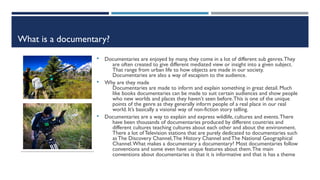
 The BBC usually make documentaries in the wild and about geology, as well as historic and
urban documentaries showing perhaps the better side and the greener side of life. One
famous fellow, David Attenborough is one of the worlds most iconic presenters for
wildlife documentaries and have be regarded as some of the best in the world. He has
made and helped made some of the BBC’s best works in In-formative film.
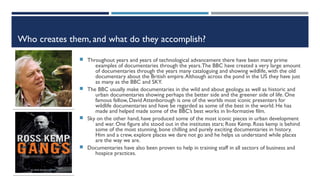
 Sky on the other hand, have produced some of the most iconic pieces in urban development
and war. One figure ahs stood out in the institutes stars; Ross Kemp. Ross kemp is behind
some of the most stunning, bone chilling and purely exciting documentaries in history.
Him and a crew, explore places we dare not go and he helps us understand while places
are the way we are.
 Documentaries have also been proven to help in training staff in all sectors of business and
hospice practices.
The History of documentaries (Pre-1900’s)
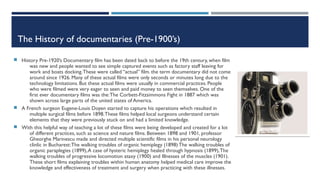
 History Pre-1920’s Documentary film has been dated back to before the 19th century, when film
was new and people wanted to see simple captured events such as factory staff leaving for
work and boats docking.These were called “actual” film. the term documentary did not come
around since 1926. Many of these actual films were only seconds or minutes long due to the
technology limitations. But these actual films were usually in commercial practices. People
who were filmed were very eager to seen and paid money to seen themselves. One of the
first ever documentary films was the:The Corbett-Fitzsimmons Fight in 1887 which was
shown across large parts of the united states of America.
 A French surgeon Eugene-Louis Doyen started to capture his operations which resulted in
multiple surgical films before 1898.These films helped local surgeons understand certain
elements that they were previously stuck on and had a limited knowledge.
 With this helpful way of teaching a lot of these films were being developed and created for a lot
of different practices, such as science and nature films. Between 1898 and 1901, professor
Gheorghe Marinescu made and directed multiple scientific films in his personal neurology
clinlic in Bucharest:The walking troubles of organic hemiplegy (1898) The walking troubles of
organic paraplegies (1899),A case of hysteric hemiplegy healed through hypnosis (1899),The
walking troubles of progressive locomotion ataxy (1900) and Illnesses of the muscles (1901).
These short films explaining troubles within human anatomy helped medical care improve the
knowledge and effectiveness of treatment and surgery when practicing with these illnesses.
1920’s-1960’s
 The 1920’s for documentary film was a first of many new elements embedded into the genre. In 1922 Romanticism was
used in the famous paramount production: Nanook of the North.This time period showed audiences what ancient
civilisations lived like, as well historic events such as the battle of waterloo.
 As Europe plunged into war, governments all over the continent were using film to influence their own people and
others. Small and short documentaries were created by governments in propaganda form to reflect the powerful
ideology's and ideals to gain the publics support in the war effort. Nazi Germany in this time needed the peoples
support and created one of the most iconic propaganda pieces,Triumph of theWill.
 During this time however, documentaries were still being created. NotablyThe Plow that Broke the plains in 1936 and
the foundation of New Deal productions that aided in the future creations of documentaries.
 At the end of the war and into the 1960’s, televisions were starting to become more popular and cheaper for the
common family to own.As a result the demand for more entertainment raised which was vital for documentaries
companies to fulfil otherwise they would not survive. As well at this time the advancement of camera quality was
more apparent, and colour was something of the future.This was the time were all thing film and television started
to take shape and advance.Although, the power of film making was still closely used as a political weapon in the west
and the east.
 It was at this time the US started to use film to appose communism across its sovereignty, as well as educating th
populace about surviving nuclear fallout.
Modern Documentaries and institutes
 In this day and age there are so many different
subgenres of documenters, they come in all
shapes forms and settings to fulfil consumer
needs. It is important to note that a lot more
can be done in this day and age to make ‘the
best’ documentary to fulfil consumer demands.
Documentaries are now widely watched along
all platforms and offer a massive insight into
cultures and environments we could only dream
of stepping into. Documentaries also offer a
form of escapism which is one of the major
reasons why they are so widely liked and
accepted in todays tastes and consumer pattern.
 Modern documentaries help in satisfying our need
for exploration from the comforts of your own
home. Many institutes try to specialise on one
or two topics or subgenres of documentaries.
(E.g BBC 1 Wildlife documentaries)
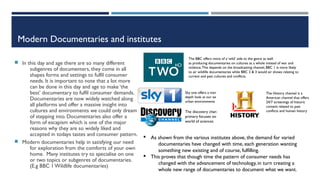
Sky one offers a more in-
depth look at our extreme
urban environments
The BBC offers more of a ‘wild’ side to the genre as well
as producing documentaries on cultures as a whole instead of war and
violence.This depends on the broadcasting channel, BBC 1 is more likely
to air wildlife documentaries while BBC 2 & 3 would air shows relating to
current and past cultures and conflicts.
The discovery channel
primary focuses on the
world of sciences
§ As shown from the various institutes above, the demand for varied
documentaries have changed with time, each generation wanting
something new existing and of course, fulfilling.
§ This proves that though time the pattern of consumer needs has
changed with the advancement of technology, in turn creating a
whole new range of documentaries to document what we want.
The History channel is a
American channel that offers
24/7 screenings of historic
content related to past
conflicts and human history
Subgenres in modern documentaries
 As times have begun to change the demand and consumption for media
changed based on political, peer and personal involvement.These
changes play a vital part in the way media changes over time and what
is created. For example, since the gulf, Iraq and Afghanistan war the
demand for information on these conflicts has risen, this could then
mean that a documentary could be created to explain the conflict from
a first person point of view, something mainstream news cannot.
 This however is not always conflict related, this can be for a brand new
scientific discovery or simply a documentary on a specific science.This
variation is excellent for consumers and deciding on what they chose
to watch based on personal preference. Go back maybe 40 years ago
and subgenres of documentaries were not really mainstream but
instead black and white to the public.

Known subgenres:
•
• War Documentaries
• Mockumentaries
• Scientific Documentaries
• Urban Documentaries
• Wild life Documentaries
• Geography
• Industrial
• Dental
• Public Sector/Private
(Business Educational)
Documentaries
•
Famous examples of modern documentaries
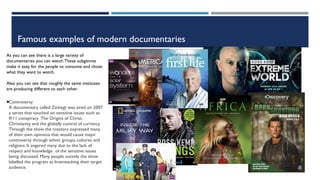
As you can see there is a large variety of
documentaries you can watch.These subgenres
make it easy for the people to consume and chose
what they want to watch.
Also you can see that roughly the same institutes
are producing different to each other.
§Controversy
A documentary called Zeitiegt was aired on 2007
a series that touched on sensitive issues such as
9/11 conspiracy The Origins of Christ,
Christianity and the globally control of currency.
Through the show the creators expressed many
of their own opinions that would cause major
controversy through ethnic groups, cultures and
religions. It angered many due to the lack of
respect and knowledge of the sensitive issues
being discussed. Many people outside the show
labelled the program as brainwashing their target
audience.
Conventions of the genre
There are many different conventions of documentaries but some are very distinctive throughout all genres.
Cinematography:
The most important feature of a documentary is its cinematography, without
careful and planned shots the documentary wouldn’t be successful and lose the
meaning through the product.These are the common conventions of the genre.
Longshots:
Longshots are used quite frequently in partnership with the presenter and the
environment, this can be used to show scale of a place or a culture.
Establishing shots:
Establishing shots are used in a change of environment to connect the audience
with the area to create a sense of transition an understanding.
Close ups:
Close ups used in documentaries highlight something of importance, drawing the
audiences eye to one spot person or thing in particular.
Medium Shots:
these shots are used in abundance with the presenter explaining information often
with the environment or place in the background.
Two shots:
Often used in documentaries with a large human presence these shots can help
set up a conversation as well as showing two people of interest.
Tracking shots
Used more in wildlife documentary the shot tracks the movement of the thing or
animal making it a key frame to watch from the audiences point of view.
Audio:
Audio is also another important part to play in creating atmosphere and feeling within a production piece.This can range from
music to the actual diegetic sound needed to describe the action or place of interest.
Ambient Sound
This type of audio is used in creating the atmosphere of any documentary, It aids in the audience getting a sense of the area and
surroundings.
Music:
Music, one of the most important elements within the structure of a documentary. Music has the power to change a whole scene
and to quickly increase your heart rate. Music is used in documentaries as mainly atmospheric creators, ideal for keeping the
audience on their toes.
Narration
Is very conventional within most documentaries as it narration often describes what is happening and feeds the audience
information regarding the topic of the program
Non-diagetic sound
To make a documentary you need to give some sort of informative fact which will inform the viewer, this is usually done by
dialogue and non-diagetic sound.This includes elements such as speech and conversation between people.
Diegetic Sound
Natural sound is used throughout these programs to create a sense of the environment, mentioned before it is a atmospheric
generators
How I’m going to apply or challenge these during the project
To make a mockumentary I must first draft up the humour side as well as being unique with the
camera angels and the way we structure the program. Humour is important in a mockumentary
but the overall construction and production must have the skin of a documentary. Meaning that
the content should be changed as well as creating some challenging angels and effects in post.
Conventions of the genre
There are many different conventions of documentaries but some are very distinctive throughout all genres.
Cinematography:
The most important feature of a documentary is its cinematography, without
careful and planned shots the documentary wouldn’t be successful and lose the
meaning through the product.These are the common conventions of the genre.
Longshots:
Longshots are used quite frequently in partnership with the presenter and the
environment, this can be used to show scale of a place or a culture.
Establishing shots:
Establishing shots are used in a change of environment to connect the audience
with the area to create a sense of transition an understanding.
Close ups:
Close ups used in documentaries highlight something of importance, drawing the
audiences eye to one spot person or thing in particular.
Medium Shots:
these shots are used in abundance with the presenter explaining information often
with the environment or place in the background.
Two shots:
Often used in documentaries with a large human presence these shots can help
set up a conversation as well as showing two people of interest.
Tracking shots
Used more in wildlife documentary the shot tracks the movement of the thing or
animal making it a key frame to watch from the audiences point of view.
Audio:
Audio is also another important part to play in creating atmosphere and feeling within a production piece.This can range from
music to the actual diegetic sound needed to describe the action or place of interest.
Ambient Sound
This type of audio is used in creating the atmosphere of any documentary, It aids in the audience getting a sense of the area and
surroundings.
Music:
Music, one of the most important elements within the structure of a documentary. Music has the power to change a whole scene
and to quickly increase your heart rate. Music is used in documentaries as mainly atmospheric creators, ideal for keeping the
audience on their toes.
Narration
Is very conventional within most documentaries as it narration often describes what is happening and feeds the audience
information regarding the topic of the program
Non-diagetic sound
To make a documentary you need to give some sort of informative fact which will inform the viewer, this is usually done by
dialogue and non-diagetic sound.This includes elements such as speech and conversation between people.
Diegetic Sound
Natural sound is used throughout these programs to create a sense of the environment, mentioned before it is a atmospheric
generators
How I’m going to apply or challenge these during the project
To make a mockumentary I must first draft up the humour side as well as being unique with the
camera angels and the way we structure the program. Humour is important in a mockumentary
but the overall construction and production must have the skin of a documentary. Meaning that
the content should be changed as well as creating some challenging angels and effects in post.

Genre research

  • 1.
    Genre research andconventions: documentaries A2 media studies written by Jordan jones
  • 2.
    What is adocumentary? § Documentaries are enjoyed by many, they come in a lot of different sub genres.They are often created to give different mediated view or insight into a given subject. That range from urban life to how objects are made in our society. Documentaries are also a way of escapism to the audience. § Why are they made Documentaries are made to inform and explain something in great detail. Much like books documentaries can be made to suit certain audiences and show people who new worlds and places they haven’t seen before.This is one of the unique points of the genre as they generally inform people of a real place in our real world. It’s basically a visional way of non-fiction story telling. § Documentaries are a way to explain and express wildlife, cultures and events.There have been thousands of documentaries produced by different countries and different cultures teaching cultures about each other and about the environment. There a lot of Television stations that are purely dedicated to documentaries such as The Discovery Channel,The History Channel and The National Geographical Channel.What makes a documentary a documentary? Most documentaries follow conventions and some even have unique features about them.The main conventions about documentaries is that it is informative and that is has a theme
  • 3.
    Who creates them,and what do they accomplish?  Throughout years and years of technological advancement there have been many prime examples of documentaries through the years.The BBC have created a very large amount of documentaries through the years many cataloguing and showing wildlife, with the old documentary about the British empire.Although across the pond in the US they have just as many as the BBC and SKY.  The BBC usually make documentaries in the wild and about geology, as well as historic and urban documentaries showing perhaps the better side and the greener side of life. One famous fellow, David Attenborough is one of the worlds most iconic presenters for wildlife documentaries and have be regarded as some of the best in the world. He has made and helped made some of the BBC’s best works in In-formative film.  Sky on the other hand, have produced some of the most iconic pieces in urban development and war. One figure ahs stood out in the institutes stars; Ross Kemp. Ross kemp is behind some of the most stunning, bone chilling and purely exciting documentaries in history. Him and a crew, explore places we dare not go and he helps us understand while places are the way we are.  Documentaries have also been proven to help in training staff in all sectors of business and hospice practices.
  • 4.
    The History ofdocumentaries (Pre-1900’s)  History Pre-1920’s Documentary film has been dated back to before the 19th century, when film was new and people wanted to see simple captured events such as factory staff leaving for work and boats docking.These were called “actual” film. the term documentary did not come around since 1926. Many of these actual films were only seconds or minutes long due to the technology limitations. But these actual films were usually in commercial practices. People who were filmed were very eager to seen and paid money to seen themselves. One of the first ever documentary films was the:The Corbett-Fitzsimmons Fight in 1887 which was shown across large parts of the united states of America.  A French surgeon Eugene-Louis Doyen started to capture his operations which resulted in multiple surgical films before 1898.These films helped local surgeons understand certain elements that they were previously stuck on and had a limited knowledge.  With this helpful way of teaching a lot of these films were being developed and created for a lot of different practices, such as science and nature films. Between 1898 and 1901, professor Gheorghe Marinescu made and directed multiple scientific films in his personal neurology clinlic in Bucharest:The walking troubles of organic hemiplegy (1898) The walking troubles of organic paraplegies (1899),A case of hysteric hemiplegy healed through hypnosis (1899),The walking troubles of progressive locomotion ataxy (1900) and Illnesses of the muscles (1901). These short films explaining troubles within human anatomy helped medical care improve the knowledge and effectiveness of treatment and surgery when practicing with these illnesses.
  • 5.
    1920’s-1960’s  The 1920’sfor documentary film was a first of many new elements embedded into the genre. In 1922 Romanticism was used in the famous paramount production: Nanook of the North.This time period showed audiences what ancient civilisations lived like, as well historic events such as the battle of waterloo.  As Europe plunged into war, governments all over the continent were using film to influence their own people and others. Small and short documentaries were created by governments in propaganda form to reflect the powerful ideology's and ideals to gain the publics support in the war effort. Nazi Germany in this time needed the peoples support and created one of the most iconic propaganda pieces,Triumph of theWill.  During this time however, documentaries were still being created. NotablyThe Plow that Broke the plains in 1936 and the foundation of New Deal productions that aided in the future creations of documentaries.  At the end of the war and into the 1960’s, televisions were starting to become more popular and cheaper for the common family to own.As a result the demand for more entertainment raised which was vital for documentaries companies to fulfil otherwise they would not survive. As well at this time the advancement of camera quality was more apparent, and colour was something of the future.This was the time were all thing film and television started to take shape and advance.Although, the power of film making was still closely used as a political weapon in the west and the east.  It was at this time the US started to use film to appose communism across its sovereignty, as well as educating th populace about surviving nuclear fallout.
  • 6.
    Modern Documentaries andinstitutes  In this day and age there are so many different subgenres of documenters, they come in all shapes forms and settings to fulfil consumer needs. It is important to note that a lot more can be done in this day and age to make ‘the best’ documentary to fulfil consumer demands. Documentaries are now widely watched along all platforms and offer a massive insight into cultures and environments we could only dream of stepping into. Documentaries also offer a form of escapism which is one of the major reasons why they are so widely liked and accepted in todays tastes and consumer pattern.  Modern documentaries help in satisfying our need for exploration from the comforts of your own home. Many institutes try to specialise on one or two topics or subgenres of documentaries. (E.g BBC 1 Wildlife documentaries) Sky one offers a more in- depth look at our extreme urban environments The BBC offers more of a ‘wild’ side to the genre as well as producing documentaries on cultures as a whole instead of war and violence.This depends on the broadcasting channel, BBC 1 is more likely to air wildlife documentaries while BBC 2 & 3 would air shows relating to current and past cultures and conflicts. The discovery channel primary focuses on the world of sciences § As shown from the various institutes above, the demand for varied documentaries have changed with time, each generation wanting something new existing and of course, fulfilling. § This proves that though time the pattern of consumer needs has changed with the advancement of technology, in turn creating a whole new range of documentaries to document what we want. The History channel is a American channel that offers 24/7 screenings of historic content related to past conflicts and human history
  • 7.
    Subgenres in moderndocumentaries  As times have begun to change the demand and consumption for media changed based on political, peer and personal involvement.These changes play a vital part in the way media changes over time and what is created. For example, since the gulf, Iraq and Afghanistan war the demand for information on these conflicts has risen, this could then mean that a documentary could be created to explain the conflict from a first person point of view, something mainstream news cannot.  This however is not always conflict related, this can be for a brand new scientific discovery or simply a documentary on a specific science.This variation is excellent for consumers and deciding on what they chose to watch based on personal preference. Go back maybe 40 years ago and subgenres of documentaries were not really mainstream but instead black and white to the public.  Known subgenres: • • War Documentaries • Mockumentaries • Scientific Documentaries • Urban Documentaries • Wild life Documentaries • Geography • Industrial • Dental • Public Sector/Private (Business Educational) Documentaries •
  • 8.
    Famous examples ofmodern documentaries As you can see there is a large variety of documentaries you can watch.These subgenres make it easy for the people to consume and chose what they want to watch. Also you can see that roughly the same institutes are producing different to each other. §Controversy A documentary called Zeitiegt was aired on 2007 a series that touched on sensitive issues such as 9/11 conspiracy The Origins of Christ, Christianity and the globally control of currency. Through the show the creators expressed many of their own opinions that would cause major controversy through ethnic groups, cultures and religions. It angered many due to the lack of respect and knowledge of the sensitive issues being discussed. Many people outside the show labelled the program as brainwashing their target audience.
  • 9.
    Conventions of thegenre There are many different conventions of documentaries but some are very distinctive throughout all genres. Cinematography: The most important feature of a documentary is its cinematography, without careful and planned shots the documentary wouldn’t be successful and lose the meaning through the product.These are the common conventions of the genre. Longshots: Longshots are used quite frequently in partnership with the presenter and the environment, this can be used to show scale of a place or a culture. Establishing shots: Establishing shots are used in a change of environment to connect the audience with the area to create a sense of transition an understanding. Close ups: Close ups used in documentaries highlight something of importance, drawing the audiences eye to one spot person or thing in particular. Medium Shots: these shots are used in abundance with the presenter explaining information often with the environment or place in the background. Two shots: Often used in documentaries with a large human presence these shots can help set up a conversation as well as showing two people of interest. Tracking shots Used more in wildlife documentary the shot tracks the movement of the thing or animal making it a key frame to watch from the audiences point of view. Audio: Audio is also another important part to play in creating atmosphere and feeling within a production piece.This can range from music to the actual diegetic sound needed to describe the action or place of interest. Ambient Sound This type of audio is used in creating the atmosphere of any documentary, It aids in the audience getting a sense of the area and surroundings. Music: Music, one of the most important elements within the structure of a documentary. Music has the power to change a whole scene and to quickly increase your heart rate. Music is used in documentaries as mainly atmospheric creators, ideal for keeping the audience on their toes. Narration Is very conventional within most documentaries as it narration often describes what is happening and feeds the audience information regarding the topic of the program Non-diagetic sound To make a documentary you need to give some sort of informative fact which will inform the viewer, this is usually done by dialogue and non-diagetic sound.This includes elements such as speech and conversation between people. Diegetic Sound Natural sound is used throughout these programs to create a sense of the environment, mentioned before it is a atmospheric generators How I’m going to apply or challenge these during the project To make a mockumentary I must first draft up the humour side as well as being unique with the camera angels and the way we structure the program. Humour is important in a mockumentary but the overall construction and production must have the skin of a documentary. Meaning that the content should be changed as well as creating some challenging angels and effects in post.
  • 10.
    Conventions of thegenre There are many different conventions of documentaries but some are very distinctive throughout all genres. Cinematography: The most important feature of a documentary is its cinematography, without careful and planned shots the documentary wouldn’t be successful and lose the meaning through the product.These are the common conventions of the genre. Longshots: Longshots are used quite frequently in partnership with the presenter and the environment, this can be used to show scale of a place or a culture. Establishing shots: Establishing shots are used in a change of environment to connect the audience with the area to create a sense of transition an understanding. Close ups: Close ups used in documentaries highlight something of importance, drawing the audiences eye to one spot person or thing in particular. Medium Shots: these shots are used in abundance with the presenter explaining information often with the environment or place in the background. Two shots: Often used in documentaries with a large human presence these shots can help set up a conversation as well as showing two people of interest. Tracking shots Used more in wildlife documentary the shot tracks the movement of the thing or animal making it a key frame to watch from the audiences point of view. Audio: Audio is also another important part to play in creating atmosphere and feeling within a production piece.This can range from music to the actual diegetic sound needed to describe the action or place of interest. Ambient Sound This type of audio is used in creating the atmosphere of any documentary, It aids in the audience getting a sense of the area and surroundings. Music: Music, one of the most important elements within the structure of a documentary. Music has the power to change a whole scene and to quickly increase your heart rate. Music is used in documentaries as mainly atmospheric creators, ideal for keeping the audience on their toes. Narration Is very conventional within most documentaries as it narration often describes what is happening and feeds the audience information regarding the topic of the program Non-diagetic sound To make a documentary you need to give some sort of informative fact which will inform the viewer, this is usually done by dialogue and non-diagetic sound.This includes elements such as speech and conversation between people. Diegetic Sound Natural sound is used throughout these programs to create a sense of the environment, mentioned before it is a atmospheric generators How I’m going to apply or challenge these during the project To make a mockumentary I must first draft up the humour side as well as being unique with the camera angels and the way we structure the program. Humour is important in a mockumentary but the overall construction and production must have the skin of a documentary. Meaning that the content should be changed as well as creating some challenging angels and effects in post.