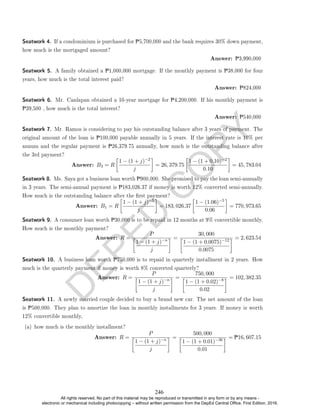
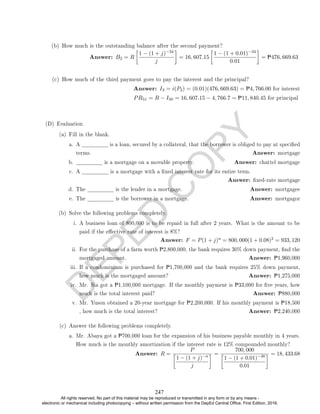
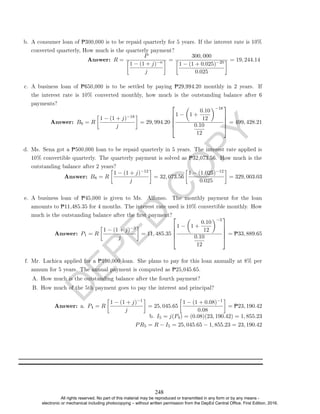
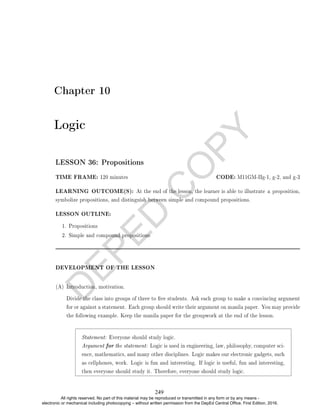
D
E
P
E
D
C
O
P
Y
General
Mathematics
Teacher’s Guide
Department of Education
Republic of the Philippines
This Teacher’s Guide was developed by the Commission
on Higher Education (CHED) in collaboration with content and
teaching experts from universities, colleges, basic education,
and other academic institutions and was donated to the
Department of Education (DepEd) for use in senior high school
in support of the implementation of the enhanced basic
education curriculum (K to 12).
We encourage teachers and other education stakeholders
to email their feedback, comments, and recommendations to the
Department of Education at action@deped.gov.ph.
We value your feedback and recommendations.
All rights reserved. No part of this material may be reproduced or transmitted in any form or by any means -
electronic or mechanical including photocopying – without written permission from the DepEd Central Office. First Edition, 2016.
D
E
P
E
D
C
O
P
Y
General Mathematics
Teacher’s Guide
First Edition 2016
Republic Act 8293. Section 176 states that: No copyright shall subsist in any work
of the Government of the Philippines. However, prior approval of the government agency or
office wherein the work is created shall be necessary for exploitation of such work for profit.
Such agency or office may, among other things, impose as a condition the payment of
royalties.
Borrowed materials (i.e., songs, stories, poems, pictures, photos, brand names,
trademarks, etc.) included in this learning resource are owned by their respective copyright
holders. DepEd is represented by the Filipinas Copyright Licensing Society (FILCOLS), Inc.
in seeking permission to use these materials from their respective copyright owners. All
means have been exhausted in seeking permission to use these materials. The publisher
and authors do not represent nor claim ownership over them.
Only institutions and companies which have entered an agreement with FILCOLS
and only within the agreed framework may copy from this Teacher’s Guide. Those who
have not entered in an agreement with FILCOLS must, if they wish to copy, contact the
publishers and authors directly.
435-5258, respectively.
Published by the Department of Education
Secretary: Br. Armin A. Luistro FSC
Undersecretary: Dina S. Ocampo, PhD
Printed in the Philippines by Lexicon Press Inc.
Copyright of this donated manuscript is transferred to DepEd, including the right to
modify and determine the use of its content. Modifications made to the original manuscript were
the direct result of DepEd's quality assurance process, including compliance with social content
guidelines, and as such are the sole responsibility of the DepEd.
Development Team of the General Mathematics Teacher’s Guide
Writers: Leo Andrei A. Crisologo Eden Delight P. Miro, Ph.D. Lester C. Hao
Shirlee R. Ocampo Regina M. Tresvalles Emellie G. Palomo, Ph.D.
Technical Editors: Christian Paul O. Chan Shio, PhD. Mark L. Loyola, Ph.D.
Reviewer: Jude Buot Eleanor Villanueva
Typesetters: Juan Carlo F. Mallari Ma. Regina Paz S. Onglao
Copyreader: Sheena I. Fe Illustrator: Daniella Louise Borrero
Cover Art Illustrator: Quincy D. Gonzales
Team Leader: Dr. Debbie Marie B. Verzosa, Ph.D.
Authors and publishers may email or contact FILCOLS at filcols@gmail.com or (02)
Department of Education-Bureau of Learning Resources (DepEd-BLR)
Office Address: Ground Floor Bonifacio Building, DepEd Complex
Meralco Avenue, Pasig City, Philippines 1600
Telefax: (02) 634-1054 or 634-1072
E-mail Address: blr.lrqad@deped.gov.ph / blr.lrpd@deped.gov.ph
All rights reserved. No part of this material may be reproduced or transmitted in any form or by any means -
electronic or mechanical including photocopying – without written permission from the DepEd Central Office. First Edition, 2016.
D
E
P
E
D
C
O
P
Y
M11GM-Ic-3
equations,
and
inequalities.
11.
graphs
rational
functions.
M11GM-Ic-2
12.
solves
problems
involving
rational
functions,
M11GM-Ic-1
(a)
intercepts
(b)
zeroes;
and
(c)
asymptotes
of
rational
functions
9.
finds
the
domain
and
range
of
a
rational
function.
M11GM-Ib-5
10.
determines
the:
M11GM-Ib-4
values,
(b)
graph,
and
(c)
equation.
7.
solves
rational
equations
and
inequalities.
M11GM-Ib-3
8.
represents
a
rational
function
through
its:
(a)
table
of
rational
inequality.
M11GM-Ib-2
5.
represents
real-life
situations
using
rational
functions.
M11GM-Ib-1
6.
distinguishes
rational
function,
rational
equation,
and
solve
real-life
problems
involving
rational
functions.
2.
accurately
formulate
and
functions.
2.
key
concepts
of
rational
4.
solves
problems
involving
functions.
M11GM-Ia-4
M11GM-Ia-3
3.
performs
addition,
subtraction,
multiplication,
division,
and
composition
of
functions
2.
evaluates
a
function.
M11GM-Ia-2
piece-wise
functions.
M11GM-Ia-1
1.
represents
real-life
situations
using
functions,
including
..
rner.
lea
The
1.
accurately
construct
mathematical
models
to
represent
real-life
situations
using
functions.
.
o..
ble
t
rner
is
a
lea
The
functions.
1.
key
concepts
of
...
g
of
n
andi
derst
un
s
e
t
stra
n
demo
rner
lea
The
Functions
and
Their
Graphs
LEARNING
COMPETENCIES
CODE
PERFORMANCE
STANDARDS
CONTENT
CONTENT
STANDARDS
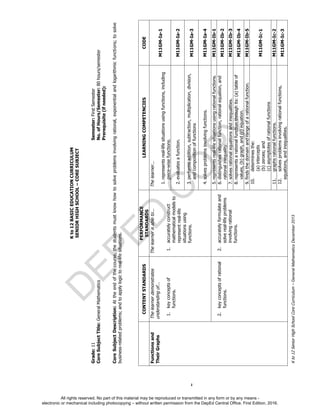
Grade:
11
Semester:
First
Semester
Core
Subject
Title:
General
Mathematics
No.
of
Hours/Semester:
80
hours/semester
Prerequisite
(if
needed):
Core
Subject
Description:
At
the
end
of
the
course,
the
students
must
know
how
to
solve
problems
involving
rational,
exponential
and
logarithmic
functions;
to
solve
business-related
problems;
and
to
apply
logic
to
real-life
situations.
General
Mathematics
December
2013
–
ulum
Curric
Core
l
hoo
Sc
High
nior
e
12
S
to
K
K
to
12
BASIC
EDUCATION
CURRICULUM
SENIOR
HIGH
SCHOOL
–
CORE
SUBJECT
i
All rights reserved. No part of this material may be reproduced or transmitted in any form or by any means -
electronic or mechanical including photocopying – without written permission from the DepEd Central Office. First Edition, 2016.
D
E
P
E
D
C
O
P
Y
K
to
12
BASIC
EDUCATION
CURRICULUM
SENIOR
HIGH
SCHOOL
–
CORE
SUBJECT
K
to
12
Senior
High
School
Core
Curriculum
–
General
Mathematics
December
2013
CONTENT
CONTENT
STANDARDS
PERFORMANCE
STANDARDS
LEARNING
COMPETENCIES
CODE
3.
key
concepts
of
inverse
functions,
exponential
functions,
and
logarithmic
functions.
3.
apply
the
concepts
of
inverse
functions,
exponential
functions,
and
logarithmic
functions
to
formulate
and
solve
real-life
problems
with
precision
and
accuracy.
1.
represents
real-life
situations
using
one-to
one
functions.
M11GM-Id-1
2.
determines
the
inverse
of
a
one-to-one
function.
M11GM-Id-2
3.
represents
an
inverse
function
through
its:
(a)
table
of
values,
and
(b)
graph.
M11GM-Id-3
4.
finds
the
domain
and
range
of
an
inverse
function.
M11GM-Id-4
5.
graphs
inverse
functions.
M11GM-Ie-1
6.
solves
problems
involving
inverse
functions.
M11GM-Ie-2
7.
represents
real-life
situations
using
exponential
functions.
M11GM-Ie-3
8.
distinguishes
between
exponential
function,
exponential
equation,
and
exponential
inequality.
M11GM-Ie-4
9.
solves
exponential
equations
and
inequalities.
M11GM-Ie-f-1
10.
represents
an
exponential
function
through
its:
(a)
table
of
values,
(b)
graph,
and
(c)
equation.
M11GM-If-2
11.
finds
the
domain
and
range
of
an
exponential
function.
M11GM-If-3
12.
determines
the
intercepts,
zeroes,
and
asymptotes
of
an
exponential
function.
M11GM-If-4
13.
graphs
exponential
functions.
M11GM-Ig-1
14.
solves
problems
involving
exponential
functions,
equations,
and
inequalities.
M11GM-Ig-2
15.
represents
real-life
situations
using
logarithmic
functions.
M11GM-Ih-1
16.
distinguishes
logarithmic
function,
logarithmic
equation,
and
logarithmic
inequality.
M11GM-Ih-2
17.
illustrates
the
laws
of
logarithms.
M11GM-Ih-3
18.
solves
logarithmic
equations
and
inequalities.
M11GM-Ih-i-1
19.
represents
a
logarithmic
function
through
its:
(a)
table
of
values,
(b)
graph,
and
(c)
equation.
M11GM-Ii-2
20.
finds
the
domain
and
range
of
a
logarithmic
function.
M11GM-Ii-3
21.
determines
the
intercepts,
zeroes,
and
asymptotes
of
logarithmic
functions.
M11GM-Ii-4
22.
graphs
logarithmic
functions.
M11GM-Ij-1
23.
solves
problems
involving
logarithmic
functions,
equations,
and
inequalities.
M11GM-Ij-2
ii
All rights reserved. No part of this material may be reproduced or transmitted in any form or by any means -
electronic or mechanical including photocopying – without written permission from the DepEd Central Office. First Edition, 2016.
D
E
P
E
D
C
O
P
Y
iii
47.
illustrates
different
types
of
tautologies
and
fallacies.
M11GM-IIi-1
propositions.
M11GM-IIh-2
45.
determines
the
truth
values
of
propositions.
M11GM-IIh-1
46.
illustrates
the
different
forms
of
conditional
propositions.
M11GM-IIg-4
M11GM-IIg-3
44.
performs
the
different
types
of
operations
on
propositions.
41.
illustrates
a
proposition.
M11GM-IIg-1
42.
symbolizes
propositions.
M11GM-IIg-2
43.
distinguishes
between
simple
and
compound
1.
judiciously
apply
logic
in
real-life
arguments.
.
o..
ble
t
rner
is
a
lea
The
propositional
logic;
syllogisms
and
fallacies.
1.
key
concepts
of
...
g
of
n
andi
derst
un
s
e
t
stra
n
demo
rner
lea
The
Logic
M11GM-IIf-3
40.
solves
problems
involving
business
and
consumer
loans
(amortization,
mortgage).
M11GM-IIf-1
39.
distinguishes
between
business
and
consumer
loans.
M11GM-IIf-2
38.
illustrates
business
and
consumer
loans.
3.
decide
wisely
on
the
appropriateness
of
business
or
consumer
loan
and
its
proper
utilization.
business
and
consumer
loans.
37.
interprets
the
theory
of
efficient
markets.
M11GM-IIe-5
3.
basic
concepts
of
M11GM-IIe-4
bonds.
33.
illustrate
stocks
and
bonds.
M11GM-IIe-1
34.
distinguishes
between
stocks
and
bonds.
M11GM-IIe-2
35.
describes
the
different
markets
for
stocks
and
bonds.
M11GM-IIe-3
36.
analyzes
the
different
market
indices
for
stocks
and
2.
use
appropriate
financial
instruments
involving
stocks
and
bonds
in
formulating
conclusions
and
making
decisions.
and
bonds.
M11GM-IId-3
2.
basic
concepts
of
stocks
deferred
annuity.
M11GM-IId-2
32.
calculates
the
present
value
and
period
of
deferral
of
a
that
includes
an
annuity.
M11GM-IIc-d-1
31.
calculates
the
fair
market
value
of
a
cash
flow
stream
30.
finds
the
future
value
and
present
value
of
both
simple
annuities
and
general
annuities.
28.
illustrates
simple
and
general
annuities.
M11GM-IIc-1
29.
distinguishes
between
simple
and
general
annuities.
M11GM-IIc-2
M11GM-IIb-2
27.
solves
problems
involving
simple
and
compound
interests.
M11GM-IIa-b-1
present
value
in
simple
interest
and
compound
interest
environment.
24.
illustrates
simple
and
compound
interests.
M11GM-IIa-1
25.
distinguishes
between
simple
and
compound
interests.
M11GM-IIa-2
26.
computes
interest,
maturity
value,
future
value,
and
solve
problems
involving
simple
and
compound
interests
and
simple
and
general
annuities
using
appropriate
business
and
financial
instruments.
1.
investigate,
analyze
and
.
o..
ble
t
rner
is
a
lea
The
1.
key
concepts
of
simple
and
compound
interests,
and
simple
and
general
annuities.
...
g
of
n
andi
derst
un
s
e
t
stra
n
demo
rner
lea
The
Basic
Business
Mathematics
LEARNING
COMPETENCIES
CODE
STANDARDS
CONTENT
CONTENT
STANDARDS
PERFORMANCE
General
Mathematics
December
2013
–
ulum
Curric
Core
l
hoo
Sc
High
nior
e
12
S
to
K
K
to
12
BASIC
EDUCATION
CURRICULUM
SENIOR
HIGH
SCHOOL
–
CORE
SUBJECT
All rights reserved. No part of this material may be reproduced or transmitted in any form or by any means -
electronic or mechanical including photocopying – without written permission from the DepEd Central Office. First Edition, 2016.
D
E
P
E
D
C
O
P
Y
K
to
12
BASIC
EDUCATION
CURRICULUM
SENIOR
HIGH
SCHOOL
–
CORE
SUBJECT
CONTENT
CONTENT
STANDARDS
PERFORMANCE
STANDARDS
LEARNING
COMPETENCIES
CODE
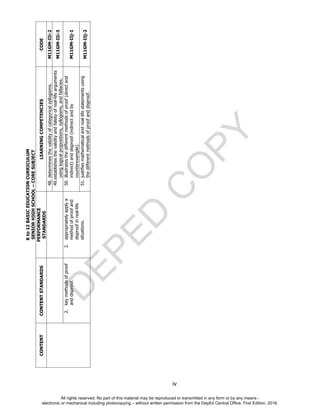
48.
determines
the
validity
of
categorical
syllogisms.
M11GM-IIi-2
49.
establishes
the
validity
and
falsity
of
real-life
arguments
using
logical
propositions,
syllogisms,
and
fallacies.
M11GM-IIi-3
2.
key
methods
of
proof
and
disproof.
2.
appropriately
apply
a
method
of
proof
and
disproof
in
real-life
situations.
50.
illustrates
the
different
methods
of
proof
(direct
and
indirect)
and
disproof
(indirect
and
by
counterexample).
M11GM-IIj-1
51.
justifies
mathematical
and
real-life
statements
using
the
different
methods
of
proof
and
disproof.
M11GM-IIj-2
iv
All rights reserved. No part of this material may be reproduced or transmitted in any form or by any means -
electronic or mechanical including photocopying – without written permission from the DepEd Central Office. First Edition, 2016.
D
E
P
E
D
C
O
P
Y
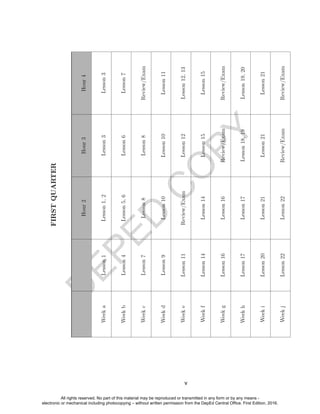
Week
j
Lesson
22
Lesson
22
Review/Exam
Review/Exam
Week
i
Lesson
20
Lesson
21
Lesson
21
Lesson
21
Week
h
Lesson
17
Lesson
17
Lesson
18,
19
Lesson
19,
20
Week
g
Lesson
16
Lesson
16
Review/Exam
Review/Exam
Week
f
Lesson
14
Lesson
14
Lesson
15
Lesson
15
Week
e
Lesson
11
Review/Exam
Lesson
12
Lesson
12,
13
Week
d
Lesson
9
Lesson
10
Lesson
10
Lesson
11
Week
c
Lesson
7
Lesson
8
Lesson
8
Review/Exam
Week
b
Lesson
4
Lesson
5,
6
Lesson
6
Lesson
7
Week
a
Lesson
1
Lesson
1,
2
Lesson
3
Lesson
3
Hour
1
Hour
2
Hour
3
Hour
4
FIRST
QUARTER
v
All rights reserved. No part of this material may be reproduced or transmitted in any form or by any means -
electronic or mechanical including photocopying – without written permission from the DepEd Central Office. First Edition, 2016.
D
E
P
E
D
C
O
P
Y
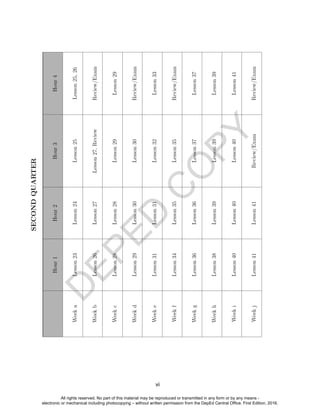
SECOND
QUARTER
Week
j
Lesson
41
Lesson
41
Review/Exam
Review/Exam
Week
i
Lesson
40
Lesson
40
Lesson
40
Lesson
41
Week
h
Lesson
38
Lesson
39
Lesson
39
Lesson
39
Week
g
Lesson
36
Lesson
36
Lesson
37
Lesson
37
Week
f
Lesson
34
Lesson
35
Lesson
35
Review/Exam
Week
e
Lesson
31
Lesson
31
Lesson
32
Lesson
33
Week
d
Lesson
29
Lesson
30
Lesson
30
Review/Exam
Week
c
Lesson
28
Lesson
28
Lesson
29
Lesson
29
Week
b
Lesson
26
Lesson
27
Lesson
27,
Review
Review/Exam
Week
a
Lesson
23
Lesson
24
Lesson
25
Lesson
25,
26
Hour
1
Hour
2
Hour
3
Hour
4
vi
All rights reserved. No part of this material may be reproduced or transmitted in any form or by any means -
electronic or mechanical including photocopying – without written permission from the DepEd Central Office. First Edition, 2016.
D
E
P
E
D
C
O
P
Y
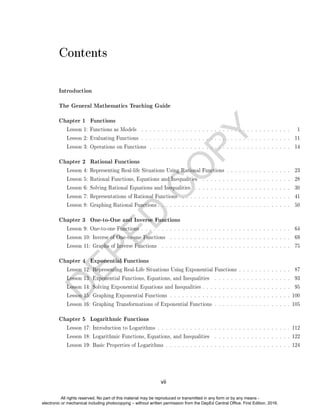
Contents
Introduction
The General Mathematics Teaching Guide
Chapter 1 Functions
Lesson 1: Functions as Models . . . . . . . . . . . . . . . . . . . . . . . . . . . . . . . . . . . . . 1
Lesson 2: Evaluating Functions . . . . . . . . . . . . . . . . . . . . . . . . . . . . . . . . . . . . . 11
Lesson 3: Operations on Functions . . . . . . . . . . . . . . . . . . . . . . . . . . . . . . . . . . . 14
Chapter 2 Rational Functions
Lesson 4: Representing Real-life Situations Using Rational Functions . . . . . . . . . . . . . . . . 23
Lesson 5: Rational Functions, Equations and Inequalities . . . . . . . . . . . . . . . . . . . . . . 28
Lesson 6: Solving Rational Equations and Inequalities . . . . . . . . . . . . . . . . . . . . . . . . 30
Lesson 7: Representations of Rational Functions . . . . . . . . . . . . . . . . . . . . . . . . . . . 41
Lesson 8: Graphing Rational Functions . . . . . . . . . . . . . . . . . . . . . . . . . . . . . . . . . 50
Chapter 3 One-to-One and Inverse Functions
Lesson 9: One-to-one Functions . . . . . . . . . . . . . . . . . . . . . . . . . . . . . . . . . . . . . 64
Lesson 10: Inverse of One-to-one Functions . . . . . . . . . . . . . . . . . . . . . . . . . . . . . . 69
Lesson 11: Graphs of Inverse Functions . . . . . . . . . . . . . . . . . . . . . . . . . . . . . . . . 75
Chapter 4 Exponential Functions
Lesson 12: Representing Real-Life Situations Using Exponential Functions . . . . . . . . . . . . . 87
Lesson 13: Exponential Functions, Equations, and Inequalities . . . . . . . . . . . . . . . . . . . 93
Lesson 14: Solving Exponential Equations and Inequalities . . . . . . . . . . . . . . . . . . . . . . 95
Lesson 15: Graphing Exponential Functions . . . . . . . . . . . . . . . . . . . . . . . . . . . . . . 100
Lesson 16: Graphing Transformations of Exponential Functions . . . . . . . . . . . . . . . . . . . 105
Chapter 5 Logarithmic Functions
Lesson 17: Introduction to Logarithms . . . . . . . . . . . . . . . . . . . . . . . . . . . . . . . . . 112
Lesson 18: Logarithmic Functions, Equations, and Inequalities . . . . . . . . . . . . . . . . . . . 122
Lesson 19: Basic Properties of Logarithms . . . . . . . . . . . . . . . . . . . . . . . . . . . . . . . 124
vii
All rights reserved. No part of this material may be reproduced or transmitted in any form or by any means -
electronic or mechanical including photocopying – without written permission from the DepEd Central Office. First Edition, 2016.
D
E
P
E
D
C
O
P
Y
Lesson 20: Laws of Logarithms . . . . . . . . . . . . . . . . . . . . . . . . . . . . . . . . . . . . . 127
Lesson 21: Solving Logarithmic Equations and Inequalities . . . . . . . . . . . . . . . . . . . . . . 133
Lesson 22: The Logarithmic Function . . . . . . . . . . . . . . . . . . . . . . . . . . . . . . . . . 143
Chapter 6 Simple and Compound Interest
Lesson 23: Illustrating Simple and Compound Interest . . . . . . . . . . . . . . . . . . . . . . . . 153
Lesson 24: Simple Interest . . . . . . . . . . . . . . . . . . . . . . . . . . . . . . . . . . . . . . . . 156
Lesson 25: Compound Interest . . . . . . . . . . . . . . . . . . . . . . . . . . . . . . . . . . . . . 162
Lesson 26: Compounding More than Once a Year . . . . . . . . . . . . . . . . . . . . . . . . . . . 167
Lesson 27: Finding Interest Rate and Time in Compound Interest . . . . . . . . . . . . . . . . . 178
Chapter 7 Annuities
Lesson 28: Simple Annuity . . . . . . . . . . . . . . . . . . . . . . . . . . . . . . . . . . . . . . . 188
Lesson 29: General Annuity . . . . . . . . . . . . . . . . . . . . . . . . . . . . . . . . . . . . . . . 201
Lesson 30: Deferred Annuity . . . . . . . . . . . . . . . . . . . . . . . . . . . . . . . . . . . . . . 213
Chapter 8 Basic Concepts of Stocks and Bonds
Lesson 31: Stocks and Bonds . . . . . . . . . . . . . . . . . . . . . . . . . . . . . . . . . . . . . . 222
Lesson 32: Market Indices for Stocks and Bonds . . . . . . . . . . . . . . . . . . . . . . . . . . . . 230
Lesson 33: Theory of Ecient Markets . . . . . . . . . . . . . . . . . . . . . . . . . . . . . . . . . 233
Chapter 9 Basic Concepts of Loans
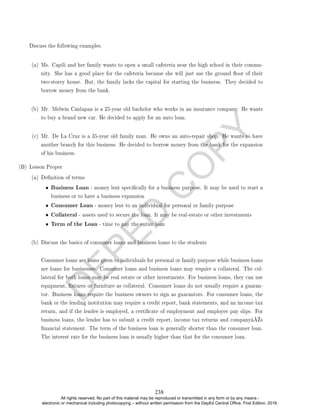
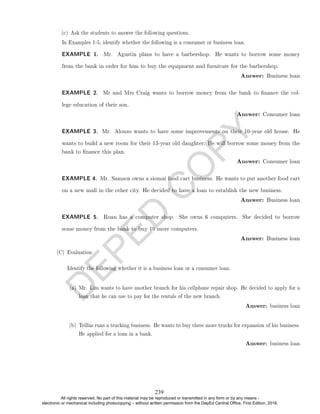
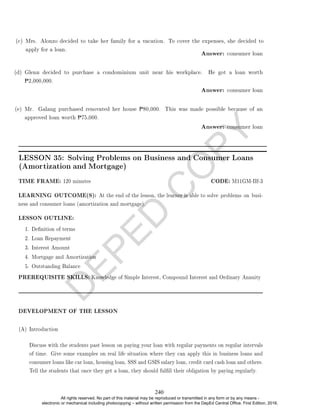
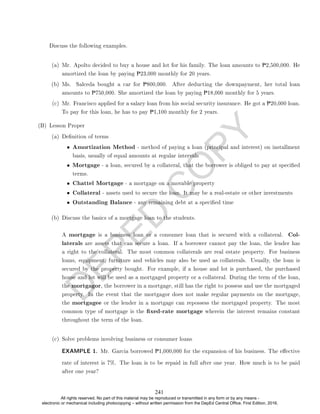
Lesson 34: Business Loans and Consumer Loans . . . . . . . . . . . . . . . . . . . . . . . . . . . 237
Lesson 35: Solving Problems on Business and Consumer Loans (Amortization and Mortgage) . . 240
Chapter 10 Logic
Lesson 36: Propositions . . . . . . . . . . . . . . . . . . . . . . . . . . . . . . . . . . . . . . . . . 249
Lesson 37: Logical Operators . . . . . . . . . . . . . . . . . . . . . . . . . . . . . . . . . . . . . . 254
Lesson 38: Constructing Truth Tables . . . . . . . . . . . . . . . . . . . . . . . . . . . . . . . . . 266
Lesson 39: Logical Equivalence and Forms of Conditional Propositions . . . . . . . . . . . . . . . 271
Lesson 40: Valid arguments and fallacies . . . . . . . . . . . . . . . . . . . . . . . . . . . . . . . . 278
Lesson 41: Methods of Proof . . . . . . . . . . . . . . . . . . . . . . . . . . . . . . . . . . . . . . 292
Acknowledgments
viii
All rights reserved. No part of this material may be reproduced or transmitted in any form or by any means -
electronic or mechanical including photocopying – without written permission from the DepEd Central Office. First Edition, 2016.
D
E
P
E
D
C
O
P
Y
Introduction
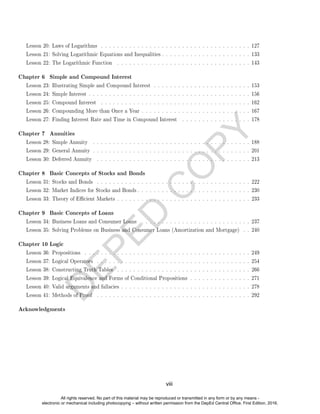
As the Commission supports DepEd's implementation of SHS, we uphold the vision and mission of the K
to 12 program stated in Section 2 of the Republic Act 10533, or the `Enhanced Basic Education Act of
2013,' that the every graduate of basic education be an empowered individual, through a program rooted
on... the competence to engage in work and be productive, the ability to coexist in fruitful harmony with
local and global communities, the capability to engage in creative and critical thinking, and the capacity
and willingness to transform others and one's self.
We believe that teachers are our most important partners in attaining this goal. As we support them
through this Teaching Guide, we also provide them a framework to guide the lessons and assessment tools
that they will design, the activities and questions that they will facilitate, and the deeper content areas
and competencies that they will immerse themselves into.
We introduce, the SHS for SHS Framework.
The SHS for SHS Framework
The SHS for SHS Framework, which stands for Saysay-Husay-Sarili for Senior High School, is at the
center of this book. This Teaching Guide will provide support to all SHS teachers, combining high-quality
content with exible elements to accommodate diversity of teachers and environments.
In this Teaching Guide, teachers will get to master these concepts:
Saysay: Meaning
Why is this important?
As teachers, we have to let our learners see the value of what they are learning in order to fully engage in
the content on both the cognitive and aective levels.
Husay: Mastery
How will I understand this?
Given that developing mastery goes beyond memorization, teachers also intend to aim for deep under-
standing of the subject matter where they lead learners to analyze and synthesize knowledge.
Sarili: Ownership
What can I do with my education?
When teachers empower learners to take ownership of their learning, they develop independence and self-
direction, learning about both the subject matter and themselves.
ix
All rights reserved. No part of this material may be reproduced or transmitted in any form or by any means -
electronic or mechanical including photocopying – without written permission from the DepEd Central Office. First Edition, 2016.
D
E
P
E
D
C
O
P
Y
The General Mathematics Teaching Guide
Implementing a new curriculum is always subject to a new set of challenges. References are not always
available, and training may be too short to cover all the required topics. Under these circumstances,
providing teachers with quality resource materials aligned with the curricular competencies may be the
best strategy for delivering the expected learning outcomes. Such is the rationale for creating a series of
teaching guides for several Grade 11 and 12 subjects. The intention is to provide teachers a complete
resource that addresses all expected learning competencies, as stated in the Department of Educations
ocial curriculum guide.
This resource is a teaching guide for General Mathematics. The structure is quite unique, reective of the
wide scope of General Mathematics: functions, business mathematics, and logic. Each lesson begins with
an introductory or motivational activity. The main part of the lesson presents important ideas and provides
several solved examples. Explanations to basic properties, the rationale for mathematical procedures, and
the derivation of important formulas are also provided. The goal is to enable teachers to move learners
away from regurgitating information and towards an authentic understanding of, and appreciation for, the
subject matter.
The chapters on functions are an extension of the functions learned in Junior High School, where the focus
was primarily on linear, quadratic, and polynomial functions. In Grade 11, learners will be exposed to other
types of functions such as piecewise, rational, exponential, and logarithmic functions. Related topics such
as solving equations and inequalities, as well as identifying the domain, range, intercepts, and asymptotes
are also included.
The chapters on business mathematics in Grade 11 may be learners' rst opportunity to be exposed to
topics related to nancial literacy. Here, they learn about simple and compound interest, annuities, loans,
stocks, and bonds. These lessons can hopefully prepare learners to analyze business-related problems and
make sound nancial decisions.
The nal chapter on logic exposes learners to symbolic forms of propositions (or statements) and argu-
ments. Through the use of symbolic logic, learners should be able to recognize equivalent propositions,
identify fallacies, and judge the validity of arguments. The culminating lesson is an application of the
rules of symbolic logic, as learners are taught to write their own justications to mathematical and real-life
statements.
This teaching guide is intended to be a practical resource for teachers. It includes activities, explanations,
and assessment tools. While the beginning teacher may use this teaching guide as a `script', more expe-
rienced teachers can use this resource as a starting point for writing their own lesson plans. In any case,
it is hoped that this resource, together with the teaching guide for other subjects, can support teachers in
achieving the vision of the K to 12 program.
x
All rights reserved. No part of this material may be reproduced or transmitted in any form or by any means -
electronic or mechanical including photocopying – without written permission from the DepEd Central Office. First Edition, 2016.
D
E
P
E
D
C
O
P
Y
Chapter 1
Functions
LESSON 1: Functions as Models
TIME FRAME: 90 minutes CODE: M11GM-Ia-1 and M11GM-Ia-4
LEARNING OUTCOME(S): At the end of the lesson, the learner is able to represent real life situa-
tions using functions, including piecewise functions, and solve problems involving functions.
LESSON OUTLINE:
1. Review: of relations and functions
2. Review: The function as a machine
3. Review: Functions and relations as a set of ordered pairs
4. Review: Functions and relations as a table of values
5. Review: Functions as a graph in the Cartesian plane
6. Review: Vertical line test
7. Functions as representations of real life situations
8. Piecewise functions
DEVELOPMENT OF THE LESSON
(A) Review of Functions from Junior High School
The concept of functions were introduced during Grade 8. The review provided in this teaching
guide is extensive. Discuss only as much as necessary.
Note to the Teacher:
1
All rights reserved. No part of this material may be reproduced or transmitted in any form or by any means -
electronic or mechanical including photocopying – without written permission from the DepEd Central Office. First Edition, 2016.
D
E
P
E
D
C
O
P
Y
Relations Functions
The function as a machine
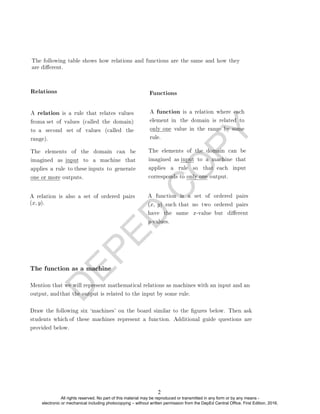
The following table shows how relations and functions are the same and how they
are dierent.
A relation is a rule that relates values
froma set of values (called the domain)
to a second set of values (called the
range).
The elements of the domain can be
imagined as input to a machine that
applies a rule to these inputs to generate
one or more outputs.
A function is a relation where each
element in the domain is related to
only one value in the range by some
rule.
The elements of the domain can be
imagined as input to a machine that
applies a rule so that each input
corresponds to only one output.
A relation is also a set of ordered pairs
(x, y).
A function is a set of ordered pairs
(x, y) such that no two ordered pairs
have the same x-value but dierent
y-values.
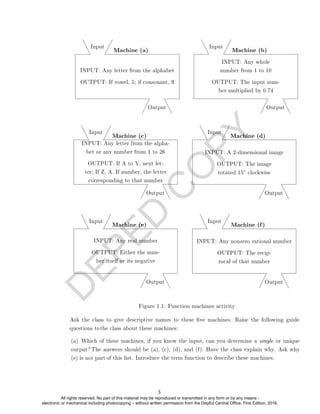
Mention that we will represent mathematical relations as machines with an input and an
output, andthat the output is related to the input by some rule.
Draw the following six `machines' on the board similar to the gures below. Then ask
students which of these machines represent a function. Additional guide questions are
provided below.
2
All rights reserved. No part of this material may be reproduced or transmitted in any form or by any means -
electronic or mechanical including photocopying – without written permission from the DepEd Central Office. First Edition, 2016.
D
E
P
E
D
C
O
P
Y
Input
Machine (a)
Output
INPUT: Any letter from the alphabet
OUTPUT: If vowel, 5; if consonant, 9
Input
Machine (b)
Output
INPUT: Any whole
number from 1 to 10
OUTPUT: The input num-
ber multiplied by 0.74
Input
Machine (c)
Output
INPUT: Any letter from the alpha-
bet or any number from 1 to 26
OUTPUT: If A to Y, next let-
ter; If Z, A. If number, the letter
corresponding to that number
Input
Machine (d)
Output
INPUT: A 2-dimensional image
OUTPUT: The image
rotated 15
◦ clockwise
Input
Machine (e)
Output
INPUT: Any real number
OUTPUT: Either the num-
ber itself or its negative
Input
Machine (f)
Output
INPUT: Any nonzero rational number
OUTPUT: The recip-
rocal of that number
Figure 1.1: Function machines activity
Ask the class to give descriptive names to these ve machines. Raise the following guide
questions tothe class about these machines:
(a) Which of these machines, if you know the input, can you determine a single or unique
output? The answers should be (a), (c), (d), and (f). Have the class explain why. Ask why
(e) is not part of this list. Introduce the term function to describe these machines.
3
All rights reserved. No part of this material may be reproduced or transmitted in any form or by any means -
electronic or mechanical including photocopying – without written permission from the DepEd Central Office. First Edition, 2016.
D
E
P
E
D
C
O
P
Y
Functions and relations as a set of ordered pairs
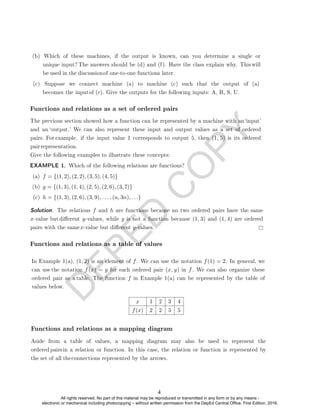
EXAMPLE 1. Which of the following relations are functions?
(a) f = {(1, 2), (2, 2), (3, 5), (4, 5)}
(b) g = {(1, 3), (1, 4), (2, 5), (2, 6), (3, 7)}
(c) h = {(1, 3), (2, 6), (3, 9), . . . , (n, 3n), . . .}
Functions and relations as a table of values
x 1 2 3 4
f(x) 2 2 5 5
Functions and relations as a mapping diagram
(b) Which of these machines, if the output is known, can you determine a single or
unique input? The answers should be (d) and (f). Have the class explain why. This will
be used in the discussionof one-to-one functions later.
(c) Suppose we connect machine (a) to machine (c) such that the output of (a)
becomes the inputof (c). Give the outputs for the following inputs: A, R, S, U.
The previous section showed how a function can be represented by a machine with an`input'
and an `output.' We can also represent these input and output values as a set of ordered
pairs. For example, if the input value 1 corresponds to output 5, then (1, 5) is its ordered
pairrepresentation.
Give the following examples to illustrate these concepts:
Solution. The relations f and h are functions because no two ordered pairs have the same
x-value but dierent y-values, while g is not a function because (1, 3) and (1, 4) are ordered
pairs with the samex-value but dierent y-values.
In Example 1(a), (1, 2) is an element of f. We can use the notation f(1) = 2. In general, we
can use the notation f (x) = y for each ordered pair (x, y) in f . We can also organize these
ordered pair as a table. The function f in Example 1(a) can be represented by the table of
values below.
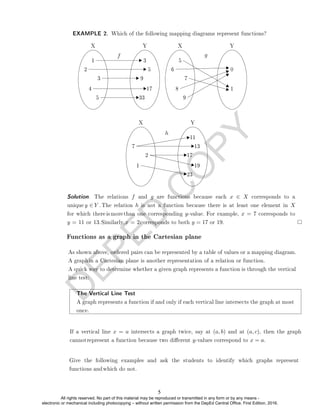
Aside from a table of values, a mapping diagram may also be used to represent the
ordered pairsin a relation or function. In this case, the relation or function is represented by
the set of all theconnections represented by the arrows.
4
All rights reserved. No part of this material may be reproduced or transmitted in any form or by any means -
electronic or mechanical including photocopying – without written permission from the DepEd Central Office. First Edition, 2016.
D
E
P
E
D
C
O
P
Y
X Y
f
1
2
3
4
5
3
5
9
17
33
X Y
g
5
6
7
8
9
0
1
X Y
h
7
2
1
11
13
17
19
23
Functions as a graph in the Cartesian plane
The Vertical Line Test
A graph represents a function if and only if each vertical line intersects the graph at most
once.
Solution. The relations f and g are functions because each x ∈ X corresponds to a
unique y ∈ Y . The relation h is not a function because there is at least one element in X
for which there is more than one corresponding y-value. For example, x = 7 corresponds to
y = 11 or 13.Similarly,x = 2corresponds to both y = 17 or 19.
As shown above, ordered pairs can be represented by a table of values or a mapping diagram.
A graphin a Cartesian plane is another representation of a relation or function.
A quick way to determine whether a given graph represents a function is through the vertical
line test:
If a vertical line x = a intersects a graph twice, say at (a, b) and at (a, c), then the graph
cannotrepresent a function because two dierent y-values correspond to x = a.
Give the following examples and ask the students to identify which graphs represent
functions andwhich do not.
EXAMPLE 2. Which of the following mapping diagrams represent functions?
5
All rights reserved. No part of this material may be reproduced or transmitted in any form or by any means -
electronic or mechanical including photocopying – without written permission from the DepEd Central Office. First Edition, 2016.
D
E
P
E
D
C
O
P
Y
(a)
(b)
(c)
(d)
(e)
Explain that by convention, the x-variable is the input variable and that the value of the
y-variable is computed based on the value of the x-variable. A relation is a function if for each
x-value there corresponds only one y-value.
Teaching Tip
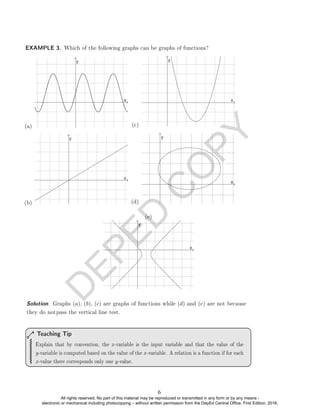
EXAMPLE 3. Which of the following graphs can be graphs of functions?
Solution. Graphs (a), (b), (c) are graphs of functions while (d) and (e) are not because
they do notpass the vertical line test.
6
All rights reserved. No part of this material may be reproduced or transmitted in any form or by any means -
electronic or mechanical including photocopying – without written permission from the DepEd Central Office. First Edition, 2016.
D
E
P
E
D
C
O
P
Y
EXAMPLE 4. Which of the following represents a function?
(a) y = 2x + 1
(b) y = x2 − 2x + 2
(c) x2 + y2 = 1
(d) y =
√
x + 1
(e) y =
2x + 1
x − 1
(f) y = bxc + 1 where bxc is the greatest integer function. (Optional example)
Denition.
The domain of a relation as the set of all possible values that the variable x can take.
EXAMPLE 5. Identify the domain for each relation above using set builder notation.
Solution. The domains for the relations above are as follows:
(a) R
(b) R
(c) [−1, 1]
(d) [−1, +∞)
(e) (−∞, 1) ∪ (1, +∞)
(f) R
(a) f(x) = 2x + 1
(b) q(x) = x2
√
x + 1
Solution. All are relations. All are functions except (c). Equation (c) is not a function
because wecan nd an x-value that corresponds to more than one y-value (ex. if x = 0,
then y can be +1 or−1.)
If a relation is a function, then y can be replaced with f(x) to denote that the value of
y dependson the value of x. Do this for the functions in the examples above, replacing f
with other letters todistinguish the functions from each other:
− 2x + 2
(c.) g(x) =
2x + 1
(d.) r(x) =
x − 1
(e.) F(x) = bxc + 1 where bxc is the greatest integer function.
7
All rights reserved. No part of this material may be reproduced or transmitted in any form or by any means -
electronic or mechanical including photocopying – without written permission from the DepEd Central Office. First Edition, 2016.
D
E
P
E
D
C
O
P
Y
Functions as representations of real-life situations
Denition.
1. A linear function is a function of the form f(x) = ax + b, where a 6= 0.
2. A quadratic function is a function of the form f(x) = ax2 + bx + c, where a 6= 0.
3. A polynomial function of degree n is a function of the form
f(x) = anxn
+ an−1xn−1
+ a1x + a0, where n 6= 0.
Solution. Since each meal costs P40, then the cost function is C(x) = 40x.
Figure 1.2
(B) Lesson Proper
Students learned about linear functions in Grade 8, quadratic functions in Grade 9,
and polynomialfunctions in Grade 10. To recall, the denitions are given below.
Functions can often be used to model real situations. Identifying an appropriate
functional model willlead to a better understanding of various phenomena.
EXAMPLE 6. Give a function C that can represent the cost of buying x meals, if
one meal costsP40.
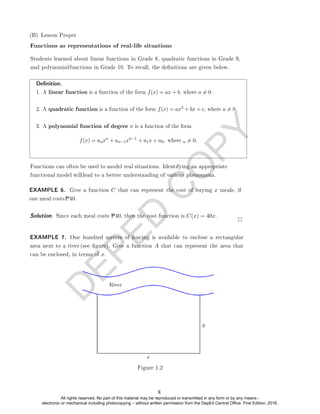
EXAMPLE 7. One hundred meters of fencing is available to enclose a rectangular
area next to a river (see gure). Give a function A that can represent the area that
can be enclosed, in terms of x.
8
All rights reserved. No part of this material may be reproduced or transmitted in any form or by any means -
electronic or mechanical including photocopying – without written permission from the DepEd Central Office. First Edition, 2016.
D
E
P
E
D
C
O
P
Y
A(x) = x(50 − 0.5x) = 50x − 0.5x2
.
Piecewise Functions
t(m) =
(
300 if 0  m ≤ 100
300 + m if m  100
F(d) =
(
8 if 0  d ≤ 4
8 + 1.5bdc if d  4
◦
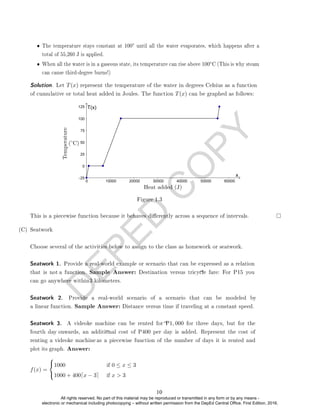
◦ after 940 J of heat is applied.
• The temperature stays constant at 0◦C until all the ice melts, which happens once a total of
6,950 J of heat is applied.
• The temperature increases steadily and reaches 100◦C) after a total of 14,470 J is applied.
Solution. The area of the rectangular enclosure is A = xy. We will write this as a
function of x.
Since only 100 m of fencing is available, then x + 2y = 100 or y = (100 −x)/2 = 50 − 0.5x.
Thus,
Some situations can only be described by more than one formula, depending on the
value of theindependent variable.
Solution. Let t(m) represent the amount paid by the consumer each month. It can be
expressed bythe piecewise function
EXAMPLE 8. A user is charged P300 monthly for a particular mobile plan, which
includes 100 freetext messages. Messages in excess of 100 are charged P1 each. Represent
the amount a consumer payseach month as a function of the number of messages m sent
in a month.
EXAMPLE 9. A jeepney ride costs P8.00 for the rst 4 kilometers, and each
additional integerkilometer adds P1.50 to the fare. Use a piecewise function to represent
the jeepney fare in terms ofthe distance d in kilometers.
Solution. The input value is distance and the output is the cost of the jeepney fare. If F(d)
representsthe fare as a function of distance, the function can be represented as follows:
The symbol bdc denotes the greatest integer or oor function applied to d. The oor
function givesthe largest integer less than or equal to d, e.g. b4.1c = b4.9c = 4.
EXAMPLE 10. Water can exist in three states: solid ice, liquid water, and gaseous water
vapor. It takes a certain amount of heat before water can change state. Use the following
information to sketch the graph of the function representing the temperature of water as a
function of the amount of total heat added in Joules (J). Explain why this is a piecewise
function.
• A solid block of ice is at −25 C and heat is added until it completely turns into water vapor.
• The temperature of the ice increases steadily and reaches 0
9
All rights reserved. No part of this material may be reproduced or transmitted in any form or by any means -
electronic or mechanical including photocopying – without written permission from the DepEd Central Office. First Edition, 2016.
D
E
P
E
D
C
O
P
Y
• The temperature stays constant at 100◦ until all the water evaporates, which happens after a
total of 55,260 J is applied.
• When all the water is in a gaseous state, its temperature can rise above 100◦C (This is why steam
can cause third-degree burns!)
Figure 1.3
This is a piecewise function because it behaves dierently across a sequence of intervals.
(C) Seatwork
Choose several of the activities below to assign to the class as homework or seatwork.
f(x) =



1000 if 0 ≤ x ≤ 3
1000 + 400dx − 3e if x  3
Solution. Let T(x) represent the temperature of the water in degrees Celsius as a function
of cumulative or total heat added in Joules. The function T(x) can be graphed as follows:
Seatwork 1. Provide a real-world example or scenario that can be expressed as a relation
that is not a function. Sample Answer: Destination versus tricycle fare: For P15 you
can go anywhere within3 kilometers.
Seatwork 2. Provide a real-world scenario of a scenario that can be modeled by
a linear function. Sample Answer: Distance versus time if traveling at a constant speed.
Seatwork 3. A videoke machine can be rented for P1, 000 for three days, but for the
fourth day onwards, an additional cost of P400 per day is added. Represent the cost of
renting a videoke machine as a piecewise function of the number of days it is rented and
plot its graph. Answer:
10
All rights reserved. No part of this material may be reproduced or transmitted in any form or by any means -
electronic or mechanical including photocopying – without written permission from the DepEd Central Office. First Edition, 2016.
D
E
P
E
D
C
O
P
Y
swer: f(x) = 700dx
4 e, x ∈ N















150x if 0 ≤ x ≤ 20
130x if 21 ≤ x ≤ 50
110x if 51 ≤ x ≤ 100
100x if x  100
, x ∈ N
Performance Task
LESSON 2: Evaluating Functions
LESSON OUTLINE:
1. Evaluating functions
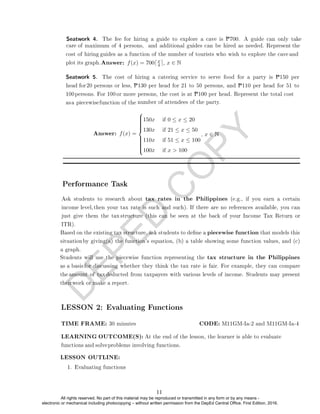
Seatwork 4. The fee for hiring a guide to explore a cave is P700. A guide can only take
care of maximum of 4 persons, and additional guides can be hired as needed. Represent the
cost of hiring guides as a function of the number of tourists who wish to explore the cave and
plot its graph.An
Seatwork 5. The cost of hiring a catering service to serve food for a party is P150 per
head for 20 persons or less, P130 per head for 21 to 50 persons, and P110 per head for 51 to
100persons. For 100 or more persons, the cost is at P100 per head. Represent the total cost
asa piecewisefunction of the number of attendees of the party.
Answer: f(x) =
Ask students to research about tax rates in the Philippines (e.g., if you earn a certain
income level, then your tax rate is such and such). If there are no references available, you can
just give them the tax structure (this can be seen at the back of your Income Tax Return or
ITR).
Based on the existing tax structure, ask students to dene a piecewise function that models this
situation by giving(a) the function's equation, (b) a table showing some function values, and (c)
a graph.
Students will use the piecewise function representing the tax structure in the Philippines
as a basis for discussing whether they think the tax rate is fair. For example, they can compare
the amount of tax deducted from taxpayers with various levels of income. Students may present
theirwork or make a report.
LEARNING OUTCOME(S): At the end of the lesson, the learner is able to evaluate
functions and solveproblems involving functions.
TIME FRAME: 30 minutes CODE: M11GM-Ia-2 and M11GM-Ia-4
11
All rights reserved. No part of this material may be reproduced or transmitted in any form or by any means -
electronic or mechanical including photocopying – without written permission from the DepEd Central Office. First Edition, 2016.
D
E
P
E
D
C
O
P
Y
DEVELOPMENT OF THE LESSON
(A) Lesson Proper
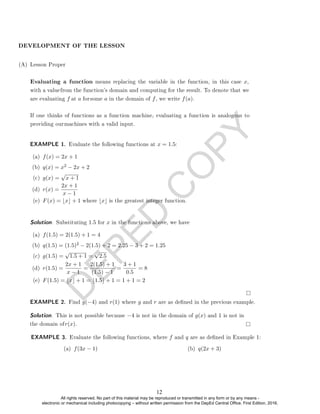
EXAMPLE 1. Evaluate the following functions at x = 1.5:
(a) f(x) = 2x + 1
(b) q(x) = x2 − 2x + 2
(c) g(x) =
√
x + 1
(d) r(x) =
2x + 1
x − 1
(e) F(x) = bxc + 1 where bxc is the greatest integer function.
Solution. Substituting 1.5 for x in the functions above, we have
(a) f(1.5) = 2(1.5) + 1 = 4
(b) q(1.5) = (1.5)2 − 2(1.5) + 2 = 2.25 − 3 + 2 = 1.25
(c) g(1.5) =
√
1.5 + 1 =
√
2.5
(d) r(1.5) =
2x + 1
x − 1
=
2(1.5) + 1
(1.5) − 1
=
3 + 1
0.5
= 8
(e) F(1.5) = bxc + 1 = b1.5c + 1 = 1 + 1 = 2
EXAMPLE 2. Find g(−4) and r(1) where g and r are as dened in the previous example.
Evaluating a function means replacing the variable in the function, in this case x,
with a valuefrom the function's domain and computing for the result. To denote that we
are evaluating f at a forsome a in the domain of f, we write f(a).
If one thinks of functions as a function machine, evaluating a function is analogous to
providing ourmachines with a valid input.
Solution. This is not possible because −4 is not in the domain of g(x) and 1 is not in
the domain ofr(x).
EXAMPLE 3. Evaluate the following functions, where f and q are as dened in Example 1:
(a) f(3x − 1) (b) q(2x + 3)
12
All rights reserved. No part of this material may be reproduced or transmitted in any form or by any means -
electronic or mechanical including photocopying – without written permission from the DepEd Central Office. First Edition, 2016.
D
E
P
E
D
C
O
P
Y
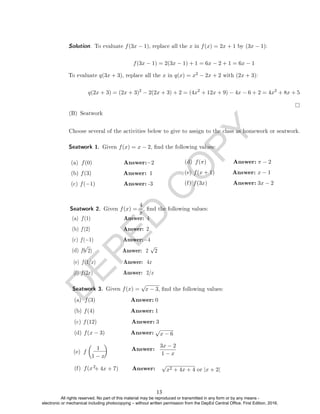
Solution. To evaluate f(3x − 1), replace all the x in f(x) = 2x + 1 by (3x − 1):
f(3x − 1) = 2(3x − 1) + 1 = 6x − 2 + 1 = 6x − 1
To evaluate q(3x + 3), replace all the x in q(x) = x2 − 2x + 2 with (2x + 3):
q(2x + 3) = (2x + 3)2
− 2(2x + 3) + 2 = (4x2
+ 12x + 9) − 4x − 6 + 2 = 4x2
+ 8x + 5
(B) Seatwork
Choose several of the activities below to give to assign to the class as homework or seatwork.
Seatwork 1. Given f(x) = x − 2, nd the following values:
Seatwork 2. Given f(x) =
4
x
, nd the following values:
√
2
Seatwork 3. Given f(x) =
√
√
x − 6
(e) f

1
1 − x
3x − 2
1 − x
(a) f(0) Answer:−2
(b) f(3) Answer: 1
(c) f(−1) Answer: -3
(d) f(π) Answer: π − 2
(e) f(x + 1) Answer: x − 1
(f) f(3x) Answer: 3x − 2
(a) f(1) Answer: 4
(b) f(2) Answer: 2
(c) f(−1) Answer:−4
(d) f(
(e) f(1/x) Answer: 4x
(f) f(2x) Answer: 2/x
(f) f(x2
x2 + 4x + 4 or |x + 2|
√
+ 4x + 7) Answer:
x − 3, nd the following values:
(a) f(3) Answer: 0
(b) f(4) Answer: 1
(c) f(12) Answer: 3
(d) f(x − 3) Answer:
√
2) Answer: 2

Answer:
13
All rights reserved. No part of this material may be reproduced or transmitted in any form or by any means -
electronic or mechanical including photocopying – without written permission from the DepEd Central Office. First Edition, 2016.
D
E
P
E
D
C
O
P
Y
LESSON 3: Operations on Functions
LESSON OUTLINE:
1. Review: Addition and subtraction of algebraic expressions
2. Review: Multiplication and division of algebraic expressions
3. Addition, subtraction, multiplication, and division of functions
4. Composition of functions
DEVELOPMENT OF THE LESSON
(A) Introduction, motivation.
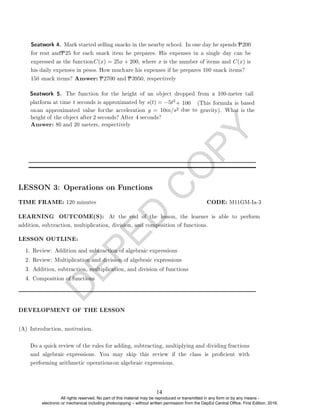
Seatwork 4. Mark started selling snacks in the nearby school. In one day he spends P200
for rent andP25 for each snack item he prepares. His expenses in a single day can be
expressed as the functionC(x) = 25x + 200, where x is the number of items and C(x) is
his daily expenses in pesos. How muchare his expenses if he prepares 100 snack items?
150 snack items? Answer: P2700 and P3950, respectively
Seatwork 5. The function for the height of an object dropped from a 100-meter tall
platform at time t seconds is approximated by s(t) = −5t + 100 (This formula is based
onan approximated value forthe acceleration g = 10m/s due to gravity). What is the
height of the object after 2 seconds? After 4 seconds?
Answer: 80 and 20 meters, respectively
2
2
LEARNING OUTCOME(S): At the end of the lesson, the learner is able to perform
addition, subtraction, multiplication, division, and composition of functions.
TIME FRAME: 120 minutes CODE: M11GM-Ia-3
Do a quick review of the rules for adding, subtracting, multiplying and dividing fractions
and algebraic expressions. You may skip this review if the class is procient with
performing arithmetic operationson algebraic expressions.
14
All rights reserved. No part of this material may be reproduced or transmitted in any form or by any means -
electronic or mechanical including photocopying – without written permission from the DepEd Central Office. First Edition, 2016.
D
E
P
E
D
C
O
P
Y
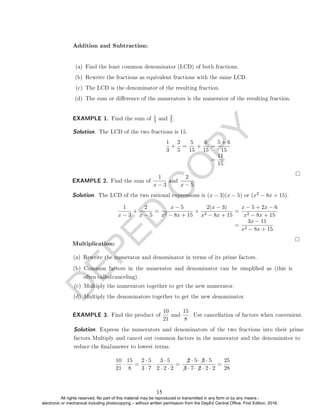
Addition and Subtraction:
(a) Find the least common denominator (LCD) of both fractions.
(b) Rewrite the fractions as equivalent fractions with the same LCD.
(c) The LCD is the denominator of the resulting fraction.
(d) The sum or dierence of the numerators is the numerator of the resulting fraction.
EXAMPLE 1. Find the sum of
1
3 and
2
5 .
Solution. The LCD of the two fractions is 15.
1
3
+
2
5
=
5
15
+
6
15
=
5 + 6
15
=
11
15
EXAMPLE 2. Find the sum of
1
x − 3
and
2
x − 5
.
Solution. The LCD of the two rational expressions is (x − 3)(x − 5) or (x2 − 8x + 15).
1
x − 3
+
2
x − 5
=
x − 5
x2 − 8x + 15
+
2(x − 3)
x2 − 8x + 15
=
x − 5 + 2x − 6
x2 − 8x + 15
=
3x − 11
x2 − 8x + 15
Multiplication:
(a) Rewrite the numerator and denominator in terms of its prime factors.
(c) Multiply the numerators together to get the new numerator.
(d) Multiply the denominators together to get the new denominator.
EXAMPLE 3. Find the product of
10
21
and
15
8
. Use cancellation of factors when convenient.
(b) Common factors in the numerator and denominator can be simplied as (this is
often calledcanceling).
Solution. Express the numerators and denominators of the two fractions into their prime
factors.Multiply and cancel out common factors in the numerator and the denominator to
reduce the nalanswer to lowest terms.
10
21
·
15
8
=
2 · 5
3 · 7
·
3 · 5
2 · 2 · 2
=
6 2 · 5· 6 3 · 5
6 3 · 7· 6 2 · 2 · 2
=
25
28
15
All rights reserved. No part of this material may be reproduced or transmitted in any form or by any means -
electronic or mechanical including photocopying – without written permission from the DepEd Central Office. First Edition, 2016.
D
E
P
E
D
C
O
P
Y
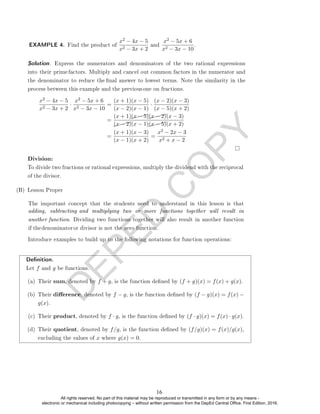
EXAMPLE 4. Find the product of
x2 − 4x − 5
x2 − 3x + 2
and
x2 − 5x + 6
x2 − 3x − 10
.
x2 − 4x − 5
x2 − 3x + 2
·
x2 − 5x + 6
x2 − 3x − 10
=
(x + 1)(x − 5)
(x − 2)(x − 1)
·
(x − 2)(x − 3)
(x − 5)(x + 2)
=
(x + 1)

(x − 5)

(x − 2)(x − 3)


(x − 2)(x − 1)

(x − 5)(x + 2)
=
(x + 1)(x − 3)
(x − 1)(x + 2)
=
x2 − 2x − 3
x2 + x − 2
(B) Lesson Proper
Introduce examples to build up to the following notations for function operations:
Denition.
Let f and g be functions.
(a) Their sum, denoted by f + g, is the function dened by (f + g)(x) = f(x) + g(x).
(b) Their dierence, denoted by f − g, is the function dened by (f − g)(x) = f(x) −
g(x).
(c) Their product, denoted by f · g, is the function dened by (f · g)(x) = f(x) · g(x).
(d) Their quotient, denoted by f/g, is the function dened by (f/g)(x) = f(x)/g(x),
excluding the values of x where g(x) = 0.
Solution. Express the numerators and denominators of the two rational expressions
into their prime factors. Multiply and cancel out common factors in the numerator and
the denominator to reduce the nal answer to lowest terms. Note the similarity in the
process between this example and the previousone on fractions.
Division:
To divide two fractions or rational expressions, multiply the dividend with the reciprocal
of the divisor.
The important concept that the students need to understand in this lesson is that
adding, subtracting and multiplying two or more functions together will result in
another function. Dividing two functions together will also result in another function
if thedenominatoror divisor is not the zero function.
16
All rights reserved. No part of this material may be reproduced or transmitted in any form or by any means -
electronic or mechanical including photocopying – without written permission from the DepEd Central Office. First Edition, 2016.
D
E
P
E
D
C
O
P
Y
• f(x) = x + 3
• p(x) = 2x − 7
• v(x) = x2 + 5x + 4
• g(x) = x2 + 2x − 8
• h(x) =
x + 7
2 − x
• t(x) =
x − 2
x + 3
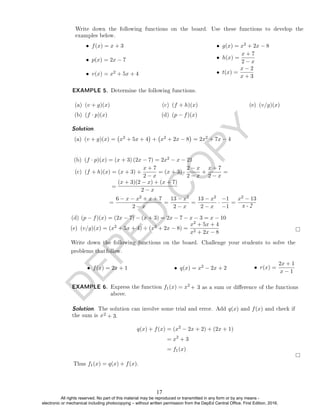
EXAMPLE 5. Determine the following functions.
(a) (v + g)(x)
(b) (f · p)(x)
(c) (f + h)(x)
(d) (p − f)(x)
(e) (v/g)(x)
Solution.
(a) (v + g)(x) = x2 + 5x + 4

+ x2 + 2x − 8

= 2x2 + 7x − 4
(b) (f · p)(x) = (x + 3) (2x − 7) = 2x2 − x − 21
(c) (f + h)(x) = (x + 3) +
x + 7
2 − x
= (x + 3) ·
2 − x
2 − x
+
x + 7
2 − x
=
(x + 3)(2 − x) + (x + 7)
2 − x
=
=
6 − x − x2 + x + 7
2 − x
=
13 − x2
2 − x
=
13 − x2
2 − x
·
−1
−1
=
x2 − 13
(e) (v/g)(x) = (x2 + 5x + 4) ÷ (x2 + 2x − 8) =
x2 + 5x + 4
x2 + 2x − 8
• f(x) = 2x + 1 • q(x) = x2 − 2x + 2 • r(x) =
2x + 1
x − 1
EXAMPLE 6. Express the function f1(x) = x2
2 + 3.
q(x) + f(x) = (x2
− 2x + 2) + (2x + 1)
= x2
+ 3
= f1(x)
Thus f1(x) = q(x) + f(x).
Write down the following functions on the board. Use these functions to develop the
examples below.
Solution. The solution can involve some trial and error. Add q(x) and f(x) and check if
the sum is x
+ 3 as a sum or dierence of the functions
above.
Write down the following functions on the board. Challenge your students to solve the
problems thatfollow.
(d) (p − f)(x) = (2x − 7) − (x + 3) = 2x − 7 − x − 3 = x − 10
x - 2
17
All rights reserved. No part of this material may be reproduced or transmitted in any form or by any means -
electronic or mechanical including photocopying – without written permission from the DepEd Central Office. First Edition, 2016.
D
E
P
E
D
C
O
P
Y
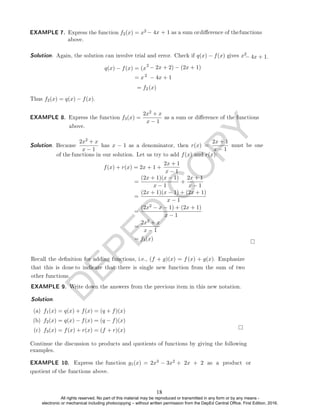
Solution. Again, the solution can involve trial and error. Check if q(x) − f(x) gives x2
− 4x + 1.
q(x) − f(x) = (x
2
− 2x + 2) − (2x + 1)
= x2
2 (x)
Thus f2(x) = q(x) − f(x).
EXAMPLE 8. Express the function f3(x) =
2x2 + x
Solution. Because
2x2 + x
x − 1
has x − 1 as a denominator, then r(x) =
2x + 1
2x + 1
x − 1
=
(2x + 1)(x − 1)
x − 1
+
2x + 1
x − 1
=
(2x + 1)(x − 1) + (2x + 1)
x − 1
=
(2x2 − x − 1) + (2x + 1)
x − 1
=
2x2 + x
x − 1
= f3(x)
EXAMPLE 9. Write down the answers from the previous item in this new notation.
Solution. .
(a) f1(x) = q(x) + f(x) = (q + f)(x)
(b) f2(x) = q(x) − f(x) = (q − f)(x)
(c) f3(x) = f(x) + r(x) = (f + r)(x)
EXAMPLE 10. Express the function g1(x) = 2x3 − 3x2
EXAMPLE 7. Express the function f2(x) = x2
− 4x + 1
= f
− 4x + 1 as a sum ordierence of thefunctions
above.
must be one
x − 1
of the
f(x) + r(x) = 2x + 1 +
functions in our solution. Let us try to add f(x) and r(x):
Recall the denition for adding functions, i.e., (f + g)(x) = f (x) + g(x). Emphasize
that this is done to indicate that there is single new function from the sum of two
other functions.
Continue the discussion to products and quotients of functions by giving the following
examples.
as a sum or dierence of the functions
x − 1
above.
+ 2x + 2 as a product or
quotient of the functions above.
18
All rights reserved. No part of this material may be reproduced or transmitted in any form or by any means -
electronic or mechanical including photocopying – without written permission from the DepEd Central Office. First Edition, 2016.
D
E
P
E
D
C
O
P
Y
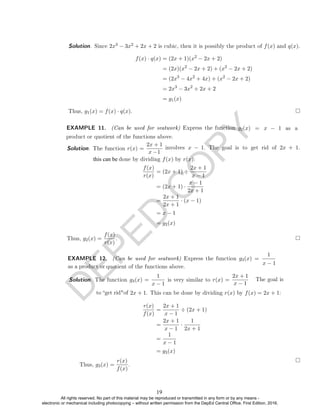
Solution. Since 2x3 − 3x2 + 2x + 2 is cubic, then it is possibly the product of f(x) and q(x).
f(x) · q(x) = (2x + 1)(x2
− 2x + 2)
= (2x)(x2
− 2x + 2) + (x2
− 2x + 2)
= (2x3
− 4x2
+ 4x) + (x2
− 2x + 2)
= 2x3
− 3x2
+ 2x + 2
= g1(x)
Thus, g1(x) = f(x) · q(x).
EXAMPLE 11. (Can be used for seatwork) Express the function g2
Solution. The function r(x) =
2x + 1
f(x)
r(x)
= (2x + 1) ÷
2x + 1
x − 1
= (2x + 1) ·
x − 1
2x + 1
=
2x + 1
2x + 1
· (x − 1)
= x − 1
= g2(x)
Thus, g2(x) =
f(x)
r(x)
.
EXAMPLE 12. (Can be used for seatwork) Express the function g3(x) =
1
quotient of the functions above.
Solution. The function g3(x) =
1
x − 1
is very similar to r(x) =
2x + 1
2x + 1. This can be done by dividing r(x) by f(x) = 2x + 1:
r(x)
f(x)
=
2x + 1
x − 1
÷ (2x + 1)
=
2x + 1
x − 1
·
1
2x + 1
=
1
x − 1
= g3(x)
Thus, g3(x) =
r(x)
f(x)
.
(x) = x − 1 as a
product or quotient of the functions above.
involves x − 1. The goal is to get rid of 2x + 1.
x −1
this can be done by dividing f(x) by r(x):
x − 1
as a product or
. The goal is
x − 1
to get ridof
19
All rights reserved. No part of this material may be reproduced or transmitted in any form or by any means -
electronic or mechanical including photocopying – without written permission from the DepEd Central Office. First Edition, 2016.
D
E
P
E
D
C
O
P
Y
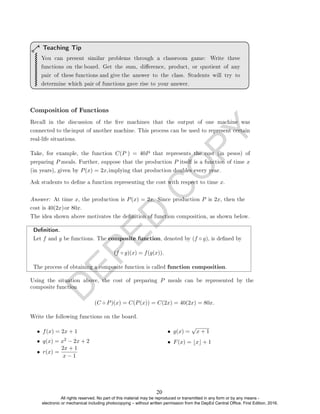
Teaching Tip
Composition of Functions
Ask students to dene a function representing the cost with respect to time x.
Denition.
Let f and g be functions. The composite function, denoted by (f ◦ g), is dened by
(f ◦ g)(x) = f(g(x)).
The process of obtaining a composite function is called function composition.
(C ◦ P)(x) = C(P(x)) = C(2x) = 40(2x) = 80x.
Write the following functions on the board.
• f(x) = 2x + 1
• q(x) = x2 − 2x + 2
• r(x) =
2x + 1
x − 1
• g(x) =
√
x + 1
• F(x) = bxc + 1
You can present similar problems through a classroom game: Write three
functions on the board. Get the sum, dierence, product, or quotient of any
pair of these functions and give the answer to the class. Students will try to
determine which pair of functions gave rise to your answer.
Recall in the discussion of the ve machines that the output of one machine was
connected to theinput of another machine. This process can be used to represent certain
real-life situations.
Take, for example, the function C(P ) = 40P that represents the cost (in pesos) of
preparing P meals. Further, suppose that the production P itself is a function of time x
(in years), given by P(x) = 2x,implying that production doubles every year.
Answer: At time x, the production is P(x) = 2x. Since production P is 2x, then the
cost is 40(2x)or 80x.
The idea shown above motivates the denition of function composition, as shown below.
Using the situation above, the cost of preparing P meals can be represented by the
composite function
20
All rights reserved. No part of this material may be reproduced or transmitted in any form or by any means -
electronic or mechanical including photocopying – without written permission from the DepEd Central Office. First Edition, 2016.
D
E
P
E
D
C
O
P
Y
Solution.
(g ◦ f)(x) = g(f(x))
=
p
f(x) + 1
=
p
(2x + 1) + 1
=
√
2x + 2
EXAMPLE 14. Find and simplify (q ◦ f)(x). Is it the same with (f ◦ q)(x)?
Solution. .
(q ◦ f)(x) = q(f(x))
= [f(x)]2
− 2 [f(x)] + 2
= (2x + 1)2
− 2(2x + 1) + 2
= (4x2
+ 4x + 1) − (4x + 2) + 2
= 4x2
+ 1
(f ◦ q)(x) = f(q(x))
= 2(x2
− 2x + 2) + 1
= 2x2
− 4x + 5
EXAMPLE 15. Find and simplify (f ◦ r)(x).
Solution.
(f ◦ r)(x) = f(r(x)) = 2r(x) + 1
= 2

2x + 1
x − 1

+ 1 =
4x + 2
x − 1
+ 1 =
(4x + 2) + (x − 1)
x − 1
=
5x + 1
x − 1
EXAMPLE 16. Find and simplify (F ◦ r)(5).
Solution.
(F ◦ r)(5) = F(r(5)) = br(5)c + 1 =

2(5) + 1
5 − 1

+ 1 =

11
4

+ 1 = 2 + 1 = 3
EXAMPLE 13. Find and simplify (g ◦ f)(x).
The functions (q ◦ f)(x) and (f ◦ q)(x) are not the same. This is also illustrated in
the mappingdiagrams below.
21
All rights reserved. No part of this material may be reproduced or transmitted in any form or by any means -
electronic or mechanical including photocopying – without written permission from the DepEd Central Office. First Edition, 2016.
D
E
P
E
D
C
O
P
Y
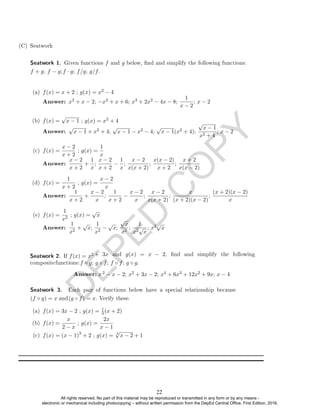
(C) Seatwork
(a) f(x) = x + 2 ; g(x) = x2 − 4
Answer: x2 + x − 2; −x2 + x + 6; x3 + 2x2 − 4x − 8;
1
x − 2
; x − 2
(b) f(x) =
√
x − 1 ; g(x) = x2 + 4
Answer:
√
x − 1 + x2 + 4;
√
x − 1 − x2 − 4;
√
x − 1(x2 + 4);
√
x − 1
x2 + 4
; x − 2
(c) f(x) =
x − 2
x + 2
; g(x) =
1
x
Answer:
x − 2
x + 2
+
1
x
;
x − 2
x + 2
−
1
x
;
x − 2
x(x + 2)
;
x(x − 2)
x + 2
;
x + 2
x(x − 2)
(d) f(x) =
1
x + 2
; g(x) =
x − 2
x
Answer:
1
x + 2
+
x − 2
x
;
1
x + 2
−
x − 2
x
;
x − 2
x(x + 2)
;
x
(x + 2)(x − 2)
;
(x + 2)(x − 2)
x
(e) f(x) =
1
x2
; g(x) =
√
x
Answer:
1
x2
+
√
x;
1
x2
−
√
x;
√
x
x2
;
1
x2
√
x
; x2√
x
Seatwork 2. If f(x) = x2
2 − x − 2; x2 + 3x − 2; x4 + 6x3 + 12x2 + 9x; x − 4
(a) f(x) = 3x − 2 ; g(x) = 1
3 (x + 2)
(b) f(x) =
x
2 − x
; g(x) =
2x
x − 1
(c) f(x) = (x − 1)3
+ 2 ; g(x) = 3
√
x − 2 + 1
Seatwork 1. Given functions f and g below, nd and simplify the following functions:
f + g; f − g;f · g; f/g; g/f.
Seatwork 3. Each pair of functions below have a special relationship because
(f ◦ g) = x and(g ◦ f) = x. Verify these.
Answer: x
+ 3x and g(x) = x − 2, nd and simplify the following
compositefunctions:f ◦ g; g ◦ f; f ◦ f; g ◦ g.
22
All rights reserved. No part of this material may be reproduced or transmitted in any form or by any means -
electronic or mechanical including photocopying – without written permission from the DepEd Central Office. First Edition, 2016.
D
E
P
E
D
C
O
P
Y
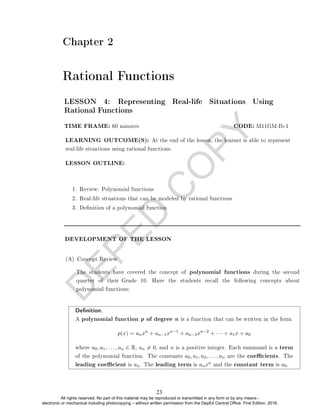
Chapter 2
Rational Functions
LESSON OUTLINE:
1. Review: Polynomial functions
2. Real-life situations that can be modeled by rational functions
3. Denition of a polynomial function
DEVELOPMENT OF THE LESSON
(A) Concept Review
LESSON 4: Representing Real-life Situations Using
Rational Functions
TIME FRAME: 60 minutes CODE: M11GM-Ib-1
LEARNING OUTCOME(S): At the end of the lesson, the learner is able to represent
real-life situations using rational functions.
The students have covered the concept of polynomial functions during the second
quarter of their Grade 10. Have the students recall the following concepts about
polynomial functions:
Denition.
A polynomial function p of degree n is a function that can be written in the form
p(x) = anxn
+ an−1xn−1
+ an−2xn−2
+ · · · + a1x + a0
where a0, a1, . . . , an ∈ R, an 6= 0, and n is a positive integer. Each summand is a term
of the polynomial function. The constants a0, a1, a2, . . . , an are the coecients. The
leading coecient is an. The leading term is anxn and the constant term is a0.
23
All rights reserved. No part of this material may be reproduced or transmitted in any form or by any means -
electronic or mechanical including photocopying – without written permission from the DepEd Central Office. First Edition, 2016.
D
E
P
E
D
C
O
P
Y
(B) Introduction
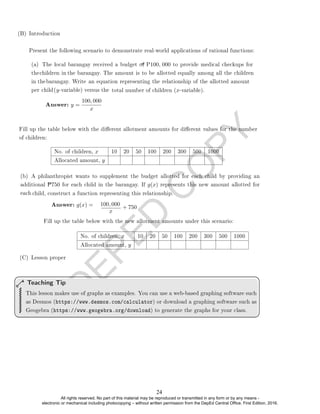
Present the following scenario to demonstrate real-world applications of rational functions:
x
Fill up the table below with the dierent allotment amounts for dierent values for the number
of children:
No. of children, x 10 20 50 100 200 300 500 1000
Allocated amount, y
x
+ 750
Fill up the table below with the new allotment amounts under this scenario:
No. of children, x 10 20 50 100 200 300 500 1000
Allocated amount, y
(C) Lesson proper
This lesson makes use of graphs as examples. You can use a web-based graphing software such
as Desmos (https://www.desmos.com/calculator) or download a graphing software such as
Geogebra (https://www.geogebra.org/download) to generate the graphs for your class.
Teaching Tip
(a) The local barangay received a budget of P100, 000 to provide medical checkups for
thechildren in the barangay. The amount is to be allotted equally among all the children
in thebarangay. Write an equation representing the relationship of the allotted amount
per child(y-variable) versus the total number of children (x-variable).
100, 000
Answer: y =
Answer: g(x) = 100, 000
(b) A philanthropist wants to supplement the budget allotted for each child by providing an
additional P750 for each child in the barangay. If g(x) represents this new amount allotted for
each child, construct a function representing this relationship.
24
All rights reserved. No part of this material may be reproduced or transmitted in any form or by any means -
electronic or mechanical including photocopying – without written permission from the DepEd Central Office. First Edition, 2016.
D
E
P
E
D
C
O
P
Y
Denition.
A rational function is a function of the form f(x) =
p(x)
q(x)
where p(x) and q(x) are
polynomial functions, and q(x) is not the zero function (i.e., q(x) 6≡ 0). The domain of
f(x) is all values of x where q(x) 6= 0.
Solution. The following table of values show v for various values of t.
t (seconds) 1 2 4 5 10
v (meters per second) 10 5 2.5 2 1
The function v(t) =
10
t
can represent v as a function of t.
EXAMPLE 2. Suppose that c(t) =
5t
t2
Solution.
t 0 1 2 5 10
c(t) 0 2.5 2 0.962 0.495
Figure 2.1
Present the following scenarios to the class. These are real-world relationships that can be
modeledby rational functions. Indicate that unlike polynomial functions, rational functions may
contain avariable in the denominator.
EXAMPLE 1. An object is to travel a distance of 10 meters. Express velocity v as a function
v(t) oftravel time t, in seconds.
(in mg/mL) represents the concentration of a drug
values for c(t)for t = 1, 2, 5, 10. Round o answers to three decimal places. Use the table to
sketch a graph andinterpret the results.
in a
+ 1
patient's bloodstream t hours after the drug was administered. Construct a table of
25
All rights reserved. No part of this material may be reproduced or transmitted in any form or by any means -
electronic or mechanical including photocopying – without written permission from the DepEd Central Office. First Edition, 2016.
D
E
P
E
D
C
O
P
Y
(D) Experiment (could be done outside class)
Each group should bring or be provided with the following materials:
• Flat mirror
• Measuring tape or meterstick
• A thick book
Instructions.
(c) Take the following measurements in centimeters and note down the values:
• a = the height of the ashlight from the oor
• b = the distance between the center of mirror and the wall
• c = the distance between the oor and the mirror (or the thickness of the book).
• x = the distance from the wall to the ashlight
• y = the height of the reection on the wall
The graph indicates that the maximum drug concentration occurs around 1 hour after
the drug was administered (calculus can be used to determine the exact value at which
the maximum occurs). After 1 hour, the graph suggests that drug concentration
decreases until it is almost zero.
Ask the class what these examples have in common, and the class should observe that
in all cases,there is a variable in the denominator.
This experiment is adapted from the Light it up activity from the National Council of
Teachers of Mathematics (NCTM) Illuminations project.
http://illuminations.nctm.org/Lesson.aspx?id=1968
Have the class perform this experiment involving light reecting o a small mirror into
a wall. Theclass can be divided into groups of 3 or 4 students with their own materials.
• Flashlight with narrow beam or laser pointer. (LED ashlights may not be
suitable for this activity)
(d) The student holding the ashlight goes to various distances away from the mirror,
while making sure that the ashlight is held at the same height throughout the
experiment. At each location, the student measures the following distances, in
centimeters.
(b) Stand on the side of the mirror opposite the wall. Aim the ashlight toward the
center of themirror so that the light reects o the mirror and onto the wall.
(a) Place the thick book a short distance from the wall and place the mirror on top of
the book.
26
All rights reserved. No part of this material may be reproduced or transmitted in any form or by any means -
electronic or mechanical including photocopying – without written permission from the DepEd Central Office. First Edition, 2016.
D
E
P
E
D
C
O
P
Y
Figure 2.2
Distance from
ashlight to
wall (x)
Distance from
reection to
oor (y)
(f) On a Cartesian plane or graphing paper, plot a graph of your data.
(g) Plot the graph of the equation y =
a
x − b
+ c on the same grid as your data. You can use a
graphing tool like Geogebra or Desmos (see links above). Are your experiment results consistent
with the results predicted by the graph?
(h) Using the equation above, determine the distance from the oor of the reection if the person
holding the ashlight is:
i. 3 meters from the wall
ii. 4 meters from the wall
Note that each group may have dierent results due to height dierences between students.
(e) Collect at least 10 data points and enter them into the table below:
27
All rights reserved. No part of this material may be reproduced or transmitted in any form or by any means -
electronic or mechanical including photocopying – without written permission from the DepEd Central Office. First Edition, 2016.
D
E
P
E
D
C
O
P
Y
2 + 800
x
b(t) =
50t
t + 1
0 ≤ t ≤ 20
where t is in hours and b(t) is in millions.
LESSON 5: Rational Functions, Equations and Inequalities
LESSON OUTLINE:
1. Review: Rational expressions
2. Denition and examples of rational functions, rational equations, and rational inequalities
DEVELOPMENT OF THE LESSON
(A) Review of Rational Expressions
Denition.
A rational expression is an expression that can be written as a ratio of two polynomials.
Evaluate the function at t = 1, 2, 5, 10, 15, 20. Interpret the obtained values.
Answer: 25; 33.33,41.67; 45.45; 46.88; 47.62; The population increases but does not
exceed 48 million.
Seatwork 2. Suppose the amount of bacteria growing in a petri dish is represented by the
function
A rational expression can be described as a function where either the numerator,
denominator, or both have a variable on it.
Provide these examples of algebraic expressions and have the class identify if they are
rational or not. Have them explain their reasoning.
LEARNING OUTCOME(S): At the end of the lesson, the learner is able to distinguish
rational functions, rational equations and rational inequalities
TIME FRAME: 30 minutes CODE: M11GM-Ib-2
Find the perimeter of the fence if one side has length 10 meters, 50 meters.
Answer: 100 m, 116 m
2x
material required. Answer: P(x) =
(E) Seatwork
Seatwork 1. A fence is to enclose a rectangular vegetable farm with an area of 400 square
meters. If x is the length of one side of this fence, nd a function P (x) representing the
perimeter of the fencing
28
All rights reserved. No part of this material may be reproduced or transmitted in any form or by any means -
electronic or mechanical including photocopying – without written permission from the DepEd Central Office. First Edition, 2016.
D
E
P
E
D
C
O
P
Y
x2 + 3x + 2
x + 4
Rational expression because it is a ratio of two polynomials.
1
3x2
Rational expression because the numerator 1 is a polynomial
(of degree 0).
x2 + 4x − 3
2
Rational expression which is also a polynomial.
√
x + 1
x3 − 1
Not a rational expression since the numerator is not a polyno-
mial.
1
x + 2
x − 2
The expression is equal to
1
(x + 2)(x − 2)
so it is a rational
expression.
(B) Lesson Proper
Rational Equa-
tion
Rational Inequal-
ity
Rational Function
Denition An equation in-
volving rational
expressions
An inequality
involving rational
expressions
A function of the form
of f(x) =
p(x)
q(x)
where
p(x) and q(x) are poly-
nomials, and q(x) is not
the zero function
Example
2
x
−
3
2x
=
1
5
5
x − 3
≤
2
x
f(x) =
x2 + 2x + 3
x + 1
or
y =
x2 + 2x + 3
x + 1
Use the table below to show how to distinguish among rational equations, rational
inequalities andrational functions:
A rational equation or inequality can be solved for all x values that satisfy the equation or
inequality.Whereas we solve an equation or inequality, we do not solve functions. Rather,
a function (and inparticular, a rational function) expresses a relationship between two
variables (such as x and y), andcan be represented by a table of values or a graph.
29
All rights reserved. No part of this material may be reproduced or transmitted in any form or by any means -
electronic or mechanical including photocopying – without written permission from the DepEd Central Office. First Edition, 2016.
D
E
P
E
D
C
O
P
Y
Seatwork 1. Determine which of the following are rational expressions.
(a)
15
√
x − 1
(b) 5x4 − 6x7 + 1
(c)
5 − x3
x
Answer: Only (b) and (c) are rational functions.
(a) y = 5x3
8
x
− 8 =
x
2x − 1
Answer: rational equation
(c)
√
x − 2 = 4 Answer: none of these
(d)
x − 1
x + 1
= x3
Answer: rational equation
(e) y =
7x3 − 4
√
x + 1
x2 + 3
Answer: none of these
(f) 6x −
5
x + 3
≥ 0 Answer: rational inequality
LESSON 6: Solving Rational Equations and Inequalities
LESSON OUTLINE:
1. Solving rational equations
2. Interval and set notation
3. Solving rational inequalities
4. Solving word problems involving rational equations or inequalities.
(C) Seatwork
Seatwork 2. Determine whether the given is a rational function, a rational equation,
a rationalinequality, or none of these.
− 2x + 1 Answer: rational function
(b)
LEARNING OUTCOME(S): At the end of the lesson, the learner is able to solve rational
equationsand inequalities, and solve problems involving rational equations and inequalities.
TIME FRAME: 90 minutes CODE: M11GM-Ib-3
30
All rights reserved. No part of this material may be reproduced or transmitted in any form or by any means -
electronic or mechanical including photocopying – without written permission from the DepEd Central Office. First Edition, 2016.
D
E
P
E
D
C
O
P
Y
(A) Motivation
Give some rational equations such as
x + 1
2x
= 10 and ask students some strategies they could try for
solving it.
Next, turn the equation to an inequality, e.g.,
x + 1
2x
≤ 10. Challenge the class to provide as many
solutions and non-solutions as they can.
Inform the class that this lesson provides systematic techniques to solve rational equations and in-
equalities.
Procedure for Solving Rational Equations
To solve rational equations:
(b) Note that eliminating denominators may introduce extraneous solutions. Check the solutions of
the transformed equations with the original equation.
EXAMPLE 1. Solve for x:
2
x
−
3
2x
=
1
5
.
Solution. .
The LCD of all denominators is 10x. Multiply
both sides of the equation by 10x and solve the
resulting equation.
10x

2
x

− 10x

3
2x

= 10x

1
5

20 − 15 = 2x
5 = 2x
x =
5
2
Since the solution to the equation is
5
2 , then sub-
stituting x = 5
2 in the original equation must
make this equation true:
2
5/2
−
3
2(5/2)
?
=
1
5
4
5
−
3
5
?
=
1
5
1
5
√
=
1
5
EXAMPLE 2. Solve for x:
x
x + 2
−
1
x − 2 =
8
x2 − 4
.
Solution. Factor each denominator in the fraction.
x
x + 2
−
1
x − 2
=
8
(x − 2)(x + 2)
DEVELOPMENT OF THE LESSON
(B) Lesson Proper
To solve an equation or inequality in one variable such as x means to nd all values of x
for whichthe equation or inequality is true.
(a) Eliminate denominators by multiplying each term of the equation by the least common
denominator.
31
All rights reserved. No part of this material may be reproduced or transmitted in any form or by any means -
electronic or mechanical including photocopying – without written permission from the DepEd Central Office. First Edition, 2016.
D
E
P
E
D
C
O
P
Y
(x − 2)(x + 2) ·
x
x + 2
− (x − 2)(x + 2) ·
1
x − 2
= [(x − 2)(x + 2)]

8
(x − 2)(x + 2)

(x − 2)x − (x + 2) = 8
x2
− 3x − 10 = 0
Upon reaching this step, we can use strategies for solving polynomial equations.
x2
− 3x − 10 = 0
(x + 2)(x − 5) = 0
x + 2 = 0 or x − 5 = 0
x = −2 or x = 5
12 + x
25 + x
= 0.6
The LCD is (x−2)(x+2). Multiply the LCD to both sides of the equation to remove
the denominators.
Check for extraneous solutions by substituting the answers back into the original
equation. Sincex = 2 will make the original equation undened, it is an extraneous
solution. Since x = 5 satises theoriginal equation, it is the only solution.
Let us apply the concepts we learned in solving rational equations to solving word
problems. Rational equations can be applied to problems with variables in the
denominator. Discuss the following exam-ples in class.
EXAMPLE 3. In an inter-barangay basketball league, the team from Barangay
Culiat has won 12 out of 25 games, a winning percentage of 48%. How many games
should they win in a row to improvetheir win percentage to 60%?
Since 25 + x is the only denominator, we multiply it to both sides of the equation.
We then solve theresulting equation:
Solution. Let x represent the number of games that they need to win to raise their
percentage to 60%. The team has already won 12 out of their 25 games. If they win x
games in a row to increase their percentage to 60%, then they would have played 12 + x
games out of 25 + x games. The equation is
The equation is a rational equation. Solve the equation using the techniques
previously discussed:
32
All rights reserved. No part of this material may be reproduced or transmitted in any form or by any means -
electronic or mechanical including photocopying – without written permission from the DepEd Central Office. First Edition, 2016.
D
E
P
E
D
C
O
P
Y
12 + x
25 + x
= 0.6
12 + x = 0.6(25 + x)
12 + x = 0.6(25) + 0.6x
x − 0.6x = 15 − 12
0.4x = 3
x = 7.5
Since x represents the number of games, this number should be an integer. Therefore Barangay Culiat
needs to win 8 games in a row to raise their winning percentage to 60%.
EXAMPLE 4. Jens walks 5 kilometers from his house to Quiapo to buy a new bike which he uses to
return home. He averaged 10 kilometers faster on his bike than on on foot. If his total trip took 1
hour and 20 minutes, what is his walking speed in kph? Use the formula v = d
t .
Solution. Using the formula v = d
t , we have the formula for time t = d
v .
Let v be Jens' walking speed. Then v + 10 is his speed on his new bike. Jens' walking time is
5
v and
his biking time is
5
v+10.
Rewriting the time 1 hour and 20 minutes as the fraction
4
3 hours, the equation becomes:
5
v
+
5
v + 10
=
4
3
The LCD is 3v(v + 10). Multiply both sides by the LCD the remove the denominators and solve the
resulting equation:
5
v
+
5
v + 10
=
4
3
3v(v + 10) ·
5
v
+ 3v(v + 10) ·
5
v + 10
= 3v(v + 10) ·
4
3
15(v + 10) + 15v = 4v(v + 10)
30v + 150 = 4v2
+ 40v
4v2
+ 10v − 150 = 0
2v2
+ 5v − 75 = 0
(2v + 15)(v − 5) = 0
v = −
15
2
or v = 5
Since v is the walking speed, it cannot be negative. We conclude that Jens' walking speed is 5 kph.
33
All rights reserved. No part of this material may be reproduced or transmitted in any form or by any means -
electronic or mechanical including photocopying – without written permission from the DepEd Central Office. First Edition, 2016.
D
E
P
E
D
C
O
P
Y
Interval and Set Notation
Interval Set Notation Graph
(a, b) {x|a  x  b} a b
[a, b] {x|a ≤ x ≤ b} a b
[a, b) {x|a ≤ x  b} a b
(a, b] {x|a  x ≤ b} a b
(a, ∞) {x|a  x}
a
[a, ∞) {x|a ≤ x}
a
(−∞, b) {x|x  b}
b
(−∞, b] {x|x ≤ b}
b
(−∞, ∞)
R (set of all real
numbers)
Solutions to inequalities in this text will be represented using set notation.
Procedure for Solving Rational Inequalities
To solve rational inequalities:
(a) Use addition or subtraction to rewrite the inequality as a single fraction on one side of the
inequality symbol and 0 on the other side. This step is explained more fully in the box below.
(b) Determine over what intervals the fraction takes on positive and negative values.
i. Locate the x-values for which the rational expression is zero or undened (factoring the
numerator and denominator is a useful strategy).
ii. Mark the numbers found in (i) on a number line. Use a shaded circle to indicate that the
value is included in the solution set, and a hollow circle to indicate that the value is excluded.
These numbers partition the number line into intervals.
iii. Select a test point within the interior of each interval in (ii). The sign of the rational
expression at this test point is also the sign of the rational expression at each interior point
in the aforementioned interval.
An inequality may have innitely many solutions. The set of all solutions can be
expressed using setnotation or interval notation. These notations are presented in the table
below:
34
All rights reserved. No part of this material may be reproduced or transmitted in any form or by any means -
electronic or mechanical including photocopying – without written permission from the DepEd Central Office. First Edition, 2016.
D
E
P
E
D
C
O
P
Y
iv. Summarize the intervals containing the solutions.
Given
2x
x + 1
≥ 1, why is it not valid to rewrite this as 2x ≥ x + 1? Recall that
• if x + 1 is positive, then
2x
x + 1
≥ 1 is equivalent to 2x ≥ x + 1. (The inequality sign is
retained.)
• if x + 1 is negative, then
2x
x + 1
≥ 1 is equivalent to 2x ≤ x + 1. (The inequality sign is
reversed.)
Since x + 1 could be positive or negative, then there is no single inequality that is equivalent
to
2x
x + 1
≥ 1.
Thus, multiplying both sides of an inequality by x + 1 is not valid, and the correct way to
proceed is to use addition or subtraction.
Why do we have to make one side of the inequality zero?
EXAMPLE 5. Solve the inequality
2x
x + 1
≥ 1
Solution. (a) Rewrite the inequality as a single fraction on one side, and 0 on the other side.
2x
x + 1
− 1 ≥ 0
2x − (x + 1)
x + 1
≥ 0
x − 1
x + 1
≥ 0
−1 1
x + 1
in these intervals. Construct a table of signs as shown below.
Interval x  −1 −1  x  1 x  1
Test point x = −2 x = 0 x = 2
x − 1 − − +
x + 1 − + +
x − 1
x + 1
+ − +
(b) The value x = 1 is included in the solution since it makes the fraction equal to zero, while
x = −1makes the fraction undened. Mark these on a number line. Use a shaded circle
for x = 1 (a solution) and an unshaded circle for x = −1 (not a solution).
(c) Choose convenient test points in the intervals determined by −1 and 1 to determine the
sign of x − 1
35
All rights reserved. No part of this material may be reproduced or transmitted in any form or by any means -
electronic or mechanical including photocopying – without written permission from the DepEd Central Office. First Edition, 2016.
D
E
P
E
D
C
O
P
Y
−1 1
EXAMPLE 6. Solve:
3
x − 2

1
x
.
Solution. (a) Rewrite as an inequality with zero on one side.
3
x − 2
−
1
x
 0
3x − (x − 2)
x(x − 2)
 0
2x + 2
x(x − 2)
 0
2(x + 1)
x(x − 2)
 0
-1 0 2
Interval x  −1 −1  x  0 0  x  2 x  2
Test point x = −2 x = −1
2 x = 1 x = 3
2(x + 1) − + + +
x − − + +
x − 2 − − − +
2(x + 1)
x(x − 2)
− + − +
(d) Summarize the intervals satisfying the inequality. Plot these intervals on the number line.
-1 0 2
make the inequality false.
The solution set is {x ∈ R|x  −1 or x ≥ 1}. It can also be written using interval
notation:(−∞, −1) ∪ [1, ∞).
(d) Since we are looking for the intervals where the fraction is positive or zero,
we determine the solution intervals to be x  −1 and x ≥ 1. Plot these intervals on
thenumber line.
(b) The fraction will be zero for x = −1 and undened for 0 and 2. Plot on a number
line. Use hollow circles since these values are not part of the solutions.
(c) Construct a table of signs to determine the sign of the function in each interval
determined by−1, 0, and 2.
The solution set of the inequality is the set {x ∈ R|x  −1 or 0  x  2}. All numbers
in this set (such as −2 or 1) make the inequality true, while all numbers not on this set
(such as 0 or 3)
36
All rights reserved. No part of this material may be reproduced or transmitted in any form or by any means -
electronic or mechanical including photocopying – without written permission from the DepEd Central Office. First Edition, 2016.
D
E
P
E
D
C
O
P
Y
We now look at word problems that can be modeled using rational inequalities.
8 = x2
h
Express h in terms of x:
h =
8
x2
Since the height is greater than the width, h  x and our inequality is
8
x2
 x
(a) To solve this inequality, we rewrite with zero on one side:
8
x2
 x
8
x2
− x  0
8 − x3
x2
 0
(2 − x)(x2 + 2x + 4)
x2
 0
−4 0 16 28
EXAMPLE 7. A box with a square base is to have a volume of 8 cubic meters. Let x be the
length of the side of the square base and h be the height of the box. What are the possible
measurements of a side of the square base if the height should be longer than a side of the
square base?
Solution. The volume of a rectangular box is the product of its width, length, and height.
Since thebase of the box is square, its width and length are equal.
The variable x is the length of a side of the box, while h is its height. The equation relating h
and xis
(b) The rational expression will be zero for x = 16 and x = 28 and undened for x = 0 and
x = 4.Plot on a number line and use hollow circles since these values are not part of the
solution set.
(c) Construct a table of signs to determine the sign of the function in each interval
determined by 0 and 2.
37
All rights reserved. No part of this material may be reproduced or transmitted in any form or by any means -
electronic or mechanical including photocopying – without written permission from the DepEd Central Office. First Edition, 2016.
D
E
P
E
D
C
O
P
Y
Interval x  0 0  x  2 x  2
Test point x = −1 x = 1 x = 3
2 − x + + −
x2 + 2x + 4 + + +
x2 + + +
(2−x)(x2+2x+4)
x2 + + −
Therefore the height of the box should be less than 2 meters.
The wholesaler's price of red cloth per meter can be expressed as
1120
cloth per meter can be expressed as
1600
x + 4
.
1600
x + 4
−
1120
x
≥ 10
(a) To solve this inequality, rewrite it with zero on one side and simplify:
1600
x + 4
−
1120
x
≥ 10
160
x + 4
−
112
x
≥ 1
160
x + 4
−
112
x
− 1 ≥ 0
(d) Since the rational expression is positive in the interval 0  x  2, this is the solution set
of theinequality. We reject the interval x  0 even if the expression is positive here since we
only considerpositive values of x for this problem.
Solution. Let the variable x be the length of the additional cloth purchased by the vendor
from thewholesaler.
EXAMPLE 8. A dressmaker ordered several meters of red cloth from a vendor, but the
vendor only had 4 meters of red cloth in stock. The vendor bought the remaining lengths of
red cloth from a wholesaler for P1120. He then sold those lengths of red cloth to the
dressmaker along with the original 4 meters of cloth for a total of P1600. If the vendor's price
per meter is at least P10 more than the wholesaler's price per meter, what possible lengths of
cloth did the vendor purchase from thewholesaler?
. . The vendor's price
x
of red
Since the vendor's price per meter is at least P10 more than the wholesaler's price per
meter, the inequality can be written as
38
All rights reserved. No part of this material may be reproduced or transmitted in any form or by any means -
electronic or mechanical including photocopying – without written permission from the DepEd Central Office. First Edition, 2016.
D
E
P
E
D
C
O
P
Y
160x − 112(x + 4) − (x2 + 4x)
x(x + 4)
≥ 0
160x − 112x − 448 − x2 − 4x
x(x + 4)
≥ 0
x2 − 44x + 448
x(x + 4)
≤ 0
(x − 16)(x − 28)
x(x + 4)
≤ 0
-4 0 16 28
Interval x  −4 −4  x  0 0  x  16 16  x  28 x  28
Test point x = −5 x = −1 x = 10 x = 20 x = 30
x − 16 − − − + +
x − 28 − − − − +
x − − + + +
x + 4 − + + + +
(x − 16)(x − 28)
x(x + 4)
+ − + − +
(C) Seatwork
(a)
3
x + 1
=
2
x − 3
Answer: 11
(b)
2x
x + 1
+
5
2x
= 2 Answer: −5
Seatwork 1. Find the solutions for each rational equation below. Make sure to check for
extraneous solutions.
(d) The expression is negative in the interval −4  x  0 and in the interval 16  x  28.
However, since we are dealing with lengths of cloth, we discard the interval where the length is
negative. Also, as shown above x = 16 and x = 28 are part of the solution. Therefore the
vendor bought and soldan additional length of red cloth between 16 to 28 meters
(inclusive) to the dressmaker.
(c) Construct a table of signs to determine the sign of the function in each interval determined
by thevalues above.
(b) The rational expression will be zero for x = 16 and x = 28 and undened for x = 0 and
x = 4.Plot on a number line and use hollow circles since these values are not part of the
solution set. The gure below is not drawn to scale.
39
All rights reserved. No part of this material may be reproduced or transmitted in any form or by any means -
electronic or mechanical including photocopying – without written permission from the DepEd Central Office. First Edition, 2016.
D
E
P
E
D
C
O
P
Y
(c)
x2 − 10
x − 1
=
−14 − 5x
x − 1
Answer: −4, −1
(d)
x2 − 4x
x − 2
=
14 − 9x
x − 2
Answer: −7
(a)
(x + 3)(x − 2)
(x + 2)(x − 1)
≥ 0 Answer: (−∞, −3] ∪ [2, ∞)
(b)
(x + 4)(x − 3)
(x − 2)(x2 + 2)
≥ 0 Answer: [−4, 2) ∪ [3, ∞)
(c)
x + 1
x + 3
≤ 2 Answer: (−∞, −5] ∪ (−3, ∞)
(d)
x − 2
x2 − 3x − 10
 0 Answer: (−∞, −2) ∪ (2, 5)
6 + x
.
Answer: 1.5 L
Seatwork 4. Two ships travelling from Dumaguete to Cagayan de Oro dier in average
speed by 10 kph. The slower ship takes 3 hours longer to travel a 240 kilometer route than
for the faster ship to travel a 200 kilometer route. Find the speed of the slower ship. Hint:
Construct an equation withtime t as the variable.
Answer: 30 kph
3 + x
Hint: If x is the amount of pure pineapple juice to be added,
the percentage can be written as
Seatwork 3. You have 6 liters of a pineapple juice blend that is 50% pineapple juice.
How many liters of pure pineapple juice needs to be added to make a juice blend that is
75%pineapple juice?
Seatwork 2. Find the solution set for each rational inequality below. Graph the solution
set on a number line.
40
All rights reserved. No part of this material may be reproduced or transmitted in any form or by any means -
electronic or mechanical including photocopying – without written permission from the DepEd Central Office. First Edition, 2016.
D
E
P
E
D
C
O
P
Y
LESSON 7: Representations of Rational Functions
LESSON OUTLINE:
1. Review: Denition of rational functions
2. Representing a rational function through a table of values, a graph or an equation
DEVELOPMENT OF THE LESSON
(A) Recall of important concepts
Begin the session by recalling the denition of a rational function.
Denition
A rational function is a function of the form f(x) =
p(x)
q(x)
where p(x) and q(x) are
polynomial functions, and q(x) is not the zero function, i.e, q(x) 6≡ 0. The domain of
f(x) is all values of x where q(x) 6= 0.
(B) Lesson proper
Present a simple scenario involving rational functions to the class:
Average speed (or velocity) can be computed by the formula s = d
t
100
t , since the distance is xed at 100 meters.
TIME FRAME: 120 minutes CODE: M11GM-Ib-4
LEARNING OUTCOME(S): At the end of the lesson, the learner is able to represent a
rational func-tion through its table of values, graphs and equation, and solve problems involving
rational functions.
In this lesson we demonstrate how we can represent rational functions using tables of values,
graphsand equation.
. Consider a 100-meter track
usedfor foot races. The speed of a runner can be computed by taking the time it will take him to
run thetrack and applying it to the formula s =
EXAMPLE 1. Represent the speed of a runner as a function of the time it takes to run 100
metersin the track.
Solution. Since the speed of a runner depends on the time it takes the runner to run 100
meters, wecan represent speed as a function of time.
41
All rights reserved. No part of this material may be reproduced or transmitted in any form or by any means -
electronic or mechanical including photocopying – without written permission from the DepEd Central Office. First Edition, 2016.
D
E
P
E
D
C
O
P
Y
s(x) =
100
x
Observe that it is similar in structure to the formula s = d
t relating speed, distance and time.
You can use a spreadsheet program such as Microsoft Excel, LibreOce Calc
(https://www.libreoffice.org/download/libreoffice-fresh/) or the Google Docs
spreadsheet (http://docs.google.com) to generate a table of values.
Software tools
x
. The table of values for run times from 10 seconds to 20 seconds is as follows:
x 10 12 14 16 18 20
s(x) 10 8.33 7.14 6.25 5.56 5
100
x
follow a smooth curve or a straight line.
Solution. Assign points on the Cartesian plane for each entry on the table of values above:
Let x represent the time it takes the runner to run 100 meters. Then the speed can be
represented asa function s(x) as follows:
EXAMPLE 2. Continuing the scenario above, construct a table of values for the speed of a
runneragainst dierent run times.
Solution. A table of values can help us determine the behavior of a function as the variable x
changes.
The current world record (as of October 2015) for the 100-meter dash is 9.58 seconds set by
the Jamaican Usain Bolt in 2009. We start our table of values at 10 seconds.
s(x) = 100
Let x be the run time and s(x) be the speed of the runner in meters per second, where
From the table we can observe that the speed decreases with time. We can use a graph to
determineif the points on the function follow a smooth curve or a straight line.
EXAMPLE 3. Plot the points on the table of values on a Cartesian plane. Determine if the
pointson the function s(x) =
A(10,10) B(12,8.33) C(14,7.14) D(16, 6.25) E(18,5.56) F(20,5)
42
All rights reserved. No part of this material may be reproduced or transmitted in any form or by any means -
electronic or mechanical including photocopying – without written permission from the DepEd Central Office. First Edition, 2016.
D
E
P
E
D
C
O
P
Y
Plot these points on the Cartesian plane.
Figure 2.3
Figure 2.4
By connecting the points, we can see that they are not collinear but rather
follow a smooth curve.
For the 100-meter dash scenario, we have constructed a function of speed against time,
andrepresentedour function with a table of values and a graph.
The previous example is based on a real world scenario and has limitations on the values
of the x- variable. For example, a runner cannot have negative time (which would mean he is
running backwardsin time!), nor can a exceed the limits of human physiology (can a person run
100-meters in 5 seconds?). However, we can apply the skills of constructing tables of values
and plotting graphs to observe the behavior of rational functions.
43
All rights reserved. No part of this material may be reproduced or transmitted in any form or by any means -
electronic or mechanical including photocopying – without written permission from the DepEd Central Office. First Edition, 2016.
D
E
P
E
D
C
O
P
Y
EXAMPLE 4. Represent the rational function given by f(x) =
x − 1
a graph of the function by connecting points.
x −10 −8 −6 −4 −2 0 2 4 6 8 10
f(x) 1.22 1.29 1.4 1.67 3 −1 0.33 0.6 0.71 0.78 0.82
Figure 2.5
plot
using a table of values and
x + 1
Solution. Since we are now considering functions in general, we can nd function values across
morevalues of x. Let us construct a table of values for some x-values from −10 to 10:
Make the observation that the function values appear to be increasing, but suddenly jumps from
3 to−1, and then starts to increase again. Why would this be the case?
Let us attempt to get a better picture by plotting the points on a Cartesian plane and
connecting thepoints.
Ask a student to connect the points on this graph. At this point we can expect that the
student will make the mistake and simply connect all points, specically the mistake of
connecting E to F. Allowthis to happen but make sure to process the mistake right away.
44
All rights reserved. No part of this material may be reproduced or transmitted in any form or by any means -
electronic or mechanical including photocopying – without written permission from the DepEd Central Office. First Edition, 2016.
D
E
P
E
D
C
O
P
Y
Figure 2.6: An expected mistake in graphing the function f(x) =
x − 1
x + 1
Why would the graph unexpectedly break the smooth curve and jump from point E to point F? The
answer is that it doesn't! Let us take a look at the function again:
f(x) =
x − 1
x + 1
Observe that the function will be undened at x = −1. This means that there cannot be a line
connecting point E and point F as this implies that there is a point in the graph of the function where
x = −1. We will cover this aspect of graphs of rational functions in a future lesson, so for now we just
present a partial graph for the function above as follows:
Figure 2.7: Remove the segment connecting E and F as the graph does not pass through points with an
x-value of −1.
45
All rights reserved. No part of this material may be reproduced or transmitted in any form or by any means -
electronic or mechanical including photocopying – without written permission from the DepEd Central Office. First Edition, 2016.
D
E
P
E
D
C
O
P
Y
EXAMPLE 5. Represent the rational function f(x) =
x2 − 3x − 10
x
using a table of values. Plot the
points given in the table of values and sketch a graph by connecting the points.
Solution. As we have seen in the previous example, we will need to look at the x-values which will
make the denominator zero. Since x = 0 will make the denominator zero, then f is not dened at 0.
Taking function values integers in −6 ≤ x ≤ 10, x 6= 0 we get the following table of values:
x −5 −4 −3 −2 −1 1 2
f(x) −6 −4.5 −2.67 0 6 −12 −6
x 3 4 5 6 7 8 9 10
f(x) −3.33 −1.5 0 1.33 2.57 3.75 4.89 6
Plotting the values above as points in the Cartesian plane:
Figure 2.8
46
All rights reserved. No part of this material may be reproduced or transmitted in any form or by any means -
electronic or mechanical including photocopying – without written permission from the DepEd Central Office. First Edition, 2016.
D
E
P
E
D
C
O
P
Y
We connect the dots to sketch the graph, but we keep in mind that x = 0 is not part of the domain.
For now we only connect those with values x ≤ −1 and those with values x ≥ 1.
Figure 2.9
Note that x = −2 and x = 5 are zeroes of the rational function, which means that the function value
at these values is zero. These x-values give the x-intercepts of the graph.
The behavior of the function near those values which make the function undened will be studied in
the next few lessons.
In the previous lesson on rational equations, we discussed a basketball team playing in an interbarangay
league. Let us return to that example and expand the scenario to use rational functions.
EXAMPLE 6. In an interbarangay basketball league, the team from Barangay Culiat has won 12 out
of 25 games, a winning percentage of 48%. We have seen that they need to win 8 games consecutively
to raise their percentage to at least 60%. What will be their winning percentage if they win
(a) 10 games in a row?
(b) 15? 20? 30? 50? 100 games?
47
All rights reserved. No part of this material may be reproduced or transmitted in any form or by any means -
electronic or mechanical including photocopying – without written permission from the DepEd Central Office. First Edition, 2016.
D
E
P
E
D
C
O
P
Y
Can they reach a 100% winning percentage?
Solution. Let x be the number of wins that Barangay Culiat needs to win in a row. Then the
percentage p is a function of the number of wins that the team needs to win. The function can be
written as:
p(x) =
12 + x
25 + x
Construct a table of values for p(x).
x 10 15 20 30 50 100
p(x) 0.63 0.68 0.71 0.76 0.83 0.90
We interpret the table of values as follows:
No. of consecutive wins Win percentage
8 60%
10 63%
15 68%
20 71%
30 76%
50 83%
100 90%
200 94%
300 96%
Even if the team wins 300 consecutive games, the team still cannot reach a 100% winning percentage.
Note that the denominator 25 + x is greater than the numerator, so 100% cannot be achieved. This
is reasonable, since the team has lost 13 games already, so they cannot be perfect.
EXAMPLE 7. Ten goats were set loose in an island and their population growth can be approximated
by the function
P(t) =

60(t + 1)
t + 6

where P represents the goat population in year t since they were set loose. Recall that the symbol b·c
denotes the greatest integer function.
(a) How many goats will there be after 5 years?
(b) What is the maximum goat population that the island can support?
48
All rights reserved. No part of this material may be reproduced or transmitted in any form or by any means -
electronic or mechanical including photocopying – without written permission from the DepEd Central Office. First Edition, 2016.
D
E
P
E
D
C
O
P
Y
Solution. (a) Evaluate the function for t = 5:
P(5) =

60(5 + 1)
5 + 6

= b32.726c = 32
There will be 32 goats after 5 years.
(b) Construct a table of values for P(x):
t 5 10 15 20 50 300 1000
P(t) 32 41 45 48 54 59 59
Observe that even if t is increased, the function does not exceed 59. The model suggests that the
island cannot support only up to 59 goats. (Note that since the model is just an approximation,
there may be errors and the number 59 may not be exact).
(C) Seatwork and Homework
Seatwork 1. The electric current I (in amperes) passing through a resistor is related to the voltage
V across a resistor (in volts) and the resistance R (in ohms) by the formula I = V
R . If the resistor is
connected across the terminals of a car battery (12 volts), construct a table of values of the current
across the resistor for dierent resistor values from 2000 ohms to 5,000 ohms. Use intervals of 1000
ohms. Plot these values as points in the Cartesian plane and connect the points. Is this a smooth
curve or a straight line?
Answer:
R 2,000 3,000 4,000 5,000
I 0.006 0.004 0.003 0.0024
; smooth curve
Seatwork 2. Construct a table of values for the function f(x) =
x − 3
x + 4
for −6 ≤ x ≤ 2, x taking on
integer values. Identify values of x where the function will be undened. Plot the points corresponding
to values in the table. Connect these points with a smooth curve. Explain why the points cannot be
joined by a single curve. Identify the zeroes of this function.
Answer:
x −6 −5 −4 −3 −2 −1 0 1 2
f(x) 4.5 8 und. −6 −2.5 −1.33 −0.75 −0.4 −0.167
The points cannot be joined by a single curve because f is not dened at x = −4. It has a vertical
asymptote there.
Seatwork 3. For the function f(x) =
x2 + x − 6
x2 + x − 20
:
(a) Identify values where the function will be undened. Answer: x = 4, −5
(b) Construct a table of values for −6 ≤ x ≤ 2 where x takes on integer values;
49
All rights reserved. No part of this material may be reproduced or transmitted in any form or by any means -
electronic or mechanical including photocopying – without written permission from the DepEd Central Office. First Edition, 2016.
D
E
P
E
D
C
O
P
Y
x −6 −5 −4 −3 −2 −1 0 1 2
f(x) 2.4 und −0.75 0 0.22 0.3 0.3 0.22 0
(c) Identify the zeroes of the function. Answer: x = −3, 2
(d) Plot and sketch the graph of the function.
LESSON 8: Graphing Rational Functions
TIME FRAME: 120 minutes CODE: M11GM-Ib-5, c-1, c-2, and c-3
LEARNING OUTCOME(S): At the end of the lesson, the learner is able to nd the domain and range,
intercepts, zeroes, asymptotes of rational functions, graph rational functions, and solve problems involving
rational functions.
LESSON OUTLINE:
1. Review: domain, range, zeroes, intercepts of functions
2. Domain and intercepts of functions
3. Using a table of signs to introduce the idea of asymptotes
4. Denition of a vertical asymptote
5. Denition of a horizontal asymptote
6. Identifying asymptotes of a rational function
7. Graphing a rational function using its asymptotes, intercepts and table of signs.
8. Identifying the range of a rational function through its graph
DEVELOPMENT OF THE LESSON
(A) Recall of important concepts
Start the lesson by recalling the following important properties of functions:
Answer:
(a) The domain of a function is the set of all values that the variable x can take.
(b) The range of a function is the set of all values that f(x) can take.
(c) The zeroes of a function are the values of x which make the function zero. The
real numbered zeroes are also x-intercepts of the graph of the function.
(d) The y-intercept is the function value when x = 0.
50
All rights reserved. No part of this material may be reproduced or transmitted in any form or by any means -
electronic or mechanical including photocopying – without written permission from the DepEd Central Office. First Edition, 2016.
D
E
P
E
D
C
O
P
Y
(B) Lesson Development
In sketching the graph of a rational function, we will make use of the x and y-intercepts of the function.
In addition, we will observe how the function behaves near the values where the function is undened,
as well as in the extreme values of x.
Let us take a detailed look at the steps in graphing a simple rational function and develop a process
for graphing other rational functions.
EXAMPLE 1. Consider the function f(x) =
x − 2
x + 2
. (a) Find its domain, (b) intercepts, (c) sketch its
graph and (d) determine its range.
Solution. (a) The domain of f(x) is {x ∈ R| x 6= −2}.
Explanation: Observe that the function is undened at x = −2. This means that x = −2 is not part
of the domain of f(x). In addition, no other values of x will make the function undened.
(b) The x-intercept of f(x) is 2 and its y-intercept is −1.
Explanation: Recall that the x-intercepts of a rational function are the values of x that will make
the function zero. A rational function will be zero if its numerator is zero. Therefore the zeroes of a
rational function are the zeroes of its numerator.
The numerator x − 2 will be zero at x = 2. Therefore x = 2 is a zero of f(x). Since it is a real zero,
it is also an x-intercept.
The y-intercept of a function is equal to f(0). In this case, f(0) = −2
2 = −1.
(c) To sketch the graph of f(x), let us look at what happens to the graph near the values of x which
make the denominator undened. Recall that in the previous lesson, we simply skipped connecting the
points at integer values. Let us see what happens when x takes on values that takes the denominator
closer to zero.
The denominator is zero when x = −2. Let us look at values of x close to −2 on its left side (i.e.
x  −2, denoted −2−) and values of x close to −2 on its right side (i.e. x  −2, denoted −2+).
i. Table of values for x approaching 2−.
51
All rights reserved. No part of this material may be reproduced or transmitted in any form or by any means -
electronic or mechanical including photocopying – without written permission from the DepEd Central Office. First Edition, 2016.
D
E
P
E
D
C
O
P
Y
x −3 −2.5 −2.1 −2.01 −2.001 −2.0001 As x approaches −2−
f(x) 5 9 41 401 4001 40001 f(x) increases without bound
Notation: We use the notation `f(x) → +∞ as x → −2−
' to indicate that f(x) increases without
bound as x approaches −2 from the left.
ii. Table of values for x approaching −2+.
x −1 −1.5 −1.9 −1.99 −1.999 −1.9999 As x approaches −2+
f(x) −3 −7 −39 −399 −3999 −39999 f(x) decreases without bound
Notation: We use the notation `f(x) → −∞ as x → −2+
' to indicate that f(x) decreases without
bound as x approaches −2 from the right.
After plotting the points corresponding to these values on the Cartesian plane, we obtain
Figure 2.10: Note that the axes do not have the same scale.
Observe that as x approaches −2 from the left and from the right, the graph gets closer and closer
to the line x = −2, indicated in the gure with a dashed line. We call this line a vertical asymptote,
which we formally dene as follows.
Denition.
The vertical line x = a is a vertical asymptote of a function f if the graph of f either
increases or decreases without bound as the x-values approach a from the right or left.
52
All rights reserved. No part of this material may be reproduced or transmitted in any form or by any means -
electronic or mechanical including photocopying – without written permission from the DepEd Central Office. First Edition, 2016.
D
E
P
E
D
C
O
P
Y
53
Finding the Vertical Asymptotes of a Rational Function
(a) Reduce the rational function to lowest terms by cancelling out the common factor/s
in the numerator and denominator.
(b) Find the values a that will make the denominator of the reduced rational function
equal to zero.
(c) The line x = a is a vertical asymptote.
We will also look how the function behaves as x increases or decreases without bound. We rst con-
struct a table of values for f(x) as x increases without bound, or in symbols, as x → +∞.
iii. Table of values for f(x) as x → +∞.
x 5 10 100 1000 10000 As x → +∞
f(x) 0.43 0.67 0.96 0.9960 0.99960 f(x) approaches 1−
Next, construct a table of values for f(x) as x decreases without bound, or in symbols, as x → −∞.
iv. Table of values for f(x) as x → −∞.
x −5 −10 −100 −1000 −10000 As x → −∞
f(x) 2.33 1.5 1.041 1.00401 1.0004001 f(x) approaches 1+
After plotting the points corresponding to these values on the Cartesian plane, we obtain
Figure 2.11: Note that the axes do not have the same scale.
53
All rights reserved. No part of this material may be reproduced or transmitted in any form or by any means -
electronic or mechanical including photocopying – without written permission from the DepEd Central Office. First Edition, 2016.
D
E
P
E
D
C
O
P
Y
Observe that as x increases or decreases without bound, f(x) gets closer and closer to 1. The line
y = 1 is indicated in the gure with a dashed line. We call this line a horizontal asymptote, which we
formally dene as follows.
Denition.
The horizontal line y = b is a horizontal asymptote of the function f if f(x) gets
closer to b as x increases or decreases without bound (x → +∞ or x → −∞).
A rational function may or may not cross its horizontal asymptote. If the function does not cross the
horizontal asymptote y = b, then b is not part of the range of the rational function.
Now that we know the behavior of the function as x approaches −2 (where the function is undened),
and also as x → +∞ or x → −∞, we can complete the sketch of the graph by looking at the behavior
of the graph at the zeroes.
Construct a table of signs to determine the sign of the function on the intervals determined by the
zeroes and the vertical asymptotes. That is, construct a table of signs using the values of x that make
either the numerator or denominator 0 as boundaries. In this example, the boundaries are x = −2
and x = 2.
Interval x  −2 −2  x  2 x  2
Test point x = −3 x = 0 x = 3
x − 2 − − +
x + 2 − + +
x − 2
x + 2
+ − +
Graph above the x-axis below the x-axis above the x-axis
Observe that at the x-intercept x = 2, the graph changes from negative to positive.
Plot the zeroes, the y-intercept, and the asymptotes. From the table of signs and the previous
graphs, we know that f(x)  1 as x → +∞ and f(x)  1 as x → −∞. Draw a short segment across
(2, 0) to indicate that the function transitions from negative to positive at this point.
We also know that f(x) increases without bound as x → −2− and f(x) decreases without bound as
x → −2+. Sketch some arrows near the asymptotes to indicate this information.
54
All rights reserved. No part of this material may be reproduced or transmitted in any form or by any means -
electronic or mechanical including photocopying – without written permission from the DepEd Central Office. First Edition, 2016.
D
E
P
E
D
C
O
P
Y
Figure 2.12: Zeroes and asymptotes of f(x).
Trace the arrowheads along with the intercepts using smooth curves. Do not cross the vertical asymp-
tote.
Figure 2.13: Tracing with smooth curves.
This graph show the correct behavior of the function, but it may not show the correct heights. To do
so, one would need to plot more points. The actual graph is shown below. This graph was obtained
through the use of a graphing software.
55
All rights reserved. No part of this material may be reproduced or transmitted in any form or by any means -
electronic or mechanical including photocopying – without written permission from the DepEd Central Office. First Edition, 2016.
D
E
P
E
D
C
O
P
Y
Figure 2.14: The actual sketch of the graph of y =
x − 2
x + 2
for reference.
(d) From the graph of the rational function, we observe that the function does not cross the horizontal
asymptote. We also observe that the function increases and decreases without bound, and is asymp-
totic to the line y = 1. Therefore only the value 1 is not included in the range of f(x). The range of
f(x) is (−∞, 1) ∪ (1, +∞).
EXAMPLE 2. Find the horizontal asymptote of f(x) =
4x2 + 4x + 1
x2 + 3x + 2
.
Solution. We have seen from the previous example that the horizontal asymptotes can be determined
by looking at the behavior of rational functions at extreme values of x (x → −∞ or x → +∞).
However, at extreme values of x, the value of a polynomial can be approximated using the value of the
leading term. For example, if x = 1000, the value of 4x2 +4x+1 is 4, 004, 001. A good approximation
is the value of 4x2, which is 4, 000, 000.
Similarly, for extreme values of x, the value of x2 + 3x + 2 can be approximated by x2. Thus, for
extreme values of x, then f(x) approaches can be approximated by
4x2
x2
= 4, and therefore f(x)
approaches 4 for extreme values of x. This means that we have a horizontal asymptote at y = 4.
EXAMPLE 3. Find the horizontal asymptote of f(x) =
2x2 − 5
3x2 + x − 7
.
Solution. Following the idea from the previous example, the value of
2x2 − 5
3x2 + x − 7
can be approximated
by
2x2
3x2
=
2
3
for extreme values of x. Thus, the horizontal asymptote is y = 2
3.
56
All rights reserved. No part of this material may be reproduced or transmitted in any form or by any means -
electronic or mechanical including photocopying – without written permission from the DepEd Central Office. First Edition, 2016.
D
E
P
E
D
C
O
P
Y
EXAMPLE 4. Find the horizontal asymptote of f(x) =
3x + 4
2x2 + 3x + 1
.
Solution. Again based on the idea from the previous example, the value of
3x + 4
2x2 + 3x + 1
can be
approximated by
3x
2x2
=
3
2x
for extreme values of x. If we substitute extreme values of x in
3
2x
, we
obtain values very close to 0. Thus, the horizontal asymptote is y = 0.
EXAMPLE 5. Show that f(x) =
4x3 − 1
3x2 + 2x − 5
has no horizontal asymptote.
Solution. For large values of x, the value of
4x3 − 1
3x2 + 2x − 5
can be approximated by
4x3
3x2
=
4x
3
. If we
substitute extreme values of x in
4x
3
, we obtain extreme values as well. Thus, if x takes on extreme
values, then y also takes on extreme values and do not approach a particular nite number. The
function has no horizontal asymptote.
We summarize the results from the previous examples as follows.
Horizontal asymptotes of a rational function.
Let n be the degree of the numerator and m be the degree of the denominator:
• If n  m, the horizontal asymptote is y = 0.
• If n = m, the horizontal asymptote is y = a
b , where a is the leading coecient of
the numerator and b is the leading coecient of the denominator.
• If n  m, there is no horizontal asymptote.
Finally, the table below provides a summary to the entire lesson.
57
All rights reserved. No part of this material may be reproduced or transmitted in any form or by any means -
electronic or mechanical including photocopying – without written permission from the DepEd Central Office. First Edition, 2016.
D
E
P
E
D
C
O
P
Y
How to nd the Do the following:
domain
Find all x values which do not make the denominator
0.
y-intercept
If 0 is not in the domain, then there is no y-intercept.
If 0 is in the domain, the y-intercept is the value of the
function at x = 0.
x-intercept
Find the values of x where the numerator is zero but
the denominator is non-zero.
vertical asymptotes
Find the values of x where the denominator of the
reduced rational function is zero.
horizontal asymptote
Use the degree of the polynomial in the numerator and
denominator, as indicated above.
range
Graph the function. (However, there may be rational
functions where more advanced techniques like calcu-
lus are needed)
EXAMPLE 6. Sketch the graph of f(x) =
3x2 − 8x − 3
2x2 + 7x − 4
. Find its domain and range.
Solution. The domain of the function is all values of x not including those where the function is
undened. Therefore, the domain of f(x) is the set (−∞, −4) ∪ (−4, 1
2) ∪ (1
2, +∞).
The numerator and denominator of f(x) can be factored as follows:
f(x) =
3x2 − 8x − 3
2x2 + 7x − 4
=
(3x + 1)(x − 3)
(2x − 1)(x + 4)
We also obtain the following:
• y-intercept: f(0) =
0 − 0 − 3
0 + 0 − 4
=
3
4
• x-intercepts or zeroes: 3x + 1 = 0 ⇒ x = −1
3; x − 3 = 0 ⇒ x = 3
• vertical asymptotes: 2x − 1 = 0 ⇒ x = 1
2; x + 4 = 0 ⇒ x = −4
• horizontal asymptote: The polynomials in the numerator and denominator have equal degree.
The horizontal asymptote is the ratio of the leading coecients: y = 3
2
Plot the intercepts and asymptotes on the Cartesian plane.
58
All rights reserved. No part of this material may be reproduced or transmitted in any form or by any means -
electronic or mechanical including photocopying – without written permission from the DepEd Central Office. First Edition, 2016.
D
E
P
E
D
C
O
P
Y
59
Figure 2.15: Intercepts and asymptotes of f(x).
Construct a table of signs using the values of x that make either the numerator or denominator 0 as
boundaries. These are (in increasing order) −4, −1
3 , 1
2 , and 3.
Interval x  −4 −4  x  −1
3 −1
3  x  1
2
1
2  x  3 x  3
Test point x = −10 x = −2 x = 0 x = 1 x = 10
3x + 1 − − + + +
x − 3 − − − − +
2x − 1 − − − + +
x + 4 − + + + +
(3x + 1)(x − 3)
(2x − 1)(x + 4)
+ − + − +
Graph above x-axis below x-axis above x-axis below x-axis above x-axis
Draw sections of the graph through the zeroes indicating the correct transition based on the table of signs.
59
All rights reserved. No part of this material may be reproduced or transmitted in any form or by any means -
electronic or mechanical including photocopying – without written permission from the DepEd Central Office. First Edition, 2016.
D
E
P
E
D
C
O
P
Y
Figure 2.16: Sketch the transitions across the zeroes based on the table of signs.
Draw sections of the graph near the asymptotes based on the transition indicated on the table of signs.
Figure 2.17: Sketch the graph near the asymptotes based on the table of signs.
Complete the sketch by connecting the arrowheads, making sure that the sketch passes through the y-intercept
as well. The sketch should follow the horizontal asymptote as the x-values goes to the extreme left and right
of the Cartesian plane.
60
All rights reserved. No part of this material may be reproduced or transmitted in any form or by any means -
electronic or mechanical including photocopying – without written permission from the DepEd Central Office. First Edition, 2016.
D
E
P
E
D
C
O
P
Y
Figure 2.18: Rough sketch of the graph following the information above.
The actual graph, obtained through a graphing software, is shown in the next gure.
Figure 2.19: Actual sketch of the graph using a software grapher.
From the graph, we observe that the function increases and decreases without bound. The graph also crosses
the horizontal asymptote. Therefore the range of the function is the set R of all real numbers.
(C) Seatwork
Seatwork 1. For each, identify the x- and y-intercepts, the asymptotes, and the intervals where the
function is above or below the x-axis. Sketch the graph. Identify the domain, and (if possible) the
range. You can conrm your work using a graphing software.
61
All rights reserved. No part of this material may be reproduced or transmitted in any form or by any means -
electronic or mechanical including photocopying – without written permission from the DepEd Central Office. First Edition, 2016.
D
E
P
E
D
C
O
P
Y
(a) f(x) =
2
x + 1
(b) f(x) =
2
x2 + 2x + 1
(c) f(x) =
3x
x + 3
(d) f(x) =
2x + 3
4x − 7
(e) f(x) =
(4x − 3)(x − 1)
(2x + 1)(x + 1)
(f) f(x) =
(5x − 2)(x − 2)
(3x − 4)(x + 2)
(g) f(x) =
x2 − x + 6
x2 − 6x + 8
(h) f(x) =
x2 − 4x − 5
x − 4
(i) f(x) =
x − 1
x3 − 4x
(j) f(x) =
x2 − 9
x2 + 4
Seatwork 2. Past records from a factory producing electronic components show that on average, new
employees can assemble N(t) components per day after t days of training, where
N(t) =
75t
t + 5
t ≥ 0.
Sketch the graph of N on the rst quadrant, and include the intercepts and asymptotes. What hap-
pens to N(t) as t → ∞? What does this mean in practical terms? Answer: As
t → ∞, N(t) → 75. Even if a person trains for several days, the maximum number of items that he
or she can assemble cannot exceed 75.
Seatwork 3. After a drug is injected into a patient's bloodstream, the concentration c of the drug in
the bloodstream t minutes after the injection is given by
c(t) =
20t
t2 + 2
t ≥ 0.
Sketch the graph of c(t) and include the intercepts and asymptotes. What happens to c(t) as t → ∞?
What does this mean in practical terms? Answer: As t → ∞, c(t) → 0. As time passes by, the drug
concentration eventually reaches 0.
Seatwork 4. A challenging riddle. I am a rational function having a vertical asymptote at the lines
x = 3 and x = −3, and a horizontal asymptote at y = 1. If my only x-intercept is 5, and my y-
intercept is −5
9, what function am I? Sample Answer:
f(x) =
(x − 5)2(x2 + 1)
(x + 3)(x − 3)(x2 + 5)
62
All rights reserved. No part of this material may be reproduced or transmitted in any form or by any means -
electronic or mechanical including photocopying – without written permission from the DepEd Central Office. First Edition, 2016.
D
E
P
E
D
C
O
P
Y
Performance Task
Consider the rational function p =
5125000V 2 − 449000V + 19307
125V 2(1000V − 43)
. This function is based on the van
der Waals equation for predicting the pressure p of a gas as a function of V at a xed temperature. The
function above models the pressure p of carbon dioxide in terms of volume V if the temperature is 500
kelvins.
1
1. What are the vertical asymptote(s) of the function? Ans: V = 0 and V = 43/1000
2. What is the horizontal asymptote of the function? Ans: p = 0
3. What are the p-intercept(s) of the function? Ans: None
4. What is the V -intercept of the function? Ans: None
5. Use a table of signs to determine when the function is positive or negative.
Students will process their responses from the performance task to answer various questions, such as:
1. Sketch the graph of the function. What do you think is the domain of the function given this context?
Hint: Remember that pressure and volume cannot be negative.
2. Explain the signicance of the vertical asymptote(s) in practical terms. Ans: There is a vertical
asymptote at V = 0.043 liters. If we try to squeeze in the carbon dioxide a space that is almost
small as this, the pressure will be extremely high.
3. Explain the signicance of the horizontal asymptote. Ans: As the volume increases, the pressure
becomes closer to 0. This makes sense because if there is a very large space to contain the gas, then
the pressure becomes very small.
1
Crauder, B., Evans, B.,  Noell, A. (2008). Functions and change: A modeling approach to college algebra and trigonom-
etry
63
All rights reserved. No part of this material may be reproduced or transmitted in any form or by any means -
electronic or mechanical including photocopying – without written permission from the DepEd Central Office. First Edition, 2016.
D
E
P
E
D
C
O
P
Y
Chapter 3
One-to-One and Inverse Functions
LESSON 9: One-to-one Functions
TIME FRAME: 60 minutes CODE: M11GM-Id-1 and g-2
LEARNING OUTCOME(S): At the end of the lesson, the learner is able to represent real-life situa-
tions using one-to-one functions.
LESSON OUTLINE:
1. Denition of a one-to-one function.
2. Real-life situations that can be represented by one-to-one functions.
3. Properties of one-to-one functions.
4. Horizontal line test.
DEVELOPMENT OF THE LESSON
(A) Motivation Activity
In 1999, NASA lost a $125 million Mars orbiter satellite because a Lockheed Martin engineering team
used English units of measurement while NASA used SI units for an important spacecraft operation.
The satellite was planned to be the rst weather observer on another planet, but instead of slipping
into a stable orbit, it disappeared from the scientists tracking it.
It turned out that the software controlling the orbiter's thrusters calculated the force needed to exert
in pounds of force, while another piece of software interpreted the resulting calculation in Newtons.
64
64
All rights reserved. No part of this material may be reproduced or transmitted in any form or by any means -
electronic or mechanical including photocopying – without written permission from the DepEd Central Office. First Edition, 2016.
D
E
P
E
D
C
O
P
Y
The resulting miscalculation brought the spacecraft too close to the planet, making it disintegrate as
it entered the Martian atmosphere.
Group the class into pairs and have them perform the following activity:
Each pair is tasked to coordinate an engineering team based in the United States who uses English units
of measurement with an engineering team in the Philippines using SI units. The two engineering teams
are tasked with designing and constructing an engine for a motorcycle that can be used underwater.
Listed below are the conversion factors:
English unit SI unit
1 pound-force 4.448 Newtons
1 foot 0.3048 meters
1 mile 1.609 kilometers
1 gallon 3.785 liters
English unit SI unit
1 Newton 0.2248 pounds-force
1 meter 3.281 feet
1 kilometer 0.6214 miles
1 liter 0.2642 gallons
The following formulas for converting Fahrenheit to Celsius and vice versa are also given:
T◦C =
5
9
(T◦F − 32)
T◦F =
9
5
T◦C + 32
The rst task is to convert and translate the English units in the following message from the US team
to metric:
`As you can see, the engine should be able to provide 850 pounds of force at half-throttle
even when it is 47 feet underwater. Having sections of the engine casing exposed to the
water is great for keeping it cooled down, but we should have a warning sensor whenever
the engine temperature reaches 200◦F. The design also guarantees that the motorcycle can
travel from 12 to 16 miles underwater at a full tank of 3.4 gallons.'
Having converted this message, the Philippine team responded with the following message. Your team
is tasked to perform the translations from metric to English units this time:
`Our test conditions restrict us to working up to 12 meters underwater, and at this depth,
we observe the engine providing 185 Newtons of force. Also, the temperature you specied
is still well within the safe operating temperature of the engine, and we recommend that the
warning sensor triggers at 120◦C instead. We were also able to extend the distance covered
by the motorcycle to 4.5 kilometers per liter of fuel.'
Verify the students' answers using the answer key:
65
All rights reserved. No part of this material may be reproduced or transmitted in any form or by any means -
electronic or mechanical including photocopying – without written permission from the DepEd Central Office. First Edition, 2016.
D
E
P
E
D
C
O
P
Y
850 lb-f 3780.08 N
47 feet 14.3256 m
200◦F 93.33◦C
12 to 16 miles 19.31 to 25.74 km
3.4 gallons 12.87 L
12 m 39.37 ft
185 N 41.59 lb-f
120◦C 248◦F
4.5 km 2.796 miles
1 L 0.2642 gallons
Have the class observe that in each case, the conversion is invertible, that is, conversion can be done
in both directions.
(B) Lesson Development
Denition:
The function f is one-to-one if for any x1, x2 in the domain of f, then f(x1) 6= f(x2).
That is, the same y-value is never paired with two dierent x-values.
The unit conversions performed in the motivation activity represent one-to-one functions as we cannot
get two dierent SI measurements for a given English measurement. The reverse is also true.
In Examples 1-5, ask the class to determine whether the given relation is a function. If it is a function,
determine whether it is one-to-one.
EXAMPLE 1. The relation pairing an SSS member to his or her SSS number.
Solution. Each SSS member assigned a unique SSS number. Thus, the relation is a function. Further,
two dierent members cannot be assigned the same SSS number. Thus, the function is one-to-one
EXAMPLE 2. The relation pairing a real number to its square.
Solution. Each real number has a unique perfect square. Thus, the relation is a function. However,
two dierent real numbers such as 2 and −2 may have the same square. Thus, the function is not
one-to-one.
EXAMPLE 3. The relation pairing an airport to its airport code. Airport codes are three letter codes
used to uniquely identify airports around the world and prominently displayed on checked-in bags to
denote the destination of these bags. Here are some examples of airport codes:
• MNL - Ninoy Aquino International Airport (All terminals)
• CEB - Mactan-Cebu International Airport
• DVO - Francisco Bangoy International Airport (Davao)
• JFK - John F. Kennedy International Airport (New York City)
66
All rights reserved. No part of this material may be reproduced or transmitted in any form or by any means -
electronic or mechanical including photocopying – without written permission from the DepEd Central Office. First Edition, 2016.
D
E
P
E
D
C
O
P
Y
• CDG - Charles de Gaulle International Airport (Paris, France)
Airport codes can be looked up at https://www.world-airport-codes.com
Solution. Since each airport has a unique airport code, then the relation is a function. Also, since no
two airports share the same airport code, then the function is one-to-one.
EXAMPLE 4. The relation pairing a person to his or her citizenship.
Solution. The relation is not a function because a person can have dual citizenship (i.e., citizenship
is not unique).
EXAMPLE 5. The relation pairing a distance d (in kilometers) traveled along a given jeepney route
to the jeepney fare for traveling that distance.
Solution. The relation is a function since each distance traveled along a given jeepney route has an
ocial fare. In fact, as shown in Lesson 1, the jeepney fare may be represented by a piecewise function,
as shown below:
F(d) =
(
8.00 if 0  d ≤ 4
(8.00 + 1.50 bdc) if d  4
Note that bdc is the oor function applied to d.
If the distance to be traveled is 3 kilometers, then F(3) = 8, However, the function is not one-to-one
because dierent distances (e.g., 2, 3 or 4 kilometers) are charged the same rate (P8.00). That is,
because F(3) = F(2) = F(3.5) = 8, then F is not one-to-one.
Graphs of One-to-One Functions
Show the following graphs to the class. Ask them if the given function is one-to-one or not by having
them check if there is a y-value with more than one corresponding x-value.
67
All rights reserved. No part of this material may be reproduced or transmitted in any form or by any means -
electronic or mechanical including photocopying – without written permission from the DepEd Central Office. First Edition, 2016.
D
E
P
E
D
C
O
P
Y
The students with the teacher's guidance should identify that the second, third and fourth graphs
represent one-to-one functions. The rst graph is a quadratic function. It is not one-to-one because
the y-value 0 is paired with two x-values, namely 2 and −2.
A simple way to determine if a given graph is that of a one-to-one function is by using the Horizontal
Line Test.
Horizontal Line Test
A function is one-to-one if each horizontal line does not intersect the graph at more than
one point.
The rst graph showing the plot of y = x2 −4 fails the horizontal line test because some lines intersect
the graph at more than one point. The remaining three graphs pass the horizontal line test, because
all horizontal lines intersect the graph at most once.
The Vertical and Horizontal Line Tests
All functions satisfy the vertical line test. All one-to-one functions satisfy both the vertical
and horizontal line tests.
68
All rights reserved. No part of this material may be reproduced or transmitted in any form or by any means -
electronic or mechanical including photocopying – without written permission from the DepEd Central Office. First Edition, 2016.
D
E
P
E
D
C
O
P
Y
LESSON 10: Inverse of One-to-one Functions
TIME FRAME: 120 minutes CODE: M11GM-Id-2, d-3, and e-2
LEARNING OUTCOME(S): At the end of the lesson, the learner is able to determine the inverse of
a one-to-one function, represent an inverse function through its table of values, and solve problems involving
inverse functions.
LESSON OUTLINE:
1. Inverse of a one-to-one function.
2. Properties of the inverse of a one-to-one function.
DEVELOPMENT OF THE LESSON
(A) Motivation
Consider the table of values for the function given by the equation y = 2x − 1 given below:
x −4 −3 −2 −1 0 1 2 3 4
y −9 −7 −5 −3 −1 1 3 5 7
Verify that it is a one-to-one function by showing that no two y-values share the same x-value.
Let us invert the values for x and y:
x −9 −7 −5 −3 −1 1 3 5 7
y −4 −3 −2 −1 0 1 2 3 4
Does this table still represent a function?
We should see that it can still represent a function because each x value is associated with only one
y value.
Next consider the table of values for another function below:
x −4 −3 −2 −1 0 1 2 3 4
y −1 −1 −1 −1 0 1 1 1 1
Show that the table does not represent a function because there are some y-values that are paired
with more than one x-value. For example, y = 1 is paired with x = 1, 2, 3, 4.
69
All rights reserved. No part of this material may be reproduced or transmitted in any form or by any means -
electronic or mechanical including photocopying – without written permission from the DepEd Central Office. First Edition, 2016.
D
E
P
E
D
C
O
P
Y
Invert the values for x and y. Will the resulting table still represent a function?
x −1 −1 −1 −1 0 1 1 1 1
y −4 −3 −2 −1 0 1 2 3 4
The resulting table does not represent a function since x = 1 is paired with more than one y-value;
namely, 1, 2, 3 and 4.
`Inverting' functions
The previous discussion shows that
• if the x- and y-values of a one-to-one function are interchanged, the result is a
function, but
• if the x- and y-values of a function that is not one-to-one are inverted, the result is
no longer a function.
(B) Lesson Development
Dene the inverse of a one-to-one function.
Denition
Let f be a one-to-one function with domain A and range B. Then the inverse of f,
denoted f−1, is a function with domain B and range A dened by f−1(y) = x if and
only if f(x) = y for any y in B.
A function has an inverse if and only if it is one-to-one.
As shown earlier, `inverting' the x- and y-values of a function results in a function if and
only if the original function is one-to-one.
To determine the inverse of a function from its equation
In light of the denition, the inverse of a one-to-one function can be interpreted as the same function
but in the opposite direction, that is, it is a function from a y-value back to its corresponding
x-value.
70
All rights reserved. No part of this material may be reproduced or transmitted in any form or by any means -
electronic or mechanical including photocopying – without written permission from the DepEd Central Office. First Edition, 2016.
D
E
P
E
D
C
O
P
Y
To nd the inverse of a one-to-one function,
(a) write the function in the form y = f(x);
(b) interchange the x and y variables;
(c) solve for y in terms of x.
This is because we are interchanging the input and output values of a function.
For the next examples, we use the denition of the inverse to verify our answers.
EXAMPLE 1. Find the inverse of f(x) = 3x + 1.
Solution. The equation of the function is y = 3x + 1.
Interchange the x and y variables: x = 3y + 1
Solve for y in terms of x:
x = 3y + 1
x − 1 = 3y
x − 1
3
= y =⇒ y =
x − 1
3
Therefore the inverse of f(x) = 3x + 1 is f−1(x) =
x − 1
3
.
Ask the following questions to the class:
(a) What is the inverse of the inverse?
(b) What is f(f−1(x))? How about f−1(f(x))?
Have the class do these on the example above. Then discuss the following properties that the class
should have observed from above:
Property of an inverse of a one-to-one function
Given a one-to-one function f(x) and its inverse f−1(x). Then the following are true:
(a) The inverse of f−1(x) is f(x).
(b) f(f−1(x)) = x for all x in the domain of f−1.
(c) f−1(f(x)) = x for all x in the domain of f.
71
All rights reserved. No part of this material may be reproduced or transmitted in any form or by any means -
electronic or mechanical including photocopying – without written permission from the DepEd Central Office. First Edition, 2016.
D
E
P
E
D
C
O
P
Y
For the second and third properties above, it can be imagined that evaluating a function and its
inverse in succession is like reversing the eect of the function. For example, the inverse of a function
that multiplies 3 to a number and adds 1 is a function that subtracts 1 and then divides the result by 3.
EXAMPLE 2. Find the inverse of g(x) = x3 − 2.
Solution. The equation of the function is y = x3 − 2.
Interchange the x and y variables: x = y3 − 2.
Solve for y in terms of x:
x = y3
− 2
x + 2 = y3
3
√
x + 2 = y =⇒ y =
3
√
x + 2
The inverse of g(x) = x3 − 2 is g−1(x) = 3
√
x + 2.
EXAMPLE 3. Find the inverse of the rational function f(x) =
2x + 1
3x − 4
.
Solution. The equation of the function is y =
2x + 1
3x − 4
.
Interchange the x and y variables: x =
2y + 1
3y − 4
Solve for y in terms of x:
x =
2y + 1
3y − 4
x(3y − 4) = 2y + 1
3xy − 4x = 2y + 1
3xy − 2y = 4x + 1 (Place all terms with y on one side
and those without y on the other side.)
y(3x − 2) = 4x + 1
y =
4x + 1
3x − 2
Therefore the inverse of f(x) is f−1(x) =
4x + 1
3x − 2
.
72
All rights reserved. No part of this material may be reproduced or transmitted in any form or by any means -
electronic or mechanical including photocopying – without written permission from the DepEd Central Office. First Edition, 2016.
D
E
P
E
D
C
O
P
Y
EXAMPLE 4. Find the inverse of f(x) = x2 + 4x − 2, if it exists.
Solution. The students should recognize that this is a quadratic function with a graph in the shape
of a parabola that opens upwards. It is not a one-to-one function as it fails the horizontal line test.
(Optional) We can show that applying the procedure for nding the inverse to this function leads to
a result which is not a function.
The equation of the function is y = x2 + 4x − 2.
Interchange the x and y variables: x = y2 + 4y − 2
Solve for y in terms of x:
x = y2
+ 4y − 2
x + 2 = y2
+ 4y
x + 2 + 4 = y2
+ 4y + 4 (Complete the square.)
x + 6 = (y + 2)2
±
√
x + 6 = y + 2
±
√
x + 6 − 2 = y =⇒ y = ±
√
x + 6 − 2
The equation y = ±
√
x + 6 − 2 does not represent a function because there are some x-values that
correspond to two dierent y-values (e.g., if x = 3, y can be 1 or −5.). Therefore the function
f(x) = x2 + 4x − 2 has no inverse function.
EXAMPLE 5. Find the inverse of f(x) = |3x|, if it exists.
Solution. Recall that the graph of y = |3x| is shaped like a V whose vertex is located at the origin.
This function fails the horizontal line test and therefore has no inverse.
Alternate Solution. We can also show that f−1 does not exist by showing that f is not one-to-one.
Note that f(1) = f(−1) = 3. Since the x-values 1 and −1 are paired to the same y-value, then f is
not one-to-one and it cannot have an inverse.
(Optional) Again, if we apply the procedure for nding the inverse of a one-to-one function, a problem
occurs:
The equation of the function is y = |4x|.
Interchange x and y: x = |4y|.
73
All rights reserved. No part of this material may be reproduced or transmitted in any form or by any means -
electronic or mechanical including photocopying – without written permission from the DepEd Central Office. First Edition, 2016.
D
E
P
E
D
C
O
P
Y
Solve for y in terms of x:
x = |4y|
x =
p
(4y)2 (Recall the denition |x| =
√
x2)
x2
= 4y2
x2
4
= y2
±
r
x2
4
= y =⇒ y = ±
r
x2
4
Here, x = 2 will correspond to y = 1 and y = −1, so y = ±
q
x2
4 is not a function. Therefore
f(x) = |3x| has no inverse function.
EXAMPLE 6. To convert from degrees Fahrenheit to Kelvin, the function is k(t) = 5
9(t−32)+273.15,
where t is the temperature in Fahrenheit (Kelvin is the SI unit of temperature). Find the inverse
function converting the temperature in Kelvin to degrees Fahrenheit.
Solution. The equation of the function is k = 5
9(t − 32) + 273.15.
To maintain k and t as the respective temperatures in Kelvin and Fahrenheit (and lessen confusion),
let us not interchange the variables. We just solve for t in terms of k:
k =
5
9
(t − 32) + 273.15
k − 273.15 =
5
9
(t − 32)
9
5
(k − 273.15) = t − 32
9
5
(k − 273.15) + 32 = t =⇒ t =
9
5
(k − 273.15)
Therefore the inverse function is t(k) = 9
5(k − 273.15) where k is the temperature in Kelvin.
(C) Seatwork
The following activities can be given as either homework or seatwork.
Seatwork 1. Give 3 examples of situations that can be represented as a one-to-one function and two
examples of situations that are not one-to-one.
74
All rights reserved. No part of this material may be reproduced or transmitted in any form or by any means -
electronic or mechanical including photocopying – without written permission from the DepEd Central Office. First Edition, 2016.
D
E
P
E
D
C
O
P
Y
Sample Answer: vehicles to plate numbers, movie tickets to seat numbers, presidents or prime
ministers to countries, mayors to cities or towns
Seatwork 2. Choose a situation or scenario that can be represented as a one-to-one function and
explain why it is important that the function in that scenario is one-to-one.
Sample Answer: A person must have only one tax identication number (TIN) so that all the taxes
he pays can be accurately recorded. If he has two TINs, the BIR might think that he did not pay all
his taxes if his payments are split between multiple TINs. If a single TIN has two persons associated
to it, then it would not be possible to ascertain which person is paying proper taxes and which is not.
Seatwork 3. Find the inverse functions of the following one-to-one functions:
(a) f(x) =
1
2
x + 4 Answer: f−1(x) = 2x − 8
(b) f(x) = (x + 3)3 Answer: f−1(x) = 3
√
x − 3
(c) f(x) =
3
x − 4
Answer: f−1(x) =
4x + 3
x
(d) f(x) =
x + 3
x − 3
Answer: f−1(x) =
3x + 3
x − 1
(e) f(x) =
2x + 1
4x − 1
Answer: f−1(x) =
x + 1
4x − 2
Seatwork 4. Show that f(x) = |x − 1| is not a one-to-one function.
LESSON 11: Graphs of Inverse Functions
TIME FRAME: 120 minutes CODE: M11GM-Id-3, d-4, e-1, and e-2
LEARNING OUTCOME(S): At the end of the lesson, the learner is able to represent an inverse func-
tion through its graph,nd the domain and range of an inverse function, graph inverse functions, and solve
problems involving inverse functions.
LESSON OUTLINE:
1. Graphical method of determining the inverse of a function
2. Algebraic methods= of determining the inverse of a function
3. Domain and range of the inverse of a function
4. Problems involving inverse functions
75
All rights reserved. No part of this material may be reproduced or transmitted in any form or by any means -
electronic or mechanical including photocopying – without written permission from the DepEd Central Office. First Edition, 2016.
D
E
P
E
D
C
O
P
Y
DEVELOPMENT OF THE LESSON
(A) Motivation
In this lesson, we will use the property of one-to-one functions and their inverses that the graph of
the inverse function is the reection of the graph of the original function across the line y = x. Assign
the following activity as homework to practice the idea of drawing reections across a line. This is
suggested as a homework as the activity itself does not make use of the idea of functions but merely
makes the reection transformation more natural to the student.
(a) Complete the drawings by sketching the reection of the gure across the line y = x. For an
accurate gure, fold the paper across the line y = x and trace the gure underneath.
Images are based on http: // artforkidshub. com/ 5-free-symmetry-art-activity/ and were
edited for this activity.
(b) Consider the points on the rst image below. Can these points represent a one-to-one function?
Draw the reection of the points below across the line y = x. What can you observe about the
coordinates of the points on the gure and the coordinates of the points on the image?
(c) Consider the graph on the second image below. Is this a graph of a one-to-one function? Draw
the reection of the graph across the line y = x.
76
All rights reserved. No part of this material may be reproduced or transmitted in any form or by any means -
electronic or mechanical including photocopying – without written permission from the DepEd Central Office. First Edition, 2016.
D
E
P
E
D
C
O
P
Y
Elicit from the students the following ideas:
• The coordinates of the points in the reected image are reversed in relation to those in the original
image.
• If a function is not one-to-one, the reection of its graph about the line y = x does not produce
a function.
(B) Lesson Development
The coordinates of points in a graph of the inverse of a one-to-one function are the coordinates of
points in the original function with the x and y-coordinates interchanged.
Recall that f and f−1 satisfy the property that f−1(f(x)) = x. This means that the inverse f−1(x)
sends the y-values of points in f(x) back to x.
x
f(x)
−
−
→ y
f−1(y)
−
−
−
−
→ x
Relationship Between the Graphs of a Function and its Inverse
First we need to ascertain that the given graph corresponds to a one-to-one function by applying the
horizontal line test. If it passes the test, the corresponding function is one-to-one.
Graphing inverse functions
Given the graph of a one-to-one function, the graph of its inverse can be obtained by
reecting the graph about the line y = x.
77
All rights reserved. No part of this material may be reproduced or transmitted in any form or by any means -
electronic or mechanical including photocopying – without written permission from the DepEd Central Office. First Edition, 2016.
D
E
P
E
D
C
O
P
Y
Solution. Take the reection of the restricted graph of y = 2x + 1 across the line y = x.
Verify using techniques in an earlier lesson that the inverse function is given by f−1(x) =
x − 1
2
.
EXAMPLE 1. Graph y = f−1 (x) if the graph of y = f(x) = 2x + 1 restricted in the domain
{x |−2 ≤ x ≤ 1.5} is given below. What is the range of f(x)? What is the domain and range of its
inverse?
The range of the original function can be determined by inspection of the graph. The
range is{y ∈ R | − 3 ≤ y ≤ 4}.
78
All rights reserved. No part of this material may be reproduced or transmitted in any form or by any means -
electronic or mechanical including photocopying – without written permission from the DepEd Central Office. First Edition, 2016.
D
E
P
E
D
C
O
P
Y
f(x) f−1(x)
Domain [−2, 1.5] [−3, 4]
Range [−3, 4] [−2, 1.5]
Observe that the domain of the inverse is the range of the original function, and that the range of the
inverse is the domain of the original function. Is this true for all one-to-one functions and their inverses?
EXAMPLE 2. Find and graph the inverse of f(x) =
1
x
, whose graph is shown below.
Solution. Applying the horizontal line test we verify that the function is one-to-one. Since the graph
of f(x) =
1
x
is symmetric with respect to the line y = x (indicated by a dashed line), its reection
across the line y = x is itself. Therefore the inverse of f(x) is itself, or f−1(x) = f(x).
In summary,
The domain and range of the inverse function can be determined by inspection of the graph:
Domain of f−1
(x) = [−3, 4]
Range of f−1
(x) = [−2, 1.5]
79
All rights reserved. No part of this material may be reproduced or transmitted in any form or by any means -
electronic or mechanical including photocopying – without written permission from the DepEd Central Office. First Edition, 2016.
D
E
P
E
D
C
O
P
Y
Verify that f−1(x) = f(x) =
1
x
using the techniques used in the previous lesson.
EXAMPLE 3. Find the inverse of f(x) = 3
√
x + 1 using the given graph.
The domain and range of the inverse function can be determined by inspection of the graph:
Domain of f−1
(x) = [−3, 4]
Range of f−1
(x) = [−2, 1.5]
80
All rights reserved. No part of this material may be reproduced or transmitted in any form or by any means -
electronic or mechanical including photocopying – without written permission from the DepEd Central Office. First Edition, 2016.
D
E
P
E
D
C
O
P
Y
The result of the reection of the graph of f(x) = 3
√
x + 1 is the graph of y = x3 − 1. Therefore
f−1(x) = x3 − 1.
EXAMPLE 4. Consider the rational function f(x) =
5x − 1
−x + 2
whose graph is shown below:
(a) Find its domain and range.
(b) Find the equation of its asymptotes.
(c) Find the graph of its inverse.
(d) Find the domain and range of its inverse.
Solution. Applying the horizontal line test we conrm that the function is one-to-one. Reect the
graph of f(x) across the line y = x to get the plot of the inverse function.
81
All rights reserved. No part of this material may be reproduced or transmitted in any form or by any means -
electronic or mechanical including photocopying – without written permission from the DepEd Central Office. First Edition, 2016.
D
E
P
E
D
C
O
P
Y
(a) From our lessons on rational functions, we get the following results:
Domain of f(x) = (−∞, 2) ∪ (2, ∞)
Range of f(x) = (−∞, −5) ∪ (−5, ∞)
(b) Using techniques from the lesson on rational functions, the equations of the asymptotes are
Vertical asymptote: x = 2
Horizontal asymptote: y = −5
(c) The inverse can be graphed by taking the reection of the graph across y = x.
Observe that the new asymptotes are the old asymptotes with the x and y values interchanged.
In fact, the asymptotes could also be obtained by reecting the original asymptotes about the
line y = x.
Vertical asymptote: x = −5
Horizontal asymptote: y = 2
(d) The domain and range of the function and its inverse are as follows:
f(x) f−1(x)
Domain (−∞, 2) ∪ (2, ∞) (−∞, −5) ∪ (−5, ∞)
Range (−∞, −5) ∪ (−5, ∞) (−∞, 2) ∪ (2, ∞)
We can make the observation that the domain of the inverse is the range of the original function,
and the range of the inverse is the domain of the original function.
Solution. .
82
All rights reserved. No part of this material may be reproduced or transmitted in any form or by any means -
electronic or mechanical including photocopying – without written permission from the DepEd Central Office. First Edition, 2016.
D
E
P
E
D
C
O
P
Y
EXAMPLE 5. In the examples above, what will happen if we plot the inverse functions of the inverse
functions?
Solution. If we plot the inverse of a function, we reect the original function about the line y = x. If
we plot the inverse of the inverse, we just reect the graph back about the line y = x and end up with
the original function.
This result implies that the original function is the inverse of its inverse, or f−1
−1
(x) = f(x).
Solving problems involving inverse functions
We can apply the concepts of inverse functions in solving word problems involving reversible processes.
EXAMPLE 6. You asked a friend to think of a nonnegative number, add two to the number, square
the number, multiply the result by 3 and divide the result by 2. If the result is 54, what is the original
number? Construct an inverse function that will provide the original number if the result is given.
Solution. We rst construct the function that will compute the nal number based on the original
number. Following the instructions, we come up with this function:
f(x) = (x + 2)2
· 3 ÷ 2 =
3(x + 2)2
2
The graph is shown below, on the left. This is not a one-to-one function because the graph does not
satisfy the horizontal line test. However, the instruction indicated that the original number must be
nonnegative. The domain of the function must thus be restricted to x ≥ 0, and its graph is shown on
the right, below.
83
All rights reserved. No part of this material may be reproduced or transmitted in any form or by any means -
electronic or mechanical including photocopying – without written permission from the DepEd Central Office. First Edition, 2016.
D
E
P
E
D
C
O
P
Y
The function with restricted domain x ≥ 0 is then a one-to-one function, and we can nd its inverse.
Interchange the x and y variables: x =
3(y + 2)2
2
, y ≥ 0
Solve for y in terms of x:
x =
3(y + 2)2
2
2x
3
= (y + 2)2
r
2x
3
= y + 2 Since y ≥ 2 we do not need to consider −
r
2x
3
r
2x
3
− 2 = y =⇒ y =
r
2x
3
− 2
Finally we evaluate the inverse function at x = 54 to determine the original number:
f−1
(54) =
r
2(54)
3
− 2 =
r
108
3
− 2 =
√
36 − 2 = 6 − 2 = 4
The original number is 4.
EXAMPLE 7. Engineers have determined that the maximum force t in tons that a particular bridge
can carry is related to the distance d in meters between its supports by the following function:
t(d) =

12.5
d
3
How far should the supports be if the bridge is to support 6.5 tons? Construct an inverse function to
determine the result.
Solution. The equation of the function is t =

12.5
d
3
.
To lessen confusion in this case, let us not interchange d and t as they denote specic values. Solve
instead for d in terms of t:
t =

12.5
d
3
3
√
t =
12.5
d
d =
12.5
3
√
t
The inverse function is d(t) =
12.5
3
√
t
.
84
All rights reserved. No part of this material may be reproduced or transmitted in any form or by any means -
electronic or mechanical including photocopying – without written permission from the DepEd Central Office. First Edition, 2016.
D
E
P
E
D
C
O
P
Y
Evaluate the function at t = 6.5: d(6.5) =
22.5
3
√
6.5
= 12.06.
The supports should be placed at most 12.06 meters apart.
(C) Seatwork and Exercises
Seatwork 1. Construct a table of values for the function f(x) = x2 + 1 in the restricted domain
{0, 0.5, 1, 1.5, 2, 2.5, 3}. Is this a one-to-one function? If it is a one-to-one function, construct the table
of values of the inverse.
Answer:
x 0 0.5 1 1.5 2 2.5 3
f(x) 1 1.25 2 3.25 5 7.25 10
Yes, f is one-to-one in the restricted domain. The table for the inverse is
x 1 1.25 2 3.25 5 7.25 10
f−1(x) 0 0.5 1 1.5 2 2.5 3
Seatwork 2. The set A = {(−4, 4), (−3, 2), (−2, 1), (0, −1), (1, −3), (2, −5)} of ordered pairs form a
function. Find the inverse of this function and plot the inverse on a Cartesian plane.
Answer: A−1 = {(4, −4), (2, −3), (1, −2), (−1, 0), (−3, 1), (−5, 2)}
Seatwork 3. Identify if the given graph can be that of a one-to-one function. Explain briey why.
(a)
(b)
(c)
(d)
(e)
Answer: Only (a), (b), and (e) satisfy the horizontal line test.
Seatwork 4. Draw the graph of the inverse function of the one-to-one functions in the previous exercise.
Seatwork 5. The function f(x) = 2
√
x − 2 + 3 is a one-to-one function.
(a) What is its domain and range? Answer: [2, ∞)
(b) Plot the graph of this function and its inverse.
(c) What is the domain and range of its inverse? Answer: Domain: [3, ∞), Range: [2, ∞)
85
All rights reserved. No part of this material may be reproduced or transmitted in any form or by any means -
electronic or mechanical including photocopying – without written permission from the DepEd Central Office. First Edition, 2016.
D
E
P
E
D
C
O
P
Y
Seatwork 6. The rational function f(x) =
3x + 2
x − 4
is a one-to-one function.
(b) nd the lone zero of its inverse (a value x = a such that f−1
−3)l2
l =
p
w/(3.4 × 10−3); 11.11 cm
Answer:
.
Seatwork 7. A particular breed of tilapia has its weight w (in kilograms) related to its length l
(incm) modeled by the function w = (3.24 × 10
(a) = 0). Answer: −1/2
(a) Find the domain and range of its inverse.
Answer: Domain:(−∞, 3) ∪ (3, ∞), Range:(−∞, 4) ∪ (4,∞)
Explain why the function is one-to-one, even ifit is a quadratic function.
[Possible explanation: The graph for l ≥ 0 (length cannot be negative) passes the horizontal
linetest] Find the inverse of this function and nd the approximate length of a single sh if its
weightis 400 grams.
86
All rights reserved. No part of this material may be reproduced or transmitted in any form or by any means -
electronic or mechanical including photocopying – without written permission from the DepEd Central Office. First Edition, 2016.
D
E
P
E
D
C
O
P
Y
Chapter 4
Exponential Functions
LESSON OUTLINE:
1. Exponential functions and their transformations
2. Exponential growth and decay
3. Compound interest
4. The natural exponential function
DEVELOPMENT OF THE LESSON
(A) Motivation
Group Activity. This activity can help introduce the concept of an exponential function.
LESSON 12: Representing Real-Life Situations Using Exponential
Functions
TIME FRAME: 150 minutes CODE: M11GM-Ie-3 and g-2
LEARNING OUTCOME(S): At the end of the lesson, the learner is able to represent
real-life situations using exponential functions.
Exponential functions occur in various real world situations. Exponential functions are used to
model real-life situations such as population growth, radioactive decay, carbon dating, growth of
an epidemic,loan interest rates, and investments.
87
All rights reserved. No part of this material may be reproduced or transmitted in any form or by any means -
electronic or mechanical including photocopying – without written permission from the DepEd Central Office. First Edition, 2016.
D
E
P
E
D
C
O
P
Y
Materials. One 2-meter string and a pair of scissors for each group
(a) At Step 0, there is 1 string.
(b) At Step 1, fold the string into two equal parts and then cut at the middle. How many strings of
equal length do you have? Enter your answer in the table below.
(c) At Step 2, again fold each of the strings equally and then cut. How many strings of equal length
do you have? Enter your answer in the table below.
(d) Continue the process until the table is completely lled-up.
Step 0 1 2 3 4 5 6 7
Number of Strings 1
Questions.
(a) What pattern can be observed from the data?
(b) Dene a formula for the number of strings as a function of the step number.
Answers.
Step 0 1 2 3 4 5 6 7
Number of Strings 1 2 4 8 16 32 64 128
It can be observed that as the step number increases by one, the number of strings doubles. If n is
the number of strings and s is the step number, then n = 2s.
(B) Lesson Proper
Denition.
An exponential function with base b is a function of the form f(x) = bx or y = bx,
where b  0 , b 6= 1.
EXAMPLE 1. Complete a table of values for x = 3, 2, 1, 0, 1, 2 and 3 for the exponential functions
y = 1
3
x
, y = 10x, and y = (0.8)x.
Solution. The solution is as follows:
88
All rights reserved. No part of this material may be reproduced or transmitted in any form or by any means -
electronic or mechanical including photocopying – without written permission from the DepEd Central Office. First Edition, 2016.
D
E
P
E
D
C
O
P
Y
x −3 −2 −1 0 1 2 3
y = 1
3
x
27 9 3 1
1
3
1
9
1
27
y = 10x 1
1000
1
100
1
10
1 10 100 1000
y = (0.8)x 1.953125 1.5625 1.25 1 0.8 0.64 0.512
EXAMPLE 2. If f(x) = 3x, evaluate f(2), f(−2), f 1
2

, f(0.4), and f(π).
Solution.
f(2) = 32
= 9
f(−2) = 3−2
=
1
32
=
1
9
f

1
2

= 31/2
=
√
3
f(0.4) = 30.4
= 32/5
=
5
√
32 =
5
√
9
Since π ≈ 3.14159 is irrational, the rules for rational exponents are not applicable. We dene 3π
using rational numbers: f(π) = 3π can be approximated by 33.14. A better approximation is 33.14159.
Intuitively, one can obtain any level of accuracy for 3π by considering suciently more decimal places
of π. Mathematically, it can be proved that these approximations approach a unique value, which we
dene to be 3π.
Denition.
Let b be a positive number not equal to 1. A transformation of an exponential function
with base b is a function of the form
g(x) = a · bx−c
+ d
where a, c, and d are real numbers.
Many applications involve transformations of exponential functions. Some of the most common ap-
plications in real-life of exponential functions and their transformations are population growth,
exponential decay, and compound interest.
89
All rights reserved. No part of this material may be reproduced or transmitted in any form or by any means -
electronic or mechanical including photocopying – without written permission from the DepEd Central Office. First Edition, 2016.
D
E
P
E
D
C
O
P
Y
(a) Population
On several instances, scientists will start with a certain number of bacteria or animals and watch
how the population grows. For example, if the population doubles every 3 days, this can be
represented as an exponential function.
EXAMPLE 3. Let t = time in days. At t = 0, there were initially 20 bacteria. Suppose that the
bacteria doubles every 100 hours. Give an exponential model for the bacteria as a function of t.
Initially, at t = 0 Number of bacteria = 20
at t = 100 Number of bacteria = 20(2)
at t = 200 Number of bacteria = 20(2)2
at t = 300 Number of bacteria = 20(2)3
at t = 400 Number of bacteria = 20(2)4
Solution. An exponential model for this situation is y = 20(2)t/100.
Exponential Models and Population Growth.
Suppose a quantity y doubles every T units of time. If y0 is the initial amount, then the
quantity y after t units of time is given by y = y0(2)t/T .
(b) Exponential Decay
Exponential functions can be used to model radioactive decay.
Denition.
The half-life of a radioactive substance is the time it takes for half of the substance to
decay.
EXAMPLE 4. Suppose that the half-life of a certain radioactive substance is 10 days and there
are 10g initially, determine the amount of substance remaining after 30 days.
Solution. Let t = time in days. We use the fact that the mass is halved every 10 days (from
denition of half-life). Thus, we have:
Initially, at t = 0 Amount of Substance = 10 g
at t = 10 days Amount of Substance = 5 g
at t = 20 days Amount of Substance = 2.5 g
at t = 30 days Amount of Substance = 1.25 g
An exponential model for this situation is y = 10 1
2
t/10
.
90
All rights reserved. No part of this material may be reproduced or transmitted in any form or by any means -
electronic or mechanical including photocopying – without written permission from the DepEd Central Office. First Edition, 2016.
D
E
P
E
D
C
O
P
Y
(c) Compound Interest
A starting amount of money (called the principal) can be invested at a certain interest rate that
is earned at the end of a given period of time (such as one year). If the interest rate is com-
pounded, the interest earned at the end of the period is added to the principal, and this new
amount will earn interest in the next period. The same process is repeated for each succeeding
period: interest previously earned will also earn interest in the next period. Compound interest
will be discussed in more depth in Lessons 23 and 25.
EXAMPLE 5. Mrs. De la Cruz invested P100, 000. in a company that oers 6% interest
compounded annually. How much will this investment be worth at the end of each year for the
next ve years?
Solution. Let t be the time in years. Then we have:
Initially, at t = 0 Investment = P100, 000
at t = 1 Investment = P100, 000(1.06) = P106, 000
at t = 2 Investment = P106, 000(1.06) = P112, 360
at t = 3 Investment = P112, 360(1.06) ≈ P119, 101.60
at t = 4 Investment = P119, 101.60(1.06) ≈ P126, 247.70
at t = 5 Investment = P26, 247.70(1.06) ≈ P133, 822.56
An exponential model for this situation is y = 100, 000(1.06)t.
Compound Interest.
If a principal P is invested at an annual rate of r, compounded annually, then the amount
after t years is given by A = P(1 + r)t.
EXAMPLE 6. Referring to Example 5, is it possible for Mrs. De la Cruz to double her money
in 8 years? in 10 years?
Solution. Using the model y = 100000(1.06)t, substitute t = 8 and t = 10:
If t = 8, then y = P100, 000(1.06)8 ≈ P159, 384.81. If t = 10, then y = P100, 000(1.06)10 ≈
P179, 084.77. Since her money still has not reached P200, 000 after 10 years, then she has not
doubled her money during this time.
91
All rights reserved. No part of this material may be reproduced or transmitted in any form or by any means -
electronic or mechanical including photocopying – without written permission from the DepEd Central Office. First Edition, 2016.
D
E
P
E
D
C
O
P
Y
The Natural Exponential Function
While an exponential function may have various bases, a frequently used based is the irrational
number e ≈ 2.71828. The enrichment in Lesson 27 will show how the number e arises from the
concept of compound interest. Because e is a commonly used based, the natural exponential
function is dened having e as the base.
Denition.
The natural exponential function is the function f(x) = ex.
EXAMPLE 7. A large slab of meat is taken from the refrigerator and placed in a pre-heated
oven. The temperature T of the slab t minutes after being placed in the oven is given by
T = 170165e0.006t degrees Celsius. Construct a table of values for the following values of t: 0, 10,
20, 30, 40, 50, 60, and interpret your results. Round o values to the nearest integer.
Solution. The solution is as follows:
t 0 10 20 30 40 50 60
T 5 15 24 32 40 47 54
The slab of meat is increasing in temperature at roughly the same rate.
(C) Seatwork
Seatwork 1. Suppose that a couple invested P50, 000 in an account when their child was born, to
prepare for the child's college education. If the average interest rate is 4.4% compounded annually,
(a) give an exponential model for the situation, and (b) will the money be doubled by the time the
child turns 18 years old?
Solution. An exponential model for the situation is A = 50, 000(1.044)t, where t is the number of years
since the amount was invested. If t = 18, then A = 50, 000(1.044)18 ≈ P108, 537.29. By the time the
child turns 18 years old, the money has more than doubled since the amount exceeded P100, 000.
Seatwork 2. You take out a P20,000 loan at a 5% interest rate. If the interest is compounded annually,
(a) give an exponential model for the situation, and (b) how much will you owe after 10 years?
Solution. An exponential model for this situation is A = P20, 000(1.05)t where t is the number of
years since the amount was loaned. If t = 10, A = P20, 000(1.05)10 ≈ P32, 577.89. Thus, the total
amount you owe after 10 years is P32, 577.89.
Seatwork 3. Suppose that the half-life of a substance is 250 years. If there were initially 100 g of the
substance, (a) give an exponential model for the situation, and (b) how much will remain after 500
years?
92
All rights reserved. No part of this material may be reproduced or transmitted in any form or by any means -
electronic or mechanical including photocopying – without written permission from the DepEd Central Office. First Edition, 2016.
D
E
P
E
D
C
O
P
Y
Solution. The situation can be modeled by y = 100 1
2
x/250
, where x = 0 corresponds to the time
when there were 100 g of substance. If x = 500, then y = 100 1
2
500/250
= 100 1
2
2
= 25. Thus, there
will be 25 g remaining after 500 years.
Alternate Solution. After 250 years, the substance reduces to half (50 g); after another 250 years,
the substance reduces to half again (25 g).
(D) Evaluation
Solve the given problems and check.
(a) A population starts with 1,000 individuals and triples every 80 years. (a) Give an exponential
model for the situation. (b) What is the size of the population after 100 years?
Solution. The situation can be modeled by y = 1, 000(3)x/80, where x = 0 corresponds to the
time when there were 1,000 individuals. If x = 100, then y = 1, 000(3)100/80 = 3, 948.22 ≈ 3, 948.
Thus, there will be 3,948 individuals after 100 years.
(b) P10, 000 is invested at 2% compounded annually. (a) Give an exponential model for the situation.
(b) What is the amount after 12 years?
Solution. The situation can be modeled by A = 10, 000(1.02)t, where t is the number of years
since the amount was invested.
A = 10, 000(1.02)12
= 12, 682.42
Thus, the amount after 12 years is P12, 682.42.
LESSON 13: Exponential Functions, Equations, and Inequalities
TIME FRAME: 30 minutes CODE: M11GM-Ie-4
LEARNING OUTCOME(S): At the end of the lesson, the learner is able to distinguish among expo-
nential functions, exponential equations, and exponential inequalities.
LESSON OUTLINE:
1. Exponential expressions
2. Denition and examples of rational functions, rational equations, and rational inequalities
93
All rights reserved. No part of this material may be reproduced or transmitted in any form or by any means -
electronic or mechanical including photocopying – without written permission from the DepEd Central Office. First Edition, 2016.
D
E
P
E
D
C
O
P
Y
(A) Motivation
Ask students to share their ideas about how A, B, and C are similar, and how they are dierent.
(a) 4x−1 = 16x (b) y = 2x (c) 2x ≥ 26
Possible responses. Items (a), (b), and (c) all involve expressions with a variable in the exponent.
Items (a) and (c) involve only one variable, but (b) expresses a relationship between two variables.
Items (a) and (b) involve an equality, but (0c) involves an inequality.
(B) Lesson Proper
Denition.
An exponential expression is an expression of the form a · bx−c + d, where b  0,
b 6= 1.
The denitions of exponential equations, inequalities, and functions are shown below.
Exponential Equation Exponential Inequality Exponential Function
Denition
An equation involving
exponential expressions
An inequality involving
exponential expressions
Function of the form
f(x) = bx, where b  0,
b 6= 1.
Example 72x−x2
=
1
343
52x − 5x+1 ≤ 0
f(x) = (1.8)x or y =
(1.8)x
An exponential equation or inequality can be solved for all x values that satisfy the equation or
inequality (Lesson 14). An exponential function is not `solved' Rather, it expresses a relationship
between two variables (such as x and y), and can be represented by a table of values or a graph
(Lessons 15 and 16).
(C) Seatwork
Seatwork 1. Determine whether the given is an exponential function, an exponential equation, an
exponential inequality or none of these.
(a) f(x) = 2x3 Answer: None of these
(b) f(x) = 2x Answer: Exponential function
(c) y = ex Answer: Exponential function
(d) 22(5x+1) = 500 Answer: Exponential equation
(e) 625 ≥ 5x+8 Answer: Exponential inequality
DEVELOPMENT OF THE LESSON
94
All rights reserved. No part of this material may be reproduced or transmitted in any form or by any means -
electronic or mechanical including photocopying – without written permission from the DepEd Central Office. First Edition, 2016.
D
E
P
E
D
C
O
P
Y
LESSON 14: Solving Exponential Equations and Inequalities
TIME FRAME: 120 minutes CODE: M11GM-Ie-f-1
LEARNING OUTCOME(S): At the end of the lesson, the learner is able to solve exponential equa-
tions and inequalities.
LESSON OUTLINE:
1. Review: Properties of exponents
2. Solving exponential equations
3. Solving exponential inequalities
DEVELOPMENT OF THE LESSON
(A) Motivation
Recall the following denitions and theorems.
Denition.
Let a 6= 0. We dene the following:
(1) a0 = 1
(2) a−n =
1
an
Theorem.
Let r and s be rational numbers. Then
(1) aras = ar+s
(2)
ar
as
= ar−s
(3) (ar)s = ars
(4) (ab)r = arbr
(5)
a
b
r
=
ar
br
95
All rights reserved. No part of this material may be reproduced or transmitted in any form or by any means -
electronic or mechanical including photocopying – without written permission from the DepEd Central Office. First Edition, 2016.
D
E
P
E
D
C
O
P
Y
(a) 49 = 7x+1
(b) 7 = 2x + 3
(c) 3x = 32x−1
(d) 5x−1 = 125
(e) 8x = x2 − 9
(f) x2 = 3x3 + 2x − 1
(g) 2x + 3  x − 1
(h) 2x−2  8
Answer. Only (a), (c), and (d) are exponential equations.
Some exponential equations can be solved by using the fact that exponential functions are one-to-one.
One-to-one Property of Exponential Functions
If x1 6= x2, then bx1 6= bx2 . Conversely, if bx1 = bx2 then x1 = x2.
One strategy to solve exponential equations is to write both sides of the equation as powers
of the same base.
Teaching Tip
EXAMPLE 1. Solve the equation 4x−1 = 16.
Solution. We write both sides with 4 as the base.
4x−1
= 16
4x−1
= 42
x − 1 = 2
x = 2 + 1
x = 3
Alternate Solution. We can also write both sides with 2 as the base.
4x−1
= 16
(22
)x−1
= 24
22(x−1)
= 24
2(x − 1) = 4
2x − 2 = 4
2x = 6
x = 3
(B) Lesson Proper
Ask students which of the following are exponential equations.
96
All rights reserved. No part of this material may be reproduced or transmitted in any form or by any means -
electronic or mechanical including photocopying – without written permission from the DepEd Central Office. First Edition, 2016.
D
E
P
E
D
C
O
P
Y
You can verify that x = 3 is a solution by substituting it back to the original equation: 43−1 = 42 =
16.
This example shows that there may be more than one way to solve an exponential equation. The
important thing is to write both sides using the same base.
EXAMPLE 2. Solve the equation 125x−1 = 25x+3.
Solution. Both 125 and 25 can be written using 5 as the base.
125x−1
= 25x+3
(53
)x−1
= (52
)x+3
53(x−1)
= 52(x+3)
3(x − 1) = 2(x + 3)
3x − 3 = 2x + 6
x = 9
EXAMPLE 3. Solve the equation 9x2
= 3x+3.
Solution. Both 9 and 3 can be written using 3 as the base.
(32
)x2
= 3x+3
32x2
= 3x+3
2x2
= x + 3
2x2
− x − 3 = 0
(2x − 3)(x + 1) = 0
2x − 3 = 0 or x + 1 = 0
x =
3
2
or x = 1
97
All rights reserved. No part of this material may be reproduced or transmitted in any form or by any means -
electronic or mechanical including photocopying – without written permission from the DepEd Central Office. First Edition, 2016.
D
E
P
E
D
C
O
P
Y
Property of Exponential Inequalities
If b  1, then the exponential function y = bx is increasing for all x. This means that
bx  by if and only if x  y.
If 0  b  1, then the exponential function y = bx is decreasing for all x. This means
that bx  by if and only if x  y.
Students should be careful when solving exponential inequalities such as bm  bn. The result-
ing direction of the inequality (m  n or m  n) is based on whether the base b is greater
than 1 or less than 1.
Teaching Tip
EXAMPLE 4. Solve the inequality 3x  9x−2.
Solution. Both 9 and 3 can be written using 3 as the base.
3x
 (32
)x−2
3x
 32(x−2)
3x
 32x−4
Since the base 3  1, then this inequality is equivalent to
x  2x − 4 (the direction of the inequality is retained)
4  2x − x
4  x
Thus, the solution set is (4, +∞]. (You can verify that x = 5 and 6 are solutions, but x = 4 and 3 are
not.)
EXAMPLE 5. Solve the inequality

1
10
x+5
≥

1
100
3x
.
Solution. Since
1
100 = 1
10
2
, then we write both sides of the inequality with
1
10 as the base.

1
10
x+5
≥

1
100
3x

1
10
x+5
≥

1
102
3x

1
10
x+5
≥

1
10
6x
Exponential inequalities can be solved using the following property.
98
All rights reserved. No part of this material may be reproduced or transmitted in any form or by any means -
electronic or mechanical including photocopying – without written permission from the DepEd Central Office. First Edition, 2016.
D
E
P
E
D
C
O
P
Y
Since the base
1
10  1, then this inequality is equivalent to
x + 5 ≤ 6x (the direction of the inequality is reversed)
5 ≤ 6x − x
5 ≤ 5x
1 ≤ x
Thus, the solution set is [1, +∞). (You can verify that x = 1 and 2 are solutions, but x = 0 and 1 are
not.)
EXAMPLE 6. The half-life of Zn-71 is 2.45 minutes.
1 Initially, there were y0 grams of Zn-71, but
only
1
256 of this amount remains after some time. How much time has passed?
Solution. Using exponential models in Lesson 12, we can determine that after t minutes, the amount
of Zn-71 in the substance is y = y0
1
2
t/2.45
. We solve the equation y0
1
2
t/2.45
= 1
256y0:

1
2
t/2.45
=
1
256

1
2
t/2.45
=

1
2
8
t
2.45
= 8
t = 19.6
Thus, 19.6 minutes have passed since t = 0.
(C) Seatwork
Seatwork 1. John and Peter are solving (0.6)x−3  (0.36)−x−1. Did anyone get the correct solution?
If not, spot the error or errors.
1
http://www.periodictable.com/Isotopes/030.71/index.p.full.html
99
All rights reserved. No part of this material may be reproduced or transmitted in any form or by any means -
electronic or mechanical including photocopying – without written permission from the DepEd Central Office. First Edition, 2016.
D
E
P
E
D
C
O
P
Y
John
(0.6)x−3
 (0.36)−x−1
(0.6)x−3
 (0.62
)−x−1
(0.6)x−3
 (0.6)2(−x−1)
(0.6)x−3
 (0.6)−2x−2
x − 3  −2x − 2
3x  1
x 
1
3
Peter
(0.6)x−3
 (0.36)−x−1
(0.6)x−3
 (0.62
)−x−1
(0.6)x−3
 (0.6)2(−x−1)
(0.6)x−3
 (0.6)−2x−2
x − 3  −2x − 2
3x  1
x 
1
3
Solution. Peter is correct and John is not. John should have reversed the direction of the inequality
when he transformed (0.6)x−3  (0.6)−2x−2 to x − 3  −2x − 2 because the base 0.6 is less than 1.
The correct answer is x  1
3, which was reached by Peter.
Seatwork 2. Solve for x.
(a) 162x−3 = 4x+2 Answer: x = 8
3
(b)

1
2
2x
= 23−x Hint: Write
1
2
as 2−1 Answer: x = −3
(c) 42x+7 ≤ 322x−3 Answer:

29
6
, +∞

(d)

2
5
5x−1
≥
25
4
Hint: Write
25
4
as

2
5
−2
Answer: (−∞, −1
5]
(D) Evaluation.
Solve for x.
(a) 7x+4 = 492x−1 Answer: x = 2
(b) 4x+2 = 82x Answer: x = 1
(c)

2
3
5x+2
=

3
2
2x
Answer:

−
2
7
, +∞

100
All rights reserved. No part of this material may be reproduced or transmitted in any form or by any means -
electronic or mechanical including photocopying – without written permission from the DepEd Central Office. First Edition, 2016.
D
E
P
E
D
C
O
P
Y
LEARNING OUTCOME(S): At the end of the lesson, the learner is able to represent an exponential
function through its table of values, graph, and equation, nd the domain, range, intercepts, zeroes, and
asymptotes of an exponential function, and graph exponential functions.
LESSON OUTLINE:
1. Graphs of f(x) = bx if b  1
2. Graphs of f(x) = bx if 0  b  1
3. Domain, range, intercepts, zeroes, and asymptotes of an exponential function
DEVELOPMENT OF THE LESSON
(A) Introduction
The graph of an exponential function is a necessary tool in describing its behavior and characteristics
 its intercepts, asymptotes, and zeroes. A graph can also provide insights as to real-life situations
that can be modeled by exponential functions.
(B) Lesson Proper
We rst graph by plotting a few points. Results will be generalized later on.
EXAMPLE 1. Sketch the graph of f(x) = 2x.
Solution. .
Step 1. Construct a table of values of ordered pairs for the given function. The table of values for
f(x) is as follows:
x −4 −3 −2 −1 0 1 2 3
f(x)
1
16
1
8
1
4
1
2
1 2 4 8
LESSON 15: Graphing Exponential Functions
TIME FRAME: 120 minutes CODE: M11GM-f-2, f-3, f-4, and g-1
101
All rights reserved. No part of this material may be reproduced or transmitted in any form or by any means -
electronic or mechanical including photocopying – without written permission from the DepEd Central Office. First Edition, 2016.
D
E
P
E
D
C
O
P
Y
(a) Plotting of points for f(x) = 2x
(b) Graph of f(x) = 2x
Figure 4.1
It can be observed that the function is dened for all values of x, is strictly increasing, and attains
only positive y-values. As x decreases without bound, the function approaches 0. That is, the line
y = 0 is a horizontal asymptote.
EXAMPLE 2. Sketch the graph of g(x) =

1
2
x
.
Solution.
Step 1. The table of values for g(x) is as follows:
x −3 −2 −1 0 1 2 3 4
f(x) 8 4 2 1
1
2
1
4
1
8
1
16
Step 2. Plot the points found in the table and connect them using a smooth curve.
102
All rights reserved. No part of this material may be reproduced or transmitted in any form or by any means -
electronic or mechanical including photocopying – without written permission from the DepEd Central Office. First Edition, 2016.
D
E
P
E
D
C
O
P
Y
(a) Plotting of points for g(x) =

1
2
x
(b) Graph of g(x) =

1
2
x
Figure 4.2
It can be observed that the function is dened for all values of x, is strictly decreasing, and attains
only positive values. As x increases without bound, the function approaches 0. That is, the line y = 0
is a horizontal asymptote.
In general, depending on whether b  1 or 0  b  1, the graph of f(x) = bx has the following
behavior:
(a) b  1 (b) 0  b  1
Figure 4.3
Step 2. Plot the points found in the table and connect them using a smooth curve.
103
All rights reserved. No part of this material may be reproduced or transmitted in any form or by any means -
electronic or mechanical including photocopying – without written permission from the DepEd Central Office. First Edition, 2016.
D
E
P
E
D
C
O
P
Y
Properties of Exponential Functions
The following properties of f(x) = bx, where b  0 and b 6= 1, can be observed from the graph:
(a) The domain is the set R.
(b) The range is the set (0, +∞).
(c) It is a one-to-one function. It satises the Horizontal Line Test.
(d) The y-intercept is 1. There is no x-intercept.
(e) The horizontal asymptote is the line y = 0 (or the x-axis). There is no vertical asymptote.
Although graphs of exponential functions generally look like one of the two graphs above, the
graph changes as the base changes. Give the following seatworks to help students investigate
how the base aects the shape of the graph.
Teaching Tip
(C) Seatwork
Seatwork 1.
(a) Complete the following table of values for f(x) = 2x and g(x) = 3x.
x −4 −3 −2 −1 0 1 2 3
f(x)
g(x)
(b) Construct a coordinate plane showing x from −4 to 4 and y from −1 to 30. Sketch the graphs
of f(x) and g(x) on this coordinate plane. Compare both graphs.
(c) For each function, identify the domain, range, y-intercept, and horizontal asymptote.
Seatwork 2.
(a) Complete the following table of values for f(x) =

1
2
x
and g(x) =

1
3
x
.
x −4 −3 −2 −1 0 1 2 3
f(x)
g(x)
(b) Construct a coordinate plane showing x from −4 to 4, and y from −1 to 30. Sketch the graphs
of f(x) and g(x) on this coordinate plane. Compare both graphs.
104
All rights reserved. No part of this material may be reproduced or transmitted in any form or by any means -
electronic or mechanical including photocopying – without written permission from the DepEd Central Office. First Edition, 2016.
D
E
P
E
D
C
O
P
Y
(c) For each function, identify the domain, range, y-intercept, and horizontal asymptote.
Seatwork 3. Graph the function f(x) = 5−x. Identify the domain, range, y-intercept, and horizontal
asymptote. Hint: Note that 5−x =
1
5x
=

1
5
x
.
LESSON 16: Graphing Transformations of Exponential Functions
TIME FRAME: 120 minutes CODE: M11GM-f-2, f-3, f-4, and g-1
LEARNING OUTCOME(S): At the end of the lesson, the learner is able to represent a transforma-
tion of an exponential function through its table of values, graph, and equation, and graph transformations
of exponential functions.
LESSON OUTLINE:
1. Vertical reection
2. Vertical stretching or shrinking
3. Vertical and horizontal shifts
DEVELOPMENT OF THE LESSON
(A) Motivation
Divide the students into groups. Assign each group one of the functions below. For their assigned
function, they need to do the following:
• Complete a table of values (use integer x-values from −3 to 3).
• Sketch the graph. Each group should use a coordinate plane showing x from −4 to 4, and y from
−1 to 30.
• After graphing, each group explains how their graph compares with the graph of y = 2x.
Functions:
(a) y = 2x
(b) y = −2x
(c) y = 3 · 2x
(d) y = 2
5 · 2x
(e) y = 2x + 1
(f) y = 2x − 1
(g) y = 2x+1
(h) y = 2x−1
105
All rights reserved. No part of this material may be reproduced or transmitted in any form or by any means -
electronic or mechanical including photocopying – without written permission from the DepEd Central Office. First Edition, 2016.
D
E
P
E
D
C
O
P
Y
Answers.
x −3 −2 −1 0 1 2 3
How the graph
relates to y = 2x.
(a) y = 2x 0.125 0.25 0.5 1 2 4 8 Not Applicable
(b) y = −2x −0.125 −.25 −.5 −1 −2 −4 −8
Each y is multiplied
by −1.
(c) y = 3 · 2x 0.375 0.75 1.5 3 6 12 24
Each y is multiplied
by 3.
(d) y = 2
5 · 2x 0.05 0.1 0.2 0.4 0.8 1.6 3.2
Each y is multiplied
by 2/5.
(e) y = 2x + 1 1.125 1.25 1.5 2 3 5 9
Graph shifts up by
1 unit
(f) y = 2x − 1 −0.875 −0.75 −0.5 0 1 3 7
Graph shifts down
by 1 unit.
(g) y = 2x+1 0.25 0.5 1 2 4 8 16
Graph shifts to the
left by 1 unit.
(h) y = 2x−1 0.0625 0.125 0.25 0.5 1 2 4
Graph shifts to the
right by 1 unit
(B) Lesson Proper
Reecting Graphs
EXAMPLE 1. Use the graph of y = 2x to sketch the graphs of the functions y = −2x and y = 2−x.
Solution. Some y-values are shown in the following table.
x −3 −2 −1 0 1 2 3
y = 2x 0.125 0.25 0.5 1 2 4 8
y = −2x −0.125 −0.25 −0.5 −1 −2 −4 −8
y = 2−x 8 4 2 1 0.5 0.25 0.125
The y-coordinate of each point on the graph of y = −2x is the negative of the corresponding y-
coordinate of the graph of y = 2x. Thus, the graph of y = −2x is the reection of the graph of y = 2x
about the x-axis.
The value of y = 2−x at x is the same as that of y = 2x at −x. Thus, the graph of y = 2−x is the
reection of the graph of y = 2x about the y-axis.
106
All rights reserved. No part of this material may be reproduced or transmitted in any form or by any means -
electronic or mechanical including photocopying – without written permission from the DepEd Central Office. First Edition, 2016.
D
E
P
E
D
C
O
P
Y
The corresponding graphs are shown below:
Figure 4.4
The results in the Example 1 can be generalized as follows.
Reection
The graph of y = −f(x) is the reection about the x-axis of the graph of y = f(x).
The graph of y = f(−x) is the reection about the y-axis of the graph of y = f(x).
EXAMPLE 2. Use the graph of y = 2x to graph the functions y = 3(2x) and y = 0.4(2x).
Solution. Some y-values are shown in the following table:
x −3 −2 −1 0 1 2 3
y = 2x 0.125 0.25 0.5 1 2 4 8
y = 3(2x) 0.375 0.75 1.5 3 6 12 24
y = 0.4(2x) 0.05 0.1 0.2 0.4 0.8 1.6 3.2
The y-coordinate of each point on the graph of y = 3(2x) is 3 times the y-coordinate of the correspond-
ing point on y = 2x. Similarly, the y-coordinate of each point on the graph of y = 0.4(2x) is 0.4 times
the y-coordinate of the corresponding point on y = 2x. The graphs of these functions are shown below.
107
All rights reserved. No part of this material may be reproduced or transmitted in any form or by any means -
electronic or mechanical including photocopying – without written permission from the DepEd Central Office. First Edition, 2016.
D
E
P
E
D
C
O
P
Y
Figure 4.5
Observations
(a) The domain for all three graphs is the set R.
(b) The y-intercepts were also multiplied correspondingly. The y-intercept of y = 3(2x) is 3, and the
y-intercept of y = 0.4(2x) is 0.4.
(c) All three graphs have the same horizontal asymptote y = 0.
(d) The range of all three graphs is the set (0, +∞).
The results of Example 2 can be generalized as follows.
Vertical Stretching or Shrinking
Let a  0 be a constant. The graph of y = af(x) can be obtained by multiplying the y-
coordinate of each point on the graph of y = f(x) by a. The eect is a vertical stretching,
if a  1, or a vertical shrinking, if 0  a  1, of the graph of y = f(x).
EXAMPLE 3. Use the graph of y = 2x to graph the functions y = 2x − 3 and y = 2x + 1.
Solution. Some y-values are shown in the following table:
x −3 −2 −1 0 1 2 3
y = 2x 0.125 0.25 0.5 1 2 4 8
y = 2x − 3 −2.875 −2.75 −2.5 −2 −1 1 5
y = 2x + 1 1.125 1.25 1.5 2 3 5 9
108
All rights reserved. No part of this material may be reproduced or transmitted in any form or by any means -
electronic or mechanical including photocopying – without written permission from the DepEd Central Office. First Edition, 2016.
D
E
P
E
D
C
O
P
Y
The graphs of these functions are shown below.
Figure 4.6
Observations
(a) The domain for all three functions is the set R.
(b) The range of y = 2x + 1 is (1, +∞) and the range of y = 2x − 3 is (−3, +∞).
(c) The y-intercepts and horizontal asymptotes were also vertically translated from the y-intercept
and horizontal asymptote of y = 2x .
(d) The horizontal asymptote of y = 2x is y = 0. Shift this 1 unit up to get the horizontal asymptote
of y = 2x + 1 which is y = 1, and 3 units down to get the horizontal asymptote of y = 2x − 3,
which is y = −3.
The results of Example 3 can be generalized as follows.
Vertical Shifts
Let d be a real number. The graph of y = f(x) + d is a vertical shift of d units up, if
d  0, or a vertical shift of d units down if d  0, of the graph of y = f(x).
109
All rights reserved. No part of this material may be reproduced or transmitted in any form or by any means -
electronic or mechanical including photocopying – without written permission from the DepEd Central Office. First Edition, 2016.
D
E
P
E
D
C
O
P
Y
x −3 −2 −1 0 1 2 3
y = 2x 0.125 0.25 0.5 1 2 4 8
y = 2x−2 0.031 0.063 0.125 0.25 0.5 1 2
y = 2x+4 2 4 8 16 32 64 128
The graphs of these functions are shown below.
Figure 4.7
Observations
(a) The domain of all three functions is the set R.
(b) The range of all three functions is the set (0, +∞).
(c) The y-intercepts changed. To nd them, substitute x = 0 in the function. Thus, the y-intercept
of y = 2x+4 is 24 = 16 and the y-intercept of y = 2x−2 is 22 = 0.25.
(d) Translating a graph horizontally does not change the horizontal asymptote. Thus, the horizontal
asymptote of all three graphs is y = 0.
EXAMPLE 4. Use the graph of y = 2x to graph the functions y = 2x−2 and y = 2x+4.
Solution. Some y-values are shown in the following table:
110
All rights reserved. No part of this material may be reproduced or transmitted in any form or by any means -
electronic or mechanical including photocopying – without written permission from the DepEd Central Office. First Edition, 2016.
D
E
P
E
D
C
O
P
Y
Graph of f(x) = a · bx−c + d
• The value of b, where b  1 or 0  b  1, determines whether the graph is increasing
or decreasing.
• The value of |a| determines the stretch or shrinking of the graph. Further, if a is
negative, there is a reection of the graph about the x-axis.
• The vertical shift is d units up if d  0, or d units down if d  0.
• The horizontal shift is c units to the right if c  0, or c units to the left if c  0.
(C) Seatwork
Seatwork 1. For each of the following functions, (a) use transformations to describe how the graph
is related to an exponential function y = bx, (b) sketch the graph, (c) identify the domain, range,
y-intercept, and horizontal asymptote.
(a) y = 3x − 4
(b) y =

1
2
x
+ 2
(c) y = 2x−5
(d) y = (0.8)x+1
(e) y = 2

1
3
x
(f) y = 0.25(3x)
(g) y = 2x−3 + 1
(h) y =

1
3
x−1
− 2
The results of Example 4 can be generalized as follows.
Horizontal Shifts
Let c be a real number. The graph of y = f(x − c) is a horizontal shift of c units to
the right, if c  0, or a horizontal shift of c units to the left, if c  0, of the graph of
y = f(x).
The examples above can be generalized to form the following guidelines for graphing transformations
of exponential functions:
111
All rights reserved. No part of this material may be reproduced or transmitted in any form or by any means -
electronic or mechanical including photocopying – without written permission from the DepEd Central Office. First Edition, 2016.
D
E
P
E
D
C
O
P
Y
Chapter 5
Logarithmic Functions
LESSON 17: Introduction to Logarithms
TIME FRAME: 120 minutes CODE: M11GM-Ih-1 and j-2
LEARNING OUTCOME(S): At the end of the lesson, the learner is able to represent real-life situa-
tions using logarithmic functions, and solve problems involving logarithms.
LESSON OUTLINE:
1. Logarithms and its inverse relationship with exponents
2. Exponential and logarithmic forms of an equation
3. Real-life situations that can be represented by logarithmic functions
DEVELOPMENT OF THE LESSON
(A) Motivation
Review exponents by asking the class to simplify the given expressions, and nd the value of x in each
case.
(a) 24 = x (b) 43 = x (c) 5−1 = x (d) 16−1
2 = x
(Answers: 16, 64 ,
1
5
,
1
4
)
In this lesson, we will look at it from another perspective. What if it is the exponent that is missing?
112
112
All rights reserved. No part of this material may be reproduced or transmitted in any form or by any means -
electronic or mechanical including photocopying – without written permission from the DepEd Central Office. First Edition, 2016.
D
E
P
E
D
C
O
P
Y
For example, ask students to gure out the missing number in the following expressions. (You may
turn this into a game.)
(a) 5x = 625
(b) 3x =
1
9
(c) 7x = 0
(d) 10x = 100, 000
Finally, present the question: `How do we solve for x, aside from observation?' Mention that there is
a mathematical way to present (rewrite) the expressions, and that is through logarithms, the inverse
process of exponentiation.
By mentioning `inverse process,' we are giving the students an impression of what to expect in
the next lessons: that the exponential and logarithmic functions are actually inverse functions.
Teaching Tip
(B) Lesson Proper
(a) Introduce the logarithm concept.
Think of a logarithm of x to the base b (denoted by logb x as the exponent of b that gives
x. For example, log3 81 = 4 because 34 = 81. Some additional examples are given below:
(a) log2 32 = 5 because 25 = 32
(b) log5 1 = 0 because 50 = 1
(c) log6

1
6

= (−1) because 6−1 =
1
6
EXAMPLE 1. Without using a calculator, nd the value of the following logarithmic expression.
(a) log2 32
(b) log9 729
(c) log5 5
(d) log1
2
16
(e) log7 1
(f) log5
1
√
5
Solution. .
(a) What exponent of 2 will give 32? Answer: 5
(b) What exponent of 9 will give 729? Answer: 3
(c) What exponent of 5 will give 5? Answer: 1
(d) What exponent of 1/2 will give 16? Answer: −4
(e) What exponent of 7 will give 1? Answer: 0
(f) What exponent of 5 will give
1
√
5
? Answer: −1/2
113
All rights reserved. No part of this material may be reproduced or transmitted in any form or by any means -
electronic or mechanical including photocopying – without written permission from the DepEd Central Office. First Edition, 2016.
D
E
P
E
D
C
O
P
Y
(b) Provide the formal denition of logarithms.
Denition
Let a and b be positive real numbers such that b 6= 1. The logarithm of a with base
b, denoted by logb a, is dened as the number such that blogb a = a. That is, logb a is the
exponent that b must be raised to produce a.
Logarithms and exponents allow us to express the same relationship in two dierent ways. The
following table shows how the expressions in Example 1 can be written using two equivalent
forms.
Logarithmic Form Exponential Form
log2 32 = 5 25 = 32
log9 729 = 3 93 = 729
log5 5 = 1 51 = 5
log1/2 16 = −4 1
2
−4
= 16
log7 1 = 0 70 = 1
log5
1
√
5
= −1
2 5−1/2 = 1
√
5
Exponential and Logarithmic Forms
Logarithmic form: logb a = c
Exponential form: bc = a
• In both the logarithmic and exponential forms, b is the base.
• In the exponential form, c is an exponent. But c = logb a. This implies that the logarithm
is actually an exponent.
• In the logarithmic form logb a, a cannot be negative. For example, log2(−8) is not dened
since 2 raised to any exponent will never result to a negative number.
• The value of logb x can be negative. For example, log5
1
125
= −3 because 5−3 =
1
125
.
Common logarithms are logarithms with base 10; the base 10 is usually omitted when writing
common logarithms. This means that log x is a short notation for log10 x .
As mentioned in Lesson 12, the number e (which is approximately 2.71828) has important appli-
cations in mathematics. Logarithms with base e are called natural logarithms, and are denoted
by ln. In other words, ln x is another way of writing loge x.
114
All rights reserved. No part of this material may be reproduced or transmitted in any form or by any means -
electronic or mechanical including photocopying – without written permission from the DepEd Central Office. First Edition, 2016.
D
E
P
E
D
C
O
P
Y
It will be an advantage if students have a good grasp of their table of powers, the same
way the mastery of the multiplication table aids in division.
Teaching Tip
EXAMPLE 2. Rewrite the following exponential equations in logarithmic form, whenever pos-
sible.
(a) 53 = 125
(b) 7−2 =
1
49
(c) 102 = 100
(d)

2
3
2
=
4
9
(e) (0.1)−4 = 10, 000
(f) 40 = 1
(g) 7b = 21
(h) e2 = x
(i) (−2)2 = 4
Solution. .
(a) log5 125 = 3
(b) log7
1
49
= −2 (Remark that it is aright to have a negative exponent, but not a negative base
or argument.)
(c) log 100 = 2
(d) log2
3

4
9

= 2 (Remark that it is alright to have a fractional or decimal base, as long as it is
positive.)
(e) log0.1 10, 000 = −4
(f) log4 1 = 0
(g) log7 21 = b (Because of the presence of 7 and 21, some students might incorrectly think that
b = 3. However, 73 6= 21. The approximate value of b, using a calculator, is 1.5646. You can
also ask your students to verify that 71.5645 is approximately 21.)
(h) ln x = 2
(i) Cannot be written in logarithmic form since the base is a negative number.
EXAMPLE 3. Rewrite the following logarithmic equations in exponential form.
(a) log m = n
(b) log3 81 = 4
(c) log√
5 5 = 2
(d) log3
4
64
27
= −3
(e) log4 2 =
1
2
(f) log10 0.001 = −3
(g) ln 8 = a
115
All rights reserved. No part of this material may be reproduced or transmitted in any form or by any means -
electronic or mechanical including photocopying – without written permission from the DepEd Central Office. First Edition, 2016.
D
E
P
E
D
C
O
P
Y
Solution. .
(a) 10n = m
(b) 34 = 81
(c) (
√
5)2 = 5
(d)

3
4
−3
=
64
27
(e) 41/2 = 2
(f) 10−3 = 0.001 or 10−3 =
1
1, 000
(g) ea = 8
(c) Representation of real-life situations that use logarithms. You can choose just one situation,
depending on the interest of your students.
The purpose of this lesson is to briey inform the students on the application of logarithms
in situations that are familiar to them, without actually asking students to solve for
unknown quantities yet. We will revisit all of these problem types in future lessons.
Teaching Tip
Logarithms allow us to discuss very large numbers in more manageable ways. For example, 1031,
a very large number, may be dicult to work with. But its common logarithm log 1031 = 31 is
easier to grasp. Because logarithms can facilitate an understanding of very large numbers (or
positive numbers very close to zero), it has applications in various situations.
i. Sample application: The Richter scale. In 1935, Charles Richter proposed a logarithmic scale
to measure the intensity of an earthquake. He dened the magnitude of an earthquake as
a function of its amplitude on a standard seismograph. The following formula produces the
same results, but is based on the energy released by an earthquake.
1
Earthquake Magnitude on a Richter scale
The magnitude R of an earthquake is given by
R =
2
3
log
E
104.40
where E (in joules) is the energy released by the earthquake (the quantity 104.40 is the
energy released by a very small reference earthquake).
The formula indicates that the magnitude of an earthquake is based on the logarithm of the
ratio between the energy it releases and the energy released by the reference earthquake.
EXAMPLE 4. Suppose that an earthquake released approximately 1012 joules of energy. (a)
1
Barnett, R. A., Ziegler, M. R., Byleen, K. E.,  Sobecki, D. (2008). Precalculus. New York: McGraw-Hill.
116
All rights reserved. No part of this material may be reproduced or transmitted in any form or by any means -
electronic or mechanical including photocopying – without written permission from the DepEd Central Office. First Edition, 2016.
D
E
P
E
D
C
O
P
Y
What is its magnitude on a Richter scale? (b) How much more energy does this earthquake
release than that by the reference earthquake?
Solution. .
(a) Since E = 1012, then R =
2
3
log
1012
104.40
=
2
3
log 107.6.
Since by denition, log107.6 = 7.6 is the exponent by which 10 must be raised to obtain
107.6, then log 107.6 = 7.6.
Thus, R =
2
3
(7.6) ≈ 5.1.
(b) This earthquake releases 1012/104.40 = 107.6 ≈ 39810717 times more energy than that
by the reference earthquake.
We will discuss the earthquakes and the Richter scale in more detail as we learn more about
logarithms (see Lesson 21).
Activity (optional; if time permits)
After dening the Richter scale, you may ask the students to conduct a simple research
activity on the following: how do earthquakes with various magnitudes compare with each
other? If students do not have access to reference materials, you can just give them the
following descriptions of various earthquake magnitudes.
2
Magnitude Description
1.0
Scarcely Perceptible - Perceptible to people under favor-
able circumstances.
2.0 Slightly Felt - Hanging objects swing slightly.
3.0
Weak - Vibration is felt like one passing of a light truck.
Hanging objects swing moderately.
4.0
Moderately Strong - Felt generally by people indoors and
by some people outdoors.
5.0
Strong - Strong shaking and rocking felt throughout build-
ing. Hanging objects swing violently.
6.0
Very Strong - Some people lose their balance. Heavy ob-
jects or furniture move or may be shifted.
2
PHIVOLCS, http://www.phivolcs.dost.gov.ph/index.php?option=com_contenttask=viewid=45Itemid=100
117
All rights reserved. No part of this material may be reproduced or transmitted in any form or by any means -
electronic or mechanical including photocopying – without written permission from the DepEd Central Office. First Edition, 2016.
D
E
P
E
D
C
O
P
Y
Magnitude Description
7.0
Destructive - People nd it dicult to stand in upper
oors. Some cracks may appear. Limited liquefaction, lat-
eral spreading and landslides are observed. Trees are shaken
strongly.
8.0
Very Destructive - Many well-built buildings are consid-
erably damaged. Liquefaction and lateral spreading cause
man-made structure to sink, tilt or topple. Fissures and
faults rapture may be observed.
9.0
Devastating - Most buildings are totally damaged. Bridges
and elevated concrete structures are toppled or destroyed.
Landslides and liquefaction with lateral spreading and sand-
boil are widespread.
10.0
Completely Devastating - Practically all man-made
structures are destroyed. Massive landslides and liquefac-
tion, large scale subsidence and uplifting of land forms and
many ground ssures are observed. Changes in river courses
occur.
This activity can help foster awareness on possible disaster management and risk reduction
plans. You may pose the following problem for them to ponder on until the necessary skills
have been taught:
The 2013 earthquake in Bohol and Cebu had a magnitude of 7.2, while the 2012 earthquake
that occurred in Negros Oriental recorded a 6.7 magnitude. How much more energy was
released by the 2013 Bohol/Cebu earthquake compared to that by the Negros Oriental earth-
quake? [Note: This will be solved in Lesson 21 Example 4.]
ii. Sample application: The decibel
3
While intensity is an objective measure of sound with respect to energy and area
(measured in Watts per square meter), loudness is a subjective measure; it depends
on how the listener perceives the sound.
Teaching Tip
3
Young, C. (2012). College algebra (3rd ed). Hoboken, NJ: John Wiley  Sons.
118
All rights reserved. No part of this material may be reproduced or transmitted in any form or by any means -
electronic or mechanical including photocopying – without written permission from the DepEd Central Office. First Edition, 2016.
D
E
P
E
D
C
O
P
Y
Sound Intensity
In acoustics, the decibel (dB) level of a sound is
D = 10 log
I
10−12
where I is the sound intensity in watts/m
2 (the quantity 10−12 watts/m
2 is least audible
sound a human can hear).
With the use of decibels, a rock concert measuring 60 dB is 106 (1000000) times as loud as
a normal conversation that is 10 dB.
(Enrichment: You may ask students to research on decibel levels that are already harmful
to our auditory health, and seek ways to prevent hearing loss.)
Again, if students have limited reference materials, you can provide the following table.
4
Intensity Description Examples
Under 60 dB
Comfortable hearing
levels
Normal breathing, whisper, quiet of-
ce, normal conversation
60 − 85 dB
Intrusive and interferes
with conversation
Vacuum cleaner, washing machine,
average city trac, television
85 dB
Hearing damage begins
(unprotected exposure
for 8 hours)
Lawnmower, food blender, recre-
ational vehicles
90 − 100 dB
No more than 15 min-
utes of unprotected ex-
posure recommended
Motorcycle, newspaper press,
garbage truck
Over 100 dB
Regular exposure of
more than one minute
risks permanent damage
Jet yover (1000 ft.), jackhammer,
chainsaw, orchestra, stereos, boom
box
125 dB and above
Threshold of pain be-
gins (125 dB)
Rock concerts, jet takeo (100-
200 ft.), shotgun ring, jet engines
(near)
4
National Institute on Deafness and Other Communication Disorders (NIDCD). https://www.nidcd.nih.gov/health/i-love-
what-i-hear-common-sounds
119
All rights reserved. No part of this material may be reproduced or transmitted in any form or by any means -
electronic or mechanical including photocopying – without written permission from the DepEd Central Office. First Edition, 2016.
D
E
P
E
D
C
O
P
Y
(a) D = log
10−6
10−12
= 10 log 106 Hence by denition, log 106 is the exponent by which 10
must be raised to obtain 106, then log 106 = 6.
Thus, D = 10(6) = 60 decibles.
(b) This sound is
10−6
10−12
= 106 = 100, 000 times more intense than the least audible sound a
human can hear.
iii. (Optional enrichment for science-track students) pH levels.
Denition
In chemistry, the pH level measures the acidity of a water-based solution that is measured
by the concentration of hydrogen ions (written [H+], in moles per liter) in the solution.
It is obtained by
pH = − log[H+
]
Note (1): Once the students learn the properties of logarithms, you may go back to this
formula and show that it is exactly the same as
pH = log
1
[H+]
EXAMPLE 6. A 1-liter solution contains 0.00001 moles of hydrogen ions. Find its pH level.
Solution. Since there are 0.00001 moles of hydrogen ions in 1 liter, then the concentration
of hydrogen ions is 10−5 moles per liter. The pH level is − log 10−5. Since log 10−5 is the
exponent by which 10 must be raised to obtain 10−5, then log 10−5 = −5.
Thus, pH = − log 10−5 = −(−5) = 5.
(Enrichment: You may give the students a simple research activity involving acidity. List
10 distinct water-based (i.e. aqueous) solutions, their corresponding pH levels, and rank
from least to most acidic. They should be able to deduce that higher pH level means lesser
acidity.)
Again, the following table can provide information, in case there are not enough reference
materials.
EXAMPLE 5. The decibel level of sound in a quiet oce is 10−6watts/m2. (a) What is the
corresponding sound intensity in decibels? (b) How much more intense is this sound than
the least audible sound a human can hear?
Solution. .
120
All rights reserved. No part of this material may be reproduced or transmitted in any form or by any means -
electronic or mechanical including photocopying – without written permission from the DepEd Central Office. First Edition, 2016.
D
E
P
E
D
C
O
P
Y
pH Level of Common Solutions5
0 Battery acid 8 Sea water, eggs
1 Concentrated sulfuric acid 9 Baking Soda
2 Lemon juice, vinegar 10 Milk of magnesia
3 Orange juice, soda 11 Ammonia solution
4 Tomato juice, acid rain 12 Soapy water
5 Black coee, banana 13 Bleach, oven cleaner
6 Urine, milk 14 Liquid drain cleaner
7 Pure water
(d) Seatwork
Seatwork 1. Find the value of the following logarithmic expressions.
(a) log3 243 Answer: 5
(b) log6

1
216

Answer: −3
(c) log0.25 16 Answer: −2
Seatwork 2. Write the following exponential equations in logarithmic form.
(a) 49x = 7 Answer: log49 7 = x
(b) 6−3 =
1
216
Answer: log6 216 = −3
(c) 102 = 100 Answer: log 100 = 2
Seatwork 3. Write the following logarithmic equations in exponential form.
(a) log11
2

4
121

= −2 Answer:

11
2
−2
=
4
121
(b) ln 3 = y Answer: ey = 3
(c) log 0.001 = −3 Answer: 10−3 = 0.001
(e) Evaluation/Group Activity
Ask the students to form groups of three or four. Using a Manila paper or cartolina, they should
list down 5 exponential equations that cannot be expressed in logarithmic form, and 5 incorrect
logarithmic expressions. There should be a variety in their examples (i.e. not all ve logarithmic
expressions should have negative bases). They may present this in the next meeting, and can
serve as the motivation and recall of the introductory lesson.
5
http://www.sciencebuddies.org/science-fair-projects/project_ideas/Chem_AcidsBasespHScale.shtml
121
All rights reserved. No part of this material may be reproduced or transmitted in any form or by any means -
electronic or mechanical including photocopying – without written permission from the DepEd Central Office. First Edition, 2016.
D
E
P
E
D
C
O
P
Y
LESSON 18: Logarithmic Functions, Equations, and Inequalities
TIME FRAME: 30 minutes CODE: M11GM-Ih-2
LEARNING OUTCOME(S): At the end of the lesson, the learner is able to distinguish logarithmic func-
tion, logarithmic equation, and logarithmic inequality.
LESSON OUTLINE:
1. Denition and examples of logarithmic functions, logarithmic equations, and logarithmic inequalities
DEVELOPMENT OF THE LESSON
(A) Introduction
Ask students to share their ideas about how A, B, and C are similar, and how they are dierent.
A) log3(x − 2) = 5 B) ln x ≥ 9 C) y = − log1
2
x
Possible responses: A, B, and C all involve expressions with logarithms. A and B involve only one
variable, but C expresses a relationship between two variables. A and C involve an equality, but B
involves an inequality.
(B) Lesson Proper The denitions of exponential equations, inequalities and functions are shown below.
Logarithmic Equation Logarithmic Inequality Logarithmic Function
Denition
An equation involving
logarithms
An inequality involving
logarithms
Function of the form
f(x) = logbx(b 0, b
≠1).
Example logx 2 = 4 ln x2  (ln x)2 g(x) = log3 x
A logarithmic equation or inequality can be solved for all x values that satisfy the equation or inequality
(Lesson 21). A logarithmic function expresses a relationship between two variables (such as x and y),
and can be represented by a table of values or a graph (Lesson 22).
122
All rights reserved. No part of this material may be reproduced or transmitted in any form or by any means -
electronic or mechanical including photocopying – without written permission from the DepEd Central Office. First Edition, 2016.
D
E
P
E
D
C
O
P
Y
The purpose of this lesson is to help students dierentiate among logarithmic equations, in-
equalities, and functions. Solving is not yet required at this point.
Teaching Tip
Present the following examples of logarithmic equations:
• logx 2 = 4
• log2 x = −4
• log2 4 = x
In each, a part of the logarithmic equation is missing, and the goal is to nd the value of the unknown
that will make the left- and the right-hand sides equal.
• For logx 2 = 4, aid the students in interpreting the equation: Which value/s of x, when raised
to the fourth power, will give us 2?
• Next, log2 x = −4, the interpretation is like: What is the answer when 2 is raised to −4?
• Lastly, for log2 4 = x, it will be 2 raised to which value/s of x will give us 4?
For the examples above, students might be able to get the values of just by inspection. However,
algebraic techniques will be discussed later.
It is important for students to know that before they solve any mathematics problems, they
have to check if the given problem violates any rule or condition. An equation such as
log−2 x = 4 cannot be solved since the logarithmic expression on the left-hand side contains a
negative base, and is invalid in the rst place.
Teaching Tip
Activity
Divide the class into pairs. Some of the pairs will work on Activity A, while the others on Activity B.
(a) Activity A: Given the exponential function f(x) = 3x, ll in the table of values below:
x −4 −1 0 3 5
f(x)
Brief Introduction to Logarithmic Equations
123
All rights reserved. No part of this material may be reproduced or transmitted in any form or by any means -
electronic or mechanical including photocopying – without written permission from the DepEd Central Office. First Edition, 2016.
D
E
P
E
D
C
O
P
Y
(b) Activity B: Given the logarithmic function g(x) = log3 x, ll in the table of values below. (Note:
You can guide students by asking, To which exponent should 3 be raised to obtain x?)
x 1
81
1
3 1 27 243
g(x)
(c) After completing the table, ask two dierent pairs to compare their results and provide a con-
clusion. [Note: This activity introduces the exponential function as the inverse of a logarithmic
function.]
(C) Assignment
As a precursor to the next lesson, using knowledge in solving exponential equations, solve the following
simple logarithmic equations.
(a) log2 x = 4 (b) logx 16 = 2 (c) log 1000 = −x
Solution. (a) log2 x = 4
24 = x
x = 16
(b) logx 16 = 2
x2 = 16
x2 − 16 = 0
(x + 4)(x − 4) = 0
x = −4, +4
But the base cannot be negative. Thus, the only solution is x = 4.
(c) log 1000 = −x
Using analysis and observation, 10 raised to 3 is 1000.
Hence, log 1000 is 3.
3 = −x
x = −3
LESSON 19: Basic Properties of Logarithms
TIME FRAME: 60 minutes CODE: M11GM-Ih-3
LEARNING OUTCOME(S): At the end of the lesson, the learner is able to illustrate the laws of log-
arithms.
1. Review: Denition of logarithms
2. Three basic properties of logarithms
LESSON OUTLINE:
124
All rights reserved. No part of this material may be reproduced or transmitted in any form or by any means -
electronic or mechanical including photocopying – without written permission from the DepEd Central Office. First Edition, 2016.
D
E
P
E
D
C
O
P
Y
DEVELOPMENT OF THE LESSON
(A) Introduction
Review logarithms by asking the class to nd the value of log3 81. Guide them by asking `3 raised to
which power will give us 81?'. The correct answer is 4 since 34 = 81. Provide the following examples,
then ask students to simplify and observe carefully:
log4 1 log3 3 log4 42
Answers: log4 3 = 0 because 40 = 1.
log3 3 = 1 because 31 = 3.
log4 42 = 2 because 42 = 42.
Through observing the examples above, we will introduce the basic properties of logarithms.
(B) Lesson Proper
Basic properties of logarithms
Let b and x be real numbers such that b  0 and b 6= 1.
(a) logb 1 = 0
(b) logb bx = x
(c) If x  0, then blogb x = x
Property 1 is straightforward: logb 1 is the exponent of b that gives 1; in other words b? = 1. This
exponent must be 0.
Property 2 is also evident from the denition: logb bx is the exponent of b that gives bx. Clearly, the
exponent must be x.
Property 3:
Remind students that logb x is the exponent of b that gives x. So if we make it the exponent of b, then
we should get x.
125
All rights reserved. No part of this material may be reproduced or transmitted in any form or by any means -
electronic or mechanical including photocopying – without written permission from the DepEd Central Office. First Edition, 2016.
D
E
P
E
D
C
O
P
Y
2 14 is. They probably cannot answer since the value is not exact.
Ask for estimates: 3 is too small since 23 = 8, but 4 is too large since 24 = 16. The value must be
somewhere between 3 and 4 (in fact, closer to 4 because 14 is closer to 16 than to 8).
Now tell them that the approximate value is 3.8074. How can they check? Invite them to use their
calculators (or give the value yourself) and see that 23.8074 ≈ 14.000.
This answer should not be surprising since 3.8074 is the exponent (approximately) of 2 that
gives 14. Thus, if we make it the exponent of 2, then it should give 14. In other words, 2log2 14 = 14.
EXAMPLE 1. Use the properties logb 1 = 0, logb bx = x, and blogb x = x to nd the value of the
following logarithmic expressions.
(a) log 10
(b) ln e3
(c) log4 64
(d) log5

1
125

(e) 5log5 2
(f) log 1
Solution. .
(a) log 10 = log10 101 = 1 (Property 2)
(b) ln e3 = loge e3 = 3 (Property 2)
(c) log4 64 = log4 43 = 3 (Property 2)
(d) log5

1
125

= log5 5−3 = −3 (Property 2)
(e) 5log5 2=2 (Property 3)
(f) log 1 = 0 (Property 1)
EXAMPLE 2. Suppose you have seats to a concert featuring your favorite musical artist. Calculate
the approximate decibel level associated if a typical concert's sound intensity is 10−2 W/m2. (Refer
to Lesson 17 for a discussion of sound intensity).
Solution. .
D = 10 log

I
I0

D = 10 log

10−2
10−12

D = 10 log 1010
D = 10 · 10 (Property 2)
To clarify this, ask students what log
D = 100 dB
The concert's sound intensity is 100dB.
126
All rights reserved. No part of this material may be reproduced or transmitted in any form or by any means -
electronic or mechanical including photocopying – without written permission from the DepEd Central Office. First Edition, 2016.
D
E
P
E
D
C
O
P
Y
EXAMPLE 3. Calculate the hydrogen ion concentration of vinegar that has a pH level of 3.0. (Refer
to Lesson 17 for a discussion of pH levels).
Solution. .
pH = − log[H+]
3.0 = − log[H+]
−3.0 = log[H+]
10−3.0 = 10log H+
10−3.0 = [H+] (Property 3)
Answer. The hydrogen ion concentration is 10−3.0 moles per liter.
(C) Seatwork
Seatwork 1. Find the value of the following logarithmic expressions.
(a) log7 49 (Answer: 2)
(b) log27 3 (Answer:
1
3
)
(c) ln e (Answer: 1)
LESSON 20: Laws of Logarithms
TIME FRAME: 150 minutes CODE: M11GM-Ih-3
LEARNING OUTCOME(S): At the end of the lesson, the learner is able to illustrate the laws of log-
arithms.
LESSON OUTLINE:
1. Laws of logarithms
2. Change-of-base formula
DEVELOPMENT OF THE LESSON
(A) Introduction
On the board, write the 10 logarithmic expressions below (but mix them up). Ask students to nd
the value of each, and to group the logarithms with the same answer together.
127
All rights reserved. No part of this material may be reproduced or transmitted in any form or by any means -
electronic or mechanical including photocopying – without written permission from the DepEd Central Office. First Edition, 2016.
D
E
P
E
D
C
O
P
Y
(a) log7 73 · 78

and log7 73 + log7 78 Answer: 11
(b) log7

49
7

and log7 49 − log7 7 Answer: 1
(c) log7 75 and 5 · log7 7 Answer: 5
(d) log2

24
210

and log2 24 − log2 210 Answer: −6
(e) log3(27 · 81) and log3 27 + log3 81 Answer: 7
After the students group the logarithms into pairs with the same answer, mention that these pairs can
be generalized into certain laws of logarithms.
(B) Lesson Proper
(a) Laws of logarithms
Laws of Logarithms
Let b  0, b 6= 1 and let n ∈ R. For u  0, v  0, then
1. logb(uv) = logb u + logb v
2. logb
u
v

= logb u − logb v
3. logb(un) = n logb u
To illustrate, ask students to choose pairs of logarithms from the motivation activity as examples
to these properties.
Expected Answer:
Law Examples from motivation
logb(uv) = logb u + logb v log7 73 · 78

= log7 73 + log7 78
logb
u
v

= logb u − logb v
log7

49
7

= log7 49 − log7 7
log2

24
210

= log2 24 − log2 210
logb(un) = n logb u
log7 75 = 5 · log7 7
log3(27 · 81) = log3 27 + log3 81
128
All rights reserved. No part of this material may be reproduced or transmitted in any form or by any means -
electronic or mechanical including photocopying – without written permission from the DepEd Central Office. First Edition, 2016.
D
E
P
E
D
C
O
P
Y
logb(uv) = logb(br
bs
)
⇒ logb(uv) = logb br+s
⇒ logb(uv) = r + s
⇒ logb(uv) = logb u = logb v
2. The proof of the second law is similar to the one above.
3. Let r = logb u. Then u = br and un = brn.
un
= brn
⇒ logb(un
) = logb(brn
)
⇒ logb(un
) = rn
⇒ logb(un
) = n logb u
Mention that logb un is not the same as (logb u)n. In the rst expression, n is the exponent
of u, but in the second expression, n is the exponent of logb u.
Teaching Tip
Emphasize some common mistakes:
1. log2(5 + 2) 6= log2 5 + log2 2
2. log2(5 + 2) 6= (log2 5)(log2 2)
3. log2(5 − 2) 6= log2 5 − log2 2
4. log2(5 − 2) 6=
log2 5
log2 2
5. log2(52 · 2) 6= 2 log2(5 · 2)
EXAMPLE 1. Use the properties of logarithms to expand each expression in terms of the
logarithms of the factors. Assume each factor is positive.
(a) log(ab2)
(b) log3

3
x
3
(c) ln[x(x − 5)]
Proof of the Laws of Logarithms.
1. Let r = logb u and s = logb v. Then u = br and v = bs.
129
All rights reserved. No part of this material may be reproduced or transmitted in any form or by any means -
electronic or mechanical including photocopying – without written permission from the DepEd Central Office. First Edition, 2016.
D
E
P
E
D
C
O
P
Y
(b) log3

3
x
3
= 3 log3

3
x

= 3(log3 3 − log3 x) = 3(1 − log3 x) = 3 − 3 log3 x
(c) ln[x(x − 5)] = ln x + ln(x − 5)
EXAMPLE 2. Use the properties of logarithm to condense the expressions as a single logarithm.
(a) log 2 + log 3
(b) 2 ln x − ln y
(c) log5(x2) − 3 log5 x
(d) 2 − log 5
Solution. (a) log 2 + log 3 = log(2 · 3) = log 6
(b) 2 ln x − ln y = ln(x2) − ln y = ln

x2
y

(c) log5(x2) − 3 log5 x = log5(x2) − log5(x3) = log5

x2
x3

= log5

1
x

= log5(x−1) = − log5 x
(d) 2 − log 5
The diculty here is the missing logarithm for the number 2. We have to rst express 2 in
terms of a logarithm to base 10.
2 = 2(1)
= 2(log 10) using 1 = logb b
= log 102 using n logb u = logb un
= log 100
Thus, 2 − log 5 = log 100 = log

100
5

= log 20
(b) Change-of-base formula
Ask the students to nd the values of the given logarithms, and to try to nd a pattern.
(a) log3 729 Answer: 6
(b) log9 729 Answer: 3
(c) log27 729 Answer: 2
(d) log1/27 729 Answer: −2
(e) log729 729 Answer: 1
(f) log81 729 Answer: 3/2; solution below
It might be dicult to nd the value of log81 729, or the exponent of 81 that gives 729. One
strategy is to express 3 in terms of 81; that is, 811/4 = 3. Since 36 = 729, then (811/4)6 = 729 or
816/4 = 813/2 = 729. Thus, log81 729 = 3
2
Solution. .
(a) log(ab2) = log a + log b2 = log a + 2 log b
130
All rights reserved. No part of this material may be reproduced or transmitted in any form or by any means -
electronic or mechanical including photocopying – without written permission from the DepEd Central Office. First Edition, 2016.
D
E
P
E
D
C
O
P
Y
The activity suggests that log3n 729 = 6
n .
This pattern can be generalized to the Change-of-base formula, as given below.
Change-of-Base Formula
Let a, b, and x be positive real numbers, with a 6= 1, b 6= 1.
logb x =
loga x
loga b
The pattern log3n 729 =
6
n
from the previous activity can be derived from the change-of-
base formula as follows:
log3n 729 =
log3 729
log3 3n
=
6
n
.
Note:
EXAMPLE 3. Use the change-of-base formula to rewrite the following logarithmic expressions
to the indicated base, and then compute the value.
a. log8 32 (change to base 2)
b. log243
1
27
(change to base 3)
c. log25
1
√
5
(change to base 5)
Solution. .
a. log8 32 =
log2 32
log2 8
=
5
3
b. log243
1
27
=
log3
1
27
log3 243
=
−3
5
c. log25
1
√
5
=
log5
1
√
5
log5 25
=
−1/2
2
= −
1
4
EXAMPLE 4. Use the change-of-base formula to rewrite the following logarithmic expressions
to the indicated base. Simplify.
(a) log6 4 (change to base 2)
(b) log1
2
2 (change to base e)
.
Possible pattern from the activity:
131
All rights reserved. No part of this material may be reproduced or transmitted in any form or by any means -
electronic or mechanical including photocopying – without written permission from the DepEd Central Office. First Edition, 2016.
D
E
P
E
D
C
O
P
Y
(a) log6 4 =
log2 4
log2 6
=
2
log2 6
(b) log1
2
2 =
ln 2
ln

1
2
 =
ln 2
ln 1 − ln 2
=
ln 2
0 − ln 2
=
ln 2
− ln 2
= −1
(C) Seatwork
Seatwork 1. Use the properties of logarithm to expand the expressions as a sum, dierence, or multiple
of logarithms. Simplify.
(a) log

x3
2

(Answer: 3 log x − log 2)
(b) ln(2e)2 (Hint: (2e)2 = 4e3; Answer: 2 ln 2 + 2)
(c) log4(16a) (Answer: 2 + log4 a)
Seatwork 2. Use the properties of logarithm to condense the expressions as a single logarithm.
(a) log(x + 2) + log(x − 2) Answer: log(x2 − 4)
(b) 2 log3 5 + 1 Answer: log3 75
(c) 2 ln

3
2

− ln 4 Answer: ln

9
16

Seatwork 3. True or false.
(a) (log3 2)(log3 4) = log3 8 Answer: False
(b) (log3 2)(log3 4) = log3 6 Answer: False
(c) log 22 = (log 2)2 Answer: False
(d) log4(x − 4) =
log4 x
log4 4
Answer: False
(e) 3 log9 x2 = 6 log9 x Answer: True
(f) 3(log9 x)2 = 6 log9 x Answer: False
(g) log3 2x2 = log3 2 + 2 log3 x Answer: True
(h) log3 2x2 = 2 log3 2x Answer: False
(D) Exploration / Group Activity
Ask the students to work in pairs and solve the following problems.
(a) Given log5 2 ≈ 0.431. Use this fact and the laws of logarithms to approximate the values of
log5 8, log5

1
16

, log5
√
2, log25 2, and log25 8.
(Answers: 1.2920, −1.7227, 0.2153, 0.2153, 0.6460)
Solution. .
132
All rights reserved. No part of this material may be reproduced or transmitted in any form or by any means -
electronic or mechanical including photocopying – without written permission from the DepEd Central Office. First Edition, 2016.
D
E
P
E
D
C
O
P
Y
(b) Given log 6 ≈ 0.778 and log 4 ≈ 0.602. Use these facts and the laws of logarithms to approximate
the values of log6 4, log 24, log4 6, log

2
3

, and log

3
2

.
(Answers: 0.7737, 1.3802, 1.2925, −0.1761, 0.1761)
LESSON 21: Solving Logarithmic Equations and Inequalities
TIME FRAME: 120 minutes CODE: M11GM-Ih-i-1 and j-2
LEARNING OUTCOME(S): At the end of the lesson, the learner is able to solve logarithmic equa-
tions and inequalities, and solve problems involving logarithmic equations and inequalities.
LESSON OUTLINE:
1. Solving logarithmic equations
2. Solving logarithmic inequalities
3. Real life situations involving logarithmic equations and inequalities
DEVELOPMENT OF THE LESSON
(A) Introduction
In solving logarithmic equations and inequalities, it is important for students to remember the restric-
tions on the values of b and x in the logarithmic expression logb x. Recall that:
• b can be any positive real number except 1
• x can be any real number
• the entire expression logb x can be any real number (hence, can be negative).
The previous lessons exposed students not only to a brief encounter with logarithmic equations and
inequalities, but also to simplication techniques involving logarithmic properties.
Remark that in this lesson, they will be able to apply the previous lessons to actually solve for the
values that will make the statements true. This is to give them a sense of objective and direction.
(B) Lesson Proper
(a) Solving logarithmic equations
133
All rights reserved. No part of this material may be reproduced or transmitted in any form or by any means -
electronic or mechanical including photocopying – without written permission from the DepEd Central Office. First Edition, 2016.
D
E
P
E
D
C
O
P
Y
• Using logarithmic properties
• Applying the One-to-One property of logarithmic functions, as stated below.
One-to-One property of Logarithmic Functions
For any logarithmic function f(x) = logb x, if logb u = logb v, then u = v.
Another useful property is the Zero Factor Property:
If ab = 0, then a = 0 or b = 0.
After solving, check if each of the obtained values does not result in undened expressions
in the given equation. If so, then these values would NOT be considered solutions.
Teaching Tip
EXAMPLE 1. Find the value of x in the following equations.
(a) log4(2x) = log4 10
(b) log3(2x − 1) = 2
(c) logx 16 = 2
(d) log2(x + 1) + log2(x − 1) = 3
(e) log x2 = 2
(f) (log x)2 + 2 log x − 3 = 0
Solution. .
(a) log4(2x) = log4 10
2x = 10 (one-to-one property)
x = 5
Check: 5 is a solution since log4(2 · 5) = log4(10).
(b) log3(2x − 1) = 2
2x − 1 = 32 (changing into exponential form)
2x − 1 = 9
2x = 10
x = 5
Check: 5 is a solution since log3(2 · (5)1) = log3(9) = 2.
Some Strategies for solving logarithmic equations
• Rewriting to exponential form
134
All rights reserved. No part of this material may be reproduced or transmitted in any form or by any means -
electronic or mechanical including photocopying – without written permission from the DepEd Central Office. First Edition, 2016.
D
E
P
E
D
C
O
P
Y
x = −4, 4
Check: 4 is a solution since log4(16) = 2. However, −4 is not a solution since log−4(16)
is not dened (the base cannot be negative).
(d) log2(x + 1) + log2(x − 1) = 3
log2[(x + 1)(x − 1)] = 3 (using the property logb u + logb v = logb(uv))
(x + 1)(x − 1) = 23 (Note: Zero Factor Property cannot be used yet)
x2 − 1 = 8 (multiplication of two binomials)
x2 − 9 = 0
(x + 3)(x − 3) = 0 (factorization using a2 − b2 = (a + b)(a − b))
x = −3, 3 (Zero Factor Property)
Check: 3 is a solution since log2(3 + 1) and log2(31) are dened.
However, −3 is not a solution since log2(3 + 1) = log2(2) is not dened.
Solution: x = 3 only
(e) log x2 = 2
Method A: changing into exponential form
log x2 = 2
x2 = 102
x2 = 100
x2 − 100 = 0
(x + 10)(x − 10) = 0
x = −10, 10
Check: Both are solutions since log(10)2 = 2 and log(10)2 = 2.
(c) logx 16 = 2
x2 = 16 (changing into exponential form)
x2 − 16 = 0
(x + 4)(x − 4) = 0 (factorization using a2 − b2 = (a + b)(a − b))
135
All rights reserved. No part of this material may be reproduced or transmitted in any form or by any means -
electronic or mechanical including photocopying – without written permission from the DepEd Central Office. First Edition, 2016.
D
E
P
E
D
C
O
P
Y
log x2 = 2
2 log x = 2
log x = 1
x = 10 (we “lost” one solution)
Remark that in this case, that log x2 = 2 log x only if x  0.
(f) (log x)2 + 2 log x − 3 = 0
Note that the equation is quadratic in form.
One technique is to let log x = A for easier analysis.
A2 + 2A − 3 = 0
(A + 3)(A − 1) = 0
A = −3 or A = 1 (Note that these are not yet the nal solutions.)
log x = −3 or log x = 1
x = 10−3 =
1
1000
or x = 10
Check: Both are solutions since log

1
1000

and log 10 are dened.
EXAMPLE 2. Use logarithms to solve for the value of x in the exponential equation 2x = 3.
Solution. 2x = 3
log 2x = log 3 (applying the one-to-one property)
x log 2 = log 3 (applying logb un = n logb u since 2 is positive)
x =
log 3
log 2
≈ 1.58496
Check: Both are solutions since log(10)2 = 2 and log(10)2 = 2.
Incorrect Method: using the property logb un = n logb u immediately
Method B: using the one-to-one property
log x2 = 2
log x2 = log 102 (2 = 2(1) = 2(log 10) = log 102)
x2 = 102 (One-to-one property)
x2 − 100 = 0
(x + 10)(x − 10) = 0
x = −10, 10
136
All rights reserved. No part of this material may be reproduced or transmitted in any form or by any means -
electronic or mechanical including photocopying – without written permission from the DepEd Central Office. First Edition, 2016.
D
E
P
E
D
C
O
P
Y
Answer:
x 1
8
1
4
1
2 1 2 4 8
log1/2 x 3 2 1 0 −1 −2 −3
x 1
8
1
4
1
2 1 2 4 8
log2 x −3 −2 −1 0 1 2 3
Ask the following questions:
i. The base for the rst logarithmic expression is
1
2 , which is between 0 and 1. What do you
notice with the value of log1
2
x as x increases? (log1
2
x decreases.)
ii. The base for the second logarithmic expression is 2, which is greater than 1. What do you
notice with the value of log2 x as x increases? (log2 x increases as well.)
We can generalize the observations we made:
Property of Logarithmic Inequalities
Given the logarithmic expression logb x,
If 0  b  1, then x1  x2 if and only if logb x1  logb x2.
If b  1, then x1  x2 if and only if logb x1  logb x2.
There are two things to remember when solving logarithmic inequalities.
• The direction of the inequality ( or ) is based on whether the base b is greater
than 1 or less than 1.
• Check also that the resulting x values do not make any of the logarithms undened.
Teaching Tip
(b) Solving logarithmic inequalities
Introduce the topic by asking students to complete the tables below:
x 1
8
1
4
1
2 1 2 4 8
log1/2 x
x 1
8
1
4
1
2 1 2 4 8
log2 x
137
All rights reserved. No part of this material may be reproduced or transmitted in any form or by any means -
electronic or mechanical including photocopying – without written permission from the DepEd Central Office. First Edition, 2016.
D
E
P
E
D
C
O
P
Y
Then 2x − 1  0 and x + 2  0 must be satised.
2x − 1  0 implies x  1
2 and x + 2  0 implies x  −2
To make both logarithms dened, then x  1
2 (If x  1
2 , then x is surely greater than −2)
Step 2: Ensure that the inequality is satised.
The base 3 is greater than 1.
Thus, since log3(2x − 1)  log3(x + 2), then:
2x − 1  x + 2
x  3 (Subtract x from both sides; add 1 to both sides)
∴ x  3
Hence, the solution is (3, +∞).
(b) log0.2  −3
Step 1: Ensure that the logarithms are dened.
This means that x  0.
Step 2: Ensure that the inequality is satised.
We rst rewrite −3 as a logarithm to base
1
5: −3 = log1
5

1
5
−3
.
We obtain the inequality
log1
5
x  log1
5

1
5
−3
The base is 0.2 =
1
5
, which is less than 1.
Thus, since log1
5
x  log1
5

1
5
−3
, then x 

1
5
−3
= 125.
Also, x should be positive (from Step 1). Thus, 0  x  125.
Hence, the solution is (0, 125).
(c) −2  log x  2
Step 1: Ensure that the logarithms are dened.
This means that x  0.
EXAMPLE 3. Solve the following logarithmic inequalities.
(a) log3(2x − 1)  log3(x + 2)
(b) log0.2  −3
(c) −2  log x  2
Solution. .
(a) log3(2x − 1)  log3(x + 2)
Step 1: Ensure that the logarithms are dened.
138
All rights reserved. No part of this material may be reproduced or transmitted in any form or by any means -
electronic or mechanical including photocopying – without written permission from the DepEd Central Office. First Edition, 2016.
D
E
P
E
D
C
O
P
Y
Since the base 10 is greater than 1, we simplify both inequalities as
10−2  x and x  102
Thus obtaining
1
100
 x  100, which automatically satises the condition in Step 1. Hence,
the solution is

1
100
, 100

.
EXAMPLE 4. The 2013 earthquake in Bohol and Cebu had a magnitude of 7.2, while the
2012 earthquake that occurred in Negros Oriental recorded a 6.7 magnitude. How much more
energy was released by the 2013 Bohol/Cebu earthquake compared to that by the Negros Oriental
earthquake?” (Refer to Lesson 17 for a discussion of the Richter scale).
Solution. Let EB and EN be the energy released by the Bohol/Cebu and Negros Oriental earth-
quakes, respectively. We will determine
EB
EN
.
Based on the given magnitudes, 7.2 =
2
3
log
EB
104.4
and 6.7 =
2
3
log
EN
104.4
.
Solving for EB: 7.2

3
2

= log
EB
104.4
10.8 = log
EB
104.4
1010.8 =
EB
104.4
EB = 1010.8 · 104.4 = 1015.2
Solving for EN : 6.7

3
2

= log
EN
104.4
10.05 = log
EN
104.4
1010.05 =
EN
104.4
EB = 1010.05 · 104.4 = 1014.45
Thus,
EB
EN
=
1015.2
1014.45
= 100.75 ≈ 5.62
The Bohol/Cebu earthquake released 5.62 times more energy than the Negros Oriental earth-
quake.
Step 2: Ensure that the inequality is satised.
We rst rewrite −2 and 2 as logarithms to base 10, which are log 10−2 and log 102 respectively,
obtaining the inequality:
log 10−2  log x  log 102
We split the compound inequality into two simple inequalities:
log 10−2  log x and log x  log 102
139
All rights reserved. No part of this material may be reproduced or transmitted in any form or by any means -
electronic or mechanical including photocopying – without written permission from the DepEd Central Office. First Edition, 2016.
D
E
P
E
D
C
O
P
Y
Based on the given magnitudes, n =
2
3
log
E1
104.4
and n + 1 =
2
3
log
E2
104.4
.
Solving for E1:
3
2
n = log
E1
104.4
103n/2 =
E1
104.4
E1 = 103n/2 · 104.4 = 10
3n
2
+4.4
Solving for E2:
3
2
(n + 1) = log
E2
104.4
103(n+1)/2 =
E2
104.4
E2 = 103(n+1)/2 · 104.4 = 10
3(n+1)
2
+4.4
Thus,
E2
E1
=
10
3(n+1)
2
+4.4
10
3n
2
+4.4
= 10
3
2 ≈ 31.6
These computations indicate that each 1 unit increase in magnitude represents 31.6 times more
energy released. (This result may seem to contradict other sources which state that each 1 unit
increase in magnitude represents an earthquake that is 10 times stronger. However, those com-
putations use amplitude as a measure of strength. The computations above are based on the
energy released by the earthquake).
EXAMPLE 6. Interest compounded annually
Using the formula A = P(1 + r)n (Lesson 12, Example 5) where A is the future value of the
investment, P is the principal, r is the xed annual interest rate, and n is the number of years,
how many years will it take an investment to double if the interest rate per annum is 2.5%?
Solution. Doubling the principal P, we get A = 2P, r = 2.5% = 0.025,
A = P(1 + r)n
2P = P(1 + 0.025)n
2 = (1.025)n
log 2 = log(1.025)n
log 2 = n log(1.025)
n =
log 2
log 1.025
≈ 28.07 years
Answer: It will take approximately 28 years for the investment to double.
Solution. Let E1 and E2 be the energy released by the earthquakes with magnitude n and n+1,
respectively. We will determine
E2
E1
.
EXAMPLE 5. How much more severe is an earthquake with a magnitude of n on a Richter scale,
compared to one with a magnitude of n + 1?
140
All rights reserved. No part of this material may be reproduced or transmitted in any form or by any means -
electronic or mechanical including photocopying – without written permission from the DepEd Central Office. First Edition, 2016.
D
E
P
E
D
C
O
P
Y
Instead of taking the log of both sides in the example above, you can also take the ln of
both sides (or any other logarithm, as long as you use the same base). You can verify
that
ln 2
ln 1.025
also gives the correct answer.
Teaching Tip
EXAMPLE 7. (Population growth) The population of the Philippines can be modeled by the
function P(x) = 20, 000, 000 · e0.0251x, where x is the number of years since 1955 (e.g. x = 0 at
1955). Assuming that this model is accurate, in what year will the population reach 200 million?
Solution. Given P(x) = 200, 000, 000
200, 000, 000 = 20, 000, 000 · e0.0251x
10 = e0.0251x
ln 10 = ln e0.0251x
ln 10 = 0.0251x(ln e)
ln 10 = 0.0251x
x =
ln 10
0.0251
≈ 91 years
1955+91 = 2046
Answer: Around the year 2046, the Philippine population will reach 200 million.
Trivia: Based on this model, we will reach 100 million in the year 2019. But last July 2014,
the Philippines ocially welcomed its 100 millionth baby.
6 Hence mathematical models must
always be reviewed and veried against new data.
EXAMPLE 8. In a bacteria culture, an initial population of 5,000 bacteria grows to 12,000
after 90 minutes. Assume that the growth of bacteria follows an exponential model f(t) = Aekt
representing the number of bacteria after t minutes. (a) Find A and k, and (b) use the model
to determine the number of bacteria after 3 hours.
Solution. (a) It is given that f(0) = 5, 000 and f(90) = 12, 000.
Thus, f(0) = Aek(0) = A = 5, 000.
Also, f(90) = 5, 000ek(90) = 12, 000 ⇒ e90k =
12
5
.
Take the ln of both sides to obtain ln e90k = ln
12
5
⇒ 90k = ln
12
5
⇒ k ≈ 0.00973.
The exponential model is f(t) = 5, 000 · e0.00973t.
6
http://newsinfo.inquirer.net/623749/philippines-welcomes-100-millionth-baby
(b) 3 hours = 180 minutes; f(180) = 5, 000 · e0.00973(180) ≈ 28, 813 bacteria
141
All rights reserved. No part of this material may be reproduced or transmitted in any form or by any means -
electronic or mechanical including photocopying – without written permission from the DepEd Central Office. First Edition, 2016.
D
E
P
E
D
C
O
P
Y
EXAMPLE 9. Chains or cables suspended between two points and acted upon by a gravitational
force follow the shape of a catenary.
7 The equation y =
ex + e−x
2
is an example of such a curve
(see gure). Assuming this is the curve assumed by a suspended cable, how far apart are the
cables when y = 4? Approximate your answer to two decimal places.
Solution. We have to solve the equation 4 =
ex + e−x
2
or 8 = ex + e−x.
8 = ex + e−x
8 = ex +
1
ex
8ex = e2x + 1
e2x − 8ex + 1 = 0
Let u = ex. Then u2 = e2x, and we obtain u2 − 8u + 1 = 0.
The solutions to this quadratic equation are u = 4 ±
√
15.
Since u = ex then 4 +
√
15 = ex or 4 −
√
15 = ex
ln(4 +
√
15) = x or ln(4 −
√
15) = x
To determine the distance between the cables at y = 4, we nd the dierence between the two
obtained x-values. The distance is ln(4 +
√
15) − ln(4 −
√
15) ≈ 4.13
7
Weisstein, Eric W. Catenary. From MathWorldA Wolfram Web Resource. http://mathworld.wolfram.com/
Catenary.html
142
All rights reserved. No part of this material may be reproduced or transmitted in any form or by any means -
electronic or mechanical including photocopying – without written permission from the DepEd Central Office. First Edition, 2016.
D
E
P
E
D
C
O
P
Y
(C) Seatwork
Seatwork 1. Solve the following logarithmic equations.
(a) log5(x − 1) + log5(x + 3) − 1 = 0 Answer: 2
(b) log3 x + log3(x + 2) = 1 Answer: 1
Seatwork 2. Use logarithms to solve the exponential equation 3x+1 = 10.
Answer:
1 − log 3
log 3
≈ 1.0959
Seatwork 3. Solve the following logarithmic inequalities.
(a) ln x  1 (Note: e ≈ 2.7183) Answer: (e, +∞)
(b) log0.5(4x + 1)  log0.5(1 − 4x) Answer: (0, 1/4)
(D) Individual Activity
Ask the students to carefully dissect the expression and solve the equation:
log2 [log3(log4 x)] = 0 Answer: 64
LESSON 22: The Logarithmic Function
TIME FRAME: 120 minutes CODE: M11GM-Ii2, i-3, i-4, and j-1
LEARNING OUTCOME(S): At the end of the lesson, the learner is able to represent a logarithmic
function through its equation, table of values, and graph, nd the domain, range, intercepts, zeroes, and
asymptotes of logarithmic functions, and graph logarithmic functions.
LESSON OUTLINE:
1. Review that the logarithmic function is the inverse of an exponential function.
2. Represent the logarithmic function through its equation, table of values, and graph.
3. Analyze the basic logarithmic function by identifying its domain, range, intercepts, zeroes, and
asymptotes.
4. Sketch the graph of logarithmic functions.
143
All rights reserved. No part of this material may be reproduced or transmitted in any form or by any means -
electronic or mechanical including photocopying – without written permission from the DepEd Central Office. First Edition, 2016.
D
E
P
E
D
C
O
P
Y
(A) Introduction As was discussed in the preceding lesson, logarithms can be rewritten in exponential
form. Recalling the exponential function f(x) = bx as taught in the previous lessons, we shall attempt
to show that its inverse is a logarithmic function.
First, recall that graphically, using the horizontal line test, it can be determined that f(x) = bx is a
one-to-one function. Hence its inverse is also a function.
To nd the inverse, let y = f(x) = bx.
y = bx
x = by (interchange x and y)
y = logb x (rewrite the logarithmic form)
f−1(x) = logb x (the logarithmic function)
(B) Lesson Proper
(a) Representing the logarithmic function (base greater than 1) through its equation, table of values
and graph.
EXAMPLE 1. Sketch the graph of y = log2 x
Solution. Step 1: Construct a table of values of ordered pairs for the given function. A table of
values for y = log2 x is as follows:
x 1
16
1
8
1
4
1
2 1 2 4 8
y −4 −3 −2 −1 0 1 2 3
Step 2: Plot the points found in the table, and connect them using a smooth curve.
DEVELOPMENT OF THE LESSON
(a) Plotting of points for y = log2 x
144
All rights reserved. No part of this material may be reproduced or transmitted in any form or by any means -
electronic or mechanical including photocopying – without written permission from the DepEd Central Office. First Edition, 2016.
D
E
P
E
D
C
O
P
Y
It can be observed that the function is dened only for x  0. The function is strictly increasing,
and attains all real values. As x approaches 0 from the right, the function decreases without
bound, i.e., the line x = 0 is a vertical asymptote.
Activity: Comparing the graphs of y = 2x and y = log2 x
Ask students to quickly sketch both of these
graphs. They should notice that one graph can
be obtained from the other by ipping the
graph about the line y = x. This should be
expected, since the two functions are inverses.
2 x
(b) Graph of y = log
145
All rights reserved. No part of this material may be reproduced or transmitted in any form or by any means -
electronic or mechanical including photocopying – without written permission from the DepEd Central Office. First Edition, 2016.
D
E
P
E
D
C
O
P
Y
Solution. Step 1: Construct a table of values of ordered pairs for the given function. A table of
values for y = log1
2
x is as follows:
x 1
16
1
8
1
4
1
2 1 2 4 8
y 4 3 2 1 0 −1 −2 −3
Step 2: Plot the points found in the table, and connect them using a smooth curve.
(a) Plotting of points for y = log1
2
x (b) Graph of y = log1
2
x
It can be observed that the function is dened only for x  0. The function is strictly decreasing,
and attains all real values. As x approaches 0 from the right, the function increases without
bound, i.e., the line x = 0 is a vertical asymptote.
(c) Analyzing the logarithmic function
The graphs of y = log2 x and y = log1
2
x indicate that the graphs of the logarithmic function
y = logb x depends on the value of b. We generalize the results as follows.
(b) Representing the logarithmic function (base between 0 and 1) through its equation, table of val-
ues and graph.
EXAMPLE 2. Sketch the graph of y = log1
2
x
146
All rights reserved. No part of this material may be reproduced or transmitted in any form or by any means -
electronic or mechanical including photocopying – without written permission from the DepEd Central Office. First Edition, 2016.
D
E
P
E
D
C
O
P
Y
(a) y = logb x(b  1) (b) y = logb x(0  b  1)
Using the graph of y = logb x (b  1 or 0  b  1) as visual cue, you may elicit the following
properties from your students:
Properties of Logarithmic Functions
i. The domain is the set of all positive numbers, or {x ∈ R|x  0}. Recall that these are
precisely the permitted values of x in the expression logb x.
ii. The range is the set of all positive real numbers.
iii. It is a one-to-one function. It satises the Horizontal Line Test.
iv. The x-intercept is 1. There is no y-intercept.
v. The vertical asymptote is the line x = 0 (or the y-axis). There is no horizontal asymptote.
Relationship Between the Graphs of Logarithmic and Exponential Functions
Since logarithmic and exponential functions are inverses of each other, their graphs are reections
of each other about the line y = x, as shown below.
147
All rights reserved. No part of this material may be reproduced or transmitted in any form or by any means -
electronic or mechanical including photocopying – without written permission from the DepEd Central Office. First Edition, 2016.
D
E
P
E
D
C
O
P
Y
(a) y = bx
and y = logb x(b  1) (b) y = bx
and y = logb x(0  b  1)
Activity (Optional) Ask students to sketch the graph of y = − log2 x, and compare with that
of the graph y = log1
2
x. (They are the same. Use the laws and properties of logarithms to
explain why.)
(d) Graphing logarithmic functions
The following examples are given to illustrate graphs of transformations of logarithmic functions.
EXAMPLE 3. Sketch the graphs of y = 2 log2 x. Determine the domain, range, vertical asymp-
tote, x-intercept, and zero.
Solution. The graph of y = 2 log2 x can be obtained from the graph of y = 2 log2 x by multiplying
each y-coordinate by 2, as the following table of signs shows.
x 1
16
1
8
1
4
1
2 1 2 4 8
log2 x −4 −3 −2 −1 0 1 2 3
y = 2 log2 x −8 −6 −4 −2 0 2 4 6
148
All rights reserved. No part of this material may be reproduced or transmitted in any form or by any means -
electronic or mechanical including photocopying – without written permission from the DepEd Central Office. First Edition, 2016.
D
E
P
E
D
C
O
P
Y
Analysis:
(a) Domain: {x|x ∈ R, x  0}
(b) Range : {y|y ∈ R}
(c) Vertical Asymptote: x = 0
(d) x-intercept: 1
(e) Zero: 1
EXAMPLE 4. Sketch the graph of y = log3 x − 1.
Solution. Sketch the graph of the basic function y = log3 x. Note that the base 3  1.
The −1 means vertical shift downwards by 1 unit.
Some points on the graph of y = log3 x are (1, 0), (3, 1), and (9, 2).
Shift these points 1 unit down to obtain (1, −1), (3, 0), and (9, 1). Plot these points.
The graph is shown below.
149
All rights reserved. No part of this material may be reproduced or transmitted in any form or by any means -
electronic or mechanical including photocopying – without written permission from the DepEd Central Office. First Edition, 2016.
D
E
P
E
D
C
O
P
Y
Analysis:
(a) Domain: {x|x ∈ R, x  0}
(b) Range : {y|y ∈ R}
(c) Vertical Asymptote: x = 0
0 = log3 x − 1
log3 x = 1
x = 31 = 3
(e) Zero: 3
EXAMPLE 5. Sketch the graph of y = log0.25(x + 2).
Solution. Sketch the graph of the basic function y = log0.25
0.25
0.25
The graph is shown below.
(d) x-intercept: 3
The x-intercept can be obtained graphically. Likewise, we can solve for the
x-intercept algebraically by setting y = 0:
[x − (−2)].
The −2 means a horizontal shift of 2 units to the left.
Some points on the graph of y = log
Rewrite the equation, obtaining y = log
x. Note that the
base 0  0.25  1. Rewrite the equation, obtaining y = log
x are (1, 0), (4, −1), and (0.25, 1). Shift
thesepoints 2 units to the left to obtain (−1, 0), (2, −1), and (−1.75, 1).
Plot thesepoints.Graph:
150
All rights reserved. No part of this material may be reproduced or transmitted in any form or by any means -
electronic or mechanical including photocopying – without written permission from the DepEd Central Office. First Edition, 2016.
D
E
P
E
D
C
O
P
Y
Analysis:
(a) Domain: {x|x ∈ R, x  −2}
(The expression x + 2 should be greater than 0 for log0.25(x + 2) to be dened. Hence, x
must be greater than −2.)
(b) Range : {y|y ∈ R}
(c) Vertical Asymptote: x = −2
(d) x-intercept: −1
(e) Zero: 1
The examples above can be generalized to form the following guidelines for graphing transforma-
tions of logarithmic functions:
Graph of f(x) = a · logb(x − c) + d
• The value of b (either b  1 or 0  b  1) determines whether the graph is increasing
or decreasing.
• The value of a determines the stretch or shrinking of the graph. Further, if a is
negative, there is a reection of the graph about the x-axis.
• Based on f(x) = a · logbx, the vertical shift is d units up (if d  0) or d units down
(if d  0), and the horizontal shift is c units to the right (if c  0) or c units to the
left (if c  0).
151
All rights reserved. No part of this material may be reproduced or transmitted in any form or by any means -
electronic or mechanical including photocopying – without written permission from the DepEd Central Office. First Edition, 2016.
D
E
P
E
D
C
O
P
Y
related to an logarithmic function y = logb x, (b) sketch the graph, and (c) identify the y-intercept,
vertical asymptote, domain, and range.
(a) y = logx(x + 3)
(b) y = log1
3
(x − 1)
(c) y = (log5 x) + 6
(d) y = (log0.1 x) − 2
(e) y = log2
5
(x − 4) + 2
(f) y = log6(x + 1) + 5
Performance Task
Provide the common logarithms of some numbers, such as those below. (Or, if you have reference
materials, provide students table of logarithms)
log 2 ≈ 0.3010 log 3 ≈ 0.4771 log 5 ≈ 0.6990 log 7 ≈ 0.8451
Before calculators were invented, people used a table of logarithms (part of which may be similar to
the one shown above) to compute certain numbers, such as
21/3
51/4
.
Let the students brainstorm and decide how exponents and logarithms can be used to approximate
the value of
21/3
51/4
. (Give other numbers, if necessary).
Solution. Let n =
21/3
51/4
. Then, using laws of logarithms, log n =
1
3
log 2−
1
4
log 5. Use the table above
to approximate log n:
log n ≈
1
3
(0.3010) −
1
4
(0.6990) ≈ −0.0744
However, −0.0744 is just the log of nit is not yet the value of n. That is,
log n ≈ −0.0744.
Therefore, n ≈ 10−0.0744. The value of this number can be found using a logarithm table.
(C) Seatwork
Seatwork 1. For each of the following functions, (a) use transformations to describe how the graph is
152
All rights reserved. No part of this material may be reproduced or transmitted in any form or by any means -
electronic or mechanical including photocopying – without written permission from the DepEd Central Office. First Edition, 2016.
D
E
P
E
D
C
O
P
Y
Chapter 6
Simple and Compound Interest
LESSON 23: Illustrating Simple and Compound Interest
TIME FRAME: 60 minutes CODE: M11GM-IIa-1 and a-2
LEARNING OUTCOME(S): At the end of the lesson, the learner is able to illustrate simple and com-
pound interest.
LESSON OUTLINE:
1. Simple Interest
2. Compound Interest
DEVELOPMENT OF THE LESSON
(A) Introduction
(a) Discussion
Ask students to give their own answers to the question What are some ways to take care of
hard-earned money? Possible answers: Buy only what you need, try to save some money, invest
some money, think of the future.
(b) Classroom Game (Optional)
Group the students. For each group, write down a starting amount of cash (e.g., P100,000).
Prepare some cards that give certain options (e.g, invest in a bank that oers 3% interest, buy
clothes for P200, and so forth) and even some possible real-life concerns (e.g., pay P100 for water,
pay P5,000 for medical bills). After each group selects a card, compute the amount of money of
that group. End after 4 rounds. The point is to set the tone for thinking about how to prepare
for the future.
153
All rights reserved. No part of this material may be reproduced or transmitted in any form or by any means -
electronic or mechanical including photocopying – without written permission from the DepEd Central Office. First Edition, 2016.
D
E
P
E
D
C
O
P
Y
Explain that depositing money in a bank is like lending money to the bank in return for which
the bank pays interest. By contrast, borrowing money from banks or lending institutions
requires payment of interest. Hence, money has present and future values. You may cite suc-
cessful personalities who have applied good investment mathematics like Bo Sanchez, Warren
Buet, etc.
Try to save money!
(B) Lesson Proper
(a) Denition of Terms
• Lender or creditor - person (or institution) who invests the money or makes the funds
available
• Borrower or debtor - person (or institution) who owes the money or avails of the funds
from the lender
• Origin or loan date - date on which money is received by the borrower
• Repayment date or maturity date – date on which the money borrowed or loan is to
be completely repaid
• Time or term (t) - amount of time in years the money is borrowed or invested; length of
time between the origin and maturity dates
• Principal (P) - amount of money borrowed or invested on the origin date
• Rate (r) - annual rate, usually in percent, charged by the lender, or rate of increase of the
investment
• Interest (I) - amount paid or earned for the use of money
• Simple Interest (Is) - interest that is computed on the principal and then added to it
• Compound Interest (Ic) - interest is computed on the principal and also on the accumu-
lated past interests
• Maturity value or future value (F) - amount after t years; that the lender receives from
the borrower on the maturity date
(b) Illustration of Simple and Compound Interest
EXAMPLE 1. Suppose you won P10,000 and you plan to invest it for 5 years. A cooperative
group oers 2% simple interest rate per year. A bank oers 2% compounded annually. Which
will you choose and why?
154
All rights reserved. No part of this material may be reproduced or transmitted in any form or by any means -
electronic or mechanical including photocopying – without written permission from the DepEd Central Office. First Edition, 2016.
D
E
P
E
D
C
O
P
Y
Solution. Investment 1: Simple interest, with annual rate r
Time (t) Principal (P)
Simple Interest Amount after t years
(Maturity Value)
Solution Answer
1
10,000
(10,000)(0.02)(1) 200 10,000 + 200 = 10,200.00
2 (10,000)(0.02)(2) 400 10,000 + 400 =10,200.00
3 (10,000)(0.02)(3) 600 10,000 + 600 =10,200.00
4 (10,000)(0.02)(4) 800 10,000 + 800 =10,200.00
5 (10,000)(0.02)(5) 1 000 10,000 + 1,000 =10,200.00
Investment 2: Compound Interest, with annual rate r
Time (t)
Amount at the
start of year t
Compound Interest Amount at the end of
year t (Maturity Value)
Solution Answer
1 10,000 (10,000)(0.02)(1) 200 10,000 + 200 =10,200.00
2 10,200 (10,200)(0.02)(1) 204 10,200 + 204 =10,404.00
3 10,404 (10,404)(0.02)(1) 208.08 10,404 + 208.08 =10,612.08
4 10,612.08 (10,612.08)(0.02)(1) 212.24 10,612.08 + 212.24 =10,824.32
5 10,824.32 (10,824.32)(0.02)(1) 216.49 10,824.32 + 216.49 =11,040.81
(c) Let the students compare the interests gained in the two investments.
Simple Interest (in pesos): 11,000 - 10,000 = 1,000
Compound Interest (in pesos): 11,040.81 - 10,000 = 1,040.81
Ask the students to distinguish between simple and compound interests based on their illus-
trations.
Possible answers: Simple interest remains constant throughout the investment term. In com-
pound interest, the interest from the previous year also earns interest. Thus, the interest grows
every year.
(C) Homework
Let the students generalize the procedures in nding simple and compound interests. Allow them to
express these generalizations using formulas.
155
All rights reserved. No part of this material may be reproduced or transmitted in any form or by any means -
electronic or mechanical including photocopying – without written permission from the DepEd Central Office. First Edition, 2016.
D
E
P
E
D
C
O
P
Y
LESSON 24: Simple Interest
TIME FRAME: 60 minutes CODE: M11GM-IIa-b-1 and b-2
LEARNING OUTCOME(S): At the end of the lesson, the learner is able to compute interest, matu-
rity value, and present value in simple interest environment, and solve problems involving simple interest.
LESSON OUTLINE:
1. Finding simple interest
2. Finding the unknown principal, rate, or time
3. Finding maturity value
4. Solving real-life problems involving simple interest
PREREQUISITE SKILLS: Knowledge in Exponential Functions
DEVELOPMENT OF THE LESSON
(A) Introduction
Let the students recall from the previous lesson how to nd the interest and maturity value of an
amount earning simple interest. Allow students to present their generalizations or formulas.
(B) Lesson Proper
(a) Discuss the procedure/formula in nding simple interest.
An annual simple interest is based on the 3 factors:
a. Principal which is the amount invested or borrowed
b. Simple interest rate, usually expressed in percent
c. Time or term of loan, in years
Annual Simple Interest
Is = Prt
where Is = simple interest
P = principal
r = rate
t = term or time, in years
156
All rights reserved. No part of this material may be reproduced or transmitted in any form or by any means -
electronic or mechanical including photocopying – without written permission from the DepEd Central Office. First Edition, 2016.
D
E
P
E
D
C
O
P
Y
Solution. .
Given: P = 1, 000, 000 r = 0.25% = 0.0025 t = 1 year
Find: Is
Is = Prt = (1, 000, 000)(0.0025)(1) = 2, 500
Answer: The interest earned is P2,500.
You may also discuss to students that interest in savings account in the Philippines is
subject to 20% withholding tax. If 20% withholding tax will be applied, then the actual
interest earned is
(2,500)(0.8) = 2,000.
Teaching Tip
EXAMPLE 2. How much interest is charged when P50,000 is borrowed for 9 months at an
annual simple interest rate of 10%?
Solution. .
Given: P = 50, 000 r = 10% = 0.10 t =
9
12
year = 0.75 year
Find: Is
Note:
When the term is expressed in months (M), it should be converted to years by t =
M
12
.
Is = Prt = (50, 000)(0.10)

9
12

= (50, 000)(0.10)(0.75) = 3, 750
Answer: The simple interest charged is P3,750.
EXAMPLE 3. Complete the table below by nding the unknown
Principal (P) Rate (r) Time (t) Interest
(a) 2.5% 4 1,500
36,000 (b) 1.5 4,860
250,000 0.5% (c) 275
500,000 12.5% 10 (d)
EXAMPLE 1. A bank oers 0.25% annual simple interest rate for a particular deposit. How
much interest will be earned if 1 million pesos is deposited in this savings account for 1 year?
157
All rights reserved. No part of this material may be reproduced or transmitted in any form or by any means -
electronic or mechanical including photocopying – without written permission from the DepEd Central Office. First Edition, 2016.
D
E
P
E
D
C
O
P
Y
(a) The unknown principal can be obtained by P =
Is
rt
=
1, 500
(0.025)(4)
= 15, 000
(b) The unknown rate can be computed by r =
Is
Pt
=
4, 860
(36, 000)(1.5)
= 0.09 = 9%
(c) The unknown time can be calculated by t =
Is
Pr
=
275
(250, 000)(0.005)
= 0.22 years
(d) The unknown simple interest is given by Is = Prt = (500, 000)(0.125)(10) = 625, 000
EXAMPLE 4. When invested at an annual interest rate of 7%, an amount earned P11,200 of
simple interest in two years. How much money was originally invested?
Solution. .
Given: r = 7% = 0.07 t = 2 years IS = 11, 200
Find:P
P =
Is
rt
=
11, 200
(0.07)(2)
= 80, 000
Answer: The amount invested is P80,000.
EXAMPLE 5. If an entrepreneur applies for a loan amounting to P500,000 in a bank, the simple
interest of which is P157,500 for 3 years, what interest rate is being charged?
Solution. . Given: P = 500, 000 Is = 157, 500 t = 3 years
Find: r
r =
Is
Pt
=
157, 500
(500, 000)(3)
= 0.105 = 10.5%
Answer: The bank charged an annual simple interest rate of 10.5%.
EXAMPLE 6. How long will a principal earn an interest equal to half of it at 5% simple interest?
Solution. . Given: P r = 5% = 0.05 Is =
1
2
P = 0.5P
Find: t
t =
Is
Pr
=
0.5P
(P)(0.05)
= 10 years
Answer: It will take 10 years for a principal to earn half of its value at 5% simple annual interest
rate.
Solution. .
158
All rights reserved. No part of this material may be reproduced or transmitted in any form or by any means -
electronic or mechanical including photocopying – without written permission from the DepEd Central Office. First Edition, 2016.
D
E
P
E
D
C
O
P
Y
Many persons or institutions are interested to know the amount that a lender will give to the
borrower on the maturity date. For instance, you may be interested to know the total amount of
money in a savings account after t years at an interest rate r. This amount is called the maturity
value or future value F.
Maturity (Future) Value
F = P + Is
where F = maturity (future) value
P = principal
Is = simple interest
Substituting Is by Prt gives
F = P + Prt
F = P(1 + rt)
Maturity (Future) Value
F = P(1 + rt)
where F = maturity (future) value
P = principal
r = interest
t = term / time in years
EXAMPLE 7. Find the maturity value if 1 million pesos is deposited in a bank at an annual
simple interest rate of 0.25% after (a) 1 year and(b) 5 years?
Solution. .
Given: P = 1, 000, 000, r = 0.25% = 0.0025
Find: (a) maturity or future value F after 1 year
(b) maturity or future value F after 5 years
There are two ways to solve the problem.
Method 1: Solve the simple interest Is rst and then add it to P, that is, F = P + Is.
Method 2: Use the derived formula F = P(1 + rt).
Note:
159
All rights reserved. No part of this material may be reproduced or transmitted in any form or by any means -
electronic or mechanical including photocopying – without written permission from the DepEd Central Office. First Edition, 2016.
D
E
P
E
D
C
O
P
Y
Is = Prt = (1, 000, 000)(0.0025)(1) = 2, 500
The maturity or future value is given by F = P + Is = 1, 000, 000 + 2, 500 = 1, 002, 500
Method 2: To directly solve the future value F,
F = P(1 + rt) = (1, 000, 000)(1 + 0.0025(1)) = 1, 002, 500
Answer: The future or maturity value after 1 year is P1,002,500.
b. When t = 5,
Method 1:
Is = Prt = (1, 000, 000)(0.0025)(5) = 12, 500
F = P + Is = 1, 000, 000 + 12, 500 = 1, 012, 500
Method 2:
F = P(1 + rt) = (1, 000, 000)(1 + 0.0025(5)) = 1, 012, 500
Answer: The future or maturity value after 5 years is P1,012,500.
You may tell the students that savings accounts are covered by Philippine Deposit Insur-
ance Corp (PDIC) up to P500,000. This means that the money in the savings account is
insured up to P500,000.
For your information.
(C) Seatwork
Seatwork 1. Find the unknown principal P, rate r, time t, and interest I by completing the table.
Principal (P) Rate (r) Time (t) Interest (I)
10,000 8% 15 (1)
(2) 2% 5 10,000
360,000 (3) 2 3,600
500,000 10.5% (4) 175,500
880,000 9.25% 2.5 (5)
a. When t = 1, the simple interest is given by
Method 1:
Answer: (1) 12,000 (2) 100,000 (3) 0.5% (4) 3.34 (5) 203,500
160
All rights reserved. No part of this material may be reproduced or transmitted in any form or by any means -
electronic or mechanical including photocopying – without written permission from the DepEd Central Office. First Edition, 2016.
D
E
P
E
D
C
O
P
Y
(a) What are the amounts of interest and maturity value of a loan for P150,000 at 6
1
2% simple
interest for 3 years? Answer: I = P29,250 F = P179,250
(b) At what simple interest rate per annum will P25,000 accumulate to P33,000 in 5 years?
Answer: 6.4%
(c) How long will P40,000 amount to P51,200 if the simple interest rate is at 12% per annum?
Answer: 2.33 years, or 2 years and 4 months
(d) In order to have P200,000 in 3 years, how much should you invest if the simple interest is 5.5%?
Answer: 171,673.82
(e) Angel deposited P20,000 in a bank that pays 0.5% simple interest. How much will be her money
after 6 years? Answer: P20,600
(D) Evaluation
(a) Match the terms in column A with the correct denitions in Column B. You may choose more
than one answer from Column B.
Column A Column B
(1) Principal A. time money is borrowed
(2) Term B. amount paid or earned for the use of money
(3) Interest C. percentage of increase of investment
(4) Maturity value D. amount of money borrowed or invested
(5) Interest rate E. amount added by the lender, to be received on repayment date
F. amount received on repayment date
Answer: (1) D (2) A (3) B, E (4) F (5) C
(b) Complete the table by nding the unknown.
Principal (P) Rate (r) Time (t) Interest (I) Maturity Value (F)
60,000 4% 15 (1) (2)
(3) 12% 5 15,000 (4)
50,000 (5) 2 (6) 59,500
(7) 10.5% (8) 157,500 457,500
1,000,000 0.25% 6.5 (9) (10)
Answer:
(1) I = 36,000 (2) F = 96,000 (3)P = 25,000 (4) F = 40,000 (5) r = 9.5%
(6) I = 9, 500 (7) P = 300, 000 (8) t = 5 (9) I = 16, 250 (10)F = 1, 016, 250
Seatwork 2. Solve the following problems on simple interest.
161
All rights reserved. No part of this material may be reproduced or transmitted in any form or by any means -
electronic or mechanical including photocopying – without written permission from the DepEd Central Office. First Edition, 2016.
D
E
P
E
D
C
O
P
Y
i. Angel invested a certain amount at 8% simple interest per year. After 6 years, the interest
she received amounted to P48,000. How much did she invest? Answer: P100,000
ii. Justin borrowed P5,000 at 5% annual simple interest rate. If he decided to pay after 1 year
and 3 months, how much should he pay by then? Answer: P5,312.50
iii. How long will an amount of money double at a simple interest rate of 2% per annum?
Answer: 50 years
iv. At what simple interest rate will an amount of money double itself in 10 years?
Answer: 10%
v. If a person borrowed P88,800 at an annual simple interest rate of 10
1
4% for 18 months, how
much interest should he pay? Answer: P13,653
LESSON 25: Compound Interest
TIME FRAME: 90 minutes CODE: M11GM-II-a-b-1 and b-2
LEARNING OUTCOME(S): At the end of the lesson, the learner is able to to compute interest, ma-
turity value, and present value in compound interest environment, and solve problems involving compound
interest.
LESSON OUTLINE:
1. Finding maturity value
2. Finding present value
PREREQUISITE SKILLS: Knowledge in Simple Interests, Exponential Functions
DEVELOPMENT OF THE LESSON
(A) Introduction
Pose the following situation to the students:
Ella and Thelma each invest P10,000 for two years, but under dierent schemes. Ella's earns 2% of
P10,000 the rst year, which is P200, then another P200 the second year. Thelma earns 2% of P10,000
the rst year, which is P200, same as Ella's. But during the second year, she earns 2% of the P10,000
and 2% of the P200 also.
(c) Solve the following problems.
162
All rights reserved. No part of this material may be reproduced or transmitted in any form or by any means -
electronic or mechanical including photocopying – without written permission from the DepEd Central Office. First Edition, 2016.
D
E
P
E
D
C
O
P
Y
Ask the students the amount in Ella's and Thelma's respective accounts after two years. [P10,400 and
P10,404]. Ask them why there is a dierence [Ella just earns 2% of P10,000 but Thelma earns
2% of both the P10,000 and the previous interest].
Although the amounts may be quite close, note that the situation only includes two years, with only
a 2% interest rate. Mention that the next lesson will formalize the concepts in the given situation.
(B) Lesson Proper
Many bank savings accounts pay compound interest. In this case, the interest is added to the account
at regular intervals, and the sum becomes the new basis for computing interest. Thus, the interest
earned at a certain time interval is automatically reinvested to yield more interest.
The following table shows the amount at the end of each year if principal P is invested at an annual
interest rate r compounded annually. Computations for the particular example P = P100,000 and r
= 5% are also included.
Year (t)
Principal = P
Int. rate = r, compounded annually
Principal = P100,000
Int. rate = 5%, compounded annually
Amount at the end of the year Amount at the end of the year
1 P(1 + r) = P(1 + r) 100, 000 · 1.05 = 105, 000
2 P(1 + r)(1 + r) = P(1 + r)2 105, 000·, 1.05 = 110, 250
3 P(1 + r)2(1 + r) = P(1 + r)3 110, 250 · 1.05 = 121, 550.63
4 P(1 + r)3(1 + r) == P(1 + r)4 121, 550.63 · 1.05 = 127, 628.16
Observe that the amount at the end of each year is just the amount from the previous year
multiplied by (1 + r). In other words, 1 + r is multiplied each time the year ends. This results in
the following formula for the amount after t years, given an annual interest rate of r:
Maturity (Future) Value and Compound Interest
F = P(1 + r)t
where
P = principal or present value
F = maturity (future) value at the end of the term
r = interest rate
t = term / time in years
163
All rights reserved. No part of this material may be reproduced or transmitted in any form or by any means -
electronic or mechanical including photocopying – without written permission from the DepEd Central Office. First Edition, 2016.
D
E
P
E
D
C
O
P
Y
Compound Interest
The compound interest Ic is given by
Ic = F − P
EXAMPLE 1. Find the maturity value and the compound interest if P10,000 is compounded annually
at an interest rate of 2% in 5 years.
Solution. . Given: P = 10, 000 r = 2% = 0.02 t = 5 years
Find: (a) maturity value F (b) compound interestIc
(a) F = P(1 + r)t = (10, 000)(1 + 0.02)5 = 11, 040.081
(b) Ic = F − P = 11, 040.81 − 10, 000 = 1, 040.81
Answer: The future value F is P11,040.81 and the compound interest is P1,040.81.
Relate the procedure above to the illustration in nding compound interest under Investment
2 in Lesson 1.
Teaching Tip
EXAMPLE 2. Find the maturity value and interest if P50,000 is invested at 5% compounded annually
for 8 years.
Solution. Given: P = 50, 000 r = 5% = 0.05 t = 8 years
Find: (a) maturity value F (b) compound interestIc
(a) F = P(1 + r)t = (50, 000)(1 + 0.05)8 = 73, 872.77
(b) Ic = F − P = 73, 872.77 − 50, 000 = 23, 872.77
Answer: The maturity value F is P73,872.77 and the compound interest is P23,872.77.
EXAMPLE 3. Suppose your father deposited in your bank account P10,000 at an annual interest rate
of 0.5% compounded yearly when you graduate from kindergarten and did not get the amount until
you nish Grade 12. How much will you have in your bank account after 12 years?
164
All rights reserved. No part of this material may be reproduced or transmitted in any form or by any means -
electronic or mechanical including photocopying – without written permission from the DepEd Central Office. First Edition, 2016.
D
E
P
E
D
C
O
P
Y
Solution. . Given: P = 10, 000 r = 0.5% = 0.005 t = 12 years
Find: F
The future value F is calculated by
F = P(1 + r)t
= (10, 000)(1 + 0.005)12
= 10, 616.78
Answer: The amount will become P10,616.77 after 12 years.
This is a good time to discuss whether it is advisable to save all your money in an account
that earns only 0.5% interest.
Teaching Tip
The present value or principal of the maturity value F due in t years any rate r can be obtained from
the maturity value formula F = P(1 + r)t.
Solving for the present value P,
P(1 + r)t
= F
P(1 + r)t
(1 + r)t
=
F
(1 + r)t
P =
F
(1 + r)t
or equivalently, P = F(1 + r)−t
(C) Seatwork
Present Value P at Compound Interest
P =
F
(1 + r)t
= F(1 + r)−t
where
P = principal or present value
F = maturity (future) value at the end of the term
r = interest rate
t = term / time in years
EXAMPLE 4. What is the present value of P50,000 due in 7 years if money is worth 10% compounded
annually?
165
All rights reserved. No part of this material may be reproduced or transmitted in any form or by any means -
electronic or mechanical including photocopying – without written permission from the DepEd Central Office. First Edition, 2016.
D
E
P
E
D
C
O
P
Y
The present value P can be obtained by
P =
F
(1 + r)t
=
50, 000
(1 + 0.1)7
= 25, 657.91
Answer: The present value is P25,657.91.
EXAMPLE 5. How much money should a student place in a time deposit in a bank that pays 1.1%
compounded annually so that he will have P200,000 after 6 years?
Solution. . Given: F = 200, 000 r = 1.1% = 0.011 t = 6 years
Find: P
The present value P can be obtained by
P =
F
(1 + r)t
=
200, 000
(1 + 0.011)6
= 187, 293.65
Answer: The student should deposit P187,293.65 in the bank.
(D) Seatwork
Seatwork 1. Find the unknown principal P, rate r, time t, and compound interest Ic by completing
the table.
Principal (P) Rate (r) Time (t) Compound Interest (Ic) Maturity Value (F)
10,000 8% 15 (1) Ans: 21,721,69 (2) Ans: 31,721.69
3,000 5% 6 (3) Ans: 1,020.29 (4) Ans: 4,020.29
50,000 10.5% 10 (5) Ans: 85,704.04 (6) Ans: 135,704.04
(7) Ans: 45,286.54 2% 5 (8) Ans: 4,713.46 50,000
(9) Ans: 80,157.91 9.25% 2.5 (10) Ans: 19,842.09 100,000
Seatwork 2. Solve the following problems on compound interest.
(a) What are the amounts of interest and maturity value of a loan for P20,000 at 6 % compound
interest for 3 years? Answer: Fc = P23, 820.32 Ic = P3, 820.32
(b) In order to have P50,000 in 5 years, how much should you invest if the compound interest is 5%?
Answer: P = P39,176.31
(c) A savings account in a bank yields 0.25% compound interest annually. Accumulate (nd the
future value of ) P25,000 for 4 years in this savings account. How much interest will be gained?
Answer: Fc = P25, 250.94 Ic = P250.94
(d) In a certain bank, Angel invested P88,000 in a time deposit that pays 0.5% compound interest
in a year. How much will be her money after 6 years? How much interest will she gain?
Answer: Fc = P90, 673.22 Ic = P2, 673.22
Solution. . Given: F = 50, 000 r = 10% = 0.1 t = 7 years Find: P
166
All rights reserved. No part of this material may be reproduced or transmitted in any form or by any means -
electronic or mechanical including photocopying – without written permission from the DepEd Central Office. First Edition, 2016.
D
E
P
E
D
C
O
P
Y
(e) On the 7th birthday of her daughter, Shirlee deposited an amount in a bank peso bond fund that
pays 1.0% interest compounded annually. How much should she deposit if she wants to have
P100,000 on her daughter's 18th birthday? Answer: P = P89, 632.37
(E) Evaluation
Answer the following questions.
(a) Christian deposited P5,000 in a bank that pays 2% compounded annually.
Complete the table below.
Time (t)
Amount at the start of
year t
Rate (r) Compound Interest Ic
Amount at the end of
year t
1 5,000 2% 100 5,100
2 2% (1) Ans: 202 (2) Ans: 5,202
5 2% (3) Ans: 520.40
10 (4) Ans: 5,975.46 2% (5) Ans: 6,094.97
(b) In problem 1, Christian made a withdrawal of P2,000 after two years. If no further withdrawal
is made, how much will be in his account after another 3 years? Answer: P3,397.99
(c) How much money must be invested to obtain an amount of P30,000 in 4 years if money earns at
8% compounded annually? Answer: P22,050.90
(d) A businessman invested P100,000 in a fund that pays 10.5% compounded annually for 5 years.
How much was in the fund at the end of the term? Answer: P164,744.68
(e) What amount must be deposited by a 15-year old student in a bank that pays 1% compounded
annually so that after 10 years he will have P20,000? Answer: P18,105.74
LESSON 26: Compounding More than Once a Year
TIME FRAME: 90 minutes CODE: M11GM-II-a-b-1 and b-2
LEARNING OUTCOME(S): At the end of the lesson, the learner is able to to compute maturity value,
interest, and present value, and solve problems involving compound interest when compound interest is
computed more than once a year.
LESSON OUTLINE:
1. Compounding more than once a year
2. Finding maturity value, interest, and present value when compound interest is computed more than
once a year
167
All rights reserved. No part of this material may be reproduced or transmitted in any form or by any means -
electronic or mechanical including photocopying – without written permission from the DepEd Central Office. First Edition, 2016.
D
E
P
E
D
C
O
P
Y
3. Enrichment (optional): Continuously compounded interest
PREREQUISITE SKILLS: Knowledge in Compound Interests
DEVELOPMENT OF THE LESSON
(A) Introduction, Motivation
Group the students into two.
Have one representative from each group `deposit' P100 into a jar or box.
Group 1: This group will earn compound interest each day at a rate of 5%.
Group 2: This group will earn compound interest twice a day at a rate of 2.5%.
Ask the students to discuss whether one group will earn more than the other group. Let each group
compute how much money they will have at the end of 5 days. Let them observe the `compounding
eect' by constructing the table below.
Time (in days) Group 1's investment Group 2's investment
1
2
(100)(1.05) = 105.00
(100)(1.025) = 102.50
1 (102.50)(1.025) = 105.06
1
1
2
(105.00)(1.05) = 110.25
(105.06)(1.025) = 107.69
2 (107.69)(1.025) = 110.38
2
1
2
(110.25)(1.05) = 115.76
(110.38)(1.025) = 113.14
3 (113.14)(1.025) = 115.97
3
1
2
(115.76)(1.05) = 121.55
(115.97)(1.025) = 118.87
4 (118.87)(1.025) = 121.84
4
1
2
(121.55)(1.05) = 127.63
(121.84)(1.025) = 124.89
5 (124.89)(1.025) = 128.01
(B) Lesson Proper
(a) Allow the students to compare the compound amounts when compounding semi-annually and
compounding annually by posing the following example:
EXAMPLE 1. Given a principal of P10,000, which of the following options will yield greater
168
All rights reserved. No part of this material may be reproduced or transmitted in any form or by any means -
electronic or mechanical including photocopying – without written permission from the DepEd Central Office. First Edition, 2016.
D
E
P
E
D
C
O
P
Y
interest after 5 years:
OPTION A: Earn an annual interest rate of 2% at the end of the year, or
OPTION B: Earn an annual interest rate of 2% in two portions1% after 6 months,
and 1% after another 6 months?
Solution. .
OPTION A: Interest is compounded annually
Time (t) in years
Principal = P10,000
Annual Int. rate = 2%, compounded annually
Amount at the end of the year
1 (10,000)(1.02) = 10,200
2 (10,200)(1.02) = 10,404
3 (10,404)(1.02) = 10,612.08
4 (10,612.08)(1.02) = 10,824.32
5 (10,824.32)(1.02) = 11,040.81
OPTION B: Interest is compounded semi-annually, or every 6 months.
Under this option, the interest rate per conversion period 1% (2% divided by 2).
Time (t) in years
Principal = P10,000
Annual Int. rate = 2%, compounded semi-annually
Amount at the end of the year
1
2 (10,000)(1.01) = 10,100
1 (10,100)(1.01) = 10,201
1
1
2 (10,201)(1.01) = 10,303.01
2 (10,303.01)(1.01) = 10,406.04
2
1
2 (10,406.04)(1.01) = 10,510.10
3 (10,510.10)(1.01) = 10,615.20
3
1
2 (10,615.20)(1.01) = 10,721.35
4 (10,721.35)(1.01) = 10,828.56
4
1
2 (10,828.56)(1.01) = 10,936.85
5 (10,936.85)(1.01) = 11,046.22
Let the students realize that interest is often compounded more than once a year (semi-annually,
quarterly, and daily). If all else is equal, a more frequent compounding will result in a
higher interest, which is why Option B gives a higher interest than Option A.
169
All rights reserved. No part of this material may be reproduced or transmitted in any form or by any means -
electronic or mechanical including photocopying – without written permission from the DepEd Central Office. First Edition, 2016.
D
E
P
E
D
C
O
P
Y
The investment scheme in Option B introduces new concepts. Because interest is compounded
twice a year, the conversion period is 6 months, and the frequency of conversion is 2.
Because the investment runs for 5 years, the total number of conversion periods is 10. The
nominal rate is 2% and the rate of interest for each conversion period is 1%. These terms
are dened generally below.
(b) Denition of Terms
Let the students dene the following additional terms:
• conversion or interest period - time between successive conversions of interest
• frequency of conversion (m) - number of conversion periods in one year
• nominal rate (i(m)) - annual rate of interest
• rate (j) of interest for each conversion period
j =
i(m)
m
=
annual rate of interest
frequency of conversion
• total number of conversion periods n
n = tm = (frequency of conversion) × (time in years)
In earlier lessons, r was used to denote the interest rate. Now that an interest rate can
refer to two rates (either nominal or rate per conversion period), the symbols i(m) and j
will be used instead.
Note on rate notation: r, i(m)
, j
(c) Provide examples of nominal rates and the corresponding frequencies of conversion and interest
rate for each period.
170
All rights reserved. No part of this material may be reproduced or transmitted in any form or by any means -
electronic or mechanical including photocopying – without written permission from the DepEd Central Office. First Edition, 2016.
D
E
P
E
D
C
O
P
Y
i(m) = Nominal Rate
(Annual Interest Rate)
m = Frequency
of Conversions
j = Interest Rate per
conversion period
One conver-
sion period
2% compounded annually;
i(1) = 0.02
1
0.02
1
= 0.02 = 2% 1 year
2% compounded semi-annually;
i(2) = 0.02
2
0.02
2
= 0.01 = 1% 6 months
2% compounded quarterly;
i(3) = 0.02
4
0.02
4
= 0.005 = 0.5% 3 months
2% compounded monthly;
i(12) = 0.02
12
0.02
12
= 0.0016 = 0.16% 1 month
2% compounded daily;
i(365) = 0.02
365
0.02
365
1 day
(d) Derive the formula in nding compound amount when compounding is computed more than once
a year.
Let the students recall (from Lesson 25) how to compute for the compound amount when principal
P is invested at an annual interest rate j compounded annually,
F = P(1 + j)t
You can modify this formula by noting that:
• the rate for each conversion period is j =
i(m)
m
• in t years, interest is compounded mt times.
Thus, you obtain the following formula:
Maturity Value, Compounding m times a year
F = P 1 +
i(m)
m
!mt
where F = maturity (future) value
P = principal
i(m)
= nominal rate of interest (annual rate)
m = frequency of conversion
t = term / time in years
171
All rights reserved. No part of this material may be reproduced or transmitted in any form or by any means -
electronic or mechanical including photocopying – without written permission from the DepEd Central Office. First Edition, 2016.
D
E
P
E
D
C
O
P
Y
F = P(1 + j)t
has the same structure as
F = P 1 +
i(m)
m
!mt
where j and
i(m)
m
refer to the interest rate per conversion period,
t and mt refer to the number of times
that interest is compounded
Teaching Tip
(e) Provide examples on compounding amounts more than once a year.
EXAMPLE 2. Find the maturity value and interest if P10,000 is deposited in a bank at 2%
compounded quarterly for 5 years.
Solution. . Given: P = 10, 000 i(4) = 0.02 t = 5 years m = 4
Find: (a)F (b)P
Compute for the interest rate in a conversion period by
j =
i(4)
m
=
0.02
4
= 0.005
Compute for the total number of conversion periods given by
n = mt = (4)(5) = 20 conversion periods.
Compute for the maturity value using
F = P(1 + j)n
= (10, 000)(1 + 0.005)20
= 11, 048.96
Answer: The compound interest is given by
Ic = F − P = 11, 048.96 − 10, 000 = P1, 048.96
172
All rights reserved. No part of this material may be reproduced or transmitted in any form or by any means -
electronic or mechanical including photocopying – without written permission from the DepEd Central Office. First Edition, 2016.
D
E
P
E
D
C
O
P
Y
EXAMPLE 3. Find the maturity value and interest if P10,000 is deposited in a bank at 2%
compounded monthly for 5 years.
Solution. . Given: P = 10, 000 i(12) = 0.02 t = 5 years m = 12
Find: (a)F (b)P
Compute for the interest rate in a conversion period by
j =
i(12)
m
=
0.02
12
= 0.0016
Compute for the total number of conversion periods given by
n = mt = (12)(5) = 60 conversion periods.
Compute for the maturity value using
F = P(1 + j)n
= (10, 000)(1 + 0.0016)60
= P11, 050.79
Answer: The compound interest is given by
Ic = F − P = 11, 050.79 − 10, 000 = P1, 050.79
Allow the students to compare the compound amounts and the compound interests when
compounded annually, semi-annually, quarterly and monthly. Emphasize that as the
frequency of conversion periods in a year increases, the larger the compound interest,
and so, is the compound amount.
Teaching Tip
EXAMPLE 4. Cris borrows P50,000 and promises to pay the principal and interest at 12%
compounded monthly. How much must he repay after 6 years?
Solution. . Given: P = P50, 000 i(12) = 0.12 t = 6 m = 12
Find: F
You may also use the other formula to compute for the maturity value
F = P 1 +
i(12)
m
!tm
= (50, 000)

1 +
0.12
12
(6)(12)
= (50, 000)(1.01)72
= P102, 354.97
Answer: Thus, Cris must pay P102,354.97 after 6 years.
(f) You may extend the discussion to nding present value when interest is compounded more than
once a year.
173
All rights reserved. No part of this material may be reproduced or transmitted in any form or by any means -
electronic or mechanical including photocopying – without written permission from the DepEd Central Office. First Edition, 2016.
D
E
P
E
D
C
O
P
Y
Present Value P at Compound Interest
P =
F
1 +
i(m)
m
!mt
where F = maturity (future) value
P = principal
i(m)
= nominal rate of interest (annual rate)
m = frequency of conversion
t = term / time in years
EXAMPLE 5. Find the present value of P50,000 due in 4 years if money is invested at 12%
compounded semi-annually.
Solution. . Given: F = 50, 000 t = 4 i(2) = 0.12
Find: P
First, compute for the interest rate per conversion period given by
j =
i(2)
m
=
0.12
2
= 0.06
The total number of conversion periods is n = tm = (4)(2) = 8.
The present value can be computed by substituting these values in the formula
P =
F
(1 + j)n
=
50, 000
(1 + 0.06)8
=
50, 000
(1.06)8
= P31, 370.62
EXAMPLE 6. What is the present value of P25,000 due in 2 years and 6 months if money is
worth 10% compounded quarterly?
Solution. . Given: F = 25, 000 t = 21
2 years i(4) = 0.10
Find: P
The interest rate per conversion period given by
j =
i(4)
m
=
0.10
4
= 0.025
and the total number of conversion periods is
n = tm =

2
1
2

(4) = 10
174
All rights reserved. No part of this material may be reproduced or transmitted in any form or by any means -
electronic or mechanical including photocopying – without written permission from the DepEd Central Office. First Edition, 2016.
D
E
P
E
D
C
O
P
Y
The present value can be computed by substituting these values in the formula
P =
F
(1 + j)n
=
25, 000
(1 + 0.025)10
=
25, 000
(1.025)10
= P19, 529.96
(C) Seatwork
Seatwork 1. Complete the table by computing the interest rate per period and total number of
conversion periods.
Nominal Rate i(m)
Interest Com-
pounded
Frequency of conversion
(m)
Interest Rate per Con-
version Period
12% Semi-annually (1) Ans: 2 (2) Ans: 6%
16% Quarterly (3) Ans: 4 (4) Ans: 4%
9% Monthly (5) Ans: 12 (6) Ans: 0.75%
(7) Ans: 10.95% Daily (8) Ans: 365 0.03%
Seatwork 2. Complete the table by computing for compound amounts, compound interests and
present values.
Principal
Nominal
Rate
Interest
com-
pounded
Frequency of
Conversion
Interest
rate per
period
Time
in
Years
Total
number
of conver-
sions
Compound
Interest
Compound
Amount
10,000 8%
Semi-
annually
(1) Ans: 2 (2) Ans:
4% 15
(3) Ans:
30
(4) Ans:
22,433.98
(5) Ans:
32,433.98
3,000 5% quarterly (6) Ans: 4 (7) Ans:
1.25%
6
years
and 3
months
(8) Ans:
25
(9) Ans:
1,092.58
(10)
Ans:
4,092.58
(11)
Ans:
15,149.74
12% monthly
(12) Ans:
12
(13)
Ans:
1%
10
(14)
Ans:
120
(15) Ans:
34,850.26 50,000
Seatwork 3. Solve the following problems on compound interest.
(a) Accumulate P15,000 for 2 years at 15% compounded monthly. Answer: P20,210.27
(b) How much should Kaye set aside and invest in a fund earning 2% compounded quarterly if she
needs P75,000 in 15 months? Answer: P73,152.80
(c) Peter is planning to invest P100,000. Bank A is oering 5% compounded semi-annually while
Bank B is oering 4.5% compounded monthly. If he plans to invest this amount for 5 years, in
which bank should he invest?
Answer: Compound amount after 5 years: Bank A: F = P128,008.45;
Bank B: F = P125,179.58; Bank A gives higher compound amount
175
All rights reserved. No part of this material may be reproduced or transmitted in any form or by any means -
electronic or mechanical including photocopying – without written permission from the DepEd Central Office. First Edition, 2016.
D
E
P
E
D
C
O
P
Y
(D) Evaluation
(a) Fill in the blanks with the correct answers.
a. When money is compounded monthly, the frequency of conversion is .
b. When the annual interest rate is 16% compounded quarterly the interest rate in a conversion
period is .
c. If the interest rate per conversion period is 1% and money is compounded monthly, the nominal
rate is .
d. When the term is 3 years and 6 months and money is compounded semi-annually, the total
number of conversion periods is
e. When the total number of conversion periods is 12 and the term is 6 years, then money is
compounded .
Answer: a. 12 b. 0.04 or 4% c. 0.12 or 12% d. 7 e. semi-annually
(b) Complete the table by computing for the compound amounts, compound interests and present
values.
Principal
Nominal
Rate
Interest
com-
pounded
Frequency
of Conver-
sions
Interest
rate per
period
Years
Total
Number
of con-
versions
per year
Compound
Interest (I)
Compound
Amount
(F)
5,000 6%
Semi-
annually
(1) Ans:2
(2)
Ans:
3%
10
(3)
Ans:20
(4) Ans:
4,030.56
(5) Ans:
9,030.56
30,000 2% quarterly (6) Ans:4
(7)
Ans:
0.5%
3
years
and 9
months
(8)
Ans:15
(9) Ans:
2,330.48
(10)
Ans:
32,330.48
(11)
Ans:
60,778.86
10% monthly
(12)
Ans:12
(13)
Ans:
0.83%
5
(14)
Ans:60
(15) Ans:
39,221.14
100,000
(c) Solve the following problems on compound interests.
a. Find the compound amount due in 8 years if P200,000 is invested at 12% compounded monthly.
Answer: P519,854.59
b. What present value, compounded quarterly at 6%, will amount to P59,780.91 in 3 years?
Answer: P50,000.00
176
All rights reserved. No part of this material may be reproduced or transmitted in any form or by any means -
electronic or mechanical including photocopying – without written permission from the DepEd Central Office. First Edition, 2016.
D
E
P
E
D
C
O
P
Y
c. Alet borrowed P15,000 payable with interest that is compounded semi-annually at 9%. How
much must she pay after 3 years? Answer: P19,533.90
d. How much must Angel deposit in a bank that pays 0.75% compounded quarterly so that she
will have P200,000 after 15 years? Answer: P178,738.30
e. Suppose that you have P80,000. You decided to deposit it on a bank and will not withdraw
from it for 10 years. A bank oers two types of compound interest accounts. The rst account
oers 6% interest compounded monthly. The second account oers 6.5% interest compounded
semi-annually. Which account will you choose if you want your money to earn more?
Answer: First Bank: F = P145,551.74
Second Bank = F = P151,667.03; Second bank yields more
(E) Enrichment(Optional)
Continuous Compounding
Interest can be compounded continuously like every hour, every minute or even a fraction of a second.
If the number of compounding m is to increase without bound, this procedure approaches what is
called continuous compounding.
The formula for continuous compounding is derived as follows:
Let i(m) be the annual interest rate and let x =
1
j
=
m
i(m)
. Then m = x(i(m)). When interest is com-
pounded continuously, then m → ∞ so x =
m
i(m)
→ ∞ (because the numerator m increases without
bound).
By substitution x =
m
i(m)
in the compound interest formula, we obtain
F = P 1 +
i(m)
m
!mt
= P

1 +
1
x
xi(m)t
= P

1 +
1
x
xi(m)t
.
Substitute larger and larger values of x in

1 +
1
x
x
.
You will see that as x → ∞,

1 +
1
x
x
approaches a number. We call this number e, which is
approximately 2.71828.
Continuous Compound Interest
If a principal P is invested at annual interest rate i(m) compounded continuously, then
the amount F at the end of t years is given by
F = Pei(m)t
177
All rights reserved. No part of this material may be reproduced or transmitted in any form or by any means -
electronic or mechanical including photocopying – without written permission from the DepEd Central Office. First Edition, 2016.
D
E
P
E
D
C
O
P
Y
EXAMPLE 7. Suppose you invested P20,000 at 3% compounded continuously. How much will you
have from this investment after 6 years?
Solution. . Given: P = 20, 000 i(m) = 0.03 t = 6 years
Find: F
Use the continuous compounding formula F = Pei(m)t. By substitution,
F = Pei(m)t
= 20, 000e(0.03)(6)
= 20, 000e0.18
= P23, 944.35
Hence, the amount P20,000 will become P23,944.35 if you invest it at 3% compounded continuously
for 6 years.
LESSON 27: Finding Interest Rate and Time in Compound Interest
TIME FRAME: 90 minutes CODE: M11GM-II-a-b-1 and b-2
LEARNING OUTCOME(S): At the end of the lesson, the learner is able to solve problems involving
rate of interest and time in compound interest.
LESSON OUTLINE:
1. Interest and time in compound interest
2. Equivalent interest rate
PREREQUISITE SKILLS: Knowledge in Compound Interests, Exponential and Logarithmic Functions
DEVELOPMENT OF THE LESSON
(A) Introduction, Motivation
Ask your students to research on the prevailing interest rates in the various types of deposit accounts
in several banks. A sample output of the research may be similar to the data in the table below.
(These values are hypothetical, and serve only as an example)
178
All rights reserved. No part of this material may be reproduced or transmitted in any form or by any means -
electronic or mechanical including photocopying – without written permission from the DepEd Central Office. First Edition, 2016.
D
E
P
E
D
C
O
P
Y
Type of De-
posit Account
Required Ini-
tial Deposit
Required Daily
Balance to earn
interest
Interest Rate (per annum)
Easy Savings P100 P1,000 0.25%
Passbook Savings P5,000 P25,000 0.25%
Advanced Savings P100,000 P500,000
None for less than P500,000
1% for P5,000,000 to P999,999
1.5% for 1 million and above
Emphasize that money deposited in savings account, aside from earning interest, may be safer
than keeping them at their houses where money can be stolen or lost. You may also mention
that interest earned in a savings account is subject to 20% withholding tax.
Teaching Tip
(B) Lesson Proper
(a) Tell the students that investors are interested to nd out how much time is needed to accumulate
a desired amount in investing a certain principal.
EXAMPLE 1. How long will it take P3,000 to accumulate to P3,500 in a bank savings account
at 0.25% compounded monthly?
Solution. . Given: P = 3, 000 F = 3, 500 i(12) = 0.25% = 0.0025 m = 12 j =
i(12)
m
=
0.0025
12
Find: t
Substituting the given values in the maturity value formula
F = P(1 + j)n
results to
3, 500 = 3, 000

1 +
0.0025
12
n
3, 500
3, 000
=

1 +
0.0025
12
n
To solve for n, take the logarithm of both sides.
log

3, 500
3, 000

= log

1 +
0.0025
12
n
log(1.166667) = n log

1 +
0.0025
12

n = 740.00 periods
Thus, payments should be made for 740 months, or t = n
m = 740
12 = 61.67 years.
179
All rights reserved. No part of this material may be reproduced or transmitted in any form or by any means -
electronic or mechanical including photocopying – without written permission from the DepEd Central Office. First Edition, 2016.
D
E
P
E
D
C
O
P
Y
As shown in the previous example, we use logarithms to solve unknowns that appear in
the exponent.
Teaching Tip
EXAMPLE 2. How long will it take P1, 000 to earn P300 if the interest is 12% compounded
semi-annually?
Solution. . Given: F = 1, 300 m = 2 i(2) = 0.12 j =
i(2)
2
=
0.12
2
= 0.06
Find: n and t
F = P(1 + j)n
1, 300 = 1, 000(1 + 0.06)n
1.3 = (1.06)n
log(1.3) = log(1.06)n
log(1.3) = n log(1.06)
n =
log 1.3
log(1.06)
= 4.503 periods
Because interest is earned only at the end of the period, then 5 six-month periods are needed so
that the interest can reach P300.
Thus, n = 5 and t = n
m = 5
2 = 2.5 years.
It will take 2.5 years for P1, 000 to earn P300.
The value of n, which refers to the number of periods, should be a whole number. Thus,
in the previous example, we used n = 5 rather than n = 4.503 to compute for t.
Caution.
(b) Tell the students that investors are also interested to know the interest rate before investing a
certain amount.
EXAMPLE 3. At what nominal rate compounded semi-annually will P10,000 accumulate to
P15,000 in 10 years?
180
All rights reserved. No part of this material may be reproduced or transmitted in any form or by any means -
electronic or mechanical including photocopying – without written permission from the DepEd Central Office. First Edition, 2016.
D
E
P
E
D
C
O
P
Y
Solution. . Given: F = 15, 000 P = 10, 000 t = 10 m = 2 n = mt = (2)(10) = 20
Find: i(2)
F = P(1 + j)n
15, 000 = 10, 000(1 + j)20
15, 000
10, 000
= (1 + j)20
1.5 = (1 + j)20
(1.5)
1
20 = 1 + j
j = 0.0205
The interest rate per conversion period is 2.05%.
The nominal rate (annual rate of interest) can be computed by
j =
i(m)
m
0.0205 =
i(2)
2
i(2)
= 0.0410 or 4.10%
Hence, the nominal rate is 4.10%.
EXAMPLE 4. At what interest rate compounded quarterly will money double itself in 10 years?
Solution. . Given: F = 2P t = 10 years m = 4 n = mt = (4)(10) = 40
Find: i(4)
F = P(1 + j)n
2P = P(1 + j)n
2 = (1 + i)40
(2)1/40
= 1 + j
(2)1/40
− 1 = j
j = 0.0175 or 1.75%
The interest rate in each conversion period is 1.75%.
181
All rights reserved. No part of this material may be reproduced or transmitted in any form or by any means -
electronic or mechanical including photocopying – without written permission from the DepEd Central Office. First Edition, 2016.
D
E
P
E
D
C
O
P
Y
The nominal rate can be computed by
j =
i(4)
m
0.0175 =
i(4)
4
i(4)
= 0.070 or 7.00%
Therefore, the nominal rate that will double an amount of money compounded quarterly in 10
years is 7.0%.
(c) Dierentiate nominal and eective rates. Teach students to convert one interest rate to an
equivalent interest rate.
Denition of terms:
• Equivalent rates - two annual rates with dierent conversion periods that will earn the
same compound amount at the end of a given number of years
• Nominal rate - annual interest rate (may be compounded more than once a year)
• Eective rate - the rate compounded annually that will give the same compound amount
as a given nominal rate; denoted by i(1)
EXAMPLE 5. What eective rate is equivalent to 10% compounded quarterly?
Solution. . Given: i(4) = 0.10 m = 4
Find: eective rate i(1)
Since the equivalent rates yield the same maturity value, then
F1 = F2
P(1 + i(1)
)t
= P 1 +
i(4)
m
!mt
Dividing both sides by P results to
(1 + i(1)
)t
= 1 +
i(4)
m
!mt
Raise both sides to
1
t
to obtain:
(1 + i(i)
) =

1 +
0.10
4
4
i(i)
=

1 +
0.10
4
4
− 1 = 0.103813 or 10.38%
Hence, the eective rate equivalent to 10% compounded quarterly is 10.38%.
182
All rights reserved. No part of this material may be reproduced or transmitted in any form or by any means -
electronic or mechanical including photocopying – without written permission from the DepEd Central Office. First Edition, 2016.
D
E
P
E
D
C
O
P
Y
We can note that 10% compounded quarterly cannot be matched by 10% compounded
annuallythe latter rate would yield less interest because there are less frequent conver-
sion periods. Thus, to match 10% compounded quarterly, the annual rate must be a bit
more than 10%, so our answer of 10.38% makes sense.
Is our answer reasonable?
As you will see in Lesson 29, when solving for an equivalent rate j, it is important to
make it very precise. Thus, when solving for an equivalent rate, say j = (1.025)4 − 1 in
Example 5, six or more decimal places are recommended.
Number of Decimal Places
EXAMPLE 6. Complete the table by computing for the rates equivalent to the following nominal
rates.
Given Interest Rate Equivalent Interest Rate
12% compounded monthly compounded annually
8 % compounded semi-annually compounded quarterly
12% compounded monthly compounded semi-annually
Solution. The maturity values accumulated by these interest rates at any time t (in particular,
at t = 1) must be equal. That is, F1 = F2 for any t, including when t = 1.
a. Given: equal P; equal t
12% compounded monthly i(12) = 0.12 m = 12 P t
compounded monthly i(1) =? m = 1 P t
Let F1 be the future value when interest is compounded annually, and F2 be the future value
when interest is 12% compounded monthly.
F1 = F2
P 1 +
i(1)
1
!(1)t
= P 1 +
i(12)
12
!12t
1 +
i(1)
1
!
=

1 +
0.12
12
12
i(1)
= (1.01)12
− 1
i(1)
= 0.126825%
Answer: 12.6825% compounded annually
183
All rights reserved. No part of this material may be reproduced or transmitted in any form or by any means -
electronic or mechanical including photocopying – without written permission from the DepEd Central Office. First Edition, 2016.
D
E
P
E
D
C
O
P
Y
b. Given: equal P; equal t
8% compounded semi-annually i(2) = 0.08 m = 2 P t
compounded quarterly i(4) =? m = 4 P t
Let F1 be the future value when interest is compounded quarterly, and F2 be the future value
when interest is 8% compounded semi-annually.
F1 = F2
P 1 +
i(4)
4
!(4)t
= P 1 +
i(2)
2
!(2)t
1 +
i(4)
4
!4
=

1 +
0.08
2
2
1 +
i(4)
4
!4
= (1.04)2
1 +
i(4)
4
= [(1.04)2
](1/4)
1 +
i(4)
4
= 1.019804
i(4)
4
= 0.019804
i(4)
= 0.079216%
Answer: 7.9216% compounded quarterly
c. Given: equal P; equal t
12% compounded monthly i(12) = 0.12 m = 12 P t
compounded semi-annually i(2) =? m = 2 P t
Let F1 be the future value when interest is compounded semi-annually, and F2 be the future
184
All rights reserved. No part of this material may be reproduced or transmitted in any form or by any means -
electronic or mechanical including photocopying – without written permission from the DepEd Central Office. First Edition, 2016.
D
E
P
E
D
C
O
P
Y
value when interest is 12% compounded monthly.
F1 = F2
P 1 +
i(2)
2
!(2)t
= 1 +
i(2)
2
!2
=

1 +
0.12
12
12
1 +
i(2)
2
!2
= (1.01)12
1 +
i(2)
42
= [(1.01)12
](1/2)
1 +
i(2)
2
= 1.061520
i(2)
= (0.061520)(2)
i(2)
= 0.12304 or 12.304%
Answer: 12.304% compounded semi-annually
(C) Seatwork
Seatwork 1. Find the unknown.
(a) F = 2, 000, P = 1, 750, m = 2, t = 4 years, j = ?, i(m) = ?
Answer: j = 0.016831504 or 1.68%, i(m) = 0.033663008 or 3.37%
(b) F = 100, 000, P = 10, 000, t = 8 years, money is compounded monthly, i(m) = ?, j = ?
Answer: j = 0.024275 or 2.43%, i(m) = 0.2913 or 29.13%
(c) F = 30, 000, P = 10, 000, i(m) = 16% compounded quarterly, j = ?, n = ?, t = ?
Answer: j = 0.04, n = 28 conversion periods, t = 7 years
(d) F = 18, 000, P = 12, 000, i(m) = 12% compounded semi-annually, j = ?, n = ?, t = ?
Answer: j = 0.06, n = 7 conversion periods, t = 3.48 years
Seatwork 2. Complete the table by computing for the following equivalent interest rates.
Given Interest Rate Equivalent Interest Rate
2% compounded annually compounded quarterly Ans: 0.019852
6% compounded quarterly compounded semi-annually Ans: 0.06045
0.5% compounded semi-annually compounded annually Ans: 0.005006
Seatwork 3. Solve the following problems.
(a) What is the nominal rate of interest if P4,000 accumulates to P10,000 in 8 years with interest
compounded quarterly? Answer: j = 0.116191927 or 11.62%
185
All rights reserved. No part of this material may be reproduced or transmitted in any form or by any means -
electronic or mechanical including photocopying – without written permission from the DepEd Central Office. First Edition, 2016.
D
E
P
E
D
C
O
P
Y
(b) At what nominal rate compounded semi-annually will P5000 amount to P6000 in2 years?
Answer: j = 0.093270279 or 9.33%
(c) What rate compounded annually will double an amount of money in 3 years?
Answer: j = 0.25992105 or 26%
(d) In how many years will it take P18,000 accumulate to P20,000 when deposited in a savings
account that earns 0.250% compounded monthly? Answer: 506 periods, so 42 years and 2
months
(e) How long will a principal double when invested at 10% compounded semi-annually?
Answer: 15 periods, so 7 years and 6 months
(D) Evaluation
(a) Complete the table by nding the unknown values (time and rate).
P
Nominal
Rate
Interest
com-
pounded
Frequency of
Conversions
Interest
rate per
period
Time in
Years
Number
of con-
versions
Compound
Interest
Compound
Amount
2,000
(1) Ans:
17.55%
Semi-
annually
(2) Ans: 2 (3) Ans:
8.78% 2
(4)
Ans: 4
(5) Ans:
800 2,800
5,000
(6) Ans:
1.82% quarterly (7) Ans: 4 (8) Ans:
0.45%
5 years
and 3
months
(9)
Ans:
21
500
(10)
Ans:
5,500
10,000 16% monthly
(11) Ans:
12
(12)
Ans:
1.33%
(13)
Ans:
1.083
(14)
Ans:
13
(15)
Ans:
1,879
11,879
(b) Solve the following problems on compound interests.
i. At what nominal rate compounded quarterly will P24,000 accumulate to P30,000 in 4 years?
Answer: 1.404% interest rate for each conversion period, 5.62% nominal rate
ii. How long will it take P15,000 to earn P5,000 if it is invested at 12% monthly?
Answer: 29 conversion periods, 2.4 years
iii. At what annual interest rate compounded semi-annually will a certain amount triple itself
in 20 years? Answer: 2.78 % interest rate for each conversion period, 5.57% nominal rate
iv. How much time is needed for money to triple if invested at 9% compounded semi-annually?
Answer: 25 periods, 12.5 years
v. Nora borrowed an amount of P40 000 which she paid with an interest of P2,000 at the end
of 3 years. At what nominal rate compounded semi-annually was it invested?
Answer: 0.82% for each conversion period, 1.63% nominal rate
186
All rights reserved. No part of this material may be reproduced or transmitted in any form or by any means -
electronic or mechanical including photocopying – without written permission from the DepEd Central Office. First Edition, 2016.
D
E
P
E
D
C
O
P
Y
Performance Task
Find situations involving simple and/or compound interest in community. For example:
• Go to various banks (or their websites) and determine the interest rates on their savings or time
deposit accounts.
• Find a cooperative in your community and ask about its interest rates.
Based on your research, experiment with various investments (e.g., P1, 000 or P5, 000 or some other
amount). How much will the investment be worth after 10 years? 20 years?
187
All rights reserved. No part of this material may be reproduced or transmitted in any form or by any means -
electronic or mechanical including photocopying – without written permission from the DepEd Central Office. First Edition, 2016.
D
E
P
E
D
C
O
P
Y
Chapter 7
Annuities
LESSON 28: Simple Annuity
TIME FRAME: 120 minutes CODE: M11GM0IIc-1, c-2, and c-d-1
LEARNING OUTCOME(S): At the end of the lesson, the learner is able to illustrate simple and gen-
eral annuities, distinguish between simple and general annuities, and nd the future and present values of
simple annuities.
LESSON OUTLINE:
1. Denition of terms
2. Time diagrams
3. Future value of a simple annuity
4. Present value of a simple annuity
5. Periodic payment of a simple annuity
PREREQUISITE SKILLS: Knowledge of Exponential Functions and Compound Interest
DEVELOPMENT OF THE LESSON
(A) Introduction/Motivation
Ask students examples where people pay by installment.
Possible answers: Insurance payments, major purchases (e.g., appliances, property), or loan pay-
ments
Payments by installment are done periodically, and in equal amounts. This payment scheme is called
annuity.
188
All rights reserved. No part of this material may be reproduced or transmitted in any form or by any means -
electronic or mechanical including photocopying – without written permission from the DepEd Central Office. First Edition, 2016.
D
E
P
E
D
C
O
P
Y
(B) Lesson Proper
(a) Present denition of terms.
• Annuity - a sequence of payments made at equal (xed) intervals or periods of time
• Payment interval - the time between successive payments
Annuities may be classied in dierent ways, as follows.
Annuities
According to payment
interval and interest
period
Simple Annuity
An annuity where the pay-
ment interval is the same as
the interest period
General Annuity
An annuity where the pay-
ment interval is not the
same as the interest period
According to time of
payment
Ordinary Annuity
(or Annuity Immediate)
A type of annuity in which
the payments are made at
the end of each payment in-
terval
Annuity Due
A type of annuity in which
the payments are made at
beginning of each payment
interval
According to duration
Annuity Certain
An annuity in which pay-
ments begin and end at def-
inite times
Contingent Annuity
An annuity in which the
payments extend over an in-
denite (or indeterminate)
length of time
• Term of an annuity, t - time between the rst payment interval and last payment interval
• Regular or Periodic payment, R - the amount of each payment
• Amount (Future Value) of an annuity, F - sum of future values of all the payments to
be made during the entire term of the annuity
• Present value of an annuity, P - sum of present values of all the payments to be made
during the entire term of the annuity
189
All rights reserved. No part of this material may be reproduced or transmitted in any form or by any means -
electronic or mechanical including photocopying – without written permission from the DepEd Central Office. First Edition, 2016.
D
E
P
E
D
C
O
P
Y
Annuity Due and Contingent Annuity are NOT emphasized in Grade 11 mathematics.
Thus, unless otherwise specied, the term `annuity' refers to an Ordinary Annuity
and an Annuity Certaini.e., an annuity with a denite term, and where payments
are made at the end of each period.
Scope of the Grade 11 curriculum
(b) Allow the students to provide real life examples of annuity certain and contingent annuity.
• Examples of annuity - installment basis of paying a car, appliance, house and lot, tuition
fee, etc.
• Examples of contingent annuity - life insurance, pension payments
(c) Let the students illustrate simple annuities as shown in the time diagrams below.
Simple Annuity
P F
R R R R R · · · R
0 1 2 3 4 5 · · · n
(d) Ask the students to illustrate certain examples of annuities using time diagrams.
An installment payment of an appliance of P3000 every month for 6 months
P F
3, 000 3, 000 3, 000 3, 000 3, 000 3, 000
0 1 2 3 4 5 6
6 months
Periodic payment R = 3, 000
Term t = 6 months
Payment interval = 1 month
Unless mentioned otherwise, all annuities discussed in this lesson are ordinary annuities.
That is, the regular payments are assumed to be done at the end of the payment period.
Ordinary Annuities
(e) Let the students illustrate and distinguish between simple and general annuities by providing
examples.
Both simple and general annuities have a time diagram for its cash ow as shown below. The
main dierence is that in a simple annuity the payment interval is the same as the interest
period while in a general annuity the payment interval is not the same as the interest period.
190
All rights reserved. No part of this material may be reproduced or transmitted in any form or by any means -
electronic or mechanical including photocopying – without written permission from the DepEd Central Office. First Edition, 2016.
D
E
P
E
D
C
O
P
Y
P F
R R R R R · · · R
0 1 2 3 4 5 · · · n
• Example of a simple annuity - Installment payment for an appliance at the end of each month
with interest compounded monthly
• Example of a general annuity - Installment payment for an appliance at the end of each month
with interest compounded annually (to be discussed in the next lesson)
(f) Discuss how to compute the amount (future value) of a simple annuity immediate.
EXAMPLE 1. Suppose Mrs. Remoto would like to save P3,000 at the end of each month, for
six months, in a fund that gives 9% compounded monthly. How much is the amount or future
value of her savings after 6 months?
Solution.
Given: R = P3, 000
term t = 6 months
interest rate per annum i(12)
= 0.09
number of conversions per year m = 12
interest rate per period j =
0.09
12
= 0.0075
Find: amount (future value) at the end of the term, F
(1) Illustrate the cash ow in a time diagram
3, 000 3, 000 3, 000 3, 000 3, 000 3, 000
0 1 2 3 4 5 6
(2) Find the future value of all the payments at the end of the term (t = 6)
3, 000 3, 000 3, 000 3, 000 3, 000 3, 000
0 1 2 3 4 5 6
3, 000
3, 000(1 + 0.0075)
3, 000(1 + 0.0075)2
3, 000(1 + 0.0075)3
3, 000(1 + 0.0075)4
3, 000(1 + 0.0075)5
191
All rights reserved. No part of this material may be reproduced or transmitted in any form or by any means -
electronic or mechanical including photocopying – without written permission from the DepEd Central Office. First Edition, 2016.
D
E
P
E
D
C
O
P
Y
(3) Add all the future values obtained from the previous step.
3, 000 = 3, 000
(3, 000)(1 + 0.0075) = 3, 022.5
(3, 000)(1 + 0.0075)2
= 3, 045.169
(3, 000)(1 + 0.0075)3
= 3, 068.008
(3, 000)(1 + 0.0075)4
= 3, 091.018
(3, 000)(1 + 0.0075)5
= 3, 114.20
F = 18, 340.89
Thus, the amount of this annuity is P18,340.89.
One basic concept is the time value of money. An amount such as P3,000 at t = 1
has a dierent value than P3,000 at t = 2, or P3,000 at t = 3, and so on.
This means that if we consider interest, we cannot just multiply P3, 000 × 6 = P18, 000
because each of the individual P3,000 payments is valued dierently from the others.
The correct way to nd the total savings at the end of 6 months is to compute the
maturity value of each P3,000 at the end of 6 months. By the end of 6 months, the
P3,000 at t = 1 would have earned interest for 5 months, the P3,000 at t = 2 would have
earned interest for 4 months, and so on.
Teaching Tip
(g) Explain how the formula for nding the amount (future value) F of an ordinary annuity is derived.
The derivation of the formula in nding the amount of an ordinary annuity is similar to the
solution of Example 1.
192
All rights reserved. No part of this material may be reproduced or transmitted in any form or by any means -
electronic or mechanical including photocopying – without written permission from the DepEd Central Office. First Edition, 2016.
D
E
P
E
D
C
O
P
Y
F
R R · · · R R
0 1 2 · · · n − 1 n
R
R(1 + j)
.
.
.
R(1 + j)n−2
R(1 + j)n−1
F = R + R(1 + j) + R(1 + j)2
+ · · · + R(1 + j)n−2
+ R(1 + j)n−1
(7.1)
Multiply both sides by 1 + j to get
F(1 + j) = R(1 + j) + R(1 + j)2
+ R(1 + j)3
+ · · · + R(1 + j)n−1
+ R(1 + j)n
(7.2)
From equation (7.2), subtract Equation (7.1) to produce
F(1 + j) − F = R(1 + j)n
− R
F[(1 + j) − 1] = R[(1 + j)n
− 1]
F(j) = R[(1 + j)n
− 1]
F = R
(1 + j)n − 1
j
The expression
(1 + j)n − 1
j
is usually denoted by the symbol sn (this is read as `s angle n').
Amount (Future Value) of an Ordinary Annuity (Annuity Immediate)
R R R R R · · · R
0 1 2 3 4 5 · · · n
The amount of an annuity immediate is given by
F = Rsn = R
(1 + j)n − 1
j
,
where R is the regular payment,
j is the interest rate per period, and
n is the number of payments
Illustrate the cash ow in a time diagram.
193
All rights reserved. No part of this material may be reproduced or transmitted in any form or by any means -
electronic or mechanical including photocopying – without written permission from the DepEd Central Office. First Edition, 2016.
D
E
P
E
D
C
O
P
Y
(h) Let the student solve Example 1 using the derived formula.
F = R
(1 + j)n − 1
j
= 3, 000
(1 + 0.0075)6 − 1
0.0075
= 18, 340.89
Emphasize that the formula for F was derived based on the procedure on how to accu-
mulate the payment of each period to the end of the term.
Teaching Tip
EXAMPLE 2. In order to save for her high school graduation, Marie decided to save P200 at
the end of each month. If the bank pays 0.250% compounded monthly, how much will her money
be at the end of 6 years?
Solution.
Given: R = 200
m = 12
i(12)
= 0.250% = 0.0025
j =
0.0025
12
= 0.0002083
t = 6 years
n = tm = 6(12) = 72 periods
Find: F
F = R
(1 + j)n − 1
j
= 200
(1 + 0.0002083)72 − 1
0.0002083
= 14, 507.02
Hence, Marie will be able to save P14,507.02 for her graduation.
(i) Discuss how to compute for the present value of an ordinary annuity (annuity immediate).
EXAMPLE 3. (Recall the problem in Example 1.) Suppose Mrs. Remoto would like to know
the present value of her monthly deposit of P3,000 when interest is 9% compounded monthly.
How much is the present value of her savings at the end of 6 months?
194
All rights reserved. No part of this material may be reproduced or transmitted in any form or by any means -
electronic or mechanical including photocopying – without written permission from the DepEd Central Office. First Edition, 2016.
D
E
P
E
D
C
O
P
Y
Solution. .
Given: periodic payment R = 3, 000 term t = 6 months interest rate per annum i(12) = 0.09
number of conversions per year m = 12 interest rate per period j =
0.09
12
= 0.0075
Find: Present Value P
(1) Discount the payment of each period to the beginning of the termthat is, nd the present
value of each payment. Recall the formula
P =
F
1 +
i(m)
m
!mt =
3, 000
1.0075t
= 3, 000(1.0075)−t
.
3, 000 3, 000 3, 000 3, 000 3, 000 3, 000
0 1 2 3 4 5 6
3, 000(1.0075)−1
3, 000(1.0075)−2
3, 000(1.0075)−3
3, 000(1.0075)−4
3, 000(1.0075)−5
3, 000(1.0075)−6
(2) Add the discounted payments to get the present value.
(3, 000)(1.0075)−1
= 2, 977.667
(3, 000)(1.0075)−2
= 2, 955.501
(3, 000)(1.0075)−3
= 2, 933.50
(3, 000)(1.0075)−4
= 2, 911.663
(3, 000)(1.0075)−5
= 2, 889.988
(3, 000)(1.0075)−6
= 2, 868.474
P = 17, 536.79
Thus, the cost of the TV set at the beginning of the term is P17,536.79.
195
All rights reserved. No part of this material may be reproduced or transmitted in any form or by any means -
electronic or mechanical including photocopying – without written permission from the DepEd Central Office. First Edition, 2016.
D
E
P
E
D
C
O
P
Y
P18,340.89, then we can simply get the present value of this amount using the formula
P =
F
(1 + j)n
=
F
1 +
i(m)
m
!tm =
18, 340.89

1 +
.09
12
6 = 17, 536.79.
The present and future values of an annuity are also related by
F = P(1 + j)n
and P =
F
(1 + j)n
Teaching Tip
(j) Explain how the formula for nding the present value P of an ordinary annuity is derived.
The derivation of the formula in nding the present value P of an annuity immediate is similar
to the solution of Example 3.
Discount or get the value of each payment at the beginning of the term and then add to get the
present value of an ordinary annuity. Use the formula
P =
F
(1 + j)n
= F(1 + j)−n
.
R R · · · R R
0 1 2 · · · n − 1 n
R(1 + j)−1
R(1 + j)−2
.
.
.
R(1 + j)−(n−1)
R(1 + j)−n
P = R(1 + j)−1
+ R(1 + j)−2
+ · · · + R(1 + j)−(n−1)
+ R(1 + j)−n
P =
R
(1 + j)1
+
R
(1 + j)2
+
R
(1 + j)3
+ · · · +
R
(1 + j)n−1
+
R
(1 + j)n (7.3)
Multiply both sides by
1
1 + j
to get
P
1 + j
=
R
(1 + j)2
+
R
(1 + j)3
+ · · · +
R
(1 + j)n
+
R
(1 + j)n+1 (7.4)
Alternate Solution to Example 3:
Since we already know from Example 1 that the accumulated amount at the end of 6 months is
196
All rights reserved. No part of this material may be reproduced or transmitted in any form or by any means -
electronic or mechanical including photocopying – without written permission from the DepEd Central Office. First Edition, 2016.
D
E
P
E
D
C
O
P
Y
From Equation (7.3), subtract Equation (7.4) to produce
P − P
1
1 + j
=
R
1 + j
−
R
(1 + j)n
P

1 −
1
1 + j

=
R
1 + j

1 −
1
(1 + j)n

= P

1 + j − 1
1 + j

=
R
1 + j
1 − (1 + j)−n

P

j
1 + j

=
R
1 + j
1 − (1 + j)−n

Pj = R 1 − (1 + j)−n

P = R
1 − (1 + j)−n
j
The expression
1 − (1 + j)−n
j
is usually denoted by the symbol an (this is read as `a angle n').
Hence, the present value P of an ordinary annuity can be written as
P = Ran = R
1 − (1 + j)−n
j
.
Alternate Derivation
The future value of an ordinary annuity was given earlier by
F = R
(1 + j)n − 1
j
.
To get the present value of this amount, we use the formula P =
F
(1 + j)n
and obtain
P =
F
(1 + j)n
=
R(1+j)n−1
j
(1 + j)n
= R
(1 + j)n − 1
j
(1 + j)−n
= R
1 − (1 + j)−n
j
.
Present Value of an Ordinary Annuity (Annuity-Immediate)
R R R R R · · · R
0 1 2 3 4 5 · · · n
The present value of an annuity-immediate is given by
P = Rn = R
1 − (1 + j)−n
j
,
where R is the regular payment,
j is the interest rate per period,
n is the number of payments
197
All rights reserved. No part of this material may be reproduced or transmitted in any form or by any means -
electronic or mechanical including photocopying – without written permission from the DepEd Central Office. First Edition, 2016.
D
E
P
E
D
C
O
P
Y
(k) Let the student solve Example 3 using the derived formula for P.
P = R
1 − (1 + j)−n
j
= 3, 000
1 − (1 + 0.0075)−6
0.0075
= 17, 536.79
(l) Introduce to the students the concept of cash value or cash price.
Denition.
The cash value or cash price is equal to the down payment (if there is any) plus the
present value of the installment payments.
EXAMPLE 4. Mr. Ribaya paid P200,000 as down payment for a car. The remaining amount
is to be settled by paying P16,200 at the end of each month for 5 years. If interest is 10.5%
compounded monthly, what is the cash price of his car?
Solution. .
Given: down payment = 200, 000 R = 16, 200
i(12) = 0.105 j =
0.105
12
= 0.00875
t = 5 years n = mt = 12(5) = 60 periods
Find: cash value or cash price of the car
The time diagram for the installment payments is given by:
P =?
16, 200 16, 200 16, 200 · · · 16, 200
0 1 2 3 · · · 60
The present value of this ordinary annuity is given by
P = R
1 − (1 + j)−n
j
= 16, 200
1 − (1 + 0.00875)−60
0.00875
= 753, 702.20
Cash Value = Down Payment + Present Value
= 200, 000 + 753, 702.20 = P953, 702.20
The cash price of the car is P953,702.20.
EXAMPLE 5. Paolo borrowed P100 000. He agrees to pay the principal plus interest by paying
an equal amount of money each year for 3 years. What should be his annual payment if interest
is 8% compounded annually?
Solution. .
Given: P = 100, 000 i(1) = 0.08 m = 1
j = 0.08 t = 3 years n = mt = 1(3) = 3 periods
Find: periodic payment R
198
All rights reserved. No part of this material may be reproduced or transmitted in any form or by any means -
electronic or mechanical including photocopying – without written permission from the DepEd Central Office. First Edition, 2016.
D
E
P
E
D
C
O
P
Y
0 1 2 3
Since P = R
1 − (1 + j)−n
j
, then
R =
P
1−(1+j)−n
j
=
100, 000
1−(1+0.08)−3
0.08
= 38, 803.35
Thus, the man should pay P38,803.35 every year for 3 years.
Formulas
Future Value of an Ordinary Annuity: F = Rsn = R
(1 + j)n − 1
j
Present Value of an Ordinary Annuity: P = Ran = R
1 − (1 + j)−n
j
Remember that an ordinary annuity is an annuity where payments are made at the end
of each period.
(C) Seatwork
Seatwork 1. Find the present value P and amount F of the following ordinary annuities.
a. Quarterly payments of P2,000 for 5 years with interest rate of 8% compounded quarterly
Answer: F = P48,594.74, P = P32,702.87
b. Semi-annual payments of P8,000 for 12 years with interest rate of 12% compounded semi-annually
Answer: F = P406,524.60, P = P100,402.90
c. Daily payments of P50 for 30 days with interest rate of 20% compounded daily
Answer: F = P1,511.98, P = P1,487.33
Note
The interest rate per conversion period is
0.2
365, and there are 30 (not 30×365) conversion
periods.
Seatwork 2. Answer the following problems.
a. Peter started to deposit P5,000 quarterly in a fund that pays 1% compounded quarterly. How much
will be in the fund after 6 years? Answer: F = P123,514.09
b. The buyer of a lot pays P50,000 cash and P10,000 every month for 10 years. If money is 8%
compounded monthly, how much is the cash value of the lot?
Answer: CV = 50,000 + 824,214.81 = P874,214.81
The cash ow of this annuity is illustrated in the time diagram given below.
P = 10, 000 R =? R =? R =?
199
All rights reserved. No part of this material may be reproduced or transmitted in any form or by any means -
electronic or mechanical including photocopying – without written permission from the DepEd Central Office. First Edition, 2016.
D
E
P
E
D
C
O
P
Y
c. How much should be invested in a fund each year paying 2% compounded annually to accumulate
P100,000 in 5 years? Answer: R = P19,215.84
d. A P50,000 loan is payable in 3 years. To repay the loan, the debtor must pay an amount every 6
months with an interest rate of 6% compounded semi-annually. How much should he pay every 6
months? Answer: R = P9,229.88
e. An appliance is for sale at either (a) P15,999 cash or (b) on terms, P1,499 each month for the next
12 months. Money is 9% compounded monthly. Which is lower, the cash price or the present value
of the installment terms? Explain.
Answer: Cash price since cash price (P15,999) is less than
the present value of all monthly payments (P17,140.93)
(D) Evaluation
(a) Fill in the blanks.
a. A sequence of payments made at equal time periods is a/an . Answer: Annuity
b. A simple annuity in which the payments are made at the end of each period is a/an .
Answer: Ordinary annuity or annuity immediate
c. An annuity where the payment interval is not the same as the interest period is a/an .
Answer: General annuity
d. An annuity where the payment interval is the same as the interest period is a/an .
Answer: Simple annuity
e. An annuity in which payments begin and end at denite times is a/an .
Answer: Annuity certain
(b) Solve the following problems.
a. Find the present value and the amount (future value) of an ordinary annuity of P5,000 payable
semi-annually for 10 years if money is worth 6% compounded semi-annually.
Answer: P = P74,387.37, F = P134,351.87
b. To pay for his debt at 12% compounded quarterly, Ruben committed for 8 quarterly payments
of P28,491.28 each. How much did he borrow? Answer: P200,000
c. A high school student would like to save P50,000 for his graduation. How much should he
deposit in a savings account every month for 5.5 years if interest is at 0.25% compounded
monthly? Answer: P752.46
d. The buyer of a car pays P169,000 cash and P12,000 every month for 5 years. If money is 10%
compounded monthly, how much is the cash price of the car?
Answer: Cash price = 169 000 + 564784.43 = P733,784.43
e. A television (TV) set is for sale at P13,499 in cash or on installment terms, P2,500 each month
for the next 6 months at 9% compounded monthly. If you were the buyer, what would you
prefer, cash or installment?
200
All rights reserved. No part of this material may be reproduced or transmitted in any form or by any means -
electronic or mechanical including photocopying – without written permission from the DepEd Central Office. First Edition, 2016.
D
E
P
E
D
C
O
P
Y
Answer: If you have cash on hand, it is better to buy
the TV set in cash since the cash price (P13,499)
is lower than the cash value (P14,613.99)
LESSON 29: General Annuity
TIME FRAME: 180 minutes CODE: M11GM0II c-d-1 and d-2
LEARNING OUTCOME(S): At the end of the lesson, the learner is able to nd the future and present
values of general annuities, and calculate the fair market value of a cash ow stream that includes an an-
nuity.
LESSON OUTLINE:
1. Future value of a general Annuity
2. Present value of a general Annuity
3. Cash value of a cash ow
PREREQUISITE SKILLS: Knowledge of Simple Annuity
DEVELOPMENT OF THE LESSON
(A) Introduction/Motivation
Group the students. Allow them to recall how to nd equivalent rates through a game. Some suggested
games are as follows.
• Game 1
Write on strips of papers interest rates that they will be converting to the specied equivalent
rates.
12% compounded monthly = compounded annually
10% compounded quarterly = compounded semi-annually
201
All rights reserved. No part of this material may be reproduced or transmitted in any form or by any means -
electronic or mechanical including photocopying – without written permission from the DepEd Central Office. First Edition, 2016.
D
E
P
E
D
C
O
P
Y
Put these strips of papers inside a box. Let each group draw 3 papers. For a given time period,
let them compute for equivalent rates. The group with the most number of correct answers is
the winner. You may also consider the fastest group with the highest number of correct answers.
• Game 2
Group the students. Let the students think of equivalent interest rates. Randomly pick a group
who will call/tag another group to convert an interest rate to its equivalent rate at a given time
span (one or two minutes). For example, the group will call the next group as `convert 12%
compounded monthly to an interest rate compounded annually!' If a group gets the correct
answer, this group has the right to call/tag another group to convert equivalent rates. If the
group did not get the correct equivalent rate, the group is out of the game. The remaining/last
group in the game is the winner.
(B) Lesson Proper
(a) Let the students recall the denition of general annuity.
• General Annuity - an annuity where the payment interval is not the same as the interest
compounding period
• General Ordinary Annuity - a general annuity in which the periodic payment is made at
the end of the payment interval
The terms used in simple annuity have the same meanings in general annuity. The lesson
will focus on general ordinary annuity only.
Teaching Tip
(b) Allow the students to provide real life examples of general annuity.
Examples of Annuity: monthly installment payment of a car, lot or house with an in-
terest rate that is compounded annually; paying a debt semi-annually when the interest is
compounded monthly
(c) Allow the students to illustrate the cash ow of a general annuity in a time diagram.
Annuity
R R R R R · · · R
0 1 2 3 4 5 · · · n
202
All rights reserved. No part of this material may be reproduced or transmitted in any form or by any means -
electronic or mechanical including photocopying – without written permission from the DepEd Central Office. First Edition, 2016.
D
E
P
E
D
C
O
P
Y
Let the students observe that the time diagram is similar to a simple ordinary annu-
ity. The main dierence is that the payment interval is not the same as the interest
compounding period.
Teaching Tip
(d) Discuss how to compute the amount (future value) of a general ordinary annuity.
The formula for the future value is just the same as that for a simple ordinary annuity.
The extra step occurs in nding j: the given interest rate per period must be converted
to an equivalent rate per payment interval.
Teaching Tip
Amount (Future) Value of a General Ordinary Annuity
F
R R R R R · · · R
0 1 2 3 4 5 · · · n
The amount or future value of general ordinary annuity is given by
F = R
(1 + j)n − 1
j
,
where R is the regular payment,
j is the equivalent interest rate per payment interval, and
n is the number of payments
EXAMPLE 1. Mel started to deposit P1,000 monthly in a fund that pays 6% compounded
quarterly. How much will be in the fund after 15 years?
Solution. .
Given: R = 1, 000 n = 12(15) = 180 payments i(4) = 0.06 m = 4
Find: F
The cash ow for this problem is shown in the diagram below.
F
1, 000 1, 000 1, 000 · · · 1, 000 1, 000
0 1 2 3 · · · 179 180
203
All rights reserved. No part of this material may be reproduced or transmitted in any form or by any means -
electronic or mechanical including photocopying – without written permission from the DepEd Central Office. First Edition, 2016.
D
E
P
E
D
C
O
P
Y
(1) Since payments are monthly, the interest rate of 6% compounded quarterly must be converted
to its equivalent interest rate that is compounded monthly.
Recall the procedure shown in Lesson 28:
F1 = F2
P 1 +
i(12)
12
!12t
= P 1 +
i(4)
4
!4t
1 +
i(12)
12
!12t
= 1 +
i(4)
4
!4t
1 +
i(12)
12
!12
= (1.015)4
1 +
i(12)
12
= [(1.015)4
]1/12
i(12)
12
= 0.004975 = j
Thus, the interest rate per monthly payment interval is 0.004975 or 0.4975%.
(2) Apply the formula in nding the future value of an ordinary annuity using the computed
equivalent rate
F = R
(1 + j)n − 1
j
= 1, 000
(1 + 0.004975)180 − 1
0.004975
= 290, 076.28
Thus, Mel will have P290,076.28 in the fund after 20 years.
EXAMPLE 2. A teacher saves P5,000 every 6 months in a bank that pays 0.25% compounded
monthly. How much will be her savings after 10 years?
Solution. .
Given: R = P5, 000 n = 2(10) = 20 payments i(12) = 0.25% = 0.0025 m = 12
Find: F
The cash ow for this problem is shown in the diagram below.
5, 000 5, 000 5, 000 · · · 5, 000 5, 000
0 1 2 3 · · · 19 20
(1) Convert 0.25% compounded monthly to its equivalent interest rate for each semi-annual
204
All rights reserved. No part of this material may be reproduced or transmitted in any form or by any means -
electronic or mechanical including photocopying – without written permission from the DepEd Central Office. First Edition, 2016.
D
E
P
E
D
C
O
P
Y
205
payment interval.
F1 = F2
P 1 +
i(2)
2
!2t
= P 1 +
i(12)
12
!12t
1 +
i(2)
2
!2
= 1 +
i(12)
12
!12
1 +
i(2)
2
!2
= (1.00020833)12
1 +
i(2)
2
= [(1.00020833)12
]1/2
i(2)
2
= (1.00020833)6
− 1
i(2)
2
= 0.00125063 = j
Thus, the interest rate per semi-annual payment interval is 0.00125063 or 0.125%.
(2) Apply the formula in nding the present value of an ordinary annuity using the computed
equivalent rate
F = R
(1 + j)n − 1
j
= 5, 000
(1 + 0.00125063)20 − 1
0.00125063
= 101, 197.06
(e) Discuss how to compute the present value of a general ordinary annuity
Present Value of an Ordinary Annuity
P
R R R R R · · · R
0 1 2 3 4 5 · · · n
The present value of an ordinary annuity is given by
P = R
1 − (1 + j)−n
j
,
where R is the regular payment,
j is the equivalent interest rate per payment interval
n is the number of payments
205
All rights reserved. No part of this material may be reproduced or transmitted in any form or by any means -
electronic or mechanical including photocopying – without written permission from the DepEd Central Office. First Edition, 2016.
D
E
P
E
D
C
O
P
Y
As with the future value formula, the formula for the present value of a general annual
immediate involves an extra step: nd an equivalent rate j with the same compounding
period as the payment interval.
Teaching Tip
EXAMPLE 3. Ken borrowed an amount of money from Kat. He agrees to pay the principal plus
interest by paying P38,973.76 each year for 3 years. How much money did he borrow if interest
is 8% compounded quarterly?
Solution. .
Given: R = P38, 973.76 i(4) = 0.08 m = 4 n = 3 payments
Find: present value P
The cash ow for this problem is shown in the diagram below.
P =?
R = 38, 973.76 R = 38, 973.76 R = 38, 973.76
0 1 2 3
(1) Convert 8% compounded quarterly to its equivalent interest rate for each payment interval.
Again recall the procedure shown in Lesson 28.
F1 = F2
P 1 +
i(1)
1
!(1)t
= P 1 +
i(4)
4
!4t
1 +
i(1)
1
!
=

1 +
0.08
4
4
i(1)
1
= (1.02)4
− 1
i(1)
1
= j = 0.082432 = 8.24%
Thus, the interest rate per payment interval is 0.082432 or 8.2432%.
(2) Apply the formula in nding the present value of an ordinary annuity using the computed
equivalent rate j = 0.082432.
P = R

1 − (1 + j)−n
j

= 38, 973.76

1 − (1 + 0.082432)−3
0.082432

= 100, 000.00
Hence, Ken borrowed P100,000 from Kat.
206
All rights reserved. No part of this material may be reproduced or transmitted in any form or by any means -
electronic or mechanical including photocopying – without written permission from the DepEd Central Office. First Edition, 2016.
D
E
P
E
D
C
O
P
Y
EXAMPLE 4. Mrs. Remoto would like to buy a television (TV) set payable monthly for 6
months starting at the end of the month. How much is the cost of the TV set if her monthly
payment is P3,000 and interest is 9% compounded semi-annually?
Solution. .
Given: R = 3, 000 i(2) = 0.09 m = 2 n = 6 payments
Find: cost (present value) at the beginning of the term P
(1) Convert the given to its equivalent interest rate for each payment interval. Again recall the
procedure shown in Lesson 28.
F1 = F2
P 1 +
i(12)
12
!(12)t
= P 1 +
i(2)
2
!(2)t
1 +
i(12)
12
!12
=

1 +
0.09
2
2
1 +
i(12)
12
!12
= (1 + 0.045)2
1 +
i(12)
12
= [(1.045)2
]1/12
i(12)
12
= 0.00736312 = j
Thus, the interest rate per monthly payment interval is 0.00736312 or 0.736312
(2) Apply the formula in nding the present value of an ordinary annuity using the computed
equivalent rate j = 0.00736312.
P = R

1 − (1 + j)−n
j

= 3, 000

1 − (1 + 0.00736312)−6
0.00736312

= 17, 545.08
Thus, the cost of the TV set is P17,545.08
We will now apply the concepts of present and future values to solve problems about cash ows.
A cash ow is a term that refers to payments received (cash inows) or payments or deposits
made (cash outows). Cash inows can be represented by positive numbers and cash outows
can be represented by negative numbers.
207
All rights reserved. No part of this material may be reproduced or transmitted in any form or by any means -
electronic or mechanical including photocopying – without written permission from the DepEd Central Office. First Edition, 2016.
D
E
P
E
D
C
O
P
Y
The fair market value or economic value of a cash ow (payment stream) on a particular
date refers to a single amount that is equivalent to the value of the payment stream at that date.
This particular date is called the focal date.
EXAMPLE 5. Mr. Ribaya received two oers on a lot that he wants to sell. Mr. Ocampo
has oered P50 000 and P1 million lump sum payment 5 years from now. Mr. Cruz has oered
P50,000 plus P40,000 every quarter for ve years. Compare the fair market values of the two
oers if money can earn 5% compounded annually. Which oer has a higher market value?
Solution. .
Given:
Mr. Ocampo's oer Mr. Cruz's oer
P50,000 down payment P50,000 down payment
P1,000,000 after 5 years P40,000 every quarter for 5 years
Find: fair market value of each oer
(1) Illustrate the cash ows of the two oers using time diagrams.
Mr. Ocampo's oer:
50, 000 1, 000, 000
0 1 2 3 · · · 20
Mr. Cruz's oer:
50, 000 40, 000 40, 000 40, 000 · · · 40, 000
0 1 2 3 · · · 20
(2) Choose a focal date and determine the values of the two oers at that focal date.
It is usually convenient to choose focal dates to either be at the start or at the end
of the term.
Teaching Tip
SOLUTION 1. Choose the focal date to be the start of the term. Since the focal date is
at t = 0, compute for the present value of each oer.
Mr. Ocampo's oer:
Since P50,000 is oered today, then its present value is still P50,000.
The present value of P1,000,000 oered ve years from now is:
P = F(1 + j)−n
= 1, 000, 000(1 + 0.05)−5
= P783, 526.17
Fair Market Value (FMV) = 50, 000 + 783, 526.17 = P833, 526.17
208
All rights reserved. No part of this material may be reproduced or transmitted in any form or by any means -
electronic or mechanical including photocopying – without written permission from the DepEd Central Office. First Edition, 2016.
D
E
P
E
D
C
O
P
Y
Mr. Cruz's oer:
Compute for the present value of a general annuity with quarterly payments but with annual
compounding at 5%.
Solve the equivalent rate of 5% compounded annually.
F1 = F2
P 1 +
i(4)
4
!(4)(t)
= P 1 +
i(1)
1
!(1)(t)
1 +
i(4)
4
!4
=

1 +
0.05
1
1
1 +
i(4)
4
= (1.05)1/4
i(4)
= 0.012272
The present value of an annuity is given by
P = R
1 − (1 + j)−n
j
= 40, 000
1 − (1 + 0.012272)−20
0.012272
= P705, 572.68
Fair Market Value (FMV) = (Downpayment) + (Present Value)
= 50, 000 + 705, 572.68 = P755, 572.68
Hence, Mr. Ocampo's oer has a higher market value. The dierence between the market
values of the two oers at the start of the term is
833, 526.17 − 755, 572.68 = P77, 953.49
SOLUTION 2. Choose the focal date to be the end of the term.
Mr. Ocampo's oer:
At the end of the term, P1,000,000 is valued as such (because this is the value at t = 5).
The future value of P50,000 at the end of the term at 5% compounded annually is given
by
F = P(1 + j)n
= 50, 000(1 + 0.05)5
= P63, 814.08
Fair Market Value = 63, 814.08 + 1, 000, 000 = P1, 063, 814.08
209
All rights reserved. No part of this material may be reproduced or transmitted in any form or by any means -
electronic or mechanical including photocopying – without written permission from the DepEd Central Office. First Edition, 2016.
D
E
P
E
D
C
O
P
Y
Mr. Cruz's oer:
The future value of this ordinary general annuity is given by:
F = R
(1 + j)n − 1
j
= 40, 000
(1 + 0.012272)20 − 1
0.012272
= P900, 509.40
The future value of P50,000 at the end of the term is P63,814.08, which was already deter-
mined earlier.
Fair Market Value = 63, 814.08 + 900, 509.40 = P964, 323.48
As expected, Mr. Ocampo’s oer still has a higher market value, even if we the focal date
to be the end of the term. The dierence between the market values of the two oers at the
end of the term is
1, 063, 814.08 − 964, 323.48 = P99, 490.60.
You can also check that the present value of the dierence is the same as the dierence
computed when the focal date was the start of the term:
P = 99, 490.60(1 + 0.05)−5 = P77, 953.49
EXAMPLE 6. Company A oers P150,000 at the end of 3 years plus P300,000 at the end of 5
years. Company B oers P25,000 at the end of each quarter for the next 5 years. Assume that
money is worth 8% compounded annually. Which oer has a better market value?
Solution. ller
Given:
Company A Company B
P150,000 at the end of 3 years P25,000 at the end of each
quarter for the next 5 years
P300,000 at the end of 5 years
Find: fair market value of each oer
i. Illustrate the cash ows of the two oers using time diagrams.
Company A Oer:
150,000 300,000
0 1 2 3 4 5
Company B Oer:
25,000 25,000 25,000 · · · 25,000
0 1 2 3 · · · 20
210
All rights reserved. No part of this material may be reproduced or transmitted in any form or by any means -
electronic or mechanical including photocopying – without written permission from the DepEd Central Office. First Edition, 2016.
D
E
P
E
D
C
O
P
Y
that selected focal date is the start of the term.
iii. Since the focal date is the start of the term, compute for the present value of each oer.
Company A Oer:
The present value of P150,000 three years from now is
P1 = F(1 + j)−n
= 150, 000(1 + 0.04)−6
= P118, 547.18
The present value of P300,000 ve years from now is
P2 = F(1 + j)−n
= 300, 000(1 + 0.04)−10
= P202, 669.25
Fair Market Value (FMV) = P1 + P2 = 118, 547.18 + 202, 669.25 = P321, 216.43
Company B Oer:
Compute for the present value of a general annuity with quarterly payments but with semi-
annual compounding at 8%.
Solve the equivalent rate, compounded quarterly, of 8% compounded semi-annually.
F1 = F2
P 1 +
i(4)
4
!4(5)
= P 1 +
i(2)
2
!2(5)
1 +
i(4)
4
!20
=

1 +
0.08
2
10
1 +
i(4)
4
= (1.04)1/2
i(4)
4
= 0.019803903
The present value of an annuity is given by
P = R
1 − (1 + j)−n
j
= 25, 000
1 − (1 + 0.019803903)−20
0.019803903
= P409, 560.4726
Therefore, Company B's oer is preferable since its market value is larger.
ii. Choose a focal date and determine the values of the two oers at that focal date. Suppose
211
All rights reserved. No part of this material may be reproduced or transmitted in any form or by any means -
electronic or mechanical including photocopying – without written permission from the DepEd Central Office. First Edition, 2016.
D
E
P
E
D
C
O
P
Y
(C) Seatwork
Seatwork 1. Find the present value P and amount F of the following.
(a) Semi-annual payments of P500 at the end of each term for 10 years with interest rate of 5%
compounded semi-annually Answer: P7,794.58; P12,772.33 (use j = 0.025, n=20)
(b) Annual payments of P1,000 at the end of each term for 8 years with interest rate of 6% com-
pounded quarterly Answer: P6,176.42; P9,946.04 (use j = 0.061364,
n=8)
(c) Quarterly payments of P2,000 at the end of each term for 5 years with interest rate of 8%
compounded annually Answer: P32,884.42; P48,318.22 (use j = 0.019427, n=20)
(d) Semi-annual payments of P8,000 at the end of each term for 12 years with interest rate of 12%
compounded quarterly Answer: P99,573.23; P411,461.66 (use j = 0.0609, n=24)
Seatwork 2. Answer the following problems.
(a) On a girl's 10th birthday, her father started to deposit P5,000 quarterly at the end of each term
in a fund that pays 1% compounded monthly. How much will be in the fund on his daughter’s
17th birthday? Answer: P144,832.94 (use j = 0.002502, n=28)
(b) The buyer of a lot pays P10,000 every month for 10 years. If money is 8% compounded annually,
how much is the cash value of the lot? Answer: P834,325.22 (use j = 0.006434, n=120)
(c) In order to save for her high school graduation, Kathrina decided to save P200 at the end of
every other month, starting the end of the second month. If the bank pays 0.250% compounded
monthly, how much will be her money at the end of 5 years?
Answer: P6,036.42 (use j = 0.000417, n=30)
(d) Mr. Bajada paid P200,000 as down payment for a farm. The remaining amount (liability) is to
be settled by paying P16,200 at the end of each month for 5 years. If interest is 5% compounded
semi-annually, what is the cash price of his farm?
Answer: P1,059,519.92 (use j = 0.0041239, n=60)
(D) Evaluation
Solve the following problems.
(a) Find the present value and amount of an ordinary annuity of P5,000 payable semi-annually for
10 years if money is worth 9% compounded annually. Answer: P65,589.25; P155274.64 (use j
= 0.044031, n=20)
212
All rights reserved. No part of this material may be reproduced or transmitted in any form or by any means -
electronic or mechanical including photocopying – without written permission from the DepEd Central Office. First Edition, 2016.
D
E
P
E
D
C
O
P
Y
(b) To pay for his debt at 12% compounded semi-annually, Ruben committed for 8 quarterly pay-
ments of P24,491.28 each. How much did he borrow? Answer: P172,238.61 (use j = 0.029563,
n=8)
(c) The buyer of a car pays P169,000 cash and P12,000 every month for 5 years. If money is 10%
compounded annually, how much is the cash price of the car? Answer: P739,464.24 (use j =
0.007974, n=60)
(d) A television (TV) set is for sale at P13,499 in cash or on installment terms, P2,500 each month
for the next 6 months at 9% compounded annually. If you were the buyer, what would you prefer,
cash or installment?
Answer: Present value of installment is P14,628.79 (use j = 0.007207, n=6); better to pay
P13,499 if cash is available, or wait until you can save enough cash than to pay by installment
LESSON 30: Deferred Annuity
TIME FRAME: 120 minutes CODE: M11GM-IId-3
LEARNING OUTCOME(S): At the end of the lesson, the learner is able to calculate the present value
and period of deferral of a deferred annuity.
LESSON OUTLINE:
1. Deferred annuity
2. Present value of a deferred annuity
3. Period of deferral of a deferred annuity
PREREQUISITE SKILLS: Knowledge of Exponential Functions
DEVELOPMENT OF THE LESSON
(A) Introduction/Motivation
Ask the students what they would like to do on their 18th birthday. Then describe to them the
following situation.
Iya, who is celebrating her 17th birthday today, does not want an extravagant party for her 18th birth-
day. Instead, she asks her parents if she could receive P500 per month until her 21st birthday. Iya's
213
All rights reserved. No part of this material may be reproduced or transmitted in any form or by any means -
electronic or mechanical including photocopying – without written permission from the DepEd Central Office. First Edition, 2016.
D
E
P
E
D
C
O
P
Y
mom decided to save today so that she can provide extra allowance every month after Iya's 18th birth-
day. But how much should the mother save today so that she will have P200 every month for 3 years
which is due exactly one year from now?
Tell the students that this is an example of a deferred annuity. Tell them that deferred annuities are
series of payments, as what they have already learned in the past lessons on annuities, but will start
on a later date.
Discuss some examples of this type of annuity in real life.
• A credit card company oering its clients to purchase today but to start paying monthly with
their choice of term after 3 months.
• A real estate agent is urging a condominium unit buyer to purchase now and start paying after
3 years when the condominium is ready for occupancy.
• A worker who has gained extra income now and wants to save his money so that he can withdraw
his money monthly starting on the day of his retirement from work.
(B) Lesson Proper
(a) Review denition of terms.
• Annuity - a sequence of payments made at equal(xed) intervals or periods of time
• Annuity Immediate or Ordinary Annuity - a type of annuity in which the payments
are made at the end of each period
(b) Present denition of terms.
• Deferred Annuity - an annuity that does not begin until a given time interval has passed
• Period of Deferral - time between the purchase of an annuity and the start of the payments
for the deferred annuity
(c) Review how to calculate the present value of an annuity immediate or ordinary annuity
and give an example.
214
All rights reserved. No part of this material may be reproduced or transmitted in any form or by any means -
electronic or mechanical including photocopying – without written permission from the DepEd Central Office. First Edition, 2016.
D
E
P
E
D
C
O
P
Y
Present Value of an Ordinary Annuity
P
R R R R R · · · R
0 1 2 3 4 5 · · · n
The present value of an ordinary annuity is given by
P = Ran = R
1 − (1 + j)−n
j
,
where R is the regular payment,
j is the interest rate per period, and
n is the number of payments
Review. Suppose Mr. Gran wants to purchase a cellular phone. He decided to pay monthly for 1
year starting at the end of the month. How much is the cost of the cellular phone if his monthly
payment is P2,500 and interest is at 9% compounded monthly?
Solution. ller Given: R = 2, 500 i(12) = 0.09 t = 1 m = 12
Find: P
P =?
2, 500 2, 500 · · · R
0 1 2 · · · n
The interest per period is j =
i(12)
m
=
0.09
12
= 0.0075.
The number of payments is n = mt = 12(1) = 12.
The present value of the annuity is
P = Ran = 2, 500
1 − (1 + 0.0075)−12
0.0075
= 28, 587.28.
Thus, the cost of the cellular phone now is P28,587.28.
(d) Dene deferred annuity and illustrate. Give the formula for nding the present value.
a. Discuss the following problem as an introduction to deferred annuity. Emphasize that for
deferred annuities, the start of the payments is on a later date.
Recall the previous example. What if Mr. Gran is considering another cellular phone that has
a dierent payment scheme? In this scheme, he has to pay P2,500 for 1 year starting at the
end of the fourth month. If the interest rate is also 9% converted monthly, how much is the
cash value of the cellular phone?
215
All rights reserved. No part of this material may be reproduced or transmitted in any form or by any means -
electronic or mechanical including photocopying – without written permission from the DepEd Central Office. First Edition, 2016.
D
E
P
E
D
C
O
P
Y
Note that the two payment schemes have the same number of payments n and the same in-
terest rate per period j. Their main dierence is the start of the payments. The rst scheme
started at the end of the rst interval which makes it an ordinary annuity. The second
scheme started on a later date. This annuity is called deferred annuity.
In this example, Mr. Gran pays starting at the end of the 4th month to the end of the
15th month. The time diagram for this option is given by:
P =?
2, 500 2, 500 · · · R
0 1 2 3 4 5 · · · 15
Now, how do we get the present value of this annuity?
Step 1: We rst assume payments are also being made during the period of deferral; in other
words, there are no skipped payments. The associated time diagram is:
P 0 =?
2, 500 2, 500 2, 500 2, 500 2, 500 · · · R
0 1 2 3 4 5 · · · 15
From the previous lesson, the present value P0 of this ordinary annuity is given by
P0
= Ran = R
1 − (1 + j)−n
j
= 2, 500
1 − (1 + 0.0075)−15
0.0075
= 35, 342.49
Step 2: We now subtract the present value of the payments made during the period of deferral.
Again, based on the previous lesson, the present value P* of the 3 payments during the period
of deferral is
P∗
= Ran = R
1 − (1 + j)−n
j
= 2, 500
1 − (1 + 0.0075)−3
0.0075
= 7, 388.89
Step 3: Since the payments in the period of deferral are articial payments, we subtract
the present value of these payments. We obtain:
P = P0
− P∗
= 35, 342.49 − 7, 388.89 = 27, 953.60
Thus, the present value of the cellular phone is P27,953.60.
Comparing the present values of the two schemes, the present value in the second scheme is
lower than the present value in the rst because the payments in the second scheme will be
received on a later date.
216
All rights reserved. No part of this material may be reproduced or transmitted in any form or by any means -
electronic or mechanical including photocopying – without written permission from the DepEd Central Office. First Edition, 2016.
D
E
P
E
D
C
O
P
Y
b. Derive the formula for calculating the present value of a deferred annuity by generalizing the
procedure from the previous example.
Consider the following time diagram where k articial payments of R∗ are placed in the period
of deferral.
R∗ R∗ · · · R∗ R R · · · R
0 1 2 · · · k k + 1 k + 2 · · · k + n
Present Value of a Deferred Annuity
P
R R · · · R
0 1 2 · · · k k + 1 k + 2 · · · k + n
The present value of a deferred annuity is given by
P = Rak+n − Rk = R
1 − (1 + j)−(k+n)
j
− R
1 − (1 + j)−k
j
,
where R is the regular payment,
j is the interest rate per period,
n is the number of payments, and
k is the number of conversion periods in the period of deferral
(or number of articial payments)
EXAMPLE 1. On his 40th birthday, Mr. Ramos decided to buy a pension plan for himself.
This plan will allow him to claim P10,000 quarterly for 5 years starting 3 months after his
60th birthday. What one-time payment should he make on his 40th birthday to pay o this
pension plan, if the interest rate is 8% compounded quarterly?
Solution. .
Given: R = 10, 000 i(4) = 0.08 t = 5 m = 4
Find: P The annuity is deferred for 20 years and it will go on for 5 years. The rst payment
is due three months (one quarter) after his 60th birthday, or at the end of the 81st conversion
period. Thus, there are 80 articial payments.
Number of articial payments: k = mt = 4(20) = 80
Number of actual payments: n = mt = 4(5) = 20
Interest rate per period: j =
i(4)
m
=
0.08
4
= 0.02
217
All rights reserved. No part of this material may be reproduced or transmitted in any form or by any means -
electronic or mechanical including photocopying – without written permission from the DepEd Central Office. First Edition, 2016.
D
E
P
E
D
C
O
P
Y
payments.
Time Diagram:
P
10, 000 10, 000 · · · 10, 000
0 1 2 · · · 80 81 82 · · · 100
Thus, the present value of the deferred annuity can be solved as
P = Rak+n − Rak = R
1 − (1 + j)−(k+n)
j
− R
1 − (1 + j)−k
j
= 10, 000
1 − (1 + 0.02)−100
0.02
− 10, 000
1 − (1 + 0.02)−80
0.02
= 33, 538.38
Therefore, the present value of these monthly pensions is P33,538.38.
EXAMPLE 2. A credit card company oers a deferred payment option for the purchase of
any appliance. Rose plans to buy a smart television set with monthly payments of P4,000 for
2 years. The payments will start at the end of 3 months. How much is the cash price of the
TV set if the interest rate is 10% compounded monthly?
The rst payment is due at the end of 3 months, or at the end of the 3rd conversion
period. Thus, there are 2 articial payments.
Teaching Tip
Solution. .
Given: R = 4, 000 i(12) = 0.10 t = 2 m = 12
Find: P The annuity is deferred for 2 months, and payments will go on for 2 years. Number
of articial payments
Number of articial payments: k = 2
Number of actual payments: n = mt = 12(2) = 24
Interest rate per period: j =
i(12)
m
=
0.10
12
= 0.00833
If you assume that there are payments in the period of deferral, there would be a total of
k + n = 2 + 24 = 26 payments.
If you assume that there are payments in the period of deferral, there would be a total of
218
All rights reserved. No part of this material may be reproduced or transmitted in any form or by any means -
electronic or mechanical including photocopying – without written permission from the DepEd Central Office. First Edition, 2016.
D
E
P
E
D
C
O
P
Y
P
4, 000 4, 000 · · · 4, 000
0 1 2 3 4 · · · 26
Thus, the present value of the deferred annuity can be solved as
P = R
1 − (1 + j)−(k+n)
j
− R
1 − (1 + j)−k
j
= 4, 000
1 − (1 + 0.00833)−26
0.00833
− 4, 000
1 − (1 + 0.00833)−2
0.00833
= 85, 260.53
Therefore, the cash price of the TV set is P85,260.53.
(C) Seatwork
Seatwork 1. Find the period of deferral in each of the following deferred annuity problem (one way
to nd the period of deferral is to count the number of articial payments)
(a) Monthly payments of P2,000 for 5 years that will start 7 months from now
Solution. The rst payment is at time 7. The period of deferral will be from time 0 to 6, which
is equivalent to 6 periods or 6 months.
(b) Annual payments of P8,000 for 12 years that will start 5 years from now
Solution. Five years from now is at time 5. The period of deferral will be from time 0 to time 4.
Thus, the period of deferral is 4 periods or 4 years.
(c) Quarterly payments of P 5,000 for 8 years that will start two years from now.
Solution. Two years from now will be at time 8 if one quarter is considered as one period.
Thus, the period of deferral is from time 0 to time 7, which is equivalent to 7 quarters or 7
periods.
(d) Semi-annual payments of P60,000 for 3 years that will start 5 years from now
Solution. The rst payment is due ve years from now which is equivalent to time 10 if payments
are made semi-annually. The period of deferral will be from time 0 to time 9, which is equivalent
to 9 semi-annual intervals or 9 periods.
(e) Payments of P3,000 every 2 years for 10 years starting at the end of 6 years
Solution. The rst payment is due at the end of 6 years which is at time 3 if payments are made
every 2 years. The period of deferral is from time 0 to time 2, which is equivalent to 2 periods
or 2 two-year intervals.
Time Diagram:
219
All rights reserved. No part of this material may be reproduced or transmitted in any form or by any means -
electronic or mechanical including photocopying – without written permission from the DepEd Central Office. First Edition, 2016.
D
E
P
E
D
C
O
P
Y
Seatwork 2. Answer the following problems completely.
(a) Emma availed of a cash loan that gave her an option to pay P10,000 monthly for 1 year. The
rst payment is due after 6 months. How much is the present value of the loan if the interest
rate is 12% converted monthly? Answer: P107,088.20
(b) Adrian purchased a laptop through the credit cooperative of their company. The cooperative
provides an option for a deferred payment. Adrian decided to pay after 4 months of purchase.
His monthly payment is computed as P3,500 payable in 12 months. How much is the cash value
of the laptop if the interest rate is 8% convertible monthly? Answer: P39,441.14
(c) Mr. and Mrs. Mercado decided to sell their house and to deposit the fund in a bank. After
computing the interest, they found out that they may withdraw P350,000 yearly for 4 years
starting at the end of 7 years when their child will be in college. How much is the fund deposited
if the interest rate is 3% converted annually? Answer: P1,089,533.99
(d) A group of employees decided to invest a portion of their bonus. After 3 months from today, they
want to withdraw from this fund P5,000 monthly for 12 months to fund their gathering that they
decide to do every month. How much is the total deposit now if the interest rate is 5% converted
monthly? Answer: P57,922.41
(e) Anna converted her loan to light payments which gives her an option to pay P1,500 every month
for 2 years. The rst payment is due 3 months from now. How much is the amount of the loan
if the interest rate is 9% converted monthly? Answer: P32,346.70
(D) Evaluation
(a) Read the following annuity problem. Fill in the blanks in the statements that follow.
A loan of P30,000 is to be repaid monthly for 5 years that will start at the end of 4 years. If
interest rate is 12% converted monthly, how much is the monthly payment?
a. The type of annuity illustrated in the problem is a . Answer: deferred
annuity
b. The total number of payments is . Answer: 60
c. The number of conversion periods in the period of deferral is . Answer: 47
d. The interest rate per period is . Answer: 0.01
e. The present value of the loan is . Answer: P30,000
(b) Find the period of deferral in the following problems.
a. Monthly payments of P10,000 for 8 years that will start 6 months from now Answer: 5
months or 5 periods
b. Semi-annual payments of P15,000 for 10 years that will start 5 years from now Answer: 9
periods or 9 half-year intervals
c. Payments of P5,000 every 4 months for 10 years that will start ve years from now. Answer:
14 periods or 14 4-month intervals
220
All rights reserved. No part of this material may be reproduced or transmitted in any form or by any means -
electronic or mechanical including photocopying – without written permission from the DepEd Central Office. First Edition, 2016.
D
E
P
E
D
C
O
P
Y
d. Annual payments of P600 for 20 years that will start 10 years from now
Answer: 9 years or 9 periods
e. Payments of P3,000 every 3 years for 12 years starting at the end of 9 years
Answer: 2 periods or 2 three-year intervals
(c) Solve the following problems completely.
a. A loan is to be repaid quarterly for 5 years that will start at the end of 2 years. If interest
rate is 6% converted quarterly, how much is the loan if the quarterly payment is P10,000?
Answer: P154,694.03
b. A car is to be purchased in monthly payments of P17,000 for 4 years starting at the end of
4 months. How much is the cash value of the car if the interest rate used is 12% converted
monthly? Answer: P626,571.56
c. A mother's savings may allow her to withdraw P50,000 semi-annually for 5 years starting at
the end of 5 years. How much is the mother's savings if the interest rate is 8% converted
semi-annually? Answer: P284,930.39
Performance Task
Find situations involving annuities in your community. For example:
• Go to an appliance store, and ask how much a certain appliance costs if it is (a) paid in full, or (b)
paid by installment.
• If you know someone borrowing from a moneylender, you can ask how much you will be charged if you
want to loan P1,000, payable in 1 year. [One common non-formal lending practice in the Philippines
is called ve-six.]
For the situation you chose, determine the interest rate for the period and the annual interest rate.
For example, if an appliance that costs P15, 000 can be paid in 8 monthly payments of P2, 000, then, the
formula 15000 = 2000
1 − (1 + j)−8
j
must be satised. Experiment with dierent values for j to determine
the interest rate for the period, and the annual interest rate.
221
All rights reserved. No part of this material may be reproduced or transmitted in any form or by any means -
electronic or mechanical including photocopying – without written permission from the DepEd Central Office. First Edition, 2016.
D
E
P
E
D
C
O
P
Y
Chapter 8
Basic Concepts of Stocks and Bonds
LESSON 31: Stocks and Bonds
TIME FRAME: 120 minutes CODE: M11GM-IIe-1 and e-2
LEARNING OUTCOME(S): At the end of the lesson, the learner is able to 1) illustrate stocks and
bonds and 2) distinguish between stocks and bonds.
LESSON OUTLINE:
1. Denition of terms related to stocks
2. Denition of terms related to bonds
3. Examples
DEVELOPMENT OF THE LESSON
(A) Introduction/Motivation
• Stocks
Ask the students who among them want to be part owners of the big companies in the Philippines.
Tell the students that it is not impossible to be part owners of these companies. Introduce to the
students how the stock market works. Tell them that if they buy stocks of a certain company,
they become one of the many owners. Being one of the owners, they are entitled to the earnings
of the company. They may get their earnings through dividends or they may opt to sell their
stocks at a higher price the moment the market value has increased.
Discuss the following examples:
(a) Five years ago, Ms. Salceda bought 500 shares of stocks in a certain corporation worth
P48.00 each. Now, each share is worth P60.50.
222
All rights reserved. No part of this material may be reproduced or transmitted in any form or by any means -
electronic or mechanical including photocopying – without written permission from the DepEd Central Office. First Edition, 2016.
D
E
P
E
D
C
O
P
Y
(b) Mr. Tagle bought 1,000 shares of stocks in a corporation that had issued 100,000 shares.
This means Mr. Tagle acquired 1% of the total shares.
(c) A certain corporation declared to give P100,000,000 dividend to the common stockholders.
If there are 1,000,000 shares, then there will be P100 dividend per share.
• Bonds
Now ask students if they ever thought they could fund big companies or even the government.
Tell the students that big companies or the government often need large amounts of money for
their projects. To raise money, they can issue bonds. Investors who purchase bonds are essen-
tially `lenders' to the issuer. However, the investors should be compensated for the lending their
money. Aside from being paid the loan at the end of a xed amount of time, the investor also
receives regular payments (called coupons), usually every six months.
Discuss the following examples:
(a) Ms. Ante bought a 10% bond for P100,000. After 10 years, she receives P100,000 back. She
also receives P100,000(0.10)/2 = P5,000 every six months for 10 years.
(b) Mr. de la Cruz is oered an 8% bond for P50,000. The bond has a face value of P50,000
with maturity date exactly 5 years from now. He receives P50,000(0.08)/2 = P2,000 every
six months for 5 years.
(B) Lesson Proper
1. Illustrate stocks and bonds.
• Stocks
1
Some corporations may raise money for their expansion by issuing stocks. Stocks are shares
in the ownership of the company. Owners of stocks may be considered as part owners of the
company. There are two types of stocks: common stock and preferred stock. Both will receive
dividends or share of earnings of the company. Dividends are paid rst to preferred sharehold-
ers.
Stocks can be bought or sold at its current price called the market value. When a person
buys some shares, the person receives a certicate with the corporation’s name, owner’s
name, number of shares and par value per share.
• Bonds
2
1
Stock Basics Tutorial, Accessed from http://www.investopedia.com/university/stocks/
2
Bonds Basics Tutorial, Accessed from http://www.investopedia.com/university/bonds/
Bonds are interest bearing security which promises to pay amount of money on a certain
ma-turity date as stated in the bond certicate. Unlike the stockholders, bondholders are
223
All rights reserved. No part of this material may be reproduced or transmitted in any form or by any means -
electronic or mechanical including photocopying – without written permission from the DepEd Central Office. First Edition, 2016.
D
E
P
E
D
C
O
P
Y
Bondholders do not vote in the institution’s annual meeting but the rst to claim in the
institution’s earnings. On the maturity date, the bondholders will receive the face amount
of the bond. Aside from the face amount due on the maturity date, the bondholders may
receive coupons (payments/interests), usually done semi-annually, depending on the coupon
rate stated in the bond certicate.
2. Distinguish between stocks and bonds.
Stocks Bonds
A form of equity nancing or raising
money by allowing investors to be part
owners of the company.
A form of debt nancing, or raising
money by borrowing from investors
Stock prices vary every day. These
prices are reported in various media
(newspaper, TV, internet, etc).
Investors are guaranteed interest pay-
ments and a return of their money at
the maturity date
Investing in stock involves some uncer-
tainty. Investors can earn if the stock
prices increase, but they can lose money
if the stock prices decrease or worse, if
the company goes bankrupt.
Uncertainty comes from the ability of
the bond issuer to pay the bondhold-
ers. Bonds issued by the government
pose less risk than those by companies
because the government has guaranteed
funding (taxes) from which it can pay
its loans.
Higher risk but with possibility of
higher returns
Lower risk but lower yield
Can be appropriate if the investment is
for the long term (10 years or more).
This can allow investors to wait for
stock prices to increase if ever they go
low.
Can be appropriate for retirees (be-
cause of the guaranteed xed income)
or for those who need the money soon
(because they cannot aord to take a
chance at the stock market)
3. Denition of terms in relation to stocks
• Stocks - share in the ownership of a company
• Dividend - share in the company's prot
• Dividend Per Share - ratio of the dividends to the number of shares
lendersto the institution which may be a government or private company. Some bond issuers
are thenational government, government agencies, government owned and controlled
corporations,non-bank corporations, banks and multilateral agencies.
224
All rights reserved. No part of this material may be reproduced or transmitted in any form or by any means -
electronic or mechanical including photocopying – without written permission from the DepEd Central Office. First Edition, 2016.
D
E
P
E
D
C
O
P
Y
• Stock Market - a place where stocks can be bought or sold. The stock market in the Philip-
pines is governed by the Philippine Stock Exchange (PSE)
• Market Value - the current price of a stock at which it can be sold
• Stock Yield Ratio - ratio of the annual dividend per share and the market value per share.
Also called current stock yield.
• Par Value - the per share amount as stated on the company certicate. Unlike market value,
it is determined by the company and remains stable over time
4. Give examples to illustrate these terms.
EXAMPLE 1. A certain nancial institution declared a P30,000,000 dividend for the common
stocks. If there are a total of 700,000 shares of common stock, how much is the dividend per share?
Given: Total Dividend = P30, 000, 000
Total Shares = 700, 000
Find: Dividend per Share
Dividend per Share =
Total Dividend
Total Shares
=
30, 000, 000
700, 000
= 42.86
Therefore, the dividend per share is P42.86.
EXAMPLE 2. A certain corporation declared a 3% dividend on a stock with a par value of P500.
Mrs Lingan owns 200 shares of stock with a par value of P500. How much is the dividend she
received?
Solution.
Given: Dividend Percentage = 3%
Par Value = P500
Number of Shares = 200
Find: Dividend
The dividend per share is P500 × 0.03 = P15. Since there are 300 shares, the total dividend is
P15/share × 200 shares = P3, 000.
225
All rights reserved. No part of this material may be reproduced or transmitted in any form or by any means -
electronic or mechanical including photocopying – without written permission from the DepEd Central Office. First Edition, 2016.
D
E
P
E
D
C
O
P
Y
In summary,
Dividend = Dividend Percentage × Par Value × Number of Shares
= 0.03(500)(200)
= 3, 000
Thus, the dividend is P3,000.
EXAMPLE 3. Corporation A, with a current market value of P52, gave a dividend of P8 per share
for its common stock. Corporation B, with a current market value of P95, gave a dividend of P12
per share. Use the stock yield ratio to measure how much dividends shareholders are getting in
relation to the amount invested.
Solution. Corporation A:
Given:Dividend per Share = P8
Market Value = P52
Find: Stock Yield Ratio
Stock Yield Ratio =
Dividend per Share
Market Value
=
8
52
= 0.1538 = 15.38%
Corporation B:
Given:Dividend per Share = P12
Market Value = P95
Find: Stock Yield Ratio
Stock Yield Ratio =
Dividend per Share
Market Value
=
12
95
= 0.1263 = 12.63%
Corporation A has a higher stock yield ratio than Corporation B. Thus, each peso would earn you
more if you invest in Corporation A than in Corporation B. If all other things are equal, then it is
wiser to invest in Corporation A.
As Example 3 shows, the stock yield ratio can be used to compare two or more investments.
5. Denition of terms in relation to bonds
• Bond - interest-bearing security which promises to pay
(1) a stated amount of money on the maturity date, and
(2) regular interest payments called coupons.
• Coupon - periodic interest payment that the bondholder receives during the time between
purchase date and maturity date; usually received semi-annually
• Coupon Rate - the rate per coupon payment period; denoted by r
• Price of a Bond - the price of the bond at purchase time; denoted by P
226
All rights reserved. No part of this material may be reproduced or transmitted in any form or by any means -
electronic or mechanical including photocopying – without written permission from the DepEd Central Office. First Edition, 2016.
D
E
P
E
D
C
O
P
Y
• Par Value or Face Value - the amount payable on the maturity date; denoted by F
If P = F, the bond is purchased at par.
If P  F, the bond is purchased at a discount.
If P  F, the bond is purchased at premium.
• Term (or Tenor) of a Bond - xed period of time (in years) at which the bond is redeemable
as stated in the bond certicate; number of years from time of purchase to maturity date
• Fair Price of a Bond - present value of all cash inows to the bondholder
6. Give examples to illustrate these terms.
EXAMPLE 4. Determine the amount of the semi-annual coupon for a bond with a face value of
P300,000 that pays 10%, payable semi-annually for its coupons.
Given: Face Value F = P300, 000
Coupon Rate r = 10%
Find: Amount of the Semi-annual Coupon
Annual coupon amount: 300, 000(0.10) = 30, 000
Semi-annual coupon amount: 30, 000 1
2

= 15, 000
Thus, the amount of the semi-annual coupon is P15,000.
The coupon rate is used only for computing the coupon amount, usually paid semi-annually. It is
not the rate at which money grows. Instead current market conditions are reected by the market
rate, and is used to compute the present value of future payments.
EXAMPLE 5. Suppose that a bond has a face value of P100,000 and its maturity date is 10 years
from now. The coupon rate is 5% payable semi-annually. Find the fair price of this bond, assuming
that the annual market rate is 4%.
Given: Face Value F = P100, 000
Coupon Rate r = 5%
Time to Maturity = 10 years
Number of Periods = 2(10) = 20
Market Rate = 4%
Find: Fair Price of the Bond
227
All rights reserved. No part of this material may be reproduced or transmitted in any form or by any means -
electronic or mechanical including photocopying – without written permission from the DepEd Central Office. First Edition, 2016.
D
E
P
E
D
C
O
P
Y
Amount of semi-annual coupon: 100, 000 0.05
2

= 2, 500
The bondholder receives 20 payments of P2,500 each, and P100,000 at t = 10.
Present value of P100,000:
P =
F
(1 + j)n
=
100, 000
(1 + 0.04)10
= 67, 556.42
Present value of P100,000:
Convert 4% to equivalent semi-annual rate:
(1 + 0.04)1
= 1 +
i(2)
2
!2
i(2)
2
= 0.019804
Thus,
P = R
1 − (1 + j)−n
j
= 2, 500
1 − (1 + 0.019804)−20
0.019804
= 40, 956.01, and
Price = 67, 556.42 + 40, 956.01 = 108, 512.43.
Thus, a price of P108,512.14 is equivalent to all future payments, assuming an annual market rate
of 4%.
(C) Seatwork
(a) The table below shows the data on 5 stockholders given the par value, the dividend percentage
and the number of shares of stock they have with a certain corporation. Find the dividend of
the 5 stockholders.
Stockholder Par Value (in Pesos) Dividend (%) Number of Shares
A 50 3% 100
B 48 2.75% 150
C 35 2.5% 300
D 42 3.12% 400
E 58 3.5% 500
Answers: (Use Dividend = Dividend Percentage × Par Value × Number of Shares)
A: 150, B: 198, C: 262.5, D: 524.15, E: 1,015
(b) Answer the following problems completely.
a. A land developer declared a dividend of P10,000,000 for its common stock. Suppose there are
600,000 shares of common stock, how much is the dividend per share? Answer: P16.67
228
All rights reserved. No part of this material may be reproduced or transmitted in any form or by any means -
electronic or mechanical including photocopying – without written permission from the DepEd Central Office. First Edition, 2016.
D
E
P
E
D
C
O
P
Y
b. A certain company gave out P25 dividend per share for its common stock. The market value
of the stock is P92. Determine the stock yield ratio. Answer: 27.17%
c. A property holdings declared a dividend of P9 per share for the common stock. If the common
stock closes at P76, how large is the stock yield ratio on this investment? Answer: 11.84%
d. Find the amount of the semi-annual coupon for a P250,000 bond which pays 7% convertible
semi-annually for its coupons. Answer: P8,750
(D) Evaluation
(a) Tell whether the following is a characteristic of stocks or bonds.
a. A form of equity nancing or raising money by allowing investors to be part owners of the
company. Answer: Stock
b. A form of debt nancing, or raising money by borrowing from investors. Answer: Bond
c. Investors are guaranteed interest payments and a return of their money at the maturity date.
Answer: Bond
d. Investors can earn if the security prices increase, but they can lose money if the security prices
decrease or worse, if the company goes bankrupt. Answer: Stock
e. It can be appropriate for retirees (because of the guaranteed xed income) or for those who
need the money soon. Answer: Bond
(b) Answer the following problems completely.
a. A food corporation declared a dividend of P25,000,000 for its common stock. Suppose there
are 180,000 shares of common stock, how much is the dividend per share? Answer: P138.89
b. A certain nancial institution declared P57 dividend per share for its common stock. The
market value of the stock is P198. Determine the stock yield ratio. Answer: 28.79%
c. A certain land developer declared a dividend of P28 per share for the common stock. If the
common stock closes at P99, how large is the stock yield ratio on this investment?
Answer: 28.28%
d. Determine the amount of a semi-annual coupon paid for a 3% bond with a face value of
P80,000 which matures after 15 years. Answer: P1,200
e. A P450,000 bond is redeemable at P550,000 after 5 years. Coupons are given at 5% convertible
semi-annually. Find the amount of the semi-annual coupon. Answer: P11,250
229
All rights reserved. No part of this material may be reproduced or transmitted in any form or by any means -
electronic or mechanical including photocopying – without written permission from the DepEd Central Office. First Edition, 2016.
D
E
P
E
D
C
O
P
Y
LESSON 32: Market Indices for Stocks and Bonds
TIME FRAME: 60 minutes CODE: M11GM-IIe-3
LEARNING OUTCOME(S): At the end of the lesson, the learner is able to 1) describe the dierent
markets for stocks and bonds and 2) analyze the dierent market indices for stocks and bonds.
LESSON OUTLINE:
1. Stock market indices
2. Stock market tables
3. Practical information about stocks
4. Bond market index
5. Practical information about bonds
PREREQUISITE SKILLS: Knowledge of Compound Interest
DEVELOPMENT OF THE LESSON
(A) Introduction/Motivation
Ask students to bring some newspaper clippings that show information about stocks and bonds. Ask
students the words they see in the clippings, and to think about what these terms might mean.
(Note: if newspaper clippings are not available, just provide sample clippings, such as those in the
lesson, below).
(B) Lesson Proper
(a) Discuss the stock market.
A stock market index is a measure of a portion of the stock market. One example is the PSE
Composite Index or PSEi. It is composed of 30 companies
3 carefully selected to represent the
general movement of market prices. The up or down movement in percent change over time can
indicate how the index is performing.
Other indices are sector indices, each representing a particular sector (e.g., nancial institutions,
industrial corporations, holding rms, service corporations, mining/oil, property)
4.
3
http://www.pse.com.ph/stockMarket/home.html
4
Ibid.
230
All rights reserved. No part of this material may be reproduced or transmitted in any form or by any means -
electronic or mechanical including photocopying – without written permission from the DepEd Central Office. First Edition, 2016.
D
E
P
E
D
C
O
P
Y
The stock index can be a standard by which investors can compare the performance of their
stocks. A nancial institution may want to compare its performance with those of others. This
can be done by comparing with the `nancials' index.
(b) Discuss terms in stock market tables
Stock indices are reported in the business section of magazines or newspapers, as well as online
(http://www.pse.com.ph/stockMarket/home.html). The following table shows how a list of index
values is typically presented (values are hypothetical).
Index Val Chg %Chg
PSEi 7,523.93 −14.20 −0.19
Financials 4,037.83 6.58 0.16
Holding Firms 6,513.37 2.42 0.037
Industrial 11,741.55 125.08 1.07
Property 2,973.52 −9.85 −0.33
Services 1,622.64 −16.27 −1.00
Mining and Oil 11,914.73 28.91 0.24
In the table above, the terms mean the following:
• Val - value of the index
• Chg - change of the index value from the previous trading day (i.e., value today minus value
yesterday)
• %Chg - ratio of Chg to Val (i.e., Chg divided by Val)
Stock Tables
Newspapers or magazines may also report on stock prices of individual companies. The following
table shows how information about stocks can be presented (values are hypothetical).
52-WK 52-WK
STOCK HI LO DIV VOL (100s) CLOSE NETCHG
HI LO
94 44 AAA 60 35.5 .70 2050 57.29 0.10
88 25 BBB 45 32.7 .28 10700 45.70 −0.2
In the table above, the terms mean the following:
• 52-WK HI/LO - highest/lowest selling price of the stock in the past 52 weeks
• HI/LO - highest/lowest selling price of the stock in the last trading day
• STOCK - three-letter symbol the company is using for trading
• DIV - dividend per share last year
231
All rights reserved. No part of this material may be reproduced or transmitted in any form or by any means -
electronic or mechanical including photocopying – without written permission from the DepEd Central Office. First Edition, 2016.
D
E
P
E
D
C
O
P
Y
• VOL (100s) - number of shares (in hundreds) traded in the last trading day (In this case,
stock AAA sold 2,050 shares of 100 which is equal to 20,500 shares.)
• CLOSE - closing price on the last trading day
• NETCHG - net change between the two last trading days (In the case of AAA, the net
change is 0.10. The closing price the day before the last trading day is P57.29 − P0.10 =
P57.19.)
Such a table may be seen in newspapers or websites which summarize the price movement on
selected stocks for the previous trading day.
Buying or Selling Stocks
To buy or sell stocks, one may go to the PSE personally. However, most transactions nowadays
are done by making a phone call to a registered broker or by logging on to a reputable online
trading platform. Those with accounts in online trading platforms may often encounter a table
like the following:
Bid Ask/Oer
Size Price Price Size
122 354,100 21.6000 21.8000 20,000 1
9 81,700 21.5500 21.9000 183,500 4
42 456,500 21.5000 22.1500 5,100 1
2 12,500 21.4500 22.2500 11,800 4
9 14,200 21.4000 22.3000 23,400 6
In the table above, the terms mean the following:
• Bid Size - the number of individual buy orders and the total number of shares they wish to
buy
• Bid Price - the price these buyers are willing to pay for the stock
• Ask Price - the price the sellers of the stock are willing to sell the stock.
• Ask Size - how many individual sell orders have been placed in the online platform and the
total number of shares these sellers wish to sell.
For example, the rst row under Bid means that there are a total of 122 traders who wish to buy
a total of 354,100 shares at P21.60 per share. On the other hand, the rst row under Ask means
that just 1 trader is willing to sell his 20,000 shares at a price of P21.80 per share.
(c) Discuss the bond market.
Bond Market Indices
The main platform for bonds or xed income securities in the Philippines is the Philippine Dealing
and Exchange Corporation (or PDEx). Unlike stock indices which are associated with virtually
232
All rights reserved. No part of this material may be reproduced or transmitted in any form or by any means -
electronic or mechanical including photocopying – without written permission from the DepEd Central Office. First Edition, 2016.
D
E
P
E
D
C
O
P
Y
233
every stock market in the world, bond market indices are far less common. In fact, other than
certain regional bond indices which have subindices covering the Philippines, our bond market
does not typically compute a bond market index. Instead, the market rates produced from the
bond market are interest rates which may be used as benchmarks for other nancial instruments.
The Bond Market and Government Bonds
Government bonds are auctioned out to banks and other brokers and dealers every Monday by
the Bureau of the Treasury. Depending on their tenors, these bonds are also called treasury bills
(t-bills), treasury notes (t-notes), or treasury bonds (t-bonds). The resulting coupon rates and
the total amount sold for these bonds are usually reported by news agencies on the day right
after the auction. Since these bond transactions involve large amounts, these bonds are usually
not sold directly to individuals. Instead these are sold to banks, insurance rms, and other major
nancial institutions. The banks may then re-sell these bonds to its clients.
Although the coupon rate for bonds is xed, bond prices uctuate because they are traded
among investors in what is called the secondary market. These prices are determined by supply
and demand, the prevailing interest rates, as well as other market forces. As the price of the
bond may increase or decrease, some investors may choose to sell back to banks the bonds they
acquired before the maturity date. This strategy allows investors to cash in on their gains even
before maturity.
Despite the fact that investing in bonds is a relatively safer investment than investing in stocks,
it is important to note that there are still risks involved when investing in bonds. While unlikely,
the most extreme scenario is that of a default by the issuer. In this case, the investor stands to
lose not only the coupons, but even the money invested in the bond. As such, before investing in
bonds, one must be aware not only of the nancial condition of the issuer of the bond, but also
the prevailing market conditions.
LESSON 33: Theory of Ecient Markets
TIME FRAME: 60 minutes CODE: M11GM-IIe-4
LEARNING OUTCOME(S): At the end of the lesson, the learner is able to interpret the theory of ef-
cient markets.
LESSON OUTLINE:
1. The Ecient Market Hypothesis
2. Dierent forms of the Ecient Market Hypothesis
233
All rights reserved. No part of this material may be reproduced or transmitted in any form or by any means -
electronic or mechanical including photocopying – without written permission from the DepEd Central Office. First Edition, 2016.
D
E
P
E
D
C
O
P
Y
DEVELOPMENT OF THE LESSON
(A) Introduction/Motivation
As an introduction, ask the students the question 'Can you beat the market?'. Let the students give
their own idea on how they can have prots on stocks.
Discuss what some investors do: If some investors think that a certain stock is undervalued (suggesting
that the price will go down in the future), they buy the stocks at a lower price now and sell it at a
higher price in the future. By contrast, if a certain stock is overvalued, investors would want to sell
the stocks at a higher price now rather than later.
However this situation runs under the assumption that a stock can be overvalued or undervalued. The
Theory of Ecient Markets counters this assumption.
(B) Lesson Proper
(a) Denition of terms (These denitions are mainly for reference. More in-depth discussion is
provided later.)
• Fundamental Analysis - analysis of various public information (e.g., sales, prots) about
a stock
• Technical Analysis - analysis of patterns in historical prices of a stock
• Weak Form of Ecient Market Theory - asserts that stock prices already incorporate
all past market trading data and information (historical price information) only
• Semistrong Form of Ecient Market Theory - asserts that stock prices already incor-
porate all publicly available information only
• Strong Form of Ecient Market Theory - asserts that stock prices already incorporate
all information (public and private)
(b) Discuss the ecient market hypothesis.
The theory of ecient markets was developed by Eugene Fama in the 1970's. It says that stock
prices already reect all the available information about the stock
5. This means that stock prices
are `accurate' they already give a correct measure of the value of a stock precisely because the
prices are already based on all information and expectation about the stock.
The slogan `Trust market prices!' can sum up the theory. One can trust market prices because
they give an accurate measure of all possible information about the stock.
5
http://www.investopedia.com/terms/e/ecientmarkethypothesis.asp
234
All rights reserved. No part of this material may be reproduced or transmitted in any form or by any means -
electronic or mechanical including photocopying – without written permission from the DepEd Central Office. First Edition, 2016.
D
E
P
E
D
C
O
P
Y
Since all stocks are `correctly priced' (because they are based on all available information), then
there is no such thing as discovering undervalued or overvalued stocks from which to gain prots.
Thus, the theory implies that investors cannot beat the market even if they do a lot of re-
search. In the end, investors will just nd out that the correct price is what is already published.
There are three form of ecient market, as discussed by Clarke, Jandik, and Mandelker
6.
For the weak form of the theory, stock prices already reect all past market trading data and
historical information only. Thus, knowing past data will not give investors an edge. If the weak
form of the theory is true, then a technical analysis (an analysis of past prices) will not yield
new information and hence will not lead to systematic prots.
For the semistrong form of the theory, stock prices already reect all publicly available data,
including those involving the product, management team, nancial statement, competitors and
industry. If the semistrong form of the theory is true, then doing a fundamental analysis
(gathering all public data) will still not lead to systematic prots.
For the strong form of the theory, all information (public and private) are incorporated in
the price. If the strong form of the theory is true, then investors still cannot gain systematic
prots even if they gather information that is not yet publicly known.
Is the theory true? The theory is often tested against various markets in the world. For
example, in the Philippines, some investors might argue that there is a pattern to stock prices.
If this is true, then analyzing historical prices can lead to gain, thereby discrediting the weak
form of the theory. By contrast, in some other countries, investors might argue that stock prices
quickly reect all historical data. If this were true, then analyzing patterns will not lead to
systematic prots. So, is the theory true? This is an open question, and various arguments have
been proposed for or against it.
SUMMARY. The theory of ecient market says all available information are already incorpo-
rated in the stock price. Thus, investors cannot generate systematic prots (except by
chance). It assumes that, on the average, investors receive a return that pays o the time value
of money and the risks associated with the investment. However, emphasize that this is only
a theory.
(c) Problem-Based Approach and Collaborative Learning
Divide the class into two groups. Form debate teams and let each group be assigned to one of
the following arguments:
a. We can beat the market.
6
Clarke, J., Jandik, T.,  Mandelker, G. (n.d.) The ecient markets hypothesis. http://m.e-m-h.org/ClJM.pdf
235
All rights reserved. No part of this material may be reproduced or transmitted in any form or by any means -
electronic or mechanical including photocopying – without written permission from the DepEd Central Office. First Edition, 2016.
D
E
P
E
D
C
O
P
Y
b. We cannot beat the market.
Use the concepts mentioned in this lesson, and do additional research if possible.
Sample arguments that can arise from the debate are as follows.
We can beat the market We cannot beat the market
Knowing more information about
stocks can help us determine the best
place to invest.
Much information about stocks are
public. We cannot prot from what
everyone else knows.
It takes time before stock prices can
respond to new information. If I invest
quickly enough, then I can gain some
prot.
Stock prices already reect all the
given information about the stocks.
Since all stocks are “correctly”
priced, we cannot buy under-valued
stock or sell over-valued stocks.
Computers are now making it faster for
stock prices to model new information.
There are human errors involved in
computing the correct value of a stock.
If I know relevant information that is
not publicly available about a certain
stock, then I might gain prots.
In order to access all the information,
I need time and resources. My prots
may actually just be equal to all my
costs in analyzing the information.
Several people have gained millions (or
even billions) from stock trading.
Everything gained is by chance. As in
lotteries, it is very unlikely to win, but
someone is bound to win.
(C) Evaluation
(a) Fill in the blanks.
a. are shares in the ownership of a company. Answer: Stocks
b. The states that prices of investments reect all available information.
Answer: Theory of ecient markets
c. The weak form of the theory of ecient markets asserts that all price information
are incorporated in the price of stocks. Answer: Historical (or past)
d. The form of the theory of ecient markets asserts that all information (public
and private) are incorporated in the price Answer: Strong
e. The form of the theory of ecient markets asserts that only all publicly available
information is incorporated in the price. Answer: Semi-strong
236
All rights reserved. No part of this material may be reproduced or transmitted in any form or by any means -
electronic or mechanical including photocopying – without written permission from the DepEd Central Office. First Edition, 2016.
D
E
P
E
D
C
O
P
Y
Chapter 9
Basic Concepts of Loans
LESSON 34: Business Loans and Consumer Loans
TIME FRAME: 60 minutes CODE:M11GM-IIf-1 and f-2
LEARNING OUTCOME(S): At the end of the lesson, the learner is able to illustrate business and con-
sumer loans and distinguish between business and consumer loans.
LESSON OUTLINE:
1. Denition of terms
2. Examples of business and consumer loans
PREREQUISITE SKILLS: Knowledge of Simple Interest, Compound Interest and Ordinary Annuity
DEVELOPMENT OF THE LESSON
(A) Introduction
Discuss with the students the cost of a college education. Let the students tell some success stories
of how some college students were able to graduate because of the parents' sacrices, or the students'
dedication by resorting to having part-time jobs. Tell them that some families choose to borrow money
from the banks or other lending institutions. Ask the students if they know how to borrow money
from banks or other lending institutions. Tell the students that this will be the topic of discussion for
this meeting.
237
All rights reserved. No part of this material may be reproduced or transmitted in any form or by any means -
electronic or mechanical including photocopying – without written permission from the DepEd Central Office. First Edition, 2016.
D
E
P
E
D
C
O
P
Y
Discuss the following examples.
(a) Ms. Capili and her family wants to open a small cafeteria near the high school in their commu-
nity. She has a good place for the cafeteria because she will just use the ground oor of their
two-storey house. But, the family lacks the capital for starting the business. They decided to
borrow money from the bank.
(b) Mr. Melwin Canlapan is a 25-year old bachelor who works in an insurance company. He wants
to buy a brand new car. He decided to apply for an auto loan.
(c) Mr. De La Cruz is a 35-year old family man. He owns an auto-repair shop. He wants to have
another branch for this business. He decided to borrow money from the bank for the expansion
of his business.
(B) Lesson Proper
(a) Denition of terms
• Business Loan - money lent specically for a business purpose. It may be used to start a
business or to have a business expansion
• Consumer Loan - money lent to an individual for personal or family purpose
• Collateral - assets used to secure the loan. It may be real-estate or other investments
• Term of the Loan - time to pay the entire loan
(b) Discuss the basics of consumer loans and business loans to the students
Consumer loans are loans given to individuals for personal or family purpose while business loans
are loans for businesses. Consumer loans and business loans may require a collateral. The col-
lateral for both loans may be real estate or other investments. For business loans, they can use
equipment, xtures or furniture as collateral. Consumer loans do not usually require a guaran-
tor. Business loans require the business owners to sign as guarantors. For consumer loans, the
bank or the lending institution may require a credit report, bank statements, and an income tax
return, and if the lendee is employed, a certicate of employment and employee pay slips. For
business loans, the lendee has to submit a credit report, income tax returns and company’s
nancial statement. The term of the business loan is generally shorter than the consumer loan.
The interest rate for the business loan is usually higher than that for the consumer loan.
238
All rights reserved. No part of this material may be reproduced or transmitted in any form or by any means -
electronic or mechanical including photocopying – without written permission from the DepEd Central Office. First Edition, 2016.
D
E
P
E
D
C
O
P
Y
EXAMPLE 1. Mr. Agustin plans to have a barbershop. He wants to borrow some money
from the bank in order for him to buy the equipment and furniture for the barbershop.
Answer: Business loan
EXAMPLE 2. Mr and Mrs Craig wants to borrow money from the bank to nance the col-
lege education of their son.
Answer: Consumer loan
EXAMPLE 3. Mr. Alonzo wants to have some improvements on their 10-year old house. He
wants to build a new room for their 13-year old daughter. He will borrow some money from the
bank to nance this plan.
Answer: Consumer loan
EXAMPLE 4. Mr. Samson owns a siomai food cart business. He wants to put another food cart
on a new mall in the other city. He decided to have a loan to establish the new business.
Answer: Business loan
EXAMPLE 5. Roan has a computer shop. She owns 6 computers. She decided to borrow
some money from the bank to buy 10 more computers.
Answer: Business loan
(C) Evaluation
Identify the following whether it is a business loan or a consumer loan.
(a) Mr. Lim wants to have another branch for his cellphone repair shop. He decided to apply for a
loan that he can use to pay for the rentals of the new branch.
Answer: business loan
(b) Trillas runs a trucking business. He wants to buy three more trucks for expansion of his business.
He applied for a loan in a bank.
Answer: business loan
(c) Ask the students to answer the following questions.
In Examples 1-5, identify whether the following is a consumer or business loan.
239
All rights reserved. No part of this material may be reproduced or transmitted in any form or by any means -
electronic or mechanical including photocopying – without written permission from the DepEd Central Office. First Edition, 2016.
D
E
P
E
D
C
O
P
Y
Answer: consumer loan
(d) Glenn decided to purchase a condominium unit near his workplace. He got a loan worth
P2,000,000.
Answer: consumer loan
(e) Mr. Galang purchased renovated her house P80,000. This was made possible because of an
approved loan worth P75,000.
Answer: consumer loan
TIME FRAME: 120 minutes CODE: M11GM-IIf-3
LEARNING OUTCOME(S): At the end of the lesson, the learner is able to solve problems on busi-
ness and consumer loans (amortization and mortgage).
LESSON OUTLINE:
1. Denition of terms
2. Loan Repayment
3. Interest Amount
4. Mortgage and Amortization
5. Outstanding Balance
PREREQUISITE SKILLS: Knowledge of Simple Interest, Compound Interest and Ordinary Annuity
DEVELOPMENT OF THE LESSON
(A) Introduction
Discuss with the students past lesson on paying your loan with regular payments on regular intervals
of time. Give some examples on real life situation where they can apply this in business loans and
consumer loans like car loan, housing loan, SSS and GSIS salary loan, credit card cash loan and others.
Tell the students that once they get a loan, they should fulll their obligation by paying regularly.
(c) Mrs. Alonzo decided to take her family for a vacation. To cover the expenses, she decided to
apply for a loan.
LESSON 35: Solving Problems on Business and Consumer Loans
(Amortization and Mortgage)
240
All rights reserved. No part of this material may be reproduced or transmitted in any form or by any means -
electronic or mechanical including photocopying – without written permission from the DepEd Central Office. First Edition, 2016.
D
E
P
E
D
C
O
P
Y
Discuss the following examples.
(a) Mr. Apolto decided to buy a house and lot for his family. The loan amounts to P2,500,000. He
amortized the loan by paying P23,000 monthly for 20 years.
(b) Ms. Salceda bought a car for P800,000. After deducting the downpayment, her total loan
amounts to P750,000. She amortized the loan by paying P18,000 monthly for 5 years.
(c) Mr. Francisco applied for a salary loan from his social security insurance. He got a P20,000 loan.
To pay for this loan, he has to pay P1,100 monthly for 2 years.
(B) Lesson Proper
(a) Denition of terms
• Amortization Method - method of paying a loan (principal and interest) on installment
basis, usually of equal amounts at regular intervals
• Mortgage - a loan, secured by a collateral, that the borrower is obliged to pay at specied
terms.
• Chattel Mortgage - a mortgage on a movable property
• Collateral - assets used to secure the loan. It may be a real-estate or other investments
• Outstanding Balance - any remaining debt at a specied time
(b) Discuss the basics of a mortgage loan to the students.
A mortgage is a business loan or a consumer loan that is secured with a collateral. Col-
laterals are assets that can secure a loan. If a borrower cannot pay the loan, the lender has
a right to the collateral. The most common collaterals are real estate property. For business
loans, equipment, furniture and vehicles may also be used as collaterals. Usually, the loan is
secured by the property bought. For example, if a house and lot is purchased, the purchased
house and lot will be used as a mortgaged property or a collateral. During the term of the loan,
the mortgagor, the borrower in a mortgage, still has the right to possess and use the mortgaged
property. In the event that the mortgagor does not make regular payments on the mortgage,
the mortgagee or the lender in a mortgage can repossess the mortgaged property. The most
common type of mortgage is the xed-rate mortgage wherein the interest remains constant
throughout the term of the loan.
(c) Solve problems involving business or consumer loans
EXAMPLE 1. Mr. Garcia borrowed P1,000,000 for the expansion of his business. The eective
rate of interest is 7%. The loan is to be repaid in full after one year. How much is to be paid
after one year?
241
All rights reserved. No part of this material may be reproduced or transmitted in any form or by any means -
electronic or mechanical including photocopying – without written permission from the DepEd Central Office. First Edition, 2016.
D
E
P
E
D
C
O
P
Y
Solution. . Given: P = 1, 000, 000 j = 0.07 n = 1
Find: F
F = P(1 + j)n
= 1, 000, 000(1 + 0.07) = 1, 070, 000
An amount of P1,070,000 must be paid after one year.
EXAMPLE 2. (Chattel mortgage). A person borrowed P1,200,000 for the purchase of a car.
If his monthly payment is P31,000 on a 5-year mortgage, nd the total amount of interest.
Solution. . Given: P = 1, 200, 000 Monthly payment = 31, 000
Find: Total Interest The total amount paid is given by
Total Amount = (31, 000)(12 months)(5 years) = 1, 860, 000
Thus, the total interest is the dierence between the total amount paid and the amount of the
mortgage:
Total Interest = 1, 860, 000 − 1, 200, 000 = 660, 000
EXAMPLE 3. If a house is sold for P3,000,000 and the bank requires 20% down payment, nd
the amount of the mortgage.
Solution.
Down payment = (down payment rate) × (cash price) = 0.20(3, 000, 000) = 600, 000
Amount of the Loan = (cash price) − (down payment) = 3, 000, 000 − 600, 000 = 2, 400, 000
The mortgage amount is P2,400,000.
Note:
In this case, the house itself is used as the mortgaged property. Also please take note that
the other way to solve this is to directly compute the mortgaged amount by multiplying
the cash value of the property by the percentage of the nanced amount, which in this
case, 100%-20%=80%. Thus, the amount of the loan is given by
(0.80)(P3, 000, 000) = P2, 400, 000.
EXAMPLE 4. Ms Rosal bought a car. After paying the downpayment, the amount of the loan
is P400,000 with an interest rate of 9% compounded monthly. The term of the loan is 3 years.
How much is the monthly payment?
242
All rights reserved. No part of this material may be reproduced or transmitted in any form or by any means -
electronic or mechanical including photocopying – without written permission from the DepEd Central Office. First Edition, 2016.
D
E
P
E
D
C
O
P
Y
Solution. . Given: P = 400, 000 i(12) = 0.09 j =
i(12)
12
=
0.09
12
= 0.005 n = 36
Find: the regular payment R
R =
P

1 − (1 + j)−n
j
 =
400, 000

1 − (1 + 0.0075)−36
0.0075
 = 12, 719.89
The regular payment is P12,719.89.
(d) Discuss the outstanding balance of a loan.
Outstanding Balance
Recall that the outstanding balance of a loan is the amount of the loan at this time. One method
to compute the outstanding balance is to get the present value of all remaining payments. This
method is called the prospective method.
Time Diagram:
n − k payments
Bk
value of the remaining n − k payments
immediately after the kth payment
P
R R · · · R R R · · · R
0 1 2 · · · k k + 1 k + 2 · · · k + n
We use the symbol Bk to denote the outstanding balance after k payments. In other books, pOBk
is used (the p stands for prospective).
EXAMPLE 5. Mrs. Se borrowed some money from a bank that oers an interest rate of 12%
compounded monthly. His monthly amortization for 5 years is P11,122.22. How much is the
outstanding balance after the 12th payment?
Solution. . Given: R = 11, 122.22 i(12) = 0.12 j =
i(12)
12
=
0.12
12
= 0.01
k = 12 number of payments paid n − k = 48 since only 48 payments remain
Find: present value of 48 future payments (since there are 48 payments left)
Bk = R

1 − (1 + j)−(n−k)
j
#
= 11, 122.22

1 − (1.01)−48
0.01

= 422, 354.73
The outstanding balance is P422,354.73.
(e) Discuss the basics of loan amortization (compute the interest and principal components of a
loan.)
243
All rights reserved. No part of this material may be reproduced or transmitted in any form or by any means -
electronic or mechanical including photocopying – without written permission from the DepEd Central Office. First Edition, 2016.
D
E
P
E
D
C
O
P
Y
down payment of P800,000. They plan to amortize the loan of P3,200,000 by paying monthly for
20 years. The interest rate is 12% convertible monthly.
a. How much is the monthly payment?
b. What is the total interest paid?
c. What are the principal and interest components of the 51st payment?
Solution. a. Given: P = 3, 200, 000 i(12) = 0.12 j =
i(12)
12
=
0.12
12
= 0.01
n = mt = (12)(20) = 240
Find: regular payment R
Using the formula P = R

1 − (1 + j)−n
j

,
then R =
P

1 − (1 + j)−n
j
 =
3, 200, 000

1 − (1 + 0.01)−240
0.01
 = 35, 234.76
Therefore, the monthly payment is P35,234.76.
b. Given: P = 3, 200, 000 R = 35, 234.76 n = 240
Find: total interest paid
There are 240 payments of P35,234.76. The total payment is 240×P35, 234.76 = P8, 456, 342.40.
The principal is only P3,200,000.
Interest Amount = (Total Payments) − (Principal)
= 8, 456, 342.40 − 3, 200, 000 = 5, 256, 342.40
The interest amount is P5,256,342.40
Note:
Students may be surprised to learn that much of what is being paid is for the interest.
This is particularly true if a loan is being paid over a long period of time.
c. Given: P = 3, 200, 000 i(12) = 0.12 j =
i(12)
12
=
0.12
12
= 0.01
n = mt = (12)(20) = 240 R = 35, 234.76
Find: principal and interest components of the 51st payment
The 51st payment of P35,234.76 is partly used to pay for the principal, and partly to pay for the
interest.
Step 1: Get the outstanding balance after the 50th payment (the balance after the 50th payment
is what the 51st payment will be for).
Since 50 payments have been paid already, there will be 190 remaining payments.
EXAMPLE 6. Mr. and Mrs. Banal purchased a house and lot worth P4,000,000. They paid a
244
All rights reserved. No part of this material may be reproduced or transmitted in any form or by any means -
electronic or mechanical including photocopying – without written permission from the DepEd Central Office. First Edition, 2016.
D
E
P
E
D
C
O
P
Y
The outstanding balance after the 50th payment is:
B50 = R

1 − (1 + j)−190
j

= 35, 234.76

1 − (1 + 0.01)−190
0.01

= 2, 991, 477.63
Step 2: After the 50th payment, the outstanding balance is P2,991,477.63.
Since the interest rate per period is j = 0.01, then the remaining balance of P2,991,477.63 will
be charged an interest of The 51st payment of P35,234.76 will be used to pay for this interest.
Thus, the interest component of the 51st payment is P29,914.78.
The remaining portion of the 51st payment is the principal component, denoted by PR51, is:
PR51 = R − I50 = 35, 234.76 − 29, 914.78 = 5, 319.98
Thus, for the 51st payment, the part that goes to pay the interest is P29,914.78 and the part
that goes to pay the principal is P5,319.98.
(f) Problem-based Approach and Collaborative Learning
Group the students into 5. Interview a real estate agent, vehicle dealer or someone who sells by
installment. Get a sample of the quotation for what they are selling. Make sure the following
details will be reported to class:
i. Cash Value of the property
ii. Downpayment
iii. Mortgaged Amount
iv. Term of the Loan
v. Monthly Payment
vi. Total Interest
(C) Seatwork
Seatwork 1. A loan of P200,000 is to be repaid in full after 3 years. If the interest rate is 8% per
annum. How much should be paid after 3 years?
Answer: F = (1 + j)n = 100, 000, (1 + 0.08)3 = 251, 942.40
Seatwork 2. For a purchase of a house and lot worth P3,800,000, the bank requires 20% down
payment, nd the mortgaged amount.
Answer: P3,040,000
Seatwork 3. A car dealer oers a 15% down payment for the purchase a car. How much is the
mortgaged amount if the cash value of the car is P1,500,000?
Answer: P1,275,000
245
All rights reserved. No part of this material may be reproduced or transmitted in any form or by any means -
electronic or mechanical including photocopying – without written permission from the DepEd Central Office. First Edition, 2016.
D
E
P
E
D
C
O
P
Y
Seatwork 4. If a condominium is purchased for P5,700,000 and the bank requires 30% down payment,
how much is the mortgaged amount?
Answer: P3,990,000
Seatwork 5. A family obtained a P1,000,000 mortgage. If the monthly payment is P38,000 for four
years, how much is the total interest paid?
Answer: P824,000
Seatwork 6. Mr. Canlapan obtained a 10-year mortgage for P4,200,000. If his monthly payment is
P39,500 , how much is the total interest?
Answer: P540,000
Seatwork 7. Mr. Ramos is considering to pay his outstanding balance after 3 years of payment. The
original amount of the loan is P100,000 payable annually in 5 years. If the interest rate is 10% per
annum and the regular payment is P26,379.75 annually, how much is the outstanding balance after
the 3rd payment?
Answer: B3 = R

1 − (1 + j)−2
j

= 26, 379.75

1 − (1 + 0.10)−2
0.10

= 45, 783.04
Seatwork 8. Ms. Saya got a business loan worth P900,000. She promised to pay the loan semi-annually
in 3 years. The semi-annual payment is P183,026.37 if money is worth 12% converted semi-annually.
How much is the outstanding balance after the rst payment?
Answer: B1 = R

1 − (1 + j)−5
j

= 183, 026.37

1 − (1.06)−5
0.06

= 770, 973.65
Seatwork 9. A consumer loan worth P30,000 is to be repaid in 12 months at 9% convertible monthly.
How much is the monthly payment?
Answer: R =
P

1 − (1 + j)−n
j
 =
30, 000

1 − (1 + 0.0075)−12
0.0075
 = 2, 623.54
Seatwork 10. A business loan worth P750,000 is to repaid in quarterly installment in 2 years. How
much is the quarterly payment if money is worth 8% converted quarterly?
Answer: R =
P

1 − (1 + j)−n
j
 =
750, 000

1 − (1 + 0.02)−8
0.02
 = 102, 382.35
Seatwork 11. A newly married couple decided to buy a brand new car. The net amount of the loan
is P500,000. They plan to amortize the loan in monthly installments for 3 years. If money is worth
12% convertible monthly,
(a) how much is the monthly installment?
Answer: R =
P

1 − (1 + j)−n
j
 =
500, 000

1 − (1 + 0.01)−36
0.01
 = P16, 607.15
246
All rights reserved. No part of this material may be reproduced or transmitted in any form or by any means -
electronic or mechanical including photocopying – without written permission from the DepEd Central Office. First Edition, 2016.
D
E
P
E
D
C
O
P
Y
(b) How much is the outstanding balance after the second payment?
Answer: B2 = R

1 − (1 + j)−34
j

= 16, 607.15

1 − (1 + 0.01)−34
0.01

= P476, 669.63
(c) How much of the third payment goes to pay the interest and the principal?
Answer: I3 = i(P2) = (0.01)(476, 669.63) = P4, 766.00 for interest
PR51 = R − I50 = 16, 607.15 − 4, 766.7 = P11, 840.45 for principal
(D) Evaluation
(a) Fill in the blank.
a. A is a loan, secured by a collateral, that the borrower is obliged to pay at specied
terms. Answer: mortgage
b. is a mortgage on a movable property. Answer: chattel mortgage
c. A is a mortgage with a xed interest rate for its entire term.
Answer: xed-rate mortgage
d. The is the lender in a mortgage. Answer: mortgagee
e. The is the borrower in a mortgage. Answer: mortgagor
(b) Solve the following problems completely.
i. A business loan of 800,000 is to be repaid in full after 2 years. What is the amount to be
paid if the eective rate of interest is 8%?
Answer: F = P(1 + j)n = 800, 000(1 + 0.08)2 = 933, 120
ii. For the purchase of a farm worth P2,800,000, the bank requires 30% down payment, nd the
mortgaged amount. Answer: P1,960,000
iii. If a condominium is purchased for P1,700,000 and the bank requires 25% down payment,
how much is the mortgaged amount? Answer: P1,275,000
iv. Mr. Sia got a P1,100,000 mortgage. If the monthly payment is P33,000 for ve years, how
much is the total interest paid? Answer: P880,000
v. Mr. Yuson obtained a 20-year mortgage for P2,200,000. If his monthly payment is P18,500
, how much is the total interest? Answer: P2,240,000
(c) Answer the following problems completely.
a. Mr. Abaya got a P700,000 loan for the expansion of his business payable monthly in 4 years.
How much is the monthly amortization if the interest rate is 12% compounded monthly?
Answer: R =
P

1 − (1 + j)−n
j
 =
700, 000

1 − (1 + 0.01)−48
0.01
 = 18, 433.68
247
All rights reserved. No part of this material may be reproduced or transmitted in any form or by any means -
electronic or mechanical including photocopying – without written permission from the DepEd Central Office. First Edition, 2016.
D
E
P
E
D
C
O
P
Y
b. A consumer loan of P300,000 is to be repaid quarterly for 5 years. If the interest rate is 10%
converted quarterly, How much is the quarterly payment?
Answer: R =
P

1 − (1 + j)−n
j
 =
300, 000

1 − (1 + 0.025)−20
0.025
 = 19, 244.14
c. A business loan of P650,000 is to be settled by paying P29,994.20 monthly in 2 years. If
the interest rate is 10% converted monthly, how much is the outstanding balance after 6
payments?
Answer: B6 = R

1 − (1 + j)−18
j

= 29, 994.20





1 −

1 +
0.10
12
−18
0.10
12





= 499, 428.21
d. Ms. Sena got a P500,000 loan to be repaid quarterly in 5 years. The interest rate applied is
10% convertible quarterly. The quarterly payment is solved as P32,073.56. How much is the
outstanding balance after 2 years?
Answer: B8 = R

1 − (1 + j)−12
j

= 32, 073.56

1 − (1.025)−12
0.025

= 329, 003.03
e. A business loan of P45,000 is given to Ms. Alfonso. The monthly payment for the loan
amounts to P11,485.35 for 4 months. The interest rate used is 10% convertible monthly. How
much is the outstanding balance after the rst payment?
Answer: P1 = R

1 − (1 + j)−3
j

= 11, 485.35





1 −

1 +
0.10
12
−3
0.10
12





= P33, 889.65
f. Mr. Lachica applied for a P100,000 loan. She plans to pay for this loan annually at 8% per
annum for 5 years. The annual payment is computed as P25,045.65.
A. How much is the outstanding balance after the fourth payment?
B. How much of the 5th payment goes to pay the interest and principal?
Answer: a. P4 = R

1 − (1 + j)−1
j

= 25, 045.65

1 − (1 + 0.08)−1
0.08

= P23, 190.42
b. I5 = j(P4) = (0.08)(23, 190.42) = 1, 855.23
PR5 = R − I5 = 25, 045.65 − 1, 855.23 = 23, 190.42
248
All rights reserved. No part of this material may be reproduced or transmitted in any form or by any means -
electronic or mechanical including photocopying – without written permission from the DepEd Central Office. First Edition, 2016.
D
E
P
E
D
C
O
P
Y
Chapter 10
Logic
LESSON 36: Propositions
TIME FRAME: 120 minutes CODE: M11GM-IIg-1, g-2, and g-3
LEARNING OUTCOME(S): At the end of the lesson, the learner is able to illustrate a proposition,
symbolize propositions, and distinguish between simple and compound propositions.
LESSON OUTLINE:
1. Propositions
2. Simple and compound propositions
DEVELOPMENT OF THE LESSON
(A) Introduction, motivation.
Divide the class into groups of three to ve students. Ask each group to make a convincing argument
for or against a statement. Each group should write their argument on manila paper. You may provide
the following example. Keep the manila paper for the groupwork at the end of the lesson.
Statement: Everyone should study logic.
Argument for the statement: Logic is used in engineering, law, philosophy, computer sci-
ence, mathematics, and many other disciplines. Logic makes our electronic gadgets, such
as cellphones, work. Logic is fun and interesting. If logic is useful, fun and interesting,
then everyone should study it. Therefore, everyone should study logic.
249
All rights reserved. No part of this material may be reproduced or transmitted in any form or by any means -
electronic or mechanical including photocopying – without written permission from the DepEd Central Office. First Edition, 2016.
D
E
P
E
D
C
O
P
Y
You may give this activity as homework. In such case, just present your example in class when
you give the homework.
Require each group to provide at least ve supporting statements.
Teaching tip
Ask each group to present their arguments in class. Remark that this is one of the many ways we use
logic in everyday lifeto convince other people that our beliefs or opinions are correct. Ask the class
whether the arguments are convincing. Remark further that, at the end of the chapter, the students
will know how to determine whether a given argument is valid or not.
(B) Lesson Proper
1. Dene a proposition.
Denition
A proposition is a declarative sentence that is either true or false, but not both. If
a proposition is true, then its truth value is true which is denoted by T; otherwise, its
truth value is false and is denoted by F.
Remark that propositions are usually denoted by small letters as shown in the next example. For
example,
p: Everyone should study logic.
may be read as
p is the proposition Everyone should study logic.
If a sequence of propositions is considered, we denote the propositions by p1, p2, ....
EXAMPLE 1. Determine whether each of the following statements is a proposition or not. If a
proposition, give its truth value.
p: Mindanao is an island in the Philippines.
q: Find a number which divides your age.
r: My seatmate will get a perfect score in the Logic exam.
s: Welcome to the Philippines!
t: 3 + 2 = 5
u: f(x) =
√
x
x + 1
is a rational function.
v: What is the domain of the function?
w: I am lying.
p1: It is not the case that
√
2 is a rational number.
250
All rights reserved. No part of this material may be reproduced or transmitted in any form or by any means -
electronic or mechanical including photocopying – without written permission from the DepEd Central Office. First Edition, 2016.
D
E
P
E
D
C
O
P
Y
p2: Either logic is fun and interesting, or it is boring.
p3: If you are a Grade 11 student, then you are a Filipino.
p4: If you are more than 60 years old, then you are entitled to a Senior Citizen's card, and if you
are entitled to a Senior Citizen's card, then you are more than 60 years old.
Solution. Recall that for a statement to be a proposition it has to be a declarative sentence, and
it should have a truth value of either true or false, but not both true and false at the same time.
p. This is a declarative sentence, and Mindanao is an island in the Philippines. Hence, p is a true
proposition.
q. This is an imperative sentence, and so it is not a proposition.
r. The statement is a declarative sentence. Although the truth value will only be known after
the Logic exam, we know that it can only be either true (my seatmate gets a perfect score) or
false (she has some mistakes), but not both. Hence, r is a proposition.
Remark that for a declarative sentence to be a proposition, it is not necessary that its true
value is immediately known.
s. Statement s is an exclamatory sentence, and so it is not a proposition.
t. Obviously, 3 + 2 = 5 is a true mathematical sentence. But, is it a declarative sentence? Yes!
To see this, note that you may read it as The sum of three and two is ve, which is clearly a
declarative sentence. Therefore, t is a true proposition.
Remark that the propositions that we consider in mathematics are of this form. More examples
are given below.
Proposition Proposition in English
in symbolic form
2 ∈ N Two is a natural number.
−100 ∈ Z Negative 100 is an integer.
π /
∈ Q The constant π is an irrational number.
π ∈ R The constant π is a real number.
√
2  2 The square root of two is less than two.
N ⊂ Z ⊂ Q ⊂ R The set of all natural numbers is a subset of the set of all integers,
the set of all integers is a subset of the set of all rational numbers, and
the set of all rational numbers is a subset of the set of all real numbers.
u. This is a declarative sentence. Since the numerator of the function is not a polynomial, the
function f is not rational and so the statement if false. Therefore, u is a false proposition.
You can remark that false mathematical sentences are still propositions.
v. It is an interrogative sentence. Hence, it is not a proposition.
w. Although w is a declarative sentence, it is not a proposition because it can neither be true nor
false. To see this, suppose one assumes that w is truethat is, it is the case that I am lying.
251
All rights reserved. No part of this material may be reproduced or transmitted in any form or by any means -
electronic or mechanical including photocopying – without written permission from the DepEd Central Office. First Edition, 2016.
D
E
P
E
D
C
O
P
Y
Since I am lying, my statement is not true, and so w must also be false. Similarly, assuming
that w is false would also lead to the conclusion that it is true as well.
p1. This is a declarative sentence and it will be shown later that
√
2 cannot be expressed as a
quotient of two integers. Thus, p1 is a proposition.
p2. It is a declarative sentence, which is true for anyone because each of us nds logic either fun
or boring. Hence, p2 is a true proposition.
p3. This is a declarative sentence, but it is not true. There are also Grade 11 students of other
nationalities.
p4. We know that it is a true proposition. Furthermore, we can express the whole sentence as You
are more than 60 years old if and only if you are entitled to a Senior Citizen's card. (You
may remark that this is an example of a biconditional statement, which will be discussed in
the next lesson.)
Remark
Consider the following mathematical sentences.
(a) 2x = 1
(b) (x + y)2 = x2 + y2
Note that both are declarative sentences, which may be read as Twice a number x is 1,
and The square of a sum is the sum of the squares, respectively. But, are they true or
false? We cannot tell because both sentences involve some unknowns x and y. Thus, the
given statements are not propositions.
2. Dene simple and compound proposition.
Denition
A compound proposition is a proposition formed from simpler propositions using
logical connectors or some combination of logical connectors. Some logical connectors
involving propositions p and/or q may be expressed as follows:
not p
p and q
p or q
if p then q
where  ·  stands for some proposition.
A proposition is simple if it cannot be broken down any further into other component
propositions.
252
All rights reserved. No part of this material may be reproduced or transmitted in any form or by any means -
electronic or mechanical including photocopying – without written permission from the DepEd Central Office. First Edition, 2016.
D
E
P
E
D
C
O
P
Y
Remark that simple propositions are also called atomic propositions because they are the building
blocks of propositional logic as atoms are considered building blocks in chemistry. Consequently,
any compound proposition is composed of simple propositions.
EXAMPLE 2. For each of the propositions in Example 1, determine whether it is a simple or
compound proposition. If it is a compound proposition, identify the simple components.
Solution. The propositions p, r, t, and u are all simple propositions. On the other hand, the
following are compound propositions.
p1: It is not the case that
√
2 is a rational number.
p2: Either logic is fun and interesting, or it is boring.
p3: If you study hard, then you will get good grades.
p4: If you are more than 60 years old, then you are entitled to a Senior Citizen's card, and
if you are entitled to a Senior Citizen's card, then you are more than 60 years old.
Furthermore, we can determine the simple propositions that make up the propositions p1, p2, p3,
and p4. We do so in the following table.
Proposition Simple Components
p1. r:
√
2 is a rational number.
p2. f: Logic is fun.
i:Logic is interesting.
b: Logic is boring.
p3. h: You study hard.
g: You get good grades.
p4. d: You can drive.
l: You have a driver's license.
Then the compound propositions may be expressed as follows:
p1: not r.
p2: f and i, or b.
p3: if h, then g.
p4: (if d, then l) and (if l, then d)
Remark that compound propositions will be revisited more closely in the next meeting.
3. Seatwork
Seatwork 1. Determine whether each of the following statements is a proposition or not. If a
proposition, give its truth value.
(a) Mabuhay!
253
All rights reserved. No part of this material may be reproduced or transmitted in any form or by any means -
electronic or mechanical including photocopying – without written permission from the DepEd Central Office. First Edition, 2016.
D
E
P
E
D
C
O
P
Y
(b) Jose Rizal is our National Hero.
(c) Who is the rst president of the republic?
(d) Ferdinand Magellan did not arrive the Philippines in 1521.
(e) 2.5 is an integer.
(f) Our Logic teacher is either pretty or handsome.
(g) Smile at your seatmate.
(h) The last kilometer marker up north is in Sta. Ana, Cagayan, and the Palaui Island is also
found there. [Teachers can replace this with a statement involving the students' locality.]
(i) 2 is even and prime.
(j) Is 2 a square of some number?
(k) If an integer is even, then its square is also even.
Answer: (b), (d), (e), (f), (h), (i), (k) are propositions. The rest are not. Of these, (b), (h), (i),
and (k) are true; the truth value of (f) can be discussed and agreed upon by the class
Seatwork 2. For each proposition in item 1, identify whether it is a simple or compound proposition.
If it is a compound proposition, identify its primitive components.
Answer: Only (b) and (e) are simple propositions.
(C) Groupwork.
In the motivation activity, each group was asked to provide an argument for or against a statement of
their choice. Ask each group to determine whether each sentence in their argument is a proposition.
They should also identify whether it is simple or compound. If it is a compound proposition, they
should also identify its simple components.
LESSON 37: Logical Operators
TIME FRAME: 120 minutes CODE: M11GM-IIg-4
LEARNING OUTCOME(S): At the end of the lesson, the learner is able to perform dierent types of
operations on propositions.
LESSON OUTLINE:
1. Truth tables
2. Negation, conjunction, disjunction, conditional, and biconditional.
254
All rights reserved. No part of this material may be reproduced or transmitted in any form or by any means -
electronic or mechanical including photocopying – without written permission from the DepEd Central Office. First Edition, 2016.
D
E
P
E
D
C
O
P
Y
DEVELOPMENT OF THE LESSON
(A) Introduction.
In the previous meeting, we learned about compound propositions as a combination of simple propo-
sitions using logical connectors. In this lesson, we will introduce the symbolic counterpart of the
connectors `not', `and', `or', `if . . . , then. . . ', and `. . . if and only if . . . ', which we call logical opera-
tors. To do that, we need to talk rst about an important tool in logic, the truth table.
(B) Lesson Proper
1. Introduce how to construct a truth table.
Given a proposition, its truth table shows all its possible truth values.
EXAMPLE 1. Since a proposition has two possible truth values, a proposition p would have the
following truth table.
p
T
F
The truth table is useful because we can use it to display all the possible truth value combinations
of two or more propositions. For example, suppose p and q are propositions. We can construct a
truth table displaying the relationship between the possible truth values of p and the truth values
of q. The rows of the table will correspond to each of the possible truth value combination of p and
q, and so there will be 22 = 4 rows. Thus, for propositions p and q, we have the following table.
p q
T T
T F
F T
F F
255
All rights reserved. No part of this material may be reproduced or transmitted in any form or by any means -
electronic or mechanical including photocopying – without written permission from the DepEd Central Office. First Edition, 2016.
D
E
P
E
D
C
O
P
Y
p q r
T T T
T T F
T F T
T F F
F T T
F T F
F F T
F F F
In general, a truth table involving n propositions has 2n rows.
As mentioned previously, we will use truth tables to dene the logical operators. If a given propo-
sition is a compound proposition, the truth table is used to exhibit the relationship between the
truth values of its simple components and the truth values of the given compound proposition.
2. Dene negation.
The simplest logical operator is the negation operator, which is denoted by ∼.
Denition.
The negation of a proposition p is denoted by
∼ p : (read as `not' p, )
and is dened through its truth table:
p ∼ p
T F
F T
The truth table tells us that when p is true, its negation ∼ p is false. On the other hand, when p
is false, the negation ∼ p is true.
EXAMPLE 2. State the negation of the following propositions.
n1: p(x) = x−1
x+2 is a polynomial function.
n2: 2 is an odd number.
n3: The tinikling is the most dicult dance.
n4: Everyone in Visayas speaks Cebuano.
Similarly, suppose p, q, and r are propositions. Then a truth table involving the given propositions
has 23 = 8 rows as shown below.
256
All rights reserved. No part of this material may be reproduced or transmitted in any form or by any means -
electronic or mechanical including photocopying – without written permission from the DepEd Central Office. First Edition, 2016.
D
E
P
E
D
C
O
P
Y
∼ n1: `It is not true that p(x) = x−1
x+2 is a polynomial function', or, more simply, `p(x) = x−1
x+2 is not a
polynomial function'.
∼ n2: `It is not true that 2 is an odd number', or `2 is an even number.'
∼ n3: `The tinikling is not the most dicult dance.'
∼ n4: `Not everyone in Visayas speaks Cebuano.'
It is a common mistake to assume that the proposition ∼ p is automatically false, just
because it involves a negation. However, ∼ p can be truethis happens when p is false.
For example, ∼ n2 is true because n2 is false.
Also note that negation ∼ p is not necessarily the complete opposite of p. For example, the
negation of the statement `Everyone in Visayas speaks Cebuano' merely states that there
are Visayans who do not speak Cebuano. The negation does not say that all Visayans do
not speak Cebuano.
Teaching tip
3. Dene conjunction.
The next logical operator allows us to state an expression for two propositions to be true. It is
called the conjunction operator and is denoted by ∧.
Denition.
The conjunction of propositions p and q is denoted by
p ∧ q : (p and q, )
and is dened through its truth table:
p q p ∧ q
T T T
T F F
F T F
F F F
The propositions p and q are called conjuncts.
The conjunction p∧q is true only when both conjuncts p and q are true as shown in its truth table.
Solution. The negation of the given propositions are given below.
257
All rights reserved. No part of this material may be reproduced or transmitted in any form or by any means -
electronic or mechanical including photocopying – without written permission from the DepEd Central Office. First Edition, 2016.
D
E
P
E
D
C
O
P
Y
p: Angels exist.
q: π  3
Express the following conjunctions as English sentences or in symbols, as the case may be.
(a) p ∧ q
(b) p ∧ (∼ q)
(c) `Angels do not exist and π ≤ 3.'
(d) `While angels do not exist, π  3.'
Solution. The corresponding English sentences are given below.
(a) p ∧ q: `Angels exist and π  3.'
(b) p ∧ (∼ q): `Angels exist and π ≤ 3', or `Angels exist, yet π ≤ 3.'
(c) In symbols, we have (∼ p) ∧ (∼ q)
(d) In logic, the statement is a conjunction and so, in symbols, (∼ p) ∧ q
In the example above, since proposition q is true, the conjunction p ∧ q is true when p is proven to
be true. On the other hand, both conjunctions p ∧ (∼ q) and (∼ p) ∧ (∼ q) are false because one
of the conjuncts, namely ∼ q, is false.
Emphasize that conjunctions do not always use the word `and'. Words like `but', `even
though', `yet', and `while' are also used to ag conjunctions.
Teaching tip
Consider the following sentences.
Carlo is competitive and hardworking.
Carlo is competitive but hardworking.
Carlo is competitive yet hardworking.
Although Carlo is competitive, he is hardworking.
While Carlo is competitive, he is hardworking.
In ordinary language, these sentences have subtle dierences. However, in logic, we are only in-
terested in whether the proposition is true or not, and on how the truth value of the compound
proposition (a conjunction, in this case) depends on the truth value of its simple components.
Hence, in logic, all these statements can be represented by the conjunction p ∧ q, where p : `Carlo
is competitive' and q : `Carlo is hardworking.'
EXAMPLE 3. Let p and q be the following propositions.
258
All rights reserved. No part of this material may be reproduced or transmitted in any form or by any means -
electronic or mechanical including photocopying – without written permission from the DepEd Central Office. First Edition, 2016.
D
E
P
E
D
C
O
P
Y
4. Dene disjunction.
The third logical operator is called the disjunction operator and is denoted by ∨. A disjunction
allows us to express alternatives.
Denition.
The disjunction of propositions p and q is denoted by
p ∨ q : (p or q, )
and is dened through its truth table:
p q p ∨ q
T T T
T F T
F T T
F F F
The propositions p and q are called disjuncts.
The truth table above tells us that the disjunction p ∨ q is false only when both disjuncts p and q
are false.
Note that `or' has several meanings in ordinary language. In our case, we use what mathe-
maticians call the inclusive or. That is, `p ∨ q' means that p is true or q is true or BOTH
are true.
The meaning of `or'
EXAMPLE 4. Let p, q and r be the following propositions.
p: Victor has a date with Liza.
q: Janree is sleeping.
r: Eumir is eating.
Express the following propositions in English sentences or in symbols, as the case may be.
(a) p ∨ q
(b) q ∨ (∼ r)
(c) p ∨ (q ∨ r)
(d) `Either Victor has a date with Liza or Janree is sleeping, or Eumir is eating.'
(e) `Either Victor has a date with Liza and Janree is sleeping, or Eumir is eating.'
(f) `Either Victor has a date with Liza, or Janree is sleeping and Eumir is eating.'
259
All rights reserved. No part of this material may be reproduced or transmitted in any form or by any means -
electronic or mechanical including photocopying – without written permission from the DepEd Central Office. First Edition, 2016.
D
E
P
E
D
C
O
P
Y
(g) `Either Victor has a date with Liza and Janree is sleeping, or Victor has a date with Liza and
Eumir is eating.'
Solution. The corresponding English expressions or symbols are given below.
(a) p ∨ q: `Victor has a date with Liza or Janree is sleeping.'
(b) q ∨ (∼ r): `Either Janree is sleeping, or Eumir is not eating.'
(c) p ∨ (q ∨ r): `Either Victor has a date with Liza, or Janree is sleeping or Eumir is eating.'
(d) (p ∨ q) ∨ r
(e) (p ∧ q) ∨ r
(f) p ∨ (q ∧ r)
(g) (p ∧ q) ∨ (p ∧ r)
The propositions
`Either Victor has a date with Liza, or Janree is sleeping or Eumir is eating.'
`Either Victor has a date with Liza or Janree is sleeping, or Eumir is eating.'
are represented in symbols as p ∨ (q ∨ r) and (p ∨ q) ∨ r, respectively. Notice that even as English
sentences they are very similar. In the next meeting, we will show that in logic they are actually
equivalent; that is, the compound propositions p ∨ (q ∨ r) and (p ∨ q) ∨ r are logically equivalent,
and so we can get rid of the parentheses and write them as p ∨ q ∨ r.
In a similar manner, we will also see later that p ∧ (q ∧ r) and (p ∧ q) ∧ r are logically equivalent.
Again, we can get get rid of the parentheses and write p ∧ q ∧ r.
EXAMPLE 5. Let p, q and r be propositions as in the previous example.
Consider the following scenario. One Friday night, Victor and Janree are busy studying for their
Logic exam. Meanwhile, Eumir just tweeted a picture of himself eating crispy pata and sisig!
What is the truth value of the proposition (∼ p) ∨ (q ∧ r)?
Solution. From Eumir's tweet, we can conclude that he is eating and so proposition r is true. Since
Janree is studying, proposition q is false. This implies that conjunction q ∧ r is false, since one of
the conjuncts is false. The proposition p is also false because Victor is studying, which means that
(∼ p) is true. Hence, the disjunction (∼ p) ∨ (q ∧ r) is true as one of the disjuncts is true.
This discussion may be summarized in a table as in the following:
p q r ∼ p q ∧ r (∼ p) ∨ (q ∧ r)
F F T T F T
260
All rights reserved. No part of this material may be reproduced or transmitted in any form or by any means -
electronic or mechanical including photocopying – without written permission from the DepEd Central Office. First Edition, 2016.
D
E
P
E
D
C
O
P
Y
5. Dene a conditional.
Conditionals are very important in mathematics since most mathematical statements are expressible
in this form.
Denition.
The conditional of propositions p and q is denoted by
p → q : (If p, then q, )
and is dened through its truth table:
p q p → q
T T T
T F F
F T T
F F T
The conditional p → q may also be read as `p implies q'. The proposition p is called the
hypothesis, while the proposition q is called the conclusion.
The following example illustrates that one must be careful in interpreting conditionals.
EXAMPLE 6. Suppose that Geebee is a Grade 11 student. Consider the following conditionals:
p1: If Geebee is in Grade 11, then she is a senior high school student.
p2: If Geebee is in Grade 11, then she is working as a lawyer.
p3: If Geebee has a degree in Computer Science, then she believes in true love.
Analyze the truth values of these conditionals.
Solution. .
p1: `Geebee is in Grade 11' and `Geebee is a senior high school student' are both true. Since the
hypothesis and conclusion are both true, then p1 is true, as the rst row of the truth table
asserts.
p2: `Geebee is in Grade 11' is true and `Geebee is working as a lawyer' is false because a Grade 11
student is not yet qualied to be a lawyer. Since the hypothesis is true but the conclusion is
false, then p2 is false, as the second row of the truth table indicates.
p3: `Geebee has a degree in Computer Science' is false because Geebee is still in Grade 11, and
so cannot not possibly have a university degree yet. On the other hand, we do not know the
truth value of `Geebee believes in true love'. However, according to the last two rows of the
truth table, p3 is true regardless of the truth value of its conclusion.
261
All rights reserved. No part of this material may be reproduced or transmitted in any form or by any means -
electronic or mechanical including photocopying – without written permission from the DepEd Central Office. First Edition, 2016.
D
E
P
E
D
C
O
P
Y
Another way to understand the truth value of conditional proposition p → q is to think of it as a
promise or a contract. The conditional p → q is false or, equivalently, the promise is broken when
the hypothesis p is true, while the conclusion q is false.
EXAMPLE 7.
One day, Richard tweeted to the utter delight of his friends: `If I get promoted, then I will stop
posting seles on Facebook.' Let p be the statement `Richard gets promoted' and let q be the
statement, `Richard stops posting seles on Facebook.' Determine whether the conditional p → q
is true in each of the following scenarios.
Scenario A: Richard got the promotion and promptly stopped posting seles on Facebook.
Scenario B: Richard got promoted, but then he realized that posting seles has become a habit
that he cannot break easily.
Scenario C: Richard stopped posting seles, bu he did not get the promotion.
Solution. .
Scenario A: In this scenario both the hypothesis and the conclusion are true. This means that
Richard kept his promise. According to the rst row of the truth table, the conditional p → q is
true.
Scenario B: In this scenario, Richard broke his promise. According to the second row of the truth
table, the conditional p → q is false.
Scenario C: In this scenario, did Richard break his promise? Of course not. He did not say that
his promotion is the only way to make him stop posting seles. Perhaps Richard read an article
which claims that people who are fond of posting seles have some psychological disorder! In any
case he did not break his promise, and according to the third and fourth rows of the truth table,
the conditional p → q is true.
In fact, the truth table asserts that when the hypothesis p is false, the conditional p → q is true
regardless of the truth value of the conclusion q. One way to look at this is that there is no way
that Richard can break his promise, when he fails to get the promotion.
Let us look at one last example.
EXAMPLE 8. Determine the truth values of the following propositions.
(a) If 2  0, then there are more than 100 million Filipinos.
(b) If 2  0, then there are only 5 languages spoken in the Philippines.
262
All rights reserved. No part of this material may be reproduced or transmitted in any form or by any means -
electronic or mechanical including photocopying – without written permission from the DepEd Central Office. First Edition, 2016.
D
E
P
E
D
C
O
P
Y
(c) If 2  0, then it is more fun in the Philippines.
Solution. The number 2 is a positive number, and so the proposition `2  0' is true, while `2  0'
is false.
(a) The hypothesis and the conclusion are both true. Hence the conditional is true.
(b) The hypothesis is true, but the conclusion is wrong because there are more than 5 languages in
the Philippines! In fact there are more than 100 languages in the country. Thus, the conditional
is false.
(c) Because the hypothesis is false, the conditional is true whether it is indeed more fun in the
Philippines or not.
Remark that the in the previous example the hypotheses `2  0' and `2  0' have nothing
to do with the conclusions. For example, we are not saying that there are more than 100
million Filipinos because 2  0. In logic, the hypothesis need not cause the conclusion.
Teaching tip
6. Dene biconditional proposition.
We now dene another compound proposition which we can derive from two conditional proposi-
tions.
Denition.
The biconditional of propositions p and q is denoted by
p ↔ q : (p if and only if q, )
and is dened through its truth table:
p q p ↔ q
T T T
T F F
F T F
F F T
The proposition may also be written as `p i q'. The propositions p and q are the
components of the biconditional.
263
All rights reserved. No part of this material may be reproduced or transmitted in any form or by any means -
electronic or mechanical including photocopying – without written permission from the DepEd Central Office. First Edition, 2016.
D
E
P
E
D
C
O
P
Y
The truth table of a biconditional tells us that its truth value is true when the truth values of p
and q are the same.
Let use revisit the scenario in our previous example.
EXAMPLE 9. Suppose that Geebee is a Grade 11 student. Let us now consider the following
biconditionals:
p1: Geebee is in Grade 11 if and only if she is a senior high school student.
p2: Geebee is in Grade 11 if and only if she is working as a lawyer.
p3: Geebee has a degree in Computer Science if and only if she believes in true love.
Analyze the truth values of the given biconditionals.
Solution. .
p1: Again, both simple components of p1 are true. Hence, the biconditional is true, according to
the rst row of the truth table.
p2: Since it is true that Geebee is in Grade 11 but it is not true that Geebee is working as a lawyer,
the biconditional is false as the second row of the truth table indicates.
p3: The truth value of the biconditional p3 depends on whether Geebee believes in true love or not.
If Geebee does not believe in true love, then both components of the biconditional are false
which makes the biconditional true according to the truth table. On the other hand, supposing
Geebee believes in true love, the truth value of biconditional is false.
7. Seatwork
Seatwork 1. Express the following propositions in symbols, where p, q and r are dened as follows.
p: Neil is a big eater.
q: Len has a big voice.
r: Jeric likes to travel.
s: Lemy likes violet.
(a) `While Len has a big voice, Neil is not a big eater.'
(b) `Jeric likes to travel or he does not.'
(c) `It is not true that Neil is a big eater and Lemy does not like violet.'
(d) `It may or may not be the case that Lemy likes violet.'
(e) `Either Neil is a big eater or Len has a big voice, yet Lemy likes violet.'
(f) `If Neil is a big eater or Len has a big voice, then Lemy likes violet.'
(g) `Neil is a big eater or Len has a big voice if and only if Lemy likes violet and Jeric likes to
travel.'
264
All rights reserved. No part of this material may be reproduced or transmitted in any form or by any means -
electronic or mechanical including photocopying – without written permission from the DepEd Central Office. First Edition, 2016.
D
E
P
E
D
C
O
P
Y
Seatwork 2. Express the following propositions in words, using the given propositions in Seatwork
1.
(a) p ∧ (∼ q)
(b) p ∧ (∼ p)
(c) ∼ (q ∨ r)
(d) ((∼ p) ∨ q) ∧ r
(e) (p ∧ (∼ q)) ∨ (r ∧ s)
(f) ∼ (q → r)
(g) (p ∧ (∼ q)) → (r ∧ s)
(h) p ↔ (∼ p)
(i) ((∼ p) → q) ↔ r
Seatwork 3. Find the truth values of the propositions in Seatwork 1 and 2 for the given scenario.
p q r s
T F T T
Seatwork 4. Determine the truth value of the biconditional `A polygon is a square if and only if it
is a rectangle.'
(C) Class Activity.
In this activity we look at the Instagram world of four girls: Janella, Julia, Kathryn and Liza.
We summarize their instagram dynamicswho follows whoin a table such as the following.
Janella Julia Kathryn Liza
Janella
Julia
Kathryn
Liza
A check in a cell of table means that the girl named at the beginning of the row follows on instagram
the girl at the head of the column.
Instruction: Make the following propositions true by checking the appropriate cell.
Liza follows Kathryn, but does not follow Janella.
Either Julia follows Kathryn, or Julia follows Liza.
While Janella follows everyone that Julia follows, Janella does not follow Liza.
Kathryn follows everyone who follows her.
Nobody follows herself.
There are several ways that this can be done.
265
All rights reserved. No part of this material may be reproduced or transmitted in any form or by any means -
electronic or mechanical including photocopying – without written permission from the DepEd Central Office. First Edition, 2016.
D
E
P
E
D
C
O
P
Y
Solution to the activity.
These are some of the Instagram `worlds' where the given propositions are all true.
Janella Julia Kathryn Liza
Janella X
Julia X
Kathryn X X X
Liza X
Janella Julia Kathryn Liza
Janella X X
Julia X
Kathryn X X X
Liza X
Janella Julia Kathryn Liza
Janella X
Julia X
Kathryn X X X
Liza X X
Janella Julia Kathryn Liza
Janella X X
Julia X
Kathryn X X X
Liza X X
LESSON 38: Constructing Truth Tables
TIME FRAME: 60 minutes CODE: M11GM-IIg-3, g-4, and h-1
LEARNING OUTCOME(S): At the end of the lesson, the learner is able to determine the possible truth
values of propostions.
266
All rights reserved. No part of this material may be reproduced or transmitted in any form or by any means -
electronic or mechanical including photocopying – without written permission from the DepEd Central Office. First Edition, 2016.
D
E
P
E
D
C
O
P
Y
LESSON OUTLINE:
1. Contructing truth tables
2. Tautology and contradiction.
DEVELOPMENT OF THE LESSON
(A) Introduction.
In previous sessions, we identied the following statements as compound propositions and also dened
their corresponding logical operators:
Logical Connectors Logical Operators
not p ∼ p
p and q p ∧ q
p or q p ∨ q
if p then q p → q
p if and only if q p ↔ q
where p and q are propositions.
By now, you should have mastered the truth table of the logical operators because we are going to use
them to determine all the possible truth values of more complex compound propositions using truth
tables.
(B) Lesson Proper
1. Constructing truth tables.
We discuss the construction via some examples.
EXAMPLE 1. Let p and q be propositions. Construct the truth table of the compound proposition
(p → q) ∧ (q → p).
Solution. As previously discussed, since there are two primitive propositions p and q involved, the
truth table should have four rows which consist of all possible truth values combination of p and q.
p q
T T
T F
F T
F F
267
All rights reserved. No part of this material may be reproduced or transmitted in any form or by any means -
electronic or mechanical including photocopying – without written permission from the DepEd Central Office. First Edition, 2016.
D
E
P
E
D
C
O
P
Y
The given proposition is a conjunction of the conditionals (p → q) and (q → p) as the conjuncts.
In the next two columns, we encode the truth values of these conditionals using the denition
discussed in the previous meeting.
p q p → q q → p
T T T T
T F F T
F T T F
F F T T
In the nal column, we encode the truth values of the conjunction (p → q) ∧ (q → p) using the
third and fourth columns.
p q p → q q → p (p → q) ∧ (q → p)
T T T T T
T F F T F
F T T F F
F F T T T
You may remark that the conjunction (p → q) ∧ (q → p) and biconditional p ↔ q have the
same truth tables.
p q (p → q) ∧ (q → p) p ↔ q
T T T T
T F F F
F T F F
F F T T
This makes it natural to use the symbol ↔ for a biconditional.
Teaching tip
EXAMPLE 2. Consider the compound proposition [(p → r) ∧ (q → r)] → [(p ∨ q) → r]. Construct
its truth table.
Solution. The given proposition is a conditional with the propositions (p → r) ∧ (q → r) and
(p ∨ q) → r as hypothesis and conclusion, respectively. As there are three primitive propositions
p, q and r involved, its corresponding truth table should have 23 = 8 rows. The rst 3 columns
will be for the propositions p, q and r, and on these columns we encode all the possible truth value
combination of p, q and r.
268
All rights reserved. No part of this material may be reproduced or transmitted in any form or by any means -
electronic or mechanical including photocopying – without written permission from the DepEd Central Office. First Edition, 2016.
D
E
P
E
D
C
O
P
Y
First, we consider the hypothesis (p → r) ∧ (q → r). In the next three columns, we encode the
truth values of the compounds propositions p → r, q → r, and their conjunction (p → r)∧(q → r),
using the truth values of conditional and conjunction.
p q r p → r q → r (p → r) ∧ (q → r)
T T T T T T
T T F F F F
T F T T T T
T F F F T F
F T T T T T
F T F T F F
F F T T T T
F F F T T T
Next, we consider the conclusion (p∨q) → r. We encode the truth values of p∨q and the conditional
(p ∨ q) → r in the next two columns.
p q r p → r q → r (p → r) ∧ (q → r) p ∨ q (p ∨ q) → r
T T T T T T T T
T T F F F F T F
T F T T T T T T
T F F F T F T F
F T T T T T T T
F T F T F F T F
F F T T T T F T
F F F T T T F T
On the nal column, we encode the truth value of the given compound conditional s : [(p →
r) ∧ (q → r)] → [(p ∨ q) → r].
p q r p → r q → r (p → r) ∧ (q → r) p ∨ q (p ∨ q) → r s
T T T T T T T T T
T T F F F F T F T
T F T T T T T T T
T F F F T F T F T
F T T T T T T T T
F T F T F F T F T
F F T T T T F T T
F F F T T T F T T
269
All rights reserved. No part of this material may be reproduced or transmitted in any form or by any means -
electronic or mechanical including photocopying – without written permission from the DepEd Central Office. First Edition, 2016.
D
E
P
E
D
C
O
P
Y
Notice that the last column of the truth table consists entirely of T. This means that the proposition
[(p → r) ∧ (q → r)] → [(p ∨ q) → r] is always true for all possible combinations of the truth values
of p, q, and r. Such propositions are called tautologies.
2. Dene a tautology and contradiction.
Denition.
A proposition that is always true is called a tautology, while a proposition that is always
false is called a contradiction. A tautology is denoted by τ and a contradiction by φ.
EXAMPLE 3. Let p and q be propositions. Using truth tables, show the following:
i. p ∨ τ is a tautology,
ii. p ∧ φ is a contradiction,
iii. p → (p ∨ q) is a tautology, and
iv. (p ∧ (∼ q)) ∧ (p ∧ q) is a contradiction.
Solution. We give the truth table for each proposition.
i. Note that τ is a proposition which is always true, so the second column consists of T. The
proposition p ∨ τ is true for any truth value of p; hence, it is a tautology.
p τ p ∨ τ
T T T
F T T
ii. Since φ is a proposition which is always false, the second column is all F. The truth table of
p ∧ φ says that it is false regardless of the truth value of p, and so p ∧ φ is a contradiction.
p φ p ∧ φ
T F F
F F F
iii. The proposition p → (p ∨ q) is a tautology as its truth table shows that it is always false for
any truth value combinations of p and q.
p q p ∨ q p → (p ∨ q)
T T T T
T F T T
F T T T
F F F T
iv. Since (p∧ ∼ q) ∧ (p ∧ q) is always false for any truth value combinations of p and q, it is a
contradiction.
270
All rights reserved. No part of this material may be reproduced or transmitted in any form or by any means -
electronic or mechanical including photocopying – without written permission from the DepEd Central Office. First Edition, 2016.
D
E
P
E
D
C
O
P
Y
271
p q ∼ q p ∧ (∼ q) p ∧ q (p ∧ (∼ q)) ∧ (p ∧ q)
T T F F T F
T F T T F F
F T F F F F
F F T F F F
3. Seatwork.
Seatwork 1. Construct the truth table of the following propositions.
(a.) ((p → q) ∧ q) → p
(b.) ((p → q) ∧ (∼ p)) →∼ q
(c.) ((p ∨ q) ∧ p) → (∼ q)
(d.) (p → q) → (q → p)
(e.) (∼ (p ∧ q) ∧ (∼ p)) → q
(f.) (p → q) → ((∼ p) → (∼ q))
Seatwork 2. Show that the following are tautologies.
(a.) (p ∧ q) → p
(b.) p → (p ∨ q)
(c.) (p ∧ q) → (p ∧ q)
(d.) ((p → q) ∧ p) → q
(e.) ((p → q) ∧ (∼ q)) →∼ p
(f.) ((p → q) ∧ (q → r)) → (p → r)
(g.) ((p ∨ q) ∧ (∼ p)) → q
(h.) ((∼ p) → φ) → p
(i.) ((p → r) ∧ (q → r)) → ((p ∨ q) → r)
LESSON 39: Logical Equivalence and Forms of Conditional Propositions
TIME FRAME: 180 minutes CODE: M11GM-II h-2
LEARNING OUTCOME(S): At the end of the lesson, the learner is able to illustrate dierent forms
of conditional propositions.
LESSON OUTLINE:
1. Logically equivalent propositions
2. Dierent forms of conditional proposition
271
All rights reserved. No part of this material may be reproduced or transmitted in any form or by any means -
electronic or mechanical including photocopying – without written permission from the DepEd Central Office. First Edition, 2016.
D
E
P
E
D
C
O
P
Y
DEVELOPMENT OF THE LESSON
(A) Introduction.
In the previous lesson, we constructed the truth tables of the conjunction (p → q) ∧ (q → p) and
biconditional p ↔ q, which are shown in a combined table below.
p q (p → q) ∧ (q → p) p ↔ q
T T T T
T F F F
F T F F
F F T T
Observe that the third and fourth columns are exactly the same, which means that these two propo-
sitions have the same truth values! We call such pair of propositions logically equivalent.
(B) Lesson Proper
1. Dene logical equivalence.
Denition.
Two propositions p and q are logically equivalent, denoted by p ⇔ q, if they have the
same truth values for all possible truth values of their simple components.
The logical equivalence between propositions is analogous to the concept of equality between num-
bers.
Note that, by denition, p ⇔ q implies that p and q have the same truth values, which is
the same as saying that p ↔ q is always true (and so is a tautology).
Teaching tip
EXAMPLE 1. Show that (p → q) ⇔ [(∼ p) ∨ q]. We shall call this logical equivalence the
Switcheroo law.
1
1
Waner, C.  Costenoble, S.R. (2001). Supplementary chapters to accompany Finite Mathematics, 2nd ed. Brooks/Cole.
(http://www.zweigmedia.com/RealWorld/logic/logicintro.html)
272
All rights reserved. No part of this material may be reproduced or transmitted in any form or by any means -
electronic or mechanical including photocopying – without written permission from the DepEd Central Office. First Edition, 2016.
D
E
P
E
D
C
O
P
Y
Solution. We show that (p → q) and (∼ p) ∨ q have the same truth tables.
p q p → q ∼ p (∼ p) ∨ q
T T T F T
T F F F F
F T T T T
F F T T T
The third and fth columns show that (p → q) and (∼ p) ∨ q have the same truth tables. Hence,
(p → q) ⇔ [(∼ p) ∨ q].
Alternate solution. We can also show that (p → q) ↔ [(∼ p) ∨ q] is a tautology.
p q p → q ∼ p (∼ p) ∨ q (p → q) ↔ [(∼ p) ∨ q]
T T T F T T
T F F F F T
F T T T T T
F F T T T T
The nal column shows that that (p → q) ↔ [(∼ p) ∨ q] is a tautology.
The following table presents logical equivalences which are commonly used in logical manipulations.
Table of Logical Equivalences
Let p, q, and r be propositions. One can verify using truth tables that the following are
indeed logical equivalences.
Identity Laws (p ∧ τ) ⇔ p (p ∨ φ) ⇔ p
Domination Laws (p ∨ τ) ⇔ τ (p ∧ φ) ⇔ φ
Idempotent Laws (p ∨ p) ⇔ p (p ∧ p) ⇔ p
Inverse Laws (p ∨ [∼ p]) ⇔ τ (p ∧ [∼ p]) ⇔ φ
Double Negation ∼ (∼ p) ⇔ p
Associative Laws p ∨ (q ∨ r) ⇔ (p ∨ q) ∨ r p ∧ (q ∧ r) ⇔ (p ∧ q) ∧ r
Commutative Laws p ∨ q ⇔ q ∨ p p ∧ q ⇔ q ∧ p
Distributive Laws p ∨ (q ∧ r) ⇔ (p ∨ q) ∧ (p ∨ r) p ∧ (q ∨ r) ⇔ (p ∧ q) ∨ (p ∧ r)
De Morgan's Laws ∼ (p ∨ q) ⇔ (∼ p) ∧ (∼ q) ∼ (p ∧ q) ⇔ (∼ p) ∨ (∼ q)
Absorption Laws p ∨ (p ∧ q) ⇔ p p ∧ (p ∨ q) ⇔ p
273
All rights reserved. No part of this material may be reproduced or transmitted in any form or by any means -
electronic or mechanical including photocopying – without written permission from the DepEd Central Office. First Edition, 2016.
D
E
P
E
D
C
O
P
Y
If two propositions are logically equivalent, then we can substitute the occurrence of one
with the other, as the next example shows.
Teaching tip
EXAMPLE 2. Show that ∼ (p → q) ⇔ [p ∧ (∼ q)].
Solution. On way to do this is to show that ∼ (p → q) and p ∧ (∼ q) have the same truth tables.
However, in this example, we use local equivalences to transform ∼ (p → q) into p ∧ (∼ q):
Reason
∼ (p → q)
⇔ ∼ ((∼ p) ∨ q) Switcheroo
⇔ ∼ (∼ p) ∧ (∼ q) De Morgan's Laws
⇔ p ∧ (∼ q) Double Negation
EXAMPLE 3. Let p and q be propositions. Construct the truth tables of the following conditionals:
p → q, q → p, ∼ p →∼ q, and ∼ q →∼ p.
Solution. The combined truth table is given below.
p q p → q q → p ∼ p ∼ q ∼ p →∼ q ∼ q →∼ p
T T T T F F T T
T F F T F T T F
F T T F T F F T
F F T T T T T T
Since the third and the last columns are exactly the same, we have shown that (p → q) ⇔∼ q →∼ p.
Similarly, since the fourth and the seventh columns are identical, we have that (q → p) ⇔ (∼ p →∼
q).
2. Dene dierent forms of conditional proposition.
The conditionals we considered in the previous example are the dierent forms of conditional
propositions.
274
All rights reserved. No part of this material may be reproduced or transmitted in any form or by any means -
electronic or mechanical including photocopying – without written permission from the DepEd Central Office. First Edition, 2016.
D
E
P
E
D
C
O
P
Y
Denition.
Given propositions p and q. There are three propositions that we can derive from the
conditional p → q, namely, its
(a) converse: q → p
(b) contrapositive: ∼ q →∼ p
(c) inverse: ∼ p →∼ q
Logical equivalences of conditionals
In the previous example, we have shown a proposition and its contrapositive are logically
equivalent. Also a proposition's converse and inverse are logically equivalent.
Another way to show these logical equivalences is via the Switcheroo law and the table of logical
equivalences.
To show that (p → q) ⇔∼ q →∼ p:
Reason
∼ q →∼ p
⇔ ∼ (∼ q)∨ ∼ p Double Switcheroo
⇔ q∨ ∼ p Double Negation
⇔ ∼ p ∨ q Commutative Law
⇔ p → q Switcheroo
Similarly, to show that (q → p) ⇔ (∼ p →∼ q):
Reason
∼ p →∼ q
⇔ ∼ (∼ p) ∨ (∼ q)) Switcheero
⇔ p ∧ (∼ q) Double Negation
⇔ (∼ q) ∧ p Commutative Law
⇔ q → p Switcheero
Usually, when you show logical equivalence without using the truth table, start with the more
complicated proposition and then use some known logical equivalences to arrive at the other propo-
sition.
275
All rights reserved. No part of this material may be reproduced or transmitted in any form or by any means -
electronic or mechanical including photocopying – without written permission from the DepEd Central Office. First Edition, 2016.
D
E
P
E
D
C
O
P
Y
State its (a) converse, (b) contrapositive, and (c) inverse, and determine whether each statement
is also true.
Solution. .
(a) converse
q → p : If Geebee is a senior high school student, then she is in Grade 11. This is not
necessarilyt true, because Geebee may be a Grade 12 student.
(b) contrapositive
∼ q →∼ p : If Geebee is not a senior high school student, then she is not in Grade 11. This
is true.
(c) inverse
∼ p →∼ q : If Geebee is not in Grade 11, then she is not a senior high school student. This
is not necessarily true, because she may be in Grade 10, which is not part of senior high
school.
A conditional and its contrapositive have the same truth values. This is (intuitively) clear
from the given example. If Geebee is not a senior high school student, then she cannot possibly be
in Grade 11 (∼ q →∼ p).
A conditional and its converse do not necessarily have the same truth values. In the
previous example, we saw that if Geebee is a senior high school student then we cannot assume
that she is in Grade 11 (she could be in Grade 12).
Remark that this example illustrates that in order to show that two propositions are not
logically equivalent, it is sucient to show that they do not have the same truth value for
a particular scenario. In this example, we used the scenario that Geebee is in Grade 12.
Teaching tip
EXAMPLE 5. Let p → q be the political slogan: `If there are no corrupt people, then there are
no poor people.' (This is more popularly known in the vernacular: `Kung walang kurap, walang
mahirap.') State the converse, contrapositive, and inverse of p → q .
Solution. Note that the hypothesis and conclusion are p: there are no corrupt people and q:
`there are no poor people', and their negations are ∼ p: `there are corrupt people' and ∼ q: `there
are poor people'.
EXAMPLE 4. Consider the following true conditional:
p → q : If Geebee is in Grade 11, then she is a senior high school student.
276
All rights reserved. No part of this material may be reproduced or transmitted in any form or by any means -
electronic or mechanical including photocopying – without written permission from the DepEd Central Office. First Edition, 2016.
D
E
P
E
D
C
O
P
Y
(b) contrapositive: If there are poor people, then there are corrupt people.
(c) inverse: If there are corrupt people, then there are poor people.
3. Seatwork
Seatwork 1. Verify each proposition in the Table of Logical Equivalences.
Seatwork 2. Show the following logical equivalences (a) using truth table and (b) using the known
logical equivalences:
(a.) ∼ (p ∨ ((∼ p) ∧ q)) ⇔ ((∼ p) ∧ (∼ q))
(b.) ((p ∧ q) → (p ∨ q)) ⇔ τ
Seatwork 3. Show that ∼ (p → (∼ q)) ⇔ (p ∧ q) by completing the table below.
Reason
∼ (p → (∼ q))
⇔ ∼ (∼ p∨ ∼ q) ?
⇔ ∼ (∼ p)∧ ∼ (∼ q) ?
⇔ p ∧ q ?
[Ans:] Switcheroo, De Morgan's Law, Double Negation
Seatwork 4. Show that (p → (q ∧ r)) ⇔ ((p → q) ∧ (p → r)) by completing the table below.
Reason
(p → (q ∧ r))
⇔ ∼ p ∨ (q ∧ r) ?
⇔ (sin p ∨ q) ∧ (∼ p ∨ r) ?
⇔ ((p → q) ∧ (p → r)) ?
[Ans:] Switcheroo, Distributive Law, Switcheroo
Seatwork 5. Show the following logical equivalences.
(a.) (p ∨ q) ⇔ ((∼ p) → q)
(b.) ∼ (p → q) ⇔ (p ∧ (∼ q))
(c.) ((p → r) ∧ (q → r)) ⇔ ((p ∨ q) → r)
(d.) ((p → q) ∨ (p → r)) ⇔ (p → (q ∨ r))
(e.) ((p → r) ∨ (q → r)) ⇔ ((p ∧ q) → r)
(a) converse: If there are no poor people, then there are no corrupt people.
277
All rights reserved. No part of this material may be reproduced or transmitted in any form or by any means -
electronic or mechanical including photocopying – without written permission from the DepEd Central Office. First Edition, 2016.
D
E
P
E
D
C
O
P
Y
(c.) If a positive integer is prime, then it has no divisors other than 1 and itself.
LESSON 40: Valid arguments and fallacies
TIME FRAME: 180 minutes CODE: M11GM-IIi-1, i-2, and i-3
LEARNING OUTCOME(S): At the end of the lesson, the learner is able to illustrate dierent types
of tautologies and fallacies, determine the validity of categorical syllogisms, and establish the validity and
falsity of real-life arguments using logical propositions, syllogisms, and fallacies.
LESSON OUTLINE:
1. Argument
2. Validity condition
3. Rules of inference
4. Fallacies
5. Enrichment: Truth condition
DEVELOPMENT OF THE LESSON
(A) Introduction.
Given a set of information, our goal is to logically infer from the given some new information.
For example, we know that only a small portion of the earth's water is freshwater (mostly it's saltwa-
ter). We know that if there there is a limited supply of freshwater, then we should conserve water.
Combining these information urges us to conclude that we should conserve water.
In this lesson, we are going to look at this process of inference formally. We call the set of given
information as the premise, while the derived new information is referred to as the conclusion. The
premises and the conclusion form what we call an argument.
Seatwork 6. State the converse, contrapositive, and inverse of the given conditionals.
(a.) If today is Tuesday, then it is a weekday.
(b.) If it rains, then I will not go the beach.
278
All rights reserved. No part of this material may be reproduced or transmitted in any form or by any means -
electronic or mechanical including photocopying – without written permission from the DepEd Central Office. First Edition, 2016.
D
E
P
E
D
C
O
P
Y
279
Denition.
An argument is a compound proposition of the form
(p1 ∧ p2 ∧ . . . ∧ pn) → q.
The propositions p1, p2, . . . , pn are the premises of the argument, and q is the conclu-
sion.
Arguments can be written in propositional form, as above, or in column or standard
form:
p1
p2
.
.
.
pn
∴ q
The premises of an argument are intended to act as reasons to establish the validity or acceptability
of the conclusion. We will make this statement more precise later on.
EXAMPLE 1. Explain why the following set of propositions is an argument.
If General Antonio Luna is a national hero, then he died at the hands of the Americans in 1899.
General Antonio Luna is a national hero.
Therefore, General Luna died at the hands of the Americans in 1899.
Solution. The set of propositions is an argument. Its premises are the propositions `If General Antonio
Luna is a national hero, then he died at the hands of the Americans in 1899,' and `General Antonio
Luna is a national hero.' The conclusion, which is agged by the word `therefore', is the proposition
`General Luna died at the hands of the Americans in 1899.'
Is the argument valid? Is it sound? At the end of the lesson, you will be able to answer these
questions.
EXAMPLE 2. Write the following argument presented in the introduction in propositional form and
in standard form.
If there is limited freshwater supply, then we should conserve water.
There is limited freshwater supply.
Therefore, we should conserve water.
(B) Dene argument.
279
All rights reserved. No part of this material may be reproduced or transmitted in any form or by any means -
electronic or mechanical including photocopying – without written permission from the DepEd Central Office. First Edition, 2016.
D
E
P
E
D
C
O
P
Y
p1 : If there is limited freshwater supply, then we should conserve water.
p2 : There is limited freshwater supply.
and its conclusion is
q : We should conserve water.
In symbols, we can write the whole argument in propositional form
(p1 ∧ p2) → q,
and in standard form
p1
p2
∴ q
The following example shows that two arguments may have equivalent logical forms, even if they are
dierent in content.
EXAMPLE 3. Consider the arguments A and A0 given below:
A A0
p → q If my alarm sounds, then I will wake up. p → q If my alarm sounds, then I will wake up.
p My alarm sounded. q I woke up.
∴ q Therefore, I woke up. ∴ p Therefore, my alarm sounded.
Analyze these arguments separately by answering the following question.
Validity Condition:
Is it logically impossible for the premises to be true and the conclusion false?
If the answer is YES, we say that the argument satises the validity condition. The
argument is valid.
Solution. .
Argument A
Can p → q and p both be true and q be false?
Suppose that the premises p → q and p are true. The truth table below shows that both p and p → q
are true only in the rst row. In this row, q is also true.
Solution. The premises of this argument are
280
All rights reserved. No part of this material may be reproduced or transmitted in any form or by any means -
electronic or mechanical including photocopying – without written permission from the DepEd Central Office. First Edition, 2016.
D
E
P
E
D
C
O
P
Y
281
p q p → q
T T T
T F F
F T T
F F T
Hence, YES it is logically impossible for the premises to be true and the conclusion to be false. We
say that A satises the validity condition, and so it is valid. In practical terms, this means that if my
alarm sounded, then I surely woke up.
Argument A0
Can p → q and q be true, and p be false?
Suppose that the premises p → q and q are true. The truth table below shows that both p → q and
q are true in the rst and third rows. However, in the third row, the conclusion p is false, even if the
premises are true.
p q p → q
T T T
T F F
F T T
F F T
Argument A0 does not satisfy the validity condition. In practical terms, it is possible that I woke up
but my alarm did not sound. I could have woken up due to a bad dream, for example.
In summary, we have the following.
p → q If my alarm sounds, then I will wake up. False → True
q I woke up. True
∴ p Therefore, my alarm sounded. ∴ False
(C) Dene valid argument.
Denition.
A valid argument satises the validity condition; that is, the conclusion q is true
whenever the premises p1, p2, . . . , pn are all true.
Put another way, for a valid argument, the conditional
(p1 ∧ p2 ∧ . . . ∧ pn) → q
is a tautology.
281
All rights reserved. No part of this material may be reproduced or transmitted in any form or by any means -
electronic or mechanical including photocopying – without written permission from the DepEd Central Office. First Edition, 2016.
D
E
P
E
D
C
O
P
Y
EXAMPLE 4. Prove that the argument ((p → q) ∧ p) → q is valid.
This argument is known as Modus Ponens (or Rule of Detachment).
Solution. We only need to show that the ((p → q) ∧ p) → q is a tautology. We can do this using the
truth table.
p q p → q (p → q) ∧ p ((p → q) ∧ p) → q
T T T T T
T F F F T
F T T F T
F F T F T
Since ((p → q) ∧ p) → q is a tautology, then the argument is valid.
EXAMPLE 5. Let us consider the arguments in the previous examples.
Argument A
If my alarm sounds, then I will wake up.
My alarm sounded.
Therefore, I woke up.
Argument B
If there is limited freshwater supply, then we should conserve water.
There is limited freshwater supply.
Therefore, we should conserve water.
Argument C
If General Antonio Luna is a national hero, then he died at the hands of the Americans in 1899.
General Antonio Luna is a national hero.
Therefore, General Luna died at the hands of the Americans in 1899.
Note that they are all of the form ((p → q) ∧ p) → q, or in standard form
p → q
p
∴ q
Hence, by Modus Ponens, arguments A, B, and C are all valid. However, this does not mean that
the conclusions are true. Asserting that an argument is valid simply means that the conclusion
logically follows from the premises.
282
All rights reserved. No part of this material may be reproduced or transmitted in any form or by any means -
electronic or mechanical including photocopying – without written permission from the DepEd Central Office. First Edition, 2016.
D
E
P
E
D
C
O
P
Y
Note to the teacher:
Remark that this example illustrates that the validity of an argument does not depend
on the content of the argument, but on its form.
In the next table, we display some basic forms of valid arguments in logic. They are also known as
rules of inference. The associated tautologies of these arguments were already established in Lesson
38, Seatwork 2.
Rules of Inference
Let p, q, and r be propositions.
Propositional Form Standard Form
Rule of Simplication (p ∧ q) → p
p ∧ q
∴ p
Rule of Addition p → (p ∨ q)
p
∴ p ∨ q
Rule of Conjunction (p ∧ q) → (p ∧ q)
p
q
∴ p ∧ q
Modus Ponens ((p → q) ∧ p) → q
p → q
p
∴ q
Modus Tollens ((p → q) ∧ (∼ q)) →∼ p
p → q
∼ q
∴∼ p
Law of Syllogism ((p → q) ∧ (q → r)) → (p → r)
p → q
q → r
∴ p → r
Rule of Disjunctive Syllogism ((p ∨ q) ∧ (∼ p)) → q
p ∨ q
∼ p
∴ q
Rule of Contradiction ((∼ p) → φ) → p
(∼ p) → φ
∴ p
Rule of Proof by Cases ((p → r) ∧ (q → r)) → ((p ∨ q) → r)
p → r
q → r
∴ (p ∨ q) → r
283
All rights reserved. No part of this material may be reproduced or transmitted in any form or by any means -
electronic or mechanical including photocopying – without written permission from the DepEd Central Office. First Edition, 2016.
D
E
P
E
D
C
O
P
Y
If Antonio and Jose are friends, then they are Facebook friends.
Antonio and Jose are not Facebook friends.
Therefore, they are not friends.
Solution. Let
p : Antonio and Jose are friends.
q : Antonio and Jose are Facebook friends.
Then the given argument is of the form
p → q
∼ q
∴∼ p
Hence, by Modus Tollens, the argument is valid.
EXAMPLE 7. Determine which rule is the basis of each argument below.
(a) Antonio Luna and Jose Rizal like Nelly Boustead.
Therefore, Antonio Luna likes Nelly Boustead.
(b) Antonio Luna is a scientist.
Therefore, either Antonio Luna or Jose Rizal is a scientist.
(c) If the Spaniards imprison Antonio Luna, then he will repent and not join the revolution.
If Antonio Luna regrets not joining the revolution, then he will go to Belgium to study the art
of war.
Therefore, if the Spaniards imprison Antonio Luna, then he will go to Belgium to study the art
of war.
Solution. (a) Let
p : Antonio Luna likes Nelly Boustead.
q : Jose Rizal likes Nelly Boustead.
Then the given argument is of the form
p ∧ q
∴ p
EXAMPLE 6. Determine whether the following argument is valid.
By the Rule of Simplication, the argument is valid.
284
All rights reserved. No part of this material may be reproduced or transmitted in any form or by any means -
electronic or mechanical including photocopying – without written permission from the DepEd Central Office. First Edition, 2016.
D
E
P
E
D
C
O
P
Y
p : Antonio Luna is a scientist.
q : Jose Rizal is a scientist.
The argument in standard form is
p
∴ p ∨ q,
which is valid by the Rule of Addition.
(c) Let
p : The Spaniards imprison Antonio Luna.
q : Antonio Luna regrets not joining the revolution.
r : Antonio Luna goes to Belgium to study the art of war.
In standard form, we have
p → q
q → r
∴ p → r
Thus, the argument is valid by the Law of Syllogism.
(D) Dene fallacy.
Denition.
An argument
(p1 ∧ p2 ∧ . . . ∧ pn) → q,
which is not valid is called a fallacy.
In a fallacy, it is possible for the premises p1, p2, . . . , pn to be true, while the conclusion
q is false.
Equivalently, for this case, the conditional
(p1 ∧ p2 ∧ . . . ∧ pn) → q
is not a tautology.
.(b) Let
285
All rights reserved. No part of this material may be reproduced or transmitted in any form or by any means -
electronic or mechanical including photocopying – without written permission from the DepEd Central Office. First Edition, 2016.
D
E
P
E
D
C
O
P
Y
EXAMPLE 8. Prove that the argument ((p → q) ∧ q) → p is a fallacy.
This is known as the Fallacy of the Converse.
Solution. We show that ((p → q) ∧ q) → p is not a tautology using truth table.
p q p → q (p → q) ∧ q ((p → q) ∧ q) → p
T T T T T
T F F F T
F T T T F
F F T F T
We see that on the third row, the premises q and p → q are both true but the conclusion p is false.
Therefore, the given argument is a fallacy.
Alternate solution: It is enough to nd such truth values for p and q that will make the premises
simultaneously true but the conclusion false. We call such set of values a counterexample. For this
fallacy, the counterexample occurs when p is false and q is true. These yield the following truth
values for the argument:
p q p → q (p → q) ∧ q ((p → q) ∧ q) → p
F T T T F
EXAMPLE 9. Show that the following arguments are fallacies.
Argument A'
If my alarm sounds, then I will wake up.
I woke up.
Therefore, my alarm sounded.
Argument B'
If there is limited supply of freshwater, then I will conserve water.
I will conserve water.
Therefore, there is limited supply of freshwater.
Solution. Each of the arguments has the form
p → q
q
∴ p
Thus, by the previous example, each argument is a fallacy of the converse.
286
All rights reserved. No part of this material may be reproduced or transmitted in any form or by any means -
electronic or mechanical including photocopying – without written permission from the DepEd Central Office. First Edition, 2016.
D
E
P
E
D
C
O
P
Y
0, it is possible that I woke up because of a bad dream, or because I suddenly
remembered that I still have to study for my Logic exam!
For Argument B0, even if I will conserve water, it does not logically imply that there is a limited
supply of freshwater. Perhaps, I just want to lower my monthly water bill!
The following table lists some common fallacies in logic.
Table of Fallacies
Let p, q, and r be propositions.
Propositional Form Standard Form
Fallacy of the Converse ((p → q) ∧ q) → p
p → q
q
∴ p
Fallacy of the Inverse ((p → q) ∧ (∼ p)) → (∼ q)
p → q
∼ p
∴∼ q
Arming the Disjunct ((p ∨ q) ∧ p) → (∼ q)
p ∨ q
p
∴∼ q
Fallacy of the Consequent (p → q) → (q → p)
p → q
∴ q → p
Denying a Conjunct (∼ (p ∧ q) ∧ (∼ p)) → q
∼ (p ∧ q)
∼ p
∴ q
Improper Transposition (p → q) → ((∼ p) → (∼ q))
p → q
∴ (∼ p) → (∼ q)
EXAMPLE 10. Determine whether the given is a valid argument or a fallacy.
(a)
Either Alvin sings or dances with Nina.
Alvin sang with Nina.
Therefore, Alvin did not dance with Nina.
(b)
Either Alvin sings or dances with Nina.
Alvin did not dance with Nina.
Therefore, Alvin sang with Nina.
For Argument A
(c)
It is not true that Alvin sings and dances with Nina.
Alvin did not sing with Nina.
Therefore, Alvin danced with Nina.
287
All rights reserved. No part of this material may be reproduced or transmitted in any form or by any means -
electronic or mechanical including photocopying – without written permission from the DepEd Central Office. First Edition, 2016.
D
E
P
E
D
C
O
P
Y
Solution. Let
p : Alvin sings with Nina.
q : Alvin dances with Nina.
(a) Then the given argument is of the form
p ∨ q
p
∴∼ q
Thus, the argument is the fallacy of Arming the Disjunct.
Alternate solution. We can show that the propositional form [(p ∨ q) ∧ p] →∼ q of the argument
is not a tautology (i.e., it is false for some combination of truth values for p and q).
We now nd values for p and q so that the hypothesis [(p ∨ q) ∧ p] is true but the conclusion
∼ q must be false. To make ∼ q false, then q must be true. Likewise, p must be true for the
hypothesis to be true. We now obtain the following table.
p q ∼ q p ∨ q (p ∨ q) ∧ p [(p ∨ q) ∧ p] →∼ q
T T F T T F
(b) In symbols, the given argument has of the form
p ∨ q
∼ q
∴ p
By commutativity law ((p ∧ q) ⇔ (q ∧ p)), we have
q ∨ p
∼ q
∴ p
Thus, by the Rule of Disjunctive Syllogism, the argument is valid.
(c) Transforming the argument in symbols yields the following.
∼ (p ∧ q)
∼ p
∴ q
This is the fallacy of Denying a Conjunct.
Alternate solution. We can nd truth values for p and q so that the propositional form of the
argument is false. This happens when both p and q are false, as shown below.
p ∼ p q p ∧ q ∼ (p ∧ q) ∼ (p ∧ q)∧ ∼ p [∼ (p ∧ q)∧ ∼ p] → q
F T F F T T F
288
All rights reserved. No part of this material may be reproduced or transmitted in any form or by any means -
electronic or mechanical including photocopying – without written permission from the DepEd Central Office. First Edition, 2016.
D
E
P
E
D
C
O
P
Y
(E) ENRICHMENT: Introduce the dierence between a valid argument and a sound argument.
Recall that earlier we considered the argument:
p → q If General Antonio Luna is a national hero, then he died at the hands of the Americans in 1899.
p General Antonio Luna is a national hero.
∴ q Therefore, General Luna died at the hands of the Americans in 1899.
We already know that the argument is valid by Modus Ponens. The argument satises the validity
condition. But is the argument sound?
In this section, we ask the question:
Truth Conditiona
Are the premises of the argument all generally true?
If the answer is YES, then the argument is said to satisfy the the truth condition.
adeLaplante, K. (2013). What is a good argument? The trugh condition
https://www.youtube.com/watch?v=9mk8RWTsFFw
We know that General Luna was killed by fellow Filipinos at the height of Filipino-American War.
Then the premise p → q is false because General Luna is a national hero (p is true), but he did not
die at the hands of the Americans (q is false).
Hence, the argument, though it is valid, does not satisfy the truth condition. We say that
this argument is not sound. For an argument to be considered sound it has to satisfy both the
validity condition and the truth condition2.
Denition.
A sound argument is a valid argument which also satises the truth condition.
An argument which does not satisfy either the validity condition or the truth condition
is called a bad argument.
EXAMPLE 11. The following arguments were already shown to be valid.
(a)
Antonio Luna and Jose Rizal like Nelly Boustead.
Therefore, Antonio Luna likes Nelly Boustead.
(b)
Antonio Luna is a scientist.
Therefore, either Antonio Luna or Jose Rizal is a scientist.
2
Ibid.
289
All rights reserved. No part of this material may be reproduced or transmitted in any form or by any means -
electronic or mechanical including photocopying – without written permission from the DepEd Central Office. First Edition, 2016.
D
E
P
E
D
C
O
P
Y
A simple history verication will show that the premises of both arguments are true. Nelly Boustead
was the object of aection of Antonio Luna and Jose Rizal while they were in Spain. They even almost
killed each other in a duel because of her! Moreover, Luna is known as a brilliant general but he is
also a scientist. He studied chemistry at the University of Sto. Tomas, and then he went to Spain
where he obtained his license and doctorate in pharmacy.
Hence, these arguments satisfy both the truth condition and the validity condition, and so they are
sound arguments.
EXAMPLE 12. Determine whether each of the following arguments is valid, and if each is sound.
(a)
If I was born poor, then I cannot serve my country.
I was born poor.
Therefore, I cannot serve my country.
(b)
If I study every day, then I will develop a good work ethic.
I study every day.
Therefore, I will develop a good work ethic.
Solution. By Modus Ponens, both arguments are valid. Hence, we just have to determine whether
they satisfy the truth condition.
(a) Note that being poor does not prevent one from serving one’s country (you can probably
think of some examples). Hence, the given argument is a bad argument.
(b) It is accepted as true that if I study everyday, then I will develop a good work ethic. Now, is
the statement `I study everyday' true? You should know! If you do, then this argument satises
both the validity and truth conditions, and you can rightfully assert that you will develop a good
work ethic.
(F) Seatwork
Seatwork 1. Use any of the methods in Example 8 to prove that each of the arguments in the Table
of Fallacies is not a valid argument.
Seatwork 2. Determine whether the argument is valid or not. If it valid, identify the rule of inference
which justies its validity. On the other hand, if it is not valid, construct a counterexample and, if
possible, identify what kind of fallacy it is.
(a.)
(p ∧ q) → r
p ∧ q
∴ r
Answer: Valid (Modus Ponens)
(b.)
(p ∧ q) → r
r
∴ p ∧ q
Answer: Invalid (Fallacy of the Converse)
290
All rights reserved. No part of this material may be reproduced or transmitted in any form or by any means -
electronic or mechanical including photocopying – without written permission from the DepEd Central Office. First Edition, 2016.
D
E
P
E
D
C
O
P
Y
(c.)
p →∼ q
q
∴∼ p
Answer: Valid (Modus Tollens)
(d.)
p →∼ q
∼ p
∴ q
Answer: Invalid (Fallacy of the Inverse)
(e.) If Nicanor is a famous author, then he knows how to write. But Nicanor is not a famous author.
Hence, Nicanor does not know how to write. Answer: Invalid (Fallacy of the Inverse)
(f.) If Liwayway is a famous author, then she knows how to write. Moreover, Liwayway knows how
to write. So, she is a famous author. Answer: Invalid (Fallacy of the Converse)
Seatwork 3. Determine whether each of the following arguments is (a) valid, and (b) sound.
(a.) If the solution turns blue litmus paper red, then the solution contains acid. The solution does
not contain acid. So, the solution does not turn blue litmus paper red. Answer: Valid (Modus
Tollens), and Sound
(b.) If the solution turns blue litmus paper red, then the solution contains acid. The solution turns
blue litmus paper red. So, the solution contains acid. Answer: Valid (Modus Ponens), and
Sound
(c.) If you study hard, you rene your communication skills and build up your condence. If you
rene your communication skills build up your condence, then your job opportunities increase.
Hence, if you study hard, your job opportunities increase. Answer: Valid (Syllogism), and Sound
(d.) Kidnapping is wrong if society disapproves of it. Kidnapping is wrong. So, society disapproves
of kidnapping. Answer: Invalid (Fallacy of the Converse); thus, not sound
(e.) If overeating causes disease, then it is not healthy. Overeating does not cause disease. So,
overeating is healthy. Answer: Invalid (Fallacy of the Inverse); thus not sound
(f.) The dinosaurs vanished due to a sudden, extreme drop in temperature. If the dinosaurs vanished
due to a sudden, extreme drop in temperature, then earth must have suered some sort of
cataclysm millions of years ago. Therefore, the earth must have suered some sort of cataclysm
millions of years ago. Answer: Valid (Modus Ponens); Not Sound (there is no generally accepted
theory that the rst premise is true)
(g.) If ideas are important, then books are important. If ideas change lives, ideas are important.
Hence, if books are important, then ideas change lives. Answer: Invalid; thus not sound
Seatwork 4. Discuss why each of the following is a bad argument.
(a) If I am not good in math, then I am not intelligent. I am not good in math. Then, I am not
intelligent. Answer: Invalid (Fallacy of the Inverse); thus, bad argument
291
All rights reserved. No part of this material may be reproduced or transmitted in any form or by any means -
electronic or mechanical including photocopying – without written permission from the DepEd Central Office. First Edition, 2016.
D
E
P
E
D
C
O
P
Y
(b) If I have have dark skin, then I am not beautiful. I have have dark skin. Therefore, I am not
beautiful. Answer: Valid (Modus Ponens), but wrong premise: It is not true that people with
dark skin are not beautiful; thus bad argument
(c) If I drink Gilas power energy drink every day, then I will be good in baskeball. I drink Gilas
power energy drink every day. Hence, I will be good in baskeball. Answer: Valid
(Modus Ponens), but wrong premise: It is not true that people who take a power drink everyday
automatically becomes good in basketball; thus bad argument
Seatwork 5. Construct an argument which
(a) satises the validity condition;
(b) does not satisfy the validity condition;
(c) satises the validity condition but not the truth condition;
(d) satises both the validity and the truth conditions.
LESSON 41: Methods of Proof
TIME FRAME: 180 minutes CODE: M11GM-IIj-1 and j-2
LEARNING OUTCOME(S): At the end of the lesson, the learner is able to illustrate the dierent meth-
ods of proof and disproof, and justify mathematical and real-life statements using the dierent methods of
proof and disproof.
LESSON OUTLINE:
1. Proof and proving validity of arguments in propositional form
2. Proof and proving validity of arguments in real-life situations
3. Disproof
4. Indirect proofs
5. Proof and proving validity of arguments in mathematics
DEVELOPMENT OF THE LESSON
(A) Introduction.
Suppose we want to establish the validity of the following argument.
292
All rights reserved. No part of this material may be reproduced or transmitted in any form or by any means -
electronic or mechanical including photocopying – without written permission from the DepEd Central Office. First Edition, 2016.
D
E
P
E
D
C
O
P
Y
(p ∧ (∼ q)) → r
s → p
q → (∼ u)
u ∧ s
∴ r
In the previous lesson, we learned that it suces to show that its corresponding conditional
(((p ∧ (∼ q)) → r) ∧ (s → p) ∧ (q → (∼ u)) ∧ (u ∧ s)) → r
is a tautology. However, the truth table would consist of 24 = 16 rows and about 11 columns.
Constructing such a table is very tedious! Also, the truth table is not very enlightening because it
does not give us any idea why the argument is valid.
In this lesson, we are going to discuss another method to establish the validity of an argument by cre-
ating what mathematicians call a proof. In addition, we are also going to look at how mathematicians
use proof to show that a mathematical proposition is true.
(B) Lesson Proper
1. Proof and proving validity of an argument in propositional form.
For this part, we write our proofs in two-column format. However, later on, proofs will be written
in paragraph format.
Basic idea of proofs:
The goal of the proof is to show that the conclusion logically follows from the given
propositions (or premises).
As for the content of the proof, each proposition must be a valid assertion: they must
be based on a given statement (i.e., a premise), or they must follow from the premise via
logical equivalences or rules of inferences.
EXAMPLE 1. Prove the validity of the following argument.
p → (r ∧ s)
∼ r
∴∼ p
Solution. Thinking process: We assume that all propositions over the line are true. From these two
propositions, the goal is to establish a logical sequence of propositions to arrive at the conclusion
∼ p.
293
All rights reserved. No part of this material may be reproduced or transmitted in any form or by any means -
electronic or mechanical including photocopying – without written permission from the DepEd Central Office. First Edition, 2016.
D
E
P
E
D
C
O
P
Y
A common strategy is to start with the statement not involving a conditional (i.e., start with ∼ r).
Now think, if ∼ r is true, how can we reach ∼ p?
To do that we can use Modus Tollens on p → (r∧s). But rst, we need to establish that ∼ (r∧s) is
true. Since ∼ r is true, by Rule of Addition (∼ r)∨(∼ s). Then we have [(∼ r)∨(∼ s)] ⇔∼ (r ∧s)
by De Morgan's Laws.
Actual proof:
Proposition Reason
1 ∼ r Premise
2 (∼ r) ∨ (∼ s) 1, Rule of Addition
3 ∼ (r ∧ s) 2, De Morgan's Laws
4 p → (r ∧ s) Premise
5 ∼ p 3,4, Modus Tollens
Writing proofs
From the previous example, we can see that to arrive at the nal neat and concise two-
column proof, we had to do a lot of thinking! Writing the nal proof is not always
easymany times, you need to gather your thoughts on a separate sheet of
paper.
EXAMPLE 2. Prove the validity of the following argument.
(p ∧ r) → (∼ q)
(∼ q) → r
∼ r
∴∼ (p ∧ r)
Solution. Thinking process: Observe that the Law of Syllogism can be applied to the rst two
premises: (p ∧ r) → (∼ q) and (∼ q) → r imply (p ∧ r) → r (this is a new proposition we can
assume to be true) since it follows from the premises.
Also, ∼ r is true. Then we can establish that ∼ (p ∧ r) is true by Modus Tollens on (p ∧ r) → r
and ∼ r.
Actual proof:
Proposition Reason
1 (p ∧ r) → (∼ q) Premise
2 (∼ q) → r Premise
3 (p ∧ r) → r 1, 2, Law of the Syllogism
4 ∼ r Premise
5 ∼ (p ∧ r) 3,4, Modus Tollens
294
All rights reserved. No part of this material may be reproduced or transmitted in any form or by any means -
electronic or mechanical including photocopying – without written permission from the DepEd Central Office. First Edition, 2016.
D
E
P
E
D
C
O
P
Y
Alternate solution: Thinking process: We can start with the statement not involving a conditional
(i.e., ∼ r). From this, think: what can we conclude? If ∼ r is true, then by Modus Tollens on
(∼ q) → r, then ∼ (∼ q) must be true. Finally, we apply Modus Tollens on (p ∧ r) → (∼ q) to
conclude that ∼ (p ∧ r).
Actual proof:
Proposition Reason
1 ∼ r Premise
2 (∼ q) → r Premise
3 ∼ (∼ q) 1,2, Modus Tollens
4 (p ∧ r) → (∼ q) Premise
5 ∼ (p ∧ r) 3,4, Modus Tollens
As the previous example shows, there may be more than one correct way to prove that an
argument is valid.
Teaching tip
EXAMPLE 3. Prove the validity of the following argument.
p ∨ r
(∼ r) ∨ (∼ s)
s
∴ p
Solution. Thinking process: We can start with the simple proposition s. What can we conclude?
From ∼ r∨ ∼ s, then ∼ s must be false since s is true. By Disjunctive Syllogism then ∼ r is true.
Again apply Disjunctive Syllogism on p ∨ r to conclude p.
Actual proof:
Proposition Reason
1 s Premise
2 ∼ (∼ s) Double Negation
3 (∼ r) ∨ (∼ s) Premise
4 ∼ r 2,3, Disjunctive Syllogism
5 p ∨ r Premise
6 p 4,5 Disjunctive Syllogism
295
All rights reserved. No part of this material may be reproduced or transmitted in any form or by any means -
electronic or mechanical including photocopying – without written permission from the DepEd Central Office. First Edition, 2016.
D
E
P
E
D
C
O
P
Y
Alternate solution: Thinking process: It is also valid to transform the premises p∨r and (∼ r)∨(∼ s)
to ∼ p → r and r →∼ s, respectively, via the Switcheroo law. Then we can use Modens Tollens
and Syllogism, as shown below.
Actual proof:
Proposition Reason
1 p ∨ r Premise
2 ∼ p → r Switcheroo
3 (∼ r) ∨ (∼ s) Premise
4 r →∼ s Switcheroo
5 ∼ p →∼ s Law of Syllogism
6 s Premise
7 ∼ (∼ s) 6, Double Negation
8 ∼ (∼ p) 5,7, Modus Tollens
9 p 8, Double Negation
2. Proof and proving validity of an argument in real-life situations.
EXAMPLE 4. Analyze the validity of the following argument.
If you start your own business, then you will earn right away. If you go to college, the you will
get a college degree after a few years. However, you either start your own business, or you go to
college. Therefore, you either earn right away, or you get a college degree after a few years.
Solution. To analyze this argument, we convert each proposition in symbolic form. Let b, e, c, d be
dened as follows:
b : You start your own business.
e : You earn right away.
c : You go to college.
d : You get a college degree after a few years.
Then, the given argument in standard form is given by
b → e
c → d
b ∨ c
∴ e ∨ d
This is a valid argument as shown in the following proof.
296
All rights reserved. No part of this material may be reproduced or transmitted in any form or by any means -
electronic or mechanical including photocopying – without written permission from the DepEd Central Office. First Edition, 2016.
D
E
P
E
D
C
O
P
Y
Proposition Reason
1 b ∨ c Premise
2 ∼ (∼ b) ∨ c 1, Double Negation
3 (∼ b) → c 2, Switcheroo
4 c → d Premise
5 (∼ b) → d 3,4 Law of the Syllogism
6 b → e Premise
7 (∼ e) → (∼ b) (b → e) ⇔ (∼ e) → (∼ b) (Contrapositive)
8 (∼ e) → d 7,5 Law of the Syllogism
9 ∼ (∼ e) ∨ d 8, Switcheroo
10 e ∨ d 9, Double Negation
Another rule of inference:
We have shown in the previous example that an argument of the form
p → q
r → s
p ∨ r
∴ q ∨ s
is valid. This form is called the constructed dilemma. Look at the structure of the
argument and try to see why it `makes sense.'
In the next example, we illustrate how to prove that an argument is not valid.
3. Disproof
EXAMPLE 5. Show that the following argument is invalid.
I would like a career on either teaching or diplomacy. If I teach, then I would want to study abroad.
Therefore, if I would like a career on diplomacy then I will study abroad.
Solution. We rst write the argument in symbolic form using the following propositions:
t : I would like a career in teaching.
d : I would like a career in diplomacy.
s : I would want to study abroad.
The given argument can be written in the following propositional form.
297
All rights reserved. No part of this material may be reproduced or transmitted in any form or by any means -
electronic or mechanical including photocopying – without written permission from the DepEd Central Office. First Edition, 2016.
D
E
P
E
D
C
O
P
Y
t ∨ d
t → s
∴ d → s
To show that an argument is not valid, nd truth values for each proposition such that the premises
are true but the conclusion is false.
For d → s to be false, then d must be true and s must be false. If t is false as well, then the
premises t ∨ d and t → s are both true. Thus, we have found truth values for the propositions (t is
false; d is true; s is false) for which the premises are true but the conclusion is not. The associated
row in the truth table is:
t d s t ∨ d t → s d → s
F T F T T F
Proving that an argument is invalid
The previous example illustrates that producing a counterexample is one way to
prove that an argument is invalid.
4. Indirect proofs
So far, in proofs of valid statements, we have only used direct proofs. These are proofs where we
begin from the premises and use rules of logic to reach the conclusion.
Another method is through the use of an indirect proofs or a proof by contradiction. In these
proofs, we show that the assumption that the premises are true but the conclusion is
false leads to a contradiction.
EXAMPLE 6. Prove the following argument using three methods: (a) via rules of inference, (b)
via truth tables, and (c) via an indirect proof.
p ∨ q
∼ q
∴ p
Solution. (a) via rules of inference
Proposition Reason
1 p ∨ q Premise
2 ∼ q Premise
3 p 1,2, Disjunctive Syllogism
298
All rights reserved. No part of this material may be reproduced or transmitted in any form or by any means -
electronic or mechanical including photocopying – without written permission from the DepEd Central Office. First Edition, 2016.
D
E
P
E
D
C
O
P
Y
(b) via truth tables
p q p ∨ q ∼ q ((p ∨ q)∧ ∼ q) ((p ∨ q)∧ ∼ q) → p
T T T F F T
T F T T T T
F T T F F T
F F F T F T
Since ((p ∨ q)∧ ∼ q) → p is a tautology, then the argument is valid.
(c) via an indirect proof
We assume the conclusion is false while the premises are true, and show that these lead to a
contradiction.
Suppose the conclusion p is false. Based on the premise, ∼ q is true (i.e., q is false). Thus, we have
shown that both p and q are false, so p ∨ q is also false. However, this leads to a contradiction
because p ∨ q is a premiseit has to be true.
In symbols, ∼ (p ∨ q) ∧ (p ∨ q) ⇔ φ.
5. Proof and proving validity of arguments in mathematics
We now apply the rules of logic to prove basic results in mathematics. Before we proceed, we rst
state the following important idea.
Denitions in mathematics are always `if and only if' statements.
.
Look at the following examples.
Denition `If and only if' form
An even number m is a number that can be writ-
ten as m = 2k where k is an integer.
A number m is even if and only if it can be
written as m = 2k, where k is an integer.
A binomial is a polynomial with exactly 2 terms. A polynomial is a binomial if and only if it has
exactly 2 terms.
A parallelogram is a quadrilateral with two pairs
of parallel sides.
A quadrilateral is a parallelogram if and only
if it has two pairs of parallel sides.
Now let us try to justify mathematical arguments.
EXAMPLE 7. Prove the validity of the following argument.
An even number m is a number can be written as m = 2k where k is an integer. The numbers x
and y are even. Therefore x + y is even.
299
All rights reserved. No part of this material may be reproduced or transmitted in any form or by any means -
electronic or mechanical including photocopying – without written permission from the DepEd Central Office. First Edition, 2016.
D
E
P
E
D
C
O
P
Y
Solution. Remember that the rst premise can be written as an `if and only if' statement, since it
is a denition.
Since x is even, then the rst premise implies that x can be written as x = 2k1 where k1 is an
integer. Similarly, since y is even, it can be written as y = 2k2, where k2 is an integer.
Now consider the sum x + y = 2k1 + 2k2 = 2(k1 + k2). Since k1 + k2 is an integer, then x + y is
even. (This is just Modus Ponens applied to the rst premise.)
EXAMPLE 8. Prove that the following argument is valid.
If a quadrilateral has three right angles, then it is a rectangle. In quadrilateral ABCD, mA = 90◦,
mB = 90◦ and mC = 85◦. Then ABCD is not a rectangle.
Solution. Thinking process: The only way for ABCD to be a rectangle is if D = 90◦, so that there
would be three right angles. We will prove this is not the case.
Proof: The sum of the interior angles in a rectangle is 360◦. Therefore,
mA + mB + mC + mD = 360◦
.
Substituting the given values, we obtain 90◦ + 90◦ + 85◦ + mD = 360◦. When simplied, this
becomes mD = 95◦. Since ABCD only has two right angles (namely A and B ), then it is not a
rectangle (note that the reasoning here is due to Modus Tollens).
Alternate solution: Indirect proof
Proof: Assume that the conclusion is true, that ABCD is a rectangle. Then it has three right
angles. Since C is not a right angle, then the three angles must be A , B , and D .
Since
mA + mB + mC + mD = 360◦
,
then 90◦ + 90◦ + mC + 90◦ = 360◦. When simplied, this becomes mC = 90◦. This is a contra-
diction because the measure of C was given to be 85◦.
Classroom Experiment: In the next example, allow your class to experiment. Let them draw
several quadrilaterals and think about the validity of the argument.
EXAMPLE 9. Determine whether the following argument is valid or not.
If a quadrilateral has three right angles, then it is a rectangle. Quadrilateral ABCD has two
non-consecutive right angles. Then ABCD is a rectangle.
300
All rights reserved. No part of this material may be reproduced or transmitted in any form or by any means -
electronic or mechanical including photocopying – without written permission from the DepEd Central Office. First Edition, 2016.
D
E
P
E
D
C
O
P
Y
Solution. The argument is actually not valid. One counterexample is shown below.
6. Seatwork
Seatwork 1. Establish validity of the following arguments. If the argument is not valid, give a
counterexample.
(a.)
(p ∨ q) → r
q
∴ r
Answer: Valid (q (Premise), then p ∨ q (Addition), then r (Modus Ponens))
(b.)
(p ∧ q) → r
q
∴ r
Answer: Invalid (Counterexample: p, r false; q true)
(c.)
p → (q ∧ r)
∴ (p → q) ∧ (p → r)
Answer: Valid (p → (q ∧ r)) (Premise), then ∼ p ∨ (q ∧ r) (Switcheroo), then
(∼ p ∨ q) ∧ (∼ p ∨ r) (Distributive), then (p → q) ∧ (p → r) (Switcheroo))
(d.)
p → (q ∨ r)
r → s
∴ p → s
Answer: Invalid (Counterexample: p, q true; r, s false)
(e.)
p → (r ∨ t)
∼ r
∴∼ p
Answer: Valid (∼ r (Premise), then ∼ r∨ ∼ t (Addition), then ∼ (r ∧ t) (De Morgan's), then
∼ p (Modus Tollens))
(f.)
(p ∨ q) → r
∼ r
∴ ∼ p
301
All rights reserved. No part of this material may be reproduced or transmitted in any form or by any means -
electronic or mechanical including photocopying – without written permission from the DepEd Central Office. First Edition, 2016.
D
E
P
E
D
C
O
P
Y
Answer: Valid (∼ r (Premise), then ∼ (p ∨ q) (Modus Tollens), then ∼ p∧ ∼ q (De
Morgan's), then ∼ p (Simplication))
(g.)
(p ∧ q) → r
∼ r
∴ ∼ p
Answer: Invalid (Counterexample: p true; q, r false)
(h.) If you love, then you live a full life. You chose to love and not suer from loneliness. So, you
live a full life and you do not have hatred in your heart.
Answer: Valid (Hint: First prove that you live a full life (Modus Ponens), then prove that
you do not have hatred in your heart (Modus Tollens))
(i.) It is not sunny this afternoon and it is colder than yesterday. If we will go swimming, then it
is sunny. If we do not go swimming, then we will take a boat trip. If we take a boat trip, then
we will be home by sunset. Thus, we will be home by sunset. Answer: Valid
(j.) A number m divisible by 3 can be written as m = 3k where k is an integer. A number n
divisible by 6 can be written as n = 6k where k is an integer. Therefore a number divisible by
3 is also divisible by 6. Answer: Invalid; Counterexample: 9
(k.) A number m divisible by 3 can be written as m = 3k where k is an integer. A number n
divisible by 6 can be written as n = 6k where k is an integer. Therefore a number divisible by
6 is also divisible by 3. Answer: Valid. If m = 6k for an integer k, then m = 3 · (2k). Since
2k is an integer, then m is divisible by 3.
(l.) In a triangle, two sides are equal if and only if the opposite angles are congruent. In a right
triangle with legs a, b and hypotenuse c, then a2 + b2 = c2. ABC is a right triangle where one
leg measures 6 and the hypotenuse measures 6
√
2. Therefore ABC has two equal angles.
Answer: Valid; From a2 + 62 = (6
√
2)2, then a = 6; thus, the triangle has two equal sides. By
the rst premise, then it should also have two equal angles.
(m.) If a quadrilateral is a rhombus, then its two diagonals are perpendicular and congruent. ABCD
is a quadrilateral whose diagonals are perpendicular and congruent. Therefore it is a rhombus.
Answer: Invalid; counterexample below
302
All rights reserved. No part of this material may be reproduced or transmitted in any form or by any means -
electronic or mechanical including photocopying – without written permission from the DepEd Central Office. First Edition, 2016.
D
E
P
E
D
C
O
P
Y
(C) Performance task
Performance Task 1. In this task, students will use everything they learned about logic to solve a
logic puzzle.
Suppose Lohika, the president of the Logic Club, has the following information about the attendance
of Goyong, Juan, Inday, Pipay, and Kulas to the annual general assembly of school clubs.
Exactly two of Goyong, Juan, and Pipay attended. If Kulas attended, then Juan
attended. Either both Juan and Kulas attended, or Juan did not attend. If Juan
attended, then neither Goyong nor Inday attended. At least one of Pipay and Goyong
attended. Pipay attended if and only if Kulas was absent. If Goyong attended then
so did Inday.
Help Logika analyze the given information by doing the following.
(a) Symbolize the given information.
(b) If exactly two of Goyong, Juan, and Pipay attended, what possibilities are there for them?
Answer: There are 3 possibilities: only Goyong and Juan attended; only Goyong and Pipay
attended; only Juan and Pipay attended
(c) For each case above, determine what possible attendance scenarios will can satisfy all the
premises. Answer: To satisfy all the premises, then Goyong, Pipay, and Inday are present,
while Juan and Kulas are absent.
Performance Task 2. Let each group revisit the arguments that they constructed in Lesson 1. Ask
them to do the following.
(a) Identify the premises and conclusion of the argument.
(b) Assign symbols to the premises and conclusion.
(c) Determine whether each premise is generally true, or not. If one of the premise is false, then the
whole argument cannot be sound.
(d) Establish the validity of the argument.
To establish validity, you might have to identify some implicit assumptions. For example,
in the following statement:
Logic is used in engineering, law, philosophy, computer science, mathematics, and many
other disciplines.
An implicit assumption to this argument is if logic inuences other disciplines and tech-
nological development, then it is useful.
303
All rights reserved. No part of this material may be reproduced or transmitted in any form or by any means -
electronic or mechanical including photocopying – without written permission from the DepEd Central Office. First Edition, 2016.
D
E
P
E
D
C
O
P
Y
Acknowledgments
CONSULTANTS
Ma. Cynthia Rose B. Bautista, Ph.D. Commissiono n Higher Education
Bienvenido F. Nebres, S.J. Ateneo de Manila University
Carmela C. Oracion, Ph.D. Ateneo de Manila University
Ester D. Ogena, Ph.D. Philippine Normal University
Ma. Antoinette C. Montealegre, Ph.D. Philippine Normal University
Rosemarievic V. Diaz, Ph.D. Philippine Normal University
Minella C. Alarcon, Ph.D. Commission on Higher Education
Gisella Concepcion, Ph.D. University of the Philippines
SECRETARIAT
Karol Mark R. Yee Program Director
Gerson Marvin M. Abesamis Lead, Senior High School Support Team
Danie Son D. Gonzalvo Course Development Ocer
John Carlo P. Fernando Course Development Ocer
Ma. Theresa C. Carlos Teacher Training Ocer
Mylene E. Dones Teacher Training Ocer
Robert Adrian Daulat Monitoring and Evaluation Ocer
Allison A. Danao Administrative Ocer
Ma. Leana Paula Bato Administrative Ocer
Kevin Ross D. Nera Administrative Ocer
Ayhen Loisse B. Dalena Administrative Ocer
304
All rights reserved. No part of this material may be reproduced or transmitted in any form or by any means -
electronic or mechanical including photocopying – without written permission from the DepEd Central Office. First Edition, 2016.

Gen.Math TG SHS v.1.pdf

  • 1.
    D E P E D C O P Y General Mathematics Teacher’s Guide Department ofEducation Republic of the Philippines This Teacher’s Guide was developed by the Commission on Higher Education (CHED) in collaboration with content and teaching experts from universities, colleges, basic education, and other academic institutions and was donated to the Department of Education (DepEd) for use in senior high school in support of the implementation of the enhanced basic education curriculum (K to 12). We encourage teachers and other education stakeholders to email their feedback, comments, and recommendations to the Department of Education at action@deped.gov.ph. We value your feedback and recommendations. All rights reserved. No part of this material may be reproduced or transmitted in any form or by any means - electronic or mechanical including photocopying – without written permission from the DepEd Central Office. First Edition, 2016.
  • 2.
    D E P E D C O P Y General Mathematics Teacher’s Guide FirstEdition 2016 Republic Act 8293. Section 176 states that: No copyright shall subsist in any work of the Government of the Philippines. However, prior approval of the government agency or office wherein the work is created shall be necessary for exploitation of such work for profit. Such agency or office may, among other things, impose as a condition the payment of royalties. Borrowed materials (i.e., songs, stories, poems, pictures, photos, brand names, trademarks, etc.) included in this learning resource are owned by their respective copyright holders. DepEd is represented by the Filipinas Copyright Licensing Society (FILCOLS), Inc. in seeking permission to use these materials from their respective copyright owners. All means have been exhausted in seeking permission to use these materials. The publisher and authors do not represent nor claim ownership over them. Only institutions and companies which have entered an agreement with FILCOLS and only within the agreed framework may copy from this Teacher’s Guide. Those who have not entered in an agreement with FILCOLS must, if they wish to copy, contact the publishers and authors directly. 435-5258, respectively. Published by the Department of Education Secretary: Br. Armin A. Luistro FSC Undersecretary: Dina S. Ocampo, PhD Printed in the Philippines by Lexicon Press Inc. Copyright of this donated manuscript is transferred to DepEd, including the right to modify and determine the use of its content. Modifications made to the original manuscript were the direct result of DepEd's quality assurance process, including compliance with social content guidelines, and as such are the sole responsibility of the DepEd. Development Team of the General Mathematics Teacher’s Guide Writers: Leo Andrei A. Crisologo Eden Delight P. Miro, Ph.D. Lester C. Hao Shirlee R. Ocampo Regina M. Tresvalles Emellie G. Palomo, Ph.D. Technical Editors: Christian Paul O. Chan Shio, PhD. Mark L. Loyola, Ph.D. Reviewer: Jude Buot Eleanor Villanueva Typesetters: Juan Carlo F. Mallari Ma. Regina Paz S. Onglao Copyreader: Sheena I. Fe Illustrator: Daniella Louise Borrero Cover Art Illustrator: Quincy D. Gonzales Team Leader: Dr. Debbie Marie B. Verzosa, Ph.D. Authors and publishers may email or contact FILCOLS at filcols@gmail.com or (02) Department of Education-Bureau of Learning Resources (DepEd-BLR) Office Address: Ground Floor Bonifacio Building, DepEd Complex Meralco Avenue, Pasig City, Philippines 1600 Telefax: (02) 634-1054 or 634-1072 E-mail Address: blr.lrqad@deped.gov.ph / blr.lrpd@deped.gov.ph All rights reserved. No part of this material may be reproduced or transmitted in any form or by any means - electronic or mechanical including photocopying – without written permission from the DepEd Central Office. First Edition, 2016.
  • 3.
    D E P E D C O P Y M11GM-Ic-3 equations, and inequalities. 11. graphs rational functions. M11GM-Ic-2 12. solves problems involving rational functions, M11GM-Ic-1 (a) intercepts (b) zeroes; and (c) asymptotes of rational functions 9. finds the domain and range of a rational function. M11GM-Ib-5 10. determines the: M11GM-Ib-4 values, (b) graph, and (c) equation. 7. solves rational equations and inequalities. M11GM-Ib-3 8. represents a rational function through its: (a) table of rational inequality. M11GM-Ib-2 5. represents real-life situations using rational functions. M11GM-Ib-1 6. distinguishes rational function, rational equation, and solve real-life problems involving rational functions. 2. accurately formulate and functions. 2. key concepts of rational 4. solves problems involving functions. M11GM-Ia-4 M11GM-Ia-3 3. performs addition, subtraction, multiplication, division, and composition of functions 2. evaluates a function. M11GM-Ia-2 piece-wise functions. M11GM-Ia-1 1. represents real-life situations using functions, including .. rner. lea The 1. accurately construct mathematical models to represent real-life situations using functions. . o.. ble t rner is a lea The functions. 1. key concepts of ... g of n andi derst un s e t stra n demo rner lea The Functions and Their Graphs LEARNING COMPETENCIES CODE PERFORMANCE STANDARDS CONTENT CONTENT STANDARDS Grade: 11 Semester: First Semester Core Subject Title: General Mathematics No. of Hours/Semester: 80 hours/semester Prerequisite (if needed): Core Subject Description: At the end of the course, the students must know how to solve problems involving rational, exponential and logarithmic functions; to solve business-related problems; and to apply logic to real-life situations. General Mathematics December 2013 – ulum Curric Core l hoo Sc High nior e 12 S to K K to 12 BASIC EDUCATION CURRICULUM SENIOR HIGH SCHOOL – CORE SUBJECT i All rights reserved.No part of this material may be reproduced or transmitted in any form or by any means - electronic or mechanical including photocopying – without written permission from the DepEd Central Office. First Edition, 2016.
  • 4.
    D E P E D C O P Y K to 12 BASIC EDUCATION CURRICULUM SENIOR HIGH SCHOOL – CORE SUBJECT K to 12 Senior High School Core Curriculum – General Mathematics December 2013 CONTENT CONTENT STANDARDS PERFORMANCE STANDARDS LEARNING COMPETENCIES CODE 3. key concepts of inverse functions, exponential functions, and logarithmic functions. 3. apply the concepts of inverse functions, exponential functions, and logarithmic functions to formulate and solve real-life problems with precision and accuracy. 1. represents real-life situations using one-to one functions. M11GM-Id-1 2. determines the inverse of a one-to-one function. M11GM-Id-2 3. represents an inverse function through its: (a) table of values, and (b) graph. M11GM-Id-3 4. finds the domain and range of an inverse function. M11GM-Id-4 5. graphs inverse functions. M11GM-Ie-1 6. solves problems involving inverse functions. M11GM-Ie-2 7. represents real-life situations using exponential functions. M11GM-Ie-3 8. distinguishes between exponential function, exponential equation, and exponential inequality. M11GM-Ie-4 9. solves exponential equations and inequalities. M11GM-Ie-f-1 10. represents an exponential function through its: (a) table of values, (b) graph, and (c) equation. M11GM-If-2 11. finds the domain and range of an exponential function. M11GM-If-3 12. determines the intercepts, zeroes, and asymptotes of an exponential function. M11GM-If-4 13. graphs exponential functions. M11GM-Ig-1 14. solves problems involving exponential functions, equations, and inequalities. M11GM-Ig-2 15. represents real-life situations using logarithmic functions. M11GM-Ih-1 16. distinguishes logarithmic function, logarithmic equation, and logarithmic inequality. M11GM-Ih-2 17. illustrates the laws of logarithms. M11GM-Ih-3 18. solves logarithmic equations and inequalities. M11GM-Ih-i-1 19. represents a logarithmic function through its: (a) table of values, (b) graph, and (c) equation. M11GM-Ii-2 20. finds the domain and range of a logarithmic function. M11GM-Ii-3 21. determines the intercepts, zeroes, and asymptotes of logarithmic functions. M11GM-Ii-4 22. graphs logarithmic functions. M11GM-Ij-1 23. solves problems involving logarithmic functions, equations, and inequalities. M11GM-Ij-2 ii All rights reserved.No part of this material may be reproduced or transmitted in any form or by any means - electronic or mechanical including photocopying – without written permission from the DepEd Central Office. First Edition, 2016.
  • 5.
    D E P E D C O P Y iii 47. illustrates different types of tautologies and fallacies. M11GM-IIi-1 propositions. M11GM-IIh-2 45. determines the truth values of propositions. M11GM-IIh-1 46. illustrates the different forms of conditional propositions. M11GM-IIg-4 M11GM-IIg-3 44. performs the different types of operations on propositions. 41. illustrates a proposition. M11GM-IIg-1 42. symbolizes propositions. M11GM-IIg-2 43. distinguishes between simple and compound 1. judiciously apply logic in real-life arguments. . o.. ble t rner is a lea The propositional logic; syllogisms and fallacies. 1. key concepts of ... g of n andi derst un s e t stra n demo rner lea The Logic M11GM-IIf-3 40. solves problems involving business and consumer loans (amortization, mortgage). M11GM-IIf-1 39. distinguishes between business and consumer loans. M11GM-IIf-2 38. illustrates business and consumer loans. 3. decide wisely on the appropriateness of business or consumer loan and its proper utilization. business and consumer loans. 37. interprets the theory of efficient markets. M11GM-IIe-5 3. basic concepts of M11GM-IIe-4 bonds. 33. illustrate stocks and bonds. M11GM-IIe-1 34. distinguishes between stocks and bonds. M11GM-IIe-2 35. describes the different markets for stocks and bonds. M11GM-IIe-3 36. analyzes the different market indices for stocks and 2. use appropriate financial instruments involving stocks and bonds in formulating conclusions and making decisions. and bonds. M11GM-IId-3 2. basic concepts of stocks deferred annuity. M11GM-IId-2 32. calculates the present value and period of deferral of a that includes an annuity. M11GM-IIc-d-1 31. calculates the fair market value of a cash flow stream 30. finds the future value and present value of both simple annuities and general annuities. 28. illustrates simple and general annuities. M11GM-IIc-1 29. distinguishes between simple and general annuities. M11GM-IIc-2 M11GM-IIb-2 27. solves problems involving simple and compound interests. M11GM-IIa-b-1 present value in simple interest and compound interest environment. 24. illustrates simple and compound interests. M11GM-IIa-1 25. distinguishes between simple and compound interests. M11GM-IIa-2 26. computes interest, maturity value, future value, and solve problems involving simple and compound interests and simple and general annuities using appropriate business and financial instruments. 1. investigate, analyze and . o.. ble t rner is a lea The 1. key concepts of simple and compound interests, and simple and general annuities. ... g of n andi derst un s e t stra n demo rner lea The Basic Business Mathematics LEARNING COMPETENCIES CODE STANDARDS CONTENT CONTENT STANDARDS PERFORMANCE General Mathematics December 2013 – ulum Curric Core l hoo Sc High nior e 12 S to K K to 12 BASIC EDUCATION CURRICULUM SENIOR HIGH SCHOOL – CORE SUBJECT All rights reserved.No part of this material may be reproduced or transmitted in any form or by any means - electronic or mechanical including photocopying – without written permission from the DepEd Central Office. First Edition, 2016.
  • 6.
    D E P E D C O P Y K to 12 BASIC EDUCATION CURRICULUM SENIOR HIGH SCHOOL – CORE SUBJECT CONTENT CONTENT STANDARDS PERFORMANCE STANDARDS LEARNING COMPETENCIES CODE 48. determines the validity of categorical syllogisms. M11GM-IIi-2 49. establishes the validity and falsity of real-life arguments using logical propositions, syllogisms, and fallacies. M11GM-IIi-3 2. key methods of proof and disproof. 2. appropriately apply a method of proof and disproof in real-life situations. 50. illustrates the different methods of proof (direct and indirect) and disproof (indirect and by counterexample). M11GM-IIj-1 51. justifies mathematical and real-life statements using the different methods of proof and disproof. M11GM-IIj-2 iv All rights reserved.No part of this material may be reproduced or transmitted in any form or by any means - electronic or mechanical including photocopying – without written permission from the DepEd Central Office. First Edition, 2016.
  • 7.
  • 8.
  • 9.
    D E P E D C O P Y Contents Introduction The General MathematicsTeaching Guide Chapter 1 Functions Lesson 1: Functions as Models . . . . . . . . . . . . . . . . . . . . . . . . . . . . . . . . . . . . . 1 Lesson 2: Evaluating Functions . . . . . . . . . . . . . . . . . . . . . . . . . . . . . . . . . . . . . 11 Lesson 3: Operations on Functions . . . . . . . . . . . . . . . . . . . . . . . . . . . . . . . . . . . 14 Chapter 2 Rational Functions Lesson 4: Representing Real-life Situations Using Rational Functions . . . . . . . . . . . . . . . . 23 Lesson 5: Rational Functions, Equations and Inequalities . . . . . . . . . . . . . . . . . . . . . . 28 Lesson 6: Solving Rational Equations and Inequalities . . . . . . . . . . . . . . . . . . . . . . . . 30 Lesson 7: Representations of Rational Functions . . . . . . . . . . . . . . . . . . . . . . . . . . . 41 Lesson 8: Graphing Rational Functions . . . . . . . . . . . . . . . . . . . . . . . . . . . . . . . . . 50 Chapter 3 One-to-One and Inverse Functions Lesson 9: One-to-one Functions . . . . . . . . . . . . . . . . . . . . . . . . . . . . . . . . . . . . . 64 Lesson 10: Inverse of One-to-one Functions . . . . . . . . . . . . . . . . . . . . . . . . . . . . . . 69 Lesson 11: Graphs of Inverse Functions . . . . . . . . . . . . . . . . . . . . . . . . . . . . . . . . 75 Chapter 4 Exponential Functions Lesson 12: Representing Real-Life Situations Using Exponential Functions . . . . . . . . . . . . . 87 Lesson 13: Exponential Functions, Equations, and Inequalities . . . . . . . . . . . . . . . . . . . 93 Lesson 14: Solving Exponential Equations and Inequalities . . . . . . . . . . . . . . . . . . . . . . 95 Lesson 15: Graphing Exponential Functions . . . . . . . . . . . . . . . . . . . . . . . . . . . . . . 100 Lesson 16: Graphing Transformations of Exponential Functions . . . . . . . . . . . . . . . . . . . 105 Chapter 5 Logarithmic Functions Lesson 17: Introduction to Logarithms . . . . . . . . . . . . . . . . . . . . . . . . . . . . . . . . . 112 Lesson 18: Logarithmic Functions, Equations, and Inequalities . . . . . . . . . . . . . . . . . . . 122 Lesson 19: Basic Properties of Logarithms . . . . . . . . . . . . . . . . . . . . . . . . . . . . . . . 124 vii All rights reserved. No part of this material may be reproduced or transmitted in any form or by any means - electronic or mechanical including photocopying – without written permission from the DepEd Central Office. First Edition, 2016.
  • 10.
    D E P E D C O P Y Lesson 20: Lawsof Logarithms . . . . . . . . . . . . . . . . . . . . . . . . . . . . . . . . . . . . . 127 Lesson 21: Solving Logarithmic Equations and Inequalities . . . . . . . . . . . . . . . . . . . . . . 133 Lesson 22: The Logarithmic Function . . . . . . . . . . . . . . . . . . . . . . . . . . . . . . . . . 143 Chapter 6 Simple and Compound Interest Lesson 23: Illustrating Simple and Compound Interest . . . . . . . . . . . . . . . . . . . . . . . . 153 Lesson 24: Simple Interest . . . . . . . . . . . . . . . . . . . . . . . . . . . . . . . . . . . . . . . . 156 Lesson 25: Compound Interest . . . . . . . . . . . . . . . . . . . . . . . . . . . . . . . . . . . . . 162 Lesson 26: Compounding More than Once a Year . . . . . . . . . . . . . . . . . . . . . . . . . . . 167 Lesson 27: Finding Interest Rate and Time in Compound Interest . . . . . . . . . . . . . . . . . 178 Chapter 7 Annuities Lesson 28: Simple Annuity . . . . . . . . . . . . . . . . . . . . . . . . . . . . . . . . . . . . . . . 188 Lesson 29: General Annuity . . . . . . . . . . . . . . . . . . . . . . . . . . . . . . . . . . . . . . . 201 Lesson 30: Deferred Annuity . . . . . . . . . . . . . . . . . . . . . . . . . . . . . . . . . . . . . . 213 Chapter 8 Basic Concepts of Stocks and Bonds Lesson 31: Stocks and Bonds . . . . . . . . . . . . . . . . . . . . . . . . . . . . . . . . . . . . . . 222 Lesson 32: Market Indices for Stocks and Bonds . . . . . . . . . . . . . . . . . . . . . . . . . . . . 230 Lesson 33: Theory of Ecient Markets . . . . . . . . . . . . . . . . . . . . . . . . . . . . . . . . . 233 Chapter 9 Basic Concepts of Loans Lesson 34: Business Loans and Consumer Loans . . . . . . . . . . . . . . . . . . . . . . . . . . . 237 Lesson 35: Solving Problems on Business and Consumer Loans (Amortization and Mortgage) . . 240 Chapter 10 Logic Lesson 36: Propositions . . . . . . . . . . . . . . . . . . . . . . . . . . . . . . . . . . . . . . . . . 249 Lesson 37: Logical Operators . . . . . . . . . . . . . . . . . . . . . . . . . . . . . . . . . . . . . . 254 Lesson 38: Constructing Truth Tables . . . . . . . . . . . . . . . . . . . . . . . . . . . . . . . . . 266 Lesson 39: Logical Equivalence and Forms of Conditional Propositions . . . . . . . . . . . . . . . 271 Lesson 40: Valid arguments and fallacies . . . . . . . . . . . . . . . . . . . . . . . . . . . . . . . . 278 Lesson 41: Methods of Proof . . . . . . . . . . . . . . . . . . . . . . . . . . . . . . . . . . . . . . 292 Acknowledgments viii All rights reserved. No part of this material may be reproduced or transmitted in any form or by any means - electronic or mechanical including photocopying – without written permission from the DepEd Central Office. First Edition, 2016.
  • 11.
    D E P E D C O P Y Introduction As the Commissionsupports DepEd's implementation of SHS, we uphold the vision and mission of the K to 12 program stated in Section 2 of the Republic Act 10533, or the `Enhanced Basic Education Act of 2013,' that the every graduate of basic education be an empowered individual, through a program rooted on... the competence to engage in work and be productive, the ability to coexist in fruitful harmony with local and global communities, the capability to engage in creative and critical thinking, and the capacity and willingness to transform others and one's self. We believe that teachers are our most important partners in attaining this goal. As we support them through this Teaching Guide, we also provide them a framework to guide the lessons and assessment tools that they will design, the activities and questions that they will facilitate, and the deeper content areas and competencies that they will immerse themselves into. We introduce, the SHS for SHS Framework. The SHS for SHS Framework The SHS for SHS Framework, which stands for Saysay-Husay-Sarili for Senior High School, is at the center of this book. This Teaching Guide will provide support to all SHS teachers, combining high-quality content with exible elements to accommodate diversity of teachers and environments. In this Teaching Guide, teachers will get to master these concepts: Saysay: Meaning Why is this important? As teachers, we have to let our learners see the value of what they are learning in order to fully engage in the content on both the cognitive and aective levels. Husay: Mastery How will I understand this? Given that developing mastery goes beyond memorization, teachers also intend to aim for deep under- standing of the subject matter where they lead learners to analyze and synthesize knowledge. Sarili: Ownership What can I do with my education? When teachers empower learners to take ownership of their learning, they develop independence and self- direction, learning about both the subject matter and themselves. ix All rights reserved. No part of this material may be reproduced or transmitted in any form or by any means - electronic or mechanical including photocopying – without written permission from the DepEd Central Office. First Edition, 2016.
  • 12.
    D E P E D C O P Y The General MathematicsTeaching Guide Implementing a new curriculum is always subject to a new set of challenges. References are not always available, and training may be too short to cover all the required topics. Under these circumstances, providing teachers with quality resource materials aligned with the curricular competencies may be the best strategy for delivering the expected learning outcomes. Such is the rationale for creating a series of teaching guides for several Grade 11 and 12 subjects. The intention is to provide teachers a complete resource that addresses all expected learning competencies, as stated in the Department of Educations ocial curriculum guide. This resource is a teaching guide for General Mathematics. The structure is quite unique, reective of the wide scope of General Mathematics: functions, business mathematics, and logic. Each lesson begins with an introductory or motivational activity. The main part of the lesson presents important ideas and provides several solved examples. Explanations to basic properties, the rationale for mathematical procedures, and the derivation of important formulas are also provided. The goal is to enable teachers to move learners away from regurgitating information and towards an authentic understanding of, and appreciation for, the subject matter. The chapters on functions are an extension of the functions learned in Junior High School, where the focus was primarily on linear, quadratic, and polynomial functions. In Grade 11, learners will be exposed to other types of functions such as piecewise, rational, exponential, and logarithmic functions. Related topics such as solving equations and inequalities, as well as identifying the domain, range, intercepts, and asymptotes are also included. The chapters on business mathematics in Grade 11 may be learners' rst opportunity to be exposed to topics related to nancial literacy. Here, they learn about simple and compound interest, annuities, loans, stocks, and bonds. These lessons can hopefully prepare learners to analyze business-related problems and make sound nancial decisions. The nal chapter on logic exposes learners to symbolic forms of propositions (or statements) and argu- ments. Through the use of symbolic logic, learners should be able to recognize equivalent propositions, identify fallacies, and judge the validity of arguments. The culminating lesson is an application of the rules of symbolic logic, as learners are taught to write their own justications to mathematical and real-life statements. This teaching guide is intended to be a practical resource for teachers. It includes activities, explanations, and assessment tools. While the beginning teacher may use this teaching guide as a `script', more expe- rienced teachers can use this resource as a starting point for writing their own lesson plans. In any case, it is hoped that this resource, together with the teaching guide for other subjects, can support teachers in achieving the vision of the K to 12 program. x All rights reserved. No part of this material may be reproduced or transmitted in any form or by any means - electronic or mechanical including photocopying – without written permission from the DepEd Central Office. First Edition, 2016.
  • 13.
    D E P E D C O P Y Chapter 1 Functions LESSON 1:Functions as Models TIME FRAME: 90 minutes CODE: M11GM-Ia-1 and M11GM-Ia-4 LEARNING OUTCOME(S): At the end of the lesson, the learner is able to represent real life situa- tions using functions, including piecewise functions, and solve problems involving functions. LESSON OUTLINE: 1. Review: of relations and functions 2. Review: The function as a machine 3. Review: Functions and relations as a set of ordered pairs 4. Review: Functions and relations as a table of values 5. Review: Functions as a graph in the Cartesian plane 6. Review: Vertical line test 7. Functions as representations of real life situations 8. Piecewise functions DEVELOPMENT OF THE LESSON (A) Review of Functions from Junior High School The concept of functions were introduced during Grade 8. The review provided in this teaching guide is extensive. Discuss only as much as necessary. Note to the Teacher: 1 All rights reserved. No part of this material may be reproduced or transmitted in any form or by any means - electronic or mechanical including photocopying – without written permission from the DepEd Central Office. First Edition, 2016.
  • 14.
    D E P E D C O P Y Relations Functions The functionas a machine The following table shows how relations and functions are the same and how they are dierent. A relation is a rule that relates values froma set of values (called the domain) to a second set of values (called the range). The elements of the domain can be imagined as input to a machine that applies a rule to these inputs to generate one or more outputs. A function is a relation where each element in the domain is related to only one value in the range by some rule. The elements of the domain can be imagined as input to a machine that applies a rule so that each input corresponds to only one output. A relation is also a set of ordered pairs (x, y). A function is a set of ordered pairs (x, y) such that no two ordered pairs have the same x-value but dierent y-values. Mention that we will represent mathematical relations as machines with an input and an output, andthat the output is related to the input by some rule. Draw the following six `machines' on the board similar to the gures below. Then ask students which of these machines represent a function. Additional guide questions are provided below. 2 All rights reserved. No part of this material may be reproduced or transmitted in any form or by any means - electronic or mechanical including photocopying – without written permission from the DepEd Central Office. First Edition, 2016.
  • 15.
    D E P E D C O P Y Input Machine (a) Output INPUT: Anyletter from the alphabet OUTPUT: If vowel, 5; if consonant, 9 Input Machine (b) Output INPUT: Any whole number from 1 to 10 OUTPUT: The input num- ber multiplied by 0.74 Input Machine (c) Output INPUT: Any letter from the alpha- bet or any number from 1 to 26 OUTPUT: If A to Y, next let- ter; If Z, A. If number, the letter corresponding to that number Input Machine (d) Output INPUT: A 2-dimensional image OUTPUT: The image rotated 15 ◦ clockwise Input Machine (e) Output INPUT: Any real number OUTPUT: Either the num- ber itself or its negative Input Machine (f) Output INPUT: Any nonzero rational number OUTPUT: The recip- rocal of that number Figure 1.1: Function machines activity Ask the class to give descriptive names to these ve machines. Raise the following guide questions tothe class about these machines: (a) Which of these machines, if you know the input, can you determine a single or unique output? The answers should be (a), (c), (d), and (f). Have the class explain why. Ask why (e) is not part of this list. Introduce the term function to describe these machines. 3 All rights reserved. No part of this material may be reproduced or transmitted in any form or by any means - electronic or mechanical including photocopying – without written permission from the DepEd Central Office. First Edition, 2016.
  • 16.
    D E P E D C O P Y Functions and relationsas a set of ordered pairs EXAMPLE 1. Which of the following relations are functions? (a) f = {(1, 2), (2, 2), (3, 5), (4, 5)} (b) g = {(1, 3), (1, 4), (2, 5), (2, 6), (3, 7)} (c) h = {(1, 3), (2, 6), (3, 9), . . . , (n, 3n), . . .} Functions and relations as a table of values x 1 2 3 4 f(x) 2 2 5 5 Functions and relations as a mapping diagram (b) Which of these machines, if the output is known, can you determine a single or unique input? The answers should be (d) and (f). Have the class explain why. This will be used in the discussionof one-to-one functions later. (c) Suppose we connect machine (a) to machine (c) such that the output of (a) becomes the inputof (c). Give the outputs for the following inputs: A, R, S, U. The previous section showed how a function can be represented by a machine with an`input' and an `output.' We can also represent these input and output values as a set of ordered pairs. For example, if the input value 1 corresponds to output 5, then (1, 5) is its ordered pairrepresentation. Give the following examples to illustrate these concepts: Solution. The relations f and h are functions because no two ordered pairs have the same x-value but dierent y-values, while g is not a function because (1, 3) and (1, 4) are ordered pairs with the samex-value but dierent y-values. In Example 1(a), (1, 2) is an element of f. We can use the notation f(1) = 2. In general, we can use the notation f (x) = y for each ordered pair (x, y) in f . We can also organize these ordered pair as a table. The function f in Example 1(a) can be represented by the table of values below. Aside from a table of values, a mapping diagram may also be used to represent the ordered pairsin a relation or function. In this case, the relation or function is represented by the set of all theconnections represented by the arrows. 4 All rights reserved. No part of this material may be reproduced or transmitted in any form or by any means - electronic or mechanical including photocopying – without written permission from the DepEd Central Office. First Edition, 2016.
  • 17.
    D E P E D C O P Y X Y f 1 2 3 4 5 3 5 9 17 33 X Y g 5 6 7 8 9 0 1 XY h 7 2 1 11 13 17 19 23 Functions as a graph in the Cartesian plane The Vertical Line Test A graph represents a function if and only if each vertical line intersects the graph at most once. Solution. The relations f and g are functions because each x ∈ X corresponds to a unique y ∈ Y . The relation h is not a function because there is at least one element in X for which there is more than one corresponding y-value. For example, x = 7 corresponds to y = 11 or 13.Similarly,x = 2corresponds to both y = 17 or 19. As shown above, ordered pairs can be represented by a table of values or a mapping diagram. A graphin a Cartesian plane is another representation of a relation or function. A quick way to determine whether a given graph represents a function is through the vertical line test: If a vertical line x = a intersects a graph twice, say at (a, b) and at (a, c), then the graph cannotrepresent a function because two dierent y-values correspond to x = a. Give the following examples and ask the students to identify which graphs represent functions andwhich do not. EXAMPLE 2. Which of the following mapping diagrams represent functions? 5 All rights reserved. No part of this material may be reproduced or transmitted in any form or by any means - electronic or mechanical including photocopying – without written permission from the DepEd Central Office. First Edition, 2016.
  • 18.
    D E P E D C O P Y (a) (b) (c) (d) (e) Explain that byconvention, the x-variable is the input variable and that the value of the y-variable is computed based on the value of the x-variable. A relation is a function if for each x-value there corresponds only one y-value. Teaching Tip EXAMPLE 3. Which of the following graphs can be graphs of functions? Solution. Graphs (a), (b), (c) are graphs of functions while (d) and (e) are not because they do notpass the vertical line test. 6 All rights reserved. No part of this material may be reproduced or transmitted in any form or by any means - electronic or mechanical including photocopying – without written permission from the DepEd Central Office. First Edition, 2016.
  • 19.
    D E P E D C O P Y EXAMPLE 4. Whichof the following represents a function? (a) y = 2x + 1 (b) y = x2 − 2x + 2 (c) x2 + y2 = 1 (d) y = √ x + 1 (e) y = 2x + 1 x − 1 (f) y = bxc + 1 where bxc is the greatest integer function. (Optional example) Denition. The domain of a relation as the set of all possible values that the variable x can take. EXAMPLE 5. Identify the domain for each relation above using set builder notation. Solution. The domains for the relations above are as follows: (a) R (b) R (c) [−1, 1] (d) [−1, +∞) (e) (−∞, 1) ∪ (1, +∞) (f) R (a) f(x) = 2x + 1 (b) q(x) = x2 √ x + 1 Solution. All are relations. All are functions except (c). Equation (c) is not a function because wecan nd an x-value that corresponds to more than one y-value (ex. if x = 0, then y can be +1 or−1.) If a relation is a function, then y can be replaced with f(x) to denote that the value of y dependson the value of x. Do this for the functions in the examples above, replacing f with other letters todistinguish the functions from each other: − 2x + 2 (c.) g(x) = 2x + 1 (d.) r(x) = x − 1 (e.) F(x) = bxc + 1 where bxc is the greatest integer function. 7 All rights reserved. No part of this material may be reproduced or transmitted in any form or by any means - electronic or mechanical including photocopying – without written permission from the DepEd Central Office. First Edition, 2016.
  • 20.
    D E P E D C O P Y Functions as representationsof real-life situations Denition. 1. A linear function is a function of the form f(x) = ax + b, where a 6= 0. 2. A quadratic function is a function of the form f(x) = ax2 + bx + c, where a 6= 0. 3. A polynomial function of degree n is a function of the form f(x) = anxn + an−1xn−1 + a1x + a0, where n 6= 0. Solution. Since each meal costs P40, then the cost function is C(x) = 40x. Figure 1.2 (B) Lesson Proper Students learned about linear functions in Grade 8, quadratic functions in Grade 9, and polynomialfunctions in Grade 10. To recall, the denitions are given below. Functions can often be used to model real situations. Identifying an appropriate functional model willlead to a better understanding of various phenomena. EXAMPLE 6. Give a function C that can represent the cost of buying x meals, if one meal costsP40. EXAMPLE 7. One hundred meters of fencing is available to enclose a rectangular area next to a river (see gure). Give a function A that can represent the area that can be enclosed, in terms of x. 8 All rights reserved. No part of this material may be reproduced or transmitted in any form or by any means - electronic or mechanical including photocopying – without written permission from the DepEd Central Office. First Edition, 2016.
  • 21.
    D E P E D C O P Y A(x) = x(50− 0.5x) = 50x − 0.5x2 . Piecewise Functions t(m) = ( 300 if 0 m ≤ 100 300 + m if m 100 F(d) = ( 8 if 0 d ≤ 4 8 + 1.5bdc if d 4 ◦ ◦ after 940 J of heat is applied. • The temperature stays constant at 0◦C until all the ice melts, which happens once a total of 6,950 J of heat is applied. • The temperature increases steadily and reaches 100◦C) after a total of 14,470 J is applied. Solution. The area of the rectangular enclosure is A = xy. We will write this as a function of x. Since only 100 m of fencing is available, then x + 2y = 100 or y = (100 −x)/2 = 50 − 0.5x. Thus, Some situations can only be described by more than one formula, depending on the value of theindependent variable. Solution. Let t(m) represent the amount paid by the consumer each month. It can be expressed bythe piecewise function EXAMPLE 8. A user is charged P300 monthly for a particular mobile plan, which includes 100 freetext messages. Messages in excess of 100 are charged P1 each. Represent the amount a consumer payseach month as a function of the number of messages m sent in a month. EXAMPLE 9. A jeepney ride costs P8.00 for the rst 4 kilometers, and each additional integerkilometer adds P1.50 to the fare. Use a piecewise function to represent the jeepney fare in terms ofthe distance d in kilometers. Solution. The input value is distance and the output is the cost of the jeepney fare. If F(d) representsthe fare as a function of distance, the function can be represented as follows: The symbol bdc denotes the greatest integer or oor function applied to d. The oor function givesthe largest integer less than or equal to d, e.g. b4.1c = b4.9c = 4. EXAMPLE 10. Water can exist in three states: solid ice, liquid water, and gaseous water vapor. It takes a certain amount of heat before water can change state. Use the following information to sketch the graph of the function representing the temperature of water as a function of the amount of total heat added in Joules (J). Explain why this is a piecewise function. • A solid block of ice is at −25 C and heat is added until it completely turns into water vapor. • The temperature of the ice increases steadily and reaches 0 9 All rights reserved. No part of this material may be reproduced or transmitted in any form or by any means - electronic or mechanical including photocopying – without written permission from the DepEd Central Office. First Edition, 2016.
  • 22.
    D E P E D C O P Y • The temperaturestays constant at 100◦ until all the water evaporates, which happens after a total of 55,260 J is applied. • When all the water is in a gaseous state, its temperature can rise above 100◦C (This is why steam can cause third-degree burns!) Figure 1.3 This is a piecewise function because it behaves dierently across a sequence of intervals. (C) Seatwork Choose several of the activities below to assign to the class as homework or seatwork. f(x) =    1000 if 0 ≤ x ≤ 3 1000 + 400dx − 3e if x 3 Solution. Let T(x) represent the temperature of the water in degrees Celsius as a function of cumulative or total heat added in Joules. The function T(x) can be graphed as follows: Seatwork 1. Provide a real-world example or scenario that can be expressed as a relation that is not a function. Sample Answer: Destination versus tricycle fare: For P15 you can go anywhere within3 kilometers. Seatwork 2. Provide a real-world scenario of a scenario that can be modeled by a linear function. Sample Answer: Distance versus time if traveling at a constant speed. Seatwork 3. A videoke machine can be rented for P1, 000 for three days, but for the fourth day onwards, an additional cost of P400 per day is added. Represent the cost of renting a videoke machine as a piecewise function of the number of days it is rented and plot its graph. Answer: 10 All rights reserved. No part of this material may be reproduced or transmitted in any form or by any means - electronic or mechanical including photocopying – without written permission from the DepEd Central Office. First Edition, 2016.
  • 23.
    D E P E D C O P Y swer: f(x) =700dx 4 e, x ∈ N                150x if 0 ≤ x ≤ 20 130x if 21 ≤ x ≤ 50 110x if 51 ≤ x ≤ 100 100x if x 100 , x ∈ N Performance Task LESSON 2: Evaluating Functions LESSON OUTLINE: 1. Evaluating functions Seatwork 4. The fee for hiring a guide to explore a cave is P700. A guide can only take care of maximum of 4 persons, and additional guides can be hired as needed. Represent the cost of hiring guides as a function of the number of tourists who wish to explore the cave and plot its graph.An Seatwork 5. The cost of hiring a catering service to serve food for a party is P150 per head for 20 persons or less, P130 per head for 21 to 50 persons, and P110 per head for 51 to 100persons. For 100 or more persons, the cost is at P100 per head. Represent the total cost asa piecewisefunction of the number of attendees of the party. Answer: f(x) = Ask students to research about tax rates in the Philippines (e.g., if you earn a certain income level, then your tax rate is such and such). If there are no references available, you can just give them the tax structure (this can be seen at the back of your Income Tax Return or ITR). Based on the existing tax structure, ask students to dene a piecewise function that models this situation by giving(a) the function's equation, (b) a table showing some function values, and (c) a graph. Students will use the piecewise function representing the tax structure in the Philippines as a basis for discussing whether they think the tax rate is fair. For example, they can compare the amount of tax deducted from taxpayers with various levels of income. Students may present theirwork or make a report. LEARNING OUTCOME(S): At the end of the lesson, the learner is able to evaluate functions and solveproblems involving functions. TIME FRAME: 30 minutes CODE: M11GM-Ia-2 and M11GM-Ia-4 11 All rights reserved. No part of this material may be reproduced or transmitted in any form or by any means - electronic or mechanical including photocopying – without written permission from the DepEd Central Office. First Edition, 2016.
  • 24.
    D E P E D C O P Y DEVELOPMENT OF THELESSON (A) Lesson Proper EXAMPLE 1. Evaluate the following functions at x = 1.5: (a) f(x) = 2x + 1 (b) q(x) = x2 − 2x + 2 (c) g(x) = √ x + 1 (d) r(x) = 2x + 1 x − 1 (e) F(x) = bxc + 1 where bxc is the greatest integer function. Solution. Substituting 1.5 for x in the functions above, we have (a) f(1.5) = 2(1.5) + 1 = 4 (b) q(1.5) = (1.5)2 − 2(1.5) + 2 = 2.25 − 3 + 2 = 1.25 (c) g(1.5) = √ 1.5 + 1 = √ 2.5 (d) r(1.5) = 2x + 1 x − 1 = 2(1.5) + 1 (1.5) − 1 = 3 + 1 0.5 = 8 (e) F(1.5) = bxc + 1 = b1.5c + 1 = 1 + 1 = 2 EXAMPLE 2. Find g(−4) and r(1) where g and r are as dened in the previous example. Evaluating a function means replacing the variable in the function, in this case x, with a valuefrom the function's domain and computing for the result. To denote that we are evaluating f at a forsome a in the domain of f, we write f(a). If one thinks of functions as a function machine, evaluating a function is analogous to providing ourmachines with a valid input. Solution. This is not possible because −4 is not in the domain of g(x) and 1 is not in the domain ofr(x). EXAMPLE 3. Evaluate the following functions, where f and q are as dened in Example 1: (a) f(3x − 1) (b) q(2x + 3) 12 All rights reserved. No part of this material may be reproduced or transmitted in any form or by any means - electronic or mechanical including photocopying – without written permission from the DepEd Central Office. First Edition, 2016.
  • 25.
    D E P E D C O P Y Solution. To evaluatef(3x − 1), replace all the x in f(x) = 2x + 1 by (3x − 1): f(3x − 1) = 2(3x − 1) + 1 = 6x − 2 + 1 = 6x − 1 To evaluate q(3x + 3), replace all the x in q(x) = x2 − 2x + 2 with (2x + 3): q(2x + 3) = (2x + 3)2 − 2(2x + 3) + 2 = (4x2 + 12x + 9) − 4x − 6 + 2 = 4x2 + 8x + 5 (B) Seatwork Choose several of the activities below to give to assign to the class as homework or seatwork. Seatwork 1. Given f(x) = x − 2, nd the following values: Seatwork 2. Given f(x) = 4 x , nd the following values: √ 2 Seatwork 3. Given f(x) = √ √ x − 6 (e) f 1 1 − x 3x − 2 1 − x (a) f(0) Answer:−2 (b) f(3) Answer: 1 (c) f(−1) Answer: -3 (d) f(π) Answer: π − 2 (e) f(x + 1) Answer: x − 1 (f) f(3x) Answer: 3x − 2 (a) f(1) Answer: 4 (b) f(2) Answer: 2 (c) f(−1) Answer:−4 (d) f( (e) f(1/x) Answer: 4x (f) f(2x) Answer: 2/x (f) f(x2 x2 + 4x + 4 or |x + 2| √ + 4x + 7) Answer: x − 3, nd the following values: (a) f(3) Answer: 0 (b) f(4) Answer: 1 (c) f(12) Answer: 3 (d) f(x − 3) Answer: √ 2) Answer: 2 Answer: 13 All rights reserved. No part of this material may be reproduced or transmitted in any form or by any means - electronic or mechanical including photocopying – without written permission from the DepEd Central Office. First Edition, 2016.
  • 26.
    D E P E D C O P Y LESSON 3: Operationson Functions LESSON OUTLINE: 1. Review: Addition and subtraction of algebraic expressions 2. Review: Multiplication and division of algebraic expressions 3. Addition, subtraction, multiplication, and division of functions 4. Composition of functions DEVELOPMENT OF THE LESSON (A) Introduction, motivation. Seatwork 4. Mark started selling snacks in the nearby school. In one day he spends P200 for rent andP25 for each snack item he prepares. His expenses in a single day can be expressed as the functionC(x) = 25x + 200, where x is the number of items and C(x) is his daily expenses in pesos. How muchare his expenses if he prepares 100 snack items? 150 snack items? Answer: P2700 and P3950, respectively Seatwork 5. The function for the height of an object dropped from a 100-meter tall platform at time t seconds is approximated by s(t) = −5t + 100 (This formula is based onan approximated value forthe acceleration g = 10m/s due to gravity). What is the height of the object after 2 seconds? After 4 seconds? Answer: 80 and 20 meters, respectively 2 2 LEARNING OUTCOME(S): At the end of the lesson, the learner is able to perform addition, subtraction, multiplication, division, and composition of functions. TIME FRAME: 120 minutes CODE: M11GM-Ia-3 Do a quick review of the rules for adding, subtracting, multiplying and dividing fractions and algebraic expressions. You may skip this review if the class is procient with performing arithmetic operationson algebraic expressions. 14 All rights reserved. No part of this material may be reproduced or transmitted in any form or by any means - electronic or mechanical including photocopying – without written permission from the DepEd Central Office. First Edition, 2016.
  • 27.
    D E P E D C O P Y Addition and Subtraction: (a)Find the least common denominator (LCD) of both fractions. (b) Rewrite the fractions as equivalent fractions with the same LCD. (c) The LCD is the denominator of the resulting fraction. (d) The sum or dierence of the numerators is the numerator of the resulting fraction. EXAMPLE 1. Find the sum of 1 3 and 2 5 . Solution. The LCD of the two fractions is 15. 1 3 + 2 5 = 5 15 + 6 15 = 5 + 6 15 = 11 15 EXAMPLE 2. Find the sum of 1 x − 3 and 2 x − 5 . Solution. The LCD of the two rational expressions is (x − 3)(x − 5) or (x2 − 8x + 15). 1 x − 3 + 2 x − 5 = x − 5 x2 − 8x + 15 + 2(x − 3) x2 − 8x + 15 = x − 5 + 2x − 6 x2 − 8x + 15 = 3x − 11 x2 − 8x + 15 Multiplication: (a) Rewrite the numerator and denominator in terms of its prime factors. (c) Multiply the numerators together to get the new numerator. (d) Multiply the denominators together to get the new denominator. EXAMPLE 3. Find the product of 10 21 and 15 8 . Use cancellation of factors when convenient. (b) Common factors in the numerator and denominator can be simplied as (this is often calledcanceling). Solution. Express the numerators and denominators of the two fractions into their prime factors.Multiply and cancel out common factors in the numerator and the denominator to reduce the nalanswer to lowest terms. 10 21 · 15 8 = 2 · 5 3 · 7 · 3 · 5 2 · 2 · 2 = 6 2 · 5· 6 3 · 5 6 3 · 7· 6 2 · 2 · 2 = 25 28 15 All rights reserved. No part of this material may be reproduced or transmitted in any form or by any means - electronic or mechanical including photocopying – without written permission from the DepEd Central Office. First Edition, 2016.
  • 28.
    D E P E D C O P Y EXAMPLE 4. Findthe product of x2 − 4x − 5 x2 − 3x + 2 and x2 − 5x + 6 x2 − 3x − 10 . x2 − 4x − 5 x2 − 3x + 2 · x2 − 5x + 6 x2 − 3x − 10 = (x + 1)(x − 5) (x − 2)(x − 1) · (x − 2)(x − 3) (x − 5)(x + 2) = (x + 1) (x − 5) (x − 2)(x − 3) (x − 2)(x − 1) (x − 5)(x + 2) = (x + 1)(x − 3) (x − 1)(x + 2) = x2 − 2x − 3 x2 + x − 2 (B) Lesson Proper Introduce examples to build up to the following notations for function operations: Denition. Let f and g be functions. (a) Their sum, denoted by f + g, is the function dened by (f + g)(x) = f(x) + g(x). (b) Their dierence, denoted by f − g, is the function dened by (f − g)(x) = f(x) − g(x). (c) Their product, denoted by f · g, is the function dened by (f · g)(x) = f(x) · g(x). (d) Their quotient, denoted by f/g, is the function dened by (f/g)(x) = f(x)/g(x), excluding the values of x where g(x) = 0. Solution. Express the numerators and denominators of the two rational expressions into their prime factors. Multiply and cancel out common factors in the numerator and the denominator to reduce the nal answer to lowest terms. Note the similarity in the process between this example and the previousone on fractions. Division: To divide two fractions or rational expressions, multiply the dividend with the reciprocal of the divisor. The important concept that the students need to understand in this lesson is that adding, subtracting and multiplying two or more functions together will result in another function. Dividing two functions together will also result in another function if thedenominatoror divisor is not the zero function. 16 All rights reserved. No part of this material may be reproduced or transmitted in any form or by any means - electronic or mechanical including photocopying – without written permission from the DepEd Central Office. First Edition, 2016.
  • 29.
    D E P E D C O P Y • f(x) =x + 3 • p(x) = 2x − 7 • v(x) = x2 + 5x + 4 • g(x) = x2 + 2x − 8 • h(x) = x + 7 2 − x • t(x) = x − 2 x + 3 EXAMPLE 5. Determine the following functions. (a) (v + g)(x) (b) (f · p)(x) (c) (f + h)(x) (d) (p − f)(x) (e) (v/g)(x) Solution. (a) (v + g)(x) = x2 + 5x + 4 + x2 + 2x − 8 = 2x2 + 7x − 4 (b) (f · p)(x) = (x + 3) (2x − 7) = 2x2 − x − 21 (c) (f + h)(x) = (x + 3) + x + 7 2 − x = (x + 3) · 2 − x 2 − x + x + 7 2 − x = (x + 3)(2 − x) + (x + 7) 2 − x = = 6 − x − x2 + x + 7 2 − x = 13 − x2 2 − x = 13 − x2 2 − x · −1 −1 = x2 − 13 (e) (v/g)(x) = (x2 + 5x + 4) ÷ (x2 + 2x − 8) = x2 + 5x + 4 x2 + 2x − 8 • f(x) = 2x + 1 • q(x) = x2 − 2x + 2 • r(x) = 2x + 1 x − 1 EXAMPLE 6. Express the function f1(x) = x2 2 + 3. q(x) + f(x) = (x2 − 2x + 2) + (2x + 1) = x2 + 3 = f1(x) Thus f1(x) = q(x) + f(x). Write down the following functions on the board. Use these functions to develop the examples below. Solution. The solution can involve some trial and error. Add q(x) and f(x) and check if the sum is x + 3 as a sum or dierence of the functions above. Write down the following functions on the board. Challenge your students to solve the problems thatfollow. (d) (p − f)(x) = (2x − 7) − (x + 3) = 2x − 7 − x − 3 = x − 10 x - 2 17 All rights reserved. No part of this material may be reproduced or transmitted in any form or by any means - electronic or mechanical including photocopying – without written permission from the DepEd Central Office. First Edition, 2016.
  • 30.
    D E P E D C O P Y Solution. Again, thesolution can involve trial and error. Check if q(x) − f(x) gives x2 − 4x + 1. q(x) − f(x) = (x 2 − 2x + 2) − (2x + 1) = x2 2 (x) Thus f2(x) = q(x) − f(x). EXAMPLE 8. Express the function f3(x) = 2x2 + x Solution. Because 2x2 + x x − 1 has x − 1 as a denominator, then r(x) = 2x + 1 2x + 1 x − 1 = (2x + 1)(x − 1) x − 1 + 2x + 1 x − 1 = (2x + 1)(x − 1) + (2x + 1) x − 1 = (2x2 − x − 1) + (2x + 1) x − 1 = 2x2 + x x − 1 = f3(x) EXAMPLE 9. Write down the answers from the previous item in this new notation. Solution. . (a) f1(x) = q(x) + f(x) = (q + f)(x) (b) f2(x) = q(x) − f(x) = (q − f)(x) (c) f3(x) = f(x) + r(x) = (f + r)(x) EXAMPLE 10. Express the function g1(x) = 2x3 − 3x2 EXAMPLE 7. Express the function f2(x) = x2 − 4x + 1 = f − 4x + 1 as a sum ordierence of thefunctions above. must be one x − 1 of the f(x) + r(x) = 2x + 1 + functions in our solution. Let us try to add f(x) and r(x): Recall the denition for adding functions, i.e., (f + g)(x) = f (x) + g(x). Emphasize that this is done to indicate that there is single new function from the sum of two other functions. Continue the discussion to products and quotients of functions by giving the following examples. as a sum or dierence of the functions x − 1 above. + 2x + 2 as a product or quotient of the functions above. 18 All rights reserved. No part of this material may be reproduced or transmitted in any form or by any means - electronic or mechanical including photocopying – without written permission from the DepEd Central Office. First Edition, 2016.
  • 31.
    D E P E D C O P Y Solution. Since 2x3− 3x2 + 2x + 2 is cubic, then it is possibly the product of f(x) and q(x). f(x) · q(x) = (2x + 1)(x2 − 2x + 2) = (2x)(x2 − 2x + 2) + (x2 − 2x + 2) = (2x3 − 4x2 + 4x) + (x2 − 2x + 2) = 2x3 − 3x2 + 2x + 2 = g1(x) Thus, g1(x) = f(x) · q(x). EXAMPLE 11. (Can be used for seatwork) Express the function g2 Solution. The function r(x) = 2x + 1 f(x) r(x) = (2x + 1) ÷ 2x + 1 x − 1 = (2x + 1) · x − 1 2x + 1 = 2x + 1 2x + 1 · (x − 1) = x − 1 = g2(x) Thus, g2(x) = f(x) r(x) . EXAMPLE 12. (Can be used for seatwork) Express the function g3(x) = 1 quotient of the functions above. Solution. The function g3(x) = 1 x − 1 is very similar to r(x) = 2x + 1 2x + 1. This can be done by dividing r(x) by f(x) = 2x + 1: r(x) f(x) = 2x + 1 x − 1 ÷ (2x + 1) = 2x + 1 x − 1 · 1 2x + 1 = 1 x − 1 = g3(x) Thus, g3(x) = r(x) f(x) . (x) = x − 1 as a product or quotient of the functions above. involves x − 1. The goal is to get rid of 2x + 1. x −1 this can be done by dividing f(x) by r(x): x − 1 as a product or . The goal is x − 1 to get ridof 19 All rights reserved. No part of this material may be reproduced or transmitted in any form or by any means - electronic or mechanical including photocopying – without written permission from the DepEd Central Office. First Edition, 2016.
  • 32.
    D E P E D C O P Y Teaching Tip Composition ofFunctions Ask students to dene a function representing the cost with respect to time x. Denition. Let f and g be functions. The composite function, denoted by (f ◦ g), is dened by (f ◦ g)(x) = f(g(x)). The process of obtaining a composite function is called function composition. (C ◦ P)(x) = C(P(x)) = C(2x) = 40(2x) = 80x. Write the following functions on the board. • f(x) = 2x + 1 • q(x) = x2 − 2x + 2 • r(x) = 2x + 1 x − 1 • g(x) = √ x + 1 • F(x) = bxc + 1 You can present similar problems through a classroom game: Write three functions on the board. Get the sum, dierence, product, or quotient of any pair of these functions and give the answer to the class. Students will try to determine which pair of functions gave rise to your answer. Recall in the discussion of the ve machines that the output of one machine was connected to theinput of another machine. This process can be used to represent certain real-life situations. Take, for example, the function C(P ) = 40P that represents the cost (in pesos) of preparing P meals. Further, suppose that the production P itself is a function of time x (in years), given by P(x) = 2x,implying that production doubles every year. Answer: At time x, the production is P(x) = 2x. Since production P is 2x, then the cost is 40(2x)or 80x. The idea shown above motivates the denition of function composition, as shown below. Using the situation above, the cost of preparing P meals can be represented by the composite function 20 All rights reserved. No part of this material may be reproduced or transmitted in any form or by any means - electronic or mechanical including photocopying – without written permission from the DepEd Central Office. First Edition, 2016.
  • 33.
    D E P E D C O P Y Solution. (g ◦ f)(x)= g(f(x)) = p f(x) + 1 = p (2x + 1) + 1 = √ 2x + 2 EXAMPLE 14. Find and simplify (q ◦ f)(x). Is it the same with (f ◦ q)(x)? Solution. . (q ◦ f)(x) = q(f(x)) = [f(x)]2 − 2 [f(x)] + 2 = (2x + 1)2 − 2(2x + 1) + 2 = (4x2 + 4x + 1) − (4x + 2) + 2 = 4x2 + 1 (f ◦ q)(x) = f(q(x)) = 2(x2 − 2x + 2) + 1 = 2x2 − 4x + 5 EXAMPLE 15. Find and simplify (f ◦ r)(x). Solution. (f ◦ r)(x) = f(r(x)) = 2r(x) + 1 = 2 2x + 1 x − 1 + 1 = 4x + 2 x − 1 + 1 = (4x + 2) + (x − 1) x − 1 = 5x + 1 x − 1 EXAMPLE 16. Find and simplify (F ◦ r)(5). Solution. (F ◦ r)(5) = F(r(5)) = br(5)c + 1 = 2(5) + 1 5 − 1 + 1 = 11 4 + 1 = 2 + 1 = 3 EXAMPLE 13. Find and simplify (g ◦ f)(x). The functions (q ◦ f)(x) and (f ◦ q)(x) are not the same. This is also illustrated in the mappingdiagrams below. 21 All rights reserved. No part of this material may be reproduced or transmitted in any form or by any means - electronic or mechanical including photocopying – without written permission from the DepEd Central Office. First Edition, 2016.
  • 34.
    D E P E D C O P Y (C) Seatwork (a) f(x)= x + 2 ; g(x) = x2 − 4 Answer: x2 + x − 2; −x2 + x + 6; x3 + 2x2 − 4x − 8; 1 x − 2 ; x − 2 (b) f(x) = √ x − 1 ; g(x) = x2 + 4 Answer: √ x − 1 + x2 + 4; √ x − 1 − x2 − 4; √ x − 1(x2 + 4); √ x − 1 x2 + 4 ; x − 2 (c) f(x) = x − 2 x + 2 ; g(x) = 1 x Answer: x − 2 x + 2 + 1 x ; x − 2 x + 2 − 1 x ; x − 2 x(x + 2) ; x(x − 2) x + 2 ; x + 2 x(x − 2) (d) f(x) = 1 x + 2 ; g(x) = x − 2 x Answer: 1 x + 2 + x − 2 x ; 1 x + 2 − x − 2 x ; x − 2 x(x + 2) ; x (x + 2)(x − 2) ; (x + 2)(x − 2) x (e) f(x) = 1 x2 ; g(x) = √ x Answer: 1 x2 + √ x; 1 x2 − √ x; √ x x2 ; 1 x2 √ x ; x2√ x Seatwork 2. If f(x) = x2 2 − x − 2; x2 + 3x − 2; x4 + 6x3 + 12x2 + 9x; x − 4 (a) f(x) = 3x − 2 ; g(x) = 1 3 (x + 2) (b) f(x) = x 2 − x ; g(x) = 2x x − 1 (c) f(x) = (x − 1)3 + 2 ; g(x) = 3 √ x − 2 + 1 Seatwork 1. Given functions f and g below, nd and simplify the following functions: f + g; f − g;f · g; f/g; g/f. Seatwork 3. Each pair of functions below have a special relationship because (f ◦ g) = x and(g ◦ f) = x. Verify these. Answer: x + 3x and g(x) = x − 2, nd and simplify the following compositefunctions:f ◦ g; g ◦ f; f ◦ f; g ◦ g. 22 All rights reserved. No part of this material may be reproduced or transmitted in any form or by any means - electronic or mechanical including photocopying – without written permission from the DepEd Central Office. First Edition, 2016.
  • 35.
    D E P E D C O P Y Chapter 2 Rational Functions LESSONOUTLINE: 1. Review: Polynomial functions 2. Real-life situations that can be modeled by rational functions 3. Denition of a polynomial function DEVELOPMENT OF THE LESSON (A) Concept Review LESSON 4: Representing Real-life Situations Using Rational Functions TIME FRAME: 60 minutes CODE: M11GM-Ib-1 LEARNING OUTCOME(S): At the end of the lesson, the learner is able to represent real-life situations using rational functions. The students have covered the concept of polynomial functions during the second quarter of their Grade 10. Have the students recall the following concepts about polynomial functions: Denition. A polynomial function p of degree n is a function that can be written in the form p(x) = anxn + an−1xn−1 + an−2xn−2 + · · · + a1x + a0 where a0, a1, . . . , an ∈ R, an 6= 0, and n is a positive integer. Each summand is a term of the polynomial function. The constants a0, a1, a2, . . . , an are the coecients. The leading coecient is an. The leading term is anxn and the constant term is a0. 23 All rights reserved. No part of this material may be reproduced or transmitted in any form or by any means - electronic or mechanical including photocopying – without written permission from the DepEd Central Office. First Edition, 2016.
  • 36.
    D E P E D C O P Y (B) Introduction Present thefollowing scenario to demonstrate real-world applications of rational functions: x Fill up the table below with the dierent allotment amounts for dierent values for the number of children: No. of children, x 10 20 50 100 200 300 500 1000 Allocated amount, y x + 750 Fill up the table below with the new allotment amounts under this scenario: No. of children, x 10 20 50 100 200 300 500 1000 Allocated amount, y (C) Lesson proper This lesson makes use of graphs as examples. You can use a web-based graphing software such as Desmos (https://www.desmos.com/calculator) or download a graphing software such as Geogebra (https://www.geogebra.org/download) to generate the graphs for your class. Teaching Tip (a) The local barangay received a budget of P100, 000 to provide medical checkups for thechildren in the barangay. The amount is to be allotted equally among all the children in thebarangay. Write an equation representing the relationship of the allotted amount per child(y-variable) versus the total number of children (x-variable). 100, 000 Answer: y = Answer: g(x) = 100, 000 (b) A philanthropist wants to supplement the budget allotted for each child by providing an additional P750 for each child in the barangay. If g(x) represents this new amount allotted for each child, construct a function representing this relationship. 24 All rights reserved. No part of this material may be reproduced or transmitted in any form or by any means - electronic or mechanical including photocopying – without written permission from the DepEd Central Office. First Edition, 2016.
  • 37.
    D E P E D C O P Y Denition. A rational functionis a function of the form f(x) = p(x) q(x) where p(x) and q(x) are polynomial functions, and q(x) is not the zero function (i.e., q(x) 6≡ 0). The domain of f(x) is all values of x where q(x) 6= 0. Solution. The following table of values show v for various values of t. t (seconds) 1 2 4 5 10 v (meters per second) 10 5 2.5 2 1 The function v(t) = 10 t can represent v as a function of t. EXAMPLE 2. Suppose that c(t) = 5t t2 Solution. t 0 1 2 5 10 c(t) 0 2.5 2 0.962 0.495 Figure 2.1 Present the following scenarios to the class. These are real-world relationships that can be modeledby rational functions. Indicate that unlike polynomial functions, rational functions may contain avariable in the denominator. EXAMPLE 1. An object is to travel a distance of 10 meters. Express velocity v as a function v(t) oftravel time t, in seconds. (in mg/mL) represents the concentration of a drug values for c(t)for t = 1, 2, 5, 10. Round o answers to three decimal places. Use the table to sketch a graph andinterpret the results. in a + 1 patient's bloodstream t hours after the drug was administered. Construct a table of 25 All rights reserved. No part of this material may be reproduced or transmitted in any form or by any means - electronic or mechanical including photocopying – without written permission from the DepEd Central Office. First Edition, 2016.
  • 38.
    D E P E D C O P Y (D) Experiment (couldbe done outside class) Each group should bring or be provided with the following materials: • Flat mirror • Measuring tape or meterstick • A thick book Instructions. (c) Take the following measurements in centimeters and note down the values: • a = the height of the ashlight from the oor • b = the distance between the center of mirror and the wall • c = the distance between the oor and the mirror (or the thickness of the book). • x = the distance from the wall to the ashlight • y = the height of the reection on the wall The graph indicates that the maximum drug concentration occurs around 1 hour after the drug was administered (calculus can be used to determine the exact value at which the maximum occurs). After 1 hour, the graph suggests that drug concentration decreases until it is almost zero. Ask the class what these examples have in common, and the class should observe that in all cases,there is a variable in the denominator. This experiment is adapted from the Light it up activity from the National Council of Teachers of Mathematics (NCTM) Illuminations project. http://illuminations.nctm.org/Lesson.aspx?id=1968 Have the class perform this experiment involving light reecting o a small mirror into a wall. Theclass can be divided into groups of 3 or 4 students with their own materials. • Flashlight with narrow beam or laser pointer. (LED ashlights may not be suitable for this activity) (d) The student holding the ashlight goes to various distances away from the mirror, while making sure that the ashlight is held at the same height throughout the experiment. At each location, the student measures the following distances, in centimeters. (b) Stand on the side of the mirror opposite the wall. Aim the ashlight toward the center of themirror so that the light reects o the mirror and onto the wall. (a) Place the thick book a short distance from the wall and place the mirror on top of the book. 26 All rights reserved. No part of this material may be reproduced or transmitted in any form or by any means - electronic or mechanical including photocopying – without written permission from the DepEd Central Office. First Edition, 2016.
  • 39.
    D E P E D C O P Y Figure 2.2 Distance from ashlightto wall (x) Distance from reection to oor (y) (f) On a Cartesian plane or graphing paper, plot a graph of your data. (g) Plot the graph of the equation y = a x − b + c on the same grid as your data. You can use a graphing tool like Geogebra or Desmos (see links above). Are your experiment results consistent with the results predicted by the graph? (h) Using the equation above, determine the distance from the oor of the reection if the person holding the ashlight is: i. 3 meters from the wall ii. 4 meters from the wall Note that each group may have dierent results due to height dierences between students. (e) Collect at least 10 data points and enter them into the table below: 27 All rights reserved. No part of this material may be reproduced or transmitted in any form or by any means - electronic or mechanical including photocopying – without written permission from the DepEd Central Office. First Edition, 2016.
  • 40.
    D E P E D C O P Y 2 + 800 x b(t)= 50t t + 1 0 ≤ t ≤ 20 where t is in hours and b(t) is in millions. LESSON 5: Rational Functions, Equations and Inequalities LESSON OUTLINE: 1. Review: Rational expressions 2. Denition and examples of rational functions, rational equations, and rational inequalities DEVELOPMENT OF THE LESSON (A) Review of Rational Expressions Denition. A rational expression is an expression that can be written as a ratio of two polynomials. Evaluate the function at t = 1, 2, 5, 10, 15, 20. Interpret the obtained values. Answer: 25; 33.33,41.67; 45.45; 46.88; 47.62; The population increases but does not exceed 48 million. Seatwork 2. Suppose the amount of bacteria growing in a petri dish is represented by the function A rational expression can be described as a function where either the numerator, denominator, or both have a variable on it. Provide these examples of algebraic expressions and have the class identify if they are rational or not. Have them explain their reasoning. LEARNING OUTCOME(S): At the end of the lesson, the learner is able to distinguish rational functions, rational equations and rational inequalities TIME FRAME: 30 minutes CODE: M11GM-Ib-2 Find the perimeter of the fence if one side has length 10 meters, 50 meters. Answer: 100 m, 116 m 2x material required. Answer: P(x) = (E) Seatwork Seatwork 1. A fence is to enclose a rectangular vegetable farm with an area of 400 square meters. If x is the length of one side of this fence, nd a function P (x) representing the perimeter of the fencing 28 All rights reserved. No part of this material may be reproduced or transmitted in any form or by any means - electronic or mechanical including photocopying – without written permission from the DepEd Central Office. First Edition, 2016.
  • 41.
    D E P E D C O P Y x2 + 3x+ 2 x + 4 Rational expression because it is a ratio of two polynomials. 1 3x2 Rational expression because the numerator 1 is a polynomial (of degree 0). x2 + 4x − 3 2 Rational expression which is also a polynomial. √ x + 1 x3 − 1 Not a rational expression since the numerator is not a polyno- mial. 1 x + 2 x − 2 The expression is equal to 1 (x + 2)(x − 2) so it is a rational expression. (B) Lesson Proper Rational Equa- tion Rational Inequal- ity Rational Function Denition An equation in- volving rational expressions An inequality involving rational expressions A function of the form of f(x) = p(x) q(x) where p(x) and q(x) are poly- nomials, and q(x) is not the zero function Example 2 x − 3 2x = 1 5 5 x − 3 ≤ 2 x f(x) = x2 + 2x + 3 x + 1 or y = x2 + 2x + 3 x + 1 Use the table below to show how to distinguish among rational equations, rational inequalities andrational functions: A rational equation or inequality can be solved for all x values that satisfy the equation or inequality.Whereas we solve an equation or inequality, we do not solve functions. Rather, a function (and inparticular, a rational function) expresses a relationship between two variables (such as x and y), andcan be represented by a table of values or a graph. 29 All rights reserved. No part of this material may be reproduced or transmitted in any form or by any means - electronic or mechanical including photocopying – without written permission from the DepEd Central Office. First Edition, 2016.
  • 42.
    D E P E D C O P Y Seatwork 1. Determinewhich of the following are rational expressions. (a) 15 √ x − 1 (b) 5x4 − 6x7 + 1 (c) 5 − x3 x Answer: Only (b) and (c) are rational functions. (a) y = 5x3 8 x − 8 = x 2x − 1 Answer: rational equation (c) √ x − 2 = 4 Answer: none of these (d) x − 1 x + 1 = x3 Answer: rational equation (e) y = 7x3 − 4 √ x + 1 x2 + 3 Answer: none of these (f) 6x − 5 x + 3 ≥ 0 Answer: rational inequality LESSON 6: Solving Rational Equations and Inequalities LESSON OUTLINE: 1. Solving rational equations 2. Interval and set notation 3. Solving rational inequalities 4. Solving word problems involving rational equations or inequalities. (C) Seatwork Seatwork 2. Determine whether the given is a rational function, a rational equation, a rationalinequality, or none of these. − 2x + 1 Answer: rational function (b) LEARNING OUTCOME(S): At the end of the lesson, the learner is able to solve rational equationsand inequalities, and solve problems involving rational equations and inequalities. TIME FRAME: 90 minutes CODE: M11GM-Ib-3 30 All rights reserved. No part of this material may be reproduced or transmitted in any form or by any means - electronic or mechanical including photocopying – without written permission from the DepEd Central Office. First Edition, 2016.
  • 43.
    D E P E D C O P Y (A) Motivation Give somerational equations such as x + 1 2x = 10 and ask students some strategies they could try for solving it. Next, turn the equation to an inequality, e.g., x + 1 2x ≤ 10. Challenge the class to provide as many solutions and non-solutions as they can. Inform the class that this lesson provides systematic techniques to solve rational equations and in- equalities. Procedure for Solving Rational Equations To solve rational equations: (b) Note that eliminating denominators may introduce extraneous solutions. Check the solutions of the transformed equations with the original equation. EXAMPLE 1. Solve for x: 2 x − 3 2x = 1 5 . Solution. . The LCD of all denominators is 10x. Multiply both sides of the equation by 10x and solve the resulting equation. 10x 2 x − 10x 3 2x = 10x 1 5 20 − 15 = 2x 5 = 2x x = 5 2 Since the solution to the equation is 5 2 , then sub- stituting x = 5 2 in the original equation must make this equation true: 2 5/2 − 3 2(5/2) ? = 1 5 4 5 − 3 5 ? = 1 5 1 5 √ = 1 5 EXAMPLE 2. Solve for x: x x + 2 − 1 x − 2 = 8 x2 − 4 . Solution. Factor each denominator in the fraction. x x + 2 − 1 x − 2 = 8 (x − 2)(x + 2) DEVELOPMENT OF THE LESSON (B) Lesson Proper To solve an equation or inequality in one variable such as x means to nd all values of x for whichthe equation or inequality is true. (a) Eliminate denominators by multiplying each term of the equation by the least common denominator. 31 All rights reserved. No part of this material may be reproduced or transmitted in any form or by any means - electronic or mechanical including photocopying – without written permission from the DepEd Central Office. First Edition, 2016.
  • 44.
    D E P E D C O P Y (x − 2)(x+ 2) · x x + 2 − (x − 2)(x + 2) · 1 x − 2 = [(x − 2)(x + 2)] 8 (x − 2)(x + 2) (x − 2)x − (x + 2) = 8 x2 − 3x − 10 = 0 Upon reaching this step, we can use strategies for solving polynomial equations. x2 − 3x − 10 = 0 (x + 2)(x − 5) = 0 x + 2 = 0 or x − 5 = 0 x = −2 or x = 5 12 + x 25 + x = 0.6 The LCD is (x−2)(x+2). Multiply the LCD to both sides of the equation to remove the denominators. Check for extraneous solutions by substituting the answers back into the original equation. Sincex = 2 will make the original equation undened, it is an extraneous solution. Since x = 5 satises theoriginal equation, it is the only solution. Let us apply the concepts we learned in solving rational equations to solving word problems. Rational equations can be applied to problems with variables in the denominator. Discuss the following exam-ples in class. EXAMPLE 3. In an inter-barangay basketball league, the team from Barangay Culiat has won 12 out of 25 games, a winning percentage of 48%. How many games should they win in a row to improvetheir win percentage to 60%? Since 25 + x is the only denominator, we multiply it to both sides of the equation. We then solve theresulting equation: Solution. Let x represent the number of games that they need to win to raise their percentage to 60%. The team has already won 12 out of their 25 games. If they win x games in a row to increase their percentage to 60%, then they would have played 12 + x games out of 25 + x games. The equation is The equation is a rational equation. Solve the equation using the techniques previously discussed: 32 All rights reserved. No part of this material may be reproduced or transmitted in any form or by any means - electronic or mechanical including photocopying – without written permission from the DepEd Central Office. First Edition, 2016.
  • 45.
    D E P E D C O P Y 12 + x 25+ x = 0.6 12 + x = 0.6(25 + x) 12 + x = 0.6(25) + 0.6x x − 0.6x = 15 − 12 0.4x = 3 x = 7.5 Since x represents the number of games, this number should be an integer. Therefore Barangay Culiat needs to win 8 games in a row to raise their winning percentage to 60%. EXAMPLE 4. Jens walks 5 kilometers from his house to Quiapo to buy a new bike which he uses to return home. He averaged 10 kilometers faster on his bike than on on foot. If his total trip took 1 hour and 20 minutes, what is his walking speed in kph? Use the formula v = d t . Solution. Using the formula v = d t , we have the formula for time t = d v . Let v be Jens' walking speed. Then v + 10 is his speed on his new bike. Jens' walking time is 5 v and his biking time is 5 v+10. Rewriting the time 1 hour and 20 minutes as the fraction 4 3 hours, the equation becomes: 5 v + 5 v + 10 = 4 3 The LCD is 3v(v + 10). Multiply both sides by the LCD the remove the denominators and solve the resulting equation: 5 v + 5 v + 10 = 4 3 3v(v + 10) · 5 v + 3v(v + 10) · 5 v + 10 = 3v(v + 10) · 4 3 15(v + 10) + 15v = 4v(v + 10) 30v + 150 = 4v2 + 40v 4v2 + 10v − 150 = 0 2v2 + 5v − 75 = 0 (2v + 15)(v − 5) = 0 v = − 15 2 or v = 5 Since v is the walking speed, it cannot be negative. We conclude that Jens' walking speed is 5 kph. 33 All rights reserved. No part of this material may be reproduced or transmitted in any form or by any means - electronic or mechanical including photocopying – without written permission from the DepEd Central Office. First Edition, 2016.
  • 46.
    D E P E D C O P Y Interval and SetNotation Interval Set Notation Graph (a, b) {x|a x b} a b [a, b] {x|a ≤ x ≤ b} a b [a, b) {x|a ≤ x b} a b (a, b] {x|a x ≤ b} a b (a, ∞) {x|a x} a [a, ∞) {x|a ≤ x} a (−∞, b) {x|x b} b (−∞, b] {x|x ≤ b} b (−∞, ∞) R (set of all real numbers) Solutions to inequalities in this text will be represented using set notation. Procedure for Solving Rational Inequalities To solve rational inequalities: (a) Use addition or subtraction to rewrite the inequality as a single fraction on one side of the inequality symbol and 0 on the other side. This step is explained more fully in the box below. (b) Determine over what intervals the fraction takes on positive and negative values. i. Locate the x-values for which the rational expression is zero or undened (factoring the numerator and denominator is a useful strategy). ii. Mark the numbers found in (i) on a number line. Use a shaded circle to indicate that the value is included in the solution set, and a hollow circle to indicate that the value is excluded. These numbers partition the number line into intervals. iii. Select a test point within the interior of each interval in (ii). The sign of the rational expression at this test point is also the sign of the rational expression at each interior point in the aforementioned interval. An inequality may have innitely many solutions. The set of all solutions can be expressed using setnotation or interval notation. These notations are presented in the table below: 34 All rights reserved. No part of this material may be reproduced or transmitted in any form or by any means - electronic or mechanical including photocopying – without written permission from the DepEd Central Office. First Edition, 2016.
  • 47.
    D E P E D C O P Y iv. Summarize theintervals containing the solutions. Given 2x x + 1 ≥ 1, why is it not valid to rewrite this as 2x ≥ x + 1? Recall that • if x + 1 is positive, then 2x x + 1 ≥ 1 is equivalent to 2x ≥ x + 1. (The inequality sign is retained.) • if x + 1 is negative, then 2x x + 1 ≥ 1 is equivalent to 2x ≤ x + 1. (The inequality sign is reversed.) Since x + 1 could be positive or negative, then there is no single inequality that is equivalent to 2x x + 1 ≥ 1. Thus, multiplying both sides of an inequality by x + 1 is not valid, and the correct way to proceed is to use addition or subtraction. Why do we have to make one side of the inequality zero? EXAMPLE 5. Solve the inequality 2x x + 1 ≥ 1 Solution. (a) Rewrite the inequality as a single fraction on one side, and 0 on the other side. 2x x + 1 − 1 ≥ 0 2x − (x + 1) x + 1 ≥ 0 x − 1 x + 1 ≥ 0 −1 1 x + 1 in these intervals. Construct a table of signs as shown below. Interval x −1 −1 x 1 x 1 Test point x = −2 x = 0 x = 2 x − 1 − − + x + 1 − + + x − 1 x + 1 + − + (b) The value x = 1 is included in the solution since it makes the fraction equal to zero, while x = −1makes the fraction undened. Mark these on a number line. Use a shaded circle for x = 1 (a solution) and an unshaded circle for x = −1 (not a solution). (c) Choose convenient test points in the intervals determined by −1 and 1 to determine the sign of x − 1 35 All rights reserved. No part of this material may be reproduced or transmitted in any form or by any means - electronic or mechanical including photocopying – without written permission from the DepEd Central Office. First Edition, 2016.
  • 48.
    D E P E D C O P Y −1 1 EXAMPLE 6.Solve: 3 x − 2 1 x . Solution. (a) Rewrite as an inequality with zero on one side. 3 x − 2 − 1 x 0 3x − (x − 2) x(x − 2) 0 2x + 2 x(x − 2) 0 2(x + 1) x(x − 2) 0 -1 0 2 Interval x −1 −1 x 0 0 x 2 x 2 Test point x = −2 x = −1 2 x = 1 x = 3 2(x + 1) − + + + x − − + + x − 2 − − − + 2(x + 1) x(x − 2) − + − + (d) Summarize the intervals satisfying the inequality. Plot these intervals on the number line. -1 0 2 make the inequality false. The solution set is {x ∈ R|x −1 or x ≥ 1}. It can also be written using interval notation:(−∞, −1) ∪ [1, ∞). (d) Since we are looking for the intervals where the fraction is positive or zero, we determine the solution intervals to be x −1 and x ≥ 1. Plot these intervals on thenumber line. (b) The fraction will be zero for x = −1 and undened for 0 and 2. Plot on a number line. Use hollow circles since these values are not part of the solutions. (c) Construct a table of signs to determine the sign of the function in each interval determined by−1, 0, and 2. The solution set of the inequality is the set {x ∈ R|x −1 or 0 x 2}. All numbers in this set (such as −2 or 1) make the inequality true, while all numbers not on this set (such as 0 or 3) 36 All rights reserved. No part of this material may be reproduced or transmitted in any form or by any means - electronic or mechanical including photocopying – without written permission from the DepEd Central Office. First Edition, 2016.
  • 49.
    D E P E D C O P Y We now lookat word problems that can be modeled using rational inequalities. 8 = x2 h Express h in terms of x: h = 8 x2 Since the height is greater than the width, h x and our inequality is 8 x2 x (a) To solve this inequality, we rewrite with zero on one side: 8 x2 x 8 x2 − x 0 8 − x3 x2 0 (2 − x)(x2 + 2x + 4) x2 0 −4 0 16 28 EXAMPLE 7. A box with a square base is to have a volume of 8 cubic meters. Let x be the length of the side of the square base and h be the height of the box. What are the possible measurements of a side of the square base if the height should be longer than a side of the square base? Solution. The volume of a rectangular box is the product of its width, length, and height. Since thebase of the box is square, its width and length are equal. The variable x is the length of a side of the box, while h is its height. The equation relating h and xis (b) The rational expression will be zero for x = 16 and x = 28 and undened for x = 0 and x = 4.Plot on a number line and use hollow circles since these values are not part of the solution set. (c) Construct a table of signs to determine the sign of the function in each interval determined by 0 and 2. 37 All rights reserved. No part of this material may be reproduced or transmitted in any form or by any means - electronic or mechanical including photocopying – without written permission from the DepEd Central Office. First Edition, 2016.
  • 50.
    D E P E D C O P Y Interval x 0 0 x 2 x 2 Test point x = −1 x = 1 x = 3 2 − x + + − x2 + 2x + 4 + + + x2 + + + (2−x)(x2+2x+4) x2 + + − Therefore the height of the box should be less than 2 meters. The wholesaler's price of red cloth per meter can be expressed as 1120 cloth per meter can be expressed as 1600 x + 4 . 1600 x + 4 − 1120 x ≥ 10 (a) To solve this inequality, rewrite it with zero on one side and simplify: 1600 x + 4 − 1120 x ≥ 10 160 x + 4 − 112 x ≥ 1 160 x + 4 − 112 x − 1 ≥ 0 (d) Since the rational expression is positive in the interval 0 x 2, this is the solution set of theinequality. We reject the interval x 0 even if the expression is positive here since we only considerpositive values of x for this problem. Solution. Let the variable x be the length of the additional cloth purchased by the vendor from thewholesaler. EXAMPLE 8. A dressmaker ordered several meters of red cloth from a vendor, but the vendor only had 4 meters of red cloth in stock. The vendor bought the remaining lengths of red cloth from a wholesaler for P1120. He then sold those lengths of red cloth to the dressmaker along with the original 4 meters of cloth for a total of P1600. If the vendor's price per meter is at least P10 more than the wholesaler's price per meter, what possible lengths of cloth did the vendor purchase from thewholesaler? . . The vendor's price x of red Since the vendor's price per meter is at least P10 more than the wholesaler's price per meter, the inequality can be written as 38 All rights reserved. No part of this material may be reproduced or transmitted in any form or by any means - electronic or mechanical including photocopying – without written permission from the DepEd Central Office. First Edition, 2016.
  • 51.
    D E P E D C O P Y 160x − 112(x+ 4) − (x2 + 4x) x(x + 4) ≥ 0 160x − 112x − 448 − x2 − 4x x(x + 4) ≥ 0 x2 − 44x + 448 x(x + 4) ≤ 0 (x − 16)(x − 28) x(x + 4) ≤ 0 -4 0 16 28 Interval x −4 −4 x 0 0 x 16 16 x 28 x 28 Test point x = −5 x = −1 x = 10 x = 20 x = 30 x − 16 − − − + + x − 28 − − − − + x − − + + + x + 4 − + + + + (x − 16)(x − 28) x(x + 4) + − + − + (C) Seatwork (a) 3 x + 1 = 2 x − 3 Answer: 11 (b) 2x x + 1 + 5 2x = 2 Answer: −5 Seatwork 1. Find the solutions for each rational equation below. Make sure to check for extraneous solutions. (d) The expression is negative in the interval −4 x 0 and in the interval 16 x 28. However, since we are dealing with lengths of cloth, we discard the interval where the length is negative. Also, as shown above x = 16 and x = 28 are part of the solution. Therefore the vendor bought and soldan additional length of red cloth between 16 to 28 meters (inclusive) to the dressmaker. (c) Construct a table of signs to determine the sign of the function in each interval determined by thevalues above. (b) The rational expression will be zero for x = 16 and x = 28 and undened for x = 0 and x = 4.Plot on a number line and use hollow circles since these values are not part of the solution set. The gure below is not drawn to scale. 39 All rights reserved. No part of this material may be reproduced or transmitted in any form or by any means - electronic or mechanical including photocopying – without written permission from the DepEd Central Office. First Edition, 2016.
  • 52.
    D E P E D C O P Y (c) x2 − 10 x− 1 = −14 − 5x x − 1 Answer: −4, −1 (d) x2 − 4x x − 2 = 14 − 9x x − 2 Answer: −7 (a) (x + 3)(x − 2) (x + 2)(x − 1) ≥ 0 Answer: (−∞, −3] ∪ [2, ∞) (b) (x + 4)(x − 3) (x − 2)(x2 + 2) ≥ 0 Answer: [−4, 2) ∪ [3, ∞) (c) x + 1 x + 3 ≤ 2 Answer: (−∞, −5] ∪ (−3, ∞) (d) x − 2 x2 − 3x − 10 0 Answer: (−∞, −2) ∪ (2, 5) 6 + x . Answer: 1.5 L Seatwork 4. Two ships travelling from Dumaguete to Cagayan de Oro dier in average speed by 10 kph. The slower ship takes 3 hours longer to travel a 240 kilometer route than for the faster ship to travel a 200 kilometer route. Find the speed of the slower ship. Hint: Construct an equation withtime t as the variable. Answer: 30 kph 3 + x Hint: If x is the amount of pure pineapple juice to be added, the percentage can be written as Seatwork 3. You have 6 liters of a pineapple juice blend that is 50% pineapple juice. How many liters of pure pineapple juice needs to be added to make a juice blend that is 75%pineapple juice? Seatwork 2. Find the solution set for each rational inequality below. Graph the solution set on a number line. 40 All rights reserved. No part of this material may be reproduced or transmitted in any form or by any means - electronic or mechanical including photocopying – without written permission from the DepEd Central Office. First Edition, 2016.
  • 53.
    D E P E D C O P Y LESSON 7: Representationsof Rational Functions LESSON OUTLINE: 1. Review: Denition of rational functions 2. Representing a rational function through a table of values, a graph or an equation DEVELOPMENT OF THE LESSON (A) Recall of important concepts Begin the session by recalling the denition of a rational function. Denition A rational function is a function of the form f(x) = p(x) q(x) where p(x) and q(x) are polynomial functions, and q(x) is not the zero function, i.e, q(x) 6≡ 0. The domain of f(x) is all values of x where q(x) 6= 0. (B) Lesson proper Present a simple scenario involving rational functions to the class: Average speed (or velocity) can be computed by the formula s = d t 100 t , since the distance is xed at 100 meters. TIME FRAME: 120 minutes CODE: M11GM-Ib-4 LEARNING OUTCOME(S): At the end of the lesson, the learner is able to represent a rational func-tion through its table of values, graphs and equation, and solve problems involving rational functions. In this lesson we demonstrate how we can represent rational functions using tables of values, graphsand equation. . Consider a 100-meter track usedfor foot races. The speed of a runner can be computed by taking the time it will take him to run thetrack and applying it to the formula s = EXAMPLE 1. Represent the speed of a runner as a function of the time it takes to run 100 metersin the track. Solution. Since the speed of a runner depends on the time it takes the runner to run 100 meters, wecan represent speed as a function of time. 41 All rights reserved. No part of this material may be reproduced or transmitted in any form or by any means - electronic or mechanical including photocopying – without written permission from the DepEd Central Office. First Edition, 2016.
  • 54.
    D E P E D C O P Y s(x) = 100 x Observe thatit is similar in structure to the formula s = d t relating speed, distance and time. You can use a spreadsheet program such as Microsoft Excel, LibreOce Calc (https://www.libreoffice.org/download/libreoffice-fresh/) or the Google Docs spreadsheet (http://docs.google.com) to generate a table of values. Software tools x . The table of values for run times from 10 seconds to 20 seconds is as follows: x 10 12 14 16 18 20 s(x) 10 8.33 7.14 6.25 5.56 5 100 x follow a smooth curve or a straight line. Solution. Assign points on the Cartesian plane for each entry on the table of values above: Let x represent the time it takes the runner to run 100 meters. Then the speed can be represented asa function s(x) as follows: EXAMPLE 2. Continuing the scenario above, construct a table of values for the speed of a runneragainst dierent run times. Solution. A table of values can help us determine the behavior of a function as the variable x changes. The current world record (as of October 2015) for the 100-meter dash is 9.58 seconds set by the Jamaican Usain Bolt in 2009. We start our table of values at 10 seconds. s(x) = 100 Let x be the run time and s(x) be the speed of the runner in meters per second, where From the table we can observe that the speed decreases with time. We can use a graph to determineif the points on the function follow a smooth curve or a straight line. EXAMPLE 3. Plot the points on the table of values on a Cartesian plane. Determine if the pointson the function s(x) = A(10,10) B(12,8.33) C(14,7.14) D(16, 6.25) E(18,5.56) F(20,5) 42 All rights reserved. No part of this material may be reproduced or transmitted in any form or by any means - electronic or mechanical including photocopying – without written permission from the DepEd Central Office. First Edition, 2016.
  • 55.
    D E P E D C O P Y Plot these pointson the Cartesian plane. Figure 2.3 Figure 2.4 By connecting the points, we can see that they are not collinear but rather follow a smooth curve. For the 100-meter dash scenario, we have constructed a function of speed against time, andrepresentedour function with a table of values and a graph. The previous example is based on a real world scenario and has limitations on the values of the x- variable. For example, a runner cannot have negative time (which would mean he is running backwardsin time!), nor can a exceed the limits of human physiology (can a person run 100-meters in 5 seconds?). However, we can apply the skills of constructing tables of values and plotting graphs to observe the behavior of rational functions. 43 All rights reserved. No part of this material may be reproduced or transmitted in any form or by any means - electronic or mechanical including photocopying – without written permission from the DepEd Central Office. First Edition, 2016.
  • 56.
    D E P E D C O P Y EXAMPLE 4. Representthe rational function given by f(x) = x − 1 a graph of the function by connecting points. x −10 −8 −6 −4 −2 0 2 4 6 8 10 f(x) 1.22 1.29 1.4 1.67 3 −1 0.33 0.6 0.71 0.78 0.82 Figure 2.5 plot using a table of values and x + 1 Solution. Since we are now considering functions in general, we can nd function values across morevalues of x. Let us construct a table of values for some x-values from −10 to 10: Make the observation that the function values appear to be increasing, but suddenly jumps from 3 to−1, and then starts to increase again. Why would this be the case? Let us attempt to get a better picture by plotting the points on a Cartesian plane and connecting thepoints. Ask a student to connect the points on this graph. At this point we can expect that the student will make the mistake and simply connect all points, specically the mistake of connecting E to F. Allowthis to happen but make sure to process the mistake right away. 44 All rights reserved. No part of this material may be reproduced or transmitted in any form or by any means - electronic or mechanical including photocopying – without written permission from the DepEd Central Office. First Edition, 2016.
  • 57.
    D E P E D C O P Y Figure 2.6: Anexpected mistake in graphing the function f(x) = x − 1 x + 1 Why would the graph unexpectedly break the smooth curve and jump from point E to point F? The answer is that it doesn't! Let us take a look at the function again: f(x) = x − 1 x + 1 Observe that the function will be undened at x = −1. This means that there cannot be a line connecting point E and point F as this implies that there is a point in the graph of the function where x = −1. We will cover this aspect of graphs of rational functions in a future lesson, so for now we just present a partial graph for the function above as follows: Figure 2.7: Remove the segment connecting E and F as the graph does not pass through points with an x-value of −1. 45 All rights reserved. No part of this material may be reproduced or transmitted in any form or by any means - electronic or mechanical including photocopying – without written permission from the DepEd Central Office. First Edition, 2016.
  • 58.
    D E P E D C O P Y EXAMPLE 5. Representthe rational function f(x) = x2 − 3x − 10 x using a table of values. Plot the points given in the table of values and sketch a graph by connecting the points. Solution. As we have seen in the previous example, we will need to look at the x-values which will make the denominator zero. Since x = 0 will make the denominator zero, then f is not dened at 0. Taking function values integers in −6 ≤ x ≤ 10, x 6= 0 we get the following table of values: x −5 −4 −3 −2 −1 1 2 f(x) −6 −4.5 −2.67 0 6 −12 −6 x 3 4 5 6 7 8 9 10 f(x) −3.33 −1.5 0 1.33 2.57 3.75 4.89 6 Plotting the values above as points in the Cartesian plane: Figure 2.8 46 All rights reserved. No part of this material may be reproduced or transmitted in any form or by any means - electronic or mechanical including photocopying – without written permission from the DepEd Central Office. First Edition, 2016.
  • 59.
    D E P E D C O P Y We connect thedots to sketch the graph, but we keep in mind that x = 0 is not part of the domain. For now we only connect those with values x ≤ −1 and those with values x ≥ 1. Figure 2.9 Note that x = −2 and x = 5 are zeroes of the rational function, which means that the function value at these values is zero. These x-values give the x-intercepts of the graph. The behavior of the function near those values which make the function undened will be studied in the next few lessons. In the previous lesson on rational equations, we discussed a basketball team playing in an interbarangay league. Let us return to that example and expand the scenario to use rational functions. EXAMPLE 6. In an interbarangay basketball league, the team from Barangay Culiat has won 12 out of 25 games, a winning percentage of 48%. We have seen that they need to win 8 games consecutively to raise their percentage to at least 60%. What will be their winning percentage if they win (a) 10 games in a row? (b) 15? 20? 30? 50? 100 games? 47 All rights reserved. No part of this material may be reproduced or transmitted in any form or by any means - electronic or mechanical including photocopying – without written permission from the DepEd Central Office. First Edition, 2016.
  • 60.
    D E P E D C O P Y Can they reacha 100% winning percentage? Solution. Let x be the number of wins that Barangay Culiat needs to win in a row. Then the percentage p is a function of the number of wins that the team needs to win. The function can be written as: p(x) = 12 + x 25 + x Construct a table of values for p(x). x 10 15 20 30 50 100 p(x) 0.63 0.68 0.71 0.76 0.83 0.90 We interpret the table of values as follows: No. of consecutive wins Win percentage 8 60% 10 63% 15 68% 20 71% 30 76% 50 83% 100 90% 200 94% 300 96% Even if the team wins 300 consecutive games, the team still cannot reach a 100% winning percentage. Note that the denominator 25 + x is greater than the numerator, so 100% cannot be achieved. This is reasonable, since the team has lost 13 games already, so they cannot be perfect. EXAMPLE 7. Ten goats were set loose in an island and their population growth can be approximated by the function P(t) = 60(t + 1) t + 6 where P represents the goat population in year t since they were set loose. Recall that the symbol b·c denotes the greatest integer function. (a) How many goats will there be after 5 years? (b) What is the maximum goat population that the island can support? 48 All rights reserved. No part of this material may be reproduced or transmitted in any form or by any means - electronic or mechanical including photocopying – without written permission from the DepEd Central Office. First Edition, 2016.
  • 61.
    D E P E D C O P Y Solution. (a) Evaluatethe function for t = 5: P(5) = 60(5 + 1) 5 + 6 = b32.726c = 32 There will be 32 goats after 5 years. (b) Construct a table of values for P(x): t 5 10 15 20 50 300 1000 P(t) 32 41 45 48 54 59 59 Observe that even if t is increased, the function does not exceed 59. The model suggests that the island cannot support only up to 59 goats. (Note that since the model is just an approximation, there may be errors and the number 59 may not be exact). (C) Seatwork and Homework Seatwork 1. The electric current I (in amperes) passing through a resistor is related to the voltage V across a resistor (in volts) and the resistance R (in ohms) by the formula I = V R . If the resistor is connected across the terminals of a car battery (12 volts), construct a table of values of the current across the resistor for dierent resistor values from 2000 ohms to 5,000 ohms. Use intervals of 1000 ohms. Plot these values as points in the Cartesian plane and connect the points. Is this a smooth curve or a straight line? Answer: R 2,000 3,000 4,000 5,000 I 0.006 0.004 0.003 0.0024 ; smooth curve Seatwork 2. Construct a table of values for the function f(x) = x − 3 x + 4 for −6 ≤ x ≤ 2, x taking on integer values. Identify values of x where the function will be undened. Plot the points corresponding to values in the table. Connect these points with a smooth curve. Explain why the points cannot be joined by a single curve. Identify the zeroes of this function. Answer: x −6 −5 −4 −3 −2 −1 0 1 2 f(x) 4.5 8 und. −6 −2.5 −1.33 −0.75 −0.4 −0.167 The points cannot be joined by a single curve because f is not dened at x = −4. It has a vertical asymptote there. Seatwork 3. For the function f(x) = x2 + x − 6 x2 + x − 20 : (a) Identify values where the function will be undened. Answer: x = 4, −5 (b) Construct a table of values for −6 ≤ x ≤ 2 where x takes on integer values; 49 All rights reserved. No part of this material may be reproduced or transmitted in any form or by any means - electronic or mechanical including photocopying – without written permission from the DepEd Central Office. First Edition, 2016.
  • 62.
    D E P E D C O P Y x −6 −5−4 −3 −2 −1 0 1 2 f(x) 2.4 und −0.75 0 0.22 0.3 0.3 0.22 0 (c) Identify the zeroes of the function. Answer: x = −3, 2 (d) Plot and sketch the graph of the function. LESSON 8: Graphing Rational Functions TIME FRAME: 120 minutes CODE: M11GM-Ib-5, c-1, c-2, and c-3 LEARNING OUTCOME(S): At the end of the lesson, the learner is able to nd the domain and range, intercepts, zeroes, asymptotes of rational functions, graph rational functions, and solve problems involving rational functions. LESSON OUTLINE: 1. Review: domain, range, zeroes, intercepts of functions 2. Domain and intercepts of functions 3. Using a table of signs to introduce the idea of asymptotes 4. Denition of a vertical asymptote 5. Denition of a horizontal asymptote 6. Identifying asymptotes of a rational function 7. Graphing a rational function using its asymptotes, intercepts and table of signs. 8. Identifying the range of a rational function through its graph DEVELOPMENT OF THE LESSON (A) Recall of important concepts Start the lesson by recalling the following important properties of functions: Answer: (a) The domain of a function is the set of all values that the variable x can take. (b) The range of a function is the set of all values that f(x) can take. (c) The zeroes of a function are the values of x which make the function zero. The real numbered zeroes are also x-intercepts of the graph of the function. (d) The y-intercept is the function value when x = 0. 50 All rights reserved. No part of this material may be reproduced or transmitted in any form or by any means - electronic or mechanical including photocopying – without written permission from the DepEd Central Office. First Edition, 2016.
  • 63.
    D E P E D C O P Y (B) Lesson Development Insketching the graph of a rational function, we will make use of the x and y-intercepts of the function. In addition, we will observe how the function behaves near the values where the function is undened, as well as in the extreme values of x. Let us take a detailed look at the steps in graphing a simple rational function and develop a process for graphing other rational functions. EXAMPLE 1. Consider the function f(x) = x − 2 x + 2 . (a) Find its domain, (b) intercepts, (c) sketch its graph and (d) determine its range. Solution. (a) The domain of f(x) is {x ∈ R| x 6= −2}. Explanation: Observe that the function is undened at x = −2. This means that x = −2 is not part of the domain of f(x). In addition, no other values of x will make the function undened. (b) The x-intercept of f(x) is 2 and its y-intercept is −1. Explanation: Recall that the x-intercepts of a rational function are the values of x that will make the function zero. A rational function will be zero if its numerator is zero. Therefore the zeroes of a rational function are the zeroes of its numerator. The numerator x − 2 will be zero at x = 2. Therefore x = 2 is a zero of f(x). Since it is a real zero, it is also an x-intercept. The y-intercept of a function is equal to f(0). In this case, f(0) = −2 2 = −1. (c) To sketch the graph of f(x), let us look at what happens to the graph near the values of x which make the denominator undened. Recall that in the previous lesson, we simply skipped connecting the points at integer values. Let us see what happens when x takes on values that takes the denominator closer to zero. The denominator is zero when x = −2. Let us look at values of x close to −2 on its left side (i.e. x −2, denoted −2−) and values of x close to −2 on its right side (i.e. x −2, denoted −2+). i. Table of values for x approaching 2−. 51 All rights reserved. No part of this material may be reproduced or transmitted in any form or by any means - electronic or mechanical including photocopying – without written permission from the DepEd Central Office. First Edition, 2016.
  • 64.
    D E P E D C O P Y x −3 −2.5−2.1 −2.01 −2.001 −2.0001 As x approaches −2− f(x) 5 9 41 401 4001 40001 f(x) increases without bound Notation: We use the notation `f(x) → +∞ as x → −2− ' to indicate that f(x) increases without bound as x approaches −2 from the left. ii. Table of values for x approaching −2+. x −1 −1.5 −1.9 −1.99 −1.999 −1.9999 As x approaches −2+ f(x) −3 −7 −39 −399 −3999 −39999 f(x) decreases without bound Notation: We use the notation `f(x) → −∞ as x → −2+ ' to indicate that f(x) decreases without bound as x approaches −2 from the right. After plotting the points corresponding to these values on the Cartesian plane, we obtain Figure 2.10: Note that the axes do not have the same scale. Observe that as x approaches −2 from the left and from the right, the graph gets closer and closer to the line x = −2, indicated in the gure with a dashed line. We call this line a vertical asymptote, which we formally dene as follows. Denition. The vertical line x = a is a vertical asymptote of a function f if the graph of f either increases or decreases without bound as the x-values approach a from the right or left. 52 All rights reserved. No part of this material may be reproduced or transmitted in any form or by any means - electronic or mechanical including photocopying – without written permission from the DepEd Central Office. First Edition, 2016.
  • 65.
    D E P E D C O P Y 53 Finding the VerticalAsymptotes of a Rational Function (a) Reduce the rational function to lowest terms by cancelling out the common factor/s in the numerator and denominator. (b) Find the values a that will make the denominator of the reduced rational function equal to zero. (c) The line x = a is a vertical asymptote. We will also look how the function behaves as x increases or decreases without bound. We rst con- struct a table of values for f(x) as x increases without bound, or in symbols, as x → +∞. iii. Table of values for f(x) as x → +∞. x 5 10 100 1000 10000 As x → +∞ f(x) 0.43 0.67 0.96 0.9960 0.99960 f(x) approaches 1− Next, construct a table of values for f(x) as x decreases without bound, or in symbols, as x → −∞. iv. Table of values for f(x) as x → −∞. x −5 −10 −100 −1000 −10000 As x → −∞ f(x) 2.33 1.5 1.041 1.00401 1.0004001 f(x) approaches 1+ After plotting the points corresponding to these values on the Cartesian plane, we obtain Figure 2.11: Note that the axes do not have the same scale. 53 All rights reserved. No part of this material may be reproduced or transmitted in any form or by any means - electronic or mechanical including photocopying – without written permission from the DepEd Central Office. First Edition, 2016.
  • 66.
    D E P E D C O P Y Observe that asx increases or decreases without bound, f(x) gets closer and closer to 1. The line y = 1 is indicated in the gure with a dashed line. We call this line a horizontal asymptote, which we formally dene as follows. Denition. The horizontal line y = b is a horizontal asymptote of the function f if f(x) gets closer to b as x increases or decreases without bound (x → +∞ or x → −∞). A rational function may or may not cross its horizontal asymptote. If the function does not cross the horizontal asymptote y = b, then b is not part of the range of the rational function. Now that we know the behavior of the function as x approaches −2 (where the function is undened), and also as x → +∞ or x → −∞, we can complete the sketch of the graph by looking at the behavior of the graph at the zeroes. Construct a table of signs to determine the sign of the function on the intervals determined by the zeroes and the vertical asymptotes. That is, construct a table of signs using the values of x that make either the numerator or denominator 0 as boundaries. In this example, the boundaries are x = −2 and x = 2. Interval x −2 −2 x 2 x 2 Test point x = −3 x = 0 x = 3 x − 2 − − + x + 2 − + + x − 2 x + 2 + − + Graph above the x-axis below the x-axis above the x-axis Observe that at the x-intercept x = 2, the graph changes from negative to positive. Plot the zeroes, the y-intercept, and the asymptotes. From the table of signs and the previous graphs, we know that f(x) 1 as x → +∞ and f(x) 1 as x → −∞. Draw a short segment across (2, 0) to indicate that the function transitions from negative to positive at this point. We also know that f(x) increases without bound as x → −2− and f(x) decreases without bound as x → −2+. Sketch some arrows near the asymptotes to indicate this information. 54 All rights reserved. No part of this material may be reproduced or transmitted in any form or by any means - electronic or mechanical including photocopying – without written permission from the DepEd Central Office. First Edition, 2016.
  • 67.
    D E P E D C O P Y Figure 2.12: Zeroesand asymptotes of f(x). Trace the arrowheads along with the intercepts using smooth curves. Do not cross the vertical asymp- tote. Figure 2.13: Tracing with smooth curves. This graph show the correct behavior of the function, but it may not show the correct heights. To do so, one would need to plot more points. The actual graph is shown below. This graph was obtained through the use of a graphing software. 55 All rights reserved. No part of this material may be reproduced or transmitted in any form or by any means - electronic or mechanical including photocopying – without written permission from the DepEd Central Office. First Edition, 2016.
  • 68.
    D E P E D C O P Y Figure 2.14: Theactual sketch of the graph of y = x − 2 x + 2 for reference. (d) From the graph of the rational function, we observe that the function does not cross the horizontal asymptote. We also observe that the function increases and decreases without bound, and is asymp- totic to the line y = 1. Therefore only the value 1 is not included in the range of f(x). The range of f(x) is (−∞, 1) ∪ (1, +∞). EXAMPLE 2. Find the horizontal asymptote of f(x) = 4x2 + 4x + 1 x2 + 3x + 2 . Solution. We have seen from the previous example that the horizontal asymptotes can be determined by looking at the behavior of rational functions at extreme values of x (x → −∞ or x → +∞). However, at extreme values of x, the value of a polynomial can be approximated using the value of the leading term. For example, if x = 1000, the value of 4x2 +4x+1 is 4, 004, 001. A good approximation is the value of 4x2, which is 4, 000, 000. Similarly, for extreme values of x, the value of x2 + 3x + 2 can be approximated by x2. Thus, for extreme values of x, then f(x) approaches can be approximated by 4x2 x2 = 4, and therefore f(x) approaches 4 for extreme values of x. This means that we have a horizontal asymptote at y = 4. EXAMPLE 3. Find the horizontal asymptote of f(x) = 2x2 − 5 3x2 + x − 7 . Solution. Following the idea from the previous example, the value of 2x2 − 5 3x2 + x − 7 can be approximated by 2x2 3x2 = 2 3 for extreme values of x. Thus, the horizontal asymptote is y = 2 3. 56 All rights reserved. No part of this material may be reproduced or transmitted in any form or by any means - electronic or mechanical including photocopying – without written permission from the DepEd Central Office. First Edition, 2016.
  • 69.
    D E P E D C O P Y EXAMPLE 4. Findthe horizontal asymptote of f(x) = 3x + 4 2x2 + 3x + 1 . Solution. Again based on the idea from the previous example, the value of 3x + 4 2x2 + 3x + 1 can be approximated by 3x 2x2 = 3 2x for extreme values of x. If we substitute extreme values of x in 3 2x , we obtain values very close to 0. Thus, the horizontal asymptote is y = 0. EXAMPLE 5. Show that f(x) = 4x3 − 1 3x2 + 2x − 5 has no horizontal asymptote. Solution. For large values of x, the value of 4x3 − 1 3x2 + 2x − 5 can be approximated by 4x3 3x2 = 4x 3 . If we substitute extreme values of x in 4x 3 , we obtain extreme values as well. Thus, if x takes on extreme values, then y also takes on extreme values and do not approach a particular nite number. The function has no horizontal asymptote. We summarize the results from the previous examples as follows. Horizontal asymptotes of a rational function. Let n be the degree of the numerator and m be the degree of the denominator: • If n m, the horizontal asymptote is y = 0. • If n = m, the horizontal asymptote is y = a b , where a is the leading coecient of the numerator and b is the leading coecient of the denominator. • If n m, there is no horizontal asymptote. Finally, the table below provides a summary to the entire lesson. 57 All rights reserved. No part of this material may be reproduced or transmitted in any form or by any means - electronic or mechanical including photocopying – without written permission from the DepEd Central Office. First Edition, 2016.
  • 70.
    D E P E D C O P Y How to ndthe Do the following: domain Find all x values which do not make the denominator 0. y-intercept If 0 is not in the domain, then there is no y-intercept. If 0 is in the domain, the y-intercept is the value of the function at x = 0. x-intercept Find the values of x where the numerator is zero but the denominator is non-zero. vertical asymptotes Find the values of x where the denominator of the reduced rational function is zero. horizontal asymptote Use the degree of the polynomial in the numerator and denominator, as indicated above. range Graph the function. (However, there may be rational functions where more advanced techniques like calcu- lus are needed) EXAMPLE 6. Sketch the graph of f(x) = 3x2 − 8x − 3 2x2 + 7x − 4 . Find its domain and range. Solution. The domain of the function is all values of x not including those where the function is undened. Therefore, the domain of f(x) is the set (−∞, −4) ∪ (−4, 1 2) ∪ (1 2, +∞). The numerator and denominator of f(x) can be factored as follows: f(x) = 3x2 − 8x − 3 2x2 + 7x − 4 = (3x + 1)(x − 3) (2x − 1)(x + 4) We also obtain the following: • y-intercept: f(0) = 0 − 0 − 3 0 + 0 − 4 = 3 4 • x-intercepts or zeroes: 3x + 1 = 0 ⇒ x = −1 3; x − 3 = 0 ⇒ x = 3 • vertical asymptotes: 2x − 1 = 0 ⇒ x = 1 2; x + 4 = 0 ⇒ x = −4 • horizontal asymptote: The polynomials in the numerator and denominator have equal degree. The horizontal asymptote is the ratio of the leading coecients: y = 3 2 Plot the intercepts and asymptotes on the Cartesian plane. 58 All rights reserved. No part of this material may be reproduced or transmitted in any form or by any means - electronic or mechanical including photocopying – without written permission from the DepEd Central Office. First Edition, 2016.
  • 71.
    D E P E D C O P Y 59 Figure 2.15: Interceptsand asymptotes of f(x). Construct a table of signs using the values of x that make either the numerator or denominator 0 as boundaries. These are (in increasing order) −4, −1 3 , 1 2 , and 3. Interval x −4 −4 x −1 3 −1 3 x 1 2 1 2 x 3 x 3 Test point x = −10 x = −2 x = 0 x = 1 x = 10 3x + 1 − − + + + x − 3 − − − − + 2x − 1 − − − + + x + 4 − + + + + (3x + 1)(x − 3) (2x − 1)(x + 4) + − + − + Graph above x-axis below x-axis above x-axis below x-axis above x-axis Draw sections of the graph through the zeroes indicating the correct transition based on the table of signs. 59 All rights reserved. No part of this material may be reproduced or transmitted in any form or by any means - electronic or mechanical including photocopying – without written permission from the DepEd Central Office. First Edition, 2016.
  • 72.
    D E P E D C O P Y Figure 2.16: Sketchthe transitions across the zeroes based on the table of signs. Draw sections of the graph near the asymptotes based on the transition indicated on the table of signs. Figure 2.17: Sketch the graph near the asymptotes based on the table of signs. Complete the sketch by connecting the arrowheads, making sure that the sketch passes through the y-intercept as well. The sketch should follow the horizontal asymptote as the x-values goes to the extreme left and right of the Cartesian plane. 60 All rights reserved. No part of this material may be reproduced or transmitted in any form or by any means - electronic or mechanical including photocopying – without written permission from the DepEd Central Office. First Edition, 2016.
  • 73.
    D E P E D C O P Y Figure 2.18: Roughsketch of the graph following the information above. The actual graph, obtained through a graphing software, is shown in the next gure. Figure 2.19: Actual sketch of the graph using a software grapher. From the graph, we observe that the function increases and decreases without bound. The graph also crosses the horizontal asymptote. Therefore the range of the function is the set R of all real numbers. (C) Seatwork Seatwork 1. For each, identify the x- and y-intercepts, the asymptotes, and the intervals where the function is above or below the x-axis. Sketch the graph. Identify the domain, and (if possible) the range. You can conrm your work using a graphing software. 61 All rights reserved. No part of this material may be reproduced or transmitted in any form or by any means - electronic or mechanical including photocopying – without written permission from the DepEd Central Office. First Edition, 2016.
  • 74.
    D E P E D C O P Y (a) f(x) = 2 x+ 1 (b) f(x) = 2 x2 + 2x + 1 (c) f(x) = 3x x + 3 (d) f(x) = 2x + 3 4x − 7 (e) f(x) = (4x − 3)(x − 1) (2x + 1)(x + 1) (f) f(x) = (5x − 2)(x − 2) (3x − 4)(x + 2) (g) f(x) = x2 − x + 6 x2 − 6x + 8 (h) f(x) = x2 − 4x − 5 x − 4 (i) f(x) = x − 1 x3 − 4x (j) f(x) = x2 − 9 x2 + 4 Seatwork 2. Past records from a factory producing electronic components show that on average, new employees can assemble N(t) components per day after t days of training, where N(t) = 75t t + 5 t ≥ 0. Sketch the graph of N on the rst quadrant, and include the intercepts and asymptotes. What hap- pens to N(t) as t → ∞? What does this mean in practical terms? Answer: As t → ∞, N(t) → 75. Even if a person trains for several days, the maximum number of items that he or she can assemble cannot exceed 75. Seatwork 3. After a drug is injected into a patient's bloodstream, the concentration c of the drug in the bloodstream t minutes after the injection is given by c(t) = 20t t2 + 2 t ≥ 0. Sketch the graph of c(t) and include the intercepts and asymptotes. What happens to c(t) as t → ∞? What does this mean in practical terms? Answer: As t → ∞, c(t) → 0. As time passes by, the drug concentration eventually reaches 0. Seatwork 4. A challenging riddle. I am a rational function having a vertical asymptote at the lines x = 3 and x = −3, and a horizontal asymptote at y = 1. If my only x-intercept is 5, and my y- intercept is −5 9, what function am I? Sample Answer: f(x) = (x − 5)2(x2 + 1) (x + 3)(x − 3)(x2 + 5) 62 All rights reserved. No part of this material may be reproduced or transmitted in any form or by any means - electronic or mechanical including photocopying – without written permission from the DepEd Central Office. First Edition, 2016.
  • 75.
    D E P E D C O P Y Performance Task Consider therational function p = 5125000V 2 − 449000V + 19307 125V 2(1000V − 43) . This function is based on the van der Waals equation for predicting the pressure p of a gas as a function of V at a xed temperature. The function above models the pressure p of carbon dioxide in terms of volume V if the temperature is 500 kelvins. 1 1. What are the vertical asymptote(s) of the function? Ans: V = 0 and V = 43/1000 2. What is the horizontal asymptote of the function? Ans: p = 0 3. What are the p-intercept(s) of the function? Ans: None 4. What is the V -intercept of the function? Ans: None 5. Use a table of signs to determine when the function is positive or negative. Students will process their responses from the performance task to answer various questions, such as: 1. Sketch the graph of the function. What do you think is the domain of the function given this context? Hint: Remember that pressure and volume cannot be negative. 2. Explain the signicance of the vertical asymptote(s) in practical terms. Ans: There is a vertical asymptote at V = 0.043 liters. If we try to squeeze in the carbon dioxide a space that is almost small as this, the pressure will be extremely high. 3. Explain the signicance of the horizontal asymptote. Ans: As the volume increases, the pressure becomes closer to 0. This makes sense because if there is a very large space to contain the gas, then the pressure becomes very small. 1 Crauder, B., Evans, B., Noell, A. (2008). Functions and change: A modeling approach to college algebra and trigonom- etry 63 All rights reserved. No part of this material may be reproduced or transmitted in any form or by any means - electronic or mechanical including photocopying – without written permission from the DepEd Central Office. First Edition, 2016.
  • 76.
    D E P E D C O P Y Chapter 3 One-to-One andInverse Functions LESSON 9: One-to-one Functions TIME FRAME: 60 minutes CODE: M11GM-Id-1 and g-2 LEARNING OUTCOME(S): At the end of the lesson, the learner is able to represent real-life situa- tions using one-to-one functions. LESSON OUTLINE: 1. Denition of a one-to-one function. 2. Real-life situations that can be represented by one-to-one functions. 3. Properties of one-to-one functions. 4. Horizontal line test. DEVELOPMENT OF THE LESSON (A) Motivation Activity In 1999, NASA lost a $125 million Mars orbiter satellite because a Lockheed Martin engineering team used English units of measurement while NASA used SI units for an important spacecraft operation. The satellite was planned to be the rst weather observer on another planet, but instead of slipping into a stable orbit, it disappeared from the scientists tracking it. It turned out that the software controlling the orbiter's thrusters calculated the force needed to exert in pounds of force, while another piece of software interpreted the resulting calculation in Newtons. 64 64 All rights reserved. No part of this material may be reproduced or transmitted in any form or by any means - electronic or mechanical including photocopying – without written permission from the DepEd Central Office. First Edition, 2016.
  • 77.
    D E P E D C O P Y The resulting miscalculationbrought the spacecraft too close to the planet, making it disintegrate as it entered the Martian atmosphere. Group the class into pairs and have them perform the following activity: Each pair is tasked to coordinate an engineering team based in the United States who uses English units of measurement with an engineering team in the Philippines using SI units. The two engineering teams are tasked with designing and constructing an engine for a motorcycle that can be used underwater. Listed below are the conversion factors: English unit SI unit 1 pound-force 4.448 Newtons 1 foot 0.3048 meters 1 mile 1.609 kilometers 1 gallon 3.785 liters English unit SI unit 1 Newton 0.2248 pounds-force 1 meter 3.281 feet 1 kilometer 0.6214 miles 1 liter 0.2642 gallons The following formulas for converting Fahrenheit to Celsius and vice versa are also given: T◦C = 5 9 (T◦F − 32) T◦F = 9 5 T◦C + 32 The rst task is to convert and translate the English units in the following message from the US team to metric: `As you can see, the engine should be able to provide 850 pounds of force at half-throttle even when it is 47 feet underwater. Having sections of the engine casing exposed to the water is great for keeping it cooled down, but we should have a warning sensor whenever the engine temperature reaches 200◦F. The design also guarantees that the motorcycle can travel from 12 to 16 miles underwater at a full tank of 3.4 gallons.' Having converted this message, the Philippine team responded with the following message. Your team is tasked to perform the translations from metric to English units this time: `Our test conditions restrict us to working up to 12 meters underwater, and at this depth, we observe the engine providing 185 Newtons of force. Also, the temperature you specied is still well within the safe operating temperature of the engine, and we recommend that the warning sensor triggers at 120◦C instead. We were also able to extend the distance covered by the motorcycle to 4.5 kilometers per liter of fuel.' Verify the students' answers using the answer key: 65 All rights reserved. No part of this material may be reproduced or transmitted in any form or by any means - electronic or mechanical including photocopying – without written permission from the DepEd Central Office. First Edition, 2016.
  • 78.
    D E P E D C O P Y 850 lb-f 3780.08N 47 feet 14.3256 m 200◦F 93.33◦C 12 to 16 miles 19.31 to 25.74 km 3.4 gallons 12.87 L 12 m 39.37 ft 185 N 41.59 lb-f 120◦C 248◦F 4.5 km 2.796 miles 1 L 0.2642 gallons Have the class observe that in each case, the conversion is invertible, that is, conversion can be done in both directions. (B) Lesson Development Denition: The function f is one-to-one if for any x1, x2 in the domain of f, then f(x1) 6= f(x2). That is, the same y-value is never paired with two dierent x-values. The unit conversions performed in the motivation activity represent one-to-one functions as we cannot get two dierent SI measurements for a given English measurement. The reverse is also true. In Examples 1-5, ask the class to determine whether the given relation is a function. If it is a function, determine whether it is one-to-one. EXAMPLE 1. The relation pairing an SSS member to his or her SSS number. Solution. Each SSS member assigned a unique SSS number. Thus, the relation is a function. Further, two dierent members cannot be assigned the same SSS number. Thus, the function is one-to-one EXAMPLE 2. The relation pairing a real number to its square. Solution. Each real number has a unique perfect square. Thus, the relation is a function. However, two dierent real numbers such as 2 and −2 may have the same square. Thus, the function is not one-to-one. EXAMPLE 3. The relation pairing an airport to its airport code. Airport codes are three letter codes used to uniquely identify airports around the world and prominently displayed on checked-in bags to denote the destination of these bags. Here are some examples of airport codes: • MNL - Ninoy Aquino International Airport (All terminals) • CEB - Mactan-Cebu International Airport • DVO - Francisco Bangoy International Airport (Davao) • JFK - John F. Kennedy International Airport (New York City) 66 All rights reserved. No part of this material may be reproduced or transmitted in any form or by any means - electronic or mechanical including photocopying – without written permission from the DepEd Central Office. First Edition, 2016.
  • 79.
    D E P E D C O P Y • CDG -Charles de Gaulle International Airport (Paris, France) Airport codes can be looked up at https://www.world-airport-codes.com Solution. Since each airport has a unique airport code, then the relation is a function. Also, since no two airports share the same airport code, then the function is one-to-one. EXAMPLE 4. The relation pairing a person to his or her citizenship. Solution. The relation is not a function because a person can have dual citizenship (i.e., citizenship is not unique). EXAMPLE 5. The relation pairing a distance d (in kilometers) traveled along a given jeepney route to the jeepney fare for traveling that distance. Solution. The relation is a function since each distance traveled along a given jeepney route has an ocial fare. In fact, as shown in Lesson 1, the jeepney fare may be represented by a piecewise function, as shown below: F(d) = ( 8.00 if 0 d ≤ 4 (8.00 + 1.50 bdc) if d 4 Note that bdc is the oor function applied to d. If the distance to be traveled is 3 kilometers, then F(3) = 8, However, the function is not one-to-one because dierent distances (e.g., 2, 3 or 4 kilometers) are charged the same rate (P8.00). That is, because F(3) = F(2) = F(3.5) = 8, then F is not one-to-one. Graphs of One-to-One Functions Show the following graphs to the class. Ask them if the given function is one-to-one or not by having them check if there is a y-value with more than one corresponding x-value. 67 All rights reserved. No part of this material may be reproduced or transmitted in any form or by any means - electronic or mechanical including photocopying – without written permission from the DepEd Central Office. First Edition, 2016.
  • 80.
    D E P E D C O P Y The students withthe teacher's guidance should identify that the second, third and fourth graphs represent one-to-one functions. The rst graph is a quadratic function. It is not one-to-one because the y-value 0 is paired with two x-values, namely 2 and −2. A simple way to determine if a given graph is that of a one-to-one function is by using the Horizontal Line Test. Horizontal Line Test A function is one-to-one if each horizontal line does not intersect the graph at more than one point. The rst graph showing the plot of y = x2 −4 fails the horizontal line test because some lines intersect the graph at more than one point. The remaining three graphs pass the horizontal line test, because all horizontal lines intersect the graph at most once. The Vertical and Horizontal Line Tests All functions satisfy the vertical line test. All one-to-one functions satisfy both the vertical and horizontal line tests. 68 All rights reserved. No part of this material may be reproduced or transmitted in any form or by any means - electronic or mechanical including photocopying – without written permission from the DepEd Central Office. First Edition, 2016.
  • 81.
    D E P E D C O P Y LESSON 10: Inverseof One-to-one Functions TIME FRAME: 120 minutes CODE: M11GM-Id-2, d-3, and e-2 LEARNING OUTCOME(S): At the end of the lesson, the learner is able to determine the inverse of a one-to-one function, represent an inverse function through its table of values, and solve problems involving inverse functions. LESSON OUTLINE: 1. Inverse of a one-to-one function. 2. Properties of the inverse of a one-to-one function. DEVELOPMENT OF THE LESSON (A) Motivation Consider the table of values for the function given by the equation y = 2x − 1 given below: x −4 −3 −2 −1 0 1 2 3 4 y −9 −7 −5 −3 −1 1 3 5 7 Verify that it is a one-to-one function by showing that no two y-values share the same x-value. Let us invert the values for x and y: x −9 −7 −5 −3 −1 1 3 5 7 y −4 −3 −2 −1 0 1 2 3 4 Does this table still represent a function? We should see that it can still represent a function because each x value is associated with only one y value. Next consider the table of values for another function below: x −4 −3 −2 −1 0 1 2 3 4 y −1 −1 −1 −1 0 1 1 1 1 Show that the table does not represent a function because there are some y-values that are paired with more than one x-value. For example, y = 1 is paired with x = 1, 2, 3, 4. 69 All rights reserved. No part of this material may be reproduced or transmitted in any form or by any means - electronic or mechanical including photocopying – without written permission from the DepEd Central Office. First Edition, 2016.
  • 82.
    D E P E D C O P Y Invert the valuesfor x and y. Will the resulting table still represent a function? x −1 −1 −1 −1 0 1 1 1 1 y −4 −3 −2 −1 0 1 2 3 4 The resulting table does not represent a function since x = 1 is paired with more than one y-value; namely, 1, 2, 3 and 4. `Inverting' functions The previous discussion shows that • if the x- and y-values of a one-to-one function are interchanged, the result is a function, but • if the x- and y-values of a function that is not one-to-one are inverted, the result is no longer a function. (B) Lesson Development Dene the inverse of a one-to-one function. Denition Let f be a one-to-one function with domain A and range B. Then the inverse of f, denoted f−1, is a function with domain B and range A dened by f−1(y) = x if and only if f(x) = y for any y in B. A function has an inverse if and only if it is one-to-one. As shown earlier, `inverting' the x- and y-values of a function results in a function if and only if the original function is one-to-one. To determine the inverse of a function from its equation In light of the denition, the inverse of a one-to-one function can be interpreted as the same function but in the opposite direction, that is, it is a function from a y-value back to its corresponding x-value. 70 All rights reserved. No part of this material may be reproduced or transmitted in any form or by any means - electronic or mechanical including photocopying – without written permission from the DepEd Central Office. First Edition, 2016.
  • 83.
    D E P E D C O P Y To nd theinverse of a one-to-one function, (a) write the function in the form y = f(x); (b) interchange the x and y variables; (c) solve for y in terms of x. This is because we are interchanging the input and output values of a function. For the next examples, we use the denition of the inverse to verify our answers. EXAMPLE 1. Find the inverse of f(x) = 3x + 1. Solution. The equation of the function is y = 3x + 1. Interchange the x and y variables: x = 3y + 1 Solve for y in terms of x: x = 3y + 1 x − 1 = 3y x − 1 3 = y =⇒ y = x − 1 3 Therefore the inverse of f(x) = 3x + 1 is f−1(x) = x − 1 3 . Ask the following questions to the class: (a) What is the inverse of the inverse? (b) What is f(f−1(x))? How about f−1(f(x))? Have the class do these on the example above. Then discuss the following properties that the class should have observed from above: Property of an inverse of a one-to-one function Given a one-to-one function f(x) and its inverse f−1(x). Then the following are true: (a) The inverse of f−1(x) is f(x). (b) f(f−1(x)) = x for all x in the domain of f−1. (c) f−1(f(x)) = x for all x in the domain of f. 71 All rights reserved. No part of this material may be reproduced or transmitted in any form or by any means - electronic or mechanical including photocopying – without written permission from the DepEd Central Office. First Edition, 2016.
  • 84.
    D E P E D C O P Y For the secondand third properties above, it can be imagined that evaluating a function and its inverse in succession is like reversing the eect of the function. For example, the inverse of a function that multiplies 3 to a number and adds 1 is a function that subtracts 1 and then divides the result by 3. EXAMPLE 2. Find the inverse of g(x) = x3 − 2. Solution. The equation of the function is y = x3 − 2. Interchange the x and y variables: x = y3 − 2. Solve for y in terms of x: x = y3 − 2 x + 2 = y3 3 √ x + 2 = y =⇒ y = 3 √ x + 2 The inverse of g(x) = x3 − 2 is g−1(x) = 3 √ x + 2. EXAMPLE 3. Find the inverse of the rational function f(x) = 2x + 1 3x − 4 . Solution. The equation of the function is y = 2x + 1 3x − 4 . Interchange the x and y variables: x = 2y + 1 3y − 4 Solve for y in terms of x: x = 2y + 1 3y − 4 x(3y − 4) = 2y + 1 3xy − 4x = 2y + 1 3xy − 2y = 4x + 1 (Place all terms with y on one side and those without y on the other side.) y(3x − 2) = 4x + 1 y = 4x + 1 3x − 2 Therefore the inverse of f(x) is f−1(x) = 4x + 1 3x − 2 . 72 All rights reserved. No part of this material may be reproduced or transmitted in any form or by any means - electronic or mechanical including photocopying – without written permission from the DepEd Central Office. First Edition, 2016.
  • 85.
    D E P E D C O P Y EXAMPLE 4. Findthe inverse of f(x) = x2 + 4x − 2, if it exists. Solution. The students should recognize that this is a quadratic function with a graph in the shape of a parabola that opens upwards. It is not a one-to-one function as it fails the horizontal line test. (Optional) We can show that applying the procedure for nding the inverse to this function leads to a result which is not a function. The equation of the function is y = x2 + 4x − 2. Interchange the x and y variables: x = y2 + 4y − 2 Solve for y in terms of x: x = y2 + 4y − 2 x + 2 = y2 + 4y x + 2 + 4 = y2 + 4y + 4 (Complete the square.) x + 6 = (y + 2)2 ± √ x + 6 = y + 2 ± √ x + 6 − 2 = y =⇒ y = ± √ x + 6 − 2 The equation y = ± √ x + 6 − 2 does not represent a function because there are some x-values that correspond to two dierent y-values (e.g., if x = 3, y can be 1 or −5.). Therefore the function f(x) = x2 + 4x − 2 has no inverse function. EXAMPLE 5. Find the inverse of f(x) = |3x|, if it exists. Solution. Recall that the graph of y = |3x| is shaped like a V whose vertex is located at the origin. This function fails the horizontal line test and therefore has no inverse. Alternate Solution. We can also show that f−1 does not exist by showing that f is not one-to-one. Note that f(1) = f(−1) = 3. Since the x-values 1 and −1 are paired to the same y-value, then f is not one-to-one and it cannot have an inverse. (Optional) Again, if we apply the procedure for nding the inverse of a one-to-one function, a problem occurs: The equation of the function is y = |4x|. Interchange x and y: x = |4y|. 73 All rights reserved. No part of this material may be reproduced or transmitted in any form or by any means - electronic or mechanical including photocopying – without written permission from the DepEd Central Office. First Edition, 2016.
  • 86.
    D E P E D C O P Y Solve for yin terms of x: x = |4y| x = p (4y)2 (Recall the denition |x| = √ x2) x2 = 4y2 x2 4 = y2 ± r x2 4 = y =⇒ y = ± r x2 4 Here, x = 2 will correspond to y = 1 and y = −1, so y = ± q x2 4 is not a function. Therefore f(x) = |3x| has no inverse function. EXAMPLE 6. To convert from degrees Fahrenheit to Kelvin, the function is k(t) = 5 9(t−32)+273.15, where t is the temperature in Fahrenheit (Kelvin is the SI unit of temperature). Find the inverse function converting the temperature in Kelvin to degrees Fahrenheit. Solution. The equation of the function is k = 5 9(t − 32) + 273.15. To maintain k and t as the respective temperatures in Kelvin and Fahrenheit (and lessen confusion), let us not interchange the variables. We just solve for t in terms of k: k = 5 9 (t − 32) + 273.15 k − 273.15 = 5 9 (t − 32) 9 5 (k − 273.15) = t − 32 9 5 (k − 273.15) + 32 = t =⇒ t = 9 5 (k − 273.15) Therefore the inverse function is t(k) = 9 5(k − 273.15) where k is the temperature in Kelvin. (C) Seatwork The following activities can be given as either homework or seatwork. Seatwork 1. Give 3 examples of situations that can be represented as a one-to-one function and two examples of situations that are not one-to-one. 74 All rights reserved. No part of this material may be reproduced or transmitted in any form or by any means - electronic or mechanical including photocopying – without written permission from the DepEd Central Office. First Edition, 2016.
  • 87.
    D E P E D C O P Y Sample Answer: vehiclesto plate numbers, movie tickets to seat numbers, presidents or prime ministers to countries, mayors to cities or towns Seatwork 2. Choose a situation or scenario that can be represented as a one-to-one function and explain why it is important that the function in that scenario is one-to-one. Sample Answer: A person must have only one tax identication number (TIN) so that all the taxes he pays can be accurately recorded. If he has two TINs, the BIR might think that he did not pay all his taxes if his payments are split between multiple TINs. If a single TIN has two persons associated to it, then it would not be possible to ascertain which person is paying proper taxes and which is not. Seatwork 3. Find the inverse functions of the following one-to-one functions: (a) f(x) = 1 2 x + 4 Answer: f−1(x) = 2x − 8 (b) f(x) = (x + 3)3 Answer: f−1(x) = 3 √ x − 3 (c) f(x) = 3 x − 4 Answer: f−1(x) = 4x + 3 x (d) f(x) = x + 3 x − 3 Answer: f−1(x) = 3x + 3 x − 1 (e) f(x) = 2x + 1 4x − 1 Answer: f−1(x) = x + 1 4x − 2 Seatwork 4. Show that f(x) = |x − 1| is not a one-to-one function. LESSON 11: Graphs of Inverse Functions TIME FRAME: 120 minutes CODE: M11GM-Id-3, d-4, e-1, and e-2 LEARNING OUTCOME(S): At the end of the lesson, the learner is able to represent an inverse func- tion through its graph,nd the domain and range of an inverse function, graph inverse functions, and solve problems involving inverse functions. LESSON OUTLINE: 1. Graphical method of determining the inverse of a function 2. Algebraic methods= of determining the inverse of a function 3. Domain and range of the inverse of a function 4. Problems involving inverse functions 75 All rights reserved. No part of this material may be reproduced or transmitted in any form or by any means - electronic or mechanical including photocopying – without written permission from the DepEd Central Office. First Edition, 2016.
  • 88.
    D E P E D C O P Y DEVELOPMENT OF THELESSON (A) Motivation In this lesson, we will use the property of one-to-one functions and their inverses that the graph of the inverse function is the reection of the graph of the original function across the line y = x. Assign the following activity as homework to practice the idea of drawing reections across a line. This is suggested as a homework as the activity itself does not make use of the idea of functions but merely makes the reection transformation more natural to the student. (a) Complete the drawings by sketching the reection of the gure across the line y = x. For an accurate gure, fold the paper across the line y = x and trace the gure underneath. Images are based on http: // artforkidshub. com/ 5-free-symmetry-art-activity/ and were edited for this activity. (b) Consider the points on the rst image below. Can these points represent a one-to-one function? Draw the reection of the points below across the line y = x. What can you observe about the coordinates of the points on the gure and the coordinates of the points on the image? (c) Consider the graph on the second image below. Is this a graph of a one-to-one function? Draw the reection of the graph across the line y = x. 76 All rights reserved. No part of this material may be reproduced or transmitted in any form or by any means - electronic or mechanical including photocopying – without written permission from the DepEd Central Office. First Edition, 2016.
  • 89.
    D E P E D C O P Y Elicit from thestudents the following ideas: • The coordinates of the points in the reected image are reversed in relation to those in the original image. • If a function is not one-to-one, the reection of its graph about the line y = x does not produce a function. (B) Lesson Development The coordinates of points in a graph of the inverse of a one-to-one function are the coordinates of points in the original function with the x and y-coordinates interchanged. Recall that f and f−1 satisfy the property that f−1(f(x)) = x. This means that the inverse f−1(x) sends the y-values of points in f(x) back to x. x f(x) − − → y f−1(y) − − − − → x Relationship Between the Graphs of a Function and its Inverse First we need to ascertain that the given graph corresponds to a one-to-one function by applying the horizontal line test. If it passes the test, the corresponding function is one-to-one. Graphing inverse functions Given the graph of a one-to-one function, the graph of its inverse can be obtained by reecting the graph about the line y = x. 77 All rights reserved. No part of this material may be reproduced or transmitted in any form or by any means - electronic or mechanical including photocopying – without written permission from the DepEd Central Office. First Edition, 2016.
  • 90.
    D E P E D C O P Y Solution. Take thereection of the restricted graph of y = 2x + 1 across the line y = x. Verify using techniques in an earlier lesson that the inverse function is given by f−1(x) = x − 1 2 . EXAMPLE 1. Graph y = f−1 (x) if the graph of y = f(x) = 2x + 1 restricted in the domain {x |−2 ≤ x ≤ 1.5} is given below. What is the range of f(x)? What is the domain and range of its inverse? The range of the original function can be determined by inspection of the graph. The range is{y ∈ R | − 3 ≤ y ≤ 4}. 78 All rights reserved. No part of this material may be reproduced or transmitted in any form or by any means - electronic or mechanical including photocopying – without written permission from the DepEd Central Office. First Edition, 2016.
  • 91.
    D E P E D C O P Y f(x) f−1(x) Domain [−2,1.5] [−3, 4] Range [−3, 4] [−2, 1.5] Observe that the domain of the inverse is the range of the original function, and that the range of the inverse is the domain of the original function. Is this true for all one-to-one functions and their inverses? EXAMPLE 2. Find and graph the inverse of f(x) = 1 x , whose graph is shown below. Solution. Applying the horizontal line test we verify that the function is one-to-one. Since the graph of f(x) = 1 x is symmetric with respect to the line y = x (indicated by a dashed line), its reection across the line y = x is itself. Therefore the inverse of f(x) is itself, or f−1(x) = f(x). In summary, The domain and range of the inverse function can be determined by inspection of the graph: Domain of f−1 (x) = [−3, 4] Range of f−1 (x) = [−2, 1.5] 79 All rights reserved. No part of this material may be reproduced or transmitted in any form or by any means - electronic or mechanical including photocopying – without written permission from the DepEd Central Office. First Edition, 2016.
  • 92.
    D E P E D C O P Y Verify that f−1(x)= f(x) = 1 x using the techniques used in the previous lesson. EXAMPLE 3. Find the inverse of f(x) = 3 √ x + 1 using the given graph. The domain and range of the inverse function can be determined by inspection of the graph: Domain of f−1 (x) = [−3, 4] Range of f−1 (x) = [−2, 1.5] 80 All rights reserved. No part of this material may be reproduced or transmitted in any form or by any means - electronic or mechanical including photocopying – without written permission from the DepEd Central Office. First Edition, 2016.
  • 93.
    D E P E D C O P Y The result ofthe reection of the graph of f(x) = 3 √ x + 1 is the graph of y = x3 − 1. Therefore f−1(x) = x3 − 1. EXAMPLE 4. Consider the rational function f(x) = 5x − 1 −x + 2 whose graph is shown below: (a) Find its domain and range. (b) Find the equation of its asymptotes. (c) Find the graph of its inverse. (d) Find the domain and range of its inverse. Solution. Applying the horizontal line test we conrm that the function is one-to-one. Reect the graph of f(x) across the line y = x to get the plot of the inverse function. 81 All rights reserved. No part of this material may be reproduced or transmitted in any form or by any means - electronic or mechanical including photocopying – without written permission from the DepEd Central Office. First Edition, 2016.
  • 94.
    D E P E D C O P Y (a) From ourlessons on rational functions, we get the following results: Domain of f(x) = (−∞, 2) ∪ (2, ∞) Range of f(x) = (−∞, −5) ∪ (−5, ∞) (b) Using techniques from the lesson on rational functions, the equations of the asymptotes are Vertical asymptote: x = 2 Horizontal asymptote: y = −5 (c) The inverse can be graphed by taking the reection of the graph across y = x. Observe that the new asymptotes are the old asymptotes with the x and y values interchanged. In fact, the asymptotes could also be obtained by reecting the original asymptotes about the line y = x. Vertical asymptote: x = −5 Horizontal asymptote: y = 2 (d) The domain and range of the function and its inverse are as follows: f(x) f−1(x) Domain (−∞, 2) ∪ (2, ∞) (−∞, −5) ∪ (−5, ∞) Range (−∞, −5) ∪ (−5, ∞) (−∞, 2) ∪ (2, ∞) We can make the observation that the domain of the inverse is the range of the original function, and the range of the inverse is the domain of the original function. Solution. . 82 All rights reserved. No part of this material may be reproduced or transmitted in any form or by any means - electronic or mechanical including photocopying – without written permission from the DepEd Central Office. First Edition, 2016.
  • 95.
    D E P E D C O P Y EXAMPLE 5. Inthe examples above, what will happen if we plot the inverse functions of the inverse functions? Solution. If we plot the inverse of a function, we reect the original function about the line y = x. If we plot the inverse of the inverse, we just reect the graph back about the line y = x and end up with the original function. This result implies that the original function is the inverse of its inverse, or f−1 −1 (x) = f(x). Solving problems involving inverse functions We can apply the concepts of inverse functions in solving word problems involving reversible processes. EXAMPLE 6. You asked a friend to think of a nonnegative number, add two to the number, square the number, multiply the result by 3 and divide the result by 2. If the result is 54, what is the original number? Construct an inverse function that will provide the original number if the result is given. Solution. We rst construct the function that will compute the nal number based on the original number. Following the instructions, we come up with this function: f(x) = (x + 2)2 · 3 ÷ 2 = 3(x + 2)2 2 The graph is shown below, on the left. This is not a one-to-one function because the graph does not satisfy the horizontal line test. However, the instruction indicated that the original number must be nonnegative. The domain of the function must thus be restricted to x ≥ 0, and its graph is shown on the right, below. 83 All rights reserved. No part of this material may be reproduced or transmitted in any form or by any means - electronic or mechanical including photocopying – without written permission from the DepEd Central Office. First Edition, 2016.
  • 96.
    D E P E D C O P Y The function withrestricted domain x ≥ 0 is then a one-to-one function, and we can nd its inverse. Interchange the x and y variables: x = 3(y + 2)2 2 , y ≥ 0 Solve for y in terms of x: x = 3(y + 2)2 2 2x 3 = (y + 2)2 r 2x 3 = y + 2 Since y ≥ 2 we do not need to consider − r 2x 3 r 2x 3 − 2 = y =⇒ y = r 2x 3 − 2 Finally we evaluate the inverse function at x = 54 to determine the original number: f−1 (54) = r 2(54) 3 − 2 = r 108 3 − 2 = √ 36 − 2 = 6 − 2 = 4 The original number is 4. EXAMPLE 7. Engineers have determined that the maximum force t in tons that a particular bridge can carry is related to the distance d in meters between its supports by the following function: t(d) = 12.5 d 3 How far should the supports be if the bridge is to support 6.5 tons? Construct an inverse function to determine the result. Solution. The equation of the function is t = 12.5 d 3 . To lessen confusion in this case, let us not interchange d and t as they denote specic values. Solve instead for d in terms of t: t = 12.5 d 3 3 √ t = 12.5 d d = 12.5 3 √ t The inverse function is d(t) = 12.5 3 √ t . 84 All rights reserved. No part of this material may be reproduced or transmitted in any form or by any means - electronic or mechanical including photocopying – without written permission from the DepEd Central Office. First Edition, 2016.
  • 97.
    D E P E D C O P Y Evaluate the functionat t = 6.5: d(6.5) = 22.5 3 √ 6.5 = 12.06. The supports should be placed at most 12.06 meters apart. (C) Seatwork and Exercises Seatwork 1. Construct a table of values for the function f(x) = x2 + 1 in the restricted domain {0, 0.5, 1, 1.5, 2, 2.5, 3}. Is this a one-to-one function? If it is a one-to-one function, construct the table of values of the inverse. Answer: x 0 0.5 1 1.5 2 2.5 3 f(x) 1 1.25 2 3.25 5 7.25 10 Yes, f is one-to-one in the restricted domain. The table for the inverse is x 1 1.25 2 3.25 5 7.25 10 f−1(x) 0 0.5 1 1.5 2 2.5 3 Seatwork 2. The set A = {(−4, 4), (−3, 2), (−2, 1), (0, −1), (1, −3), (2, −5)} of ordered pairs form a function. Find the inverse of this function and plot the inverse on a Cartesian plane. Answer: A−1 = {(4, −4), (2, −3), (1, −2), (−1, 0), (−3, 1), (−5, 2)} Seatwork 3. Identify if the given graph can be that of a one-to-one function. Explain briey why. (a) (b) (c) (d) (e) Answer: Only (a), (b), and (e) satisfy the horizontal line test. Seatwork 4. Draw the graph of the inverse function of the one-to-one functions in the previous exercise. Seatwork 5. The function f(x) = 2 √ x − 2 + 3 is a one-to-one function. (a) What is its domain and range? Answer: [2, ∞) (b) Plot the graph of this function and its inverse. (c) What is the domain and range of its inverse? Answer: Domain: [3, ∞), Range: [2, ∞) 85 All rights reserved. No part of this material may be reproduced or transmitted in any form or by any means - electronic or mechanical including photocopying – without written permission from the DepEd Central Office. First Edition, 2016.
  • 98.
    D E P E D C O P Y Seatwork 6. Therational function f(x) = 3x + 2 x − 4 is a one-to-one function. (b) nd the lone zero of its inverse (a value x = a such that f−1 −3)l2 l = p w/(3.4 × 10−3); 11.11 cm Answer: . Seatwork 7. A particular breed of tilapia has its weight w (in kilograms) related to its length l (incm) modeled by the function w = (3.24 × 10 (a) = 0). Answer: −1/2 (a) Find the domain and range of its inverse. Answer: Domain:(−∞, 3) ∪ (3, ∞), Range:(−∞, 4) ∪ (4,∞) Explain why the function is one-to-one, even ifit is a quadratic function. [Possible explanation: The graph for l ≥ 0 (length cannot be negative) passes the horizontal linetest] Find the inverse of this function and nd the approximate length of a single sh if its weightis 400 grams. 86 All rights reserved. No part of this material may be reproduced or transmitted in any form or by any means - electronic or mechanical including photocopying – without written permission from the DepEd Central Office. First Edition, 2016.
  • 99.
    D E P E D C O P Y Chapter 4 Exponential Functions LESSONOUTLINE: 1. Exponential functions and their transformations 2. Exponential growth and decay 3. Compound interest 4. The natural exponential function DEVELOPMENT OF THE LESSON (A) Motivation Group Activity. This activity can help introduce the concept of an exponential function. LESSON 12: Representing Real-Life Situations Using Exponential Functions TIME FRAME: 150 minutes CODE: M11GM-Ie-3 and g-2 LEARNING OUTCOME(S): At the end of the lesson, the learner is able to represent real-life situations using exponential functions. Exponential functions occur in various real world situations. Exponential functions are used to model real-life situations such as population growth, radioactive decay, carbon dating, growth of an epidemic,loan interest rates, and investments. 87 All rights reserved. No part of this material may be reproduced or transmitted in any form or by any means - electronic or mechanical including photocopying – without written permission from the DepEd Central Office. First Edition, 2016.
  • 100.
    D E P E D C O P Y Materials. One 2-meterstring and a pair of scissors for each group (a) At Step 0, there is 1 string. (b) At Step 1, fold the string into two equal parts and then cut at the middle. How many strings of equal length do you have? Enter your answer in the table below. (c) At Step 2, again fold each of the strings equally and then cut. How many strings of equal length do you have? Enter your answer in the table below. (d) Continue the process until the table is completely lled-up. Step 0 1 2 3 4 5 6 7 Number of Strings 1 Questions. (a) What pattern can be observed from the data? (b) Dene a formula for the number of strings as a function of the step number. Answers. Step 0 1 2 3 4 5 6 7 Number of Strings 1 2 4 8 16 32 64 128 It can be observed that as the step number increases by one, the number of strings doubles. If n is the number of strings and s is the step number, then n = 2s. (B) Lesson Proper Denition. An exponential function with base b is a function of the form f(x) = bx or y = bx, where b 0 , b 6= 1. EXAMPLE 1. Complete a table of values for x = 3, 2, 1, 0, 1, 2 and 3 for the exponential functions y = 1 3 x , y = 10x, and y = (0.8)x. Solution. The solution is as follows: 88 All rights reserved. No part of this material may be reproduced or transmitted in any form or by any means - electronic or mechanical including photocopying – without written permission from the DepEd Central Office. First Edition, 2016.
  • 101.
    D E P E D C O P Y x −3 −2−1 0 1 2 3 y = 1 3 x 27 9 3 1 1 3 1 9 1 27 y = 10x 1 1000 1 100 1 10 1 10 100 1000 y = (0.8)x 1.953125 1.5625 1.25 1 0.8 0.64 0.512 EXAMPLE 2. If f(x) = 3x, evaluate f(2), f(−2), f 1 2 , f(0.4), and f(π). Solution. f(2) = 32 = 9 f(−2) = 3−2 = 1 32 = 1 9 f 1 2 = 31/2 = √ 3 f(0.4) = 30.4 = 32/5 = 5 √ 32 = 5 √ 9 Since π ≈ 3.14159 is irrational, the rules for rational exponents are not applicable. We dene 3π using rational numbers: f(π) = 3π can be approximated by 33.14. A better approximation is 33.14159. Intuitively, one can obtain any level of accuracy for 3π by considering suciently more decimal places of π. Mathematically, it can be proved that these approximations approach a unique value, which we dene to be 3π. Denition. Let b be a positive number not equal to 1. A transformation of an exponential function with base b is a function of the form g(x) = a · bx−c + d where a, c, and d are real numbers. Many applications involve transformations of exponential functions. Some of the most common ap- plications in real-life of exponential functions and their transformations are population growth, exponential decay, and compound interest. 89 All rights reserved. No part of this material may be reproduced or transmitted in any form or by any means - electronic or mechanical including photocopying – without written permission from the DepEd Central Office. First Edition, 2016.
  • 102.
    D E P E D C O P Y (a) Population On severalinstances, scientists will start with a certain number of bacteria or animals and watch how the population grows. For example, if the population doubles every 3 days, this can be represented as an exponential function. EXAMPLE 3. Let t = time in days. At t = 0, there were initially 20 bacteria. Suppose that the bacteria doubles every 100 hours. Give an exponential model for the bacteria as a function of t. Initially, at t = 0 Number of bacteria = 20 at t = 100 Number of bacteria = 20(2) at t = 200 Number of bacteria = 20(2)2 at t = 300 Number of bacteria = 20(2)3 at t = 400 Number of bacteria = 20(2)4 Solution. An exponential model for this situation is y = 20(2)t/100. Exponential Models and Population Growth. Suppose a quantity y doubles every T units of time. If y0 is the initial amount, then the quantity y after t units of time is given by y = y0(2)t/T . (b) Exponential Decay Exponential functions can be used to model radioactive decay. Denition. The half-life of a radioactive substance is the time it takes for half of the substance to decay. EXAMPLE 4. Suppose that the half-life of a certain radioactive substance is 10 days and there are 10g initially, determine the amount of substance remaining after 30 days. Solution. Let t = time in days. We use the fact that the mass is halved every 10 days (from denition of half-life). Thus, we have: Initially, at t = 0 Amount of Substance = 10 g at t = 10 days Amount of Substance = 5 g at t = 20 days Amount of Substance = 2.5 g at t = 30 days Amount of Substance = 1.25 g An exponential model for this situation is y = 10 1 2 t/10 . 90 All rights reserved. No part of this material may be reproduced or transmitted in any form or by any means - electronic or mechanical including photocopying – without written permission from the DepEd Central Office. First Edition, 2016.
  • 103.
    D E P E D C O P Y (c) Compound Interest Astarting amount of money (called the principal) can be invested at a certain interest rate that is earned at the end of a given period of time (such as one year). If the interest rate is com- pounded, the interest earned at the end of the period is added to the principal, and this new amount will earn interest in the next period. The same process is repeated for each succeeding period: interest previously earned will also earn interest in the next period. Compound interest will be discussed in more depth in Lessons 23 and 25. EXAMPLE 5. Mrs. De la Cruz invested P100, 000. in a company that oers 6% interest compounded annually. How much will this investment be worth at the end of each year for the next ve years? Solution. Let t be the time in years. Then we have: Initially, at t = 0 Investment = P100, 000 at t = 1 Investment = P100, 000(1.06) = P106, 000 at t = 2 Investment = P106, 000(1.06) = P112, 360 at t = 3 Investment = P112, 360(1.06) ≈ P119, 101.60 at t = 4 Investment = P119, 101.60(1.06) ≈ P126, 247.70 at t = 5 Investment = P26, 247.70(1.06) ≈ P133, 822.56 An exponential model for this situation is y = 100, 000(1.06)t. Compound Interest. If a principal P is invested at an annual rate of r, compounded annually, then the amount after t years is given by A = P(1 + r)t. EXAMPLE 6. Referring to Example 5, is it possible for Mrs. De la Cruz to double her money in 8 years? in 10 years? Solution. Using the model y = 100000(1.06)t, substitute t = 8 and t = 10: If t = 8, then y = P100, 000(1.06)8 ≈ P159, 384.81. If t = 10, then y = P100, 000(1.06)10 ≈ P179, 084.77. Since her money still has not reached P200, 000 after 10 years, then she has not doubled her money during this time. 91 All rights reserved. No part of this material may be reproduced or transmitted in any form or by any means - electronic or mechanical including photocopying – without written permission from the DepEd Central Office. First Edition, 2016.
  • 104.
    D E P E D C O P Y The Natural ExponentialFunction While an exponential function may have various bases, a frequently used based is the irrational number e ≈ 2.71828. The enrichment in Lesson 27 will show how the number e arises from the concept of compound interest. Because e is a commonly used based, the natural exponential function is dened having e as the base. Denition. The natural exponential function is the function f(x) = ex. EXAMPLE 7. A large slab of meat is taken from the refrigerator and placed in a pre-heated oven. The temperature T of the slab t minutes after being placed in the oven is given by T = 170165e0.006t degrees Celsius. Construct a table of values for the following values of t: 0, 10, 20, 30, 40, 50, 60, and interpret your results. Round o values to the nearest integer. Solution. The solution is as follows: t 0 10 20 30 40 50 60 T 5 15 24 32 40 47 54 The slab of meat is increasing in temperature at roughly the same rate. (C) Seatwork Seatwork 1. Suppose that a couple invested P50, 000 in an account when their child was born, to prepare for the child's college education. If the average interest rate is 4.4% compounded annually, (a) give an exponential model for the situation, and (b) will the money be doubled by the time the child turns 18 years old? Solution. An exponential model for the situation is A = 50, 000(1.044)t, where t is the number of years since the amount was invested. If t = 18, then A = 50, 000(1.044)18 ≈ P108, 537.29. By the time the child turns 18 years old, the money has more than doubled since the amount exceeded P100, 000. Seatwork 2. You take out a P20,000 loan at a 5% interest rate. If the interest is compounded annually, (a) give an exponential model for the situation, and (b) how much will you owe after 10 years? Solution. An exponential model for this situation is A = P20, 000(1.05)t where t is the number of years since the amount was loaned. If t = 10, A = P20, 000(1.05)10 ≈ P32, 577.89. Thus, the total amount you owe after 10 years is P32, 577.89. Seatwork 3. Suppose that the half-life of a substance is 250 years. If there were initially 100 g of the substance, (a) give an exponential model for the situation, and (b) how much will remain after 500 years? 92 All rights reserved. No part of this material may be reproduced or transmitted in any form or by any means - electronic or mechanical including photocopying – without written permission from the DepEd Central Office. First Edition, 2016.
  • 105.
    D E P E D C O P Y Solution. The situationcan be modeled by y = 100 1 2 x/250 , where x = 0 corresponds to the time when there were 100 g of substance. If x = 500, then y = 100 1 2 500/250 = 100 1 2 2 = 25. Thus, there will be 25 g remaining after 500 years. Alternate Solution. After 250 years, the substance reduces to half (50 g); after another 250 years, the substance reduces to half again (25 g). (D) Evaluation Solve the given problems and check. (a) A population starts with 1,000 individuals and triples every 80 years. (a) Give an exponential model for the situation. (b) What is the size of the population after 100 years? Solution. The situation can be modeled by y = 1, 000(3)x/80, where x = 0 corresponds to the time when there were 1,000 individuals. If x = 100, then y = 1, 000(3)100/80 = 3, 948.22 ≈ 3, 948. Thus, there will be 3,948 individuals after 100 years. (b) P10, 000 is invested at 2% compounded annually. (a) Give an exponential model for the situation. (b) What is the amount after 12 years? Solution. The situation can be modeled by A = 10, 000(1.02)t, where t is the number of years since the amount was invested. A = 10, 000(1.02)12 = 12, 682.42 Thus, the amount after 12 years is P12, 682.42. LESSON 13: Exponential Functions, Equations, and Inequalities TIME FRAME: 30 minutes CODE: M11GM-Ie-4 LEARNING OUTCOME(S): At the end of the lesson, the learner is able to distinguish among expo- nential functions, exponential equations, and exponential inequalities. LESSON OUTLINE: 1. Exponential expressions 2. Denition and examples of rational functions, rational equations, and rational inequalities 93 All rights reserved. No part of this material may be reproduced or transmitted in any form or by any means - electronic or mechanical including photocopying – without written permission from the DepEd Central Office. First Edition, 2016.
  • 106.
    D E P E D C O P Y (A) Motivation Ask studentsto share their ideas about how A, B, and C are similar, and how they are dierent. (a) 4x−1 = 16x (b) y = 2x (c) 2x ≥ 26 Possible responses. Items (a), (b), and (c) all involve expressions with a variable in the exponent. Items (a) and (c) involve only one variable, but (b) expresses a relationship between two variables. Items (a) and (b) involve an equality, but (0c) involves an inequality. (B) Lesson Proper Denition. An exponential expression is an expression of the form a · bx−c + d, where b 0, b 6= 1. The denitions of exponential equations, inequalities, and functions are shown below. Exponential Equation Exponential Inequality Exponential Function Denition An equation involving exponential expressions An inequality involving exponential expressions Function of the form f(x) = bx, where b 0, b 6= 1. Example 72x−x2 = 1 343 52x − 5x+1 ≤ 0 f(x) = (1.8)x or y = (1.8)x An exponential equation or inequality can be solved for all x values that satisfy the equation or inequality (Lesson 14). An exponential function is not `solved' Rather, it expresses a relationship between two variables (such as x and y), and can be represented by a table of values or a graph (Lessons 15 and 16). (C) Seatwork Seatwork 1. Determine whether the given is an exponential function, an exponential equation, an exponential inequality or none of these. (a) f(x) = 2x3 Answer: None of these (b) f(x) = 2x Answer: Exponential function (c) y = ex Answer: Exponential function (d) 22(5x+1) = 500 Answer: Exponential equation (e) 625 ≥ 5x+8 Answer: Exponential inequality DEVELOPMENT OF THE LESSON 94 All rights reserved. No part of this material may be reproduced or transmitted in any form or by any means - electronic or mechanical including photocopying – without written permission from the DepEd Central Office. First Edition, 2016.
  • 107.
    D E P E D C O P Y LESSON 14: SolvingExponential Equations and Inequalities TIME FRAME: 120 minutes CODE: M11GM-Ie-f-1 LEARNING OUTCOME(S): At the end of the lesson, the learner is able to solve exponential equa- tions and inequalities. LESSON OUTLINE: 1. Review: Properties of exponents 2. Solving exponential equations 3. Solving exponential inequalities DEVELOPMENT OF THE LESSON (A) Motivation Recall the following denitions and theorems. Denition. Let a 6= 0. We dene the following: (1) a0 = 1 (2) a−n = 1 an Theorem. Let r and s be rational numbers. Then (1) aras = ar+s (2) ar as = ar−s (3) (ar)s = ars (4) (ab)r = arbr (5) a b r = ar br 95 All rights reserved. No part of this material may be reproduced or transmitted in any form or by any means - electronic or mechanical including photocopying – without written permission from the DepEd Central Office. First Edition, 2016.
  • 108.
    D E P E D C O P Y (a) 49 =7x+1 (b) 7 = 2x + 3 (c) 3x = 32x−1 (d) 5x−1 = 125 (e) 8x = x2 − 9 (f) x2 = 3x3 + 2x − 1 (g) 2x + 3 x − 1 (h) 2x−2 8 Answer. Only (a), (c), and (d) are exponential equations. Some exponential equations can be solved by using the fact that exponential functions are one-to-one. One-to-one Property of Exponential Functions If x1 6= x2, then bx1 6= bx2 . Conversely, if bx1 = bx2 then x1 = x2. One strategy to solve exponential equations is to write both sides of the equation as powers of the same base. Teaching Tip EXAMPLE 1. Solve the equation 4x−1 = 16. Solution. We write both sides with 4 as the base. 4x−1 = 16 4x−1 = 42 x − 1 = 2 x = 2 + 1 x = 3 Alternate Solution. We can also write both sides with 2 as the base. 4x−1 = 16 (22 )x−1 = 24 22(x−1) = 24 2(x − 1) = 4 2x − 2 = 4 2x = 6 x = 3 (B) Lesson Proper Ask students which of the following are exponential equations. 96 All rights reserved. No part of this material may be reproduced or transmitted in any form or by any means - electronic or mechanical including photocopying – without written permission from the DepEd Central Office. First Edition, 2016.
  • 109.
    D E P E D C O P Y You can verifythat x = 3 is a solution by substituting it back to the original equation: 43−1 = 42 = 16. This example shows that there may be more than one way to solve an exponential equation. The important thing is to write both sides using the same base. EXAMPLE 2. Solve the equation 125x−1 = 25x+3. Solution. Both 125 and 25 can be written using 5 as the base. 125x−1 = 25x+3 (53 )x−1 = (52 )x+3 53(x−1) = 52(x+3) 3(x − 1) = 2(x + 3) 3x − 3 = 2x + 6 x = 9 EXAMPLE 3. Solve the equation 9x2 = 3x+3. Solution. Both 9 and 3 can be written using 3 as the base. (32 )x2 = 3x+3 32x2 = 3x+3 2x2 = x + 3 2x2 − x − 3 = 0 (2x − 3)(x + 1) = 0 2x − 3 = 0 or x + 1 = 0 x = 3 2 or x = 1 97 All rights reserved. No part of this material may be reproduced or transmitted in any form or by any means - electronic or mechanical including photocopying – without written permission from the DepEd Central Office. First Edition, 2016.
  • 110.
    D E P E D C O P Y Property of ExponentialInequalities If b 1, then the exponential function y = bx is increasing for all x. This means that bx by if and only if x y. If 0 b 1, then the exponential function y = bx is decreasing for all x. This means that bx by if and only if x y. Students should be careful when solving exponential inequalities such as bm bn. The result- ing direction of the inequality (m n or m n) is based on whether the base b is greater than 1 or less than 1. Teaching Tip EXAMPLE 4. Solve the inequality 3x 9x−2. Solution. Both 9 and 3 can be written using 3 as the base. 3x (32 )x−2 3x 32(x−2) 3x 32x−4 Since the base 3 1, then this inequality is equivalent to x 2x − 4 (the direction of the inequality is retained) 4 2x − x 4 x Thus, the solution set is (4, +∞]. (You can verify that x = 5 and 6 are solutions, but x = 4 and 3 are not.) EXAMPLE 5. Solve the inequality 1 10 x+5 ≥ 1 100 3x . Solution. Since 1 100 = 1 10 2 , then we write both sides of the inequality with 1 10 as the base. 1 10 x+5 ≥ 1 100 3x 1 10 x+5 ≥ 1 102 3x 1 10 x+5 ≥ 1 10 6x Exponential inequalities can be solved using the following property. 98 All rights reserved. No part of this material may be reproduced or transmitted in any form or by any means - electronic or mechanical including photocopying – without written permission from the DepEd Central Office. First Edition, 2016.
  • 111.
    D E P E D C O P Y Since the base 1 10 1, then this inequality is equivalent to x + 5 ≤ 6x (the direction of the inequality is reversed) 5 ≤ 6x − x 5 ≤ 5x 1 ≤ x Thus, the solution set is [1, +∞). (You can verify that x = 1 and 2 are solutions, but x = 0 and 1 are not.) EXAMPLE 6. The half-life of Zn-71 is 2.45 minutes. 1 Initially, there were y0 grams of Zn-71, but only 1 256 of this amount remains after some time. How much time has passed? Solution. Using exponential models in Lesson 12, we can determine that after t minutes, the amount of Zn-71 in the substance is y = y0 1 2 t/2.45 . We solve the equation y0 1 2 t/2.45 = 1 256y0: 1 2 t/2.45 = 1 256 1 2 t/2.45 = 1 2 8 t 2.45 = 8 t = 19.6 Thus, 19.6 minutes have passed since t = 0. (C) Seatwork Seatwork 1. John and Peter are solving (0.6)x−3 (0.36)−x−1. Did anyone get the correct solution? If not, spot the error or errors. 1 http://www.periodictable.com/Isotopes/030.71/index.p.full.html 99 All rights reserved. No part of this material may be reproduced or transmitted in any form or by any means - electronic or mechanical including photocopying – without written permission from the DepEd Central Office. First Edition, 2016.
  • 112.
    D E P E D C O P Y John (0.6)x−3 (0.36)−x−1 (0.6)x−3 (0.62 )−x−1 (0.6)x−3 (0.6)2(−x−1) (0.6)x−3 (0.6)−2x−2 x − 3 −2x − 2 3x 1 x 1 3 Peter (0.6)x−3 (0.36)−x−1 (0.6)x−3 (0.62 )−x−1 (0.6)x−3 (0.6)2(−x−1) (0.6)x−3 (0.6)−2x−2 x − 3 −2x − 2 3x 1 x 1 3 Solution. Peter is correct and John is not. John should have reversed the direction of the inequality when he transformed (0.6)x−3 (0.6)−2x−2 to x − 3 −2x − 2 because the base 0.6 is less than 1. The correct answer is x 1 3, which was reached by Peter. Seatwork 2. Solve for x. (a) 162x−3 = 4x+2 Answer: x = 8 3 (b) 1 2 2x = 23−x Hint: Write 1 2 as 2−1 Answer: x = −3 (c) 42x+7 ≤ 322x−3 Answer: 29 6 , +∞ (d) 2 5 5x−1 ≥ 25 4 Hint: Write 25 4 as 2 5 −2 Answer: (−∞, −1 5] (D) Evaluation. Solve for x. (a) 7x+4 = 492x−1 Answer: x = 2 (b) 4x+2 = 82x Answer: x = 1 (c) 2 3 5x+2 = 3 2 2x Answer: − 2 7 , +∞ 100 All rights reserved. No part of this material may be reproduced or transmitted in any form or by any means - electronic or mechanical including photocopying – without written permission from the DepEd Central Office. First Edition, 2016.
  • 113.
    D E P E D C O P Y LEARNING OUTCOME(S): Atthe end of the lesson, the learner is able to represent an exponential function through its table of values, graph, and equation, nd the domain, range, intercepts, zeroes, and asymptotes of an exponential function, and graph exponential functions. LESSON OUTLINE: 1. Graphs of f(x) = bx if b 1 2. Graphs of f(x) = bx if 0 b 1 3. Domain, range, intercepts, zeroes, and asymptotes of an exponential function DEVELOPMENT OF THE LESSON (A) Introduction The graph of an exponential function is a necessary tool in describing its behavior and characteristics its intercepts, asymptotes, and zeroes. A graph can also provide insights as to real-life situations that can be modeled by exponential functions. (B) Lesson Proper We rst graph by plotting a few points. Results will be generalized later on. EXAMPLE 1. Sketch the graph of f(x) = 2x. Solution. . Step 1. Construct a table of values of ordered pairs for the given function. The table of values for f(x) is as follows: x −4 −3 −2 −1 0 1 2 3 f(x) 1 16 1 8 1 4 1 2 1 2 4 8 LESSON 15: Graphing Exponential Functions TIME FRAME: 120 minutes CODE: M11GM-f-2, f-3, f-4, and g-1 101 All rights reserved. No part of this material may be reproduced or transmitted in any form or by any means - electronic or mechanical including photocopying – without written permission from the DepEd Central Office. First Edition, 2016.
  • 114.
    D E P E D C O P Y (a) Plotting ofpoints for f(x) = 2x (b) Graph of f(x) = 2x Figure 4.1 It can be observed that the function is dened for all values of x, is strictly increasing, and attains only positive y-values. As x decreases without bound, the function approaches 0. That is, the line y = 0 is a horizontal asymptote. EXAMPLE 2. Sketch the graph of g(x) = 1 2 x . Solution. Step 1. The table of values for g(x) is as follows: x −3 −2 −1 0 1 2 3 4 f(x) 8 4 2 1 1 2 1 4 1 8 1 16 Step 2. Plot the points found in the table and connect them using a smooth curve. 102 All rights reserved. No part of this material may be reproduced or transmitted in any form or by any means - electronic or mechanical including photocopying – without written permission from the DepEd Central Office. First Edition, 2016.
  • 115.
    D E P E D C O P Y (a) Plotting ofpoints for g(x) = 1 2 x (b) Graph of g(x) = 1 2 x Figure 4.2 It can be observed that the function is dened for all values of x, is strictly decreasing, and attains only positive values. As x increases without bound, the function approaches 0. That is, the line y = 0 is a horizontal asymptote. In general, depending on whether b 1 or 0 b 1, the graph of f(x) = bx has the following behavior: (a) b 1 (b) 0 b 1 Figure 4.3 Step 2. Plot the points found in the table and connect them using a smooth curve. 103 All rights reserved. No part of this material may be reproduced or transmitted in any form or by any means - electronic or mechanical including photocopying – without written permission from the DepEd Central Office. First Edition, 2016.
  • 116.
    D E P E D C O P Y Properties of ExponentialFunctions The following properties of f(x) = bx, where b 0 and b 6= 1, can be observed from the graph: (a) The domain is the set R. (b) The range is the set (0, +∞). (c) It is a one-to-one function. It satises the Horizontal Line Test. (d) The y-intercept is 1. There is no x-intercept. (e) The horizontal asymptote is the line y = 0 (or the x-axis). There is no vertical asymptote. Although graphs of exponential functions generally look like one of the two graphs above, the graph changes as the base changes. Give the following seatworks to help students investigate how the base aects the shape of the graph. Teaching Tip (C) Seatwork Seatwork 1. (a) Complete the following table of values for f(x) = 2x and g(x) = 3x. x −4 −3 −2 −1 0 1 2 3 f(x) g(x) (b) Construct a coordinate plane showing x from −4 to 4 and y from −1 to 30. Sketch the graphs of f(x) and g(x) on this coordinate plane. Compare both graphs. (c) For each function, identify the domain, range, y-intercept, and horizontal asymptote. Seatwork 2. (a) Complete the following table of values for f(x) = 1 2 x and g(x) = 1 3 x . x −4 −3 −2 −1 0 1 2 3 f(x) g(x) (b) Construct a coordinate plane showing x from −4 to 4, and y from −1 to 30. Sketch the graphs of f(x) and g(x) on this coordinate plane. Compare both graphs. 104 All rights reserved. No part of this material may be reproduced or transmitted in any form or by any means - electronic or mechanical including photocopying – without written permission from the DepEd Central Office. First Edition, 2016.
  • 117.
    D E P E D C O P Y (c) For eachfunction, identify the domain, range, y-intercept, and horizontal asymptote. Seatwork 3. Graph the function f(x) = 5−x. Identify the domain, range, y-intercept, and horizontal asymptote. Hint: Note that 5−x = 1 5x = 1 5 x . LESSON 16: Graphing Transformations of Exponential Functions TIME FRAME: 120 minutes CODE: M11GM-f-2, f-3, f-4, and g-1 LEARNING OUTCOME(S): At the end of the lesson, the learner is able to represent a transforma- tion of an exponential function through its table of values, graph, and equation, and graph transformations of exponential functions. LESSON OUTLINE: 1. Vertical reection 2. Vertical stretching or shrinking 3. Vertical and horizontal shifts DEVELOPMENT OF THE LESSON (A) Motivation Divide the students into groups. Assign each group one of the functions below. For their assigned function, they need to do the following: • Complete a table of values (use integer x-values from −3 to 3). • Sketch the graph. Each group should use a coordinate plane showing x from −4 to 4, and y from −1 to 30. • After graphing, each group explains how their graph compares with the graph of y = 2x. Functions: (a) y = 2x (b) y = −2x (c) y = 3 · 2x (d) y = 2 5 · 2x (e) y = 2x + 1 (f) y = 2x − 1 (g) y = 2x+1 (h) y = 2x−1 105 All rights reserved. No part of this material may be reproduced or transmitted in any form or by any means - electronic or mechanical including photocopying – without written permission from the DepEd Central Office. First Edition, 2016.
  • 118.
    D E P E D C O P Y Answers. x −3 −2−1 0 1 2 3 How the graph relates to y = 2x. (a) y = 2x 0.125 0.25 0.5 1 2 4 8 Not Applicable (b) y = −2x −0.125 −.25 −.5 −1 −2 −4 −8 Each y is multiplied by −1. (c) y = 3 · 2x 0.375 0.75 1.5 3 6 12 24 Each y is multiplied by 3. (d) y = 2 5 · 2x 0.05 0.1 0.2 0.4 0.8 1.6 3.2 Each y is multiplied by 2/5. (e) y = 2x + 1 1.125 1.25 1.5 2 3 5 9 Graph shifts up by 1 unit (f) y = 2x − 1 −0.875 −0.75 −0.5 0 1 3 7 Graph shifts down by 1 unit. (g) y = 2x+1 0.25 0.5 1 2 4 8 16 Graph shifts to the left by 1 unit. (h) y = 2x−1 0.0625 0.125 0.25 0.5 1 2 4 Graph shifts to the right by 1 unit (B) Lesson Proper Reecting Graphs EXAMPLE 1. Use the graph of y = 2x to sketch the graphs of the functions y = −2x and y = 2−x. Solution. Some y-values are shown in the following table. x −3 −2 −1 0 1 2 3 y = 2x 0.125 0.25 0.5 1 2 4 8 y = −2x −0.125 −0.25 −0.5 −1 −2 −4 −8 y = 2−x 8 4 2 1 0.5 0.25 0.125 The y-coordinate of each point on the graph of y = −2x is the negative of the corresponding y- coordinate of the graph of y = 2x. Thus, the graph of y = −2x is the reection of the graph of y = 2x about the x-axis. The value of y = 2−x at x is the same as that of y = 2x at −x. Thus, the graph of y = 2−x is the reection of the graph of y = 2x about the y-axis. 106 All rights reserved. No part of this material may be reproduced or transmitted in any form or by any means - electronic or mechanical including photocopying – without written permission from the DepEd Central Office. First Edition, 2016.
  • 119.
    D E P E D C O P Y The corresponding graphsare shown below: Figure 4.4 The results in the Example 1 can be generalized as follows. Reection The graph of y = −f(x) is the reection about the x-axis of the graph of y = f(x). The graph of y = f(−x) is the reection about the y-axis of the graph of y = f(x). EXAMPLE 2. Use the graph of y = 2x to graph the functions y = 3(2x) and y = 0.4(2x). Solution. Some y-values are shown in the following table: x −3 −2 −1 0 1 2 3 y = 2x 0.125 0.25 0.5 1 2 4 8 y = 3(2x) 0.375 0.75 1.5 3 6 12 24 y = 0.4(2x) 0.05 0.1 0.2 0.4 0.8 1.6 3.2 The y-coordinate of each point on the graph of y = 3(2x) is 3 times the y-coordinate of the correspond- ing point on y = 2x. Similarly, the y-coordinate of each point on the graph of y = 0.4(2x) is 0.4 times the y-coordinate of the corresponding point on y = 2x. The graphs of these functions are shown below. 107 All rights reserved. No part of this material may be reproduced or transmitted in any form or by any means - electronic or mechanical including photocopying – without written permission from the DepEd Central Office. First Edition, 2016.
  • 120.
    D E P E D C O P Y Figure 4.5 Observations (a) Thedomain for all three graphs is the set R. (b) The y-intercepts were also multiplied correspondingly. The y-intercept of y = 3(2x) is 3, and the y-intercept of y = 0.4(2x) is 0.4. (c) All three graphs have the same horizontal asymptote y = 0. (d) The range of all three graphs is the set (0, +∞). The results of Example 2 can be generalized as follows. Vertical Stretching or Shrinking Let a 0 be a constant. The graph of y = af(x) can be obtained by multiplying the y- coordinate of each point on the graph of y = f(x) by a. The eect is a vertical stretching, if a 1, or a vertical shrinking, if 0 a 1, of the graph of y = f(x). EXAMPLE 3. Use the graph of y = 2x to graph the functions y = 2x − 3 and y = 2x + 1. Solution. Some y-values are shown in the following table: x −3 −2 −1 0 1 2 3 y = 2x 0.125 0.25 0.5 1 2 4 8 y = 2x − 3 −2.875 −2.75 −2.5 −2 −1 1 5 y = 2x + 1 1.125 1.25 1.5 2 3 5 9 108 All rights reserved. No part of this material may be reproduced or transmitted in any form or by any means - electronic or mechanical including photocopying – without written permission from the DepEd Central Office. First Edition, 2016.
  • 121.
    D E P E D C O P Y The graphs ofthese functions are shown below. Figure 4.6 Observations (a) The domain for all three functions is the set R. (b) The range of y = 2x + 1 is (1, +∞) and the range of y = 2x − 3 is (−3, +∞). (c) The y-intercepts and horizontal asymptotes were also vertically translated from the y-intercept and horizontal asymptote of y = 2x . (d) The horizontal asymptote of y = 2x is y = 0. Shift this 1 unit up to get the horizontal asymptote of y = 2x + 1 which is y = 1, and 3 units down to get the horizontal asymptote of y = 2x − 3, which is y = −3. The results of Example 3 can be generalized as follows. Vertical Shifts Let d be a real number. The graph of y = f(x) + d is a vertical shift of d units up, if d 0, or a vertical shift of d units down if d 0, of the graph of y = f(x). 109 All rights reserved. No part of this material may be reproduced or transmitted in any form or by any means - electronic or mechanical including photocopying – without written permission from the DepEd Central Office. First Edition, 2016.
  • 122.
    D E P E D C O P Y x −3 −2−1 0 1 2 3 y = 2x 0.125 0.25 0.5 1 2 4 8 y = 2x−2 0.031 0.063 0.125 0.25 0.5 1 2 y = 2x+4 2 4 8 16 32 64 128 The graphs of these functions are shown below. Figure 4.7 Observations (a) The domain of all three functions is the set R. (b) The range of all three functions is the set (0, +∞). (c) The y-intercepts changed. To nd them, substitute x = 0 in the function. Thus, the y-intercept of y = 2x+4 is 24 = 16 and the y-intercept of y = 2x−2 is 22 = 0.25. (d) Translating a graph horizontally does not change the horizontal asymptote. Thus, the horizontal asymptote of all three graphs is y = 0. EXAMPLE 4. Use the graph of y = 2x to graph the functions y = 2x−2 and y = 2x+4. Solution. Some y-values are shown in the following table: 110 All rights reserved. No part of this material may be reproduced or transmitted in any form or by any means - electronic or mechanical including photocopying – without written permission from the DepEd Central Office. First Edition, 2016.
  • 123.
    D E P E D C O P Y Graph of f(x)= a · bx−c + d • The value of b, where b 1 or 0 b 1, determines whether the graph is increasing or decreasing. • The value of |a| determines the stretch or shrinking of the graph. Further, if a is negative, there is a reection of the graph about the x-axis. • The vertical shift is d units up if d 0, or d units down if d 0. • The horizontal shift is c units to the right if c 0, or c units to the left if c 0. (C) Seatwork Seatwork 1. For each of the following functions, (a) use transformations to describe how the graph is related to an exponential function y = bx, (b) sketch the graph, (c) identify the domain, range, y-intercept, and horizontal asymptote. (a) y = 3x − 4 (b) y = 1 2 x + 2 (c) y = 2x−5 (d) y = (0.8)x+1 (e) y = 2 1 3 x (f) y = 0.25(3x) (g) y = 2x−3 + 1 (h) y = 1 3 x−1 − 2 The results of Example 4 can be generalized as follows. Horizontal Shifts Let c be a real number. The graph of y = f(x − c) is a horizontal shift of c units to the right, if c 0, or a horizontal shift of c units to the left, if c 0, of the graph of y = f(x). The examples above can be generalized to form the following guidelines for graphing transformations of exponential functions: 111 All rights reserved. No part of this material may be reproduced or transmitted in any form or by any means - electronic or mechanical including photocopying – without written permission from the DepEd Central Office. First Edition, 2016.
  • 124.
    D E P E D C O P Y Chapter 5 Logarithmic Functions LESSON17: Introduction to Logarithms TIME FRAME: 120 minutes CODE: M11GM-Ih-1 and j-2 LEARNING OUTCOME(S): At the end of the lesson, the learner is able to represent real-life situa- tions using logarithmic functions, and solve problems involving logarithms. LESSON OUTLINE: 1. Logarithms and its inverse relationship with exponents 2. Exponential and logarithmic forms of an equation 3. Real-life situations that can be represented by logarithmic functions DEVELOPMENT OF THE LESSON (A) Motivation Review exponents by asking the class to simplify the given expressions, and nd the value of x in each case. (a) 24 = x (b) 43 = x (c) 5−1 = x (d) 16−1 2 = x (Answers: 16, 64 , 1 5 , 1 4 ) In this lesson, we will look at it from another perspective. What if it is the exponent that is missing? 112 112 All rights reserved. No part of this material may be reproduced or transmitted in any form or by any means - electronic or mechanical including photocopying – without written permission from the DepEd Central Office. First Edition, 2016.
  • 125.
    D E P E D C O P Y For example, askstudents to gure out the missing number in the following expressions. (You may turn this into a game.) (a) 5x = 625 (b) 3x = 1 9 (c) 7x = 0 (d) 10x = 100, 000 Finally, present the question: `How do we solve for x, aside from observation?' Mention that there is a mathematical way to present (rewrite) the expressions, and that is through logarithms, the inverse process of exponentiation. By mentioning `inverse process,' we are giving the students an impression of what to expect in the next lessons: that the exponential and logarithmic functions are actually inverse functions. Teaching Tip (B) Lesson Proper (a) Introduce the logarithm concept. Think of a logarithm of x to the base b (denoted by logb x as the exponent of b that gives x. For example, log3 81 = 4 because 34 = 81. Some additional examples are given below: (a) log2 32 = 5 because 25 = 32 (b) log5 1 = 0 because 50 = 1 (c) log6 1 6 = (−1) because 6−1 = 1 6 EXAMPLE 1. Without using a calculator, nd the value of the following logarithmic expression. (a) log2 32 (b) log9 729 (c) log5 5 (d) log1 2 16 (e) log7 1 (f) log5 1 √ 5 Solution. . (a) What exponent of 2 will give 32? Answer: 5 (b) What exponent of 9 will give 729? Answer: 3 (c) What exponent of 5 will give 5? Answer: 1 (d) What exponent of 1/2 will give 16? Answer: −4 (e) What exponent of 7 will give 1? Answer: 0 (f) What exponent of 5 will give 1 √ 5 ? Answer: −1/2 113 All rights reserved. No part of this material may be reproduced or transmitted in any form or by any means - electronic or mechanical including photocopying – without written permission from the DepEd Central Office. First Edition, 2016.
  • 126.
    D E P E D C O P Y (b) Provide theformal denition of logarithms. Denition Let a and b be positive real numbers such that b 6= 1. The logarithm of a with base b, denoted by logb a, is dened as the number such that blogb a = a. That is, logb a is the exponent that b must be raised to produce a. Logarithms and exponents allow us to express the same relationship in two dierent ways. The following table shows how the expressions in Example 1 can be written using two equivalent forms. Logarithmic Form Exponential Form log2 32 = 5 25 = 32 log9 729 = 3 93 = 729 log5 5 = 1 51 = 5 log1/2 16 = −4 1 2 −4 = 16 log7 1 = 0 70 = 1 log5 1 √ 5 = −1 2 5−1/2 = 1 √ 5 Exponential and Logarithmic Forms Logarithmic form: logb a = c Exponential form: bc = a • In both the logarithmic and exponential forms, b is the base. • In the exponential form, c is an exponent. But c = logb a. This implies that the logarithm is actually an exponent. • In the logarithmic form logb a, a cannot be negative. For example, log2(−8) is not dened since 2 raised to any exponent will never result to a negative number. • The value of logb x can be negative. For example, log5 1 125 = −3 because 5−3 = 1 125 . Common logarithms are logarithms with base 10; the base 10 is usually omitted when writing common logarithms. This means that log x is a short notation for log10 x . As mentioned in Lesson 12, the number e (which is approximately 2.71828) has important appli- cations in mathematics. Logarithms with base e are called natural logarithms, and are denoted by ln. In other words, ln x is another way of writing loge x. 114 All rights reserved. No part of this material may be reproduced or transmitted in any form or by any means - electronic or mechanical including photocopying – without written permission from the DepEd Central Office. First Edition, 2016.
  • 127.
    D E P E D C O P Y It will bean advantage if students have a good grasp of their table of powers, the same way the mastery of the multiplication table aids in division. Teaching Tip EXAMPLE 2. Rewrite the following exponential equations in logarithmic form, whenever pos- sible. (a) 53 = 125 (b) 7−2 = 1 49 (c) 102 = 100 (d) 2 3 2 = 4 9 (e) (0.1)−4 = 10, 000 (f) 40 = 1 (g) 7b = 21 (h) e2 = x (i) (−2)2 = 4 Solution. . (a) log5 125 = 3 (b) log7 1 49 = −2 (Remark that it is aright to have a negative exponent, but not a negative base or argument.) (c) log 100 = 2 (d) log2 3 4 9 = 2 (Remark that it is alright to have a fractional or decimal base, as long as it is positive.) (e) log0.1 10, 000 = −4 (f) log4 1 = 0 (g) log7 21 = b (Because of the presence of 7 and 21, some students might incorrectly think that b = 3. However, 73 6= 21. The approximate value of b, using a calculator, is 1.5646. You can also ask your students to verify that 71.5645 is approximately 21.) (h) ln x = 2 (i) Cannot be written in logarithmic form since the base is a negative number. EXAMPLE 3. Rewrite the following logarithmic equations in exponential form. (a) log m = n (b) log3 81 = 4 (c) log√ 5 5 = 2 (d) log3 4 64 27 = −3 (e) log4 2 = 1 2 (f) log10 0.001 = −3 (g) ln 8 = a 115 All rights reserved. No part of this material may be reproduced or transmitted in any form or by any means - electronic or mechanical including photocopying – without written permission from the DepEd Central Office. First Edition, 2016.
  • 128.
    D E P E D C O P Y Solution. . (a) 10n= m (b) 34 = 81 (c) ( √ 5)2 = 5 (d) 3 4 −3 = 64 27 (e) 41/2 = 2 (f) 10−3 = 0.001 or 10−3 = 1 1, 000 (g) ea = 8 (c) Representation of real-life situations that use logarithms. You can choose just one situation, depending on the interest of your students. The purpose of this lesson is to briey inform the students on the application of logarithms in situations that are familiar to them, without actually asking students to solve for unknown quantities yet. We will revisit all of these problem types in future lessons. Teaching Tip Logarithms allow us to discuss very large numbers in more manageable ways. For example, 1031, a very large number, may be dicult to work with. But its common logarithm log 1031 = 31 is easier to grasp. Because logarithms can facilitate an understanding of very large numbers (or positive numbers very close to zero), it has applications in various situations. i. Sample application: The Richter scale. In 1935, Charles Richter proposed a logarithmic scale to measure the intensity of an earthquake. He dened the magnitude of an earthquake as a function of its amplitude on a standard seismograph. The following formula produces the same results, but is based on the energy released by an earthquake. 1 Earthquake Magnitude on a Richter scale The magnitude R of an earthquake is given by R = 2 3 log E 104.40 where E (in joules) is the energy released by the earthquake (the quantity 104.40 is the energy released by a very small reference earthquake). The formula indicates that the magnitude of an earthquake is based on the logarithm of the ratio between the energy it releases and the energy released by the reference earthquake. EXAMPLE 4. Suppose that an earthquake released approximately 1012 joules of energy. (a) 1 Barnett, R. A., Ziegler, M. R., Byleen, K. E., Sobecki, D. (2008). Precalculus. New York: McGraw-Hill. 116 All rights reserved. No part of this material may be reproduced or transmitted in any form or by any means - electronic or mechanical including photocopying – without written permission from the DepEd Central Office. First Edition, 2016.
  • 129.
    D E P E D C O P Y What is itsmagnitude on a Richter scale? (b) How much more energy does this earthquake release than that by the reference earthquake? Solution. . (a) Since E = 1012, then R = 2 3 log 1012 104.40 = 2 3 log 107.6. Since by denition, log107.6 = 7.6 is the exponent by which 10 must be raised to obtain 107.6, then log 107.6 = 7.6. Thus, R = 2 3 (7.6) ≈ 5.1. (b) This earthquake releases 1012/104.40 = 107.6 ≈ 39810717 times more energy than that by the reference earthquake. We will discuss the earthquakes and the Richter scale in more detail as we learn more about logarithms (see Lesson 21). Activity (optional; if time permits) After dening the Richter scale, you may ask the students to conduct a simple research activity on the following: how do earthquakes with various magnitudes compare with each other? If students do not have access to reference materials, you can just give them the following descriptions of various earthquake magnitudes. 2 Magnitude Description 1.0 Scarcely Perceptible - Perceptible to people under favor- able circumstances. 2.0 Slightly Felt - Hanging objects swing slightly. 3.0 Weak - Vibration is felt like one passing of a light truck. Hanging objects swing moderately. 4.0 Moderately Strong - Felt generally by people indoors and by some people outdoors. 5.0 Strong - Strong shaking and rocking felt throughout build- ing. Hanging objects swing violently. 6.0 Very Strong - Some people lose their balance. Heavy ob- jects or furniture move or may be shifted. 2 PHIVOLCS, http://www.phivolcs.dost.gov.ph/index.php?option=com_contenttask=viewid=45Itemid=100 117 All rights reserved. No part of this material may be reproduced or transmitted in any form or by any means - electronic or mechanical including photocopying – without written permission from the DepEd Central Office. First Edition, 2016.
  • 130.
    D E P E D C O P Y Magnitude Description 7.0 Destructive -People nd it dicult to stand in upper oors. Some cracks may appear. Limited liquefaction, lat- eral spreading and landslides are observed. Trees are shaken strongly. 8.0 Very Destructive - Many well-built buildings are consid- erably damaged. Liquefaction and lateral spreading cause man-made structure to sink, tilt or topple. Fissures and faults rapture may be observed. 9.0 Devastating - Most buildings are totally damaged. Bridges and elevated concrete structures are toppled or destroyed. Landslides and liquefaction with lateral spreading and sand- boil are widespread. 10.0 Completely Devastating - Practically all man-made structures are destroyed. Massive landslides and liquefac- tion, large scale subsidence and uplifting of land forms and many ground ssures are observed. Changes in river courses occur. This activity can help foster awareness on possible disaster management and risk reduction plans. You may pose the following problem for them to ponder on until the necessary skills have been taught: The 2013 earthquake in Bohol and Cebu had a magnitude of 7.2, while the 2012 earthquake that occurred in Negros Oriental recorded a 6.7 magnitude. How much more energy was released by the 2013 Bohol/Cebu earthquake compared to that by the Negros Oriental earth- quake? [Note: This will be solved in Lesson 21 Example 4.] ii. Sample application: The decibel 3 While intensity is an objective measure of sound with respect to energy and area (measured in Watts per square meter), loudness is a subjective measure; it depends on how the listener perceives the sound. Teaching Tip 3 Young, C. (2012). College algebra (3rd ed). Hoboken, NJ: John Wiley Sons. 118 All rights reserved. No part of this material may be reproduced or transmitted in any form or by any means - electronic or mechanical including photocopying – without written permission from the DepEd Central Office. First Edition, 2016.
  • 131.
    D E P E D C O P Y Sound Intensity In acoustics,the decibel (dB) level of a sound is D = 10 log I 10−12 where I is the sound intensity in watts/m 2 (the quantity 10−12 watts/m 2 is least audible sound a human can hear). With the use of decibels, a rock concert measuring 60 dB is 106 (1000000) times as loud as a normal conversation that is 10 dB. (Enrichment: You may ask students to research on decibel levels that are already harmful to our auditory health, and seek ways to prevent hearing loss.) Again, if students have limited reference materials, you can provide the following table. 4 Intensity Description Examples Under 60 dB Comfortable hearing levels Normal breathing, whisper, quiet of- ce, normal conversation 60 − 85 dB Intrusive and interferes with conversation Vacuum cleaner, washing machine, average city trac, television 85 dB Hearing damage begins (unprotected exposure for 8 hours) Lawnmower, food blender, recre- ational vehicles 90 − 100 dB No more than 15 min- utes of unprotected ex- posure recommended Motorcycle, newspaper press, garbage truck Over 100 dB Regular exposure of more than one minute risks permanent damage Jet yover (1000 ft.), jackhammer, chainsaw, orchestra, stereos, boom box 125 dB and above Threshold of pain be- gins (125 dB) Rock concerts, jet takeo (100- 200 ft.), shotgun ring, jet engines (near) 4 National Institute on Deafness and Other Communication Disorders (NIDCD). https://www.nidcd.nih.gov/health/i-love- what-i-hear-common-sounds 119 All rights reserved. No part of this material may be reproduced or transmitted in any form or by any means - electronic or mechanical including photocopying – without written permission from the DepEd Central Office. First Edition, 2016.
  • 132.
    D E P E D C O P Y (a) D =log 10−6 10−12 = 10 log 106 Hence by denition, log 106 is the exponent by which 10 must be raised to obtain 106, then log 106 = 6. Thus, D = 10(6) = 60 decibles. (b) This sound is 10−6 10−12 = 106 = 100, 000 times more intense than the least audible sound a human can hear. iii. (Optional enrichment for science-track students) pH levels. Denition In chemistry, the pH level measures the acidity of a water-based solution that is measured by the concentration of hydrogen ions (written [H+], in moles per liter) in the solution. It is obtained by pH = − log[H+ ] Note (1): Once the students learn the properties of logarithms, you may go back to this formula and show that it is exactly the same as pH = log 1 [H+] EXAMPLE 6. A 1-liter solution contains 0.00001 moles of hydrogen ions. Find its pH level. Solution. Since there are 0.00001 moles of hydrogen ions in 1 liter, then the concentration of hydrogen ions is 10−5 moles per liter. The pH level is − log 10−5. Since log 10−5 is the exponent by which 10 must be raised to obtain 10−5, then log 10−5 = −5. Thus, pH = − log 10−5 = −(−5) = 5. (Enrichment: You may give the students a simple research activity involving acidity. List 10 distinct water-based (i.e. aqueous) solutions, their corresponding pH levels, and rank from least to most acidic. They should be able to deduce that higher pH level means lesser acidity.) Again, the following table can provide information, in case there are not enough reference materials. EXAMPLE 5. The decibel level of sound in a quiet oce is 10−6watts/m2. (a) What is the corresponding sound intensity in decibels? (b) How much more intense is this sound than the least audible sound a human can hear? Solution. . 120 All rights reserved. No part of this material may be reproduced or transmitted in any form or by any means - electronic or mechanical including photocopying – without written permission from the DepEd Central Office. First Edition, 2016.
  • 133.
    D E P E D C O P Y pH Level ofCommon Solutions5 0 Battery acid 8 Sea water, eggs 1 Concentrated sulfuric acid 9 Baking Soda 2 Lemon juice, vinegar 10 Milk of magnesia 3 Orange juice, soda 11 Ammonia solution 4 Tomato juice, acid rain 12 Soapy water 5 Black coee, banana 13 Bleach, oven cleaner 6 Urine, milk 14 Liquid drain cleaner 7 Pure water (d) Seatwork Seatwork 1. Find the value of the following logarithmic expressions. (a) log3 243 Answer: 5 (b) log6 1 216 Answer: −3 (c) log0.25 16 Answer: −2 Seatwork 2. Write the following exponential equations in logarithmic form. (a) 49x = 7 Answer: log49 7 = x (b) 6−3 = 1 216 Answer: log6 216 = −3 (c) 102 = 100 Answer: log 100 = 2 Seatwork 3. Write the following logarithmic equations in exponential form. (a) log11 2 4 121 = −2 Answer: 11 2 −2 = 4 121 (b) ln 3 = y Answer: ey = 3 (c) log 0.001 = −3 Answer: 10−3 = 0.001 (e) Evaluation/Group Activity Ask the students to form groups of three or four. Using a Manila paper or cartolina, they should list down 5 exponential equations that cannot be expressed in logarithmic form, and 5 incorrect logarithmic expressions. There should be a variety in their examples (i.e. not all ve logarithmic expressions should have negative bases). They may present this in the next meeting, and can serve as the motivation and recall of the introductory lesson. 5 http://www.sciencebuddies.org/science-fair-projects/project_ideas/Chem_AcidsBasespHScale.shtml 121 All rights reserved. No part of this material may be reproduced or transmitted in any form or by any means - electronic or mechanical including photocopying – without written permission from the DepEd Central Office. First Edition, 2016.
  • 134.
    D E P E D C O P Y LESSON 18: LogarithmicFunctions, Equations, and Inequalities TIME FRAME: 30 minutes CODE: M11GM-Ih-2 LEARNING OUTCOME(S): At the end of the lesson, the learner is able to distinguish logarithmic func- tion, logarithmic equation, and logarithmic inequality. LESSON OUTLINE: 1. Denition and examples of logarithmic functions, logarithmic equations, and logarithmic inequalities DEVELOPMENT OF THE LESSON (A) Introduction Ask students to share their ideas about how A, B, and C are similar, and how they are dierent. A) log3(x − 2) = 5 B) ln x ≥ 9 C) y = − log1 2 x Possible responses: A, B, and C all involve expressions with logarithms. A and B involve only one variable, but C expresses a relationship between two variables. A and C involve an equality, but B involves an inequality. (B) Lesson Proper The denitions of exponential equations, inequalities and functions are shown below. Logarithmic Equation Logarithmic Inequality Logarithmic Function Denition An equation involving logarithms An inequality involving logarithms Function of the form f(x) = logbx(b 0, b ≠1). Example logx 2 = 4 ln x2 (ln x)2 g(x) = log3 x A logarithmic equation or inequality can be solved for all x values that satisfy the equation or inequality (Lesson 21). A logarithmic function expresses a relationship between two variables (such as x and y), and can be represented by a table of values or a graph (Lesson 22). 122 All rights reserved. No part of this material may be reproduced or transmitted in any form or by any means - electronic or mechanical including photocopying – without written permission from the DepEd Central Office. First Edition, 2016.
  • 135.
    D E P E D C O P Y The purpose ofthis lesson is to help students dierentiate among logarithmic equations, in- equalities, and functions. Solving is not yet required at this point. Teaching Tip Present the following examples of logarithmic equations: • logx 2 = 4 • log2 x = −4 • log2 4 = x In each, a part of the logarithmic equation is missing, and the goal is to nd the value of the unknown that will make the left- and the right-hand sides equal. • For logx 2 = 4, aid the students in interpreting the equation: Which value/s of x, when raised to the fourth power, will give us 2? • Next, log2 x = −4, the interpretation is like: What is the answer when 2 is raised to −4? • Lastly, for log2 4 = x, it will be 2 raised to which value/s of x will give us 4? For the examples above, students might be able to get the values of just by inspection. However, algebraic techniques will be discussed later. It is important for students to know that before they solve any mathematics problems, they have to check if the given problem violates any rule or condition. An equation such as log−2 x = 4 cannot be solved since the logarithmic expression on the left-hand side contains a negative base, and is invalid in the rst place. Teaching Tip Activity Divide the class into pairs. Some of the pairs will work on Activity A, while the others on Activity B. (a) Activity A: Given the exponential function f(x) = 3x, ll in the table of values below: x −4 −1 0 3 5 f(x) Brief Introduction to Logarithmic Equations 123 All rights reserved. No part of this material may be reproduced or transmitted in any form or by any means - electronic or mechanical including photocopying – without written permission from the DepEd Central Office. First Edition, 2016.
  • 136.
    D E P E D C O P Y (b) Activity B:Given the logarithmic function g(x) = log3 x, ll in the table of values below. (Note: You can guide students by asking, To which exponent should 3 be raised to obtain x?) x 1 81 1 3 1 27 243 g(x) (c) After completing the table, ask two dierent pairs to compare their results and provide a con- clusion. [Note: This activity introduces the exponential function as the inverse of a logarithmic function.] (C) Assignment As a precursor to the next lesson, using knowledge in solving exponential equations, solve the following simple logarithmic equations. (a) log2 x = 4 (b) logx 16 = 2 (c) log 1000 = −x Solution. (a) log2 x = 4 24 = x x = 16 (b) logx 16 = 2 x2 = 16 x2 − 16 = 0 (x + 4)(x − 4) = 0 x = −4, +4 But the base cannot be negative. Thus, the only solution is x = 4. (c) log 1000 = −x Using analysis and observation, 10 raised to 3 is 1000. Hence, log 1000 is 3. 3 = −x x = −3 LESSON 19: Basic Properties of Logarithms TIME FRAME: 60 minutes CODE: M11GM-Ih-3 LEARNING OUTCOME(S): At the end of the lesson, the learner is able to illustrate the laws of log- arithms. 1. Review: Denition of logarithms 2. Three basic properties of logarithms LESSON OUTLINE: 124 All rights reserved. No part of this material may be reproduced or transmitted in any form or by any means - electronic or mechanical including photocopying – without written permission from the DepEd Central Office. First Edition, 2016.
  • 137.
    D E P E D C O P Y DEVELOPMENT OF THELESSON (A) Introduction Review logarithms by asking the class to nd the value of log3 81. Guide them by asking `3 raised to which power will give us 81?'. The correct answer is 4 since 34 = 81. Provide the following examples, then ask students to simplify and observe carefully: log4 1 log3 3 log4 42 Answers: log4 3 = 0 because 40 = 1. log3 3 = 1 because 31 = 3. log4 42 = 2 because 42 = 42. Through observing the examples above, we will introduce the basic properties of logarithms. (B) Lesson Proper Basic properties of logarithms Let b and x be real numbers such that b 0 and b 6= 1. (a) logb 1 = 0 (b) logb bx = x (c) If x 0, then blogb x = x Property 1 is straightforward: logb 1 is the exponent of b that gives 1; in other words b? = 1. This exponent must be 0. Property 2 is also evident from the denition: logb bx is the exponent of b that gives bx. Clearly, the exponent must be x. Property 3: Remind students that logb x is the exponent of b that gives x. So if we make it the exponent of b, then we should get x. 125 All rights reserved. No part of this material may be reproduced or transmitted in any form or by any means - electronic or mechanical including photocopying – without written permission from the DepEd Central Office. First Edition, 2016.
  • 138.
    D E P E D C O P Y 2 14 is.They probably cannot answer since the value is not exact. Ask for estimates: 3 is too small since 23 = 8, but 4 is too large since 24 = 16. The value must be somewhere between 3 and 4 (in fact, closer to 4 because 14 is closer to 16 than to 8). Now tell them that the approximate value is 3.8074. How can they check? Invite them to use their calculators (or give the value yourself) and see that 23.8074 ≈ 14.000. This answer should not be surprising since 3.8074 is the exponent (approximately) of 2 that gives 14. Thus, if we make it the exponent of 2, then it should give 14. In other words, 2log2 14 = 14. EXAMPLE 1. Use the properties logb 1 = 0, logb bx = x, and blogb x = x to nd the value of the following logarithmic expressions. (a) log 10 (b) ln e3 (c) log4 64 (d) log5 1 125 (e) 5log5 2 (f) log 1 Solution. . (a) log 10 = log10 101 = 1 (Property 2) (b) ln e3 = loge e3 = 3 (Property 2) (c) log4 64 = log4 43 = 3 (Property 2) (d) log5 1 125 = log5 5−3 = −3 (Property 2) (e) 5log5 2=2 (Property 3) (f) log 1 = 0 (Property 1) EXAMPLE 2. Suppose you have seats to a concert featuring your favorite musical artist. Calculate the approximate decibel level associated if a typical concert's sound intensity is 10−2 W/m2. (Refer to Lesson 17 for a discussion of sound intensity). Solution. . D = 10 log I I0 D = 10 log 10−2 10−12 D = 10 log 1010 D = 10 · 10 (Property 2) To clarify this, ask students what log D = 100 dB The concert's sound intensity is 100dB. 126 All rights reserved. No part of this material may be reproduced or transmitted in any form or by any means - electronic or mechanical including photocopying – without written permission from the DepEd Central Office. First Edition, 2016.
  • 139.
    D E P E D C O P Y EXAMPLE 3. Calculatethe hydrogen ion concentration of vinegar that has a pH level of 3.0. (Refer to Lesson 17 for a discussion of pH levels). Solution. . pH = − log[H+] 3.0 = − log[H+] −3.0 = log[H+] 10−3.0 = 10log H+ 10−3.0 = [H+] (Property 3) Answer. The hydrogen ion concentration is 10−3.0 moles per liter. (C) Seatwork Seatwork 1. Find the value of the following logarithmic expressions. (a) log7 49 (Answer: 2) (b) log27 3 (Answer: 1 3 ) (c) ln e (Answer: 1) LESSON 20: Laws of Logarithms TIME FRAME: 150 minutes CODE: M11GM-Ih-3 LEARNING OUTCOME(S): At the end of the lesson, the learner is able to illustrate the laws of log- arithms. LESSON OUTLINE: 1. Laws of logarithms 2. Change-of-base formula DEVELOPMENT OF THE LESSON (A) Introduction On the board, write the 10 logarithmic expressions below (but mix them up). Ask students to nd the value of each, and to group the logarithms with the same answer together. 127 All rights reserved. No part of this material may be reproduced or transmitted in any form or by any means - electronic or mechanical including photocopying – without written permission from the DepEd Central Office. First Edition, 2016.
  • 140.
    D E P E D C O P Y (a) log7 73· 78 and log7 73 + log7 78 Answer: 11 (b) log7 49 7 and log7 49 − log7 7 Answer: 1 (c) log7 75 and 5 · log7 7 Answer: 5 (d) log2 24 210 and log2 24 − log2 210 Answer: −6 (e) log3(27 · 81) and log3 27 + log3 81 Answer: 7 After the students group the logarithms into pairs with the same answer, mention that these pairs can be generalized into certain laws of logarithms. (B) Lesson Proper (a) Laws of logarithms Laws of Logarithms Let b 0, b 6= 1 and let n ∈ R. For u 0, v 0, then 1. logb(uv) = logb u + logb v 2. logb u v = logb u − logb v 3. logb(un) = n logb u To illustrate, ask students to choose pairs of logarithms from the motivation activity as examples to these properties. Expected Answer: Law Examples from motivation logb(uv) = logb u + logb v log7 73 · 78 = log7 73 + log7 78 logb u v = logb u − logb v log7 49 7 = log7 49 − log7 7 log2 24 210 = log2 24 − log2 210 logb(un) = n logb u log7 75 = 5 · log7 7 log3(27 · 81) = log3 27 + log3 81 128 All rights reserved. No part of this material may be reproduced or transmitted in any form or by any means - electronic or mechanical including photocopying – without written permission from the DepEd Central Office. First Edition, 2016.
  • 141.
    D E P E D C O P Y logb(uv) = logb(br bs ) ⇒logb(uv) = logb br+s ⇒ logb(uv) = r + s ⇒ logb(uv) = logb u = logb v 2. The proof of the second law is similar to the one above. 3. Let r = logb u. Then u = br and un = brn. un = brn ⇒ logb(un ) = logb(brn ) ⇒ logb(un ) = rn ⇒ logb(un ) = n logb u Mention that logb un is not the same as (logb u)n. In the rst expression, n is the exponent of u, but in the second expression, n is the exponent of logb u. Teaching Tip Emphasize some common mistakes: 1. log2(5 + 2) 6= log2 5 + log2 2 2. log2(5 + 2) 6= (log2 5)(log2 2) 3. log2(5 − 2) 6= log2 5 − log2 2 4. log2(5 − 2) 6= log2 5 log2 2 5. log2(52 · 2) 6= 2 log2(5 · 2) EXAMPLE 1. Use the properties of logarithms to expand each expression in terms of the logarithms of the factors. Assume each factor is positive. (a) log(ab2) (b) log3 3 x 3 (c) ln[x(x − 5)] Proof of the Laws of Logarithms. 1. Let r = logb u and s = logb v. Then u = br and v = bs. 129 All rights reserved. No part of this material may be reproduced or transmitted in any form or by any means - electronic or mechanical including photocopying – without written permission from the DepEd Central Office. First Edition, 2016.
  • 142.
    D E P E D C O P Y (b) log3 3 x 3 = 3log3 3 x = 3(log3 3 − log3 x) = 3(1 − log3 x) = 3 − 3 log3 x (c) ln[x(x − 5)] = ln x + ln(x − 5) EXAMPLE 2. Use the properties of logarithm to condense the expressions as a single logarithm. (a) log 2 + log 3 (b) 2 ln x − ln y (c) log5(x2) − 3 log5 x (d) 2 − log 5 Solution. (a) log 2 + log 3 = log(2 · 3) = log 6 (b) 2 ln x − ln y = ln(x2) − ln y = ln x2 y (c) log5(x2) − 3 log5 x = log5(x2) − log5(x3) = log5 x2 x3 = log5 1 x = log5(x−1) = − log5 x (d) 2 − log 5 The diculty here is the missing logarithm for the number 2. We have to rst express 2 in terms of a logarithm to base 10. 2 = 2(1) = 2(log 10) using 1 = logb b = log 102 using n logb u = logb un = log 100 Thus, 2 − log 5 = log 100 = log 100 5 = log 20 (b) Change-of-base formula Ask the students to nd the values of the given logarithms, and to try to nd a pattern. (a) log3 729 Answer: 6 (b) log9 729 Answer: 3 (c) log27 729 Answer: 2 (d) log1/27 729 Answer: −2 (e) log729 729 Answer: 1 (f) log81 729 Answer: 3/2; solution below It might be dicult to nd the value of log81 729, or the exponent of 81 that gives 729. One strategy is to express 3 in terms of 81; that is, 811/4 = 3. Since 36 = 729, then (811/4)6 = 729 or 816/4 = 813/2 = 729. Thus, log81 729 = 3 2 Solution. . (a) log(ab2) = log a + log b2 = log a + 2 log b 130 All rights reserved. No part of this material may be reproduced or transmitted in any form or by any means - electronic or mechanical including photocopying – without written permission from the DepEd Central Office. First Edition, 2016.
  • 143.
    D E P E D C O P Y The activity suggeststhat log3n 729 = 6 n . This pattern can be generalized to the Change-of-base formula, as given below. Change-of-Base Formula Let a, b, and x be positive real numbers, with a 6= 1, b 6= 1. logb x = loga x loga b The pattern log3n 729 = 6 n from the previous activity can be derived from the change-of- base formula as follows: log3n 729 = log3 729 log3 3n = 6 n . Note: EXAMPLE 3. Use the change-of-base formula to rewrite the following logarithmic expressions to the indicated base, and then compute the value. a. log8 32 (change to base 2) b. log243 1 27 (change to base 3) c. log25 1 √ 5 (change to base 5) Solution. . a. log8 32 = log2 32 log2 8 = 5 3 b. log243 1 27 = log3 1 27 log3 243 = −3 5 c. log25 1 √ 5 = log5 1 √ 5 log5 25 = −1/2 2 = − 1 4 EXAMPLE 4. Use the change-of-base formula to rewrite the following logarithmic expressions to the indicated base. Simplify. (a) log6 4 (change to base 2) (b) log1 2 2 (change to base e) . Possible pattern from the activity: 131 All rights reserved. No part of this material may be reproduced or transmitted in any form or by any means - electronic or mechanical including photocopying – without written permission from the DepEd Central Office. First Edition, 2016.
  • 144.
    D E P E D C O P Y (a) log6 4= log2 4 log2 6 = 2 log2 6 (b) log1 2 2 = ln 2 ln 1 2 = ln 2 ln 1 − ln 2 = ln 2 0 − ln 2 = ln 2 − ln 2 = −1 (C) Seatwork Seatwork 1. Use the properties of logarithm to expand the expressions as a sum, dierence, or multiple of logarithms. Simplify. (a) log x3 2 (Answer: 3 log x − log 2) (b) ln(2e)2 (Hint: (2e)2 = 4e3; Answer: 2 ln 2 + 2) (c) log4(16a) (Answer: 2 + log4 a) Seatwork 2. Use the properties of logarithm to condense the expressions as a single logarithm. (a) log(x + 2) + log(x − 2) Answer: log(x2 − 4) (b) 2 log3 5 + 1 Answer: log3 75 (c) 2 ln 3 2 − ln 4 Answer: ln 9 16 Seatwork 3. True or false. (a) (log3 2)(log3 4) = log3 8 Answer: False (b) (log3 2)(log3 4) = log3 6 Answer: False (c) log 22 = (log 2)2 Answer: False (d) log4(x − 4) = log4 x log4 4 Answer: False (e) 3 log9 x2 = 6 log9 x Answer: True (f) 3(log9 x)2 = 6 log9 x Answer: False (g) log3 2x2 = log3 2 + 2 log3 x Answer: True (h) log3 2x2 = 2 log3 2x Answer: False (D) Exploration / Group Activity Ask the students to work in pairs and solve the following problems. (a) Given log5 2 ≈ 0.431. Use this fact and the laws of logarithms to approximate the values of log5 8, log5 1 16 , log5 √ 2, log25 2, and log25 8. (Answers: 1.2920, −1.7227, 0.2153, 0.2153, 0.6460) Solution. . 132 All rights reserved. No part of this material may be reproduced or transmitted in any form or by any means - electronic or mechanical including photocopying – without written permission from the DepEd Central Office. First Edition, 2016.
  • 145.
    D E P E D C O P Y (b) Given log6 ≈ 0.778 and log 4 ≈ 0.602. Use these facts and the laws of logarithms to approximate the values of log6 4, log 24, log4 6, log 2 3 , and log 3 2 . (Answers: 0.7737, 1.3802, 1.2925, −0.1761, 0.1761) LESSON 21: Solving Logarithmic Equations and Inequalities TIME FRAME: 120 minutes CODE: M11GM-Ih-i-1 and j-2 LEARNING OUTCOME(S): At the end of the lesson, the learner is able to solve logarithmic equa- tions and inequalities, and solve problems involving logarithmic equations and inequalities. LESSON OUTLINE: 1. Solving logarithmic equations 2. Solving logarithmic inequalities 3. Real life situations involving logarithmic equations and inequalities DEVELOPMENT OF THE LESSON (A) Introduction In solving logarithmic equations and inequalities, it is important for students to remember the restric- tions on the values of b and x in the logarithmic expression logb x. Recall that: • b can be any positive real number except 1 • x can be any real number • the entire expression logb x can be any real number (hence, can be negative). The previous lessons exposed students not only to a brief encounter with logarithmic equations and inequalities, but also to simplication techniques involving logarithmic properties. Remark that in this lesson, they will be able to apply the previous lessons to actually solve for the values that will make the statements true. This is to give them a sense of objective and direction. (B) Lesson Proper (a) Solving logarithmic equations 133 All rights reserved. No part of this material may be reproduced or transmitted in any form or by any means - electronic or mechanical including photocopying – without written permission from the DepEd Central Office. First Edition, 2016.
  • 146.
    D E P E D C O P Y • Using logarithmicproperties • Applying the One-to-One property of logarithmic functions, as stated below. One-to-One property of Logarithmic Functions For any logarithmic function f(x) = logb x, if logb u = logb v, then u = v. Another useful property is the Zero Factor Property: If ab = 0, then a = 0 or b = 0. After solving, check if each of the obtained values does not result in undened expressions in the given equation. If so, then these values would NOT be considered solutions. Teaching Tip EXAMPLE 1. Find the value of x in the following equations. (a) log4(2x) = log4 10 (b) log3(2x − 1) = 2 (c) logx 16 = 2 (d) log2(x + 1) + log2(x − 1) = 3 (e) log x2 = 2 (f) (log x)2 + 2 log x − 3 = 0 Solution. . (a) log4(2x) = log4 10 2x = 10 (one-to-one property) x = 5 Check: 5 is a solution since log4(2 · 5) = log4(10). (b) log3(2x − 1) = 2 2x − 1 = 32 (changing into exponential form) 2x − 1 = 9 2x = 10 x = 5 Check: 5 is a solution since log3(2 · (5)1) = log3(9) = 2. Some Strategies for solving logarithmic equations • Rewriting to exponential form 134 All rights reserved. No part of this material may be reproduced or transmitted in any form or by any means - electronic or mechanical including photocopying – without written permission from the DepEd Central Office. First Edition, 2016.
  • 147.
    D E P E D C O P Y x = −4,4 Check: 4 is a solution since log4(16) = 2. However, −4 is not a solution since log−4(16) is not dened (the base cannot be negative). (d) log2(x + 1) + log2(x − 1) = 3 log2[(x + 1)(x − 1)] = 3 (using the property logb u + logb v = logb(uv)) (x + 1)(x − 1) = 23 (Note: Zero Factor Property cannot be used yet) x2 − 1 = 8 (multiplication of two binomials) x2 − 9 = 0 (x + 3)(x − 3) = 0 (factorization using a2 − b2 = (a + b)(a − b)) x = −3, 3 (Zero Factor Property) Check: 3 is a solution since log2(3 + 1) and log2(31) are dened. However, −3 is not a solution since log2(3 + 1) = log2(2) is not dened. Solution: x = 3 only (e) log x2 = 2 Method A: changing into exponential form log x2 = 2 x2 = 102 x2 = 100 x2 − 100 = 0 (x + 10)(x − 10) = 0 x = −10, 10 Check: Both are solutions since log(10)2 = 2 and log(10)2 = 2. (c) logx 16 = 2 x2 = 16 (changing into exponential form) x2 − 16 = 0 (x + 4)(x − 4) = 0 (factorization using a2 − b2 = (a + b)(a − b)) 135 All rights reserved. No part of this material may be reproduced or transmitted in any form or by any means - electronic or mechanical including photocopying – without written permission from the DepEd Central Office. First Edition, 2016.
  • 148.
    D E P E D C O P Y log x2 =2 2 log x = 2 log x = 1 x = 10 (we “lost” one solution) Remark that in this case, that log x2 = 2 log x only if x 0. (f) (log x)2 + 2 log x − 3 = 0 Note that the equation is quadratic in form. One technique is to let log x = A for easier analysis. A2 + 2A − 3 = 0 (A + 3)(A − 1) = 0 A = −3 or A = 1 (Note that these are not yet the nal solutions.) log x = −3 or log x = 1 x = 10−3 = 1 1000 or x = 10 Check: Both are solutions since log 1 1000 and log 10 are dened. EXAMPLE 2. Use logarithms to solve for the value of x in the exponential equation 2x = 3. Solution. 2x = 3 log 2x = log 3 (applying the one-to-one property) x log 2 = log 3 (applying logb un = n logb u since 2 is positive) x = log 3 log 2 ≈ 1.58496 Check: Both are solutions since log(10)2 = 2 and log(10)2 = 2. Incorrect Method: using the property logb un = n logb u immediately Method B: using the one-to-one property log x2 = 2 log x2 = log 102 (2 = 2(1) = 2(log 10) = log 102) x2 = 102 (One-to-one property) x2 − 100 = 0 (x + 10)(x − 10) = 0 x = −10, 10 136 All rights reserved. No part of this material may be reproduced or transmitted in any form or by any means - electronic or mechanical including photocopying – without written permission from the DepEd Central Office. First Edition, 2016.
  • 149.
    D E P E D C O P Y Answer: x 1 8 1 4 1 2 12 4 8 log1/2 x 3 2 1 0 −1 −2 −3 x 1 8 1 4 1 2 1 2 4 8 log2 x −3 −2 −1 0 1 2 3 Ask the following questions: i. The base for the rst logarithmic expression is 1 2 , which is between 0 and 1. What do you notice with the value of log1 2 x as x increases? (log1 2 x decreases.) ii. The base for the second logarithmic expression is 2, which is greater than 1. What do you notice with the value of log2 x as x increases? (log2 x increases as well.) We can generalize the observations we made: Property of Logarithmic Inequalities Given the logarithmic expression logb x, If 0 b 1, then x1 x2 if and only if logb x1 logb x2. If b 1, then x1 x2 if and only if logb x1 logb x2. There are two things to remember when solving logarithmic inequalities. • The direction of the inequality ( or ) is based on whether the base b is greater than 1 or less than 1. • Check also that the resulting x values do not make any of the logarithms undened. Teaching Tip (b) Solving logarithmic inequalities Introduce the topic by asking students to complete the tables below: x 1 8 1 4 1 2 1 2 4 8 log1/2 x x 1 8 1 4 1 2 1 2 4 8 log2 x 137 All rights reserved. No part of this material may be reproduced or transmitted in any form or by any means - electronic or mechanical including photocopying – without written permission from the DepEd Central Office. First Edition, 2016.
  • 150.
    D E P E D C O P Y Then 2x −1 0 and x + 2 0 must be satised. 2x − 1 0 implies x 1 2 and x + 2 0 implies x −2 To make both logarithms dened, then x 1 2 (If x 1 2 , then x is surely greater than −2) Step 2: Ensure that the inequality is satised. The base 3 is greater than 1. Thus, since log3(2x − 1) log3(x + 2), then: 2x − 1 x + 2 x 3 (Subtract x from both sides; add 1 to both sides) ∴ x 3 Hence, the solution is (3, +∞). (b) log0.2 −3 Step 1: Ensure that the logarithms are dened. This means that x 0. Step 2: Ensure that the inequality is satised. We rst rewrite −3 as a logarithm to base 1 5: −3 = log1 5 1 5 −3 . We obtain the inequality log1 5 x log1 5 1 5 −3 The base is 0.2 = 1 5 , which is less than 1. Thus, since log1 5 x log1 5 1 5 −3 , then x 1 5 −3 = 125. Also, x should be positive (from Step 1). Thus, 0 x 125. Hence, the solution is (0, 125). (c) −2 log x 2 Step 1: Ensure that the logarithms are dened. This means that x 0. EXAMPLE 3. Solve the following logarithmic inequalities. (a) log3(2x − 1) log3(x + 2) (b) log0.2 −3 (c) −2 log x 2 Solution. . (a) log3(2x − 1) log3(x + 2) Step 1: Ensure that the logarithms are dened. 138 All rights reserved. No part of this material may be reproduced or transmitted in any form or by any means - electronic or mechanical including photocopying – without written permission from the DepEd Central Office. First Edition, 2016.
  • 151.
    D E P E D C O P Y Since the base10 is greater than 1, we simplify both inequalities as 10−2 x and x 102 Thus obtaining 1 100 x 100, which automatically satises the condition in Step 1. Hence, the solution is 1 100 , 100 . EXAMPLE 4. The 2013 earthquake in Bohol and Cebu had a magnitude of 7.2, while the 2012 earthquake that occurred in Negros Oriental recorded a 6.7 magnitude. How much more energy was released by the 2013 Bohol/Cebu earthquake compared to that by the Negros Oriental earthquake?” (Refer to Lesson 17 for a discussion of the Richter scale). Solution. Let EB and EN be the energy released by the Bohol/Cebu and Negros Oriental earth- quakes, respectively. We will determine EB EN . Based on the given magnitudes, 7.2 = 2 3 log EB 104.4 and 6.7 = 2 3 log EN 104.4 . Solving for EB: 7.2 3 2 = log EB 104.4 10.8 = log EB 104.4 1010.8 = EB 104.4 EB = 1010.8 · 104.4 = 1015.2 Solving for EN : 6.7 3 2 = log EN 104.4 10.05 = log EN 104.4 1010.05 = EN 104.4 EB = 1010.05 · 104.4 = 1014.45 Thus, EB EN = 1015.2 1014.45 = 100.75 ≈ 5.62 The Bohol/Cebu earthquake released 5.62 times more energy than the Negros Oriental earth- quake. Step 2: Ensure that the inequality is satised. We rst rewrite −2 and 2 as logarithms to base 10, which are log 10−2 and log 102 respectively, obtaining the inequality: log 10−2 log x log 102 We split the compound inequality into two simple inequalities: log 10−2 log x and log x log 102 139 All rights reserved. No part of this material may be reproduced or transmitted in any form or by any means - electronic or mechanical including photocopying – without written permission from the DepEd Central Office. First Edition, 2016.
  • 152.
    D E P E D C O P Y Based on thegiven magnitudes, n = 2 3 log E1 104.4 and n + 1 = 2 3 log E2 104.4 . Solving for E1: 3 2 n = log E1 104.4 103n/2 = E1 104.4 E1 = 103n/2 · 104.4 = 10 3n 2 +4.4 Solving for E2: 3 2 (n + 1) = log E2 104.4 103(n+1)/2 = E2 104.4 E2 = 103(n+1)/2 · 104.4 = 10 3(n+1) 2 +4.4 Thus, E2 E1 = 10 3(n+1) 2 +4.4 10 3n 2 +4.4 = 10 3 2 ≈ 31.6 These computations indicate that each 1 unit increase in magnitude represents 31.6 times more energy released. (This result may seem to contradict other sources which state that each 1 unit increase in magnitude represents an earthquake that is 10 times stronger. However, those com- putations use amplitude as a measure of strength. The computations above are based on the energy released by the earthquake). EXAMPLE 6. Interest compounded annually Using the formula A = P(1 + r)n (Lesson 12, Example 5) where A is the future value of the investment, P is the principal, r is the xed annual interest rate, and n is the number of years, how many years will it take an investment to double if the interest rate per annum is 2.5%? Solution. Doubling the principal P, we get A = 2P, r = 2.5% = 0.025, A = P(1 + r)n 2P = P(1 + 0.025)n 2 = (1.025)n log 2 = log(1.025)n log 2 = n log(1.025) n = log 2 log 1.025 ≈ 28.07 years Answer: It will take approximately 28 years for the investment to double. Solution. Let E1 and E2 be the energy released by the earthquakes with magnitude n and n+1, respectively. We will determine E2 E1 . EXAMPLE 5. How much more severe is an earthquake with a magnitude of n on a Richter scale, compared to one with a magnitude of n + 1? 140 All rights reserved. No part of this material may be reproduced or transmitted in any form or by any means - electronic or mechanical including photocopying – without written permission from the DepEd Central Office. First Edition, 2016.
  • 153.
    D E P E D C O P Y Instead of takingthe log of both sides in the example above, you can also take the ln of both sides (or any other logarithm, as long as you use the same base). You can verify that ln 2 ln 1.025 also gives the correct answer. Teaching Tip EXAMPLE 7. (Population growth) The population of the Philippines can be modeled by the function P(x) = 20, 000, 000 · e0.0251x, where x is the number of years since 1955 (e.g. x = 0 at 1955). Assuming that this model is accurate, in what year will the population reach 200 million? Solution. Given P(x) = 200, 000, 000 200, 000, 000 = 20, 000, 000 · e0.0251x 10 = e0.0251x ln 10 = ln e0.0251x ln 10 = 0.0251x(ln e) ln 10 = 0.0251x x = ln 10 0.0251 ≈ 91 years 1955+91 = 2046 Answer: Around the year 2046, the Philippine population will reach 200 million. Trivia: Based on this model, we will reach 100 million in the year 2019. But last July 2014, the Philippines ocially welcomed its 100 millionth baby. 6 Hence mathematical models must always be reviewed and veried against new data. EXAMPLE 8. In a bacteria culture, an initial population of 5,000 bacteria grows to 12,000 after 90 minutes. Assume that the growth of bacteria follows an exponential model f(t) = Aekt representing the number of bacteria after t minutes. (a) Find A and k, and (b) use the model to determine the number of bacteria after 3 hours. Solution. (a) It is given that f(0) = 5, 000 and f(90) = 12, 000. Thus, f(0) = Aek(0) = A = 5, 000. Also, f(90) = 5, 000ek(90) = 12, 000 ⇒ e90k = 12 5 . Take the ln of both sides to obtain ln e90k = ln 12 5 ⇒ 90k = ln 12 5 ⇒ k ≈ 0.00973. The exponential model is f(t) = 5, 000 · e0.00973t. 6 http://newsinfo.inquirer.net/623749/philippines-welcomes-100-millionth-baby (b) 3 hours = 180 minutes; f(180) = 5, 000 · e0.00973(180) ≈ 28, 813 bacteria 141 All rights reserved. No part of this material may be reproduced or transmitted in any form or by any means - electronic or mechanical including photocopying – without written permission from the DepEd Central Office. First Edition, 2016.
  • 154.
    D E P E D C O P Y EXAMPLE 9. Chainsor cables suspended between two points and acted upon by a gravitational force follow the shape of a catenary. 7 The equation y = ex + e−x 2 is an example of such a curve (see gure). Assuming this is the curve assumed by a suspended cable, how far apart are the cables when y = 4? Approximate your answer to two decimal places. Solution. We have to solve the equation 4 = ex + e−x 2 or 8 = ex + e−x. 8 = ex + e−x 8 = ex + 1 ex 8ex = e2x + 1 e2x − 8ex + 1 = 0 Let u = ex. Then u2 = e2x, and we obtain u2 − 8u + 1 = 0. The solutions to this quadratic equation are u = 4 ± √ 15. Since u = ex then 4 + √ 15 = ex or 4 − √ 15 = ex ln(4 + √ 15) = x or ln(4 − √ 15) = x To determine the distance between the cables at y = 4, we nd the dierence between the two obtained x-values. The distance is ln(4 + √ 15) − ln(4 − √ 15) ≈ 4.13 7 Weisstein, Eric W. Catenary. From MathWorldA Wolfram Web Resource. http://mathworld.wolfram.com/ Catenary.html 142 All rights reserved. No part of this material may be reproduced or transmitted in any form or by any means - electronic or mechanical including photocopying – without written permission from the DepEd Central Office. First Edition, 2016.
  • 155.
    D E P E D C O P Y (C) Seatwork Seatwork 1.Solve the following logarithmic equations. (a) log5(x − 1) + log5(x + 3) − 1 = 0 Answer: 2 (b) log3 x + log3(x + 2) = 1 Answer: 1 Seatwork 2. Use logarithms to solve the exponential equation 3x+1 = 10. Answer: 1 − log 3 log 3 ≈ 1.0959 Seatwork 3. Solve the following logarithmic inequalities. (a) ln x 1 (Note: e ≈ 2.7183) Answer: (e, +∞) (b) log0.5(4x + 1) log0.5(1 − 4x) Answer: (0, 1/4) (D) Individual Activity Ask the students to carefully dissect the expression and solve the equation: log2 [log3(log4 x)] = 0 Answer: 64 LESSON 22: The Logarithmic Function TIME FRAME: 120 minutes CODE: M11GM-Ii2, i-3, i-4, and j-1 LEARNING OUTCOME(S): At the end of the lesson, the learner is able to represent a logarithmic function through its equation, table of values, and graph, nd the domain, range, intercepts, zeroes, and asymptotes of logarithmic functions, and graph logarithmic functions. LESSON OUTLINE: 1. Review that the logarithmic function is the inverse of an exponential function. 2. Represent the logarithmic function through its equation, table of values, and graph. 3. Analyze the basic logarithmic function by identifying its domain, range, intercepts, zeroes, and asymptotes. 4. Sketch the graph of logarithmic functions. 143 All rights reserved. No part of this material may be reproduced or transmitted in any form or by any means - electronic or mechanical including photocopying – without written permission from the DepEd Central Office. First Edition, 2016.
  • 156.
    D E P E D C O P Y (A) Introduction Aswas discussed in the preceding lesson, logarithms can be rewritten in exponential form. Recalling the exponential function f(x) = bx as taught in the previous lessons, we shall attempt to show that its inverse is a logarithmic function. First, recall that graphically, using the horizontal line test, it can be determined that f(x) = bx is a one-to-one function. Hence its inverse is also a function. To nd the inverse, let y = f(x) = bx. y = bx x = by (interchange x and y) y = logb x (rewrite the logarithmic form) f−1(x) = logb x (the logarithmic function) (B) Lesson Proper (a) Representing the logarithmic function (base greater than 1) through its equation, table of values and graph. EXAMPLE 1. Sketch the graph of y = log2 x Solution. Step 1: Construct a table of values of ordered pairs for the given function. A table of values for y = log2 x is as follows: x 1 16 1 8 1 4 1 2 1 2 4 8 y −4 −3 −2 −1 0 1 2 3 Step 2: Plot the points found in the table, and connect them using a smooth curve. DEVELOPMENT OF THE LESSON (a) Plotting of points for y = log2 x 144 All rights reserved. No part of this material may be reproduced or transmitted in any form or by any means - electronic or mechanical including photocopying – without written permission from the DepEd Central Office. First Edition, 2016.
  • 157.
    D E P E D C O P Y It can beobserved that the function is dened only for x 0. The function is strictly increasing, and attains all real values. As x approaches 0 from the right, the function decreases without bound, i.e., the line x = 0 is a vertical asymptote. Activity: Comparing the graphs of y = 2x and y = log2 x Ask students to quickly sketch both of these graphs. They should notice that one graph can be obtained from the other by ipping the graph about the line y = x. This should be expected, since the two functions are inverses. 2 x (b) Graph of y = log 145 All rights reserved. No part of this material may be reproduced or transmitted in any form or by any means - electronic or mechanical including photocopying – without written permission from the DepEd Central Office. First Edition, 2016.
  • 158.
    D E P E D C O P Y Solution. Step 1:Construct a table of values of ordered pairs for the given function. A table of values for y = log1 2 x is as follows: x 1 16 1 8 1 4 1 2 1 2 4 8 y 4 3 2 1 0 −1 −2 −3 Step 2: Plot the points found in the table, and connect them using a smooth curve. (a) Plotting of points for y = log1 2 x (b) Graph of y = log1 2 x It can be observed that the function is dened only for x 0. The function is strictly decreasing, and attains all real values. As x approaches 0 from the right, the function increases without bound, i.e., the line x = 0 is a vertical asymptote. (c) Analyzing the logarithmic function The graphs of y = log2 x and y = log1 2 x indicate that the graphs of the logarithmic function y = logb x depends on the value of b. We generalize the results as follows. (b) Representing the logarithmic function (base between 0 and 1) through its equation, table of val- ues and graph. EXAMPLE 2. Sketch the graph of y = log1 2 x 146 All rights reserved. No part of this material may be reproduced or transmitted in any form or by any means - electronic or mechanical including photocopying – without written permission from the DepEd Central Office. First Edition, 2016.
  • 159.
    D E P E D C O P Y (a) y =logb x(b 1) (b) y = logb x(0 b 1) Using the graph of y = logb x (b 1 or 0 b 1) as visual cue, you may elicit the following properties from your students: Properties of Logarithmic Functions i. The domain is the set of all positive numbers, or {x ∈ R|x 0}. Recall that these are precisely the permitted values of x in the expression logb x. ii. The range is the set of all positive real numbers. iii. It is a one-to-one function. It satises the Horizontal Line Test. iv. The x-intercept is 1. There is no y-intercept. v. The vertical asymptote is the line x = 0 (or the y-axis). There is no horizontal asymptote. Relationship Between the Graphs of Logarithmic and Exponential Functions Since logarithmic and exponential functions are inverses of each other, their graphs are reections of each other about the line y = x, as shown below. 147 All rights reserved. No part of this material may be reproduced or transmitted in any form or by any means - electronic or mechanical including photocopying – without written permission from the DepEd Central Office. First Edition, 2016.
  • 160.
    D E P E D C O P Y (a) y =bx and y = logb x(b 1) (b) y = bx and y = logb x(0 b 1) Activity (Optional) Ask students to sketch the graph of y = − log2 x, and compare with that of the graph y = log1 2 x. (They are the same. Use the laws and properties of logarithms to explain why.) (d) Graphing logarithmic functions The following examples are given to illustrate graphs of transformations of logarithmic functions. EXAMPLE 3. Sketch the graphs of y = 2 log2 x. Determine the domain, range, vertical asymp- tote, x-intercept, and zero. Solution. The graph of y = 2 log2 x can be obtained from the graph of y = 2 log2 x by multiplying each y-coordinate by 2, as the following table of signs shows. x 1 16 1 8 1 4 1 2 1 2 4 8 log2 x −4 −3 −2 −1 0 1 2 3 y = 2 log2 x −8 −6 −4 −2 0 2 4 6 148 All rights reserved. No part of this material may be reproduced or transmitted in any form or by any means - electronic or mechanical including photocopying – without written permission from the DepEd Central Office. First Edition, 2016.
  • 161.
    D E P E D C O P Y Analysis: (a) Domain: {x|x∈ R, x 0} (b) Range : {y|y ∈ R} (c) Vertical Asymptote: x = 0 (d) x-intercept: 1 (e) Zero: 1 EXAMPLE 4. Sketch the graph of y = log3 x − 1. Solution. Sketch the graph of the basic function y = log3 x. Note that the base 3 1. The −1 means vertical shift downwards by 1 unit. Some points on the graph of y = log3 x are (1, 0), (3, 1), and (9, 2). Shift these points 1 unit down to obtain (1, −1), (3, 0), and (9, 1). Plot these points. The graph is shown below. The graph is shown below. 149 All rights reserved. No part of this material may be reproduced or transmitted in any form or by any means - electronic or mechanical including photocopying – without written permission from the DepEd Central Office. First Edition, 2016.
  • 162.
    D E P E D C O P Y Analysis: (a) Domain: {x|x∈ R, x 0} (b) Range : {y|y ∈ R} (c) Vertical Asymptote: x = 0 0 = log3 x − 1 log3 x = 1 x = 31 = 3 (e) Zero: 3 EXAMPLE 5. Sketch the graph of y = log0.25(x + 2). Solution. Sketch the graph of the basic function y = log0.25 0.25 0.25 The graph is shown below. (d) x-intercept: 3 The x-intercept can be obtained graphically. Likewise, we can solve for the x-intercept algebraically by setting y = 0: [x − (−2)]. The −2 means a horizontal shift of 2 units to the left. Some points on the graph of y = log Rewrite the equation, obtaining y = log x. Note that the base 0 0.25 1. Rewrite the equation, obtaining y = log x are (1, 0), (4, −1), and (0.25, 1). Shift thesepoints 2 units to the left to obtain (−1, 0), (2, −1), and (−1.75, 1). Plot thesepoints.Graph: 150 All rights reserved. No part of this material may be reproduced or transmitted in any form or by any means - electronic or mechanical including photocopying – without written permission from the DepEd Central Office. First Edition, 2016.
  • 163.
    D E P E D C O P Y Analysis: (a) Domain: {x|x∈ R, x −2} (The expression x + 2 should be greater than 0 for log0.25(x + 2) to be dened. Hence, x must be greater than −2.) (b) Range : {y|y ∈ R} (c) Vertical Asymptote: x = −2 (d) x-intercept: −1 (e) Zero: 1 The examples above can be generalized to form the following guidelines for graphing transforma- tions of logarithmic functions: Graph of f(x) = a · logb(x − c) + d • The value of b (either b 1 or 0 b 1) determines whether the graph is increasing or decreasing. • The value of a determines the stretch or shrinking of the graph. Further, if a is negative, there is a reection of the graph about the x-axis. • Based on f(x) = a · logbx, the vertical shift is d units up (if d 0) or d units down (if d 0), and the horizontal shift is c units to the right (if c 0) or c units to the left (if c 0). 151 All rights reserved. No part of this material may be reproduced or transmitted in any form or by any means - electronic or mechanical including photocopying – without written permission from the DepEd Central Office. First Edition, 2016.
  • 164.
    D E P E D C O P Y related to anlogarithmic function y = logb x, (b) sketch the graph, and (c) identify the y-intercept, vertical asymptote, domain, and range. (a) y = logx(x + 3) (b) y = log1 3 (x − 1) (c) y = (log5 x) + 6 (d) y = (log0.1 x) − 2 (e) y = log2 5 (x − 4) + 2 (f) y = log6(x + 1) + 5 Performance Task Provide the common logarithms of some numbers, such as those below. (Or, if you have reference materials, provide students table of logarithms) log 2 ≈ 0.3010 log 3 ≈ 0.4771 log 5 ≈ 0.6990 log 7 ≈ 0.8451 Before calculators were invented, people used a table of logarithms (part of which may be similar to the one shown above) to compute certain numbers, such as 21/3 51/4 . Let the students brainstorm and decide how exponents and logarithms can be used to approximate the value of 21/3 51/4 . (Give other numbers, if necessary). Solution. Let n = 21/3 51/4 . Then, using laws of logarithms, log n = 1 3 log 2− 1 4 log 5. Use the table above to approximate log n: log n ≈ 1 3 (0.3010) − 1 4 (0.6990) ≈ −0.0744 However, −0.0744 is just the log of nit is not yet the value of n. That is, log n ≈ −0.0744. Therefore, n ≈ 10−0.0744. The value of this number can be found using a logarithm table. (C) Seatwork Seatwork 1. For each of the following functions, (a) use transformations to describe how the graph is 152 All rights reserved. No part of this material may be reproduced or transmitted in any form or by any means - electronic or mechanical including photocopying – without written permission from the DepEd Central Office. First Edition, 2016.
  • 165.
    D E P E D C O P Y Chapter 6 Simple andCompound Interest LESSON 23: Illustrating Simple and Compound Interest TIME FRAME: 60 minutes CODE: M11GM-IIa-1 and a-2 LEARNING OUTCOME(S): At the end of the lesson, the learner is able to illustrate simple and com- pound interest. LESSON OUTLINE: 1. Simple Interest 2. Compound Interest DEVELOPMENT OF THE LESSON (A) Introduction (a) Discussion Ask students to give their own answers to the question What are some ways to take care of hard-earned money? Possible answers: Buy only what you need, try to save some money, invest some money, think of the future. (b) Classroom Game (Optional) Group the students. For each group, write down a starting amount of cash (e.g., P100,000). Prepare some cards that give certain options (e.g, invest in a bank that oers 3% interest, buy clothes for P200, and so forth) and even some possible real-life concerns (e.g., pay P100 for water, pay P5,000 for medical bills). After each group selects a card, compute the amount of money of that group. End after 4 rounds. The point is to set the tone for thinking about how to prepare for the future. 153 All rights reserved. No part of this material may be reproduced or transmitted in any form or by any means - electronic or mechanical including photocopying – without written permission from the DepEd Central Office. First Edition, 2016.
  • 166.
    D E P E D C O P Y Explain that depositingmoney in a bank is like lending money to the bank in return for which the bank pays interest. By contrast, borrowing money from banks or lending institutions requires payment of interest. Hence, money has present and future values. You may cite suc- cessful personalities who have applied good investment mathematics like Bo Sanchez, Warren Buet, etc. Try to save money! (B) Lesson Proper (a) Denition of Terms • Lender or creditor - person (or institution) who invests the money or makes the funds available • Borrower or debtor - person (or institution) who owes the money or avails of the funds from the lender • Origin or loan date - date on which money is received by the borrower • Repayment date or maturity date – date on which the money borrowed or loan is to be completely repaid • Time or term (t) - amount of time in years the money is borrowed or invested; length of time between the origin and maturity dates • Principal (P) - amount of money borrowed or invested on the origin date • Rate (r) - annual rate, usually in percent, charged by the lender, or rate of increase of the investment • Interest (I) - amount paid or earned for the use of money • Simple Interest (Is) - interest that is computed on the principal and then added to it • Compound Interest (Ic) - interest is computed on the principal and also on the accumu- lated past interests • Maturity value or future value (F) - amount after t years; that the lender receives from the borrower on the maturity date (b) Illustration of Simple and Compound Interest EXAMPLE 1. Suppose you won P10,000 and you plan to invest it for 5 years. A cooperative group oers 2% simple interest rate per year. A bank oers 2% compounded annually. Which will you choose and why? 154 All rights reserved. No part of this material may be reproduced or transmitted in any form or by any means - electronic or mechanical including photocopying – without written permission from the DepEd Central Office. First Edition, 2016.
  • 167.
    D E P E D C O P Y Solution. Investment 1:Simple interest, with annual rate r Time (t) Principal (P) Simple Interest Amount after t years (Maturity Value) Solution Answer 1 10,000 (10,000)(0.02)(1) 200 10,000 + 200 = 10,200.00 2 (10,000)(0.02)(2) 400 10,000 + 400 =10,200.00 3 (10,000)(0.02)(3) 600 10,000 + 600 =10,200.00 4 (10,000)(0.02)(4) 800 10,000 + 800 =10,200.00 5 (10,000)(0.02)(5) 1 000 10,000 + 1,000 =10,200.00 Investment 2: Compound Interest, with annual rate r Time (t) Amount at the start of year t Compound Interest Amount at the end of year t (Maturity Value) Solution Answer 1 10,000 (10,000)(0.02)(1) 200 10,000 + 200 =10,200.00 2 10,200 (10,200)(0.02)(1) 204 10,200 + 204 =10,404.00 3 10,404 (10,404)(0.02)(1) 208.08 10,404 + 208.08 =10,612.08 4 10,612.08 (10,612.08)(0.02)(1) 212.24 10,612.08 + 212.24 =10,824.32 5 10,824.32 (10,824.32)(0.02)(1) 216.49 10,824.32 + 216.49 =11,040.81 (c) Let the students compare the interests gained in the two investments. Simple Interest (in pesos): 11,000 - 10,000 = 1,000 Compound Interest (in pesos): 11,040.81 - 10,000 = 1,040.81 Ask the students to distinguish between simple and compound interests based on their illus- trations. Possible answers: Simple interest remains constant throughout the investment term. In com- pound interest, the interest from the previous year also earns interest. Thus, the interest grows every year. (C) Homework Let the students generalize the procedures in nding simple and compound interests. Allow them to express these generalizations using formulas. 155 All rights reserved. No part of this material may be reproduced or transmitted in any form or by any means - electronic or mechanical including photocopying – without written permission from the DepEd Central Office. First Edition, 2016.
  • 168.
    D E P E D C O P Y LESSON 24: SimpleInterest TIME FRAME: 60 minutes CODE: M11GM-IIa-b-1 and b-2 LEARNING OUTCOME(S): At the end of the lesson, the learner is able to compute interest, matu- rity value, and present value in simple interest environment, and solve problems involving simple interest. LESSON OUTLINE: 1. Finding simple interest 2. Finding the unknown principal, rate, or time 3. Finding maturity value 4. Solving real-life problems involving simple interest PREREQUISITE SKILLS: Knowledge in Exponential Functions DEVELOPMENT OF THE LESSON (A) Introduction Let the students recall from the previous lesson how to nd the interest and maturity value of an amount earning simple interest. Allow students to present their generalizations or formulas. (B) Lesson Proper (a) Discuss the procedure/formula in nding simple interest. An annual simple interest is based on the 3 factors: a. Principal which is the amount invested or borrowed b. Simple interest rate, usually expressed in percent c. Time or term of loan, in years Annual Simple Interest Is = Prt where Is = simple interest P = principal r = rate t = term or time, in years 156 All rights reserved. No part of this material may be reproduced or transmitted in any form or by any means - electronic or mechanical including photocopying – without written permission from the DepEd Central Office. First Edition, 2016.
  • 169.
    D E P E D C O P Y Solution. . Given: P= 1, 000, 000 r = 0.25% = 0.0025 t = 1 year Find: Is Is = Prt = (1, 000, 000)(0.0025)(1) = 2, 500 Answer: The interest earned is P2,500. You may also discuss to students that interest in savings account in the Philippines is subject to 20% withholding tax. If 20% withholding tax will be applied, then the actual interest earned is (2,500)(0.8) = 2,000. Teaching Tip EXAMPLE 2. How much interest is charged when P50,000 is borrowed for 9 months at an annual simple interest rate of 10%? Solution. . Given: P = 50, 000 r = 10% = 0.10 t = 9 12 year = 0.75 year Find: Is Note: When the term is expressed in months (M), it should be converted to years by t = M 12 . Is = Prt = (50, 000)(0.10) 9 12 = (50, 000)(0.10)(0.75) = 3, 750 Answer: The simple interest charged is P3,750. EXAMPLE 3. Complete the table below by nding the unknown Principal (P) Rate (r) Time (t) Interest (a) 2.5% 4 1,500 36,000 (b) 1.5 4,860 250,000 0.5% (c) 275 500,000 12.5% 10 (d) EXAMPLE 1. A bank oers 0.25% annual simple interest rate for a particular deposit. How much interest will be earned if 1 million pesos is deposited in this savings account for 1 year? 157 All rights reserved. No part of this material may be reproduced or transmitted in any form or by any means - electronic or mechanical including photocopying – without written permission from the DepEd Central Office. First Edition, 2016.
  • 170.
    D E P E D C O P Y (a) The unknownprincipal can be obtained by P = Is rt = 1, 500 (0.025)(4) = 15, 000 (b) The unknown rate can be computed by r = Is Pt = 4, 860 (36, 000)(1.5) = 0.09 = 9% (c) The unknown time can be calculated by t = Is Pr = 275 (250, 000)(0.005) = 0.22 years (d) The unknown simple interest is given by Is = Prt = (500, 000)(0.125)(10) = 625, 000 EXAMPLE 4. When invested at an annual interest rate of 7%, an amount earned P11,200 of simple interest in two years. How much money was originally invested? Solution. . Given: r = 7% = 0.07 t = 2 years IS = 11, 200 Find:P P = Is rt = 11, 200 (0.07)(2) = 80, 000 Answer: The amount invested is P80,000. EXAMPLE 5. If an entrepreneur applies for a loan amounting to P500,000 in a bank, the simple interest of which is P157,500 for 3 years, what interest rate is being charged? Solution. . Given: P = 500, 000 Is = 157, 500 t = 3 years Find: r r = Is Pt = 157, 500 (500, 000)(3) = 0.105 = 10.5% Answer: The bank charged an annual simple interest rate of 10.5%. EXAMPLE 6. How long will a principal earn an interest equal to half of it at 5% simple interest? Solution. . Given: P r = 5% = 0.05 Is = 1 2 P = 0.5P Find: t t = Is Pr = 0.5P (P)(0.05) = 10 years Answer: It will take 10 years for a principal to earn half of its value at 5% simple annual interest rate. Solution. . 158 All rights reserved. No part of this material may be reproduced or transmitted in any form or by any means - electronic or mechanical including photocopying – without written permission from the DepEd Central Office. First Edition, 2016.
  • 171.
    D E P E D C O P Y Many persons orinstitutions are interested to know the amount that a lender will give to the borrower on the maturity date. For instance, you may be interested to know the total amount of money in a savings account after t years at an interest rate r. This amount is called the maturity value or future value F. Maturity (Future) Value F = P + Is where F = maturity (future) value P = principal Is = simple interest Substituting Is by Prt gives F = P + Prt F = P(1 + rt) Maturity (Future) Value F = P(1 + rt) where F = maturity (future) value P = principal r = interest t = term / time in years EXAMPLE 7. Find the maturity value if 1 million pesos is deposited in a bank at an annual simple interest rate of 0.25% after (a) 1 year and(b) 5 years? Solution. . Given: P = 1, 000, 000, r = 0.25% = 0.0025 Find: (a) maturity or future value F after 1 year (b) maturity or future value F after 5 years There are two ways to solve the problem. Method 1: Solve the simple interest Is rst and then add it to P, that is, F = P + Is. Method 2: Use the derived formula F = P(1 + rt). Note: 159 All rights reserved. No part of this material may be reproduced or transmitted in any form or by any means - electronic or mechanical including photocopying – without written permission from the DepEd Central Office. First Edition, 2016.
  • 172.
    D E P E D C O P Y Is = Prt= (1, 000, 000)(0.0025)(1) = 2, 500 The maturity or future value is given by F = P + Is = 1, 000, 000 + 2, 500 = 1, 002, 500 Method 2: To directly solve the future value F, F = P(1 + rt) = (1, 000, 000)(1 + 0.0025(1)) = 1, 002, 500 Answer: The future or maturity value after 1 year is P1,002,500. b. When t = 5, Method 1: Is = Prt = (1, 000, 000)(0.0025)(5) = 12, 500 F = P + Is = 1, 000, 000 + 12, 500 = 1, 012, 500 Method 2: F = P(1 + rt) = (1, 000, 000)(1 + 0.0025(5)) = 1, 012, 500 Answer: The future or maturity value after 5 years is P1,012,500. You may tell the students that savings accounts are covered by Philippine Deposit Insur- ance Corp (PDIC) up to P500,000. This means that the money in the savings account is insured up to P500,000. For your information. (C) Seatwork Seatwork 1. Find the unknown principal P, rate r, time t, and interest I by completing the table. Principal (P) Rate (r) Time (t) Interest (I) 10,000 8% 15 (1) (2) 2% 5 10,000 360,000 (3) 2 3,600 500,000 10.5% (4) 175,500 880,000 9.25% 2.5 (5) a. When t = 1, the simple interest is given by Method 1: Answer: (1) 12,000 (2) 100,000 (3) 0.5% (4) 3.34 (5) 203,500 160 All rights reserved. No part of this material may be reproduced or transmitted in any form or by any means - electronic or mechanical including photocopying – without written permission from the DepEd Central Office. First Edition, 2016.
  • 173.
    D E P E D C O P Y (a) What arethe amounts of interest and maturity value of a loan for P150,000 at 6 1 2% simple interest for 3 years? Answer: I = P29,250 F = P179,250 (b) At what simple interest rate per annum will P25,000 accumulate to P33,000 in 5 years? Answer: 6.4% (c) How long will P40,000 amount to P51,200 if the simple interest rate is at 12% per annum? Answer: 2.33 years, or 2 years and 4 months (d) In order to have P200,000 in 3 years, how much should you invest if the simple interest is 5.5%? Answer: 171,673.82 (e) Angel deposited P20,000 in a bank that pays 0.5% simple interest. How much will be her money after 6 years? Answer: P20,600 (D) Evaluation (a) Match the terms in column A with the correct denitions in Column B. You may choose more than one answer from Column B. Column A Column B (1) Principal A. time money is borrowed (2) Term B. amount paid or earned for the use of money (3) Interest C. percentage of increase of investment (4) Maturity value D. amount of money borrowed or invested (5) Interest rate E. amount added by the lender, to be received on repayment date F. amount received on repayment date Answer: (1) D (2) A (3) B, E (4) F (5) C (b) Complete the table by nding the unknown. Principal (P) Rate (r) Time (t) Interest (I) Maturity Value (F) 60,000 4% 15 (1) (2) (3) 12% 5 15,000 (4) 50,000 (5) 2 (6) 59,500 (7) 10.5% (8) 157,500 457,500 1,000,000 0.25% 6.5 (9) (10) Answer: (1) I = 36,000 (2) F = 96,000 (3)P = 25,000 (4) F = 40,000 (5) r = 9.5% (6) I = 9, 500 (7) P = 300, 000 (8) t = 5 (9) I = 16, 250 (10)F = 1, 016, 250 Seatwork 2. Solve the following problems on simple interest. 161 All rights reserved. No part of this material may be reproduced or transmitted in any form or by any means - electronic or mechanical including photocopying – without written permission from the DepEd Central Office. First Edition, 2016.
  • 174.
    D E P E D C O P Y i. Angel investeda certain amount at 8% simple interest per year. After 6 years, the interest she received amounted to P48,000. How much did she invest? Answer: P100,000 ii. Justin borrowed P5,000 at 5% annual simple interest rate. If he decided to pay after 1 year and 3 months, how much should he pay by then? Answer: P5,312.50 iii. How long will an amount of money double at a simple interest rate of 2% per annum? Answer: 50 years iv. At what simple interest rate will an amount of money double itself in 10 years? Answer: 10% v. If a person borrowed P88,800 at an annual simple interest rate of 10 1 4% for 18 months, how much interest should he pay? Answer: P13,653 LESSON 25: Compound Interest TIME FRAME: 90 minutes CODE: M11GM-II-a-b-1 and b-2 LEARNING OUTCOME(S): At the end of the lesson, the learner is able to to compute interest, ma- turity value, and present value in compound interest environment, and solve problems involving compound interest. LESSON OUTLINE: 1. Finding maturity value 2. Finding present value PREREQUISITE SKILLS: Knowledge in Simple Interests, Exponential Functions DEVELOPMENT OF THE LESSON (A) Introduction Pose the following situation to the students: Ella and Thelma each invest P10,000 for two years, but under dierent schemes. Ella's earns 2% of P10,000 the rst year, which is P200, then another P200 the second year. Thelma earns 2% of P10,000 the rst year, which is P200, same as Ella's. But during the second year, she earns 2% of the P10,000 and 2% of the P200 also. (c) Solve the following problems. 162 All rights reserved. No part of this material may be reproduced or transmitted in any form or by any means - electronic or mechanical including photocopying – without written permission from the DepEd Central Office. First Edition, 2016.
  • 175.
    D E P E D C O P Y Ask the studentsthe amount in Ella's and Thelma's respective accounts after two years. [P10,400 and P10,404]. Ask them why there is a dierence [Ella just earns 2% of P10,000 but Thelma earns 2% of both the P10,000 and the previous interest]. Although the amounts may be quite close, note that the situation only includes two years, with only a 2% interest rate. Mention that the next lesson will formalize the concepts in the given situation. (B) Lesson Proper Many bank savings accounts pay compound interest. In this case, the interest is added to the account at regular intervals, and the sum becomes the new basis for computing interest. Thus, the interest earned at a certain time interval is automatically reinvested to yield more interest. The following table shows the amount at the end of each year if principal P is invested at an annual interest rate r compounded annually. Computations for the particular example P = P100,000 and r = 5% are also included. Year (t) Principal = P Int. rate = r, compounded annually Principal = P100,000 Int. rate = 5%, compounded annually Amount at the end of the year Amount at the end of the year 1 P(1 + r) = P(1 + r) 100, 000 · 1.05 = 105, 000 2 P(1 + r)(1 + r) = P(1 + r)2 105, 000·, 1.05 = 110, 250 3 P(1 + r)2(1 + r) = P(1 + r)3 110, 250 · 1.05 = 121, 550.63 4 P(1 + r)3(1 + r) == P(1 + r)4 121, 550.63 · 1.05 = 127, 628.16 Observe that the amount at the end of each year is just the amount from the previous year multiplied by (1 + r). In other words, 1 + r is multiplied each time the year ends. This results in the following formula for the amount after t years, given an annual interest rate of r: Maturity (Future) Value and Compound Interest F = P(1 + r)t where P = principal or present value F = maturity (future) value at the end of the term r = interest rate t = term / time in years 163 All rights reserved. No part of this material may be reproduced or transmitted in any form or by any means - electronic or mechanical including photocopying – without written permission from the DepEd Central Office. First Edition, 2016.
  • 176.
    D E P E D C O P Y Compound Interest The compoundinterest Ic is given by Ic = F − P EXAMPLE 1. Find the maturity value and the compound interest if P10,000 is compounded annually at an interest rate of 2% in 5 years. Solution. . Given: P = 10, 000 r = 2% = 0.02 t = 5 years Find: (a) maturity value F (b) compound interestIc (a) F = P(1 + r)t = (10, 000)(1 + 0.02)5 = 11, 040.081 (b) Ic = F − P = 11, 040.81 − 10, 000 = 1, 040.81 Answer: The future value F is P11,040.81 and the compound interest is P1,040.81. Relate the procedure above to the illustration in nding compound interest under Investment 2 in Lesson 1. Teaching Tip EXAMPLE 2. Find the maturity value and interest if P50,000 is invested at 5% compounded annually for 8 years. Solution. Given: P = 50, 000 r = 5% = 0.05 t = 8 years Find: (a) maturity value F (b) compound interestIc (a) F = P(1 + r)t = (50, 000)(1 + 0.05)8 = 73, 872.77 (b) Ic = F − P = 73, 872.77 − 50, 000 = 23, 872.77 Answer: The maturity value F is P73,872.77 and the compound interest is P23,872.77. EXAMPLE 3. Suppose your father deposited in your bank account P10,000 at an annual interest rate of 0.5% compounded yearly when you graduate from kindergarten and did not get the amount until you nish Grade 12. How much will you have in your bank account after 12 years? 164 All rights reserved. No part of this material may be reproduced or transmitted in any form or by any means - electronic or mechanical including photocopying – without written permission from the DepEd Central Office. First Edition, 2016.
  • 177.
    D E P E D C O P Y Solution. . Given:P = 10, 000 r = 0.5% = 0.005 t = 12 years Find: F The future value F is calculated by F = P(1 + r)t = (10, 000)(1 + 0.005)12 = 10, 616.78 Answer: The amount will become P10,616.77 after 12 years. This is a good time to discuss whether it is advisable to save all your money in an account that earns only 0.5% interest. Teaching Tip The present value or principal of the maturity value F due in t years any rate r can be obtained from the maturity value formula F = P(1 + r)t. Solving for the present value P, P(1 + r)t = F P(1 + r)t (1 + r)t = F (1 + r)t P = F (1 + r)t or equivalently, P = F(1 + r)−t (C) Seatwork Present Value P at Compound Interest P = F (1 + r)t = F(1 + r)−t where P = principal or present value F = maturity (future) value at the end of the term r = interest rate t = term / time in years EXAMPLE 4. What is the present value of P50,000 due in 7 years if money is worth 10% compounded annually? 165 All rights reserved. No part of this material may be reproduced or transmitted in any form or by any means - electronic or mechanical including photocopying – without written permission from the DepEd Central Office. First Edition, 2016.
  • 178.
    D E P E D C O P Y The present valueP can be obtained by P = F (1 + r)t = 50, 000 (1 + 0.1)7 = 25, 657.91 Answer: The present value is P25,657.91. EXAMPLE 5. How much money should a student place in a time deposit in a bank that pays 1.1% compounded annually so that he will have P200,000 after 6 years? Solution. . Given: F = 200, 000 r = 1.1% = 0.011 t = 6 years Find: P The present value P can be obtained by P = F (1 + r)t = 200, 000 (1 + 0.011)6 = 187, 293.65 Answer: The student should deposit P187,293.65 in the bank. (D) Seatwork Seatwork 1. Find the unknown principal P, rate r, time t, and compound interest Ic by completing the table. Principal (P) Rate (r) Time (t) Compound Interest (Ic) Maturity Value (F) 10,000 8% 15 (1) Ans: 21,721,69 (2) Ans: 31,721.69 3,000 5% 6 (3) Ans: 1,020.29 (4) Ans: 4,020.29 50,000 10.5% 10 (5) Ans: 85,704.04 (6) Ans: 135,704.04 (7) Ans: 45,286.54 2% 5 (8) Ans: 4,713.46 50,000 (9) Ans: 80,157.91 9.25% 2.5 (10) Ans: 19,842.09 100,000 Seatwork 2. Solve the following problems on compound interest. (a) What are the amounts of interest and maturity value of a loan for P20,000 at 6 % compound interest for 3 years? Answer: Fc = P23, 820.32 Ic = P3, 820.32 (b) In order to have P50,000 in 5 years, how much should you invest if the compound interest is 5%? Answer: P = P39,176.31 (c) A savings account in a bank yields 0.25% compound interest annually. Accumulate (nd the future value of ) P25,000 for 4 years in this savings account. How much interest will be gained? Answer: Fc = P25, 250.94 Ic = P250.94 (d) In a certain bank, Angel invested P88,000 in a time deposit that pays 0.5% compound interest in a year. How much will be her money after 6 years? How much interest will she gain? Answer: Fc = P90, 673.22 Ic = P2, 673.22 Solution. . Given: F = 50, 000 r = 10% = 0.1 t = 7 years Find: P 166 All rights reserved. No part of this material may be reproduced or transmitted in any form or by any means - electronic or mechanical including photocopying – without written permission from the DepEd Central Office. First Edition, 2016.
  • 179.
    D E P E D C O P Y (e) On the7th birthday of her daughter, Shirlee deposited an amount in a bank peso bond fund that pays 1.0% interest compounded annually. How much should she deposit if she wants to have P100,000 on her daughter's 18th birthday? Answer: P = P89, 632.37 (E) Evaluation Answer the following questions. (a) Christian deposited P5,000 in a bank that pays 2% compounded annually. Complete the table below. Time (t) Amount at the start of year t Rate (r) Compound Interest Ic Amount at the end of year t 1 5,000 2% 100 5,100 2 2% (1) Ans: 202 (2) Ans: 5,202 5 2% (3) Ans: 520.40 10 (4) Ans: 5,975.46 2% (5) Ans: 6,094.97 (b) In problem 1, Christian made a withdrawal of P2,000 after two years. If no further withdrawal is made, how much will be in his account after another 3 years? Answer: P3,397.99 (c) How much money must be invested to obtain an amount of P30,000 in 4 years if money earns at 8% compounded annually? Answer: P22,050.90 (d) A businessman invested P100,000 in a fund that pays 10.5% compounded annually for 5 years. How much was in the fund at the end of the term? Answer: P164,744.68 (e) What amount must be deposited by a 15-year old student in a bank that pays 1% compounded annually so that after 10 years he will have P20,000? Answer: P18,105.74 LESSON 26: Compounding More than Once a Year TIME FRAME: 90 minutes CODE: M11GM-II-a-b-1 and b-2 LEARNING OUTCOME(S): At the end of the lesson, the learner is able to to compute maturity value, interest, and present value, and solve problems involving compound interest when compound interest is computed more than once a year. LESSON OUTLINE: 1. Compounding more than once a year 2. Finding maturity value, interest, and present value when compound interest is computed more than once a year 167 All rights reserved. No part of this material may be reproduced or transmitted in any form or by any means - electronic or mechanical including photocopying – without written permission from the DepEd Central Office. First Edition, 2016.
  • 180.
    D E P E D C O P Y 3. Enrichment (optional):Continuously compounded interest PREREQUISITE SKILLS: Knowledge in Compound Interests DEVELOPMENT OF THE LESSON (A) Introduction, Motivation Group the students into two. Have one representative from each group `deposit' P100 into a jar or box. Group 1: This group will earn compound interest each day at a rate of 5%. Group 2: This group will earn compound interest twice a day at a rate of 2.5%. Ask the students to discuss whether one group will earn more than the other group. Let each group compute how much money they will have at the end of 5 days. Let them observe the `compounding eect' by constructing the table below. Time (in days) Group 1's investment Group 2's investment 1 2 (100)(1.05) = 105.00 (100)(1.025) = 102.50 1 (102.50)(1.025) = 105.06 1 1 2 (105.00)(1.05) = 110.25 (105.06)(1.025) = 107.69 2 (107.69)(1.025) = 110.38 2 1 2 (110.25)(1.05) = 115.76 (110.38)(1.025) = 113.14 3 (113.14)(1.025) = 115.97 3 1 2 (115.76)(1.05) = 121.55 (115.97)(1.025) = 118.87 4 (118.87)(1.025) = 121.84 4 1 2 (121.55)(1.05) = 127.63 (121.84)(1.025) = 124.89 5 (124.89)(1.025) = 128.01 (B) Lesson Proper (a) Allow the students to compare the compound amounts when compounding semi-annually and compounding annually by posing the following example: EXAMPLE 1. Given a principal of P10,000, which of the following options will yield greater 168 All rights reserved. No part of this material may be reproduced or transmitted in any form or by any means - electronic or mechanical including photocopying – without written permission from the DepEd Central Office. First Edition, 2016.
  • 181.
    D E P E D C O P Y interest after 5years: OPTION A: Earn an annual interest rate of 2% at the end of the year, or OPTION B: Earn an annual interest rate of 2% in two portions1% after 6 months, and 1% after another 6 months? Solution. . OPTION A: Interest is compounded annually Time (t) in years Principal = P10,000 Annual Int. rate = 2%, compounded annually Amount at the end of the year 1 (10,000)(1.02) = 10,200 2 (10,200)(1.02) = 10,404 3 (10,404)(1.02) = 10,612.08 4 (10,612.08)(1.02) = 10,824.32 5 (10,824.32)(1.02) = 11,040.81 OPTION B: Interest is compounded semi-annually, or every 6 months. Under this option, the interest rate per conversion period 1% (2% divided by 2). Time (t) in years Principal = P10,000 Annual Int. rate = 2%, compounded semi-annually Amount at the end of the year 1 2 (10,000)(1.01) = 10,100 1 (10,100)(1.01) = 10,201 1 1 2 (10,201)(1.01) = 10,303.01 2 (10,303.01)(1.01) = 10,406.04 2 1 2 (10,406.04)(1.01) = 10,510.10 3 (10,510.10)(1.01) = 10,615.20 3 1 2 (10,615.20)(1.01) = 10,721.35 4 (10,721.35)(1.01) = 10,828.56 4 1 2 (10,828.56)(1.01) = 10,936.85 5 (10,936.85)(1.01) = 11,046.22 Let the students realize that interest is often compounded more than once a year (semi-annually, quarterly, and daily). If all else is equal, a more frequent compounding will result in a higher interest, which is why Option B gives a higher interest than Option A. 169 All rights reserved. No part of this material may be reproduced or transmitted in any form or by any means - electronic or mechanical including photocopying – without written permission from the DepEd Central Office. First Edition, 2016.
  • 182.
    D E P E D C O P Y The investment schemein Option B introduces new concepts. Because interest is compounded twice a year, the conversion period is 6 months, and the frequency of conversion is 2. Because the investment runs for 5 years, the total number of conversion periods is 10. The nominal rate is 2% and the rate of interest for each conversion period is 1%. These terms are dened generally below. (b) Denition of Terms Let the students dene the following additional terms: • conversion or interest period - time between successive conversions of interest • frequency of conversion (m) - number of conversion periods in one year • nominal rate (i(m)) - annual rate of interest • rate (j) of interest for each conversion period j = i(m) m = annual rate of interest frequency of conversion • total number of conversion periods n n = tm = (frequency of conversion) × (time in years) In earlier lessons, r was used to denote the interest rate. Now that an interest rate can refer to two rates (either nominal or rate per conversion period), the symbols i(m) and j will be used instead. Note on rate notation: r, i(m) , j (c) Provide examples of nominal rates and the corresponding frequencies of conversion and interest rate for each period. 170 All rights reserved. No part of this material may be reproduced or transmitted in any form or by any means - electronic or mechanical including photocopying – without written permission from the DepEd Central Office. First Edition, 2016.
  • 183.
    D E P E D C O P Y i(m) = NominalRate (Annual Interest Rate) m = Frequency of Conversions j = Interest Rate per conversion period One conver- sion period 2% compounded annually; i(1) = 0.02 1 0.02 1 = 0.02 = 2% 1 year 2% compounded semi-annually; i(2) = 0.02 2 0.02 2 = 0.01 = 1% 6 months 2% compounded quarterly; i(3) = 0.02 4 0.02 4 = 0.005 = 0.5% 3 months 2% compounded monthly; i(12) = 0.02 12 0.02 12 = 0.0016 = 0.16% 1 month 2% compounded daily; i(365) = 0.02 365 0.02 365 1 day (d) Derive the formula in nding compound amount when compounding is computed more than once a year. Let the students recall (from Lesson 25) how to compute for the compound amount when principal P is invested at an annual interest rate j compounded annually, F = P(1 + j)t You can modify this formula by noting that: • the rate for each conversion period is j = i(m) m • in t years, interest is compounded mt times. Thus, you obtain the following formula: Maturity Value, Compounding m times a year F = P 1 + i(m) m !mt where F = maturity (future) value P = principal i(m) = nominal rate of interest (annual rate) m = frequency of conversion t = term / time in years 171 All rights reserved. No part of this material may be reproduced or transmitted in any form or by any means - electronic or mechanical including photocopying – without written permission from the DepEd Central Office. First Edition, 2016.
  • 184.
    D E P E D C O P Y F = P(1+ j)t has the same structure as F = P 1 + i(m) m !mt where j and i(m) m refer to the interest rate per conversion period, t and mt refer to the number of times that interest is compounded Teaching Tip (e) Provide examples on compounding amounts more than once a year. EXAMPLE 2. Find the maturity value and interest if P10,000 is deposited in a bank at 2% compounded quarterly for 5 years. Solution. . Given: P = 10, 000 i(4) = 0.02 t = 5 years m = 4 Find: (a)F (b)P Compute for the interest rate in a conversion period by j = i(4) m = 0.02 4 = 0.005 Compute for the total number of conversion periods given by n = mt = (4)(5) = 20 conversion periods. Compute for the maturity value using F = P(1 + j)n = (10, 000)(1 + 0.005)20 = 11, 048.96 Answer: The compound interest is given by Ic = F − P = 11, 048.96 − 10, 000 = P1, 048.96 172 All rights reserved. No part of this material may be reproduced or transmitted in any form or by any means - electronic or mechanical including photocopying – without written permission from the DepEd Central Office. First Edition, 2016.
  • 185.
    D E P E D C O P Y EXAMPLE 3. Findthe maturity value and interest if P10,000 is deposited in a bank at 2% compounded monthly for 5 years. Solution. . Given: P = 10, 000 i(12) = 0.02 t = 5 years m = 12 Find: (a)F (b)P Compute for the interest rate in a conversion period by j = i(12) m = 0.02 12 = 0.0016 Compute for the total number of conversion periods given by n = mt = (12)(5) = 60 conversion periods. Compute for the maturity value using F = P(1 + j)n = (10, 000)(1 + 0.0016)60 = P11, 050.79 Answer: The compound interest is given by Ic = F − P = 11, 050.79 − 10, 000 = P1, 050.79 Allow the students to compare the compound amounts and the compound interests when compounded annually, semi-annually, quarterly and monthly. Emphasize that as the frequency of conversion periods in a year increases, the larger the compound interest, and so, is the compound amount. Teaching Tip EXAMPLE 4. Cris borrows P50,000 and promises to pay the principal and interest at 12% compounded monthly. How much must he repay after 6 years? Solution. . Given: P = P50, 000 i(12) = 0.12 t = 6 m = 12 Find: F You may also use the other formula to compute for the maturity value F = P 1 + i(12) m !tm = (50, 000) 1 + 0.12 12 (6)(12) = (50, 000)(1.01)72 = P102, 354.97 Answer: Thus, Cris must pay P102,354.97 after 6 years. (f) You may extend the discussion to nding present value when interest is compounded more than once a year. 173 All rights reserved. No part of this material may be reproduced or transmitted in any form or by any means - electronic or mechanical including photocopying – without written permission from the DepEd Central Office. First Edition, 2016.
  • 186.
    D E P E D C O P Y Present Value Pat Compound Interest P = F 1 + i(m) m !mt where F = maturity (future) value P = principal i(m) = nominal rate of interest (annual rate) m = frequency of conversion t = term / time in years EXAMPLE 5. Find the present value of P50,000 due in 4 years if money is invested at 12% compounded semi-annually. Solution. . Given: F = 50, 000 t = 4 i(2) = 0.12 Find: P First, compute for the interest rate per conversion period given by j = i(2) m = 0.12 2 = 0.06 The total number of conversion periods is n = tm = (4)(2) = 8. The present value can be computed by substituting these values in the formula P = F (1 + j)n = 50, 000 (1 + 0.06)8 = 50, 000 (1.06)8 = P31, 370.62 EXAMPLE 6. What is the present value of P25,000 due in 2 years and 6 months if money is worth 10% compounded quarterly? Solution. . Given: F = 25, 000 t = 21 2 years i(4) = 0.10 Find: P The interest rate per conversion period given by j = i(4) m = 0.10 4 = 0.025 and the total number of conversion periods is n = tm = 2 1 2 (4) = 10 174 All rights reserved. No part of this material may be reproduced or transmitted in any form or by any means - electronic or mechanical including photocopying – without written permission from the DepEd Central Office. First Edition, 2016.
  • 187.
    D E P E D C O P Y The present valuecan be computed by substituting these values in the formula P = F (1 + j)n = 25, 000 (1 + 0.025)10 = 25, 000 (1.025)10 = P19, 529.96 (C) Seatwork Seatwork 1. Complete the table by computing the interest rate per period and total number of conversion periods. Nominal Rate i(m) Interest Com- pounded Frequency of conversion (m) Interest Rate per Con- version Period 12% Semi-annually (1) Ans: 2 (2) Ans: 6% 16% Quarterly (3) Ans: 4 (4) Ans: 4% 9% Monthly (5) Ans: 12 (6) Ans: 0.75% (7) Ans: 10.95% Daily (8) Ans: 365 0.03% Seatwork 2. Complete the table by computing for compound amounts, compound interests and present values. Principal Nominal Rate Interest com- pounded Frequency of Conversion Interest rate per period Time in Years Total number of conver- sions Compound Interest Compound Amount 10,000 8% Semi- annually (1) Ans: 2 (2) Ans: 4% 15 (3) Ans: 30 (4) Ans: 22,433.98 (5) Ans: 32,433.98 3,000 5% quarterly (6) Ans: 4 (7) Ans: 1.25% 6 years and 3 months (8) Ans: 25 (9) Ans: 1,092.58 (10) Ans: 4,092.58 (11) Ans: 15,149.74 12% monthly (12) Ans: 12 (13) Ans: 1% 10 (14) Ans: 120 (15) Ans: 34,850.26 50,000 Seatwork 3. Solve the following problems on compound interest. (a) Accumulate P15,000 for 2 years at 15% compounded monthly. Answer: P20,210.27 (b) How much should Kaye set aside and invest in a fund earning 2% compounded quarterly if she needs P75,000 in 15 months? Answer: P73,152.80 (c) Peter is planning to invest P100,000. Bank A is oering 5% compounded semi-annually while Bank B is oering 4.5% compounded monthly. If he plans to invest this amount for 5 years, in which bank should he invest? Answer: Compound amount after 5 years: Bank A: F = P128,008.45; Bank B: F = P125,179.58; Bank A gives higher compound amount 175 All rights reserved. No part of this material may be reproduced or transmitted in any form or by any means - electronic or mechanical including photocopying – without written permission from the DepEd Central Office. First Edition, 2016.
  • 188.
    D E P E D C O P Y (D) Evaluation (a) Fillin the blanks with the correct answers. a. When money is compounded monthly, the frequency of conversion is . b. When the annual interest rate is 16% compounded quarterly the interest rate in a conversion period is . c. If the interest rate per conversion period is 1% and money is compounded monthly, the nominal rate is . d. When the term is 3 years and 6 months and money is compounded semi-annually, the total number of conversion periods is e. When the total number of conversion periods is 12 and the term is 6 years, then money is compounded . Answer: a. 12 b. 0.04 or 4% c. 0.12 or 12% d. 7 e. semi-annually (b) Complete the table by computing for the compound amounts, compound interests and present values. Principal Nominal Rate Interest com- pounded Frequency of Conver- sions Interest rate per period Years Total Number of con- versions per year Compound Interest (I) Compound Amount (F) 5,000 6% Semi- annually (1) Ans:2 (2) Ans: 3% 10 (3) Ans:20 (4) Ans: 4,030.56 (5) Ans: 9,030.56 30,000 2% quarterly (6) Ans:4 (7) Ans: 0.5% 3 years and 9 months (8) Ans:15 (9) Ans: 2,330.48 (10) Ans: 32,330.48 (11) Ans: 60,778.86 10% monthly (12) Ans:12 (13) Ans: 0.83% 5 (14) Ans:60 (15) Ans: 39,221.14 100,000 (c) Solve the following problems on compound interests. a. Find the compound amount due in 8 years if P200,000 is invested at 12% compounded monthly. Answer: P519,854.59 b. What present value, compounded quarterly at 6%, will amount to P59,780.91 in 3 years? Answer: P50,000.00 176 All rights reserved. No part of this material may be reproduced or transmitted in any form or by any means - electronic or mechanical including photocopying – without written permission from the DepEd Central Office. First Edition, 2016.
  • 189.
    D E P E D C O P Y c. Alet borrowedP15,000 payable with interest that is compounded semi-annually at 9%. How much must she pay after 3 years? Answer: P19,533.90 d. How much must Angel deposit in a bank that pays 0.75% compounded quarterly so that she will have P200,000 after 15 years? Answer: P178,738.30 e. Suppose that you have P80,000. You decided to deposit it on a bank and will not withdraw from it for 10 years. A bank oers two types of compound interest accounts. The rst account oers 6% interest compounded monthly. The second account oers 6.5% interest compounded semi-annually. Which account will you choose if you want your money to earn more? Answer: First Bank: F = P145,551.74 Second Bank = F = P151,667.03; Second bank yields more (E) Enrichment(Optional) Continuous Compounding Interest can be compounded continuously like every hour, every minute or even a fraction of a second. If the number of compounding m is to increase without bound, this procedure approaches what is called continuous compounding. The formula for continuous compounding is derived as follows: Let i(m) be the annual interest rate and let x = 1 j = m i(m) . Then m = x(i(m)). When interest is com- pounded continuously, then m → ∞ so x = m i(m) → ∞ (because the numerator m increases without bound). By substitution x = m i(m) in the compound interest formula, we obtain F = P 1 + i(m) m !mt = P 1 + 1 x xi(m)t = P 1 + 1 x xi(m)t . Substitute larger and larger values of x in 1 + 1 x x . You will see that as x → ∞, 1 + 1 x x approaches a number. We call this number e, which is approximately 2.71828. Continuous Compound Interest If a principal P is invested at annual interest rate i(m) compounded continuously, then the amount F at the end of t years is given by F = Pei(m)t 177 All rights reserved. No part of this material may be reproduced or transmitted in any form or by any means - electronic or mechanical including photocopying – without written permission from the DepEd Central Office. First Edition, 2016.
  • 190.
    D E P E D C O P Y EXAMPLE 7. Supposeyou invested P20,000 at 3% compounded continuously. How much will you have from this investment after 6 years? Solution. . Given: P = 20, 000 i(m) = 0.03 t = 6 years Find: F Use the continuous compounding formula F = Pei(m)t. By substitution, F = Pei(m)t = 20, 000e(0.03)(6) = 20, 000e0.18 = P23, 944.35 Hence, the amount P20,000 will become P23,944.35 if you invest it at 3% compounded continuously for 6 years. LESSON 27: Finding Interest Rate and Time in Compound Interest TIME FRAME: 90 minutes CODE: M11GM-II-a-b-1 and b-2 LEARNING OUTCOME(S): At the end of the lesson, the learner is able to solve problems involving rate of interest and time in compound interest. LESSON OUTLINE: 1. Interest and time in compound interest 2. Equivalent interest rate PREREQUISITE SKILLS: Knowledge in Compound Interests, Exponential and Logarithmic Functions DEVELOPMENT OF THE LESSON (A) Introduction, Motivation Ask your students to research on the prevailing interest rates in the various types of deposit accounts in several banks. A sample output of the research may be similar to the data in the table below. (These values are hypothetical, and serve only as an example) 178 All rights reserved. No part of this material may be reproduced or transmitted in any form or by any means - electronic or mechanical including photocopying – without written permission from the DepEd Central Office. First Edition, 2016.
  • 191.
    D E P E D C O P Y Type of De- positAccount Required Ini- tial Deposit Required Daily Balance to earn interest Interest Rate (per annum) Easy Savings P100 P1,000 0.25% Passbook Savings P5,000 P25,000 0.25% Advanced Savings P100,000 P500,000 None for less than P500,000 1% for P5,000,000 to P999,999 1.5% for 1 million and above Emphasize that money deposited in savings account, aside from earning interest, may be safer than keeping them at their houses where money can be stolen or lost. You may also mention that interest earned in a savings account is subject to 20% withholding tax. Teaching Tip (B) Lesson Proper (a) Tell the students that investors are interested to nd out how much time is needed to accumulate a desired amount in investing a certain principal. EXAMPLE 1. How long will it take P3,000 to accumulate to P3,500 in a bank savings account at 0.25% compounded monthly? Solution. . Given: P = 3, 000 F = 3, 500 i(12) = 0.25% = 0.0025 m = 12 j = i(12) m = 0.0025 12 Find: t Substituting the given values in the maturity value formula F = P(1 + j)n results to 3, 500 = 3, 000 1 + 0.0025 12 n 3, 500 3, 000 = 1 + 0.0025 12 n To solve for n, take the logarithm of both sides. log 3, 500 3, 000 = log 1 + 0.0025 12 n log(1.166667) = n log 1 + 0.0025 12 n = 740.00 periods Thus, payments should be made for 740 months, or t = n m = 740 12 = 61.67 years. 179 All rights reserved. No part of this material may be reproduced or transmitted in any form or by any means - electronic or mechanical including photocopying – without written permission from the DepEd Central Office. First Edition, 2016.
  • 192.
    D E P E D C O P Y As shown inthe previous example, we use logarithms to solve unknowns that appear in the exponent. Teaching Tip EXAMPLE 2. How long will it take P1, 000 to earn P300 if the interest is 12% compounded semi-annually? Solution. . Given: F = 1, 300 m = 2 i(2) = 0.12 j = i(2) 2 = 0.12 2 = 0.06 Find: n and t F = P(1 + j)n 1, 300 = 1, 000(1 + 0.06)n 1.3 = (1.06)n log(1.3) = log(1.06)n log(1.3) = n log(1.06) n = log 1.3 log(1.06) = 4.503 periods Because interest is earned only at the end of the period, then 5 six-month periods are needed so that the interest can reach P300. Thus, n = 5 and t = n m = 5 2 = 2.5 years. It will take 2.5 years for P1, 000 to earn P300. The value of n, which refers to the number of periods, should be a whole number. Thus, in the previous example, we used n = 5 rather than n = 4.503 to compute for t. Caution. (b) Tell the students that investors are also interested to know the interest rate before investing a certain amount. EXAMPLE 3. At what nominal rate compounded semi-annually will P10,000 accumulate to P15,000 in 10 years? 180 All rights reserved. No part of this material may be reproduced or transmitted in any form or by any means - electronic or mechanical including photocopying – without written permission from the DepEd Central Office. First Edition, 2016.
  • 193.
    D E P E D C O P Y Solution. . Given:F = 15, 000 P = 10, 000 t = 10 m = 2 n = mt = (2)(10) = 20 Find: i(2) F = P(1 + j)n 15, 000 = 10, 000(1 + j)20 15, 000 10, 000 = (1 + j)20 1.5 = (1 + j)20 (1.5) 1 20 = 1 + j j = 0.0205 The interest rate per conversion period is 2.05%. The nominal rate (annual rate of interest) can be computed by j = i(m) m 0.0205 = i(2) 2 i(2) = 0.0410 or 4.10% Hence, the nominal rate is 4.10%. EXAMPLE 4. At what interest rate compounded quarterly will money double itself in 10 years? Solution. . Given: F = 2P t = 10 years m = 4 n = mt = (4)(10) = 40 Find: i(4) F = P(1 + j)n 2P = P(1 + j)n 2 = (1 + i)40 (2)1/40 = 1 + j (2)1/40 − 1 = j j = 0.0175 or 1.75% The interest rate in each conversion period is 1.75%. 181 All rights reserved. No part of this material may be reproduced or transmitted in any form or by any means - electronic or mechanical including photocopying – without written permission from the DepEd Central Office. First Edition, 2016.
  • 194.
    D E P E D C O P Y The nominal ratecan be computed by j = i(4) m 0.0175 = i(4) 4 i(4) = 0.070 or 7.00% Therefore, the nominal rate that will double an amount of money compounded quarterly in 10 years is 7.0%. (c) Dierentiate nominal and eective rates. Teach students to convert one interest rate to an equivalent interest rate. Denition of terms: • Equivalent rates - two annual rates with dierent conversion periods that will earn the same compound amount at the end of a given number of years • Nominal rate - annual interest rate (may be compounded more than once a year) • Eective rate - the rate compounded annually that will give the same compound amount as a given nominal rate; denoted by i(1) EXAMPLE 5. What eective rate is equivalent to 10% compounded quarterly? Solution. . Given: i(4) = 0.10 m = 4 Find: eective rate i(1) Since the equivalent rates yield the same maturity value, then F1 = F2 P(1 + i(1) )t = P 1 + i(4) m !mt Dividing both sides by P results to (1 + i(1) )t = 1 + i(4) m !mt Raise both sides to 1 t to obtain: (1 + i(i) ) = 1 + 0.10 4 4 i(i) = 1 + 0.10 4 4 − 1 = 0.103813 or 10.38% Hence, the eective rate equivalent to 10% compounded quarterly is 10.38%. 182 All rights reserved. No part of this material may be reproduced or transmitted in any form or by any means - electronic or mechanical including photocopying – without written permission from the DepEd Central Office. First Edition, 2016.
  • 195.
    D E P E D C O P Y We can notethat 10% compounded quarterly cannot be matched by 10% compounded annuallythe latter rate would yield less interest because there are less frequent conver- sion periods. Thus, to match 10% compounded quarterly, the annual rate must be a bit more than 10%, so our answer of 10.38% makes sense. Is our answer reasonable? As you will see in Lesson 29, when solving for an equivalent rate j, it is important to make it very precise. Thus, when solving for an equivalent rate, say j = (1.025)4 − 1 in Example 5, six or more decimal places are recommended. Number of Decimal Places EXAMPLE 6. Complete the table by computing for the rates equivalent to the following nominal rates. Given Interest Rate Equivalent Interest Rate 12% compounded monthly compounded annually 8 % compounded semi-annually compounded quarterly 12% compounded monthly compounded semi-annually Solution. The maturity values accumulated by these interest rates at any time t (in particular, at t = 1) must be equal. That is, F1 = F2 for any t, including when t = 1. a. Given: equal P; equal t 12% compounded monthly i(12) = 0.12 m = 12 P t compounded monthly i(1) =? m = 1 P t Let F1 be the future value when interest is compounded annually, and F2 be the future value when interest is 12% compounded monthly. F1 = F2 P 1 + i(1) 1 !(1)t = P 1 + i(12) 12 !12t 1 + i(1) 1 ! = 1 + 0.12 12 12 i(1) = (1.01)12 − 1 i(1) = 0.126825% Answer: 12.6825% compounded annually 183 All rights reserved. No part of this material may be reproduced or transmitted in any form or by any means - electronic or mechanical including photocopying – without written permission from the DepEd Central Office. First Edition, 2016.
  • 196.
    D E P E D C O P Y b. Given: equalP; equal t 8% compounded semi-annually i(2) = 0.08 m = 2 P t compounded quarterly i(4) =? m = 4 P t Let F1 be the future value when interest is compounded quarterly, and F2 be the future value when interest is 8% compounded semi-annually. F1 = F2 P 1 + i(4) 4 !(4)t = P 1 + i(2) 2 !(2)t 1 + i(4) 4 !4 = 1 + 0.08 2 2 1 + i(4) 4 !4 = (1.04)2 1 + i(4) 4 = [(1.04)2 ](1/4) 1 + i(4) 4 = 1.019804 i(4) 4 = 0.019804 i(4) = 0.079216% Answer: 7.9216% compounded quarterly c. Given: equal P; equal t 12% compounded monthly i(12) = 0.12 m = 12 P t compounded semi-annually i(2) =? m = 2 P t Let F1 be the future value when interest is compounded semi-annually, and F2 be the future 184 All rights reserved. No part of this material may be reproduced or transmitted in any form or by any means - electronic or mechanical including photocopying – without written permission from the DepEd Central Office. First Edition, 2016.
  • 197.
    D E P E D C O P Y value when interestis 12% compounded monthly. F1 = F2 P 1 + i(2) 2 !(2)t = 1 + i(2) 2 !2 = 1 + 0.12 12 12 1 + i(2) 2 !2 = (1.01)12 1 + i(2) 42 = [(1.01)12 ](1/2) 1 + i(2) 2 = 1.061520 i(2) = (0.061520)(2) i(2) = 0.12304 or 12.304% Answer: 12.304% compounded semi-annually (C) Seatwork Seatwork 1. Find the unknown. (a) F = 2, 000, P = 1, 750, m = 2, t = 4 years, j = ?, i(m) = ? Answer: j = 0.016831504 or 1.68%, i(m) = 0.033663008 or 3.37% (b) F = 100, 000, P = 10, 000, t = 8 years, money is compounded monthly, i(m) = ?, j = ? Answer: j = 0.024275 or 2.43%, i(m) = 0.2913 or 29.13% (c) F = 30, 000, P = 10, 000, i(m) = 16% compounded quarterly, j = ?, n = ?, t = ? Answer: j = 0.04, n = 28 conversion periods, t = 7 years (d) F = 18, 000, P = 12, 000, i(m) = 12% compounded semi-annually, j = ?, n = ?, t = ? Answer: j = 0.06, n = 7 conversion periods, t = 3.48 years Seatwork 2. Complete the table by computing for the following equivalent interest rates. Given Interest Rate Equivalent Interest Rate 2% compounded annually compounded quarterly Ans: 0.019852 6% compounded quarterly compounded semi-annually Ans: 0.06045 0.5% compounded semi-annually compounded annually Ans: 0.005006 Seatwork 3. Solve the following problems. (a) What is the nominal rate of interest if P4,000 accumulates to P10,000 in 8 years with interest compounded quarterly? Answer: j = 0.116191927 or 11.62% 185 All rights reserved. No part of this material may be reproduced or transmitted in any form or by any means - electronic or mechanical including photocopying – without written permission from the DepEd Central Office. First Edition, 2016.
  • 198.
    D E P E D C O P Y (b) At whatnominal rate compounded semi-annually will P5000 amount to P6000 in2 years? Answer: j = 0.093270279 or 9.33% (c) What rate compounded annually will double an amount of money in 3 years? Answer: j = 0.25992105 or 26% (d) In how many years will it take P18,000 accumulate to P20,000 when deposited in a savings account that earns 0.250% compounded monthly? Answer: 506 periods, so 42 years and 2 months (e) How long will a principal double when invested at 10% compounded semi-annually? Answer: 15 periods, so 7 years and 6 months (D) Evaluation (a) Complete the table by nding the unknown values (time and rate). P Nominal Rate Interest com- pounded Frequency of Conversions Interest rate per period Time in Years Number of con- versions Compound Interest Compound Amount 2,000 (1) Ans: 17.55% Semi- annually (2) Ans: 2 (3) Ans: 8.78% 2 (4) Ans: 4 (5) Ans: 800 2,800 5,000 (6) Ans: 1.82% quarterly (7) Ans: 4 (8) Ans: 0.45% 5 years and 3 months (9) Ans: 21 500 (10) Ans: 5,500 10,000 16% monthly (11) Ans: 12 (12) Ans: 1.33% (13) Ans: 1.083 (14) Ans: 13 (15) Ans: 1,879 11,879 (b) Solve the following problems on compound interests. i. At what nominal rate compounded quarterly will P24,000 accumulate to P30,000 in 4 years? Answer: 1.404% interest rate for each conversion period, 5.62% nominal rate ii. How long will it take P15,000 to earn P5,000 if it is invested at 12% monthly? Answer: 29 conversion periods, 2.4 years iii. At what annual interest rate compounded semi-annually will a certain amount triple itself in 20 years? Answer: 2.78 % interest rate for each conversion period, 5.57% nominal rate iv. How much time is needed for money to triple if invested at 9% compounded semi-annually? Answer: 25 periods, 12.5 years v. Nora borrowed an amount of P40 000 which she paid with an interest of P2,000 at the end of 3 years. At what nominal rate compounded semi-annually was it invested? Answer: 0.82% for each conversion period, 1.63% nominal rate 186 All rights reserved. No part of this material may be reproduced or transmitted in any form or by any means - electronic or mechanical including photocopying – without written permission from the DepEd Central Office. First Edition, 2016.
  • 199.
    D E P E D C O P Y Performance Task Find situationsinvolving simple and/or compound interest in community. For example: • Go to various banks (or their websites) and determine the interest rates on their savings or time deposit accounts. • Find a cooperative in your community and ask about its interest rates. Based on your research, experiment with various investments (e.g., P1, 000 or P5, 000 or some other amount). How much will the investment be worth after 10 years? 20 years? 187 All rights reserved. No part of this material may be reproduced or transmitted in any form or by any means - electronic or mechanical including photocopying – without written permission from the DepEd Central Office. First Edition, 2016.
  • 200.
    D E P E D C O P Y Chapter 7 Annuities LESSON 28:Simple Annuity TIME FRAME: 120 minutes CODE: M11GM0IIc-1, c-2, and c-d-1 LEARNING OUTCOME(S): At the end of the lesson, the learner is able to illustrate simple and gen- eral annuities, distinguish between simple and general annuities, and nd the future and present values of simple annuities. LESSON OUTLINE: 1. Denition of terms 2. Time diagrams 3. Future value of a simple annuity 4. Present value of a simple annuity 5. Periodic payment of a simple annuity PREREQUISITE SKILLS: Knowledge of Exponential Functions and Compound Interest DEVELOPMENT OF THE LESSON (A) Introduction/Motivation Ask students examples where people pay by installment. Possible answers: Insurance payments, major purchases (e.g., appliances, property), or loan pay- ments Payments by installment are done periodically, and in equal amounts. This payment scheme is called annuity. 188 All rights reserved. No part of this material may be reproduced or transmitted in any form or by any means - electronic or mechanical including photocopying – without written permission from the DepEd Central Office. First Edition, 2016.
  • 201.
    D E P E D C O P Y (B) Lesson Proper (a)Present denition of terms. • Annuity - a sequence of payments made at equal (xed) intervals or periods of time • Payment interval - the time between successive payments Annuities may be classied in dierent ways, as follows. Annuities According to payment interval and interest period Simple Annuity An annuity where the pay- ment interval is the same as the interest period General Annuity An annuity where the pay- ment interval is not the same as the interest period According to time of payment Ordinary Annuity (or Annuity Immediate) A type of annuity in which the payments are made at the end of each payment in- terval Annuity Due A type of annuity in which the payments are made at beginning of each payment interval According to duration Annuity Certain An annuity in which pay- ments begin and end at def- inite times Contingent Annuity An annuity in which the payments extend over an in- denite (or indeterminate) length of time • Term of an annuity, t - time between the rst payment interval and last payment interval • Regular or Periodic payment, R - the amount of each payment • Amount (Future Value) of an annuity, F - sum of future values of all the payments to be made during the entire term of the annuity • Present value of an annuity, P - sum of present values of all the payments to be made during the entire term of the annuity 189 All rights reserved. No part of this material may be reproduced or transmitted in any form or by any means - electronic or mechanical including photocopying – without written permission from the DepEd Central Office. First Edition, 2016.
  • 202.
    D E P E D C O P Y Annuity Due andContingent Annuity are NOT emphasized in Grade 11 mathematics. Thus, unless otherwise specied, the term `annuity' refers to an Ordinary Annuity and an Annuity Certaini.e., an annuity with a denite term, and where payments are made at the end of each period. Scope of the Grade 11 curriculum (b) Allow the students to provide real life examples of annuity certain and contingent annuity. • Examples of annuity - installment basis of paying a car, appliance, house and lot, tuition fee, etc. • Examples of contingent annuity - life insurance, pension payments (c) Let the students illustrate simple annuities as shown in the time diagrams below. Simple Annuity P F R R R R R · · · R 0 1 2 3 4 5 · · · n (d) Ask the students to illustrate certain examples of annuities using time diagrams. An installment payment of an appliance of P3000 every month for 6 months P F 3, 000 3, 000 3, 000 3, 000 3, 000 3, 000 0 1 2 3 4 5 6 6 months Periodic payment R = 3, 000 Term t = 6 months Payment interval = 1 month Unless mentioned otherwise, all annuities discussed in this lesson are ordinary annuities. That is, the regular payments are assumed to be done at the end of the payment period. Ordinary Annuities (e) Let the students illustrate and distinguish between simple and general annuities by providing examples. Both simple and general annuities have a time diagram for its cash ow as shown below. The main dierence is that in a simple annuity the payment interval is the same as the interest period while in a general annuity the payment interval is not the same as the interest period. 190 All rights reserved. No part of this material may be reproduced or transmitted in any form or by any means - electronic or mechanical including photocopying – without written permission from the DepEd Central Office. First Edition, 2016.
  • 203.
    D E P E D C O P Y P F R RR R R · · · R 0 1 2 3 4 5 · · · n • Example of a simple annuity - Installment payment for an appliance at the end of each month with interest compounded monthly • Example of a general annuity - Installment payment for an appliance at the end of each month with interest compounded annually (to be discussed in the next lesson) (f) Discuss how to compute the amount (future value) of a simple annuity immediate. EXAMPLE 1. Suppose Mrs. Remoto would like to save P3,000 at the end of each month, for six months, in a fund that gives 9% compounded monthly. How much is the amount or future value of her savings after 6 months? Solution. Given: R = P3, 000 term t = 6 months interest rate per annum i(12) = 0.09 number of conversions per year m = 12 interest rate per period j = 0.09 12 = 0.0075 Find: amount (future value) at the end of the term, F (1) Illustrate the cash ow in a time diagram 3, 000 3, 000 3, 000 3, 000 3, 000 3, 000 0 1 2 3 4 5 6 (2) Find the future value of all the payments at the end of the term (t = 6) 3, 000 3, 000 3, 000 3, 000 3, 000 3, 000 0 1 2 3 4 5 6 3, 000 3, 000(1 + 0.0075) 3, 000(1 + 0.0075)2 3, 000(1 + 0.0075)3 3, 000(1 + 0.0075)4 3, 000(1 + 0.0075)5 191 All rights reserved. No part of this material may be reproduced or transmitted in any form or by any means - electronic or mechanical including photocopying – without written permission from the DepEd Central Office. First Edition, 2016.
  • 204.
    D E P E D C O P Y (3) Add allthe future values obtained from the previous step. 3, 000 = 3, 000 (3, 000)(1 + 0.0075) = 3, 022.5 (3, 000)(1 + 0.0075)2 = 3, 045.169 (3, 000)(1 + 0.0075)3 = 3, 068.008 (3, 000)(1 + 0.0075)4 = 3, 091.018 (3, 000)(1 + 0.0075)5 = 3, 114.20 F = 18, 340.89 Thus, the amount of this annuity is P18,340.89. One basic concept is the time value of money. An amount such as P3,000 at t = 1 has a dierent value than P3,000 at t = 2, or P3,000 at t = 3, and so on. This means that if we consider interest, we cannot just multiply P3, 000 × 6 = P18, 000 because each of the individual P3,000 payments is valued dierently from the others. The correct way to nd the total savings at the end of 6 months is to compute the maturity value of each P3,000 at the end of 6 months. By the end of 6 months, the P3,000 at t = 1 would have earned interest for 5 months, the P3,000 at t = 2 would have earned interest for 4 months, and so on. Teaching Tip (g) Explain how the formula for nding the amount (future value) F of an ordinary annuity is derived. The derivation of the formula in nding the amount of an ordinary annuity is similar to the solution of Example 1. 192 All rights reserved. No part of this material may be reproduced or transmitted in any form or by any means - electronic or mechanical including photocopying – without written permission from the DepEd Central Office. First Edition, 2016.
  • 205.
    D E P E D C O P Y F R R ·· · R R 0 1 2 · · · n − 1 n R R(1 + j) . . . R(1 + j)n−2 R(1 + j)n−1 F = R + R(1 + j) + R(1 + j)2 + · · · + R(1 + j)n−2 + R(1 + j)n−1 (7.1) Multiply both sides by 1 + j to get F(1 + j) = R(1 + j) + R(1 + j)2 + R(1 + j)3 + · · · + R(1 + j)n−1 + R(1 + j)n (7.2) From equation (7.2), subtract Equation (7.1) to produce F(1 + j) − F = R(1 + j)n − R F[(1 + j) − 1] = R[(1 + j)n − 1] F(j) = R[(1 + j)n − 1] F = R (1 + j)n − 1 j The expression (1 + j)n − 1 j is usually denoted by the symbol sn (this is read as `s angle n'). Amount (Future Value) of an Ordinary Annuity (Annuity Immediate) R R R R R · · · R 0 1 2 3 4 5 · · · n The amount of an annuity immediate is given by F = Rsn = R (1 + j)n − 1 j , where R is the regular payment, j is the interest rate per period, and n is the number of payments Illustrate the cash ow in a time diagram. 193 All rights reserved. No part of this material may be reproduced or transmitted in any form or by any means - electronic or mechanical including photocopying – without written permission from the DepEd Central Office. First Edition, 2016.
  • 206.
    D E P E D C O P Y (h) Let thestudent solve Example 1 using the derived formula. F = R (1 + j)n − 1 j = 3, 000 (1 + 0.0075)6 − 1 0.0075 = 18, 340.89 Emphasize that the formula for F was derived based on the procedure on how to accu- mulate the payment of each period to the end of the term. Teaching Tip EXAMPLE 2. In order to save for her high school graduation, Marie decided to save P200 at the end of each month. If the bank pays 0.250% compounded monthly, how much will her money be at the end of 6 years? Solution. Given: R = 200 m = 12 i(12) = 0.250% = 0.0025 j = 0.0025 12 = 0.0002083 t = 6 years n = tm = 6(12) = 72 periods Find: F F = R (1 + j)n − 1 j = 200 (1 + 0.0002083)72 − 1 0.0002083 = 14, 507.02 Hence, Marie will be able to save P14,507.02 for her graduation. (i) Discuss how to compute for the present value of an ordinary annuity (annuity immediate). EXAMPLE 3. (Recall the problem in Example 1.) Suppose Mrs. Remoto would like to know the present value of her monthly deposit of P3,000 when interest is 9% compounded monthly. How much is the present value of her savings at the end of 6 months? 194 All rights reserved. No part of this material may be reproduced or transmitted in any form or by any means - electronic or mechanical including photocopying – without written permission from the DepEd Central Office. First Edition, 2016.
  • 207.
    D E P E D C O P Y Solution. . Given: periodicpayment R = 3, 000 term t = 6 months interest rate per annum i(12) = 0.09 number of conversions per year m = 12 interest rate per period j = 0.09 12 = 0.0075 Find: Present Value P (1) Discount the payment of each period to the beginning of the termthat is, nd the present value of each payment. Recall the formula P = F 1 + i(m) m !mt = 3, 000 1.0075t = 3, 000(1.0075)−t . 3, 000 3, 000 3, 000 3, 000 3, 000 3, 000 0 1 2 3 4 5 6 3, 000(1.0075)−1 3, 000(1.0075)−2 3, 000(1.0075)−3 3, 000(1.0075)−4 3, 000(1.0075)−5 3, 000(1.0075)−6 (2) Add the discounted payments to get the present value. (3, 000)(1.0075)−1 = 2, 977.667 (3, 000)(1.0075)−2 = 2, 955.501 (3, 000)(1.0075)−3 = 2, 933.50 (3, 000)(1.0075)−4 = 2, 911.663 (3, 000)(1.0075)−5 = 2, 889.988 (3, 000)(1.0075)−6 = 2, 868.474 P = 17, 536.79 Thus, the cost of the TV set at the beginning of the term is P17,536.79. 195 All rights reserved. No part of this material may be reproduced or transmitted in any form or by any means - electronic or mechanical including photocopying – without written permission from the DepEd Central Office. First Edition, 2016.
  • 208.
    D E P E D C O P Y P18,340.89, then wecan simply get the present value of this amount using the formula P = F (1 + j)n = F 1 + i(m) m !tm = 18, 340.89 1 + .09 12 6 = 17, 536.79. The present and future values of an annuity are also related by F = P(1 + j)n and P = F (1 + j)n Teaching Tip (j) Explain how the formula for nding the present value P of an ordinary annuity is derived. The derivation of the formula in nding the present value P of an annuity immediate is similar to the solution of Example 3. Discount or get the value of each payment at the beginning of the term and then add to get the present value of an ordinary annuity. Use the formula P = F (1 + j)n = F(1 + j)−n . R R · · · R R 0 1 2 · · · n − 1 n R(1 + j)−1 R(1 + j)−2 . . . R(1 + j)−(n−1) R(1 + j)−n P = R(1 + j)−1 + R(1 + j)−2 + · · · + R(1 + j)−(n−1) + R(1 + j)−n P = R (1 + j)1 + R (1 + j)2 + R (1 + j)3 + · · · + R (1 + j)n−1 + R (1 + j)n (7.3) Multiply both sides by 1 1 + j to get P 1 + j = R (1 + j)2 + R (1 + j)3 + · · · + R (1 + j)n + R (1 + j)n+1 (7.4) Alternate Solution to Example 3: Since we already know from Example 1 that the accumulated amount at the end of 6 months is 196 All rights reserved. No part of this material may be reproduced or transmitted in any form or by any means - electronic or mechanical including photocopying – without written permission from the DepEd Central Office. First Edition, 2016.
  • 209.
    D E P E D C O P Y From Equation (7.3),subtract Equation (7.4) to produce P − P 1 1 + j = R 1 + j − R (1 + j)n P 1 − 1 1 + j = R 1 + j 1 − 1 (1 + j)n = P 1 + j − 1 1 + j = R 1 + j 1 − (1 + j)−n P j 1 + j = R 1 + j 1 − (1 + j)−n Pj = R 1 − (1 + j)−n P = R 1 − (1 + j)−n j The expression 1 − (1 + j)−n j is usually denoted by the symbol an (this is read as `a angle n'). Hence, the present value P of an ordinary annuity can be written as P = Ran = R 1 − (1 + j)−n j . Alternate Derivation The future value of an ordinary annuity was given earlier by F = R (1 + j)n − 1 j . To get the present value of this amount, we use the formula P = F (1 + j)n and obtain P = F (1 + j)n = R(1+j)n−1 j (1 + j)n = R (1 + j)n − 1 j (1 + j)−n = R 1 − (1 + j)−n j . Present Value of an Ordinary Annuity (Annuity-Immediate) R R R R R · · · R 0 1 2 3 4 5 · · · n The present value of an annuity-immediate is given by P = Rn = R 1 − (1 + j)−n j , where R is the regular payment, j is the interest rate per period, n is the number of payments 197 All rights reserved. No part of this material may be reproduced or transmitted in any form or by any means - electronic or mechanical including photocopying – without written permission from the DepEd Central Office. First Edition, 2016.
  • 210.
    D E P E D C O P Y (k) Let thestudent solve Example 3 using the derived formula for P. P = R 1 − (1 + j)−n j = 3, 000 1 − (1 + 0.0075)−6 0.0075 = 17, 536.79 (l) Introduce to the students the concept of cash value or cash price. Denition. The cash value or cash price is equal to the down payment (if there is any) plus the present value of the installment payments. EXAMPLE 4. Mr. Ribaya paid P200,000 as down payment for a car. The remaining amount is to be settled by paying P16,200 at the end of each month for 5 years. If interest is 10.5% compounded monthly, what is the cash price of his car? Solution. . Given: down payment = 200, 000 R = 16, 200 i(12) = 0.105 j = 0.105 12 = 0.00875 t = 5 years n = mt = 12(5) = 60 periods Find: cash value or cash price of the car The time diagram for the installment payments is given by: P =? 16, 200 16, 200 16, 200 · · · 16, 200 0 1 2 3 · · · 60 The present value of this ordinary annuity is given by P = R 1 − (1 + j)−n j = 16, 200 1 − (1 + 0.00875)−60 0.00875 = 753, 702.20 Cash Value = Down Payment + Present Value = 200, 000 + 753, 702.20 = P953, 702.20 The cash price of the car is P953,702.20. EXAMPLE 5. Paolo borrowed P100 000. He agrees to pay the principal plus interest by paying an equal amount of money each year for 3 years. What should be his annual payment if interest is 8% compounded annually? Solution. . Given: P = 100, 000 i(1) = 0.08 m = 1 j = 0.08 t = 3 years n = mt = 1(3) = 3 periods Find: periodic payment R 198 All rights reserved. No part of this material may be reproduced or transmitted in any form or by any means - electronic or mechanical including photocopying – without written permission from the DepEd Central Office. First Edition, 2016.
  • 211.
    D E P E D C O P Y 0 1 23 Since P = R 1 − (1 + j)−n j , then R = P 1−(1+j)−n j = 100, 000 1−(1+0.08)−3 0.08 = 38, 803.35 Thus, the man should pay P38,803.35 every year for 3 years. Formulas Future Value of an Ordinary Annuity: F = Rsn = R (1 + j)n − 1 j Present Value of an Ordinary Annuity: P = Ran = R 1 − (1 + j)−n j Remember that an ordinary annuity is an annuity where payments are made at the end of each period. (C) Seatwork Seatwork 1. Find the present value P and amount F of the following ordinary annuities. a. Quarterly payments of P2,000 for 5 years with interest rate of 8% compounded quarterly Answer: F = P48,594.74, P = P32,702.87 b. Semi-annual payments of P8,000 for 12 years with interest rate of 12% compounded semi-annually Answer: F = P406,524.60, P = P100,402.90 c. Daily payments of P50 for 30 days with interest rate of 20% compounded daily Answer: F = P1,511.98, P = P1,487.33 Note The interest rate per conversion period is 0.2 365, and there are 30 (not 30×365) conversion periods. Seatwork 2. Answer the following problems. a. Peter started to deposit P5,000 quarterly in a fund that pays 1% compounded quarterly. How much will be in the fund after 6 years? Answer: F = P123,514.09 b. The buyer of a lot pays P50,000 cash and P10,000 every month for 10 years. If money is 8% compounded monthly, how much is the cash value of the lot? Answer: CV = 50,000 + 824,214.81 = P874,214.81 The cash ow of this annuity is illustrated in the time diagram given below. P = 10, 000 R =? R =? R =? 199 All rights reserved. No part of this material may be reproduced or transmitted in any form or by any means - electronic or mechanical including photocopying – without written permission from the DepEd Central Office. First Edition, 2016.
  • 212.
    D E P E D C O P Y c. How muchshould be invested in a fund each year paying 2% compounded annually to accumulate P100,000 in 5 years? Answer: R = P19,215.84 d. A P50,000 loan is payable in 3 years. To repay the loan, the debtor must pay an amount every 6 months with an interest rate of 6% compounded semi-annually. How much should he pay every 6 months? Answer: R = P9,229.88 e. An appliance is for sale at either (a) P15,999 cash or (b) on terms, P1,499 each month for the next 12 months. Money is 9% compounded monthly. Which is lower, the cash price or the present value of the installment terms? Explain. Answer: Cash price since cash price (P15,999) is less than the present value of all monthly payments (P17,140.93) (D) Evaluation (a) Fill in the blanks. a. A sequence of payments made at equal time periods is a/an . Answer: Annuity b. A simple annuity in which the payments are made at the end of each period is a/an . Answer: Ordinary annuity or annuity immediate c. An annuity where the payment interval is not the same as the interest period is a/an . Answer: General annuity d. An annuity where the payment interval is the same as the interest period is a/an . Answer: Simple annuity e. An annuity in which payments begin and end at denite times is a/an . Answer: Annuity certain (b) Solve the following problems. a. Find the present value and the amount (future value) of an ordinary annuity of P5,000 payable semi-annually for 10 years if money is worth 6% compounded semi-annually. Answer: P = P74,387.37, F = P134,351.87 b. To pay for his debt at 12% compounded quarterly, Ruben committed for 8 quarterly payments of P28,491.28 each. How much did he borrow? Answer: P200,000 c. A high school student would like to save P50,000 for his graduation. How much should he deposit in a savings account every month for 5.5 years if interest is at 0.25% compounded monthly? Answer: P752.46 d. The buyer of a car pays P169,000 cash and P12,000 every month for 5 years. If money is 10% compounded monthly, how much is the cash price of the car? Answer: Cash price = 169 000 + 564784.43 = P733,784.43 e. A television (TV) set is for sale at P13,499 in cash or on installment terms, P2,500 each month for the next 6 months at 9% compounded monthly. If you were the buyer, what would you prefer, cash or installment? 200 All rights reserved. No part of this material may be reproduced or transmitted in any form or by any means - electronic or mechanical including photocopying – without written permission from the DepEd Central Office. First Edition, 2016.
  • 213.
    D E P E D C O P Y Answer: If youhave cash on hand, it is better to buy the TV set in cash since the cash price (P13,499) is lower than the cash value (P14,613.99) LESSON 29: General Annuity TIME FRAME: 180 minutes CODE: M11GM0II c-d-1 and d-2 LEARNING OUTCOME(S): At the end of the lesson, the learner is able to nd the future and present values of general annuities, and calculate the fair market value of a cash ow stream that includes an an- nuity. LESSON OUTLINE: 1. Future value of a general Annuity 2. Present value of a general Annuity 3. Cash value of a cash ow PREREQUISITE SKILLS: Knowledge of Simple Annuity DEVELOPMENT OF THE LESSON (A) Introduction/Motivation Group the students. Allow them to recall how to nd equivalent rates through a game. Some suggested games are as follows. • Game 1 Write on strips of papers interest rates that they will be converting to the specied equivalent rates. 12% compounded monthly = compounded annually 10% compounded quarterly = compounded semi-annually 201 All rights reserved. No part of this material may be reproduced or transmitted in any form or by any means - electronic or mechanical including photocopying – without written permission from the DepEd Central Office. First Edition, 2016.
  • 214.
    D E P E D C O P Y Put these stripsof papers inside a box. Let each group draw 3 papers. For a given time period, let them compute for equivalent rates. The group with the most number of correct answers is the winner. You may also consider the fastest group with the highest number of correct answers. • Game 2 Group the students. Let the students think of equivalent interest rates. Randomly pick a group who will call/tag another group to convert an interest rate to its equivalent rate at a given time span (one or two minutes). For example, the group will call the next group as `convert 12% compounded monthly to an interest rate compounded annually!' If a group gets the correct answer, this group has the right to call/tag another group to convert equivalent rates. If the group did not get the correct equivalent rate, the group is out of the game. The remaining/last group in the game is the winner. (B) Lesson Proper (a) Let the students recall the denition of general annuity. • General Annuity - an annuity where the payment interval is not the same as the interest compounding period • General Ordinary Annuity - a general annuity in which the periodic payment is made at the end of the payment interval The terms used in simple annuity have the same meanings in general annuity. The lesson will focus on general ordinary annuity only. Teaching Tip (b) Allow the students to provide real life examples of general annuity. Examples of Annuity: monthly installment payment of a car, lot or house with an in- terest rate that is compounded annually; paying a debt semi-annually when the interest is compounded monthly (c) Allow the students to illustrate the cash ow of a general annuity in a time diagram. Annuity R R R R R · · · R 0 1 2 3 4 5 · · · n 202 All rights reserved. No part of this material may be reproduced or transmitted in any form or by any means - electronic or mechanical including photocopying – without written permission from the DepEd Central Office. First Edition, 2016.
  • 215.
    D E P E D C O P Y Let the studentsobserve that the time diagram is similar to a simple ordinary annu- ity. The main dierence is that the payment interval is not the same as the interest compounding period. Teaching Tip (d) Discuss how to compute the amount (future value) of a general ordinary annuity. The formula for the future value is just the same as that for a simple ordinary annuity. The extra step occurs in nding j: the given interest rate per period must be converted to an equivalent rate per payment interval. Teaching Tip Amount (Future) Value of a General Ordinary Annuity F R R R R R · · · R 0 1 2 3 4 5 · · · n The amount or future value of general ordinary annuity is given by F = R (1 + j)n − 1 j , where R is the regular payment, j is the equivalent interest rate per payment interval, and n is the number of payments EXAMPLE 1. Mel started to deposit P1,000 monthly in a fund that pays 6% compounded quarterly. How much will be in the fund after 15 years? Solution. . Given: R = 1, 000 n = 12(15) = 180 payments i(4) = 0.06 m = 4 Find: F The cash ow for this problem is shown in the diagram below. F 1, 000 1, 000 1, 000 · · · 1, 000 1, 000 0 1 2 3 · · · 179 180 203 All rights reserved. No part of this material may be reproduced or transmitted in any form or by any means - electronic or mechanical including photocopying – without written permission from the DepEd Central Office. First Edition, 2016.
  • 216.
    D E P E D C O P Y (1) Since paymentsare monthly, the interest rate of 6% compounded quarterly must be converted to its equivalent interest rate that is compounded monthly. Recall the procedure shown in Lesson 28: F1 = F2 P 1 + i(12) 12 !12t = P 1 + i(4) 4 !4t 1 + i(12) 12 !12t = 1 + i(4) 4 !4t 1 + i(12) 12 !12 = (1.015)4 1 + i(12) 12 = [(1.015)4 ]1/12 i(12) 12 = 0.004975 = j Thus, the interest rate per monthly payment interval is 0.004975 or 0.4975%. (2) Apply the formula in nding the future value of an ordinary annuity using the computed equivalent rate F = R (1 + j)n − 1 j = 1, 000 (1 + 0.004975)180 − 1 0.004975 = 290, 076.28 Thus, Mel will have P290,076.28 in the fund after 20 years. EXAMPLE 2. A teacher saves P5,000 every 6 months in a bank that pays 0.25% compounded monthly. How much will be her savings after 10 years? Solution. . Given: R = P5, 000 n = 2(10) = 20 payments i(12) = 0.25% = 0.0025 m = 12 Find: F The cash ow for this problem is shown in the diagram below. 5, 000 5, 000 5, 000 · · · 5, 000 5, 000 0 1 2 3 · · · 19 20 (1) Convert 0.25% compounded monthly to its equivalent interest rate for each semi-annual 204 All rights reserved. No part of this material may be reproduced or transmitted in any form or by any means - electronic or mechanical including photocopying – without written permission from the DepEd Central Office. First Edition, 2016.
  • 217.
    D E P E D C O P Y 205 payment interval. F1 =F2 P 1 + i(2) 2 !2t = P 1 + i(12) 12 !12t 1 + i(2) 2 !2 = 1 + i(12) 12 !12 1 + i(2) 2 !2 = (1.00020833)12 1 + i(2) 2 = [(1.00020833)12 ]1/2 i(2) 2 = (1.00020833)6 − 1 i(2) 2 = 0.00125063 = j Thus, the interest rate per semi-annual payment interval is 0.00125063 or 0.125%. (2) Apply the formula in nding the present value of an ordinary annuity using the computed equivalent rate F = R (1 + j)n − 1 j = 5, 000 (1 + 0.00125063)20 − 1 0.00125063 = 101, 197.06 (e) Discuss how to compute the present value of a general ordinary annuity Present Value of an Ordinary Annuity P R R R R R · · · R 0 1 2 3 4 5 · · · n The present value of an ordinary annuity is given by P = R 1 − (1 + j)−n j , where R is the regular payment, j is the equivalent interest rate per payment interval n is the number of payments 205 All rights reserved. No part of this material may be reproduced or transmitted in any form or by any means - electronic or mechanical including photocopying – without written permission from the DepEd Central Office. First Edition, 2016.
  • 218.
    D E P E D C O P Y As with thefuture value formula, the formula for the present value of a general annual immediate involves an extra step: nd an equivalent rate j with the same compounding period as the payment interval. Teaching Tip EXAMPLE 3. Ken borrowed an amount of money from Kat. He agrees to pay the principal plus interest by paying P38,973.76 each year for 3 years. How much money did he borrow if interest is 8% compounded quarterly? Solution. . Given: R = P38, 973.76 i(4) = 0.08 m = 4 n = 3 payments Find: present value P The cash ow for this problem is shown in the diagram below. P =? R = 38, 973.76 R = 38, 973.76 R = 38, 973.76 0 1 2 3 (1) Convert 8% compounded quarterly to its equivalent interest rate for each payment interval. Again recall the procedure shown in Lesson 28. F1 = F2 P 1 + i(1) 1 !(1)t = P 1 + i(4) 4 !4t 1 + i(1) 1 ! = 1 + 0.08 4 4 i(1) 1 = (1.02)4 − 1 i(1) 1 = j = 0.082432 = 8.24% Thus, the interest rate per payment interval is 0.082432 or 8.2432%. (2) Apply the formula in nding the present value of an ordinary annuity using the computed equivalent rate j = 0.082432. P = R 1 − (1 + j)−n j = 38, 973.76 1 − (1 + 0.082432)−3 0.082432 = 100, 000.00 Hence, Ken borrowed P100,000 from Kat. 206 All rights reserved. No part of this material may be reproduced or transmitted in any form or by any means - electronic or mechanical including photocopying – without written permission from the DepEd Central Office. First Edition, 2016.
  • 219.
    D E P E D C O P Y EXAMPLE 4. Mrs.Remoto would like to buy a television (TV) set payable monthly for 6 months starting at the end of the month. How much is the cost of the TV set if her monthly payment is P3,000 and interest is 9% compounded semi-annually? Solution. . Given: R = 3, 000 i(2) = 0.09 m = 2 n = 6 payments Find: cost (present value) at the beginning of the term P (1) Convert the given to its equivalent interest rate for each payment interval. Again recall the procedure shown in Lesson 28. F1 = F2 P 1 + i(12) 12 !(12)t = P 1 + i(2) 2 !(2)t 1 + i(12) 12 !12 = 1 + 0.09 2 2 1 + i(12) 12 !12 = (1 + 0.045)2 1 + i(12) 12 = [(1.045)2 ]1/12 i(12) 12 = 0.00736312 = j Thus, the interest rate per monthly payment interval is 0.00736312 or 0.736312 (2) Apply the formula in nding the present value of an ordinary annuity using the computed equivalent rate j = 0.00736312. P = R 1 − (1 + j)−n j = 3, 000 1 − (1 + 0.00736312)−6 0.00736312 = 17, 545.08 Thus, the cost of the TV set is P17,545.08 We will now apply the concepts of present and future values to solve problems about cash ows. A cash ow is a term that refers to payments received (cash inows) or payments or deposits made (cash outows). Cash inows can be represented by positive numbers and cash outows can be represented by negative numbers. 207 All rights reserved. No part of this material may be reproduced or transmitted in any form or by any means - electronic or mechanical including photocopying – without written permission from the DepEd Central Office. First Edition, 2016.
  • 220.
    D E P E D C O P Y The fair marketvalue or economic value of a cash ow (payment stream) on a particular date refers to a single amount that is equivalent to the value of the payment stream at that date. This particular date is called the focal date. EXAMPLE 5. Mr. Ribaya received two oers on a lot that he wants to sell. Mr. Ocampo has oered P50 000 and P1 million lump sum payment 5 years from now. Mr. Cruz has oered P50,000 plus P40,000 every quarter for ve years. Compare the fair market values of the two oers if money can earn 5% compounded annually. Which oer has a higher market value? Solution. . Given: Mr. Ocampo's oer Mr. Cruz's oer P50,000 down payment P50,000 down payment P1,000,000 after 5 years P40,000 every quarter for 5 years Find: fair market value of each oer (1) Illustrate the cash ows of the two oers using time diagrams. Mr. Ocampo's oer: 50, 000 1, 000, 000 0 1 2 3 · · · 20 Mr. Cruz's oer: 50, 000 40, 000 40, 000 40, 000 · · · 40, 000 0 1 2 3 · · · 20 (2) Choose a focal date and determine the values of the two oers at that focal date. It is usually convenient to choose focal dates to either be at the start or at the end of the term. Teaching Tip SOLUTION 1. Choose the focal date to be the start of the term. Since the focal date is at t = 0, compute for the present value of each oer. Mr. Ocampo's oer: Since P50,000 is oered today, then its present value is still P50,000. The present value of P1,000,000 oered ve years from now is: P = F(1 + j)−n = 1, 000, 000(1 + 0.05)−5 = P783, 526.17 Fair Market Value (FMV) = 50, 000 + 783, 526.17 = P833, 526.17 208 All rights reserved. No part of this material may be reproduced or transmitted in any form or by any means - electronic or mechanical including photocopying – without written permission from the DepEd Central Office. First Edition, 2016.
  • 221.
    D E P E D C O P Y Mr. Cruz's oer: Computefor the present value of a general annuity with quarterly payments but with annual compounding at 5%. Solve the equivalent rate of 5% compounded annually. F1 = F2 P 1 + i(4) 4 !(4)(t) = P 1 + i(1) 1 !(1)(t) 1 + i(4) 4 !4 = 1 + 0.05 1 1 1 + i(4) 4 = (1.05)1/4 i(4) = 0.012272 The present value of an annuity is given by P = R 1 − (1 + j)−n j = 40, 000 1 − (1 + 0.012272)−20 0.012272 = P705, 572.68 Fair Market Value (FMV) = (Downpayment) + (Present Value) = 50, 000 + 705, 572.68 = P755, 572.68 Hence, Mr. Ocampo's oer has a higher market value. The dierence between the market values of the two oers at the start of the term is 833, 526.17 − 755, 572.68 = P77, 953.49 SOLUTION 2. Choose the focal date to be the end of the term. Mr. Ocampo's oer: At the end of the term, P1,000,000 is valued as such (because this is the value at t = 5). The future value of P50,000 at the end of the term at 5% compounded annually is given by F = P(1 + j)n = 50, 000(1 + 0.05)5 = P63, 814.08 Fair Market Value = 63, 814.08 + 1, 000, 000 = P1, 063, 814.08 209 All rights reserved. No part of this material may be reproduced or transmitted in any form or by any means - electronic or mechanical including photocopying – without written permission from the DepEd Central Office. First Edition, 2016.
  • 222.
    D E P E D C O P Y Mr. Cruz's oer: Thefuture value of this ordinary general annuity is given by: F = R (1 + j)n − 1 j = 40, 000 (1 + 0.012272)20 − 1 0.012272 = P900, 509.40 The future value of P50,000 at the end of the term is P63,814.08, which was already deter- mined earlier. Fair Market Value = 63, 814.08 + 900, 509.40 = P964, 323.48 As expected, Mr. Ocampo’s oer still has a higher market value, even if we the focal date to be the end of the term. The dierence between the market values of the two oers at the end of the term is 1, 063, 814.08 − 964, 323.48 = P99, 490.60. You can also check that the present value of the dierence is the same as the dierence computed when the focal date was the start of the term: P = 99, 490.60(1 + 0.05)−5 = P77, 953.49 EXAMPLE 6. Company A oers P150,000 at the end of 3 years plus P300,000 at the end of 5 years. Company B oers P25,000 at the end of each quarter for the next 5 years. Assume that money is worth 8% compounded annually. Which oer has a better market value? Solution. ller Given: Company A Company B P150,000 at the end of 3 years P25,000 at the end of each quarter for the next 5 years P300,000 at the end of 5 years Find: fair market value of each oer i. Illustrate the cash ows of the two oers using time diagrams. Company A Oer: 150,000 300,000 0 1 2 3 4 5 Company B Oer: 25,000 25,000 25,000 · · · 25,000 0 1 2 3 · · · 20 210 All rights reserved. No part of this material may be reproduced or transmitted in any form or by any means - electronic or mechanical including photocopying – without written permission from the DepEd Central Office. First Edition, 2016.
  • 223.
    D E P E D C O P Y that selected focaldate is the start of the term. iii. Since the focal date is the start of the term, compute for the present value of each oer. Company A Oer: The present value of P150,000 three years from now is P1 = F(1 + j)−n = 150, 000(1 + 0.04)−6 = P118, 547.18 The present value of P300,000 ve years from now is P2 = F(1 + j)−n = 300, 000(1 + 0.04)−10 = P202, 669.25 Fair Market Value (FMV) = P1 + P2 = 118, 547.18 + 202, 669.25 = P321, 216.43 Company B Oer: Compute for the present value of a general annuity with quarterly payments but with semi- annual compounding at 8%. Solve the equivalent rate, compounded quarterly, of 8% compounded semi-annually. F1 = F2 P 1 + i(4) 4 !4(5) = P 1 + i(2) 2 !2(5) 1 + i(4) 4 !20 = 1 + 0.08 2 10 1 + i(4) 4 = (1.04)1/2 i(4) 4 = 0.019803903 The present value of an annuity is given by P = R 1 − (1 + j)−n j = 25, 000 1 − (1 + 0.019803903)−20 0.019803903 = P409, 560.4726 Therefore, Company B's oer is preferable since its market value is larger. ii. Choose a focal date and determine the values of the two oers at that focal date. Suppose 211 All rights reserved. No part of this material may be reproduced or transmitted in any form or by any means - electronic or mechanical including photocopying – without written permission from the DepEd Central Office. First Edition, 2016.
  • 224.
    D E P E D C O P Y (C) Seatwork Seatwork 1.Find the present value P and amount F of the following. (a) Semi-annual payments of P500 at the end of each term for 10 years with interest rate of 5% compounded semi-annually Answer: P7,794.58; P12,772.33 (use j = 0.025, n=20) (b) Annual payments of P1,000 at the end of each term for 8 years with interest rate of 6% com- pounded quarterly Answer: P6,176.42; P9,946.04 (use j = 0.061364, n=8) (c) Quarterly payments of P2,000 at the end of each term for 5 years with interest rate of 8% compounded annually Answer: P32,884.42; P48,318.22 (use j = 0.019427, n=20) (d) Semi-annual payments of P8,000 at the end of each term for 12 years with interest rate of 12% compounded quarterly Answer: P99,573.23; P411,461.66 (use j = 0.0609, n=24) Seatwork 2. Answer the following problems. (a) On a girl's 10th birthday, her father started to deposit P5,000 quarterly at the end of each term in a fund that pays 1% compounded monthly. How much will be in the fund on his daughter’s 17th birthday? Answer: P144,832.94 (use j = 0.002502, n=28) (b) The buyer of a lot pays P10,000 every month for 10 years. If money is 8% compounded annually, how much is the cash value of the lot? Answer: P834,325.22 (use j = 0.006434, n=120) (c) In order to save for her high school graduation, Kathrina decided to save P200 at the end of every other month, starting the end of the second month. If the bank pays 0.250% compounded monthly, how much will be her money at the end of 5 years? Answer: P6,036.42 (use j = 0.000417, n=30) (d) Mr. Bajada paid P200,000 as down payment for a farm. The remaining amount (liability) is to be settled by paying P16,200 at the end of each month for 5 years. If interest is 5% compounded semi-annually, what is the cash price of his farm? Answer: P1,059,519.92 (use j = 0.0041239, n=60) (D) Evaluation Solve the following problems. (a) Find the present value and amount of an ordinary annuity of P5,000 payable semi-annually for 10 years if money is worth 9% compounded annually. Answer: P65,589.25; P155274.64 (use j = 0.044031, n=20) 212 All rights reserved. No part of this material may be reproduced or transmitted in any form or by any means - electronic or mechanical including photocopying – without written permission from the DepEd Central Office. First Edition, 2016.
  • 225.
    D E P E D C O P Y (b) To payfor his debt at 12% compounded semi-annually, Ruben committed for 8 quarterly pay- ments of P24,491.28 each. How much did he borrow? Answer: P172,238.61 (use j = 0.029563, n=8) (c) The buyer of a car pays P169,000 cash and P12,000 every month for 5 years. If money is 10% compounded annually, how much is the cash price of the car? Answer: P739,464.24 (use j = 0.007974, n=60) (d) A television (TV) set is for sale at P13,499 in cash or on installment terms, P2,500 each month for the next 6 months at 9% compounded annually. If you were the buyer, what would you prefer, cash or installment? Answer: Present value of installment is P14,628.79 (use j = 0.007207, n=6); better to pay P13,499 if cash is available, or wait until you can save enough cash than to pay by installment LESSON 30: Deferred Annuity TIME FRAME: 120 minutes CODE: M11GM-IId-3 LEARNING OUTCOME(S): At the end of the lesson, the learner is able to calculate the present value and period of deferral of a deferred annuity. LESSON OUTLINE: 1. Deferred annuity 2. Present value of a deferred annuity 3. Period of deferral of a deferred annuity PREREQUISITE SKILLS: Knowledge of Exponential Functions DEVELOPMENT OF THE LESSON (A) Introduction/Motivation Ask the students what they would like to do on their 18th birthday. Then describe to them the following situation. Iya, who is celebrating her 17th birthday today, does not want an extravagant party for her 18th birth- day. Instead, she asks her parents if she could receive P500 per month until her 21st birthday. Iya's 213 All rights reserved. No part of this material may be reproduced or transmitted in any form or by any means - electronic or mechanical including photocopying – without written permission from the DepEd Central Office. First Edition, 2016.
  • 226.
    D E P E D C O P Y mom decided tosave today so that she can provide extra allowance every month after Iya's 18th birth- day. But how much should the mother save today so that she will have P200 every month for 3 years which is due exactly one year from now? Tell the students that this is an example of a deferred annuity. Tell them that deferred annuities are series of payments, as what they have already learned in the past lessons on annuities, but will start on a later date. Discuss some examples of this type of annuity in real life. • A credit card company oering its clients to purchase today but to start paying monthly with their choice of term after 3 months. • A real estate agent is urging a condominium unit buyer to purchase now and start paying after 3 years when the condominium is ready for occupancy. • A worker who has gained extra income now and wants to save his money so that he can withdraw his money monthly starting on the day of his retirement from work. (B) Lesson Proper (a) Review denition of terms. • Annuity - a sequence of payments made at equal(xed) intervals or periods of time • Annuity Immediate or Ordinary Annuity - a type of annuity in which the payments are made at the end of each period (b) Present denition of terms. • Deferred Annuity - an annuity that does not begin until a given time interval has passed • Period of Deferral - time between the purchase of an annuity and the start of the payments for the deferred annuity (c) Review how to calculate the present value of an annuity immediate or ordinary annuity and give an example. 214 All rights reserved. No part of this material may be reproduced or transmitted in any form or by any means - electronic or mechanical including photocopying – without written permission from the DepEd Central Office. First Edition, 2016.
  • 227.
    D E P E D C O P Y Present Value ofan Ordinary Annuity P R R R R R · · · R 0 1 2 3 4 5 · · · n The present value of an ordinary annuity is given by P = Ran = R 1 − (1 + j)−n j , where R is the regular payment, j is the interest rate per period, and n is the number of payments Review. Suppose Mr. Gran wants to purchase a cellular phone. He decided to pay monthly for 1 year starting at the end of the month. How much is the cost of the cellular phone if his monthly payment is P2,500 and interest is at 9% compounded monthly? Solution. ller Given: R = 2, 500 i(12) = 0.09 t = 1 m = 12 Find: P P =? 2, 500 2, 500 · · · R 0 1 2 · · · n The interest per period is j = i(12) m = 0.09 12 = 0.0075. The number of payments is n = mt = 12(1) = 12. The present value of the annuity is P = Ran = 2, 500 1 − (1 + 0.0075)−12 0.0075 = 28, 587.28. Thus, the cost of the cellular phone now is P28,587.28. (d) Dene deferred annuity and illustrate. Give the formula for nding the present value. a. Discuss the following problem as an introduction to deferred annuity. Emphasize that for deferred annuities, the start of the payments is on a later date. Recall the previous example. What if Mr. Gran is considering another cellular phone that has a dierent payment scheme? In this scheme, he has to pay P2,500 for 1 year starting at the end of the fourth month. If the interest rate is also 9% converted monthly, how much is the cash value of the cellular phone? 215 All rights reserved. No part of this material may be reproduced or transmitted in any form or by any means - electronic or mechanical including photocopying – without written permission from the DepEd Central Office. First Edition, 2016.
  • 228.
    D E P E D C O P Y Note that thetwo payment schemes have the same number of payments n and the same in- terest rate per period j. Their main dierence is the start of the payments. The rst scheme started at the end of the rst interval which makes it an ordinary annuity. The second scheme started on a later date. This annuity is called deferred annuity. In this example, Mr. Gran pays starting at the end of the 4th month to the end of the 15th month. The time diagram for this option is given by: P =? 2, 500 2, 500 · · · R 0 1 2 3 4 5 · · · 15 Now, how do we get the present value of this annuity? Step 1: We rst assume payments are also being made during the period of deferral; in other words, there are no skipped payments. The associated time diagram is: P 0 =? 2, 500 2, 500 2, 500 2, 500 2, 500 · · · R 0 1 2 3 4 5 · · · 15 From the previous lesson, the present value P0 of this ordinary annuity is given by P0 = Ran = R 1 − (1 + j)−n j = 2, 500 1 − (1 + 0.0075)−15 0.0075 = 35, 342.49 Step 2: We now subtract the present value of the payments made during the period of deferral. Again, based on the previous lesson, the present value P* of the 3 payments during the period of deferral is P∗ = Ran = R 1 − (1 + j)−n j = 2, 500 1 − (1 + 0.0075)−3 0.0075 = 7, 388.89 Step 3: Since the payments in the period of deferral are articial payments, we subtract the present value of these payments. We obtain: P = P0 − P∗ = 35, 342.49 − 7, 388.89 = 27, 953.60 Thus, the present value of the cellular phone is P27,953.60. Comparing the present values of the two schemes, the present value in the second scheme is lower than the present value in the rst because the payments in the second scheme will be received on a later date. 216 All rights reserved. No part of this material may be reproduced or transmitted in any form or by any means - electronic or mechanical including photocopying – without written permission from the DepEd Central Office. First Edition, 2016.
  • 229.
    D E P E D C O P Y b. Derive theformula for calculating the present value of a deferred annuity by generalizing the procedure from the previous example. Consider the following time diagram where k articial payments of R∗ are placed in the period of deferral. R∗ R∗ · · · R∗ R R · · · R 0 1 2 · · · k k + 1 k + 2 · · · k + n Present Value of a Deferred Annuity P R R · · · R 0 1 2 · · · k k + 1 k + 2 · · · k + n The present value of a deferred annuity is given by P = Rak+n − Rk = R 1 − (1 + j)−(k+n) j − R 1 − (1 + j)−k j , where R is the regular payment, j is the interest rate per period, n is the number of payments, and k is the number of conversion periods in the period of deferral (or number of articial payments) EXAMPLE 1. On his 40th birthday, Mr. Ramos decided to buy a pension plan for himself. This plan will allow him to claim P10,000 quarterly for 5 years starting 3 months after his 60th birthday. What one-time payment should he make on his 40th birthday to pay o this pension plan, if the interest rate is 8% compounded quarterly? Solution. . Given: R = 10, 000 i(4) = 0.08 t = 5 m = 4 Find: P The annuity is deferred for 20 years and it will go on for 5 years. The rst payment is due three months (one quarter) after his 60th birthday, or at the end of the 81st conversion period. Thus, there are 80 articial payments. Number of articial payments: k = mt = 4(20) = 80 Number of actual payments: n = mt = 4(5) = 20 Interest rate per period: j = i(4) m = 0.08 4 = 0.02 217 All rights reserved. No part of this material may be reproduced or transmitted in any form or by any means - electronic or mechanical including photocopying – without written permission from the DepEd Central Office. First Edition, 2016.
  • 230.
    D E P E D C O P Y payments. Time Diagram: P 10, 00010, 000 · · · 10, 000 0 1 2 · · · 80 81 82 · · · 100 Thus, the present value of the deferred annuity can be solved as P = Rak+n − Rak = R 1 − (1 + j)−(k+n) j − R 1 − (1 + j)−k j = 10, 000 1 − (1 + 0.02)−100 0.02 − 10, 000 1 − (1 + 0.02)−80 0.02 = 33, 538.38 Therefore, the present value of these monthly pensions is P33,538.38. EXAMPLE 2. A credit card company oers a deferred payment option for the purchase of any appliance. Rose plans to buy a smart television set with monthly payments of P4,000 for 2 years. The payments will start at the end of 3 months. How much is the cash price of the TV set if the interest rate is 10% compounded monthly? The rst payment is due at the end of 3 months, or at the end of the 3rd conversion period. Thus, there are 2 articial payments. Teaching Tip Solution. . Given: R = 4, 000 i(12) = 0.10 t = 2 m = 12 Find: P The annuity is deferred for 2 months, and payments will go on for 2 years. Number of articial payments Number of articial payments: k = 2 Number of actual payments: n = mt = 12(2) = 24 Interest rate per period: j = i(12) m = 0.10 12 = 0.00833 If you assume that there are payments in the period of deferral, there would be a total of k + n = 2 + 24 = 26 payments. If you assume that there are payments in the period of deferral, there would be a total of 218 All rights reserved. No part of this material may be reproduced or transmitted in any form or by any means - electronic or mechanical including photocopying – without written permission from the DepEd Central Office. First Edition, 2016.
  • 231.
    D E P E D C O P Y P 4, 000 4,000 · · · 4, 000 0 1 2 3 4 · · · 26 Thus, the present value of the deferred annuity can be solved as P = R 1 − (1 + j)−(k+n) j − R 1 − (1 + j)−k j = 4, 000 1 − (1 + 0.00833)−26 0.00833 − 4, 000 1 − (1 + 0.00833)−2 0.00833 = 85, 260.53 Therefore, the cash price of the TV set is P85,260.53. (C) Seatwork Seatwork 1. Find the period of deferral in each of the following deferred annuity problem (one way to nd the period of deferral is to count the number of articial payments) (a) Monthly payments of P2,000 for 5 years that will start 7 months from now Solution. The rst payment is at time 7. The period of deferral will be from time 0 to 6, which is equivalent to 6 periods or 6 months. (b) Annual payments of P8,000 for 12 years that will start 5 years from now Solution. Five years from now is at time 5. The period of deferral will be from time 0 to time 4. Thus, the period of deferral is 4 periods or 4 years. (c) Quarterly payments of P 5,000 for 8 years that will start two years from now. Solution. Two years from now will be at time 8 if one quarter is considered as one period. Thus, the period of deferral is from time 0 to time 7, which is equivalent to 7 quarters or 7 periods. (d) Semi-annual payments of P60,000 for 3 years that will start 5 years from now Solution. The rst payment is due ve years from now which is equivalent to time 10 if payments are made semi-annually. The period of deferral will be from time 0 to time 9, which is equivalent to 9 semi-annual intervals or 9 periods. (e) Payments of P3,000 every 2 years for 10 years starting at the end of 6 years Solution. The rst payment is due at the end of 6 years which is at time 3 if payments are made every 2 years. The period of deferral is from time 0 to time 2, which is equivalent to 2 periods or 2 two-year intervals. Time Diagram: 219 All rights reserved. No part of this material may be reproduced or transmitted in any form or by any means - electronic or mechanical including photocopying – without written permission from the DepEd Central Office. First Edition, 2016.
  • 232.
    D E P E D C O P Y Seatwork 2. Answerthe following problems completely. (a) Emma availed of a cash loan that gave her an option to pay P10,000 monthly for 1 year. The rst payment is due after 6 months. How much is the present value of the loan if the interest rate is 12% converted monthly? Answer: P107,088.20 (b) Adrian purchased a laptop through the credit cooperative of their company. The cooperative provides an option for a deferred payment. Adrian decided to pay after 4 months of purchase. His monthly payment is computed as P3,500 payable in 12 months. How much is the cash value of the laptop if the interest rate is 8% convertible monthly? Answer: P39,441.14 (c) Mr. and Mrs. Mercado decided to sell their house and to deposit the fund in a bank. After computing the interest, they found out that they may withdraw P350,000 yearly for 4 years starting at the end of 7 years when their child will be in college. How much is the fund deposited if the interest rate is 3% converted annually? Answer: P1,089,533.99 (d) A group of employees decided to invest a portion of their bonus. After 3 months from today, they want to withdraw from this fund P5,000 monthly for 12 months to fund their gathering that they decide to do every month. How much is the total deposit now if the interest rate is 5% converted monthly? Answer: P57,922.41 (e) Anna converted her loan to light payments which gives her an option to pay P1,500 every month for 2 years. The rst payment is due 3 months from now. How much is the amount of the loan if the interest rate is 9% converted monthly? Answer: P32,346.70 (D) Evaluation (a) Read the following annuity problem. Fill in the blanks in the statements that follow. A loan of P30,000 is to be repaid monthly for 5 years that will start at the end of 4 years. If interest rate is 12% converted monthly, how much is the monthly payment? a. The type of annuity illustrated in the problem is a . Answer: deferred annuity b. The total number of payments is . Answer: 60 c. The number of conversion periods in the period of deferral is . Answer: 47 d. The interest rate per period is . Answer: 0.01 e. The present value of the loan is . Answer: P30,000 (b) Find the period of deferral in the following problems. a. Monthly payments of P10,000 for 8 years that will start 6 months from now Answer: 5 months or 5 periods b. Semi-annual payments of P15,000 for 10 years that will start 5 years from now Answer: 9 periods or 9 half-year intervals c. Payments of P5,000 every 4 months for 10 years that will start ve years from now. Answer: 14 periods or 14 4-month intervals 220 All rights reserved. No part of this material may be reproduced or transmitted in any form or by any means - electronic or mechanical including photocopying – without written permission from the DepEd Central Office. First Edition, 2016.
  • 233.
    D E P E D C O P Y d. Annual paymentsof P600 for 20 years that will start 10 years from now Answer: 9 years or 9 periods e. Payments of P3,000 every 3 years for 12 years starting at the end of 9 years Answer: 2 periods or 2 three-year intervals (c) Solve the following problems completely. a. A loan is to be repaid quarterly for 5 years that will start at the end of 2 years. If interest rate is 6% converted quarterly, how much is the loan if the quarterly payment is P10,000? Answer: P154,694.03 b. A car is to be purchased in monthly payments of P17,000 for 4 years starting at the end of 4 months. How much is the cash value of the car if the interest rate used is 12% converted monthly? Answer: P626,571.56 c. A mother's savings may allow her to withdraw P50,000 semi-annually for 5 years starting at the end of 5 years. How much is the mother's savings if the interest rate is 8% converted semi-annually? Answer: P284,930.39 Performance Task Find situations involving annuities in your community. For example: • Go to an appliance store, and ask how much a certain appliance costs if it is (a) paid in full, or (b) paid by installment. • If you know someone borrowing from a moneylender, you can ask how much you will be charged if you want to loan P1,000, payable in 1 year. [One common non-formal lending practice in the Philippines is called ve-six.] For the situation you chose, determine the interest rate for the period and the annual interest rate. For example, if an appliance that costs P15, 000 can be paid in 8 monthly payments of P2, 000, then, the formula 15000 = 2000 1 − (1 + j)−8 j must be satised. Experiment with dierent values for j to determine the interest rate for the period, and the annual interest rate. 221 All rights reserved. No part of this material may be reproduced or transmitted in any form or by any means - electronic or mechanical including photocopying – without written permission from the DepEd Central Office. First Edition, 2016.
  • 234.
    D E P E D C O P Y Chapter 8 Basic Conceptsof Stocks and Bonds LESSON 31: Stocks and Bonds TIME FRAME: 120 minutes CODE: M11GM-IIe-1 and e-2 LEARNING OUTCOME(S): At the end of the lesson, the learner is able to 1) illustrate stocks and bonds and 2) distinguish between stocks and bonds. LESSON OUTLINE: 1. Denition of terms related to stocks 2. Denition of terms related to bonds 3. Examples DEVELOPMENT OF THE LESSON (A) Introduction/Motivation • Stocks Ask the students who among them want to be part owners of the big companies in the Philippines. Tell the students that it is not impossible to be part owners of these companies. Introduce to the students how the stock market works. Tell them that if they buy stocks of a certain company, they become one of the many owners. Being one of the owners, they are entitled to the earnings of the company. They may get their earnings through dividends or they may opt to sell their stocks at a higher price the moment the market value has increased. Discuss the following examples: (a) Five years ago, Ms. Salceda bought 500 shares of stocks in a certain corporation worth P48.00 each. Now, each share is worth P60.50. 222 All rights reserved. No part of this material may be reproduced or transmitted in any form or by any means - electronic or mechanical including photocopying – without written permission from the DepEd Central Office. First Edition, 2016.
  • 235.
    D E P E D C O P Y (b) Mr. Taglebought 1,000 shares of stocks in a corporation that had issued 100,000 shares. This means Mr. Tagle acquired 1% of the total shares. (c) A certain corporation declared to give P100,000,000 dividend to the common stockholders. If there are 1,000,000 shares, then there will be P100 dividend per share. • Bonds Now ask students if they ever thought they could fund big companies or even the government. Tell the students that big companies or the government often need large amounts of money for their projects. To raise money, they can issue bonds. Investors who purchase bonds are essen- tially `lenders' to the issuer. However, the investors should be compensated for the lending their money. Aside from being paid the loan at the end of a xed amount of time, the investor also receives regular payments (called coupons), usually every six months. Discuss the following examples: (a) Ms. Ante bought a 10% bond for P100,000. After 10 years, she receives P100,000 back. She also receives P100,000(0.10)/2 = P5,000 every six months for 10 years. (b) Mr. de la Cruz is oered an 8% bond for P50,000. The bond has a face value of P50,000 with maturity date exactly 5 years from now. He receives P50,000(0.08)/2 = P2,000 every six months for 5 years. (B) Lesson Proper 1. Illustrate stocks and bonds. • Stocks 1 Some corporations may raise money for their expansion by issuing stocks. Stocks are shares in the ownership of the company. Owners of stocks may be considered as part owners of the company. There are two types of stocks: common stock and preferred stock. Both will receive dividends or share of earnings of the company. Dividends are paid rst to preferred sharehold- ers. Stocks can be bought or sold at its current price called the market value. When a person buys some shares, the person receives a certicate with the corporation’s name, owner’s name, number of shares and par value per share. • Bonds 2 1 Stock Basics Tutorial, Accessed from http://www.investopedia.com/university/stocks/ 2 Bonds Basics Tutorial, Accessed from http://www.investopedia.com/university/bonds/ Bonds are interest bearing security which promises to pay amount of money on a certain ma-turity date as stated in the bond certicate. Unlike the stockholders, bondholders are 223 All rights reserved. No part of this material may be reproduced or transmitted in any form or by any means - electronic or mechanical including photocopying – without written permission from the DepEd Central Office. First Edition, 2016.
  • 236.
    D E P E D C O P Y Bondholders do notvote in the institution’s annual meeting but the rst to claim in the institution’s earnings. On the maturity date, the bondholders will receive the face amount of the bond. Aside from the face amount due on the maturity date, the bondholders may receive coupons (payments/interests), usually done semi-annually, depending on the coupon rate stated in the bond certicate. 2. Distinguish between stocks and bonds. Stocks Bonds A form of equity nancing or raising money by allowing investors to be part owners of the company. A form of debt nancing, or raising money by borrowing from investors Stock prices vary every day. These prices are reported in various media (newspaper, TV, internet, etc). Investors are guaranteed interest pay- ments and a return of their money at the maturity date Investing in stock involves some uncer- tainty. Investors can earn if the stock prices increase, but they can lose money if the stock prices decrease or worse, if the company goes bankrupt. Uncertainty comes from the ability of the bond issuer to pay the bondhold- ers. Bonds issued by the government pose less risk than those by companies because the government has guaranteed funding (taxes) from which it can pay its loans. Higher risk but with possibility of higher returns Lower risk but lower yield Can be appropriate if the investment is for the long term (10 years or more). This can allow investors to wait for stock prices to increase if ever they go low. Can be appropriate for retirees (be- cause of the guaranteed xed income) or for those who need the money soon (because they cannot aord to take a chance at the stock market) 3. Denition of terms in relation to stocks • Stocks - share in the ownership of a company • Dividend - share in the company's prot • Dividend Per Share - ratio of the dividends to the number of shares lendersto the institution which may be a government or private company. Some bond issuers are thenational government, government agencies, government owned and controlled corporations,non-bank corporations, banks and multilateral agencies. 224 All rights reserved. No part of this material may be reproduced or transmitted in any form or by any means - electronic or mechanical including photocopying – without written permission from the DepEd Central Office. First Edition, 2016.
  • 237.
    D E P E D C O P Y • Stock Market- a place where stocks can be bought or sold. The stock market in the Philip- pines is governed by the Philippine Stock Exchange (PSE) • Market Value - the current price of a stock at which it can be sold • Stock Yield Ratio - ratio of the annual dividend per share and the market value per share. Also called current stock yield. • Par Value - the per share amount as stated on the company certicate. Unlike market value, it is determined by the company and remains stable over time 4. Give examples to illustrate these terms. EXAMPLE 1. A certain nancial institution declared a P30,000,000 dividend for the common stocks. If there are a total of 700,000 shares of common stock, how much is the dividend per share? Given: Total Dividend = P30, 000, 000 Total Shares = 700, 000 Find: Dividend per Share Dividend per Share = Total Dividend Total Shares = 30, 000, 000 700, 000 = 42.86 Therefore, the dividend per share is P42.86. EXAMPLE 2. A certain corporation declared a 3% dividend on a stock with a par value of P500. Mrs Lingan owns 200 shares of stock with a par value of P500. How much is the dividend she received? Solution. Given: Dividend Percentage = 3% Par Value = P500 Number of Shares = 200 Find: Dividend The dividend per share is P500 × 0.03 = P15. Since there are 300 shares, the total dividend is P15/share × 200 shares = P3, 000. 225 All rights reserved. No part of this material may be reproduced or transmitted in any form or by any means - electronic or mechanical including photocopying – without written permission from the DepEd Central Office. First Edition, 2016.
  • 238.
    D E P E D C O P Y In summary, Dividend =Dividend Percentage × Par Value × Number of Shares = 0.03(500)(200) = 3, 000 Thus, the dividend is P3,000. EXAMPLE 3. Corporation A, with a current market value of P52, gave a dividend of P8 per share for its common stock. Corporation B, with a current market value of P95, gave a dividend of P12 per share. Use the stock yield ratio to measure how much dividends shareholders are getting in relation to the amount invested. Solution. Corporation A: Given:Dividend per Share = P8 Market Value = P52 Find: Stock Yield Ratio Stock Yield Ratio = Dividend per Share Market Value = 8 52 = 0.1538 = 15.38% Corporation B: Given:Dividend per Share = P12 Market Value = P95 Find: Stock Yield Ratio Stock Yield Ratio = Dividend per Share Market Value = 12 95 = 0.1263 = 12.63% Corporation A has a higher stock yield ratio than Corporation B. Thus, each peso would earn you more if you invest in Corporation A than in Corporation B. If all other things are equal, then it is wiser to invest in Corporation A. As Example 3 shows, the stock yield ratio can be used to compare two or more investments. 5. Denition of terms in relation to bonds • Bond - interest-bearing security which promises to pay (1) a stated amount of money on the maturity date, and (2) regular interest payments called coupons. • Coupon - periodic interest payment that the bondholder receives during the time between purchase date and maturity date; usually received semi-annually • Coupon Rate - the rate per coupon payment period; denoted by r • Price of a Bond - the price of the bond at purchase time; denoted by P 226 All rights reserved. No part of this material may be reproduced or transmitted in any form or by any means - electronic or mechanical including photocopying – without written permission from the DepEd Central Office. First Edition, 2016.
  • 239.
    D E P E D C O P Y • Par Valueor Face Value - the amount payable on the maturity date; denoted by F If P = F, the bond is purchased at par. If P F, the bond is purchased at a discount. If P F, the bond is purchased at premium. • Term (or Tenor) of a Bond - xed period of time (in years) at which the bond is redeemable as stated in the bond certicate; number of years from time of purchase to maturity date • Fair Price of a Bond - present value of all cash inows to the bondholder 6. Give examples to illustrate these terms. EXAMPLE 4. Determine the amount of the semi-annual coupon for a bond with a face value of P300,000 that pays 10%, payable semi-annually for its coupons. Given: Face Value F = P300, 000 Coupon Rate r = 10% Find: Amount of the Semi-annual Coupon Annual coupon amount: 300, 000(0.10) = 30, 000 Semi-annual coupon amount: 30, 000 1 2 = 15, 000 Thus, the amount of the semi-annual coupon is P15,000. The coupon rate is used only for computing the coupon amount, usually paid semi-annually. It is not the rate at which money grows. Instead current market conditions are reected by the market rate, and is used to compute the present value of future payments. EXAMPLE 5. Suppose that a bond has a face value of P100,000 and its maturity date is 10 years from now. The coupon rate is 5% payable semi-annually. Find the fair price of this bond, assuming that the annual market rate is 4%. Given: Face Value F = P100, 000 Coupon Rate r = 5% Time to Maturity = 10 years Number of Periods = 2(10) = 20 Market Rate = 4% Find: Fair Price of the Bond 227 All rights reserved. No part of this material may be reproduced or transmitted in any form or by any means - electronic or mechanical including photocopying – without written permission from the DepEd Central Office. First Edition, 2016.
  • 240.
    D E P E D C O P Y Amount of semi-annualcoupon: 100, 000 0.05 2 = 2, 500 The bondholder receives 20 payments of P2,500 each, and P100,000 at t = 10. Present value of P100,000: P = F (1 + j)n = 100, 000 (1 + 0.04)10 = 67, 556.42 Present value of P100,000: Convert 4% to equivalent semi-annual rate: (1 + 0.04)1 = 1 + i(2) 2 !2 i(2) 2 = 0.019804 Thus, P = R 1 − (1 + j)−n j = 2, 500 1 − (1 + 0.019804)−20 0.019804 = 40, 956.01, and Price = 67, 556.42 + 40, 956.01 = 108, 512.43. Thus, a price of P108,512.14 is equivalent to all future payments, assuming an annual market rate of 4%. (C) Seatwork (a) The table below shows the data on 5 stockholders given the par value, the dividend percentage and the number of shares of stock they have with a certain corporation. Find the dividend of the 5 stockholders. Stockholder Par Value (in Pesos) Dividend (%) Number of Shares A 50 3% 100 B 48 2.75% 150 C 35 2.5% 300 D 42 3.12% 400 E 58 3.5% 500 Answers: (Use Dividend = Dividend Percentage × Par Value × Number of Shares) A: 150, B: 198, C: 262.5, D: 524.15, E: 1,015 (b) Answer the following problems completely. a. A land developer declared a dividend of P10,000,000 for its common stock. Suppose there are 600,000 shares of common stock, how much is the dividend per share? Answer: P16.67 228 All rights reserved. No part of this material may be reproduced or transmitted in any form or by any means - electronic or mechanical including photocopying – without written permission from the DepEd Central Office. First Edition, 2016.
  • 241.
    D E P E D C O P Y b. A certaincompany gave out P25 dividend per share for its common stock. The market value of the stock is P92. Determine the stock yield ratio. Answer: 27.17% c. A property holdings declared a dividend of P9 per share for the common stock. If the common stock closes at P76, how large is the stock yield ratio on this investment? Answer: 11.84% d. Find the amount of the semi-annual coupon for a P250,000 bond which pays 7% convertible semi-annually for its coupons. Answer: P8,750 (D) Evaluation (a) Tell whether the following is a characteristic of stocks or bonds. a. A form of equity nancing or raising money by allowing investors to be part owners of the company. Answer: Stock b. A form of debt nancing, or raising money by borrowing from investors. Answer: Bond c. Investors are guaranteed interest payments and a return of their money at the maturity date. Answer: Bond d. Investors can earn if the security prices increase, but they can lose money if the security prices decrease or worse, if the company goes bankrupt. Answer: Stock e. It can be appropriate for retirees (because of the guaranteed xed income) or for those who need the money soon. Answer: Bond (b) Answer the following problems completely. a. A food corporation declared a dividend of P25,000,000 for its common stock. Suppose there are 180,000 shares of common stock, how much is the dividend per share? Answer: P138.89 b. A certain nancial institution declared P57 dividend per share for its common stock. The market value of the stock is P198. Determine the stock yield ratio. Answer: 28.79% c. A certain land developer declared a dividend of P28 per share for the common stock. If the common stock closes at P99, how large is the stock yield ratio on this investment? Answer: 28.28% d. Determine the amount of a semi-annual coupon paid for a 3% bond with a face value of P80,000 which matures after 15 years. Answer: P1,200 e. A P450,000 bond is redeemable at P550,000 after 5 years. Coupons are given at 5% convertible semi-annually. Find the amount of the semi-annual coupon. Answer: P11,250 229 All rights reserved. No part of this material may be reproduced or transmitted in any form or by any means - electronic or mechanical including photocopying – without written permission from the DepEd Central Office. First Edition, 2016.
  • 242.
    D E P E D C O P Y LESSON 32: MarketIndices for Stocks and Bonds TIME FRAME: 60 minutes CODE: M11GM-IIe-3 LEARNING OUTCOME(S): At the end of the lesson, the learner is able to 1) describe the dierent markets for stocks and bonds and 2) analyze the dierent market indices for stocks and bonds. LESSON OUTLINE: 1. Stock market indices 2. Stock market tables 3. Practical information about stocks 4. Bond market index 5. Practical information about bonds PREREQUISITE SKILLS: Knowledge of Compound Interest DEVELOPMENT OF THE LESSON (A) Introduction/Motivation Ask students to bring some newspaper clippings that show information about stocks and bonds. Ask students the words they see in the clippings, and to think about what these terms might mean. (Note: if newspaper clippings are not available, just provide sample clippings, such as those in the lesson, below). (B) Lesson Proper (a) Discuss the stock market. A stock market index is a measure of a portion of the stock market. One example is the PSE Composite Index or PSEi. It is composed of 30 companies 3 carefully selected to represent the general movement of market prices. The up or down movement in percent change over time can indicate how the index is performing. Other indices are sector indices, each representing a particular sector (e.g., nancial institutions, industrial corporations, holding rms, service corporations, mining/oil, property) 4. 3 http://www.pse.com.ph/stockMarket/home.html 4 Ibid. 230 All rights reserved. No part of this material may be reproduced or transmitted in any form or by any means - electronic or mechanical including photocopying – without written permission from the DepEd Central Office. First Edition, 2016.
  • 243.
    D E P E D C O P Y The stock indexcan be a standard by which investors can compare the performance of their stocks. A nancial institution may want to compare its performance with those of others. This can be done by comparing with the `nancials' index. (b) Discuss terms in stock market tables Stock indices are reported in the business section of magazines or newspapers, as well as online (http://www.pse.com.ph/stockMarket/home.html). The following table shows how a list of index values is typically presented (values are hypothetical). Index Val Chg %Chg PSEi 7,523.93 −14.20 −0.19 Financials 4,037.83 6.58 0.16 Holding Firms 6,513.37 2.42 0.037 Industrial 11,741.55 125.08 1.07 Property 2,973.52 −9.85 −0.33 Services 1,622.64 −16.27 −1.00 Mining and Oil 11,914.73 28.91 0.24 In the table above, the terms mean the following: • Val - value of the index • Chg - change of the index value from the previous trading day (i.e., value today minus value yesterday) • %Chg - ratio of Chg to Val (i.e., Chg divided by Val) Stock Tables Newspapers or magazines may also report on stock prices of individual companies. The following table shows how information about stocks can be presented (values are hypothetical). 52-WK 52-WK STOCK HI LO DIV VOL (100s) CLOSE NETCHG HI LO 94 44 AAA 60 35.5 .70 2050 57.29 0.10 88 25 BBB 45 32.7 .28 10700 45.70 −0.2 In the table above, the terms mean the following: • 52-WK HI/LO - highest/lowest selling price of the stock in the past 52 weeks • HI/LO - highest/lowest selling price of the stock in the last trading day • STOCK - three-letter symbol the company is using for trading • DIV - dividend per share last year 231 All rights reserved. No part of this material may be reproduced or transmitted in any form or by any means - electronic or mechanical including photocopying – without written permission from the DepEd Central Office. First Edition, 2016.
  • 244.
    D E P E D C O P Y • VOL (100s)- number of shares (in hundreds) traded in the last trading day (In this case, stock AAA sold 2,050 shares of 100 which is equal to 20,500 shares.) • CLOSE - closing price on the last trading day • NETCHG - net change between the two last trading days (In the case of AAA, the net change is 0.10. The closing price the day before the last trading day is P57.29 − P0.10 = P57.19.) Such a table may be seen in newspapers or websites which summarize the price movement on selected stocks for the previous trading day. Buying or Selling Stocks To buy or sell stocks, one may go to the PSE personally. However, most transactions nowadays are done by making a phone call to a registered broker or by logging on to a reputable online trading platform. Those with accounts in online trading platforms may often encounter a table like the following: Bid Ask/Oer Size Price Price Size 122 354,100 21.6000 21.8000 20,000 1 9 81,700 21.5500 21.9000 183,500 4 42 456,500 21.5000 22.1500 5,100 1 2 12,500 21.4500 22.2500 11,800 4 9 14,200 21.4000 22.3000 23,400 6 In the table above, the terms mean the following: • Bid Size - the number of individual buy orders and the total number of shares they wish to buy • Bid Price - the price these buyers are willing to pay for the stock • Ask Price - the price the sellers of the stock are willing to sell the stock. • Ask Size - how many individual sell orders have been placed in the online platform and the total number of shares these sellers wish to sell. For example, the rst row under Bid means that there are a total of 122 traders who wish to buy a total of 354,100 shares at P21.60 per share. On the other hand, the rst row under Ask means that just 1 trader is willing to sell his 20,000 shares at a price of P21.80 per share. (c) Discuss the bond market. Bond Market Indices The main platform for bonds or xed income securities in the Philippines is the Philippine Dealing and Exchange Corporation (or PDEx). Unlike stock indices which are associated with virtually 232 All rights reserved. No part of this material may be reproduced or transmitted in any form or by any means - electronic or mechanical including photocopying – without written permission from the DepEd Central Office. First Edition, 2016.
  • 245.
    D E P E D C O P Y 233 every stock marketin the world, bond market indices are far less common. In fact, other than certain regional bond indices which have subindices covering the Philippines, our bond market does not typically compute a bond market index. Instead, the market rates produced from the bond market are interest rates which may be used as benchmarks for other nancial instruments. The Bond Market and Government Bonds Government bonds are auctioned out to banks and other brokers and dealers every Monday by the Bureau of the Treasury. Depending on their tenors, these bonds are also called treasury bills (t-bills), treasury notes (t-notes), or treasury bonds (t-bonds). The resulting coupon rates and the total amount sold for these bonds are usually reported by news agencies on the day right after the auction. Since these bond transactions involve large amounts, these bonds are usually not sold directly to individuals. Instead these are sold to banks, insurance rms, and other major nancial institutions. The banks may then re-sell these bonds to its clients. Although the coupon rate for bonds is xed, bond prices uctuate because they are traded among investors in what is called the secondary market. These prices are determined by supply and demand, the prevailing interest rates, as well as other market forces. As the price of the bond may increase or decrease, some investors may choose to sell back to banks the bonds they acquired before the maturity date. This strategy allows investors to cash in on their gains even before maturity. Despite the fact that investing in bonds is a relatively safer investment than investing in stocks, it is important to note that there are still risks involved when investing in bonds. While unlikely, the most extreme scenario is that of a default by the issuer. In this case, the investor stands to lose not only the coupons, but even the money invested in the bond. As such, before investing in bonds, one must be aware not only of the nancial condition of the issuer of the bond, but also the prevailing market conditions. LESSON 33: Theory of Ecient Markets TIME FRAME: 60 minutes CODE: M11GM-IIe-4 LEARNING OUTCOME(S): At the end of the lesson, the learner is able to interpret the theory of ef- cient markets. LESSON OUTLINE: 1. The Ecient Market Hypothesis 2. Dierent forms of the Ecient Market Hypothesis 233 All rights reserved. No part of this material may be reproduced or transmitted in any form or by any means - electronic or mechanical including photocopying – without written permission from the DepEd Central Office. First Edition, 2016.
  • 246.
    D E P E D C O P Y DEVELOPMENT OF THELESSON (A) Introduction/Motivation As an introduction, ask the students the question 'Can you beat the market?'. Let the students give their own idea on how they can have prots on stocks. Discuss what some investors do: If some investors think that a certain stock is undervalued (suggesting that the price will go down in the future), they buy the stocks at a lower price now and sell it at a higher price in the future. By contrast, if a certain stock is overvalued, investors would want to sell the stocks at a higher price now rather than later. However this situation runs under the assumption that a stock can be overvalued or undervalued. The Theory of Ecient Markets counters this assumption. (B) Lesson Proper (a) Denition of terms (These denitions are mainly for reference. More in-depth discussion is provided later.) • Fundamental Analysis - analysis of various public information (e.g., sales, prots) about a stock • Technical Analysis - analysis of patterns in historical prices of a stock • Weak Form of Ecient Market Theory - asserts that stock prices already incorporate all past market trading data and information (historical price information) only • Semistrong Form of Ecient Market Theory - asserts that stock prices already incor- porate all publicly available information only • Strong Form of Ecient Market Theory - asserts that stock prices already incorporate all information (public and private) (b) Discuss the ecient market hypothesis. The theory of ecient markets was developed by Eugene Fama in the 1970's. It says that stock prices already reect all the available information about the stock 5. This means that stock prices are `accurate' they already give a correct measure of the value of a stock precisely because the prices are already based on all information and expectation about the stock. The slogan `Trust market prices!' can sum up the theory. One can trust market prices because they give an accurate measure of all possible information about the stock. 5 http://www.investopedia.com/terms/e/ecientmarkethypothesis.asp 234 All rights reserved. No part of this material may be reproduced or transmitted in any form or by any means - electronic or mechanical including photocopying – without written permission from the DepEd Central Office. First Edition, 2016.
  • 247.
    D E P E D C O P Y Since all stocksare `correctly priced' (because they are based on all available information), then there is no such thing as discovering undervalued or overvalued stocks from which to gain prots. Thus, the theory implies that investors cannot beat the market even if they do a lot of re- search. In the end, investors will just nd out that the correct price is what is already published. There are three form of ecient market, as discussed by Clarke, Jandik, and Mandelker 6. For the weak form of the theory, stock prices already reect all past market trading data and historical information only. Thus, knowing past data will not give investors an edge. If the weak form of the theory is true, then a technical analysis (an analysis of past prices) will not yield new information and hence will not lead to systematic prots. For the semistrong form of the theory, stock prices already reect all publicly available data, including those involving the product, management team, nancial statement, competitors and industry. If the semistrong form of the theory is true, then doing a fundamental analysis (gathering all public data) will still not lead to systematic prots. For the strong form of the theory, all information (public and private) are incorporated in the price. If the strong form of the theory is true, then investors still cannot gain systematic prots even if they gather information that is not yet publicly known. Is the theory true? The theory is often tested against various markets in the world. For example, in the Philippines, some investors might argue that there is a pattern to stock prices. If this is true, then analyzing historical prices can lead to gain, thereby discrediting the weak form of the theory. By contrast, in some other countries, investors might argue that stock prices quickly reect all historical data. If this were true, then analyzing patterns will not lead to systematic prots. So, is the theory true? This is an open question, and various arguments have been proposed for or against it. SUMMARY. The theory of ecient market says all available information are already incorpo- rated in the stock price. Thus, investors cannot generate systematic prots (except by chance). It assumes that, on the average, investors receive a return that pays o the time value of money and the risks associated with the investment. However, emphasize that this is only a theory. (c) Problem-Based Approach and Collaborative Learning Divide the class into two groups. Form debate teams and let each group be assigned to one of the following arguments: a. We can beat the market. 6 Clarke, J., Jandik, T., Mandelker, G. (n.d.) The ecient markets hypothesis. http://m.e-m-h.org/ClJM.pdf 235 All rights reserved. No part of this material may be reproduced or transmitted in any form or by any means - electronic or mechanical including photocopying – without written permission from the DepEd Central Office. First Edition, 2016.
  • 248.
    D E P E D C O P Y b. We cannotbeat the market. Use the concepts mentioned in this lesson, and do additional research if possible. Sample arguments that can arise from the debate are as follows. We can beat the market We cannot beat the market Knowing more information about stocks can help us determine the best place to invest. Much information about stocks are public. We cannot prot from what everyone else knows. It takes time before stock prices can respond to new information. If I invest quickly enough, then I can gain some prot. Stock prices already reect all the given information about the stocks. Since all stocks are “correctly” priced, we cannot buy under-valued stock or sell over-valued stocks. Computers are now making it faster for stock prices to model new information. There are human errors involved in computing the correct value of a stock. If I know relevant information that is not publicly available about a certain stock, then I might gain prots. In order to access all the information, I need time and resources. My prots may actually just be equal to all my costs in analyzing the information. Several people have gained millions (or even billions) from stock trading. Everything gained is by chance. As in lotteries, it is very unlikely to win, but someone is bound to win. (C) Evaluation (a) Fill in the blanks. a. are shares in the ownership of a company. Answer: Stocks b. The states that prices of investments reect all available information. Answer: Theory of ecient markets c. The weak form of the theory of ecient markets asserts that all price information are incorporated in the price of stocks. Answer: Historical (or past) d. The form of the theory of ecient markets asserts that all information (public and private) are incorporated in the price Answer: Strong e. The form of the theory of ecient markets asserts that only all publicly available information is incorporated in the price. Answer: Semi-strong 236 All rights reserved. No part of this material may be reproduced or transmitted in any form or by any means - electronic or mechanical including photocopying – without written permission from the DepEd Central Office. First Edition, 2016.
  • 249.
    D E P E D C O P Y Chapter 9 Basic Conceptsof Loans LESSON 34: Business Loans and Consumer Loans TIME FRAME: 60 minutes CODE:M11GM-IIf-1 and f-2 LEARNING OUTCOME(S): At the end of the lesson, the learner is able to illustrate business and con- sumer loans and distinguish between business and consumer loans. LESSON OUTLINE: 1. Denition of terms 2. Examples of business and consumer loans PREREQUISITE SKILLS: Knowledge of Simple Interest, Compound Interest and Ordinary Annuity DEVELOPMENT OF THE LESSON (A) Introduction Discuss with the students the cost of a college education. Let the students tell some success stories of how some college students were able to graduate because of the parents' sacrices, or the students' dedication by resorting to having part-time jobs. Tell them that some families choose to borrow money from the banks or other lending institutions. Ask the students if they know how to borrow money from banks or other lending institutions. Tell the students that this will be the topic of discussion for this meeting. 237 All rights reserved. No part of this material may be reproduced or transmitted in any form or by any means - electronic or mechanical including photocopying – without written permission from the DepEd Central Office. First Edition, 2016.
  • 250.
    D E P E D C O P Y Discuss the followingexamples. (a) Ms. Capili and her family wants to open a small cafeteria near the high school in their commu- nity. She has a good place for the cafeteria because she will just use the ground oor of their two-storey house. But, the family lacks the capital for starting the business. They decided to borrow money from the bank. (b) Mr. Melwin Canlapan is a 25-year old bachelor who works in an insurance company. He wants to buy a brand new car. He decided to apply for an auto loan. (c) Mr. De La Cruz is a 35-year old family man. He owns an auto-repair shop. He wants to have another branch for this business. He decided to borrow money from the bank for the expansion of his business. (B) Lesson Proper (a) Denition of terms • Business Loan - money lent specically for a business purpose. It may be used to start a business or to have a business expansion • Consumer Loan - money lent to an individual for personal or family purpose • Collateral - assets used to secure the loan. It may be real-estate or other investments • Term of the Loan - time to pay the entire loan (b) Discuss the basics of consumer loans and business loans to the students Consumer loans are loans given to individuals for personal or family purpose while business loans are loans for businesses. Consumer loans and business loans may require a collateral. The col- lateral for both loans may be real estate or other investments. For business loans, they can use equipment, xtures or furniture as collateral. Consumer loans do not usually require a guaran- tor. Business loans require the business owners to sign as guarantors. For consumer loans, the bank or the lending institution may require a credit report, bank statements, and an income tax return, and if the lendee is employed, a certicate of employment and employee pay slips. For business loans, the lendee has to submit a credit report, income tax returns and company’s nancial statement. The term of the business loan is generally shorter than the consumer loan. The interest rate for the business loan is usually higher than that for the consumer loan. 238 All rights reserved. No part of this material may be reproduced or transmitted in any form or by any means - electronic or mechanical including photocopying – without written permission from the DepEd Central Office. First Edition, 2016.
  • 251.
    D E P E D C O P Y EXAMPLE 1. Mr.Agustin plans to have a barbershop. He wants to borrow some money from the bank in order for him to buy the equipment and furniture for the barbershop. Answer: Business loan EXAMPLE 2. Mr and Mrs Craig wants to borrow money from the bank to nance the col- lege education of their son. Answer: Consumer loan EXAMPLE 3. Mr. Alonzo wants to have some improvements on their 10-year old house. He wants to build a new room for their 13-year old daughter. He will borrow some money from the bank to nance this plan. Answer: Consumer loan EXAMPLE 4. Mr. Samson owns a siomai food cart business. He wants to put another food cart on a new mall in the other city. He decided to have a loan to establish the new business. Answer: Business loan EXAMPLE 5. Roan has a computer shop. She owns 6 computers. She decided to borrow some money from the bank to buy 10 more computers. Answer: Business loan (C) Evaluation Identify the following whether it is a business loan or a consumer loan. (a) Mr. Lim wants to have another branch for his cellphone repair shop. He decided to apply for a loan that he can use to pay for the rentals of the new branch. Answer: business loan (b) Trillas runs a trucking business. He wants to buy three more trucks for expansion of his business. He applied for a loan in a bank. Answer: business loan (c) Ask the students to answer the following questions. In Examples 1-5, identify whether the following is a consumer or business loan. 239 All rights reserved. No part of this material may be reproduced or transmitted in any form or by any means - electronic or mechanical including photocopying – without written permission from the DepEd Central Office. First Edition, 2016.
  • 252.
    D E P E D C O P Y Answer: consumer loan (d)Glenn decided to purchase a condominium unit near his workplace. He got a loan worth P2,000,000. Answer: consumer loan (e) Mr. Galang purchased renovated her house P80,000. This was made possible because of an approved loan worth P75,000. Answer: consumer loan TIME FRAME: 120 minutes CODE: M11GM-IIf-3 LEARNING OUTCOME(S): At the end of the lesson, the learner is able to solve problems on busi- ness and consumer loans (amortization and mortgage). LESSON OUTLINE: 1. Denition of terms 2. Loan Repayment 3. Interest Amount 4. Mortgage and Amortization 5. Outstanding Balance PREREQUISITE SKILLS: Knowledge of Simple Interest, Compound Interest and Ordinary Annuity DEVELOPMENT OF THE LESSON (A) Introduction Discuss with the students past lesson on paying your loan with regular payments on regular intervals of time. Give some examples on real life situation where they can apply this in business loans and consumer loans like car loan, housing loan, SSS and GSIS salary loan, credit card cash loan and others. Tell the students that once they get a loan, they should fulll their obligation by paying regularly. (c) Mrs. Alonzo decided to take her family for a vacation. To cover the expenses, she decided to apply for a loan. LESSON 35: Solving Problems on Business and Consumer Loans (Amortization and Mortgage) 240 All rights reserved. No part of this material may be reproduced or transmitted in any form or by any means - electronic or mechanical including photocopying – without written permission from the DepEd Central Office. First Edition, 2016.
  • 253.
    D E P E D C O P Y Discuss the followingexamples. (a) Mr. Apolto decided to buy a house and lot for his family. The loan amounts to P2,500,000. He amortized the loan by paying P23,000 monthly for 20 years. (b) Ms. Salceda bought a car for P800,000. After deducting the downpayment, her total loan amounts to P750,000. She amortized the loan by paying P18,000 monthly for 5 years. (c) Mr. Francisco applied for a salary loan from his social security insurance. He got a P20,000 loan. To pay for this loan, he has to pay P1,100 monthly for 2 years. (B) Lesson Proper (a) Denition of terms • Amortization Method - method of paying a loan (principal and interest) on installment basis, usually of equal amounts at regular intervals • Mortgage - a loan, secured by a collateral, that the borrower is obliged to pay at specied terms. • Chattel Mortgage - a mortgage on a movable property • Collateral - assets used to secure the loan. It may be a real-estate or other investments • Outstanding Balance - any remaining debt at a specied time (b) Discuss the basics of a mortgage loan to the students. A mortgage is a business loan or a consumer loan that is secured with a collateral. Col- laterals are assets that can secure a loan. If a borrower cannot pay the loan, the lender has a right to the collateral. The most common collaterals are real estate property. For business loans, equipment, furniture and vehicles may also be used as collaterals. Usually, the loan is secured by the property bought. For example, if a house and lot is purchased, the purchased house and lot will be used as a mortgaged property or a collateral. During the term of the loan, the mortgagor, the borrower in a mortgage, still has the right to possess and use the mortgaged property. In the event that the mortgagor does not make regular payments on the mortgage, the mortgagee or the lender in a mortgage can repossess the mortgaged property. The most common type of mortgage is the xed-rate mortgage wherein the interest remains constant throughout the term of the loan. (c) Solve problems involving business or consumer loans EXAMPLE 1. Mr. Garcia borrowed P1,000,000 for the expansion of his business. The eective rate of interest is 7%. The loan is to be repaid in full after one year. How much is to be paid after one year? 241 All rights reserved. No part of this material may be reproduced or transmitted in any form or by any means - electronic or mechanical including photocopying – without written permission from the DepEd Central Office. First Edition, 2016.
  • 254.
    D E P E D C O P Y Solution. . Given:P = 1, 000, 000 j = 0.07 n = 1 Find: F F = P(1 + j)n = 1, 000, 000(1 + 0.07) = 1, 070, 000 An amount of P1,070,000 must be paid after one year. EXAMPLE 2. (Chattel mortgage). A person borrowed P1,200,000 for the purchase of a car. If his monthly payment is P31,000 on a 5-year mortgage, nd the total amount of interest. Solution. . Given: P = 1, 200, 000 Monthly payment = 31, 000 Find: Total Interest The total amount paid is given by Total Amount = (31, 000)(12 months)(5 years) = 1, 860, 000 Thus, the total interest is the dierence between the total amount paid and the amount of the mortgage: Total Interest = 1, 860, 000 − 1, 200, 000 = 660, 000 EXAMPLE 3. If a house is sold for P3,000,000 and the bank requires 20% down payment, nd the amount of the mortgage. Solution. Down payment = (down payment rate) × (cash price) = 0.20(3, 000, 000) = 600, 000 Amount of the Loan = (cash price) − (down payment) = 3, 000, 000 − 600, 000 = 2, 400, 000 The mortgage amount is P2,400,000. Note: In this case, the house itself is used as the mortgaged property. Also please take note that the other way to solve this is to directly compute the mortgaged amount by multiplying the cash value of the property by the percentage of the nanced amount, which in this case, 100%-20%=80%. Thus, the amount of the loan is given by (0.80)(P3, 000, 000) = P2, 400, 000. EXAMPLE 4. Ms Rosal bought a car. After paying the downpayment, the amount of the loan is P400,000 with an interest rate of 9% compounded monthly. The term of the loan is 3 years. How much is the monthly payment? 242 All rights reserved. No part of this material may be reproduced or transmitted in any form or by any means - electronic or mechanical including photocopying – without written permission from the DepEd Central Office. First Edition, 2016.
  • 255.
    D E P E D C O P Y Solution. . Given:P = 400, 000 i(12) = 0.09 j = i(12) 12 = 0.09 12 = 0.005 n = 36 Find: the regular payment R R = P 1 − (1 + j)−n j = 400, 000 1 − (1 + 0.0075)−36 0.0075 = 12, 719.89 The regular payment is P12,719.89. (d) Discuss the outstanding balance of a loan. Outstanding Balance Recall that the outstanding balance of a loan is the amount of the loan at this time. One method to compute the outstanding balance is to get the present value of all remaining payments. This method is called the prospective method. Time Diagram: n − k payments Bk value of the remaining n − k payments immediately after the kth payment P R R · · · R R R · · · R 0 1 2 · · · k k + 1 k + 2 · · · k + n We use the symbol Bk to denote the outstanding balance after k payments. In other books, pOBk is used (the p stands for prospective). EXAMPLE 5. Mrs. Se borrowed some money from a bank that oers an interest rate of 12% compounded monthly. His monthly amortization for 5 years is P11,122.22. How much is the outstanding balance after the 12th payment? Solution. . Given: R = 11, 122.22 i(12) = 0.12 j = i(12) 12 = 0.12 12 = 0.01 k = 12 number of payments paid n − k = 48 since only 48 payments remain Find: present value of 48 future payments (since there are 48 payments left) Bk = R 1 − (1 + j)−(n−k) j # = 11, 122.22 1 − (1.01)−48 0.01 = 422, 354.73 The outstanding balance is P422,354.73. (e) Discuss the basics of loan amortization (compute the interest and principal components of a loan.) 243 All rights reserved. No part of this material may be reproduced or transmitted in any form or by any means - electronic or mechanical including photocopying – without written permission from the DepEd Central Office. First Edition, 2016.
  • 256.
    D E P E D C O P Y down payment ofP800,000. They plan to amortize the loan of P3,200,000 by paying monthly for 20 years. The interest rate is 12% convertible monthly. a. How much is the monthly payment? b. What is the total interest paid? c. What are the principal and interest components of the 51st payment? Solution. a. Given: P = 3, 200, 000 i(12) = 0.12 j = i(12) 12 = 0.12 12 = 0.01 n = mt = (12)(20) = 240 Find: regular payment R Using the formula P = R 1 − (1 + j)−n j , then R = P 1 − (1 + j)−n j = 3, 200, 000 1 − (1 + 0.01)−240 0.01 = 35, 234.76 Therefore, the monthly payment is P35,234.76. b. Given: P = 3, 200, 000 R = 35, 234.76 n = 240 Find: total interest paid There are 240 payments of P35,234.76. The total payment is 240×P35, 234.76 = P8, 456, 342.40. The principal is only P3,200,000. Interest Amount = (Total Payments) − (Principal) = 8, 456, 342.40 − 3, 200, 000 = 5, 256, 342.40 The interest amount is P5,256,342.40 Note: Students may be surprised to learn that much of what is being paid is for the interest. This is particularly true if a loan is being paid over a long period of time. c. Given: P = 3, 200, 000 i(12) = 0.12 j = i(12) 12 = 0.12 12 = 0.01 n = mt = (12)(20) = 240 R = 35, 234.76 Find: principal and interest components of the 51st payment The 51st payment of P35,234.76 is partly used to pay for the principal, and partly to pay for the interest. Step 1: Get the outstanding balance after the 50th payment (the balance after the 50th payment is what the 51st payment will be for). Since 50 payments have been paid already, there will be 190 remaining payments. EXAMPLE 6. Mr. and Mrs. Banal purchased a house and lot worth P4,000,000. They paid a 244 All rights reserved. No part of this material may be reproduced or transmitted in any form or by any means - electronic or mechanical including photocopying – without written permission from the DepEd Central Office. First Edition, 2016.
  • 257.
    D E P E D C O P Y The outstanding balanceafter the 50th payment is: B50 = R 1 − (1 + j)−190 j = 35, 234.76 1 − (1 + 0.01)−190 0.01 = 2, 991, 477.63 Step 2: After the 50th payment, the outstanding balance is P2,991,477.63. Since the interest rate per period is j = 0.01, then the remaining balance of P2,991,477.63 will be charged an interest of The 51st payment of P35,234.76 will be used to pay for this interest. Thus, the interest component of the 51st payment is P29,914.78. The remaining portion of the 51st payment is the principal component, denoted by PR51, is: PR51 = R − I50 = 35, 234.76 − 29, 914.78 = 5, 319.98 Thus, for the 51st payment, the part that goes to pay the interest is P29,914.78 and the part that goes to pay the principal is P5,319.98. (f) Problem-based Approach and Collaborative Learning Group the students into 5. Interview a real estate agent, vehicle dealer or someone who sells by installment. Get a sample of the quotation for what they are selling. Make sure the following details will be reported to class: i. Cash Value of the property ii. Downpayment iii. Mortgaged Amount iv. Term of the Loan v. Monthly Payment vi. Total Interest (C) Seatwork Seatwork 1. A loan of P200,000 is to be repaid in full after 3 years. If the interest rate is 8% per annum. How much should be paid after 3 years? Answer: F = (1 + j)n = 100, 000, (1 + 0.08)3 = 251, 942.40 Seatwork 2. For a purchase of a house and lot worth P3,800,000, the bank requires 20% down payment, nd the mortgaged amount. Answer: P3,040,000 Seatwork 3. A car dealer oers a 15% down payment for the purchase a car. How much is the mortgaged amount if the cash value of the car is P1,500,000? Answer: P1,275,000 245 All rights reserved. No part of this material may be reproduced or transmitted in any form or by any means - electronic or mechanical including photocopying – without written permission from the DepEd Central Office. First Edition, 2016.
  • 258.
    D E P E D C O P Y Seatwork 4. Ifa condominium is purchased for P5,700,000 and the bank requires 30% down payment, how much is the mortgaged amount? Answer: P3,990,000 Seatwork 5. A family obtained a P1,000,000 mortgage. If the monthly payment is P38,000 for four years, how much is the total interest paid? Answer: P824,000 Seatwork 6. Mr. Canlapan obtained a 10-year mortgage for P4,200,000. If his monthly payment is P39,500 , how much is the total interest? Answer: P540,000 Seatwork 7. Mr. Ramos is considering to pay his outstanding balance after 3 years of payment. The original amount of the loan is P100,000 payable annually in 5 years. If the interest rate is 10% per annum and the regular payment is P26,379.75 annually, how much is the outstanding balance after the 3rd payment? Answer: B3 = R 1 − (1 + j)−2 j = 26, 379.75 1 − (1 + 0.10)−2 0.10 = 45, 783.04 Seatwork 8. Ms. Saya got a business loan worth P900,000. She promised to pay the loan semi-annually in 3 years. The semi-annual payment is P183,026.37 if money is worth 12% converted semi-annually. How much is the outstanding balance after the rst payment? Answer: B1 = R 1 − (1 + j)−5 j = 183, 026.37 1 − (1.06)−5 0.06 = 770, 973.65 Seatwork 9. A consumer loan worth P30,000 is to be repaid in 12 months at 9% convertible monthly. How much is the monthly payment? Answer: R = P 1 − (1 + j)−n j = 30, 000 1 − (1 + 0.0075)−12 0.0075 = 2, 623.54 Seatwork 10. A business loan worth P750,000 is to repaid in quarterly installment in 2 years. How much is the quarterly payment if money is worth 8% converted quarterly? Answer: R = P 1 − (1 + j)−n j = 750, 000 1 − (1 + 0.02)−8 0.02 = 102, 382.35 Seatwork 11. A newly married couple decided to buy a brand new car. The net amount of the loan is P500,000. They plan to amortize the loan in monthly installments for 3 years. If money is worth 12% convertible monthly, (a) how much is the monthly installment? Answer: R = P 1 − (1 + j)−n j = 500, 000 1 − (1 + 0.01)−36 0.01 = P16, 607.15 246 All rights reserved. No part of this material may be reproduced or transmitted in any form or by any means - electronic or mechanical including photocopying – without written permission from the DepEd Central Office. First Edition, 2016.
  • 259.
    D E P E D C O P Y (b) How muchis the outstanding balance after the second payment? Answer: B2 = R 1 − (1 + j)−34 j = 16, 607.15 1 − (1 + 0.01)−34 0.01 = P476, 669.63 (c) How much of the third payment goes to pay the interest and the principal? Answer: I3 = i(P2) = (0.01)(476, 669.63) = P4, 766.00 for interest PR51 = R − I50 = 16, 607.15 − 4, 766.7 = P11, 840.45 for principal (D) Evaluation (a) Fill in the blank. a. A is a loan, secured by a collateral, that the borrower is obliged to pay at specied terms. Answer: mortgage b. is a mortgage on a movable property. Answer: chattel mortgage c. A is a mortgage with a xed interest rate for its entire term. Answer: xed-rate mortgage d. The is the lender in a mortgage. Answer: mortgagee e. The is the borrower in a mortgage. Answer: mortgagor (b) Solve the following problems completely. i. A business loan of 800,000 is to be repaid in full after 2 years. What is the amount to be paid if the eective rate of interest is 8%? Answer: F = P(1 + j)n = 800, 000(1 + 0.08)2 = 933, 120 ii. For the purchase of a farm worth P2,800,000, the bank requires 30% down payment, nd the mortgaged amount. Answer: P1,960,000 iii. If a condominium is purchased for P1,700,000 and the bank requires 25% down payment, how much is the mortgaged amount? Answer: P1,275,000 iv. Mr. Sia got a P1,100,000 mortgage. If the monthly payment is P33,000 for ve years, how much is the total interest paid? Answer: P880,000 v. Mr. Yuson obtained a 20-year mortgage for P2,200,000. If his monthly payment is P18,500 , how much is the total interest? Answer: P2,240,000 (c) Answer the following problems completely. a. Mr. Abaya got a P700,000 loan for the expansion of his business payable monthly in 4 years. How much is the monthly amortization if the interest rate is 12% compounded monthly? Answer: R = P 1 − (1 + j)−n j = 700, 000 1 − (1 + 0.01)−48 0.01 = 18, 433.68 247 All rights reserved. No part of this material may be reproduced or transmitted in any form or by any means - electronic or mechanical including photocopying – without written permission from the DepEd Central Office. First Edition, 2016.
  • 260.
    D E P E D C O P Y b. A consumerloan of P300,000 is to be repaid quarterly for 5 years. If the interest rate is 10% converted quarterly, How much is the quarterly payment? Answer: R = P 1 − (1 + j)−n j = 300, 000 1 − (1 + 0.025)−20 0.025 = 19, 244.14 c. A business loan of P650,000 is to be settled by paying P29,994.20 monthly in 2 years. If the interest rate is 10% converted monthly, how much is the outstanding balance after 6 payments? Answer: B6 = R 1 − (1 + j)−18 j = 29, 994.20      1 − 1 + 0.10 12 −18 0.10 12      = 499, 428.21 d. Ms. Sena got a P500,000 loan to be repaid quarterly in 5 years. The interest rate applied is 10% convertible quarterly. The quarterly payment is solved as P32,073.56. How much is the outstanding balance after 2 years? Answer: B8 = R 1 − (1 + j)−12 j = 32, 073.56 1 − (1.025)−12 0.025 = 329, 003.03 e. A business loan of P45,000 is given to Ms. Alfonso. The monthly payment for the loan amounts to P11,485.35 for 4 months. The interest rate used is 10% convertible monthly. How much is the outstanding balance after the rst payment? Answer: P1 = R 1 − (1 + j)−3 j = 11, 485.35      1 − 1 + 0.10 12 −3 0.10 12      = P33, 889.65 f. Mr. Lachica applied for a P100,000 loan. She plans to pay for this loan annually at 8% per annum for 5 years. The annual payment is computed as P25,045.65. A. How much is the outstanding balance after the fourth payment? B. How much of the 5th payment goes to pay the interest and principal? Answer: a. P4 = R 1 − (1 + j)−1 j = 25, 045.65 1 − (1 + 0.08)−1 0.08 = P23, 190.42 b. I5 = j(P4) = (0.08)(23, 190.42) = 1, 855.23 PR5 = R − I5 = 25, 045.65 − 1, 855.23 = 23, 190.42 248 All rights reserved. No part of this material may be reproduced or transmitted in any form or by any means - electronic or mechanical including photocopying – without written permission from the DepEd Central Office. First Edition, 2016.
  • 261.
    D E P E D C O P Y Chapter 10 Logic LESSON 36:Propositions TIME FRAME: 120 minutes CODE: M11GM-IIg-1, g-2, and g-3 LEARNING OUTCOME(S): At the end of the lesson, the learner is able to illustrate a proposition, symbolize propositions, and distinguish between simple and compound propositions. LESSON OUTLINE: 1. Propositions 2. Simple and compound propositions DEVELOPMENT OF THE LESSON (A) Introduction, motivation. Divide the class into groups of three to ve students. Ask each group to make a convincing argument for or against a statement. Each group should write their argument on manila paper. You may provide the following example. Keep the manila paper for the groupwork at the end of the lesson. Statement: Everyone should study logic. Argument for the statement: Logic is used in engineering, law, philosophy, computer sci- ence, mathematics, and many other disciplines. Logic makes our electronic gadgets, such as cellphones, work. Logic is fun and interesting. If logic is useful, fun and interesting, then everyone should study it. Therefore, everyone should study logic. 249 All rights reserved. No part of this material may be reproduced or transmitted in any form or by any means - electronic or mechanical including photocopying – without written permission from the DepEd Central Office. First Edition, 2016.
  • 262.
    D E P E D C O P Y You may givethis activity as homework. In such case, just present your example in class when you give the homework. Require each group to provide at least ve supporting statements. Teaching tip Ask each group to present their arguments in class. Remark that this is one of the many ways we use logic in everyday lifeto convince other people that our beliefs or opinions are correct. Ask the class whether the arguments are convincing. Remark further that, at the end of the chapter, the students will know how to determine whether a given argument is valid or not. (B) Lesson Proper 1. Dene a proposition. Denition A proposition is a declarative sentence that is either true or false, but not both. If a proposition is true, then its truth value is true which is denoted by T; otherwise, its truth value is false and is denoted by F. Remark that propositions are usually denoted by small letters as shown in the next example. For example, p: Everyone should study logic. may be read as p is the proposition Everyone should study logic. If a sequence of propositions is considered, we denote the propositions by p1, p2, .... EXAMPLE 1. Determine whether each of the following statements is a proposition or not. If a proposition, give its truth value. p: Mindanao is an island in the Philippines. q: Find a number which divides your age. r: My seatmate will get a perfect score in the Logic exam. s: Welcome to the Philippines! t: 3 + 2 = 5 u: f(x) = √ x x + 1 is a rational function. v: What is the domain of the function? w: I am lying. p1: It is not the case that √ 2 is a rational number. 250 All rights reserved. No part of this material may be reproduced or transmitted in any form or by any means - electronic or mechanical including photocopying – without written permission from the DepEd Central Office. First Edition, 2016.
  • 263.
    D E P E D C O P Y p2: Either logicis fun and interesting, or it is boring. p3: If you are a Grade 11 student, then you are a Filipino. p4: If you are more than 60 years old, then you are entitled to a Senior Citizen's card, and if you are entitled to a Senior Citizen's card, then you are more than 60 years old. Solution. Recall that for a statement to be a proposition it has to be a declarative sentence, and it should have a truth value of either true or false, but not both true and false at the same time. p. This is a declarative sentence, and Mindanao is an island in the Philippines. Hence, p is a true proposition. q. This is an imperative sentence, and so it is not a proposition. r. The statement is a declarative sentence. Although the truth value will only be known after the Logic exam, we know that it can only be either true (my seatmate gets a perfect score) or false (she has some mistakes), but not both. Hence, r is a proposition. Remark that for a declarative sentence to be a proposition, it is not necessary that its true value is immediately known. s. Statement s is an exclamatory sentence, and so it is not a proposition. t. Obviously, 3 + 2 = 5 is a true mathematical sentence. But, is it a declarative sentence? Yes! To see this, note that you may read it as The sum of three and two is ve, which is clearly a declarative sentence. Therefore, t is a true proposition. Remark that the propositions that we consider in mathematics are of this form. More examples are given below. Proposition Proposition in English in symbolic form 2 ∈ N Two is a natural number. −100 ∈ Z Negative 100 is an integer. π / ∈ Q The constant π is an irrational number. π ∈ R The constant π is a real number. √ 2 2 The square root of two is less than two. N ⊂ Z ⊂ Q ⊂ R The set of all natural numbers is a subset of the set of all integers, the set of all integers is a subset of the set of all rational numbers, and the set of all rational numbers is a subset of the set of all real numbers. u. This is a declarative sentence. Since the numerator of the function is not a polynomial, the function f is not rational and so the statement if false. Therefore, u is a false proposition. You can remark that false mathematical sentences are still propositions. v. It is an interrogative sentence. Hence, it is not a proposition. w. Although w is a declarative sentence, it is not a proposition because it can neither be true nor false. To see this, suppose one assumes that w is truethat is, it is the case that I am lying. 251 All rights reserved. No part of this material may be reproduced or transmitted in any form or by any means - electronic or mechanical including photocopying – without written permission from the DepEd Central Office. First Edition, 2016.
  • 264.
    D E P E D C O P Y Since I amlying, my statement is not true, and so w must also be false. Similarly, assuming that w is false would also lead to the conclusion that it is true as well. p1. This is a declarative sentence and it will be shown later that √ 2 cannot be expressed as a quotient of two integers. Thus, p1 is a proposition. p2. It is a declarative sentence, which is true for anyone because each of us nds logic either fun or boring. Hence, p2 is a true proposition. p3. This is a declarative sentence, but it is not true. There are also Grade 11 students of other nationalities. p4. We know that it is a true proposition. Furthermore, we can express the whole sentence as You are more than 60 years old if and only if you are entitled to a Senior Citizen's card. (You may remark that this is an example of a biconditional statement, which will be discussed in the next lesson.) Remark Consider the following mathematical sentences. (a) 2x = 1 (b) (x + y)2 = x2 + y2 Note that both are declarative sentences, which may be read as Twice a number x is 1, and The square of a sum is the sum of the squares, respectively. But, are they true or false? We cannot tell because both sentences involve some unknowns x and y. Thus, the given statements are not propositions. 2. Dene simple and compound proposition. Denition A compound proposition is a proposition formed from simpler propositions using logical connectors or some combination of logical connectors. Some logical connectors involving propositions p and/or q may be expressed as follows: not p p and q p or q if p then q where · stands for some proposition. A proposition is simple if it cannot be broken down any further into other component propositions. 252 All rights reserved. No part of this material may be reproduced or transmitted in any form or by any means - electronic or mechanical including photocopying – without written permission from the DepEd Central Office. First Edition, 2016.
  • 265.
    D E P E D C O P Y Remark that simplepropositions are also called atomic propositions because they are the building blocks of propositional logic as atoms are considered building blocks in chemistry. Consequently, any compound proposition is composed of simple propositions. EXAMPLE 2. For each of the propositions in Example 1, determine whether it is a simple or compound proposition. If it is a compound proposition, identify the simple components. Solution. The propositions p, r, t, and u are all simple propositions. On the other hand, the following are compound propositions. p1: It is not the case that √ 2 is a rational number. p2: Either logic is fun and interesting, or it is boring. p3: If you study hard, then you will get good grades. p4: If you are more than 60 years old, then you are entitled to a Senior Citizen's card, and if you are entitled to a Senior Citizen's card, then you are more than 60 years old. Furthermore, we can determine the simple propositions that make up the propositions p1, p2, p3, and p4. We do so in the following table. Proposition Simple Components p1. r: √ 2 is a rational number. p2. f: Logic is fun. i:Logic is interesting. b: Logic is boring. p3. h: You study hard. g: You get good grades. p4. d: You can drive. l: You have a driver's license. Then the compound propositions may be expressed as follows: p1: not r. p2: f and i, or b. p3: if h, then g. p4: (if d, then l) and (if l, then d) Remark that compound propositions will be revisited more closely in the next meeting. 3. Seatwork Seatwork 1. Determine whether each of the following statements is a proposition or not. If a proposition, give its truth value. (a) Mabuhay! 253 All rights reserved. No part of this material may be reproduced or transmitted in any form or by any means - electronic or mechanical including photocopying – without written permission from the DepEd Central Office. First Edition, 2016.
  • 266.
    D E P E D C O P Y (b) Jose Rizalis our National Hero. (c) Who is the rst president of the republic? (d) Ferdinand Magellan did not arrive the Philippines in 1521. (e) 2.5 is an integer. (f) Our Logic teacher is either pretty or handsome. (g) Smile at your seatmate. (h) The last kilometer marker up north is in Sta. Ana, Cagayan, and the Palaui Island is also found there. [Teachers can replace this with a statement involving the students' locality.] (i) 2 is even and prime. (j) Is 2 a square of some number? (k) If an integer is even, then its square is also even. Answer: (b), (d), (e), (f), (h), (i), (k) are propositions. The rest are not. Of these, (b), (h), (i), and (k) are true; the truth value of (f) can be discussed and agreed upon by the class Seatwork 2. For each proposition in item 1, identify whether it is a simple or compound proposition. If it is a compound proposition, identify its primitive components. Answer: Only (b) and (e) are simple propositions. (C) Groupwork. In the motivation activity, each group was asked to provide an argument for or against a statement of their choice. Ask each group to determine whether each sentence in their argument is a proposition. They should also identify whether it is simple or compound. If it is a compound proposition, they should also identify its simple components. LESSON 37: Logical Operators TIME FRAME: 120 minutes CODE: M11GM-IIg-4 LEARNING OUTCOME(S): At the end of the lesson, the learner is able to perform dierent types of operations on propositions. LESSON OUTLINE: 1. Truth tables 2. Negation, conjunction, disjunction, conditional, and biconditional. 254 All rights reserved. No part of this material may be reproduced or transmitted in any form or by any means - electronic or mechanical including photocopying – without written permission from the DepEd Central Office. First Edition, 2016.
  • 267.
    D E P E D C O P Y DEVELOPMENT OF THELESSON (A) Introduction. In the previous meeting, we learned about compound propositions as a combination of simple propo- sitions using logical connectors. In this lesson, we will introduce the symbolic counterpart of the connectors `not', `and', `or', `if . . . , then. . . ', and `. . . if and only if . . . ', which we call logical opera- tors. To do that, we need to talk rst about an important tool in logic, the truth table. (B) Lesson Proper 1. Introduce how to construct a truth table. Given a proposition, its truth table shows all its possible truth values. EXAMPLE 1. Since a proposition has two possible truth values, a proposition p would have the following truth table. p T F The truth table is useful because we can use it to display all the possible truth value combinations of two or more propositions. For example, suppose p and q are propositions. We can construct a truth table displaying the relationship between the possible truth values of p and the truth values of q. The rows of the table will correspond to each of the possible truth value combination of p and q, and so there will be 22 = 4 rows. Thus, for propositions p and q, we have the following table. p q T T T F F T F F 255 All rights reserved. No part of this material may be reproduced or transmitted in any form or by any means - electronic or mechanical including photocopying – without written permission from the DepEd Central Office. First Edition, 2016.
  • 268.
    D E P E D C O P Y p q r TT T T T F T F T T F F F T T F T F F F T F F F In general, a truth table involving n propositions has 2n rows. As mentioned previously, we will use truth tables to dene the logical operators. If a given propo- sition is a compound proposition, the truth table is used to exhibit the relationship between the truth values of its simple components and the truth values of the given compound proposition. 2. Dene negation. The simplest logical operator is the negation operator, which is denoted by ∼. Denition. The negation of a proposition p is denoted by ∼ p : (read as `not' p, ) and is dened through its truth table: p ∼ p T F F T The truth table tells us that when p is true, its negation ∼ p is false. On the other hand, when p is false, the negation ∼ p is true. EXAMPLE 2. State the negation of the following propositions. n1: p(x) = x−1 x+2 is a polynomial function. n2: 2 is an odd number. n3: The tinikling is the most dicult dance. n4: Everyone in Visayas speaks Cebuano. Similarly, suppose p, q, and r are propositions. Then a truth table involving the given propositions has 23 = 8 rows as shown below. 256 All rights reserved. No part of this material may be reproduced or transmitted in any form or by any means - electronic or mechanical including photocopying – without written permission from the DepEd Central Office. First Edition, 2016.
  • 269.
    D E P E D C O P Y ∼ n1: `Itis not true that p(x) = x−1 x+2 is a polynomial function', or, more simply, `p(x) = x−1 x+2 is not a polynomial function'. ∼ n2: `It is not true that 2 is an odd number', or `2 is an even number.' ∼ n3: `The tinikling is not the most dicult dance.' ∼ n4: `Not everyone in Visayas speaks Cebuano.' It is a common mistake to assume that the proposition ∼ p is automatically false, just because it involves a negation. However, ∼ p can be truethis happens when p is false. For example, ∼ n2 is true because n2 is false. Also note that negation ∼ p is not necessarily the complete opposite of p. For example, the negation of the statement `Everyone in Visayas speaks Cebuano' merely states that there are Visayans who do not speak Cebuano. The negation does not say that all Visayans do not speak Cebuano. Teaching tip 3. Dene conjunction. The next logical operator allows us to state an expression for two propositions to be true. It is called the conjunction operator and is denoted by ∧. Denition. The conjunction of propositions p and q is denoted by p ∧ q : (p and q, ) and is dened through its truth table: p q p ∧ q T T T T F F F T F F F F The propositions p and q are called conjuncts. The conjunction p∧q is true only when both conjuncts p and q are true as shown in its truth table. Solution. The negation of the given propositions are given below. 257 All rights reserved. No part of this material may be reproduced or transmitted in any form or by any means - electronic or mechanical including photocopying – without written permission from the DepEd Central Office. First Edition, 2016.
  • 270.
    D E P E D C O P Y p: Angels exist. q:π 3 Express the following conjunctions as English sentences or in symbols, as the case may be. (a) p ∧ q (b) p ∧ (∼ q) (c) `Angels do not exist and π ≤ 3.' (d) `While angels do not exist, π 3.' Solution. The corresponding English sentences are given below. (a) p ∧ q: `Angels exist and π 3.' (b) p ∧ (∼ q): `Angels exist and π ≤ 3', or `Angels exist, yet π ≤ 3.' (c) In symbols, we have (∼ p) ∧ (∼ q) (d) In logic, the statement is a conjunction and so, in symbols, (∼ p) ∧ q In the example above, since proposition q is true, the conjunction p ∧ q is true when p is proven to be true. On the other hand, both conjunctions p ∧ (∼ q) and (∼ p) ∧ (∼ q) are false because one of the conjuncts, namely ∼ q, is false. Emphasize that conjunctions do not always use the word `and'. Words like `but', `even though', `yet', and `while' are also used to ag conjunctions. Teaching tip Consider the following sentences. Carlo is competitive and hardworking. Carlo is competitive but hardworking. Carlo is competitive yet hardworking. Although Carlo is competitive, he is hardworking. While Carlo is competitive, he is hardworking. In ordinary language, these sentences have subtle dierences. However, in logic, we are only in- terested in whether the proposition is true or not, and on how the truth value of the compound proposition (a conjunction, in this case) depends on the truth value of its simple components. Hence, in logic, all these statements can be represented by the conjunction p ∧ q, where p : `Carlo is competitive' and q : `Carlo is hardworking.' EXAMPLE 3. Let p and q be the following propositions. 258 All rights reserved. No part of this material may be reproduced or transmitted in any form or by any means - electronic or mechanical including photocopying – without written permission from the DepEd Central Office. First Edition, 2016.
  • 271.
    D E P E D C O P Y 4. Dene disjunction. Thethird logical operator is called the disjunction operator and is denoted by ∨. A disjunction allows us to express alternatives. Denition. The disjunction of propositions p and q is denoted by p ∨ q : (p or q, ) and is dened through its truth table: p q p ∨ q T T T T F T F T T F F F The propositions p and q are called disjuncts. The truth table above tells us that the disjunction p ∨ q is false only when both disjuncts p and q are false. Note that `or' has several meanings in ordinary language. In our case, we use what mathe- maticians call the inclusive or. That is, `p ∨ q' means that p is true or q is true or BOTH are true. The meaning of `or' EXAMPLE 4. Let p, q and r be the following propositions. p: Victor has a date with Liza. q: Janree is sleeping. r: Eumir is eating. Express the following propositions in English sentences or in symbols, as the case may be. (a) p ∨ q (b) q ∨ (∼ r) (c) p ∨ (q ∨ r) (d) `Either Victor has a date with Liza or Janree is sleeping, or Eumir is eating.' (e) `Either Victor has a date with Liza and Janree is sleeping, or Eumir is eating.' (f) `Either Victor has a date with Liza, or Janree is sleeping and Eumir is eating.' 259 All rights reserved. No part of this material may be reproduced or transmitted in any form or by any means - electronic or mechanical including photocopying – without written permission from the DepEd Central Office. First Edition, 2016.
  • 272.
    D E P E D C O P Y (g) `Either Victorhas a date with Liza and Janree is sleeping, or Victor has a date with Liza and Eumir is eating.' Solution. The corresponding English expressions or symbols are given below. (a) p ∨ q: `Victor has a date with Liza or Janree is sleeping.' (b) q ∨ (∼ r): `Either Janree is sleeping, or Eumir is not eating.' (c) p ∨ (q ∨ r): `Either Victor has a date with Liza, or Janree is sleeping or Eumir is eating.' (d) (p ∨ q) ∨ r (e) (p ∧ q) ∨ r (f) p ∨ (q ∧ r) (g) (p ∧ q) ∨ (p ∧ r) The propositions `Either Victor has a date with Liza, or Janree is sleeping or Eumir is eating.' `Either Victor has a date with Liza or Janree is sleeping, or Eumir is eating.' are represented in symbols as p ∨ (q ∨ r) and (p ∨ q) ∨ r, respectively. Notice that even as English sentences they are very similar. In the next meeting, we will show that in logic they are actually equivalent; that is, the compound propositions p ∨ (q ∨ r) and (p ∨ q) ∨ r are logically equivalent, and so we can get rid of the parentheses and write them as p ∨ q ∨ r. In a similar manner, we will also see later that p ∧ (q ∧ r) and (p ∧ q) ∧ r are logically equivalent. Again, we can get get rid of the parentheses and write p ∧ q ∧ r. EXAMPLE 5. Let p, q and r be propositions as in the previous example. Consider the following scenario. One Friday night, Victor and Janree are busy studying for their Logic exam. Meanwhile, Eumir just tweeted a picture of himself eating crispy pata and sisig! What is the truth value of the proposition (∼ p) ∨ (q ∧ r)? Solution. From Eumir's tweet, we can conclude that he is eating and so proposition r is true. Since Janree is studying, proposition q is false. This implies that conjunction q ∧ r is false, since one of the conjuncts is false. The proposition p is also false because Victor is studying, which means that (∼ p) is true. Hence, the disjunction (∼ p) ∨ (q ∧ r) is true as one of the disjuncts is true. This discussion may be summarized in a table as in the following: p q r ∼ p q ∧ r (∼ p) ∨ (q ∧ r) F F T T F T 260 All rights reserved. No part of this material may be reproduced or transmitted in any form or by any means - electronic or mechanical including photocopying – without written permission from the DepEd Central Office. First Edition, 2016.
  • 273.
    D E P E D C O P Y 5. Dene aconditional. Conditionals are very important in mathematics since most mathematical statements are expressible in this form. Denition. The conditional of propositions p and q is denoted by p → q : (If p, then q, ) and is dened through its truth table: p q p → q T T T T F F F T T F F T The conditional p → q may also be read as `p implies q'. The proposition p is called the hypothesis, while the proposition q is called the conclusion. The following example illustrates that one must be careful in interpreting conditionals. EXAMPLE 6. Suppose that Geebee is a Grade 11 student. Consider the following conditionals: p1: If Geebee is in Grade 11, then she is a senior high school student. p2: If Geebee is in Grade 11, then she is working as a lawyer. p3: If Geebee has a degree in Computer Science, then she believes in true love. Analyze the truth values of these conditionals. Solution. . p1: `Geebee is in Grade 11' and `Geebee is a senior high school student' are both true. Since the hypothesis and conclusion are both true, then p1 is true, as the rst row of the truth table asserts. p2: `Geebee is in Grade 11' is true and `Geebee is working as a lawyer' is false because a Grade 11 student is not yet qualied to be a lawyer. Since the hypothesis is true but the conclusion is false, then p2 is false, as the second row of the truth table indicates. p3: `Geebee has a degree in Computer Science' is false because Geebee is still in Grade 11, and so cannot not possibly have a university degree yet. On the other hand, we do not know the truth value of `Geebee believes in true love'. However, according to the last two rows of the truth table, p3 is true regardless of the truth value of its conclusion. 261 All rights reserved. No part of this material may be reproduced or transmitted in any form or by any means - electronic or mechanical including photocopying – without written permission from the DepEd Central Office. First Edition, 2016.
  • 274.
    D E P E D C O P Y Another way tounderstand the truth value of conditional proposition p → q is to think of it as a promise or a contract. The conditional p → q is false or, equivalently, the promise is broken when the hypothesis p is true, while the conclusion q is false. EXAMPLE 7. One day, Richard tweeted to the utter delight of his friends: `If I get promoted, then I will stop posting seles on Facebook.' Let p be the statement `Richard gets promoted' and let q be the statement, `Richard stops posting seles on Facebook.' Determine whether the conditional p → q is true in each of the following scenarios. Scenario A: Richard got the promotion and promptly stopped posting seles on Facebook. Scenario B: Richard got promoted, but then he realized that posting seles has become a habit that he cannot break easily. Scenario C: Richard stopped posting seles, bu he did not get the promotion. Solution. . Scenario A: In this scenario both the hypothesis and the conclusion are true. This means that Richard kept his promise. According to the rst row of the truth table, the conditional p → q is true. Scenario B: In this scenario, Richard broke his promise. According to the second row of the truth table, the conditional p → q is false. Scenario C: In this scenario, did Richard break his promise? Of course not. He did not say that his promotion is the only way to make him stop posting seles. Perhaps Richard read an article which claims that people who are fond of posting seles have some psychological disorder! In any case he did not break his promise, and according to the third and fourth rows of the truth table, the conditional p → q is true. In fact, the truth table asserts that when the hypothesis p is false, the conditional p → q is true regardless of the truth value of the conclusion q. One way to look at this is that there is no way that Richard can break his promise, when he fails to get the promotion. Let us look at one last example. EXAMPLE 8. Determine the truth values of the following propositions. (a) If 2 0, then there are more than 100 million Filipinos. (b) If 2 0, then there are only 5 languages spoken in the Philippines. 262 All rights reserved. No part of this material may be reproduced or transmitted in any form or by any means - electronic or mechanical including photocopying – without written permission from the DepEd Central Office. First Edition, 2016.
  • 275.
    D E P E D C O P Y (c) If 2 0, then it is more fun in the Philippines. Solution. The number 2 is a positive number, and so the proposition `2 0' is true, while `2 0' is false. (a) The hypothesis and the conclusion are both true. Hence the conditional is true. (b) The hypothesis is true, but the conclusion is wrong because there are more than 5 languages in the Philippines! In fact there are more than 100 languages in the country. Thus, the conditional is false. (c) Because the hypothesis is false, the conditional is true whether it is indeed more fun in the Philippines or not. Remark that the in the previous example the hypotheses `2 0' and `2 0' have nothing to do with the conclusions. For example, we are not saying that there are more than 100 million Filipinos because 2 0. In logic, the hypothesis need not cause the conclusion. Teaching tip 6. Dene biconditional proposition. We now dene another compound proposition which we can derive from two conditional proposi- tions. Denition. The biconditional of propositions p and q is denoted by p ↔ q : (p if and only if q, ) and is dened through its truth table: p q p ↔ q T T T T F F F T F F F T The proposition may also be written as `p i q'. The propositions p and q are the components of the biconditional. 263 All rights reserved. No part of this material may be reproduced or transmitted in any form or by any means - electronic or mechanical including photocopying – without written permission from the DepEd Central Office. First Edition, 2016.
  • 276.
    D E P E D C O P Y The truth tableof a biconditional tells us that its truth value is true when the truth values of p and q are the same. Let use revisit the scenario in our previous example. EXAMPLE 9. Suppose that Geebee is a Grade 11 student. Let us now consider the following biconditionals: p1: Geebee is in Grade 11 if and only if she is a senior high school student. p2: Geebee is in Grade 11 if and only if she is working as a lawyer. p3: Geebee has a degree in Computer Science if and only if she believes in true love. Analyze the truth values of the given biconditionals. Solution. . p1: Again, both simple components of p1 are true. Hence, the biconditional is true, according to the rst row of the truth table. p2: Since it is true that Geebee is in Grade 11 but it is not true that Geebee is working as a lawyer, the biconditional is false as the second row of the truth table indicates. p3: The truth value of the biconditional p3 depends on whether Geebee believes in true love or not. If Geebee does not believe in true love, then both components of the biconditional are false which makes the biconditional true according to the truth table. On the other hand, supposing Geebee believes in true love, the truth value of biconditional is false. 7. Seatwork Seatwork 1. Express the following propositions in symbols, where p, q and r are dened as follows. p: Neil is a big eater. q: Len has a big voice. r: Jeric likes to travel. s: Lemy likes violet. (a) `While Len has a big voice, Neil is not a big eater.' (b) `Jeric likes to travel or he does not.' (c) `It is not true that Neil is a big eater and Lemy does not like violet.' (d) `It may or may not be the case that Lemy likes violet.' (e) `Either Neil is a big eater or Len has a big voice, yet Lemy likes violet.' (f) `If Neil is a big eater or Len has a big voice, then Lemy likes violet.' (g) `Neil is a big eater or Len has a big voice if and only if Lemy likes violet and Jeric likes to travel.' 264 All rights reserved. No part of this material may be reproduced or transmitted in any form or by any means - electronic or mechanical including photocopying – without written permission from the DepEd Central Office. First Edition, 2016.
  • 277.
    D E P E D C O P Y Seatwork 2. Expressthe following propositions in words, using the given propositions in Seatwork 1. (a) p ∧ (∼ q) (b) p ∧ (∼ p) (c) ∼ (q ∨ r) (d) ((∼ p) ∨ q) ∧ r (e) (p ∧ (∼ q)) ∨ (r ∧ s) (f) ∼ (q → r) (g) (p ∧ (∼ q)) → (r ∧ s) (h) p ↔ (∼ p) (i) ((∼ p) → q) ↔ r Seatwork 3. Find the truth values of the propositions in Seatwork 1 and 2 for the given scenario. p q r s T F T T Seatwork 4. Determine the truth value of the biconditional `A polygon is a square if and only if it is a rectangle.' (C) Class Activity. In this activity we look at the Instagram world of four girls: Janella, Julia, Kathryn and Liza. We summarize their instagram dynamicswho follows whoin a table such as the following. Janella Julia Kathryn Liza Janella Julia Kathryn Liza A check in a cell of table means that the girl named at the beginning of the row follows on instagram the girl at the head of the column. Instruction: Make the following propositions true by checking the appropriate cell. Liza follows Kathryn, but does not follow Janella. Either Julia follows Kathryn, or Julia follows Liza. While Janella follows everyone that Julia follows, Janella does not follow Liza. Kathryn follows everyone who follows her. Nobody follows herself. There are several ways that this can be done. 265 All rights reserved. No part of this material may be reproduced or transmitted in any form or by any means - electronic or mechanical including photocopying – without written permission from the DepEd Central Office. First Edition, 2016.
  • 278.
    D E P E D C O P Y Solution to theactivity. These are some of the Instagram `worlds' where the given propositions are all true. Janella Julia Kathryn Liza Janella X Julia X Kathryn X X X Liza X Janella Julia Kathryn Liza Janella X X Julia X Kathryn X X X Liza X Janella Julia Kathryn Liza Janella X Julia X Kathryn X X X Liza X X Janella Julia Kathryn Liza Janella X X Julia X Kathryn X X X Liza X X LESSON 38: Constructing Truth Tables TIME FRAME: 60 minutes CODE: M11GM-IIg-3, g-4, and h-1 LEARNING OUTCOME(S): At the end of the lesson, the learner is able to determine the possible truth values of propostions. 266 All rights reserved. No part of this material may be reproduced or transmitted in any form or by any means - electronic or mechanical including photocopying – without written permission from the DepEd Central Office. First Edition, 2016.
  • 279.
    D E P E D C O P Y LESSON OUTLINE: 1. Contructingtruth tables 2. Tautology and contradiction. DEVELOPMENT OF THE LESSON (A) Introduction. In previous sessions, we identied the following statements as compound propositions and also dened their corresponding logical operators: Logical Connectors Logical Operators not p ∼ p p and q p ∧ q p or q p ∨ q if p then q p → q p if and only if q p ↔ q where p and q are propositions. By now, you should have mastered the truth table of the logical operators because we are going to use them to determine all the possible truth values of more complex compound propositions using truth tables. (B) Lesson Proper 1. Constructing truth tables. We discuss the construction via some examples. EXAMPLE 1. Let p and q be propositions. Construct the truth table of the compound proposition (p → q) ∧ (q → p). Solution. As previously discussed, since there are two primitive propositions p and q involved, the truth table should have four rows which consist of all possible truth values combination of p and q. p q T T T F F T F F 267 All rights reserved. No part of this material may be reproduced or transmitted in any form or by any means - electronic or mechanical including photocopying – without written permission from the DepEd Central Office. First Edition, 2016.
  • 280.
    D E P E D C O P Y The given propositionis a conjunction of the conditionals (p → q) and (q → p) as the conjuncts. In the next two columns, we encode the truth values of these conditionals using the denition discussed in the previous meeting. p q p → q q → p T T T T T F F T F T T F F F T T In the nal column, we encode the truth values of the conjunction (p → q) ∧ (q → p) using the third and fourth columns. p q p → q q → p (p → q) ∧ (q → p) T T T T T T F F T F F T T F F F F T T T You may remark that the conjunction (p → q) ∧ (q → p) and biconditional p ↔ q have the same truth tables. p q (p → q) ∧ (q → p) p ↔ q T T T T T F F F F T F F F F T T This makes it natural to use the symbol ↔ for a biconditional. Teaching tip EXAMPLE 2. Consider the compound proposition [(p → r) ∧ (q → r)] → [(p ∨ q) → r]. Construct its truth table. Solution. The given proposition is a conditional with the propositions (p → r) ∧ (q → r) and (p ∨ q) → r as hypothesis and conclusion, respectively. As there are three primitive propositions p, q and r involved, its corresponding truth table should have 23 = 8 rows. The rst 3 columns will be for the propositions p, q and r, and on these columns we encode all the possible truth value combination of p, q and r. 268 All rights reserved. No part of this material may be reproduced or transmitted in any form or by any means - electronic or mechanical including photocopying – without written permission from the DepEd Central Office. First Edition, 2016.
  • 281.
    D E P E D C O P Y First, we considerthe hypothesis (p → r) ∧ (q → r). In the next three columns, we encode the truth values of the compounds propositions p → r, q → r, and their conjunction (p → r)∧(q → r), using the truth values of conditional and conjunction. p q r p → r q → r (p → r) ∧ (q → r) T T T T T T T T F F F F T F T T T T T F F F T F F T T T T T F T F T F F F F T T T T F F F T T T Next, we consider the conclusion (p∨q) → r. We encode the truth values of p∨q and the conditional (p ∨ q) → r in the next two columns. p q r p → r q → r (p → r) ∧ (q → r) p ∨ q (p ∨ q) → r T T T T T T T T T T F F F F T F T F T T T T T T T F F F T F T F F T T T T T T T F T F T F F T F F F T T T T F T F F F T T T F T On the nal column, we encode the truth value of the given compound conditional s : [(p → r) ∧ (q → r)] → [(p ∨ q) → r]. p q r p → r q → r (p → r) ∧ (q → r) p ∨ q (p ∨ q) → r s T T T T T T T T T T T F F F F T F T T F T T T T T T T T F F F T F T F T F T T T T T T T T F T F T F F T F T F F T T T T F T T F F F T T T F T T 269 All rights reserved. No part of this material may be reproduced or transmitted in any form or by any means - electronic or mechanical including photocopying – without written permission from the DepEd Central Office. First Edition, 2016.
  • 282.
    D E P E D C O P Y Notice that thelast column of the truth table consists entirely of T. This means that the proposition [(p → r) ∧ (q → r)] → [(p ∨ q) → r] is always true for all possible combinations of the truth values of p, q, and r. Such propositions are called tautologies. 2. Dene a tautology and contradiction. Denition. A proposition that is always true is called a tautology, while a proposition that is always false is called a contradiction. A tautology is denoted by τ and a contradiction by φ. EXAMPLE 3. Let p and q be propositions. Using truth tables, show the following: i. p ∨ τ is a tautology, ii. p ∧ φ is a contradiction, iii. p → (p ∨ q) is a tautology, and iv. (p ∧ (∼ q)) ∧ (p ∧ q) is a contradiction. Solution. We give the truth table for each proposition. i. Note that τ is a proposition which is always true, so the second column consists of T. The proposition p ∨ τ is true for any truth value of p; hence, it is a tautology. p τ p ∨ τ T T T F T T ii. Since φ is a proposition which is always false, the second column is all F. The truth table of p ∧ φ says that it is false regardless of the truth value of p, and so p ∧ φ is a contradiction. p φ p ∧ φ T F F F F F iii. The proposition p → (p ∨ q) is a tautology as its truth table shows that it is always false for any truth value combinations of p and q. p q p ∨ q p → (p ∨ q) T T T T T F T T F T T T F F F T iv. Since (p∧ ∼ q) ∧ (p ∧ q) is always false for any truth value combinations of p and q, it is a contradiction. 270 All rights reserved. No part of this material may be reproduced or transmitted in any form or by any means - electronic or mechanical including photocopying – without written permission from the DepEd Central Office. First Edition, 2016.
  • 283.
    D E P E D C O P Y 271 p q ∼q p ∧ (∼ q) p ∧ q (p ∧ (∼ q)) ∧ (p ∧ q) T T F F T F T F T T F F F T F F F F F F T F F F 3. Seatwork. Seatwork 1. Construct the truth table of the following propositions. (a.) ((p → q) ∧ q) → p (b.) ((p → q) ∧ (∼ p)) →∼ q (c.) ((p ∨ q) ∧ p) → (∼ q) (d.) (p → q) → (q → p) (e.) (∼ (p ∧ q) ∧ (∼ p)) → q (f.) (p → q) → ((∼ p) → (∼ q)) Seatwork 2. Show that the following are tautologies. (a.) (p ∧ q) → p (b.) p → (p ∨ q) (c.) (p ∧ q) → (p ∧ q) (d.) ((p → q) ∧ p) → q (e.) ((p → q) ∧ (∼ q)) →∼ p (f.) ((p → q) ∧ (q → r)) → (p → r) (g.) ((p ∨ q) ∧ (∼ p)) → q (h.) ((∼ p) → φ) → p (i.) ((p → r) ∧ (q → r)) → ((p ∨ q) → r) LESSON 39: Logical Equivalence and Forms of Conditional Propositions TIME FRAME: 180 minutes CODE: M11GM-II h-2 LEARNING OUTCOME(S): At the end of the lesson, the learner is able to illustrate dierent forms of conditional propositions. LESSON OUTLINE: 1. Logically equivalent propositions 2. Dierent forms of conditional proposition 271 All rights reserved. No part of this material may be reproduced or transmitted in any form or by any means - electronic or mechanical including photocopying – without written permission from the DepEd Central Office. First Edition, 2016.
  • 284.
    D E P E D C O P Y DEVELOPMENT OF THELESSON (A) Introduction. In the previous lesson, we constructed the truth tables of the conjunction (p → q) ∧ (q → p) and biconditional p ↔ q, which are shown in a combined table below. p q (p → q) ∧ (q → p) p ↔ q T T T T T F F F F T F F F F T T Observe that the third and fourth columns are exactly the same, which means that these two propo- sitions have the same truth values! We call such pair of propositions logically equivalent. (B) Lesson Proper 1. Dene logical equivalence. Denition. Two propositions p and q are logically equivalent, denoted by p ⇔ q, if they have the same truth values for all possible truth values of their simple components. The logical equivalence between propositions is analogous to the concept of equality between num- bers. Note that, by denition, p ⇔ q implies that p and q have the same truth values, which is the same as saying that p ↔ q is always true (and so is a tautology). Teaching tip EXAMPLE 1. Show that (p → q) ⇔ [(∼ p) ∨ q]. We shall call this logical equivalence the Switcheroo law. 1 1 Waner, C. Costenoble, S.R. (2001). Supplementary chapters to accompany Finite Mathematics, 2nd ed. Brooks/Cole. (http://www.zweigmedia.com/RealWorld/logic/logicintro.html) 272 All rights reserved. No part of this material may be reproduced or transmitted in any form or by any means - electronic or mechanical including photocopying – without written permission from the DepEd Central Office. First Edition, 2016.
  • 285.
    D E P E D C O P Y Solution. We showthat (p → q) and (∼ p) ∨ q have the same truth tables. p q p → q ∼ p (∼ p) ∨ q T T T F T T F F F F F T T T T F F T T T The third and fth columns show that (p → q) and (∼ p) ∨ q have the same truth tables. Hence, (p → q) ⇔ [(∼ p) ∨ q]. Alternate solution. We can also show that (p → q) ↔ [(∼ p) ∨ q] is a tautology. p q p → q ∼ p (∼ p) ∨ q (p → q) ↔ [(∼ p) ∨ q] T T T F T T T F F F F T F T T T T T F F T T T T The nal column shows that that (p → q) ↔ [(∼ p) ∨ q] is a tautology. The following table presents logical equivalences which are commonly used in logical manipulations. Table of Logical Equivalences Let p, q, and r be propositions. One can verify using truth tables that the following are indeed logical equivalences. Identity Laws (p ∧ τ) ⇔ p (p ∨ φ) ⇔ p Domination Laws (p ∨ τ) ⇔ τ (p ∧ φ) ⇔ φ Idempotent Laws (p ∨ p) ⇔ p (p ∧ p) ⇔ p Inverse Laws (p ∨ [∼ p]) ⇔ τ (p ∧ [∼ p]) ⇔ φ Double Negation ∼ (∼ p) ⇔ p Associative Laws p ∨ (q ∨ r) ⇔ (p ∨ q) ∨ r p ∧ (q ∧ r) ⇔ (p ∧ q) ∧ r Commutative Laws p ∨ q ⇔ q ∨ p p ∧ q ⇔ q ∧ p Distributive Laws p ∨ (q ∧ r) ⇔ (p ∨ q) ∧ (p ∨ r) p ∧ (q ∨ r) ⇔ (p ∧ q) ∨ (p ∧ r) De Morgan's Laws ∼ (p ∨ q) ⇔ (∼ p) ∧ (∼ q) ∼ (p ∧ q) ⇔ (∼ p) ∨ (∼ q) Absorption Laws p ∨ (p ∧ q) ⇔ p p ∧ (p ∨ q) ⇔ p 273 All rights reserved. No part of this material may be reproduced or transmitted in any form or by any means - electronic or mechanical including photocopying – without written permission from the DepEd Central Office. First Edition, 2016.
  • 286.
    D E P E D C O P Y If two propositionsare logically equivalent, then we can substitute the occurrence of one with the other, as the next example shows. Teaching tip EXAMPLE 2. Show that ∼ (p → q) ⇔ [p ∧ (∼ q)]. Solution. On way to do this is to show that ∼ (p → q) and p ∧ (∼ q) have the same truth tables. However, in this example, we use local equivalences to transform ∼ (p → q) into p ∧ (∼ q): Reason ∼ (p → q) ⇔ ∼ ((∼ p) ∨ q) Switcheroo ⇔ ∼ (∼ p) ∧ (∼ q) De Morgan's Laws ⇔ p ∧ (∼ q) Double Negation EXAMPLE 3. Let p and q be propositions. Construct the truth tables of the following conditionals: p → q, q → p, ∼ p →∼ q, and ∼ q →∼ p. Solution. The combined truth table is given below. p q p → q q → p ∼ p ∼ q ∼ p →∼ q ∼ q →∼ p T T T T F F T T T F F T F T T F F T T F T F F T F F T T T T T T Since the third and the last columns are exactly the same, we have shown that (p → q) ⇔∼ q →∼ p. Similarly, since the fourth and the seventh columns are identical, we have that (q → p) ⇔ (∼ p →∼ q). 2. Dene dierent forms of conditional proposition. The conditionals we considered in the previous example are the dierent forms of conditional propositions. 274 All rights reserved. No part of this material may be reproduced or transmitted in any form or by any means - electronic or mechanical including photocopying – without written permission from the DepEd Central Office. First Edition, 2016.
  • 287.
    D E P E D C O P Y Denition. Given propositions pand q. There are three propositions that we can derive from the conditional p → q, namely, its (a) converse: q → p (b) contrapositive: ∼ q →∼ p (c) inverse: ∼ p →∼ q Logical equivalences of conditionals In the previous example, we have shown a proposition and its contrapositive are logically equivalent. Also a proposition's converse and inverse are logically equivalent. Another way to show these logical equivalences is via the Switcheroo law and the table of logical equivalences. To show that (p → q) ⇔∼ q →∼ p: Reason ∼ q →∼ p ⇔ ∼ (∼ q)∨ ∼ p Double Switcheroo ⇔ q∨ ∼ p Double Negation ⇔ ∼ p ∨ q Commutative Law ⇔ p → q Switcheroo Similarly, to show that (q → p) ⇔ (∼ p →∼ q): Reason ∼ p →∼ q ⇔ ∼ (∼ p) ∨ (∼ q)) Switcheero ⇔ p ∧ (∼ q) Double Negation ⇔ (∼ q) ∧ p Commutative Law ⇔ q → p Switcheero Usually, when you show logical equivalence without using the truth table, start with the more complicated proposition and then use some known logical equivalences to arrive at the other propo- sition. 275 All rights reserved. No part of this material may be reproduced or transmitted in any form or by any means - electronic or mechanical including photocopying – without written permission from the DepEd Central Office. First Edition, 2016.
  • 288.
    D E P E D C O P Y State its (a)converse, (b) contrapositive, and (c) inverse, and determine whether each statement is also true. Solution. . (a) converse q → p : If Geebee is a senior high school student, then she is in Grade 11. This is not necessarilyt true, because Geebee may be a Grade 12 student. (b) contrapositive ∼ q →∼ p : If Geebee is not a senior high school student, then she is not in Grade 11. This is true. (c) inverse ∼ p →∼ q : If Geebee is not in Grade 11, then she is not a senior high school student. This is not necessarily true, because she may be in Grade 10, which is not part of senior high school. A conditional and its contrapositive have the same truth values. This is (intuitively) clear from the given example. If Geebee is not a senior high school student, then she cannot possibly be in Grade 11 (∼ q →∼ p). A conditional and its converse do not necessarily have the same truth values. In the previous example, we saw that if Geebee is a senior high school student then we cannot assume that she is in Grade 11 (she could be in Grade 12). Remark that this example illustrates that in order to show that two propositions are not logically equivalent, it is sucient to show that they do not have the same truth value for a particular scenario. In this example, we used the scenario that Geebee is in Grade 12. Teaching tip EXAMPLE 5. Let p → q be the political slogan: `If there are no corrupt people, then there are no poor people.' (This is more popularly known in the vernacular: `Kung walang kurap, walang mahirap.') State the converse, contrapositive, and inverse of p → q . Solution. Note that the hypothesis and conclusion are p: there are no corrupt people and q: `there are no poor people', and their negations are ∼ p: `there are corrupt people' and ∼ q: `there are poor people'. EXAMPLE 4. Consider the following true conditional: p → q : If Geebee is in Grade 11, then she is a senior high school student. 276 All rights reserved. No part of this material may be reproduced or transmitted in any form or by any means - electronic or mechanical including photocopying – without written permission from the DepEd Central Office. First Edition, 2016.
  • 289.
    D E P E D C O P Y (b) contrapositive: Ifthere are poor people, then there are corrupt people. (c) inverse: If there are corrupt people, then there are poor people. 3. Seatwork Seatwork 1. Verify each proposition in the Table of Logical Equivalences. Seatwork 2. Show the following logical equivalences (a) using truth table and (b) using the known logical equivalences: (a.) ∼ (p ∨ ((∼ p) ∧ q)) ⇔ ((∼ p) ∧ (∼ q)) (b.) ((p ∧ q) → (p ∨ q)) ⇔ τ Seatwork 3. Show that ∼ (p → (∼ q)) ⇔ (p ∧ q) by completing the table below. Reason ∼ (p → (∼ q)) ⇔ ∼ (∼ p∨ ∼ q) ? ⇔ ∼ (∼ p)∧ ∼ (∼ q) ? ⇔ p ∧ q ? [Ans:] Switcheroo, De Morgan's Law, Double Negation Seatwork 4. Show that (p → (q ∧ r)) ⇔ ((p → q) ∧ (p → r)) by completing the table below. Reason (p → (q ∧ r)) ⇔ ∼ p ∨ (q ∧ r) ? ⇔ (sin p ∨ q) ∧ (∼ p ∨ r) ? ⇔ ((p → q) ∧ (p → r)) ? [Ans:] Switcheroo, Distributive Law, Switcheroo Seatwork 5. Show the following logical equivalences. (a.) (p ∨ q) ⇔ ((∼ p) → q) (b.) ∼ (p → q) ⇔ (p ∧ (∼ q)) (c.) ((p → r) ∧ (q → r)) ⇔ ((p ∨ q) → r) (d.) ((p → q) ∨ (p → r)) ⇔ (p → (q ∨ r)) (e.) ((p → r) ∨ (q → r)) ⇔ ((p ∧ q) → r) (a) converse: If there are no poor people, then there are no corrupt people. 277 All rights reserved. No part of this material may be reproduced or transmitted in any form or by any means - electronic or mechanical including photocopying – without written permission from the DepEd Central Office. First Edition, 2016.
  • 290.
    D E P E D C O P Y (c.) If apositive integer is prime, then it has no divisors other than 1 and itself. LESSON 40: Valid arguments and fallacies TIME FRAME: 180 minutes CODE: M11GM-IIi-1, i-2, and i-3 LEARNING OUTCOME(S): At the end of the lesson, the learner is able to illustrate dierent types of tautologies and fallacies, determine the validity of categorical syllogisms, and establish the validity and falsity of real-life arguments using logical propositions, syllogisms, and fallacies. LESSON OUTLINE: 1. Argument 2. Validity condition 3. Rules of inference 4. Fallacies 5. Enrichment: Truth condition DEVELOPMENT OF THE LESSON (A) Introduction. Given a set of information, our goal is to logically infer from the given some new information. For example, we know that only a small portion of the earth's water is freshwater (mostly it's saltwa- ter). We know that if there there is a limited supply of freshwater, then we should conserve water. Combining these information urges us to conclude that we should conserve water. In this lesson, we are going to look at this process of inference formally. We call the set of given information as the premise, while the derived new information is referred to as the conclusion. The premises and the conclusion form what we call an argument. Seatwork 6. State the converse, contrapositive, and inverse of the given conditionals. (a.) If today is Tuesday, then it is a weekday. (b.) If it rains, then I will not go the beach. 278 All rights reserved. No part of this material may be reproduced or transmitted in any form or by any means - electronic or mechanical including photocopying – without written permission from the DepEd Central Office. First Edition, 2016.
  • 291.
    D E P E D C O P Y 279 Denition. An argument isa compound proposition of the form (p1 ∧ p2 ∧ . . . ∧ pn) → q. The propositions p1, p2, . . . , pn are the premises of the argument, and q is the conclu- sion. Arguments can be written in propositional form, as above, or in column or standard form: p1 p2 . . . pn ∴ q The premises of an argument are intended to act as reasons to establish the validity or acceptability of the conclusion. We will make this statement more precise later on. EXAMPLE 1. Explain why the following set of propositions is an argument. If General Antonio Luna is a national hero, then he died at the hands of the Americans in 1899. General Antonio Luna is a national hero. Therefore, General Luna died at the hands of the Americans in 1899. Solution. The set of propositions is an argument. Its premises are the propositions `If General Antonio Luna is a national hero, then he died at the hands of the Americans in 1899,' and `General Antonio Luna is a national hero.' The conclusion, which is agged by the word `therefore', is the proposition `General Luna died at the hands of the Americans in 1899.' Is the argument valid? Is it sound? At the end of the lesson, you will be able to answer these questions. EXAMPLE 2. Write the following argument presented in the introduction in propositional form and in standard form. If there is limited freshwater supply, then we should conserve water. There is limited freshwater supply. Therefore, we should conserve water. (B) Dene argument. 279 All rights reserved. No part of this material may be reproduced or transmitted in any form or by any means - electronic or mechanical including photocopying – without written permission from the DepEd Central Office. First Edition, 2016.
  • 292.
    D E P E D C O P Y p1 : Ifthere is limited freshwater supply, then we should conserve water. p2 : There is limited freshwater supply. and its conclusion is q : We should conserve water. In symbols, we can write the whole argument in propositional form (p1 ∧ p2) → q, and in standard form p1 p2 ∴ q The following example shows that two arguments may have equivalent logical forms, even if they are dierent in content. EXAMPLE 3. Consider the arguments A and A0 given below: A A0 p → q If my alarm sounds, then I will wake up. p → q If my alarm sounds, then I will wake up. p My alarm sounded. q I woke up. ∴ q Therefore, I woke up. ∴ p Therefore, my alarm sounded. Analyze these arguments separately by answering the following question. Validity Condition: Is it logically impossible for the premises to be true and the conclusion false? If the answer is YES, we say that the argument satises the validity condition. The argument is valid. Solution. . Argument A Can p → q and p both be true and q be false? Suppose that the premises p → q and p are true. The truth table below shows that both p and p → q are true only in the rst row. In this row, q is also true. Solution. The premises of this argument are 280 All rights reserved. No part of this material may be reproduced or transmitted in any form or by any means - electronic or mechanical including photocopying – without written permission from the DepEd Central Office. First Edition, 2016.
  • 293.
    D E P E D C O P Y 281 p q p→ q T T T T F F F T T F F T Hence, YES it is logically impossible for the premises to be true and the conclusion to be false. We say that A satises the validity condition, and so it is valid. In practical terms, this means that if my alarm sounded, then I surely woke up. Argument A0 Can p → q and q be true, and p be false? Suppose that the premises p → q and q are true. The truth table below shows that both p → q and q are true in the rst and third rows. However, in the third row, the conclusion p is false, even if the premises are true. p q p → q T T T T F F F T T F F T Argument A0 does not satisfy the validity condition. In practical terms, it is possible that I woke up but my alarm did not sound. I could have woken up due to a bad dream, for example. In summary, we have the following. p → q If my alarm sounds, then I will wake up. False → True q I woke up. True ∴ p Therefore, my alarm sounded. ∴ False (C) Dene valid argument. Denition. A valid argument satises the validity condition; that is, the conclusion q is true whenever the premises p1, p2, . . . , pn are all true. Put another way, for a valid argument, the conditional (p1 ∧ p2 ∧ . . . ∧ pn) → q is a tautology. 281 All rights reserved. No part of this material may be reproduced or transmitted in any form or by any means - electronic or mechanical including photocopying – without written permission from the DepEd Central Office. First Edition, 2016.
  • 294.
    D E P E D C O P Y EXAMPLE 4. Provethat the argument ((p → q) ∧ p) → q is valid. This argument is known as Modus Ponens (or Rule of Detachment). Solution. We only need to show that the ((p → q) ∧ p) → q is a tautology. We can do this using the truth table. p q p → q (p → q) ∧ p ((p → q) ∧ p) → q T T T T T T F F F T F T T F T F F T F T Since ((p → q) ∧ p) → q is a tautology, then the argument is valid. EXAMPLE 5. Let us consider the arguments in the previous examples. Argument A If my alarm sounds, then I will wake up. My alarm sounded. Therefore, I woke up. Argument B If there is limited freshwater supply, then we should conserve water. There is limited freshwater supply. Therefore, we should conserve water. Argument C If General Antonio Luna is a national hero, then he died at the hands of the Americans in 1899. General Antonio Luna is a national hero. Therefore, General Luna died at the hands of the Americans in 1899. Note that they are all of the form ((p → q) ∧ p) → q, or in standard form p → q p ∴ q Hence, by Modus Ponens, arguments A, B, and C are all valid. However, this does not mean that the conclusions are true. Asserting that an argument is valid simply means that the conclusion logically follows from the premises. 282 All rights reserved. No part of this material may be reproduced or transmitted in any form or by any means - electronic or mechanical including photocopying – without written permission from the DepEd Central Office. First Edition, 2016.
  • 295.
    D E P E D C O P Y Note to theteacher: Remark that this example illustrates that the validity of an argument does not depend on the content of the argument, but on its form. In the next table, we display some basic forms of valid arguments in logic. They are also known as rules of inference. The associated tautologies of these arguments were already established in Lesson 38, Seatwork 2. Rules of Inference Let p, q, and r be propositions. Propositional Form Standard Form Rule of Simplication (p ∧ q) → p p ∧ q ∴ p Rule of Addition p → (p ∨ q) p ∴ p ∨ q Rule of Conjunction (p ∧ q) → (p ∧ q) p q ∴ p ∧ q Modus Ponens ((p → q) ∧ p) → q p → q p ∴ q Modus Tollens ((p → q) ∧ (∼ q)) →∼ p p → q ∼ q ∴∼ p Law of Syllogism ((p → q) ∧ (q → r)) → (p → r) p → q q → r ∴ p → r Rule of Disjunctive Syllogism ((p ∨ q) ∧ (∼ p)) → q p ∨ q ∼ p ∴ q Rule of Contradiction ((∼ p) → φ) → p (∼ p) → φ ∴ p Rule of Proof by Cases ((p → r) ∧ (q → r)) → ((p ∨ q) → r) p → r q → r ∴ (p ∨ q) → r 283 All rights reserved. No part of this material may be reproduced or transmitted in any form or by any means - electronic or mechanical including photocopying – without written permission from the DepEd Central Office. First Edition, 2016.
  • 296.
    D E P E D C O P Y If Antonio andJose are friends, then they are Facebook friends. Antonio and Jose are not Facebook friends. Therefore, they are not friends. Solution. Let p : Antonio and Jose are friends. q : Antonio and Jose are Facebook friends. Then the given argument is of the form p → q ∼ q ∴∼ p Hence, by Modus Tollens, the argument is valid. EXAMPLE 7. Determine which rule is the basis of each argument below. (a) Antonio Luna and Jose Rizal like Nelly Boustead. Therefore, Antonio Luna likes Nelly Boustead. (b) Antonio Luna is a scientist. Therefore, either Antonio Luna or Jose Rizal is a scientist. (c) If the Spaniards imprison Antonio Luna, then he will repent and not join the revolution. If Antonio Luna regrets not joining the revolution, then he will go to Belgium to study the art of war. Therefore, if the Spaniards imprison Antonio Luna, then he will go to Belgium to study the art of war. Solution. (a) Let p : Antonio Luna likes Nelly Boustead. q : Jose Rizal likes Nelly Boustead. Then the given argument is of the form p ∧ q ∴ p EXAMPLE 6. Determine whether the following argument is valid. By the Rule of Simplication, the argument is valid. 284 All rights reserved. No part of this material may be reproduced or transmitted in any form or by any means - electronic or mechanical including photocopying – without written permission from the DepEd Central Office. First Edition, 2016.
  • 297.
    D E P E D C O P Y p : AntonioLuna is a scientist. q : Jose Rizal is a scientist. The argument in standard form is p ∴ p ∨ q, which is valid by the Rule of Addition. (c) Let p : The Spaniards imprison Antonio Luna. q : Antonio Luna regrets not joining the revolution. r : Antonio Luna goes to Belgium to study the art of war. In standard form, we have p → q q → r ∴ p → r Thus, the argument is valid by the Law of Syllogism. (D) Dene fallacy. Denition. An argument (p1 ∧ p2 ∧ . . . ∧ pn) → q, which is not valid is called a fallacy. In a fallacy, it is possible for the premises p1, p2, . . . , pn to be true, while the conclusion q is false. Equivalently, for this case, the conditional (p1 ∧ p2 ∧ . . . ∧ pn) → q is not a tautology. .(b) Let 285 All rights reserved. No part of this material may be reproduced or transmitted in any form or by any means - electronic or mechanical including photocopying – without written permission from the DepEd Central Office. First Edition, 2016.
  • 298.
    D E P E D C O P Y EXAMPLE 8. Provethat the argument ((p → q) ∧ q) → p is a fallacy. This is known as the Fallacy of the Converse. Solution. We show that ((p → q) ∧ q) → p is not a tautology using truth table. p q p → q (p → q) ∧ q ((p → q) ∧ q) → p T T T T T T F F F T F T T T F F F T F T We see that on the third row, the premises q and p → q are both true but the conclusion p is false. Therefore, the given argument is a fallacy. Alternate solution: It is enough to nd such truth values for p and q that will make the premises simultaneously true but the conclusion false. We call such set of values a counterexample. For this fallacy, the counterexample occurs when p is false and q is true. These yield the following truth values for the argument: p q p → q (p → q) ∧ q ((p → q) ∧ q) → p F T T T F EXAMPLE 9. Show that the following arguments are fallacies. Argument A' If my alarm sounds, then I will wake up. I woke up. Therefore, my alarm sounded. Argument B' If there is limited supply of freshwater, then I will conserve water. I will conserve water. Therefore, there is limited supply of freshwater. Solution. Each of the arguments has the form p → q q ∴ p Thus, by the previous example, each argument is a fallacy of the converse. 286 All rights reserved. No part of this material may be reproduced or transmitted in any form or by any means - electronic or mechanical including photocopying – without written permission from the DepEd Central Office. First Edition, 2016.
  • 299.
    D E P E D C O P Y 0, it ispossible that I woke up because of a bad dream, or because I suddenly remembered that I still have to study for my Logic exam! For Argument B0, even if I will conserve water, it does not logically imply that there is a limited supply of freshwater. Perhaps, I just want to lower my monthly water bill! The following table lists some common fallacies in logic. Table of Fallacies Let p, q, and r be propositions. Propositional Form Standard Form Fallacy of the Converse ((p → q) ∧ q) → p p → q q ∴ p Fallacy of the Inverse ((p → q) ∧ (∼ p)) → (∼ q) p → q ∼ p ∴∼ q Arming the Disjunct ((p ∨ q) ∧ p) → (∼ q) p ∨ q p ∴∼ q Fallacy of the Consequent (p → q) → (q → p) p → q ∴ q → p Denying a Conjunct (∼ (p ∧ q) ∧ (∼ p)) → q ∼ (p ∧ q) ∼ p ∴ q Improper Transposition (p → q) → ((∼ p) → (∼ q)) p → q ∴ (∼ p) → (∼ q) EXAMPLE 10. Determine whether the given is a valid argument or a fallacy. (a) Either Alvin sings or dances with Nina. Alvin sang with Nina. Therefore, Alvin did not dance with Nina. (b) Either Alvin sings or dances with Nina. Alvin did not dance with Nina. Therefore, Alvin sang with Nina. For Argument A (c) It is not true that Alvin sings and dances with Nina. Alvin did not sing with Nina. Therefore, Alvin danced with Nina. 287 All rights reserved. No part of this material may be reproduced or transmitted in any form or by any means - electronic or mechanical including photocopying – without written permission from the DepEd Central Office. First Edition, 2016.
  • 300.
    D E P E D C O P Y Solution. Let p :Alvin sings with Nina. q : Alvin dances with Nina. (a) Then the given argument is of the form p ∨ q p ∴∼ q Thus, the argument is the fallacy of Arming the Disjunct. Alternate solution. We can show that the propositional form [(p ∨ q) ∧ p] →∼ q of the argument is not a tautology (i.e., it is false for some combination of truth values for p and q). We now nd values for p and q so that the hypothesis [(p ∨ q) ∧ p] is true but the conclusion ∼ q must be false. To make ∼ q false, then q must be true. Likewise, p must be true for the hypothesis to be true. We now obtain the following table. p q ∼ q p ∨ q (p ∨ q) ∧ p [(p ∨ q) ∧ p] →∼ q T T F T T F (b) In symbols, the given argument has of the form p ∨ q ∼ q ∴ p By commutativity law ((p ∧ q) ⇔ (q ∧ p)), we have q ∨ p ∼ q ∴ p Thus, by the Rule of Disjunctive Syllogism, the argument is valid. (c) Transforming the argument in symbols yields the following. ∼ (p ∧ q) ∼ p ∴ q This is the fallacy of Denying a Conjunct. Alternate solution. We can nd truth values for p and q so that the propositional form of the argument is false. This happens when both p and q are false, as shown below. p ∼ p q p ∧ q ∼ (p ∧ q) ∼ (p ∧ q)∧ ∼ p [∼ (p ∧ q)∧ ∼ p] → q F T F F T T F 288 All rights reserved. No part of this material may be reproduced or transmitted in any form or by any means - electronic or mechanical including photocopying – without written permission from the DepEd Central Office. First Edition, 2016.
  • 301.
    D E P E D C O P Y (E) ENRICHMENT: Introducethe dierence between a valid argument and a sound argument. Recall that earlier we considered the argument: p → q If General Antonio Luna is a national hero, then he died at the hands of the Americans in 1899. p General Antonio Luna is a national hero. ∴ q Therefore, General Luna died at the hands of the Americans in 1899. We already know that the argument is valid by Modus Ponens. The argument satises the validity condition. But is the argument sound? In this section, we ask the question: Truth Conditiona Are the premises of the argument all generally true? If the answer is YES, then the argument is said to satisfy the the truth condition. adeLaplante, K. (2013). What is a good argument? The trugh condition https://www.youtube.com/watch?v=9mk8RWTsFFw We know that General Luna was killed by fellow Filipinos at the height of Filipino-American War. Then the premise p → q is false because General Luna is a national hero (p is true), but he did not die at the hands of the Americans (q is false). Hence, the argument, though it is valid, does not satisfy the truth condition. We say that this argument is not sound. For an argument to be considered sound it has to satisfy both the validity condition and the truth condition2. Denition. A sound argument is a valid argument which also satises the truth condition. An argument which does not satisfy either the validity condition or the truth condition is called a bad argument. EXAMPLE 11. The following arguments were already shown to be valid. (a) Antonio Luna and Jose Rizal like Nelly Boustead. Therefore, Antonio Luna likes Nelly Boustead. (b) Antonio Luna is a scientist. Therefore, either Antonio Luna or Jose Rizal is a scientist. 2 Ibid. 289 All rights reserved. No part of this material may be reproduced or transmitted in any form or by any means - electronic or mechanical including photocopying – without written permission from the DepEd Central Office. First Edition, 2016.
  • 302.
    D E P E D C O P Y A simple historyverication will show that the premises of both arguments are true. Nelly Boustead was the object of aection of Antonio Luna and Jose Rizal while they were in Spain. They even almost killed each other in a duel because of her! Moreover, Luna is known as a brilliant general but he is also a scientist. He studied chemistry at the University of Sto. Tomas, and then he went to Spain where he obtained his license and doctorate in pharmacy. Hence, these arguments satisfy both the truth condition and the validity condition, and so they are sound arguments. EXAMPLE 12. Determine whether each of the following arguments is valid, and if each is sound. (a) If I was born poor, then I cannot serve my country. I was born poor. Therefore, I cannot serve my country. (b) If I study every day, then I will develop a good work ethic. I study every day. Therefore, I will develop a good work ethic. Solution. By Modus Ponens, both arguments are valid. Hence, we just have to determine whether they satisfy the truth condition. (a) Note that being poor does not prevent one from serving one’s country (you can probably think of some examples). Hence, the given argument is a bad argument. (b) It is accepted as true that if I study everyday, then I will develop a good work ethic. Now, is the statement `I study everyday' true? You should know! If you do, then this argument satises both the validity and truth conditions, and you can rightfully assert that you will develop a good work ethic. (F) Seatwork Seatwork 1. Use any of the methods in Example 8 to prove that each of the arguments in the Table of Fallacies is not a valid argument. Seatwork 2. Determine whether the argument is valid or not. If it valid, identify the rule of inference which justies its validity. On the other hand, if it is not valid, construct a counterexample and, if possible, identify what kind of fallacy it is. (a.) (p ∧ q) → r p ∧ q ∴ r Answer: Valid (Modus Ponens) (b.) (p ∧ q) → r r ∴ p ∧ q Answer: Invalid (Fallacy of the Converse) 290 All rights reserved. No part of this material may be reproduced or transmitted in any form or by any means - electronic or mechanical including photocopying – without written permission from the DepEd Central Office. First Edition, 2016.
  • 303.
    D E P E D C O P Y (c.) p →∼ q q ∴∼p Answer: Valid (Modus Tollens) (d.) p →∼ q ∼ p ∴ q Answer: Invalid (Fallacy of the Inverse) (e.) If Nicanor is a famous author, then he knows how to write. But Nicanor is not a famous author. Hence, Nicanor does not know how to write. Answer: Invalid (Fallacy of the Inverse) (f.) If Liwayway is a famous author, then she knows how to write. Moreover, Liwayway knows how to write. So, she is a famous author. Answer: Invalid (Fallacy of the Converse) Seatwork 3. Determine whether each of the following arguments is (a) valid, and (b) sound. (a.) If the solution turns blue litmus paper red, then the solution contains acid. The solution does not contain acid. So, the solution does not turn blue litmus paper red. Answer: Valid (Modus Tollens), and Sound (b.) If the solution turns blue litmus paper red, then the solution contains acid. The solution turns blue litmus paper red. So, the solution contains acid. Answer: Valid (Modus Ponens), and Sound (c.) If you study hard, you rene your communication skills and build up your condence. If you rene your communication skills build up your condence, then your job opportunities increase. Hence, if you study hard, your job opportunities increase. Answer: Valid (Syllogism), and Sound (d.) Kidnapping is wrong if society disapproves of it. Kidnapping is wrong. So, society disapproves of kidnapping. Answer: Invalid (Fallacy of the Converse); thus, not sound (e.) If overeating causes disease, then it is not healthy. Overeating does not cause disease. So, overeating is healthy. Answer: Invalid (Fallacy of the Inverse); thus not sound (f.) The dinosaurs vanished due to a sudden, extreme drop in temperature. If the dinosaurs vanished due to a sudden, extreme drop in temperature, then earth must have suered some sort of cataclysm millions of years ago. Therefore, the earth must have suered some sort of cataclysm millions of years ago. Answer: Valid (Modus Ponens); Not Sound (there is no generally accepted theory that the rst premise is true) (g.) If ideas are important, then books are important. If ideas change lives, ideas are important. Hence, if books are important, then ideas change lives. Answer: Invalid; thus not sound Seatwork 4. Discuss why each of the following is a bad argument. (a) If I am not good in math, then I am not intelligent. I am not good in math. Then, I am not intelligent. Answer: Invalid (Fallacy of the Inverse); thus, bad argument 291 All rights reserved. No part of this material may be reproduced or transmitted in any form or by any means - electronic or mechanical including photocopying – without written permission from the DepEd Central Office. First Edition, 2016.
  • 304.
    D E P E D C O P Y (b) If Ihave have dark skin, then I am not beautiful. I have have dark skin. Therefore, I am not beautiful. Answer: Valid (Modus Ponens), but wrong premise: It is not true that people with dark skin are not beautiful; thus bad argument (c) If I drink Gilas power energy drink every day, then I will be good in baskeball. I drink Gilas power energy drink every day. Hence, I will be good in baskeball. Answer: Valid (Modus Ponens), but wrong premise: It is not true that people who take a power drink everyday automatically becomes good in basketball; thus bad argument Seatwork 5. Construct an argument which (a) satises the validity condition; (b) does not satisfy the validity condition; (c) satises the validity condition but not the truth condition; (d) satises both the validity and the truth conditions. LESSON 41: Methods of Proof TIME FRAME: 180 minutes CODE: M11GM-IIj-1 and j-2 LEARNING OUTCOME(S): At the end of the lesson, the learner is able to illustrate the dierent meth- ods of proof and disproof, and justify mathematical and real-life statements using the dierent methods of proof and disproof. LESSON OUTLINE: 1. Proof and proving validity of arguments in propositional form 2. Proof and proving validity of arguments in real-life situations 3. Disproof 4. Indirect proofs 5. Proof and proving validity of arguments in mathematics DEVELOPMENT OF THE LESSON (A) Introduction. Suppose we want to establish the validity of the following argument. 292 All rights reserved. No part of this material may be reproduced or transmitted in any form or by any means - electronic or mechanical including photocopying – without written permission from the DepEd Central Office. First Edition, 2016.
  • 305.
    D E P E D C O P Y (p ∧ (∼q)) → r s → p q → (∼ u) u ∧ s ∴ r In the previous lesson, we learned that it suces to show that its corresponding conditional (((p ∧ (∼ q)) → r) ∧ (s → p) ∧ (q → (∼ u)) ∧ (u ∧ s)) → r is a tautology. However, the truth table would consist of 24 = 16 rows and about 11 columns. Constructing such a table is very tedious! Also, the truth table is not very enlightening because it does not give us any idea why the argument is valid. In this lesson, we are going to discuss another method to establish the validity of an argument by cre- ating what mathematicians call a proof. In addition, we are also going to look at how mathematicians use proof to show that a mathematical proposition is true. (B) Lesson Proper 1. Proof and proving validity of an argument in propositional form. For this part, we write our proofs in two-column format. However, later on, proofs will be written in paragraph format. Basic idea of proofs: The goal of the proof is to show that the conclusion logically follows from the given propositions (or premises). As for the content of the proof, each proposition must be a valid assertion: they must be based on a given statement (i.e., a premise), or they must follow from the premise via logical equivalences or rules of inferences. EXAMPLE 1. Prove the validity of the following argument. p → (r ∧ s) ∼ r ∴∼ p Solution. Thinking process: We assume that all propositions over the line are true. From these two propositions, the goal is to establish a logical sequence of propositions to arrive at the conclusion ∼ p. 293 All rights reserved. No part of this material may be reproduced or transmitted in any form or by any means - electronic or mechanical including photocopying – without written permission from the DepEd Central Office. First Edition, 2016.
  • 306.
    D E P E D C O P Y A common strategyis to start with the statement not involving a conditional (i.e., start with ∼ r). Now think, if ∼ r is true, how can we reach ∼ p? To do that we can use Modus Tollens on p → (r∧s). But rst, we need to establish that ∼ (r∧s) is true. Since ∼ r is true, by Rule of Addition (∼ r)∨(∼ s). Then we have [(∼ r)∨(∼ s)] ⇔∼ (r ∧s) by De Morgan's Laws. Actual proof: Proposition Reason 1 ∼ r Premise 2 (∼ r) ∨ (∼ s) 1, Rule of Addition 3 ∼ (r ∧ s) 2, De Morgan's Laws 4 p → (r ∧ s) Premise 5 ∼ p 3,4, Modus Tollens Writing proofs From the previous example, we can see that to arrive at the nal neat and concise two- column proof, we had to do a lot of thinking! Writing the nal proof is not always easymany times, you need to gather your thoughts on a separate sheet of paper. EXAMPLE 2. Prove the validity of the following argument. (p ∧ r) → (∼ q) (∼ q) → r ∼ r ∴∼ (p ∧ r) Solution. Thinking process: Observe that the Law of Syllogism can be applied to the rst two premises: (p ∧ r) → (∼ q) and (∼ q) → r imply (p ∧ r) → r (this is a new proposition we can assume to be true) since it follows from the premises. Also, ∼ r is true. Then we can establish that ∼ (p ∧ r) is true by Modus Tollens on (p ∧ r) → r and ∼ r. Actual proof: Proposition Reason 1 (p ∧ r) → (∼ q) Premise 2 (∼ q) → r Premise 3 (p ∧ r) → r 1, 2, Law of the Syllogism 4 ∼ r Premise 5 ∼ (p ∧ r) 3,4, Modus Tollens 294 All rights reserved. No part of this material may be reproduced or transmitted in any form or by any means - electronic or mechanical including photocopying – without written permission from the DepEd Central Office. First Edition, 2016.
  • 307.
    D E P E D C O P Y Alternate solution: Thinkingprocess: We can start with the statement not involving a conditional (i.e., ∼ r). From this, think: what can we conclude? If ∼ r is true, then by Modus Tollens on (∼ q) → r, then ∼ (∼ q) must be true. Finally, we apply Modus Tollens on (p ∧ r) → (∼ q) to conclude that ∼ (p ∧ r). Actual proof: Proposition Reason 1 ∼ r Premise 2 (∼ q) → r Premise 3 ∼ (∼ q) 1,2, Modus Tollens 4 (p ∧ r) → (∼ q) Premise 5 ∼ (p ∧ r) 3,4, Modus Tollens As the previous example shows, there may be more than one correct way to prove that an argument is valid. Teaching tip EXAMPLE 3. Prove the validity of the following argument. p ∨ r (∼ r) ∨ (∼ s) s ∴ p Solution. Thinking process: We can start with the simple proposition s. What can we conclude? From ∼ r∨ ∼ s, then ∼ s must be false since s is true. By Disjunctive Syllogism then ∼ r is true. Again apply Disjunctive Syllogism on p ∨ r to conclude p. Actual proof: Proposition Reason 1 s Premise 2 ∼ (∼ s) Double Negation 3 (∼ r) ∨ (∼ s) Premise 4 ∼ r 2,3, Disjunctive Syllogism 5 p ∨ r Premise 6 p 4,5 Disjunctive Syllogism 295 All rights reserved. No part of this material may be reproduced or transmitted in any form or by any means - electronic or mechanical including photocopying – without written permission from the DepEd Central Office. First Edition, 2016.
  • 308.
    D E P E D C O P Y Alternate solution: Thinkingprocess: It is also valid to transform the premises p∨r and (∼ r)∨(∼ s) to ∼ p → r and r →∼ s, respectively, via the Switcheroo law. Then we can use Modens Tollens and Syllogism, as shown below. Actual proof: Proposition Reason 1 p ∨ r Premise 2 ∼ p → r Switcheroo 3 (∼ r) ∨ (∼ s) Premise 4 r →∼ s Switcheroo 5 ∼ p →∼ s Law of Syllogism 6 s Premise 7 ∼ (∼ s) 6, Double Negation 8 ∼ (∼ p) 5,7, Modus Tollens 9 p 8, Double Negation 2. Proof and proving validity of an argument in real-life situations. EXAMPLE 4. Analyze the validity of the following argument. If you start your own business, then you will earn right away. If you go to college, the you will get a college degree after a few years. However, you either start your own business, or you go to college. Therefore, you either earn right away, or you get a college degree after a few years. Solution. To analyze this argument, we convert each proposition in symbolic form. Let b, e, c, d be dened as follows: b : You start your own business. e : You earn right away. c : You go to college. d : You get a college degree after a few years. Then, the given argument in standard form is given by b → e c → d b ∨ c ∴ e ∨ d This is a valid argument as shown in the following proof. 296 All rights reserved. No part of this material may be reproduced or transmitted in any form or by any means - electronic or mechanical including photocopying – without written permission from the DepEd Central Office. First Edition, 2016.
  • 309.
    D E P E D C O P Y Proposition Reason 1 b∨ c Premise 2 ∼ (∼ b) ∨ c 1, Double Negation 3 (∼ b) → c 2, Switcheroo 4 c → d Premise 5 (∼ b) → d 3,4 Law of the Syllogism 6 b → e Premise 7 (∼ e) → (∼ b) (b → e) ⇔ (∼ e) → (∼ b) (Contrapositive) 8 (∼ e) → d 7,5 Law of the Syllogism 9 ∼ (∼ e) ∨ d 8, Switcheroo 10 e ∨ d 9, Double Negation Another rule of inference: We have shown in the previous example that an argument of the form p → q r → s p ∨ r ∴ q ∨ s is valid. This form is called the constructed dilemma. Look at the structure of the argument and try to see why it `makes sense.' In the next example, we illustrate how to prove that an argument is not valid. 3. Disproof EXAMPLE 5. Show that the following argument is invalid. I would like a career on either teaching or diplomacy. If I teach, then I would want to study abroad. Therefore, if I would like a career on diplomacy then I will study abroad. Solution. We rst write the argument in symbolic form using the following propositions: t : I would like a career in teaching. d : I would like a career in diplomacy. s : I would want to study abroad. The given argument can be written in the following propositional form. 297 All rights reserved. No part of this material may be reproduced or transmitted in any form or by any means - electronic or mechanical including photocopying – without written permission from the DepEd Central Office. First Edition, 2016.
  • 310.
    D E P E D C O P Y t ∨ d t→ s ∴ d → s To show that an argument is not valid, nd truth values for each proposition such that the premises are true but the conclusion is false. For d → s to be false, then d must be true and s must be false. If t is false as well, then the premises t ∨ d and t → s are both true. Thus, we have found truth values for the propositions (t is false; d is true; s is false) for which the premises are true but the conclusion is not. The associated row in the truth table is: t d s t ∨ d t → s d → s F T F T T F Proving that an argument is invalid The previous example illustrates that producing a counterexample is one way to prove that an argument is invalid. 4. Indirect proofs So far, in proofs of valid statements, we have only used direct proofs. These are proofs where we begin from the premises and use rules of logic to reach the conclusion. Another method is through the use of an indirect proofs or a proof by contradiction. In these proofs, we show that the assumption that the premises are true but the conclusion is false leads to a contradiction. EXAMPLE 6. Prove the following argument using three methods: (a) via rules of inference, (b) via truth tables, and (c) via an indirect proof. p ∨ q ∼ q ∴ p Solution. (a) via rules of inference Proposition Reason 1 p ∨ q Premise 2 ∼ q Premise 3 p 1,2, Disjunctive Syllogism 298 All rights reserved. No part of this material may be reproduced or transmitted in any form or by any means - electronic or mechanical including photocopying – without written permission from the DepEd Central Office. First Edition, 2016.
  • 311.
    D E P E D C O P Y (b) via truthtables p q p ∨ q ∼ q ((p ∨ q)∧ ∼ q) ((p ∨ q)∧ ∼ q) → p T T T F F T T F T T T T F T T F F T F F F T F T Since ((p ∨ q)∧ ∼ q) → p is a tautology, then the argument is valid. (c) via an indirect proof We assume the conclusion is false while the premises are true, and show that these lead to a contradiction. Suppose the conclusion p is false. Based on the premise, ∼ q is true (i.e., q is false). Thus, we have shown that both p and q are false, so p ∨ q is also false. However, this leads to a contradiction because p ∨ q is a premiseit has to be true. In symbols, ∼ (p ∨ q) ∧ (p ∨ q) ⇔ φ. 5. Proof and proving validity of arguments in mathematics We now apply the rules of logic to prove basic results in mathematics. Before we proceed, we rst state the following important idea. Denitions in mathematics are always `if and only if' statements. . Look at the following examples. Denition `If and only if' form An even number m is a number that can be writ- ten as m = 2k where k is an integer. A number m is even if and only if it can be written as m = 2k, where k is an integer. A binomial is a polynomial with exactly 2 terms. A polynomial is a binomial if and only if it has exactly 2 terms. A parallelogram is a quadrilateral with two pairs of parallel sides. A quadrilateral is a parallelogram if and only if it has two pairs of parallel sides. Now let us try to justify mathematical arguments. EXAMPLE 7. Prove the validity of the following argument. An even number m is a number can be written as m = 2k where k is an integer. The numbers x and y are even. Therefore x + y is even. 299 All rights reserved. No part of this material may be reproduced or transmitted in any form or by any means - electronic or mechanical including photocopying – without written permission from the DepEd Central Office. First Edition, 2016.
  • 312.
    D E P E D C O P Y Solution. Remember thatthe rst premise can be written as an `if and only if' statement, since it is a denition. Since x is even, then the rst premise implies that x can be written as x = 2k1 where k1 is an integer. Similarly, since y is even, it can be written as y = 2k2, where k2 is an integer. Now consider the sum x + y = 2k1 + 2k2 = 2(k1 + k2). Since k1 + k2 is an integer, then x + y is even. (This is just Modus Ponens applied to the rst premise.) EXAMPLE 8. Prove that the following argument is valid. If a quadrilateral has three right angles, then it is a rectangle. In quadrilateral ABCD, mA = 90◦, mB = 90◦ and mC = 85◦. Then ABCD is not a rectangle. Solution. Thinking process: The only way for ABCD to be a rectangle is if D = 90◦, so that there would be three right angles. We will prove this is not the case. Proof: The sum of the interior angles in a rectangle is 360◦. Therefore, mA + mB + mC + mD = 360◦ . Substituting the given values, we obtain 90◦ + 90◦ + 85◦ + mD = 360◦. When simplied, this becomes mD = 95◦. Since ABCD only has two right angles (namely A and B ), then it is not a rectangle (note that the reasoning here is due to Modus Tollens). Alternate solution: Indirect proof Proof: Assume that the conclusion is true, that ABCD is a rectangle. Then it has three right angles. Since C is not a right angle, then the three angles must be A , B , and D . Since mA + mB + mC + mD = 360◦ , then 90◦ + 90◦ + mC + 90◦ = 360◦. When simplied, this becomes mC = 90◦. This is a contra- diction because the measure of C was given to be 85◦. Classroom Experiment: In the next example, allow your class to experiment. Let them draw several quadrilaterals and think about the validity of the argument. EXAMPLE 9. Determine whether the following argument is valid or not. If a quadrilateral has three right angles, then it is a rectangle. Quadrilateral ABCD has two non-consecutive right angles. Then ABCD is a rectangle. 300 All rights reserved. No part of this material may be reproduced or transmitted in any form or by any means - electronic or mechanical including photocopying – without written permission from the DepEd Central Office. First Edition, 2016.
  • 313.
    D E P E D C O P Y Solution. The argumentis actually not valid. One counterexample is shown below. 6. Seatwork Seatwork 1. Establish validity of the following arguments. If the argument is not valid, give a counterexample. (a.) (p ∨ q) → r q ∴ r Answer: Valid (q (Premise), then p ∨ q (Addition), then r (Modus Ponens)) (b.) (p ∧ q) → r q ∴ r Answer: Invalid (Counterexample: p, r false; q true) (c.) p → (q ∧ r) ∴ (p → q) ∧ (p → r) Answer: Valid (p → (q ∧ r)) (Premise), then ∼ p ∨ (q ∧ r) (Switcheroo), then (∼ p ∨ q) ∧ (∼ p ∨ r) (Distributive), then (p → q) ∧ (p → r) (Switcheroo)) (d.) p → (q ∨ r) r → s ∴ p → s Answer: Invalid (Counterexample: p, q true; r, s false) (e.) p → (r ∨ t) ∼ r ∴∼ p Answer: Valid (∼ r (Premise), then ∼ r∨ ∼ t (Addition), then ∼ (r ∧ t) (De Morgan's), then ∼ p (Modus Tollens)) (f.) (p ∨ q) → r ∼ r ∴ ∼ p 301 All rights reserved. No part of this material may be reproduced or transmitted in any form or by any means - electronic or mechanical including photocopying – without written permission from the DepEd Central Office. First Edition, 2016.
  • 314.
    D E P E D C O P Y Answer: Valid (∼r (Premise), then ∼ (p ∨ q) (Modus Tollens), then ∼ p∧ ∼ q (De Morgan's), then ∼ p (Simplication)) (g.) (p ∧ q) → r ∼ r ∴ ∼ p Answer: Invalid (Counterexample: p true; q, r false) (h.) If you love, then you live a full life. You chose to love and not suer from loneliness. So, you live a full life and you do not have hatred in your heart. Answer: Valid (Hint: First prove that you live a full life (Modus Ponens), then prove that you do not have hatred in your heart (Modus Tollens)) (i.) It is not sunny this afternoon and it is colder than yesterday. If we will go swimming, then it is sunny. If we do not go swimming, then we will take a boat trip. If we take a boat trip, then we will be home by sunset. Thus, we will be home by sunset. Answer: Valid (j.) A number m divisible by 3 can be written as m = 3k where k is an integer. A number n divisible by 6 can be written as n = 6k where k is an integer. Therefore a number divisible by 3 is also divisible by 6. Answer: Invalid; Counterexample: 9 (k.) A number m divisible by 3 can be written as m = 3k where k is an integer. A number n divisible by 6 can be written as n = 6k where k is an integer. Therefore a number divisible by 6 is also divisible by 3. Answer: Valid. If m = 6k for an integer k, then m = 3 · (2k). Since 2k is an integer, then m is divisible by 3. (l.) In a triangle, two sides are equal if and only if the opposite angles are congruent. In a right triangle with legs a, b and hypotenuse c, then a2 + b2 = c2. ABC is a right triangle where one leg measures 6 and the hypotenuse measures 6 √ 2. Therefore ABC has two equal angles. Answer: Valid; From a2 + 62 = (6 √ 2)2, then a = 6; thus, the triangle has two equal sides. By the rst premise, then it should also have two equal angles. (m.) If a quadrilateral is a rhombus, then its two diagonals are perpendicular and congruent. ABCD is a quadrilateral whose diagonals are perpendicular and congruent. Therefore it is a rhombus. Answer: Invalid; counterexample below 302 All rights reserved. No part of this material may be reproduced or transmitted in any form or by any means - electronic or mechanical including photocopying – without written permission from the DepEd Central Office. First Edition, 2016.
  • 315.
    D E P E D C O P Y (C) Performance task PerformanceTask 1. In this task, students will use everything they learned about logic to solve a logic puzzle. Suppose Lohika, the president of the Logic Club, has the following information about the attendance of Goyong, Juan, Inday, Pipay, and Kulas to the annual general assembly of school clubs. Exactly two of Goyong, Juan, and Pipay attended. If Kulas attended, then Juan attended. Either both Juan and Kulas attended, or Juan did not attend. If Juan attended, then neither Goyong nor Inday attended. At least one of Pipay and Goyong attended. Pipay attended if and only if Kulas was absent. If Goyong attended then so did Inday. Help Logika analyze the given information by doing the following. (a) Symbolize the given information. (b) If exactly two of Goyong, Juan, and Pipay attended, what possibilities are there for them? Answer: There are 3 possibilities: only Goyong and Juan attended; only Goyong and Pipay attended; only Juan and Pipay attended (c) For each case above, determine what possible attendance scenarios will can satisfy all the premises. Answer: To satisfy all the premises, then Goyong, Pipay, and Inday are present, while Juan and Kulas are absent. Performance Task 2. Let each group revisit the arguments that they constructed in Lesson 1. Ask them to do the following. (a) Identify the premises and conclusion of the argument. (b) Assign symbols to the premises and conclusion. (c) Determine whether each premise is generally true, or not. If one of the premise is false, then the whole argument cannot be sound. (d) Establish the validity of the argument. To establish validity, you might have to identify some implicit assumptions. For example, in the following statement: Logic is used in engineering, law, philosophy, computer science, mathematics, and many other disciplines. An implicit assumption to this argument is if logic inuences other disciplines and tech- nological development, then it is useful. 303 All rights reserved. No part of this material may be reproduced or transmitted in any form or by any means - electronic or mechanical including photocopying – without written permission from the DepEd Central Office. First Edition, 2016.
  • 316.
    D E P E D C O P Y Acknowledgments CONSULTANTS Ma. Cynthia RoseB. Bautista, Ph.D. Commissiono n Higher Education Bienvenido F. Nebres, S.J. Ateneo de Manila University Carmela C. Oracion, Ph.D. Ateneo de Manila University Ester D. Ogena, Ph.D. Philippine Normal University Ma. Antoinette C. Montealegre, Ph.D. Philippine Normal University Rosemarievic V. Diaz, Ph.D. Philippine Normal University Minella C. Alarcon, Ph.D. Commission on Higher Education Gisella Concepcion, Ph.D. University of the Philippines SECRETARIAT Karol Mark R. Yee Program Director Gerson Marvin M. Abesamis Lead, Senior High School Support Team Danie Son D. Gonzalvo Course Development Ocer John Carlo P. Fernando Course Development Ocer Ma. Theresa C. Carlos Teacher Training Ocer Mylene E. Dones Teacher Training Ocer Robert Adrian Daulat Monitoring and Evaluation Ocer Allison A. Danao Administrative Ocer Ma. Leana Paula Bato Administrative Ocer Kevin Ross D. Nera Administrative Ocer Ayhen Loisse B. Dalena Administrative Ocer 304 All rights reserved. No part of this material may be reproduced or transmitted in any form or by any means - electronic or mechanical including photocopying – without written permission from the DepEd Central Office. First Edition, 2016.