D
EPED
C
O
PY
10
Mathematics
Department of Education
Republic of the Philippines
This book was collaboratively developed and reviewed by
educators from public and private schools, colleges, and/or universities.
We encourage teachers and other education stakeholders to email their
feedback, comments, and recommendations to the Department of
Education at action@deped.gov.ph.
We value your feedback and recommendations.
Teacher’s Guide
Unit 2
All rights reserved. No part of this material may be reproduced or transmitted in any form or by any means -
electronic or mechanical including photocopying – without written permission from the DepEd Central Office. First Edition, 2015.
VISIT DEPED TAMBAYAN
http://richardrrr.blogspot.com/
1. Center of top breaking headlines and current events related to Department of Education.
2. Offers free K-12 Materials you can use and share
D
EPED
C
O
PY
Mathematics – Grade 10
Teacher’s Guide
First Edition 2015
Republic Act 8293, section 176 states that: No copyright shall subsist in any work
of the Government of the Philippines. However, prior approval of the government agency or
office wherein the work is created shall be necessary for exploitation of such work for profit.
Such agency or office may, among other things, impose as a condition the payment of
royalties.
Borrowed materials (i.e., songs, stories, poems, pictures, photos, brand names,
trademarks, etc.) included in this book are owned by their respective copyright holders.
DepEd is represented by the Filipinas Copyright Licensing Society (FILCOLS), Inc. in seeking
permission to use these materials from their respective copyright owners. . All means have
been exhausted in seeking permission to use these materials. The publisher and authors do
not represent nor claim ownership over them.
Only institutions and companies which have entered an agreement with FILCOLS
and only within the agreed framework may copy this Teacher’s Guide. Those who have not
entered in an agreement with FILCOLS must, if they wish to copy, contact the publishers and
authors directly.
Authors and publishers may email or contact FILCOLS at filcols@gmail.com or
(02) 439-2204, respectively.
Published by the Department of Education
Secretary: Br. Armin A. Luistro FSC
Undersecretary: Dina S. Ocampo, PhD
Printed in the Philippines by REX Book Store
Department of Education-Instructional Materials Council Secretariat (DepEd-IMCS)
Office Address: 5th Floor Mabini Building, DepEd Complex
Meralco Avenue, Pasig City
Philippines 1600
Telefax: (02) 634-1054, 634-1072
E-mail Address: imcsetd@yahoo.com
Development Team of the Teacher’s Guide
Consultants: Soledad A. Ulep, PhD, Debbie Marie B. Verzosa, PhD, and
Rosemarievic Villena-Diaz, PhD
Authors: Melvin M. Callanta, Allan M. Canonigo, Arnaldo I. Chua, Jerry D.
Cruz, Mirla S. Esparrago, Elino S. Garcia, Aries N. Magnaye, Fernando B.
Orines, Rowena S. Perez, and Concepcion S. Ternida
Editor: Maxima J. Acelajado, PhD
Reviewers: Carlene P. Arceo, PhD, Rene R. Belecina, PhD, Dolores P.
Borja, Maylani L. Galicia, Ma. Corazon P. Loja, Jones A. Tudlong, PhD, and
Reymond Anthony M. Quan
Illustrator: Cyrell T. Navarro
Layout Artists: Aro R. Rara, Jose Quirovin Mabuti, and Ronwaldo Victor Ma.
A. Pagulayan
Management and Specialists: Jocelyn DR Andaya, Jose D. Tuguinayo Jr.,
Elizabeth G. Catao, Maribel S. Perez, and Nicanor M. San Gabriel Jr.
All rights reserved. No part of this material may be reproduced or transmitted in any form or by any means -
electronic or mechanical including photocopying – without written permission from the DepEd Central Office. First Edition, 2015.
D
EPED
C
O
PY
Introduction
This Teacher’s Guide has been prepared to provide teachers of Grade
10 Mathematics with guidelines on how to effectively use the Learner’s
Material to ensure that learners will attain the expected content and
performance standards.
This book consists of four units subdivided into modules which are
further subdivided into lessons. Each module contains the content and
performance standards and the learning competencies that must be attained
and developed by the learners which they could manifest through their
products and performances.
The special features of this Teacher’s Guide are:
A. Learning Outcomes. Each module contains the content and
performance standards and the products and/ or performances
expected from the learners as a manifestation of their
understanding.
B. Planning for Assessment. The assessment map indicates the
type of assessment and categorized the objectives to be assessed
into knowledge, process/skills, understanding, and performance
C. Planning for Teaching-Learning. Each lesson has Learning
Goals and Targets, a Pre-Assessment, Activities with answers,
What to Know, What to Reflect on and Understand, What to
Transfer, and Summary / Synthesis / Generalization.
D. Summative Test. After each module, answers to the summative
test are provided to help the teachers evaluate how much the
learners have learned.
E. Glossary of Terms. Important terms in the module are defined or
clearly described.
F. References and Other Materials. This provides the teachers with
the list of reference materials used, both print and digital.
We hope that this Teacher’s Guide will provide the teachers with the
necessary guide and information to be able to teach the lessons in a more
creative, engaging, interactive, and effective manner.
All rights reserved. No part of this material may be reproduced or transmitted in any form or by any means -
electronic or mechanical including photocopying – without written permission from the DepEd Central Office. First Edition, 2015.
D
EPED
C
O
PY
Unit 2
Module 3: Polynomial Functions................................................................ 82
Learning Outcomes ..............................................................................................82
Planning for Assessment......................................................................................83
Planning for Teaching-Learning ...........................................................................86
Pre-Assessment ...................................................................................................87
Learning Goals and Targets.................................................................................87
Activity 1....................................................................................................88
Activity 2....................................................................................................89
Activity 3....................................................................................................90
Activity 4....................................................................................................90
Activity 5....................................................................................................91
Activity 6....................................................................................................91
Activity 7....................................................................................................92
Activity 8....................................................................................................94
Activity 9....................................................................................................99
Activity 10................................................................................................100
Activity 11................................................................................................101
Activity 12................................................................................................102
Activity 13................................................................................................106
Activity 14................................................................................................107
Summary/Synthesis/Generalization...................................................................108
Summative Test.......................................................................................................109
Glossary of Terms...................................................................................................114
References Used in This Module ........................................................................115
Module 4: Circles........................................................................................... 116
Learning Outcomes ............................................................................................116
Planning for Assessment....................................................................................117
Planning for Teaching-Learning .........................................................................123
Pre-Assessment .................................................................................................125
Learning Goals and Targets...............................................................................126
Lesson 1A: Chords, Arcs, and Central Angles................................................126
Activity 1..................................................................................................127
Activity 2..................................................................................................128
Activity 3..................................................................................................129
Activity 4..................................................................................................130
Activity 5..................................................................................................131
Activity 6..................................................................................................132
Activity 7..................................................................................................132
Activity 8..................................................................................................132
Activity 9..................................................................................................133
Activity 10................................................................................................136
Activity 11................................................................................................136
Activity 12................................................................................................137
Activity 13................................................................................................138
Summary/Synthesis/Generalization...................................................................139
Lesson 1B: Arcs and Inscribed Angles.............................................................139
Activity 1..................................................................................................140
Table of Contents
Curriculum Guide: Mathematics Grade 10
All rights reserved. No part of this material may be reproduced or transmitted in any form or by any means -
electronic or mechanical including photocopying – without written permission from the DepEd Central Office. First Edition, 2015.
D
EPED
C
O
PY
Activity 2..................................................................................................141
Activity 3..................................................................................................142
Activity 4..................................................................................................143
Activity 5..................................................................................................144
Activity 6..................................................................................................145
Activity 7..................................................................................................145
Activity 8..................................................................................................146
Activity 9..................................................................................................148
Activity 10................................................................................................151
Activity 11................................................................................................153
Activity 12................................................................................................154
Summary/Synthesis/Generalization...................................................................154
Lesson 2A: Tangents and Secants of a Circle ................................................155
Activity 1..................................................................................................155
Activity 2..................................................................................................159
Activity 3..................................................................................................160
Activity 4..................................................................................................161
Activity 5..................................................................................................162
Activity 6..................................................................................................163
Activity 7..................................................................................................164
Activity 8..................................................................................................172
Summary/Synthesis/Generalization...................................................................172
Lesson 2B: Tangent and Secant Segments.....................................................173
Activity 1..................................................................................................173
Activity 2..................................................................................................174
Activity 3..................................................................................................174
Activity 4..................................................................................................175
Activity 5..................................................................................................175
Activity 6..................................................................................................176
Activity 7..................................................................................................176
Activity 8..................................................................................................177
Activity 9..................................................................................................179
Activity 10................................................................................................180
Summary/Synthesis/Generalization...................................................................180
Summative Test.......................................................................................................181
Glossary of Terms...................................................................................................189
List of Theorems and Postulates on Circles....................................................191
References and Website Links Used in This Module ....................................193
Module 5: Plane Coordinate Geometry ..................................................198
Learning Outcomes ............................................................................................198
Planning for Assessment....................................................................................199
Planning for Teaching-Learning .........................................................................205
Pre-Assessment .................................................................................................207
Learning Goals and Targets...............................................................................207
Lesson 1: The Distance Formula, the Midpoint Formula,
and the Coordinate Proof....................................................................207
Activity 1..................................................................................................208
Activity 2..................................................................................................208
Activity 3..................................................................................................209
Activity 4..................................................................................................210
All rights reserved. No part of this material may be reproduced or transmitted in any form or by any means -
electronic or mechanical including photocopying – without written permission from the DepEd Central Office. First Edition, 2015.
D
EPED
C
O
PY
Activity 5..................................................................................................212
Activity 6..................................................................................................212
Activity 7..................................................................................................213
Activity 8..................................................................................................215
Activity 9..................................................................................................216
Activity 10................................................................................................217
Activity 11................................................................................................220
Summary/Synthesis/Generalization...................................................................221
Lesson 2: The Equation of a Circle ....................................................................221
Activity 1..................................................................................................221
Activity 2..................................................................................................222
Activity 3..................................................................................................223
Activity 4..................................................................................................225
Activity 5..................................................................................................226
Activity 6..................................................................................................227
Activity 7..................................................................................................227
Activity 8..................................................................................................228
Activity 9..................................................................................................228
Activity 10................................................................................................229
Summary/Synthesis/Generalization...................................................................230
Summative Test.......................................................................................................231
Glossary of Terms...................................................................................................237
References and Website Links Used in This Module ....................................238
All rights reserved. No part of this material may be reproduced or transmitted in any form or by any means -
electronic or mechanical including photocopying – without written permission from the DepEd Central Office. First Edition, 2015.
D
EPED
C
O
PY
All rights reserved. No part of this material may be reproduced or transmitted in any form or by any means -
electronic or mechanical including photocopying – without written permission from the DepEd Central Office. First Edition, 2015.
D
EPED
C
O
PY
All rights reserved. No part of this material may be reproduced or transmitted in any form or by any means -
electronic or mechanical including photocopying – without written permission from the DepEd Central Office. First Edition, 2015.
D
EPED
C
O
PY
All rights reserved. No part of this material may be reproduced or transmitted in any form or by any means -
electronic or mechanical including photocopying – without written permission from the DepEd Central Office. First Edition, 2015.
D
EPED
C
O
PY
All rights reserved. No part of this material may be reproduced or transmitted in any form or by any means -
electronic or mechanical including photocopying – without written permission from the DepEd Central Office. First Edition, 2015.
D
EPED
C
O
PY
All rights reserved. No part of this material may be reproduced or transmitted in any form or by any means -
electronic or mechanical including photocopying – without written permission from the DepEd Central Office. First Edition, 2015.
D
EPED
C
O
PY
All rights reserved. No part of this material may be reproduced or transmitted in any form or by any means -
electronic or mechanical including photocopying – without written permission from the DepEd Central Office. First Edition, 2015.
D
EPED
C
O
PY
All rights reserved. No part of this material may be reproduced or transmitted in any form or by any means -
electronic or mechanical including photocopying – without written permission from the DepEd Central Office. First Edition, 2015.
D
EPED
C
O
PY
All rights reserved. No part of this material may be reproduced or transmitted in any form or by any means -
electronic or mechanical including photocopying – without written permission from the DepEd Central Office. First Edition, 2015.
D
EPED
C
O
PY
All rights reserved. No part of this material may be reproduced or transmitted in any form or by any means -
electronic or mechanical including photocopying – without written permission from the DepEd Central Office. First Edition, 2015.
D
EPED
C
O
PY
All rights reserved. No part of this material may be reproduced or transmitted in any form or by any means -
electronic or mechanical including photocopying – without written permission from the DepEd Central Office. First Edition, 2015.
D
EPED
C
O
PY
All rights reserved. No part of this material may be reproduced or transmitted in any form or by any means -
electronic or mechanical including photocopying – without written permission from the DepEd Central Office. First Edition, 2015.
D
EPED
C
O
PY
All rights reserved. No part of this material may be reproduced or transmitted in any form or by any means -
electronic or mechanical including photocopying – without written permission from the DepEd Central Office. First Edition, 2015.
D
EPED
C
O
PY
All rights reserved. No part of this material may be reproduced or transmitted in any form or by any means -
electronic or mechanical including photocopying – without written permission from the DepEd Central Office. First Edition, 2015.
D
EPED
C
O
PY
All rights reserved. No part of this material may be reproduced or transmitted in any form or by any means -
electronic or mechanical including photocopying – without written permission from the DepEd Central Office. First Edition, 2015.
D
EPED
C
O
PY
82
Module 3: Polynomial Functions
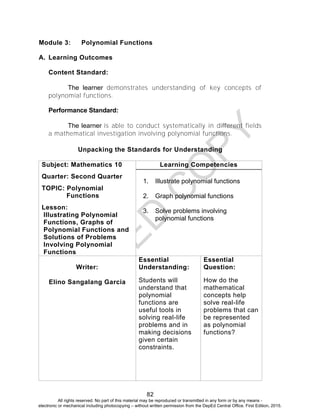
A. Learning Outcomes
Content Standard:
The learner demonstrates understanding of key concepts of
polynomial functions.
Performance Standard:
The learner is able to conduct systematically in different fields
a mathematical investigation involving polynomial functions.
Unpacking the Standards for Understanding
Subject: Mathematics 10
Quarter: Second Quarter
TOPIC: Polynomial
Functions
Lesson:
Illustrating Polynomial
Functions, Graphs of
Polynomial Functions and
Solutions of Problems
Involving Polynomial
Functions
Learning Competencies
1. Illustrate polynomial functions
2. Graph polynomial functions
3. Solve problems involving
polynomial functions
Writer:
Elino Sangalang Garcia
Essential
Understanding:
Students will
understand that
polynomial
functions are
useful tools in
solving real-life
problems and in
making decisions
given certain
constraints.
Essential
Question:
How do the
mathematical
concepts help
solve real-life
problems that can
be represented
as polynomial
functions?
All rights reserved. No part of this material may be reproduced or transmitted in any form or by any means -
electronic or mechanical including photocopying – without written permission from the DepEd Central Office. First Edition, 2015.
D
EPED
C
O
PY
83
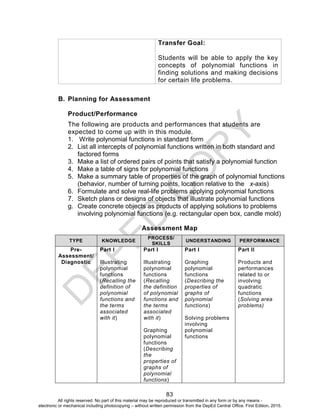
Transfer Goal:
Students will be able to apply the key
concepts of polynomial functions in
finding solutions and making decisions
for certain life problems.
B. Planning for Assessment
Product/Performance
The following are products and performances that students are
expected to come up with in this module.
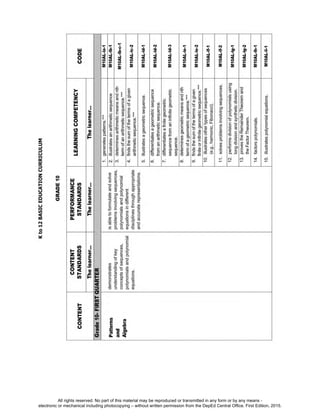
1. Write polynomial functions in standard form
2. List all intercepts of polynomial functions written in both standard and
factored forms
3. Make a list of ordered pairs of points that satisfy a polynomial function
4. Make a table of signs for polynomial functions
5. Make a summary table of properties of the graph of polynomial functions
(behavior, number of turning points, location relative to the x-axis)
6. Formulate and solve real-life problems applying polynomial functions
7. Sketch plans or designs of objects that illustrate polynomial functions
g. Create concrete objects as products of applying solutions to problems
involving polynomial functions (e.g. rectangular open box, candle mold)
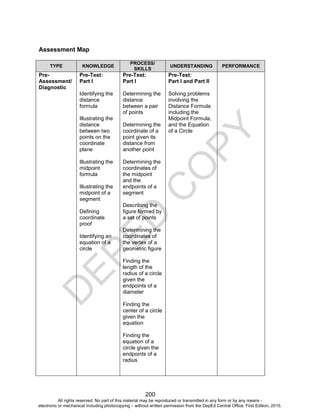
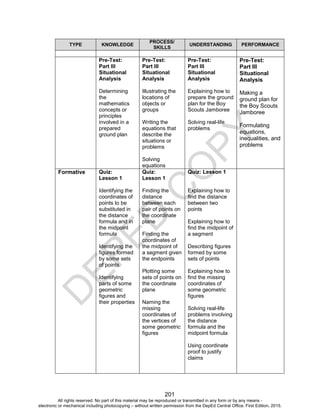
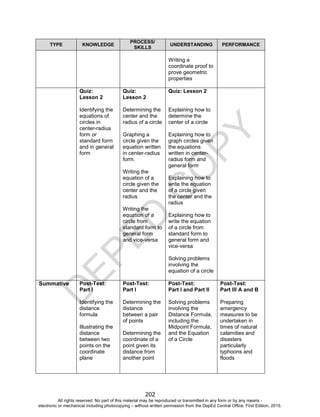
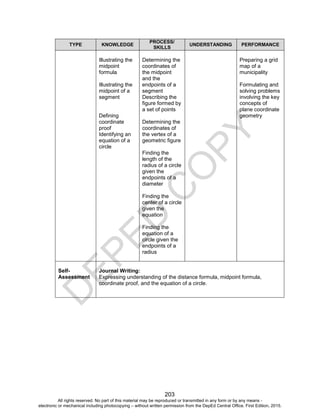
Assessment Map
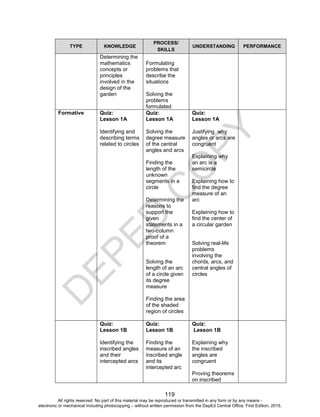
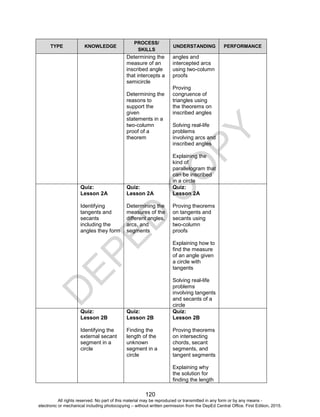
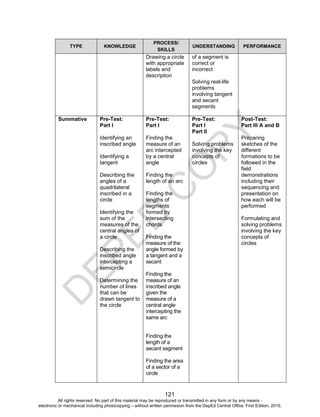
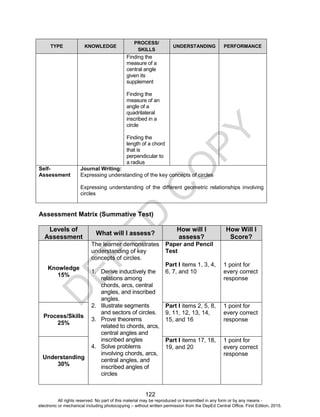
TYPE KNOWLEDGE
PROCESS/
SKILLS
UNDERSTANDING PERFORMANCE
Pre-
Assessment/
Diagnostic
Part I
Illustrating
polynomial
functions
(Recalling the
definition of
polynomial
functions and
the terms
associated
with it)
Part I
Illustrating
polynomial
functions
(Recalling
the definition
of polynomial
functions and
the terms
associated
with it)
Graphing
polynomial
functions
(Describing
the
properties of
graphs of
polynomial
functions)
Part I
Graphing
polynomial
functions
(Describing the
properties of
graphs of
polynomial
functions)
Solving problems
involving
polynomial
functions
Part II
Products and
performances
related to or
involving
quadratic
functions
(Solving area
problems)
All rights reserved. No part of this material may be reproduced or transmitted in any form or by any means -
electronic or mechanical including photocopying – without written permission from the DepEd Central Office. First Edition, 2015.
D
EPED
C
O
PY
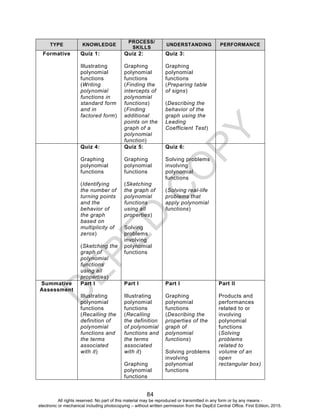
84
TYPE KNOWLEDGE
PROCESS/
SKILLS
UNDERSTANDING PERFORMANCE
Formative Quiz 1:
Illustrating
polynomial
functions
(Writing
polynomial
functions in
standard form
and in
factored form)
Quiz 2:
Graphing
polynomial
functions
(Finding the
intercepts of
polynomial
functions)
(Finding
additional
points on the
graph of a
polynomial
function)
Quiz 3:
Graphing
polynomial
functions
(Preparing table
of signs)
(Describing the
behavior of the
graph using the
Leading
Coefficient Test)
Quiz 4:
Graphing
polynomial
functions
(Identifying
the number of
turning points
and the
behavior of
the graph
based on
multiplicity of
zeros)
(Sketching the
graph of
polynomial
functions
using all
properties)
Quiz 5:
Graphing
polynomial
functions
(Sketching
the graph of
polynomial
functions
using all
properties)
Solving
problems
involving
polynomial
functions
Quiz 6:
Solving problems
involving
polynomial
functions
(Solving real-life
problems that
apply polynomial
functions)
Summative
Assessment
Part I
Illustrating
polynomial
functions
(Recalling the
definition of
polynomial
functions and
the terms
associated
with it)
Part I
Illustrating
polynomial
functions
(Recalling
the definition
of polynomial
functions and
the terms
associated
with it)
Graphing
polynomial
functions
Part I
Graphing
polynomial
functions
(Describing the
properties of the
graph of
polynomial
functions)
Solving problems
involving
polynomial
functions
Part II
Products and
performances
related to or
involving
polynomial
functions
(Solving
problems
related to
volume of an
open
rectangular box)
All rights reserved. No part of this material may be reproduced or transmitted in any form or by any means -
electronic or mechanical including photocopying – without written permission from the DepEd Central Office. First Edition, 2015.
D
EPED
C
O
PY
85
TYPE KNOWLEDGE
PROCESS/
SKILLS
UNDERSTANDING PERFORMANCE
(Describing
the
properties of
the graphs of
polynomial
functions)
Self-
Assessment
(optional)
Journal Writing:
Expressing understanding of polynomial functions, graphing
polynomial functions, and solving problems involving polynomial
functions
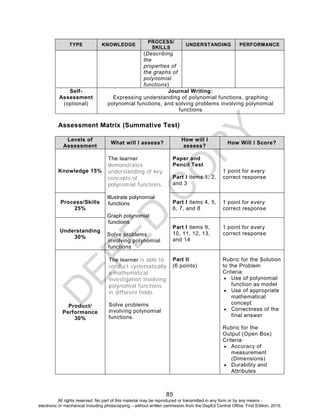
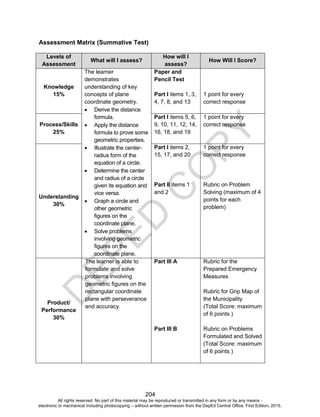
Assessment Matrix (Summative Test)
Levels of
Assessment
What will I assess?
How will I
assess?
How Will I Score?
Knowledge 15%
The learner
demonstrates
understanding of key
concepts of
polynomial functions.
Illustrate polynomial
functions.
Graph polynomial
functions
Solve problems
involving polynomial
functions
Paper and
Pencil Test
Part I items 1, 2,
and 3
1 point for every
correct response
Process/Skills
25%
Part I items 4, 5,
6, 7, and 8
1 point for every
correct response
Understanding
30%
Part I items 9,
10, 11, 12, 13,
and 14
1 point for every
correct response
Product/
Performance
30%
The learner is able to
conduct systematically
a mathematical
investigation involving
polynomial functions
in different fields.
Solve problems
involving polynomial
functions.
Part II
(6 points)
Rubric for the Solution
to the Problem
Criteria:
 Use of polynomial
function as model
 Use of appropriate
mathematical
concept
 Correctness of the
final answer
Rubric for the
Output (Open Box)
Criteria:
 Accuracy of
measurement
(Dimensions)
 Durability and
Attributes
All rights reserved. No part of this material may be reproduced or transmitted in any form or by any means -
electronic or mechanical including photocopying – without written permission from the DepEd Central Office. First Edition, 2015.
D
EPED
C
O
PY
86
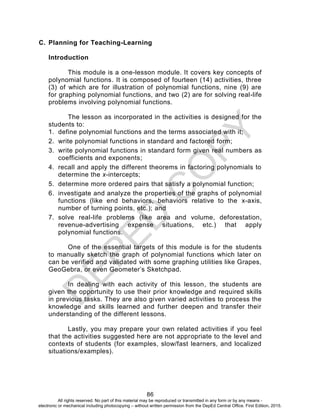
C. Planning for Teaching-Learning
Introduction
This module is a one-lesson module. It covers key concepts of
polynomial functions. It is composed of fourteen (14) activities, three
(3) of which are for illustration of polynomial functions, nine (9) are
for graphing polynomial functions, and two (2) are for solving real-life
problems involving polynomial functions.
The lesson as incorporated in the activities is designed for the
students to:
1. define polynomial functions and the terms associated with it;
2. write polynomial functions in standard and factored form;
3. write polynomial functions in standard form given real numbers as
coefficients and exponents;
4. recall and apply the different theorems in factoring polynomials to
determine the x-intercepts;
5. determine more ordered pairs that satisfy a polynomial function;
6. investigate and analyze the properties of the graphs of polynomial
functions (like end behaviors, behaviors relative to the x-axis,
number of turning points, etc.); and
7. solve real-life problems (like area and volume, deforestation,
revenue-advertising expense situations, etc.) that apply
polynomial functions.
One of the essential targets of this module is for the students
to manually sketch the graph of polynomial functions which later on
can be verified and validated with some graphing utilities like Grapes,
GeoGebra, or even Geometer’s Sketchpad.
In dealing with each activity of this lesson, the students are
given the opportunity to use their prior knowledge and required skills
in previous tasks. They are also given varied activities to process the
knowledge and skills learned and further deepen and transfer their
understanding of the different lessons.
Lastly, you may prepare your own related activities if you feel
that the activities suggested here are not appropriate to the level and
contexts of students (for examples, slow/fast learners, and localized
situations/examples).
All rights reserved. No part of this material may be reproduced or transmitted in any form or by any means -
electronic or mechanical including photocopying – without written permission from the DepEd Central Office. First Edition, 2015.
D
EPED
C
O
PY
87
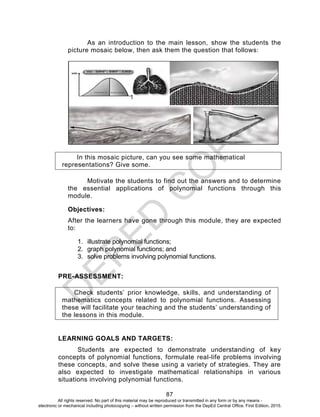
As an introduction to the main lesson, show the students the
picture mosaic below, then ask them the question that follows:
In this mosaic picture, can you see some mathematical
representations? Give some.
Motivate the students to find out the answers and to determine
the essential applications of polynomial functions through this
module.
Objectives:
After the learners have gone through this module, they are expected
to:
1. illustrate polynomial functions;
2. graph polynomial functions; and
3. solve problems involving polynomial functions.
PRE-ASSESSMENT:
Check students’ prior knowledge, skills, and understanding of
mathematics concepts related to polynomial functions. Assessing
these will facilitate your teaching and the students’ understanding of
the lessons in this module.
LEARNING GOALS AND TARGETS:
Students are expected to demonstrate understanding of key
concepts of polynomial functions, formulate real-life problems involving
these concepts, and solve these using a variety of strategies. They are
also expected to investigate mathematical relationships in various
situations involving polynomial functions.
All rights reserved. No part of this material may be reproduced or transmitted in any form or by any means -
electronic or mechanical including photocopying – without written permission from the DepEd Central Office. First Edition, 2015.
D
EPED
C
O
PY
88
What to KNOW
The students need first to recall the concept of polynomial
expressions. These will lead them to define and illustrate mathematically
the polynomial functions.
Activity 1: Which is which?
Answer Key
1. polynomial
2. not polynomial because the variable of one term is inside the radical
sign
3. polynomial
4. not polynomial because the exponents of the variable are not whole
numbers
5. not polynomial because the variables are in the denominator
6. polynomial
7. not polynomial because the exponent of one variable is not a whole
number
8. polynomial
9. not polynomial because the exponent of one variable is negative
10. polynomial
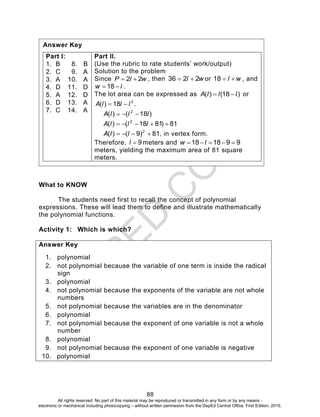
Answer Key
Part I: Part II.
(Use the rubric to rate students’ work/output)
Solution to the problem
Since wlP 22  , then wl 2236  or wl 18 , and
lw  18 .
The lot area can be expressed as )18()( lllA  or
2
18)( lllA  .
)18()( 2
lllA 
81)8118()( 2
 lllA
81)9()( 2
 llA , in vertex form.
Therefore, 9l meters and 991818  lw
meters, yielding the maximum area of 81 square
meters.
1. B 8. B
2. C 9. A
3. A 10. A
4. D 11. D
5. A 12. D
6. D 13. A
7. C 14. A
All rights reserved. No part of this material may be reproduced or transmitted in any form or by any means -
electronic or mechanical including photocopying – without written permission from the DepEd Central Office. First Edition, 2015.
D
EPED
C
O
PY
89
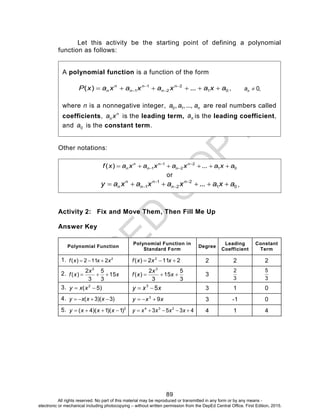
Let this activity be the starting point of defining a polynomial
function as follows:
Other notations:
Activity 2: Fix and Move Them, Then Fill Me Up
Answer Key
Polynomial Function
Polynomial Function in
Standard Form
Degree
Leading
Coefficient
Constant
Term
1. 2
2112)( xxxf  2112)( 2
 xxxf 2 2 2
2. x
x
xf 15
3
5
3
2
)(
3

3
5
15
3
2
)(
3
 x
x
xf 3
3
2
3
5
3. )5( 2
 xxy xxy 53
 3 1 0
4. )3)(3(  xxxy xxy 93
 3 -1 0
5. 2
)1)(1)(4(  xxxy 4353 234
 xxxxy 4 1 4
01
2
2
1
1 ...)( axaxaxaxaxf n
n
n
n
n
n  



or
01
2
2
1
1 ... axaxaxaxay n
n
n
n
n
n  


 ,
A polynomial function is a function of the form
01
2
2
1
1 ...)( axaxaxaxaxP n
n
n
n
n
n  


 , ,0na
where n is a nonnegative integer, naaa ...,,, 10 are real numbers called
coefficients, n
n xa is the leading term, na is the leading coefficient,
and 0a is the constant term.
All rights reserved. No part of this material may be reproduced or transmitted in any form or by any means -
electronic or mechanical including photocopying – without written permission from the DepEd Central Office. First Edition, 2015.
D
EPED
C
O
PY
90
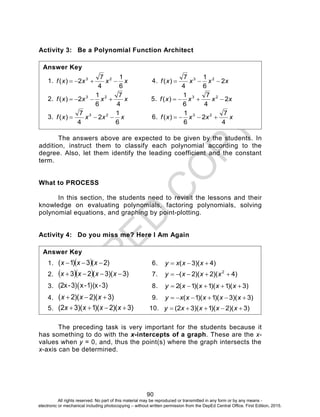
Activity 3: Be a Polynomial Function Architect
The answers above are expected to be given by the students. In
addition, instruct them to classify each polynomial according to the
degree. Also, let them identify the leading coefficient and the constant
term.
What to PROCESS
In this section, the students need to revisit the lessons and their
knowledge on evaluating polynomials, factoring polynomials, solving
polynomial equations, and graphing by point-plotting.
Activity 4: Do you miss me? Here I Am Again
The preceding task is very important for the students because it
has something to do with the x-intercepts of a graph. These are the x-
values when y = 0, and, thus the point(s) where the graph intersects the
x-axis can be determined.
Answer Key
1.   )2(3)1(  xxx 6. )4)(3(  xxxy
2.    )3)(3(23  xxxx 7. )4)(2)(2( 2
 xxxy
3.  (2x-3) x-1 (x-3) 8. )3)(1)(1)(1(2  xxxxy
4. )3)(2)(2(  xxx 9. )3)(3)(1)(1(  xxxxxy
5. )3)(2)(1)(32(  xxxx 10. )3)(2)(1)(32(  xxxxy
Answer Key
1. xxxxf
6
1
4
7
2)( 23
 4. xxxxf 2
6
1
4
7
)( 23

2. xxxxf
4
7
6
1
2)( 23
 5. xxxxf 2
4
7
6
1
)( 23

3. xxxxf
6
1
2
4
7
)( 23
 6. xxxxf
4
7
2
6
1
)( 23

All rights reserved. No part of this material may be reproduced or transmitted in any form or by any means -
electronic or mechanical including photocopying – without written permission from the DepEd Central Office. First Edition, 2015.
D
EPED
C
O
PY
91
Activity 5: Seize Me and Intercept Me
Activity 6: Give Me More Companions
Answer Key
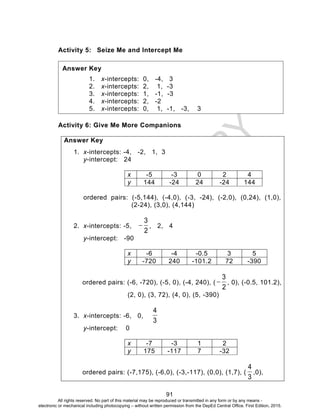
1. x-intercepts: -4, -2, 1, 3
y-intercept: 24
x -5 -3 0 2 4
y 144 -24 24 -24 144
ordered pairs: (-5,144), (-4,0), (-3, -24), (-2,0), (0,24), (1,0),
(2-24), (3,0), (4,144)
2. x-intercepts: -5,
2
3
 , 2, 4
y-intercept: -90
x -6 -4 -0.5 3 5
y -720 240 -101.2 72 -390
ordered pairs: (-6, -720), (-5, 0), (-4, 240), (
2
3
 , 0), (-0.5, 101.2),
(2, 0), (3, 72), (4, 0), (5, -390)
3. x-intercepts: -6, 0,
3
4
y-intercept: 0
x -7 -3 1 2
y 175 -117 7 -32
ordered pairs: (-7,175), (-6,0), (-3,-117), (0,0), (1,7), (
3
4
,0),
Answer Key
1. x-intercepts: 0, -4, 3
2. x-intercepts: 2, 1, -3
3. x-intercepts: 1, -1, -3
4. x-intercepts: 2, -2
5. x-intercepts: 0, 1, -1, -3, 3
All rights reserved. No part of this material may be reproduced or transmitted in any form or by any means -
electronic or mechanical including photocopying – without written permission from the DepEd Central Office. First Edition, 2015.
D
EPED
C
O
PY
92
(2,-32)
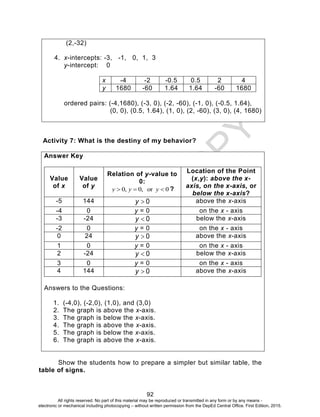
4. x-intercepts: -3, -1, 0, 1, 3
y-intercept: 0
x -4 -2 -0.5 0.5 2 4
y 1680 -60 1.64 1.64 -60 1680
ordered pairs: (-4,1680), (-3, 0), (-2, -60), (-1, 0), (-0.5, 1.64),
(0, 0), (0.5, 1.64), (1, 0), (2, -60), (3, 0), (4, 1680)
Activity 7: What is the destiny of my behavior?
Answer Key
Value
of x
Value
of y
Relation of y-value to
0:
0, 0, or 0y y y   ?
Location of the Point
(x,y): above the x-
axis, on the x-axis, or
below the x-axis?
-5 144 0y above the x-axis
-4 0 y = 0 on the x - axis
-3 -24 0y below the x-axis
-2 0 y = 0 on the x - axis
0 24 0y above the x-axis
1 0 y = 0 on the x - axis
2 -24 0y below the x-axis
3 0 y = 0 on the x - axis
4 144 0y above the x-axis
Answers to the Questions:
1. (-4,0), (-2,0), (1,0), and (3,0)
2. The graph is above the x-axis.
3. The graph is below the x-axis.
4. The graph is above the x-axis.
5. The graph is below the x-axis.
6. The graph is above the x-axis.
Show the students how to prepare a simpler but similar table, the
table of signs.
All rights reserved. No part of this material may be reproduced or transmitted in any form or by any means -
electronic or mechanical including photocopying – without written permission from the DepEd Central Office. First Edition, 2015.
D
EPED
C
O
PY
93
Example:
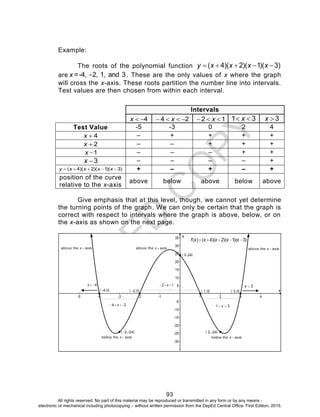
The roots of the polynomial function )3)(1)(2)(4(  xxxxy
are x =-4, -2, 1, and 3. These are the only values of x where the graph
will cross the x-axis. These roots partition the number line into intervals.
Test values are then chosen from within each interval.
Intervals
4x 24  x 12  x 31  x 3x
Test Value -5 -3 0 2 4
4x – + + + +
2x – – + + +
1x – – – + +
3x – – – – +
)3)(1)(2)(4(  xxxxy + – + – +
position of the curve
relative to the x-axis
above below above below above
Give emphasis that at this level, though, we cannot yet determine
the turning points of the graph. We can only be certain that the graph is
correct with respect to intervals where the graph is above, below, or on
the x-axis as shown on the next page.
All rights reserved. No part of this material may be reproduced or transmitted in any form or by any means -
electronic or mechanical including photocopying – without written permission from the DepEd Central Office. First Edition, 2015.
D
EPED
C
O
PY
94
Activity 8: Sign on and Sketch Me
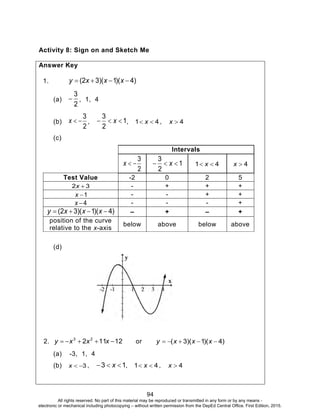
Answer Key
1. )4)(1)(32(  xxxy
(a)
2
3
 , 1, 4
(b)
2
3
x , 1
2
3
 x , 41  x , 4x
(c)
Intervals
2
3
x 1
2
3
 x 41  x 4x
Test Value -2 0 2 5
32 x - + + +
1x - - + +
4x - - - +
)4)(1)(32(  xxxy – + – +
position of the curve
relative to the x-axis
below above below above
(d)
2. 12112 23
 xxxy or )4)(1)(3(  xxxy
(a) -3, 1, 4
(b) 3x , 13  x , 41  x , 4x
All rights reserved. No part of this material may be reproduced or transmitted in any form or by any means -
electronic or mechanical including photocopying – without written permission from the DepEd Central Office. First Edition, 2015.
D
EPED
C
O
PY
95
(c)
Intervals
3x 13  x 41  x 4x
Test Value -4 0 2 5
3x - + + +
1x - - + +
4x - - - +
)4)(1)(3(  xxxy + - + -
position of the curve
relative to the x-axis
above below above below
Note: Observe that there is one more factor, -1, that
affects the final sign of y. For example, under
3x , the sign of y is positive because
= +-(-)(-)(-) .
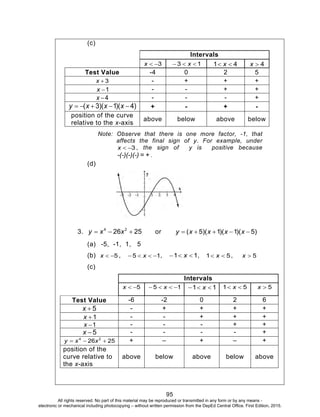
(d)
3. 2526 24
 xxy or )5)(1)(1)(5(  xxxxy
(a) -5, -1, 1, 5
(b) 5x , 15  x , 11  x , 51  x , 5x
(c)
Intervals
5x 15  x 11  x 51  x 5x
Test Value -6 -2 0 2 6
5x - + + + +
1x - - + + +
1x - - - + +
5x - - - - +
2526 24
 xxy + – + – +
position of the
curve relative to
the x-axis
above below above below above
All rights reserved. No part of this material may be reproduced or transmitted in any form or by any means -
electronic or mechanical including photocopying – without written permission from the DepEd Central Office. First Edition, 2015.
D
EPED
C
O
PY
96
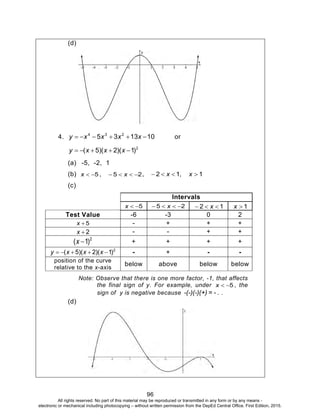
(d)
4. 101335 234
 xxxxy or
2
)1)(2)(5(  xxxy
(a) -5, -2, 1
(b) 5x , 25  x , 12  x , 1x
(c)
Intervals
5x 25  x 12  x 1x
Test Value -6 -3 0 2
5x - + + +
2x - - + +
2
)1( x + + + +
2
)1)(2)(5(  xxxy - + - -
position of the curve
relative to the x-axis
below above below below
Note: Observe that there is one more factor, -1, that affects
the final sign of y. For example, under 5x , the
sign of y is negative because = --(-)(-)(+) . .
(d)
All rights reserved. No part of this material may be reproduced or transmitted in any form or by any means -
electronic or mechanical including photocopying – without written permission from the DepEd Central Office. First Edition, 2015.
D
EPED
C
O
PY
97
5. 342
)1()1)(3(  xxxxy
(a) -3, -1, 0, 1
(b) 3x , 13  x , 01  x , 10  x , 1x
(c)
Intervals
3x 13  x 01  x 10  x 1x
Test Value -4 -2 -0.5 0.5 2
2
x + + + + +
3x - + + + +
4
)1( x + + + + +
3
)1( x - - - - +
342
)1()1)(3(  xxxxy + – – – +
position of the curve
relative to the x-axis
above below below below above
(d)
Broken parts of the graph indicate that somewhere below,
they are connected. The graph goes downward from (-1,0)
and at a certain point, it turns upward to (-3,0).
Answers to the Questions:
1. For )4)(1)(32(  xxxy
a. Since there is no other x-intercept to the left of
2
3
 , then the
graph falls to the left continuously without end.
b. (i) 1
2
3
 x and 4x (ii)
2
3
x and 41  x
c. Since there is no other x-intercept to the right of 4, then the
graph rises to the right continuously without end.
d. leading term: 3
2x
e. leading coefficient: 2, degree: 3
All rights reserved. No part of this material may be reproduced or transmitted in any form or by any means -
electronic or mechanical including photocopying – without written permission from the DepEd Central Office. First Edition, 2015.
D
EPED
C
O
PY
98
2. For 12112 23
 xxxy or )4)(1)(3(  xxxy
a. Since there is no other x-intercept to the left of -3, then the
graph rises to the left continuously without end.
b. (i) 3x and 41  x (ii) 13  x and 4x
c. Since there is no other x-intercept to the right of 4, then the
graph falls to the right continuously without end.
d. leading term: 3
x
e. leading coefficient: -1, degree: 3
3. For 2526 24
 xxy or )5)(1)(1)(5(  xxxxy
a. Since there is no other x-intercept to the left of -5, then the
graph rises to the left continuously without end.
b. (i) 5x and 11  x (ii) 15  x and 51  x
c. Since there is no other x-intercept to the right of 5, then the
graph rises to the right continuously without end.
d. leading term: 4
x
e. leading coefficient: 1, degree: 4
4. For 101335 234
 xxxxy or 2
)1)(2)(5(  xxxy
a. Since there is no other x-intercept to the left of -5, then the
graph falls to the left continuously without end.
b. (i) 25  x (ii) 5x , 12  x and 1x
c. Since there is no other x-intercept to the right of 1, then the
graph falls to the right continuously without end.
d. leading term: 4
x
e. leading coefficient: -1, degree: 4
5. For 342
)1()1)(3(  xxxxy
a. Since there is no other x-intercept to the left of -3, then the
graph rises to the left continuously without end.
b. (i) 3x and 1x (ii) 13  x , 1 0,x   and 10  x
c. Since there is no other x-intercept to the right of 1, then the
graph rises to the right continuously without end.
d. leading term: 10
x
e. leading coefficient: 1, degree: 10
Let the students reflect on these questions: Do the leading
coefficient and degree of the polynomial affect the behavior of its
graph? Encourage them to do an investigation as they perform the next
activity.
All rights reserved. No part of this material may be reproduced or transmitted in any form or by any means -
electronic or mechanical including photocopying – without written permission from the DepEd Central Office. First Edition, 2015.
D
EPED
C
O
PY
99
Activity 9: Follow My Path!
Answer Key
Case 1:
a. positive b. odd degree c. falling to the left
rising to the right
Case 2:
a. negative b. odd degree c. rising to the left
falling to the right
Case 3:
a. positive b. even degree c. rising to the left
rising to the right
Case 4:
a. negative b. even degree c. falling to the left
falling to the right
Summary table:
Sample Polynomial Function
Leading
Coefficient:
0n
or
0n
Degree:
Even
or Odd
Behavior of
the Graph:
Rising or
Falling
Possible
Sketch
Left-
hand
Right-
hand
1. 12772 23
 xxxy
0n odd falling rising
2. 473 2345
 xxxxy
0n odd rising falling
3. xxxy 67 24
 0n even rising rising
4. 2414132 234
 xxxxy
0n even falling falling
All rights reserved. No part of this material may be reproduced or transmitted in any form or by any means -
electronic or mechanical including photocopying – without written permission from the DepEd Central Office. First Edition, 2015.
D
EPED
C
O
PY
100
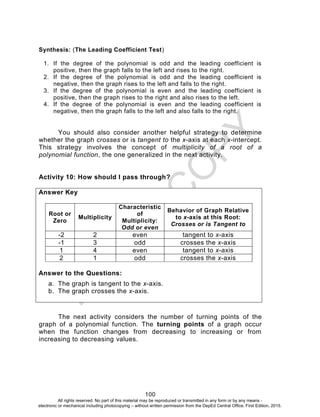
Synthesis: (The Leading Coefficient Test)
1. If the degree of the polynomial is odd and the leading coefficient is
positive, then the graph falls to the left and rises to the right.
2. If the degree of the polynomial is odd and the leading coefficient is
negative, then the graph rises to the left and falls to the right.
3. If the degree of the polynomial is even and the leading coefficient is
positive, then the graph rises to the right and also rises to the left.
4. If the degree of the polynomial is even and the leading coefficient is
negative, then the graph falls to the left and also falls to the right.
You should also consider another helpful strategy to determine
whether the graph crosses or is tangent to the x-axis at each x-intercept.
This strategy involves the concept of multiplicity of a root of a
polynomial function, the one generalized in the next activity.
Activity 10: How should I pass through?
Answer Key
Root or
Zero
Multiplicity
Characteristic
of
Multiplicity:
Odd or even
Behavior of Graph Relative
to x-axis at this Root:
Crosses or is Tangent to
-2 2 even tangent to x-axis
-1 3 odd crosses the x-axis
1 4 even tangent to x-axis
2 1 odd crosses the x-axis
Answer to the Questions:
a. The graph is tangent to the x-axis.
b. The graph crosses the x-axis.
The next activity considers the number of turning points of the
graph of a polynomial function. The turning points of a graph occur
when the function changes from decreasing to increasing or from
increasing to decreasing values.
All rights reserved. No part of this material may be reproduced or transmitted in any form or by any means -
electronic or mechanical including photocopying – without written permission from the DepEd Central Office. First Edition, 2015.
D
EPED
C
O
PY
101
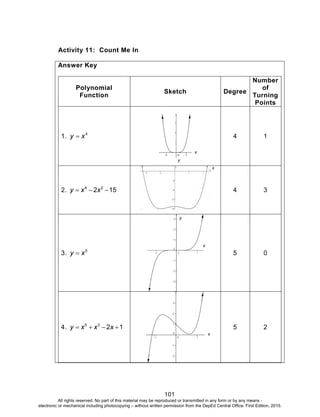
Activity 11: Count Me In
Answer Key
Polynomial
Function
Sketch Degree
Number
of
Turning
Points
1. 4
xy  4 1
2. 152 24
 xxy 4 3
3. 5
xy  5 0
4. 1235
 xxxy 5 2
x
y
x
y
x
x
All rights reserved. No part of this material may be reproduced or transmitted in any form or by any means -
electronic or mechanical including photocopying – without written permission from the DepEd Central Office. First Edition, 2015.
D
EPED
C
O
PY
102
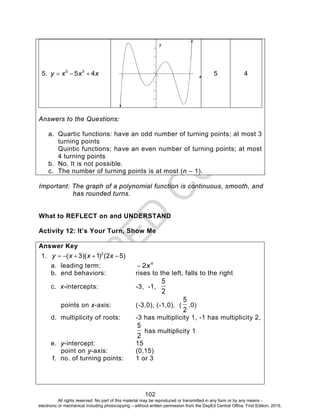
5. xxxy 45 35
 5 4
Answers to the Questions:
a. Quartic functions: have an odd number of turning points; at most 3
turning points
Quintic functions: have an even number of turning points; at most
4 turning points
b. No. It is not possible.
c. The number of turning points is at most (n – 1).
Important: The graph of a polynomial function is continuous, smooth, and
has rounded turns.
What to REFLECT on and UNDERSTAND
Activity 12: It’s Your Turn, Show Me
Answer Key
1. )52()1)(3( 2
 xxxy
a. leading term: 4
2x
b. end behaviors: rises to the left, falls to the right
c. x-intercepts: -3, -1,
2
5
points on x-axis: (-3,0), (-1,0), (
2
5
,0)
d. multiplicity of roots: -3 has multiplicity 1, -1 has multiplicity 2,
2
5
has multiplicity 1
e. y-intercept: 15
point on y-axis: (0,15)
f. no. of turning points: 1 or 3
x
y
All rights reserved. No part of this material may be reproduced or transmitted in any form or by any means -
electronic or mechanical including photocopying – without written permission from the DepEd Central Office. First Edition, 2015.
D
EPED
C
O
PY
103
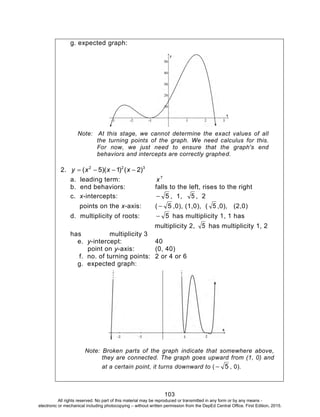
g. expected graph:
Note: At this stage, we cannot determine the exact values of all
the turning points of the graph. We need calculus for this.
For now, we just need to ensure that the graph's end
behaviors and intercepts are correctly graphed.
2. 322
)2()1)(5(  xxxy
a. leading term: 7
x
b. end behaviors: falls to the left, rises to the right
c. x-intercepts: 5 , 1, 5 , 2
points on the x-axis: ( 5 ,0), (1,0), ( 5 ,0), (2,0)
d. multiplicity of roots: 5 has multiplicity 1, 1 has
multiplicity 2, 5 has multiplicity 1, 2
has multiplicity 3
e. y-intercept: 40
point on y-axis: (0, 40)
f. no. of turning points: 2 or 4 or 6
g. expected graph:
Note: Broken parts of the graph indicate that somewhere above,
they are connected. The graph goes upward from (1, 0) and
at a certain point, it turns downward to ( 5 , 0).
All rights reserved. No part of this material may be reproduced or transmitted in any form or by any means -
electronic or mechanical including photocopying – without written permission from the DepEd Central Office. First Edition, 2015.
D
EPED
C
O
PY
104
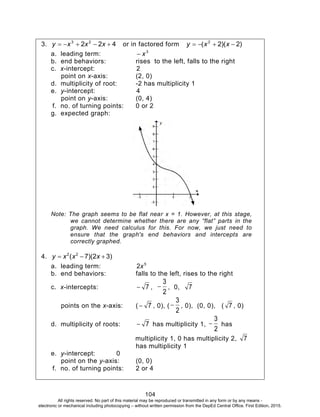
3. 422 23
 xxxy or in factored form )2)(2( 2
 xxy
a. leading term: 3
x
b. end behaviors: rises to the left, falls to the right
c. x-intercept: 2
point on x-axis: (2, 0)
d. multiplicity of root: -2 has multiplicity 1
e. y-intercept: 4
point on y-axis: (0, 4)
f. no. of turning points: 0 or 2
g. expected graph:
Note: The graph seems to be flat near x = 1. However, at this stage,
we cannot determine whether there are any “flat” parts in the
graph. We need calculus for this. For now, we just need to
ensure that the graph's end behaviors and intercepts are
correctly graphed.
4. )32)(7( 22
 xxxy
a. leading term: 5
2x
b. end behaviors: falls to the left, rises to the right
c. x-intercepts: 7 ,
2
3
 , 0, 7
points on the x-axis: ( 7 , 0), (
2
3
 , 0), (0, 0), ( 7 , 0)
d. multiplicity of roots: 7 has multiplicity 1,
2
3
 has
multiplicity 1, 0 has multiplicity 2, 7
has multiplicity 1
e. y-intercept: 0
point on the y-axis: (0, 0)
f. no. of turning points: 2 or 4
All rights reserved. No part of this material may be reproduced or transmitted in any form or by any means -
electronic or mechanical including photocopying – without written permission from the DepEd Central Office. First Edition, 2015.
D
EPED
C
O
PY
105
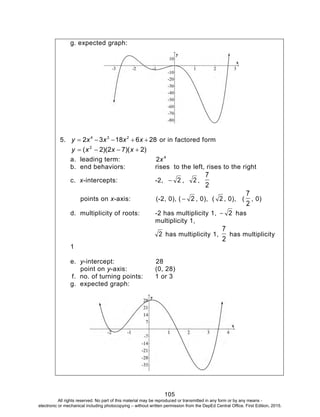
g. expected graph:
5. 2861832 234
 xxxxy or in factored form
)2)(72)(2( 2
 xxxy
a. leading term: 4
2x
b. end behaviors: rises to the left, rises to the right
c. x-intercepts: -2, 2 , 2 ,
2
7
points on x-axis: (-2, 0), ( 2 , 0), ( 2 , 0), (
2
7
, 0)
d. multiplicity of roots: -2 has multiplicity 1, 2 has
multiplicity 1,
2 has multiplicity 1,
2
7
has multiplicity
1
e. y-intercept: 28
point on y-axis: (0, 28)
f. no. of turning points: 1 or 3
g. expected graph:
All rights reserved. No part of this material may be reproduced or transmitted in any form or by any means -
electronic or mechanical including photocopying – without written permission from the DepEd Central Office. First Edition, 2015.
D
EPED
C
O
PY
106
Activity 13: Investigate Deeper and Decide Wisely
Answers to the Questions
1. a. 50%
b. The value given by the table is 23.7%. The polynomial gives a
value of 26.3%. The given polynomial is the cubic polynomial
that best fits the data. We expect it to give a good
approximation of the forest cover but it may not necessarily
produce the exact values.
c. The domain of the function is [0,98]. Since year 2100
corresponds to x = 200, we cannot use the function to predict
forest cover during this year. Moreover, if x = 200, the
polynomial predicts a forest cover of 59.46%. This is very
unrealistic unless major actions are done to reverse the trend.
You can find other data that can be modelled by a
polynomial. Use the regression tool in MS Excel or GeoGebra
to determine the best fit polynomial for the data.
2. The figure below can help solve the problem.
18 - 2x18
24 - 2x
24
x
x
x
x
x
x
x
x
All rights reserved. No part of this material may be reproduced or transmitted in any form or by any means -
electronic or mechanical including photocopying – without written permission from the DepEd Central Office. First Edition, 2015.
D
EPED
C
O
PY
107
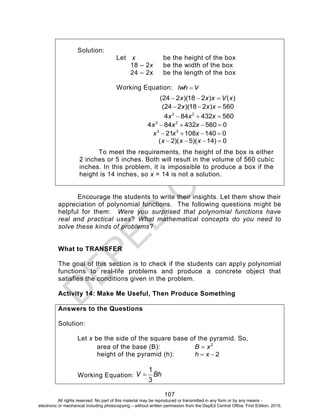
Solution:
Let x be the height of the box
18 – 2x be the width of the box
24 – 2x be the length of the box
Working Equation: Vlwh 
)()218)(224( xVxxx 
560)218)(224(  xxx
560432844 23
 xxx
0560432844 23
 xxx
014010821 23
 xxx
0)14)(5)(2(  xxx
To meet the requirements, the height of the box is either
2 inches or 5 inches. Both will result in the volume of 560 cubic
inches. In this problem, it is impossible to produce a box if the
height is 14 inches, so x = 14 is not a solution.
Encourage the students to write their insights. Let them show their
appreciation of polynomial functions. The following questions might be
helpful for them: Were you surprised that polynomial functions have
real and practical uses? What mathematical concepts do you need to
solve these kinds of problems?
What to TRANSFER
The goal of this section is to check if the students can apply polynomial
functions to real-life problems and produce a concrete object that
satisfies the conditions given in the problem.
Activity 14: Make Me Useful, Then Produce Something
Answers to the Questions
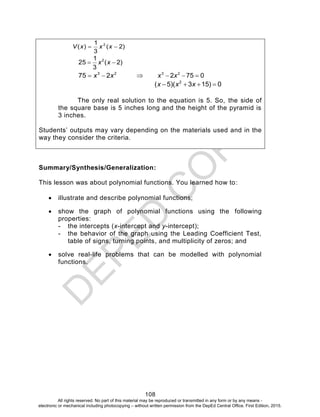
Solution:
Let x be the side of the square base of the pyramid. So,
area of the base (B): 2
xB 
height of the pyramid (h): 2 xh
Working Equation: BhV
3
1

All rights reserved. No part of this material may be reproduced or transmitted in any form or by any means -
electronic or mechanical including photocopying – without written permission from the DepEd Central Office. First Edition, 2015.
D
EPED
C
O
PY
108
)2(
3
1
)( 2
 xxxV
)2(
3
1
25 2
 xx
23
275 xx   0752 23
 xx
0)153)(5( 2
 xxx
The only real solution to the equation is 5. So, the side of
the square base is 5 inches long and the height of the pyramid is
3 inches.
Students’ outputs may vary depending on the materials used and in the
way they consider the criteria.
Summary/Synthesis/Generalization:
This lesson was about polynomial functions. You learned how to:
 illustrate and describe polynomial functions;
 show the graph of polynomial functions using the following
properties:
- the intercepts (x-intercept and y-intercept);
- the behavior of the graph using the Leading Coefficient Test,
table of signs, turning points, and multiplicity of zeros; and
 solve real-life problems that can be modelled with polynomial
functions.
All rights reserved. No part of this material may be reproduced or transmitted in any form or by any means -
electronic or mechanical including photocopying – without written permission from the DepEd Central Office. First Edition, 2015.
D
EPED
C
O
PY
109
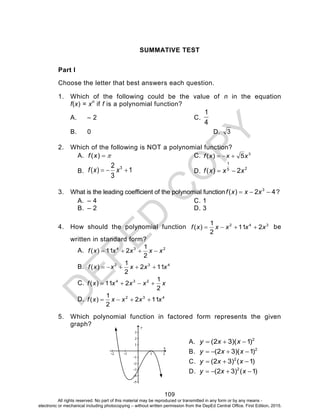
SUMMATIVE TEST
Part I
Choose the letter that best answers each question.
1. Which of the following could be the value of n in the equation
f(x) = xn
if f is a polynomial function?
A. – 2 C.
4
1
B. 0 D. 3
2. Which of the following is NOT a polynomial function?
A. )(xf C. 3
5)( xxxf 
B. 1
3
2
)( 3
 xxf D. 25
1
2)( xxxf 
3. What is the leading coefficient of the polynomial function 42)( 3
 xxxf ?
A. – 4 C. 1
B. – 2 D. 3
4. How should the polynomial function 342
211
2
1
)( xxxxxf  be
written in standard form?
A. 234
2
1
211)( xxxxxf 
B. 432
112
2
1
)( xxxxxf 
C. xxxxxf
2
1
211)( 234

D. 432
112
2
1
)( xxxxxf 
5. Which polynomial function in factored form represents the given
graph?
A. 2
)1)(32(  xxy
B. 2
)1)(32(  xxy
C. )1()32( 2
 xxy
D. )1()32( 2
 xxy
y
All rights reserved. No part of this material may be reproduced or transmitted in any form or by any means -
electronic or mechanical including photocopying – without written permission from the DepEd Central Office. First Edition, 2015.
D
EPED
C
O
PY
110
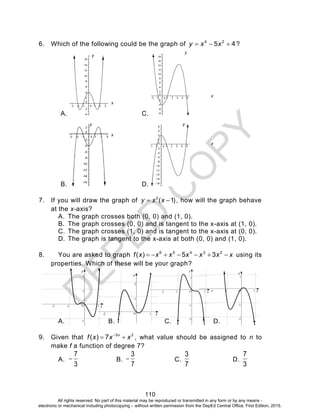
6. Which of the following could be the graph of 45 24
 xxy ?
A. C.
B. D.
7. If you will draw the graph of )1(2
 xxy , how will the graph behave
at the x-axis?
A. The graph crosses both (0, 0) and (1, 0).
B. The graph crosses (0, 0) and is tangent to the x-axis at (1, 0).
C. The graph crosses (1, 0) and is tangent to the x-axis at (0, 0).
D. The graph is tangent to the x-axis at both (0, 0) and (1, 0).
8. You are asked to graph xxxxxxxf  23456
35)( using its
properties. Which of these will be your graph?
A.
-5 -4 -3 -2 -1 1 x
-5
-4
-3
-2
-1
1
2
y
O
B.
-6 -5 -4 -3 -2 -1 1 x
-5
-4
-3
-2
-1
1
2
y
O
C.
-6 -5 -4 -3 -2 -1 1 x
-6
-5
-4
-3
-2
-1
1
y
O
D.
-6 -5 -4 -3 -2 -1 1 x
-6
-5
-4
-3
-2
-1
1
y
O
9. Given that 23
7)( xxxf n
 
, what value should be assigned to n to
make f a function of degree 7?
A.
3
7
 B.
7
3
 C.
7
3
D.
3
7
y
y
yy
x
x
x
x
All rights reserved. No part of this material may be reproduced or transmitted in any form or by any means -
electronic or mechanical including photocopying – without written permission from the DepEd Central Office. First Edition, 2015.
D
EPED
C
O
PY
111
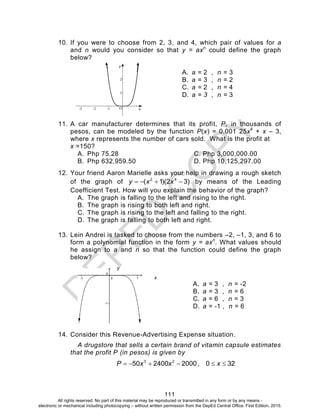
10. If you were to choose from 2, 3, and 4, which pair of values for a
and n would you consider so that y = axn
could define the graph
below?
-8 -7 -6 -5 -4 -3 -2 -1 x
-6
-5
-4
-3
-2
-1
1
2
y
O
11. A car manufacturer determines that its profit, P, in thousands of
pesos, can be modeled by the function P(x) = 0.001 25x4
+ x – 3,
where x represents the number of cars sold. What is the profit at
x =150?
A. Php 75.28 C. Php 3,000,000.00
B. Php 632,959.50 D. Php 10,125,297.00
12. Your friend Aaron Marielle asks your help in drawing a rough sketch
of the graph of )32)(1( 42
 xxy by means of the Leading
Coefficient Test. How will you explain the behavior of the graph?
A. The graph is falling to the left and rising to the right.
B. The graph is rising to both left and right.
C. The graph is rising to the left and falling to the right.
D. The graph is falling to both left and right.
13. Lein Andrei is tasked to choose from the numbers –2, –1, 3, and 6 to
form a polynomial function in the form y = axn
. What values should
he assign to a and n so that the function could define the graph
below?
14. Consider this Revenue-Advertising Expense situation.
A drugstore that sells a certain brand of vitamin capsule estimates
that the profit P (in pesos) is given by
320,2000240050 23
 xxxP
A. a = 3 , n = -2
B. a = 3 , n = 6
C. a = 6 , n = 3
D. a = -1 , n = 6
A. a = 2 , n = 3
B. a = 3 , n = 2
C. a = 2 , n = 4
D. a = 3 , n = 3
x
y
All rights reserved. No part of this material may be reproduced or transmitted in any form or by any means -
electronic or mechanical including photocopying – without written permission from the DepEd Central Office. First Edition, 2015.
D
EPED
C
O
PY
112
where x is the amount spent on advertising (in thousands of pesos).
An advertising agency provides four (4) different advertising
packages with costs listed below. Which of these packages will
yield the highest revenue for the company?
A. Package A: Php 8,000.00
B. Package B: Php 16,000.00
C. Package C: Php 32,000.00
D. Package D: Php 48,000.00
Part 2
Read and analyze the situation below. Then, answer the questions or
perform the required task.
An open box with dimensions 2 inches by 3 inches by 4 inches
needs to be increased in size to hold five times as much material as the
current box. (Assume each dimension is increased by the same
amount.)
Task:
(a) Write a function that represents the volume V of the new box.
(b) Find the dimensions of the new box.
(c) Using hard paperboard, make the two boxes - one with the
original dimensions and another with the new dimensions.
(d) On one face of the bigger box, write your mathematical
solution in getting the new dimensions.
Additional guidelines:
1. The boxes should look presentable and are durable enough to
hold any dry material such as sand, rice grains, etc.
2. Consider the rubric below.
Rubric for Rating the Output:
Point Descriptor
3
Polynomial function is correctly presented as model,
appropriate mathematical concepts are used in the solution,
and the correct final answer is obtained.
2
Polynomial function is correctly presented as model,
appropriate mathematical concepts are partially used in the
solution, and the correct final answer is obtained.
1
Polynomial function is not correctly presented as model,
other alternative mathematical concepts are used in the
solution, and the final answer is incorrect.
All rights reserved. No part of this material may be reproduced or transmitted in any form or by any means -
electronic or mechanical including photocopying – without written permission from the DepEd Central Office. First Edition, 2015.
D
EPED
C
O
PY
113
Criteria for Rating the Output (Box):
 Each box has the needed dimensions.
 The boxes are durable and presentable.
Point/s to be Given:
3 points if the boxes have met the two criteria
2 points if the boxes have met only one criterion
1 point if the boxes have not met any of the criteria
Answer Key for Summative Test
Part I: Part II.
(Use the rubric to rate students’ work/output)
Solution for finding the dimensions of the desired box:
Let x be the number to be added to each of length, width
and height to increase the size of the box. Then the
dimensions of the new box are x+2 by x+3 by x+4.
Since the volume of the original box is (2 inches)
(3 inches) (4 inches) = 24 cubic inches, then the volume
of the new box is 120 cubic inches.
Writing these in an equation, we have
)()4)(3)(2( xVxxx 
12024269 23
 xxx
096269 23
 xxx ,
0)4811)(2( 2
 xxx
Therefore, from the last equation, the only real solution
is x = 2. Thus, the dimensions of the new box are 4
inches by 5 inches by 6 inches.
Note to the Teacher:
To validate that the volume of the bigger box is five
times the volume of the other box, guide the students to
compare the content of both boxes using sand, rice
grains, or mongo seeds.
1. B
2. D
3. B
4. C
5. B
6. A
7. C
8. C
9. A
10. B
11. B
12. D
13. D
14. C
All rights reserved. No part of this material may be reproduced or transmitted in any form or by any means -
electronic or mechanical including photocopying – without written permission from the DepEd Central Office. First Edition, 2015.
D
EPED
C
O
PY
114
Glossary of Terms
Constant Function – a polynomial function whose degree is 0
Cubic Function – a polynomial function whose degree is 3
Evaluating a Polynomial – the process of finding the value of the
polynomial at a given value in its domain
Intercepts of a Graph – the points on the graph that have zero as
either the x-coordinate or the y-coordinate
Irreducible Factor - a factor that can no longer be factored using
coefficients that are real numbers
Leading Coefficient Test - a test that uses the leading term of the
polynomial function to determine the right-hand and the left-hand
behaviors of the graph
Linear Function - a polynomial function whose degree is 1
Multiplicity of a Root - tells how many times a particular number is a
root for a given polynomial
Nonnegative Integer - zero or any positive integer
Polynomial Function - a function denoted by
01
2
2
1
1 ...)( axaxaxaxaxP n
n
n
n
n
n  


 , where n is a nonnegative
integer, naaa ...,,, 10 are real numbers called coefficients, but ,0na ,
n
n xa is the leading term, na is the leading coefficient, and 0a is the
constant term
Polynomial in Standard Form - any polynomial whose terms are
arranged in decreasing powers of x
Quadratic Function - a polynomial function whose degree is 2
Quartic Function - a polynomial function whose degree is 4
Quintic Function - a polynomial function whose degree is 5
Turning Point - point where the function changes from decreasing to
increasing or from increasing to decreasing values
All rights reserved. No part of this material may be reproduced or transmitted in any form or by any means -
electronic or mechanical including photocopying – without written permission from the DepEd Central Office. First Edition, 2015.
D
EPED
C
O
PY
115
References
Alferez, M. S., Duro, MC.A., & Tupaz, KK. L. (2008). MSA Advanced
Algebra. Quezon City, Philippines: MSA Publishing House
Berry, J., Graham, T., Sharp, J., & Berry, E. (2003). Schaum’s A-Z
Mathematics. London, United Kingdom: Hodder &Stoughton
Educational.
Cabral, E. A., De Lara-Tuprio, E. P., De Las Penas, ML. N., Francisco,
F. F., Garces, IJ. L., Marcelo, R. M., & Sarmiento, J. F. (2010).
Precalculus. Quezon City, Philippines: Ateneo de Manila University
Press
Jose-Dilao, S., Orines, F. B., & Bernabe, J. G. (2003). Advanced
Algebra, Trigonometry and Statistics. Quezon City, Philippines: JTW
Corporation
Lamayo, F. C., & Deauna, M. C. (1990). Fourth Year Integrated
Mathematics. Quezon City, Philippines: Phoenix Publishing House, Inc.
Larson, R., & Hostetler, R. P. (2012). Algebra and Trigonometry. Pasig
City, Philippines: Cengage Learning Asia Pte Ltd
Marasigan, J. A., Coronel, A. C., & Coronel, I. C. (2004). Advanced
Algebra with Trigonometry and Statistics. Makati City, Philippines: The
Bookmark, Inc.
Quimpo, N. F. (2005). A Course in Freshman Algebra. Quezon City,
Philippines
Uy, F. B., & Ocampo, J. L. (2000). Board Primer in Mathematics.
Mandaluyong City, Philippines: Capitol Publishing House.
Villaluna, T. T., & Van Zandt, GE. L. (2009). Hands-on, Minds-on
Activities in Mathematics IV. Quezon City, Philippines: St. Jude
Thaddeus Publications.
All rights reserved. No part of this material may be reproduced or transmitted in any form or by any means -
electronic or mechanical including photocopying – without written permission from the DepEd Central Office. First Edition, 2015.
D
EPED
C
O
PY
116
Module 4: Circles
A. Learning Outcomes
Content Standard:
The learner demonstrates understanding of key concepts of circles.
Performance Standard:
The learner is able to formulate and find solutions to challenging
situations involving circles and other related terms in different disciplines
through appropriate and accurate representations.
Unpacking the Standards for Understanding
Subject: Mathematics 10
Quarter: Second Quarter
TOPIC: Circles
LESSONS:
1. A. Chords, Arcs, and
Central Angles
B. Arcs and Inscribed
Angles
2. A. Tangents and
Secants
of a Circle
B. Tangent and Secant
Segments
Learning Competencies
1. Derive inductively the relations among
chords, arcs, central angles, and inscribed
angles
2. Illustrate segments and sectors of circles
3. Prove theorems related to chords, arcs,
central angles, and inscribed angles
4. Solve problems involving chords, arcs,
central angles, and inscribed angles of
circles
5. Illustrate tangents and secants of circles
6. Prove theorems on tangents and secants
7. Solve problems involving tangents and
secants of circles
Writer:
Concepcion S. Ternida
Essential
Understanding:
Students will
understand that the
concept of circles has
wide applications in real
life and is a useful tool
in problem-solving and
in decision making.
Essential
Question:
How do geometric
relationships
involving circles
help solve real-life
problems that are
circular in nature?
All rights reserved. No part of this material may be reproduced or transmitted in any form or by any means -
electronic or mechanical including photocopying – without written permission from the DepEd Central Office. First Edition, 2015.
D
EPED
C
O
PY
117
Transfer Goal:
Students will be able to apply the key
concepts of circles in finding solutions and
in making decisions for certain real-life
problems.
B. Planning for Assessment
Product/Performance
The following are products and performances that students are expected
to come up with in this module.
1. Objects or situations in real life where chords, arcs, and central angles of
circles are illustrated
2. A circle graph applying the knowledge of central angles, arcs, and sectors
of a circle
3. Sketch plans or designs of a stage with circular objects that illustrate the
use of inscribed angles and arcs of a circle
4. Sketch plans or designs of an arch bridge that illustrate the applications of
secants and tangents
5. Deriving geometric relationships involving circles
6. Proof of theorems and other geometric relationships involving circles
7. Formulated and solved real-life problems
Assessment Map
TYPE KNOWLEDGE
PROCESS/
SKILLS
UNDERSTANDING PERFORMANCE
Pre-
Assessment/
Diagnostic
Pre-Test:
Part I
Identifying
inscribed angle
Identifying the
external secant
segment
Describing the
opposite angles
of a quadrilateral
inscribed in a
circle
Identifying the
sum of the
measures of the
central angles of
a circle
Pre-Test:
Part I
Finding the
length of an arc
of a circle given
its radius
Finding the
measure of a
central angle
given its
intercepted arc
Finding the
lengths of
segments
formed by
intersecting
chords
Pre-Test:
Part I
Part II
Solving problems
involving the key
concepts of
circles
All rights reserved. No part of this material may be reproduced or transmitted in any form or by any means -
electronic or mechanical including photocopying – without written permission from the DepEd Central Office. First Edition, 2015.
D
EPED
C
O
PY
118
TYPE KNOWLEDGE
PROCESS/
SKILLS
UNDERSTANDING PERFORMANCE
Describing the
inscribed angle
intercepting a
semicircle
Determining the
number of line
that can be
drawn tangent to
the circle
Finding the
measure of the
angle formed by
two secants
Finding the
length of a chord
that is
perpendicular to
a radius
Finding the
length of a
secant segment
Finding the area
of a sector of a
circle
Finding the
measure of a
central angle
given its
supplement
Finding the
measure of an
angle of a
quadrilateral
inscribed in a
circle
Finding the
measure of an
inscribed angle
given the
measure of a
central angle
intercepting the
same arc
Pre-Test:
Part III
Situational
Analysis
Planning the
design of a
garden
Pre-Test:
Part III
Situational
Analysis
Illustrating every
part or portion of
the garden
including their
measurements
and accessories
Pre-Test:
Part III
Situational
Analysis
Explaining how to
prepare the
designs of the
garden
Pre-Test:
Part III
Situational
Analysis
Making designs
of gardens
All rights reserved. No part of this material may be reproduced or transmitted in any form or by any means -
electronic or mechanical including photocopying – without written permission from the DepEd Central Office. First Edition, 2015.
D
EPED
C
O
PY
119
TYPE KNOWLEDGE
PROCESS/
SKILLS
UNDERSTANDING PERFORMANCE
Determining the
mathematics
concepts or
principles
involved in the
design of the
garden
Formulating
problems that
describe the
situations
Solving the
problems
formulated
Formative Quiz:
Lesson 1A
Identifying and
describing terms
related to circles
Quiz:
Lesson 1A
Solving the
degree measure
of the central
angles and arcs
Finding the
length of the
unknown
segments in a
circle
Determining the
reasons to
support the
given
statements in a
two-column
proof of a
theorem
Solving the
length of an arc
of a circle given
its degree
measure
Finding the area
of the shaded
region of circles
Quiz:
Lesson 1A
Justifying why
angles or arcs are
congruent
Explaining why
an arc is a
semicircle
Explaining how to
find the degree
measure of an
arc
Explaining how to
find the center of
a circular garden
Solving real-life
problems
involving the
chords, arcs, and
central angles of
circles
Quiz:
Lesson 1B
Identifying the
inscribed angles
and their
intercepted arcs
Quiz:
Lesson 1B
Finding the
measure of an
inscribed angle
and its
intercepted arc
Quiz:
Lesson 1B
Explaining why
the inscribed
angles are
congruent
Proving theorems
on inscribed
All rights reserved. No part of this material may be reproduced or transmitted in any form or by any means -
electronic or mechanical including photocopying – without written permission from the DepEd Central Office. First Edition, 2015.
D
EPED
C
O
PY
120
TYPE KNOWLEDGE
PROCESS/
SKILLS
UNDERSTANDING PERFORMANCE
Determining the
measure of an
inscribed angle
that intercepts a
semicircle
Determining the
reasons to
support the
given
statements in a
two-column
proof of a
theorem
angles and
intercepted arcs
using two-column
proofs
Proving
congruence of
triangles using
the theorems on
inscribed angles
Solving real-life
problems
involving arcs and
inscribed angles
Explaining the
kind of
parallelogram that
can be inscribed
in a circle
Quiz:
Lesson 2A
Identifying
tangents and
secants
including the
angles they form
Quiz:
Lesson 2A
Determining the
measures of the
different angles,
arcs, and
segments
Quiz:
Lesson 2A
Proving theorems
on tangents and
secants using
two-column
proofs
Explaining how to
find the measure
of an angle given
a circle with
tangents
Solving real-life
problems
involving tangents
and secants of a
circle
Quiz:
Lesson 2B
Identifying the
external secant
segment in a
circle
Quiz:
Lesson 2B
Finding the
length of the
unknown
segment in a
circle
Quiz:
Lesson 2B
Proving theorems
on intersecting
chords, secant
segments, and
tangent segments
Explaining why
the solution for
finding the length
All rights reserved. No part of this material may be reproduced or transmitted in any form or by any means -
electronic or mechanical including photocopying – without written permission from the DepEd Central Office. First Edition, 2015.
D
EPED
C
O
PY
121
TYPE KNOWLEDGE
PROCESS/
SKILLS
UNDERSTANDING PERFORMANCE
Drawing a circle
with appropriate
labels and
description
of a segment is
correct or
incorrect
Solving real-life
problems
involving tangent
and secant
segments
Summative Pre-Test:
Part I
Identifying an
inscribed angle
Identifying a
tangent
Describing the
angles of a
quadrilateral
inscribed in a
circle
Identifying the
sum of the
measures of the
central angles of
a circle
Describing the
inscribed angle
intercepting a
semicircle
Determining the
number of lines
that can be
drawn tangent to
the circle
Pre-Test:
Part I
Finding the
measure of an
arc intercepted
by a central
angle
Finding the
length of an arc
Finding the
lengths of
segments
formed by
intersecting
chords
Finding the
measure of the
angle formed by
a tangent and a
secant
Finding the
measure of an
inscribed angle
given the
measure of a
central angle
intercepting the
same arc
Finding the
length of a
secant segment
Finding the area
of a sector of a
circle
Pre-Test:
Part I
Part II
Solving problems
involving the key
concepts of
circles
Post-Test:
Part III A and B
Preparing
sketches of the
different
formations to be
followed in the
field
demonstrations
including their
sequencing and
presentation on
how each will be
performed
Formulating and
solving problems
involving the key
concepts of
circles
All rights reserved. No part of this material may be reproduced or transmitted in any form or by any means -
electronic or mechanical including photocopying – without written permission from the DepEd Central Office. First Edition, 2015.
D
EPED
C
O
PY
122
TYPE KNOWLEDGE
PROCESS/
SKILLS
UNDERSTANDING PERFORMANCE
Finding the
measure of a
central angle
given its
supplement
Finding the
measure of an
angle of a
quadrilateral
inscribed in a
circle
Finding the
length of a chord
that is
perpendicular to
a radius
Self-
Assessment
Journal Writing:
Expressing understanding of the key concepts of circles
Expressing understanding of the different geometric relationships involving
circles
Assessment Matrix (Summative Test)
Levels of
Assessment
What will I assess?
How will I
assess?
How Will I
Score?
Knowledge
15%
The learner demonstrates
understanding of key
concepts of circles.
1. Derive inductively the
relations among
chords, arcs, central
angles, and inscribed
angles.
2. Illustrate segments
and sectors of circles.
3. Prove theorems
related to chords, arcs,
central angles and
inscribed angles
4. Solve problems
involving chords, arcs,
central angles, and
inscribed angles of
circles
Paper and Pencil
Test
Part I items 1, 3, 4,
6, 7, and 10
1 point for
every correct
response
Process/Skills
25%
Part I items 2, 5, 8,
9, 11, 12, 13, 14,
15, and 16
1 point for
every correct
response
Understanding
30%
Part I items 17, 18,
19, and 20
1 point for
every correct
response
All rights reserved. No part of this material may be reproduced or transmitted in any form or by any means -
electronic or mechanical including photocopying – without written permission from the DepEd Central Office. First Edition, 2015.
D
EPED
C
O
PY
123
5. Illustrate tangents and
secants of circles
6. Prove theorems on
tangents and secants
7. Solve problems
involving tangents and
secants of circles
Part II items 1 and
2
Rubric on
Problem
Solving
(maximum of
4 points for
each
problem)
Product/
Performance
30%
The learner is able to
formulate and find
solutions to challenging
situations involving
circles and other related
terms in different
disciplines through
appropriate and accurate
representations.
Part III A
Part III B
Rubric for
Sketches of
the Different
Formations
(Total Score:
maximum of
6 points )
Rubric on
Problems
Formulated
and Solved
(Total Score:
maximum of
6 points )
C. Planning for Teaching-Learning
This module covers key concepts of circles. It is divided into four
lessons namely: Chords, Arcs, and Central Angles, Arcs and Inscribed
Angles, Tangents and Secants of a Circle, and Tangent and Secant
Segments.
Lesson 1A is about the relations among chords, arcs and central
angles of a circle, area of a segment and a sector, and arc length of a
circle. In this lesson, the students will determine the relationship between
the measures of the central angle and its intercepted arc, apply the
different geometric relationships among chords, arcs, and central angles
in solving problems, complete the proof of a theorem related to these
concepts, find the area of a segment and the sector of a circle, and
determine the length of an arc. (Note that all measures of angles and arcs
are in degrees.)
Moreover, the students will be given the opportunity to demonstrate
their understanding of the lesson by naming objects and citing real-life
situations where chords, arcs, and central angles of a circle are illustrated
and applied.
All rights reserved. No part of this material may be reproduced or transmitted in any form or by any means -
electronic or mechanical including photocopying – without written permission from the DepEd Central Office. First Edition, 2015.
D
EPED
C
O
PY
124
The concepts about arcs and inscribed angles of a circle are
contained in Lesson 1B. In this lesson, the students will determine the
geometric relationships that exist among arcs and inscribed angles of a
circle, apply these in solving problems, and prove related theorems.
Moreover, they will formulate and solve real-life problems involving these
geometric concepts.
The geometric relationships involving tangents and secants and
their applications in real life will be taken up in Lesson 2A. In this lesson,
the students will find the measures of angles formed by secants and
tangents and the arcs that these angles intercept. They will apply the
relationships involving tangents and secants in finding the lengths of
segments of some geometric figures. Moreover, the students will be given
opportunities to formulate and solve real-life problems involving tangents
and secants of a circle.
Lesson 2B of this module is about the different geometric
relationships involving tangent and secant segments. The students will
apply these geometric relationships in finding the lengths of segments
formed by tangents and secants. To demonstrate their understanding of the
lesson, the students will make a design of a real-life object where tangent
and secant segments are illustrated or applied, then formulate and solve
problems out of this design.
In all the lessons, the students are given the opportunity to use their
prior knowledge and skills in learning circles. They are also given varied
activities to process the knowledge and skills learned and further deepen
and transfer their understanding of the different lessons.
As an introduction to the main lesson, show the students the
pictures below, then ask them the questions that follow:
All rights reserved. No part of this material may be reproduced or transmitted in any form or by any means -
electronic or mechanical including photocopying – without written permission from the DepEd Central Office. First Edition, 2015.
D
EPED
C
O
PY
125
Entice the students to find out the answers to these questions and
to determine the vast applications of circles through this module.
Objectives:
After the learners have gone through the lessons contained in this
module, they are expected to:
1. identify and describe terms related to circles;
2. use the relationship among chords, arcs, central angles, and
inscribed angles of circles;
3. find the area of segments andsectors of circles;
4. find the lengths of arcs of circles;
5. use two-column proofs in proving theorems related to chords, arcs,
central angles, and inscribed angles of circles;
6. identify the tangents and secants of circles;
7. formulate and solve problems involving chords, arcs, central angles,
and inscribed angles of circles;
8. use two-column proofs in proving theorems related to tangents and
secants of circles; and
9. formulate and solve problems involving tangents and secants of
circles.
PRE-ASSESSMENT:
Have you imagined yourself pushing a cart or riding a bus having
wheels that are not round? Do you think you can move heavy objects
from one place to another easily or travel distant places as fast as you
can? What difficulty do you think would you experience without circles?
Have you ever thought of the importance of circles in the field of
transportation, industries, sports, navigation, carpentry, and in your daily
life?
Check students’ prior knowledge, skills, and understanding of
mathematics concepts related to circles. Assessing these will facilitate
teaching and students’ understanding of the lessons in this module.
All rights reserved. No part of this material may be reproduced or transmitted in any form or by any means -
electronic or mechanical including photocopying – without written permission from the DepEd Central Office. First Edition, 2015.
D
EPED
C
O
PY
126
LEARNING GOALS AND TARGETS:
Students are expected to demonstrate understanding of key concepts
of circles, formulate real-life problems involving these concepts, and solve
these using a variety of strategies. They are also expected to investigate
mathematical relationships in various situations involving circles.
Lesson 1A: Chords, arcs, and Central angles
What to Know
Assess students’ knowledge of the different mathematics concepts
previously studied and their skills in performing mathematical operations.
Assessing these will facilitate teaching and students’ understanding of chords,
arcs, and central angles. Tell them that as they go through this lesson, they
have to think of this important question: “How do the relationships among
chords, arcs, and central angles of a circle facilitate finding solutions to real-
life problems and making decisions?”
Ask the students to identify, name, and describe the terms related to circles
by doing Activity 1. Let them explain how they arrived at their answers. Also,
ask them to describe and differentiate these terms.
Answer Key
Part I Part II (Use the rubric to rate students’
1. B 11. A works/outputs)
2. A 12. A 1. 24.67 m
3. D 13. B 2. 27.38 km
4. D 14. A
5. C 15. A Part III (Use the rubric to rate students’
6. C 16. A works/outputs)
7. C 17. A
8. B 18. C
9. A 19. B
10. D 20. C
All rights reserved. No part of this material may be reproduced or transmitted in any form or by any means -
electronic or mechanical including photocopying – without written permission from the DepEd Central Office. First Edition, 2015.
D
EPED
C
O
PY
127
Activity 1: Know My Terms and Conditions…
Answer Key
1. AN , AJ , AE 5. JL, JN , EN , EL
2. EJ 6. LEN , LJE , ENL, JLN , LNJ
3. EL, EJ 7. JAN , NAE
4. JNE , JLE 8. LEJ , JEN
Questions:
a. Recall the definition of the terms related to circles.
Terms related to circle Description
1. radius It is a segment drawn from the center of
the circle to any point on the circle.
2. diameter It is a segment whose endpoints are on the
circle and it passes through the center of
the circle. It is the longest chord.
3. chord It is a segment joining any two points on
the circle.
4. semicircle It is an arc measuring one-half of the
circumference of a circle.
5. minor arc It is an arc of a circle that measures less
than a semicircle.
6. major arc It is an arc of a circle that measures
greater than a semicircle.
7. central angle It is an angle whose vertex is at the center
of the circle and with two radii as its sides.
8. inscribed angle It is an angle whose vertex is on a circle
and whose sides contain chords of the
circle.
All rights reserved. No part of this material may be reproduced or transmitted in any form or by any means -
electronic or mechanical including photocopying – without written permission from the DepEd Central Office. First Edition, 2015.
D
EPED
C
O
PY
128
Show the students the right triangles with different measures of sides
and let them find the missing side. Give focus on the mathematics concepts
or principles applied to find the unknown side particularly the Pythagorean
theorem.
Activity 2: What is my missing side?
Answer Key
b. 1. A radius is half the measure of the diameter.
2. A diameter is twice the measure of the radius and it is the longest
chord.
3. A chord is a segment joining any two points on the circle.
4. A semicircle is an arc measuring one-half the circumference of a
circle.
5. A minor arc is an arc of a circle that measures less than the
semicircle.
6. A major arc is an arc of a circle that measures greater than the
semicircle.
7. A central angle is an angle whose vertex is the center of the circle
and with two radii as its sides.
8. An inscribed angle is an angle whose vertex is on a circle and
whose sides contain chords of the circle.
Answer Key
1. 10c units
2. 49.17c units
3. 73.12c units
4. 12a units
5. 4b units
6. 12.12b units
Questions:
a. Using the equation 222
cba  .
b. Pythagorean theorem
All rights reserved. No part of this material may be reproduced or transmitted in any form or by any means -
electronic or mechanical including photocopying – without written permission from the DepEd Central Office. First Edition, 2015.
D
EPED
C
O
PY
129
Provide the students with an opportunity to derive the relationship
between the measures of the central angle and the measure of its intercepted
arc. Ask them to perform Activity 3. In this activity, students will measure the
angles of the given figures using a protractor. Ask them to get the sum of the
angles in the first figure as well as the sum of the central angles in the second
figure. Ask them also to identify the intercepted arc of each central angle.
Emphasize that the sum of the angles formed by the coplanar rays with
common vertex but with no common interior points is equal to the sum of the
central angles formed by the radii of a circle with no common interior points.
Activity 3: Measure Me and You Will See…
Answer Key
1. a. 105 d. 90
b. 75 e. 30
c. 60
2. a. 105 d. 90
b. 75 e. 30
c. 60
3. In each figure, the angles have a common vertex.
4. 360 ; 360
5. 360
6. 360
7.
Central Angle Measure Intercepted Arc
1. FAB 105 FB
2. BAC 75 BC
3. CAD 60 CD
4. EAD 90 ED
5. EAF 30 EF
8. 360 because the measure of the central angle is equal to the
measure of its intercepted arc.
9. Equal
All rights reserved. No part of this material may be reproduced or transmitted in any form or by any means -
electronic or mechanical including photocopying – without written permission from the DepEd Central Office. First Edition, 2015.
D
EPED
C
O
PY
130
Present a real-life situation to the students to develop their
understanding of arcs and central angles of circles. In this activity, ask them
to find the degree measure of each arc of the wheel and also the angle
formed at the hub. Ask them further the importance of the spokes of the
wheel.
Activity 4: Travel Safely
Before proceeding to the next activities, let the students give a brief
summary of what they have learned so far. Provide them with an opportunity
to relate or connect their responses in the activities given to this lesson. Let
the students read and understand some important notes on chords, arcs, and
central angles. Tell them to study carefully the examples given.
What to PROCESS
In this section, let the students apply the key concepts of chords, arcs,
and central angles. Tell them to use the mathematical ideas and the
examples presented in the preceding section to answer the activities
provided.
Ask the students to perform Activity 5. In this activity, the students will
identify and name arcs and central angles in the given circle and explain how
they identified them.
Answer Key
a. 60 ; 60
b. Evaluate students’ responses
All rights reserved. No part of this material may be reproduced or transmitted in any form or by any means -
electronic or mechanical including photocopying – without written permission from the DepEd Central Office. First Edition, 2015.
D
EPED
C
O
PY
131
Activity 5: Identify and Name Me
In activities 6, 7, and 8, ask the students to apply the different
geometric relationships in finding the degree measure of the central angles,
the arcs that the angles intercept, and the lengths of chords. Then, let them
explain how they arrived at their answers.
Answer Key
1. LMH (or LGH ) and LKH (or LJH );JKM (or JLM ) and
JGM (or JHM )
2.
Minor Arcs Major Arcs
JK KMJ
KL KGL
LM LJM
MG MKG
HG HKG
JH JMH
Note: There are many ways of naming the major arcs. The given
answers are just some of those ways.
3. Some Possible Answers: LAM ; MAG ; GAH ; JAH ; JAK ;
LAK
Questions:
a. A semicircle is an arc with measure equal to one-half of the
circumference of a circle and is named by using the two endpoints
and another point on the arc.
A minor arc is an arc of a circle that measures less than the
semicircle. It is named by using the two endpoints on the circle.
A major arc is an arc of a circle that measures greater than the
semicircle. It is named by using the two endpoints and another point
on the arc.
A central angle is an angle whose vertex is the center of the circle
and with two radii as its sides.
b. Yes. A circle has an infinite set of points. Therefore, a circle has
many semicircles, arcs, and central angles.
All rights reserved. No part of this material may be reproduced or transmitted in any form or by any means -
electronic or mechanical including photocopying – without written permission from the DepEd Central Office. First Edition, 2015.
D
EPED
C
O
PY
132
Activity 6: Find My Degree Measure
Activity 7: Find Me!
Activity 8: Get My Length
Provide the students opportunity to develop their skills in writing proofs.
Ask them to complete the proof of a theorem involving the diameter, chord,
and arc of a circle by doing Activity 9. If needed, guide the students as they
complete the proof of the theorem.
Answer Key
1. 90 6. 90
2. 48 7. 48
3. 138 8. 150
4. 42 9. 42
5. 132 10. 132
Answer Key
1. JSO and NSI ; JSN and OSI . They are vertical angles.
2. a. 113
b. 67
c. 67
3. Yes. Yes. Opposite sides of rectangles are congruent.
4. JO and NI ;JN and OI . The central angles that intercept the arcs
are congruent.
5. a. 67 d. 113
b. 113 e. 180
c. 67 f. 180
6. NJO ; NIO; JOI ;JNI . The arcs measure 180°. Each arc or
semicircle contains the endpoints of the diameter.
Answer Key
1. 8 units 5. 24.639  units
2. 2 units 6. 8 units
3. 5 units 7. 29.572  units
4. 24.639  units 8. 581074 . units
Note: Evaluate students’ explanations.
All rights reserved. No part of this material may be reproduced or transmitted in any form or by any means -
electronic or mechanical including photocopying – without written permission from the DepEd Central Office. First Edition, 2015.
D
EPED
C
O
PY
133
Activity 9: Make Me Complete!
Problem: To prove that in a circle, a diameter bisects a chord and an arc
with the same endpoints if and only if it is perpendicular to the
chord. The proof has two parts.
Given: ES is a diameter of U and
perpendicular to chord GN at I.
Prove: 1. GINI 
2. EGEN 
3. GSNS 
N
G
E
I
S
U
Answer Key
Proof of Part 1: We will show that ES bisects GN and the minor arc GN.
Statements Reasons
1. U with diameter ES and chord
GN ; GNES 
Given
2. GIU and NIU are right angles. Definition of perpendicular lines
3. NIUGIU  Right angles are congruent.
4. UNUG  Radii of the same circle are
congruent.
All rights reserved. No part of this material may be reproduced or transmitted in any form or by any means -
electronic or mechanical including photocopying – without written permission from the DepEd Central Office. First Edition, 2015.
D
EPED
C
O
PY
134
Answer Key
Proof:
Statements Reasons
5. UIUI  Reflexive/Identity Property
6. NIUGIU  HyL Theorem
7. NIGI  Corresponding parts of congruent
triangles are congruent (CPCTC).
8. ES bisects GN . Definition of segment bisector
9. NUIGUI  From 6, CPCTC
10. GUI and GUE are the
same angles.
NUI and NUE are the same
angles.
E, I, U are collinear.
11. NUEmGUEm  From 9, 10, definition of congruent
angles
12. GUEmmEG 
NUEmmEN 
Degree measure of an arc
13. mEGmEN 
From 11, 12, substitution
14. NUSmGUSm  From 11, definition of
supplementary angles, angles that
are supplementary to congruent
angles are congruent.
15. GUSmmGS 
NUSmmNS 
Degree measure of an arc
16. mGSmNS 
From 14, 15, substitution
17. ES bisects GN .
Definition of arc bisector
All rights reserved. No part of this material may be reproduced or transmitted in any form or by any means -
electronic or mechanical including photocopying – without written permission from the DepEd Central Office. First Edition, 2015.
D
EPED
C
O
PY
135
Given: ES is a diameter of U; ES bisects GN
at I and the minor arc GN.
Combining Parts 1 and 2, the theorem is proven.
Have the students apply the knowledge and skills they have learned
about arc length, segment, and sector of a circle. Ask the students to perform
Activity 10 and Activity 11.
Answer Key
Proof of Part 2: We will show that GNES  .
Statements Reasons
1. U with diameter ES , ES
bisects GN at I and the minor
arc
GN.
Given
2. NIGI 
NEGE 
Definition of bisector
3. UIUI  Reflexive/Identity Property
4. UNUG  Radii of the same circle are
congruent.
5. NIUGIU  SSS Postulate
6. UINUIG  CPCTC
7. UIG and UIN are right
angles.
Angles which form a linear pair and
are congruent are right angles.
8. GNIU  Definition of perpendicular lines
9. GNES  IU is on ES
N
GI
U
E
S
All rights reserved. No part of this material may be reproduced or transmitted in any form or by any means -
electronic or mechanical including photocopying – without written permission from the DepEd Central Office. First Edition, 2015.
D
EPED
C
O
PY
136
Activity 10: Find My Arc Length
Activity 11: Find This Part!
Answer Key
1. 3.925 units
2. 32.5 units or 5.23 units
3. 7.85 units
4. 64.10 units or 10.47 units
5. 8.29 units
Questions:
a. The area of each shaded region was determined by using the
proportion
r
lA


2360
where A = degree measure of the arc,
l = length of the arc, r = radius of the circle. Use the formula for
finding the area of a segment and the area of a triangle.
b. The proportion
r
lA


2360
, area of a segment and the area of a
triangle were used and so with substitution and the division
property.
Answer Key
1. 9  cm2
or 28.26 cm2
2. 18 cm2
or 56.52 cm2
3. 52.77 cm2
4. 9.31 cm2
5. 59.04 cm2
6. 40 cm2
Questions:
a. The area of the sector is equal to the product of the ratio
360
arctheofmeasure
and the area of the circle.
Subtract the area of the triangle from the area of the sector.
b. Area of a circle, area of a triangle, ratio, equilateral triangle, and
regular pentagon
All rights reserved. No part of this material may be reproduced or transmitted in any form or by any means -
electronic or mechanical including photocopying – without written permission from the DepEd Central Office. First Edition, 2015.
D
EPED
C
O
PY
137
What to REFLECT on and UNDERSTAND
Ask the students to take a closer look at some aspects of the
geometric concepts contained in this lesson. Provide them opportunities to
think deeply and test further their understanding of the lesson by doing
Activity 12. In this activity, the students will solve problems involving chords,
arcs, central angles, area of a segment and a sector, and arc length of a
circle.
Activity 12: More Circles Please …
Answer Key
1. a. 72
b. 3.768 cm
c. regular pentagon
2. Yes. There are two pairs of congruent central angles/vertical angles
formed and they intercept congruent arcs.
3. a. Yes. because the arcs are intercepted by the same central angle.
b. No. Even if the two circles have the same central angles, the
lengths of their intercepted arcs are not equal because the 2
circles have different radii.
4. 60. (Evaluate students’ explanations. They are expected to use the
proportion
r
lA


2360
to support their explanations.)
5. Draw two chords on the garden and a perpendicular bisector to
each of the chords. The intersection of the perpendicular bisectors
to the chord is the center of the circular garden.
6. a. Education, because it has the highest budget which is
Php12,000.00
Savings & Utilities, because they have the lowest budget which
is Php4,500.00
b. Education. It should be given the greater allocation because it is
a very good investment.
c. Education – 120
Food – 90
Utilities – 45
Savings – 45
Other expenses – 60
d. Get the percentage for each item by dividing the allotted budget
by the monthly income, then multiply it by 360.
All rights reserved. No part of this material may be reproduced or transmitted in any form or by any means -
electronic or mechanical including photocopying – without written permission from the DepEd Central Office. First Edition, 2015.
D
EPED
C
O
PY
138
Before the students move to the next section of this lesson, give a
short test (formative test) to find out how well they understood the lesson. Ask
them also to write a journal about their understanding of chords, arcs, and
central angles. Refer to the Assessment Map.
What to TRANSFER
Give the students opportunities to demonstrate their understanding of
circles by doing a practical task. Let them perform Activity 13. You can ask
the students to work individually or in group. In this activity, the students will
name 5 objects or cite 5 situations in real life where chords, arcs, and central
angles of a circle are illustrated. Then, instruct them to formulate and solve
problems out of these objects or situations. Also, ask them to make a circle
graph showing the different school fees that students like them have to pay
voluntarily like Parents-Teachers Association fee, miscellaneous fee, school
paper fee, Supreme Student Government fee, and other fees. Ask them to
explain how they applied their knowledge of central angles and arcs of circle
in preparing the graph. Then, using the circle graph that they made, ask them
to formulate and solve at least two problems involving arcs, central angles,
and sectors of a circle.
Activity 13: My Real World
Answer Key
Evaluate students’ product. You may use the rubric provided.
e.
Item Sector Arc Length
Education 61.654 cm2 52.3 cm
Food 490.625 cm2
39.25 cm
Utilities 245.3125 cm2
19.625 cm
Savings 245.3125 cm2
19.625 cm
Other expenses 308.327 cm2
61.26 cm
All rights reserved. No part of this material may be reproduced or transmitted in any form or by any means -
electronic or mechanical including photocopying – without written permission from the DepEd Central Office. First Edition, 2015.
D
EPED
C
O
PY
139
Summary/Synthesis/Generalization:
This lesson was about chords, arcs and central angles of a circle, area
of a segment and a sector, and arc length of a circle. In this lesson, the
students determined the relationship between the measures of the central
angle and its intercepted arc.
They were also given the opportunity to apply the different geometric
relationships among chords, arcs, and central angles in solving problems,
complete the proof of a theorem related to these concepts, find the area of a
segment and the sector of a circle, and determine the length of an arc.
Moreover, the students were asked to name objects and cite real-life
situations where chords, arcs, and central angles of a circle are illustrated and
the relationships among these concepts are applied.
Lesson 1B: Arcs and Inscribed Angles
What to KNOW
Let the students relate and connect previously learned mathematics
concepts to the new lesson, arcs and inscribed angles. As they go through
this lesson, tell them to think of this important question: “How do geometric
relationships involving arcs and inscribed angles facilitate solving real-life
problems and making decisions?”
Start the lesson by asking the students to perform Activity 1. In this
activity, the students will identify in a given figure the angles and their
intercepted arcs. The students should be able to explain how they identified
and named these angles and intercepted arcs.
All rights reserved. No part of this material may be reproduced or transmitted in any form or by any means -
electronic or mechanical including photocopying – without written permission from the DepEd Central Office. First Edition, 2015.
D
EPED
C
O
PY
140
Activity 1: My Angles and Intercepted Arcs
Give the students opportunity to determine the relationship between
the measure of an inscribed angle and the measure of its intercepted arc by
performing Activity 2. The students should be able to realize in this activity
that the measure of an angle inscribed in a circle is one-half the measure of
its intercepted arc (or the measure of the intercepted arc is twice the measure
of the inscribed angle).
Answer Key
Angles Arc That the Angle Intercepts
MSC MC
CSD CD
MSD MD
MGC MC
DGC CD
MGD MD
1. Determine the chords having a common endpoint on the circle. The
chords are the sides of the angle and the common endpoint on the
circle is the vertex.
Determine two radii of the circle. The two radii are the sides of the angle
and the center of the circle is the vertex.
Determine the arc that lies in the interior of the angle with endpoints on
the same angle.
2. There are 6 angles and there are also 6 arcs that these angles
intercept.
3. An angle intercepts an arc if a point on one side of the angle is an
endpoint of the arc.
All rights reserved. No part of this material may be reproduced or transmitted in any form or by any means -
electronic or mechanical including photocopying – without written permission from the DepEd Central Office. First Edition, 2015.
D
EPED
C
O
PY
141
Activity 2: Inscribe Me!
Answer Key
Possible Responses
1. 2.
3. 60WELm ;
60mLW
The measure of the central angle is
equal to the measure of its intercepted
arc.
4. 30LDWm
5. An inscribed angle is an angle whose vertex is on a circle and whose
sides contain chords of the circle.
6. The measure of LDW is one-half the measure of LW .
All rights reserved. No part of this material may be reproduced or transmitted in any form or by any means -
electronic or mechanical including photocopying – without written permission from the DepEd Central Office. First Edition, 2015.
D
EPED
C
O
PY
142
Activity 3 is related to Activity 2. In this activity, the students will
determine the relationship that exists when an inscribed angle intercepts a
semicircle. They should be able to find out that the measure of an inscribed
angle that intercepts a semicircle is 90°.
Activity 3: Intercept Me so I Won’t Fall!
Answer Key
1. 2.
3. 4.
5. a. 90MOTm b. 90MUTm c. 90MNTm
The measures of the three angles are equal. Each angle measures 90°.
The measure of an inscribed angle intercepting a semicircle is 90°.
The measures of inscribed angles intercepting the same arc are equal.
Answer Key
7. Draw other inscribed angles of the circle. Determine the measures of
these angles and the degree measures of their respective intercepted
arcs. (Check students’ drawings.)
The measure of an inscribed angle is one-half the degree measure
of its intercepted arc.
If an angle is inscribed in a circle, then the measure of the angle
equals one-half the measure of its intercepted arc (or the measure of
the intercepted arc is twice the measure of the inscribed angle).
All rights reserved. No part of this material may be reproduced or transmitted in any form or by any means -
electronic or mechanical including photocopying – without written permission from the DepEd Central Office. First Edition, 2015.
D
EPED
C
O
PY
143
Develop students’ understanding of the lesson by relating it to a real-
life situation. Ask them to determine the mathematics concepts that they can
apply to solve the problem presented in Activity 4.
Activity 4: One, Two,…, Say Cheese!
Answer Key
1.
2. Relationship between the central angle or inscribed angle and the arc
that the angle intercepts.
3. Go farther from the house until the entire house is seen on the eye
piece or on the LCD screen viewer of the camera.
80°
40°
New location where Janel
could photograph the entire
house with the telephoto lens
All rights reserved. No part of this material may be reproduced or transmitted in any form or by any means -
electronic or mechanical including photocopying – without written permission from the DepEd Central Office. First Edition, 2015.
D
EPED
C
O
PY
144
Before proceeding to the next section of this lesson, let the students
give a brief summary of the activities done. Provide them with an opportunity
to relate or connect their responses in the activities given to their new lesson,
Arcs and Inscribed Angles. Let the students read and understand some
important notes on the different geometric relationships involving arcs and
inscribed angles and let them study carefully the examples given.
What to PROCESS
Give the students opportunities to use the different geometric
relationships involving arcs and inscribed angles, and the examples
presented in the preceding section to perform the succeeding activities.
Ask the students to perform Activities 5, 6, and 7. In these activities,
they will identify the inscribed angles and their intercepted arcs, and apply the
theorems pertaining to these geometric concepts and other mathematics
concepts in finding their degree measures. Provide the students opportunities
to explain their answers.
Activity 5: Inscribe, Intercept, then Measure
Answer Key
1. LCA , LCE , ACE , ALC , CAE , CAL , LAE , and AEC
2.
a. CAL
b. ACE
c. LCE and LAE
d. ALC and AEC
3.
a. 281m d. 564 m g. 287 m
b. 622 m e. 1245 m h. 628 m
c. 623 m f. 566 m i. 629 m
4.
a. 52mCL c. 52mAE
b. 128mAC d. 128mLE
All rights reserved. No part of this material may be reproduced or transmitted in any form or by any means -
electronic or mechanical including photocopying – without written permission from the DepEd Central Office. First Edition, 2015.
D
EPED
C
O
PY
145
Activity 6: Half, Equal or Twice As?
Activity 7: Encircle Me!
Answer Key
1. BDCBAC  and ABDACD  . If inscribed angles intercept the
same arc, then the angles are congruent.
2. 108mCD
3. 48ACBm
4.
a. 7x c. 38DCAm
b. 38ABDm d. 76mAD
5.
a. 5x c. 52mBC
b. 26BDCm d. 26BACm
Answer Key
1. 4.
a. 150mOA a. 105TIAm
b. 50mOG b. 82FAIm
c. 80GOAm
d. 25GAOm
2. 5.
a. 65CARm a. 116mTM
b. 557.ACRm  b. 64mMA
c. 557.ARCm  c. 116mAE
d. 115mAC d. 32MEAm
e. 115mAR e. 58TAMm
3.
a. 35RDMm
b. 55DRMm
c. 90DMRm
d. 110mDM
e. 180mRD
All rights reserved. No part of this material may be reproduced or transmitted in any form or by any means -
electronic or mechanical including photocopying – without written permission from the DepEd Central Office. First Edition, 2015.
D
EPED
C
O
PY
146
In Activity 8, ask the students to complete the proof of the theorem on
inscribed angle and its intercepted arc. This activity would further develop
their skills in writing proofs which they need in proving other geometric
relationships.
Activity 8: Complete to Prove!
Problem: To prove that if an angle is inscribed in a circle, then the
measure of the angle equals one-half the measure of its
intercepted arc (or the measure of the intercepted arc is twice
the measure of the inscribed angle).
Case 1:
Given: PQR inscribed in S and
PQ is a diameter.
Prove: PRPQR m
2
1
m 
Draw RS and let xPQR m .
P
R
Q
S
x
All rights reserved. No part of this material may be reproduced or transmitted in any form or by any means -
electronic or mechanical including photocopying – without written permission from the DepEd Central Office. First Edition, 2015.
D
EPED
C
O
PY
147
What to REFLECT on and UNDERSTAND
Provide the students with opportunities to think deeply and test further
their understanding of the lesson. Let them prove the different theorems on
arcs and inscribed angles of a circle and other geometric relationships by
performing Activity 9 and Activity 10. Moreover, ask the students to solve the
problems in Activity 11 for them to realize the wide applications of the lesson
in real life.
Answer Key
Statements Reasons
1. PQR inscribed in S
and PQ is a diameter. Given
2. RSQS  Radii of a circle are congruent.
3. QRS is an isosceles  . Definition of isosceles triangle
4. QRSPQR  The base angles of an isosceles
triangle are congruent.
5. QRSPQR  mm The measures of congruent angles
are equal.
6. xQRS m Transitive Property
7. xPSR 2m 
The measure of an exterior angle of a
triangle is equal to the sum of the
measures of its remote interior
angles.
8. PRPSR mm 
The measure of a central angle is
equal to the measure of its
intercepted arc.
9. xPR 2m  Transitive Property
10.  PQRPR  m2m Substitution
11. PRQRS m
2
1
m  Multiplication Property of Equality
All rights reserved. No part of this material may be reproduced or transmitted in any form or by any means -
electronic or mechanical including photocopying – without written permission from the DepEd Central Office. First Edition, 2015.
D
EPED
C
O
PY
148
Activity 9: Prove It or Else …!
Answer Key
1. Case 3
Given: SMC inscribed in A.
Prove: Cm
2
1
m SSMC 
To prove: Draw diameter MP.
Answer Key
1. Case 2
Given: KLM inscribed in O.
Prove: KMKLM m
2
1
m 
To prove: Draw diameter LN.
Proof:
Statements Reasons
KNKLN m
2
1
m  and MNMLN m
2
1
m 
The measure of an
inscribed angle is one-half
the measure of its
intercepted arc (Case 1).
MNKNMLNKLN m
2
1
m
2
1
mm  or
 MNKNMLNKLN mm
2
1
mm 
Addition Property
KLMMLNKLN  mmm Angle Addition Postulate
KMMNKN mmm 
Arc Addition Postulate
KMKLM m
2
1
m 
Substitution
All rights reserved. No part of this material may be reproduced or transmitted in any form or by any means -
electronic or mechanical including photocopying – without written permission from the DepEd Central Office. First Edition, 2015.
D
EPED
C
O
PY
149
Proof:
Statements Reasons
Sm
2
1
m PPMS  and PCPMC m
2
1
m 
The measure of an
inscribed angle is one-half
the measure of its
intercepted arc (Case 1).
PMCSMCPMS  mmm or
PMSPMCSMC  mmm
Angle Addition Postulate
PCSCPS mmm  or
PSPCSC mmm 
Arc Addition Postulate
PSPCPMSPMC m
2
1
m
2
1
mm  or
 PSPCPMSPMC mm
2
1
mm 
By Subtraction
Cm
2
1
m SSMC  Substitution
2. Given: In T, PR and AC are the
intercepted arcs of PQR
and ABC , respectively.
ACPR 
Prove: ABCPQR 
Proof:
Statements Reasons
ACPR 
Given
ACPR mm 
Congruent arcs have equal
measures.
PRPQR m
2
1
m  and
ACABC m
2
1
m 
The measure of an inscribed
angle is one-half the measure
of its intercepted arc.
ACPQR m
2
1
m  Substitution
ABCPQR  mm Transitive Property
ABCPQR 
Angles with equal measures
are congruent.
All rights reserved. No part of this material may be reproduced or transmitted in any form or by any means -
electronic or mechanical including photocopying – without written permission from the DepEd Central Office. First Edition, 2015.
D
EPED
C
O
PY
150
3. Given: In C, GML intercepts
semicircle GEL.
Prove: GML is a right angle.
Proof:
Statements Reasons
GML intercepts semicircle GEL. Given
180m GEL
The degree measure of a
semicircle is 180.
GELGML m
2
1
m 
The measure of an inscribed
angle is one-half the measure
of its intercepted arc.
 180
2
1
m GML or 90m GML
Substitution
GML is a right angle. Definition of right angle
4. Given: Quadrilateral WIND is inscribed
in Y .
Prove: 1. W and N are supplementary.
2. I and D are supplementary.
To prove: Draw WY , IY , NY , and DY .
Proof:
Statements Reasons
360mmmm  DYWNYDIYNWYI
The sum of the measures
of the central angles of a
circle is 360.
WIWYI mm  , INIYN mm  ,
NDNYD mm  , and DWDYW mm 
The measure of a central
angle is equal to the
measure of its intercepted
arc.
360mmmm  DWNDINWI Substitution
360mm  DWIDNI
Arc Addition Postulate
All rights reserved. No part of this material may be reproduced or transmitted in any form or by any means -
electronic or mechanical including photocopying – without written permission from the DepEd Central Office. First Edition, 2015.
D
EPED
C
O
PY
151
Activity 10: Prove to Me if You Can!
Answer Key
1. Given: MT and AC are chords of D.
and ATMC  ,
Prove: THACHM  .
Proof
Statements Reasons
1. MT and AC are chords of
D and .MC AT
Given
2. MCA , ATM , CMT , and
CAT are inscribed angles.
Definition of inscribed angle
3. ATMMCA  and
CATCMT 
Inscribed angles intercepting the
same arc are congruent.
4. THACHM  ASA Congruence Postulate
M
A
T
D
C
H
Answer Key
Statements Reasons
DNIDWI m
2
1
m  and DWIDNI m
2
1
m 
The measure of an inscribed
angle is one-half the
measure of its intercepted
arc.
DWIDNIDNIDWI m
2
1
m
2
1
mm  or
 DWIDNIDNIDWI mm
2
1
mm 
By Addition
 360
2
1
mm  DNIDWI or
180mm  DNIDWI
Substitution
W and N are supplementary.
Definition of supplementary
angles
360mmmm  DNIW
The sum of the measures of
the angles of a quadrilateral
is 360.
360180mm  DI Substitution
180mm  DI Addition Property
I and D are supplementary.
Definition of supplementary
angles
All rights reserved. No part of this material may be reproduced or transmitted in any form or by any means -
electronic or mechanical including photocopying – without written permission from the DepEd Central Office. First Edition, 2015.
D
EPED
C
O
PY
152
Answer Key
2. Given: Quadrilateral DRIV is inscribed in E.
RV is a diagonal that passes through
the center of the circle.
IVDV 
Prove: RVIRVD 
Proof:
Statements Reasons
1. RV is a diagonal that
passes through the center of
the circle
Given
2. RVRV  Reflexive Property
3. VRIDRV  Inscribed angles intercepting the
same arc are congruent.
4. RIV and RDV are
semicircles.
Definition of semicircle
5. RDV and RIV are right
angles.
Inscribed angle intercepting a
semicircle measures 90°
6. RVD and RVI are right
triangles.
Definition of right triangle
7. RVIRVD 
Hypotenuse-Angle Congruence
Theorem
3. Given: In A, NESE  and .SC NT
Prove: TNECSE 
Proof:
Statements Reasons
1. NESE  and NTSC  Given
2. NESE  and NTSC 
If two arcs are congruent, then
the chords joined by their
respective endpoints are also
congruent.
3. mNEmSE  and
mNTmSC 
Congruent arcs have equal
measures.
4. mECmSCmSE  and
mETmNTmEN 
Arc Addition Postulate
E I
V
R
D
S
E
N
T
A
C
All rights reserved. No part of this material may be reproduced or transmitted in any form or by any means -
electronic or mechanical including photocopying – without written permission from the DepEd Central Office. First Edition, 2015.
D
EPED
C
O
PY
153
Activity 11: Take Me to Your Real-World!
Answer Key
1. a. 72°
b. 36°. The measure of an inscribed angle is one-half the measure of
its intercepted arc.
2. Rectangle. In a circle, there is only one chord that can be drawn
parallel and congruent to another chord in the same circle. Moreover,
the diagonals of the parallelogram are also the diameters of the circle.
Hence, each inscribed angle formed by the adjacent sides of the
parallelogram intercepts a semicircle and measures 90°.
3. 38°. If EG is drawn, the viewing angles of Joanna, Clarissa, and
Juliana intercept the same arc. Hence, the viewing angles of Joanna
and Juliana measure the same as the viewing angle of Clarissa.
4. Mang Ador has to draw two inscribed angles on the circle such that
each measures 90°. Then, connect the other endpoints of the sides of
each angle to form the diameter. The point of intersection of the two
diameters is the center of the circle.
5. a. PQR is a right triangle.
b. The length of RS is the geometric mean of the lengths of PS and
QS .
c. PS = 6 in.; QS = 2 in.; RS = 32 in.
d. 34RT in. and 34MN in.
Answer Key
Statements Reasons
1. mETmEC 
Substitution
2. ETEC 
Definition of Congruence
3. Draw chord CT . Definition of chord of a circle
4. ETCECT  Inscribed angles intercepting
congruent arcs are congruent.
5. CET is an isosceles triangle. Definition of isosceles triangle.
6. TECE  The legs of an isosceles triangle are
congruent.
7. TNECSE  SSS Congruence Postulate
All rights reserved. No part of this material may be reproduced or transmitted in any form or by any means -
electronic or mechanical including photocopying – without written permission from the DepEd Central Office. First Edition, 2015.
D
EPED
C
O
PY
154
Before the students move to the next section of this lesson, give a
short test (formative test) to find out how well they understood the lesson. Ask
them also to write a journal about their understanding of arcs and inscribed
angles. Refer to the Assessment Map.
What to TRANSFER
Give the students opportunities to demonstrate their understanding of
the geometric relationships involving arcs and inscribed angles. In Activity 12,
ask the students to make a design of a stage where a special event will be
held. Tell them to include in the design some circular objects that illustrate the
use of inscribed angles and arcs of a circle, and explain how they applied
these concepts in preparing the design. Then, ask them to formulate and
solve problems out of the design they made. You can ask the students to
work individually or in groups.
Activity 12: How special is the event?
Summary/Synthesis/Generalization:
This lesson was about arcs and inscribed angles of a circle. In this
lesson, the students were given the opportunity to determine the geometric
relationships that exist among arcs and inscribed angles of a circle, apply
these in solving problems, and prove related theorems. Moreover, they were
given the chance to formulate and solve real-life problems involving these
geometric concepts out of the product they were asked to come up with as a
demonstration of their understanding of the lesson.
Answer Key
Evaluate students’ product. You may use the given rubric.
All rights reserved. No part of this material may be reproduced or transmitted in any form or by any means -
electronic or mechanical including photocopying – without written permission from the DepEd Central Office. First Edition, 2015.
D
EPED
C
O
PY
155
Lesson 2A: Tangents and Secants of a Circle
What to KNOW
Assess students’ prior mathematical knowledge and skills that are
related to tangents and secants of a circle. This would facilitate teaching and
guide the students in understanding the different geometric relationships
involving tangents and secants of a circle.
Start the lesson by asking the students to perform Activity 1. This
activity would lead them to some geometric relationships involving tangents
and segments drawn from the center of the circle to the point of tangency.
That is, the radius of a circle that is drawn to the point of tangency is
perpendicular to the tangent line and is also the shortest segment.
Activity 1: Measure then Compare!
Answer Key
1. Use a compass to draw S.
2. Draw line m such that it intersects S at exactly one point. Label the
point of intersection as T.
3. Connect S and T by a line segment. What is TS in the figure drawn?
TS is a radius of S.
All rights reserved. No part of this material may be reproduced or transmitted in any form or by any means -
electronic or mechanical including photocopying – without written permission from the DepEd Central Office. First Edition, 2015.
D
EPED
C
O
PY
156
4. Mark four other points on line m such that two of these points are on
the left side of T and the other two points are on the right side. Label
these points as M, N, P, and Q, respectively.
5. Using a protractor, find the measures of MTS , NTS , PTS, and
QTS . How do the measures of the four angles compare?
The four angles have equal measures. Each angle measures 90°.
6. Repeat step 2 to 5. This time, draw line n such that it intersects the
circle at another point. Name this point V.
The four angles, AVS , BVS , DVS , and EVS have equal
measures. Each angle measures 90°.
All rights reserved. No part of this material may be reproduced or transmitted in any form or by any means -
electronic or mechanical including photocopying – without written permission from the DepEd Central Office. First Edition, 2015.
D
EPED
C
O
PY
157
7. Draw MS , NS , PS , and QS .
8. Using a ruler, find the lengths of TS , MS , NS , PS , andQS .
How do the lengths of the five segments compare?
The lengths of the five segments, TS , MS , NS , PS , and QS are
not equal.
What do you think is the shortest segment from the center of a circle
to the line that intersects it at exactly one point? Explain your
answer.
The shortest segment from the center of a circle to the line that
intersects the circle at exactly one point is the segment
perpendicular to the line. Whereas, the other segments become the
hypotenuses of the right triangles formed. Recall that the
hypotenuse is the longest side of a right triangle.
All rights reserved. No part of this material may be reproduced or transmitted in any form or by any means -
electronic or mechanical including photocopying – without written permission from the DepEd Central Office. First Edition, 2015.
D
EPED
C
O
PY
158
Provide the students with opportunities to investigate relationships
among arcs and angles formed by secants and tangents. Ask them to perform
Activity 2 and Activity 3. Let the students realize the following geometric
relationships:
1. If two secants intersect on a circle, then the measure of the angle formed
is one-half the measure of the intercepted arc. (Note: Relate this to the
relationship between the measure of the inscribed angle and the measure
of its intercepted arc.)
2. If a secant and a tangent intersect in the exterior of a circle, then the
measure of the angle formed is one-half the positive difference of the
measures of the intercepted arcs.
3. If a secant and a tangent intersect at the point of tangency, then the
measure of each angle formed is one-half the measure of its intercepted
arc.
4. If two secants intersect in the exterior of a circle, then the measure of the
angle formed is one-half the positive difference of the measures of the
intercepted arcs.
5. If two tangents intersect in the exterior of a circle, then the measure of the
angle formed is one-half the positive difference of the measures of the
intercepted arcs.
6. If two secants intersect in the interior of a circle, then the measure of an
angle formed is one-half the sum of the measures of the arcs intercepted
by the angle and its vertical angle.
All rights reserved. No part of this material may be reproduced or transmitted in any form or by any means -
electronic or mechanical including photocopying – without written permission from the DepEd Central Office. First Edition, 2015.
D
EPED
C
O
PY
159
Activity 2: Investigate Me!
Answer Key
1. Which lines intersect circle C at two points? AD, AE, DG,
How about the lines that intersect the circle at exactly one point? BG
2. What are the angles having A as the vertex?
DAG,DAB,EAG,DAE  . There are still other angles with A as
the vertex, but for the purpose of our new lesson, we consider these
angles.
C as the vertex? DCE,ECF,ACG,ACD 
D as the vertex? .ADG There are still other angles with D as the
vertex but for the meantime, we only consider this.
G as the vertex? AGD. There are still other angles with G as the
vertex but for the meantime, we only consider this.
3. DAB AD DCE DE
DAE DE ACD AD
DAG DEA ACF AF
EAG EFA ECF EF
ADF AF AGD AF and AD
4. DAE and DCE DE
DAB , DCA , and AGD AD
ACF , ADF , and AGD AF
5. 4334.DAEm  8768.ACGm 
90EAGm  111.14m ECF
5755.DABm   m DCE 68.87
43124.DAGm  4334.ADGm 
 111.14m ACD 1321.AGDm 
All rights reserved. No part of this material may be reproduced or transmitted in any form or by any means -
electronic or mechanical including photocopying – without written permission from the DepEd Central Office. First Edition, 2015.
D
EPED
C
O
PY
160
Activity 3: Find Out by Yourself!
Answer Key
6. Determine the measure of the central angle that intercepts the same
arc. The measure of the central angle is equal to the measure of its
intercepted arc.
mAD= 111.14 mEFA= 180
mDE= 68.86 mEF= 111.14
mDEA= 248.86 mAF= 68.86
7.  DAEmDCEm  2
 DAEmmDE  2 . Since mDEDCEm  ,
then  DAEmmDE  2 .
8.  DABmmAD  2
 EAGmmEFA  2
9. mAFmADBGDm 
2
1
Answer Key
2. RSTRST is a central angle of S.
4.  mSTRSTm
2
1

6. Yes. mRTmRVTRSTm 
2
1
8. Yes. mNTmRTRSTm 
2
1
10. Yes. mMNmRTRSTm 
2
1
12. Yes.  mMNmRTRSTm 
2
1
All rights reserved. No part of this material may be reproduced or transmitted in any form or by any means -
electronic or mechanical including photocopying – without written permission from the DepEd Central Office. First Edition, 2015.
D
EPED
C
O
PY
161
Let the students give their realizations of the activities done before
proceeding to the next activities. Provide them with an opportunity to relate or
connect their responses to the activities given in their lesson, tangents and
secants of a circle. Let the students read and understand some important
notes on tangents and secants of a circle and study carefully the examples
given.
What to PROCESS
In this section, let the students use the geometric concepts and
relationships they have studied and the examples presented in the preceding
section to answer the succeeding activities.
Present to the students the figure given in Activity 4. In this activity, the
students should be able to identify the tangents and secants in the figure
including the angles that they form and the arcs that these angles intercept.
They should be able to determine also the unknown measure of the angle
formed by secants intersecting in the exterior of the circle. Give emphasis to
the geometric relationship the students applied in finding the measure of the
angle. Provide them opportunities to compare their answers and correct their
errors, if there are any.
Activity 4: Tangents or Secants?
Answer Key
1. KL and LM. Each line intersects the circle at exactly one point.
2. KN and MP. Each line intersects the circle at two points.
3. KNK and N; MPM and P; KLK; LMM
4. There are other angles formed but only these are considered.
KOM is formed by two secant lines.
KLM is formed by two tangent lines.
LMP, LKN, PMR, and NKS. Each is formed by a secant and a
tangent.
5. PMRMP  , KOMNP  , NKSKN  , KLMKM  ,
KLMKPM 
6. 50KLMm ; mNP = 30
All rights reserved. No part of this material may be reproduced or transmitted in any form or by any means -
electronic or mechanical including photocopying – without written permission from the DepEd Central Office. First Edition, 2015.
D
EPED
C
O
PY
162
In Activity 5, provide the students with opportunities to apply the
different geometric relationships in finding the measures of the angles formed
by tangents and secants and the arcs that these angles intercept. Let them
also determine the lengths of segments tangent to circle/s and other
segments drawn on a circle. Ask them to support their answers by stating the
geometric relationships applied.
Activity 5: From One Place to Another
What to REFLECT on and UNDERSTAND
Let the students think deeply and test further their understanding of the
different geometric relationships involving tangents and secants of circles by
doing Activity 6. In this activity, they will apply these geometric relationships in
solving problems.
Answer Key
1. 40ABCm 7. 61PQOm
2. 40MQLm 119PQRm
3. 47PTRm 8. a. 125mPW
133RTSm b. 5.27RPWm
4. a. 10x c. 5.62PRWm
b. 65mCG d. 5.27WREm
c. 55mAR e. 5.62WERm
5. 71mMC f. 5.62WERm
6. 854OR 9. 546 PQ
24RS 10. a. 6x
24854 KS b. 19ST
c. 19RT
d. 19AT
All rights reserved. No part of this material may be reproduced or transmitted in any form or by any means -
electronic or mechanical including photocopying – without written permission from the DepEd Central Office. First Edition, 2015.
D
EPED
C
O
PY
163
Activity 6: Think of These Relationships Deeply!
Provide the students with opportunities to prove theorems involving
tangents and secants of circles. Let them perform Activity 7. Guide the
students in writing the proof. If needed, provide hints.
Answer Key
1.
a. 90RONm ; 90RONm . The radius of a circle is
perpendicular to a tangent line at the point of tangency.
b. NUDNRO 
c. 59NROm
d. 41NDUm ; 131DUOm
e. 5RO ; 12DN ; 36DU
NRO is not congruent to DUN . The lengths of their sides are
not equal.
2. LU is tangent to I. SC is also tangent to I.
3.
a. LIRL  . If two segments from the same exterior point are tangent
to a circle, then the two segments are congruent.
b. LTILTR  by HyL Theorem.
c. 38ILTm ; 52ITLm ; 52RTLm
d. 26TL ; 24LI ; 16AL
4.
a. 6SZ
b. 3DZ
c. 57.CX 
d. 57.CY 
If two segments from the same exterior point are tangent to a circle,
then the two segments are congruent.
5. 555 m
6.
a. 55Pm
55Rm
55Sm
b. The angle that I will make with the lighthouse must be less than
55°.
All rights reserved. No part of this material may be reproduced or transmitted in any form or by any means -
electronic or mechanical including photocopying – without written permission from the DepEd Central Office. First Edition, 2015.
D
EPED
C
O
PY
164
Activity 7: Is this true?
Answer Key
1. Given: AB is tangent to C at D.
Prove: CDAB 
To prove: a. Draw AC
b. Assume AB is not perpendicular
toCD and ACAB 
Proof:
Statement Reason
AB is not perpendicular
toCD and ACAB  .
Assumption
E is a point on AD such that
DADE 2
Ruler Postulate
AEDA 
Betweenness and Congruence
of Segments
CADCAE  Right angles are congruent.
ACAC  Reflexive Property
CEACDA  SAS Congruence Postulate
CECD  CPCTC
CECD 
The lengths of congruent
segments are equal.
D and E are on C. Definition of circle
D and E are the points of intersection
of tangent line AB and
C is not true.
A tangent intersects the circle at
exactly one point.
CDAB 
Only one line can be drawn on a
circle that is tangent to it at the
point of tangency.
2. Given:RS is a radius of S.
RSPQ 
Prove: PQ is tangent to S at R.
To prove: Draw QS .
All rights reserved. No part of this material may be reproduced or transmitted in any form or by any means -
electronic or mechanical including photocopying – without written permission from the DepEd Central Office. First Edition, 2015.
D
EPED
C
O
PY
165
Answer Key
Proof:
Statement Reason
RS is a radius of S and RSPQ  . Given
QS >RS
The shortest segment from the
center of a circle to a line tangent
to it is the perpendicular
segment.
Q is not on S.
No other point of a tangent line
other than the point of tangency
lies on a circle.
PQ is tangent to S at R. A tangent intersects the circle at
exactly one point.
3. Given: EM and EL are tangent to
S at M and L, respectively.
Prove: ELEM 
To prove: Draw MS , LS , and ES .
Proof:
Statement Reason
LSMS  Radii of the same circle are
congruent.
LSEL  and MSEM  . A line tangent to a circle is
perpendicular to the radius.
ESES  Reflexive Property
  ESM ESL Hypotenuse-Leg Congruence
Theorem
ELEM  CPCTC
All rights reserved. No part of this material may be reproduced or transmitted in any form or by any means -
electronic or mechanical including photocopying – without written permission from the DepEd Central Office. First Edition, 2015.
D
EPED
C
O
PY
166
4.
a. Given: RS and TS are tangent to V at R and T, respectively,
and intersect at the exterior S.
Prove: TRTQRRST mm
2
1
m 
To prove: Draw RV , TV , and SV .
Proof:
Statement Reason
SVTSVR  (Proven)
90mm  RSVRVS and
90mm  TSVTVS
Acute angles of a right
triangle are complementary.
RVTTVSRVS  mmm Angle Addition Postulate
       
 
m 90 90
180 2
RVT x x
x
Substitution
xTR 2180m 
The measure of a central
angle is equal to the
measure of its intercepted
arc.
360mm  TRTQR
The degree measure of a
circle is 360.
xTQR 2180m 
Substitution and Addition
Property of Equality
RSTTSVRSV  mmm Angle Addition Postulate
x
xxTSVRSV
2
mm

 By Substitution and Addition
xRST 2m  Transitive Property
   
 x
xxTRTQR
22
21802180mm

 By Substitution and
Subtraction
All rights reserved. No part of this material may be reproduced or transmitted in any form or by any means -
electronic or mechanical including photocopying – without written permission from the DepEd Central Office. First Edition, 2015.
D
EPED
C
O
PY
167
Answer Key
 RSTTRTQR  m2mm
By Substitution
TRTQRRST mm
2
1
m  Multiplication Property
b. Given:KL is tangent to O at K.
NL is a secant that passes through O at M and N.
KL and NL intersect at the
exterior point L.
Prove: MKNPKKLN mm
2
1
m 
To prove: Draw KM , MO , and KO .
Let xMKLm  so that xMKOm  90 and xKMOm  90 .
Proof:
Statement Reason
 NPKNMK m
2
1
m 
The measure of an
inscribed angle is one-half
the measure of its
intercepted arc.
NLKMKLNMK  mmm
The measure of the
exterior angle of a triangle
is equal to the sum of the
measures of its remote
interior angles.
KMKOM mm 
The measure of a central
angle is equal to the
measure of its intercepted
arc.
All rights reserved. No part of this material may be reproduced or transmitted in any form or by any means -
electronic or mechanical including photocopying – without written permission from the DepEd Central Office. First Edition, 2015.
D
EPED
C
O
PY
168
90mm  MKOMKL
The sum of the
measures of
complementary angles is
90.
180mmm  KOMMKOKMO
The sum of the
measures of the interior
angle of a triangle is 180
xKOM 2m  Addition Property
xKM 2m  Transitive Property
  KMMKL mm2  or  KMMKL m
2
1
m  Multiplication Property
    MKLNMKKMNPK  mmm
2
1
m
2
1
MKLNLKMKL  mmm
NLK m
By Subtraction
KMNPKNLK mm
2
1
m  By Substitution
c. Given: AC is a secant that passes
through T at A and B.
EC is a secant that passes
through T at E and D.
AC and EC intersect at the
exterior point C.
Prove: BDAEACE mm
2
1
m 
To prove: Draw AD and BE .
All rights reserved. No part of this material may be reproduced or transmitted in any form or by any means -
electronic or mechanical including photocopying – without written permission from the DepEd Central Office. First Edition, 2015.
D
EPED
C
O
PY
169
Answer Key
Proof:
Statement Reason
ACEDACADE  mmm
The measure of the
exterior angle of a
triangle is equal to the
sum of the measures of
its remote interior
angles.
 AEADE m
2
1
m  and
 BDDAB m
2
1
m 
The measure of an
inscribed angle is one-
half the measure of its
intercepted arc.
    DABADEBDAE  mmm
2
1
m
2
1 By Subtraction
ACEDACADE  mmm Addition Property
   BDAEACE m
2
1
m
2
1
m  or
BDAEACE mm
2
1
m 
Transitive Property
5. Given: PR and QS are secants
intersecting in the interior
of V at T.
PS and QR are the intercepted
arcs of PTS and QTR .
Prove:  QRPSPTS mm
2
1
m 
To prove: Draw RS .
All rights reserved. No part of this material may be reproduced or transmitted in any form or by any means -
electronic or mechanical including photocopying – without written permission from the DepEd Central Office. First Edition, 2015.
D
EPED
C
O
PY
170
Proof:
Statement Reason
 PSPRS m
2
1
m  and
 QRQSR m
2
1
m 
The measure of an
inscribed angle is one-half
the measure of its
intercepted arc.
QSRPRSQTR  mmm The measure of the
exterior angle of a triangle
is equal to the sum of the
measures of its remote
interior angles.
   QRPSQTR m
2
1
m
2
1
m  or
QRPSQTR mm
2
1
m 
Substitution
PTSQTR  mm The measures of vertical
angles are equal.
QRPSPTS mm
2
1
m 
Transitive Property
6. Given: MP and LN are secant and
tangent, respectively, and
intersect at C at the point
of tangency, M.
Prove:  MPNMP m
2
1
m  and
 MKPLMP m
2
1
m 
To prove: Draw OP and OM .
Let xNMP m so that xOMP  90m and
xOPM  90m .
All rights reserved. No part of this material may be reproduced or transmitted in any form or by any means -
electronic or mechanical including photocopying – without written permission from the DepEd Central Office. First Edition, 2015.
D
EPED
C
O
PY
171
Before the students move to the next section of this lesson, give a
short test (formative test) to find out how well they understood the lesson. Ask
them also to write a journal about their understanding of tangents and secants
of a circle. Refer to the Assessment Map.
Answer Key
Proof:
Statement Reason
MPMOP mm 
The measure of a central
angle is equal to the
measure of its intercepted
arc.
90mm  OMPNMP
The sum of the measures
of complementary angles
is 90.
180mmm  MOPOPMOMP
The sum of the measures
of a triangle is 180.
xMOP 2m 
Addition Property
xMP 2m  Transitive Property
 NMPMP  m2m Substitution
 MPNMP m
2
1
m 
Multiplication Property
360mm  MKPMP The degree measure of a
circle is 360.
xMKP 2360m  By Substitution and
Subtraction
 xMKP  1802m By Factoring
xLMP  9090m or
xLMP  180m
Angle Addition Postulate
 LMPMKP  m2m Substitution
 MKPLMP m
2
1
m 
Multiplication Property
All rights reserved. No part of this material may be reproduced or transmitted in any form or by any means -
electronic or mechanical including photocopying – without written permission from the DepEd Central Office. First Edition, 2015.
D
EPED
C
O
PY
172
What to TRANSFER
Give the students opportunities to demonstrate their understanding of
the different geometric relationships involving tangents and secants of circles
by doing a practical task. Let them perform Activity 8. You can ask the
students to work individually or in a group. In this activity, the students will
formulate and solve problems involving tangents and secants of circles as
illustrated in some real-life objects.
Activity 8: My Real World
Summary/Synthesis/Generalization:
This lesson was about the geometric relationships involving tangents
and secants of a circle, the angles they form and the arcs that these angles
intercept. The lesson provided the students with opportunities to derive
geometric relationships involving radius of a circle drawn to the point of
tangency, investigate relationships among arcs and angles formed by secants
and tangents, and apply these in solving problems. Moreover, they were given
the chance to prove the different theorems on tangents and secants and
demonstrate their understanding of these concepts by doing a practical task.
Their understanding of this lesson and other previously learned mathematics
concepts and principles will facilitate their learning of the wide applications of
circles in real life.
Answer Key
Evaluate students’ product. You may use the rubric provided.
All rights reserved. No part of this material may be reproduced or transmitted in any form or by any means -
electronic or mechanical including photocopying – without written permission from the DepEd Central Office. First Edition, 2015.
D
EPED
C
O
PY
173
Lesson 2B: Tangent and Secant Segments
What to KNOW
Find out how much students have learned about the different
mathematics concepts previously studied and their skills in performing
mathematical operations. Checking these will facilitate teaching and students’
understanding of the geometric relationships involving tangent and secant
segments. Tell them that as they go through this lesson, they have to think of
this important question: How do geometric relationships involving tangent and
secant segments facilitate solving real-life problems and making decisions?
Provide the students with opportunities to enhance further their skills in
finding solutions to mathematical sentences previously studied. Let them
perform Activity1. In this activity, the students will solve linear and quadratic
equations in one variable. These mathematical skills are prerequisites to
learning the geometric relationships involving tangent and secant segments.
Ask the students to explain how they arrived at the solutions and how
they applied the mathematics concepts or principles in solving each
mathematical sentence.
Activity 1: What is my value?
Present to the students the figure in Activity 2. Then, let them identify
the tangent and secant lines and the chords, name all the segments they can
see, and describe a point in relation to the circle. This activity has something
to do with the lesson. Let the students relate this to the succeeding activities.
Answer Key
1. 9x 6. 5x
2. 5x 7. 8x
3. 6x 8. 32x
4. 9x 9. 53x
5. 12x 10. 54x
Questions:
a. Applying the Division Property of Equality and Extracting Square
Roots
b. Division Property of Equality and Extracting Square Roots
All rights reserved. No part of this material may be reproduced or transmitted in any form or by any means -
electronic or mechanical including photocopying – without written permission from the DepEd Central Office. First Edition, 2015.
D
EPED
C
O
PY
174
Activity 2: My Segments
Ask the students to perform Activity 3 to determine the relationship that
exists among segments formed by intersecting chords of a circle. In this
activity, the students might not be able to arrive at the accurate
measurements of the chords due to the limitations of the measuring
instrument to be used. If possible, use math freeware like GeoGebra in
performing the activity.
Activity 3: What is true about my chords?
Present to the students a situation that would capture their interest and
develop their understanding of the lesson. Let them perform Activity 4. In this
activity, the students will determine the mathematics concepts or principles to
solve the given problem.
Answer Key
1. JL - tangent; JS - secant; AS ; AT ; LN - chords
2. NE ; ET ; AE ; EL
3. AS ; AJ ; JL
4. A point outside the circle
Answer Key
1-2.
3. a. BA= 2.8 units c. MA = 1.95 units
b. TA = 2.8 units d. NA= 4.02 units
4. The product of BAand TA is equal to the product of MA and NA.
5. If two chords of a circle intersect, then the product of the measures
of the segments of one chord is equal to the product of the measures
of the segments of the other chord. (Emphasize this idea.)
All rights reserved. No part of this material may be reproduced or transmitted in any form or by any means -
electronic or mechanical including photocopying – without written permission from the DepEd Central Office. First Edition, 2015.
D
EPED
C
O
PY
175
Activity 4: Fly Me to Your World
Ask the students to summarize the activities done before proceeding to
the next activities. Provide them with an opportunity to relate or connect their
responses in the activities given to their new lesson, Tangent and Secant
Segments. Let the students read and understand some important notes on
tangent and secant segments and study carefully the examples given.
What to PROCESS
Let the students use the different geometric relationships involving
tangent and secant segments and the examples presented in the preceding
section to answer the succeeding activities.
In Activity 5, the students will name the external secant segments in
the given figures. This activity would familiarize them with the geometric
concept and facilitate problem solving.
Activity 5: Am I away from you?
Answer Key
1. d = 27.67 km
2. External secant segment, tangent, Pythagorean theorem
Answer Key
1. IM and IL
2. TS and DS
3. OS
4. IR
5. LF and WE
6. IH , FG , IJ , EF , AK , DC
All rights reserved. No part of this material may be reproduced or transmitted in any form or by any means -
electronic or mechanical including photocopying – without written permission from the DepEd Central Office. First Edition, 2015.
D
EPED
C
O
PY
176
Have the students apply the different theorems involving chords and
tangent and secant segments to find the unknown lengths of segments on a
circle and solve related problems. Ask the students to perform Activity 6 and
Activity 7.
Activity 6: Find My Length!
Activity 7: Try to Fit!
Answer Key
1. 8x units 6. 5.10x units
2. 8x units 7. 8.4x units
3. 9x units 8. 15x units
4. 5x units 9. 32.6102 x units
5. 64.6x units 10. 4x units
Questions:
a. The theorems on two intersecting chords, secant segments, tangent
segments, and external secant segments were applied.
b. Evaluate students’ responses.
Answer Key
1. Possible answer:
2. a. VU = 4.57 units
b. XU = 8 units
All rights reserved. No part of this material may be reproduced or transmitted in any form or by any means -
electronic or mechanical including photocopying – without written permission from the DepEd Central Office. First Edition, 2015.
D
EPED
C
O
PY
177
What to REFLECT on and UNDERSTAND
Test further students’ understanding of the different geometric
relationships involving tangent and secant segments including chords by
doing Activity 8 and Activity 9. Let the students prove the different theorems
on intersecting chords, secant segments, tangent segments, and external
secant segments and solve problems involving these concepts.
Activity 8: Prove Me Right!
Answer Key
1. Given: AB and DE are chords of C
intersecting at M.
Prove: EMDMBMAM 
To prove: Draw AE and BD .
Proof:
Statement Reason
 mBEBAEm
2
1
 and
 mBEBDEm
2
1

The measure of an inscribed
angle is one-half the
measure of its intercepted
arc.
BDEBAE 
Inscribed angles intercepting
the same arc are congruent.
DMB~AME  AA Similarity Theorem
DM
BM
AM
EM

Lengths of sides of similar
triangles are proportional.
EMDMBMAM  Multiplication Property
All rights reserved. No part of this material may be reproduced or transmitted in any form or by any means -
electronic or mechanical including photocopying – without written permission from the DepEd Central Office. First Edition, 2015.
D
EPED
C
O
PY
178
Answer Key
2. Given: DP and DS are secant
segments of T drawn
from exterior point D.
Prove: DRDSDQDP 
To prove: Draw PR and QS .
Proof:
Statement Reason
RSQQPR  and SRPPQS 
Inscribed angles
intercepting the same arc
are congruent.
DRPDQS 
Supplements of congruent
angles are congruent
DRP~DQS  AA Similarity Theorem
DQ
DS
DR
DP

Lengths of sides of similar
triangles are proportional.
DRDSDQDP  Multiplication Property
3. Given: KL and KM are tangent
and secant segments,
respectively of O drawn
from exterior point K.
KM intersects O at N.
Prove:
2
KLKNKM 
To prove: Draw LM and LN.
All rights reserved. No part of this material may be reproduced or transmitted in any form or by any means -
electronic or mechanical including photocopying – without written permission from the DepEd Central Office. First Edition, 2015.
D
EPED
C
O
PY
179
Activity 9: Understand Me More …
Answer Key
1. Janel. She used the theorem “If two secant segments are drawn to a
circle from an exterior point, then the product of the lengths of one
secant segment and its external secant segment is equal to the product
of the lengths of the other secant segment and its external secant
segment.”
2. Gate 1 is 91.65 m from the main road.
3. a. The point of tangency of the two light balls from the ceiling is about
44.72 cm.
b. Anton needs about 1967.53 cm of string.
Answer Key
Proof:
Statement Reason
 mLNNLKm
2
1
 and
 mLNLMNm
2
1

The measure of an inscribed
angle is one-half the measure
of its intercepted arc.
LMNmNLKm  Transitive Property
LMNNLK 
Angles with equal measures
are congruent.
LMNmNLMmLNKm 
The measure of the exterior
angle of a triangle is equal to
the sum of the measures of its
remote interior angles.
NLKmNLMmLNKm  Substitution
NLKmNLMmKLMm  Angle Addition Postulate
KLMmLNKm  Transitive Property
KLMLNK 
Angles with equal measures
are congruent.
LNM~MKL  AA Similarity Theorem
KN
KL
KL
KM

Lengths of sides of similar
triangles are proportional.
2
KLKNKM  Multiplication Property
All rights reserved. No part of this material may be reproduced or transmitted in any form or by any means -
electronic or mechanical including photocopying – without written permission from the DepEd Central Office. First Edition, 2015.
D
EPED
C
O
PY
180
Find out how well the students understood the lesson by giving a short
test (formative test) before proceeding to the next section. Ask them also to
write a journal about their understanding of tangent and secant segments.
Refer to the Assessment Map.
What to TRANSFER
Give the students opportunities to demonstrate their understanding of
tangent and secant segments including chords of a circle by doing a practical
task. Let them perform Activity 10. You can ask the students to work
individually or in a group.
In Activity 10, the students will make a design of an arch bridge that
would connect two places which are separated by a river, 20 m wide. Tell
them to indicate on the design the different measurements of the parts of the
bridge. The students are expected to formulate and solve problems involving
tangent and secant segments out of the design and the measurements of its
parts.
Activity 10: My True World!
Summary/Synthesis/Generalization:
This lesson was about the different geometric relationships involving
tangents, secants, and chords of a circle. The lesson provided the students
with opportunities to derive geometric relationship involving intersecting
chords, identify tangent and secant segments, and prove and apply different
theorems on chords, tangent, and secant segments. These theorems were
used to solve various geometric problems. Understanding the ideas
presented in this lesson will facilitate their learning of the succeeding lessons.
Answer Key
Evaluate students’ product. You may use the rubric provided.
All rights reserved. No part of this material may be reproduced or transmitted in any form or by any means -
electronic or mechanical including photocopying – without written permission from the DepEd Central Office. First Edition, 2015.
D
EPED
C
O
PY
181
SUMMATIVE TEST
Part I
Choose the letter that you think best answers each of the following questions.
1. In the figure on the right, which is an inscribed angle?
A. RST
B. PQR
C. QVT
D. QST
2. In F below, AG is a diameter. What is mAD if 65DFGm ?
A. 65°
B. 115°
C. 130°
D. 230°
3. Which of the following lines is tangent to F as shown in the figure
below?
A. DE
B. AG
C. BD
D. AE
All rights reserved. No part of this material may be reproduced or transmitted in any form or by any means -
electronic or mechanical including photocopying – without written permission from the DepEd Central Office. First Edition, 2015.
D
EPED
C
O
PY
182
4. Quadrilateral ABCD is inscribed in a circle. Which of the following is true
about the angle measures of the quadrilateral?
I. 180 CmAm
II. 180 DmBm
III. 90 CmAm
A. I and II B. I and III C. II and III D. I, II, and III
5. An arc of a circle measures 72°. If the radius of the circle is 6 cm, about
how long is the arc?
A. 1.884 cm B. 2.4 cm C. 3.768 cm D. 7.54 cm
6. What is the total measure of the central angles of a circle with no common
interior points?
A. 480 B. 360 C. 180 D. 120
7. What kind of angle is the inscribed angle that intercepts a semicircle?
A. straight B. obtuse C. right D. acute
8. What is the length of AS in the figure on the right?
A. 6.92 units C. 14.4 units
B.
117
10
units D.
130
9
units
9. Line AB is tangent to C at D. If mDF = 166 and mDE = 78, what is
ABFm ?
A. 44
B. 61
C. 88
D. 122
All rights reserved. No part of this material may be reproduced or transmitted in any form or by any means -
electronic or mechanical including photocopying – without written permission from the DepEd Central Office. First Edition, 2015.
D
EPED
C
O
PY
183
PE
U
R
H
A
E
L T
O
T
H
8 cm
45°
10.How many line/s can be drawn through a given point on a circle that is
tangent to the circle?
A. four B. three C. two D. one
11.In U on the right, what is PREm if 56PUEm ?
A. 28 C. 56
B. 34 D. 124
12.In the figure below, TA and HA are secants. If TA = 18 cm, LA = 8 cm,
and AE = 10 cm,
what is the length of AH in the given figure?
A. 18 cm C. 22.5 cm
B. 20 cm D. 24.5 cm
13.In O on the right, mHT = 45 and the length of the
radius is 8 cm. What is the area of the shaded region
in terms of ?
A. 6  cm2
C. 10 cm2
B. 8 cm2
D. 12 cm2
All rights reserved. No part of this material may be reproduced or transmitted in any form or by any means -
electronic or mechanical including photocopying – without written permission from the DepEd Central Office. First Edition, 2015.
D
EPED
C
O
PY
184
C
K
L
77°
U
96°
S
14. In the circle on the right, what is the measure of SRT if AST is a
semicircle and ?74SRAm
A. 16
B. 74
C. 106
D. 154
15. Quadrilateral LUCK is inscribed in S. If 96m LUC and
,77m UCK find ULKm .
A. 77
B. 84
C. 96
D. 103
16. In S on the right, what is RT if QS = 18 units
and VW = 4 units?
A. 24 units
B. 28 units
C. 14 units
D. 216 units
17. A circular garden has a radius of 2 m. Find the area of the smaller
segment of the garden determined by a 90 arc.
A.  2 m2
B. 2 m2
C.  m2
D.  24  m2
R
A
S
T
All rights reserved. No part of this material may be reproduced or transmitted in any form or by any means -
electronic or mechanical including photocopying – without written permission from the DepEd Central Office. First Edition, 2015.
D
EPED
C
O
PY
185
18.
A. 60°
B. 75°
C. 120°
D. 150°
19. Mang Jose cut a circular board with a diameter 80 cm. Then, he divided
the board into 20 congruent sectors. What is the area of each sector?
A. 80 cm2
B. 320 cm2
C. 800 cm2
D. 6001 cm2
20. Mary designed a pendant. It is a regular octagon set in a circle. Suppose
the opposite vertices are connected by line segments and meet at the
center of the circle. What is the measure of each angle formed at the
center?
A. 5.22 B. 45 C. 567. D. 135
Part II
Solve each of the following problems. Show your complete solutions.
1. Mr. Jaena designed an arch for the top part of a subdivision’s main gate.
The arch will be made out of bent iron. In the design, the 16 segments
between the two concentric semicircles are each 0.7 meter long. Suppose
the diameter of the outer semicircle is 8 meters. What is the length, in
whole meters, of the shortest iron needed to make the arch?
2. A rope fits tightly around two pulleys. What is the distance between the
centers of the pulleys if the radii of the bigger and smaller pulleys are
10 cm and 6 cm, respectively, and the portion of the rope tangent to the
two pulleys is 50 cm long?
30°
Karen has a necklace with a circular pendant hanging
from a chain around her neck. The chain is tangent to
the pendant. If the chain is extended as shown in the
diagram on the right, it forms an angle of 30° below
the pendant. What is the measure of the arc at the
bottom of the pendant?
All rights reserved. No part of this material may be reproduced or transmitted in any form or by any means -
electronic or mechanical including photocopying – without written permission from the DepEd Central Office. First Edition, 2015.
D
EPED
C
O
PY
186
Rubric for Problem Solving
4 3 2 1
Used an
appropriate
strategy to come
up with a correct
solution and
arrived at a
correct answer
Used an
appropriate
strategy to come
up with a
solution, but a
part of the
solution led to an
incorrect answer
Used an
appropriate
strategy but
came up with an
entirely wrong
solution that led
to an incorrect
answer
Attempted to
solve the problem
but used an
inappropriate
strategy that led
to a wrong
solution
Part III A: GRASPS Assessment
Perform the following.
Goal: To prepare the different student formations to be done during a
field demonstration
Role: Student assigned to prepare the different formations to be
followed in the field demonstration
Audience: The school principal, your teacher, and your fellow students
Situation: Your school has been selected by the municipal/city
government to perform a field demonstration as part of a big
local event where many visitors and spectators are expected to
arrive and witness the said occasion. The principal of your
school designated one of your teachers to organize and lead the
group of students who will perform the field demonstration.
Being one of the students selected to perform during the
activity, your teacher asked you to plan the different student
formations for the field demonstration. In particular, your teacher
instructed you to include arrangements that show geometric
figures such as circles, arcs, tangents, and secants. Your
teacher also asked you to make a sketch of the various
formations and include the order in which these will be
performed by the group.
All rights reserved. No part of this material may be reproduced or transmitted in any form or by any means -
electronic or mechanical including photocopying – without written permission from the DepEd Central Office. First Edition, 2015.
D
EPED
C
O
PY
187
Products: Sketches of the different formations to be followed in the field
demonstrations including the order and manner on how each
will be performed
Standards: The sketches of the different formations must be accurate and
presentable, and the sequencing must also be systematic.
Rubric for Sketches of the Different Formations
4 3 2 1
The sketches of
the different
formations are
accurately made,
presentable, and
the sequencing is
systematic.
The sketches of
the different
formations are
accurately made
and the
sequencing is
systematic but not
presentable.
The sketches of
the different
formations are not
accurately made
but the
sequencing is
systematic.
The sketches of
the different
formations are
made but not
accurate and the
sequencing is not
systematic.
Part III B
Use the prepared sketches of the different formations in Part III A in
formulating problems involving circles, then solve.
All rights reserved. No part of this material may be reproduced or transmitted in any form or by any means -
electronic or mechanical including photocopying – without written permission from the DepEd Central Office. First Edition, 2015.
D
EPED
C
O
PY
188
Rubric on Problems Formulated and Solved
Score Descriptors
6
Poses a more complex problem with 2 or more correct possible
solutions and communicates ideas unmistakably, shows in-
depth comprehension of the pertinent concepts and/or
processes, and provides explanations wherever appropriate.
5
Poses a more complex problem and finishes all significant
parts of the solution and communicates ideas unmistakably,
shows in-depth comprehension of the pertinent concepts
and/or processes.
4
Poses a complex problem and finishes all significant parts of
the solution and communicates ideas unmistakably, shows in-
depth comprehension of the pertinent concepts and/or
processes.
3
Poses a complex problem and finishes most significant parts of
the solution and communicates ideas unmistakably, shows
comprehension of major concepts although neglects or
misinterprets less significant ideas or details.
2
Poses a problem and finishes some significant parts of the
solution and communicates ideas unmistakably but shows
gaps on theoretical comprehension.
1
Poses a problem but demonstrates minor comprehension, not
being able to develop an approach.
Source: D.O. #73 s. 2012
Answer Key
Part I Part II (Use the rubric to rate students’ works/outputs)
1. B 11. A 1. 35 m
2. B 12. C 2. 50.16 cm
3. D 13. B
4. A 14. C
5. D 15. D Part III A (Use the rubric to rate students’ works/outputs)
6. B 16. D Part III B (Use the rubric to rate students’ works/outputs)
7. C 17. A
8. D 18. D
9. A 19. A
10. D 20. B
All rights reserved. No part of this material may be reproduced or transmitted in any form or by any means -
electronic or mechanical including photocopying – without written permission from the DepEd Central Office. First Edition, 2015.
D
EPED
C
O
PY
189
GLOSSARY OF TERMS
Arc – a part of a circle
Arc Length – the length of an arc which can be determined by using the
proportion
r
lA
=
360 2
, where A is the degree measure of an arc, r is the
radius of the circle, and l is the arc length
Central Angle – an angle formed by two rays whose vertex is the center of
the circle
Common External Tangents – tangents which do not intersect the segment
joining the centers of the two circles
Common Internal Tangents – tangents that intersect the segment joining
the centers of the two circles
Common Tangent – a line that is tangent to two circles on the same plane
Congruent Arcs – arcs of the same circle or of congruent circles with equal
measures
Congruent Circles – circles with congruent radii
Degree Measure of a Major Arc – the measure of a major arc that is equal
to 360 minus the measure of the minor arc with the same endpoints.
Degree Measure of a Minor Arc – the measure of the central angle which
intercepts the arc
External Secant Segment – the part of a secant segment that is outside a
circle
Inscribed Angle – an angle whose vertex is on a circle and whose sides
contain chords of the circle
Intercepted Arc – an arc that lies in the interior of an inscribed angle and has
endpoints on the angle
All rights reserved. No part of this material may be reproduced or transmitted in any form or by any means -
electronic or mechanical including photocopying – without written permission from the DepEd Central Office. First Edition, 2015.
D
EPED
C
O
PY
190
Major Arc – an arc of a circle whose measure is greater than that of a
semicircle
Minor Arc – an arc of a circle whose measure is less than that of a semicircle
Point of Tangency – the point of intersection of the tangent line and the
circle
Secant – a line that intersects a circle at exactly two points. A secant contains
a chord of a circle
Sector of a Circle – the region bounded by an arc of the circle and the two
radii to the endpoints of the arc
Segment of a Circle – the region bounded by an arc and a segment joining
its endpoints
Semicircle – an arc measuring one-half the circumference of a circle
Tangent to a Circle – a line coplanar with the circle and intersects it at one
and only one point
All rights reserved. No part of this material may be reproduced or transmitted in any form or by any means -
electronic or mechanical including photocopying – without written permission from the DepEd Central Office. First Edition, 2015.
D
EPED
C
O
PY
191
List of Theorems And Postulates On Circles
Postulates:
1. Arc Addition Postulate. The measure of an arc formed by two adjacent
arcs is the sum of the measures of the two arcs.
2. At a given point on a circle, one and only one line can be drawn that is
tangent to the circle.
Theorems:
1. In a circle or in congruent circles, two minor arcs are congruent if and only
if their corresponding central angles are congruent.
2. In a circle or in congruent circles, two minor arcs are congruent if and only
if their corresponding chords are congruent.
3. In a circle, a diameter bisects a chord and an arc with the same endpoints
if and only if it is perpendicular to the chord.
4. If an angle is inscribed in a circle, then the measure of the angle equals
one-half the measure of its intercepted arc (or the measure of the
intercepted arc is twice the measure of the inscribed angle).
5. If two inscribed angles of a circle (or congruent circles) intercept congruent
arcs or the same arc, then the angles are congruent.
6. If an inscribed angle of a circle intercepts a semicircle, then the angle is a
right angle.
7. If a quadrilateral is inscribed in a circle, then its opposite angles are
supplementary.
8. If a line is tangent to a circle, then it is perpendicular to the radius drawn to
the point of tangency.
9. If a line is perpendicular to a radius of a circle at its endpoint that is on the
circle, then the line is tangent to the circle.
All rights reserved. No part of this material may be reproduced or transmitted in any form or by any means -
electronic or mechanical including photocopying – without written permission from the DepEd Central Office. First Edition, 2015.
D
EPED
C
O
PY
192
10. If two segments from the same exterior point are tangent to a circle, then
the two segments are congruent.
11. If two secants intersect in the exterior of a circle, then the measure of the
angle formed is one-half the positive difference of the measures of the
intercepted arcs.
12. If a secant and a tangent intersect in the exterior of a circle, then the
measure of the angle formed is one-half the positive difference of the
measures of the intercepted arcs.
13. If two tangents intersect in the exterior of a circle, then the measure of
the angle formed is one-half the positive difference of the measures of
the intercepted arcs.
14. If two secants intersect in the interior of a circle, then the measure of an
angle formed is one-half the sum of the measures of the arcs intercepted
by the angle and its vertical angle.
15. If a secant and a tangent intersect at the point of tangency, then the
measure of each angle formed is one-half the measure of its intercepted
arc.
16. If two chords of a circle intersect, then the product of the measures of
the segments of one chord is equal to the product of the measures of the
segments of the other chord.
17. If two secant segments are drawn to a circle from an exterior point, then
the product of the lengths of one secant segment and its external secant
segment is equal to the product of the lengths of the other secant
segment and its external secant segment.
18. If a tangent segment and a secant segment are drawn to a circle from an
exterior point, then the square of the length of the tangent segment is
equal to the product of the lengths of the secant segment and its
external secant segment.
All rights reserved. No part of this material may be reproduced or transmitted in any form or by any means -
electronic or mechanical including photocopying – without written permission from the DepEd Central Office. First Edition, 2015.
D
EPED
C
O
PY
193
DEPED INSTRUCTIONAL MATERIALS THAT CAN BE USED AS
ADDITIONAL RESOURCES FOR THE LESSON ON CIRCLES:
1. Basic Education Assistance for Mindanao (BEAM) Learning Guide, Third
Year Mathematics. Module 18: Circles and Their Properties.
2. Distance Learning Module (DLM) 3, Module 1 and 2: Circles.
References And Website Links Used in This Module:
References:
Bass, L. E., Charles, R.I., Hall, B., Johnson, A., & Kennedy, D. (2008). Texas
Geometry. Boston, Massachusetts: Pearson Prentice Hall.
Bass, L. E., Hall B.R., Johnson A., & Wood, D.F. (1998). Prentice Hall
Geometry Tools for a Changing World. NJ, USA: Prentice-Hall, Inc.
Boyd, C., Malloy, C., & Flores. (2008). McGraw-Hill Geometry. USA: The
McGraw-Hill Companies, Inc.
Callanta, M. M. (2002). Infinity, Worktext in Mathematics III. Makati City:
EUREKA Scholastic Publishing, Inc.
Chapin, I., Landau, M. & McCracken. (1997). Prentice Hall Middle Grades
Math, Tools for Success. Upper Saddle River, New Jersey: Prentice-
Hall, Inc.
Cifarelli, V. (2009) cK-12 Geometry, Flexbook Next Generation Textbooks.
USA: Creative Commons Attribution-Share Alike.
Clemens, S. R., O’Daffer, P. G., Cooney, T.J., & Dossey, J. A. (1990).
Geometry. USA: Addison-Wesley Publishing Company, Inc.
Clements, D. H., Jones, K.W., Moseley, L. G., & Schulman, L. (1999). Math in
My World. Farmington, New York: McGraw-Hill Division.
Department of Education. (2012) K to 12 Curriculum Guide Mathematics.
Department of Education, Philippines.
Gantert, A. X. (2008) AMSCO’s Geometry. NY, USA: AMSCO School
Publications, Inc.
Renfro, F. L. (1992) Addison-Wesley Geometry Teacher’s Edition. USA:
Addison-Wesley Publishing Company, Inc.
All rights reserved. No part of this material may be reproduced or transmitted in any form or by any means -
electronic or mechanical including photocopying – without written permission from the DepEd Central Office. First Edition, 2015.
D
EPED
C
O
PY
194
Rich, B. and Thomas, C. (2009). Schaum’s Outlines Geometry (4th
ed.) USA:
The McGraw-Hill Companies, Inc.
Smith, S. A., Nelson, C.W., Koss, R. K., Keedy, M. L., & Bittinger, M. L.
(1992) Addison-Wesley Informal Geometry. USA: Addison-Wesley
Publishing Company, Inc.
Wilson, P. S. (1993) Mathematics, Applications and Connections, Course I.,
Westerville, Ohio: Glencoe Division of Macmillan/McGraw-Hill
Publishing Company.
Website Links as References and Source of for Learning Activities:
CK-12 Foundation. cK-12 Inscribed Angles. (2014). Retrieved from
http://www.ck12.org/book/CK-12-Geometry-Honors-Concepts/ section/8.7/
CK-12 Foundation. cK-12 Secant Lines to Circles. (2014). Retrieved from
http://www.ck12.org/book/CK-12-Geometry-Honors-Concepts/ section/8.8/
CK-12 Foundation. cK-12 Tangent Lines to Circles. (2014). Retrieved from
http://www.ck12.org/book/CK-12-Geometry-Honors-Concepts/ section/8.4/
Houghton Mifflin Harcourt. Cliffs Notes. Arcs and Inscribed Angles. (2013).
Retrieved from http://www.cliffsnotes.com/math/geometry/circles/arcs-and-
inscribed-angles
Houghton Mifflin Harcourt. Cliffs Notes. Segments of Chords, Secants, and
Tangents. (2013). Retrieved from
http://www.cliffsnotes.com/math/geometry/circles/segments-of-chords-
secants-tangents
Math Open Reference. Arc. (2009). Retrieved from
http://www.mathopenref.com/arc.html
Math Open Reference. Arc Length. (2009). Retrieved from
http://www.mathopenref.com/arclength.html
Math Open Reference. Central Angle. (2009). Retrieved from
http://www.mathopenref.com/circlecentral.html
Math Open Reference. Central Angle Theorem. (2009). Retrieved from
http://www.mathopenref.com/arccentralangletheorem.html
All rights reserved. No part of this material may be reproduced or transmitted in any form or by any means -
electronic or mechanical including photocopying – without written permission from the DepEd Central Office. First Edition, 2015.
D
EPED
C
O
PY
195
Math Open Reference. Chord. (2009). Retrieved from
http://www.mathopenref.com/chord.html
Math Open Reference. Inscribed Angle. (2009). Retrieved from
http://www.mathopenref.com/circleinscribed.html
Math Open Reference. Intersecting Secants Theorem. (2009). Retrieved from
http://www.mathopenref.com/secantsintersecting.html
Math Open Reference. Sector. (2009). Retrieved from
http://www.mathopenref.com/arcsector.html
Math Open Reference. Segment. (2009). Retrieved from
http://www.mathopenref.com/segment.html
math-worksheet.org. Free Math Worksheets. Arc Length and Sector Area.
(2014). Retrieved from http://www.math-worksheet.org/arc-length-and-sector-
area
math-worksheet.org. Free Math Worksheets. Inscribed Angles. (2014).
Retrieved from http://www.math-worksheet.org/inscribed-angles
math-worksheet.org. Free Math Worksheets. Secant-Tangent Angles. (2014).
Retrieved from http://www.math-worksheet.org/secant-tangent-angles
math-worksheet.org. Free Math Worksheets. Tangents. (2014). Retrieved
from tangents
OnlineMathLearning.com. Circle Theorems. (2013). Retrieved from
http://www.onlinemathlearning.com/circle-theorems.html
Roberts, Donna. Oswego City School District Regents exam Prep Center.
Geometry Lesson Page. Formulas for Angles in Circles Formed by Radii,
Chords, Tangents, Secants. (2012). Retrieved from
http://www.regentsprep.org/Regents/math/geometry/ GP15/CircleAngles.htm
All rights reserved. No part of this material may be reproduced or transmitted in any form or by any means -
electronic or mechanical including photocopying – without written permission from the DepEd Central Office. First Edition, 2015.
D
EPED
C
O
PY
196
Website Links for Videos:
Coach, Learn. NCEA Maths Level 1 Geometric reasoning: Angles Within
Circles. (2012). Retrieved from http://www.youtube.com/watch?v=jUAHw-
JIobc
Khan Academy. Equation for a circle using the Pythagorean Theorem.
Retrieved from https://www.khanacademy.org/math/geometry/cc-geometry-
circles
Schmidt, Larry. Angles and Arcs Formed by Tangents, Secants, and Chords.
(2013). Retrieved from http://www.youtube.com/watch?v=I-RyXI7h1bM
Sophia.org. Geometry. Circles. (2014). Retrieved from
http://www.sophia.org/topics/circles
Website Links for Images:
Cherry Valley Nursery and Landscape Supply. Seasonal Colors Flowers and
Plants. (2014). Retrieved from http://www.cherryvalleynursery.com/
eBay Inc. Commodore Holden CSA Mullins pursuit mag wheel 17 inch
genuine - 4blok #34. (2014). Retrieved from
http://www.ebay.com.au/itm/Commodore-Holden-CSA-Mullins-pursuit-mag-
wheel-17-inch-genuine-4blok-34-/221275049465
Fort Worth Weekly. Facebook Fact: Cowboys Are World’s Team. (2012) .
Retrieved from http://www.fwweekly.com/2012/08/21/facebook-fact-cowboys-
now-worlds-team/
GlobalMotion Media Inc. Circular Quay, Sydney Harbour to Historic Hunter's
Hill Photos. (2013). Retrieved from http://www.everytrail.com/ guide/circular-
quay-sydney-harbour-to-historic-hunters-hill/photos
HiSupplier.com Online Inc. Shandong Sun Paper Industry Joint Stock Co.,Ltd.
Retrieved from http://pappapers.en.hisupplier.com/product-66751-Art-
Boards.html
Kable. Slip-Sliding Away. (2014). Retrieved from http://www.offshore-
technology.com/features/feature1674/feature1674-5.html
Materia Geek. Nikon D500 presentada officialmente. (2009). Retrieved from
http://materiageek.com/2009/04/nikon-d5000-presentada-oficialmente/
All rights reserved. No part of this material may be reproduced or transmitted in any form or by any means -
electronic or mechanical including photocopying – without written permission from the DepEd Central Office. First Edition, 2015.
D
EPED
C
O
PY
197
Piatt, Andy. Dreamstime.com. Rainbow Stripe Hot Air Balloon. Retrieved from
http://thumbs.dreamstime.com/z/rainbow-stripe-hot-air-balloon-788611.jpg
Regents of the University of Colorado. Nautical Navigation. (2014). Retrieved
from http://www.teachengineering.org/view_activity.php?url=
collection/cub_/activities/cub_navigation/cub_navigation_lesson07_activity1.x
ml
Sambhav Transmission. Industrial Pulleys. Retrieved from
http://www.indiamart.com/sambhav-transmission/industrial-pulleys.html
shadefxcanopies.com. Flower Picture Gallery, Garden Pergola Canopies.
Retrieved from http://www.flowerpicturegallery.com/v/halifax-public-
gardens/Circular+mini+garden+with+white+red+flowers+and+dark+
grass+in+the+middle+at+Halifax+Public+Gardens.jpg.html
Tidwell, Jen. Home Sweet House. (2012). Retrieved from
http://youveneverheardofjentidwell.com/2012/03/02/home-sweet-house/
Weston Digital Services. FWR Motorcycles LTD. CHAINS AND
SPROCKETS. (2014). Retrieved from
http://fwrm.co.uk/index.php?main_page=index&cPath=585&zenid=10omr4he
hmnbkktbl94th0mlp6
All rights reserved. No part of this material may be reproduced or transmitted in any form or by any means -
electronic or mechanical including photocopying – without written permission from the DepEd Central Office. First Edition, 2015.
D
EPED
C
O
PY
198
Module 5: Plane Coordinate Geometry
A. Learning Outcomes
Content Standard:
The learner demonstrates understanding of key concepts of
coordinate geometry.
Performance Standard:
The learner is able to formulate and solve problems involving
geometric figures on the rectangular coordinate plane with perseverance and
accuracy.
Unpacking the Standards for Understanding
Subject:
Mathematics 10
Quarter: Second
Quarter
Topic: Plane
Coordinate Geometry
Lessons:
1. The Distance
Formula
2. The Equation of a
Circle
Learning Competencies
 Derive the distance formula
 Apply the distance formula to prove some geometric
properties
 Illustrate the center-radius form of the equation of a
circle
 Determine the center and radius of a circle given its
equation and vice versa
 Graph a circle and other geometric figures on the
coordinate plane
 Solve problems involving geometric figures on the
coordinate plane
Writer:
Melvin M. Callanta
Essential
Understanding:
Students will understand that
the concepts involving plane
coordinate geometry are
useful tools in solving real-life
problems like finding
locations, distances,
mapping, etc.
Essential
Question:
How do the key
concepts of plane
coordinate geometry
facilitate finding
solutions to real-life
problems involving
geometric figures?
All rights reserved. No part of this material may be reproduced or transmitted in any form or by any means -
electronic or mechanical including photocopying – without written permission from the DepEd Central Office. First Edition, 2015.
D
EPED
C
O
PY
199
Transfer Goal:
Students will be able to apply with perseverance and
accuracy the key concepts of plane coordinate
geometry in formulating and solving problems involving
geometric figures on the rectangular coordinate plane.
B. Planning for Assessment
Product/Performance
The following are products and performances that students are expected to
come up with in this module.
1. Ground Plan drawn on a grid with coordinates
2. Equations and problems involving mathematics concepts already learned
such as coordinate plane, slope and equation of a line, parallel and
perpendicular lines, polygons, distance, angles, etc
3. Finding the distance between a pair of points on the coordinate plane
4. Determining the missing coordinates of the endpoints of a segment
5. Finding the coordinates of the midpoint of the segment whose endpoints
are given
6. Describing the figure formed by a set of points on a coordinate plane
7. Determining the missing coordinates corresponding to the vertices of
some polygons
8. Solutions to problems involving the distance and the midpoint formulas
9. Coordinate Proofs of some geometric properties
10. Sketch of a municipal, city, or provincial map on a coordinate plane with
the coordinates of some important landmarks
11. Formulating and solving real-life problems involving the distance and the
midpoint formula
12. Finding the radius of a circle drawn on a coordinate plane
13. Determining the center and the radius of a circle given the equation
14. Graphing a circle given the equation
15. Writing the equation of a circle given the center and the radius
16. Writing the equation of a circle from standard form to general form and
vice-versa
17. Determining the equation that describes a circle
18. Solutions to problems involving the equation of a circle
19. Formulating and solving real-life problems involving the equation of a
circle
All rights reserved. No part of this material may be reproduced or transmitted in any form or by any means -
electronic or mechanical including photocopying – without written permission from the DepEd Central Office. First Edition, 2015.
D
EPED
C
O
PY
200
Assessment Map
TYPE KNOWLEDGE
PROCESS/
SKILLS
UNDERSTANDING PERFORMANCE
Pre-
Assessment/
Diagnostic
Pre-Test:
Part I
Identifying the
distance
formula
Illustrating the
distance
between two
points on the
coordinate
plane
Illustrating the
midpoint
formula
Illustrating the
midpoint of a
segment
Defining
coordinate
proof
Identifying an
equation of a
circle
Pre-Test:
Part I
Determining the
distance
between a pair
of points
Determining the
coordinate of a
point given its
distance from
another point
Determining the
coordinates of
the midpoint
and the
endpoints of a
segment
Describing the
figure formed by
a set of points
Determining the
coordinates of
the vertex of a
geometric figure
Finding the
length of the
radius of a circle
given the
endpoints of a
diameter
Finding the
center of a circle
given the
equation
Finding the
equation of a
circle given the
endpoints of a
radius
Pre-Test:
Part I and Part II
Solving problems
involving the
Distance Formula
including the
Midpoint Formula,
and the Equation
of a Circle
All rights reserved. No part of this material may be reproduced or transmitted in any form or by any means -
electronic or mechanical including photocopying – without written permission from the DepEd Central Office. First Edition, 2015.
D
EPED
C
O
PY
201
TYPE KNOWLEDGE
PROCESS/
SKILLS
UNDERSTANDING PERFORMANCE
Pre-Test:
Part III
Situational
Analysis
Determining
the
mathematics
concepts or
principles
involved in a
prepared
ground plan
Pre-Test:
Part III
Situational
Analysis
Illustrating the
locations of
objects or
groups
Writing the
equations that
describe the
situations or
problems
Solving
equations
Pre-Test:
Part III
Situational
Analysis
Explaining how to
prepare the ground
plan for the Boy
Scouts Jamboree
Solving real-life
problems
Pre-Test:
Part III
Situational
Analysis
Making a
ground plan for
the Boy Scouts
Jamboree
Formulating
equations,
inequalities, and
problems
Formative Quiz:
Lesson 1
Identifying the
coordinates of
points to be
substituted in
the distance
formula and in
the midpoint
formula
Identifying the
figures formed
by some sets
of points
Identifying
parts of some
geometric
figures and
their properties
Quiz:
Lesson 1
Finding the
distance
between each
pair of points on
the coordinate
plane
Finding the
coordinates of
the midpoint of
a segment given
the endpoints
Plotting some
sets of points on
the coordinate
plane
Naming the
missing
coordinates of
the vertices of
some geometric
figures
Quiz: Lesson 1
Explaining how to
find the distance
between two
points
Explaining how to
find the midpoint of
a segment
Describing figures
formed by some
sets of points
Explaining how to
find the missing
coordinates of
some geometric
figures
Solving real-life
problems involving
the distance
formula and the
midpoint formula
Using coordinate
proof to justify
claims
All rights reserved. No part of this material may be reproduced or transmitted in any form or by any means -
electronic or mechanical including photocopying – without written permission from the DepEd Central Office. First Edition, 2015.
D
EPED
C
O
PY
202
TYPE KNOWLEDGE
PROCESS/
SKILLS
UNDERSTANDING PERFORMANCE
Writing a
coordinate proof to
prove geometric
properties
Quiz:
Lesson 2
Identifying the
equations of
circles in
center-radius
form or
standard form
and in general
form
Quiz:
Lesson 2
Determining the
center and the
radius of a circle
Graphing a
circle given the
equation written
in center-radius
form.
Writing the
equation of a
circle given the
center and the
radius
Writing the
equation of a
circle from
standard form to
general form
and vice-versa
Quiz: Lesson 2
Explaining how to
determine the
center of a circle
Explaining how to
graph circles given
the equations
written in center-
radius form and
general form
Explaining how to
write the equation
of a circle given
the center and the
radius
Explaining how to
write the equation
of a circle from
standard form to
general form and
vice-versa
Solving problems
involving the
equation of a circle
Summative Post-Test:
Part I
Identifying the
distance
formula
Illustrating the
distance
between two
points on the
coordinate
plane
Post-Test:
Part I
Determining the
distance
between a pair
of points
Determining the
coordinate of a
point given its
distance from
another point
Post-Test:
Part I and Part II
Solving problems
involving the
Distance Formula,
including the
Midpoint Formula,
and the Equation
of a Circle
Post-Test:
Part III A and B
Preparing
emergency
measures to be
undertaken in
times of natural
calamities and
disasters
particularly
typhoons and
floods
All rights reserved. No part of this material may be reproduced or transmitted in any form or by any means -
electronic or mechanical including photocopying – without written permission from the DepEd Central Office. First Edition, 2015.
D
EPED
C
O
PY
203
TYPE KNOWLEDGE
PROCESS/
SKILLS
UNDERSTANDING PERFORMANCE
Illustrating the
midpoint
formula
Illustrating the
midpoint of a
segment
Defining
coordinate
proof
Identifying an
equation of a
circle
Determining the
coordinates of
the midpoint
and the
endpoints of a
segment
Describing the
figure formed by
a set of points
Determining the
coordinates of
the vertex of a
geometric figure
Finding the
length of the
radius of a circle
given the
endpoints of a
diameter
Finding the
center of a circle
given the
equation
Finding the
equation of a
circle given the
endpoints of a
radius
Preparing a grid
map of a
municipality
Formulating and
solving problems
involving the key
concepts of
plane coordinate
geometry
Self-
Assessment
Journal Writing:
Expressing understanding of the distance formula, midpoint formula,
coordinate proof, and the equation of a circle.
All rights reserved. No part of this material may be reproduced or transmitted in any form or by any means -
electronic or mechanical including photocopying – without written permission from the DepEd Central Office. First Edition, 2015.
D
EPED
C
O
PY
204
Assessment Matrix (Summative Test))
Levels of
Assessment
What will I assess?
How will I
assess?
How Will I Score?
Knowledge
15%
The learner
demonstrates
understanding of key
concepts of plane
coordinate geometry.
 Derive the distance
formula.
 Apply the distance
formula to prove some
geometric properties.
 Illustrate the center-
radius form of the
equation of a circle.
 Determine the center
and radius of a circle
given its equation and
vice versa.
 Graph a circle and
other geometric
figures on the
coordinate plane.
 Solve problems
involving geometric
figures on the
coordinate plane.
Paper and
Pencil Test
Part I items 1, 3,
4, 7, 8, and 13
1 point for every
correct response
Process/Skills
25%
Part I items 5, 6,
9, 10, 11, 12, 14,
16, 18, and 19
1 point for every
correct response
Understanding
30%
Part I items 2,
15, 17, and 20
Part II items 1
and 2
1 point for every
correct response
Rubric on Problem
Solving (maximum of 4
points for each
problem)
Product/
Performance
30%
The learner is able to
formulate and solve
problems involving
geometric figures on the
rectangular coordinate
plane with perseverance
and accuracy.
Part III A
Part III B
Rubric for the
Prepared Emergency
Measures
Rubric for Grip Map of
the Municipality
(Total Score: maximum
of 6 points )
Rubric on Problems
Formulated and Solved
(Total Score: maximum
of 6 points )
All rights reserved. No part of this material may be reproduced or transmitted in any form or by any means -
electronic or mechanical including photocopying – without written permission from the DepEd Central Office. First Edition, 2015.
D
EPED
C
O
PY
205
C. Planning for Teaching-Learning
This module covers key concepts of plane coordinate geometry. It is
divided into two lessons, namely: The Distance Formula and the Equation of
a Circle.
In Lesson 1 of this module, the students will derive the distance
formula and apply it in proving geometric relationships and in solving
problems, particularly finding the distance between objects or points. They
will also learn about the midpoint formula and its applications. Moreover, the
students will graph and describe geometric figures on the coordinate plane.
The second lesson is about the equation of a circle. In this lesson, the
students will illustrate the center-radius form of the equation of a circle,
determine the center and the radius given its equation and vice-versa, and
show its graph on the coordinate plane (or by using the computer freeware,
GeoGebra). More importantly, the students will solve problems involving the
equation of a circle.
In learning the equation of a circle, the students will use their prior
knowledge and skills through the different activities provided. This is to
connect and relate those mathematics concepts and skills that students
previously studied to their new lesson. They will also perform varied learning
tasks to process the knowledge and skills learned and to further deepen and
transfer their understanding of the different lessons in real-life situations.
Introduce the main lesson to the students by showing them the
pictures below, then ask them the questions that follow:
All rights reserved. No part of this material may be reproduced or transmitted in any form or by any means -
electronic or mechanical including photocopying – without written permission from the DepEd Central Office. First Edition, 2015.
D
EPED
C
O
PY
206
Entice the students to find the answers to these questions and to
determine the vast applications of plane coordinate geometry through this
module.
Objectives:
After the learners have gone through the lessons contained in this module,
they are expected to:
1. derive the distance formula;
2. find the distance between points;
3. determine the coordinates of the midpoint of a segment;
4. name the missing coordinates of the vertices of some geometric figures;
5. write a coordinate proof to prove some geometric relationships;
6. give/write the center-radius form of the equation of a circle;
7. determine the center and radius of a circle given its equation and vice versa;
8. write the equation of a circle from standard form to general form and vice
versa;
9. graph a circle and other geometric figures on the coordinate plane; and
10. solve problems involving geometric figures on the coordinate plane.
Look around! What geometric figures do you see in your classroom,
school buildings, houses, bridges, roads, and other structures? Have you
ever asked yourself how geometric figures helped in planning the
construction of these structures?
In your community or province, was there any instance when a
stranger or a tourist asked you about the location of a place or a
landmark? Were you able to give the right direction and its distance? If
not, could you give the right information the next time somebody asks you
the same question?
All rights reserved. No part of this material may be reproduced or transmitted in any form or by any means -
electronic or mechanical including photocopying – without written permission from the DepEd Central Office. First Edition, 2015.
D
EPED
C
O
PY
207
PRE-ASSESSMENT:
Assess students’ prior knowledge, skills, and understanding of mathematics
concepts related to the Distance Formula, the Midpoint Formula, the
Coordinate Proof, and the Equation of a Circle. These will facilitate teaching
and students’ understanding of the lessons in this module.
LEARNING GOALS AND TARGETS:
Students are expected to demonstrate understanding of key concepts of
plane coordinate geometry, formulate real-life problems involving these concepts,
and solve these with perseverance and accuracy.
Lesson 1: The Distance Formula, the Midpoint Formula, and the Coordinate
Proof
What to KNOW
Check students’ knowledge of the different mathematics concepts
previously studied and their skills in performing mathematical operations. These
will facilitate teaching and students’ understanding of the distance formula and
the midpoint formula and in writing coordinate proofs. Tell them that as they go
through this lesson, they have to think of this important question: How do the
distance formula, the midpoint formula, and the coordinate proof facilitate finding
solutions to real-life problems and making decisions?
Let the students start the lesson by doing Activity 1. Ask them to use the
given number line in determining the lengths of segments. Let them explain how
Answer Key
Part I Part II (Use the rubric to rate students’
works/outputs)
1. C 11. D 1. 100 km
2. C 12. A 2.     994 22
 yx
3. B 13. A
4. B 14. B
5. B 15. C Part III (Use the rubric to rate students’
works/outputs)
6. D 16. C
7. B 17. C
8. D 18. B
9. A 19. D
10. C 20. B
All rights reserved. No part of this material may be reproduced or transmitted in any form or by any means -
electronic or mechanical including photocopying – without written permission from the DepEd Central Office. First Edition, 2015.
D
EPED
C
O
PY
208
they used the coordinates of points in finding each length. Emphasize in this
activity the relationships among the segments based on their lengths, the
distance between the endpoints of segments whose coordinates on the number
line are known, and the significance of these to the lesson.
Activity 1: How long is this part?
Answer Key
1. 4 units
2. 4 units
3. 6 units
4. 2 units
5. 3 units
6. 1 unit
a. Counting the number of units from one point to the other point using
the number line or finding the absolute value of the difference of the
coordinates of the points
b. Yes. By counting the number of units from one point to the other
point using the number line or finding the absolute value of the
difference of the coordinates of the points
c. AB  BC , AC  CE, CD  DG , AB  EG . The two segments
have the same lengths.
d. d.1) AB + BC = AC; d.2) AC + CE = AE
e. Yes. The absolute values of the difference of their coordinates are
equal.
AD = 410  = 14
DA =  104  = 14
BF = 96  = 15
FB =  69  = 15
Students’ understanding of the relationships among the sides of a right
triangle is a prerequisite to the derivation of the Distance Formula. In Activity 2,
provide the students opportunity to recall Pythagorean theorem by asking them
to find the length of the unknown side of a right triangle. Tell them to explain how
they arrived at each length of a side.
Activity 2: Why am I right?
Answer Key
1. 5 units
2. 12 units
3. 12 units
4. 132 units  7.21 units
All rights reserved. No part of this material may be reproduced or transmitted in any form or by any means -
electronic or mechanical including photocopying – without written permission from the DepEd Central Office. First Edition, 2015.
D
EPED
C
O
PY
209
5. 54 units  8.94 units
6. 632 units 15.87 units
The length of the unknown side of each right triangle is obtained by
applying the Pythagorean theorem.
Let students relate their understanding of the Pythagorean theorem to
finding the distance between objects or points on the coordinate plane. This
would help them understand the derivation of the distance formula.
Ask the students to perform Activity 3. In this activity, they will be
presented with a situation involving distances of objects or points on a coordinate
plane. If possible, let the students find out how the coordinates of points can be
used in finding distances between objects.
Activity 3: Let’s Exercise!
Answer Key
1. 10 km. By applying the Pythagorean theorem. That is, 222
86 c ; c = 10
km.
2. 3 km. distance from City Hall  4,0 to Plaza 4,3 = 30  = 3
9 km. distance from City Hall  4,0 to Emilio’s house  4,9 = 90  = 9
3. 9 km. distance from Jose’s house  0,0 to Gasoline Station 0,9 = 90  = 9
4.  0,0 – Jose’s house  12,3 – Diego’s house
 4,9 – Emilio’s house  4,3 – Plaza
5.  4,0 – City Hall  0,9 – Gasoline Station
6. By finding the absolute value of the difference of the coordinates of the
points corresponding to Emilio’s house and the City Hall and Jose’s house
and the Gasoline Station, respectively
Distance from Emilio’s house  4,9 to City Hall  4,0 = 90 
= 9
Answer: 9 km
Distance from Jose’s house  0,0 to Gasoline Station  0,9 = 09 
= 9 km
Answer: 9 km
The distances of the houses of Jose, Emilio, and Diego from each other
can be determined by applying the Pythagorean Theorem.
Jose’s house  0,0 to Emilio’s house  4,9
All rights reserved. No part of this material may be reproduced or transmitted in any form or by any means -
electronic or mechanical including photocopying – without written permission from the DepEd Central Office. First Edition, 2015.
D
EPED
C
O
PY
210
222
94 c ; c = 97 km  9.85 km
Jose’s house  0,0 to Diego’s house  12,3
222
123 c ; c = 153 km  12.37 km
Emilio’s house  4,9 to Diego’s house  12,3
222
86 c ; c = 10 km
Provide the students opportunity to derive the Distance Formula. Ask
them to perform Activity 4. In this activity, the students should be able to come up
with the Distance Formula starting from two given points on the coordinate plane.
Activity 4: Let Me Formulate!
Answer Key
1. 2.
3. C 1,8 . By determining the coordinates
of the point of intersection of the
two lines
AC = 6 units
BC = 8 units
4. Right Triangle. ACBC  . Hence,
the triangle contains a 90-degree
angle. Pythagorean Theorem can
be applied.
AB = 10 units
x
y
x
y
x
y
All rights reserved. No part of this material may be reproduced or transmitted in any form or by any means -
electronic or mechanical including photocopying – without written permission from the DepEd Central Office. First Edition, 2015.
D
EPED
C
O
PY
211
Before proceeding to the next activities, let the students give a brief
summary of the activities done. Provide them an opportunity to relate or connect
their responses in the activities given to their new lesson. Let the students read
and understand some important notes on the distance formula and the midpoint
formula and in writing coordinate proofs. Tell them to study carefully the
examples given.
What to PROCESS
In this section, let the students apply the key concepts of the Distance
Formula, Midpoint Formula, and Coordinate Proof. Tell them to use the
mathematical ideas and the examples presented in the preceding section to
answer the activities provided.
Ask the students to perform Activity 5. In this activity, the students will
determine the distance between two points on the coordinate plane using the
Distance Formula. They should be able to explain how to find the distance
between points that are aligned horizontally, vertically, or neither.
5. C 21,yx
AC = 21 xx  or 12 xx 
BC = 21 yy  or 12 yy 
2
AB =    2
12
2
12 yyxx 
AB =    2
12
2
12 yyxx 
x
y
All rights reserved. No part of this material may be reproduced or transmitted in any form or by any means -
electronic or mechanical including photocopying – without written permission from the DepEd Central Office. First Edition, 2015.
D
EPED
C
O
PY
212
Activity 5: How far are we from each other?
Let the students apply the Midpoint Formula in finding the coordinates of
the midpoint of a segment whose endpoints are given by doing Activity 6. This
activity will enhance their skill in proving geometric relationships using coordinate
proof and in solving real-life problems involving the midpoint formula.
Activity 6: Meet Me Halfway!
Answer Key
1.  9,9 6.  9,8
2.  8,7 7.  4,5
3.  4,4 8. 





2
15
,
2
15
4.  1,4 9.  7,8
5. 





2
5
,
2
3
10.  4,5
Answer Key
1. 8 units 6. 13 units
2. 15 units 7. 10.3 units
3. 11.4 units 8. 66.11 units
4. 13 units 9. 13.6 units
5. 6.4 units 10. 12.81 units
a. Regardless of whether points are aligned horizontally or vertically,
the distance d between these points can be determined using the
Distance Formula,    2
12
2
12 yyxxd  . Moreover, the
following formulas can also be used.
a.1) d = 12 xx  , for the distance d between two points that are
aligned horizontally
a.2) d = 12 yy  , for the distance d between two points that are
aligned vertically
b. The Distance Formula can be used to find the distance between two
points on a coordinate plane.
All rights reserved. No part of this material may be reproduced or transmitted in any form or by any means -
electronic or mechanical including photocopying – without written permission from the DepEd Central Office. First Edition, 2015.
D
EPED
C
O
PY
213
Provide the students opportunity to relate the properties of some
geometric figures to the new lesson by performing Activity 7. Ask them to plot
some set of points on the coordinate plane. Then, connect the consecutive points
by a line segment to form a figure. Tell them to identify the figures formed and
use the distance formula to characterize or describe each. Emphasize to the
students the different properties of these geometric figures for they need this in
determining the missing coordinates of each figure’s vertices.
Activity 7: What figure am I?
Answer Key
1. 2.
3. 4.
y
x
y
x
x
y
x
y
All rights reserved. No part of this material may be reproduced or transmitted in any form or by any means -
electronic or mechanical including photocopying – without written permission from the DepEd Central Office. First Edition, 2015.
D
EPED
C
O
PY
214
5. 6.
x
y
x
y
7. 8.
x
y
x
y
9. 10.
x
y
x
y
All rights reserved. No part of this material may be reproduced or transmitted in any form or by any means -
electronic or mechanical including photocopying – without written permission from the DepEd Central Office. First Edition, 2015.
D
EPED
C
O
PY
215
An important skill that students need in writing coordinate proof is to name
the missing coordinates of geometric figures drawn on a coordinate plane.
Activity 8 provides the students opportunity to develop such skill. In this activity,
the students will name the missing coordinates of the vertices of geometric
figures in terms of the given variables.
Activity 8: I Missed You But Now I Found You!
What to REFLECT on and UNDERSTAND
Answer Key
1. O cba , 5. A 0,a
2. V ba, D da,
3. V 0,3a E cb,
M  ba,3 6. S 0,0
4. W  cb, P ba,
For questions a-d, evaluate
students’ responses.
a. The figures formed in #1, #2, and #3 are triangles. Each figure has three
sides.
The figures formed in #4, #5, #6, #7, #8, and #9 are quadrilaterals. Each
figure has four sides.
The figure formed in #10 is a pentagon. It has five sides.
b. ΔABC and ΔFUN are isosceles triangles. ΔGOT and ΔFUN are right
triangles.
c. ΔABC and ΔFUN are isosceles because each has two sides congruent or
with equal lengths.
ΔGOT and ΔFUN are right triangles because each contains a right angle.
d. Quadrilaterals LIKE and LOVE are squares.
Quadrilaterals LIKE, DATE, LOVE and SONG are rectangles.
Quadrilaterals LIKE, DATE, LOVE, SONG, and BEAT are parallelograms.
Quadrilateral WIND is a trapezoid.
e. Quadrilaterals LIKE and LOVE are squares because each has four sides
congruent and contains four right angles.
Quadrilaterals LIKE, DATE, LOVE, and SONG are rectangles because
each has two pairs of congruent and parallel sides and contains four right
angles.
Quadrilaterals LIKE, DATE, LOVE, SONG, and BEAT are parallelograms
because each has two pairs of congruent and parallel sides and has
opposite angles that are congruent.
Quadrilateral WIND is a trapezoid because it has a pair of parallel sides.
All rights reserved. No part of this material may be reproduced or transmitted in any form or by any means -
electronic or mechanical including photocopying – without written permission from the DepEd Central Office. First Edition, 2015.
D
EPED
C
O
PY
216
Ask the students to take a closer look at some aspects of the Distance
Formula, the Midpoint Formula, and the Coordinate Proof. Provide them with
opportunities to think deeply and test further their understanding of the lesson by
doing Activity 9. In this activity, the students will solve problems involving these
mathematics concepts and explain or justify their answers.
Activity 9: Think of This Over and Over and Over … Again!
Answer Key
1. y = 15 or y = -9;
2. a. x = 21 – if N is in the first quadrant
x = -3 – if N is in the second quadrant
b. 






2
5
,3
3.  4,7 
4. 99 km
5. Luisa and Grace are both correct. If the expressions are evaluated,
Luisa and Grace will arrive at the same value.
6. a. Possible answer: To become more accessible to students coming
from both buildings.
b.  70,90
c. The distance between the two buildings is about 357.8 m.
Since the study shed is midway between the two school buildings,
then it is about 178.9 m away from each. This is obtained by dividing
357.8 by 2.
7. a. 100 km b. 5 hours
8. No. The triangle is not an equilateral triangle. It is actually an isosceles
triangle. The distance between A and C is 2a while the distance
between A and B or B and C is 2a .
9. a. Yes.    22
dbacFS  and    22
dbcaAT  .
Since    22
acca  , then FS = AT.
b. Rectangle; The quadrilateral has two pairs of opposite sides that are
parallel and congruent and has four right angles.
Develop further students’ understanding of Coordinate Proof by asking
them to perform Activity 10. Ask the students to write a coordinate proof to prove
the particular geometric relationship. Let them realize the significance of the
Distance Formula, the Midpoint Formula, and the different mathematics concepts
already studied in coming up with the coordinate proof.
The values of x were obtained
by using the distance formula
and the coordinates of the
midpoint were determined by
using the midpoint formula.
Students may further give
explanations to their answers
based on the solutions
presented.
All rights reserved. No part of this material may be reproduced or transmitted in any form or by any means -
electronic or mechanical including photocopying – without written permission from the DepEd Central Office. First Edition, 2015.
D
EPED
C
O
PY
217
Activity 10: Prove that this is True!
Answer Key
1. Show that QSPR  .
If QSPR  , then QSPR  .
   202  cabPR
2222 caabb 
2222 cbabaPR 
    22
0 cabQS
   22
0 cab
2222 caabb 
2222 cbabaQS 
Therefore, QSPR  and QSPR  . Hence, the diagonals of an
isosceles trapezoid are congruent.
2. Show that LGMC
2
1
 .
2
0
2
2
0
2













ba
MC
2
4
2
4
ba

2
22 ba
MC


   2020  baLG
22 ba 
2
22
2
1 ba
LG


Therefore, LGMC
2
1
 . Hence, the median to the hypotenuse of a right
triangle is half the hypotenuse.
All rights reserved. No part of this material may be reproduced or transmitted in any form or by any means -
electronic or mechanical including photocopying – without written permission from the DepEd Central Office. First Edition, 2015.
D
EPED
C
O
PY
218
3. Show that PSRSQRPQ  .
2
2
2
2
0 










 

c
c
ab
PQ
2
2
2
2











 

cab
2
2222 caabb
PQ


2
0
2
2
0
2















cab
QR
2
2
0
2
2
0 










 

cab
RS
2
2
2
2











 

cab
2
2
2
2











 

cab
2
2222 caabb
QR


2
2222 caabb
RS


2
2
2
2
0 










 

c
c
ab
PS
2
2
2
2











 

cab
2
2222 caabb
PS


Therefore, PSRSQRPQ  and PQRS is a rhombus.
All rights reserved. No part of this material may be reproduced or transmitted in any form or by any means -
electronic or mechanical including photocopying – without written permission from the DepEd Central Office. First Edition, 2015.
D
EPED
C
O
PY
219
4. Show that CSBT  .
If CSBT  , then CSBT  .
22
2
0
2

















 

ba
aBT
22
2
0
2













ba
a
2
2
2
2
3













ba
2
229 ba
BT


2
2
0
2
2













ba
aCS
2
2
2
2
3











 

ba
2
229 ba
CS


5. Equate the lengths AC and BD to
prove that ABCD is a rectangle.
BDAC 
       2020202  cbacab
22222222 cbabacaabb 
abab 22 
04 ab
Since a > 0, then b = 0. And that A is along the y – axis. Also, B is along the
line parallel to the y-axis. Therefore, ADC is a right angle and ABCD is a
rectangle.
Therefore, CSBT  and CSBT  .
Hence, the medians to the legs of an
isosceles triangle are congruent.
All rights reserved. No part of this material may be reproduced or transmitted in any form or by any means -
electronic or mechanical including photocopying – without written permission from the DepEd Central Office. First Edition, 2015.
D
EPED
C
O
PY
220
6. Show that LECG
2
1

   2020  cbLE
22 cbLE 
2
0
2
2
22















caba
CG
2
2
2
2













cb
2
22 cb
CG


Therefore, LECG
2
1
 .
Before the students move to the next section of this lesson, give a short
test (formative test) to find out how well they understood the lesson. Ask them
also to write a journal about their understanding of the distance formula, midpoint
formula, and the coordinate proof. Refer to the Assessment Map.
What to TRANSFER
Give the students opportunities to demonstrate their understanding of the
Distance Formula, the Midpoint Formula, and the use of Coordinate Proofs by
doing a practical task. Let them perform Activity 11. You can ask the students to
work individually or in group. In this activity, the students will make a sketch of
the map of their municipality, city, or province on a coordinate plane. They will
indicate on the map some important landmarks, and then determine the
coordinates of each. Tell them to explain why the landmarks they have indicated
are significant in their community and to write a paragraph explaining how they
selected the coordinates of these landmarks. Using the coordinates assigned to
the different landmarks, the students will formulate then solve problems involving
the distance formula and the midpoint formula. They will also formulate problems
which require the use of coordinate proofs.
Activity 11: A Map of My Own
Answer Key
Evaluate students’ answers. You may use the rubric.
All rights reserved. No part of this material may be reproduced or transmitted in any form or by any means -
electronic or mechanical including photocopying – without written permission from the DepEd Central Office. First Edition, 2015.
D
EPED
C
O
PY
221
Summary/Synthesis/Generalization:
This lesson was about the distance formula, the midpoint formula, the use
of coordinate proofs, and the applications of these mathematical concepts in real
life. The lesson provided the students with opportunities to derive the distance
formula, find the distance between points, determine the coordinates of the
midpoint of a segment, name the missing coordinates of the vertices of some
geometric figures, write a coordinate proof to prove some geometric relationships,
and solve problems involving the different concepts learned in this lesson. Moreover,
the students were given the opportunities to formulate then solve problems
involving the distance formula, the midpoint formula, and the coordinate proof.
Lesson 2: The Equation of a Circle
What to KNOW
Find out how much the students have learned about the different
mathematics concepts previously studied and their skills in performing
mathematical operations. Checking these will facilitate teaching and students’
understanding of the equation of a circle. Tell them that as they go through this
lesson, they have to think of this important question: “How does the equation of a
circle facilitate finding solutions to real-life problems and making decisions?”
Two of the essential mathematics concepts needed by the students in
understanding the equation of a circle are the perfect square trinomial and the
square of a binomial. Activity 1 of this lesson will provide them opportunity to
recall these concepts. In this activity, the students will determine the number that
must be added to a given expression to make it a perfect square trinomial and
then express the result as a square of a binomial. They should be able to explain
how they came up with the perfect square trinomial and the square of a binomial.
Emphasize to the students that the process they have done in producing a
perfect square trinomial is also referred to as completing the square.
Activity 1: Make It Perfect!
Answer Key
1. 4;  2
2x
2. 25;  2
5t
3. 49;  2
7r
4. 121;  211r
5. 324;  2
18x
a. Add the square of one-half the
coefficient of the linear term.
b. Factor the perfect square trinomial.
c. Use the distributive property of
multiplication or FOIL Method.
All rights reserved. No part of this material may be reproduced or transmitted in any form or by any means -
electronic or mechanical including photocopying – without written permission from the DepEd Central Office. First Edition, 2015.
D
EPED
C
O
PY
222
Provide the students opportunity to develop their understanding of the
equation of a circle. Ask them to perform Activity 2. In this activity, the students
will be presented with a situation involving the equation of a circle. Let them find
the distance of the plane from the air traffic controller given the coordinates of the
point where it is located and the y-coordinate of the position of the plane at a
particular instance if its x-coordinate is given. Furthermore, ask them to describe
the path of the plane as it goes around the airport. Challenge them to determine
the equation that would define the path of the plane. Let them realize that the
distance formula is related to the equation defining the plane’s path around the
airport.
Activity 2: Is there a traffic in the air?
Answers Key
Provide the students opportunity to come up with an equation that can be
used in finding the radius of a circle. Ask them to perform Activity 3. In this
activity, the students should be able to realize that the Distance Formula can be
used in finding the radius of a circle. And that the distance of a point from the
center of a circle is also the radius of the circle.
Answer Key
1. 50 km
2. When x = 5, y = 49.75 or y = -49.75.
When x = 10, y = 48.99 or y = -48.99.
When x = 15, y = 47.7 or y = -47.4
When x = -20, y = 45.83 or y = -45.83.
When x = -30, y = 40 or y = -40.
3. No. It is not possible for the plane to be at a point whose coordinatex 
is 60 because its distance from the air traffic controller would be
greater than 50 km.
4. The path is circular. 250022
 yx
Answer Key
6.
4
81
;
2
2
9






w 9.
36
1
;
2
6
1






s
7.
4
121
;
2
2
11






x 10.
64
9
;
2
8
3






t
8.
4
625
;
2
2
25






v
All rights reserved. No part of this material may be reproduced or transmitted in any form or by any means -
electronic or mechanical including photocopying – without written permission from the DepEd Central Office. First Edition, 2015.
D
EPED
C
O
PY
223
Activity 3: How far am I from my point of rotation?
A.
Answer Key
1. 8 units
2. Yes, the circle will pass through
 8,0 ,  0,8 , and  8,0  because
the distance from these points to
the center of the circle is 8 units.
3. No, because the distance from point
M  6,4 to the center of the circle
is less than 8 units.
No, because the distance from point
N 2,9  to the center of the circle is
more than 8 units.
4. 8 units; 08  = 8
5. If a point is on the circle, its distance from the center is equal to the
radius.
6. Since the distance d of a point from the center of the circle is
22 yxd  and is equal to the radius r, then 22 yxr  or
222 ryx  .
y
x
All rights reserved. No part of this material may be reproduced or transmitted in any form or by any means -
electronic or mechanical including photocopying – without written permission from the DepEd Central Office. First Edition, 2015.
D
EPED
C
O
PY
224
B.
Before proceeding to the next activities, let the students give a brief
summary of the activities they have done. Provide them with an opportunity to
relate or connect their responses in the activities given to their new lesson,
equation of a circle. Let the students read and understand some important notes
on equation of a circle. Tell them to study carefully the examples given.
What to PROCESS
Let the students use the mathematical ideas they have learned about the
equation of a circle and the examples presented in the preceding section to
perform the succeeding activities.
Answer Key
1. 61 units or approximately 7.81 units
2. Yes, the circle will pass through
 7,2 ,  7,8 , and  4,3  because
the distance from each of these points
to the center of the circle is 61 units
or approximately 7.81 units.
3. No, because the distance from point
M  6,7 to the center of the circle is
more than 7.81 units.
4. 61 units or approximately 7.81 units.
Note: Evaluate students’ explanations.
5. If the center of the circle is not at the origin, its radius can be
determined by using the distance formula,
   2
12
2
12 yyxxd  . Since the distance of the point from
the center of the circle is equal to the radius r, then
   2
12
2
12 yyxxr  or     22
12
2
12 ryyxx  . If
 y,xP is a point on the circle and  k,hC is the center, then
    22
12
2
12 ryyxx  becomes     222 rkyhx  .
y
x
All rights reserved. No part of this material may be reproduced or transmitted in any form or by any means -
electronic or mechanical including photocopying – without written permission from the DepEd Central Office. First Edition, 2015.
D
EPED
C
O
PY
225
In Activity 4, the students will determine the center and the radius of each
circle, given its equation. Then, the students will be asked to graph the circle. Ask
them to explain how they determined the center and the radius of the circle.
Furthermore, tell them to explain how to graph a circle given its equation in
different forms. Strengthen students’ understanding of the graphs of circles
through the use of available mathematics freeware like Geogebra.
Activity 4: Always Start at This Point!
Answer Key
1. Center:  0,0 3. Center:  0,0
Radius: 7 units Radius: 10 units
2. Center:  6,5 4. Center:  1,7 
Radius: 9 units Radius: 7 units
y
x
y
x
y
x
y
x
All rights reserved. No part of this material may be reproduced or transmitted in any form or by any means -
electronic or mechanical including photocopying – without written permission from the DepEd Central Office. First Edition, 2015.
D
EPED
C
O
PY
226
Ask the students to perform Activity 5. This time, the students will write the
equation of a circle given the center and the radius. Ask them to explain how to
determine the equation of a circle whether or not the center is the origin.
Activity 5: What defines me?
Answer Key
1. 14422
 yx
2.     8162 22
 yx
3.     22527 22
 yx
4.     5054 22
 yx
5.     27810 22
 yx
Answer Key
5. Center:  3,4 6. Center:  8,5 
Radius: 8 units Radius: 11 units
a. Note: Evaluate students’ responses.
b. Determine first the center and the radius of the circle defined by the
equation, then graph.
If the given equation is in the form 222
ryx  , the center is at the
origin and the radius of the circle is r.
If the given equation is in the form     222
rkyhx  , the center is
at  kh, and the radius of the circle is r.
If the given equation is in the form 022
 FEyDxyx ,
transform it into the form     222
rkyhx  . The center is at
 kh, and the radius of the circle is r.
a. Write the equation in the
form
222
ryx  where the origin is the
center and r is the radius of the circle.
Write the equation in the
form    222
rkyhx  where  kh, is
the center and r is the radius of the circle.
b. No, because the two circles have different
radii.
y
x
y
x
All rights reserved. No part of this material may be reproduced or transmitted in any form or by any means -
electronic or mechanical including photocopying – without written permission from the DepEd Central Office. First Edition, 2015.
D
EPED
C
O
PY
227
Activities 6 and 7 provide students opportunities to write equations of
circles from center-radius form or standard form to general form and vice-versa.
At this point, ask them to explain how to transform the equation of a circle from
one form to another form and discuss the mathematics concepts or principles
applied. Furthermore, challenge them to find a shorter way of transforming
equation of a circle from general form to standard form and vice-versa.
Activity 6: Turn Me into a General!
Answer Key
1. 0168422  yxyx 6. 0151422
 xyx
2. 04718822
 yxyx 7. 045422
 yyx
3. 04421222
 yxyx 8. 096422
 xyx
4. 0112141622
 yxyx 9. 023101022
 yxyx
5. 0111022
 yyx 10. 08822
 yxyx
Note: Evaluate students’ explanations.
Activity 7: Don’t Treat this as a Demotion!
Answer Key
1.     6441 22
 yx 4.   1004 22
 yx
Center:  4,1 Center:  4,0 
Radius: 8 units Radius: 10 units
2.     3622 22
 yx 5. 4
3
1
3
2
22












 yx
Center:  2,2 Center: 





3
1
,
3
2
Radius: 6 units Radius: 2 units
3.     3225 22
 yx 6. 9
2
3
2
5
22












 yx
Center:  2,5  Center: 






2
3
,
2
5
Radius: 24 units Radius: 3 units
a. Grouping the terms, then applying completing the square, addition
property of equality and factoring.
All rights reserved. No part of this material may be reproduced or transmitted in any form or by any means -
electronic or mechanical including photocopying – without written permission from the DepEd Central Office. First Edition, 2015.
D
EPED
C
O
PY
228
b. Completing the square, Addition Property of Equality, Square of a
Binomial
c. Using the values of D, E, and F in the general equation of a circle,
022  FEyDxyx , to find the center (h,k) and radius r. The
GeoGebra freeware can also be used for verification.
What to REFLECT on and UNDERSTAND:
Ask the students to have a closer look at some aspects of the equation of
a circle. Provide them with opportunities to think deeply and test further their
understanding of the equation of a circle by doing Activities 8 and 9. Give more
focus on the real-life applications of the equation of a circle.
Activity 8: A Circle? Why not?
Activity 9: Find Out More!
Answer Key
1. No. 0268222  yxyx can be written as     92421  yx .
Notice that -9 cannot be expressed as a square of another number.
2. Yes. yxyx 104922  can be written as     202522  yx .
3. No. 328622  yxyx is not an equation of a circle. Its graph is not
also a circle.
4. No. 06514822  yxyx is merely a point. The radius must be
greater than 0 for a circle to exist.
Answer Key
1.     8183 22
 yx
2.     36710 22
 yx or     36510 22
 yx
3. 753  yx
4.     1355 22
 yx
5. a.     10043 22
 yx
b. Yes, because point  6,11 is still within the critical area.
c. Follow the advice of PDRRMC.
d. (Evaluate students’ responses/explanations.)
All rights reserved. No part of this material may be reproduced or transmitted in any form or by any means -
electronic or mechanical including photocopying – without written permission from the DepEd Central Office. First Edition, 2015.
D
EPED
C
O
PY
229
Before the students move to the next section of this lesson, give a short
test (formative test) to find out how well they understood the lesson. Ask them
also to write a journal about their understanding of the equation of a circle. Refer
to the Assessment Map.
What to TRANSFER
Give the students opportunities to demonstrate their understanding of the
equation of a circle by doing a practical task. Let them perform Activity 10. You
can ask the students to work individually or in a group.
In Activity 10, the students will paste some small pictures of objects on
grid paper and position them at different coordinates. Then, the students will
draw circles that contain these pictures. Using the pictures and the circles drawn
on the grid, they will formulate problems involving the equation of the circle, and
then solve them.
Activity 10: Let This be a Part of My Scrapbook!
Answer Key
Evaluate students’ answers. You may use the rubric.
Answer Key
6. a. Wise Tower -     8135 22
 yx
Global Tower -     1663 22
 yx
Star Tower -     36312 22
 yx
b.  2,12 - Star Tower
 7,6  - Wise Tower
 8,2 - Global Tower
 3,1 - Wise and Global Tower
c. Many possible answers. Evaluate students’ responses.
All rights reserved. No part of this material may be reproduced or transmitted in any form or by any means -
electronic or mechanical including photocopying – without written permission from the DepEd Central Office. First Edition, 2015.
D
EPED
C
O
PY
230
Summary/Synthesis/Generalization:
This lesson was about the equation of circles. The lesson provided the
students with opportunities to illustrate the center-radius form of the equation of a
circle, determine the center and the radius of a circle given its equation and vice
versa, write the equation of a circle from standard form to general form and vice-
versa, graph circles on the coordinate plane, and solve problems involving the
equation of circles. Moreover, they were given the opportunity to formulate and
solve real-life problems involving the equation of a circle through the practical task
performed. Their understanding of this lesson and other previously learned
mathematics concepts and principles will facilitate their learning of other related
mathematics concepts.
All rights reserved. No part of this material may be reproduced or transmitted in any form or by any means -
electronic or mechanical including photocopying – without written permission from the DepEd Central Office. First Edition, 2015.
D
EPED
C
O
PY
231
SUMMATIVE TEST
Part I
Choose the letter that you think best answers the question.
1. Which of the following is NOT a formula for finding the distance between two
points on the coordinate plane?
A. 12 xxd  C.    2
12
2
12 yyxxd 
B. 12 yyd  D.    2
12
2
12 yyxxd 
2. A map is drawn on a grid where 1 unit is equivalent to 2 km. On the same
map, the coordinates of the point corresponding to San Rafael is (1,4).
Suppose San Quintin is 20 km away from San Rafael. Which of the following
could be the coordinates of the point corresponding to San Rafael?
A. (17,16) B. (17,10) C. (9,10) D. (-15,16)
3. Let M and N be points on the coordinate plane as shown in the figure below.
If the coordinates of M and N are  75, and  45 , , which of the following
would give the distance between the two points?
A. 47  B. 57  C. 74  D. 54 
4. Point Q is the midpoint of ST . Which of the following is true about ST?
A. QTQSST  C. QTQSST  2
B. QTQSST  D. QTQSST  2
5. The distance between points  5,xM and  15 ,C is 10 units. What is the x-
coordinate of M if it lies in the second quadrant?
A. -7 B. -3 C. -1 D. 13
x
y
All rights reserved. No part of this material may be reproduced or transmitted in any form or by any means -
electronic or mechanical including photocopying – without written permission from the DepEd Central Office. First Edition, 2015.
D
EPED
C
O
PY
232
6. What is the distance between points D(-10,2) and E(6,10)?
A. 16 B. 20 C. 210 D. 58
7. Which of the following equation describes a circle on the coordinate plane
with a center at  32 , and a radius of 5 units?
A.     222
2532  yx C.     222
2523  yx
B.     222
532  yx D.     222
532  yx
8. Which of the following would give the coordinates of the midpoint of P(-6,13)
and Q(9,6)?
A. 




 
2
69
2
136
, C. 




 
2
69
2
136
,
B. 




 
2
613
2
96
, D. 




 
2
613
2
96
,
9. The endpoints of a segment are (-5,2) and (9,12), respectively. What are the
coordinates of its midpoint?
A. (7,5) B. (2,7) C. (-7,5) D. (7,2)
10. The coordinates of the vertices of a rectangle are  62,W  ,  610,I ,
 310 ,N , and  32  ,D . What is the length of a diagonal of the rectangle?
A. 7.5 B. 9 C. 12 D. 15
11. The coordinates of the vertices of a triangle are  24,G  ,  15 ,O , and
 810,T . What is the length of the segment joining the midpoint of GT and
O?
A. 102 B. 58 C. 103 D. 106
12. The endpoints of a diameter of a circle are  86,E  and  24 ,G . What is the
length of the radius of the circle?
A. 210 B. 25 C. 102 D. 10
13. What proof uses figures on a coordinate plane to prove geometric properties?
A. Indirect Proof C. Coordinate Proof
B. Direct Proof D. Two-Column Proof
14. What figure is formed when the points K(-2,10), L(8,8), M(6,2), and N(-4,4)
are connected consecutively?
A. Trapezoid B. Parallelogram C. Square D. Rectangle
All rights reserved. No part of this material may be reproduced or transmitted in any form or by any means -
electronic or mechanical including photocopying – without written permission from the DepEd Central Office. First Edition, 2015.
D
EPED
C
O
PY
233
15. Three speed cameras were installed at different points along an expressway.
On a map drawn on a coordinate plane, the coordinates of the first speed
camera are (-2,4). Suppose the second camera is exactly between the other
two and its coordinates are (12,8). What are the coordinates of the third speed
camera?
A. (26,12) B. (26,16) C. (22,12) D. (22,16)
16. In the equilateral triangle below, what are the coordinates of P?
A.  a,20
B.  02 ,a
C.  30 a,
D.  20 a,
17. Jose, Andres, Emilio, and Juan live in different barangays of Magiting town as
shown on the coordinate plane below.
Who lives the farthest from the Town Hall if it is located at the origin?
A. Jose B. Andres C. Emilio D. Juan
Jose
Emilio
Andres
Juan
Town Hall
All rights reserved. No part of this material may be reproduced or transmitted in any form or by any means -
electronic or mechanical including photocopying – without written permission from the DepEd Central Office. First Edition, 2015.
D
EPED
C
O
PY
234
18. What is the center of the circle 0366422
 yxyx ?
A. (9,-3) B. (3,-2) C. (2,-3) D. (2,-10)
19. A radius of a circle has endpoints  34, and  21, . What is the equation
that defines the circle if its center is at the second quadrant?
A.     5021 22
 yx C.     5034 22
 yx
B.     5021 22
 yx D.     5034 22
 yx
20. A radio signal can transmit messages up to a distance of 5 km. If the radio
signal’s origin is located at a point whose coordinates are (-2,7). What is the
equation of the circle that defines the boundary up to which the messages
can be transmitted?
A.     2572 22
 yx C.     2572 22
 yx
B.     572 22
 yx D.     572 22
 yx
Part II
Directions: Solve each of the following problems. Show your complete solutions.
1. A tracking device that is installed in a mobile phone indicates that its user is
located at a point whose coordinates are (18,14). In the tracking device, each
unit on the grid is equivalent to 7 km. If the phone user came from a place
whose coordinates are (2,6)? How far has he travelled?
2. The equation that represents the transmission boundaries of a cellular phone
tower is 019921022
 yxyx . What is the greatest distance, in
kilometers, can the signal of the tower be transmitted?
Rubric for Problem Solving
4 3 2 1
Used an
appropriate
strategy to come
up with correct
solution and
arrived at a
correct answer
Used an
appropriate
strategy to come
up with a solution,
but a part of the
solution led to an
incorrect answer
Used an
appropriate
strategy but came
up with an entirely
wrong solution
that led to an
incorrect answer
Attempted to solve
the problem but
used an
inappropriate
strategy that led to
a wrong solution
All rights reserved. No part of this material may be reproduced or transmitted in any form or by any means -
electronic or mechanical including photocopying – without written permission from the DepEd Central Office. First Edition, 2015.
D
EPED
C
O
PY
235
Part III A: GRASPS Assessment
Perform the following.
Goal: To prepare emergency measures to be undertaken in times of
natural calamities and disasters particularly typhoons and floods
Role: Radio Group Chairman of the Municipal Disaster and Risk
Management Committee
Audience: Municipal and Barangay Officials and Volunteers
Situation: Typhoons and floods frequently affect your municipality during
rainy seasons. For the past years, losses of lives and damages to
properties have occurred. Because of this, your municipal mayor
designated you to chair the Radio Group of the Municipal Disaster
and Risk Management Committee to warn the residents of your
municipality of any imminent natural calamities and disasters like
typhoons and floods. The municipal government gave your group a
number of two-way radios and antennas to be installed in strategic
places in the municipality. These shall be used as the need arises.
As chairman of the Radio Group, you were tasked to prepare
emergency measures that you will undertake to reduce if not to
avoid losses of lives and damages to properties during rainy
seasons. These include the positioning of the different two-way
radios and antennas for communication and coordination among
the members of the Radio Group. You were also asked to prepare
a grid map of your municipality showing the positions of the two-
way radios and antennas.
Products: 1. Emergency Measures to be undertaken in times of natural
calamities and disasters
2. Grid map of your municipality showing the locations of the
different two-way radios and antennas
Standards: The emergency measures must be clear, relevant, and systematic.
The grid map of the municipality must be accurate, presentable,
and appropriate.
All rights reserved. No part of this material may be reproduced or transmitted in any form or by any means -
electronic or mechanical including photocopying – without written permission from the DepEd Central Office. First Edition, 2015.
D
EPED
C
O
PY
236
Rubric for the Prepared Emergency Measures
4 3 2 1
The emergency
measures are
clearly presented,
relevant to the
situation, and
systematic.
The emergency
measures are
clearly presented
and relevant to
the situation but
not systematic.
The emergency
measures are
clearly presented
but not relevant to
the situation and
not systematic.
The emergency
measures are not
clearly presented,
not relevant to the
situation, and not
systematic.
Rubric for Grid Map of the Municipality
4 3 2 1
The grid map is
accurately made,
appropriate, and
presentable.
The grid map is
accurately made
and appropriate
but not
presentable.
The grid map is
not accurately
made but
appropriate.
The grid map is
not accurately
made and not
appropriate.
Part III B
Use the prepared grid map of the municipality in Part III A in formulating
problems involving plane coordinate geometry, then solve.
Rubric on Problems Formulated and Solved
Score Descriptors
6
Poses a more complex problem with 2 or more correct
possible solutions and communicates ideas unmistakably,
shows in-depth comprehension of the pertinent concepts
and/or processes, and provides explanations wherever
appropriate.
5
Poses a more complex problem and finishes all significant
parts of the solution and communicates ideas unmistakably,
shows in-depth comprehension of the pertinent concepts
and/or processes.
4
Poses a complex problem and finishes all significant parts of
the solution and communicates ideas unmistakably, shows in-
depth comprehension of the pertinent concepts and/or
processes.
3
Poses a complex problem and finishes most significant parts
of the solution and communicates ideas unmistakably, shows
comprehension of major concepts although neglects or
All rights reserved. No part of this material may be reproduced or transmitted in any form or by any means -
electronic or mechanical including photocopying – without written permission from the DepEd Central Office. First Edition, 2015.
D
EPED
C
O
PY
237
Score Descriptors
misinterprets less significant ideas or details.
2
Poses a problem and finishes some significant parts of the
solution and communicates ideas unmistakably but shows
gaps on theoretical comprehension.
1
Poses a problem but demonstrates minor comprehension, not
being able to develop an approach.
Source: D.O. #73, s. 2012
Glossary of Terms
Coordinate Proof – a proof that uses figures on a coordinate plane to prove
geometric relationships.
Distance Formula – an equation that can be used to find the distance between
any pair of points on the coordinate plane. The distance formula is
   2
12
2
12 yyxxd  or    2
12
2
12 yyxxPQ  , if  11 y,xP and
 22 y,xQ are points on a coordinate plane.
Horizontal Distance (between two points) – the absolute value of the difference
of the x-coordinates of two points
Midpoint – a point on a line segment that divides the same segment into two
equal parts.
Midpoint Formula – a formula that can be used to find the coordinates of the
midpoint of a line segment on the coordinate plane. The midpoint of  11 y,xP
and  22 y,xQ is 




 
22
2121 yy
,
xx
.
Answer Key
Part I Part II (Use the rubric to rate students’ works/outputs)
1. C 11. A 1. 556 km
2. C 12. B 2. 15 km
3. C 13. C
4. A 14. B
5. B 15. A Part III A (Use the rubric to rate students’ works/outputs)
6. D 16. C Part III B (Use the rubric to rate students’ works/outputs)
7. D 17. C
8. B 18. C
9. B 19. C
]10. D 20. C
All rights reserved. No part of this material may be reproduced or transmitted in any form or by any means -
electronic or mechanical including photocopying – without written permission from the DepEd Central Office. First Edition, 2015.
D
EPED
C
O
PY
238
The General Equation of a Circle – the equation of a circle obtained by
expanding     222
rkyhx  . The general equation of a circle is
022
 FEyDxyx , where D, E, and F are real numbers.
The Standard Equation of a Circle – the equation that defines a circle with
center at (h, k) and a radius of r units. It is given by    
2 2 2
.   x h y k r
Vertical Distance (between two points) – the absolute value of the difference of
the y-coordinates of two points.
DepEd INSTRUCTIONAL MATERIALS THAT CAN BE USED AS ADDITIONAL
RESOURCES:
1. Basic Education Assistance for Mindanao (BEAM) Learning Guide, Third
Year Mathematics. Plane Coordinate Geometry. Module 20: Distance and
Midpoint Formulae
2. Basic Education Assistance for Mindanao (BEAM) Learning Guide, Third
Year Mathematics. Plane Coordinate Geometry. Module 22: Equation of a
Circle
3. Distance Learning Module (DLM) 3, Module 3: Plane Coordinate Geometry.
4. EASE Modules Year III, Module 2: Plane Coordinate Geometry
References and Website Links Used in This Module:
References:
Bass, L. E., Charles, R. I., Hall, B., Johnson, A., & Kennedy, D. (2008) Texas
Geometry. Boston, Massachusetts: Pearson Prentice Hall.
Bass, L. E., Hall, B.R., Johnson, A., & Wood, D. F. (1998) Prentice Hall
Geometry Tools for a Changing World. NJ, USA: Prentice-Hall, Inc.
Boyd, C., Malloy, C. & Flores. (2008) Glencoe McGraw-Hill Geometry. USA: The
McGraw-Hill Companies, Inc.
Callanta, M. M. (2012) Infinity, Worktext in Mathematics III. Makati City: EUREKA
Scholastic Publishing, Inc.
All rights reserved. No part of this material may be reproduced or transmitted in any form or by any means -
electronic or mechanical including photocopying – without written permission from the DepEd Central Office. First Edition, 2015.
D
EPED
C
O
PY
239
Chapin, I., Landau, M. & McCracken. (1997) Prentice Hall Middle Grades Math,
Tools for Success. Upper Saddle River, New Jersey: Prentice-Hall, Inc.
Cifarelli, V. (2009) cK-12 Geometry, Flexbook Next Generation Textbooks. USA:
Creative Commons Attribution-Share Alike.
Clemens, S. R., O’Daffer, P. G., Cooney, T. J., & Dossey, J. A. (1990) Addison-
Wesley Geometry. USA: Addison-Wesley Publishing Company, Inc.
Clements, D. H., Jones, K. W., Moseley, L.G., & Schulman, L. (1999) Math in my
World. New York: McGraw-Hill Division.
Department of Education. (2012) K to 12 Curriculum Guide Mathematics.
Philippines.
Gantert, A. X. (2008) AMSCO’s Geometry. NY, USA: AMSCO School
Publications, Inc.
Renfro, F. L. (1992) Addison-Wesley Geometry Teacher’s Edition. USA:
Addison-Wesley Publishing Company, Inc.
Rich, B. & Thomas, C. (2009) Schaum’s Outlines Geometry Fourth Edition. USA:
The McGraw-Hill Companies, Inc.
Smith, S. A., Nelson, C.W., Koss, R. K., Keedy, M. L., & Bittinger, M. L. (1992)
Addison-Wesley Informal Geometry. USA: Addison-Wesley Publishing
Company, Inc.
Wilson, P. S. (1993) Mathematics, Applications and Connections, Course I.
Westerville, Ohio: Glencoe Division of Macmillan/McGraw-Hill Publishing
Company.
All rights reserved. No part of this material may be reproduced or transmitted in any form or by any means -
electronic or mechanical including photocopying – without written permission from the DepEd Central Office. First Edition, 2015.
D
EPED
C
O
PY
240
Website Links as References and Sources of Learning Activities:
CliffsNotes. Midpoint Formula. (2013). Retrieved from
http://www.cliffsnotes.com/math/geometry/coordinate-geometry/midpoint-formula
CliffsNotes. Distance Formula. (2013). Retrieved from
http://www.cliffsnotes.com/math/geometry/coordinate-geometry/distance-formula
Math Open Reference. Basic Equation of a Circle (Center at 0,0). (2009).
Retrieved from http://www.mathopenref.com/ coordbasiccircle.html
Math Open Reference. Equation of a Circle, General Form (Center anywhere).
(2009). Retrieved from http://www.mathopenref.com/coordgeneralcircle.html
Math-worksheet.org. Using equationsof circles.(2014).Retrieved from
http://www.math-worksheet.org/using-equations-of-circles
Math-worksheet.org. Writing equations ofcircles.(2014). Retrieved from
http://www.math-worksheet.org/writing-equations-of-circles
Roberts, Donna. Oswego City School District Regents exam Prep Center.
Geometry Lesson Page. Midpoint of a Line Segment. (2012). Retrieved from
http://www.regentsprep.org/Regents/ math/geometry/GCG2/ Lmidpoint.htm
Roberts, Donna. Oswego City School District Regents exam Prep Center.
Geometry Lesson Page. Midpoint of a Line Segment. (2012). Retrieved from
http://www.regentsprep.org/Regents/math/geometry/GCG3/ Ldistance.htm
Stapel, Elizabeth. "Conics: Circles: Introduction & Drawing." Purplemath.
Retrieved from http://www.purplemath.com/modules/ circle.htm
Website Links for Videos:
Khan Academy. Equation for a circle using the Pythagorean Theorem. Retrieved
from https://www.khanacademy.org/math/geometry/ cc-geometry-
circles/equation-of-a-circle/v/equation-for-a-circle-using-the-pythagorean-theorem
Khan Academy. Completing the square to write equation in standard form of a
circle. Retrieved from https://www.khanacademy.org/math/ geometry/cc-
geometry-circles/equation-of-a-circle/v/completing-the-square-to-write-equation-
in-standard-form-of-a-circle
Khan Academy. Equation for a circle using the Pythagorean Theorem. Retrieved
from https://www.khanacademy.org/math/geometry/ cc-geometry-
circles/equation-of-a-circle/v/equation-for-a-circle-using-the-pythagorean-theorem
All rights reserved. No part of this material may be reproduced or transmitted in any form or by any means -
electronic or mechanical including photocopying – without written permission from the DepEd Central Office. First Edition, 2015.
D
EPED
C
O
PY
241
Khan Academy. Equation for a circle using the Pythagorean Theorem. Retrieved
from https://www.khanacademy.org/math/geometry/ cc-geometry-
circles/equation-of-a-circle/v/equation-for-a-circle-using-the-pythagorean-theorem
Ukmathsteacher. Core 1 – Coordinate Geometry (3) – Midpoint and distance
formula and Length of Line Segment. Retrieved from
http://www.youtube.com/watch?v=qTliFzj4wuc
VividMaths.com. Distance Formula. Retrieved from
http://www.youtube.com/watch?v=QPIWrQyeuYw
Website Links for Images:
asiatravel.com. Pangasinan Map. Retrieved from
http://www.asiatravel.com/philippines/pangasinan/pangasinanmap.jpg
DownTheRoad.org. Pictures of, Chengdu to Kangding, China Photo, Images,
Picture from. (2005). Retrieved from http://www.downtheroad.org/Asia/Photo/
9Sichuan_China_Image/3Chengdu_Kangding_China.htm
funcheap.com. globe-map-wallpapers_5921_1600[1]. Retrieved from
http://sf.funcheap.com/hostelling-internationals-world-travel-101-santa-
clara/globe-map-wallpapers_5921_16001/
Hugh Odom Vertical Consultants. eleven40 theme on Genesis Framework·
WordPress. Cell Tower Development – How Are Cell Tower Locations Selected?
Retrieved from http://blog.thebrokerlist.com/cell-tower-development-how-are-cell-
tower-locations-selected/
LiveViewGPS, Inc. GPS Tracking PT-10 Series. (2014). Retrieved from
http://www.liveviewgps.com/gps+tracking+device+pt-10+series.html
Sloan, Chris. Current "1991" Air Traffic Control Tower at Amsterdam Schiphol
Airport – 2012. (2012). Retrieved from http://airchive.com/html/airplanes-and-
airports/amsterdam-schipol-airport-the-netherlands-/current-1991-air-traffic-
control-tower-at-amsterdam-schiphol-airport-2012-/25510
wordfromthewell.com. Your Mind is Like an Airplane. (2012). Retrieved from
http://wordfromthewell.com/2012/11/14/your-mind-is-like-an-airplane/
All rights reserved. No part of this material may be reproduced or transmitted in any form or by any means -
electronic or mechanical including photocopying – without written permission from the DepEd Central Office. First Edition, 2015.

Math10 tg u2

  • 1.
    D EPED C O PY 10 Mathematics Department of Education Republicof the Philippines This book was collaboratively developed and reviewed by educators from public and private schools, colleges, and/or universities. We encourage teachers and other education stakeholders to email their feedback, comments, and recommendations to the Department of Education at action@deped.gov.ph. We value your feedback and recommendations. Teacher’s Guide Unit 2 All rights reserved. No part of this material may be reproduced or transmitted in any form or by any means - electronic or mechanical including photocopying – without written permission from the DepEd Central Office. First Edition, 2015. VISIT DEPED TAMBAYAN http://richardrrr.blogspot.com/ 1. Center of top breaking headlines and current events related to Department of Education. 2. Offers free K-12 Materials you can use and share
  • 2.
    D EPED C O PY Mathematics – Grade10 Teacher’s Guide First Edition 2015 Republic Act 8293, section 176 states that: No copyright shall subsist in any work of the Government of the Philippines. However, prior approval of the government agency or office wherein the work is created shall be necessary for exploitation of such work for profit. Such agency or office may, among other things, impose as a condition the payment of royalties. Borrowed materials (i.e., songs, stories, poems, pictures, photos, brand names, trademarks, etc.) included in this book are owned by their respective copyright holders. DepEd is represented by the Filipinas Copyright Licensing Society (FILCOLS), Inc. in seeking permission to use these materials from their respective copyright owners. . All means have been exhausted in seeking permission to use these materials. The publisher and authors do not represent nor claim ownership over them. Only institutions and companies which have entered an agreement with FILCOLS and only within the agreed framework may copy this Teacher’s Guide. Those who have not entered in an agreement with FILCOLS must, if they wish to copy, contact the publishers and authors directly. Authors and publishers may email or contact FILCOLS at filcols@gmail.com or (02) 439-2204, respectively. Published by the Department of Education Secretary: Br. Armin A. Luistro FSC Undersecretary: Dina S. Ocampo, PhD Printed in the Philippines by REX Book Store Department of Education-Instructional Materials Council Secretariat (DepEd-IMCS) Office Address: 5th Floor Mabini Building, DepEd Complex Meralco Avenue, Pasig City Philippines 1600 Telefax: (02) 634-1054, 634-1072 E-mail Address: imcsetd@yahoo.com Development Team of the Teacher’s Guide Consultants: Soledad A. Ulep, PhD, Debbie Marie B. Verzosa, PhD, and Rosemarievic Villena-Diaz, PhD Authors: Melvin M. Callanta, Allan M. Canonigo, Arnaldo I. Chua, Jerry D. Cruz, Mirla S. Esparrago, Elino S. Garcia, Aries N. Magnaye, Fernando B. Orines, Rowena S. Perez, and Concepcion S. Ternida Editor: Maxima J. Acelajado, PhD Reviewers: Carlene P. Arceo, PhD, Rene R. Belecina, PhD, Dolores P. Borja, Maylani L. Galicia, Ma. Corazon P. Loja, Jones A. Tudlong, PhD, and Reymond Anthony M. Quan Illustrator: Cyrell T. Navarro Layout Artists: Aro R. Rara, Jose Quirovin Mabuti, and Ronwaldo Victor Ma. A. Pagulayan Management and Specialists: Jocelyn DR Andaya, Jose D. Tuguinayo Jr., Elizabeth G. Catao, Maribel S. Perez, and Nicanor M. San Gabriel Jr. All rights reserved. No part of this material may be reproduced or transmitted in any form or by any means - electronic or mechanical including photocopying – without written permission from the DepEd Central Office. First Edition, 2015.
  • 3.
    D EPED C O PY Introduction This Teacher’s Guidehas been prepared to provide teachers of Grade 10 Mathematics with guidelines on how to effectively use the Learner’s Material to ensure that learners will attain the expected content and performance standards. This book consists of four units subdivided into modules which are further subdivided into lessons. Each module contains the content and performance standards and the learning competencies that must be attained and developed by the learners which they could manifest through their products and performances. The special features of this Teacher’s Guide are: A. Learning Outcomes. Each module contains the content and performance standards and the products and/ or performances expected from the learners as a manifestation of their understanding. B. Planning for Assessment. The assessment map indicates the type of assessment and categorized the objectives to be assessed into knowledge, process/skills, understanding, and performance C. Planning for Teaching-Learning. Each lesson has Learning Goals and Targets, a Pre-Assessment, Activities with answers, What to Know, What to Reflect on and Understand, What to Transfer, and Summary / Synthesis / Generalization. D. Summative Test. After each module, answers to the summative test are provided to help the teachers evaluate how much the learners have learned. E. Glossary of Terms. Important terms in the module are defined or clearly described. F. References and Other Materials. This provides the teachers with the list of reference materials used, both print and digital. We hope that this Teacher’s Guide will provide the teachers with the necessary guide and information to be able to teach the lessons in a more creative, engaging, interactive, and effective manner. All rights reserved. No part of this material may be reproduced or transmitted in any form or by any means - electronic or mechanical including photocopying – without written permission from the DepEd Central Office. First Edition, 2015.
  • 4.
    D EPED C O PY Unit 2 Module 3:Polynomial Functions................................................................ 82 Learning Outcomes ..............................................................................................82 Planning for Assessment......................................................................................83 Planning for Teaching-Learning ...........................................................................86 Pre-Assessment ...................................................................................................87 Learning Goals and Targets.................................................................................87 Activity 1....................................................................................................88 Activity 2....................................................................................................89 Activity 3....................................................................................................90 Activity 4....................................................................................................90 Activity 5....................................................................................................91 Activity 6....................................................................................................91 Activity 7....................................................................................................92 Activity 8....................................................................................................94 Activity 9....................................................................................................99 Activity 10................................................................................................100 Activity 11................................................................................................101 Activity 12................................................................................................102 Activity 13................................................................................................106 Activity 14................................................................................................107 Summary/Synthesis/Generalization...................................................................108 Summative Test.......................................................................................................109 Glossary of Terms...................................................................................................114 References Used in This Module ........................................................................115 Module 4: Circles........................................................................................... 116 Learning Outcomes ............................................................................................116 Planning for Assessment....................................................................................117 Planning for Teaching-Learning .........................................................................123 Pre-Assessment .................................................................................................125 Learning Goals and Targets...............................................................................126 Lesson 1A: Chords, Arcs, and Central Angles................................................126 Activity 1..................................................................................................127 Activity 2..................................................................................................128 Activity 3..................................................................................................129 Activity 4..................................................................................................130 Activity 5..................................................................................................131 Activity 6..................................................................................................132 Activity 7..................................................................................................132 Activity 8..................................................................................................132 Activity 9..................................................................................................133 Activity 10................................................................................................136 Activity 11................................................................................................136 Activity 12................................................................................................137 Activity 13................................................................................................138 Summary/Synthesis/Generalization...................................................................139 Lesson 1B: Arcs and Inscribed Angles.............................................................139 Activity 1..................................................................................................140 Table of Contents Curriculum Guide: Mathematics Grade 10 All rights reserved. No part of this material may be reproduced or transmitted in any form or by any means - electronic or mechanical including photocopying – without written permission from the DepEd Central Office. First Edition, 2015.
  • 5.
    D EPED C O PY Activity 2..................................................................................................141 Activity 3..................................................................................................142 Activity4..................................................................................................143 Activity 5..................................................................................................144 Activity 6..................................................................................................145 Activity 7..................................................................................................145 Activity 8..................................................................................................146 Activity 9..................................................................................................148 Activity 10................................................................................................151 Activity 11................................................................................................153 Activity 12................................................................................................154 Summary/Synthesis/Generalization...................................................................154 Lesson 2A: Tangents and Secants of a Circle ................................................155 Activity 1..................................................................................................155 Activity 2..................................................................................................159 Activity 3..................................................................................................160 Activity 4..................................................................................................161 Activity 5..................................................................................................162 Activity 6..................................................................................................163 Activity 7..................................................................................................164 Activity 8..................................................................................................172 Summary/Synthesis/Generalization...................................................................172 Lesson 2B: Tangent and Secant Segments.....................................................173 Activity 1..................................................................................................173 Activity 2..................................................................................................174 Activity 3..................................................................................................174 Activity 4..................................................................................................175 Activity 5..................................................................................................175 Activity 6..................................................................................................176 Activity 7..................................................................................................176 Activity 8..................................................................................................177 Activity 9..................................................................................................179 Activity 10................................................................................................180 Summary/Synthesis/Generalization...................................................................180 Summative Test.......................................................................................................181 Glossary of Terms...................................................................................................189 List of Theorems and Postulates on Circles....................................................191 References and Website Links Used in This Module ....................................193 Module 5: Plane Coordinate Geometry ..................................................198 Learning Outcomes ............................................................................................198 Planning for Assessment....................................................................................199 Planning for Teaching-Learning .........................................................................205 Pre-Assessment .................................................................................................207 Learning Goals and Targets...............................................................................207 Lesson 1: The Distance Formula, the Midpoint Formula, and the Coordinate Proof....................................................................207 Activity 1..................................................................................................208 Activity 2..................................................................................................208 Activity 3..................................................................................................209 Activity 4..................................................................................................210 All rights reserved. No part of this material may be reproduced or transmitted in any form or by any means - electronic or mechanical including photocopying – without written permission from the DepEd Central Office. First Edition, 2015.
  • 6.
    D EPED C O PY Activity 5..................................................................................................212 Activity 6..................................................................................................212 Activity7..................................................................................................213 Activity 8..................................................................................................215 Activity 9..................................................................................................216 Activity 10................................................................................................217 Activity 11................................................................................................220 Summary/Synthesis/Generalization...................................................................221 Lesson 2: The Equation of a Circle ....................................................................221 Activity 1..................................................................................................221 Activity 2..................................................................................................222 Activity 3..................................................................................................223 Activity 4..................................................................................................225 Activity 5..................................................................................................226 Activity 6..................................................................................................227 Activity 7..................................................................................................227 Activity 8..................................................................................................228 Activity 9..................................................................................................228 Activity 10................................................................................................229 Summary/Synthesis/Generalization...................................................................230 Summative Test.......................................................................................................231 Glossary of Terms...................................................................................................237 References and Website Links Used in This Module ....................................238 All rights reserved. No part of this material may be reproduced or transmitted in any form or by any means - electronic or mechanical including photocopying – without written permission from the DepEd Central Office. First Edition, 2015.
  • 7.
    D EPED C O PY All rights reserved.No part of this material may be reproduced or transmitted in any form or by any means - electronic or mechanical including photocopying – without written permission from the DepEd Central Office. First Edition, 2015.
  • 8.
    D EPED C O PY All rights reserved.No part of this material may be reproduced or transmitted in any form or by any means - electronic or mechanical including photocopying – without written permission from the DepEd Central Office. First Edition, 2015.
  • 9.
    D EPED C O PY All rights reserved.No part of this material may be reproduced or transmitted in any form or by any means - electronic or mechanical including photocopying – without written permission from the DepEd Central Office. First Edition, 2015.
  • 10.
    D EPED C O PY All rights reserved.No part of this material may be reproduced or transmitted in any form or by any means - electronic or mechanical including photocopying – without written permission from the DepEd Central Office. First Edition, 2015.
  • 11.
    D EPED C O PY All rights reserved.No part of this material may be reproduced or transmitted in any form or by any means - electronic or mechanical including photocopying – without written permission from the DepEd Central Office. First Edition, 2015.
  • 12.
    D EPED C O PY All rights reserved.No part of this material may be reproduced or transmitted in any form or by any means - electronic or mechanical including photocopying – without written permission from the DepEd Central Office. First Edition, 2015.
  • 13.
    D EPED C O PY All rights reserved.No part of this material may be reproduced or transmitted in any form or by any means - electronic or mechanical including photocopying – without written permission from the DepEd Central Office. First Edition, 2015.
  • 14.
    D EPED C O PY All rights reserved.No part of this material may be reproduced or transmitted in any form or by any means - electronic or mechanical including photocopying – without written permission from the DepEd Central Office. First Edition, 2015.
  • 15.
    D EPED C O PY All rights reserved.No part of this material may be reproduced or transmitted in any form or by any means - electronic or mechanical including photocopying – without written permission from the DepEd Central Office. First Edition, 2015.
  • 16.
    D EPED C O PY All rights reserved.No part of this material may be reproduced or transmitted in any form or by any means - electronic or mechanical including photocopying – without written permission from the DepEd Central Office. First Edition, 2015.
  • 17.
    D EPED C O PY All rights reserved.No part of this material may be reproduced or transmitted in any form or by any means - electronic or mechanical including photocopying – without written permission from the DepEd Central Office. First Edition, 2015.
  • 18.
    D EPED C O PY All rights reserved.No part of this material may be reproduced or transmitted in any form or by any means - electronic or mechanical including photocopying – without written permission from the DepEd Central Office. First Edition, 2015.
  • 19.
    D EPED C O PY All rights reserved.No part of this material may be reproduced or transmitted in any form or by any means - electronic or mechanical including photocopying – without written permission from the DepEd Central Office. First Edition, 2015.
  • 20.
    D EPED C O PY All rights reserved.No part of this material may be reproduced or transmitted in any form or by any means - electronic or mechanical including photocopying – without written permission from the DepEd Central Office. First Edition, 2015.
  • 21.
    D EPED C O PY 82 Module 3: PolynomialFunctions A. Learning Outcomes Content Standard: The learner demonstrates understanding of key concepts of polynomial functions. Performance Standard: The learner is able to conduct systematically in different fields a mathematical investigation involving polynomial functions. Unpacking the Standards for Understanding Subject: Mathematics 10 Quarter: Second Quarter TOPIC: Polynomial Functions Lesson: Illustrating Polynomial Functions, Graphs of Polynomial Functions and Solutions of Problems Involving Polynomial Functions Learning Competencies 1. Illustrate polynomial functions 2. Graph polynomial functions 3. Solve problems involving polynomial functions Writer: Elino Sangalang Garcia Essential Understanding: Students will understand that polynomial functions are useful tools in solving real-life problems and in making decisions given certain constraints. Essential Question: How do the mathematical concepts help solve real-life problems that can be represented as polynomial functions? All rights reserved. No part of this material may be reproduced or transmitted in any form or by any means - electronic or mechanical including photocopying – without written permission from the DepEd Central Office. First Edition, 2015.
  • 22.
    D EPED C O PY 83 Transfer Goal: Students willbe able to apply the key concepts of polynomial functions in finding solutions and making decisions for certain life problems. B. Planning for Assessment Product/Performance The following are products and performances that students are expected to come up with in this module. 1. Write polynomial functions in standard form 2. List all intercepts of polynomial functions written in both standard and factored forms 3. Make a list of ordered pairs of points that satisfy a polynomial function 4. Make a table of signs for polynomial functions 5. Make a summary table of properties of the graph of polynomial functions (behavior, number of turning points, location relative to the x-axis) 6. Formulate and solve real-life problems applying polynomial functions 7. Sketch plans or designs of objects that illustrate polynomial functions g. Create concrete objects as products of applying solutions to problems involving polynomial functions (e.g. rectangular open box, candle mold) Assessment Map TYPE KNOWLEDGE PROCESS/ SKILLS UNDERSTANDING PERFORMANCE Pre- Assessment/ Diagnostic Part I Illustrating polynomial functions (Recalling the definition of polynomial functions and the terms associated with it) Part I Illustrating polynomial functions (Recalling the definition of polynomial functions and the terms associated with it) Graphing polynomial functions (Describing the properties of graphs of polynomial functions) Part I Graphing polynomial functions (Describing the properties of graphs of polynomial functions) Solving problems involving polynomial functions Part II Products and performances related to or involving quadratic functions (Solving area problems) All rights reserved. No part of this material may be reproduced or transmitted in any form or by any means - electronic or mechanical including photocopying – without written permission from the DepEd Central Office. First Edition, 2015.
  • 23.
    D EPED C O PY 84 TYPE KNOWLEDGE PROCESS/ SKILLS UNDERSTANDING PERFORMANCE FormativeQuiz 1: Illustrating polynomial functions (Writing polynomial functions in standard form and in factored form) Quiz 2: Graphing polynomial functions (Finding the intercepts of polynomial functions) (Finding additional points on the graph of a polynomial function) Quiz 3: Graphing polynomial functions (Preparing table of signs) (Describing the behavior of the graph using the Leading Coefficient Test) Quiz 4: Graphing polynomial functions (Identifying the number of turning points and the behavior of the graph based on multiplicity of zeros) (Sketching the graph of polynomial functions using all properties) Quiz 5: Graphing polynomial functions (Sketching the graph of polynomial functions using all properties) Solving problems involving polynomial functions Quiz 6: Solving problems involving polynomial functions (Solving real-life problems that apply polynomial functions) Summative Assessment Part I Illustrating polynomial functions (Recalling the definition of polynomial functions and the terms associated with it) Part I Illustrating polynomial functions (Recalling the definition of polynomial functions and the terms associated with it) Graphing polynomial functions Part I Graphing polynomial functions (Describing the properties of the graph of polynomial functions) Solving problems involving polynomial functions Part II Products and performances related to or involving polynomial functions (Solving problems related to volume of an open rectangular box) All rights reserved. No part of this material may be reproduced or transmitted in any form or by any means - electronic or mechanical including photocopying – without written permission from the DepEd Central Office. First Edition, 2015.
  • 24.
    D EPED C O PY 85 TYPE KNOWLEDGE PROCESS/ SKILLS UNDERSTANDING PERFORMANCE (Describing the propertiesof the graphs of polynomial functions) Self- Assessment (optional) Journal Writing: Expressing understanding of polynomial functions, graphing polynomial functions, and solving problems involving polynomial functions Assessment Matrix (Summative Test) Levels of Assessment What will I assess? How will I assess? How Will I Score? Knowledge 15% The learner demonstrates understanding of key concepts of polynomial functions. Illustrate polynomial functions. Graph polynomial functions Solve problems involving polynomial functions Paper and Pencil Test Part I items 1, 2, and 3 1 point for every correct response Process/Skills 25% Part I items 4, 5, 6, 7, and 8 1 point for every correct response Understanding 30% Part I items 9, 10, 11, 12, 13, and 14 1 point for every correct response Product/ Performance 30% The learner is able to conduct systematically a mathematical investigation involving polynomial functions in different fields. Solve problems involving polynomial functions. Part II (6 points) Rubric for the Solution to the Problem Criteria:  Use of polynomial function as model  Use of appropriate mathematical concept  Correctness of the final answer Rubric for the Output (Open Box) Criteria:  Accuracy of measurement (Dimensions)  Durability and Attributes All rights reserved. No part of this material may be reproduced or transmitted in any form or by any means - electronic or mechanical including photocopying – without written permission from the DepEd Central Office. First Edition, 2015.
  • 25.
    D EPED C O PY 86 C. Planning forTeaching-Learning Introduction This module is a one-lesson module. It covers key concepts of polynomial functions. It is composed of fourteen (14) activities, three (3) of which are for illustration of polynomial functions, nine (9) are for graphing polynomial functions, and two (2) are for solving real-life problems involving polynomial functions. The lesson as incorporated in the activities is designed for the students to: 1. define polynomial functions and the terms associated with it; 2. write polynomial functions in standard and factored form; 3. write polynomial functions in standard form given real numbers as coefficients and exponents; 4. recall and apply the different theorems in factoring polynomials to determine the x-intercepts; 5. determine more ordered pairs that satisfy a polynomial function; 6. investigate and analyze the properties of the graphs of polynomial functions (like end behaviors, behaviors relative to the x-axis, number of turning points, etc.); and 7. solve real-life problems (like area and volume, deforestation, revenue-advertising expense situations, etc.) that apply polynomial functions. One of the essential targets of this module is for the students to manually sketch the graph of polynomial functions which later on can be verified and validated with some graphing utilities like Grapes, GeoGebra, or even Geometer’s Sketchpad. In dealing with each activity of this lesson, the students are given the opportunity to use their prior knowledge and required skills in previous tasks. They are also given varied activities to process the knowledge and skills learned and further deepen and transfer their understanding of the different lessons. Lastly, you may prepare your own related activities if you feel that the activities suggested here are not appropriate to the level and contexts of students (for examples, slow/fast learners, and localized situations/examples). All rights reserved. No part of this material may be reproduced or transmitted in any form or by any means - electronic or mechanical including photocopying – without written permission from the DepEd Central Office. First Edition, 2015.
  • 26.
    D EPED C O PY 87 As an introductionto the main lesson, show the students the picture mosaic below, then ask them the question that follows: In this mosaic picture, can you see some mathematical representations? Give some. Motivate the students to find out the answers and to determine the essential applications of polynomial functions through this module. Objectives: After the learners have gone through this module, they are expected to: 1. illustrate polynomial functions; 2. graph polynomial functions; and 3. solve problems involving polynomial functions. PRE-ASSESSMENT: Check students’ prior knowledge, skills, and understanding of mathematics concepts related to polynomial functions. Assessing these will facilitate your teaching and the students’ understanding of the lessons in this module. LEARNING GOALS AND TARGETS: Students are expected to demonstrate understanding of key concepts of polynomial functions, formulate real-life problems involving these concepts, and solve these using a variety of strategies. They are also expected to investigate mathematical relationships in various situations involving polynomial functions. All rights reserved. No part of this material may be reproduced or transmitted in any form or by any means - electronic or mechanical including photocopying – without written permission from the DepEd Central Office. First Edition, 2015.
  • 27.
    D EPED C O PY 88 What to KNOW Thestudents need first to recall the concept of polynomial expressions. These will lead them to define and illustrate mathematically the polynomial functions. Activity 1: Which is which? Answer Key 1. polynomial 2. not polynomial because the variable of one term is inside the radical sign 3. polynomial 4. not polynomial because the exponents of the variable are not whole numbers 5. not polynomial because the variables are in the denominator 6. polynomial 7. not polynomial because the exponent of one variable is not a whole number 8. polynomial 9. not polynomial because the exponent of one variable is negative 10. polynomial Answer Key Part I: Part II. (Use the rubric to rate students’ work/output) Solution to the problem Since wlP 22  , then wl 2236  or wl 18 , and lw  18 . The lot area can be expressed as )18()( lllA  or 2 18)( lllA  . )18()( 2 lllA  81)8118()( 2  lllA 81)9()( 2  llA , in vertex form. Therefore, 9l meters and 991818  lw meters, yielding the maximum area of 81 square meters. 1. B 8. B 2. C 9. A 3. A 10. A 4. D 11. D 5. A 12. D 6. D 13. A 7. C 14. A All rights reserved. No part of this material may be reproduced or transmitted in any form or by any means - electronic or mechanical including photocopying – without written permission from the DepEd Central Office. First Edition, 2015.
  • 28.
    D EPED C O PY 89 Let this activitybe the starting point of defining a polynomial function as follows: Other notations: Activity 2: Fix and Move Them, Then Fill Me Up Answer Key Polynomial Function Polynomial Function in Standard Form Degree Leading Coefficient Constant Term 1. 2 2112)( xxxf  2112)( 2  xxxf 2 2 2 2. x x xf 15 3 5 3 2 )( 3  3 5 15 3 2 )( 3  x x xf 3 3 2 3 5 3. )5( 2  xxy xxy 53  3 1 0 4. )3)(3(  xxxy xxy 93  3 -1 0 5. 2 )1)(1)(4(  xxxy 4353 234  xxxxy 4 1 4 01 2 2 1 1 ...)( axaxaxaxaxf n n n n n n      or 01 2 2 1 1 ... axaxaxaxay n n n n n n      , A polynomial function is a function of the form 01 2 2 1 1 ...)( axaxaxaxaxP n n n n n n      , ,0na where n is a nonnegative integer, naaa ...,,, 10 are real numbers called coefficients, n n xa is the leading term, na is the leading coefficient, and 0a is the constant term. All rights reserved. No part of this material may be reproduced or transmitted in any form or by any means - electronic or mechanical including photocopying – without written permission from the DepEd Central Office. First Edition, 2015.
  • 29.
    D EPED C O PY 90 Activity 3: Bea Polynomial Function Architect The answers above are expected to be given by the students. In addition, instruct them to classify each polynomial according to the degree. Also, let them identify the leading coefficient and the constant term. What to PROCESS In this section, the students need to revisit the lessons and their knowledge on evaluating polynomials, factoring polynomials, solving polynomial equations, and graphing by point-plotting. Activity 4: Do you miss me? Here I Am Again The preceding task is very important for the students because it has something to do with the x-intercepts of a graph. These are the x- values when y = 0, and, thus the point(s) where the graph intersects the x-axis can be determined. Answer Key 1.   )2(3)1(  xxx 6. )4)(3(  xxxy 2.    )3)(3(23  xxxx 7. )4)(2)(2( 2  xxxy 3.  (2x-3) x-1 (x-3) 8. )3)(1)(1)(1(2  xxxxy 4. )3)(2)(2(  xxx 9. )3)(3)(1)(1(  xxxxxy 5. )3)(2)(1)(32(  xxxx 10. )3)(2)(1)(32(  xxxxy Answer Key 1. xxxxf 6 1 4 7 2)( 23  4. xxxxf 2 6 1 4 7 )( 23  2. xxxxf 4 7 6 1 2)( 23  5. xxxxf 2 4 7 6 1 )( 23  3. xxxxf 6 1 2 4 7 )( 23  6. xxxxf 4 7 2 6 1 )( 23  All rights reserved. No part of this material may be reproduced or transmitted in any form or by any means - electronic or mechanical including photocopying – without written permission from the DepEd Central Office. First Edition, 2015.
  • 30.
    D EPED C O PY 91 Activity 5: SeizeMe and Intercept Me Activity 6: Give Me More Companions Answer Key 1. x-intercepts: -4, -2, 1, 3 y-intercept: 24 x -5 -3 0 2 4 y 144 -24 24 -24 144 ordered pairs: (-5,144), (-4,0), (-3, -24), (-2,0), (0,24), (1,0), (2-24), (3,0), (4,144) 2. x-intercepts: -5, 2 3  , 2, 4 y-intercept: -90 x -6 -4 -0.5 3 5 y -720 240 -101.2 72 -390 ordered pairs: (-6, -720), (-5, 0), (-4, 240), ( 2 3  , 0), (-0.5, 101.2), (2, 0), (3, 72), (4, 0), (5, -390) 3. x-intercepts: -6, 0, 3 4 y-intercept: 0 x -7 -3 1 2 y 175 -117 7 -32 ordered pairs: (-7,175), (-6,0), (-3,-117), (0,0), (1,7), ( 3 4 ,0), Answer Key 1. x-intercepts: 0, -4, 3 2. x-intercepts: 2, 1, -3 3. x-intercepts: 1, -1, -3 4. x-intercepts: 2, -2 5. x-intercepts: 0, 1, -1, -3, 3 All rights reserved. No part of this material may be reproduced or transmitted in any form or by any means - electronic or mechanical including photocopying – without written permission from the DepEd Central Office. First Edition, 2015.
  • 31.
    D EPED C O PY 92 (2,-32) 4. x-intercepts: -3,-1, 0, 1, 3 y-intercept: 0 x -4 -2 -0.5 0.5 2 4 y 1680 -60 1.64 1.64 -60 1680 ordered pairs: (-4,1680), (-3, 0), (-2, -60), (-1, 0), (-0.5, 1.64), (0, 0), (0.5, 1.64), (1, 0), (2, -60), (3, 0), (4, 1680) Activity 7: What is the destiny of my behavior? Answer Key Value of x Value of y Relation of y-value to 0: 0, 0, or 0y y y   ? Location of the Point (x,y): above the x- axis, on the x-axis, or below the x-axis? -5 144 0y above the x-axis -4 0 y = 0 on the x - axis -3 -24 0y below the x-axis -2 0 y = 0 on the x - axis 0 24 0y above the x-axis 1 0 y = 0 on the x - axis 2 -24 0y below the x-axis 3 0 y = 0 on the x - axis 4 144 0y above the x-axis Answers to the Questions: 1. (-4,0), (-2,0), (1,0), and (3,0) 2. The graph is above the x-axis. 3. The graph is below the x-axis. 4. The graph is above the x-axis. 5. The graph is below the x-axis. 6. The graph is above the x-axis. Show the students how to prepare a simpler but similar table, the table of signs. All rights reserved. No part of this material may be reproduced or transmitted in any form or by any means - electronic or mechanical including photocopying – without written permission from the DepEd Central Office. First Edition, 2015.
  • 32.
    D EPED C O PY 93 Example: The roots ofthe polynomial function )3)(1)(2)(4(  xxxxy are x =-4, -2, 1, and 3. These are the only values of x where the graph will cross the x-axis. These roots partition the number line into intervals. Test values are then chosen from within each interval. Intervals 4x 24  x 12  x 31  x 3x Test Value -5 -3 0 2 4 4x – + + + + 2x – – + + + 1x – – – + + 3x – – – – + )3)(1)(2)(4(  xxxxy + – + – + position of the curve relative to the x-axis above below above below above Give emphasis that at this level, though, we cannot yet determine the turning points of the graph. We can only be certain that the graph is correct with respect to intervals where the graph is above, below, or on the x-axis as shown on the next page. All rights reserved. No part of this material may be reproduced or transmitted in any form or by any means - electronic or mechanical including photocopying – without written permission from the DepEd Central Office. First Edition, 2015.
  • 33.
    D EPED C O PY 94 Activity 8: Signon and Sketch Me Answer Key 1. )4)(1)(32(  xxxy (a) 2 3  , 1, 4 (b) 2 3 x , 1 2 3  x , 41  x , 4x (c) Intervals 2 3 x 1 2 3  x 41  x 4x Test Value -2 0 2 5 32 x - + + + 1x - - + + 4x - - - + )4)(1)(32(  xxxy – + – + position of the curve relative to the x-axis below above below above (d) 2. 12112 23  xxxy or )4)(1)(3(  xxxy (a) -3, 1, 4 (b) 3x , 13  x , 41  x , 4x All rights reserved. No part of this material may be reproduced or transmitted in any form or by any means - electronic or mechanical including photocopying – without written permission from the DepEd Central Office. First Edition, 2015.
  • 34.
    D EPED C O PY 95 (c) Intervals 3x 13 x 41  x 4x Test Value -4 0 2 5 3x - + + + 1x - - + + 4x - - - + )4)(1)(3(  xxxy + - + - position of the curve relative to the x-axis above below above below Note: Observe that there is one more factor, -1, that affects the final sign of y. For example, under 3x , the sign of y is positive because = +-(-)(-)(-) . (d) 3. 2526 24  xxy or )5)(1)(1)(5(  xxxxy (a) -5, -1, 1, 5 (b) 5x , 15  x , 11  x , 51  x , 5x (c) Intervals 5x 15  x 11  x 51  x 5x Test Value -6 -2 0 2 6 5x - + + + + 1x - - + + + 1x - - - + + 5x - - - - + 2526 24  xxy + – + – + position of the curve relative to the x-axis above below above below above All rights reserved. No part of this material may be reproduced or transmitted in any form or by any means - electronic or mechanical including photocopying – without written permission from the DepEd Central Office. First Edition, 2015.
  • 35.
    D EPED C O PY 96 (d) 4. 101335 234 xxxxy or 2 )1)(2)(5(  xxxy (a) -5, -2, 1 (b) 5x , 25  x , 12  x , 1x (c) Intervals 5x 25  x 12  x 1x Test Value -6 -3 0 2 5x - + + + 2x - - + + 2 )1( x + + + + 2 )1)(2)(5(  xxxy - + - - position of the curve relative to the x-axis below above below below Note: Observe that there is one more factor, -1, that affects the final sign of y. For example, under 5x , the sign of y is negative because = --(-)(-)(+) . . (d) All rights reserved. No part of this material may be reproduced or transmitted in any form or by any means - electronic or mechanical including photocopying – without written permission from the DepEd Central Office. First Edition, 2015.
  • 36.
    D EPED C O PY 97 5. 342 )1()1)(3( xxxxy (a) -3, -1, 0, 1 (b) 3x , 13  x , 01  x , 10  x , 1x (c) Intervals 3x 13  x 01  x 10  x 1x Test Value -4 -2 -0.5 0.5 2 2 x + + + + + 3x - + + + + 4 )1( x + + + + + 3 )1( x - - - - + 342 )1()1)(3(  xxxxy + – – – + position of the curve relative to the x-axis above below below below above (d) Broken parts of the graph indicate that somewhere below, they are connected. The graph goes downward from (-1,0) and at a certain point, it turns upward to (-3,0). Answers to the Questions: 1. For )4)(1)(32(  xxxy a. Since there is no other x-intercept to the left of 2 3  , then the graph falls to the left continuously without end. b. (i) 1 2 3  x and 4x (ii) 2 3 x and 41  x c. Since there is no other x-intercept to the right of 4, then the graph rises to the right continuously without end. d. leading term: 3 2x e. leading coefficient: 2, degree: 3 All rights reserved. No part of this material may be reproduced or transmitted in any form or by any means - electronic or mechanical including photocopying – without written permission from the DepEd Central Office. First Edition, 2015.
  • 37.
    D EPED C O PY 98 2. For 1211223  xxxy or )4)(1)(3(  xxxy a. Since there is no other x-intercept to the left of -3, then the graph rises to the left continuously without end. b. (i) 3x and 41  x (ii) 13  x and 4x c. Since there is no other x-intercept to the right of 4, then the graph falls to the right continuously without end. d. leading term: 3 x e. leading coefficient: -1, degree: 3 3. For 2526 24  xxy or )5)(1)(1)(5(  xxxxy a. Since there is no other x-intercept to the left of -5, then the graph rises to the left continuously without end. b. (i) 5x and 11  x (ii) 15  x and 51  x c. Since there is no other x-intercept to the right of 5, then the graph rises to the right continuously without end. d. leading term: 4 x e. leading coefficient: 1, degree: 4 4. For 101335 234  xxxxy or 2 )1)(2)(5(  xxxy a. Since there is no other x-intercept to the left of -5, then the graph falls to the left continuously without end. b. (i) 25  x (ii) 5x , 12  x and 1x c. Since there is no other x-intercept to the right of 1, then the graph falls to the right continuously without end. d. leading term: 4 x e. leading coefficient: -1, degree: 4 5. For 342 )1()1)(3(  xxxxy a. Since there is no other x-intercept to the left of -3, then the graph rises to the left continuously without end. b. (i) 3x and 1x (ii) 13  x , 1 0,x   and 10  x c. Since there is no other x-intercept to the right of 1, then the graph rises to the right continuously without end. d. leading term: 10 x e. leading coefficient: 1, degree: 10 Let the students reflect on these questions: Do the leading coefficient and degree of the polynomial affect the behavior of its graph? Encourage them to do an investigation as they perform the next activity. All rights reserved. No part of this material may be reproduced or transmitted in any form or by any means - electronic or mechanical including photocopying – without written permission from the DepEd Central Office. First Edition, 2015.
  • 38.
    D EPED C O PY 99 Activity 9: FollowMy Path! Answer Key Case 1: a. positive b. odd degree c. falling to the left rising to the right Case 2: a. negative b. odd degree c. rising to the left falling to the right Case 3: a. positive b. even degree c. rising to the left rising to the right Case 4: a. negative b. even degree c. falling to the left falling to the right Summary table: Sample Polynomial Function Leading Coefficient: 0n or 0n Degree: Even or Odd Behavior of the Graph: Rising or Falling Possible Sketch Left- hand Right- hand 1. 12772 23  xxxy 0n odd falling rising 2. 473 2345  xxxxy 0n odd rising falling 3. xxxy 67 24  0n even rising rising 4. 2414132 234  xxxxy 0n even falling falling All rights reserved. No part of this material may be reproduced or transmitted in any form or by any means - electronic or mechanical including photocopying – without written permission from the DepEd Central Office. First Edition, 2015.
  • 39.
    D EPED C O PY 100 Synthesis: (The LeadingCoefficient Test) 1. If the degree of the polynomial is odd and the leading coefficient is positive, then the graph falls to the left and rises to the right. 2. If the degree of the polynomial is odd and the leading coefficient is negative, then the graph rises to the left and falls to the right. 3. If the degree of the polynomial is even and the leading coefficient is positive, then the graph rises to the right and also rises to the left. 4. If the degree of the polynomial is even and the leading coefficient is negative, then the graph falls to the left and also falls to the right. You should also consider another helpful strategy to determine whether the graph crosses or is tangent to the x-axis at each x-intercept. This strategy involves the concept of multiplicity of a root of a polynomial function, the one generalized in the next activity. Activity 10: How should I pass through? Answer Key Root or Zero Multiplicity Characteristic of Multiplicity: Odd or even Behavior of Graph Relative to x-axis at this Root: Crosses or is Tangent to -2 2 even tangent to x-axis -1 3 odd crosses the x-axis 1 4 even tangent to x-axis 2 1 odd crosses the x-axis Answer to the Questions: a. The graph is tangent to the x-axis. b. The graph crosses the x-axis. The next activity considers the number of turning points of the graph of a polynomial function. The turning points of a graph occur when the function changes from decreasing to increasing or from increasing to decreasing values. All rights reserved. No part of this material may be reproduced or transmitted in any form or by any means - electronic or mechanical including photocopying – without written permission from the DepEd Central Office. First Edition, 2015.
  • 40.
    D EPED C O PY 101 Activity 11: CountMe In Answer Key Polynomial Function Sketch Degree Number of Turning Points 1. 4 xy  4 1 2. 152 24  xxy 4 3 3. 5 xy  5 0 4. 1235  xxxy 5 2 x y x y x x All rights reserved. No part of this material may be reproduced or transmitted in any form or by any means - electronic or mechanical including photocopying – without written permission from the DepEd Central Office. First Edition, 2015.
  • 41.
    D EPED C O PY 102 5. xxxy 4535  5 4 Answers to the Questions: a. Quartic functions: have an odd number of turning points; at most 3 turning points Quintic functions: have an even number of turning points; at most 4 turning points b. No. It is not possible. c. The number of turning points is at most (n – 1). Important: The graph of a polynomial function is continuous, smooth, and has rounded turns. What to REFLECT on and UNDERSTAND Activity 12: It’s Your Turn, Show Me Answer Key 1. )52()1)(3( 2  xxxy a. leading term: 4 2x b. end behaviors: rises to the left, falls to the right c. x-intercepts: -3, -1, 2 5 points on x-axis: (-3,0), (-1,0), ( 2 5 ,0) d. multiplicity of roots: -3 has multiplicity 1, -1 has multiplicity 2, 2 5 has multiplicity 1 e. y-intercept: 15 point on y-axis: (0,15) f. no. of turning points: 1 or 3 x y All rights reserved. No part of this material may be reproduced or transmitted in any form or by any means - electronic or mechanical including photocopying – without written permission from the DepEd Central Office. First Edition, 2015.
  • 42.
    D EPED C O PY 103 g. expected graph: Note:At this stage, we cannot determine the exact values of all the turning points of the graph. We need calculus for this. For now, we just need to ensure that the graph's end behaviors and intercepts are correctly graphed. 2. 322 )2()1)(5(  xxxy a. leading term: 7 x b. end behaviors: falls to the left, rises to the right c. x-intercepts: 5 , 1, 5 , 2 points on the x-axis: ( 5 ,0), (1,0), ( 5 ,0), (2,0) d. multiplicity of roots: 5 has multiplicity 1, 1 has multiplicity 2, 5 has multiplicity 1, 2 has multiplicity 3 e. y-intercept: 40 point on y-axis: (0, 40) f. no. of turning points: 2 or 4 or 6 g. expected graph: Note: Broken parts of the graph indicate that somewhere above, they are connected. The graph goes upward from (1, 0) and at a certain point, it turns downward to ( 5 , 0). All rights reserved. No part of this material may be reproduced or transmitted in any form or by any means - electronic or mechanical including photocopying – without written permission from the DepEd Central Office. First Edition, 2015.
  • 43.
    D EPED C O PY 104 3. 422 23 xxxy or in factored form )2)(2( 2  xxy a. leading term: 3 x b. end behaviors: rises to the left, falls to the right c. x-intercept: 2 point on x-axis: (2, 0) d. multiplicity of root: -2 has multiplicity 1 e. y-intercept: 4 point on y-axis: (0, 4) f. no. of turning points: 0 or 2 g. expected graph: Note: The graph seems to be flat near x = 1. However, at this stage, we cannot determine whether there are any “flat” parts in the graph. We need calculus for this. For now, we just need to ensure that the graph's end behaviors and intercepts are correctly graphed. 4. )32)(7( 22  xxxy a. leading term: 5 2x b. end behaviors: falls to the left, rises to the right c. x-intercepts: 7 , 2 3  , 0, 7 points on the x-axis: ( 7 , 0), ( 2 3  , 0), (0, 0), ( 7 , 0) d. multiplicity of roots: 7 has multiplicity 1, 2 3  has multiplicity 1, 0 has multiplicity 2, 7 has multiplicity 1 e. y-intercept: 0 point on the y-axis: (0, 0) f. no. of turning points: 2 or 4 All rights reserved. No part of this material may be reproduced or transmitted in any form or by any means - electronic or mechanical including photocopying – without written permission from the DepEd Central Office. First Edition, 2015.
  • 44.
    D EPED C O PY 105 g. expected graph: 5.2861832 234  xxxxy or in factored form )2)(72)(2( 2  xxxy a. leading term: 4 2x b. end behaviors: rises to the left, rises to the right c. x-intercepts: -2, 2 , 2 , 2 7 points on x-axis: (-2, 0), ( 2 , 0), ( 2 , 0), ( 2 7 , 0) d. multiplicity of roots: -2 has multiplicity 1, 2 has multiplicity 1, 2 has multiplicity 1, 2 7 has multiplicity 1 e. y-intercept: 28 point on y-axis: (0, 28) f. no. of turning points: 1 or 3 g. expected graph: All rights reserved. No part of this material may be reproduced or transmitted in any form or by any means - electronic or mechanical including photocopying – without written permission from the DepEd Central Office. First Edition, 2015.
  • 45.
    D EPED C O PY 106 Activity 13: InvestigateDeeper and Decide Wisely Answers to the Questions 1. a. 50% b. The value given by the table is 23.7%. The polynomial gives a value of 26.3%. The given polynomial is the cubic polynomial that best fits the data. We expect it to give a good approximation of the forest cover but it may not necessarily produce the exact values. c. The domain of the function is [0,98]. Since year 2100 corresponds to x = 200, we cannot use the function to predict forest cover during this year. Moreover, if x = 200, the polynomial predicts a forest cover of 59.46%. This is very unrealistic unless major actions are done to reverse the trend. You can find other data that can be modelled by a polynomial. Use the regression tool in MS Excel or GeoGebra to determine the best fit polynomial for the data. 2. The figure below can help solve the problem. 18 - 2x18 24 - 2x 24 x x x x x x x x All rights reserved. No part of this material may be reproduced or transmitted in any form or by any means - electronic or mechanical including photocopying – without written permission from the DepEd Central Office. First Edition, 2015.
  • 46.
    D EPED C O PY 107 Solution: Let x bethe height of the box 18 – 2x be the width of the box 24 – 2x be the length of the box Working Equation: Vlwh  )()218)(224( xVxxx  560)218)(224(  xxx 560432844 23  xxx 0560432844 23  xxx 014010821 23  xxx 0)14)(5)(2(  xxx To meet the requirements, the height of the box is either 2 inches or 5 inches. Both will result in the volume of 560 cubic inches. In this problem, it is impossible to produce a box if the height is 14 inches, so x = 14 is not a solution. Encourage the students to write their insights. Let them show their appreciation of polynomial functions. The following questions might be helpful for them: Were you surprised that polynomial functions have real and practical uses? What mathematical concepts do you need to solve these kinds of problems? What to TRANSFER The goal of this section is to check if the students can apply polynomial functions to real-life problems and produce a concrete object that satisfies the conditions given in the problem. Activity 14: Make Me Useful, Then Produce Something Answers to the Questions Solution: Let x be the side of the square base of the pyramid. So, area of the base (B): 2 xB  height of the pyramid (h): 2 xh Working Equation: BhV 3 1  All rights reserved. No part of this material may be reproduced or transmitted in any form or by any means - electronic or mechanical including photocopying – without written permission from the DepEd Central Office. First Edition, 2015.
  • 47.
    D EPED C O PY 108 )2( 3 1 )( 2  xxxV )2( 3 1 252  xx 23 275 xx   0752 23  xx 0)153)(5( 2  xxx The only real solution to the equation is 5. So, the side of the square base is 5 inches long and the height of the pyramid is 3 inches. Students’ outputs may vary depending on the materials used and in the way they consider the criteria. Summary/Synthesis/Generalization: This lesson was about polynomial functions. You learned how to:  illustrate and describe polynomial functions;  show the graph of polynomial functions using the following properties: - the intercepts (x-intercept and y-intercept); - the behavior of the graph using the Leading Coefficient Test, table of signs, turning points, and multiplicity of zeros; and  solve real-life problems that can be modelled with polynomial functions. All rights reserved. No part of this material may be reproduced or transmitted in any form or by any means - electronic or mechanical including photocopying – without written permission from the DepEd Central Office. First Edition, 2015.
  • 48.
    D EPED C O PY 109 SUMMATIVE TEST Part I Choosethe letter that best answers each question. 1. Which of the following could be the value of n in the equation f(x) = xn if f is a polynomial function? A. – 2 C. 4 1 B. 0 D. 3 2. Which of the following is NOT a polynomial function? A. )(xf C. 3 5)( xxxf  B. 1 3 2 )( 3  xxf D. 25 1 2)( xxxf  3. What is the leading coefficient of the polynomial function 42)( 3  xxxf ? A. – 4 C. 1 B. – 2 D. 3 4. How should the polynomial function 342 211 2 1 )( xxxxxf  be written in standard form? A. 234 2 1 211)( xxxxxf  B. 432 112 2 1 )( xxxxxf  C. xxxxxf 2 1 211)( 234  D. 432 112 2 1 )( xxxxxf  5. Which polynomial function in factored form represents the given graph? A. 2 )1)(32(  xxy B. 2 )1)(32(  xxy C. )1()32( 2  xxy D. )1()32( 2  xxy y All rights reserved. No part of this material may be reproduced or transmitted in any form or by any means - electronic or mechanical including photocopying – without written permission from the DepEd Central Office. First Edition, 2015.
  • 49.
    D EPED C O PY 110 6. Which ofthe following could be the graph of 45 24  xxy ? A. C. B. D. 7. If you will draw the graph of )1(2  xxy , how will the graph behave at the x-axis? A. The graph crosses both (0, 0) and (1, 0). B. The graph crosses (0, 0) and is tangent to the x-axis at (1, 0). C. The graph crosses (1, 0) and is tangent to the x-axis at (0, 0). D. The graph is tangent to the x-axis at both (0, 0) and (1, 0). 8. You are asked to graph xxxxxxxf  23456 35)( using its properties. Which of these will be your graph? A. -5 -4 -3 -2 -1 1 x -5 -4 -3 -2 -1 1 2 y O B. -6 -5 -4 -3 -2 -1 1 x -5 -4 -3 -2 -1 1 2 y O C. -6 -5 -4 -3 -2 -1 1 x -6 -5 -4 -3 -2 -1 1 y O D. -6 -5 -4 -3 -2 -1 1 x -6 -5 -4 -3 -2 -1 1 y O 9. Given that 23 7)( xxxf n   , what value should be assigned to n to make f a function of degree 7? A. 3 7  B. 7 3  C. 7 3 D. 3 7 y y yy x x x x All rights reserved. No part of this material may be reproduced or transmitted in any form or by any means - electronic or mechanical including photocopying – without written permission from the DepEd Central Office. First Edition, 2015.
  • 50.
    D EPED C O PY 111 10. If youwere to choose from 2, 3, and 4, which pair of values for a and n would you consider so that y = axn could define the graph below? -8 -7 -6 -5 -4 -3 -2 -1 x -6 -5 -4 -3 -2 -1 1 2 y O 11. A car manufacturer determines that its profit, P, in thousands of pesos, can be modeled by the function P(x) = 0.001 25x4 + x – 3, where x represents the number of cars sold. What is the profit at x =150? A. Php 75.28 C. Php 3,000,000.00 B. Php 632,959.50 D. Php 10,125,297.00 12. Your friend Aaron Marielle asks your help in drawing a rough sketch of the graph of )32)(1( 42  xxy by means of the Leading Coefficient Test. How will you explain the behavior of the graph? A. The graph is falling to the left and rising to the right. B. The graph is rising to both left and right. C. The graph is rising to the left and falling to the right. D. The graph is falling to both left and right. 13. Lein Andrei is tasked to choose from the numbers –2, –1, 3, and 6 to form a polynomial function in the form y = axn . What values should he assign to a and n so that the function could define the graph below? 14. Consider this Revenue-Advertising Expense situation. A drugstore that sells a certain brand of vitamin capsule estimates that the profit P (in pesos) is given by 320,2000240050 23  xxxP A. a = 3 , n = -2 B. a = 3 , n = 6 C. a = 6 , n = 3 D. a = -1 , n = 6 A. a = 2 , n = 3 B. a = 3 , n = 2 C. a = 2 , n = 4 D. a = 3 , n = 3 x y All rights reserved. No part of this material may be reproduced or transmitted in any form or by any means - electronic or mechanical including photocopying – without written permission from the DepEd Central Office. First Edition, 2015.
  • 51.
    D EPED C O PY 112 where x isthe amount spent on advertising (in thousands of pesos). An advertising agency provides four (4) different advertising packages with costs listed below. Which of these packages will yield the highest revenue for the company? A. Package A: Php 8,000.00 B. Package B: Php 16,000.00 C. Package C: Php 32,000.00 D. Package D: Php 48,000.00 Part 2 Read and analyze the situation below. Then, answer the questions or perform the required task. An open box with dimensions 2 inches by 3 inches by 4 inches needs to be increased in size to hold five times as much material as the current box. (Assume each dimension is increased by the same amount.) Task: (a) Write a function that represents the volume V of the new box. (b) Find the dimensions of the new box. (c) Using hard paperboard, make the two boxes - one with the original dimensions and another with the new dimensions. (d) On one face of the bigger box, write your mathematical solution in getting the new dimensions. Additional guidelines: 1. The boxes should look presentable and are durable enough to hold any dry material such as sand, rice grains, etc. 2. Consider the rubric below. Rubric for Rating the Output: Point Descriptor 3 Polynomial function is correctly presented as model, appropriate mathematical concepts are used in the solution, and the correct final answer is obtained. 2 Polynomial function is correctly presented as model, appropriate mathematical concepts are partially used in the solution, and the correct final answer is obtained. 1 Polynomial function is not correctly presented as model, other alternative mathematical concepts are used in the solution, and the final answer is incorrect. All rights reserved. No part of this material may be reproduced or transmitted in any form or by any means - electronic or mechanical including photocopying – without written permission from the DepEd Central Office. First Edition, 2015.
  • 52.
    D EPED C O PY 113 Criteria for Ratingthe Output (Box):  Each box has the needed dimensions.  The boxes are durable and presentable. Point/s to be Given: 3 points if the boxes have met the two criteria 2 points if the boxes have met only one criterion 1 point if the boxes have not met any of the criteria Answer Key for Summative Test Part I: Part II. (Use the rubric to rate students’ work/output) Solution for finding the dimensions of the desired box: Let x be the number to be added to each of length, width and height to increase the size of the box. Then the dimensions of the new box are x+2 by x+3 by x+4. Since the volume of the original box is (2 inches) (3 inches) (4 inches) = 24 cubic inches, then the volume of the new box is 120 cubic inches. Writing these in an equation, we have )()4)(3)(2( xVxxx  12024269 23  xxx 096269 23  xxx , 0)4811)(2( 2  xxx Therefore, from the last equation, the only real solution is x = 2. Thus, the dimensions of the new box are 4 inches by 5 inches by 6 inches. Note to the Teacher: To validate that the volume of the bigger box is five times the volume of the other box, guide the students to compare the content of both boxes using sand, rice grains, or mongo seeds. 1. B 2. D 3. B 4. C 5. B 6. A 7. C 8. C 9. A 10. B 11. B 12. D 13. D 14. C All rights reserved. No part of this material may be reproduced or transmitted in any form or by any means - electronic or mechanical including photocopying – without written permission from the DepEd Central Office. First Edition, 2015.
  • 53.
    D EPED C O PY 114 Glossary of Terms ConstantFunction – a polynomial function whose degree is 0 Cubic Function – a polynomial function whose degree is 3 Evaluating a Polynomial – the process of finding the value of the polynomial at a given value in its domain Intercepts of a Graph – the points on the graph that have zero as either the x-coordinate or the y-coordinate Irreducible Factor - a factor that can no longer be factored using coefficients that are real numbers Leading Coefficient Test - a test that uses the leading term of the polynomial function to determine the right-hand and the left-hand behaviors of the graph Linear Function - a polynomial function whose degree is 1 Multiplicity of a Root - tells how many times a particular number is a root for a given polynomial Nonnegative Integer - zero or any positive integer Polynomial Function - a function denoted by 01 2 2 1 1 ...)( axaxaxaxaxP n n n n n n      , where n is a nonnegative integer, naaa ...,,, 10 are real numbers called coefficients, but ,0na , n n xa is the leading term, na is the leading coefficient, and 0a is the constant term Polynomial in Standard Form - any polynomial whose terms are arranged in decreasing powers of x Quadratic Function - a polynomial function whose degree is 2 Quartic Function - a polynomial function whose degree is 4 Quintic Function - a polynomial function whose degree is 5 Turning Point - point where the function changes from decreasing to increasing or from increasing to decreasing values All rights reserved. No part of this material may be reproduced or transmitted in any form or by any means - electronic or mechanical including photocopying – without written permission from the DepEd Central Office. First Edition, 2015.
  • 54.
    D EPED C O PY 115 References Alferez, M. S.,Duro, MC.A., & Tupaz, KK. L. (2008). MSA Advanced Algebra. Quezon City, Philippines: MSA Publishing House Berry, J., Graham, T., Sharp, J., & Berry, E. (2003). Schaum’s A-Z Mathematics. London, United Kingdom: Hodder &Stoughton Educational. Cabral, E. A., De Lara-Tuprio, E. P., De Las Penas, ML. N., Francisco, F. F., Garces, IJ. L., Marcelo, R. M., & Sarmiento, J. F. (2010). Precalculus. Quezon City, Philippines: Ateneo de Manila University Press Jose-Dilao, S., Orines, F. B., & Bernabe, J. G. (2003). Advanced Algebra, Trigonometry and Statistics. Quezon City, Philippines: JTW Corporation Lamayo, F. C., & Deauna, M. C. (1990). Fourth Year Integrated Mathematics. Quezon City, Philippines: Phoenix Publishing House, Inc. Larson, R., & Hostetler, R. P. (2012). Algebra and Trigonometry. Pasig City, Philippines: Cengage Learning Asia Pte Ltd Marasigan, J. A., Coronel, A. C., & Coronel, I. C. (2004). Advanced Algebra with Trigonometry and Statistics. Makati City, Philippines: The Bookmark, Inc. Quimpo, N. F. (2005). A Course in Freshman Algebra. Quezon City, Philippines Uy, F. B., & Ocampo, J. L. (2000). Board Primer in Mathematics. Mandaluyong City, Philippines: Capitol Publishing House. Villaluna, T. T., & Van Zandt, GE. L. (2009). Hands-on, Minds-on Activities in Mathematics IV. Quezon City, Philippines: St. Jude Thaddeus Publications. All rights reserved. No part of this material may be reproduced or transmitted in any form or by any means - electronic or mechanical including photocopying – without written permission from the DepEd Central Office. First Edition, 2015.
  • 55.
    D EPED C O PY 116 Module 4: Circles A.Learning Outcomes Content Standard: The learner demonstrates understanding of key concepts of circles. Performance Standard: The learner is able to formulate and find solutions to challenging situations involving circles and other related terms in different disciplines through appropriate and accurate representations. Unpacking the Standards for Understanding Subject: Mathematics 10 Quarter: Second Quarter TOPIC: Circles LESSONS: 1. A. Chords, Arcs, and Central Angles B. Arcs and Inscribed Angles 2. A. Tangents and Secants of a Circle B. Tangent and Secant Segments Learning Competencies 1. Derive inductively the relations among chords, arcs, central angles, and inscribed angles 2. Illustrate segments and sectors of circles 3. Prove theorems related to chords, arcs, central angles, and inscribed angles 4. Solve problems involving chords, arcs, central angles, and inscribed angles of circles 5. Illustrate tangents and secants of circles 6. Prove theorems on tangents and secants 7. Solve problems involving tangents and secants of circles Writer: Concepcion S. Ternida Essential Understanding: Students will understand that the concept of circles has wide applications in real life and is a useful tool in problem-solving and in decision making. Essential Question: How do geometric relationships involving circles help solve real-life problems that are circular in nature? All rights reserved. No part of this material may be reproduced or transmitted in any form or by any means - electronic or mechanical including photocopying – without written permission from the DepEd Central Office. First Edition, 2015.
  • 56.
    D EPED C O PY 117 Transfer Goal: Students willbe able to apply the key concepts of circles in finding solutions and in making decisions for certain real-life problems. B. Planning for Assessment Product/Performance The following are products and performances that students are expected to come up with in this module. 1. Objects or situations in real life where chords, arcs, and central angles of circles are illustrated 2. A circle graph applying the knowledge of central angles, arcs, and sectors of a circle 3. Sketch plans or designs of a stage with circular objects that illustrate the use of inscribed angles and arcs of a circle 4. Sketch plans or designs of an arch bridge that illustrate the applications of secants and tangents 5. Deriving geometric relationships involving circles 6. Proof of theorems and other geometric relationships involving circles 7. Formulated and solved real-life problems Assessment Map TYPE KNOWLEDGE PROCESS/ SKILLS UNDERSTANDING PERFORMANCE Pre- Assessment/ Diagnostic Pre-Test: Part I Identifying inscribed angle Identifying the external secant segment Describing the opposite angles of a quadrilateral inscribed in a circle Identifying the sum of the measures of the central angles of a circle Pre-Test: Part I Finding the length of an arc of a circle given its radius Finding the measure of a central angle given its intercepted arc Finding the lengths of segments formed by intersecting chords Pre-Test: Part I Part II Solving problems involving the key concepts of circles All rights reserved. No part of this material may be reproduced or transmitted in any form or by any means - electronic or mechanical including photocopying – without written permission from the DepEd Central Office. First Edition, 2015.
  • 57.
    D EPED C O PY 118 TYPE KNOWLEDGE PROCESS/ SKILLS UNDERSTANDING PERFORMANCE Describingthe inscribed angle intercepting a semicircle Determining the number of line that can be drawn tangent to the circle Finding the measure of the angle formed by two secants Finding the length of a chord that is perpendicular to a radius Finding the length of a secant segment Finding the area of a sector of a circle Finding the measure of a central angle given its supplement Finding the measure of an angle of a quadrilateral inscribed in a circle Finding the measure of an inscribed angle given the measure of a central angle intercepting the same arc Pre-Test: Part III Situational Analysis Planning the design of a garden Pre-Test: Part III Situational Analysis Illustrating every part or portion of the garden including their measurements and accessories Pre-Test: Part III Situational Analysis Explaining how to prepare the designs of the garden Pre-Test: Part III Situational Analysis Making designs of gardens All rights reserved. No part of this material may be reproduced or transmitted in any form or by any means - electronic or mechanical including photocopying – without written permission from the DepEd Central Office. First Edition, 2015.
  • 58.
    D EPED C O PY 119 TYPE KNOWLEDGE PROCESS/ SKILLS UNDERSTANDING PERFORMANCE Determiningthe mathematics concepts or principles involved in the design of the garden Formulating problems that describe the situations Solving the problems formulated Formative Quiz: Lesson 1A Identifying and describing terms related to circles Quiz: Lesson 1A Solving the degree measure of the central angles and arcs Finding the length of the unknown segments in a circle Determining the reasons to support the given statements in a two-column proof of a theorem Solving the length of an arc of a circle given its degree measure Finding the area of the shaded region of circles Quiz: Lesson 1A Justifying why angles or arcs are congruent Explaining why an arc is a semicircle Explaining how to find the degree measure of an arc Explaining how to find the center of a circular garden Solving real-life problems involving the chords, arcs, and central angles of circles Quiz: Lesson 1B Identifying the inscribed angles and their intercepted arcs Quiz: Lesson 1B Finding the measure of an inscribed angle and its intercepted arc Quiz: Lesson 1B Explaining why the inscribed angles are congruent Proving theorems on inscribed All rights reserved. No part of this material may be reproduced or transmitted in any form or by any means - electronic or mechanical including photocopying – without written permission from the DepEd Central Office. First Edition, 2015.
  • 59.
    D EPED C O PY 120 TYPE KNOWLEDGE PROCESS/ SKILLS UNDERSTANDING PERFORMANCE Determiningthe measure of an inscribed angle that intercepts a semicircle Determining the reasons to support the given statements in a two-column proof of a theorem angles and intercepted arcs using two-column proofs Proving congruence of triangles using the theorems on inscribed angles Solving real-life problems involving arcs and inscribed angles Explaining the kind of parallelogram that can be inscribed in a circle Quiz: Lesson 2A Identifying tangents and secants including the angles they form Quiz: Lesson 2A Determining the measures of the different angles, arcs, and segments Quiz: Lesson 2A Proving theorems on tangents and secants using two-column proofs Explaining how to find the measure of an angle given a circle with tangents Solving real-life problems involving tangents and secants of a circle Quiz: Lesson 2B Identifying the external secant segment in a circle Quiz: Lesson 2B Finding the length of the unknown segment in a circle Quiz: Lesson 2B Proving theorems on intersecting chords, secant segments, and tangent segments Explaining why the solution for finding the length All rights reserved. No part of this material may be reproduced or transmitted in any form or by any means - electronic or mechanical including photocopying – without written permission from the DepEd Central Office. First Edition, 2015.
  • 60.
    D EPED C O PY 121 TYPE KNOWLEDGE PROCESS/ SKILLS UNDERSTANDING PERFORMANCE Drawinga circle with appropriate labels and description of a segment is correct or incorrect Solving real-life problems involving tangent and secant segments Summative Pre-Test: Part I Identifying an inscribed angle Identifying a tangent Describing the angles of a quadrilateral inscribed in a circle Identifying the sum of the measures of the central angles of a circle Describing the inscribed angle intercepting a semicircle Determining the number of lines that can be drawn tangent to the circle Pre-Test: Part I Finding the measure of an arc intercepted by a central angle Finding the length of an arc Finding the lengths of segments formed by intersecting chords Finding the measure of the angle formed by a tangent and a secant Finding the measure of an inscribed angle given the measure of a central angle intercepting the same arc Finding the length of a secant segment Finding the area of a sector of a circle Pre-Test: Part I Part II Solving problems involving the key concepts of circles Post-Test: Part III A and B Preparing sketches of the different formations to be followed in the field demonstrations including their sequencing and presentation on how each will be performed Formulating and solving problems involving the key concepts of circles All rights reserved. No part of this material may be reproduced or transmitted in any form or by any means - electronic or mechanical including photocopying – without written permission from the DepEd Central Office. First Edition, 2015.
  • 61.
    D EPED C O PY 122 TYPE KNOWLEDGE PROCESS/ SKILLS UNDERSTANDING PERFORMANCE Findingthe measure of a central angle given its supplement Finding the measure of an angle of a quadrilateral inscribed in a circle Finding the length of a chord that is perpendicular to a radius Self- Assessment Journal Writing: Expressing understanding of the key concepts of circles Expressing understanding of the different geometric relationships involving circles Assessment Matrix (Summative Test) Levels of Assessment What will I assess? How will I assess? How Will I Score? Knowledge 15% The learner demonstrates understanding of key concepts of circles. 1. Derive inductively the relations among chords, arcs, central angles, and inscribed angles. 2. Illustrate segments and sectors of circles. 3. Prove theorems related to chords, arcs, central angles and inscribed angles 4. Solve problems involving chords, arcs, central angles, and inscribed angles of circles Paper and Pencil Test Part I items 1, 3, 4, 6, 7, and 10 1 point for every correct response Process/Skills 25% Part I items 2, 5, 8, 9, 11, 12, 13, 14, 15, and 16 1 point for every correct response Understanding 30% Part I items 17, 18, 19, and 20 1 point for every correct response All rights reserved. No part of this material may be reproduced or transmitted in any form or by any means - electronic or mechanical including photocopying – without written permission from the DepEd Central Office. First Edition, 2015.
  • 62.
    D EPED C O PY 123 5. Illustrate tangentsand secants of circles 6. Prove theorems on tangents and secants 7. Solve problems involving tangents and secants of circles Part II items 1 and 2 Rubric on Problem Solving (maximum of 4 points for each problem) Product/ Performance 30% The learner is able to formulate and find solutions to challenging situations involving circles and other related terms in different disciplines through appropriate and accurate representations. Part III A Part III B Rubric for Sketches of the Different Formations (Total Score: maximum of 6 points ) Rubric on Problems Formulated and Solved (Total Score: maximum of 6 points ) C. Planning for Teaching-Learning This module covers key concepts of circles. It is divided into four lessons namely: Chords, Arcs, and Central Angles, Arcs and Inscribed Angles, Tangents and Secants of a Circle, and Tangent and Secant Segments. Lesson 1A is about the relations among chords, arcs and central angles of a circle, area of a segment and a sector, and arc length of a circle. In this lesson, the students will determine the relationship between the measures of the central angle and its intercepted arc, apply the different geometric relationships among chords, arcs, and central angles in solving problems, complete the proof of a theorem related to these concepts, find the area of a segment and the sector of a circle, and determine the length of an arc. (Note that all measures of angles and arcs are in degrees.) Moreover, the students will be given the opportunity to demonstrate their understanding of the lesson by naming objects and citing real-life situations where chords, arcs, and central angles of a circle are illustrated and applied. All rights reserved. No part of this material may be reproduced or transmitted in any form or by any means - electronic or mechanical including photocopying – without written permission from the DepEd Central Office. First Edition, 2015.
  • 63.
    D EPED C O PY 124 The concepts aboutarcs and inscribed angles of a circle are contained in Lesson 1B. In this lesson, the students will determine the geometric relationships that exist among arcs and inscribed angles of a circle, apply these in solving problems, and prove related theorems. Moreover, they will formulate and solve real-life problems involving these geometric concepts. The geometric relationships involving tangents and secants and their applications in real life will be taken up in Lesson 2A. In this lesson, the students will find the measures of angles formed by secants and tangents and the arcs that these angles intercept. They will apply the relationships involving tangents and secants in finding the lengths of segments of some geometric figures. Moreover, the students will be given opportunities to formulate and solve real-life problems involving tangents and secants of a circle. Lesson 2B of this module is about the different geometric relationships involving tangent and secant segments. The students will apply these geometric relationships in finding the lengths of segments formed by tangents and secants. To demonstrate their understanding of the lesson, the students will make a design of a real-life object where tangent and secant segments are illustrated or applied, then formulate and solve problems out of this design. In all the lessons, the students are given the opportunity to use their prior knowledge and skills in learning circles. They are also given varied activities to process the knowledge and skills learned and further deepen and transfer their understanding of the different lessons. As an introduction to the main lesson, show the students the pictures below, then ask them the questions that follow: All rights reserved. No part of this material may be reproduced or transmitted in any form or by any means - electronic or mechanical including photocopying – without written permission from the DepEd Central Office. First Edition, 2015.
  • 64.
    D EPED C O PY 125 Entice the studentsto find out the answers to these questions and to determine the vast applications of circles through this module. Objectives: After the learners have gone through the lessons contained in this module, they are expected to: 1. identify and describe terms related to circles; 2. use the relationship among chords, arcs, central angles, and inscribed angles of circles; 3. find the area of segments andsectors of circles; 4. find the lengths of arcs of circles; 5. use two-column proofs in proving theorems related to chords, arcs, central angles, and inscribed angles of circles; 6. identify the tangents and secants of circles; 7. formulate and solve problems involving chords, arcs, central angles, and inscribed angles of circles; 8. use two-column proofs in proving theorems related to tangents and secants of circles; and 9. formulate and solve problems involving tangents and secants of circles. PRE-ASSESSMENT: Have you imagined yourself pushing a cart or riding a bus having wheels that are not round? Do you think you can move heavy objects from one place to another easily or travel distant places as fast as you can? What difficulty do you think would you experience without circles? Have you ever thought of the importance of circles in the field of transportation, industries, sports, navigation, carpentry, and in your daily life? Check students’ prior knowledge, skills, and understanding of mathematics concepts related to circles. Assessing these will facilitate teaching and students’ understanding of the lessons in this module. All rights reserved. No part of this material may be reproduced or transmitted in any form or by any means - electronic or mechanical including photocopying – without written permission from the DepEd Central Office. First Edition, 2015.
  • 65.
    D EPED C O PY 126 LEARNING GOALS ANDTARGETS: Students are expected to demonstrate understanding of key concepts of circles, formulate real-life problems involving these concepts, and solve these using a variety of strategies. They are also expected to investigate mathematical relationships in various situations involving circles. Lesson 1A: Chords, arcs, and Central angles What to Know Assess students’ knowledge of the different mathematics concepts previously studied and their skills in performing mathematical operations. Assessing these will facilitate teaching and students’ understanding of chords, arcs, and central angles. Tell them that as they go through this lesson, they have to think of this important question: “How do the relationships among chords, arcs, and central angles of a circle facilitate finding solutions to real- life problems and making decisions?” Ask the students to identify, name, and describe the terms related to circles by doing Activity 1. Let them explain how they arrived at their answers. Also, ask them to describe and differentiate these terms. Answer Key Part I Part II (Use the rubric to rate students’ 1. B 11. A works/outputs) 2. A 12. A 1. 24.67 m 3. D 13. B 2. 27.38 km 4. D 14. A 5. C 15. A Part III (Use the rubric to rate students’ 6. C 16. A works/outputs) 7. C 17. A 8. B 18. C 9. A 19. B 10. D 20. C All rights reserved. No part of this material may be reproduced or transmitted in any form or by any means - electronic or mechanical including photocopying – without written permission from the DepEd Central Office. First Edition, 2015.
  • 66.
    D EPED C O PY 127 Activity 1: KnowMy Terms and Conditions… Answer Key 1. AN , AJ , AE 5. JL, JN , EN , EL 2. EJ 6. LEN , LJE , ENL, JLN , LNJ 3. EL, EJ 7. JAN , NAE 4. JNE , JLE 8. LEJ , JEN Questions: a. Recall the definition of the terms related to circles. Terms related to circle Description 1. radius It is a segment drawn from the center of the circle to any point on the circle. 2. diameter It is a segment whose endpoints are on the circle and it passes through the center of the circle. It is the longest chord. 3. chord It is a segment joining any two points on the circle. 4. semicircle It is an arc measuring one-half of the circumference of a circle. 5. minor arc It is an arc of a circle that measures less than a semicircle. 6. major arc It is an arc of a circle that measures greater than a semicircle. 7. central angle It is an angle whose vertex is at the center of the circle and with two radii as its sides. 8. inscribed angle It is an angle whose vertex is on a circle and whose sides contain chords of the circle. All rights reserved. No part of this material may be reproduced or transmitted in any form or by any means - electronic or mechanical including photocopying – without written permission from the DepEd Central Office. First Edition, 2015.
  • 67.
    D EPED C O PY 128 Show the studentsthe right triangles with different measures of sides and let them find the missing side. Give focus on the mathematics concepts or principles applied to find the unknown side particularly the Pythagorean theorem. Activity 2: What is my missing side? Answer Key b. 1. A radius is half the measure of the diameter. 2. A diameter is twice the measure of the radius and it is the longest chord. 3. A chord is a segment joining any two points on the circle. 4. A semicircle is an arc measuring one-half the circumference of a circle. 5. A minor arc is an arc of a circle that measures less than the semicircle. 6. A major arc is an arc of a circle that measures greater than the semicircle. 7. A central angle is an angle whose vertex is the center of the circle and with two radii as its sides. 8. An inscribed angle is an angle whose vertex is on a circle and whose sides contain chords of the circle. Answer Key 1. 10c units 2. 49.17c units 3. 73.12c units 4. 12a units 5. 4b units 6. 12.12b units Questions: a. Using the equation 222 cba  . b. Pythagorean theorem All rights reserved. No part of this material may be reproduced or transmitted in any form or by any means - electronic or mechanical including photocopying – without written permission from the DepEd Central Office. First Edition, 2015.
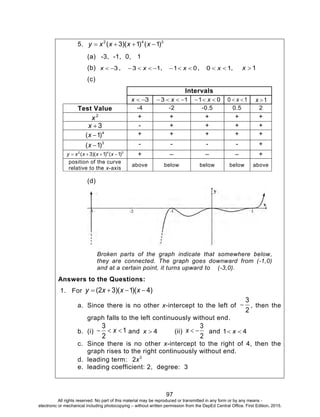
  • 68.
    D EPED C O PY 129 Provide the studentswith an opportunity to derive the relationship between the measures of the central angle and the measure of its intercepted arc. Ask them to perform Activity 3. In this activity, students will measure the angles of the given figures using a protractor. Ask them to get the sum of the angles in the first figure as well as the sum of the central angles in the second figure. Ask them also to identify the intercepted arc of each central angle. Emphasize that the sum of the angles formed by the coplanar rays with common vertex but with no common interior points is equal to the sum of the central angles formed by the radii of a circle with no common interior points. Activity 3: Measure Me and You Will See… Answer Key 1. a. 105 d. 90 b. 75 e. 30 c. 60 2. a. 105 d. 90 b. 75 e. 30 c. 60 3. In each figure, the angles have a common vertex. 4. 360 ; 360 5. 360 6. 360 7. Central Angle Measure Intercepted Arc 1. FAB 105 FB 2. BAC 75 BC 3. CAD 60 CD 4. EAD 90 ED 5. EAF 30 EF 8. 360 because the measure of the central angle is equal to the measure of its intercepted arc. 9. Equal All rights reserved. No part of this material may be reproduced or transmitted in any form or by any means - electronic or mechanical including photocopying – without written permission from the DepEd Central Office. First Edition, 2015.
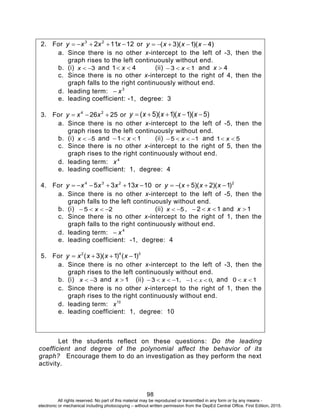
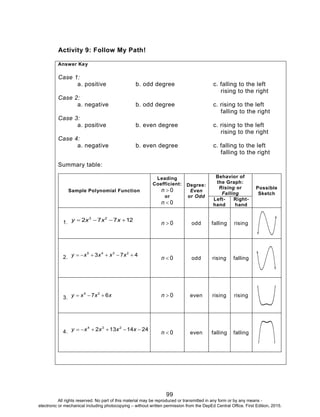
  • 69.
    D EPED C O PY 130 Present a real-lifesituation to the students to develop their understanding of arcs and central angles of circles. In this activity, ask them to find the degree measure of each arc of the wheel and also the angle formed at the hub. Ask them further the importance of the spokes of the wheel. Activity 4: Travel Safely Before proceeding to the next activities, let the students give a brief summary of what they have learned so far. Provide them with an opportunity to relate or connect their responses in the activities given to this lesson. Let the students read and understand some important notes on chords, arcs, and central angles. Tell them to study carefully the examples given. What to PROCESS In this section, let the students apply the key concepts of chords, arcs, and central angles. Tell them to use the mathematical ideas and the examples presented in the preceding section to answer the activities provided. Ask the students to perform Activity 5. In this activity, the students will identify and name arcs and central angles in the given circle and explain how they identified them. Answer Key a. 60 ; 60 b. Evaluate students’ responses All rights reserved. No part of this material may be reproduced or transmitted in any form or by any means - electronic or mechanical including photocopying – without written permission from the DepEd Central Office. First Edition, 2015.
  • 70.
    D EPED C O PY 131 Activity 5: Identifyand Name Me In activities 6, 7, and 8, ask the students to apply the different geometric relationships in finding the degree measure of the central angles, the arcs that the angles intercept, and the lengths of chords. Then, let them explain how they arrived at their answers. Answer Key 1. LMH (or LGH ) and LKH (or LJH );JKM (or JLM ) and JGM (or JHM ) 2. Minor Arcs Major Arcs JK KMJ KL KGL LM LJM MG MKG HG HKG JH JMH Note: There are many ways of naming the major arcs. The given answers are just some of those ways. 3. Some Possible Answers: LAM ; MAG ; GAH ; JAH ; JAK ; LAK Questions: a. A semicircle is an arc with measure equal to one-half of the circumference of a circle and is named by using the two endpoints and another point on the arc. A minor arc is an arc of a circle that measures less than the semicircle. It is named by using the two endpoints on the circle. A major arc is an arc of a circle that measures greater than the semicircle. It is named by using the two endpoints and another point on the arc. A central angle is an angle whose vertex is the center of the circle and with two radii as its sides. b. Yes. A circle has an infinite set of points. Therefore, a circle has many semicircles, arcs, and central angles. All rights reserved. No part of this material may be reproduced or transmitted in any form or by any means - electronic or mechanical including photocopying – without written permission from the DepEd Central Office. First Edition, 2015.
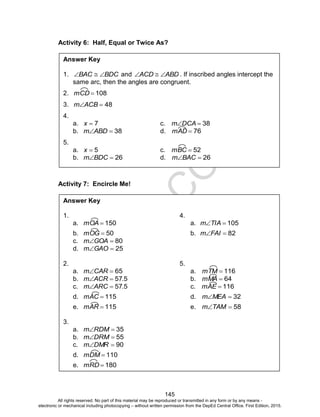
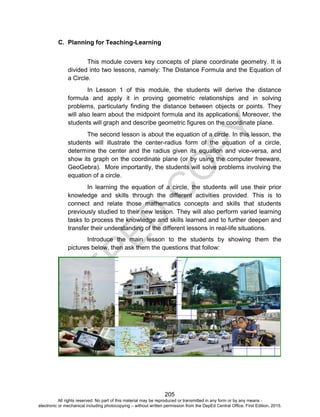
  • 71.
    D EPED C O PY 132 Activity 6: FindMy Degree Measure Activity 7: Find Me! Activity 8: Get My Length Provide the students opportunity to develop their skills in writing proofs. Ask them to complete the proof of a theorem involving the diameter, chord, and arc of a circle by doing Activity 9. If needed, guide the students as they complete the proof of the theorem. Answer Key 1. 90 6. 90 2. 48 7. 48 3. 138 8. 150 4. 42 9. 42 5. 132 10. 132 Answer Key 1. JSO and NSI ; JSN and OSI . They are vertical angles. 2. a. 113 b. 67 c. 67 3. Yes. Yes. Opposite sides of rectangles are congruent. 4. JO and NI ;JN and OI . The central angles that intercept the arcs are congruent. 5. a. 67 d. 113 b. 113 e. 180 c. 67 f. 180 6. NJO ; NIO; JOI ;JNI . The arcs measure 180°. Each arc or semicircle contains the endpoints of the diameter. Answer Key 1. 8 units 5. 24.639  units 2. 2 units 6. 8 units 3. 5 units 7. 29.572  units 4. 24.639  units 8. 581074 . units Note: Evaluate students’ explanations. All rights reserved. No part of this material may be reproduced or transmitted in any form or by any means - electronic or mechanical including photocopying – without written permission from the DepEd Central Office. First Edition, 2015.
  • 72.
    D EPED C O PY 133 Activity 9: MakeMe Complete! Problem: To prove that in a circle, a diameter bisects a chord and an arc with the same endpoints if and only if it is perpendicular to the chord. The proof has two parts. Given: ES is a diameter of U and perpendicular to chord GN at I. Prove: 1. GINI  2. EGEN  3. GSNS  N G E I S U Answer Key Proof of Part 1: We will show that ES bisects GN and the minor arc GN. Statements Reasons 1. U with diameter ES and chord GN ; GNES  Given 2. GIU and NIU are right angles. Definition of perpendicular lines 3. NIUGIU  Right angles are congruent. 4. UNUG  Radii of the same circle are congruent. All rights reserved. No part of this material may be reproduced or transmitted in any form or by any means - electronic or mechanical including photocopying – without written permission from the DepEd Central Office. First Edition, 2015.
  • 73.
    D EPED C O PY 134 Answer Key Proof: Statements Reasons 5.UIUI  Reflexive/Identity Property 6. NIUGIU  HyL Theorem 7. NIGI  Corresponding parts of congruent triangles are congruent (CPCTC). 8. ES bisects GN . Definition of segment bisector 9. NUIGUI  From 6, CPCTC 10. GUI and GUE are the same angles. NUI and NUE are the same angles. E, I, U are collinear. 11. NUEmGUEm  From 9, 10, definition of congruent angles 12. GUEmmEG  NUEmmEN  Degree measure of an arc 13. mEGmEN  From 11, 12, substitution 14. NUSmGUSm  From 11, definition of supplementary angles, angles that are supplementary to congruent angles are congruent. 15. GUSmmGS  NUSmmNS  Degree measure of an arc 16. mGSmNS  From 14, 15, substitution 17. ES bisects GN . Definition of arc bisector All rights reserved. No part of this material may be reproduced or transmitted in any form or by any means - electronic or mechanical including photocopying – without written permission from the DepEd Central Office. First Edition, 2015.
  • 74.
    D EPED C O PY 135 Given: ES isa diameter of U; ES bisects GN at I and the minor arc GN. Combining Parts 1 and 2, the theorem is proven. Have the students apply the knowledge and skills they have learned about arc length, segment, and sector of a circle. Ask the students to perform Activity 10 and Activity 11. Answer Key Proof of Part 2: We will show that GNES  . Statements Reasons 1. U with diameter ES , ES bisects GN at I and the minor arc GN. Given 2. NIGI  NEGE  Definition of bisector 3. UIUI  Reflexive/Identity Property 4. UNUG  Radii of the same circle are congruent. 5. NIUGIU  SSS Postulate 6. UINUIG  CPCTC 7. UIG and UIN are right angles. Angles which form a linear pair and are congruent are right angles. 8. GNIU  Definition of perpendicular lines 9. GNES  IU is on ES N GI U E S All rights reserved. No part of this material may be reproduced or transmitted in any form or by any means - electronic or mechanical including photocopying – without written permission from the DepEd Central Office. First Edition, 2015.
  • 75.
    D EPED C O PY 136 Activity 10: FindMy Arc Length Activity 11: Find This Part! Answer Key 1. 3.925 units 2. 32.5 units or 5.23 units 3. 7.85 units 4. 64.10 units or 10.47 units 5. 8.29 units Questions: a. The area of each shaded region was determined by using the proportion r lA   2360 where A = degree measure of the arc, l = length of the arc, r = radius of the circle. Use the formula for finding the area of a segment and the area of a triangle. b. The proportion r lA   2360 , area of a segment and the area of a triangle were used and so with substitution and the division property. Answer Key 1. 9  cm2 or 28.26 cm2 2. 18 cm2 or 56.52 cm2 3. 52.77 cm2 4. 9.31 cm2 5. 59.04 cm2 6. 40 cm2 Questions: a. The area of the sector is equal to the product of the ratio 360 arctheofmeasure and the area of the circle. Subtract the area of the triangle from the area of the sector. b. Area of a circle, area of a triangle, ratio, equilateral triangle, and regular pentagon All rights reserved. No part of this material may be reproduced or transmitted in any form or by any means - electronic or mechanical including photocopying – without written permission from the DepEd Central Office. First Edition, 2015.
  • 76.
    D EPED C O PY 137 What to REFLECTon and UNDERSTAND Ask the students to take a closer look at some aspects of the geometric concepts contained in this lesson. Provide them opportunities to think deeply and test further their understanding of the lesson by doing Activity 12. In this activity, the students will solve problems involving chords, arcs, central angles, area of a segment and a sector, and arc length of a circle. Activity 12: More Circles Please … Answer Key 1. a. 72 b. 3.768 cm c. regular pentagon 2. Yes. There are two pairs of congruent central angles/vertical angles formed and they intercept congruent arcs. 3. a. Yes. because the arcs are intercepted by the same central angle. b. No. Even if the two circles have the same central angles, the lengths of their intercepted arcs are not equal because the 2 circles have different radii. 4. 60. (Evaluate students’ explanations. They are expected to use the proportion r lA   2360 to support their explanations.) 5. Draw two chords on the garden and a perpendicular bisector to each of the chords. The intersection of the perpendicular bisectors to the chord is the center of the circular garden. 6. a. Education, because it has the highest budget which is Php12,000.00 Savings & Utilities, because they have the lowest budget which is Php4,500.00 b. Education. It should be given the greater allocation because it is a very good investment. c. Education – 120 Food – 90 Utilities – 45 Savings – 45 Other expenses – 60 d. Get the percentage for each item by dividing the allotted budget by the monthly income, then multiply it by 360. All rights reserved. No part of this material may be reproduced or transmitted in any form or by any means - electronic or mechanical including photocopying – without written permission from the DepEd Central Office. First Edition, 2015.
  • 77.
    D EPED C O PY 138 Before the studentsmove to the next section of this lesson, give a short test (formative test) to find out how well they understood the lesson. Ask them also to write a journal about their understanding of chords, arcs, and central angles. Refer to the Assessment Map. What to TRANSFER Give the students opportunities to demonstrate their understanding of circles by doing a practical task. Let them perform Activity 13. You can ask the students to work individually or in group. In this activity, the students will name 5 objects or cite 5 situations in real life where chords, arcs, and central angles of a circle are illustrated. Then, instruct them to formulate and solve problems out of these objects or situations. Also, ask them to make a circle graph showing the different school fees that students like them have to pay voluntarily like Parents-Teachers Association fee, miscellaneous fee, school paper fee, Supreme Student Government fee, and other fees. Ask them to explain how they applied their knowledge of central angles and arcs of circle in preparing the graph. Then, using the circle graph that they made, ask them to formulate and solve at least two problems involving arcs, central angles, and sectors of a circle. Activity 13: My Real World Answer Key Evaluate students’ product. You may use the rubric provided. e. Item Sector Arc Length Education 61.654 cm2 52.3 cm Food 490.625 cm2 39.25 cm Utilities 245.3125 cm2 19.625 cm Savings 245.3125 cm2 19.625 cm Other expenses 308.327 cm2 61.26 cm All rights reserved. No part of this material may be reproduced or transmitted in any form or by any means - electronic or mechanical including photocopying – without written permission from the DepEd Central Office. First Edition, 2015.
  • 78.
    D EPED C O PY 139 Summary/Synthesis/Generalization: This lesson wasabout chords, arcs and central angles of a circle, area of a segment and a sector, and arc length of a circle. In this lesson, the students determined the relationship between the measures of the central angle and its intercepted arc. They were also given the opportunity to apply the different geometric relationships among chords, arcs, and central angles in solving problems, complete the proof of a theorem related to these concepts, find the area of a segment and the sector of a circle, and determine the length of an arc. Moreover, the students were asked to name objects and cite real-life situations where chords, arcs, and central angles of a circle are illustrated and the relationships among these concepts are applied. Lesson 1B: Arcs and Inscribed Angles What to KNOW Let the students relate and connect previously learned mathematics concepts to the new lesson, arcs and inscribed angles. As they go through this lesson, tell them to think of this important question: “How do geometric relationships involving arcs and inscribed angles facilitate solving real-life problems and making decisions?” Start the lesson by asking the students to perform Activity 1. In this activity, the students will identify in a given figure the angles and their intercepted arcs. The students should be able to explain how they identified and named these angles and intercepted arcs. All rights reserved. No part of this material may be reproduced or transmitted in any form or by any means - electronic or mechanical including photocopying – without written permission from the DepEd Central Office. First Edition, 2015.
  • 79.
    D EPED C O PY 140 Activity 1: MyAngles and Intercepted Arcs Give the students opportunity to determine the relationship between the measure of an inscribed angle and the measure of its intercepted arc by performing Activity 2. The students should be able to realize in this activity that the measure of an angle inscribed in a circle is one-half the measure of its intercepted arc (or the measure of the intercepted arc is twice the measure of the inscribed angle). Answer Key Angles Arc That the Angle Intercepts MSC MC CSD CD MSD MD MGC MC DGC CD MGD MD 1. Determine the chords having a common endpoint on the circle. The chords are the sides of the angle and the common endpoint on the circle is the vertex. Determine two radii of the circle. The two radii are the sides of the angle and the center of the circle is the vertex. Determine the arc that lies in the interior of the angle with endpoints on the same angle. 2. There are 6 angles and there are also 6 arcs that these angles intercept. 3. An angle intercepts an arc if a point on one side of the angle is an endpoint of the arc. All rights reserved. No part of this material may be reproduced or transmitted in any form or by any means - electronic or mechanical including photocopying – without written permission from the DepEd Central Office. First Edition, 2015.
  • 80.
    D EPED C O PY 141 Activity 2: InscribeMe! Answer Key Possible Responses 1. 2. 3. 60WELm ; 60mLW The measure of the central angle is equal to the measure of its intercepted arc. 4. 30LDWm 5. An inscribed angle is an angle whose vertex is on a circle and whose sides contain chords of the circle. 6. The measure of LDW is one-half the measure of LW . All rights reserved. No part of this material may be reproduced or transmitted in any form or by any means - electronic or mechanical including photocopying – without written permission from the DepEd Central Office. First Edition, 2015.
  • 81.
    D EPED C O PY 142 Activity 3 isrelated to Activity 2. In this activity, the students will determine the relationship that exists when an inscribed angle intercepts a semicircle. They should be able to find out that the measure of an inscribed angle that intercepts a semicircle is 90°. Activity 3: Intercept Me so I Won’t Fall! Answer Key 1. 2. 3. 4. 5. a. 90MOTm b. 90MUTm c. 90MNTm The measures of the three angles are equal. Each angle measures 90°. The measure of an inscribed angle intercepting a semicircle is 90°. The measures of inscribed angles intercepting the same arc are equal. Answer Key 7. Draw other inscribed angles of the circle. Determine the measures of these angles and the degree measures of their respective intercepted arcs. (Check students’ drawings.) The measure of an inscribed angle is one-half the degree measure of its intercepted arc. If an angle is inscribed in a circle, then the measure of the angle equals one-half the measure of its intercepted arc (or the measure of the intercepted arc is twice the measure of the inscribed angle). All rights reserved. No part of this material may be reproduced or transmitted in any form or by any means - electronic or mechanical including photocopying – without written permission from the DepEd Central Office. First Edition, 2015.
  • 82.
    D EPED C O PY 143 Develop students’ understandingof the lesson by relating it to a real- life situation. Ask them to determine the mathematics concepts that they can apply to solve the problem presented in Activity 4. Activity 4: One, Two,…, Say Cheese! Answer Key 1. 2. Relationship between the central angle or inscribed angle and the arc that the angle intercepts. 3. Go farther from the house until the entire house is seen on the eye piece or on the LCD screen viewer of the camera. 80° 40° New location where Janel could photograph the entire house with the telephoto lens All rights reserved. No part of this material may be reproduced or transmitted in any form or by any means - electronic or mechanical including photocopying – without written permission from the DepEd Central Office. First Edition, 2015.
  • 83.
    D EPED C O PY 144 Before proceeding tothe next section of this lesson, let the students give a brief summary of the activities done. Provide them with an opportunity to relate or connect their responses in the activities given to their new lesson, Arcs and Inscribed Angles. Let the students read and understand some important notes on the different geometric relationships involving arcs and inscribed angles and let them study carefully the examples given. What to PROCESS Give the students opportunities to use the different geometric relationships involving arcs and inscribed angles, and the examples presented in the preceding section to perform the succeeding activities. Ask the students to perform Activities 5, 6, and 7. In these activities, they will identify the inscribed angles and their intercepted arcs, and apply the theorems pertaining to these geometric concepts and other mathematics concepts in finding their degree measures. Provide the students opportunities to explain their answers. Activity 5: Inscribe, Intercept, then Measure Answer Key 1. LCA , LCE , ACE , ALC , CAE , CAL , LAE , and AEC 2. a. CAL b. ACE c. LCE and LAE d. ALC and AEC 3. a. 281m d. 564 m g. 287 m b. 622 m e. 1245 m h. 628 m c. 623 m f. 566 m i. 629 m 4. a. 52mCL c. 52mAE b. 128mAC d. 128mLE All rights reserved. No part of this material may be reproduced or transmitted in any form or by any means - electronic or mechanical including photocopying – without written permission from the DepEd Central Office. First Edition, 2015.
  • 84.
    D EPED C O PY 145 Activity 6: Half,Equal or Twice As? Activity 7: Encircle Me! Answer Key 1. BDCBAC  and ABDACD  . If inscribed angles intercept the same arc, then the angles are congruent. 2. 108mCD 3. 48ACBm 4. a. 7x c. 38DCAm b. 38ABDm d. 76mAD 5. a. 5x c. 52mBC b. 26BDCm d. 26BACm Answer Key 1. 4. a. 150mOA a. 105TIAm b. 50mOG b. 82FAIm c. 80GOAm d. 25GAOm 2. 5. a. 65CARm a. 116mTM b. 557.ACRm  b. 64mMA c. 557.ARCm  c. 116mAE d. 115mAC d. 32MEAm e. 115mAR e. 58TAMm 3. a. 35RDMm b. 55DRMm c. 90DMRm d. 110mDM e. 180mRD All rights reserved. No part of this material may be reproduced or transmitted in any form or by any means - electronic or mechanical including photocopying – without written permission from the DepEd Central Office. First Edition, 2015.
  • 85.
    D EPED C O PY 146 In Activity 8,ask the students to complete the proof of the theorem on inscribed angle and its intercepted arc. This activity would further develop their skills in writing proofs which they need in proving other geometric relationships. Activity 8: Complete to Prove! Problem: To prove that if an angle is inscribed in a circle, then the measure of the angle equals one-half the measure of its intercepted arc (or the measure of the intercepted arc is twice the measure of the inscribed angle). Case 1: Given: PQR inscribed in S and PQ is a diameter. Prove: PRPQR m 2 1 m  Draw RS and let xPQR m . P R Q S x All rights reserved. No part of this material may be reproduced or transmitted in any form or by any means - electronic or mechanical including photocopying – without written permission from the DepEd Central Office. First Edition, 2015.
  • 86.
    D EPED C O PY 147 What to REFLECTon and UNDERSTAND Provide the students with opportunities to think deeply and test further their understanding of the lesson. Let them prove the different theorems on arcs and inscribed angles of a circle and other geometric relationships by performing Activity 9 and Activity 10. Moreover, ask the students to solve the problems in Activity 11 for them to realize the wide applications of the lesson in real life. Answer Key Statements Reasons 1. PQR inscribed in S and PQ is a diameter. Given 2. RSQS  Radii of a circle are congruent. 3. QRS is an isosceles  . Definition of isosceles triangle 4. QRSPQR  The base angles of an isosceles triangle are congruent. 5. QRSPQR  mm The measures of congruent angles are equal. 6. xQRS m Transitive Property 7. xPSR 2m  The measure of an exterior angle of a triangle is equal to the sum of the measures of its remote interior angles. 8. PRPSR mm  The measure of a central angle is equal to the measure of its intercepted arc. 9. xPR 2m  Transitive Property 10.  PQRPR  m2m Substitution 11. PRQRS m 2 1 m  Multiplication Property of Equality All rights reserved. No part of this material may be reproduced or transmitted in any form or by any means - electronic or mechanical including photocopying – without written permission from the DepEd Central Office. First Edition, 2015.
  • 87.
    D EPED C O PY 148 Activity 9: ProveIt or Else …! Answer Key 1. Case 3 Given: SMC inscribed in A. Prove: Cm 2 1 m SSMC  To prove: Draw diameter MP. Answer Key 1. Case 2 Given: KLM inscribed in O. Prove: KMKLM m 2 1 m  To prove: Draw diameter LN. Proof: Statements Reasons KNKLN m 2 1 m  and MNMLN m 2 1 m  The measure of an inscribed angle is one-half the measure of its intercepted arc (Case 1). MNKNMLNKLN m 2 1 m 2 1 mm  or  MNKNMLNKLN mm 2 1 mm  Addition Property KLMMLNKLN  mmm Angle Addition Postulate KMMNKN mmm  Arc Addition Postulate KMKLM m 2 1 m  Substitution All rights reserved. No part of this material may be reproduced or transmitted in any form or by any means - electronic or mechanical including photocopying – without written permission from the DepEd Central Office. First Edition, 2015.
  • 88.
    D EPED C O PY 149 Proof: Statements Reasons Sm 2 1 m PPMS and PCPMC m 2 1 m  The measure of an inscribed angle is one-half the measure of its intercepted arc (Case 1). PMCSMCPMS  mmm or PMSPMCSMC  mmm Angle Addition Postulate PCSCPS mmm  or PSPCSC mmm  Arc Addition Postulate PSPCPMSPMC m 2 1 m 2 1 mm  or  PSPCPMSPMC mm 2 1 mm  By Subtraction Cm 2 1 m SSMC  Substitution 2. Given: In T, PR and AC are the intercepted arcs of PQR and ABC , respectively. ACPR  Prove: ABCPQR  Proof: Statements Reasons ACPR  Given ACPR mm  Congruent arcs have equal measures. PRPQR m 2 1 m  and ACABC m 2 1 m  The measure of an inscribed angle is one-half the measure of its intercepted arc. ACPQR m 2 1 m  Substitution ABCPQR  mm Transitive Property ABCPQR  Angles with equal measures are congruent. All rights reserved. No part of this material may be reproduced or transmitted in any form or by any means - electronic or mechanical including photocopying – without written permission from the DepEd Central Office. First Edition, 2015.
  • 89.
    D EPED C O PY 150 3. Given: InC, GML intercepts semicircle GEL. Prove: GML is a right angle. Proof: Statements Reasons GML intercepts semicircle GEL. Given 180m GEL The degree measure of a semicircle is 180. GELGML m 2 1 m  The measure of an inscribed angle is one-half the measure of its intercepted arc.  180 2 1 m GML or 90m GML Substitution GML is a right angle. Definition of right angle 4. Given: Quadrilateral WIND is inscribed in Y . Prove: 1. W and N are supplementary. 2. I and D are supplementary. To prove: Draw WY , IY , NY , and DY . Proof: Statements Reasons 360mmmm  DYWNYDIYNWYI The sum of the measures of the central angles of a circle is 360. WIWYI mm  , INIYN mm  , NDNYD mm  , and DWDYW mm  The measure of a central angle is equal to the measure of its intercepted arc. 360mmmm  DWNDINWI Substitution 360mm  DWIDNI Arc Addition Postulate All rights reserved. No part of this material may be reproduced or transmitted in any form or by any means - electronic or mechanical including photocopying – without written permission from the DepEd Central Office. First Edition, 2015.
  • 90.
    D EPED C O PY 151 Activity 10: Proveto Me if You Can! Answer Key 1. Given: MT and AC are chords of D. and ATMC  , Prove: THACHM  . Proof Statements Reasons 1. MT and AC are chords of D and .MC AT Given 2. MCA , ATM , CMT , and CAT are inscribed angles. Definition of inscribed angle 3. ATMMCA  and CATCMT  Inscribed angles intercepting the same arc are congruent. 4. THACHM  ASA Congruence Postulate M A T D C H Answer Key Statements Reasons DNIDWI m 2 1 m  and DWIDNI m 2 1 m  The measure of an inscribed angle is one-half the measure of its intercepted arc. DWIDNIDNIDWI m 2 1 m 2 1 mm  or  DWIDNIDNIDWI mm 2 1 mm  By Addition  360 2 1 mm  DNIDWI or 180mm  DNIDWI Substitution W and N are supplementary. Definition of supplementary angles 360mmmm  DNIW The sum of the measures of the angles of a quadrilateral is 360. 360180mm  DI Substitution 180mm  DI Addition Property I and D are supplementary. Definition of supplementary angles All rights reserved. No part of this material may be reproduced or transmitted in any form or by any means - electronic or mechanical including photocopying – without written permission from the DepEd Central Office. First Edition, 2015.
  • 91.
    D EPED C O PY 152 Answer Key 2. Given:Quadrilateral DRIV is inscribed in E. RV is a diagonal that passes through the center of the circle. IVDV  Prove: RVIRVD  Proof: Statements Reasons 1. RV is a diagonal that passes through the center of the circle Given 2. RVRV  Reflexive Property 3. VRIDRV  Inscribed angles intercepting the same arc are congruent. 4. RIV and RDV are semicircles. Definition of semicircle 5. RDV and RIV are right angles. Inscribed angle intercepting a semicircle measures 90° 6. RVD and RVI are right triangles. Definition of right triangle 7. RVIRVD  Hypotenuse-Angle Congruence Theorem 3. Given: In A, NESE  and .SC NT Prove: TNECSE  Proof: Statements Reasons 1. NESE  and NTSC  Given 2. NESE  and NTSC  If two arcs are congruent, then the chords joined by their respective endpoints are also congruent. 3. mNEmSE  and mNTmSC  Congruent arcs have equal measures. 4. mECmSCmSE  and mETmNTmEN  Arc Addition Postulate E I V R D S E N T A C All rights reserved. No part of this material may be reproduced or transmitted in any form or by any means - electronic or mechanical including photocopying – without written permission from the DepEd Central Office. First Edition, 2015.
  • 92.
    D EPED C O PY 153 Activity 11: TakeMe to Your Real-World! Answer Key 1. a. 72° b. 36°. The measure of an inscribed angle is one-half the measure of its intercepted arc. 2. Rectangle. In a circle, there is only one chord that can be drawn parallel and congruent to another chord in the same circle. Moreover, the diagonals of the parallelogram are also the diameters of the circle. Hence, each inscribed angle formed by the adjacent sides of the parallelogram intercepts a semicircle and measures 90°. 3. 38°. If EG is drawn, the viewing angles of Joanna, Clarissa, and Juliana intercept the same arc. Hence, the viewing angles of Joanna and Juliana measure the same as the viewing angle of Clarissa. 4. Mang Ador has to draw two inscribed angles on the circle such that each measures 90°. Then, connect the other endpoints of the sides of each angle to form the diameter. The point of intersection of the two diameters is the center of the circle. 5. a. PQR is a right triangle. b. The length of RS is the geometric mean of the lengths of PS and QS . c. PS = 6 in.; QS = 2 in.; RS = 32 in. d. 34RT in. and 34MN in. Answer Key Statements Reasons 1. mETmEC  Substitution 2. ETEC  Definition of Congruence 3. Draw chord CT . Definition of chord of a circle 4. ETCECT  Inscribed angles intercepting congruent arcs are congruent. 5. CET is an isosceles triangle. Definition of isosceles triangle. 6. TECE  The legs of an isosceles triangle are congruent. 7. TNECSE  SSS Congruence Postulate All rights reserved. No part of this material may be reproduced or transmitted in any form or by any means - electronic or mechanical including photocopying – without written permission from the DepEd Central Office. First Edition, 2015.
  • 93.
    D EPED C O PY 154 Before the studentsmove to the next section of this lesson, give a short test (formative test) to find out how well they understood the lesson. Ask them also to write a journal about their understanding of arcs and inscribed angles. Refer to the Assessment Map. What to TRANSFER Give the students opportunities to demonstrate their understanding of the geometric relationships involving arcs and inscribed angles. In Activity 12, ask the students to make a design of a stage where a special event will be held. Tell them to include in the design some circular objects that illustrate the use of inscribed angles and arcs of a circle, and explain how they applied these concepts in preparing the design. Then, ask them to formulate and solve problems out of the design they made. You can ask the students to work individually or in groups. Activity 12: How special is the event? Summary/Synthesis/Generalization: This lesson was about arcs and inscribed angles of a circle. In this lesson, the students were given the opportunity to determine the geometric relationships that exist among arcs and inscribed angles of a circle, apply these in solving problems, and prove related theorems. Moreover, they were given the chance to formulate and solve real-life problems involving these geometric concepts out of the product they were asked to come up with as a demonstration of their understanding of the lesson. Answer Key Evaluate students’ product. You may use the given rubric. All rights reserved. No part of this material may be reproduced or transmitted in any form or by any means - electronic or mechanical including photocopying – without written permission from the DepEd Central Office. First Edition, 2015.
  • 94.
    D EPED C O PY 155 Lesson 2A: Tangentsand Secants of a Circle What to KNOW Assess students’ prior mathematical knowledge and skills that are related to tangents and secants of a circle. This would facilitate teaching and guide the students in understanding the different geometric relationships involving tangents and secants of a circle. Start the lesson by asking the students to perform Activity 1. This activity would lead them to some geometric relationships involving tangents and segments drawn from the center of the circle to the point of tangency. That is, the radius of a circle that is drawn to the point of tangency is perpendicular to the tangent line and is also the shortest segment. Activity 1: Measure then Compare! Answer Key 1. Use a compass to draw S. 2. Draw line m such that it intersects S at exactly one point. Label the point of intersection as T. 3. Connect S and T by a line segment. What is TS in the figure drawn? TS is a radius of S. All rights reserved. No part of this material may be reproduced or transmitted in any form or by any means - electronic or mechanical including photocopying – without written permission from the DepEd Central Office. First Edition, 2015.
  • 95.
    D EPED C O PY 156 4. Mark fourother points on line m such that two of these points are on the left side of T and the other two points are on the right side. Label these points as M, N, P, and Q, respectively. 5. Using a protractor, find the measures of MTS , NTS , PTS, and QTS . How do the measures of the four angles compare? The four angles have equal measures. Each angle measures 90°. 6. Repeat step 2 to 5. This time, draw line n such that it intersects the circle at another point. Name this point V. The four angles, AVS , BVS , DVS , and EVS have equal measures. Each angle measures 90°. All rights reserved. No part of this material may be reproduced or transmitted in any form or by any means - electronic or mechanical including photocopying – without written permission from the DepEd Central Office. First Edition, 2015.
  • 96.
    D EPED C O PY 157 7. Draw MS, NS , PS , and QS . 8. Using a ruler, find the lengths of TS , MS , NS , PS , andQS . How do the lengths of the five segments compare? The lengths of the five segments, TS , MS , NS , PS , and QS are not equal. What do you think is the shortest segment from the center of a circle to the line that intersects it at exactly one point? Explain your answer. The shortest segment from the center of a circle to the line that intersects the circle at exactly one point is the segment perpendicular to the line. Whereas, the other segments become the hypotenuses of the right triangles formed. Recall that the hypotenuse is the longest side of a right triangle. All rights reserved. No part of this material may be reproduced or transmitted in any form or by any means - electronic or mechanical including photocopying – without written permission from the DepEd Central Office. First Edition, 2015.
  • 97.
    D EPED C O PY 158 Provide the studentswith opportunities to investigate relationships among arcs and angles formed by secants and tangents. Ask them to perform Activity 2 and Activity 3. Let the students realize the following geometric relationships: 1. If two secants intersect on a circle, then the measure of the angle formed is one-half the measure of the intercepted arc. (Note: Relate this to the relationship between the measure of the inscribed angle and the measure of its intercepted arc.) 2. If a secant and a tangent intersect in the exterior of a circle, then the measure of the angle formed is one-half the positive difference of the measures of the intercepted arcs. 3. If a secant and a tangent intersect at the point of tangency, then the measure of each angle formed is one-half the measure of its intercepted arc. 4. If two secants intersect in the exterior of a circle, then the measure of the angle formed is one-half the positive difference of the measures of the intercepted arcs. 5. If two tangents intersect in the exterior of a circle, then the measure of the angle formed is one-half the positive difference of the measures of the intercepted arcs. 6. If two secants intersect in the interior of a circle, then the measure of an angle formed is one-half the sum of the measures of the arcs intercepted by the angle and its vertical angle. All rights reserved. No part of this material may be reproduced or transmitted in any form or by any means - electronic or mechanical including photocopying – without written permission from the DepEd Central Office. First Edition, 2015.
  • 98.
    D EPED C O PY 159 Activity 2: InvestigateMe! Answer Key 1. Which lines intersect circle C at two points? AD, AE, DG, How about the lines that intersect the circle at exactly one point? BG 2. What are the angles having A as the vertex? DAG,DAB,EAG,DAE  . There are still other angles with A as the vertex, but for the purpose of our new lesson, we consider these angles. C as the vertex? DCE,ECF,ACG,ACD  D as the vertex? .ADG There are still other angles with D as the vertex but for the meantime, we only consider this. G as the vertex? AGD. There are still other angles with G as the vertex but for the meantime, we only consider this. 3. DAB AD DCE DE DAE DE ACD AD DAG DEA ACF AF EAG EFA ECF EF ADF AF AGD AF and AD 4. DAE and DCE DE DAB , DCA , and AGD AD ACF , ADF , and AGD AF 5. 4334.DAEm  8768.ACGm  90EAGm  111.14m ECF 5755.DABm   m DCE 68.87 43124.DAGm  4334.ADGm   111.14m ACD 1321.AGDm  All rights reserved. No part of this material may be reproduced or transmitted in any form or by any means - electronic or mechanical including photocopying – without written permission from the DepEd Central Office. First Edition, 2015.
  • 99.
    D EPED C O PY 160 Activity 3: FindOut by Yourself! Answer Key 6. Determine the measure of the central angle that intercepts the same arc. The measure of the central angle is equal to the measure of its intercepted arc. mAD= 111.14 mEFA= 180 mDE= 68.86 mEF= 111.14 mDEA= 248.86 mAF= 68.86 7.  DAEmDCEm  2  DAEmmDE  2 . Since mDEDCEm  , then  DAEmmDE  2 . 8.  DABmmAD  2  EAGmmEFA  2 9. mAFmADBGDm  2 1 Answer Key 2. RSTRST is a central angle of S. 4.  mSTRSTm 2 1  6. Yes. mRTmRVTRSTm  2 1 8. Yes. mNTmRTRSTm  2 1 10. Yes. mMNmRTRSTm  2 1 12. Yes.  mMNmRTRSTm  2 1 All rights reserved. No part of this material may be reproduced or transmitted in any form or by any means - electronic or mechanical including photocopying – without written permission from the DepEd Central Office. First Edition, 2015.
  • 100.
    D EPED C O PY 161 Let the studentsgive their realizations of the activities done before proceeding to the next activities. Provide them with an opportunity to relate or connect their responses to the activities given in their lesson, tangents and secants of a circle. Let the students read and understand some important notes on tangents and secants of a circle and study carefully the examples given. What to PROCESS In this section, let the students use the geometric concepts and relationships they have studied and the examples presented in the preceding section to answer the succeeding activities. Present to the students the figure given in Activity 4. In this activity, the students should be able to identify the tangents and secants in the figure including the angles that they form and the arcs that these angles intercept. They should be able to determine also the unknown measure of the angle formed by secants intersecting in the exterior of the circle. Give emphasis to the geometric relationship the students applied in finding the measure of the angle. Provide them opportunities to compare their answers and correct their errors, if there are any. Activity 4: Tangents or Secants? Answer Key 1. KL and LM. Each line intersects the circle at exactly one point. 2. KN and MP. Each line intersects the circle at two points. 3. KNK and N; MPM and P; KLK; LMM 4. There are other angles formed but only these are considered. KOM is formed by two secant lines. KLM is formed by two tangent lines. LMP, LKN, PMR, and NKS. Each is formed by a secant and a tangent. 5. PMRMP  , KOMNP  , NKSKN  , KLMKM  , KLMKPM  6. 50KLMm ; mNP = 30 All rights reserved. No part of this material may be reproduced or transmitted in any form or by any means - electronic or mechanical including photocopying – without written permission from the DepEd Central Office. First Edition, 2015.
  • 101.
    D EPED C O PY 162 In Activity 5,provide the students with opportunities to apply the different geometric relationships in finding the measures of the angles formed by tangents and secants and the arcs that these angles intercept. Let them also determine the lengths of segments tangent to circle/s and other segments drawn on a circle. Ask them to support their answers by stating the geometric relationships applied. Activity 5: From One Place to Another What to REFLECT on and UNDERSTAND Let the students think deeply and test further their understanding of the different geometric relationships involving tangents and secants of circles by doing Activity 6. In this activity, they will apply these geometric relationships in solving problems. Answer Key 1. 40ABCm 7. 61PQOm 2. 40MQLm 119PQRm 3. 47PTRm 8. a. 125mPW 133RTSm b. 5.27RPWm 4. a. 10x c. 5.62PRWm b. 65mCG d. 5.27WREm c. 55mAR e. 5.62WERm 5. 71mMC f. 5.62WERm 6. 854OR 9. 546 PQ 24RS 10. a. 6x 24854 KS b. 19ST c. 19RT d. 19AT All rights reserved. No part of this material may be reproduced or transmitted in any form or by any means - electronic or mechanical including photocopying – without written permission from the DepEd Central Office. First Edition, 2015.
  • 102.
    D EPED C O PY 163 Activity 6: Thinkof These Relationships Deeply! Provide the students with opportunities to prove theorems involving tangents and secants of circles. Let them perform Activity 7. Guide the students in writing the proof. If needed, provide hints. Answer Key 1. a. 90RONm ; 90RONm . The radius of a circle is perpendicular to a tangent line at the point of tangency. b. NUDNRO  c. 59NROm d. 41NDUm ; 131DUOm e. 5RO ; 12DN ; 36DU NRO is not congruent to DUN . The lengths of their sides are not equal. 2. LU is tangent to I. SC is also tangent to I. 3. a. LIRL  . If two segments from the same exterior point are tangent to a circle, then the two segments are congruent. b. LTILTR  by HyL Theorem. c. 38ILTm ; 52ITLm ; 52RTLm d. 26TL ; 24LI ; 16AL 4. a. 6SZ b. 3DZ c. 57.CX  d. 57.CY  If two segments from the same exterior point are tangent to a circle, then the two segments are congruent. 5. 555 m 6. a. 55Pm 55Rm 55Sm b. The angle that I will make with the lighthouse must be less than 55°. All rights reserved. No part of this material may be reproduced or transmitted in any form or by any means - electronic or mechanical including photocopying – without written permission from the DepEd Central Office. First Edition, 2015.
  • 103.
    D EPED C O PY 164 Activity 7: Isthis true? Answer Key 1. Given: AB is tangent to C at D. Prove: CDAB  To prove: a. Draw AC b. Assume AB is not perpendicular toCD and ACAB  Proof: Statement Reason AB is not perpendicular toCD and ACAB  . Assumption E is a point on AD such that DADE 2 Ruler Postulate AEDA  Betweenness and Congruence of Segments CADCAE  Right angles are congruent. ACAC  Reflexive Property CEACDA  SAS Congruence Postulate CECD  CPCTC CECD  The lengths of congruent segments are equal. D and E are on C. Definition of circle D and E are the points of intersection of tangent line AB and C is not true. A tangent intersects the circle at exactly one point. CDAB  Only one line can be drawn on a circle that is tangent to it at the point of tangency. 2. Given:RS is a radius of S. RSPQ  Prove: PQ is tangent to S at R. To prove: Draw QS . All rights reserved. No part of this material may be reproduced or transmitted in any form or by any means - electronic or mechanical including photocopying – without written permission from the DepEd Central Office. First Edition, 2015.
  • 104.
    D EPED C O PY 165 Answer Key Proof: Statement Reason RSis a radius of S and RSPQ  . Given QS >RS The shortest segment from the center of a circle to a line tangent to it is the perpendicular segment. Q is not on S. No other point of a tangent line other than the point of tangency lies on a circle. PQ is tangent to S at R. A tangent intersects the circle at exactly one point. 3. Given: EM and EL are tangent to S at M and L, respectively. Prove: ELEM  To prove: Draw MS , LS , and ES . Proof: Statement Reason LSMS  Radii of the same circle are congruent. LSEL  and MSEM  . A line tangent to a circle is perpendicular to the radius. ESES  Reflexive Property   ESM ESL Hypotenuse-Leg Congruence Theorem ELEM  CPCTC All rights reserved. No part of this material may be reproduced or transmitted in any form or by any means - electronic or mechanical including photocopying – without written permission from the DepEd Central Office. First Edition, 2015.
  • 105.
    D EPED C O PY 166 4. a. Given: RSand TS are tangent to V at R and T, respectively, and intersect at the exterior S. Prove: TRTQRRST mm 2 1 m  To prove: Draw RV , TV , and SV . Proof: Statement Reason SVTSVR  (Proven) 90mm  RSVRVS and 90mm  TSVTVS Acute angles of a right triangle are complementary. RVTTVSRVS  mmm Angle Addition Postulate           m 90 90 180 2 RVT x x x Substitution xTR 2180m  The measure of a central angle is equal to the measure of its intercepted arc. 360mm  TRTQR The degree measure of a circle is 360. xTQR 2180m  Substitution and Addition Property of Equality RSTTSVRSV  mmm Angle Addition Postulate x xxTSVRSV 2 mm   By Substitution and Addition xRST 2m  Transitive Property      x xxTRTQR 22 21802180mm   By Substitution and Subtraction All rights reserved. No part of this material may be reproduced or transmitted in any form or by any means - electronic or mechanical including photocopying – without written permission from the DepEd Central Office. First Edition, 2015.
  • 106.
    D EPED C O PY 167 Answer Key  RSTTRTQR m2mm By Substitution TRTQRRST mm 2 1 m  Multiplication Property b. Given:KL is tangent to O at K. NL is a secant that passes through O at M and N. KL and NL intersect at the exterior point L. Prove: MKNPKKLN mm 2 1 m  To prove: Draw KM , MO , and KO . Let xMKLm  so that xMKOm  90 and xKMOm  90 . Proof: Statement Reason  NPKNMK m 2 1 m  The measure of an inscribed angle is one-half the measure of its intercepted arc. NLKMKLNMK  mmm The measure of the exterior angle of a triangle is equal to the sum of the measures of its remote interior angles. KMKOM mm  The measure of a central angle is equal to the measure of its intercepted arc. All rights reserved. No part of this material may be reproduced or transmitted in any form or by any means - electronic or mechanical including photocopying – without written permission from the DepEd Central Office. First Edition, 2015.
  • 107.
    D EPED C O PY 168 90mm  MKOMKL Thesum of the measures of complementary angles is 90. 180mmm  KOMMKOKMO The sum of the measures of the interior angle of a triangle is 180 xKOM 2m  Addition Property xKM 2m  Transitive Property   KMMKL mm2  or  KMMKL m 2 1 m  Multiplication Property     MKLNMKKMNPK  mmm 2 1 m 2 1 MKLNLKMKL  mmm NLK m By Subtraction KMNPKNLK mm 2 1 m  By Substitution c. Given: AC is a secant that passes through T at A and B. EC is a secant that passes through T at E and D. AC and EC intersect at the exterior point C. Prove: BDAEACE mm 2 1 m  To prove: Draw AD and BE . All rights reserved. No part of this material may be reproduced or transmitted in any form or by any means - electronic or mechanical including photocopying – without written permission from the DepEd Central Office. First Edition, 2015.
  • 108.
    D EPED C O PY 169 Answer Key Proof: Statement Reason ACEDACADE mmm The measure of the exterior angle of a triangle is equal to the sum of the measures of its remote interior angles.  AEADE m 2 1 m  and  BDDAB m 2 1 m  The measure of an inscribed angle is one- half the measure of its intercepted arc.     DABADEBDAE  mmm 2 1 m 2 1 By Subtraction ACEDACADE  mmm Addition Property    BDAEACE m 2 1 m 2 1 m  or BDAEACE mm 2 1 m  Transitive Property 5. Given: PR and QS are secants intersecting in the interior of V at T. PS and QR are the intercepted arcs of PTS and QTR . Prove:  QRPSPTS mm 2 1 m  To prove: Draw RS . All rights reserved. No part of this material may be reproduced or transmitted in any form or by any means - electronic or mechanical including photocopying – without written permission from the DepEd Central Office. First Edition, 2015.
  • 109.
    D EPED C O PY 170 Proof: Statement Reason  PSPRSm 2 1 m  and  QRQSR m 2 1 m  The measure of an inscribed angle is one-half the measure of its intercepted arc. QSRPRSQTR  mmm The measure of the exterior angle of a triangle is equal to the sum of the measures of its remote interior angles.    QRPSQTR m 2 1 m 2 1 m  or QRPSQTR mm 2 1 m  Substitution PTSQTR  mm The measures of vertical angles are equal. QRPSPTS mm 2 1 m  Transitive Property 6. Given: MP and LN are secant and tangent, respectively, and intersect at C at the point of tangency, M. Prove:  MPNMP m 2 1 m  and  MKPLMP m 2 1 m  To prove: Draw OP and OM . Let xNMP m so that xOMP  90m and xOPM  90m . All rights reserved. No part of this material may be reproduced or transmitted in any form or by any means - electronic or mechanical including photocopying – without written permission from the DepEd Central Office. First Edition, 2015.
  • 110.
    D EPED C O PY 171 Before the studentsmove to the next section of this lesson, give a short test (formative test) to find out how well they understood the lesson. Ask them also to write a journal about their understanding of tangents and secants of a circle. Refer to the Assessment Map. Answer Key Proof: Statement Reason MPMOP mm  The measure of a central angle is equal to the measure of its intercepted arc. 90mm  OMPNMP The sum of the measures of complementary angles is 90. 180mmm  MOPOPMOMP The sum of the measures of a triangle is 180. xMOP 2m  Addition Property xMP 2m  Transitive Property  NMPMP  m2m Substitution  MPNMP m 2 1 m  Multiplication Property 360mm  MKPMP The degree measure of a circle is 360. xMKP 2360m  By Substitution and Subtraction  xMKP  1802m By Factoring xLMP  9090m or xLMP  180m Angle Addition Postulate  LMPMKP  m2m Substitution  MKPLMP m 2 1 m  Multiplication Property All rights reserved. No part of this material may be reproduced or transmitted in any form or by any means - electronic or mechanical including photocopying – without written permission from the DepEd Central Office. First Edition, 2015.
  • 111.
    D EPED C O PY 172 What to TRANSFER Givethe students opportunities to demonstrate their understanding of the different geometric relationships involving tangents and secants of circles by doing a practical task. Let them perform Activity 8. You can ask the students to work individually or in a group. In this activity, the students will formulate and solve problems involving tangents and secants of circles as illustrated in some real-life objects. Activity 8: My Real World Summary/Synthesis/Generalization: This lesson was about the geometric relationships involving tangents and secants of a circle, the angles they form and the arcs that these angles intercept. The lesson provided the students with opportunities to derive geometric relationships involving radius of a circle drawn to the point of tangency, investigate relationships among arcs and angles formed by secants and tangents, and apply these in solving problems. Moreover, they were given the chance to prove the different theorems on tangents and secants and demonstrate their understanding of these concepts by doing a practical task. Their understanding of this lesson and other previously learned mathematics concepts and principles will facilitate their learning of the wide applications of circles in real life. Answer Key Evaluate students’ product. You may use the rubric provided. All rights reserved. No part of this material may be reproduced or transmitted in any form or by any means - electronic or mechanical including photocopying – without written permission from the DepEd Central Office. First Edition, 2015.
  • 112.
    D EPED C O PY 173 Lesson 2B: Tangentand Secant Segments What to KNOW Find out how much students have learned about the different mathematics concepts previously studied and their skills in performing mathematical operations. Checking these will facilitate teaching and students’ understanding of the geometric relationships involving tangent and secant segments. Tell them that as they go through this lesson, they have to think of this important question: How do geometric relationships involving tangent and secant segments facilitate solving real-life problems and making decisions? Provide the students with opportunities to enhance further their skills in finding solutions to mathematical sentences previously studied. Let them perform Activity1. In this activity, the students will solve linear and quadratic equations in one variable. These mathematical skills are prerequisites to learning the geometric relationships involving tangent and secant segments. Ask the students to explain how they arrived at the solutions and how they applied the mathematics concepts or principles in solving each mathematical sentence. Activity 1: What is my value? Present to the students the figure in Activity 2. Then, let them identify the tangent and secant lines and the chords, name all the segments they can see, and describe a point in relation to the circle. This activity has something to do with the lesson. Let the students relate this to the succeeding activities. Answer Key 1. 9x 6. 5x 2. 5x 7. 8x 3. 6x 8. 32x 4. 9x 9. 53x 5. 12x 10. 54x Questions: a. Applying the Division Property of Equality and Extracting Square Roots b. Division Property of Equality and Extracting Square Roots All rights reserved. No part of this material may be reproduced or transmitted in any form or by any means - electronic or mechanical including photocopying – without written permission from the DepEd Central Office. First Edition, 2015.
  • 113.
    D EPED C O PY 174 Activity 2: MySegments Ask the students to perform Activity 3 to determine the relationship that exists among segments formed by intersecting chords of a circle. In this activity, the students might not be able to arrive at the accurate measurements of the chords due to the limitations of the measuring instrument to be used. If possible, use math freeware like GeoGebra in performing the activity. Activity 3: What is true about my chords? Present to the students a situation that would capture their interest and develop their understanding of the lesson. Let them perform Activity 4. In this activity, the students will determine the mathematics concepts or principles to solve the given problem. Answer Key 1. JL - tangent; JS - secant; AS ; AT ; LN - chords 2. NE ; ET ; AE ; EL 3. AS ; AJ ; JL 4. A point outside the circle Answer Key 1-2. 3. a. BA= 2.8 units c. MA = 1.95 units b. TA = 2.8 units d. NA= 4.02 units 4. The product of BAand TA is equal to the product of MA and NA. 5. If two chords of a circle intersect, then the product of the measures of the segments of one chord is equal to the product of the measures of the segments of the other chord. (Emphasize this idea.) All rights reserved. No part of this material may be reproduced or transmitted in any form or by any means - electronic or mechanical including photocopying – without written permission from the DepEd Central Office. First Edition, 2015.
  • 114.
    D EPED C O PY 175 Activity 4: FlyMe to Your World Ask the students to summarize the activities done before proceeding to the next activities. Provide them with an opportunity to relate or connect their responses in the activities given to their new lesson, Tangent and Secant Segments. Let the students read and understand some important notes on tangent and secant segments and study carefully the examples given. What to PROCESS Let the students use the different geometric relationships involving tangent and secant segments and the examples presented in the preceding section to answer the succeeding activities. In Activity 5, the students will name the external secant segments in the given figures. This activity would familiarize them with the geometric concept and facilitate problem solving. Activity 5: Am I away from you? Answer Key 1. d = 27.67 km 2. External secant segment, tangent, Pythagorean theorem Answer Key 1. IM and IL 2. TS and DS 3. OS 4. IR 5. LF and WE 6. IH , FG , IJ , EF , AK , DC All rights reserved. No part of this material may be reproduced or transmitted in any form or by any means - electronic or mechanical including photocopying – without written permission from the DepEd Central Office. First Edition, 2015.
  • 115.
    D EPED C O PY 176 Have the studentsapply the different theorems involving chords and tangent and secant segments to find the unknown lengths of segments on a circle and solve related problems. Ask the students to perform Activity 6 and Activity 7. Activity 6: Find My Length! Activity 7: Try to Fit! Answer Key 1. 8x units 6. 5.10x units 2. 8x units 7. 8.4x units 3. 9x units 8. 15x units 4. 5x units 9. 32.6102 x units 5. 64.6x units 10. 4x units Questions: a. The theorems on two intersecting chords, secant segments, tangent segments, and external secant segments were applied. b. Evaluate students’ responses. Answer Key 1. Possible answer: 2. a. VU = 4.57 units b. XU = 8 units All rights reserved. No part of this material may be reproduced or transmitted in any form or by any means - electronic or mechanical including photocopying – without written permission from the DepEd Central Office. First Edition, 2015.
  • 116.
    D EPED C O PY 177 What to REFLECTon and UNDERSTAND Test further students’ understanding of the different geometric relationships involving tangent and secant segments including chords by doing Activity 8 and Activity 9. Let the students prove the different theorems on intersecting chords, secant segments, tangent segments, and external secant segments and solve problems involving these concepts. Activity 8: Prove Me Right! Answer Key 1. Given: AB and DE are chords of C intersecting at M. Prove: EMDMBMAM  To prove: Draw AE and BD . Proof: Statement Reason  mBEBAEm 2 1  and  mBEBDEm 2 1  The measure of an inscribed angle is one-half the measure of its intercepted arc. BDEBAE  Inscribed angles intercepting the same arc are congruent. DMB~AME  AA Similarity Theorem DM BM AM EM  Lengths of sides of similar triangles are proportional. EMDMBMAM  Multiplication Property All rights reserved. No part of this material may be reproduced or transmitted in any form or by any means - electronic or mechanical including photocopying – without written permission from the DepEd Central Office. First Edition, 2015.
  • 117.
    D EPED C O PY 178 Answer Key 2. Given:DP and DS are secant segments of T drawn from exterior point D. Prove: DRDSDQDP  To prove: Draw PR and QS . Proof: Statement Reason RSQQPR  and SRPPQS  Inscribed angles intercepting the same arc are congruent. DRPDQS  Supplements of congruent angles are congruent DRP~DQS  AA Similarity Theorem DQ DS DR DP  Lengths of sides of similar triangles are proportional. DRDSDQDP  Multiplication Property 3. Given: KL and KM are tangent and secant segments, respectively of O drawn from exterior point K. KM intersects O at N. Prove: 2 KLKNKM  To prove: Draw LM and LN. All rights reserved. No part of this material may be reproduced or transmitted in any form or by any means - electronic or mechanical including photocopying – without written permission from the DepEd Central Office. First Edition, 2015.
  • 118.
    D EPED C O PY 179 Activity 9: UnderstandMe More … Answer Key 1. Janel. She used the theorem “If two secant segments are drawn to a circle from an exterior point, then the product of the lengths of one secant segment and its external secant segment is equal to the product of the lengths of the other secant segment and its external secant segment.” 2. Gate 1 is 91.65 m from the main road. 3. a. The point of tangency of the two light balls from the ceiling is about 44.72 cm. b. Anton needs about 1967.53 cm of string. Answer Key Proof: Statement Reason  mLNNLKm 2 1  and  mLNLMNm 2 1  The measure of an inscribed angle is one-half the measure of its intercepted arc. LMNmNLKm  Transitive Property LMNNLK  Angles with equal measures are congruent. LMNmNLMmLNKm  The measure of the exterior angle of a triangle is equal to the sum of the measures of its remote interior angles. NLKmNLMmLNKm  Substitution NLKmNLMmKLMm  Angle Addition Postulate KLMmLNKm  Transitive Property KLMLNK  Angles with equal measures are congruent. LNM~MKL  AA Similarity Theorem KN KL KL KM  Lengths of sides of similar triangles are proportional. 2 KLKNKM  Multiplication Property All rights reserved. No part of this material may be reproduced or transmitted in any form or by any means - electronic or mechanical including photocopying – without written permission from the DepEd Central Office. First Edition, 2015.
  • 119.
    D EPED C O PY 180 Find out howwell the students understood the lesson by giving a short test (formative test) before proceeding to the next section. Ask them also to write a journal about their understanding of tangent and secant segments. Refer to the Assessment Map. What to TRANSFER Give the students opportunities to demonstrate their understanding of tangent and secant segments including chords of a circle by doing a practical task. Let them perform Activity 10. You can ask the students to work individually or in a group. In Activity 10, the students will make a design of an arch bridge that would connect two places which are separated by a river, 20 m wide. Tell them to indicate on the design the different measurements of the parts of the bridge. The students are expected to formulate and solve problems involving tangent and secant segments out of the design and the measurements of its parts. Activity 10: My True World! Summary/Synthesis/Generalization: This lesson was about the different geometric relationships involving tangents, secants, and chords of a circle. The lesson provided the students with opportunities to derive geometric relationship involving intersecting chords, identify tangent and secant segments, and prove and apply different theorems on chords, tangent, and secant segments. These theorems were used to solve various geometric problems. Understanding the ideas presented in this lesson will facilitate their learning of the succeeding lessons. Answer Key Evaluate students’ product. You may use the rubric provided. All rights reserved. No part of this material may be reproduced or transmitted in any form or by any means - electronic or mechanical including photocopying – without written permission from the DepEd Central Office. First Edition, 2015.
  • 120.
    D EPED C O PY 181 SUMMATIVE TEST Part I Choosethe letter that you think best answers each of the following questions. 1. In the figure on the right, which is an inscribed angle? A. RST B. PQR C. QVT D. QST 2. In F below, AG is a diameter. What is mAD if 65DFGm ? A. 65° B. 115° C. 130° D. 230° 3. Which of the following lines is tangent to F as shown in the figure below? A. DE B. AG C. BD D. AE All rights reserved. No part of this material may be reproduced or transmitted in any form or by any means - electronic or mechanical including photocopying – without written permission from the DepEd Central Office. First Edition, 2015.
  • 121.
    D EPED C O PY 182 4. Quadrilateral ABCDis inscribed in a circle. Which of the following is true about the angle measures of the quadrilateral? I. 180 CmAm II. 180 DmBm III. 90 CmAm A. I and II B. I and III C. II and III D. I, II, and III 5. An arc of a circle measures 72°. If the radius of the circle is 6 cm, about how long is the arc? A. 1.884 cm B. 2.4 cm C. 3.768 cm D. 7.54 cm 6. What is the total measure of the central angles of a circle with no common interior points? A. 480 B. 360 C. 180 D. 120 7. What kind of angle is the inscribed angle that intercepts a semicircle? A. straight B. obtuse C. right D. acute 8. What is the length of AS in the figure on the right? A. 6.92 units C. 14.4 units B. 117 10 units D. 130 9 units 9. Line AB is tangent to C at D. If mDF = 166 and mDE = 78, what is ABFm ? A. 44 B. 61 C. 88 D. 122 All rights reserved. No part of this material may be reproduced or transmitted in any form or by any means - electronic or mechanical including photocopying – without written permission from the DepEd Central Office. First Edition, 2015.
  • 122.
    D EPED C O PY 183 PE U R H A E L T O T H 8 cm 45° 10.Howmany line/s can be drawn through a given point on a circle that is tangent to the circle? A. four B. three C. two D. one 11.In U on the right, what is PREm if 56PUEm ? A. 28 C. 56 B. 34 D. 124 12.In the figure below, TA and HA are secants. If TA = 18 cm, LA = 8 cm, and AE = 10 cm, what is the length of AH in the given figure? A. 18 cm C. 22.5 cm B. 20 cm D. 24.5 cm 13.In O on the right, mHT = 45 and the length of the radius is 8 cm. What is the area of the shaded region in terms of ? A. 6  cm2 C. 10 cm2 B. 8 cm2 D. 12 cm2 All rights reserved. No part of this material may be reproduced or transmitted in any form or by any means - electronic or mechanical including photocopying – without written permission from the DepEd Central Office. First Edition, 2015.
  • 123.
    D EPED C O PY 184 C K L 77° U 96° S 14. In thecircle on the right, what is the measure of SRT if AST is a semicircle and ?74SRAm A. 16 B. 74 C. 106 D. 154 15. Quadrilateral LUCK is inscribed in S. If 96m LUC and ,77m UCK find ULKm . A. 77 B. 84 C. 96 D. 103 16. In S on the right, what is RT if QS = 18 units and VW = 4 units? A. 24 units B. 28 units C. 14 units D. 216 units 17. A circular garden has a radius of 2 m. Find the area of the smaller segment of the garden determined by a 90 arc. A.  2 m2 B. 2 m2 C.  m2 D.  24  m2 R A S T All rights reserved. No part of this material may be reproduced or transmitted in any form or by any means - electronic or mechanical including photocopying – without written permission from the DepEd Central Office. First Edition, 2015.
  • 124.
    D EPED C O PY 185 18. A. 60° B. 75° C.120° D. 150° 19. Mang Jose cut a circular board with a diameter 80 cm. Then, he divided the board into 20 congruent sectors. What is the area of each sector? A. 80 cm2 B. 320 cm2 C. 800 cm2 D. 6001 cm2 20. Mary designed a pendant. It is a regular octagon set in a circle. Suppose the opposite vertices are connected by line segments and meet at the center of the circle. What is the measure of each angle formed at the center? A. 5.22 B. 45 C. 567. D. 135 Part II Solve each of the following problems. Show your complete solutions. 1. Mr. Jaena designed an arch for the top part of a subdivision’s main gate. The arch will be made out of bent iron. In the design, the 16 segments between the two concentric semicircles are each 0.7 meter long. Suppose the diameter of the outer semicircle is 8 meters. What is the length, in whole meters, of the shortest iron needed to make the arch? 2. A rope fits tightly around two pulleys. What is the distance between the centers of the pulleys if the radii of the bigger and smaller pulleys are 10 cm and 6 cm, respectively, and the portion of the rope tangent to the two pulleys is 50 cm long? 30° Karen has a necklace with a circular pendant hanging from a chain around her neck. The chain is tangent to the pendant. If the chain is extended as shown in the diagram on the right, it forms an angle of 30° below the pendant. What is the measure of the arc at the bottom of the pendant? All rights reserved. No part of this material may be reproduced or transmitted in any form or by any means - electronic or mechanical including photocopying – without written permission from the DepEd Central Office. First Edition, 2015.
  • 125.
    D EPED C O PY 186 Rubric for ProblemSolving 4 3 2 1 Used an appropriate strategy to come up with a correct solution and arrived at a correct answer Used an appropriate strategy to come up with a solution, but a part of the solution led to an incorrect answer Used an appropriate strategy but came up with an entirely wrong solution that led to an incorrect answer Attempted to solve the problem but used an inappropriate strategy that led to a wrong solution Part III A: GRASPS Assessment Perform the following. Goal: To prepare the different student formations to be done during a field demonstration Role: Student assigned to prepare the different formations to be followed in the field demonstration Audience: The school principal, your teacher, and your fellow students Situation: Your school has been selected by the municipal/city government to perform a field demonstration as part of a big local event where many visitors and spectators are expected to arrive and witness the said occasion. The principal of your school designated one of your teachers to organize and lead the group of students who will perform the field demonstration. Being one of the students selected to perform during the activity, your teacher asked you to plan the different student formations for the field demonstration. In particular, your teacher instructed you to include arrangements that show geometric figures such as circles, arcs, tangents, and secants. Your teacher also asked you to make a sketch of the various formations and include the order in which these will be performed by the group. All rights reserved. No part of this material may be reproduced or transmitted in any form or by any means - electronic or mechanical including photocopying – without written permission from the DepEd Central Office. First Edition, 2015.
  • 126.
    D EPED C O PY 187 Products: Sketches ofthe different formations to be followed in the field demonstrations including the order and manner on how each will be performed Standards: The sketches of the different formations must be accurate and presentable, and the sequencing must also be systematic. Rubric for Sketches of the Different Formations 4 3 2 1 The sketches of the different formations are accurately made, presentable, and the sequencing is systematic. The sketches of the different formations are accurately made and the sequencing is systematic but not presentable. The sketches of the different formations are not accurately made but the sequencing is systematic. The sketches of the different formations are made but not accurate and the sequencing is not systematic. Part III B Use the prepared sketches of the different formations in Part III A in formulating problems involving circles, then solve. All rights reserved. No part of this material may be reproduced or transmitted in any form or by any means - electronic or mechanical including photocopying – without written permission from the DepEd Central Office. First Edition, 2015.
  • 127.
    D EPED C O PY 188 Rubric on ProblemsFormulated and Solved Score Descriptors 6 Poses a more complex problem with 2 or more correct possible solutions and communicates ideas unmistakably, shows in- depth comprehension of the pertinent concepts and/or processes, and provides explanations wherever appropriate. 5 Poses a more complex problem and finishes all significant parts of the solution and communicates ideas unmistakably, shows in-depth comprehension of the pertinent concepts and/or processes. 4 Poses a complex problem and finishes all significant parts of the solution and communicates ideas unmistakably, shows in- depth comprehension of the pertinent concepts and/or processes. 3 Poses a complex problem and finishes most significant parts of the solution and communicates ideas unmistakably, shows comprehension of major concepts although neglects or misinterprets less significant ideas or details. 2 Poses a problem and finishes some significant parts of the solution and communicates ideas unmistakably but shows gaps on theoretical comprehension. 1 Poses a problem but demonstrates minor comprehension, not being able to develop an approach. Source: D.O. #73 s. 2012 Answer Key Part I Part II (Use the rubric to rate students’ works/outputs) 1. B 11. A 1. 35 m 2. B 12. C 2. 50.16 cm 3. D 13. B 4. A 14. C 5. D 15. D Part III A (Use the rubric to rate students’ works/outputs) 6. B 16. D Part III B (Use the rubric to rate students’ works/outputs) 7. C 17. A 8. D 18. D 9. A 19. A 10. D 20. B All rights reserved. No part of this material may be reproduced or transmitted in any form or by any means - electronic or mechanical including photocopying – without written permission from the DepEd Central Office. First Edition, 2015.
  • 128.
    D EPED C O PY 189 GLOSSARY OF TERMS Arc– a part of a circle Arc Length – the length of an arc which can be determined by using the proportion r lA = 360 2 , where A is the degree measure of an arc, r is the radius of the circle, and l is the arc length Central Angle – an angle formed by two rays whose vertex is the center of the circle Common External Tangents – tangents which do not intersect the segment joining the centers of the two circles Common Internal Tangents – tangents that intersect the segment joining the centers of the two circles Common Tangent – a line that is tangent to two circles on the same plane Congruent Arcs – arcs of the same circle or of congruent circles with equal measures Congruent Circles – circles with congruent radii Degree Measure of a Major Arc – the measure of a major arc that is equal to 360 minus the measure of the minor arc with the same endpoints. Degree Measure of a Minor Arc – the measure of the central angle which intercepts the arc External Secant Segment – the part of a secant segment that is outside a circle Inscribed Angle – an angle whose vertex is on a circle and whose sides contain chords of the circle Intercepted Arc – an arc that lies in the interior of an inscribed angle and has endpoints on the angle All rights reserved. No part of this material may be reproduced or transmitted in any form or by any means - electronic or mechanical including photocopying – without written permission from the DepEd Central Office. First Edition, 2015.
  • 129.
    D EPED C O PY 190 Major Arc –an arc of a circle whose measure is greater than that of a semicircle Minor Arc – an arc of a circle whose measure is less than that of a semicircle Point of Tangency – the point of intersection of the tangent line and the circle Secant – a line that intersects a circle at exactly two points. A secant contains a chord of a circle Sector of a Circle – the region bounded by an arc of the circle and the two radii to the endpoints of the arc Segment of a Circle – the region bounded by an arc and a segment joining its endpoints Semicircle – an arc measuring one-half the circumference of a circle Tangent to a Circle – a line coplanar with the circle and intersects it at one and only one point All rights reserved. No part of this material may be reproduced or transmitted in any form or by any means - electronic or mechanical including photocopying – without written permission from the DepEd Central Office. First Edition, 2015.
  • 130.
    D EPED C O PY 191 List of TheoremsAnd Postulates On Circles Postulates: 1. Arc Addition Postulate. The measure of an arc formed by two adjacent arcs is the sum of the measures of the two arcs. 2. At a given point on a circle, one and only one line can be drawn that is tangent to the circle. Theorems: 1. In a circle or in congruent circles, two minor arcs are congruent if and only if their corresponding central angles are congruent. 2. In a circle or in congruent circles, two minor arcs are congruent if and only if their corresponding chords are congruent. 3. In a circle, a diameter bisects a chord and an arc with the same endpoints if and only if it is perpendicular to the chord. 4. If an angle is inscribed in a circle, then the measure of the angle equals one-half the measure of its intercepted arc (or the measure of the intercepted arc is twice the measure of the inscribed angle). 5. If two inscribed angles of a circle (or congruent circles) intercept congruent arcs or the same arc, then the angles are congruent. 6. If an inscribed angle of a circle intercepts a semicircle, then the angle is a right angle. 7. If a quadrilateral is inscribed in a circle, then its opposite angles are supplementary. 8. If a line is tangent to a circle, then it is perpendicular to the radius drawn to the point of tangency. 9. If a line is perpendicular to a radius of a circle at its endpoint that is on the circle, then the line is tangent to the circle. All rights reserved. No part of this material may be reproduced or transmitted in any form or by any means - electronic or mechanical including photocopying – without written permission from the DepEd Central Office. First Edition, 2015.
  • 131.
    D EPED C O PY 192 10. If twosegments from the same exterior point are tangent to a circle, then the two segments are congruent. 11. If two secants intersect in the exterior of a circle, then the measure of the angle formed is one-half the positive difference of the measures of the intercepted arcs. 12. If a secant and a tangent intersect in the exterior of a circle, then the measure of the angle formed is one-half the positive difference of the measures of the intercepted arcs. 13. If two tangents intersect in the exterior of a circle, then the measure of the angle formed is one-half the positive difference of the measures of the intercepted arcs. 14. If two secants intersect in the interior of a circle, then the measure of an angle formed is one-half the sum of the measures of the arcs intercepted by the angle and its vertical angle. 15. If a secant and a tangent intersect at the point of tangency, then the measure of each angle formed is one-half the measure of its intercepted arc. 16. If two chords of a circle intersect, then the product of the measures of the segments of one chord is equal to the product of the measures of the segments of the other chord. 17. If two secant segments are drawn to a circle from an exterior point, then the product of the lengths of one secant segment and its external secant segment is equal to the product of the lengths of the other secant segment and its external secant segment. 18. If a tangent segment and a secant segment are drawn to a circle from an exterior point, then the square of the length of the tangent segment is equal to the product of the lengths of the secant segment and its external secant segment. All rights reserved. No part of this material may be reproduced or transmitted in any form or by any means - electronic or mechanical including photocopying – without written permission from the DepEd Central Office. First Edition, 2015.
  • 132.
    D EPED C O PY 193 DEPED INSTRUCTIONAL MATERIALSTHAT CAN BE USED AS ADDITIONAL RESOURCES FOR THE LESSON ON CIRCLES: 1. Basic Education Assistance for Mindanao (BEAM) Learning Guide, Third Year Mathematics. Module 18: Circles and Their Properties. 2. Distance Learning Module (DLM) 3, Module 1 and 2: Circles. References And Website Links Used in This Module: References: Bass, L. E., Charles, R.I., Hall, B., Johnson, A., & Kennedy, D. (2008). Texas Geometry. Boston, Massachusetts: Pearson Prentice Hall. Bass, L. E., Hall B.R., Johnson A., & Wood, D.F. (1998). Prentice Hall Geometry Tools for a Changing World. NJ, USA: Prentice-Hall, Inc. Boyd, C., Malloy, C., & Flores. (2008). McGraw-Hill Geometry. USA: The McGraw-Hill Companies, Inc. Callanta, M. M. (2002). Infinity, Worktext in Mathematics III. Makati City: EUREKA Scholastic Publishing, Inc. Chapin, I., Landau, M. & McCracken. (1997). Prentice Hall Middle Grades Math, Tools for Success. Upper Saddle River, New Jersey: Prentice- Hall, Inc. Cifarelli, V. (2009) cK-12 Geometry, Flexbook Next Generation Textbooks. USA: Creative Commons Attribution-Share Alike. Clemens, S. R., O’Daffer, P. G., Cooney, T.J., & Dossey, J. A. (1990). Geometry. USA: Addison-Wesley Publishing Company, Inc. Clements, D. H., Jones, K.W., Moseley, L. G., & Schulman, L. (1999). Math in My World. Farmington, New York: McGraw-Hill Division. Department of Education. (2012) K to 12 Curriculum Guide Mathematics. Department of Education, Philippines. Gantert, A. X. (2008) AMSCO’s Geometry. NY, USA: AMSCO School Publications, Inc. Renfro, F. L. (1992) Addison-Wesley Geometry Teacher’s Edition. USA: Addison-Wesley Publishing Company, Inc. All rights reserved. No part of this material may be reproduced or transmitted in any form or by any means - electronic or mechanical including photocopying – without written permission from the DepEd Central Office. First Edition, 2015.
  • 133.
    D EPED C O PY 194 Rich, B. andThomas, C. (2009). Schaum’s Outlines Geometry (4th ed.) USA: The McGraw-Hill Companies, Inc. Smith, S. A., Nelson, C.W., Koss, R. K., Keedy, M. L., & Bittinger, M. L. (1992) Addison-Wesley Informal Geometry. USA: Addison-Wesley Publishing Company, Inc. Wilson, P. S. (1993) Mathematics, Applications and Connections, Course I., Westerville, Ohio: Glencoe Division of Macmillan/McGraw-Hill Publishing Company. Website Links as References and Source of for Learning Activities: CK-12 Foundation. cK-12 Inscribed Angles. (2014). Retrieved from http://www.ck12.org/book/CK-12-Geometry-Honors-Concepts/ section/8.7/ CK-12 Foundation. cK-12 Secant Lines to Circles. (2014). Retrieved from http://www.ck12.org/book/CK-12-Geometry-Honors-Concepts/ section/8.8/ CK-12 Foundation. cK-12 Tangent Lines to Circles. (2014). Retrieved from http://www.ck12.org/book/CK-12-Geometry-Honors-Concepts/ section/8.4/ Houghton Mifflin Harcourt. Cliffs Notes. Arcs and Inscribed Angles. (2013). Retrieved from http://www.cliffsnotes.com/math/geometry/circles/arcs-and- inscribed-angles Houghton Mifflin Harcourt. Cliffs Notes. Segments of Chords, Secants, and Tangents. (2013). Retrieved from http://www.cliffsnotes.com/math/geometry/circles/segments-of-chords- secants-tangents Math Open Reference. Arc. (2009). Retrieved from http://www.mathopenref.com/arc.html Math Open Reference. Arc Length. (2009). Retrieved from http://www.mathopenref.com/arclength.html Math Open Reference. Central Angle. (2009). Retrieved from http://www.mathopenref.com/circlecentral.html Math Open Reference. Central Angle Theorem. (2009). Retrieved from http://www.mathopenref.com/arccentralangletheorem.html All rights reserved. No part of this material may be reproduced or transmitted in any form or by any means - electronic or mechanical including photocopying – without written permission from the DepEd Central Office. First Edition, 2015.
  • 134.
    D EPED C O PY 195 Math Open Reference.Chord. (2009). Retrieved from http://www.mathopenref.com/chord.html Math Open Reference. Inscribed Angle. (2009). Retrieved from http://www.mathopenref.com/circleinscribed.html Math Open Reference. Intersecting Secants Theorem. (2009). Retrieved from http://www.mathopenref.com/secantsintersecting.html Math Open Reference. Sector. (2009). Retrieved from http://www.mathopenref.com/arcsector.html Math Open Reference. Segment. (2009). Retrieved from http://www.mathopenref.com/segment.html math-worksheet.org. Free Math Worksheets. Arc Length and Sector Area. (2014). Retrieved from http://www.math-worksheet.org/arc-length-and-sector- area math-worksheet.org. Free Math Worksheets. Inscribed Angles. (2014). Retrieved from http://www.math-worksheet.org/inscribed-angles math-worksheet.org. Free Math Worksheets. Secant-Tangent Angles. (2014). Retrieved from http://www.math-worksheet.org/secant-tangent-angles math-worksheet.org. Free Math Worksheets. Tangents. (2014). Retrieved from tangents OnlineMathLearning.com. Circle Theorems. (2013). Retrieved from http://www.onlinemathlearning.com/circle-theorems.html Roberts, Donna. Oswego City School District Regents exam Prep Center. Geometry Lesson Page. Formulas for Angles in Circles Formed by Radii, Chords, Tangents, Secants. (2012). Retrieved from http://www.regentsprep.org/Regents/math/geometry/ GP15/CircleAngles.htm All rights reserved. No part of this material may be reproduced or transmitted in any form or by any means - electronic or mechanical including photocopying – without written permission from the DepEd Central Office. First Edition, 2015.
  • 135.
    D EPED C O PY 196 Website Links forVideos: Coach, Learn. NCEA Maths Level 1 Geometric reasoning: Angles Within Circles. (2012). Retrieved from http://www.youtube.com/watch?v=jUAHw- JIobc Khan Academy. Equation for a circle using the Pythagorean Theorem. Retrieved from https://www.khanacademy.org/math/geometry/cc-geometry- circles Schmidt, Larry. Angles and Arcs Formed by Tangents, Secants, and Chords. (2013). Retrieved from http://www.youtube.com/watch?v=I-RyXI7h1bM Sophia.org. Geometry. Circles. (2014). Retrieved from http://www.sophia.org/topics/circles Website Links for Images: Cherry Valley Nursery and Landscape Supply. Seasonal Colors Flowers and Plants. (2014). Retrieved from http://www.cherryvalleynursery.com/ eBay Inc. Commodore Holden CSA Mullins pursuit mag wheel 17 inch genuine - 4blok #34. (2014). Retrieved from http://www.ebay.com.au/itm/Commodore-Holden-CSA-Mullins-pursuit-mag- wheel-17-inch-genuine-4blok-34-/221275049465 Fort Worth Weekly. Facebook Fact: Cowboys Are World’s Team. (2012) . Retrieved from http://www.fwweekly.com/2012/08/21/facebook-fact-cowboys- now-worlds-team/ GlobalMotion Media Inc. Circular Quay, Sydney Harbour to Historic Hunter's Hill Photos. (2013). Retrieved from http://www.everytrail.com/ guide/circular- quay-sydney-harbour-to-historic-hunters-hill/photos HiSupplier.com Online Inc. Shandong Sun Paper Industry Joint Stock Co.,Ltd. Retrieved from http://pappapers.en.hisupplier.com/product-66751-Art- Boards.html Kable. Slip-Sliding Away. (2014). Retrieved from http://www.offshore- technology.com/features/feature1674/feature1674-5.html Materia Geek. Nikon D500 presentada officialmente. (2009). Retrieved from http://materiageek.com/2009/04/nikon-d5000-presentada-oficialmente/ All rights reserved. No part of this material may be reproduced or transmitted in any form or by any means - electronic or mechanical including photocopying – without written permission from the DepEd Central Office. First Edition, 2015.
  • 136.
    D EPED C O PY 197 Piatt, Andy. Dreamstime.com.Rainbow Stripe Hot Air Balloon. Retrieved from http://thumbs.dreamstime.com/z/rainbow-stripe-hot-air-balloon-788611.jpg Regents of the University of Colorado. Nautical Navigation. (2014). Retrieved from http://www.teachengineering.org/view_activity.php?url= collection/cub_/activities/cub_navigation/cub_navigation_lesson07_activity1.x ml Sambhav Transmission. Industrial Pulleys. Retrieved from http://www.indiamart.com/sambhav-transmission/industrial-pulleys.html shadefxcanopies.com. Flower Picture Gallery, Garden Pergola Canopies. Retrieved from http://www.flowerpicturegallery.com/v/halifax-public- gardens/Circular+mini+garden+with+white+red+flowers+and+dark+ grass+in+the+middle+at+Halifax+Public+Gardens.jpg.html Tidwell, Jen. Home Sweet House. (2012). Retrieved from http://youveneverheardofjentidwell.com/2012/03/02/home-sweet-house/ Weston Digital Services. FWR Motorcycles LTD. CHAINS AND SPROCKETS. (2014). Retrieved from http://fwrm.co.uk/index.php?main_page=index&cPath=585&zenid=10omr4he hmnbkktbl94th0mlp6 All rights reserved. No part of this material may be reproduced or transmitted in any form or by any means - electronic or mechanical including photocopying – without written permission from the DepEd Central Office. First Edition, 2015.
  • 137.
    D EPED C O PY 198 Module 5: PlaneCoordinate Geometry A. Learning Outcomes Content Standard: The learner demonstrates understanding of key concepts of coordinate geometry. Performance Standard: The learner is able to formulate and solve problems involving geometric figures on the rectangular coordinate plane with perseverance and accuracy. Unpacking the Standards for Understanding Subject: Mathematics 10 Quarter: Second Quarter Topic: Plane Coordinate Geometry Lessons: 1. The Distance Formula 2. The Equation of a Circle Learning Competencies  Derive the distance formula  Apply the distance formula to prove some geometric properties  Illustrate the center-radius form of the equation of a circle  Determine the center and radius of a circle given its equation and vice versa  Graph a circle and other geometric figures on the coordinate plane  Solve problems involving geometric figures on the coordinate plane Writer: Melvin M. Callanta Essential Understanding: Students will understand that the concepts involving plane coordinate geometry are useful tools in solving real-life problems like finding locations, distances, mapping, etc. Essential Question: How do the key concepts of plane coordinate geometry facilitate finding solutions to real-life problems involving geometric figures? All rights reserved. No part of this material may be reproduced or transmitted in any form or by any means - electronic or mechanical including photocopying – without written permission from the DepEd Central Office. First Edition, 2015.
  • 138.
    D EPED C O PY 199 Transfer Goal: Students willbe able to apply with perseverance and accuracy the key concepts of plane coordinate geometry in formulating and solving problems involving geometric figures on the rectangular coordinate plane. B. Planning for Assessment Product/Performance The following are products and performances that students are expected to come up with in this module. 1. Ground Plan drawn on a grid with coordinates 2. Equations and problems involving mathematics concepts already learned such as coordinate plane, slope and equation of a line, parallel and perpendicular lines, polygons, distance, angles, etc 3. Finding the distance between a pair of points on the coordinate plane 4. Determining the missing coordinates of the endpoints of a segment 5. Finding the coordinates of the midpoint of the segment whose endpoints are given 6. Describing the figure formed by a set of points on a coordinate plane 7. Determining the missing coordinates corresponding to the vertices of some polygons 8. Solutions to problems involving the distance and the midpoint formulas 9. Coordinate Proofs of some geometric properties 10. Sketch of a municipal, city, or provincial map on a coordinate plane with the coordinates of some important landmarks 11. Formulating and solving real-life problems involving the distance and the midpoint formula 12. Finding the radius of a circle drawn on a coordinate plane 13. Determining the center and the radius of a circle given the equation 14. Graphing a circle given the equation 15. Writing the equation of a circle given the center and the radius 16. Writing the equation of a circle from standard form to general form and vice-versa 17. Determining the equation that describes a circle 18. Solutions to problems involving the equation of a circle 19. Formulating and solving real-life problems involving the equation of a circle All rights reserved. No part of this material may be reproduced or transmitted in any form or by any means - electronic or mechanical including photocopying – without written permission from the DepEd Central Office. First Edition, 2015.
  • 139.
    D EPED C O PY 200 Assessment Map TYPE KNOWLEDGE PROCESS/ SKILLS UNDERSTANDINGPERFORMANCE Pre- Assessment/ Diagnostic Pre-Test: Part I Identifying the distance formula Illustrating the distance between two points on the coordinate plane Illustrating the midpoint formula Illustrating the midpoint of a segment Defining coordinate proof Identifying an equation of a circle Pre-Test: Part I Determining the distance between a pair of points Determining the coordinate of a point given its distance from another point Determining the coordinates of the midpoint and the endpoints of a segment Describing the figure formed by a set of points Determining the coordinates of the vertex of a geometric figure Finding the length of the radius of a circle given the endpoints of a diameter Finding the center of a circle given the equation Finding the equation of a circle given the endpoints of a radius Pre-Test: Part I and Part II Solving problems involving the Distance Formula including the Midpoint Formula, and the Equation of a Circle All rights reserved. No part of this material may be reproduced or transmitted in any form or by any means - electronic or mechanical including photocopying – without written permission from the DepEd Central Office. First Edition, 2015.
  • 140.
    D EPED C O PY 201 TYPE KNOWLEDGE PROCESS/ SKILLS UNDERSTANDING PERFORMANCE Pre-Test: PartIII Situational Analysis Determining the mathematics concepts or principles involved in a prepared ground plan Pre-Test: Part III Situational Analysis Illustrating the locations of objects or groups Writing the equations that describe the situations or problems Solving equations Pre-Test: Part III Situational Analysis Explaining how to prepare the ground plan for the Boy Scouts Jamboree Solving real-life problems Pre-Test: Part III Situational Analysis Making a ground plan for the Boy Scouts Jamboree Formulating equations, inequalities, and problems Formative Quiz: Lesson 1 Identifying the coordinates of points to be substituted in the distance formula and in the midpoint formula Identifying the figures formed by some sets of points Identifying parts of some geometric figures and their properties Quiz: Lesson 1 Finding the distance between each pair of points on the coordinate plane Finding the coordinates of the midpoint of a segment given the endpoints Plotting some sets of points on the coordinate plane Naming the missing coordinates of the vertices of some geometric figures Quiz: Lesson 1 Explaining how to find the distance between two points Explaining how to find the midpoint of a segment Describing figures formed by some sets of points Explaining how to find the missing coordinates of some geometric figures Solving real-life problems involving the distance formula and the midpoint formula Using coordinate proof to justify claims All rights reserved. No part of this material may be reproduced or transmitted in any form or by any means - electronic or mechanical including photocopying – without written permission from the DepEd Central Office. First Edition, 2015.
  • 141.
    D EPED C O PY 202 TYPE KNOWLEDGE PROCESS/ SKILLS UNDERSTANDING PERFORMANCE Writinga coordinate proof to prove geometric properties Quiz: Lesson 2 Identifying the equations of circles in center-radius form or standard form and in general form Quiz: Lesson 2 Determining the center and the radius of a circle Graphing a circle given the equation written in center-radius form. Writing the equation of a circle given the center and the radius Writing the equation of a circle from standard form to general form and vice-versa Quiz: Lesson 2 Explaining how to determine the center of a circle Explaining how to graph circles given the equations written in center- radius form and general form Explaining how to write the equation of a circle given the center and the radius Explaining how to write the equation of a circle from standard form to general form and vice-versa Solving problems involving the equation of a circle Summative Post-Test: Part I Identifying the distance formula Illustrating the distance between two points on the coordinate plane Post-Test: Part I Determining the distance between a pair of points Determining the coordinate of a point given its distance from another point Post-Test: Part I and Part II Solving problems involving the Distance Formula, including the Midpoint Formula, and the Equation of a Circle Post-Test: Part III A and B Preparing emergency measures to be undertaken in times of natural calamities and disasters particularly typhoons and floods All rights reserved. No part of this material may be reproduced or transmitted in any form or by any means - electronic or mechanical including photocopying – without written permission from the DepEd Central Office. First Edition, 2015.
  • 142.
    D EPED C O PY 203 TYPE KNOWLEDGE PROCESS/ SKILLS UNDERSTANDING PERFORMANCE Illustratingthe midpoint formula Illustrating the midpoint of a segment Defining coordinate proof Identifying an equation of a circle Determining the coordinates of the midpoint and the endpoints of a segment Describing the figure formed by a set of points Determining the coordinates of the vertex of a geometric figure Finding the length of the radius of a circle given the endpoints of a diameter Finding the center of a circle given the equation Finding the equation of a circle given the endpoints of a radius Preparing a grid map of a municipality Formulating and solving problems involving the key concepts of plane coordinate geometry Self- Assessment Journal Writing: Expressing understanding of the distance formula, midpoint formula, coordinate proof, and the equation of a circle. All rights reserved. No part of this material may be reproduced or transmitted in any form or by any means - electronic or mechanical including photocopying – without written permission from the DepEd Central Office. First Edition, 2015.
  • 143.
    D EPED C O PY 204 Assessment Matrix (SummativeTest)) Levels of Assessment What will I assess? How will I assess? How Will I Score? Knowledge 15% The learner demonstrates understanding of key concepts of plane coordinate geometry.  Derive the distance formula.  Apply the distance formula to prove some geometric properties.  Illustrate the center- radius form of the equation of a circle.  Determine the center and radius of a circle given its equation and vice versa.  Graph a circle and other geometric figures on the coordinate plane.  Solve problems involving geometric figures on the coordinate plane. Paper and Pencil Test Part I items 1, 3, 4, 7, 8, and 13 1 point for every correct response Process/Skills 25% Part I items 5, 6, 9, 10, 11, 12, 14, 16, 18, and 19 1 point for every correct response Understanding 30% Part I items 2, 15, 17, and 20 Part II items 1 and 2 1 point for every correct response Rubric on Problem Solving (maximum of 4 points for each problem) Product/ Performance 30% The learner is able to formulate and solve problems involving geometric figures on the rectangular coordinate plane with perseverance and accuracy. Part III A Part III B Rubric for the Prepared Emergency Measures Rubric for Grip Map of the Municipality (Total Score: maximum of 6 points ) Rubric on Problems Formulated and Solved (Total Score: maximum of 6 points ) All rights reserved. No part of this material may be reproduced or transmitted in any form or by any means - electronic or mechanical including photocopying – without written permission from the DepEd Central Office. First Edition, 2015.
  • 144.
    D EPED C O PY 205 C. Planning forTeaching-Learning This module covers key concepts of plane coordinate geometry. It is divided into two lessons, namely: The Distance Formula and the Equation of a Circle. In Lesson 1 of this module, the students will derive the distance formula and apply it in proving geometric relationships and in solving problems, particularly finding the distance between objects or points. They will also learn about the midpoint formula and its applications. Moreover, the students will graph and describe geometric figures on the coordinate plane. The second lesson is about the equation of a circle. In this lesson, the students will illustrate the center-radius form of the equation of a circle, determine the center and the radius given its equation and vice-versa, and show its graph on the coordinate plane (or by using the computer freeware, GeoGebra). More importantly, the students will solve problems involving the equation of a circle. In learning the equation of a circle, the students will use their prior knowledge and skills through the different activities provided. This is to connect and relate those mathematics concepts and skills that students previously studied to their new lesson. They will also perform varied learning tasks to process the knowledge and skills learned and to further deepen and transfer their understanding of the different lessons in real-life situations. Introduce the main lesson to the students by showing them the pictures below, then ask them the questions that follow: All rights reserved. No part of this material may be reproduced or transmitted in any form or by any means - electronic or mechanical including photocopying – without written permission from the DepEd Central Office. First Edition, 2015.
  • 145.
    D EPED C O PY 206 Entice the studentsto find the answers to these questions and to determine the vast applications of plane coordinate geometry through this module. Objectives: After the learners have gone through the lessons contained in this module, they are expected to: 1. derive the distance formula; 2. find the distance between points; 3. determine the coordinates of the midpoint of a segment; 4. name the missing coordinates of the vertices of some geometric figures; 5. write a coordinate proof to prove some geometric relationships; 6. give/write the center-radius form of the equation of a circle; 7. determine the center and radius of a circle given its equation and vice versa; 8. write the equation of a circle from standard form to general form and vice versa; 9. graph a circle and other geometric figures on the coordinate plane; and 10. solve problems involving geometric figures on the coordinate plane. Look around! What geometric figures do you see in your classroom, school buildings, houses, bridges, roads, and other structures? Have you ever asked yourself how geometric figures helped in planning the construction of these structures? In your community or province, was there any instance when a stranger or a tourist asked you about the location of a place or a landmark? Were you able to give the right direction and its distance? If not, could you give the right information the next time somebody asks you the same question? All rights reserved. No part of this material may be reproduced or transmitted in any form or by any means - electronic or mechanical including photocopying – without written permission from the DepEd Central Office. First Edition, 2015.
  • 146.
    D EPED C O PY 207 PRE-ASSESSMENT: Assess students’ priorknowledge, skills, and understanding of mathematics concepts related to the Distance Formula, the Midpoint Formula, the Coordinate Proof, and the Equation of a Circle. These will facilitate teaching and students’ understanding of the lessons in this module. LEARNING GOALS AND TARGETS: Students are expected to demonstrate understanding of key concepts of plane coordinate geometry, formulate real-life problems involving these concepts, and solve these with perseverance and accuracy. Lesson 1: The Distance Formula, the Midpoint Formula, and the Coordinate Proof What to KNOW Check students’ knowledge of the different mathematics concepts previously studied and their skills in performing mathematical operations. These will facilitate teaching and students’ understanding of the distance formula and the midpoint formula and in writing coordinate proofs. Tell them that as they go through this lesson, they have to think of this important question: How do the distance formula, the midpoint formula, and the coordinate proof facilitate finding solutions to real-life problems and making decisions? Let the students start the lesson by doing Activity 1. Ask them to use the given number line in determining the lengths of segments. Let them explain how Answer Key Part I Part II (Use the rubric to rate students’ works/outputs) 1. C 11. D 1. 100 km 2. C 12. A 2.     994 22  yx 3. B 13. A 4. B 14. B 5. B 15. C Part III (Use the rubric to rate students’ works/outputs) 6. D 16. C 7. B 17. C 8. D 18. B 9. A 19. D 10. C 20. B All rights reserved. No part of this material may be reproduced or transmitted in any form or by any means - electronic or mechanical including photocopying – without written permission from the DepEd Central Office. First Edition, 2015.
  • 147.
    D EPED C O PY 208 they used thecoordinates of points in finding each length. Emphasize in this activity the relationships among the segments based on their lengths, the distance between the endpoints of segments whose coordinates on the number line are known, and the significance of these to the lesson. Activity 1: How long is this part? Answer Key 1. 4 units 2. 4 units 3. 6 units 4. 2 units 5. 3 units 6. 1 unit a. Counting the number of units from one point to the other point using the number line or finding the absolute value of the difference of the coordinates of the points b. Yes. By counting the number of units from one point to the other point using the number line or finding the absolute value of the difference of the coordinates of the points c. AB  BC , AC  CE, CD  DG , AB  EG . The two segments have the same lengths. d. d.1) AB + BC = AC; d.2) AC + CE = AE e. Yes. The absolute values of the difference of their coordinates are equal. AD = 410  = 14 DA =  104  = 14 BF = 96  = 15 FB =  69  = 15 Students’ understanding of the relationships among the sides of a right triangle is a prerequisite to the derivation of the Distance Formula. In Activity 2, provide the students opportunity to recall Pythagorean theorem by asking them to find the length of the unknown side of a right triangle. Tell them to explain how they arrived at each length of a side. Activity 2: Why am I right? Answer Key 1. 5 units 2. 12 units 3. 12 units 4. 132 units  7.21 units All rights reserved. No part of this material may be reproduced or transmitted in any form or by any means - electronic or mechanical including photocopying – without written permission from the DepEd Central Office. First Edition, 2015.
  • 148.
    D EPED C O PY 209 5. 54 units 8.94 units 6. 632 units 15.87 units The length of the unknown side of each right triangle is obtained by applying the Pythagorean theorem. Let students relate their understanding of the Pythagorean theorem to finding the distance between objects or points on the coordinate plane. This would help them understand the derivation of the distance formula. Ask the students to perform Activity 3. In this activity, they will be presented with a situation involving distances of objects or points on a coordinate plane. If possible, let the students find out how the coordinates of points can be used in finding distances between objects. Activity 3: Let’s Exercise! Answer Key 1. 10 km. By applying the Pythagorean theorem. That is, 222 86 c ; c = 10 km. 2. 3 km. distance from City Hall  4,0 to Plaza 4,3 = 30  = 3 9 km. distance from City Hall  4,0 to Emilio’s house  4,9 = 90  = 9 3. 9 km. distance from Jose’s house  0,0 to Gasoline Station 0,9 = 90  = 9 4.  0,0 – Jose’s house  12,3 – Diego’s house  4,9 – Emilio’s house  4,3 – Plaza 5.  4,0 – City Hall  0,9 – Gasoline Station 6. By finding the absolute value of the difference of the coordinates of the points corresponding to Emilio’s house and the City Hall and Jose’s house and the Gasoline Station, respectively Distance from Emilio’s house  4,9 to City Hall  4,0 = 90  = 9 Answer: 9 km Distance from Jose’s house  0,0 to Gasoline Station  0,9 = 09  = 9 km Answer: 9 km The distances of the houses of Jose, Emilio, and Diego from each other can be determined by applying the Pythagorean Theorem. Jose’s house  0,0 to Emilio’s house  4,9 All rights reserved. No part of this material may be reproduced or transmitted in any form or by any means - electronic or mechanical including photocopying – without written permission from the DepEd Central Office. First Edition, 2015.
  • 149.
    D EPED C O PY 210 222 94 c ;c = 97 km  9.85 km Jose’s house  0,0 to Diego’s house  12,3 222 123 c ; c = 153 km  12.37 km Emilio’s house  4,9 to Diego’s house  12,3 222 86 c ; c = 10 km Provide the students opportunity to derive the Distance Formula. Ask them to perform Activity 4. In this activity, the students should be able to come up with the Distance Formula starting from two given points on the coordinate plane. Activity 4: Let Me Formulate! Answer Key 1. 2. 3. C 1,8 . By determining the coordinates of the point of intersection of the two lines AC = 6 units BC = 8 units 4. Right Triangle. ACBC  . Hence, the triangle contains a 90-degree angle. Pythagorean Theorem can be applied. AB = 10 units x y x y x y All rights reserved. No part of this material may be reproduced or transmitted in any form or by any means - electronic or mechanical including photocopying – without written permission from the DepEd Central Office. First Edition, 2015.
  • 150.
    D EPED C O PY 211 Before proceeding tothe next activities, let the students give a brief summary of the activities done. Provide them an opportunity to relate or connect their responses in the activities given to their new lesson. Let the students read and understand some important notes on the distance formula and the midpoint formula and in writing coordinate proofs. Tell them to study carefully the examples given. What to PROCESS In this section, let the students apply the key concepts of the Distance Formula, Midpoint Formula, and Coordinate Proof. Tell them to use the mathematical ideas and the examples presented in the preceding section to answer the activities provided. Ask the students to perform Activity 5. In this activity, the students will determine the distance between two points on the coordinate plane using the Distance Formula. They should be able to explain how to find the distance between points that are aligned horizontally, vertically, or neither. 5. C 21,yx AC = 21 xx  or 12 xx  BC = 21 yy  or 12 yy  2 AB =    2 12 2 12 yyxx  AB =    2 12 2 12 yyxx  x y All rights reserved. No part of this material may be reproduced or transmitted in any form or by any means - electronic or mechanical including photocopying – without written permission from the DepEd Central Office. First Edition, 2015.
  • 151.
    D EPED C O PY 212 Activity 5: Howfar are we from each other? Let the students apply the Midpoint Formula in finding the coordinates of the midpoint of a segment whose endpoints are given by doing Activity 6. This activity will enhance their skill in proving geometric relationships using coordinate proof and in solving real-life problems involving the midpoint formula. Activity 6: Meet Me Halfway! Answer Key 1.  9,9 6.  9,8 2.  8,7 7.  4,5 3.  4,4 8.       2 15 , 2 15 4.  1,4 9.  7,8 5.       2 5 , 2 3 10.  4,5 Answer Key 1. 8 units 6. 13 units 2. 15 units 7. 10.3 units 3. 11.4 units 8. 66.11 units 4. 13 units 9. 13.6 units 5. 6.4 units 10. 12.81 units a. Regardless of whether points are aligned horizontally or vertically, the distance d between these points can be determined using the Distance Formula,    2 12 2 12 yyxxd  . Moreover, the following formulas can also be used. a.1) d = 12 xx  , for the distance d between two points that are aligned horizontally a.2) d = 12 yy  , for the distance d between two points that are aligned vertically b. The Distance Formula can be used to find the distance between two points on a coordinate plane. All rights reserved. No part of this material may be reproduced or transmitted in any form or by any means - electronic or mechanical including photocopying – without written permission from the DepEd Central Office. First Edition, 2015.
  • 152.
    D EPED C O PY 213 Provide the studentsopportunity to relate the properties of some geometric figures to the new lesson by performing Activity 7. Ask them to plot some set of points on the coordinate plane. Then, connect the consecutive points by a line segment to form a figure. Tell them to identify the figures formed and use the distance formula to characterize or describe each. Emphasize to the students the different properties of these geometric figures for they need this in determining the missing coordinates of each figure’s vertices. Activity 7: What figure am I? Answer Key 1. 2. 3. 4. y x y x x y x y All rights reserved. No part of this material may be reproduced or transmitted in any form or by any means - electronic or mechanical including photocopying – without written permission from the DepEd Central Office. First Edition, 2015.
  • 153.
    D EPED C O PY 214 5. 6. x y x y 7. 8. x y x y 9.10. x y x y All rights reserved. No part of this material may be reproduced or transmitted in any form or by any means - electronic or mechanical including photocopying – without written permission from the DepEd Central Office. First Edition, 2015.
  • 154.
    D EPED C O PY 215 An important skillthat students need in writing coordinate proof is to name the missing coordinates of geometric figures drawn on a coordinate plane. Activity 8 provides the students opportunity to develop such skill. In this activity, the students will name the missing coordinates of the vertices of geometric figures in terms of the given variables. Activity 8: I Missed You But Now I Found You! What to REFLECT on and UNDERSTAND Answer Key 1. O cba , 5. A 0,a 2. V ba, D da, 3. V 0,3a E cb, M  ba,3 6. S 0,0 4. W  cb, P ba, For questions a-d, evaluate students’ responses. a. The figures formed in #1, #2, and #3 are triangles. Each figure has three sides. The figures formed in #4, #5, #6, #7, #8, and #9 are quadrilaterals. Each figure has four sides. The figure formed in #10 is a pentagon. It has five sides. b. ΔABC and ΔFUN are isosceles triangles. ΔGOT and ΔFUN are right triangles. c. ΔABC and ΔFUN are isosceles because each has two sides congruent or with equal lengths. ΔGOT and ΔFUN are right triangles because each contains a right angle. d. Quadrilaterals LIKE and LOVE are squares. Quadrilaterals LIKE, DATE, LOVE and SONG are rectangles. Quadrilaterals LIKE, DATE, LOVE, SONG, and BEAT are parallelograms. Quadrilateral WIND is a trapezoid. e. Quadrilaterals LIKE and LOVE are squares because each has four sides congruent and contains four right angles. Quadrilaterals LIKE, DATE, LOVE, and SONG are rectangles because each has two pairs of congruent and parallel sides and contains four right angles. Quadrilaterals LIKE, DATE, LOVE, SONG, and BEAT are parallelograms because each has two pairs of congruent and parallel sides and has opposite angles that are congruent. Quadrilateral WIND is a trapezoid because it has a pair of parallel sides. All rights reserved. No part of this material may be reproduced or transmitted in any form or by any means - electronic or mechanical including photocopying – without written permission from the DepEd Central Office. First Edition, 2015.
  • 155.
    D EPED C O PY 216 Ask the studentsto take a closer look at some aspects of the Distance Formula, the Midpoint Formula, and the Coordinate Proof. Provide them with opportunities to think deeply and test further their understanding of the lesson by doing Activity 9. In this activity, the students will solve problems involving these mathematics concepts and explain or justify their answers. Activity 9: Think of This Over and Over and Over … Again! Answer Key 1. y = 15 or y = -9; 2. a. x = 21 – if N is in the first quadrant x = -3 – if N is in the second quadrant b.        2 5 ,3 3.  4,7  4. 99 km 5. Luisa and Grace are both correct. If the expressions are evaluated, Luisa and Grace will arrive at the same value. 6. a. Possible answer: To become more accessible to students coming from both buildings. b.  70,90 c. The distance between the two buildings is about 357.8 m. Since the study shed is midway between the two school buildings, then it is about 178.9 m away from each. This is obtained by dividing 357.8 by 2. 7. a. 100 km b. 5 hours 8. No. The triangle is not an equilateral triangle. It is actually an isosceles triangle. The distance between A and C is 2a while the distance between A and B or B and C is 2a . 9. a. Yes.    22 dbacFS  and    22 dbcaAT  . Since    22 acca  , then FS = AT. b. Rectangle; The quadrilateral has two pairs of opposite sides that are parallel and congruent and has four right angles. Develop further students’ understanding of Coordinate Proof by asking them to perform Activity 10. Ask the students to write a coordinate proof to prove the particular geometric relationship. Let them realize the significance of the Distance Formula, the Midpoint Formula, and the different mathematics concepts already studied in coming up with the coordinate proof. The values of x were obtained by using the distance formula and the coordinates of the midpoint were determined by using the midpoint formula. Students may further give explanations to their answers based on the solutions presented. All rights reserved. No part of this material may be reproduced or transmitted in any form or by any means - electronic or mechanical including photocopying – without written permission from the DepEd Central Office. First Edition, 2015.
  • 156.
    D EPED C O PY 217 Activity 10: Provethat this is True! Answer Key 1. Show that QSPR  . If QSPR  , then QSPR  .    202  cabPR 2222 caabb  2222 cbabaPR      22 0 cabQS    22 0 cab 2222 caabb  2222 cbabaQS  Therefore, QSPR  and QSPR  . Hence, the diagonals of an isosceles trapezoid are congruent. 2. Show that LGMC 2 1  . 2 0 2 2 0 2              ba MC 2 4 2 4 ba  2 22 ba MC      2020  baLG 22 ba  2 22 2 1 ba LG   Therefore, LGMC 2 1  . Hence, the median to the hypotenuse of a right triangle is half the hypotenuse. All rights reserved. No part of this material may be reproduced or transmitted in any form or by any means - electronic or mechanical including photocopying – without written permission from the DepEd Central Office. First Edition, 2015.
  • 157.
    D EPED C O PY 218 3. Show thatPSRSQRPQ  . 2 2 2 2 0               c c ab PQ 2 2 2 2               cab 2 2222 caabb PQ   2 0 2 2 0 2                cab QR 2 2 0 2 2 0               cab RS 2 2 2 2               cab 2 2 2 2               cab 2 2222 caabb QR   2 2222 caabb RS   2 2 2 2 0               c c ab PS 2 2 2 2               cab 2 2222 caabb PS   Therefore, PSRSQRPQ  and PQRS is a rhombus. All rights reserved. No part of this material may be reproduced or transmitted in any form or by any means - electronic or mechanical including photocopying – without written permission from the DepEd Central Office. First Edition, 2015.
  • 158.
    D EPED C O PY 219 4. Show thatCSBT  . If CSBT  , then CSBT  . 22 2 0 2                     ba aBT 22 2 0 2              ba a 2 2 2 2 3              ba 2 229 ba BT   2 2 0 2 2              ba aCS 2 2 2 2 3               ba 2 229 ba CS   5. Equate the lengths AC and BD to prove that ABCD is a rectangle. BDAC         2020202  cbacab 22222222 cbabacaabb  22222222 cbabacaabb  abab 22  04 ab Since a > 0, then b = 0. And that A is along the y – axis. Also, B is along the line parallel to the y-axis. Therefore, ADC is a right angle and ABCD is a rectangle. Therefore, CSBT  and CSBT  . Hence, the medians to the legs of an isosceles triangle are congruent. All rights reserved. No part of this material may be reproduced or transmitted in any form or by any means - electronic or mechanical including photocopying – without written permission from the DepEd Central Office. First Edition, 2015.
  • 159.
    D EPED C O PY 220 6. Show thatLECG 2 1     2020  cbLE 22 cbLE  2 0 2 2 22                caba CG 2 2 2 2              cb 2 22 cb CG   Therefore, LECG 2 1  . Before the students move to the next section of this lesson, give a short test (formative test) to find out how well they understood the lesson. Ask them also to write a journal about their understanding of the distance formula, midpoint formula, and the coordinate proof. Refer to the Assessment Map. What to TRANSFER Give the students opportunities to demonstrate their understanding of the Distance Formula, the Midpoint Formula, and the use of Coordinate Proofs by doing a practical task. Let them perform Activity 11. You can ask the students to work individually or in group. In this activity, the students will make a sketch of the map of their municipality, city, or province on a coordinate plane. They will indicate on the map some important landmarks, and then determine the coordinates of each. Tell them to explain why the landmarks they have indicated are significant in their community and to write a paragraph explaining how they selected the coordinates of these landmarks. Using the coordinates assigned to the different landmarks, the students will formulate then solve problems involving the distance formula and the midpoint formula. They will also formulate problems which require the use of coordinate proofs. Activity 11: A Map of My Own Answer Key Evaluate students’ answers. You may use the rubric. All rights reserved. No part of this material may be reproduced or transmitted in any form or by any means - electronic or mechanical including photocopying – without written permission from the DepEd Central Office. First Edition, 2015.
  • 160.
    D EPED C O PY 221 Summary/Synthesis/Generalization: This lesson wasabout the distance formula, the midpoint formula, the use of coordinate proofs, and the applications of these mathematical concepts in real life. The lesson provided the students with opportunities to derive the distance formula, find the distance between points, determine the coordinates of the midpoint of a segment, name the missing coordinates of the vertices of some geometric figures, write a coordinate proof to prove some geometric relationships, and solve problems involving the different concepts learned in this lesson. Moreover, the students were given the opportunities to formulate then solve problems involving the distance formula, the midpoint formula, and the coordinate proof. Lesson 2: The Equation of a Circle What to KNOW Find out how much the students have learned about the different mathematics concepts previously studied and their skills in performing mathematical operations. Checking these will facilitate teaching and students’ understanding of the equation of a circle. Tell them that as they go through this lesson, they have to think of this important question: “How does the equation of a circle facilitate finding solutions to real-life problems and making decisions?” Two of the essential mathematics concepts needed by the students in understanding the equation of a circle are the perfect square trinomial and the square of a binomial. Activity 1 of this lesson will provide them opportunity to recall these concepts. In this activity, the students will determine the number that must be added to a given expression to make it a perfect square trinomial and then express the result as a square of a binomial. They should be able to explain how they came up with the perfect square trinomial and the square of a binomial. Emphasize to the students that the process they have done in producing a perfect square trinomial is also referred to as completing the square. Activity 1: Make It Perfect! Answer Key 1. 4;  2 2x 2. 25;  2 5t 3. 49;  2 7r 4. 121;  211r 5. 324;  2 18x a. Add the square of one-half the coefficient of the linear term. b. Factor the perfect square trinomial. c. Use the distributive property of multiplication or FOIL Method. All rights reserved. No part of this material may be reproduced or transmitted in any form or by any means - electronic or mechanical including photocopying – without written permission from the DepEd Central Office. First Edition, 2015.
  • 161.
    D EPED C O PY 222 Provide the studentsopportunity to develop their understanding of the equation of a circle. Ask them to perform Activity 2. In this activity, the students will be presented with a situation involving the equation of a circle. Let them find the distance of the plane from the air traffic controller given the coordinates of the point where it is located and the y-coordinate of the position of the plane at a particular instance if its x-coordinate is given. Furthermore, ask them to describe the path of the plane as it goes around the airport. Challenge them to determine the equation that would define the path of the plane. Let them realize that the distance formula is related to the equation defining the plane’s path around the airport. Activity 2: Is there a traffic in the air? Answers Key Provide the students opportunity to come up with an equation that can be used in finding the radius of a circle. Ask them to perform Activity 3. In this activity, the students should be able to realize that the Distance Formula can be used in finding the radius of a circle. And that the distance of a point from the center of a circle is also the radius of the circle. Answer Key 1. 50 km 2. When x = 5, y = 49.75 or y = -49.75. When x = 10, y = 48.99 or y = -48.99. When x = 15, y = 47.7 or y = -47.4 When x = 15, y = 47.7 or y = -47.4 When x = -20, y = 45.83 or y = -45.83. When x = -30, y = 40 or y = -40. 3. No. It is not possible for the plane to be at a point whose coordinatex  is 60 because its distance from the air traffic controller would be greater than 50 km. 4. The path is circular. 250022  yx Answer Key 6. 4 81 ; 2 2 9       w 9. 36 1 ; 2 6 1       s 7. 4 121 ; 2 2 11       x 10. 64 9 ; 2 8 3       t 8. 4 625 ; 2 2 25       v All rights reserved. No part of this material may be reproduced or transmitted in any form or by any means - electronic or mechanical including photocopying – without written permission from the DepEd Central Office. First Edition, 2015.
  • 162.
    D EPED C O PY 223 Activity 3: Howfar am I from my point of rotation? A. Answer Key 1. 8 units 2. Yes, the circle will pass through  8,0 ,  0,8 , and  8,0  because the distance from these points to the center of the circle is 8 units. 3. No, because the distance from point M  6,4 to the center of the circle is less than 8 units. No, because the distance from point N 2,9  to the center of the circle is more than 8 units. 4. 8 units; 08  = 8 5. If a point is on the circle, its distance from the center is equal to the radius. 6. Since the distance d of a point from the center of the circle is 22 yxd  and is equal to the radius r, then 22 yxr  or 222 ryx  . y x All rights reserved. No part of this material may be reproduced or transmitted in any form or by any means - electronic or mechanical including photocopying – without written permission from the DepEd Central Office. First Edition, 2015.
  • 163.
    D EPED C O PY 224 B. Before proceeding tothe next activities, let the students give a brief summary of the activities they have done. Provide them with an opportunity to relate or connect their responses in the activities given to their new lesson, equation of a circle. Let the students read and understand some important notes on equation of a circle. Tell them to study carefully the examples given. What to PROCESS Let the students use the mathematical ideas they have learned about the equation of a circle and the examples presented in the preceding section to perform the succeeding activities. Answer Key 1. 61 units or approximately 7.81 units 2. Yes, the circle will pass through  7,2 ,  7,8 , and  4,3  because the distance from each of these points to the center of the circle is 61 units or approximately 7.81 units. 3. No, because the distance from point M  6,7 to the center of the circle is more than 7.81 units. 4. 61 units or approximately 7.81 units. Note: Evaluate students’ explanations. 5. If the center of the circle is not at the origin, its radius can be determined by using the distance formula,    2 12 2 12 yyxxd  . Since the distance of the point from the center of the circle is equal to the radius r, then    2 12 2 12 yyxxr  or     22 12 2 12 ryyxx  . If  y,xP is a point on the circle and  k,hC is the center, then     22 12 2 12 ryyxx  becomes     222 rkyhx  . y x All rights reserved. No part of this material may be reproduced or transmitted in any form or by any means - electronic or mechanical including photocopying – without written permission from the DepEd Central Office. First Edition, 2015.
  • 164.
    D EPED C O PY 225 In Activity 4,the students will determine the center and the radius of each circle, given its equation. Then, the students will be asked to graph the circle. Ask them to explain how they determined the center and the radius of the circle. Furthermore, tell them to explain how to graph a circle given its equation in different forms. Strengthen students’ understanding of the graphs of circles through the use of available mathematics freeware like Geogebra. Activity 4: Always Start at This Point! Answer Key 1. Center:  0,0 3. Center:  0,0 Radius: 7 units Radius: 10 units 2. Center:  6,5 4. Center:  1,7  Radius: 9 units Radius: 7 units y x y x y x y x All rights reserved. No part of this material may be reproduced or transmitted in any form or by any means - electronic or mechanical including photocopying – without written permission from the DepEd Central Office. First Edition, 2015.
  • 165.
    D EPED C O PY 226 Ask the studentsto perform Activity 5. This time, the students will write the equation of a circle given the center and the radius. Ask them to explain how to determine the equation of a circle whether or not the center is the origin. Activity 5: What defines me? Answer Key 1. 14422  yx 2.     8162 22  yx 3.     22527 22  yx 4.     5054 22  yx 5.     27810 22  yx Answer Key 5. Center:  3,4 6. Center:  8,5  Radius: 8 units Radius: 11 units a. Note: Evaluate students’ responses. b. Determine first the center and the radius of the circle defined by the equation, then graph. If the given equation is in the form 222 ryx  , the center is at the origin and the radius of the circle is r. If the given equation is in the form     222 rkyhx  , the center is at  kh, and the radius of the circle is r. If the given equation is in the form 022  FEyDxyx , transform it into the form     222 rkyhx  . The center is at  kh, and the radius of the circle is r. a. Write the equation in the form 222 ryx  where the origin is the center and r is the radius of the circle. Write the equation in the form    222 rkyhx  where  kh, is the center and r is the radius of the circle. b. No, because the two circles have different radii. y x y x All rights reserved. No part of this material may be reproduced or transmitted in any form or by any means - electronic or mechanical including photocopying – without written permission from the DepEd Central Office. First Edition, 2015.
  • 166.
    D EPED C O PY 227 Activities 6 and7 provide students opportunities to write equations of circles from center-radius form or standard form to general form and vice-versa. At this point, ask them to explain how to transform the equation of a circle from one form to another form and discuss the mathematics concepts or principles applied. Furthermore, challenge them to find a shorter way of transforming equation of a circle from general form to standard form and vice-versa. Activity 6: Turn Me into a General! Answer Key 1. 0168422  yxyx 6. 0151422  xyx 2. 04718822  yxyx 7. 045422  yyx 3. 04421222  yxyx 8. 096422  xyx 4. 0112141622  yxyx 9. 023101022  yxyx 5. 0111022  yyx 10. 08822  yxyx Note: Evaluate students’ explanations. Activity 7: Don’t Treat this as a Demotion! Answer Key 1.     6441 22  yx 4.   1004 22  yx Center:  4,1 Center:  4,0  Radius: 8 units Radius: 10 units 2.     3622 22  yx 5. 4 3 1 3 2 22              yx Center:  2,2 Center:       3 1 , 3 2 Radius: 6 units Radius: 2 units 3.     3225 22  yx 6. 9 2 3 2 5 22              yx Center:  2,5  Center:        2 3 , 2 5 Radius: 24 units Radius: 3 units a. Grouping the terms, then applying completing the square, addition property of equality and factoring. All rights reserved. No part of this material may be reproduced or transmitted in any form or by any means - electronic or mechanical including photocopying – without written permission from the DepEd Central Office. First Edition, 2015.
  • 167.
    D EPED C O PY 228 b. Completing thesquare, Addition Property of Equality, Square of a Binomial c. Using the values of D, E, and F in the general equation of a circle, 022  FEyDxyx , to find the center (h,k) and radius r. The GeoGebra freeware can also be used for verification. What to REFLECT on and UNDERSTAND: Ask the students to have a closer look at some aspects of the equation of a circle. Provide them with opportunities to think deeply and test further their understanding of the equation of a circle by doing Activities 8 and 9. Give more focus on the real-life applications of the equation of a circle. Activity 8: A Circle? Why not? Activity 9: Find Out More! Answer Key 1. No. 0268222  yxyx can be written as     92421  yx . Notice that -9 cannot be expressed as a square of another number. 2. Yes. yxyx 104922  can be written as     202522  yx . 3. No. 328622  yxyx is not an equation of a circle. Its graph is not also a circle. 4. No. 06514822  yxyx is merely a point. The radius must be greater than 0 for a circle to exist. Answer Key 1.     8183 22  yx 2.     36710 22  yx or     36510 22  yx 3. 753  yx 4.     1355 22  yx 5. a.     10043 22  yx b. Yes, because point  6,11 is still within the critical area. c. Follow the advice of PDRRMC. d. (Evaluate students’ responses/explanations.) All rights reserved. No part of this material may be reproduced or transmitted in any form or by any means - electronic or mechanical including photocopying – without written permission from the DepEd Central Office. First Edition, 2015.
  • 168.
    D EPED C O PY 229 Before the studentsmove to the next section of this lesson, give a short test (formative test) to find out how well they understood the lesson. Ask them also to write a journal about their understanding of the equation of a circle. Refer to the Assessment Map. What to TRANSFER Give the students opportunities to demonstrate their understanding of the equation of a circle by doing a practical task. Let them perform Activity 10. You can ask the students to work individually or in a group. In Activity 10, the students will paste some small pictures of objects on grid paper and position them at different coordinates. Then, the students will draw circles that contain these pictures. Using the pictures and the circles drawn on the grid, they will formulate problems involving the equation of the circle, and then solve them. Activity 10: Let This be a Part of My Scrapbook! Answer Key Evaluate students’ answers. You may use the rubric. Answer Key 6. a. Wise Tower -     8135 22  yx Global Tower -     1663 22  yx Star Tower -     36312 22  yx b.  2,12 - Star Tower  7,6  - Wise Tower  8,2 - Global Tower  3,1 - Wise and Global Tower c. Many possible answers. Evaluate students’ responses. All rights reserved. No part of this material may be reproduced or transmitted in any form or by any means - electronic or mechanical including photocopying – without written permission from the DepEd Central Office. First Edition, 2015.
  • 169.
    D EPED C O PY 230 Summary/Synthesis/Generalization: This lesson wasabout the equation of circles. The lesson provided the students with opportunities to illustrate the center-radius form of the equation of a circle, determine the center and the radius of a circle given its equation and vice versa, write the equation of a circle from standard form to general form and vice- versa, graph circles on the coordinate plane, and solve problems involving the equation of circles. Moreover, they were given the opportunity to formulate and solve real-life problems involving the equation of a circle through the practical task performed. Their understanding of this lesson and other previously learned mathematics concepts and principles will facilitate their learning of other related mathematics concepts. All rights reserved. No part of this material may be reproduced or transmitted in any form or by any means - electronic or mechanical including photocopying – without written permission from the DepEd Central Office. First Edition, 2015.
  • 170.
    D EPED C O PY 231 SUMMATIVE TEST Part I Choosethe letter that you think best answers the question. 1. Which of the following is NOT a formula for finding the distance between two points on the coordinate plane? A. 12 xxd  C.    2 12 2 12 yyxxd  B. 12 yyd  D.    2 12 2 12 yyxxd  2. A map is drawn on a grid where 1 unit is equivalent to 2 km. On the same map, the coordinates of the point corresponding to San Rafael is (1,4). Suppose San Quintin is 20 km away from San Rafael. Which of the following could be the coordinates of the point corresponding to San Rafael? A. (17,16) B. (17,10) C. (9,10) D. (-15,16) 3. Let M and N be points on the coordinate plane as shown in the figure below. If the coordinates of M and N are  75, and  45 , , which of the following would give the distance between the two points? A. 47  B. 57  C. 74  D. 54  4. Point Q is the midpoint of ST . Which of the following is true about ST? A. QTQSST  C. QTQSST  2 B. QTQSST  D. QTQSST  2 5. The distance between points  5,xM and  15 ,C is 10 units. What is the x- coordinate of M if it lies in the second quadrant? A. -7 B. -3 C. -1 D. 13 x y All rights reserved. No part of this material may be reproduced or transmitted in any form or by any means - electronic or mechanical including photocopying – without written permission from the DepEd Central Office. First Edition, 2015.
  • 171.
    D EPED C O PY 232 6. What isthe distance between points D(-10,2) and E(6,10)? A. 16 B. 20 C. 210 D. 58 7. Which of the following equation describes a circle on the coordinate plane with a center at  32 , and a radius of 5 units? A.     222 2532  yx C.     222 2523  yx B.     222 532  yx D.     222 532  yx 8. Which of the following would give the coordinates of the midpoint of P(-6,13) and Q(9,6)? A.        2 69 2 136 , C.        2 69 2 136 , B.        2 613 2 96 , D.        2 613 2 96 , 9. The endpoints of a segment are (-5,2) and (9,12), respectively. What are the coordinates of its midpoint? A. (7,5) B. (2,7) C. (-7,5) D. (7,2) 10. The coordinates of the vertices of a rectangle are  62,W  ,  610,I ,  310 ,N , and  32  ,D . What is the length of a diagonal of the rectangle? A. 7.5 B. 9 C. 12 D. 15 11. The coordinates of the vertices of a triangle are  24,G  ,  15 ,O , and  810,T . What is the length of the segment joining the midpoint of GT and O? A. 102 B. 58 C. 103 D. 106 12. The endpoints of a diameter of a circle are  86,E  and  24 ,G . What is the length of the radius of the circle? A. 210 B. 25 C. 102 D. 10 13. What proof uses figures on a coordinate plane to prove geometric properties? A. Indirect Proof C. Coordinate Proof B. Direct Proof D. Two-Column Proof 14. What figure is formed when the points K(-2,10), L(8,8), M(6,2), and N(-4,4) are connected consecutively? A. Trapezoid B. Parallelogram C. Square D. Rectangle All rights reserved. No part of this material may be reproduced or transmitted in any form or by any means - electronic or mechanical including photocopying – without written permission from the DepEd Central Office. First Edition, 2015.
  • 172.
    D EPED C O PY 233 15. Three speedcameras were installed at different points along an expressway. On a map drawn on a coordinate plane, the coordinates of the first speed camera are (-2,4). Suppose the second camera is exactly between the other two and its coordinates are (12,8). What are the coordinates of the third speed camera? A. (26,12) B. (26,16) C. (22,12) D. (22,16) 16. In the equilateral triangle below, what are the coordinates of P? A.  a,20 B.  02 ,a C.  30 a, D.  20 a, 17. Jose, Andres, Emilio, and Juan live in different barangays of Magiting town as shown on the coordinate plane below. Who lives the farthest from the Town Hall if it is located at the origin? A. Jose B. Andres C. Emilio D. Juan Jose Emilio Andres Juan Town Hall All rights reserved. No part of this material may be reproduced or transmitted in any form or by any means - electronic or mechanical including photocopying – without written permission from the DepEd Central Office. First Edition, 2015.
  • 173.
    D EPED C O PY 234 18. What isthe center of the circle 0366422  yxyx ? A. (9,-3) B. (3,-2) C. (2,-3) D. (2,-10) 19. A radius of a circle has endpoints  34, and  21, . What is the equation that defines the circle if its center is at the second quadrant? A.     5021 22  yx C.     5034 22  yx B.     5021 22  yx D.     5034 22  yx 20. A radio signal can transmit messages up to a distance of 5 km. If the radio signal’s origin is located at a point whose coordinates are (-2,7). What is the equation of the circle that defines the boundary up to which the messages can be transmitted? A.     2572 22  yx C.     2572 22  yx B.     572 22  yx D.     572 22  yx Part II Directions: Solve each of the following problems. Show your complete solutions. 1. A tracking device that is installed in a mobile phone indicates that its user is located at a point whose coordinates are (18,14). In the tracking device, each unit on the grid is equivalent to 7 km. If the phone user came from a place whose coordinates are (2,6)? How far has he travelled? 2. The equation that represents the transmission boundaries of a cellular phone tower is 019921022  yxyx . What is the greatest distance, in kilometers, can the signal of the tower be transmitted? Rubric for Problem Solving 4 3 2 1 Used an appropriate strategy to come up with correct solution and arrived at a correct answer Used an appropriate strategy to come up with a solution, but a part of the solution led to an incorrect answer Used an appropriate strategy but came up with an entirely wrong solution that led to an incorrect answer Attempted to solve the problem but used an inappropriate strategy that led to a wrong solution All rights reserved. No part of this material may be reproduced or transmitted in any form or by any means - electronic or mechanical including photocopying – without written permission from the DepEd Central Office. First Edition, 2015.
  • 174.
    D EPED C O PY 235 Part III A:GRASPS Assessment Perform the following. Goal: To prepare emergency measures to be undertaken in times of natural calamities and disasters particularly typhoons and floods Role: Radio Group Chairman of the Municipal Disaster and Risk Management Committee Audience: Municipal and Barangay Officials and Volunteers Situation: Typhoons and floods frequently affect your municipality during rainy seasons. For the past years, losses of lives and damages to properties have occurred. Because of this, your municipal mayor designated you to chair the Radio Group of the Municipal Disaster and Risk Management Committee to warn the residents of your municipality of any imminent natural calamities and disasters like typhoons and floods. The municipal government gave your group a number of two-way radios and antennas to be installed in strategic places in the municipality. These shall be used as the need arises. As chairman of the Radio Group, you were tasked to prepare emergency measures that you will undertake to reduce if not to avoid losses of lives and damages to properties during rainy seasons. These include the positioning of the different two-way radios and antennas for communication and coordination among the members of the Radio Group. You were also asked to prepare a grid map of your municipality showing the positions of the two- way radios and antennas. Products: 1. Emergency Measures to be undertaken in times of natural calamities and disasters 2. Grid map of your municipality showing the locations of the different two-way radios and antennas Standards: The emergency measures must be clear, relevant, and systematic. The grid map of the municipality must be accurate, presentable, and appropriate. All rights reserved. No part of this material may be reproduced or transmitted in any form or by any means - electronic or mechanical including photocopying – without written permission from the DepEd Central Office. First Edition, 2015.
  • 175.
    D EPED C O PY 236 Rubric for thePrepared Emergency Measures 4 3 2 1 The emergency measures are clearly presented, relevant to the situation, and systematic. The emergency measures are clearly presented and relevant to the situation but not systematic. The emergency measures are clearly presented but not relevant to the situation and not systematic. The emergency measures are not clearly presented, not relevant to the situation, and not systematic. Rubric for Grid Map of the Municipality 4 3 2 1 The grid map is accurately made, appropriate, and presentable. The grid map is accurately made and appropriate but not presentable. The grid map is not accurately made but appropriate. The grid map is not accurately made and not appropriate. Part III B Use the prepared grid map of the municipality in Part III A in formulating problems involving plane coordinate geometry, then solve. Rubric on Problems Formulated and Solved Score Descriptors 6 Poses a more complex problem with 2 or more correct possible solutions and communicates ideas unmistakably, shows in-depth comprehension of the pertinent concepts and/or processes, and provides explanations wherever appropriate. 5 Poses a more complex problem and finishes all significant parts of the solution and communicates ideas unmistakably, shows in-depth comprehension of the pertinent concepts and/or processes. 4 Poses a complex problem and finishes all significant parts of the solution and communicates ideas unmistakably, shows in- depth comprehension of the pertinent concepts and/or processes. 3 Poses a complex problem and finishes most significant parts of the solution and communicates ideas unmistakably, shows comprehension of major concepts although neglects or All rights reserved. No part of this material may be reproduced or transmitted in any form or by any means - electronic or mechanical including photocopying – without written permission from the DepEd Central Office. First Edition, 2015.
  • 176.
    D EPED C O PY 237 Score Descriptors misinterprets lesssignificant ideas or details. 2 Poses a problem and finishes some significant parts of the solution and communicates ideas unmistakably but shows gaps on theoretical comprehension. 1 Poses a problem but demonstrates minor comprehension, not being able to develop an approach. Source: D.O. #73, s. 2012 Glossary of Terms Coordinate Proof – a proof that uses figures on a coordinate plane to prove geometric relationships. Distance Formula – an equation that can be used to find the distance between any pair of points on the coordinate plane. The distance formula is    2 12 2 12 yyxxd  or    2 12 2 12 yyxxPQ  , if  11 y,xP and  22 y,xQ are points on a coordinate plane. Horizontal Distance (between two points) – the absolute value of the difference of the x-coordinates of two points Midpoint – a point on a line segment that divides the same segment into two equal parts. Midpoint Formula – a formula that can be used to find the coordinates of the midpoint of a line segment on the coordinate plane. The midpoint of  11 y,xP and  22 y,xQ is        22 2121 yy , xx . Answer Key Part I Part II (Use the rubric to rate students’ works/outputs) 1. C 11. A 1. 556 km 2. C 12. B 2. 15 km 3. C 13. C 4. A 14. B 5. B 15. A Part III A (Use the rubric to rate students’ works/outputs) 6. D 16. C Part III B (Use the rubric to rate students’ works/outputs) 7. D 17. C 8. B 18. C 9. B 19. C ]10. D 20. C All rights reserved. No part of this material may be reproduced or transmitted in any form or by any means - electronic or mechanical including photocopying – without written permission from the DepEd Central Office. First Edition, 2015.
  • 177.
    D EPED C O PY 238 The General Equationof a Circle – the equation of a circle obtained by expanding     222 rkyhx  . The general equation of a circle is 022  FEyDxyx , where D, E, and F are real numbers. The Standard Equation of a Circle – the equation that defines a circle with center at (h, k) and a radius of r units. It is given by     2 2 2 .   x h y k r Vertical Distance (between two points) – the absolute value of the difference of the y-coordinates of two points. DepEd INSTRUCTIONAL MATERIALS THAT CAN BE USED AS ADDITIONAL RESOURCES: 1. Basic Education Assistance for Mindanao (BEAM) Learning Guide, Third Year Mathematics. Plane Coordinate Geometry. Module 20: Distance and Midpoint Formulae 2. Basic Education Assistance for Mindanao (BEAM) Learning Guide, Third Year Mathematics. Plane Coordinate Geometry. Module 22: Equation of a Circle 3. Distance Learning Module (DLM) 3, Module 3: Plane Coordinate Geometry. 4. EASE Modules Year III, Module 2: Plane Coordinate Geometry References and Website Links Used in This Module: References: Bass, L. E., Charles, R. I., Hall, B., Johnson, A., & Kennedy, D. (2008) Texas Geometry. Boston, Massachusetts: Pearson Prentice Hall. Bass, L. E., Hall, B.R., Johnson, A., & Wood, D. F. (1998) Prentice Hall Geometry Tools for a Changing World. NJ, USA: Prentice-Hall, Inc. Boyd, C., Malloy, C. & Flores. (2008) Glencoe McGraw-Hill Geometry. USA: The McGraw-Hill Companies, Inc. Callanta, M. M. (2012) Infinity, Worktext in Mathematics III. Makati City: EUREKA Scholastic Publishing, Inc. All rights reserved. No part of this material may be reproduced or transmitted in any form or by any means - electronic or mechanical including photocopying – without written permission from the DepEd Central Office. First Edition, 2015.
  • 178.
    D EPED C O PY 239 Chapin, I., Landau,M. & McCracken. (1997) Prentice Hall Middle Grades Math, Tools for Success. Upper Saddle River, New Jersey: Prentice-Hall, Inc. Cifarelli, V. (2009) cK-12 Geometry, Flexbook Next Generation Textbooks. USA: Creative Commons Attribution-Share Alike. Clemens, S. R., O’Daffer, P. G., Cooney, T. J., & Dossey, J. A. (1990) Addison- Wesley Geometry. USA: Addison-Wesley Publishing Company, Inc. Clements, D. H., Jones, K. W., Moseley, L.G., & Schulman, L. (1999) Math in my World. New York: McGraw-Hill Division. Department of Education. (2012) K to 12 Curriculum Guide Mathematics. Philippines. Gantert, A. X. (2008) AMSCO’s Geometry. NY, USA: AMSCO School Publications, Inc. Renfro, F. L. (1992) Addison-Wesley Geometry Teacher’s Edition. USA: Addison-Wesley Publishing Company, Inc. Rich, B. & Thomas, C. (2009) Schaum’s Outlines Geometry Fourth Edition. USA: The McGraw-Hill Companies, Inc. Smith, S. A., Nelson, C.W., Koss, R. K., Keedy, M. L., & Bittinger, M. L. (1992) Addison-Wesley Informal Geometry. USA: Addison-Wesley Publishing Company, Inc. Wilson, P. S. (1993) Mathematics, Applications and Connections, Course I. Westerville, Ohio: Glencoe Division of Macmillan/McGraw-Hill Publishing Company. All rights reserved. No part of this material may be reproduced or transmitted in any form or by any means - electronic or mechanical including photocopying – without written permission from the DepEd Central Office. First Edition, 2015.
  • 179.
    D EPED C O PY 240 Website Links asReferences and Sources of Learning Activities: CliffsNotes. Midpoint Formula. (2013). Retrieved from http://www.cliffsnotes.com/math/geometry/coordinate-geometry/midpoint-formula CliffsNotes. Distance Formula. (2013). Retrieved from http://www.cliffsnotes.com/math/geometry/coordinate-geometry/distance-formula Math Open Reference. Basic Equation of a Circle (Center at 0,0). (2009). Retrieved from http://www.mathopenref.com/ coordbasiccircle.html Math Open Reference. Equation of a Circle, General Form (Center anywhere). (2009). Retrieved from http://www.mathopenref.com/coordgeneralcircle.html Math-worksheet.org. Using equationsof circles.(2014).Retrieved from http://www.math-worksheet.org/using-equations-of-circles Math-worksheet.org. Writing equations ofcircles.(2014). Retrieved from http://www.math-worksheet.org/writing-equations-of-circles Roberts, Donna. Oswego City School District Regents exam Prep Center. Geometry Lesson Page. Midpoint of a Line Segment. (2012). Retrieved from http://www.regentsprep.org/Regents/ math/geometry/GCG2/ Lmidpoint.htm Roberts, Donna. Oswego City School District Regents exam Prep Center. Geometry Lesson Page. Midpoint of a Line Segment. (2012). Retrieved from http://www.regentsprep.org/Regents/math/geometry/GCG3/ Ldistance.htm Stapel, Elizabeth. "Conics: Circles: Introduction & Drawing." Purplemath. Retrieved from http://www.purplemath.com/modules/ circle.htm Website Links for Videos: Khan Academy. Equation for a circle using the Pythagorean Theorem. Retrieved from https://www.khanacademy.org/math/geometry/ cc-geometry- circles/equation-of-a-circle/v/equation-for-a-circle-using-the-pythagorean-theorem Khan Academy. Completing the square to write equation in standard form of a circle. Retrieved from https://www.khanacademy.org/math/ geometry/cc- geometry-circles/equation-of-a-circle/v/completing-the-square-to-write-equation- in-standard-form-of-a-circle Khan Academy. Equation for a circle using the Pythagorean Theorem. Retrieved from https://www.khanacademy.org/math/geometry/ cc-geometry- circles/equation-of-a-circle/v/equation-for-a-circle-using-the-pythagorean-theorem All rights reserved. No part of this material may be reproduced or transmitted in any form or by any means - electronic or mechanical including photocopying – without written permission from the DepEd Central Office. First Edition, 2015.
  • 180.
    D EPED C O PY 241 Khan Academy. Equationfor a circle using the Pythagorean Theorem. Retrieved from https://www.khanacademy.org/math/geometry/ cc-geometry- circles/equation-of-a-circle/v/equation-for-a-circle-using-the-pythagorean-theorem Ukmathsteacher. Core 1 – Coordinate Geometry (3) – Midpoint and distance formula and Length of Line Segment. Retrieved from http://www.youtube.com/watch?v=qTliFzj4wuc VividMaths.com. Distance Formula. Retrieved from http://www.youtube.com/watch?v=QPIWrQyeuYw Website Links for Images: asiatravel.com. Pangasinan Map. Retrieved from http://www.asiatravel.com/philippines/pangasinan/pangasinanmap.jpg DownTheRoad.org. Pictures of, Chengdu to Kangding, China Photo, Images, Picture from. (2005). Retrieved from http://www.downtheroad.org/Asia/Photo/ 9Sichuan_China_Image/3Chengdu_Kangding_China.htm funcheap.com. globe-map-wallpapers_5921_1600[1]. Retrieved from http://sf.funcheap.com/hostelling-internationals-world-travel-101-santa- clara/globe-map-wallpapers_5921_16001/ Hugh Odom Vertical Consultants. eleven40 theme on Genesis Framework· WordPress. Cell Tower Development – How Are Cell Tower Locations Selected? Retrieved from http://blog.thebrokerlist.com/cell-tower-development-how-are-cell- tower-locations-selected/ LiveViewGPS, Inc. GPS Tracking PT-10 Series. (2014). Retrieved from http://www.liveviewgps.com/gps+tracking+device+pt-10+series.html Sloan, Chris. Current "1991" Air Traffic Control Tower at Amsterdam Schiphol Airport – 2012. (2012). Retrieved from http://airchive.com/html/airplanes-and- airports/amsterdam-schipol-airport-the-netherlands-/current-1991-air-traffic- control-tower-at-amsterdam-schiphol-airport-2012-/25510 wordfromthewell.com. Your Mind is Like an Airplane. (2012). Retrieved from http://wordfromthewell.com/2012/11/14/your-mind-is-like-an-airplane/ All rights reserved. No part of this material may be reproduced or transmitted in any form or by any means - electronic or mechanical including photocopying – without written permission from the DepEd Central Office. First Edition, 2015.