Genital Herpes Update
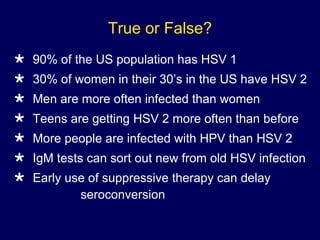
True or False? 90% of the US population has HSV 1 30% of women in their 30’s in the US have HSV 2 Men are more often infected than women Teens are getting HSV 2 more often than before More people are infected with HPV than HSV 2 IgM tests can sort out new from old HSV infection Early use of suppressive therapy can delay    seroconversion
Testing Scenario 25 year old woman presents for STI screening because she’s met a new partner.  She’s had no sex in 6 months, she has no symptoms at all. What HSV tests, if any, do you include in her screening visit?
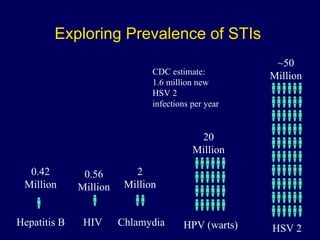
Exploring Prevalence of STIs  Hepatitis B 0.42 Million HIV 0.56 Million Chlamydia 2 Million HPV (warts) 20 Million HSV 2 ~50 Million CDC estimate:  1.6 million new  HSV 2  infections per year
Why do 90% of those infected with  HSV 2 not know it? Most HSV infections are subtle, not dramatic Outbreaks occur in entire “boxer shorts” area People attribute symptoms to other things Providers are misdiagnosing HSV as shingles  Existing HSV 1 infection ameliorates HSV 2 People aren’t being tested
How do you diagnose herpes? Identifying infection in the symptomatic person: Swab the affected area and look for virus PCR  swab with typing  4 times more sensitive than culture All major labs now have PCR Culture  swab with typing 76% false negative rate compared to PCR
How do you diagnose herpes? Identifying infection in the asymptomatic person: Draw blood and look for antibody   Western Blot at University of WA (can be sent) HerpeSelect (Quest)  ELISA Immunoblot Express Biokit (in office test) Captia (LabCorp)
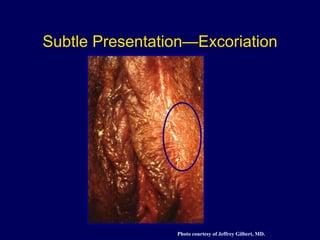
Subtle Presentation—Excoriation Photo courtesy of Jeffrey Gilbert, MD.
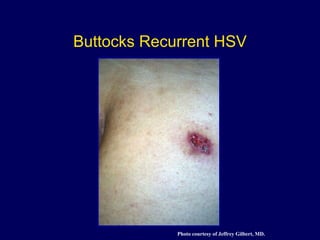
Buttocks Recurrent HSV Photo courtesy of Jeffrey Gilbert, MD.
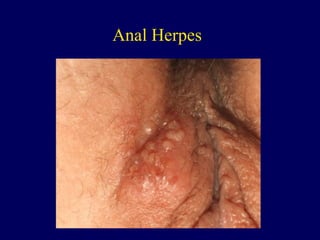
Anal Herpes
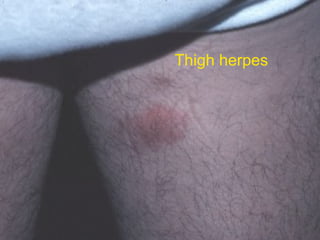
Thigh herpes
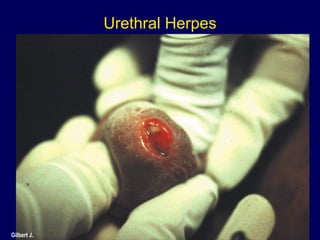
Urethral Herpes Gilbert J.
Why do we need to know the virus type? Source is often different Much HSV 1 is likely oral to genital transmission Can happen in a completely monogamous couple Prognosis is different HSV 1 recurs about 0.7 times per year HSV 2 recurs on average 3-5 times per year Susceptibility to opposite type is different HSV 2 largely protects against getting HSV 1 HSV 1 does not protect against getting HSV 2 Treatment choice may be different Early suppression for new HSV 2 may not be necessary  for new HSV 1
Who are Blood Antibody Test  Candidates? Current or previous partner has HSV Negative swab-test Trying  to  document first infection Has been diagnosed by exam, wants confirm /typing Requesting an STD screen Recurrent vague genital symptoms or dysuria/pyuria HIV positive patients
IgG  Serology timing and IgM tests   Time needed after infection to make antibody: 3 weeks 50% seroconvert 6 weeks 70% seroconvert 4 months most everyone seroconverts  Importance of confirming 1.1 to 3.5 positives    Do not use ever use IgM   Cannot separate HSV 1 from HSV 2   Cannot separate the various herpes viruses   IgM present in 35% of recurrences
What codes get HSV serology covered by insurance? Genital itching  689.1 Pain with intercourse 625.0 Pain with urination  788.1 Female genital pain 625.0 Neuralgia 724.3 Burning, tingling,  numbness, prickling 782.0
Testing and Treatment scenario A couple, 42 year old male and 47 year old female, present to your practice requesting herpes testing as they begin a new sexual relationship because he  has had a suspicious rash on his penis a couple times in the past.  His HSV IgG test for HSV 1 comes back negative, his HSV 2 positive.  Her HSV 1 is positive, her HSV 2 is negative.  How do you counsel this couple?
What are usual HSV 2 transmission rates? Conditions: The couple is aware that one has HSV Abstaining from sex with outbreaks Not using condoms regularly Not taking antiviral therapy daily Rates: About 10% male to female per year transmit About 4% female to male per year transmit Some studies show a little more, a little less
How do you reduce transmission? Antiviral therapy  reduce transmission by 48% Condoms reduce transmission by about 30-50%
Antiviral Therapy - First Episode  First episode - treat for 7-10 days with any Acyclovir 400 mg orally three times a day for 7–10 days or Famciclovir 250 mg orally three times a day for 7–10 days or Valacyclovir 1 g orally twice a day for 7–10 days
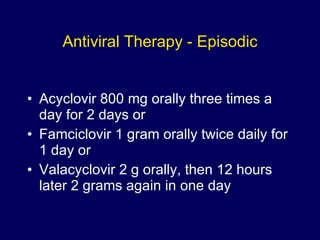
Antiviral Therapy - Episodic Acyclovir 800 mg orally three times a day for 2 days or Famciclovir 1 gram orally twice daily for 1 day or Valacyclovir 2 g orally, then 12 hours later 2 grams again in one day
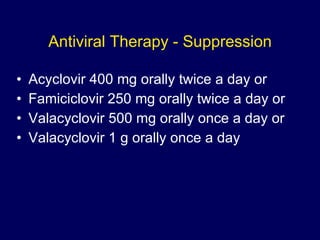
Antiviral Therapy - Suppression Acyclovir 400 mg orally twice a day or Famiciclovir 250 mg orally twice a day or Valacyclovir 500 mg orally once a day or Valacyclovir 1 g orally once a day
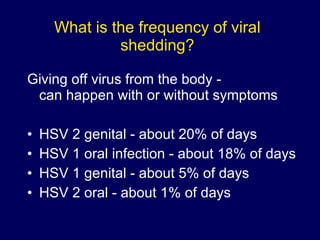
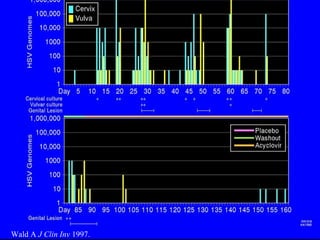
What is the frequency of viral shedding? Giving off virus from the body -  can happen with or without symptoms HSV 2 genital - about 20% of days HSV 1 oral infection - about 18% of days HSV 1 genital - about 5% of days HSV 2 oral - about 1% of days
Wald A  J Clin Inv  1997.
HSV 2 triples the risk of HIV acquisition Why? 1) HSV breaks in the skin allow HIV in 2) T-cells migrate to the site of broken  skin to resolve the outbreak, those  are the cells that HIV infects
Treatment 28 year old female presents to your practice complaining of frequently recurring HSV outbreaks.  What information do you need from her and what interventions are appropriate?
Who benefits from suppression? Has an uninfected sexual partner Has multiple sexual partners Has new HSV 2  genitally (<6 months) Shedding up to 42% of days sampled (JID, Wald) Women late in pregnancy with genital herpes  Immunocompromised by pregnancy so shedding is increased High risk for HIV acquisition risk Wants to have fewer outbreaks
Who may not need suppression? Has HSV but not sexually active and isn’t bothered by outbreaks The partner is infected with same type HSV (i.e. 1 or 2) and they aren’t bothered by outbreaks Couples who have made the conscious decision not to worry about sexual transmission
Patient Counseling Messages You are still the same person you were before this diagnosis You can still have a children/family You can still have sex You can transmit virus between outbreaks There are effective treatments for herpes Give yourself time to feel better You can come back to talk to me

Genital Herpes Update

  • 1.
    Genital Herpes Update
  • 2.
    True or False?90% of the US population has HSV 1 30% of women in their 30’s in the US have HSV 2 Men are more often infected than women Teens are getting HSV 2 more often than before More people are infected with HPV than HSV 2 IgM tests can sort out new from old HSV infection Early use of suppressive therapy can delay seroconversion
  • 3.
    Testing Scenario 25year old woman presents for STI screening because she’s met a new partner. She’s had no sex in 6 months, she has no symptoms at all. What HSV tests, if any, do you include in her screening visit?
  • 4.
    Exploring Prevalence ofSTIs Hepatitis B 0.42 Million HIV 0.56 Million Chlamydia 2 Million HPV (warts) 20 Million HSV 2 ~50 Million CDC estimate: 1.6 million new HSV 2 infections per year
  • 5.
    Why do 90%of those infected with HSV 2 not know it? Most HSV infections are subtle, not dramatic Outbreaks occur in entire “boxer shorts” area People attribute symptoms to other things Providers are misdiagnosing HSV as shingles Existing HSV 1 infection ameliorates HSV 2 People aren’t being tested
  • 6.
    How do youdiagnose herpes? Identifying infection in the symptomatic person: Swab the affected area and look for virus PCR swab with typing 4 times more sensitive than culture All major labs now have PCR Culture swab with typing 76% false negative rate compared to PCR
  • 7.
    How do youdiagnose herpes? Identifying infection in the asymptomatic person: Draw blood and look for antibody Western Blot at University of WA (can be sent) HerpeSelect (Quest) ELISA Immunoblot Express Biokit (in office test) Captia (LabCorp)
  • 8.
    Subtle Presentation—Excoriation Photocourtesy of Jeffrey Gilbert, MD.
  • 9.
    Buttocks Recurrent HSVPhoto courtesy of Jeffrey Gilbert, MD.
  • 10.
  • 11.
  • 12.
  • 13.
    Why do weneed to know the virus type? Source is often different Much HSV 1 is likely oral to genital transmission Can happen in a completely monogamous couple Prognosis is different HSV 1 recurs about 0.7 times per year HSV 2 recurs on average 3-5 times per year Susceptibility to opposite type is different HSV 2 largely protects against getting HSV 1 HSV 1 does not protect against getting HSV 2 Treatment choice may be different Early suppression for new HSV 2 may not be necessary for new HSV 1
  • 14.
    Who are BloodAntibody Test Candidates? Current or previous partner has HSV Negative swab-test Trying to document first infection Has been diagnosed by exam, wants confirm /typing Requesting an STD screen Recurrent vague genital symptoms or dysuria/pyuria HIV positive patients
  • 15.
    IgG Serologytiming and IgM tests Time needed after infection to make antibody: 3 weeks 50% seroconvert 6 weeks 70% seroconvert 4 months most everyone seroconverts Importance of confirming 1.1 to 3.5 positives Do not use ever use IgM Cannot separate HSV 1 from HSV 2 Cannot separate the various herpes viruses IgM present in 35% of recurrences
  • 16.
    What codes getHSV serology covered by insurance? Genital itching 689.1 Pain with intercourse 625.0 Pain with urination 788.1 Female genital pain 625.0 Neuralgia 724.3 Burning, tingling, numbness, prickling 782.0
  • 17.
    Testing and Treatmentscenario A couple, 42 year old male and 47 year old female, present to your practice requesting herpes testing as they begin a new sexual relationship because he has had a suspicious rash on his penis a couple times in the past. His HSV IgG test for HSV 1 comes back negative, his HSV 2 positive. Her HSV 1 is positive, her HSV 2 is negative. How do you counsel this couple?
  • 18.
    What are usualHSV 2 transmission rates? Conditions: The couple is aware that one has HSV Abstaining from sex with outbreaks Not using condoms regularly Not taking antiviral therapy daily Rates: About 10% male to female per year transmit About 4% female to male per year transmit Some studies show a little more, a little less
  • 19.
    How do youreduce transmission? Antiviral therapy reduce transmission by 48% Condoms reduce transmission by about 30-50%
  • 20.
    Antiviral Therapy -First Episode First episode - treat for 7-10 days with any Acyclovir 400 mg orally three times a day for 7–10 days or Famciclovir 250 mg orally three times a day for 7–10 days or Valacyclovir 1 g orally twice a day for 7–10 days
  • 21.
    Antiviral Therapy -Episodic Acyclovir 800 mg orally three times a day for 2 days or Famciclovir 1 gram orally twice daily for 1 day or Valacyclovir 2 g orally, then 12 hours later 2 grams again in one day
  • 22.
    Antiviral Therapy -Suppression Acyclovir 400 mg orally twice a day or Famiciclovir 250 mg orally twice a day or Valacyclovir 500 mg orally once a day or Valacyclovir 1 g orally once a day
  • 23.
    What is thefrequency of viral shedding? Giving off virus from the body - can happen with or without symptoms HSV 2 genital - about 20% of days HSV 1 oral infection - about 18% of days HSV 1 genital - about 5% of days HSV 2 oral - about 1% of days
  • 24.
    Wald A J Clin Inv 1997.
  • 25.
    HSV 2 triplesthe risk of HIV acquisition Why? 1) HSV breaks in the skin allow HIV in 2) T-cells migrate to the site of broken skin to resolve the outbreak, those are the cells that HIV infects
  • 26.
    Treatment 28 yearold female presents to your practice complaining of frequently recurring HSV outbreaks. What information do you need from her and what interventions are appropriate?
  • 27.
    Who benefits fromsuppression? Has an uninfected sexual partner Has multiple sexual partners Has new HSV 2 genitally (<6 months) Shedding up to 42% of days sampled (JID, Wald) Women late in pregnancy with genital herpes Immunocompromised by pregnancy so shedding is increased High risk for HIV acquisition risk Wants to have fewer outbreaks
  • 28.
    Who may notneed suppression? Has HSV but not sexually active and isn’t bothered by outbreaks The partner is infected with same type HSV (i.e. 1 or 2) and they aren’t bothered by outbreaks Couples who have made the conscious decision not to worry about sexual transmission
  • 29.
    Patient Counseling MessagesYou are still the same person you were before this diagnosis You can still have a children/family You can still have sex You can transmit virus between outbreaks There are effective treatments for herpes Give yourself time to feel better You can come back to talk to me

Editor's Notes

  • #9 Reference: Gilbert J. You may think you don’t see much herpes, but…you may only see the tip of the iceberg: a guide to genital herpes and herpes zoster. Data on file, GlaxoSmithKline. 2001. VAL933R0.
  • #10 Atypical Recurrent HSV Atypical is defined as not fitting the “classic” textbook description Atypical presentations and/or locations are found frequently and are common Reference: Gilbert J. You may think you don’t see much herpes, but…you may only see the tip of the iceberg: a guide to genital herpes and herpes zoster. Data on file, GlaxoSmithKline. 2001. VAL933R0.
  • #13 Reference: Gilbert J. You may think you don’t see much herpes, but…you may only see the tip of the iceberg: a guide to genital herpes and herpes zoster. Data on file, GlaxoSmithKline. 2001. VAL933R0.
  • #15 Reference: Ashley R et al. Genital Herpes: Review of the Epidemic and Potential Use of Type-Specific Serology. Clin Microbiol Rev . 1999;12:1-8.
  • #26 Though the rationale that I describe today to place HSV 2 positive patients on suppression to reduce HIV acquisition have not yet been proven, they make a whole lot of sense. When the genital epithelium is disupted, with or without recognized symptoms, HIV can enter the body more easily, if it is around. CD4 cells, the targets of HIV, are recruited by the immune system to the site of HSV reactivation. There the cells sit, on broken skin, just waiting to be infected by any HIV that is nearby. Connie Celum and her associates have ongoing studies to see if suppressing HSV 2 with acyclovir can decrease new HIV infections. Perhaps next year, we will have more than theoretical information to warrant suppression for HSV 2 infected patients.