INTRODUCTION :
⚫ Genetherapy is a novel treatment method
which utilizes genes or short oligonucleotide
sequences as therapeutic molecules, instead
of conventional drug compounds.
⚫ This technique is widely used to treat those
defective genes which contribute to .
3.
TYPES OF GENETHERAPY :
Gene therapy is classified into the following two
types:
1. Somatic gene therapy
2. Germ line gene therapy
4.
Somatic Gene Therapy:-
⚫In somatic gene therapy, the somatic cells of a
patient are targeted for foreign gene transfer.
⚫In this case the effects caused by the foreign gene
is restricted to the individual patient only, and
not inherited by the patient's offspring or later
generations.
Germ Line Gene Therapy :-
⚫Here, the functional genes, which are to be
integrated into the genomes, are inserted in the
germ cells, i.e., sperm or eggs.
⚫Targeting of germ cells makes the therapy
heritable.
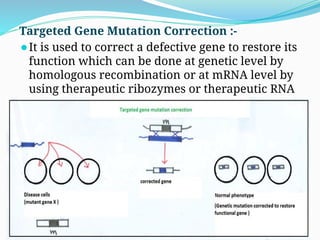
Targeted Gene MutationCorrection :-
⚫It is used to correct a defective gene to restore its
function which can be done at genetic level by
homologous recombination or at mRNA level by
using therapeutic ribozymes or therapeutic RNA
editing.
METHODS OF GENETHERAPY :
There are mainly two approaches for the transfer
of genes in gene therapy:
1. Transfer of genes into patient cells outside the
body (ex vivo gene therapy)
2. Transfer of genes directly to cells inside the
body (in vivo gene therapy).
11.
Ex Vivo GeneTherapy :-
⚫In this mode of gene therapy genes are transferred to the
cells grown in culture, transformed cells are selected,
multiplied and then introduced into the patient.
⚫The use of autologous cells avoids immune system
rejection of the introduced cells.
⚫The cells are sourced initially from the patient to be
treated and grown in culture before being reintroduced
into the same individual.
⚫This approach can be applied to the tissues like
hematopoietic cells and skin cells which can be removed
from the body, genetically corrected outside the body and
reintroduced into the patient body where they become
engrafted and survive for a long period of time.
13.
In Vivo GeneTherapy :-
⚫ In vivo method of gene transfer involves the transfer of cloned genes
directly into the tissues of the patient.
⚫ This is done in case of tissues whose individual cells cannot be cultured
in vitro in sufficient numbers (like brain cells) and/or where re-
implantation of the cultured cells in the patient is not efficient.
⚫ Liposomes and certain viral vectors are employed for this purpose
because of lack of any other mode of selection.
⚫ In case of viral vectors such type of cultured cells were often used
which have been infected with the recombinant retrovirus in vitro to
produce modified viral vectors regularly. These cultured cells will be
called as vector-producing cells (VPCs)). The VPCs transfer the gene to
surrounding disease cells.
⚫ The efficiency of gene transfer and expression determines the success
of this approach, because of the lack of any way for selection and
amplification of cells which take up and express the foreign gene.
14.
In vivo Exvivo
Less invasive More invasive
Technically simple Technically complex
Vectors introduced directly No vectors introduced directly
Safety check not possible Safety check possible
Decreased control over target cells Close control possible
Difference Between in vivo and ex
vivo
Gene