Genesis Of Logistics
What is it logistic?
Logistics is generally the detailed organization and implementation of a complex operation. In a general business
sense, logistics is the management of the flow of things between the point of origin and the point of consumption to
meet requirements of customers or corporations. The resources managed in logistics may include tangible goods such
as materials, equipment, and supplies, as well as food and other consumable items. The logistics of physical items
usually involves the integration of information flow, materials handling, production, packaging, inventory,
transportation, warehousing, and often security.
In military science, logistics is concerned with maintaining army supply lines while disrupting those of the enemy, since
an armed force without resources and transportation is defenseless. Military logistics was already practiced in the
ancient world and as modern military have a significant need for logistics solutions, advanced implementations have
been developed. In military logistics, logistics officers manage how and when to move resources to the places they are
needed.
Logistics management is the part of supply chain management that plans, implements, and controls the efficient,
effective forward, and reverse flow and storage of goods, services, and related information between point of origin and
What is it logistic?
Genesis of logistics in art of war.
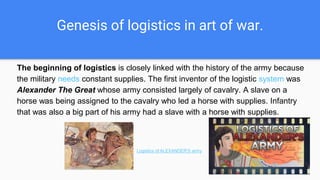
The beginning of logistics is closely linked with the history of the army because
the military needs constant supplies. The first inventor of the logistic system was
Alexander The Great whose army consisted largely of cavalry. A slave on a
horse was being assigned to the cavalry who led a horse with supplies. Infantry
that was also a big part of his army had a slave with a horse with supplies.
Logistics of ALEXANDER'S army
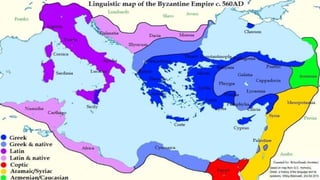
Byzantine Empire
The first information about the use of logistics in the art of war was found in
the chronicles of the Byzantine Empire. Emperor Leon VI in his work titled
"Summary of Martial Arts" distinguished, next to strategy and tactics, the third
war science - logistics. According to him, the task of logistics was to take care
of regular pay pay, appropriate armament and equipment of soldiers, and
preparation for battle.
Modern understanding of the logistics
Modern understanding of the logistics refers to issued in 1837 by AH Jominiego's work: "Outline of
the art of war ". He described the logistics as a practical art movement the army, which also includes
the continuous supply, and engineering. Milestone in the history of logistics was the Second World
War. At that time, the U.S. Defense Department established a special teams whose task was to
develop mathematical models of planning and their application in solving the supply problems of the
U.S. Army that established the foundations of mathematical science of planning, known today as
operational research, as well as the economic discipline - logistics
World War II Logistics
Surprising as it may sound, supply chain management (SCM) is more than a century old. Most mark
1913, the year of the introduction of the Ford Model-T assembly line, as the birth of CSM. From there,
it rapidly evolved and reached one of its finest moments during World War II. Some even credit savvy
supply chain strategy with helping the Allies win the war.
The supply chain the Allies built is often hailed as the most advanced of its time and potentially since.
The incredible speed at which it was built makes it all the more impressive. According to Fortune, “in
wartime, logistics eats strategy for lunch.” In other words, many historians believe military success
hinges more on logistics than strategic thinking. In fact, all the logistics planning that went into the war
gave birth to a new field called operations research.
World War II Logistics
During the world wars, the United States created the Department of Defense and the materials
industry. The Allies had similar needs for their armaments and pooled their factory outputs. The result
was nothing short of astounding. A captured German soldier may have best summarized the effect of
the importance of these logistical triumphs. Marching past one of the roadside supply dumps he
muttered, “I know how you defeated us. You piled up the supplies and then let them fall on us.” WWII
was what the Germans called materialschlact, or “matérielbattle.”
The result was an international supply chain, with purchasing, logistics, and materials departments of
various countries reporting to the same entity. This structure helped define the role of the supply chain
manager in an organization. At home, women entered the supply chain by joining the workforce to
sustain the country’s production capacity.
World War II Logistics
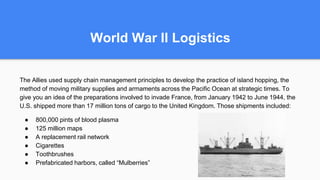
The Allies used supply chain management principles to develop the practice of island hopping, the
method of moving military supplies and armaments across the Pacific Ocean at strategic times. To
give you an idea of the preparations involved to invade France, from January 1942 to June 1944, the
U.S. shipped more than 17 million tons of cargo to the United Kingdom. Those shipments included:
● 800,000 pints of blood plasma
● 125 million maps
● A replacement rail network
● Cigarettes
● Toothbrushes
● Prefabricated harbors, called “Mulberries”

Genesis of logistics

  • 1.
  • 2.
    What is itlogistic? Logistics is generally the detailed organization and implementation of a complex operation. In a general business sense, logistics is the management of the flow of things between the point of origin and the point of consumption to meet requirements of customers or corporations. The resources managed in logistics may include tangible goods such as materials, equipment, and supplies, as well as food and other consumable items. The logistics of physical items usually involves the integration of information flow, materials handling, production, packaging, inventory, transportation, warehousing, and often security. In military science, logistics is concerned with maintaining army supply lines while disrupting those of the enemy, since an armed force without resources and transportation is defenseless. Military logistics was already practiced in the ancient world and as modern military have a significant need for logistics solutions, advanced implementations have been developed. In military logistics, logistics officers manage how and when to move resources to the places they are needed. Logistics management is the part of supply chain management that plans, implements, and controls the efficient, effective forward, and reverse flow and storage of goods, services, and related information between point of origin and
  • 3.
    What is itlogistic?
  • 4.
    Genesis of logisticsin art of war. The beginning of logistics is closely linked with the history of the army because the military needs constant supplies. The first inventor of the logistic system was Alexander The Great whose army consisted largely of cavalry. A slave on a horse was being assigned to the cavalry who led a horse with supplies. Infantry that was also a big part of his army had a slave with a horse with supplies. Logistics of ALEXANDER'S army
  • 5.
    Byzantine Empire The firstinformation about the use of logistics in the art of war was found in the chronicles of the Byzantine Empire. Emperor Leon VI in his work titled "Summary of Martial Arts" distinguished, next to strategy and tactics, the third war science - logistics. According to him, the task of logistics was to take care of regular pay pay, appropriate armament and equipment of soldiers, and preparation for battle.
  • 7.
    Modern understanding ofthe logistics Modern understanding of the logistics refers to issued in 1837 by AH Jominiego's work: "Outline of the art of war ". He described the logistics as a practical art movement the army, which also includes the continuous supply, and engineering. Milestone in the history of logistics was the Second World War. At that time, the U.S. Defense Department established a special teams whose task was to develop mathematical models of planning and their application in solving the supply problems of the U.S. Army that established the foundations of mathematical science of planning, known today as operational research, as well as the economic discipline - logistics
  • 8.
    World War IILogistics Surprising as it may sound, supply chain management (SCM) is more than a century old. Most mark 1913, the year of the introduction of the Ford Model-T assembly line, as the birth of CSM. From there, it rapidly evolved and reached one of its finest moments during World War II. Some even credit savvy supply chain strategy with helping the Allies win the war. The supply chain the Allies built is often hailed as the most advanced of its time and potentially since. The incredible speed at which it was built makes it all the more impressive. According to Fortune, “in wartime, logistics eats strategy for lunch.” In other words, many historians believe military success hinges more on logistics than strategic thinking. In fact, all the logistics planning that went into the war gave birth to a new field called operations research.
  • 9.
    World War IILogistics During the world wars, the United States created the Department of Defense and the materials industry. The Allies had similar needs for their armaments and pooled their factory outputs. The result was nothing short of astounding. A captured German soldier may have best summarized the effect of the importance of these logistical triumphs. Marching past one of the roadside supply dumps he muttered, “I know how you defeated us. You piled up the supplies and then let them fall on us.” WWII was what the Germans called materialschlact, or “matérielbattle.” The result was an international supply chain, with purchasing, logistics, and materials departments of various countries reporting to the same entity. This structure helped define the role of the supply chain manager in an organization. At home, women entered the supply chain by joining the workforce to sustain the country’s production capacity.
  • 10.
    World War IILogistics The Allies used supply chain management principles to develop the practice of island hopping, the method of moving military supplies and armaments across the Pacific Ocean at strategic times. To give you an idea of the preparations involved to invade France, from January 1942 to June 1944, the U.S. shipped more than 17 million tons of cargo to the United Kingdom. Those shipments included: ● 800,000 pints of blood plasma ● 125 million maps ● A replacement rail network ● Cigarettes ● Toothbrushes ● Prefabricated harbors, called “Mulberries”