Generic Model Fitting of
Passive RF Devices
Tao-Yi Lee
Advisor: Yu-Jiu Wang
RFVLSI LAB @ NCTU
2014/4/18 Tao-Yi Lee @ RFVLSILAB 1
Outline
• The Model Fitting Design Flow
• Examples
– Model Fitting Of Inductors
– Model Fitting Of Center Tapped Inductors
– Model Fitting Of Transmission Lines
– Model Fitting Of Transformers
• Conclusion and Future Works
• References
2014/4/18 Tao-Yi Lee @ RFVLSILAB 2
Design Flow of Modeling Fitting
2014/4/18 Tao-Yi Lee @ RFVLSILAB 3
Start
Propose passive lumped
equivalent model for an arbitrary
high-frequency structure
Solve Y parameter matrix [Y] of the
lumped equivalent network
Rum EM simulations of the desired
structures, obtain [YEM]
Program the Ycost(R1, L1, C1)=[Y]-
[YEM] matrix into MATLAB script as
cost functions in numerical
analysis
Solve values for lumped
component, i.e. find R1, L1, C1,…,
such that Ycost is minimized
Stop
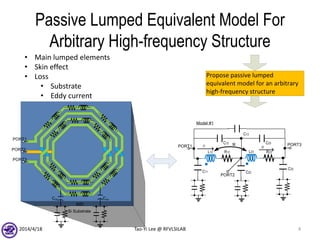
Passive Lumped Equivalent Model For
Arbitrary High-frequency Structure
2014/4/18 Tao-Yi Lee @ RFVLSILAB 4
Propose passive lumped
equivalent model for an arbitrary
high-frequency structure
PORT1 PORT3
C13
C12 C23
C33
C22C11
L12 L23R12 R23
Model #1
PORT2
M
i2i1
PORT1
PORT2
PORT3
Si Substrate
IMD
Cox Cox
• Main lumped elements
• Skin effect
• Loss
• Substrate
• Eddy current
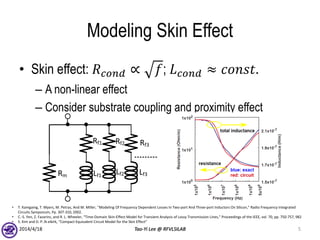
Modeling Skin Effect
• Skin effect: 𝑅 𝑐𝑜𝑛𝑑 ∝ 𝑓; 𝐿 𝑐𝑜𝑛𝑑 ≈ 𝑐𝑜𝑛𝑠𝑡.
– A non-linear effect
– Consider substrate coupling and proximity effect
2014/4/18 Tao-Yi Lee @ RFVLSILAB 5
• T. Kamgaing, T. Myers, M. Petras, And M. Miller, "Modeling Of Frequency Dependent Losses In Two-port And Three-port Inductors On Silicon," Radio Frequency Integrated
Circuits Symposium, Pp. 307-310, 2002.
• C.-S. Yen, Z. Fazarinc, and R. L. Wheeler, “Time-Domain Skin-Effect Model for Transient Analysis of Lossy Transmission Lines,” Proceedings of the IEEE, vol. 70, pp. 750-757, 982
• S. Kim and D. P..N eikirk, “Compact Equivalent Circuit Model for the Skin Effect”
Rm
Rf1
Lf1
Rf2
Lf2
Rf3
Lf3
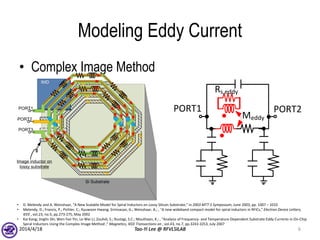
Modeling Eddy Current
• Complex Image Method
2014/4/18 Tao-Yi Lee @ RFVLSILAB 6
• D. Melendy and A. Weisshaar, “A New Scalable Model for Spiral Inductors on Lossy Silicon Substrate,” in 2003 MTT-S Symposium, June 2003, pp. 1007 – 1010
• Melendy, D.; Francis, P.; Pichler, C.; Kyuwoon Hwang; Srinivasan, G.; Weisshaar, A.; , "A new wideband compact model for spiral inductors in RFICs," Electron Device Letters,
IEEE , vol.23, no.5, pp.273-275, May 2002
• Kai Kang; Jinglin Shi; Wen-Yan Yin; Le-Wei Li; Zouhdi, S.; Rustagi, S.C.; Mouthaan, K.; , "Analysis of Frequency- and Temperature-Dependent Substrate Eddy Currents in On-Chip
Spiral Inductors Using the Complex Image Method ," Magnetics, IEEE Transactions on , vol.43, no.7, pp.3243-3253, July 2007
PORT1 PORT2
Meddy
Rs,eddy
PORT1
PORT2
PORT3
Si Substrate
IMD
Image inductor on
lossy substrate
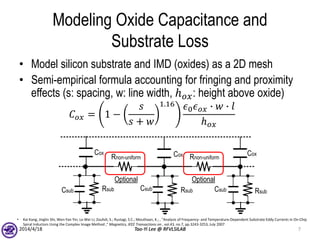
Modeling Oxide Capacitance and
Substrate Loss
• Model silicon substrate and IMD (oxides) as a 2D mesh
• Semi-empirical formula accounting for fringing and proximity
effects (s: spacing, w: line width, ℎ 𝑜𝑥: height above oxide)
𝐶 𝑜𝑥 = 1 −
𝑠
𝑠 + 𝑤
1.16 𝜖0 𝜖 𝑜𝑥 ∙ 𝑤 ∙ 𝑙
ℎ 𝑜𝑥
2014/4/18 Tao-Yi Lee @ RFVLSILAB 7
CoxCox Cox
RsubCsubRsubCsubRsubCsub
Rnon-uniform Rnon-uniform
OptionalOptional
• Kai Kang; Jinglin Shi; Wen-Yan Yin; Le-Wei Li; Zouhdi, S.; Rustagi, S.C.; Mouthaan, K.; , "Analysis of Frequency- and Temperature-Dependent Substrate Eddy Currents in On-Chip
Spiral Inductors Using the Complex Image Method ," Magnetics, IEEE Transactions on , vol.43, no.7, pp.3243-3253, July 2007
Modeling Substrate
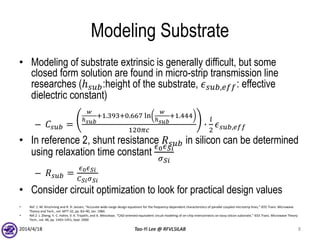
• Modeling of substrate extrinsic is generally difficult, but some
closed form solution are found in micro-strip transmission line
researches (ℎ 𝑠𝑢𝑏:height of the substrate, 𝜖 𝑠𝑢𝑏,𝑒𝑓𝑓: effective
dielectric constant)
– 𝐶𝑠𝑢𝑏 =
𝑤
ℎ 𝑠𝑢𝑏
+1.393+0.667 ln
𝑤
ℎ 𝑠𝑢𝑏
+1.444
120𝜋𝑐
∙
𝑙
2
𝜖 𝑠𝑢𝑏,𝑒𝑓𝑓
• In reference 2, shunt resistance 𝑅 𝑠𝑢𝑏 in silicon can be determined
using relaxation time constant
𝜖0 𝜖 𝑆𝑖
𝜎 𝑆𝑖
– 𝑅 𝑠𝑢𝑏 =
𝜖0 𝜖 𝑆𝑖
𝐶 𝑆𝑖 𝜎 𝑆𝑖
• Consider circuit optimization to look for practical design values
2014/4/18 Tao-Yi Lee @ RFVLSILAB 8
• Ref. 1 :M. Kirschning and R. H. Jansen, “Accurate wide-range design equations for the frequency-dependent characteristics of parallel coupled microstrip lines,” IEEE Trans. Microwave
Theory and Tech., vol. MTT-32, pp. 83–90, Jan. 1984.
• Ref.2 :J. Zheng, Y.-C. Hahm, V. K. Tripathi, and A. Weisshaar, “CAD-oriented equivalent circuit modeling of on-chip interconnects on lossy silicon substrate,” IEEE Trans. Microwave Theory
Tech., vol. 48, pp. 1443–1451, Sept. 2000
Solve Y Parameter Matrix 𝑌 of The
Lumped Equivalent Network
• Definition of Y parameters
– Yij =
Ii
Vj Vk=0 for k≠j
–
𝐼1
𝐼2
𝐼3
𝑌11 𝑌12 𝑌13
𝑌21 𝑌22 𝑌23
𝑌31 𝑌32 𝑌33
𝑉1
𝑉2
𝑉3
– Short all other terminals to ground reference and write down
𝑌𝑖𝑗 as function of lumped elements
– Simple; Can be done by inspection
– Matrix symmetry of passive networks
2014/4/18 Tao-Yi Lee @ RFVLSILAB 9
Solve Y parameter matrix [Y] of the
lumped equivalent network
Solve Y Parameter Matrix 𝑌 of The
Lumped Equivalent Network
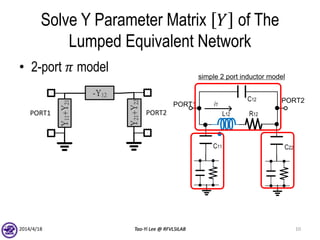
• 2-port 𝜋 model
2014/4/18 Tao-Yi Lee @ RFVLSILAB 10
Y11+Y21
-Y12
Y21+Y22
PORT1 PORT2
PORT1
C12
C22C11
L12 R12
PORT2i1
simple 2 port inductor model
Solve Y Parameter Matrix 𝑌 of The
Lumped Equivalent Network
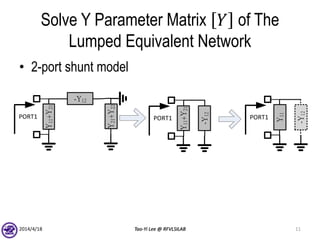
• 2-port shunt model
2014/4/18 Tao-Yi Lee @ RFVLSILAB 11
Y11+Y21
-Y12
Y21+Y22
PORT1
Y11+Y21
PORT1
-Y12
Y11
PORT1
-Y12
Solve Y Parameter Matrix 𝑌 of The
Lumped Equivalent Network
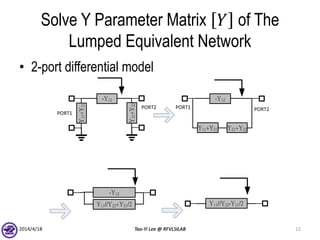
• 2-port differential model
2014/4/18 Tao-Yi Lee @ RFVLSILAB 12
Y11+Y21
-Y12
Y21+Y22
PORT1
PORT2
-Y12
PORT1 PORT2
Y11+Y21 Y21+Y22
-Y12
Y11//Y22+Y21/2 Y11//Y22-Y21/2
Run EM Simulations Of The Desired
Structures, Obtain 𝑌𝐸𝑀
• Convert S-parameters to
Y-parameters via post-
processing
2014/4/18 Tao-Yi Lee @ RFVLSILAB 13
Rum EM simulations of the desired
structures, obtain [YEM]
YEMSEM
Define The Minimization Problem In
MATLAB
∀i, j, minimize
R1,R2,…,L1,L2,…,C1,C2,…
ΔYij
= minimize
R1,R2,…,L1,L2,…,C1,C2,…
𝐘 − 𝐘𝐄𝐌
subject to all passive elements ≥ 0
2014/4/18 Tao-Yi Lee @ RFVLSILAB 14
Program the Ycost(R1, L1, C1)=[Y]-
[YEM] matrix into MATLAB script as
cost functions in numerical
analysis
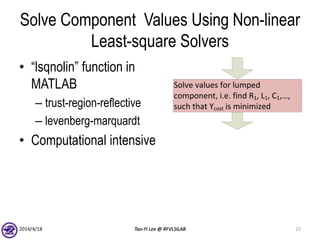
Solve Component Values Using Non-linear
Least-square Solvers
• “lsqnolin” function in
MATLAB
– trust-region-reflective
– levenberg-marquardt
• Computational intensive
2014/4/18 Tao-Yi Lee @ RFVLSILAB 15
Solve values for lumped
component, i.e. find R1, L1, C1,…,
such that Ycost is minimized
MODEL FITTING OF INDUCTORS
2014/4/18 Tao-Yi Lee @ RFVLSILAB 16
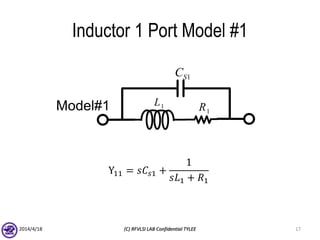
Inductor 1 Port Model #1
Y11 = 𝑠𝐶𝑠1 +
1
𝑠𝐿1 + 𝑅1
2014/4/18 (C) RFVLSI LAB Confidential TYLEE 17
Model#1 1R1L
1SC
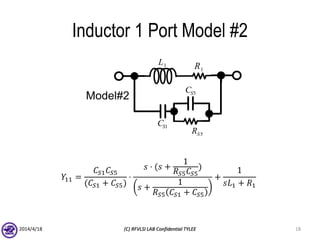
Inductor 1 Port Model #2
𝑌11 =
𝐶𝑆1 𝐶𝑆5
(𝐶𝑆1 + 𝐶𝑆5)
⋅
𝑠 ⋅ (𝑠 +
1
𝑅 𝑆5 𝐶𝑆5
)
𝑠 +
1
𝑅 𝑆5 𝐶𝑆1 + 𝐶𝑆5
+
1
𝑠𝐿1 + 𝑅1
2014/4/18 (C) RFVLSI LAB Confidential TYLEE 18
Model#2
1SC
5SC
5SR
1R1L
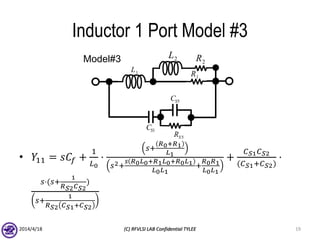
Inductor 1 Port Model #3
• 𝑌11 = 𝑠𝐶𝑓 +
1
𝐿0
⋅
𝑠+
𝑅0+𝑅1
𝐿1
𝑠2+
𝑠 𝑅0 𝐿0+𝑅1 𝐿0+𝑅0 𝐿1
𝐿0 𝐿1
+
𝑅0 𝑅1
𝐿0 𝐿1
+
𝐶 𝑆1 𝐶 𝑆2
(𝐶 𝑆1+𝐶 𝑆2)
⋅
𝑠⋅(𝑠+
1
𝑅 𝑆2 𝐶 𝑆2
)
𝑠+
1
𝑅 𝑆2 𝐶 𝑆1+𝐶 𝑆2
2014/4/18 (C) RFVLSI LAB Confidential TYLEE 19
2R2LModel#3
1SC
5SC
5SR
1R1L
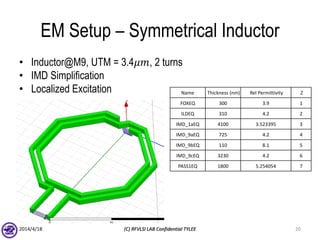
EM Setup – Symmetrical Inductor
• Inductor@M9, UTM = 3.4𝜇𝑚, 2 turns
• IMD Simplification
• Localized Excitation
2014/4/18 (C) RFVLSI LAB Confidential TYLEE 20
Name Thickness (nm) Rel Permittivity Z
FOXEQ 300 3.9 1
ILDEQ 310 4.2 2
IMD_1aEQ 4100 3.523395 3
IMD_9aEQ 725 4.2 4
IMD_9bEQ 110 8.1 5
IMD_9cEQ 3230 4.2 6
PASS1EQ 1800 5.254054 7
MODEL FITTING OF CENTER-TAPPED
INDUCTORS
2014/4/18 Tao-Yi Lee @ RFVLSILAB 21
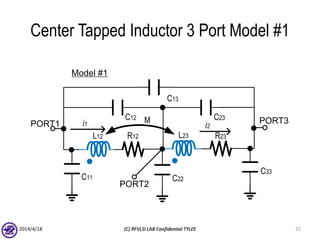
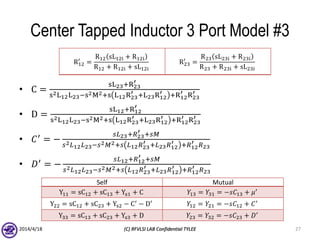
Center Tapped Inductor 3 Port Model #1
2014/4/18 (C) RFVLSI LAB Confidential TYLEE 22
PORT1 PORT3
C13
C12 C23
C33
C22C11
L12 L23R12 R23
Model #1
PORT2
M
i2i1
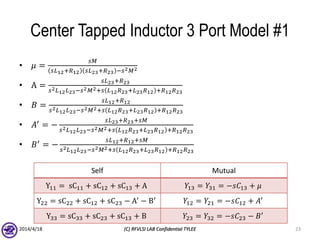
Center Tapped Inductor 3 Port Model #1
• 𝜇 =
𝑠𝑀
𝑠𝐿12+𝑅12 𝑠𝐿23+𝑅23 −𝑠2 𝑀2
• A =
𝑠𝐿23+𝑅23
𝑠2 𝐿12 𝐿23−𝑠2 𝑀2+𝑠 𝐿12 𝑅23+𝐿23 𝑅12 +𝑅12 𝑅23
• 𝐵 =
𝑠𝐿12+𝑅12
𝑠2 𝐿12 𝐿23−𝑠2 𝑀2+𝑠 𝐿12 𝑅23+𝐿23 𝑅12 +𝑅12 𝑅23
• 𝐴′
= −
𝑠𝐿23+𝑅23+𝑠𝑀
𝑠2 𝐿12 𝐿23−𝑠2 𝑀2+𝑠 𝐿12 𝑅23+𝐿23 𝑅12 +𝑅12 𝑅23
• 𝐵′
= −
𝑠𝐿12+𝑅12+𝑠𝑀
𝑠2 𝐿12 𝐿23−𝑠2 𝑀2+𝑠 𝐿12 𝑅23+𝐿23 𝑅12 +𝑅12 𝑅23
2014/4/18 (C) RFVLSI LAB Confidential TYLEE 23
Self Mutual
Y11 = sC11 + sC12 + sC13 + A 𝑌13 = 𝑌31 = −𝑠𝐶13 + 𝜇
Y22 = sC22 + sC12 + sC23 − A′
− B′
𝑌12 = 𝑌21 = −𝑠𝐶12 + 𝐴′
Y33 = sC33 + sC23 + sC13 + B 𝑌23 = 𝑌32 = −𝑠𝐶23 − 𝐵′
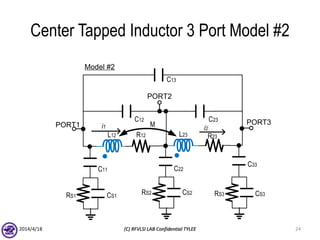
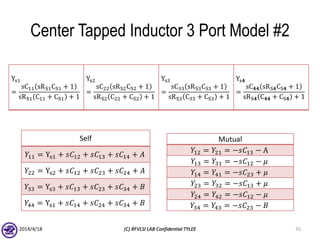
Center Tapped Inductor 3 Port Model #2
2014/4/18 (C) RFVLSI LAB Confidential TYLEE 24
PORT1
PORT2
PORT3
C13
C12 C23
C33
C22C11
L12 L23R12 R23
Model #2
CS2RS2 CS3RS3CS1RS1
M i2i1
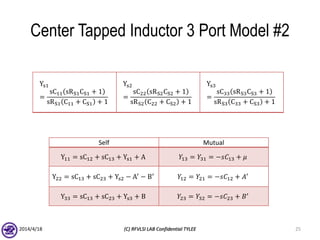
Center Tapped Inductor 3 Port Model #2
2014/4/18 (C) RFVLSI LAB Confidential TYLEE 25
Ys1
=
sC11 sRS1CS1 + 1
sRS1 C11 + CS1 + 1
Ys2
=
sC22 sRS2CS2 + 1
sRS2 C22 + CS2 + 1
Ys3
=
sC33 sRS3CS3 + 1
sRS3 C33 + CS3 + 1
Self Mutual
Y11 = sC12 + sC13 + Ys1 + A 𝑌13 = 𝑌31 = −𝑠𝐶13 + 𝜇
Y22 = sC13 + sC23 + Ys2 − A′
− B′
𝑌12 = 𝑌21 = −𝑠𝐶12 + 𝐴′
Y33 = sC13 + sC23 + Ys3 + B 𝑌23 = 𝑌32 = −𝑠𝐶23 + 𝐵′
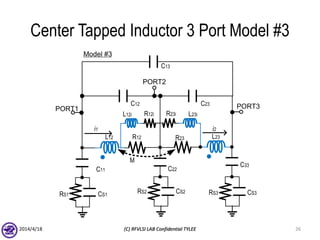
Center Tapped Inductor 3 Port Model #3
2014/4/18 (C) RFVLSI LAB Confidential TYLEE 26
PORT1
PORT2
PORT3
C13
C12 C23
C33
C22C11
L12 L23R12 R23
Model #3
CS2RS2 CS3RS3CS1RS1
L12i R12i L23iR23i
M
i2i1
Center Tapped Inductor 3 Port Model #3
• C =
sL23+R23
′
s2L12L23−s2M2+s L12R23
′ +L23R12
′ +R12
′ R23
′
• D =
sL12+R12
′
s2L12L23−s2M2+s L12R23
′ +L23R12
′ +R12
′ R23
′
• 𝐶′ = −
𝑠𝐿23+𝑅23
′ +𝑠𝑀
𝑠2 𝐿12 𝐿23−𝑠2 𝑀2+𝑠 𝐿12 𝑅23
′ +𝐿23 𝑅12
′ +𝑅12
′ 𝑅23
• 𝐷′
= −
𝑠𝐿12+𝑅12
′ +𝑠𝑀
𝑠2 𝐿12 𝐿23−𝑠2 𝑀2+𝑠 𝐿12 𝑅23
′ +𝐿23 𝑅12
′ +𝑅12
′ 𝑅23
2014/4/18 (C) RFVLSI LAB Confidential TYLEE 27
Self Mutual
Y11 = sC12 + sC13 + Ys1 + C 𝑌13 = 𝑌31 = −𝑠𝐶13 + 𝜇′
Y22 = sC12 + sC23 + Ys2 − C′
− D′
𝑌12 = 𝑌21 = −𝑠𝐶12 + 𝐶′
Y33 = sC13 + sC23 + Ys3 + D 𝑌23 = 𝑌32 = −𝑠𝐶23 + 𝐷′
R12
′
=
R12 sL12i + R12i
R12 + R12i + sL12i
R23
′
=
R23 sL23i + R23i
R23 + R23i + sL23i
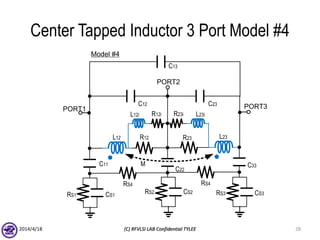
Center Tapped Inductor 3 Port Model #4
2014/4/18 (C) RFVLSI LAB Confidential TYLEE 28
PORT1
PORT2
PORT3
C13
C12 C23
C33
C22
C11
L12 L23R12 R23
Model #4
CS2RS2 CS3RS3CS1RS1
L12i R12i L23iR23i
RS4 RS4
M
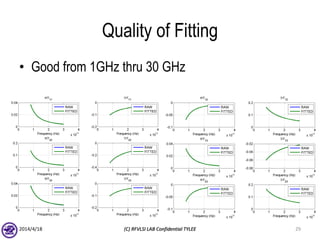
Quality of Fitting
• Good from 1GHz thru 30 GHz
2014/4/18 (C) RFVLSI LAB Confidential TYLEE 29
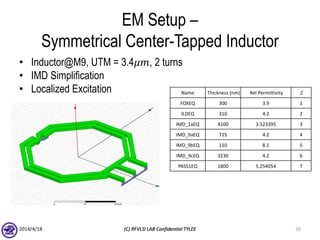
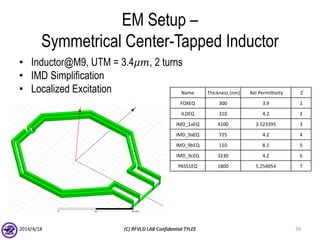
EM Setup –
Symmetrical Center-Tapped Inductor
• Inductor@M9, UTM = 3.4𝜇𝑚, 2 turns
• IMD Simplification
• Localized Excitation
2014/4/18 (C) RFVLSI LAB Confidential TYLEE 30
Name Thickness (nm) Rel Permittivity Z
FOXEQ 300 3.9 1
ILDEQ 310 4.2 2
IMD_1aEQ 4100 3.523395 3
IMD_9aEQ 725 4.2 4
IMD_9bEQ 110 8.1 5
IMD_9cEQ 3230 4.2 6
PASS1EQ 1800 5.254054 7
MODEL FITTING OF 4 PORT CENTER-
TAPPED INDUCTORS
2014/4/18 Tao-Yi Lee @ RFVLSILAB 31
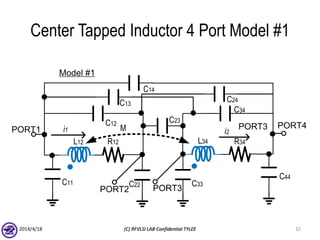
Center Tapped Inductor 4 Port Model #1
2014/4/18 (C) RFVLSI LAB Confidential TYLEE 32
PORT1 PORT3
C14
C12
C34
C44
C33C11
L12 L34R12 R34
Model #1
PORT2
M i2i1
PORT3C22
C23
PORT4
C24
C13
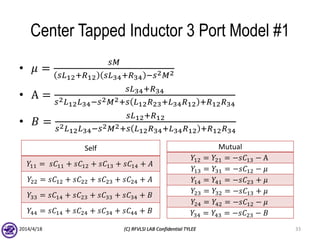
Center Tapped Inductor 3 Port Model #1
• 𝜇 =
𝑠𝑀
𝑠𝐿12+𝑅12 𝑠𝐿34+𝑅34 −𝑠2 𝑀2
• A =
𝑠𝐿34+𝑅34
𝑠2 𝐿12 𝐿34−𝑠2 𝑀2+𝑠 𝐿12 𝑅23+𝐿34 𝑅12 +𝑅12 𝑅34
• 𝐵 =
𝑠𝐿12+𝑅12
𝑠2 𝐿12 𝐿34−𝑠2 𝑀2+𝑠 𝐿12 𝑅34+𝐿34 𝑅12 +𝑅12 𝑅34
2014/4/18 (C) RFVLSI LAB Confidential TYLEE 33
Self
𝑌11 = 𝑠𝐶11 + 𝑠𝐶12 + 𝑠𝐶13 + 𝑠𝐶14 + 𝐴
𝑌22 = 𝑠𝐶12 + 𝑠𝐶22 + 𝑠𝐶23 + 𝑠𝐶24 + 𝐴
𝑌33 = 𝑠𝐶14 + 𝑠𝐶23 + 𝑠𝐶33 + 𝑠𝐶34 + 𝐵
𝑌44 = 𝑠𝐶14 + 𝑠𝐶24 + 𝑠𝐶34 + 𝑠𝐶44 + 𝐵
Mutual
𝑌12 = 𝑌21 = −𝑠𝐶13 − A
𝑌13 = 𝑌31 = −𝑠𝐶12 − 𝜇
𝑌14 = 𝑌41 = −𝑠𝐶23 + 𝜇
𝑌23 = 𝑌32 = −𝑠𝐶13 + 𝜇
𝑌24 = 𝑌42 = −𝑠𝐶12 − 𝜇
𝑌34 = 𝑌43 = −𝑠𝐶23 − 𝐵
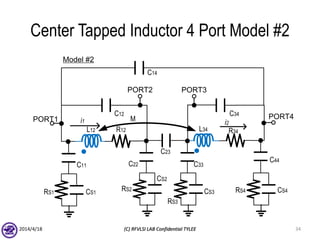
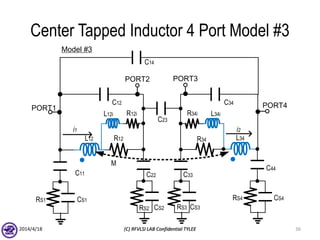
Center Tapped Inductor 4 Port Model #2
2014/4/18 (C) RFVLSI LAB Confidential TYLEE 34
PORT1
PORT2
PORT4
C14
C12 C34
C44
C33C11
L12 L34R12 R34
Model #2
CS2
RS2 CS4RS4CS1RS1
M i2i1
CS3
RS3
C22
C23
PORT3
Center Tapped Inductor 3 Port Model #2
2014/4/18 (C) RFVLSI LAB Confidential TYLEE 35
Ys1
=
sC11 sRS1CS1 + 1
sRS1 C11 + CS1 + 1
Ys2
=
sC22 sRS2CS2 + 1
sRS2 C22 + CS2 + 1
Ys3
=
sC33 sRS3CS3 + 1
sRS3 C33 + CS3 + 1
Ys𝟒
=
sC 𝟒𝟒 sRS𝟒CS𝟒 + 1
sRS𝟒 C 𝟒𝟒 + CS𝟒 + 1
Self
𝑌11 = Ys1 + 𝑠𝐶12 + 𝑠𝐶13 + 𝑠𝐶14 + 𝐴
𝑌22 = Ys2 + 𝑠𝐶12 + 𝑠𝐶23 + 𝑠𝐶24 + 𝐴
𝑌33 = Ys3 + 𝑠𝐶13 + 𝑠𝐶23 + 𝑠𝐶34 + 𝐵
𝑌44 = Ys1 + 𝑠𝐶14 + 𝑠𝐶24 + 𝑠𝐶34 + 𝐵
Mutual
𝑌12 = 𝑌21 = −𝑠𝐶13 − A
𝑌13 = 𝑌31 = −𝑠𝐶12 − 𝜇
𝑌14 = 𝑌41 = −𝑠𝐶23 + 𝜇
𝑌23 = 𝑌32 = −𝑠𝐶13 + 𝜇
𝑌24 = 𝑌42 = −𝑠𝐶12 − 𝜇
𝑌34 = 𝑌43 = −𝑠𝐶23 − 𝐵
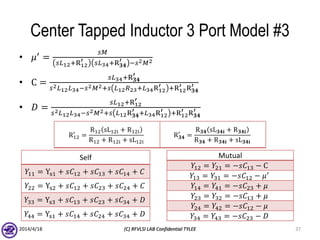
Center Tapped Inductor 4 Port Model #3
2014/4/18 (C) RFVLSI LAB Confidential TYLEE 36
PORT1
PORT2
PORT4
C14
C12 C34
C44
C22C11
L12 L34R12 R34
Model #3
CS3RS2
CS4RS4CS1RS1
L12i R12i L34iR34i
M
i2i1
C33
RS3CS2
C23
PORT3
Center Tapped Inductor 3 Port Model #3
• 𝜇′ =
𝑠𝑀
𝑠𝐿12+R12
′ 𝑠𝐿34+R 𝟑𝟒
′ −𝑠2 𝑀2
• C =
𝑠𝐿34+R 𝟑𝟒
′
𝑠2 𝐿12 𝐿34−𝑠2 𝑀2+𝑠 𝐿12 𝑅23+𝐿34R12
′ +R12
′ R 𝟑𝟒
′
• 𝐷 =
𝑠𝐿12+R12
′
𝑠2 𝐿12 𝐿34−𝑠2 𝑀2+𝑠 𝐿12R 𝟑𝟒
′ +𝐿34R12
′ +R12
′ R 𝟑𝟒
′
2014/4/18 (C) RFVLSI LAB Confidential TYLEE 37
R12
′
=
R12 sL12i + R12i
R12 + R12i + sL12i
R 𝟑𝟒
′
=
R 𝟑𝟒 sL 𝟑𝟒𝐢 + R 𝟑𝟒𝐢
R 𝟑𝟒 + R 𝟑𝟒𝐢 + sL 𝟑𝟒𝐢
Self
𝑌11 = Ys1 + 𝑠𝐶12 + 𝑠𝐶13 + 𝑠𝐶14 + 𝐶
𝑌22 = Ys2 + 𝑠𝐶12 + 𝑠𝐶23 + 𝑠𝐶24 + 𝐶
𝑌33 = Ys3 + 𝑠𝐶13 + 𝑠𝐶23 + 𝑠𝐶34 + 𝐷
𝑌44 = Ys1 + 𝑠𝐶14 + 𝑠𝐶24 + 𝑠𝐶34 + 𝐷
Mutual
𝑌12 = 𝑌21 = −𝑠𝐶13 − C
𝑌13 = 𝑌31 = −𝑠𝐶12 − 𝜇′
𝑌14 = 𝑌41 = −𝑠𝐶23 + 𝜇
𝑌23 = 𝑌32 = −𝑠𝐶13 + 𝜇
𝑌24 = 𝑌42 = −𝑠𝐶12 − 𝜇
𝑌34 = 𝑌43 = −𝑠𝐶23 − 𝐷
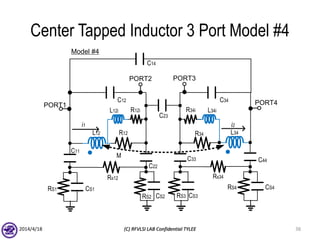
Center Tapped Inductor 3 Port Model #4
2014/4/18 (C) RFVLSI LAB Confidential TYLEE 38
PORT1
PORT2
PORT4
C14
C12 C34
C44
C22
C11
L12 L34R12 R34
Model #4
CS3RS2
CS4RS4CS1RS1
L12i R12i L34iR34i
M
i2i1
C33
RS3CS2
C23
PORT3
Rs12 Rs34
EM Setup –
Symmetrical Center-Tapped Inductor
• Inductor@M9, UTM = 3.4𝜇𝑚, 2 turns
• IMD Simplification
• Localized Excitation
2014/4/18 (C) RFVLSI LAB Confidential TYLEE 39
Name Thickness (nm) Rel Permittivity Z
FOXEQ 300 3.9 1
ILDEQ 310 4.2 2
IMD_1aEQ 4100 3.523395 3
IMD_9aEQ 725 4.2 4
IMD_9bEQ 110 8.1 5
IMD_9cEQ 3230 4.2 6
PASS1EQ 1800 5.254054 7
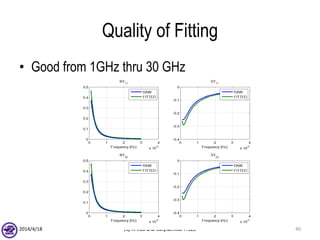
Quality of Fitting
• Good from 1GHz thru 30 GHz
2014/4/18 (C) RFVLSI LAB Confidential TYLEE 40
Future Works
• Accuracy of transformer models
• Accuracy in higher frequencies
2014/4/18 Tao-Yi Lee @ RFVLSILAB 41
2014/4/18 Tao-Yi Lee @ RFVLSILAB 42
Thank you for listening!
References
• Sung-gi Yang, Gi-hyon Ryu, And Kwang-seok Seo, "Fully Symmetrical, Diff
Erential-pair Type Floating Active Inductors," International Symposium On Circuits
And Systems, Pp. 93-96, Jun. 1997.
• Kenichi Okada And Kazuya Masu, "Modeling Of Spiral Inductors," In Advanced
Microwave Circuits And Systems, April 1, 2010, P. 291.
• C. Patrick Yue, Changsup Ryu, Jack Lau, Thomas H. Lee, And S. Simon Wong, "A
PHYSICAL MODEL FOR PLANAR SPIRAL INDUCTORS ON SILICON".
• T. Kamgaing, T. Myers, M. Petras, And M. Miller, "Modeling Of Frequency
Dependent Losses In Two-port And Three-port Inductors On Silicon," Radio
Frequency Integrated Circuits Symposium, Pp. 307-310, 2002.
• J. R. Long And M. A. Copeland, "Modeling, Characterization And Design Of
Monolithic Inductors For Silicon Rfics.," Custom Integrated Circuits Conference,
1996.
• Sunderarajan S. Mohan, Maria Del Mar Hershenson, Stephen P. Boyd, And
Thomas H. Lee, "Simple Accurate Expressions For Planar Spiral Inductances,"
JOURNAL OF SOLID-STATE CIRCUITS, Vol. 34, No. 10, Oct. 1999.
2014/4/18 Tao-Yi Lee @ RFVLSILAB 43

Generiic RF passive device modeling

  • 1.
    Generic Model Fittingof Passive RF Devices Tao-Yi Lee Advisor: Yu-Jiu Wang RFVLSI LAB @ NCTU 2014/4/18 Tao-Yi Lee @ RFVLSILAB 1
  • 2.
    Outline • The ModelFitting Design Flow • Examples – Model Fitting Of Inductors – Model Fitting Of Center Tapped Inductors – Model Fitting Of Transmission Lines – Model Fitting Of Transformers • Conclusion and Future Works • References 2014/4/18 Tao-Yi Lee @ RFVLSILAB 2
  • 3.
    Design Flow ofModeling Fitting 2014/4/18 Tao-Yi Lee @ RFVLSILAB 3 Start Propose passive lumped equivalent model for an arbitrary high-frequency structure Solve Y parameter matrix [Y] of the lumped equivalent network Rum EM simulations of the desired structures, obtain [YEM] Program the Ycost(R1, L1, C1)=[Y]- [YEM] matrix into MATLAB script as cost functions in numerical analysis Solve values for lumped component, i.e. find R1, L1, C1,…, such that Ycost is minimized Stop
  • 4.
    Passive Lumped EquivalentModel For Arbitrary High-frequency Structure 2014/4/18 Tao-Yi Lee @ RFVLSILAB 4 Propose passive lumped equivalent model for an arbitrary high-frequency structure PORT1 PORT3 C13 C12 C23 C33 C22C11 L12 L23R12 R23 Model #1 PORT2 M i2i1 PORT1 PORT2 PORT3 Si Substrate IMD Cox Cox • Main lumped elements • Skin effect • Loss • Substrate • Eddy current
  • 5.
    Modeling Skin Effect •Skin effect: 𝑅 𝑐𝑜𝑛𝑑 ∝ 𝑓; 𝐿 𝑐𝑜𝑛𝑑 ≈ 𝑐𝑜𝑛𝑠𝑡. – A non-linear effect – Consider substrate coupling and proximity effect 2014/4/18 Tao-Yi Lee @ RFVLSILAB 5 • T. Kamgaing, T. Myers, M. Petras, And M. Miller, "Modeling Of Frequency Dependent Losses In Two-port And Three-port Inductors On Silicon," Radio Frequency Integrated Circuits Symposium, Pp. 307-310, 2002. • C.-S. Yen, Z. Fazarinc, and R. L. Wheeler, “Time-Domain Skin-Effect Model for Transient Analysis of Lossy Transmission Lines,” Proceedings of the IEEE, vol. 70, pp. 750-757, 982 • S. Kim and D. P..N eikirk, “Compact Equivalent Circuit Model for the Skin Effect” Rm Rf1 Lf1 Rf2 Lf2 Rf3 Lf3
  • 6.
    Modeling Eddy Current •Complex Image Method 2014/4/18 Tao-Yi Lee @ RFVLSILAB 6 • D. Melendy and A. Weisshaar, “A New Scalable Model for Spiral Inductors on Lossy Silicon Substrate,” in 2003 MTT-S Symposium, June 2003, pp. 1007 – 1010 • Melendy, D.; Francis, P.; Pichler, C.; Kyuwoon Hwang; Srinivasan, G.; Weisshaar, A.; , "A new wideband compact model for spiral inductors in RFICs," Electron Device Letters, IEEE , vol.23, no.5, pp.273-275, May 2002 • Kai Kang; Jinglin Shi; Wen-Yan Yin; Le-Wei Li; Zouhdi, S.; Rustagi, S.C.; Mouthaan, K.; , "Analysis of Frequency- and Temperature-Dependent Substrate Eddy Currents in On-Chip Spiral Inductors Using the Complex Image Method ," Magnetics, IEEE Transactions on , vol.43, no.7, pp.3243-3253, July 2007 PORT1 PORT2 Meddy Rs,eddy PORT1 PORT2 PORT3 Si Substrate IMD Image inductor on lossy substrate
  • 7.
    Modeling Oxide Capacitanceand Substrate Loss • Model silicon substrate and IMD (oxides) as a 2D mesh • Semi-empirical formula accounting for fringing and proximity effects (s: spacing, w: line width, ℎ 𝑜𝑥: height above oxide) 𝐶 𝑜𝑥 = 1 − 𝑠 𝑠 + 𝑤 1.16 𝜖0 𝜖 𝑜𝑥 ∙ 𝑤 ∙ 𝑙 ℎ 𝑜𝑥 2014/4/18 Tao-Yi Lee @ RFVLSILAB 7 CoxCox Cox RsubCsubRsubCsubRsubCsub Rnon-uniform Rnon-uniform OptionalOptional • Kai Kang; Jinglin Shi; Wen-Yan Yin; Le-Wei Li; Zouhdi, S.; Rustagi, S.C.; Mouthaan, K.; , "Analysis of Frequency- and Temperature-Dependent Substrate Eddy Currents in On-Chip Spiral Inductors Using the Complex Image Method ," Magnetics, IEEE Transactions on , vol.43, no.7, pp.3243-3253, July 2007
  • 8.
    Modeling Substrate • Modelingof substrate extrinsic is generally difficult, but some closed form solution are found in micro-strip transmission line researches (ℎ 𝑠𝑢𝑏:height of the substrate, 𝜖 𝑠𝑢𝑏,𝑒𝑓𝑓: effective dielectric constant) – 𝐶𝑠𝑢𝑏 = 𝑤 ℎ 𝑠𝑢𝑏 +1.393+0.667 ln 𝑤 ℎ 𝑠𝑢𝑏 +1.444 120𝜋𝑐 ∙ 𝑙 2 𝜖 𝑠𝑢𝑏,𝑒𝑓𝑓 • In reference 2, shunt resistance 𝑅 𝑠𝑢𝑏 in silicon can be determined using relaxation time constant 𝜖0 𝜖 𝑆𝑖 𝜎 𝑆𝑖 – 𝑅 𝑠𝑢𝑏 = 𝜖0 𝜖 𝑆𝑖 𝐶 𝑆𝑖 𝜎 𝑆𝑖 • Consider circuit optimization to look for practical design values 2014/4/18 Tao-Yi Lee @ RFVLSILAB 8 • Ref. 1 :M. Kirschning and R. H. Jansen, “Accurate wide-range design equations for the frequency-dependent characteristics of parallel coupled microstrip lines,” IEEE Trans. Microwave Theory and Tech., vol. MTT-32, pp. 83–90, Jan. 1984. • Ref.2 :J. Zheng, Y.-C. Hahm, V. K. Tripathi, and A. Weisshaar, “CAD-oriented equivalent circuit modeling of on-chip interconnects on lossy silicon substrate,” IEEE Trans. Microwave Theory Tech., vol. 48, pp. 1443–1451, Sept. 2000
  • 9.
    Solve Y ParameterMatrix 𝑌 of The Lumped Equivalent Network • Definition of Y parameters – Yij = Ii Vj Vk=0 for k≠j – 𝐼1 𝐼2 𝐼3 𝑌11 𝑌12 𝑌13 𝑌21 𝑌22 𝑌23 𝑌31 𝑌32 𝑌33 𝑉1 𝑉2 𝑉3 – Short all other terminals to ground reference and write down 𝑌𝑖𝑗 as function of lumped elements – Simple; Can be done by inspection – Matrix symmetry of passive networks 2014/4/18 Tao-Yi Lee @ RFVLSILAB 9 Solve Y parameter matrix [Y] of the lumped equivalent network
  • 10.
    Solve Y ParameterMatrix 𝑌 of The Lumped Equivalent Network • 2-port 𝜋 model 2014/4/18 Tao-Yi Lee @ RFVLSILAB 10 Y11+Y21 -Y12 Y21+Y22 PORT1 PORT2 PORT1 C12 C22C11 L12 R12 PORT2i1 simple 2 port inductor model
  • 11.
    Solve Y ParameterMatrix 𝑌 of The Lumped Equivalent Network • 2-port shunt model 2014/4/18 Tao-Yi Lee @ RFVLSILAB 11 Y11+Y21 -Y12 Y21+Y22 PORT1 Y11+Y21 PORT1 -Y12 Y11 PORT1 -Y12
  • 12.
    Solve Y ParameterMatrix 𝑌 of The Lumped Equivalent Network • 2-port differential model 2014/4/18 Tao-Yi Lee @ RFVLSILAB 12 Y11+Y21 -Y12 Y21+Y22 PORT1 PORT2 -Y12 PORT1 PORT2 Y11+Y21 Y21+Y22 -Y12 Y11//Y22+Y21/2 Y11//Y22-Y21/2
  • 13.
    Run EM SimulationsOf The Desired Structures, Obtain 𝑌𝐸𝑀 • Convert S-parameters to Y-parameters via post- processing 2014/4/18 Tao-Yi Lee @ RFVLSILAB 13 Rum EM simulations of the desired structures, obtain [YEM] YEMSEM
  • 14.
    Define The MinimizationProblem In MATLAB ∀i, j, minimize R1,R2,…,L1,L2,…,C1,C2,… ΔYij = minimize R1,R2,…,L1,L2,…,C1,C2,… 𝐘 − 𝐘𝐄𝐌 subject to all passive elements ≥ 0 2014/4/18 Tao-Yi Lee @ RFVLSILAB 14 Program the Ycost(R1, L1, C1)=[Y]- [YEM] matrix into MATLAB script as cost functions in numerical analysis
  • 15.
    Solve Component ValuesUsing Non-linear Least-square Solvers • “lsqnolin” function in MATLAB – trust-region-reflective – levenberg-marquardt • Computational intensive 2014/4/18 Tao-Yi Lee @ RFVLSILAB 15 Solve values for lumped component, i.e. find R1, L1, C1,…, such that Ycost is minimized
  • 16.
    MODEL FITTING OFINDUCTORS 2014/4/18 Tao-Yi Lee @ RFVLSILAB 16
  • 17.
    Inductor 1 PortModel #1 Y11 = 𝑠𝐶𝑠1 + 1 𝑠𝐿1 + 𝑅1 2014/4/18 (C) RFVLSI LAB Confidential TYLEE 17 Model#1 1R1L 1SC
  • 18.
    Inductor 1 PortModel #2 𝑌11 = 𝐶𝑆1 𝐶𝑆5 (𝐶𝑆1 + 𝐶𝑆5) ⋅ 𝑠 ⋅ (𝑠 + 1 𝑅 𝑆5 𝐶𝑆5 ) 𝑠 + 1 𝑅 𝑆5 𝐶𝑆1 + 𝐶𝑆5 + 1 𝑠𝐿1 + 𝑅1 2014/4/18 (C) RFVLSI LAB Confidential TYLEE 18 Model#2 1SC 5SC 5SR 1R1L
  • 19.
    Inductor 1 PortModel #3 • 𝑌11 = 𝑠𝐶𝑓 + 1 𝐿0 ⋅ 𝑠+ 𝑅0+𝑅1 𝐿1 𝑠2+ 𝑠 𝑅0 𝐿0+𝑅1 𝐿0+𝑅0 𝐿1 𝐿0 𝐿1 + 𝑅0 𝑅1 𝐿0 𝐿1 + 𝐶 𝑆1 𝐶 𝑆2 (𝐶 𝑆1+𝐶 𝑆2) ⋅ 𝑠⋅(𝑠+ 1 𝑅 𝑆2 𝐶 𝑆2 ) 𝑠+ 1 𝑅 𝑆2 𝐶 𝑆1+𝐶 𝑆2 2014/4/18 (C) RFVLSI LAB Confidential TYLEE 19 2R2LModel#3 1SC 5SC 5SR 1R1L
  • 20.
    EM Setup –Symmetrical Inductor • Inductor@M9, UTM = 3.4𝜇𝑚, 2 turns • IMD Simplification • Localized Excitation 2014/4/18 (C) RFVLSI LAB Confidential TYLEE 20 Name Thickness (nm) Rel Permittivity Z FOXEQ 300 3.9 1 ILDEQ 310 4.2 2 IMD_1aEQ 4100 3.523395 3 IMD_9aEQ 725 4.2 4 IMD_9bEQ 110 8.1 5 IMD_9cEQ 3230 4.2 6 PASS1EQ 1800 5.254054 7
  • 21.
    MODEL FITTING OFCENTER-TAPPED INDUCTORS 2014/4/18 Tao-Yi Lee @ RFVLSILAB 21
  • 22.
    Center Tapped Inductor3 Port Model #1 2014/4/18 (C) RFVLSI LAB Confidential TYLEE 22 PORT1 PORT3 C13 C12 C23 C33 C22C11 L12 L23R12 R23 Model #1 PORT2 M i2i1
  • 23.
    Center Tapped Inductor3 Port Model #1 • 𝜇 = 𝑠𝑀 𝑠𝐿12+𝑅12 𝑠𝐿23+𝑅23 −𝑠2 𝑀2 • A = 𝑠𝐿23+𝑅23 𝑠2 𝐿12 𝐿23−𝑠2 𝑀2+𝑠 𝐿12 𝑅23+𝐿23 𝑅12 +𝑅12 𝑅23 • 𝐵 = 𝑠𝐿12+𝑅12 𝑠2 𝐿12 𝐿23−𝑠2 𝑀2+𝑠 𝐿12 𝑅23+𝐿23 𝑅12 +𝑅12 𝑅23 • 𝐴′ = − 𝑠𝐿23+𝑅23+𝑠𝑀 𝑠2 𝐿12 𝐿23−𝑠2 𝑀2+𝑠 𝐿12 𝑅23+𝐿23 𝑅12 +𝑅12 𝑅23 • 𝐵′ = − 𝑠𝐿12+𝑅12+𝑠𝑀 𝑠2 𝐿12 𝐿23−𝑠2 𝑀2+𝑠 𝐿12 𝑅23+𝐿23 𝑅12 +𝑅12 𝑅23 2014/4/18 (C) RFVLSI LAB Confidential TYLEE 23 Self Mutual Y11 = sC11 + sC12 + sC13 + A 𝑌13 = 𝑌31 = −𝑠𝐶13 + 𝜇 Y22 = sC22 + sC12 + sC23 − A′ − B′ 𝑌12 = 𝑌21 = −𝑠𝐶12 + 𝐴′ Y33 = sC33 + sC23 + sC13 + B 𝑌23 = 𝑌32 = −𝑠𝐶23 − 𝐵′
  • 24.
    Center Tapped Inductor3 Port Model #2 2014/4/18 (C) RFVLSI LAB Confidential TYLEE 24 PORT1 PORT2 PORT3 C13 C12 C23 C33 C22C11 L12 L23R12 R23 Model #2 CS2RS2 CS3RS3CS1RS1 M i2i1
  • 25.
    Center Tapped Inductor3 Port Model #2 2014/4/18 (C) RFVLSI LAB Confidential TYLEE 25 Ys1 = sC11 sRS1CS1 + 1 sRS1 C11 + CS1 + 1 Ys2 = sC22 sRS2CS2 + 1 sRS2 C22 + CS2 + 1 Ys3 = sC33 sRS3CS3 + 1 sRS3 C33 + CS3 + 1 Self Mutual Y11 = sC12 + sC13 + Ys1 + A 𝑌13 = 𝑌31 = −𝑠𝐶13 + 𝜇 Y22 = sC13 + sC23 + Ys2 − A′ − B′ 𝑌12 = 𝑌21 = −𝑠𝐶12 + 𝐴′ Y33 = sC13 + sC23 + Ys3 + B 𝑌23 = 𝑌32 = −𝑠𝐶23 + 𝐵′
  • 26.
    Center Tapped Inductor3 Port Model #3 2014/4/18 (C) RFVLSI LAB Confidential TYLEE 26 PORT1 PORT2 PORT3 C13 C12 C23 C33 C22C11 L12 L23R12 R23 Model #3 CS2RS2 CS3RS3CS1RS1 L12i R12i L23iR23i M i2i1
  • 27.
    Center Tapped Inductor3 Port Model #3 • C = sL23+R23 ′ s2L12L23−s2M2+s L12R23 ′ +L23R12 ′ +R12 ′ R23 ′ • D = sL12+R12 ′ s2L12L23−s2M2+s L12R23 ′ +L23R12 ′ +R12 ′ R23 ′ • 𝐶′ = − 𝑠𝐿23+𝑅23 ′ +𝑠𝑀 𝑠2 𝐿12 𝐿23−𝑠2 𝑀2+𝑠 𝐿12 𝑅23 ′ +𝐿23 𝑅12 ′ +𝑅12 ′ 𝑅23 • 𝐷′ = − 𝑠𝐿12+𝑅12 ′ +𝑠𝑀 𝑠2 𝐿12 𝐿23−𝑠2 𝑀2+𝑠 𝐿12 𝑅23 ′ +𝐿23 𝑅12 ′ +𝑅12 ′ 𝑅23 2014/4/18 (C) RFVLSI LAB Confidential TYLEE 27 Self Mutual Y11 = sC12 + sC13 + Ys1 + C 𝑌13 = 𝑌31 = −𝑠𝐶13 + 𝜇′ Y22 = sC12 + sC23 + Ys2 − C′ − D′ 𝑌12 = 𝑌21 = −𝑠𝐶12 + 𝐶′ Y33 = sC13 + sC23 + Ys3 + D 𝑌23 = 𝑌32 = −𝑠𝐶23 + 𝐷′ R12 ′ = R12 sL12i + R12i R12 + R12i + sL12i R23 ′ = R23 sL23i + R23i R23 + R23i + sL23i
  • 28.
    Center Tapped Inductor3 Port Model #4 2014/4/18 (C) RFVLSI LAB Confidential TYLEE 28 PORT1 PORT2 PORT3 C13 C12 C23 C33 C22 C11 L12 L23R12 R23 Model #4 CS2RS2 CS3RS3CS1RS1 L12i R12i L23iR23i RS4 RS4 M
  • 29.
    Quality of Fitting •Good from 1GHz thru 30 GHz 2014/4/18 (C) RFVLSI LAB Confidential TYLEE 29
  • 30.
    EM Setup – SymmetricalCenter-Tapped Inductor • Inductor@M9, UTM = 3.4𝜇𝑚, 2 turns • IMD Simplification • Localized Excitation 2014/4/18 (C) RFVLSI LAB Confidential TYLEE 30 Name Thickness (nm) Rel Permittivity Z FOXEQ 300 3.9 1 ILDEQ 310 4.2 2 IMD_1aEQ 4100 3.523395 3 IMD_9aEQ 725 4.2 4 IMD_9bEQ 110 8.1 5 IMD_9cEQ 3230 4.2 6 PASS1EQ 1800 5.254054 7
  • 31.
    MODEL FITTING OF4 PORT CENTER- TAPPED INDUCTORS 2014/4/18 Tao-Yi Lee @ RFVLSILAB 31
  • 32.
    Center Tapped Inductor4 Port Model #1 2014/4/18 (C) RFVLSI LAB Confidential TYLEE 32 PORT1 PORT3 C14 C12 C34 C44 C33C11 L12 L34R12 R34 Model #1 PORT2 M i2i1 PORT3C22 C23 PORT4 C24 C13
  • 33.
    Center Tapped Inductor3 Port Model #1 • 𝜇 = 𝑠𝑀 𝑠𝐿12+𝑅12 𝑠𝐿34+𝑅34 −𝑠2 𝑀2 • A = 𝑠𝐿34+𝑅34 𝑠2 𝐿12 𝐿34−𝑠2 𝑀2+𝑠 𝐿12 𝑅23+𝐿34 𝑅12 +𝑅12 𝑅34 • 𝐵 = 𝑠𝐿12+𝑅12 𝑠2 𝐿12 𝐿34−𝑠2 𝑀2+𝑠 𝐿12 𝑅34+𝐿34 𝑅12 +𝑅12 𝑅34 2014/4/18 (C) RFVLSI LAB Confidential TYLEE 33 Self 𝑌11 = 𝑠𝐶11 + 𝑠𝐶12 + 𝑠𝐶13 + 𝑠𝐶14 + 𝐴 𝑌22 = 𝑠𝐶12 + 𝑠𝐶22 + 𝑠𝐶23 + 𝑠𝐶24 + 𝐴 𝑌33 = 𝑠𝐶14 + 𝑠𝐶23 + 𝑠𝐶33 + 𝑠𝐶34 + 𝐵 𝑌44 = 𝑠𝐶14 + 𝑠𝐶24 + 𝑠𝐶34 + 𝑠𝐶44 + 𝐵 Mutual 𝑌12 = 𝑌21 = −𝑠𝐶13 − A 𝑌13 = 𝑌31 = −𝑠𝐶12 − 𝜇 𝑌14 = 𝑌41 = −𝑠𝐶23 + 𝜇 𝑌23 = 𝑌32 = −𝑠𝐶13 + 𝜇 𝑌24 = 𝑌42 = −𝑠𝐶12 − 𝜇 𝑌34 = 𝑌43 = −𝑠𝐶23 − 𝐵
  • 34.
    Center Tapped Inductor4 Port Model #2 2014/4/18 (C) RFVLSI LAB Confidential TYLEE 34 PORT1 PORT2 PORT4 C14 C12 C34 C44 C33C11 L12 L34R12 R34 Model #2 CS2 RS2 CS4RS4CS1RS1 M i2i1 CS3 RS3 C22 C23 PORT3
  • 35.
    Center Tapped Inductor3 Port Model #2 2014/4/18 (C) RFVLSI LAB Confidential TYLEE 35 Ys1 = sC11 sRS1CS1 + 1 sRS1 C11 + CS1 + 1 Ys2 = sC22 sRS2CS2 + 1 sRS2 C22 + CS2 + 1 Ys3 = sC33 sRS3CS3 + 1 sRS3 C33 + CS3 + 1 Ys𝟒 = sC 𝟒𝟒 sRS𝟒CS𝟒 + 1 sRS𝟒 C 𝟒𝟒 + CS𝟒 + 1 Self 𝑌11 = Ys1 + 𝑠𝐶12 + 𝑠𝐶13 + 𝑠𝐶14 + 𝐴 𝑌22 = Ys2 + 𝑠𝐶12 + 𝑠𝐶23 + 𝑠𝐶24 + 𝐴 𝑌33 = Ys3 + 𝑠𝐶13 + 𝑠𝐶23 + 𝑠𝐶34 + 𝐵 𝑌44 = Ys1 + 𝑠𝐶14 + 𝑠𝐶24 + 𝑠𝐶34 + 𝐵 Mutual 𝑌12 = 𝑌21 = −𝑠𝐶13 − A 𝑌13 = 𝑌31 = −𝑠𝐶12 − 𝜇 𝑌14 = 𝑌41 = −𝑠𝐶23 + 𝜇 𝑌23 = 𝑌32 = −𝑠𝐶13 + 𝜇 𝑌24 = 𝑌42 = −𝑠𝐶12 − 𝜇 𝑌34 = 𝑌43 = −𝑠𝐶23 − 𝐵
  • 36.
    Center Tapped Inductor4 Port Model #3 2014/4/18 (C) RFVLSI LAB Confidential TYLEE 36 PORT1 PORT2 PORT4 C14 C12 C34 C44 C22C11 L12 L34R12 R34 Model #3 CS3RS2 CS4RS4CS1RS1 L12i R12i L34iR34i M i2i1 C33 RS3CS2 C23 PORT3
  • 37.
    Center Tapped Inductor3 Port Model #3 • 𝜇′ = 𝑠𝑀 𝑠𝐿12+R12 ′ 𝑠𝐿34+R 𝟑𝟒 ′ −𝑠2 𝑀2 • C = 𝑠𝐿34+R 𝟑𝟒 ′ 𝑠2 𝐿12 𝐿34−𝑠2 𝑀2+𝑠 𝐿12 𝑅23+𝐿34R12 ′ +R12 ′ R 𝟑𝟒 ′ • 𝐷 = 𝑠𝐿12+R12 ′ 𝑠2 𝐿12 𝐿34−𝑠2 𝑀2+𝑠 𝐿12R 𝟑𝟒 ′ +𝐿34R12 ′ +R12 ′ R 𝟑𝟒 ′ 2014/4/18 (C) RFVLSI LAB Confidential TYLEE 37 R12 ′ = R12 sL12i + R12i R12 + R12i + sL12i R 𝟑𝟒 ′ = R 𝟑𝟒 sL 𝟑𝟒𝐢 + R 𝟑𝟒𝐢 R 𝟑𝟒 + R 𝟑𝟒𝐢 + sL 𝟑𝟒𝐢 Self 𝑌11 = Ys1 + 𝑠𝐶12 + 𝑠𝐶13 + 𝑠𝐶14 + 𝐶 𝑌22 = Ys2 + 𝑠𝐶12 + 𝑠𝐶23 + 𝑠𝐶24 + 𝐶 𝑌33 = Ys3 + 𝑠𝐶13 + 𝑠𝐶23 + 𝑠𝐶34 + 𝐷 𝑌44 = Ys1 + 𝑠𝐶14 + 𝑠𝐶24 + 𝑠𝐶34 + 𝐷 Mutual 𝑌12 = 𝑌21 = −𝑠𝐶13 − C 𝑌13 = 𝑌31 = −𝑠𝐶12 − 𝜇′ 𝑌14 = 𝑌41 = −𝑠𝐶23 + 𝜇 𝑌23 = 𝑌32 = −𝑠𝐶13 + 𝜇 𝑌24 = 𝑌42 = −𝑠𝐶12 − 𝜇 𝑌34 = 𝑌43 = −𝑠𝐶23 − 𝐷
  • 38.
    Center Tapped Inductor3 Port Model #4 2014/4/18 (C) RFVLSI LAB Confidential TYLEE 38 PORT1 PORT2 PORT4 C14 C12 C34 C44 C22 C11 L12 L34R12 R34 Model #4 CS3RS2 CS4RS4CS1RS1 L12i R12i L34iR34i M i2i1 C33 RS3CS2 C23 PORT3 Rs12 Rs34
  • 39.
    EM Setup – SymmetricalCenter-Tapped Inductor • Inductor@M9, UTM = 3.4𝜇𝑚, 2 turns • IMD Simplification • Localized Excitation 2014/4/18 (C) RFVLSI LAB Confidential TYLEE 39 Name Thickness (nm) Rel Permittivity Z FOXEQ 300 3.9 1 ILDEQ 310 4.2 2 IMD_1aEQ 4100 3.523395 3 IMD_9aEQ 725 4.2 4 IMD_9bEQ 110 8.1 5 IMD_9cEQ 3230 4.2 6 PASS1EQ 1800 5.254054 7
  • 40.
    Quality of Fitting •Good from 1GHz thru 30 GHz 2014/4/18 (C) RFVLSI LAB Confidential TYLEE 40
  • 41.
    Future Works • Accuracyof transformer models • Accuracy in higher frequencies 2014/4/18 Tao-Yi Lee @ RFVLSILAB 41
  • 42.
    2014/4/18 Tao-Yi Lee@ RFVLSILAB 42 Thank you for listening!
  • 43.
    References • Sung-gi Yang,Gi-hyon Ryu, And Kwang-seok Seo, "Fully Symmetrical, Diff Erential-pair Type Floating Active Inductors," International Symposium On Circuits And Systems, Pp. 93-96, Jun. 1997. • Kenichi Okada And Kazuya Masu, "Modeling Of Spiral Inductors," In Advanced Microwave Circuits And Systems, April 1, 2010, P. 291. • C. Patrick Yue, Changsup Ryu, Jack Lau, Thomas H. Lee, And S. Simon Wong, "A PHYSICAL MODEL FOR PLANAR SPIRAL INDUCTORS ON SILICON". • T. Kamgaing, T. Myers, M. Petras, And M. Miller, "Modeling Of Frequency Dependent Losses In Two-port And Three-port Inductors On Silicon," Radio Frequency Integrated Circuits Symposium, Pp. 307-310, 2002. • J. R. Long And M. A. Copeland, "Modeling, Characterization And Design Of Monolithic Inductors For Silicon Rfics.," Custom Integrated Circuits Conference, 1996. • Sunderarajan S. Mohan, Maria Del Mar Hershenson, Stephen P. Boyd, And Thomas H. Lee, "Simple Accurate Expressions For Planar Spiral Inductances," JOURNAL OF SOLID-STATE CIRCUITS, Vol. 34, No. 10, Oct. 1999. 2014/4/18 Tao-Yi Lee @ RFVLSILAB 43