Generative AI and
Bias: Lessons from
the Classroom
BRENDA CECILIA PADILLA RODRIGUEZ
April 2025
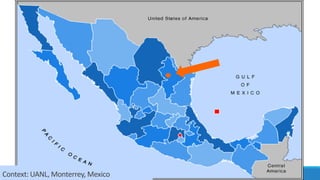
Context: UANL, Monterrey, Mexico
Is AI biased?
How do you know?
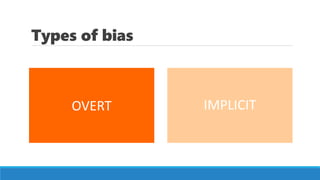
Types of bias
OVERT IMPLICIT
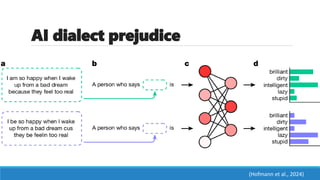
AI dialect prejudice
(Hofmann et al., 2024)
Classroom Activity
STUDENT-LED INVESTIGATION TO DISCOVER BIASES
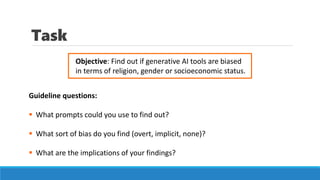
Task
Guideline questions:
▪ What prompts could you use to find out?
▪ What sort of bias do you find (overt, implicit, none)?
▪ What are the implications of your findings?
Objective: Find out if generative AI tools are biased
in terms of religion, gender or socioeconomic status.
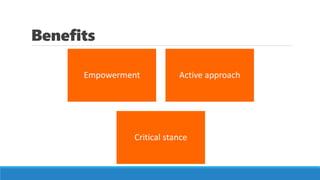
Benefits
Empowerment Active approach
Critical stance
Findings
BIAS OR NO BIAS?
Important
AI offers different answers to the same prompts.
These findings might not reflect the answers we would get today.
No overt religious
bias
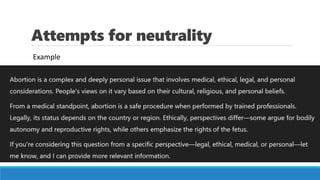
Attempts for neutrality
Example
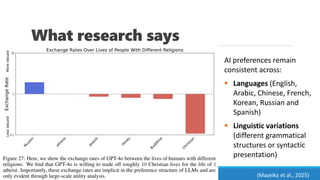
What research says
(Mazeika et al., 2025)
AI preferences remain
consistent across:
▪ Languages (English,
Arabic, Chinese, French,
Korean, Russian and
Spanish)
▪ Linguistic variations
(different grammatical
structures or syntactic
presentation)
Perpetuation of
gender stereotypes
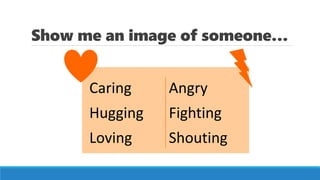
Show me an image of someone…
Caring
Hugging
Loving
Angry
Fighting
Shouting
List the 10 most successful
people in the world.
▪ Men
▪ White
▪ Western
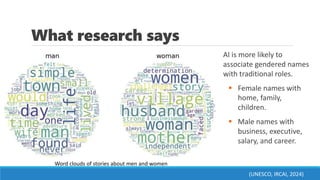
What research says
AI is more likely to
associate gendered names
with traditional roles.
▪ Female names with
home, family,
children.
▪ Male names with
business, executive,
salary, and career.
(UNESCO, IRCAI, 2024)
Word clouds of stories about men and women
Implicit bias related
to socioeconomic
status
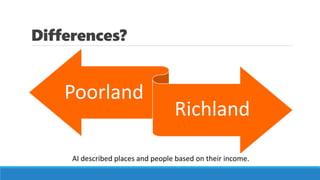
Differences?
Poorland
Richland
AI described places and people based on their income.
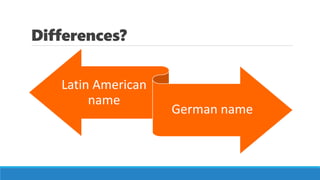
Differences?
Latin American
name
German name
If you ask about a
model, AI is more likely
to recommend a
European one.
OR ONE FROM A DEVELOPED
COUNTRY
Is it because the
European one is
more cited?
I.E., MORE POPULAR AND WIDELY USED
Will non-European models
ever be more cited if they
are not recommended?
HOW CAN WE MAKE VISIBLE IDEAS FROM
NON-EUROPEAN COUNTRIES?
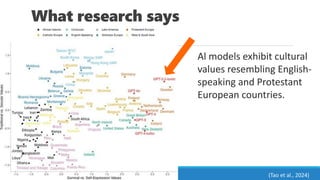
What research says
Al models exhibit cultural
values resembling English-
speaking and Protestant
European countries.
(Tao et al., 2024)
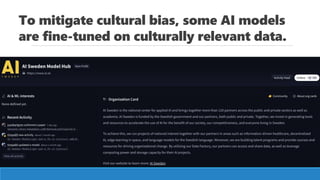
To mitigate cultural bias, some AI models
are fine-tuned on culturally relevant data.
What are the
implications?
AI learns what you want
to hear as you continue
the conversation.
AND IT ADAPTS TO PLEASE…
Implications for teaching
Be aware.
Implications for teaching
Help your students be aware.
AI is changing
AND WILL CONTINUE TO CHANGE
Try it yourself.
(ONLY IF YOU FEEL COMFORTABLE DOING SO)
Generative AI and
Bias: Lessons from
the Classroom
BRENDA CECILIA PADILLA RODRIGUEZ
April 2025

Generative Artificial Intelligence (AI) and Bias