GENERATING FUNCTIONAL VARIATIONS OF THE SHELTER
                      by

                      Victor Molina


          A paper presented in partial fulfillment
             of the requirements for the course
        Forecasting and the Evolution of Technology


         ARIZONA STATE UNIVERSITY EAST

                        May 2003
GENERATING FUNCTIONAL VARIATIONS OF THE SHELTER


Introduction
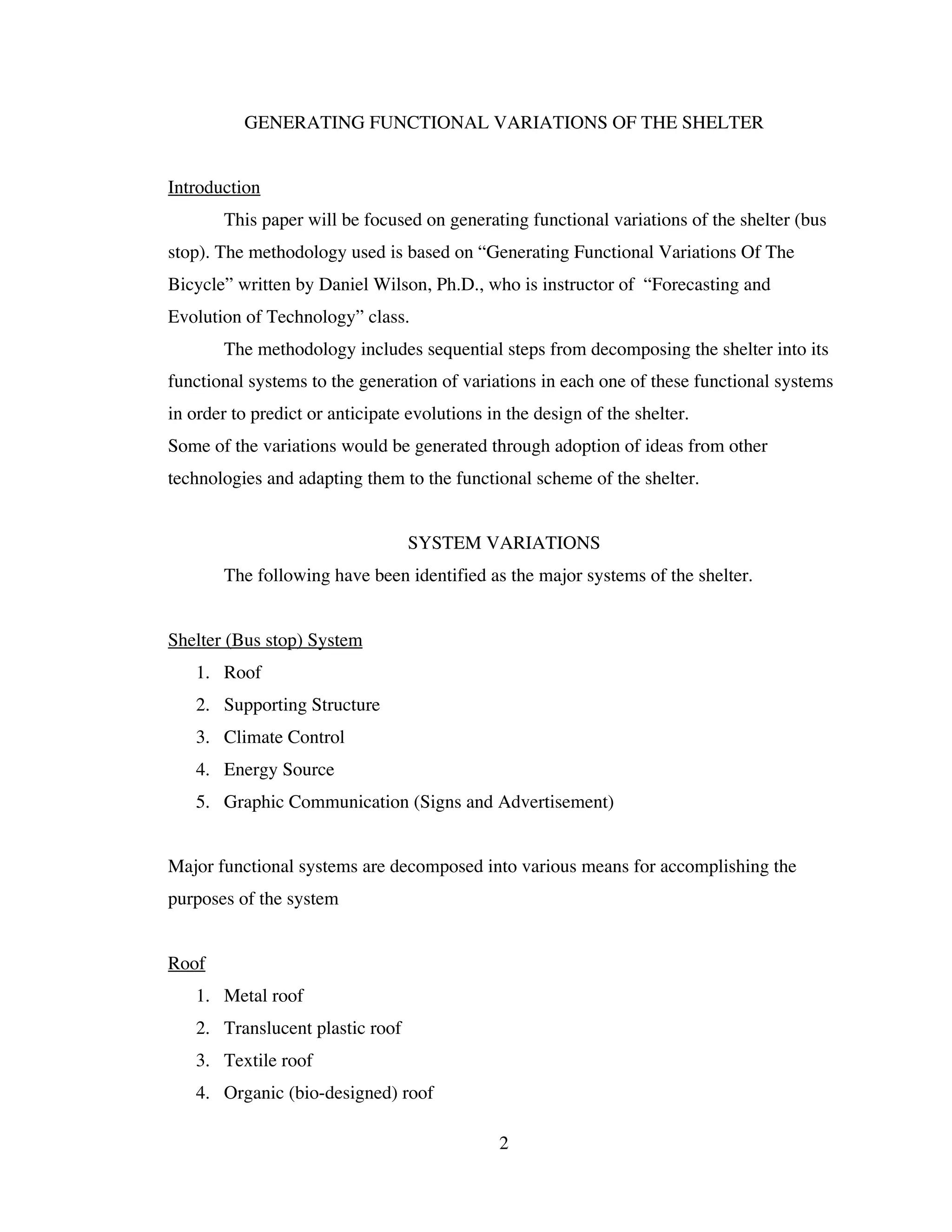
       This paper will be focused on generating functional variations of the shelter (bus
stop). The methodology used is based on “Generating Functional Variations Of The
Bicycle” written by Daniel Wilson, Ph.D., who is instructor of “Forecasting and
Evolution of Technology” class.
       The methodology includes sequential steps from decomposing the shelter into its
functional systems to the generation of variations in each one of these functional systems
in order to predict or anticipate evolutions in the design of the shelter.
Some of the variations would be generated through adoption of ideas from other
technologies and adapting them to the functional scheme of the shelter.


                                  SYSTEM VARIATIONS
       The following have been identified as the major systems of the shelter.


Shelter (Bus stop) System
   1. Roof
   2. Supporting Structure
   3. Climate Control
   4. Energy Source
   5. Graphic Communication (Signs and Advertisement)


Major functional systems are decomposed into various means for accomplishing the
purposes of the system


Roof
   1. Metal roof
   2. Translucent plastic roof
   3. Textile roof
   4. Organic (bio-designed) roof

                                               2
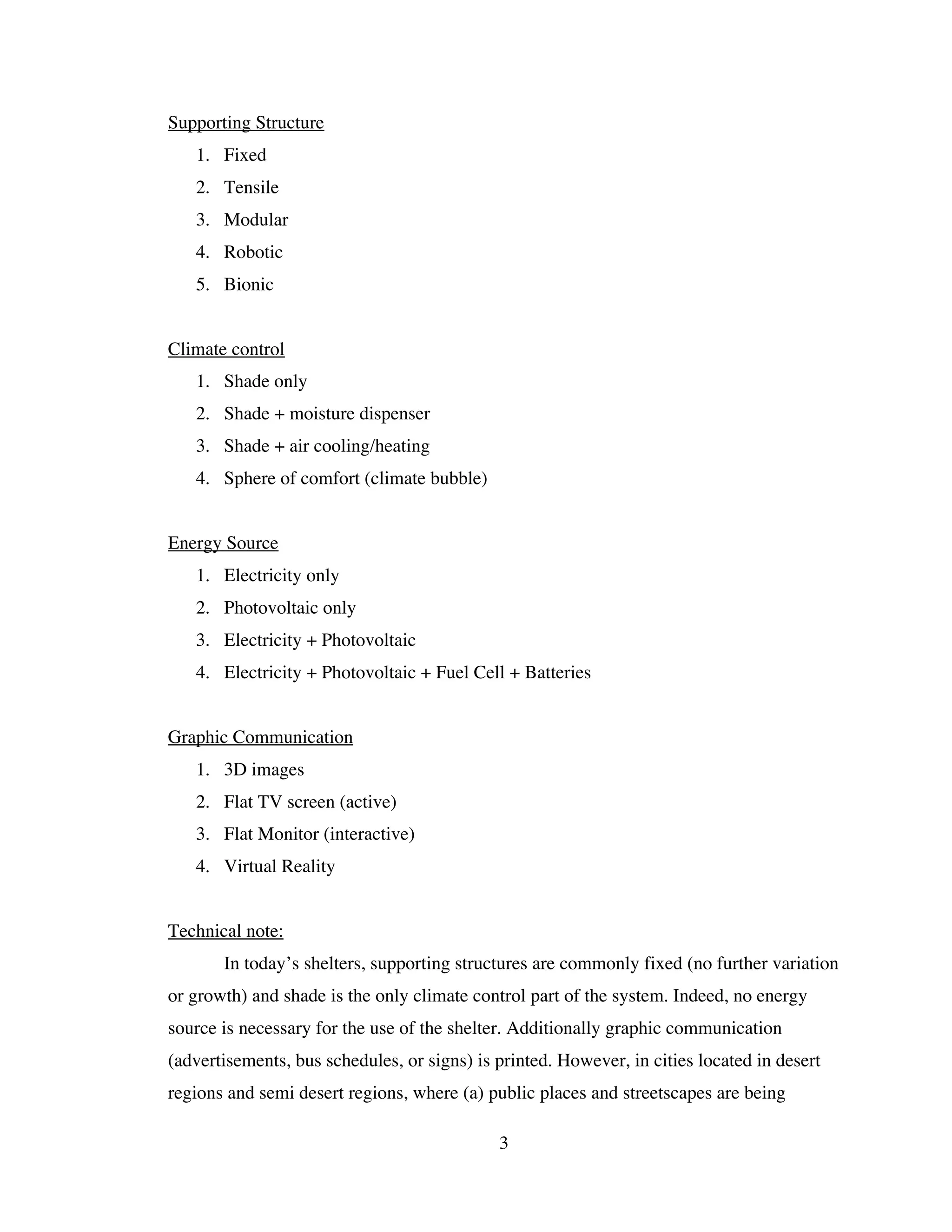
Supporting Structure
   1. Fixed
   2. Tensile
   3. Modular
   4. Robotic
   5. Bionic


Climate control
   1. Shade only
   2. Shade + moisture dispenser
   3. Shade + air cooling/heating
   4. Sphere of comfort (climate bubble)


Energy Source
   1. Electricity only
   2. Photovoltaic only
   3. Electricity + Photovoltaic
   4. Electricity + Photovoltaic + Fuel Cell + Batteries


Graphic Communication
   1. 3D images
   2. Flat TV screen (active)
   3. Flat Monitor (interactive)
   4. Virtual Reality


Technical note:
       In today’s shelters, supporting structures are commonly fixed (no further variation
or growth) and shade is the only climate control part of the system. Indeed, no energy
source is necessary for the use of the shelter. Additionally graphic communication
(advertisements, bus schedules, or signs) is printed. However, in cities located in desert
regions and semi desert regions, where (a) public places and streetscapes are being

                                             3
considered as a strategy toward downtown redevelopment, and (b) public transportation
is likely to be promoted, it is necessary to forecast variations of a new design of the
shelter that would cover the need of a potential group of users.


                                        SUMMARY
       The following variations of each particular system have been identified. The
number of variations of each system in parenthesis


Shelter (Bus stop) System:
   1. Roof (4)
   2. Supporting Structure (5)
   3. Climate Control (4)
   4. Energy Source (4)
   5. Graphic Communication (4)


Total variations
       If ni denote the number of variations in the i-th system, then the total number of
variations of the shelter in the product of the individual system variations, as follows:


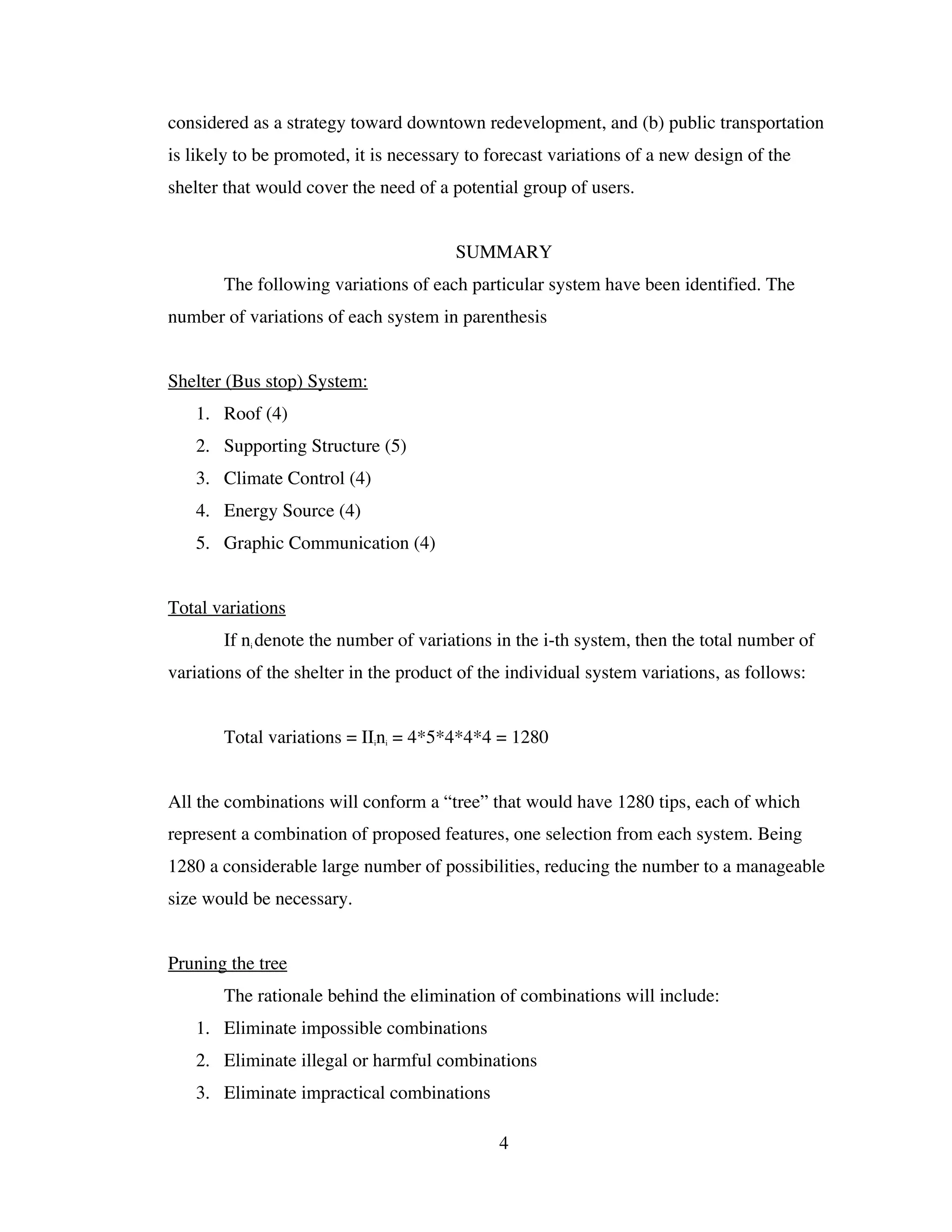
       Total variations = IIini = 4*5*4*4*4 = 1280


All the combinations will conform a “tree” that would have 1280 tips, each of which
represent a combination of proposed features, one selection from each system. Being
1280 a considerable large number of possibilities, reducing the number to a manageable
size would be necessary.


Pruning the tree
       The rationale behind the elimination of combinations will include:
   1. Eliminate impossible combinations
   2. Eliminate illegal or harmful combinations
   3. Eliminate impractical combinations

                                              4
4. Eliminate combinations that might cause inner problem in the system
   5. Eliminate combinations that could lead to behavioral constrains imposed by the
       intended user
   6. Eliminate combinations with legal restrictions


Shelter System After Pruning The Tree
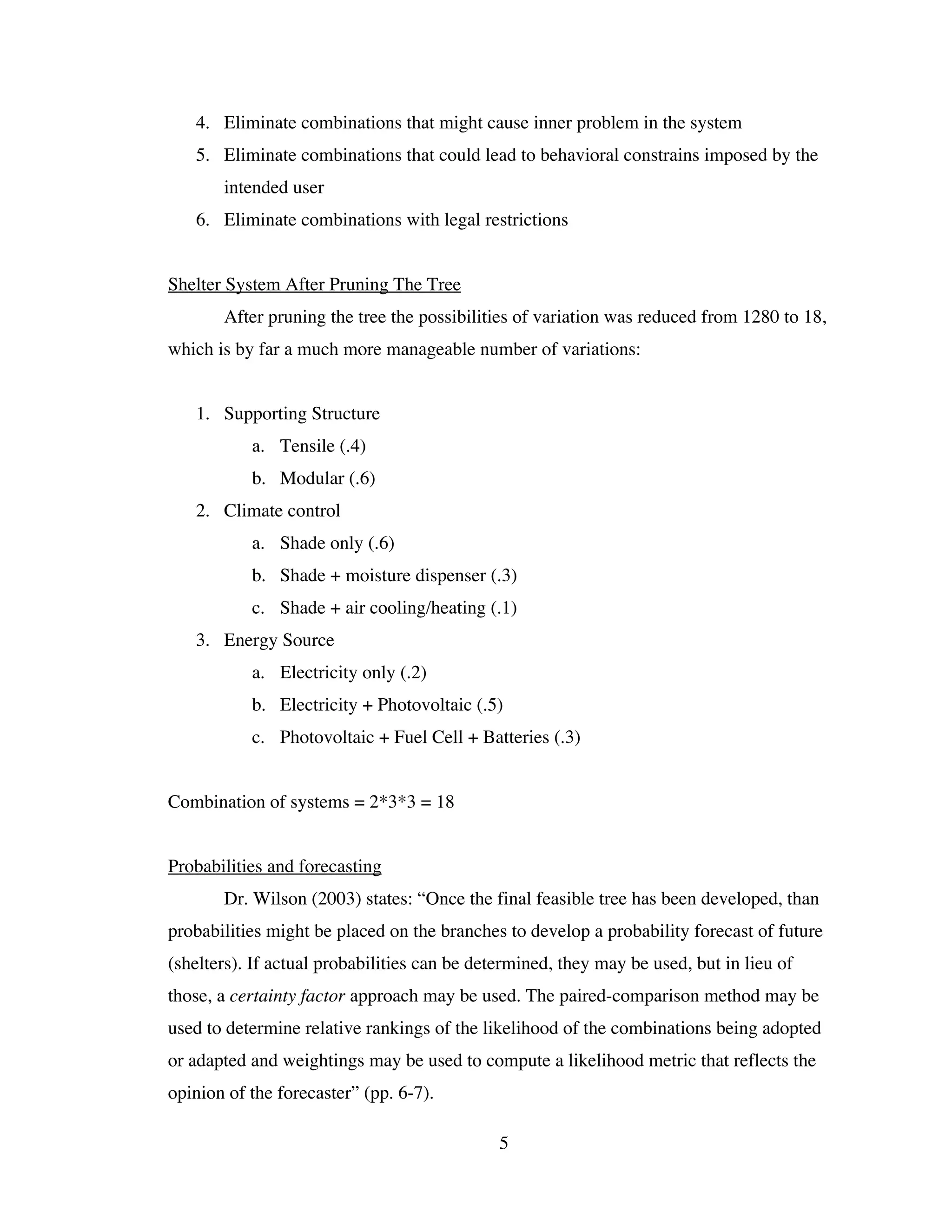
       After pruning the tree the possibilities of variation was reduced from 1280 to 18,
which is by far a much more manageable number of variations:


   1. Supporting Structure
           a. Tensile (.4)
           b. Modular (.6)
   2. Climate control
           a. Shade only (.6)
           b. Shade + moisture dispenser (.3)
           c. Shade + air cooling/heating (.1)
   3. Energy Source
           a. Electricity only (.2)
           b. Electricity + Photovoltaic (.5)
           c. Photovoltaic + Fuel Cell + Batteries (.3)


Combination of systems = 2*3*3 = 18


Probabilities and forecasting
       Dr. Wilson (2003) states: “Once the final feasible tree has been developed, than
probabilities might be placed on the branches to develop a probability forecast of future
(shelters). If actual probabilities can be determined, they may be used, but in lieu of
those, a certainty factor approach may be used. The paired-comparison method may be
used to determine relative rankings of the likelihood of the combinations being adopted
or adapted and weightings may be used to compute a likelihood metric that reflects the
opinion of the forecaster” (pp. 6-7).

                                              5
Likelihood Metrics and the Paired Comparison Method
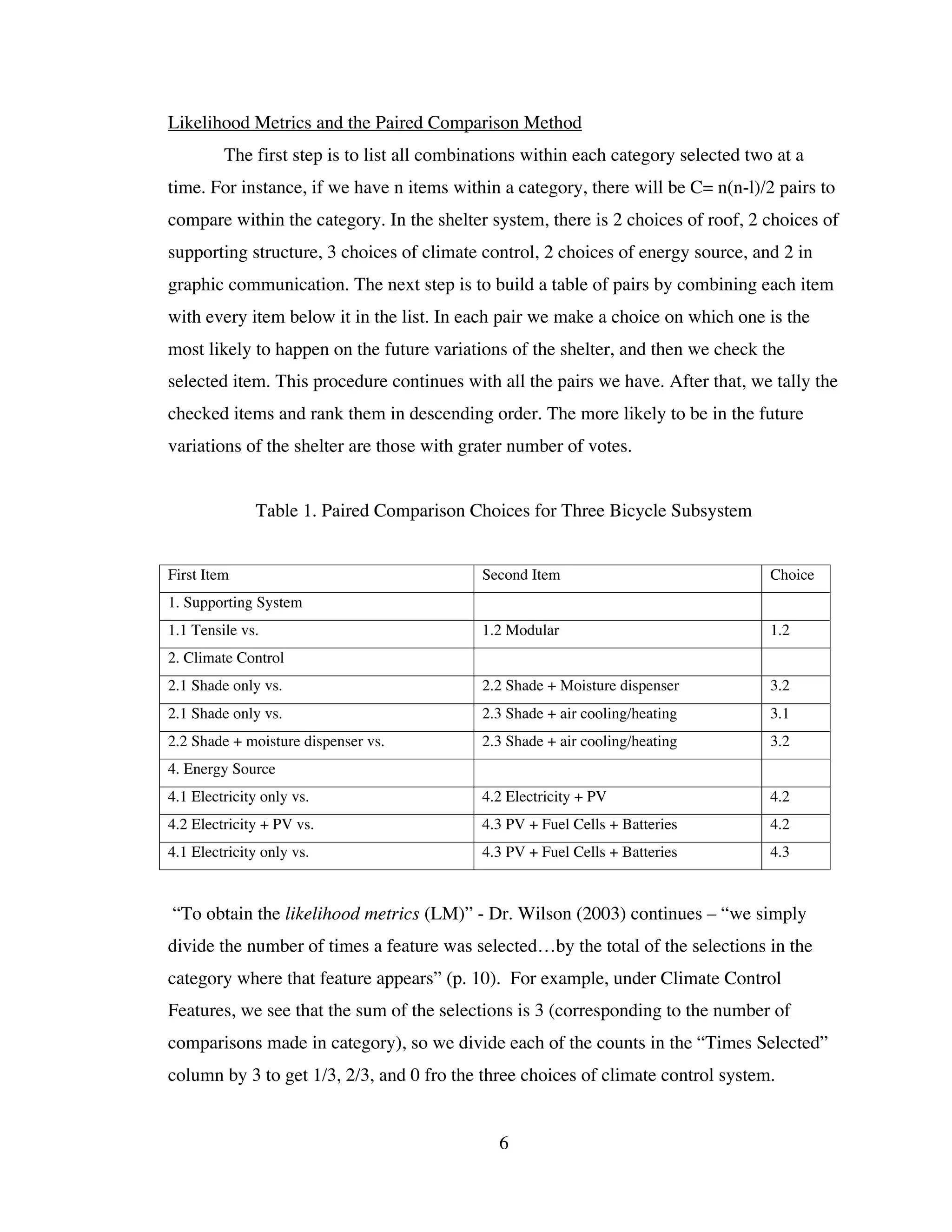
         The first step is to list all combinations within each category selected two at a
time. For instance, if we have n items within a category, there will be C= n(n-l)/2 pairs to
compare within the category. In the shelter system, there is 2 choices of roof, 2 choices of
supporting structure, 3 choices of climate control, 2 choices of energy source, and 2 in
graphic communication. The next step is to build a table of pairs by combining each item
with every item below it in the list. In each pair we make a choice on which one is the
most likely to happen on the future variations of the shelter, and then we check the
selected item. This procedure continues with all the pairs we have. After that, we tally the
checked items and rank them in descending order. The more likely to be in the future
variations of the shelter are those with grater number of votes.


              Table 1. Paired Comparison Choices for Three Bicycle Subsystem


First Item                                   Second Item                             Choice
1. Supporting System
1.1 Tensile vs.                              1.2 Modular                             1.2
2. Climate Control
2.1 Shade only vs.                           2.2 Shade + Moisture dispenser          3.2
2.1 Shade only vs.                           2.3 Shade + air cooling/heating         3.1
2.2 Shade + moisture dispenser vs.           2.3 Shade + air cooling/heating         3.2
4. Energy Source
4.1 Electricity only vs.                     4.2 Electricity + PV                    4.2
4.2 Electricity + PV vs.                     4.3 PV + Fuel Cells + Batteries         4.2
4.1 Electricity only vs.                     4.3 PV + Fuel Cells + Batteries         4.3


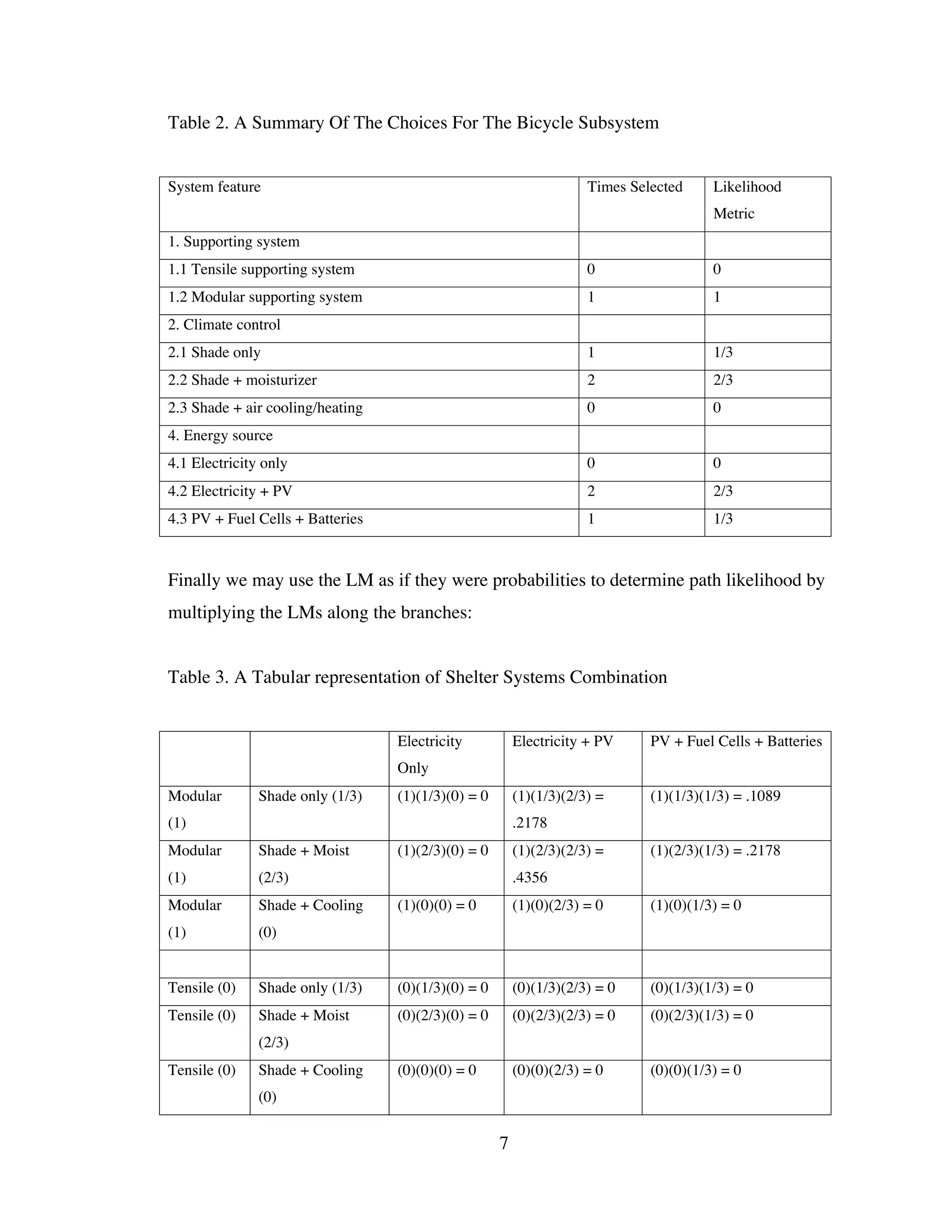
“To obtain the likelihood metrics (LM)” - Dr. Wilson (2003) continues – “we simply
divide the number of times a feature was selected…by the total of the selections in the
category where that feature appears” (p. 10). For example, under Climate Control
Features, we see that the sum of the selections is 3 (corresponding to the number of
comparisons made in category), so we divide each of the counts in the “Times Selected”
column by 3 to get 1/3, 2/3, and 0 fro the three choices of climate control system.


                                               6
Table 2. A Summary Of The Choices For The Bicycle Subsystem


System feature                                                      Times Selected     Likelihood
                                                                                       Metric
1. Supporting system
1.1 Tensile supporting system                                       0                  0
1.2 Modular supporting system                                       1                  1
2. Climate control
2.1 Shade only                                                      1                  1/3
2.2 Shade + moisturizer                                             2                  2/3
2.3 Shade + air cooling/heating                                     0                  0
4. Energy source
4.1 Electricity only                                                0                  0
4.2 Electricity + PV                                                2                  2/3
4.3 PV + Fuel Cells + Batteries                                     1                  1/3


Finally we may use the LM as if they were probabilities to determine path likelihood by
multiplying the LMs along the branches:


Table 3. A Tabular representation of Shelter Systems Combination


                                  Electricity           Electricity + PV     PV + Fuel Cells + Batteries
                                  Only
Modular        Shade only (1/3)   (1)(1/3)(0) = 0       (1)(1/3)(2/3) =      (1)(1/3)(1/3) = .1089
(1)                                                     .2178
Modular        Shade + Moist      (1)(2/3)(0) = 0       (1)(2/3)(2/3) =      (1)(2/3)(1/3) = .2178
(1)            (2/3)                                    .4356
Modular        Shade + Cooling    (1)(0)(0) = 0         (1)(0)(2/3) = 0      (1)(0)(1/3) = 0
(1)            (0)


Tensile (0)    Shade only (1/3)   (0)(1/3)(0) = 0       (0)(1/3)(2/3) = 0    (0)(1/3)(1/3) = 0
Tensile (0)    Shade + Moist      (0)(2/3)(0) = 0       (0)(2/3)(2/3) = 0    (0)(2/3)(1/3) = 0
               (2/3)
Tensile (0)    Shade + Cooling    (0)(0)(0) = 0         (0)(0)(2/3) = 0      (0)(0)(1/3) = 0
               (0)


                                                    7
Conclusion
   The shelter combinations, for cities located in desert regions, in descending order of
likelihood are:


   •   Modular supporting structure, shade+moist, electricity+PV (.4356)
   •   Modular supporting structure, shade+moist, PV+fuel cells+batteries (.2178)
   •   Modular supporting structure, shade only, electricity+PV (.2178)
   •   Modular supporting structure, shade only, PV+fuel cells+PV (.1089)


References

JC Decaux [Online] www.jcdecaux.com/anglais/metiers/mobilierurbain/focus/index.htm


Wilson D. (2003). Generating Functional Variations of the Bicycle. College of
       Technology and Applied Sciences. Arizona State University.


                                            8

Generating Multiple Variations of the Shelter

  • 1.
    GENERATING FUNCTIONAL VARIATIONSOF THE SHELTER by Victor Molina A paper presented in partial fulfillment of the requirements for the course Forecasting and the Evolution of Technology ARIZONA STATE UNIVERSITY EAST May 2003
  • 2.
    GENERATING FUNCTIONAL VARIATIONSOF THE SHELTER Introduction This paper will be focused on generating functional variations of the shelter (bus stop). The methodology used is based on “Generating Functional Variations Of The Bicycle” written by Daniel Wilson, Ph.D., who is instructor of “Forecasting and Evolution of Technology” class. The methodology includes sequential steps from decomposing the shelter into its functional systems to the generation of variations in each one of these functional systems in order to predict or anticipate evolutions in the design of the shelter. Some of the variations would be generated through adoption of ideas from other technologies and adapting them to the functional scheme of the shelter. SYSTEM VARIATIONS The following have been identified as the major systems of the shelter. Shelter (Bus stop) System 1. Roof 2. Supporting Structure 3. Climate Control 4. Energy Source 5. Graphic Communication (Signs and Advertisement) Major functional systems are decomposed into various means for accomplishing the purposes of the system Roof 1. Metal roof 2. Translucent plastic roof 3. Textile roof 4. Organic (bio-designed) roof 2
  • 3.
    Supporting Structure 1. Fixed 2. Tensile 3. Modular 4. Robotic 5. Bionic Climate control 1. Shade only 2. Shade + moisture dispenser 3. Shade + air cooling/heating 4. Sphere of comfort (climate bubble) Energy Source 1. Electricity only 2. Photovoltaic only 3. Electricity + Photovoltaic 4. Electricity + Photovoltaic + Fuel Cell + Batteries Graphic Communication 1. 3D images 2. Flat TV screen (active) 3. Flat Monitor (interactive) 4. Virtual Reality Technical note: In today’s shelters, supporting structures are commonly fixed (no further variation or growth) and shade is the only climate control part of the system. Indeed, no energy source is necessary for the use of the shelter. Additionally graphic communication (advertisements, bus schedules, or signs) is printed. However, in cities located in desert regions and semi desert regions, where (a) public places and streetscapes are being 3
  • 4.
    considered as astrategy toward downtown redevelopment, and (b) public transportation is likely to be promoted, it is necessary to forecast variations of a new design of the shelter that would cover the need of a potential group of users. SUMMARY The following variations of each particular system have been identified. The number of variations of each system in parenthesis Shelter (Bus stop) System: 1. Roof (4) 2. Supporting Structure (5) 3. Climate Control (4) 4. Energy Source (4) 5. Graphic Communication (4) Total variations If ni denote the number of variations in the i-th system, then the total number of variations of the shelter in the product of the individual system variations, as follows: Total variations = IIini = 4*5*4*4*4 = 1280 All the combinations will conform a “tree” that would have 1280 tips, each of which represent a combination of proposed features, one selection from each system. Being 1280 a considerable large number of possibilities, reducing the number to a manageable size would be necessary. Pruning the tree The rationale behind the elimination of combinations will include: 1. Eliminate impossible combinations 2. Eliminate illegal or harmful combinations 3. Eliminate impractical combinations 4
  • 5.
    4. Eliminate combinationsthat might cause inner problem in the system 5. Eliminate combinations that could lead to behavioral constrains imposed by the intended user 6. Eliminate combinations with legal restrictions Shelter System After Pruning The Tree After pruning the tree the possibilities of variation was reduced from 1280 to 18, which is by far a much more manageable number of variations: 1. Supporting Structure a. Tensile (.4) b. Modular (.6) 2. Climate control a. Shade only (.6) b. Shade + moisture dispenser (.3) c. Shade + air cooling/heating (.1) 3. Energy Source a. Electricity only (.2) b. Electricity + Photovoltaic (.5) c. Photovoltaic + Fuel Cell + Batteries (.3) Combination of systems = 2*3*3 = 18 Probabilities and forecasting Dr. Wilson (2003) states: “Once the final feasible tree has been developed, than probabilities might be placed on the branches to develop a probability forecast of future (shelters). If actual probabilities can be determined, they may be used, but in lieu of those, a certainty factor approach may be used. The paired-comparison method may be used to determine relative rankings of the likelihood of the combinations being adopted or adapted and weightings may be used to compute a likelihood metric that reflects the opinion of the forecaster” (pp. 6-7). 5
  • 6.
    Likelihood Metrics andthe Paired Comparison Method The first step is to list all combinations within each category selected two at a time. For instance, if we have n items within a category, there will be C= n(n-l)/2 pairs to compare within the category. In the shelter system, there is 2 choices of roof, 2 choices of supporting structure, 3 choices of climate control, 2 choices of energy source, and 2 in graphic communication. The next step is to build a table of pairs by combining each item with every item below it in the list. In each pair we make a choice on which one is the most likely to happen on the future variations of the shelter, and then we check the selected item. This procedure continues with all the pairs we have. After that, we tally the checked items and rank them in descending order. The more likely to be in the future variations of the shelter are those with grater number of votes. Table 1. Paired Comparison Choices for Three Bicycle Subsystem First Item Second Item Choice 1. Supporting System 1.1 Tensile vs. 1.2 Modular 1.2 2. Climate Control 2.1 Shade only vs. 2.2 Shade + Moisture dispenser 3.2 2.1 Shade only vs. 2.3 Shade + air cooling/heating 3.1 2.2 Shade + moisture dispenser vs. 2.3 Shade + air cooling/heating 3.2 4. Energy Source 4.1 Electricity only vs. 4.2 Electricity + PV 4.2 4.2 Electricity + PV vs. 4.3 PV + Fuel Cells + Batteries 4.2 4.1 Electricity only vs. 4.3 PV + Fuel Cells + Batteries 4.3 “To obtain the likelihood metrics (LM)” - Dr. Wilson (2003) continues – “we simply divide the number of times a feature was selected…by the total of the selections in the category where that feature appears” (p. 10). For example, under Climate Control Features, we see that the sum of the selections is 3 (corresponding to the number of comparisons made in category), so we divide each of the counts in the “Times Selected” column by 3 to get 1/3, 2/3, and 0 fro the three choices of climate control system. 6
  • 7.
    Table 2. ASummary Of The Choices For The Bicycle Subsystem System feature Times Selected Likelihood Metric 1. Supporting system 1.1 Tensile supporting system 0 0 1.2 Modular supporting system 1 1 2. Climate control 2.1 Shade only 1 1/3 2.2 Shade + moisturizer 2 2/3 2.3 Shade + air cooling/heating 0 0 4. Energy source 4.1 Electricity only 0 0 4.2 Electricity + PV 2 2/3 4.3 PV + Fuel Cells + Batteries 1 1/3 Finally we may use the LM as if they were probabilities to determine path likelihood by multiplying the LMs along the branches: Table 3. A Tabular representation of Shelter Systems Combination Electricity Electricity + PV PV + Fuel Cells + Batteries Only Modular Shade only (1/3) (1)(1/3)(0) = 0 (1)(1/3)(2/3) = (1)(1/3)(1/3) = .1089 (1) .2178 Modular Shade + Moist (1)(2/3)(0) = 0 (1)(2/3)(2/3) = (1)(2/3)(1/3) = .2178 (1) (2/3) .4356 Modular Shade + Cooling (1)(0)(0) = 0 (1)(0)(2/3) = 0 (1)(0)(1/3) = 0 (1) (0) Tensile (0) Shade only (1/3) (0)(1/3)(0) = 0 (0)(1/3)(2/3) = 0 (0)(1/3)(1/3) = 0 Tensile (0) Shade + Moist (0)(2/3)(0) = 0 (0)(2/3)(2/3) = 0 (0)(2/3)(1/3) = 0 (2/3) Tensile (0) Shade + Cooling (0)(0)(0) = 0 (0)(0)(2/3) = 0 (0)(0)(1/3) = 0 (0) 7
  • 8.
    Conclusion The shelter combinations, for cities located in desert regions, in descending order of likelihood are: • Modular supporting structure, shade+moist, electricity+PV (.4356) • Modular supporting structure, shade+moist, PV+fuel cells+batteries (.2178) • Modular supporting structure, shade only, electricity+PV (.2178) • Modular supporting structure, shade only, PV+fuel cells+PV (.1089) References JC Decaux [Online] www.jcdecaux.com/anglais/metiers/mobilierurbain/focus/index.htm Wilson D. (2003). Generating Functional Variations of the Bicycle. College of Technology and Applied Sciences. Arizona State University. 8