M.V.SC. (VETERINARY MICROBIOLOGY), FIRST YEAR, MONSOON SEMESTER DATE 18.01.2021
VMC 603 (VETERINARY MYCOLOGY), UNIT I
TOPIC: GENERAL CHARACTERISTICS OF FUNGI
DR. SAVITA KUMARI
ASSISTANT PROFESSOR-CUM-JR. SCIENTIST
DEPARTMENT OF VETERINARY MICROBIOLOGY
BIHAR VETERINARY COLLEGE, BASU, PATNA
INTRODUCTION
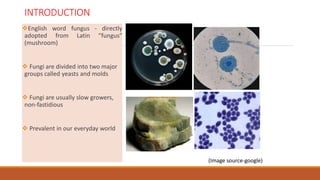
English word fungus - directly
adopted from Latin “fungus”
(mushroom)
 Fungi are divided into two major
groups called yeasts and molds
 Fungi are usually slow growers,
non-fastidious
 Prevalent in our everyday world
(Image source-google)
Terms:
Mycology - branch of biology, concerned with the study of fungi
Mycotoxicology- The study of fungal toxins
Mycoses- The diseases caused by fungi in animals. (s., mycosis)
Phaehyphomycosis- Infection caused by pigmented (dematiaceous) fungi
Mycetoma- Tumour-like granulomatous lesions caused by saprophytic fungi
Pseudomycetoma- Tumour-like granulomatous lesions, associated with dermatophytes invasion
Mycotoxicoses- Diseases resulting from ingestion of fungal toxins
HISTORY
Mycology was one of the first microbiological sciences, beginning around 1835, when Bassi
discovered that some fungi are pathogenic
 In 1900, Darling characterized the pathogenic fungus, Histoplasma capsulatum
Majority of techniques- developed in the early 1900's by a scientist named Sabouraud
Raymond Sabouraud - major contributions in mycology
He invented a method to select fungi with a medium of low pH and a rather high concentration of
sugar, media called as Sabouraud agar
General characteristics:
1.5 million species in the kingdom Fungi
Approx. 400 fungal species - pathogenic for humans and animals
Widely distributed in the environment
Eukaryotic
Non-photosynthetic heterotrophs
Produce exoenzymes and obtain nutrients by absorption
Cell walls contain chitin and other polysaccharides
The two main morphological fungal forms are moulds and yeasts
Reproduce both sexually and asexually with the production of spores
Grow aerobically at 25°C; some moulds are strict aerobes
Tolerate high osmotic pressures and low pH values
Grow on Sabouraud dextrose agar, pH 5.5
Non- motile, few (e.g. Chytrids) have a motile phase
Fungal cell membranes have a unique sterol, ergosterol, which replaces cholesterol found in mammalian
cell membranes
Resistant to antimicrobial drugs which are effective against bacteria
Fungal species may be saprophytic, parasitic or mutualistic
Majority are saprophytes; some cause opportunistic infections
Mutualistic fungi:
Have obligatory associations with other microorganisms
Non-pathogenic
Saprophytic fungi-
widespread in the environment
involved in the decomposition of organic matter, cause sporadic opportunistic infections in animals
Parasitic fungi:
Pathogenic
Dermatophytes are pathogens that cause ringworm in animals and humans
Overgrowth of yeasts, which are often commensals on skin and mucous membranes, may cause
localized lesions
Morphology of fungi
The two main morphological fungal forms- moulds and yeasts
Moulds multicellular, threadlike fungus, grow as branching filaments called hyphae (2 to 10
μm in diameter)
Unicellular yeasts - oval or spherical appearance (3 to 5 μm in diameter)
Dimorphic fungi occur in both mould and yeast forms
Environmental factors usually determine the form of dimorphic fungus
Candida albicans, produce forms additional to the two major forms- polymorphic
MYCOSES
Diseases caused by fungi – mycoses
Four general categories on the basis of the primary tissue affinity of the pathogen
a. Superficial mycoses- infections limited to the hair and dead layers of the skin (stratum corneum)
b. Cutaneous mycoses (dermatophytoses or ringworm)- affect only the skin, hair, and nails
c. Subcutaneous mycoses- affect the subcutaneous tissue below the skin, and occasionally, the
bone
d. Systemic mycoses- infect the internal organs and may spread throughout the host, most serious
of the mycoses

General_characteristics_of_Fungi.pdf...............

  • 1.
    M.V.SC. (VETERINARY MICROBIOLOGY),FIRST YEAR, MONSOON SEMESTER DATE 18.01.2021 VMC 603 (VETERINARY MYCOLOGY), UNIT I TOPIC: GENERAL CHARACTERISTICS OF FUNGI DR. SAVITA KUMARI ASSISTANT PROFESSOR-CUM-JR. SCIENTIST DEPARTMENT OF VETERINARY MICROBIOLOGY BIHAR VETERINARY COLLEGE, BASU, PATNA
  • 2.
    INTRODUCTION English word fungus- directly adopted from Latin “fungus” (mushroom)  Fungi are divided into two major groups called yeasts and molds  Fungi are usually slow growers, non-fastidious  Prevalent in our everyday world (Image source-google)
  • 3.
    Terms: Mycology - branchof biology, concerned with the study of fungi Mycotoxicology- The study of fungal toxins Mycoses- The diseases caused by fungi in animals. (s., mycosis) Phaehyphomycosis- Infection caused by pigmented (dematiaceous) fungi Mycetoma- Tumour-like granulomatous lesions caused by saprophytic fungi Pseudomycetoma- Tumour-like granulomatous lesions, associated with dermatophytes invasion Mycotoxicoses- Diseases resulting from ingestion of fungal toxins
  • 4.
    HISTORY Mycology was oneof the first microbiological sciences, beginning around 1835, when Bassi discovered that some fungi are pathogenic  In 1900, Darling characterized the pathogenic fungus, Histoplasma capsulatum Majority of techniques- developed in the early 1900's by a scientist named Sabouraud Raymond Sabouraud - major contributions in mycology He invented a method to select fungi with a medium of low pH and a rather high concentration of sugar, media called as Sabouraud agar
  • 5.
    General characteristics: 1.5 millionspecies in the kingdom Fungi Approx. 400 fungal species - pathogenic for humans and animals Widely distributed in the environment Eukaryotic Non-photosynthetic heterotrophs Produce exoenzymes and obtain nutrients by absorption
  • 6.
    Cell walls containchitin and other polysaccharides The two main morphological fungal forms are moulds and yeasts Reproduce both sexually and asexually with the production of spores Grow aerobically at 25°C; some moulds are strict aerobes Tolerate high osmotic pressures and low pH values Grow on Sabouraud dextrose agar, pH 5.5 Non- motile, few (e.g. Chytrids) have a motile phase Fungal cell membranes have a unique sterol, ergosterol, which replaces cholesterol found in mammalian cell membranes
  • 7.
    Resistant to antimicrobialdrugs which are effective against bacteria Fungal species may be saprophytic, parasitic or mutualistic Majority are saprophytes; some cause opportunistic infections Mutualistic fungi: Have obligatory associations with other microorganisms Non-pathogenic
  • 8.
    Saprophytic fungi- widespread inthe environment involved in the decomposition of organic matter, cause sporadic opportunistic infections in animals Parasitic fungi: Pathogenic Dermatophytes are pathogens that cause ringworm in animals and humans Overgrowth of yeasts, which are often commensals on skin and mucous membranes, may cause localized lesions
  • 9.
    Morphology of fungi Thetwo main morphological fungal forms- moulds and yeasts Moulds multicellular, threadlike fungus, grow as branching filaments called hyphae (2 to 10 μm in diameter) Unicellular yeasts - oval or spherical appearance (3 to 5 μm in diameter) Dimorphic fungi occur in both mould and yeast forms Environmental factors usually determine the form of dimorphic fungus Candida albicans, produce forms additional to the two major forms- polymorphic
  • 10.
    MYCOSES Diseases caused byfungi – mycoses Four general categories on the basis of the primary tissue affinity of the pathogen a. Superficial mycoses- infections limited to the hair and dead layers of the skin (stratum corneum) b. Cutaneous mycoses (dermatophytoses or ringworm)- affect only the skin, hair, and nails c. Subcutaneous mycoses- affect the subcutaneous tissue below the skin, and occasionally, the bone d. Systemic mycoses- infect the internal organs and may spread throughout the host, most serious of the mycoses