GENERAL SPECIFICATIONS FOR
ENERGY EFFICIENT LED BASED
LIGHTING SYSTEM
SCOPE:
The intent and scope of this specification is design, development, manufacturing and
supply of energy efficient luminaries using High Power SMD LEDs with suitable
current control driver circuit and other accessories including mounting arrangement
and related mechanical and electrical works and warranty period obligations at
Indian Oil Refineries and associated Townships conforming to this specification,
Technical Data Sheets and other relevant Indian/ International Standards.
BY: H Anandkumar Singh
R&D Head , Ready Led Lighting Pvt Ltd
LED
• High Power SMD LEDs
• having minimum luminous efficiency of 100 lumens/watt.
• The LEDs shall be of reputed make such as Cree Inc. / Nichia Corporation/
OSRAM /Philips Lumileds/ Seoul Semiconductor.
• LED module/ array shall deliver at least 70% of initial lumens, when installed
for a minimum of 40,000 hours. Need to provide supporting certification for
the same.
• The CCT of the LED fixture shall be in the range of 6500 °K.
• CRI of minimum 80.
• The Uniformity Ratio (Emin /Eavg) shall be greater than 35%.
• Life Span Shoud be 40000 hours.
• The P/N junction temperature of individual LED must not exceed 100 oC. High
• Thermal conduction must be achieved by use of silicon heat conductive
greases and adhesive.
FIXTURE
• LED must be mounted on heat sinking conductive bars if any with suitable
large area surface by means of fins to dissipate the conducted heat. The
fins must be exposed to ambient flowing air.
• The casing made of non-corrosive aluminum having high conductivity shall
have external surface designed in a manner so as to act as an efficient
heat sink to extract heat generated at PN-junction of a LED. Efforts shall be
made to keep the overall outer dimensions as minimum as possible
without compromising on the performance of the LEDs or luminary.
• The fixture shall be designed in such a manner that it is easy to handle and
install, is not too large and unwieldy, is of robust construction, light weight
and conforms to minimum IP65 class of protection for outdoor use and
min. IP20 for indoor application against dust and moisture intrusion.
LUMINARY
• The LED luminaries shall produce constant lux level in the voltage range of
100V to 250V AC input. Voltage variations/ fluctuations in the specified
voltage range shall not impinge upon the lux level it produces.
• All luminaires shall be provided with acrylic / polycarbonate / glass
diffusers and/or aluminized reflectors and/or lenses to provide proper
road lighting distribution.
• The minimum acceptable luminous efficacy of the fixture offered shall be
100 Lm/W
• Toughened and/or tempered glass of sufficient strength may be provided
under the LED chamber to protect the LEDs and luminaires.
• No part shall be constructed of polycarbonate unless it is UV stabilized.
• The luminaries shall be capable of operating normally in ambient
temperatures from -10°C to 45°C maintaining junction temperature below
100°C and heat sink temperature below 60°C, ensuring efficient thermal
management of the luminaire.
• Built-in external heat sink as well as an aluminum MCPCB printed circuit
board, designed in such a way that the heat generated within the LED
source is efficiently dissipated to the surrounding atmosphere without
abnormal rise in temperature. Any debris build up shall not degrade heat
dissipation performance of the luminaries.
• assisted cooling system is not acceptable.
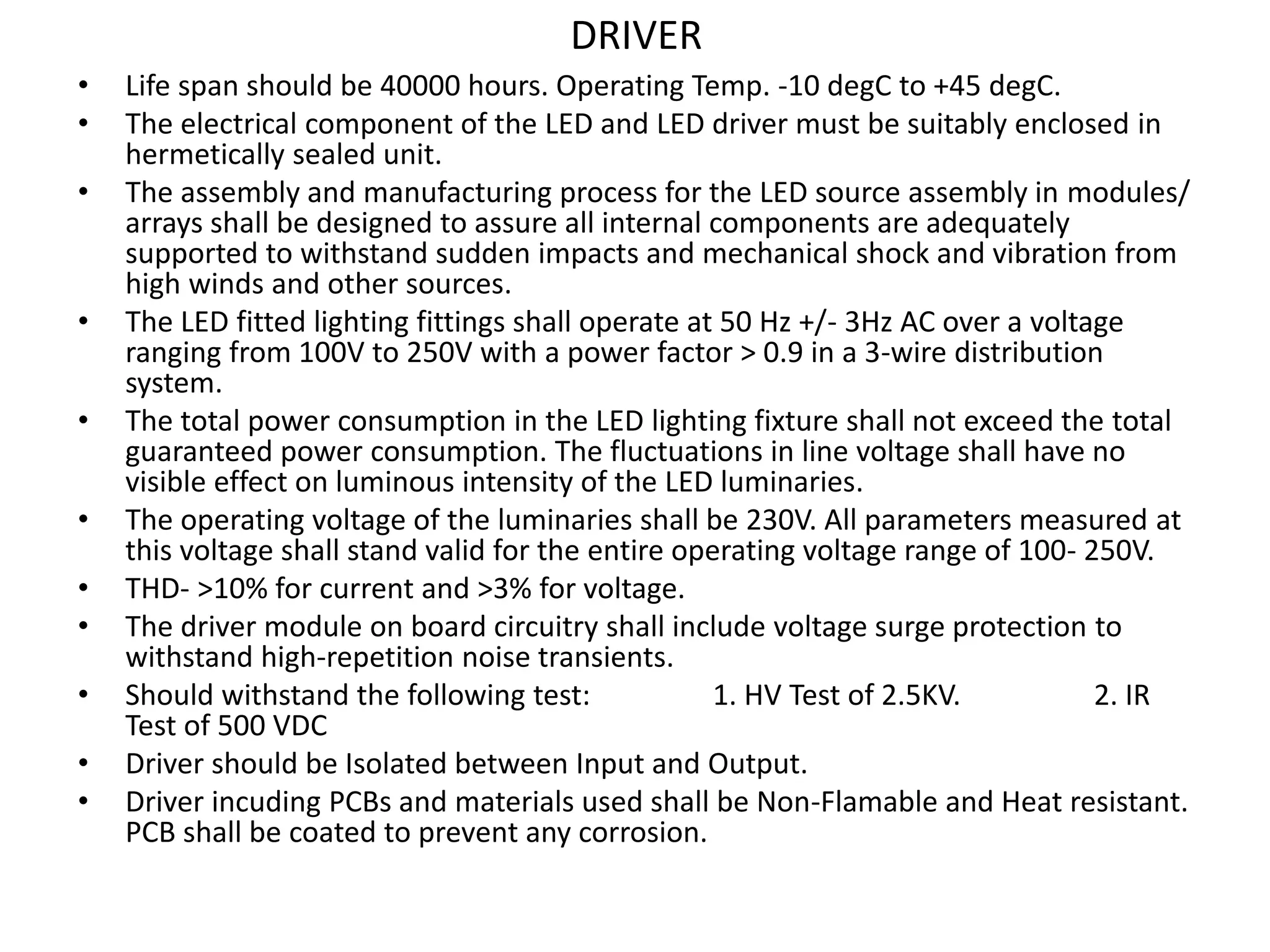
DRIVER
• Life span should be 40000 hours. Operating Temp. -10 degC to +45 degC.
• The electrical component of the LED and LED driver must be suitably enclosed in
hermetically sealed unit.
• The assembly and manufacturing process for the LED source assembly in modules/
arrays shall be designed to assure all internal components are adequately
supported to withstand sudden impacts and mechanical shock and vibration from
high winds and other sources.
• The LED fitted lighting fittings shall operate at 50 Hz +/- 3Hz AC over a voltage
ranging from 100V to 250V with a power factor > 0.9 in a 3-wire distribution
system.
• The total power consumption in the LED lighting fixture shall not exceed the total
guaranteed power consumption. The fluctuations in line voltage shall have no
visible effect on luminous intensity of the LED luminaries.
• The operating voltage of the luminaries shall be 230V. All parameters measured at
this voltage shall stand valid for the entire operating voltage range of 100- 250V.
• THD- >10% for current and >3% for voltage.
• The driver module on board circuitry shall include voltage surge protection to
withstand high-repetition noise transients.
• Should withstand the following test: 1. HV Test of 2.5KV. 2. IR
Test of 500 VDC
• Driver should be Isolated between Input and Output.
• Driver incuding PCBs and materials used shall be Non-Flamable and Heat resistant.
PCB shall be coated to prevent any corrosion.
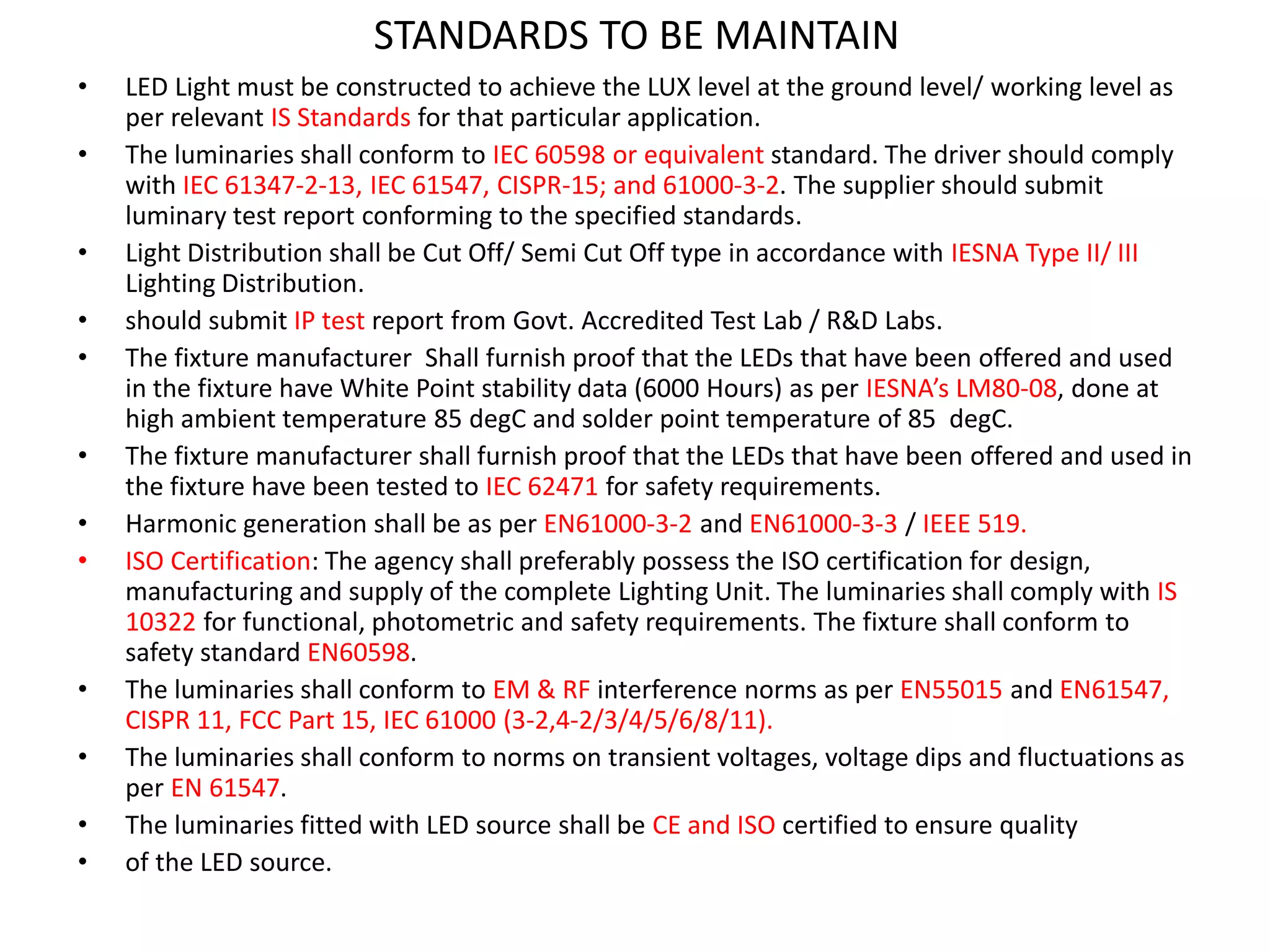
STANDARDS TO BE MAINTAIN
• LED Light must be constructed to achieve the LUX level at the ground level/ working level as
per relevant IS Standards for that particular application.
• The luminaries shall conform to IEC 60598 or equivalent standard. The driver should comply
with IEC 61347-2-13, IEC 61547, CISPR-15; and 61000-3-2. The supplier should submit
luminary test report conforming to the specified standards.
• Light Distribution shall be Cut Off/ Semi Cut Off type in accordance with IESNA Type II/ III
Lighting Distribution.
• should submit IP test report from Govt. Accredited Test Lab / R&D Labs.
• The fixture manufacturer Shall furnish proof that the LEDs that have been offered and used
in the fixture have White Point stability data (6000 Hours) as per IESNA’s LM80-08, done at
high ambient temperature 85 degC and solder point temperature of 85 degC.
• The fixture manufacturer shall furnish proof that the LEDs that have been offered and used in
the fixture have been tested to IEC 62471 for safety requirements.
• Harmonic generation shall be as per EN61000-3-2 and EN61000-3-3 / IEEE 519.
• ISO Certification: The agency shall preferably possess the ISO certification for design,
manufacturing and supply of the complete Lighting Unit. The luminaries shall comply with IS
10322 for functional, photometric and safety requirements. The fixture shall conform to
safety standard EN60598.
• The luminaries shall conform to EM & RF interference norms as per EN55015 and EN61547,
CISPR 11, FCC Part 15, IEC 61000 (3-2,4-2/3/4/5/6/8/11).
• The luminaries shall conform to norms on transient voltages, voltage dips and fluctuations as
per EN 61547.
• The luminaries fitted with LED source shall be CE and ISO certified to ensure quality
• of the LED source.
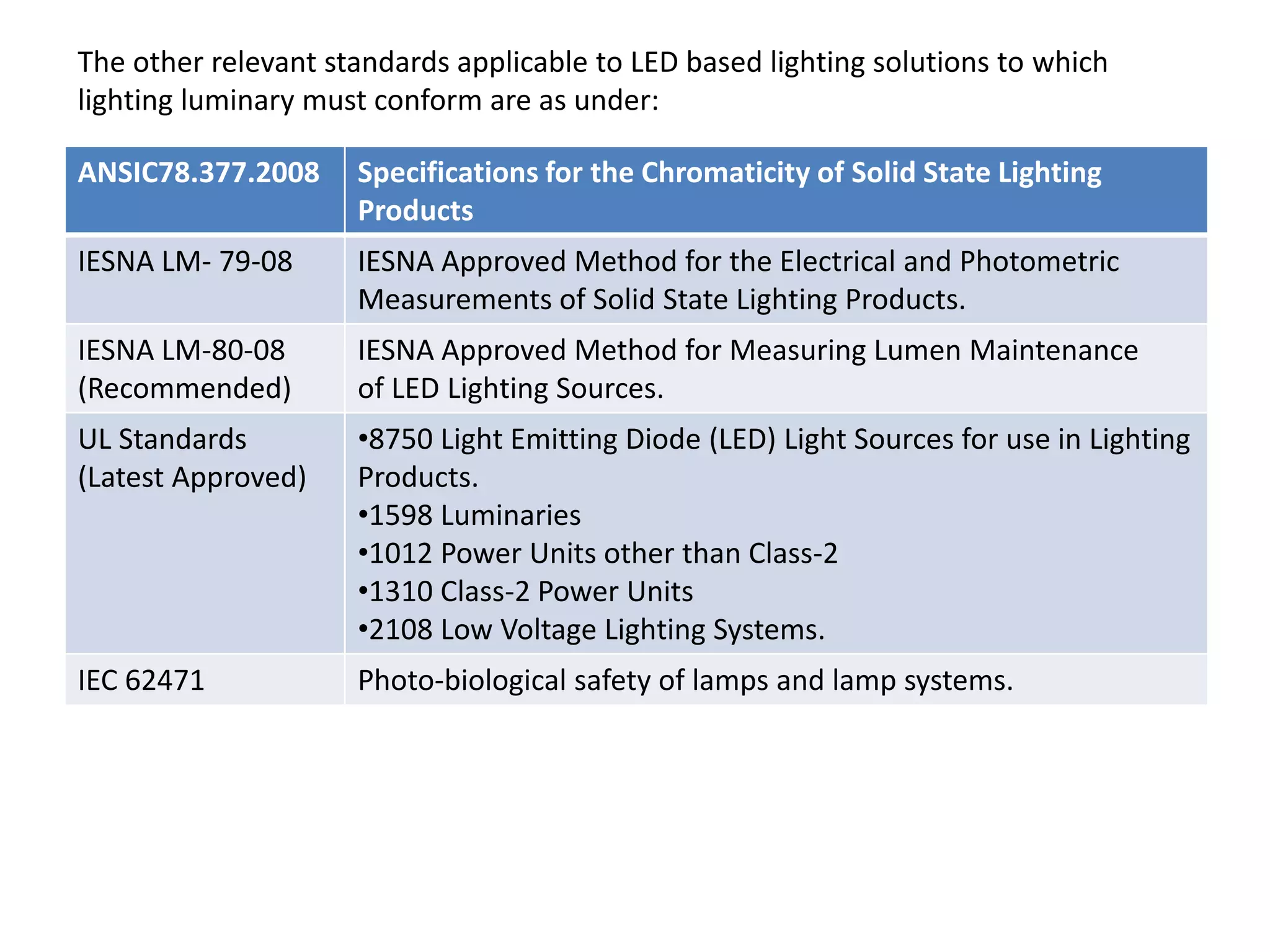
The other relevant standards applicable to LED based lighting solutions to which
lighting luminary must conform are as under:
ANSIC78.377.2008 Specifications for the Chromaticity of Solid State Lighting
Products
IESNA LM- 79-08 IESNA Approved Method for the Electrical and Photometric
Measurements of Solid State Lighting Products.
IESNA LM-80-08
(Recommended)
IESNA Approved Method for Measuring Lumen Maintenance
of LED Lighting Sources.
UL Standards
(Latest Approved)
•8750 Light Emitting Diode (LED) Light Sources for use in Lighting
Products.
•1598 Luminaries
•1012 Power Units other than Class-2
•1310 Class-2 Power Units
•2108 Low Voltage Lighting Systems.
IEC 62471 Photo-biological safety of lamps and lamp systems.
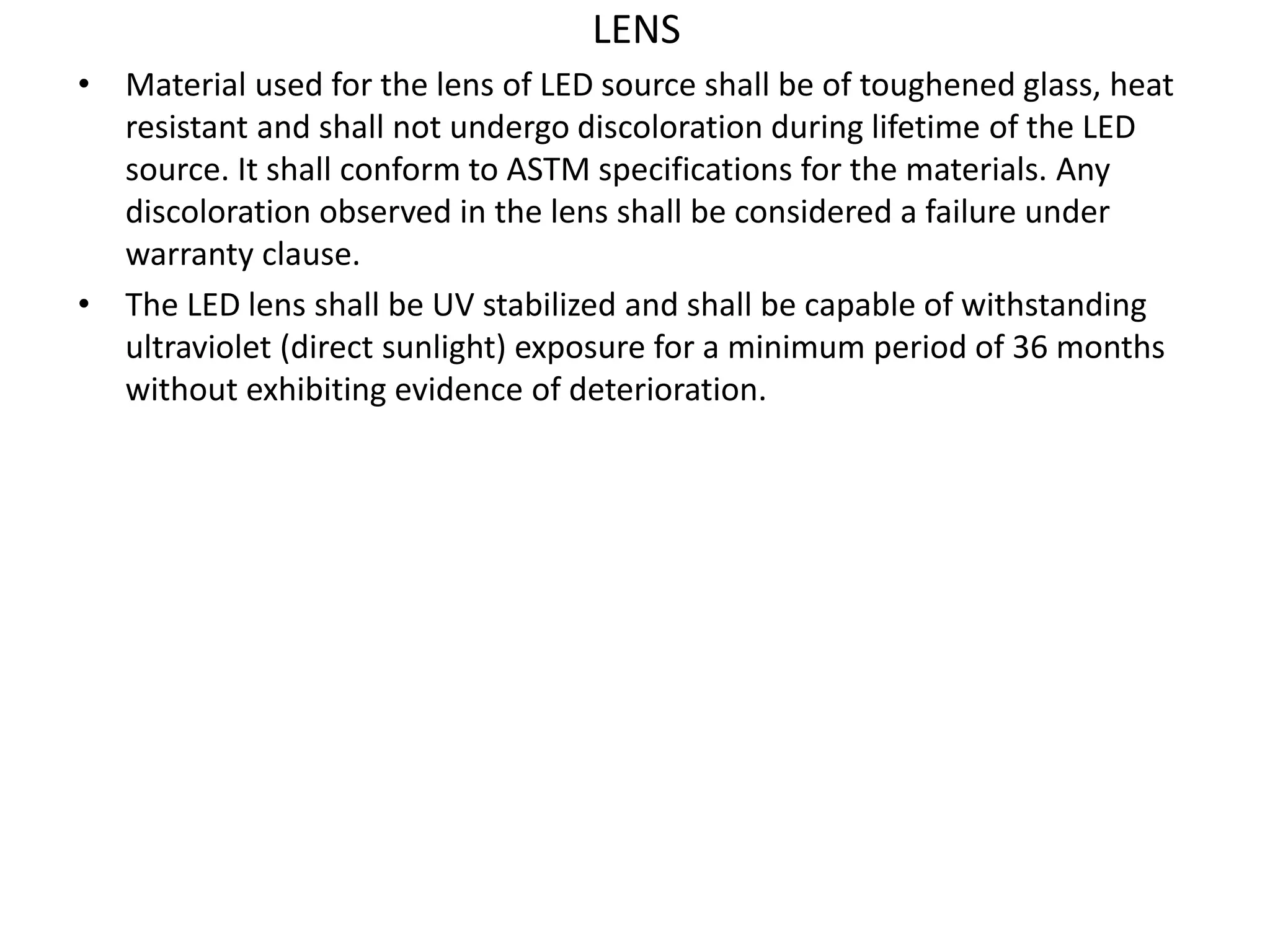
LENS
• Material used for the lens of LED source shall be of toughened glass, heat
resistant and shall not undergo discoloration during lifetime of the LED
source. It shall conform to ASTM specifications for the materials. Any
discoloration observed in the lens shall be considered a failure under
warranty clause.
• The LED lens shall be UV stabilized and shall be capable of withstanding
ultraviolet (direct sunlight) exposure for a minimum period of 36 months
without exhibiting evidence of deterioration.
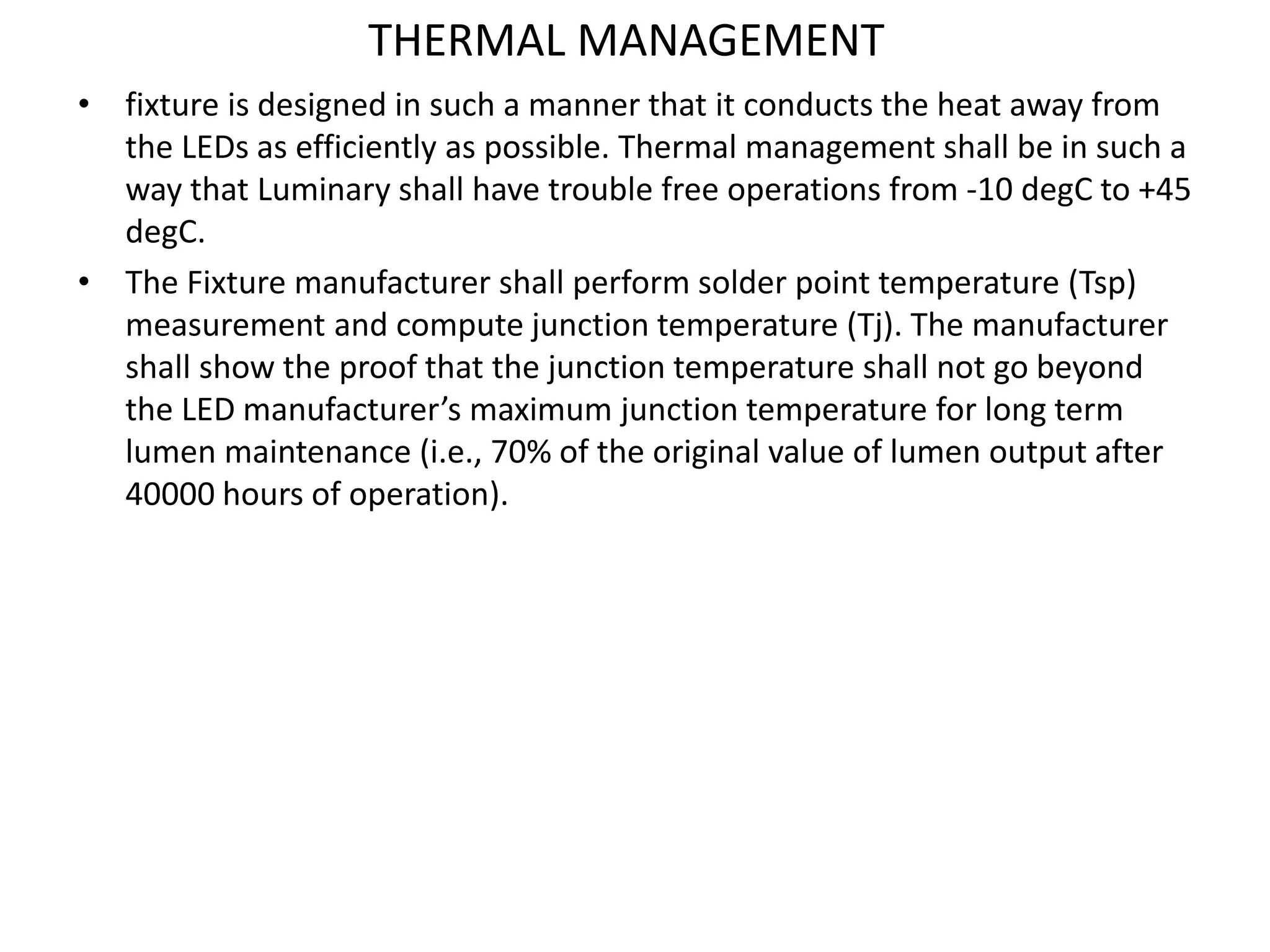
THERMAL MANAGEMENT
• fixture is designed in such a manner that it conducts the heat away from
the LEDs as efficiently as possible. Thermal management shall be in such a
way that Luminary shall have trouble free operations from -10 degC to +45
degC.
• The Fixture manufacturer shall perform solder point temperature (Tsp)
measurement and compute junction temperature (Tj). The manufacturer
shall show the proof that the junction temperature shall not go beyond
the LED manufacturer’s maximum junction temperature for long term
lumen maintenance (i.e., 70% of the original value of lumen output after
40000 hours of operation).
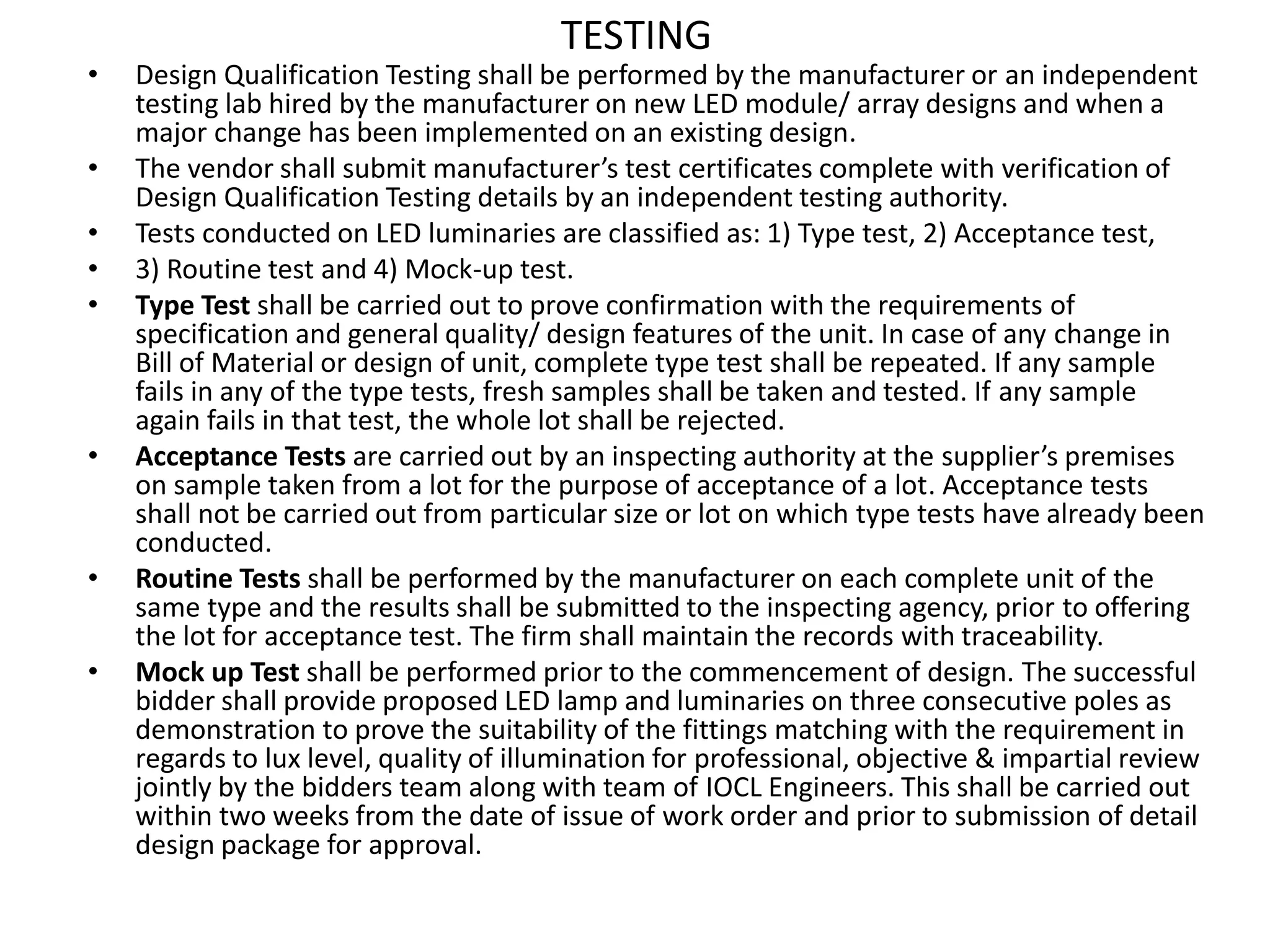
TESTING
• Design Qualification Testing shall be performed by the manufacturer or an independent
testing lab hired by the manufacturer on new LED module/ array designs and when a
major change has been implemented on an existing design.
• The vendor shall submit manufacturer’s test certificates complete with verification of
Design Qualification Testing details by an independent testing authority.
• Tests conducted on LED luminaries are classified as: 1) Type test, 2) Acceptance test,
• 3) Routine test and 4) Mock-up test.
• Type Test shall be carried out to prove confirmation with the requirements of
specification and general quality/ design features of the unit. In case of any change in
Bill of Material or design of unit, complete type test shall be repeated. If any sample
fails in any of the type tests, fresh samples shall be taken and tested. If any sample
again fails in that test, the whole lot shall be rejected.
• Acceptance Tests are carried out by an inspecting authority at the supplier’s premises
on sample taken from a lot for the purpose of acceptance of a lot. Acceptance tests
shall not be carried out from particular size or lot on which type tests have already been
conducted.
• Routine Tests shall be performed by the manufacturer on each complete unit of the
same type and the results shall be submitted to the inspecting agency, prior to offering
the lot for acceptance test. The firm shall maintain the records with traceability.
• Mock up Test shall be performed prior to the commencement of design. The successful
bidder shall provide proposed LED lamp and luminaries on three consecutive poles as
demonstration to prove the suitability of the fittings matching with the requirement in
regards to lux level, quality of illumination for professional, objective & impartial review
jointly by the bidders team along with team of IOCL Engineers. This shall be carried out
within two weeks from the date of issue of work order and prior to submission of detail
design package for approval.
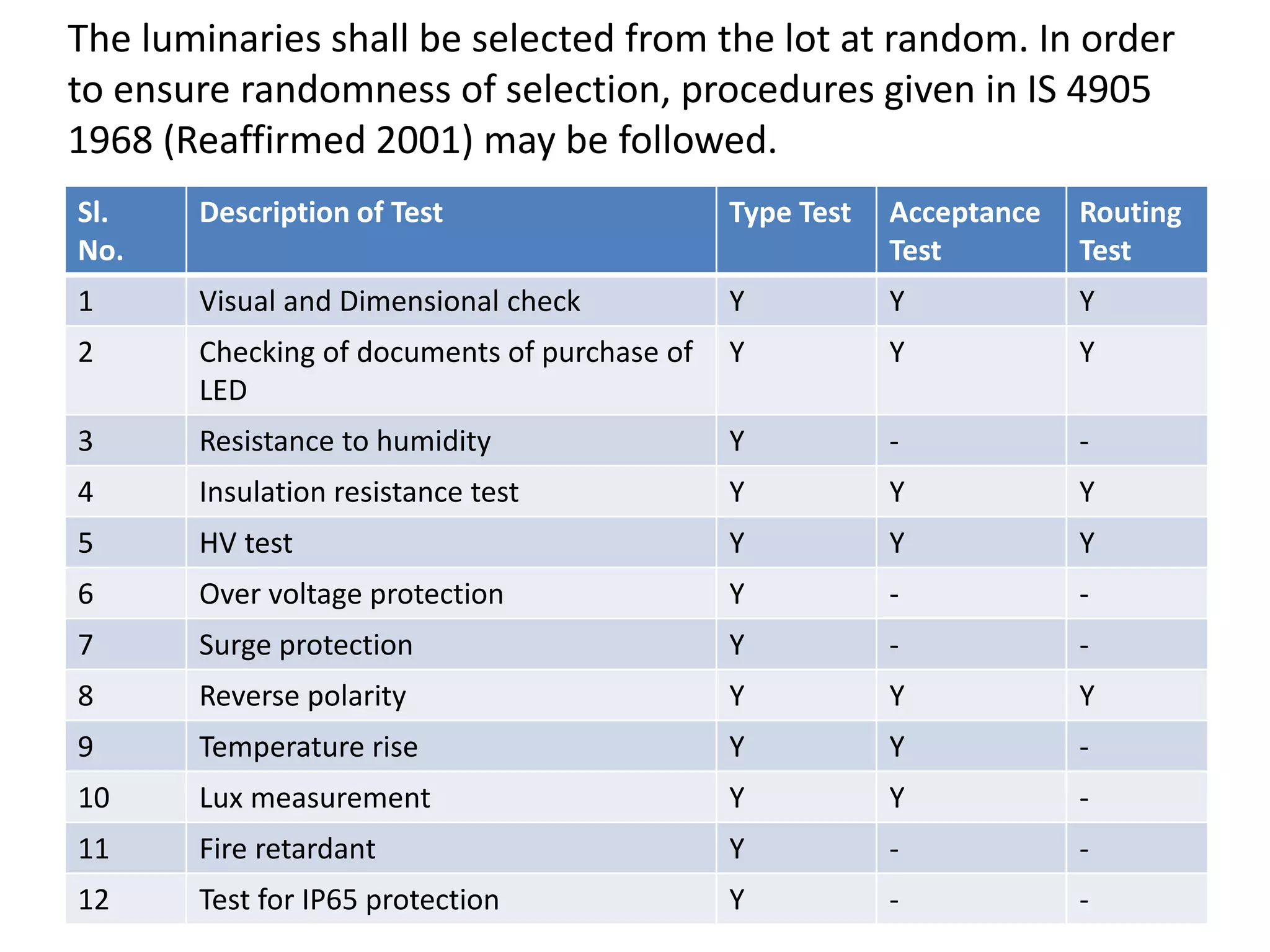
The luminaries shall be selected from the lot at random. In order
to ensure randomness of selection, procedures given in IS 4905
1968 (Reaffirmed 2001) may be followed.
Sl.
No.
Description of Test Type Test Acceptance
Test
Routing
Test
1 Visual and Dimensional check Y Y Y
2 Checking of documents of purchase of
LED
Y Y Y
3 Resistance to humidity Y - -
4 Insulation resistance test Y Y Y
5 HV test Y Y Y
6 Over voltage protection Y - -
7 Surge protection Y - -
8 Reverse polarity Y Y Y
9 Temperature rise Y Y -
10 Lux measurement Y Y -
11 Fire retardant Y - -
12 Test for IP65 protection Y - -
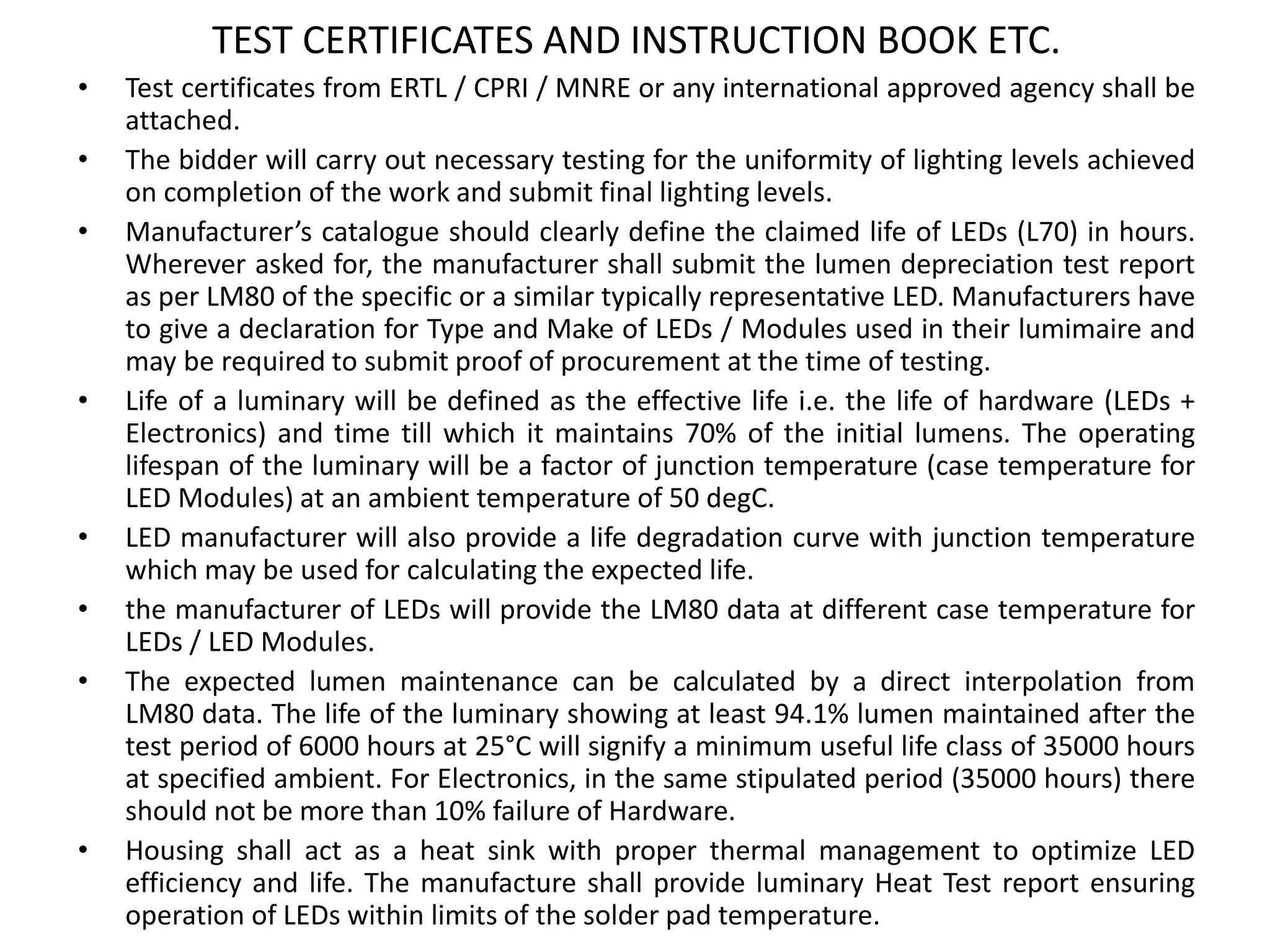
TEST CERTIFICATES AND INSTRUCTION BOOK ETC.
• Test certificates from ERTL / CPRI / MNRE or any international approved agency shall be
attached.
• The bidder will carry out necessary testing for the uniformity of lighting levels achieved
on completion of the work and submit final lighting levels.
• Manufacturer’s catalogue should clearly define the claimed life of LEDs (L70) in hours.
Wherever asked for, the manufacturer shall submit the lumen depreciation test report
as per LM80 of the specific or a similar typically representative LED. Manufacturers have
to give a declaration for Type and Make of LEDs / Modules used in their lumimaire and
may be required to submit proof of procurement at the time of testing.
• Life of a luminary will be defined as the effective life i.e. the life of hardware (LEDs +
Electronics) and time till which it maintains 70% of the initial lumens. The operating
lifespan of the luminary will be a factor of junction temperature (case temperature for
LED Modules) at an ambient temperature of 50 degC.
• LED manufacturer will also provide a life degradation curve with junction temperature
which may be used for calculating the expected life.
• the manufacturer of LEDs will provide the LM80 data at different case temperature for
LEDs / LED Modules.
• The expected lumen maintenance can be calculated by a direct interpolation from
LM80 data. The life of the luminary showing at least 94.1% lumen maintained after the
test period of 6000 hours at 25°C will signify a minimum useful life class of 35000 hours
at specified ambient. For Electronics, in the same stipulated period (35000 hours) there
should not be more than 10% failure of Hardware.
• Housing shall act as a heat sink with proper thermal management to optimize LED
efficiency and life. The manufacture shall provide luminary Heat Test report ensuring
operation of LEDs within limits of the solder pad temperature.
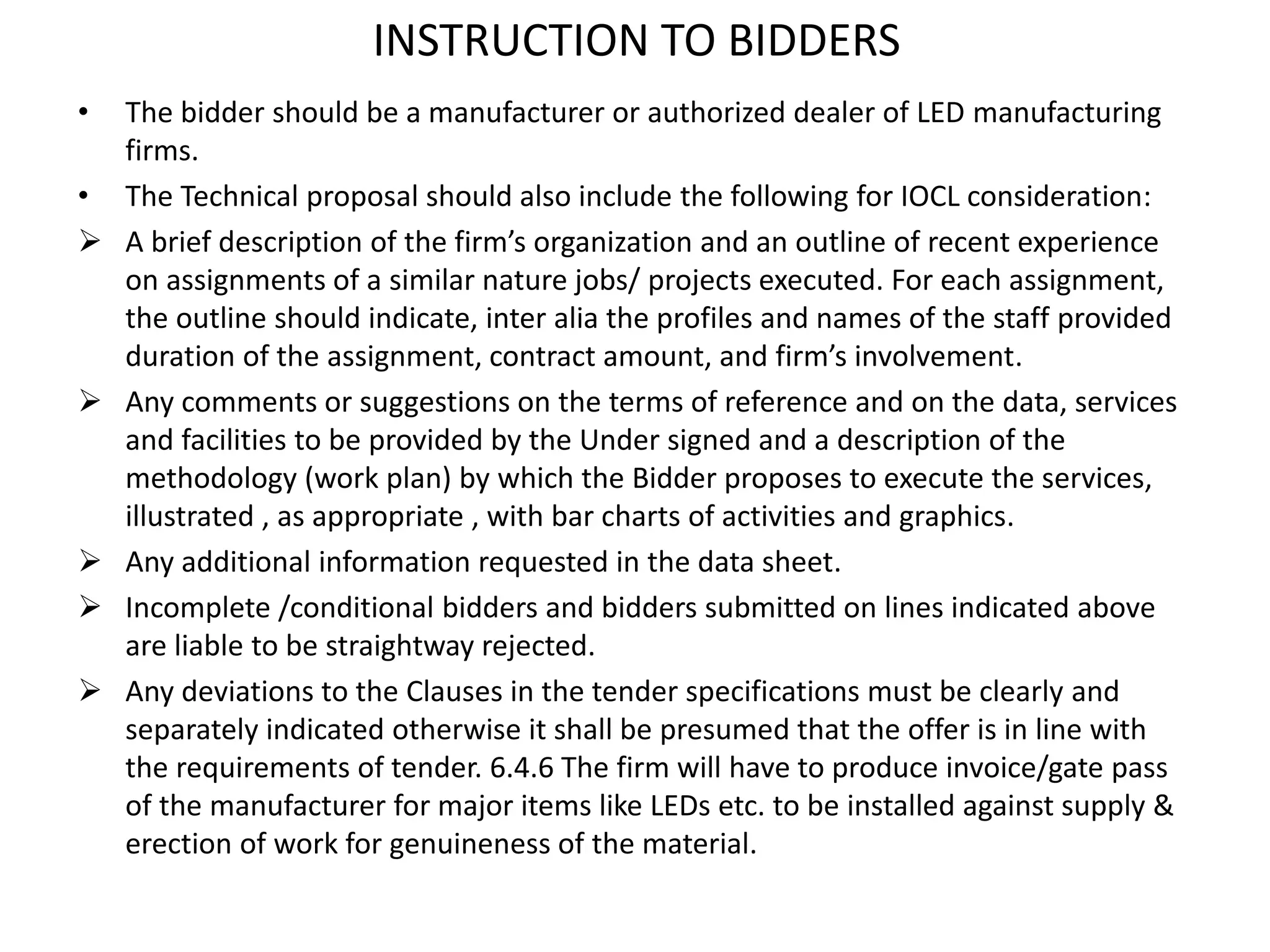
INSTRUCTION TO BIDDERS
• The bidder should be a manufacturer or authorized dealer of LED manufacturing
firms.
• The Technical proposal should also include the following for IOCL consideration:
 A brief description of the firm’s organization and an outline of recent experience
on assignments of a similar nature jobs/ projects executed. For each assignment,
the outline should indicate, inter alia the profiles and names of the staff provided
duration of the assignment, contract amount, and firm’s involvement.
 Any comments or suggestions on the terms of reference and on the data, services
and facilities to be provided by the Under signed and a description of the
methodology (work plan) by which the Bidder proposes to execute the services,
illustrated , as appropriate , with bar charts of activities and graphics.
 Any additional information requested in the data sheet.
 Incomplete /conditional bidders and bidders submitted on lines indicated above
are liable to be straightway rejected.
 Any deviations to the Clauses in the tender specifications must be clearly and
separately indicated otherwise it shall be presumed that the offer is in line with
the requirements of tender. 6.4.6 The firm will have to produce invoice/gate pass
of the manufacturer for major items like LEDs etc. to be installed against supply &
erection of work for genuineness of the material.

General specifications for energy efficient led based

  • 1.
    GENERAL SPECIFICATIONS FOR ENERGYEFFICIENT LED BASED LIGHTING SYSTEM SCOPE: The intent and scope of this specification is design, development, manufacturing and supply of energy efficient luminaries using High Power SMD LEDs with suitable current control driver circuit and other accessories including mounting arrangement and related mechanical and electrical works and warranty period obligations at Indian Oil Refineries and associated Townships conforming to this specification, Technical Data Sheets and other relevant Indian/ International Standards. BY: H Anandkumar Singh R&D Head , Ready Led Lighting Pvt Ltd
  • 2.
    LED • High PowerSMD LEDs • having minimum luminous efficiency of 100 lumens/watt. • The LEDs shall be of reputed make such as Cree Inc. / Nichia Corporation/ OSRAM /Philips Lumileds/ Seoul Semiconductor. • LED module/ array shall deliver at least 70% of initial lumens, when installed for a minimum of 40,000 hours. Need to provide supporting certification for the same. • The CCT of the LED fixture shall be in the range of 6500 °K. • CRI of minimum 80. • The Uniformity Ratio (Emin /Eavg) shall be greater than 35%. • Life Span Shoud be 40000 hours. • The P/N junction temperature of individual LED must not exceed 100 oC. High • Thermal conduction must be achieved by use of silicon heat conductive greases and adhesive.
  • 3.
    FIXTURE • LED mustbe mounted on heat sinking conductive bars if any with suitable large area surface by means of fins to dissipate the conducted heat. The fins must be exposed to ambient flowing air. • The casing made of non-corrosive aluminum having high conductivity shall have external surface designed in a manner so as to act as an efficient heat sink to extract heat generated at PN-junction of a LED. Efforts shall be made to keep the overall outer dimensions as minimum as possible without compromising on the performance of the LEDs or luminary. • The fixture shall be designed in such a manner that it is easy to handle and install, is not too large and unwieldy, is of robust construction, light weight and conforms to minimum IP65 class of protection for outdoor use and min. IP20 for indoor application against dust and moisture intrusion.
  • 4.
    LUMINARY • The LEDluminaries shall produce constant lux level in the voltage range of 100V to 250V AC input. Voltage variations/ fluctuations in the specified voltage range shall not impinge upon the lux level it produces. • All luminaires shall be provided with acrylic / polycarbonate / glass diffusers and/or aluminized reflectors and/or lenses to provide proper road lighting distribution. • The minimum acceptable luminous efficacy of the fixture offered shall be 100 Lm/W • Toughened and/or tempered glass of sufficient strength may be provided under the LED chamber to protect the LEDs and luminaires. • No part shall be constructed of polycarbonate unless it is UV stabilized. • The luminaries shall be capable of operating normally in ambient temperatures from -10°C to 45°C maintaining junction temperature below 100°C and heat sink temperature below 60°C, ensuring efficient thermal management of the luminaire. • Built-in external heat sink as well as an aluminum MCPCB printed circuit board, designed in such a way that the heat generated within the LED source is efficiently dissipated to the surrounding atmosphere without abnormal rise in temperature. Any debris build up shall not degrade heat dissipation performance of the luminaries. • assisted cooling system is not acceptable.
  • 5.
    DRIVER • Life spanshould be 40000 hours. Operating Temp. -10 degC to +45 degC. • The electrical component of the LED and LED driver must be suitably enclosed in hermetically sealed unit. • The assembly and manufacturing process for the LED source assembly in modules/ arrays shall be designed to assure all internal components are adequately supported to withstand sudden impacts and mechanical shock and vibration from high winds and other sources. • The LED fitted lighting fittings shall operate at 50 Hz +/- 3Hz AC over a voltage ranging from 100V to 250V with a power factor > 0.9 in a 3-wire distribution system. • The total power consumption in the LED lighting fixture shall not exceed the total guaranteed power consumption. The fluctuations in line voltage shall have no visible effect on luminous intensity of the LED luminaries. • The operating voltage of the luminaries shall be 230V. All parameters measured at this voltage shall stand valid for the entire operating voltage range of 100- 250V. • THD- >10% for current and >3% for voltage. • The driver module on board circuitry shall include voltage surge protection to withstand high-repetition noise transients. • Should withstand the following test: 1. HV Test of 2.5KV. 2. IR Test of 500 VDC • Driver should be Isolated between Input and Output. • Driver incuding PCBs and materials used shall be Non-Flamable and Heat resistant. PCB shall be coated to prevent any corrosion.
  • 6.
    STANDARDS TO BEMAINTAIN • LED Light must be constructed to achieve the LUX level at the ground level/ working level as per relevant IS Standards for that particular application. • The luminaries shall conform to IEC 60598 or equivalent standard. The driver should comply with IEC 61347-2-13, IEC 61547, CISPR-15; and 61000-3-2. The supplier should submit luminary test report conforming to the specified standards. • Light Distribution shall be Cut Off/ Semi Cut Off type in accordance with IESNA Type II/ III Lighting Distribution. • should submit IP test report from Govt. Accredited Test Lab / R&D Labs. • The fixture manufacturer Shall furnish proof that the LEDs that have been offered and used in the fixture have White Point stability data (6000 Hours) as per IESNA’s LM80-08, done at high ambient temperature 85 degC and solder point temperature of 85 degC. • The fixture manufacturer shall furnish proof that the LEDs that have been offered and used in the fixture have been tested to IEC 62471 for safety requirements. • Harmonic generation shall be as per EN61000-3-2 and EN61000-3-3 / IEEE 519. • ISO Certification: The agency shall preferably possess the ISO certification for design, manufacturing and supply of the complete Lighting Unit. The luminaries shall comply with IS 10322 for functional, photometric and safety requirements. The fixture shall conform to safety standard EN60598. • The luminaries shall conform to EM & RF interference norms as per EN55015 and EN61547, CISPR 11, FCC Part 15, IEC 61000 (3-2,4-2/3/4/5/6/8/11). • The luminaries shall conform to norms on transient voltages, voltage dips and fluctuations as per EN 61547. • The luminaries fitted with LED source shall be CE and ISO certified to ensure quality • of the LED source.
  • 7.
    The other relevantstandards applicable to LED based lighting solutions to which lighting luminary must conform are as under: ANSIC78.377.2008 Specifications for the Chromaticity of Solid State Lighting Products IESNA LM- 79-08 IESNA Approved Method for the Electrical and Photometric Measurements of Solid State Lighting Products. IESNA LM-80-08 (Recommended) IESNA Approved Method for Measuring Lumen Maintenance of LED Lighting Sources. UL Standards (Latest Approved) •8750 Light Emitting Diode (LED) Light Sources for use in Lighting Products. •1598 Luminaries •1012 Power Units other than Class-2 •1310 Class-2 Power Units •2108 Low Voltage Lighting Systems. IEC 62471 Photo-biological safety of lamps and lamp systems.
  • 8.
    LENS • Material usedfor the lens of LED source shall be of toughened glass, heat resistant and shall not undergo discoloration during lifetime of the LED source. It shall conform to ASTM specifications for the materials. Any discoloration observed in the lens shall be considered a failure under warranty clause. • The LED lens shall be UV stabilized and shall be capable of withstanding ultraviolet (direct sunlight) exposure for a minimum period of 36 months without exhibiting evidence of deterioration.
  • 9.
    THERMAL MANAGEMENT • fixtureis designed in such a manner that it conducts the heat away from the LEDs as efficiently as possible. Thermal management shall be in such a way that Luminary shall have trouble free operations from -10 degC to +45 degC. • The Fixture manufacturer shall perform solder point temperature (Tsp) measurement and compute junction temperature (Tj). The manufacturer shall show the proof that the junction temperature shall not go beyond the LED manufacturer’s maximum junction temperature for long term lumen maintenance (i.e., 70% of the original value of lumen output after 40000 hours of operation).
  • 10.
    TESTING • Design QualificationTesting shall be performed by the manufacturer or an independent testing lab hired by the manufacturer on new LED module/ array designs and when a major change has been implemented on an existing design. • The vendor shall submit manufacturer’s test certificates complete with verification of Design Qualification Testing details by an independent testing authority. • Tests conducted on LED luminaries are classified as: 1) Type test, 2) Acceptance test, • 3) Routine test and 4) Mock-up test. • Type Test shall be carried out to prove confirmation with the requirements of specification and general quality/ design features of the unit. In case of any change in Bill of Material or design of unit, complete type test shall be repeated. If any sample fails in any of the type tests, fresh samples shall be taken and tested. If any sample again fails in that test, the whole lot shall be rejected. • Acceptance Tests are carried out by an inspecting authority at the supplier’s premises on sample taken from a lot for the purpose of acceptance of a lot. Acceptance tests shall not be carried out from particular size or lot on which type tests have already been conducted. • Routine Tests shall be performed by the manufacturer on each complete unit of the same type and the results shall be submitted to the inspecting agency, prior to offering the lot for acceptance test. The firm shall maintain the records with traceability. • Mock up Test shall be performed prior to the commencement of design. The successful bidder shall provide proposed LED lamp and luminaries on three consecutive poles as demonstration to prove the suitability of the fittings matching with the requirement in regards to lux level, quality of illumination for professional, objective & impartial review jointly by the bidders team along with team of IOCL Engineers. This shall be carried out within two weeks from the date of issue of work order and prior to submission of detail design package for approval.
  • 11.
    The luminaries shallbe selected from the lot at random. In order to ensure randomness of selection, procedures given in IS 4905 1968 (Reaffirmed 2001) may be followed. Sl. No. Description of Test Type Test Acceptance Test Routing Test 1 Visual and Dimensional check Y Y Y 2 Checking of documents of purchase of LED Y Y Y 3 Resistance to humidity Y - - 4 Insulation resistance test Y Y Y 5 HV test Y Y Y 6 Over voltage protection Y - - 7 Surge protection Y - - 8 Reverse polarity Y Y Y 9 Temperature rise Y Y - 10 Lux measurement Y Y - 11 Fire retardant Y - - 12 Test for IP65 protection Y - -
  • 12.
    TEST CERTIFICATES ANDINSTRUCTION BOOK ETC. • Test certificates from ERTL / CPRI / MNRE or any international approved agency shall be attached. • The bidder will carry out necessary testing for the uniformity of lighting levels achieved on completion of the work and submit final lighting levels. • Manufacturer’s catalogue should clearly define the claimed life of LEDs (L70) in hours. Wherever asked for, the manufacturer shall submit the lumen depreciation test report as per LM80 of the specific or a similar typically representative LED. Manufacturers have to give a declaration for Type and Make of LEDs / Modules used in their lumimaire and may be required to submit proof of procurement at the time of testing. • Life of a luminary will be defined as the effective life i.e. the life of hardware (LEDs + Electronics) and time till which it maintains 70% of the initial lumens. The operating lifespan of the luminary will be a factor of junction temperature (case temperature for LED Modules) at an ambient temperature of 50 degC. • LED manufacturer will also provide a life degradation curve with junction temperature which may be used for calculating the expected life. • the manufacturer of LEDs will provide the LM80 data at different case temperature for LEDs / LED Modules. • The expected lumen maintenance can be calculated by a direct interpolation from LM80 data. The life of the luminary showing at least 94.1% lumen maintained after the test period of 6000 hours at 25°C will signify a minimum useful life class of 35000 hours at specified ambient. For Electronics, in the same stipulated period (35000 hours) there should not be more than 10% failure of Hardware. • Housing shall act as a heat sink with proper thermal management to optimize LED efficiency and life. The manufacture shall provide luminary Heat Test report ensuring operation of LEDs within limits of the solder pad temperature.
  • 13.
    INSTRUCTION TO BIDDERS •The bidder should be a manufacturer or authorized dealer of LED manufacturing firms. • The Technical proposal should also include the following for IOCL consideration:  A brief description of the firm’s organization and an outline of recent experience on assignments of a similar nature jobs/ projects executed. For each assignment, the outline should indicate, inter alia the profiles and names of the staff provided duration of the assignment, contract amount, and firm’s involvement.  Any comments or suggestions on the terms of reference and on the data, services and facilities to be provided by the Under signed and a description of the methodology (work plan) by which the Bidder proposes to execute the services, illustrated , as appropriate , with bar charts of activities and graphics.  Any additional information requested in the data sheet.  Incomplete /conditional bidders and bidders submitted on lines indicated above are liable to be straightway rejected.  Any deviations to the Clauses in the tender specifications must be clearly and separately indicated otherwise it shall be presumed that the offer is in line with the requirements of tender. 6.4.6 The firm will have to produce invoice/gate pass of the manufacturer for major items like LEDs etc. to be installed against supply & erection of work for genuineness of the material.