GENERAL PHYSICS 1
ONE-DIMENSIONAL
MOTION
STEM 12
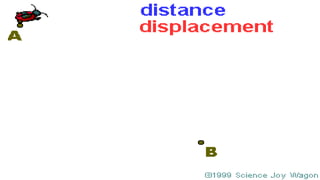
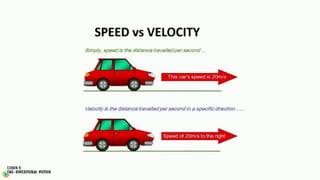
IS SPEED AND VELOCITY THE SAME?
ASSESSMEN
T
1. What quantity describes the
length of the actual paths traveled
by an object?
A. acceleration
B. distance
C. displacement
D. velocity
1. What quantity describes the
length of the actual paths traveled
by an object?
A. acceleration
B. distance
C. displacement
D. velocity
2. What quantity describes the length
and direction of the change in position
measured from the starting point?
A. acceleration
B. distance
C. displacement
D. velocity
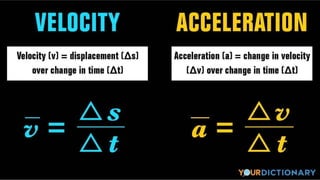
3. What quantity describes the rate of
change in displacement over the
elapsed time?
A. acceleration
B. distance
C. displacement
D. velocity
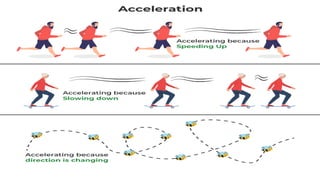
4. What quantity describes the rate of
change in velocity over the elapsed
time?
A. acceleration
B. distance
C. displacement
D. velocity
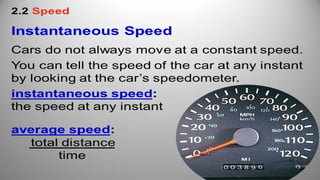
5. What device is used to measure the
speed of a moving object at any given
instant?
A. anemometer
B. barometer
C. speedometer
D. thermometer
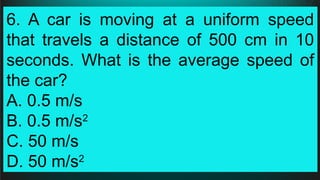
6. A car is moving at a uniform speed
that travels a distance of 500 cm in 10
seconds. What is the average speed of
the car?
A. 0.5 m/s
B. 0.5 m/s2
C. 50 m/s
D. 50 m/s2
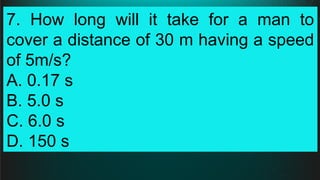
7. How long will it take for a man to
cover a distance of 30 m having a speed
of 5m/s?
A. 0.17 s
B. 5.0 s
C. 6.0 s
D. 150 s
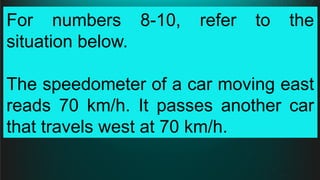
For numbers 8-10, refer to the
situation below.
The speedometer of a car moving east
reads 70 km/h. It passes another car
that travels west at 70 km/h.
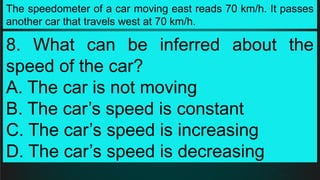
The speedometer of a car moving east reads 70 km/h. It passes
another car that travels west at 70 km/h.
8. What can be inferred about the
speed of the car?
A. The car is not moving
B. The car’s speed is constant
C. The car’s speed is increasing
D. The car’s speed is decreasing
The speedometer of a car moving east reads 70 km/h. It passes
another car that travels west at 70 km/h.
9. What can be inferred about the velocity of the
car?
A. The velocity of the car remains the same
B. The velocity of the car is increasing from east to
west
C. The velocity of the car is decreasing from east to
west
D. The velocity of the car is not the same from east
to west
For numbers 10-12, refer to the
problem below.
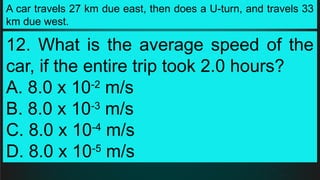
A car travels 27 km due east, then
does a U-turn, and travels 33 km due
west.
A car travels 27 km due east, then does a U-turn, and travels 33
km due west.
10. What is the total distance
covered by the car?
A. 27 m
B. 33 m
C. 60 m
D. 65 m
A car travels 27 km due east, then does a U-turn, and travels 33
km due west.
11. What is the displacement of the
car?
A. 6 m due east
B. 6 m due west
C. 6 m due north
D. 6 m due south
A car travels 27 km due east, then does a U-turn, and travels 33
km due west.
12. What is the average speed of the
car, if the entire trip took 2.0 hours?
A. 8.0 x 10⁻²
m/s
B. 8.0 x 10⁻³
m/s
C. 8.0 x 10⁻⁴
m/s
D. 8.0 x 10⁻⁵
m/s
For numbers 13-15, refer to the
problem below.
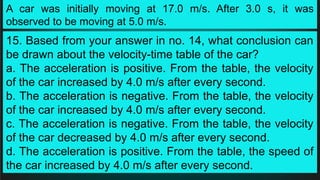
A car was initially moving at 17.0 m/s.
After 3.0 s, it was observed to be
moving at 5.0 m/s.
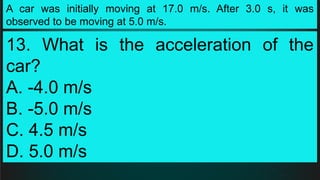
A car was initially moving at 17.0 m/s. After 3.0 s, it was
observed to be moving at 5.0 m/s.
13. What is the acceleration of the
car?
A. -4.0 m/s
B. -5.0 m/s
C. 4.5 m/s
D. 5.0 m/s
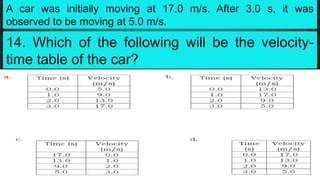
A car was initially moving at 17.0 m/s. After 3.0 s, it was
observed to be moving at 5.0 m/s.
14. Which of the following will be the velocity-
time table of the car?
A car was initially moving at 17.0 m/s. After 3.0 s, it was
observed to be moving at 5.0 m/s.
15. Based from your answer in no. 14, what conclusion can
be drawn about the velocity-time table of the car?
a. The acceleration is positive. From the table, the velocity
of the car increased by 4.0 m/s after every second.
b. The acceleration is negative. From the table, the velocity
of the car increased by 4.0 m/s after every second.
c. The acceleration is negative. From the table, the velocity
of the car decreased by 4.0 m/s after every second.
d. The acceleration is positive. From the table, the speed of
the car increased by 4.0 m/s after every second.
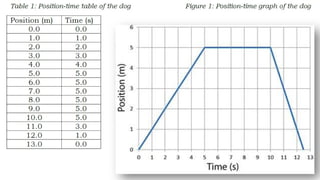
Position-Time and Velocity-Time Graphs
Questions for Consideration
What is a position-time graph?
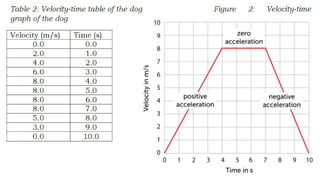
What is a velocity-time graph?
How do features on one graph translate into features
on the other?
Distance-Time Graphs
 Show an object’s position as a function of
time.
 x-axis: time
 y-axis: distance
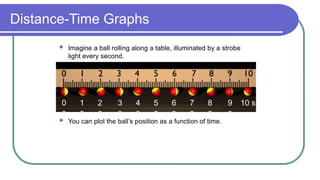
Distance-Time Graphs
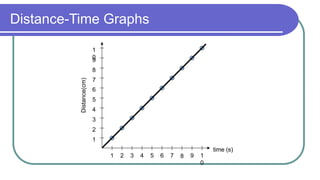
 Imagine a ball rolling along a table, illuminated by a strobe
light every second.
 You can plot the ball’s position as a function of time.
0
s
1
s
2
s
3
s
4
s
5
s
6
s
7
s
8
s
9
s
10 s
Distance-Time Graphs
1 2 3 4 5 6 7 8 9 1
0
1
2
3
4
5
6
7
8
9
1
0
time (s)
Distance(cm)
Distance-Time Graphs
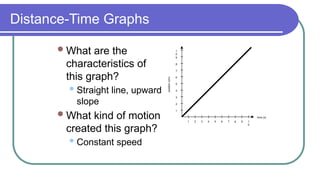
What are the
characteristics of
this graph?
Straight line, upward
slope
What kind of motion
created this graph?
Constant speed
1 2 3 4 5 6 7 8 9 1
0
1
2
3
4
5
6
7
8
9
1
0
time (s)
position
(cm)
Distance-Time Graphs
Each type of motion has a characteristic shape on a D-
T graph.
Constant speed
Zero speed (at rest)
Accelerating (speeding up)
Decelerating (slowing down)
Distance-Time Graphs
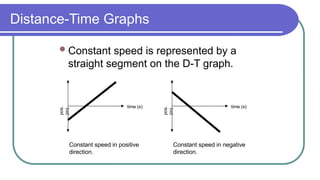
Constant speed is represented by a
straight segment on the D-T graph.
time (s)
pos.
(m)
Constant speed in positive
direction.
time (s)
pos.
(m)
Constant speed in negative
direction.
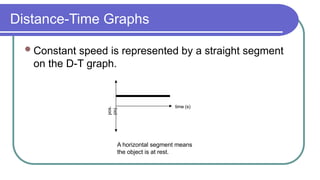
Distance-Time Graphs
Constant speed is represented by a straight segment
on the D-T graph.
time (s)
pos.
(m)
A horizontal segment means
the object is at rest.
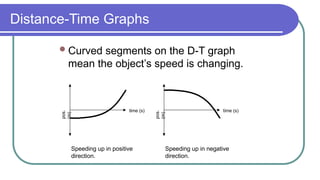
Distance-Time Graphs
Curved segments on the D-T graph
mean the object’s speed is changing.
time (s)
pos.
(m)
Speeding up in positive
direction.
time (s)
pos.
(m)
Speeding up in negative
direction.
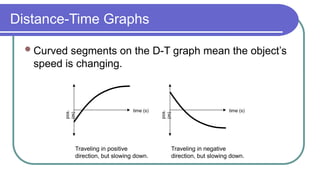
Distance-Time Graphs
Curved segments on the D-T graph mean the object’s
speed is changing.
time (s)
pos.
(m)
Traveling in positive
direction, but slowing down.
time (s)
pos.
(m)
Traveling in negative
direction, but slowing down.
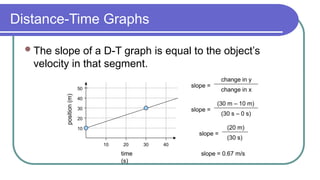
Distance-Time Graphs
The slope of a D-T graph is equal to the object’s
velocity in that segment.
time
(s)
position
(m)
10 20 30 40
10
20
30
40
50
slope =
change in y
change in x
slope =
(30 m – 10 m)
(30 s – 0 s)
slope =
(20 m)
(30 s)
slope = 0.67 m/s
Distance-Time Graphs
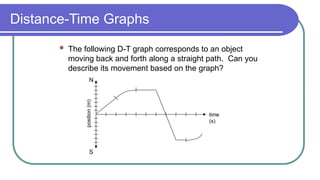
 The following D-T graph corresponds to an object
moving back and forth along a straight path. Can you
describe its movement based on the graph?
time
(s)
position
(m)
N
S
Velocity-Time Graphs
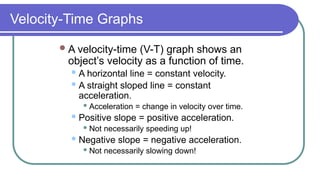
A velocity-time (V-T) graph shows an
object’s velocity as a function of time.
A horizontal line = constant velocity.
A straight sloped line = constant
acceleration.
 Acceleration = change in velocity over time.
Positive slope = positive acceleration.
 Not necessarily speeding up!
Negative slope = negative acceleration.
 Not necessarily slowing down!
Velocity-Time Graphs
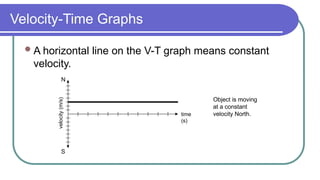
A horizontal line on the V-T graph means constant
velocity.
time
(s)
velocity
(m/s)
N
S
Object is moving
at a constant
velocity North.
Velocity-Time Graphs
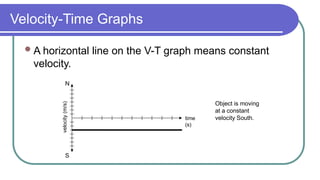
A horizontal line on the V-T graph means constant
velocity.
time
(s)
velocity
(m/s)
N
S
Object is moving
at a constant
velocity South.
Velocity-Time Graphs
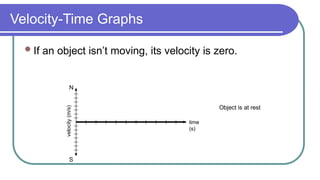
If an object isn’t moving, its velocity is zero.
time
(s)
velocity
(m/s)
N
S
Object is at rest
Velocity-Time Graphs
If the V-T line has a positive slope, the object is
undergoing acceleration in positive direction.
If v is positive also, object is speeding up.
If v is negative, object is slowing down.
Velocity-Time Graphs
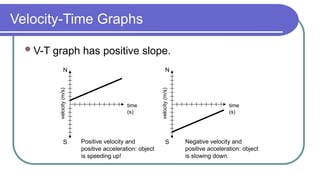
V-T graph has positive slope.
time
(s)
velocity
(m/s)
N
S Positive velocity and
positive acceleration: object
is speeding up!
time
(s)
velocity
(m/s)
N
S Negative velocity and
positive acceleration: object
is slowing down.
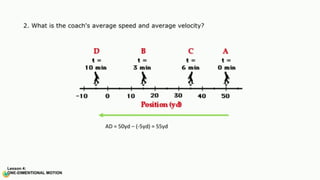
Velocity-Time Graphs
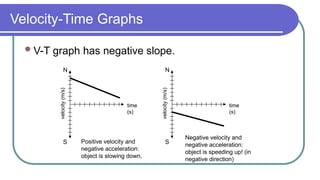
If the V-T line has a negative slope, the object is
undergoing acceleration in the negative direction.
If v is positive, the object is slowing down.
If v is negative also, the object is speeding up.
Velocity-Time Graphs
V-T graph has negative slope.
time
(s)
velocity
(m/s)
N
S Positive velocity and
negative acceleration:
object is slowing down,
time
(s)
velocity
(m/s)
N
S
Negative velocity and
negative acceleration:
object is speeding up! (in
negative direction)
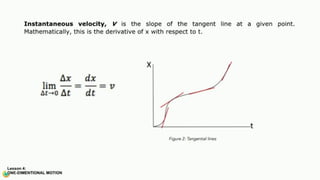
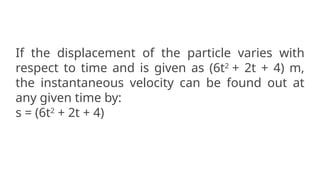
If the displacement of the particle varies with
respect to time and is given as (6t2
+ 2t + 4) m,
the instantaneous velocity can be found out at
any given time by:
s = (6t2
+ 2t + 4)
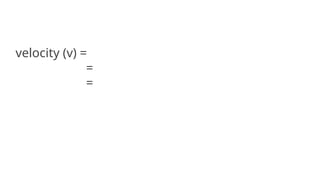
velocity (v) =
=
=
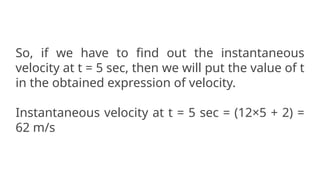
So, if we have to find out the instantaneous
velocity at t = 5 sec, then we will put the value of t
in the obtained expression of velocity.
Instantaneous velocity at t = 5 sec = (12×5 + 2) =
62 m/s
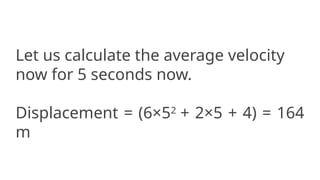
Let us calculate the average velocity
now for 5 seconds now.
Displacement = (6×52
+ 2×5 + 4) = 164
m
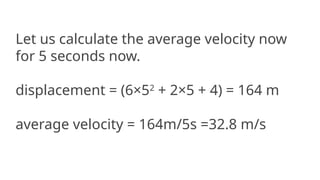
Let us calculate the average velocity now
for 5 seconds now.
displacement = (6×52
+ 2×5 + 4) = 164 m
average velocity = 164m/5s =32.8 m/s
ASSESSMEN
T
1. What quantity describes the
slope of any nonvertical line in a
position-time graph?
A. acceleration
B. displacement
C. speed
D. velocity
2. What can be inferred about the
velocity in position-time graph if the
graph is a horizontal line?
A. the body is at rest
B. the body is accelerating
C. the body is decelerating
D. the body is constantly moving
3. What conclusion can be drawn in a
position-time graph if the slope is
steep?
A. the body indicates a faster speed
B. the body indicates a slower speed
C. the body indicates a faster velocity
D. the body indicates a slower
displacement
4. What quantity describes the slope of
any nonvertical line in a velocity-time
graph?
A. acceleration
B. distance
C. speed
D. velocity
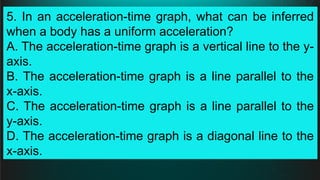
5. In an acceleration-time graph, what can be inferred
when a body has a uniform acceleration?
A. The acceleration-time graph is a vertical line to the y-
axis.
B. The acceleration-time graph is a line parallel to the
x-axis.
C. The acceleration-time graph is a line parallel to the
y-axis.
D. The acceleration-time graph is a diagonal line to the
x-axis.
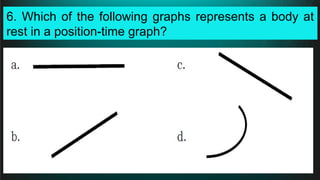
6. Which of the following graphs represents a body at
rest in a position-time graph?
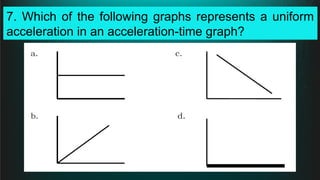
7. Which of the following graphs represents a uniform
acceleration in an acceleration-time graph?
8. What quantity indicates the rise
of the slope in a position-time
graph?
A. acceleration
B. displacement
C. speed
D. velocity
9. What indicates the area in an
acceleration-time graph?
A. change in speed of the object
B. change in time of the object
C. change in velocity of the object
D. change in distance of the object
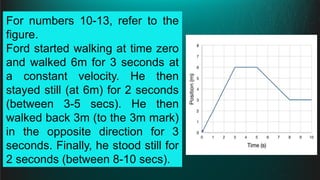
For numbers 10-13, refer to the
figure.
Ford started walking at time zero
and walked 6m for 3 seconds at
a constant velocity. He then
stayed still (at 6m) for 2 seconds
(between 3-5 secs). He then
walked back 3m (to the 3m mark)
in the opposite direction for 3
seconds. Finally, he stood still for
2 seconds (between 8-10 secs).
10. Based from the figure, what can be
observed about the velocity of Ford
during his first three seconds?
A. His average velocity is 1 m/s.
B. His average velocity is 2 m/s.
C. His average velocity is 3 m/s.
D. His average velocity is 4 m/s.
11. What conclusion can be drawn about the
movement of Ford during his 3-5 and 8-10
seconds movement?
I. constant speed, II. faster speed, III. body at
rest, IV. zero velocity
A. III only
B. II and IV
C. III and IV
D. I, III, and IV
12. What can be inferred about the
slope of Ford during his 5-8
seconds movement?
A. accelerating speed
B. accelerating velocity
C. negative slope
D. positive slope
13. If Ford happens to go back to
his origin after 10 seconds. What is
the total displacement of Ford?
A. 0 m
B. 3m
C. 6 m
D. 8 m
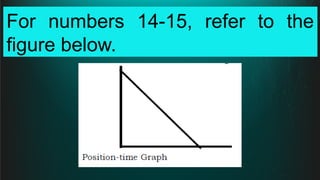
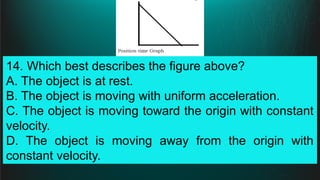
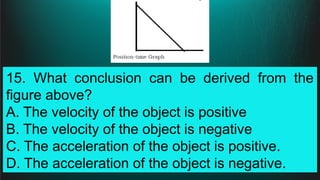
For numbers 14-15, refer to the
figure below.
14. Which best describes the figure above?
A. The object is at rest.
B. The object is moving with uniform acceleration.
C. The object is moving toward the origin with constant
velocity.
D. The object is moving away from the origin with
constant velocity.
15. What conclusion can be derived from the
figure above?
A. The velocity of the object is positive
B. The velocity of the object is negative
C. The acceleration of the object is positive.
D. The acceleration of the object is negative.
Question:
Imagine you are on top of a 10-
storey building and were ask to
throw down 2 things. Which would
reach the ground first, the
elephant or the small tennis ball?
Why?
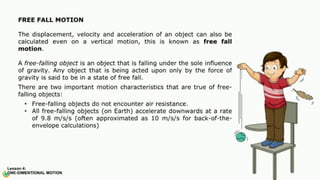
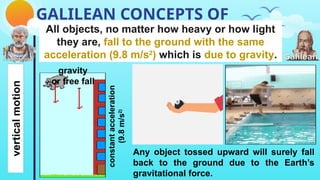
GALILEAN CONCEPTS OF
MOTION
Aristotelian Galilean
vertical
motion
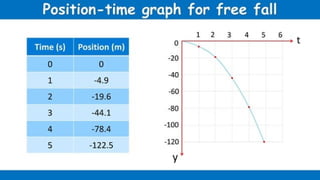
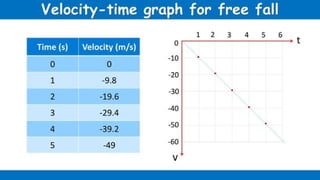
All objects, no matter how heavy or how light
they are, fall to the ground with the same
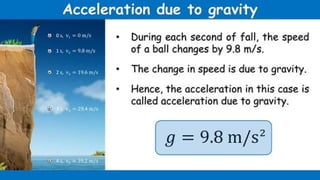
acceleration (9.8 m/s2
) which is due to gravity.
gravity
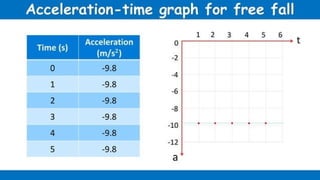
or free fall
constant
acceleration
(9.8
m/s
2)
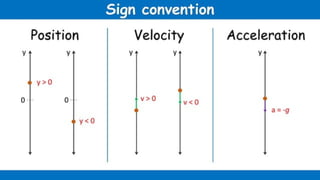
Any object tossed upward will surely fall
back to the ground due to the Earth’s
gravitational force.
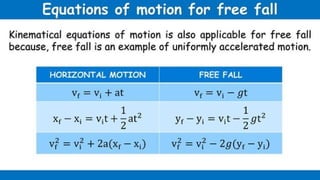
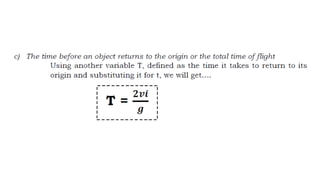
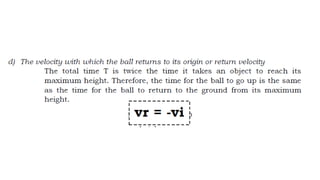
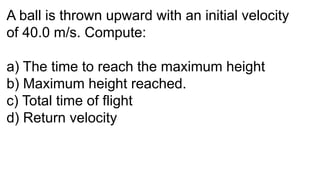
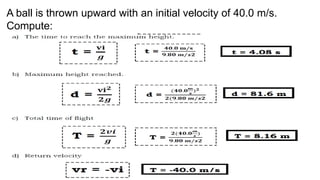
A ball is thrown upward with an initial velocity
of 40.0 m/s. Compute:
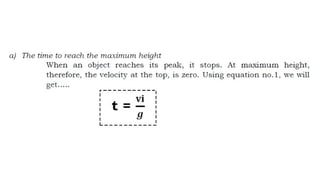
a) The time to reach the maximum height
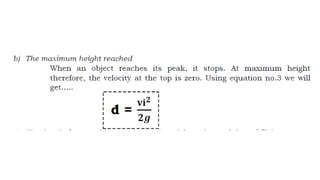
b) Maximum height reached.
c) Total time of flight
d) Return velocity
A ball is thrown upward with an initial velocity of 40.0 m/s.
Compute:
QUESTIONS
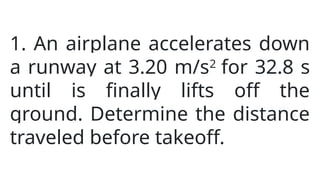
1. An airplane accelerates down
a runway at 3.20 m/s2
for 32.8 s
until is finally lifts off the
ground. Determine the distance
traveled before takeoff.
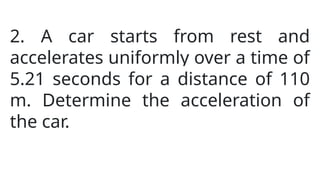
2. A car starts from rest and
accelerates uniformly over a time of
5.21 seconds for a distance of 110
m. Determine the acceleration of
the car.
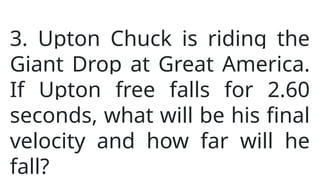
3. Upton Chuck is riding the
Giant Drop at Great America.
If Upton free falls for 2.60
seconds, what will be his final
velocity and how far will he
fall?
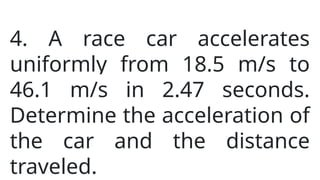
4. A race car accelerates
uniformly from 18.5 m/s to
46.1 m/s in 2.47 seconds.
Determine the acceleration of
the car and the distance
traveled.
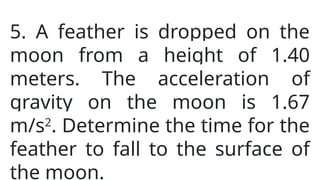
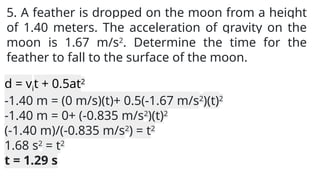
5. A feather is dropped on the
moon from a height of 1.40
meters. The acceleration of
gravity on the moon is 1.67
m/s2
. Determine the time for the
feather to fall to the surface of
the moon.
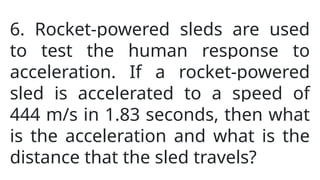
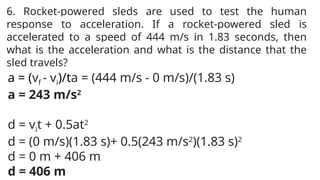
6. Rocket-powered sleds are used
to test the human response to
acceleration. If a rocket-powered
sled is accelerated to a speed of
444 m/s in 1.83 seconds, then what
is the acceleration and what is the
distance that the sled travels?
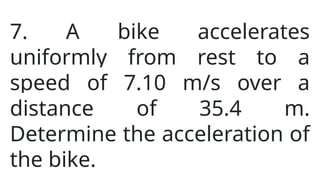
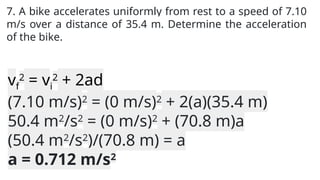
7. A bike accelerates
uniformly from rest to a
speed of 7.10 m/s over a
distance of 35.4 m.
Determine the acceleration of
the bike.
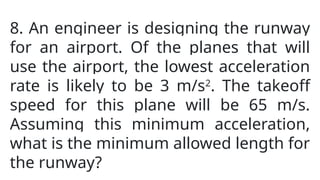
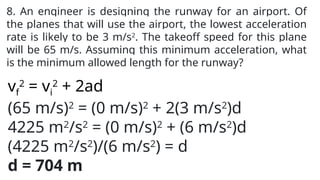
8. An engineer is designing the runway
for an airport. Of the planes that will
use the airport, the lowest acceleration
rate is likely to be 3 m/s2
. The takeoff
speed for this plane will be 65 m/s.
Assuming this minimum acceleration,
what is the minimum allowed length for
the runway?
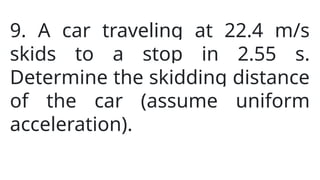
9. A car traveling at 22.4 m/s
skids to a stop in 2.55 s.
Determine the skidding distance
of the car (assume uniform
acceleration).
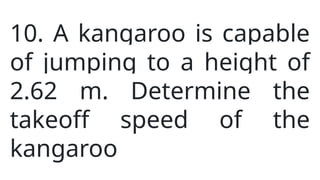
10. A kangaroo is capable
of jumping to a height of
2.62 m. Determine the
takeoff speed of the
kangaroo
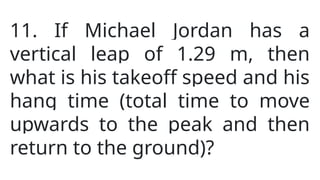
11. If Michael Jordan has a
vertical leap of 1.29 m, then
what is his takeoff speed and his
hang time (total time to move
upwards to the peak and then
return to the ground)?
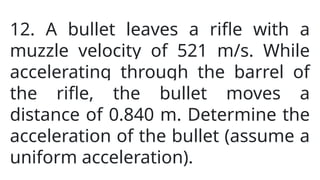
12. A bullet leaves a rifle with a
muzzle velocity of 521 m/s. While
accelerating through the barrel of
the rifle, the bullet moves a
distance of 0.840 m. Determine the
acceleration of the bullet (assume a
uniform acceleration).
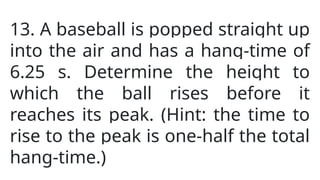
13. A baseball is popped straight up
into the air and has a hang-time of
6.25 s. Determine the height to
which the ball rises before it
reaches its peak. (Hint: the time to
rise to the peak is one-half the total
hang-time.)
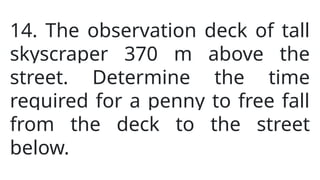
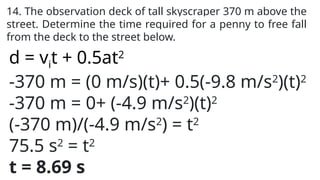
14. The observation deck of tall
skyscraper 370 m above the
street. Determine the time
required for a penny to free fall
from the deck to the street
below.
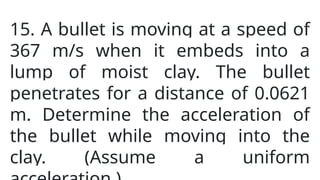
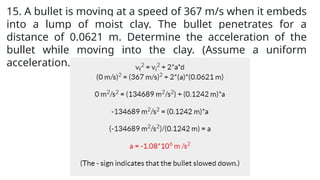
15. A bullet is moving at a speed of
367 m/s when it embeds into a
lump of moist clay. The bullet
penetrates for a distance of 0.0621
m. Determine the acceleration of
the bullet while moving into the
clay. (Assume a uniform
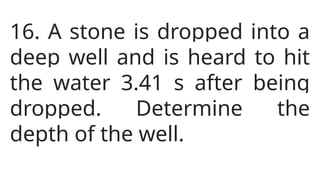
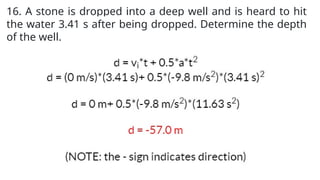
16. A stone is dropped into a
deep well and is heard to hit
the water 3.41 s after being
dropped. Determine the
depth of the well.
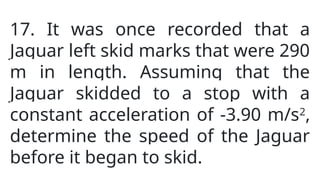
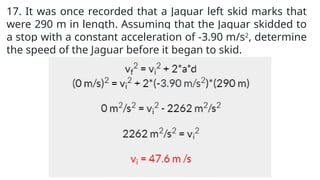
17. It was once recorded that a
Jaguar left skid marks that were 290
m in length. Assuming that the
Jaguar skidded to a stop with a
constant acceleration of -3.90 m/s2
,
determine the speed of the Jaguar
before it began to skid.
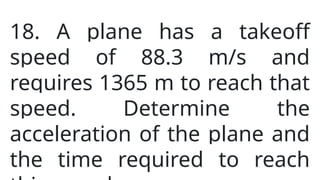
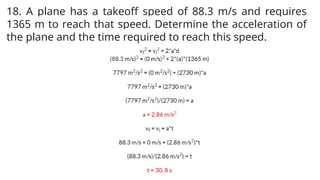
18. A plane has a takeoff
speed of 88.3 m/s and
requires 1365 m to reach that
speed. Determine the
acceleration of the plane and
the time required to reach
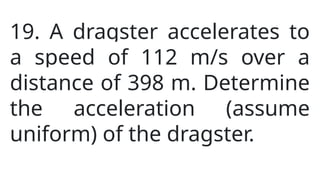
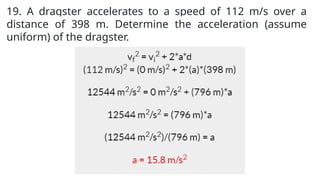
19. A dragster accelerates to
a speed of 112 m/s over a
distance of 398 m. Determine
the acceleration (assume
uniform) of the dragster.
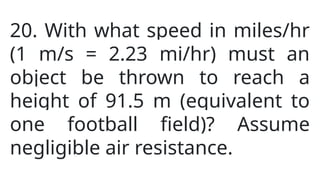
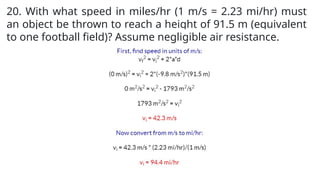
20. With what speed in miles/hr
(1 m/s = 2.23 mi/hr) must an
object be thrown to reach a
height of 91.5 m (equivalent to
one football field)? Assume
negligible air resistance.
ANSWERS
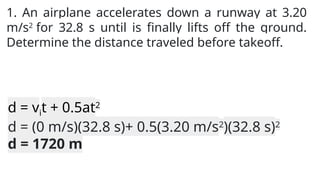
1. An airplane accelerates down a runway at 3.20
m/s2
for 32.8 s until is finally lifts off the ground.
Determine the distance traveled before takeoff.
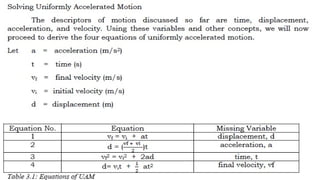
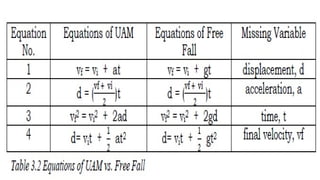
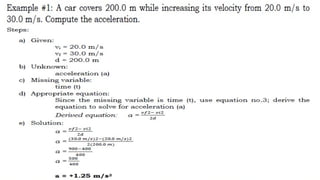
d = vit + 0.5at2
d = (0 m/s)(32.8 s)+ 0.5(3.20 m/s2
)(32.8 s)2
d = 1720 m
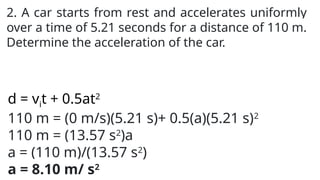
2. A car starts from rest and accelerates uniformly
over a time of 5.21 seconds for a distance of 110 m.
Determine the acceleration of the car.
d = vit + 0.5at2
110 m = (0 m/s)(5.21 s)+ 0.5(a)(5.21 s)2
110 m = (13.57 s2
)a
a = (110 m)/(13.57 s2
)
a = 8.10 m/ s2
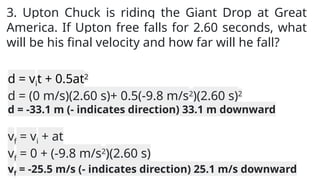
3. Upton Chuck is riding the Giant Drop at Great
America. If Upton free falls for 2.60 seconds, what
will be his final velocity and how far will he fall?
d = vit + 0.5at2
d = (0 m/s)(2.60 s)+ 0.5(-9.8 m/s2
)(2.60 s)2
d = -33.1 m (- indicates direction) 33.1 m downward
vf = vi + at
vf = 0 + (-9.8 m/s2
)(2.60 s)
vf = -25.5 m/s (- indicates direction) 25.1 m/s downward
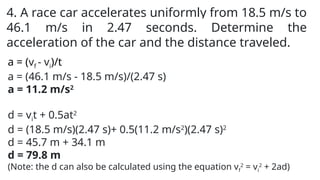
4. A race car accelerates uniformly from 18.5 m/s to
46.1 m/s in 2.47 seconds. Determine the
acceleration of the car and the distance traveled.
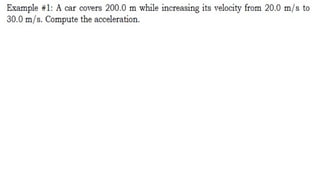
a = (vf - vi)/t
a = (46.1 m/s - 18.5 m/s)/(2.47 s)
a = 11.2 m/s2
d = vit + 0.5at2
d = (18.5 m/s)(2.47 s)+ 0.5(11.2 m/s2
)(2.47 s)2
d = 45.7 m + 34.1 m
d = 79.8 m
(Note: the d can also be calculated using the equation vf
2
= vi
2
+ 2ad)
5. A feather is dropped on the moon from a height
of 1.40 meters. The acceleration of gravity on the
moon is 1.67 m/s2
. Determine the time for the
feather to fall to the surface of the moon.
d = vit + 0.5at2
-1.40 m = (0 m/s)(t)+ 0.5(-1.67 m/s2
)(t)2
-1.40 m = 0+ (-0.835 m/s2
)(t)2
(-1.40 m)/(-0.835 m/s2
) = t2
1.68 s2
= t2
t = 1.29 s
6. Rocket-powered sleds are used to test the human
response to acceleration. If a rocket-powered sled is
accelerated to a speed of 444 m/s in 1.83 seconds, then
what is the acceleration and what is the distance that the
sled travels?
a = (vf - vi)/ta = (444 m/s - 0 m/s)/(1.83 s)
a = 243 m/s2
d = vit + 0.5at2
d = (0 m/s)(1.83 s)+ 0.5(243 m/s2
)(1.83 s)2
d = 0 m + 406 m
d = 406 m
7. A bike accelerates uniformly from rest to a speed of 7.10
m/s over a distance of 35.4 m. Determine the acceleration
of the bike.
vf
2
= vi
2
+ 2ad
(7.10 m/s)2
= (0 m/s)2
+ 2(a)(35.4 m)
50.4 m2
/s2
= (0 m/s)2
+ (70.8 m)a
(50.4 m2
/s2
)/(70.8 m) = a
a = 0.712 m/s2
8. An engineer is designing the runway for an airport. Of
the planes that will use the airport, the lowest acceleration
rate is likely to be 3 m/s2
. The takeoff speed for this plane
will be 65 m/s. Assuming this minimum acceleration, what
is the minimum allowed length for the runway?
vf
2
= vi
2
+ 2ad
(65 m/s)2
= (0 m/s)2
+ 2(3 m/s2
)d
4225 m2
/s2
= (0 m/s)2
+ (6 m/s2
)d
(4225 m2
/s2
)/(6 m/s2
) = d
d = 704 m
9. A car traveling at 22.4 m/s skids to a stop in 2.55 s.
Determine the skidding distance of the car (assume
uniform acceleration).
d = [(vi + vf)/2]t
d = [(22.4 m/s + 0 m/s)/2] 2.55 s
d = (11.2 m/s)(2.55 s)
d = 28.6 m
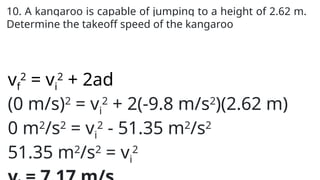
10. A kangaroo is capable of jumping to a height of 2.62 m.
Determine the takeoff speed of the kangaroo
vf
2
= vi
2
+ 2ad
(0 m/s)2
= vi
2
+ 2(-9.8 m/s2
)(2.62 m)
0 m2
/s2
= vi
2
- 51.35 m2
/s2
51.35 m2
/s2
= vi
2
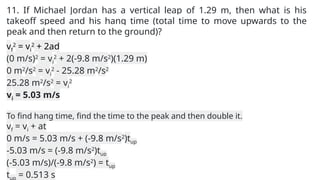
11. If Michael Jordan has a vertical leap of 1.29 m, then what is his
takeoff speed and his hang time (total time to move upwards to the
peak and then return to the ground)?
vf
2
= vi
2
+ 2ad
(0 m/s)2
= vi
2
+ 2(-9.8 m/s2
)(1.29 m)
0 m2
/s2
= vi
2
- 25.28 m2
/s2
25.28 m2
/s2
= vi
2
vi = 5.03 m/s
To find hang time, find the time to the peak and then double it.
vf = vi + at
0 m/s = 5.03 m/s + (-9.8 m/s2
)tup
-5.03 m/s = (-9.8 m/s2
)tup
(-5.03 m/s)/(-9.8 m/s2
) = tup
tup = 0.513 s
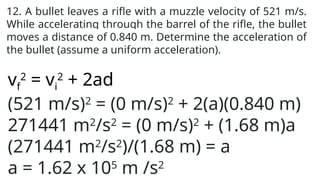
12. A bullet leaves a rifle with a muzzle velocity of 521 m/s.
While accelerating through the barrel of the rifle, the bullet
moves a distance of 0.840 m. Determine the acceleration of
the bullet (assume a uniform acceleration).
vf
2
= vi
2
+ 2ad
(521 m/s)2
= (0 m/s)2
+ 2(a)(0.840 m)
271441 m2
/s2
= (0 m/s)2
+ (1.68 m)a
(271441 m2
/s2
)/(1.68 m) = a
a = 1.62 x 10⁵
m /s2
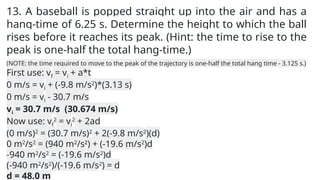
13. A baseball is popped straight up into the air and has a
hang-time of 6.25 s. Determine the height to which the ball
rises before it reaches its peak. (Hint: the time to rise to the
peak is one-half the total hang-time.)
(NOTE: the time required to move to the peak of the trajectory is one-half the total hang time - 3.125 s.)
First use: vf = vi + a*t
0 m/s = vi + (-9.8 m/s2
)*(3.13 s)
0 m/s = vi - 30.7 m/s
vi = 30.7 m/s (30.674 m/s)
Now use: vf
2
= vi
2
+ 2ad
(0 m/s)2
= (30.7 m/s)2
+ 2(-9.8 m/s2
)(d)
0 m2
/s2
= (940 m2
/s2
) + (-19.6 m/s2
)d
-940 m2
/s2
= (-19.6 m/s2
)d
(-940 m2
/s2
)/(-19.6 m/s2
) = d
d = 48.0 m
14. The observation deck of tall skyscraper 370 m above the
street. Determine the time required for a penny to free fall
from the deck to the street below.
d = vit + 0.5at2
-370 m = (0 m/s)(t)+ 0.5(-9.8 m/s2
)(t)2
-370 m = 0+ (-4.9 m/s2
)(t)2
(-370 m)/(-4.9 m/s2
) = t2
75.5 s2
= t2
t = 8.69 s
15. A bullet is moving at a speed of 367 m/s when it embeds
into a lump of moist clay. The bullet penetrates for a
distance of 0.0621 m. Determine the acceleration of the
bullet while moving into the clay. (Assume a uniform
acceleration.)
16. A stone is dropped into a deep well and is heard to hit
the water 3.41 s after being dropped. Determine the depth
of the well.
17. It was once recorded that a Jaguar left skid marks that
were 290 m in length. Assuming that the Jaguar skidded to
a stop with a constant acceleration of -3.90 m/s2
, determine
the speed of the Jaguar before it began to skid.
18. A plane has a takeoff speed of 88.3 m/s and requires
1365 m to reach that speed. Determine the acceleration of
the plane and the time required to reach this speed.
19. A dragster accelerates to a speed of 112 m/s over a
distance of 398 m. Determine the acceleration (assume
uniform) of the dragster.
20. With what speed in miles/hr (1 m/s = 2.23 mi/hr) must
an object be thrown to reach a height of 91.5 m (equivalent
to one football field)? Assume negligible air resistance.
ASSESSMEN
T
1. Which of the following quantities is
an example of uniformly accelerated
motion in one dimension?
A. free fall
B. momentum
C. projectile motion
D. uniform circular motion
2. What type of motion is being shown
when you dropped an object from a
certain height and gravity was acting on
it?
A. free fall
B. momentum
C. projectile motion
D. uniform circular motion
3. A stone is thrown straight up.
What is it’s acceleration on the way
up?
A. -10.80 m/s2
B. -9.80 m/s2
C. 9.80 m/s2
D. +10.80 m/s2
4. What happens to the velocity of
a ball as it is dropped off a cliff?
A. It is constant
B. It decreases at a uniform rate
C. It increases at a uniform rate
D. It increases at non-uniform rate
5. What is the value of “g” or
acceleration due to gravity?
A. 6.80 m/s2
B. 7.80 m/s2
C. 9.80 m/s2
D. 10.80 m/s2
6. What causes some bodies to fall
faster than others even though
they have the same mass?
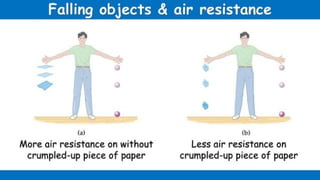
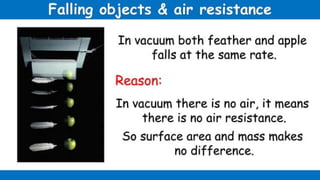
A. air resistance
B. gravity of the earth
C. heat
D. velocity of the body
For numbers 7-10, refer to the
following problem:
A ball is thrown upward with an
initial velocity.
A ball is thrown upward with an initial velocity.
7. Which of the following becomes
zero when the ball reaches its
maximum height?
A. acceleration
B. displacement
C. time
D. velocity
A ball is thrown upward with an initial velocity.
8. Which of the following becomes
zero when the ball returns to its origin?
A. acceleration
B. displacement
C. time
D. velocity
A ball is thrown upward with an initial velocity.
9. How would you compare the time it
took the ball to go up with the time it
took the ball to go down?
A. equal
B. greater than
C. insufficient data
D. less than
A ball is thrown upward with an initial velocity.
10. The ball returns to its origin after 3.0
s. How long will take for the ball to reach
the maximum height from the ground?
A. 1.5 s
B. 2.0 s
C. 3.0 s
D. 6.0 s
11. A bus started from rest and moved with
uniform acceleration. It acquired a velocity
of 60m/s after 100 seconds. Find the
acceleration of the bus.
a. 0.6 m/s2
b. 1.0 m/s2
c. 2.6 m/s2
d. 3.0 m/s2
12. A man is driving down a street at 55 km/h.
Suddenly, a child runs into the street. If it takes
the man 0.75 s to react and apply the brakes,
how many meters the man will travel before he
begins to slow down?
A. 0.0058 m
B. 5.8 m
C. 15.8 m
D. 57.8 m
13. A stone was dropped from rest from the
top of a building and took 10 seconds to hit
the ground. What is the final velocity of the
stone?
A. -98 m/s
B. -100 m/s
C. 98 m/s
D. 100 m/s
14. A tricycle is parked in a terminal.
Suddenly, it accelerated at 2m/s2
for
5s. How far did the tricycle move?
A. 10 m
B. 15 m
C. 20 m
D. 25 m
15. You are walking in Paris alongside the Eiffel
Tower and suddenly a coin smacks you on the
head and knocks you to the ground. If it takes
30.0 seconds the coin tagged you in the head.
Neglecting air resistance, how high is the Eiffel
Tower?
A. 4,000 m
B. 4,410 m
C. 5,000 m
D. 5,410 m

General Physics 1 Two Directional Motion.pptx

  • 1.
  • 9.
    IS SPEED ANDVELOCITY THE SAME?
  • 46.
  • 47.
    1. What quantitydescribes the length of the actual paths traveled by an object? A. acceleration B. distance C. displacement D. velocity
  • 48.
    1. What quantitydescribes the length of the actual paths traveled by an object? A. acceleration B. distance C. displacement D. velocity
  • 49.
    2. What quantitydescribes the length and direction of the change in position measured from the starting point? A. acceleration B. distance C. displacement D. velocity
  • 50.
    3. What quantitydescribes the rate of change in displacement over the elapsed time? A. acceleration B. distance C. displacement D. velocity
  • 51.
    4. What quantitydescribes the rate of change in velocity over the elapsed time? A. acceleration B. distance C. displacement D. velocity
  • 52.
    5. What deviceis used to measure the speed of a moving object at any given instant? A. anemometer B. barometer C. speedometer D. thermometer
  • 53.
    6. A caris moving at a uniform speed that travels a distance of 500 cm in 10 seconds. What is the average speed of the car? A. 0.5 m/s B. 0.5 m/s2 C. 50 m/s D. 50 m/s2
  • 54.
    7. How longwill it take for a man to cover a distance of 30 m having a speed of 5m/s? A. 0.17 s B. 5.0 s C. 6.0 s D. 150 s
  • 55.
    For numbers 8-10,refer to the situation below. The speedometer of a car moving east reads 70 km/h. It passes another car that travels west at 70 km/h.
  • 56.
    The speedometer ofa car moving east reads 70 km/h. It passes another car that travels west at 70 km/h. 8. What can be inferred about the speed of the car? A. The car is not moving B. The car’s speed is constant C. The car’s speed is increasing D. The car’s speed is decreasing
  • 57.
    The speedometer ofa car moving east reads 70 km/h. It passes another car that travels west at 70 km/h. 9. What can be inferred about the velocity of the car? A. The velocity of the car remains the same B. The velocity of the car is increasing from east to west C. The velocity of the car is decreasing from east to west D. The velocity of the car is not the same from east to west
  • 58.
    For numbers 10-12,refer to the problem below. A car travels 27 km due east, then does a U-turn, and travels 33 km due west.
  • 59.
    A car travels27 km due east, then does a U-turn, and travels 33 km due west. 10. What is the total distance covered by the car? A. 27 m B. 33 m C. 60 m D. 65 m
  • 60.
    A car travels27 km due east, then does a U-turn, and travels 33 km due west. 11. What is the displacement of the car? A. 6 m due east B. 6 m due west C. 6 m due north D. 6 m due south
  • 61.
    A car travels27 km due east, then does a U-turn, and travels 33 km due west. 12. What is the average speed of the car, if the entire trip took 2.0 hours? A. 8.0 x 10⁻² m/s B. 8.0 x 10⁻³ m/s C. 8.0 x 10⁻⁴ m/s D. 8.0 x 10⁻⁵ m/s
  • 62.
    For numbers 13-15,refer to the problem below. A car was initially moving at 17.0 m/s. After 3.0 s, it was observed to be moving at 5.0 m/s.
  • 63.
    A car wasinitially moving at 17.0 m/s. After 3.0 s, it was observed to be moving at 5.0 m/s. 13. What is the acceleration of the car? A. -4.0 m/s B. -5.0 m/s C. 4.5 m/s D. 5.0 m/s
  • 64.
    A car wasinitially moving at 17.0 m/s. After 3.0 s, it was observed to be moving at 5.0 m/s. 14. Which of the following will be the velocity- time table of the car?
  • 65.
    A car wasinitially moving at 17.0 m/s. After 3.0 s, it was observed to be moving at 5.0 m/s. 15. Based from your answer in no. 14, what conclusion can be drawn about the velocity-time table of the car? a. The acceleration is positive. From the table, the velocity of the car increased by 4.0 m/s after every second. b. The acceleration is negative. From the table, the velocity of the car increased by 4.0 m/s after every second. c. The acceleration is negative. From the table, the velocity of the car decreased by 4.0 m/s after every second. d. The acceleration is positive. From the table, the speed of the car increased by 4.0 m/s after every second.
  • 66.
  • 67.
    Questions for Consideration Whatis a position-time graph? What is a velocity-time graph? How do features on one graph translate into features on the other?
  • 68.
    Distance-Time Graphs  Showan object’s position as a function of time.  x-axis: time  y-axis: distance
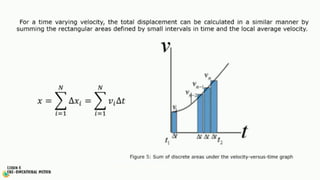
  • 69.
    Distance-Time Graphs  Imaginea ball rolling along a table, illuminated by a strobe light every second.  You can plot the ball’s position as a function of time. 0 s 1 s 2 s 3 s 4 s 5 s 6 s 7 s 8 s 9 s 10 s
  • 70.
    Distance-Time Graphs 1 23 4 5 6 7 8 9 1 0 1 2 3 4 5 6 7 8 9 1 0 time (s) Distance(cm)
  • 71.
    Distance-Time Graphs What arethe characteristics of this graph? Straight line, upward slope What kind of motion created this graph? Constant speed 1 2 3 4 5 6 7 8 9 1 0 1 2 3 4 5 6 7 8 9 1 0 time (s) position (cm)
  • 72.
    Distance-Time Graphs Each typeof motion has a characteristic shape on a D- T graph. Constant speed Zero speed (at rest) Accelerating (speeding up) Decelerating (slowing down)
  • 73.
    Distance-Time Graphs Constant speedis represented by a straight segment on the D-T graph. time (s) pos. (m) Constant speed in positive direction. time (s) pos. (m) Constant speed in negative direction.
  • 74.
    Distance-Time Graphs Constant speedis represented by a straight segment on the D-T graph. time (s) pos. (m) A horizontal segment means the object is at rest.
  • 75.
    Distance-Time Graphs Curved segmentson the D-T graph mean the object’s speed is changing. time (s) pos. (m) Speeding up in positive direction. time (s) pos. (m) Speeding up in negative direction.
  • 76.
    Distance-Time Graphs Curved segmentson the D-T graph mean the object’s speed is changing. time (s) pos. (m) Traveling in positive direction, but slowing down. time (s) pos. (m) Traveling in negative direction, but slowing down.
  • 77.
    Distance-Time Graphs The slopeof a D-T graph is equal to the object’s velocity in that segment. time (s) position (m) 10 20 30 40 10 20 30 40 50 slope = change in y change in x slope = (30 m – 10 m) (30 s – 0 s) slope = (20 m) (30 s) slope = 0.67 m/s
  • 78.
    Distance-Time Graphs  Thefollowing D-T graph corresponds to an object moving back and forth along a straight path. Can you describe its movement based on the graph? time (s) position (m) N S
  • 79.
    Velocity-Time Graphs A velocity-time(V-T) graph shows an object’s velocity as a function of time. A horizontal line = constant velocity. A straight sloped line = constant acceleration.  Acceleration = change in velocity over time. Positive slope = positive acceleration.  Not necessarily speeding up! Negative slope = negative acceleration.  Not necessarily slowing down!
  • 80.
    Velocity-Time Graphs A horizontalline on the V-T graph means constant velocity. time (s) velocity (m/s) N S Object is moving at a constant velocity North.
  • 81.
    Velocity-Time Graphs A horizontalline on the V-T graph means constant velocity. time (s) velocity (m/s) N S Object is moving at a constant velocity South.
  • 82.
    Velocity-Time Graphs If anobject isn’t moving, its velocity is zero. time (s) velocity (m/s) N S Object is at rest
  • 83.
    Velocity-Time Graphs If theV-T line has a positive slope, the object is undergoing acceleration in positive direction. If v is positive also, object is speeding up. If v is negative, object is slowing down.
  • 84.
    Velocity-Time Graphs V-T graphhas positive slope. time (s) velocity (m/s) N S Positive velocity and positive acceleration: object is speeding up! time (s) velocity (m/s) N S Negative velocity and positive acceleration: object is slowing down.
  • 85.
    Velocity-Time Graphs If theV-T line has a negative slope, the object is undergoing acceleration in the negative direction. If v is positive, the object is slowing down. If v is negative also, the object is speeding up.
  • 86.
    Velocity-Time Graphs V-T graphhas negative slope. time (s) velocity (m/s) N S Positive velocity and negative acceleration: object is slowing down, time (s) velocity (m/s) N S Negative velocity and negative acceleration: object is speeding up! (in negative direction)
  • 95.
    If the displacementof the particle varies with respect to time and is given as (6t2 + 2t + 4) m, the instantaneous velocity can be found out at any given time by: s = (6t2 + 2t + 4)
  • 96.
  • 97.
    So, if wehave to find out the instantaneous velocity at t = 5 sec, then we will put the value of t in the obtained expression of velocity. Instantaneous velocity at t = 5 sec = (12×5 + 2) = 62 m/s
  • 98.
    Let us calculatethe average velocity now for 5 seconds now. Displacement = (6×52 + 2×5 + 4) = 164 m
  • 99.
    Let us calculatethe average velocity now for 5 seconds now. displacement = (6×52 + 2×5 + 4) = 164 m average velocity = 164m/5s =32.8 m/s
  • 104.
  • 105.
    1. What quantitydescribes the slope of any nonvertical line in a position-time graph? A. acceleration B. displacement C. speed D. velocity
  • 106.
    2. What canbe inferred about the velocity in position-time graph if the graph is a horizontal line? A. the body is at rest B. the body is accelerating C. the body is decelerating D. the body is constantly moving
  • 107.
    3. What conclusioncan be drawn in a position-time graph if the slope is steep? A. the body indicates a faster speed B. the body indicates a slower speed C. the body indicates a faster velocity D. the body indicates a slower displacement
  • 108.
    4. What quantitydescribes the slope of any nonvertical line in a velocity-time graph? A. acceleration B. distance C. speed D. velocity
  • 109.
    5. In anacceleration-time graph, what can be inferred when a body has a uniform acceleration? A. The acceleration-time graph is a vertical line to the y- axis. B. The acceleration-time graph is a line parallel to the x-axis. C. The acceleration-time graph is a line parallel to the y-axis. D. The acceleration-time graph is a diagonal line to the x-axis.
  • 110.
    6. Which ofthe following graphs represents a body at rest in a position-time graph?
  • 111.
    7. Which ofthe following graphs represents a uniform acceleration in an acceleration-time graph?
  • 112.
    8. What quantityindicates the rise of the slope in a position-time graph? A. acceleration B. displacement C. speed D. velocity
  • 113.
    9. What indicatesthe area in an acceleration-time graph? A. change in speed of the object B. change in time of the object C. change in velocity of the object D. change in distance of the object
  • 114.
    For numbers 10-13,refer to the figure. Ford started walking at time zero and walked 6m for 3 seconds at a constant velocity. He then stayed still (at 6m) for 2 seconds (between 3-5 secs). He then walked back 3m (to the 3m mark) in the opposite direction for 3 seconds. Finally, he stood still for 2 seconds (between 8-10 secs).
  • 115.
    10. Based fromthe figure, what can be observed about the velocity of Ford during his first three seconds? A. His average velocity is 1 m/s. B. His average velocity is 2 m/s. C. His average velocity is 3 m/s. D. His average velocity is 4 m/s.
  • 116.
    11. What conclusioncan be drawn about the movement of Ford during his 3-5 and 8-10 seconds movement? I. constant speed, II. faster speed, III. body at rest, IV. zero velocity A. III only B. II and IV C. III and IV D. I, III, and IV
  • 117.
    12. What canbe inferred about the slope of Ford during his 5-8 seconds movement? A. accelerating speed B. accelerating velocity C. negative slope D. positive slope
  • 118.
    13. If Fordhappens to go back to his origin after 10 seconds. What is the total displacement of Ford? A. 0 m B. 3m C. 6 m D. 8 m
  • 119.
    For numbers 14-15,refer to the figure below.
  • 120.
    14. Which bestdescribes the figure above? A. The object is at rest. B. The object is moving with uniform acceleration. C. The object is moving toward the origin with constant velocity. D. The object is moving away from the origin with constant velocity.
  • 121.
    15. What conclusioncan be derived from the figure above? A. The velocity of the object is positive B. The velocity of the object is negative C. The acceleration of the object is positive. D. The acceleration of the object is negative.
  • 140.
    Question: Imagine you areon top of a 10- storey building and were ask to throw down 2 things. Which would reach the ground first, the elephant or the small tennis ball? Why?
  • 142.
    GALILEAN CONCEPTS OF MOTION AristotelianGalilean vertical motion All objects, no matter how heavy or how light they are, fall to the ground with the same acceleration (9.8 m/s2 ) which is due to gravity. gravity or free fall constant acceleration (9.8 m/s 2) Any object tossed upward will surely fall back to the ground due to the Earth’s gravitational force.
  • 166.
    A ball isthrown upward with an initial velocity of 40.0 m/s. Compute: a) The time to reach the maximum height b) Maximum height reached. c) Total time of flight d) Return velocity
  • 167.
    A ball isthrown upward with an initial velocity of 40.0 m/s. Compute:
  • 168.
  • 169.
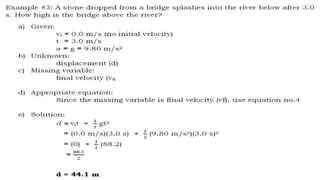
    1. An airplaneaccelerates down a runway at 3.20 m/s2 for 32.8 s until is finally lifts off the ground. Determine the distance traveled before takeoff.
  • 170.
    2. A carstarts from rest and accelerates uniformly over a time of 5.21 seconds for a distance of 110 m. Determine the acceleration of the car.
  • 171.
    3. Upton Chuckis riding the Giant Drop at Great America. If Upton free falls for 2.60 seconds, what will be his final velocity and how far will he fall?
  • 172.
    4. A racecar accelerates uniformly from 18.5 m/s to 46.1 m/s in 2.47 seconds. Determine the acceleration of the car and the distance traveled.
  • 173.
    5. A featheris dropped on the moon from a height of 1.40 meters. The acceleration of gravity on the moon is 1.67 m/s2 . Determine the time for the feather to fall to the surface of the moon.
  • 174.
    6. Rocket-powered sledsare used to test the human response to acceleration. If a rocket-powered sled is accelerated to a speed of 444 m/s in 1.83 seconds, then what is the acceleration and what is the distance that the sled travels?
  • 175.
    7. A bikeaccelerates uniformly from rest to a speed of 7.10 m/s over a distance of 35.4 m. Determine the acceleration of the bike.
  • 176.
    8. An engineeris designing the runway for an airport. Of the planes that will use the airport, the lowest acceleration rate is likely to be 3 m/s2 . The takeoff speed for this plane will be 65 m/s. Assuming this minimum acceleration, what is the minimum allowed length for the runway?
  • 177.
    9. A cartraveling at 22.4 m/s skids to a stop in 2.55 s. Determine the skidding distance of the car (assume uniform acceleration).
  • 178.
    10. A kangaroois capable of jumping to a height of 2.62 m. Determine the takeoff speed of the kangaroo
  • 179.
    11. If MichaelJordan has a vertical leap of 1.29 m, then what is his takeoff speed and his hang time (total time to move upwards to the peak and then return to the ground)?
  • 180.
    12. A bulletleaves a rifle with a muzzle velocity of 521 m/s. While accelerating through the barrel of the rifle, the bullet moves a distance of 0.840 m. Determine the acceleration of the bullet (assume a uniform acceleration).
  • 181.
    13. A baseballis popped straight up into the air and has a hang-time of 6.25 s. Determine the height to which the ball rises before it reaches its peak. (Hint: the time to rise to the peak is one-half the total hang-time.)
  • 182.
    14. The observationdeck of tall skyscraper 370 m above the street. Determine the time required for a penny to free fall from the deck to the street below.
  • 183.
    15. A bulletis moving at a speed of 367 m/s when it embeds into a lump of moist clay. The bullet penetrates for a distance of 0.0621 m. Determine the acceleration of the bullet while moving into the clay. (Assume a uniform
  • 184.
    16. A stoneis dropped into a deep well and is heard to hit the water 3.41 s after being dropped. Determine the depth of the well.
  • 185.
    17. It wasonce recorded that a Jaguar left skid marks that were 290 m in length. Assuming that the Jaguar skidded to a stop with a constant acceleration of -3.90 m/s2 , determine the speed of the Jaguar before it began to skid.
  • 186.
    18. A planehas a takeoff speed of 88.3 m/s and requires 1365 m to reach that speed. Determine the acceleration of the plane and the time required to reach
  • 187.
    19. A dragsteraccelerates to a speed of 112 m/s over a distance of 398 m. Determine the acceleration (assume uniform) of the dragster.
  • 188.
    20. With whatspeed in miles/hr (1 m/s = 2.23 mi/hr) must an object be thrown to reach a height of 91.5 m (equivalent to one football field)? Assume negligible air resistance.
  • 189.
  • 190.
    1. An airplaneaccelerates down a runway at 3.20 m/s2 for 32.8 s until is finally lifts off the ground. Determine the distance traveled before takeoff. d = vit + 0.5at2 d = (0 m/s)(32.8 s)+ 0.5(3.20 m/s2 )(32.8 s)2 d = 1720 m
  • 191.
    2. A carstarts from rest and accelerates uniformly over a time of 5.21 seconds for a distance of 110 m. Determine the acceleration of the car. d = vit + 0.5at2 110 m = (0 m/s)(5.21 s)+ 0.5(a)(5.21 s)2 110 m = (13.57 s2 )a a = (110 m)/(13.57 s2 ) a = 8.10 m/ s2
  • 192.
    3. Upton Chuckis riding the Giant Drop at Great America. If Upton free falls for 2.60 seconds, what will be his final velocity and how far will he fall? d = vit + 0.5at2 d = (0 m/s)(2.60 s)+ 0.5(-9.8 m/s2 )(2.60 s)2 d = -33.1 m (- indicates direction) 33.1 m downward vf = vi + at vf = 0 + (-9.8 m/s2 )(2.60 s) vf = -25.5 m/s (- indicates direction) 25.1 m/s downward
  • 193.
    4. A racecar accelerates uniformly from 18.5 m/s to 46.1 m/s in 2.47 seconds. Determine the acceleration of the car and the distance traveled. a = (vf - vi)/t a = (46.1 m/s - 18.5 m/s)/(2.47 s) a = 11.2 m/s2 d = vit + 0.5at2 d = (18.5 m/s)(2.47 s)+ 0.5(11.2 m/s2 )(2.47 s)2 d = 45.7 m + 34.1 m d = 79.8 m (Note: the d can also be calculated using the equation vf 2 = vi 2 + 2ad)
  • 194.
    5. A featheris dropped on the moon from a height of 1.40 meters. The acceleration of gravity on the moon is 1.67 m/s2 . Determine the time for the feather to fall to the surface of the moon. d = vit + 0.5at2 -1.40 m = (0 m/s)(t)+ 0.5(-1.67 m/s2 )(t)2 -1.40 m = 0+ (-0.835 m/s2 )(t)2 (-1.40 m)/(-0.835 m/s2 ) = t2 1.68 s2 = t2 t = 1.29 s
  • 195.
    6. Rocket-powered sledsare used to test the human response to acceleration. If a rocket-powered sled is accelerated to a speed of 444 m/s in 1.83 seconds, then what is the acceleration and what is the distance that the sled travels? a = (vf - vi)/ta = (444 m/s - 0 m/s)/(1.83 s) a = 243 m/s2 d = vit + 0.5at2 d = (0 m/s)(1.83 s)+ 0.5(243 m/s2 )(1.83 s)2 d = 0 m + 406 m d = 406 m
  • 196.
    7. A bikeaccelerates uniformly from rest to a speed of 7.10 m/s over a distance of 35.4 m. Determine the acceleration of the bike. vf 2 = vi 2 + 2ad (7.10 m/s)2 = (0 m/s)2 + 2(a)(35.4 m) 50.4 m2 /s2 = (0 m/s)2 + (70.8 m)a (50.4 m2 /s2 )/(70.8 m) = a a = 0.712 m/s2
  • 197.
    8. An engineeris designing the runway for an airport. Of the planes that will use the airport, the lowest acceleration rate is likely to be 3 m/s2 . The takeoff speed for this plane will be 65 m/s. Assuming this minimum acceleration, what is the minimum allowed length for the runway? vf 2 = vi 2 + 2ad (65 m/s)2 = (0 m/s)2 + 2(3 m/s2 )d 4225 m2 /s2 = (0 m/s)2 + (6 m/s2 )d (4225 m2 /s2 )/(6 m/s2 ) = d d = 704 m
  • 198.
    9. A cartraveling at 22.4 m/s skids to a stop in 2.55 s. Determine the skidding distance of the car (assume uniform acceleration). d = [(vi + vf)/2]t d = [(22.4 m/s + 0 m/s)/2] 2.55 s d = (11.2 m/s)(2.55 s) d = 28.6 m
  • 199.
    10. A kangaroois capable of jumping to a height of 2.62 m. Determine the takeoff speed of the kangaroo vf 2 = vi 2 + 2ad (0 m/s)2 = vi 2 + 2(-9.8 m/s2 )(2.62 m) 0 m2 /s2 = vi 2 - 51.35 m2 /s2 51.35 m2 /s2 = vi 2
  • 200.
    11. If MichaelJordan has a vertical leap of 1.29 m, then what is his takeoff speed and his hang time (total time to move upwards to the peak and then return to the ground)? vf 2 = vi 2 + 2ad (0 m/s)2 = vi 2 + 2(-9.8 m/s2 )(1.29 m) 0 m2 /s2 = vi 2 - 25.28 m2 /s2 25.28 m2 /s2 = vi 2 vi = 5.03 m/s To find hang time, find the time to the peak and then double it. vf = vi + at 0 m/s = 5.03 m/s + (-9.8 m/s2 )tup -5.03 m/s = (-9.8 m/s2 )tup (-5.03 m/s)/(-9.8 m/s2 ) = tup tup = 0.513 s
  • 201.
    12. A bulletleaves a rifle with a muzzle velocity of 521 m/s. While accelerating through the barrel of the rifle, the bullet moves a distance of 0.840 m. Determine the acceleration of the bullet (assume a uniform acceleration). vf 2 = vi 2 + 2ad (521 m/s)2 = (0 m/s)2 + 2(a)(0.840 m) 271441 m2 /s2 = (0 m/s)2 + (1.68 m)a (271441 m2 /s2 )/(1.68 m) = a a = 1.62 x 10⁵ m /s2
  • 202.
    13. A baseballis popped straight up into the air and has a hang-time of 6.25 s. Determine the height to which the ball rises before it reaches its peak. (Hint: the time to rise to the peak is one-half the total hang-time.) (NOTE: the time required to move to the peak of the trajectory is one-half the total hang time - 3.125 s.) First use: vf = vi + a*t 0 m/s = vi + (-9.8 m/s2 )*(3.13 s) 0 m/s = vi - 30.7 m/s vi = 30.7 m/s (30.674 m/s) Now use: vf 2 = vi 2 + 2ad (0 m/s)2 = (30.7 m/s)2 + 2(-9.8 m/s2 )(d) 0 m2 /s2 = (940 m2 /s2 ) + (-19.6 m/s2 )d -940 m2 /s2 = (-19.6 m/s2 )d (-940 m2 /s2 )/(-19.6 m/s2 ) = d d = 48.0 m
  • 203.
    14. The observationdeck of tall skyscraper 370 m above the street. Determine the time required for a penny to free fall from the deck to the street below. d = vit + 0.5at2 -370 m = (0 m/s)(t)+ 0.5(-9.8 m/s2 )(t)2 -370 m = 0+ (-4.9 m/s2 )(t)2 (-370 m)/(-4.9 m/s2 ) = t2 75.5 s2 = t2 t = 8.69 s
  • 204.
    15. A bulletis moving at a speed of 367 m/s when it embeds into a lump of moist clay. The bullet penetrates for a distance of 0.0621 m. Determine the acceleration of the bullet while moving into the clay. (Assume a uniform acceleration.)
  • 205.
    16. A stoneis dropped into a deep well and is heard to hit the water 3.41 s after being dropped. Determine the depth of the well.
  • 206.
    17. It wasonce recorded that a Jaguar left skid marks that were 290 m in length. Assuming that the Jaguar skidded to a stop with a constant acceleration of -3.90 m/s2 , determine the speed of the Jaguar before it began to skid.
  • 207.
    18. A planehas a takeoff speed of 88.3 m/s and requires 1365 m to reach that speed. Determine the acceleration of the plane and the time required to reach this speed.
  • 208.
    19. A dragsteraccelerates to a speed of 112 m/s over a distance of 398 m. Determine the acceleration (assume uniform) of the dragster.
  • 209.
    20. With whatspeed in miles/hr (1 m/s = 2.23 mi/hr) must an object be thrown to reach a height of 91.5 m (equivalent to one football field)? Assume negligible air resistance.
  • 210.
  • 211.
    1. Which ofthe following quantities is an example of uniformly accelerated motion in one dimension? A. free fall B. momentum C. projectile motion D. uniform circular motion
  • 212.
    2. What typeof motion is being shown when you dropped an object from a certain height and gravity was acting on it? A. free fall B. momentum C. projectile motion D. uniform circular motion
  • 213.
    3. A stoneis thrown straight up. What is it’s acceleration on the way up? A. -10.80 m/s2 B. -9.80 m/s2 C. 9.80 m/s2 D. +10.80 m/s2
  • 214.
    4. What happensto the velocity of a ball as it is dropped off a cliff? A. It is constant B. It decreases at a uniform rate C. It increases at a uniform rate D. It increases at non-uniform rate
  • 215.
    5. What isthe value of “g” or acceleration due to gravity? A. 6.80 m/s2 B. 7.80 m/s2 C. 9.80 m/s2 D. 10.80 m/s2
  • 216.
    6. What causessome bodies to fall faster than others even though they have the same mass? A. air resistance B. gravity of the earth C. heat D. velocity of the body
  • 217.
    For numbers 7-10,refer to the following problem: A ball is thrown upward with an initial velocity.
  • 218.
    A ball isthrown upward with an initial velocity. 7. Which of the following becomes zero when the ball reaches its maximum height? A. acceleration B. displacement C. time D. velocity
  • 219.
    A ball isthrown upward with an initial velocity. 8. Which of the following becomes zero when the ball returns to its origin? A. acceleration B. displacement C. time D. velocity
  • 220.
    A ball isthrown upward with an initial velocity. 9. How would you compare the time it took the ball to go up with the time it took the ball to go down? A. equal B. greater than C. insufficient data D. less than
  • 221.
    A ball isthrown upward with an initial velocity. 10. The ball returns to its origin after 3.0 s. How long will take for the ball to reach the maximum height from the ground? A. 1.5 s B. 2.0 s C. 3.0 s D. 6.0 s
  • 222.
    11. A busstarted from rest and moved with uniform acceleration. It acquired a velocity of 60m/s after 100 seconds. Find the acceleration of the bus. a. 0.6 m/s2 b. 1.0 m/s2 c. 2.6 m/s2 d. 3.0 m/s2
  • 223.
    12. A manis driving down a street at 55 km/h. Suddenly, a child runs into the street. If it takes the man 0.75 s to react and apply the brakes, how many meters the man will travel before he begins to slow down? A. 0.0058 m B. 5.8 m C. 15.8 m D. 57.8 m
  • 224.
    13. A stonewas dropped from rest from the top of a building and took 10 seconds to hit the ground. What is the final velocity of the stone? A. -98 m/s B. -100 m/s C. 98 m/s D. 100 m/s
  • 225.
    14. A tricycleis parked in a terminal. Suddenly, it accelerated at 2m/s2 for 5s. How far did the tricycle move? A. 10 m B. 15 m C. 20 m D. 25 m
  • 226.
    15. You arewalking in Paris alongside the Eiffel Tower and suddenly a coin smacks you on the head and knocks you to the ground. If it takes 30.0 seconds the coin tagged you in the head. Neglecting air resistance, how high is the Eiffel Tower? A. 4,000 m B. 4,410 m C. 5,000 m D. 5,410 m