MATHEMATICS OF FINANCE
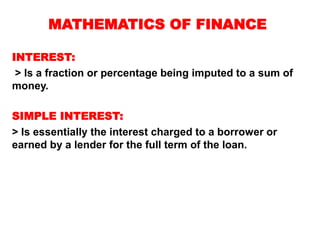
INTEREST:
> Is a fraction or percentage being imputed to a sum of
money.
SIMPLE INTEREST:
> Is essentially the interest charged to a borrower or
earned by a lender for the full term of the loan.
• FORMULA:
I = P x R x T
Where:
I = interest
P = Principal
R = Rate
T = time
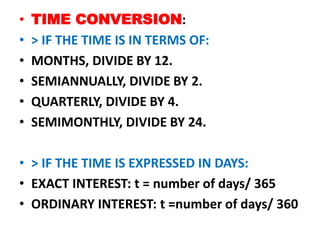
• TIME CONVERSION:
• > IF THE TIME IS IN TERMS OF:
• MONTHS, DIVIDE BY 12.
• SEMIANNUALLY, DIVIDE BY 2.
• QUARTERLY, DIVIDE BY 4.
• SEMIMONTHLY, DIVIDE BY 24.
• > IF THE TIME IS EXPRESSED IN DAYS:
• EXACT INTEREST: t = number of days/ 365
• ORDINARY INTEREST: t =number of days/ 360
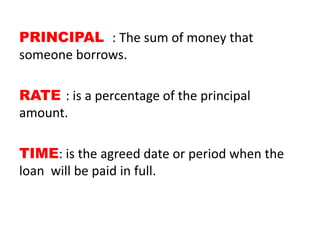
PRINCIPAL : The sum of money that
someone borrows.
RATE : is a percentage of the principal
amount.
TIME: is the agreed date or period when the
loan will be paid in full.
• 1. Given:
• P = P10,000
• R= 5 % per month
• Time = 5 months
• I = ?
• 2. Given:
• I = P 6,000
• P = P 20,000
• R = 8% per year
• T = ?
3. Given:
R = 15% per month
Time = 6 months
I = P 4,500
P = ?
4. Given:
P = P 30,000.
I = P 9,000.
R = ? ( per month)
T = 3 months
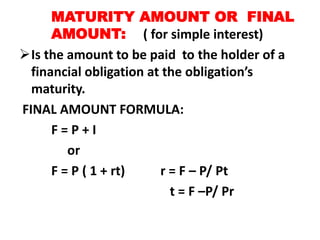
MATURITY AMOUNT OR FINAL
AMOUNT: ( for simple interest)
Is the amount to be paid to the holder of a
financial obligation at the obligation’s
maturity.
FINAL AMOUNT FORMULA:
F = P + I
or
F = P ( 1 + rt) r = F – P/ Pt
t = F –P/ Pr
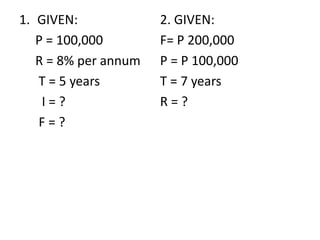
1. GIVEN:
P = 100,000
R = 8% per annum
T = 5 years
I = ?
F = ?
2. GIVEN:
F= P 200,000
P = P 100,000
T = 7 years
R = ?
COMPOUND INTEREST:
Is similar to simple interest, only
that the interest charged or
earned is being rolled – up and
reinvested with the principal
amount.
The sum by which the original
principal has increased by the end
of the term of the investment.
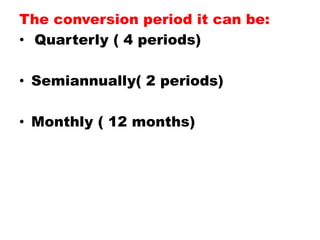
The conversion period it can be:
• Quarterly ( 4 periods)
• Semiannually( 2 periods)
• Monthly ( 12 months)
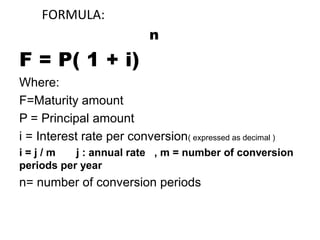
FORMULA:
n
F = P( 1 + i)
Where:
F=Maturity amount
P = Principal amount
i = Interest rate per conversion( expressed as decimal )
i = j / m j : annual rate , m = number of conversion
periods per year
n= number of conversion periods
• Example 1.
Accumulate P 5,000 for 3 years at 10%
compounded quarterly.
Given:
P = P5,000
n=3(4) = 12
i = j/m = 10%/ 4 = .10/4 = 0.025
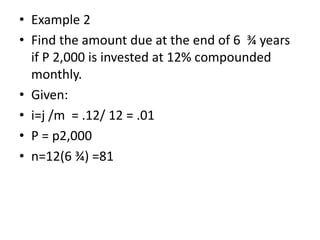
• Example 2
• Find the amount due at the end of 6 ¾ years
if P 2,000 is invested at 12% compounded
monthly.
• Given:
• i=j /m = .12/ 12 = .01
• P = p2,000
• n=12(6 ¾) =81
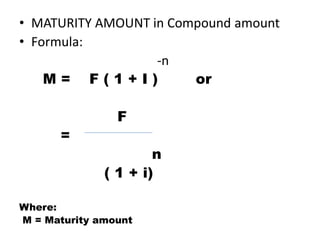
• MATURITY AMOUNT in Compound amount
• Formula:
-n
M = F ( 1 + I ) or
F
=
n
( 1 + i)
Where:
M = Maturity amount
• 1. Find the maturity amount of p5,000 due in
6 years if money is worth 12% compounded
semiannually.
• 2. If money can be invested at 12%
compounded semiannually, find the maturity
amount of p1,000 due at the end of 5 ½
years.

general math ( finals topics).pdf

  • 1.
    MATHEMATICS OF FINANCE INTEREST: >Is a fraction or percentage being imputed to a sum of money. SIMPLE INTEREST: > Is essentially the interest charged to a borrower or earned by a lender for the full term of the loan.
  • 2.
    • FORMULA: I =P x R x T Where: I = interest P = Principal R = Rate T = time
  • 3.
    • TIME CONVERSION: •> IF THE TIME IS IN TERMS OF: • MONTHS, DIVIDE BY 12. • SEMIANNUALLY, DIVIDE BY 2. • QUARTERLY, DIVIDE BY 4. • SEMIMONTHLY, DIVIDE BY 24. • > IF THE TIME IS EXPRESSED IN DAYS: • EXACT INTEREST: t = number of days/ 365 • ORDINARY INTEREST: t =number of days/ 360
  • 4.
    PRINCIPAL : Thesum of money that someone borrows. RATE : is a percentage of the principal amount. TIME: is the agreed date or period when the loan will be paid in full.
  • 5.
    • 1. Given: •P = P10,000 • R= 5 % per month • Time = 5 months • I = ? • 2. Given: • I = P 6,000 • P = P 20,000 • R = 8% per year • T = ? 3. Given: R = 15% per month Time = 6 months I = P 4,500 P = ? 4. Given: P = P 30,000. I = P 9,000. R = ? ( per month) T = 3 months
  • 6.
    MATURITY AMOUNT ORFINAL AMOUNT: ( for simple interest) Is the amount to be paid to the holder of a financial obligation at the obligation’s maturity. FINAL AMOUNT FORMULA: F = P + I or F = P ( 1 + rt) r = F – P/ Pt t = F –P/ Pr
  • 7.
    1. GIVEN: P =100,000 R = 8% per annum T = 5 years I = ? F = ? 2. GIVEN: F= P 200,000 P = P 100,000 T = 7 years R = ?
  • 8.
    COMPOUND INTEREST: Is similarto simple interest, only that the interest charged or earned is being rolled – up and reinvested with the principal amount. The sum by which the original principal has increased by the end of the term of the investment.
  • 9.
    The conversion periodit can be: • Quarterly ( 4 periods) • Semiannually( 2 periods) • Monthly ( 12 months)
  • 10.
    FORMULA: n F = P(1 + i) Where: F=Maturity amount P = Principal amount i = Interest rate per conversion( expressed as decimal ) i = j / m j : annual rate , m = number of conversion periods per year n= number of conversion periods
  • 11.
    • Example 1. AccumulateP 5,000 for 3 years at 10% compounded quarterly. Given: P = P5,000 n=3(4) = 12 i = j/m = 10%/ 4 = .10/4 = 0.025
  • 12.
    • Example 2 •Find the amount due at the end of 6 ¾ years if P 2,000 is invested at 12% compounded monthly. • Given: • i=j /m = .12/ 12 = .01 • P = p2,000 • n=12(6 ¾) =81
  • 13.
    • MATURITY AMOUNTin Compound amount • Formula: -n M = F ( 1 + I ) or F = n ( 1 + i) Where: M = Maturity amount
  • 14.
    • 1. Findthe maturity amount of p5,000 due in 6 years if money is worth 12% compounded semiannually. • 2. If money can be invested at 12% compounded semiannually, find the maturity amount of p1,000 due at the end of 5 ½ years.