DEVELOPMENTAL
BIOLOGY
(5th
semester)
Dr Monita Dhiman
Assistant Professor
Department of Zoology
Khalsa College for Women, Ludhiana
EMBRYO LOGY
vs
DEVELOPMENTAL
BIOLOGY
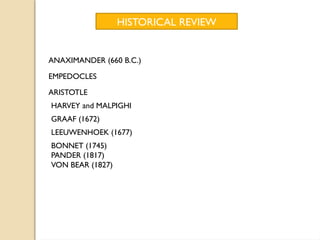
HISTORICAL REVIEW
ANAXIMANDER (660 B.C.)
EMPEDOCLES
ARISTOTLE
HARVEY and MALPIGHI
GRAAF (1672)
LEEUWENHOEK (1677)
BONNET (1745)
PANDER (1817)
VON BEAR (1827)
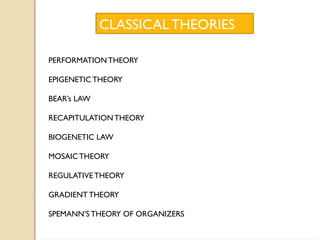
CLASSICAL THEORIES
PERFORMATIONTHEORY
EPIGENETIC THEORY
BEAR’s LAW
RECAPITULATION THEORY
BIOGENETIC LAW
MOSAIC THEORY
REGULATIVE THEORY
GRADIENT THEORY
SPEMANN’S THEORY OF ORGANIZERS
Basic concept of Development
Development is the process by which a complex multicellular
organism arises from a single cell. An overview of developmental
processes include:
Stages of Development
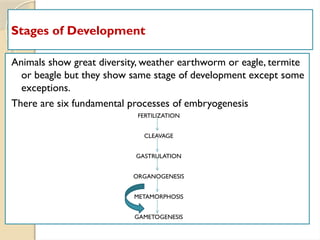
Animals show great diversity, weather earthworm or eagle, termite
or beagle but they show same stage of development except some
exceptions.
There are six fundamental processes of embryogenesis
FERTILIZATION
CLEAVAGE
GASTRULATION
ORGANOGENESIS
METAMORPHOSIS
GAMETOGENESIS
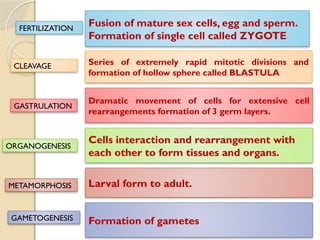
Fusion of mature sex cells, egg and sperm.
Formation of single cell called ZYGOTE
Series of extremely rapid mitotic divisions and
formation of hollow sphere called BLASTULA
Dramatic movement of cells for extensive cell
rearrangements formation of 3 germ layers.
Cells interaction and rearrangement with
each other to form tissues and organs.
Larval form to adult.
Formation of gametes
FERTILIZATION
CLEAVAGE
GASTRULATION
ORGANOGENESIS
METAMORPHOSIS
GAMETOGENESIS
Developmental Hierarchy
DEVELOPMENT ZOOLOGY
Syllabus
UNIT
-I
 Gametogenesis with particular reference to differentiation of
spermatozoa. Vitellogenesis, role of follicle/subtesticular cells in
gametogenesis.
 Egg maturation : egg membranes : polarity of egg.
UNIT
-II
 Fertilization, parthenogenesis.
 Cleavage : Types of cleavage patterns depending upon amount
and distribution of yolk and position of spindle.
 Blastula and types of blastula. Fate maps of chick and frog
embryos.
Syllabus continue….
UNIT
-III
 Induction: cell to cell interactions: juxtacrine, paracrine, gap
junctions; basic concepts of organizers and inducers and their
role. Determination and differentiation.
 Development up to three germ layers in Herdmania, Amphioxus,
frog, chick and rabbit.
UNIT
-IV
 Foetal membranes, their formation and role.
 Mammalian placenta – its formation, types and functions.
Metamorphosis in Herdmania and Rana (frog)
general description regarding Developmental Biology

general description regarding Developmental Biology

  • 1.
    DEVELOPMENTAL BIOLOGY (5th semester) Dr Monita Dhiman AssistantProfessor Department of Zoology Khalsa College for Women, Ludhiana
  • 3.
  • 4.
    HISTORICAL REVIEW ANAXIMANDER (660B.C.) EMPEDOCLES ARISTOTLE HARVEY and MALPIGHI GRAAF (1672) LEEUWENHOEK (1677) BONNET (1745) PANDER (1817) VON BEAR (1827)
  • 5.
    CLASSICAL THEORIES PERFORMATIONTHEORY EPIGENETIC THEORY BEAR’sLAW RECAPITULATION THEORY BIOGENETIC LAW MOSAIC THEORY REGULATIVE THEORY GRADIENT THEORY SPEMANN’S THEORY OF ORGANIZERS
  • 6.
    Basic concept ofDevelopment Development is the process by which a complex multicellular organism arises from a single cell. An overview of developmental processes include:
  • 7.
    Stages of Development Animalsshow great diversity, weather earthworm or eagle, termite or beagle but they show same stage of development except some exceptions. There are six fundamental processes of embryogenesis FERTILIZATION CLEAVAGE GASTRULATION ORGANOGENESIS METAMORPHOSIS GAMETOGENESIS
  • 8.
    Fusion of maturesex cells, egg and sperm. Formation of single cell called ZYGOTE Series of extremely rapid mitotic divisions and formation of hollow sphere called BLASTULA Dramatic movement of cells for extensive cell rearrangements formation of 3 germ layers. Cells interaction and rearrangement with each other to form tissues and organs. Larval form to adult. Formation of gametes FERTILIZATION CLEAVAGE GASTRULATION ORGANOGENESIS METAMORPHOSIS GAMETOGENESIS
  • 9.
  • 10.
    DEVELOPMENT ZOOLOGY Syllabus UNIT -I  Gametogenesiswith particular reference to differentiation of spermatozoa. Vitellogenesis, role of follicle/subtesticular cells in gametogenesis.  Egg maturation : egg membranes : polarity of egg. UNIT -II  Fertilization, parthenogenesis.  Cleavage : Types of cleavage patterns depending upon amount and distribution of yolk and position of spindle.  Blastula and types of blastula. Fate maps of chick and frog embryos.
  • 11.
    Syllabus continue…. UNIT -III  Induction:cell to cell interactions: juxtacrine, paracrine, gap junctions; basic concepts of organizers and inducers and their role. Determination and differentiation.  Development up to three germ layers in Herdmania, Amphioxus, frog, chick and rabbit. UNIT -IV  Foetal membranes, their formation and role.  Mammalian placenta – its formation, types and functions. Metamorphosis in Herdmania and Rana (frog)