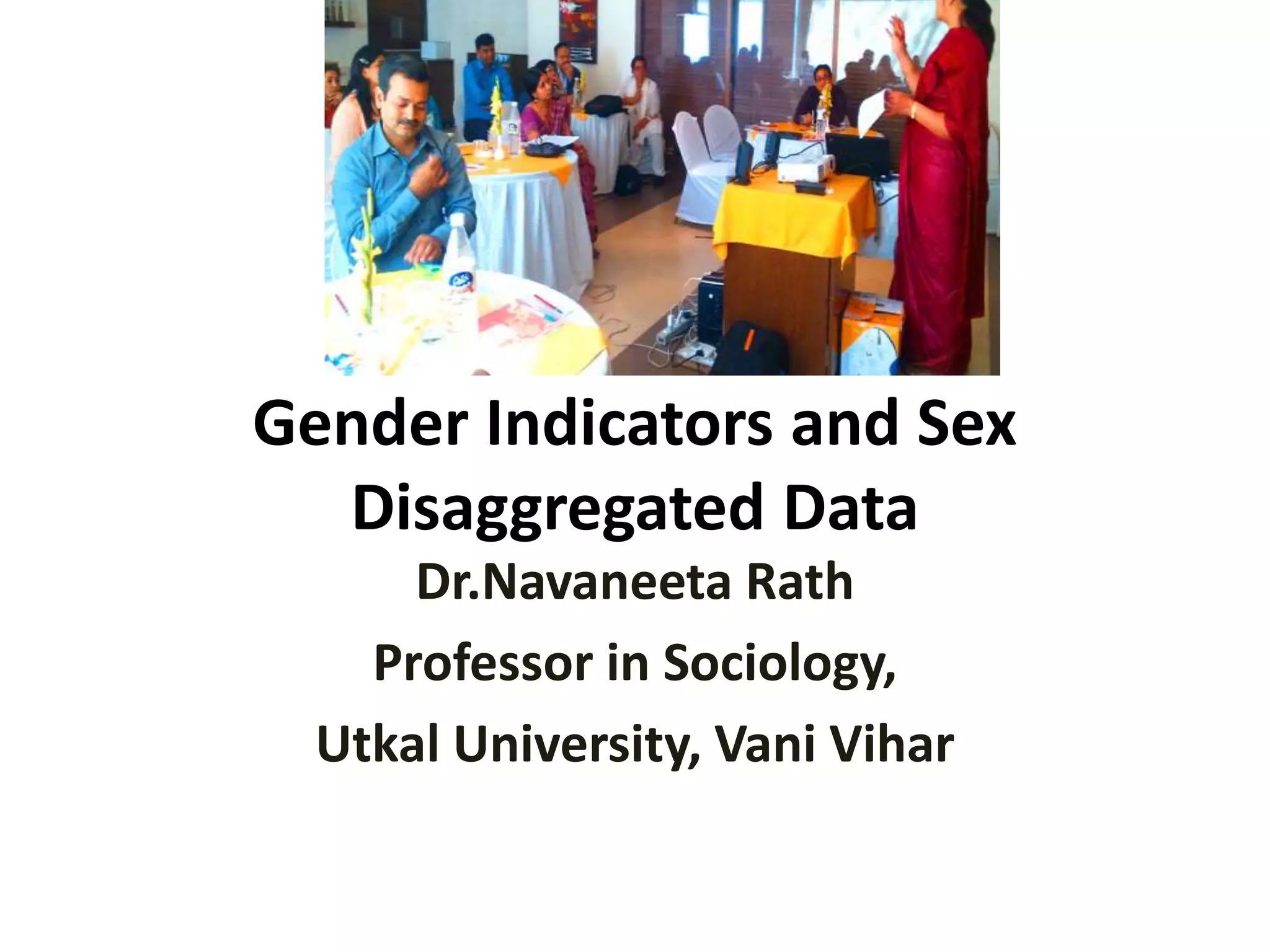
Gender Indicators and Sex
Disaggregated Data
Dr.Navaneeta Rath
Professor in Sociology,
Utkal University, Vani Vihar
Sex disaggregated Data for gender
Planning and Integration
• Bringing gender symmetry is an avowed purpose
and a priority area in all national agendas and
efforts of all international development agencies.
• Collecting sex-disaggregated data is one of the
most common approaches that researchers use
to integrate gender in basic research,
assessments made for policy research and
evaluative research.
• Gender difference in service delivery and service
outcome is an accepted phenomenon.
What are Indicators?
• Indicators are criteria or measures against
which changes can be assessed.
• They are the pointers, facts, numbers,
opinions or perceptions – used to signify
changes in specific conditions or progress
towards particular objectives.
Gender Indicators: What are They?
• Gender indicators indicate the development benefits
reaped by each gender group by development plans,
pogrammes and schemes. For eg. Progress in literacy,
reduction in maternal mortality, possession of land etc.
• Every gender group has its development challenges.
• Development opportunities have their differential
deliveries across groups and across culture.
• Gender difference in service delivery and service
outcome is an accepted phenomenon.
Common Gender Indicators in India
• Level of education
• Health status
• Access to safe drinking water, food security
• Representation in employment
• Income and wealth
• Participation in decision making
• Rate of violence against women
The Story of the Fox and the Crane
• Equal treatment does not mean the same treatment.
Opportunities are not availed equally by all.
• The Fox invited the Crane to dinner. He served the food
on a large flat dish. The Crane with her long, narrow
beak could not eat.
• The Crane invited the Fox to dinner. She served the
food in a deep vase, and so the Fox with his short, wide
face could not eat.
• Both friends had an equal opportunity for
nourishment, but each time one of them could not
take advantage of this opportunity.
• Gender difference in service delivery and service
outcome is an accepted phenomenon. For eg.
Gender divide in pay, political representation,
inheritance
• The development challenge in every case is to
identify barriers to the opportunities that exist,
and
• Design the adjusted interventions that will lead to
equality of outcome.
Sex disaggregated Data for gender
Planning and Integration
• Bringing gender symmetry is an avowed purpose
and a priority area in all national agendas and
efforts of all international development agencies.
• Collecting sex-disaggregated data is one of the
most common approaches that researchers use
to integrate gender in basic research,
assessments made for policy research and
evaluative research.
• Gender difference in service delivery and service
outcome is an accepted phenomenon.
Gender Planning
• Gender symmetry can be ensured through
perfect and effective gender planning.
• For this, identification of the gender inequalities,
constraints, opportunities, and unintended
consequences of planning and programmes is
needed.
• By identifying important gender-related issues
before a program starts or early on in
implementation, implementers can foresee and
address gender-related issues proactively.
Continued:
• Gender-sensitive indicators
 Address the gender gaps and inequalities that are
sought to be redressed
 Requires the collection of data, disaggregated by sex,
as well as by age and socio-economic and ethnic
groups,
 Taken into account a long-term perspective (i.e., social
change takes time); and
 Use participatory approaches. Women and men
actively take part in the planning of performance
measurement frameworks, in their implementation,
and in the discussion of their findings.
Characteristics of Gender Indicators:
• Realistic
• Meaningful
• Quantitative
• Qualitative
• Time bound
• Describing the efficacy of the inputs, process
and output
Sex Disaggregated Data and Gender
Budgeting
• Sex Disaggregated Data is a basic pre requisite
for gender budgeting.
• These data are frequently missing with the
planners, policy makers and policy
implementers.
• Sex Disaggregated Data means statistics and
data gathered and broken down by sex in
order to aid comparison.
Why Gender Disaggregated Data is
Needed?
• Sex disaggregated data are needed to:
Make gender analysis
Need identification
Deciding priorities
Designing gender sensitive programmes and
schemes
Prioritizing resource allocation
Gender Difference needs to Collect
Gender Disaggregated Data
• In a society, the needs of men and women,
girls, and boys are not the same.
• They face different social, economic, and
cultural barriers that affect their ability to
access and benefit from resources, services
and programs equitably.
Continued:
• Collecting and analyzing sex-disaggregated data is an
important part of every gender analysis.
• Sex-disaggregated data is a powerful tool to identify
quantifiable differences between women and men and
between girls and boys. It is needed to be conducted
at different stages of policy planning and
implementation to address gender issues.
• Without sex-disaggregated data, vital information is
missed about the existing differences and gaps
between girls, boys, women, and men. Their unique
needs are often overlooked in planning and
implementation.
History of Gender Disaggregated
Data
• The history of gender statistics begins with the First
World Conference on Women (Mexico 1975), which
first recognized the importance of producing
statistics on women.
• The importance of such statistics was reiterated at
the Second World Conference on
Women (Copenhagen 1980).
• By the Third World Conference on Women (Nairobi
1985), some work in the field of gender/women
statistics had begun.
Continued:
• Statistics Sweden was perhaps the first statistical office
worldwide to designate specific staff to work on gender
statistics in 1983.
• The Nairobi World Conference on Women (1985) also
marked the major watershed between the focus on
statistics on women and work on gender statistics. By
the time of the Fourth World Conference on
Women (Beijing 1995), many national statistical offices
and international agencies had prepared primers and
guides on the new approach of gender statistics.
How Sex Disaggregated Data is
prepared?
• Sex-disaggregated data are data that are
collected and analysed separately on males and
females.
• This typically involves asking the “who” questions
in household surveys: who provides labor, who
makes the decisions, who owns and controls the
land and other resources.
• It involves asking men and women about their
individual roles and responsibilities, rights
enjoyed, relations and resources enjoyed.
Continued:
• When talking about sex-disaggregated data, a
comparisons of male- and female-headed
household is not being made.
• Some people mistakenly believe that the goal of
collecting sex-disaggregated data and conducting
gender analysis is simply to understand the
situation for women.
• Sex-disaggregated data are not necessarily
collected from women and men within the same
household, but they are collected about women
and men.
Unit of Analysis
• Individual(Understanding individual choices,
preferences, or decisions)
• Households (Understanding individual
choices, preferences, or decisions)
• Intrahouseholds (This does not treat the
household as a single unit, but seeks to
understand how multiple individuals within
the household interact and affect outcomes. )
Continued:
• Community(Communities may be the focus of
policies or interventions. )
• Regional (For cross-country comparisons,
including those of trade or policies, national or
regional analysis is appropriate.)
• Formal and informal agencies(cooperatives,
extension service providers, credit banks, water
user groups, micro-finance groups, self-help
groups, etc. )
• Value Chain
Musts for Sex disaagregated Data
Analysis
• Collect information about both men and
women.
• This does not necessarily require interviewing
men and women in the same household.
Studies that fail to include male and female
respondents will be subject to biases; the
extent of the bias will depend on the
knowledge and perceptions of the
respondent(s).
Continued:
• All data collection methods must be context
specific. Questions must be adapted to the
context. Those collecting and analyzing the data
need to understand gender roles and social
dynamics. This knowledge must also guide the
settings for interviews or focus groups.
• Work with a gender expert early in the process to
define the research question and methodology.
Continued:
• Researchers collecting data from human
subjects must ensure that the participants
have completed a confidentiality and consent
agreement. While these requirements are
important for all research, they are essential
for gender analyses that address sensitive
topics such as asset ownership and domestic
violence.
Continued:
• Comparing male and female headed
households is not gender analysis. Differences
between these diverse household types
cannot necessarily be attributed to the sex of
the household head.
Thank You

Gender indicators and sex disaggregated data

  • 1.
    Gender Indicators andSex Disaggregated Data Dr.Navaneeta Rath Professor in Sociology, Utkal University, Vani Vihar
  • 2.
    Sex disaggregated Datafor gender Planning and Integration • Bringing gender symmetry is an avowed purpose and a priority area in all national agendas and efforts of all international development agencies. • Collecting sex-disaggregated data is one of the most common approaches that researchers use to integrate gender in basic research, assessments made for policy research and evaluative research. • Gender difference in service delivery and service outcome is an accepted phenomenon.
  • 3.
    What are Indicators? •Indicators are criteria or measures against which changes can be assessed. • They are the pointers, facts, numbers, opinions or perceptions – used to signify changes in specific conditions or progress towards particular objectives.
  • 4.
    Gender Indicators: Whatare They? • Gender indicators indicate the development benefits reaped by each gender group by development plans, pogrammes and schemes. For eg. Progress in literacy, reduction in maternal mortality, possession of land etc. • Every gender group has its development challenges. • Development opportunities have their differential deliveries across groups and across culture. • Gender difference in service delivery and service outcome is an accepted phenomenon.
  • 5.
    Common Gender Indicatorsin India • Level of education • Health status • Access to safe drinking water, food security • Representation in employment • Income and wealth • Participation in decision making • Rate of violence against women
  • 6.
    The Story ofthe Fox and the Crane • Equal treatment does not mean the same treatment. Opportunities are not availed equally by all. • The Fox invited the Crane to dinner. He served the food on a large flat dish. The Crane with her long, narrow beak could not eat. • The Crane invited the Fox to dinner. She served the food in a deep vase, and so the Fox with his short, wide face could not eat. • Both friends had an equal opportunity for nourishment, but each time one of them could not take advantage of this opportunity.
  • 7.
    • Gender differencein service delivery and service outcome is an accepted phenomenon. For eg. Gender divide in pay, political representation, inheritance • The development challenge in every case is to identify barriers to the opportunities that exist, and • Design the adjusted interventions that will lead to equality of outcome.
  • 8.
    Sex disaggregated Datafor gender Planning and Integration • Bringing gender symmetry is an avowed purpose and a priority area in all national agendas and efforts of all international development agencies. • Collecting sex-disaggregated data is one of the most common approaches that researchers use to integrate gender in basic research, assessments made for policy research and evaluative research. • Gender difference in service delivery and service outcome is an accepted phenomenon.
  • 9.
    Gender Planning • Gendersymmetry can be ensured through perfect and effective gender planning. • For this, identification of the gender inequalities, constraints, opportunities, and unintended consequences of planning and programmes is needed. • By identifying important gender-related issues before a program starts or early on in implementation, implementers can foresee and address gender-related issues proactively.
  • 10.
    Continued: • Gender-sensitive indicators Address the gender gaps and inequalities that are sought to be redressed  Requires the collection of data, disaggregated by sex, as well as by age and socio-economic and ethnic groups,  Taken into account a long-term perspective (i.e., social change takes time); and  Use participatory approaches. Women and men actively take part in the planning of performance measurement frameworks, in their implementation, and in the discussion of their findings.
  • 11.
    Characteristics of GenderIndicators: • Realistic • Meaningful • Quantitative • Qualitative • Time bound • Describing the efficacy of the inputs, process and output
  • 12.
    Sex Disaggregated Dataand Gender Budgeting • Sex Disaggregated Data is a basic pre requisite for gender budgeting. • These data are frequently missing with the planners, policy makers and policy implementers. • Sex Disaggregated Data means statistics and data gathered and broken down by sex in order to aid comparison.
  • 13.
    Why Gender DisaggregatedData is Needed? • Sex disaggregated data are needed to: Make gender analysis Need identification Deciding priorities Designing gender sensitive programmes and schemes Prioritizing resource allocation
  • 14.
    Gender Difference needsto Collect Gender Disaggregated Data • In a society, the needs of men and women, girls, and boys are not the same. • They face different social, economic, and cultural barriers that affect their ability to access and benefit from resources, services and programs equitably.
  • 15.
    Continued: • Collecting andanalyzing sex-disaggregated data is an important part of every gender analysis. • Sex-disaggregated data is a powerful tool to identify quantifiable differences between women and men and between girls and boys. It is needed to be conducted at different stages of policy planning and implementation to address gender issues. • Without sex-disaggregated data, vital information is missed about the existing differences and gaps between girls, boys, women, and men. Their unique needs are often overlooked in planning and implementation.
  • 16.
    History of GenderDisaggregated Data • The history of gender statistics begins with the First World Conference on Women (Mexico 1975), which first recognized the importance of producing statistics on women. • The importance of such statistics was reiterated at the Second World Conference on Women (Copenhagen 1980). • By the Third World Conference on Women (Nairobi 1985), some work in the field of gender/women statistics had begun.
  • 17.
    Continued: • Statistics Swedenwas perhaps the first statistical office worldwide to designate specific staff to work on gender statistics in 1983. • The Nairobi World Conference on Women (1985) also marked the major watershed between the focus on statistics on women and work on gender statistics. By the time of the Fourth World Conference on Women (Beijing 1995), many national statistical offices and international agencies had prepared primers and guides on the new approach of gender statistics.
  • 18.
    How Sex DisaggregatedData is prepared? • Sex-disaggregated data are data that are collected and analysed separately on males and females. • This typically involves asking the “who” questions in household surveys: who provides labor, who makes the decisions, who owns and controls the land and other resources. • It involves asking men and women about their individual roles and responsibilities, rights enjoyed, relations and resources enjoyed.
  • 19.
    Continued: • When talkingabout sex-disaggregated data, a comparisons of male- and female-headed household is not being made. • Some people mistakenly believe that the goal of collecting sex-disaggregated data and conducting gender analysis is simply to understand the situation for women. • Sex-disaggregated data are not necessarily collected from women and men within the same household, but they are collected about women and men.
  • 20.
    Unit of Analysis •Individual(Understanding individual choices, preferences, or decisions) • Households (Understanding individual choices, preferences, or decisions) • Intrahouseholds (This does not treat the household as a single unit, but seeks to understand how multiple individuals within the household interact and affect outcomes. )
  • 21.
    Continued: • Community(Communities maybe the focus of policies or interventions. ) • Regional (For cross-country comparisons, including those of trade or policies, national or regional analysis is appropriate.) • Formal and informal agencies(cooperatives, extension service providers, credit banks, water user groups, micro-finance groups, self-help groups, etc. ) • Value Chain
  • 22.
    Musts for Sexdisaagregated Data Analysis • Collect information about both men and women. • This does not necessarily require interviewing men and women in the same household. Studies that fail to include male and female respondents will be subject to biases; the extent of the bias will depend on the knowledge and perceptions of the respondent(s).
  • 23.
    Continued: • All datacollection methods must be context specific. Questions must be adapted to the context. Those collecting and analyzing the data need to understand gender roles and social dynamics. This knowledge must also guide the settings for interviews or focus groups. • Work with a gender expert early in the process to define the research question and methodology.
  • 24.
    Continued: • Researchers collectingdata from human subjects must ensure that the participants have completed a confidentiality and consent agreement. While these requirements are important for all research, they are essential for gender analyses that address sensitive topics such as asset ownership and domestic violence.
  • 25.
    Continued: • Comparing maleand female headed households is not gender analysis. Differences between these diverse household types cannot necessarily be attributed to the sex of the household head.
  • 26.