Gender Equality in Malawi Lake Basin
Programme
Highlights
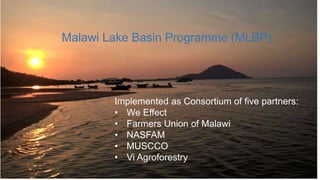
Malawi Lake Basin Programme (MLBP)
Implemented as Consortium of five partners:
• We Effect
• Farmers Union of Malawi
• NASFAM
• MUSCCO
• Vi Agroforestry
MLBP Objectives
1.Increased community adaptation to impacts of climate
change
2.Increased agricultural productivity and diversification
3.Strengthened farmer organisation and entrepreneurship
4.Improved policy, advocacy and enabling environment
5.Increased empowerment of women, youth and
vulnerable groups
6.Strengthened local partners
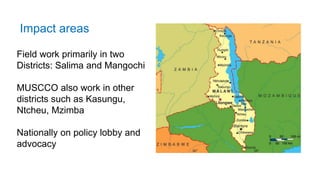
Field work primarily in two
Districts: Salima and Mangochi
MUSCCO also work in other
districts such as Kasungu,
Ntcheu, Mzimba
Nationally on policy lobby and
advocacy
Impact areas
Gen
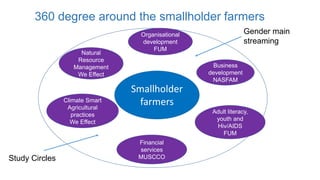
Smallholder
farmers
Organisational
development
FUM
Business
development
NASFAM
Financial
services
MUSCCO
Climate Smart
Agricultural
practices
We Effect
Natural
Resource
Management
We Effect
Adult literacy,
youth and
Hiv/AIDS
FUM
360 degree around the smallholder farmers
Gender main
streaming
Study Circles
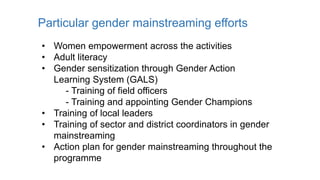
Particular gender mainstreaming efforts
• Women empowerment across the activities
• Adult literacy
• Gender sensitization through Gender Action
Learning System (GALS)
- Training of field officers
- Training and appointing Gender Champions
• Training of local leaders
• Training of sector and district coordinators in gender
mainstreaming
• Action plan for gender mainstreaming throughout the
programme
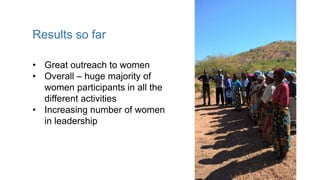
Results so far
• Great outreach to women
• Overall – huge majority of
women participants in all the
different activities
• Increasing number of women
in leadership
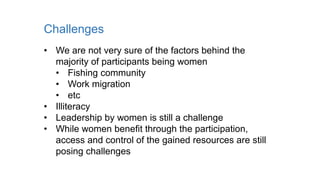
Challenges
• We are not very sure of the factors behind the
majority of participants being women
• Fishing community
• Work migration
• etc
• Illiteracy
• Leadership by women is still a challenge
• While women benefit through the participation,
access and control of the gained resources are still
posing challenges
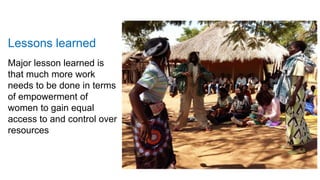
Lessons learned
Major lesson learned is
that much more work
needs to be done in terms
of empowerment of
women to gain equal
access to and control over
resources
Way forward
We have therefore developed and action plan for
mainstreaming gender equality into all the sectors
• Engendering Programme document (logframe)
• Gender analyses for all sectors
• Gender planning in all sectors
• FRAS implementation
• Improving documentation on women empowerment
• Try to establish a work relation ship with WOLREC
with focus on human rights
For consideration
• More use of household approach for improving gender
relationships?
• How to define a household?
• Participation of other partners and approaches?
• Availability of good policies and tools?
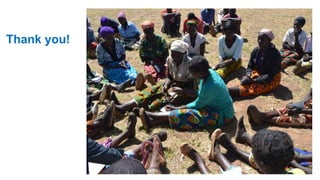
Thank you!

Gender Equality in Malawi Lake Basin Programme

  • 1.
    Gender Equality inMalawi Lake Basin Programme Highlights
  • 2.
    Malawi Lake BasinProgramme (MLBP) Implemented as Consortium of five partners: • We Effect • Farmers Union of Malawi • NASFAM • MUSCCO • Vi Agroforestry
  • 3.
    MLBP Objectives 1.Increased communityadaptation to impacts of climate change 2.Increased agricultural productivity and diversification 3.Strengthened farmer organisation and entrepreneurship 4.Improved policy, advocacy and enabling environment 5.Increased empowerment of women, youth and vulnerable groups 6.Strengthened local partners
  • 4.
    Field work primarilyin two Districts: Salima and Mangochi MUSCCO also work in other districts such as Kasungu, Ntcheu, Mzimba Nationally on policy lobby and advocacy Impact areas
  • 5.
    Gen Smallholder farmers Organisational development FUM Business development NASFAM Financial services MUSCCO Climate Smart Agricultural practices We Effect Natural Resource Management WeEffect Adult literacy, youth and Hiv/AIDS FUM 360 degree around the smallholder farmers Gender main streaming Study Circles
  • 6.
    Particular gender mainstreamingefforts • Women empowerment across the activities • Adult literacy • Gender sensitization through Gender Action Learning System (GALS) - Training of field officers - Training and appointing Gender Champions • Training of local leaders • Training of sector and district coordinators in gender mainstreaming • Action plan for gender mainstreaming throughout the programme
  • 7.
    Results so far •Great outreach to women • Overall – huge majority of women participants in all the different activities • Increasing number of women in leadership
  • 8.
    Challenges • We arenot very sure of the factors behind the majority of participants being women • Fishing community • Work migration • etc • Illiteracy • Leadership by women is still a challenge • While women benefit through the participation, access and control of the gained resources are still posing challenges
  • 9.
    Lessons learned Major lessonlearned is that much more work needs to be done in terms of empowerment of women to gain equal access to and control over resources
  • 10.
    Way forward We havetherefore developed and action plan for mainstreaming gender equality into all the sectors • Engendering Programme document (logframe) • Gender analyses for all sectors • Gender planning in all sectors • FRAS implementation • Improving documentation on women empowerment • Try to establish a work relation ship with WOLREC with focus on human rights
  • 11.
    For consideration • Moreuse of household approach for improving gender relationships? • How to define a household? • Participation of other partners and approaches? • Availability of good policies and tools?
  • 12.

Editor's Notes

  • #2 For the communication department in Sthlm to be able to spread the information, they need the voices from the field. And that is where I come in. I am here to serve as a link between you (and the partners and our target group) and the office in Sthlm, to make sure that our work is being seen! New role, havent had a communication officer in this region before. Cecilia, ROEA, used to cover ROSA aswell.