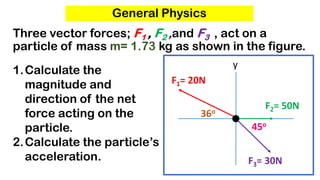
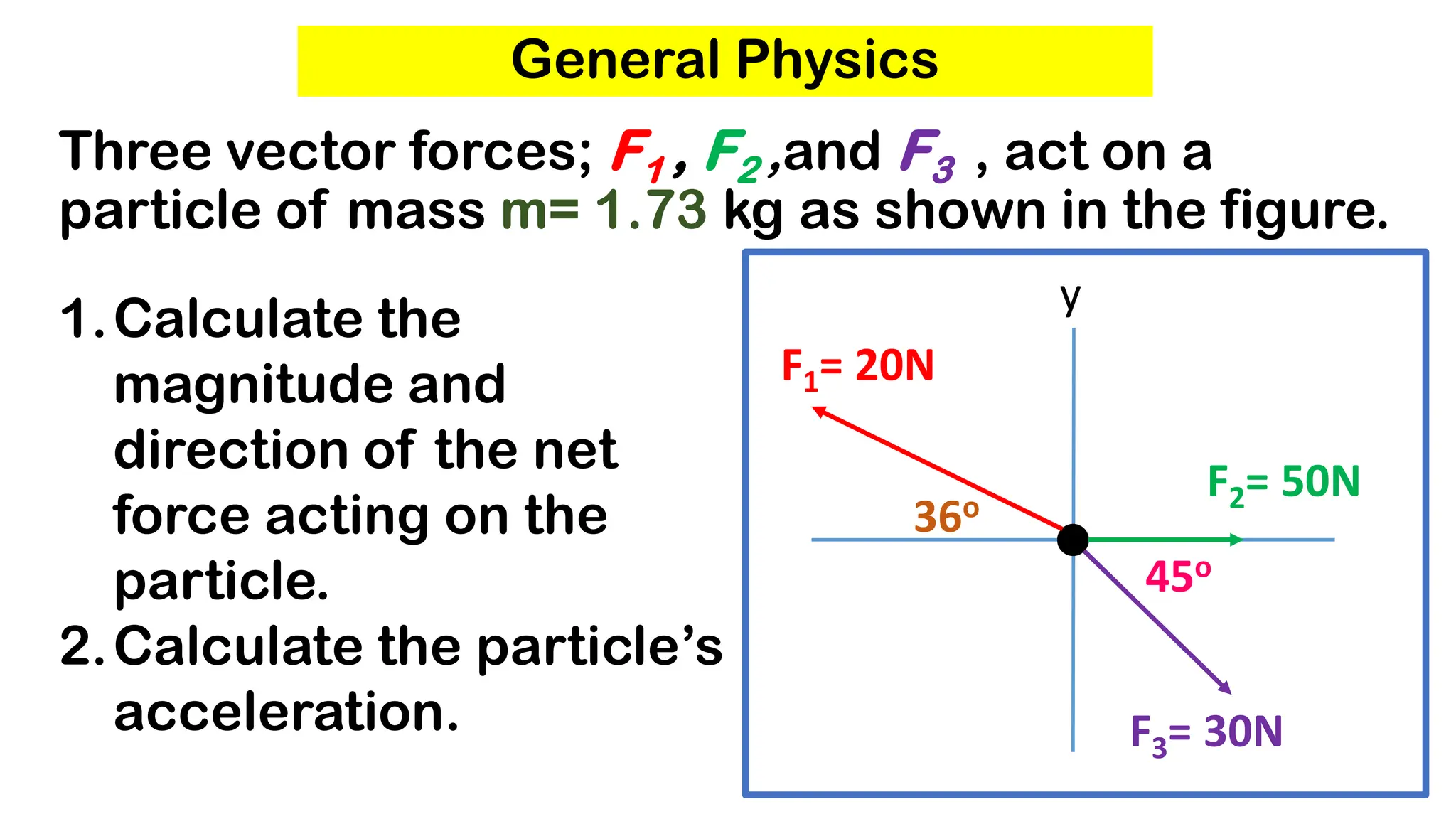
Three vector forces;F1 , F2 ,and F3 , act on a
particle of mass m= 1.73 kg as shown in the figure.
1.Calculate the
magnitude and
direction of the net
force acting on the
particle.
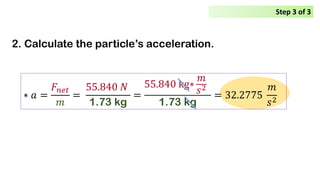
2.Calculate the particle’s
acceleration.
y
F1= 20N
F2= 50N
F3= 30N
45o
36o
General Physics
2.
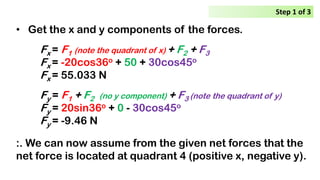
• Get thex and y components of the forces.
Fx = F1 (note the quadrant of x) + F2 + F3
Fx = -20cos36o + 50 + 30cos45o
Fx = 55.033 N
Fy = F1 + F2 (no y component) + F3 (note the quadrant of y)
Fy = 20sin36o + 0 - 30cos45o
Fy = -9.46 N
:. We can now assume from the given net forces that the
net force is located at quadrant 4 (positive x, negative y).
Step 1 of 3
3.
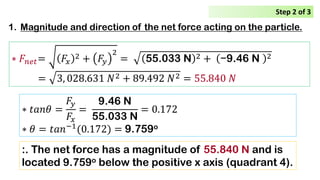
1. Magnitude anddirection of the net force acting on the particle.
∗ 𝐹𝐹𝑛𝑛𝑛𝑛𝑛𝑛= 𝐹𝐹𝑥𝑥
2 + 𝐹𝐹𝑦𝑦
2
= 55.033 N 2 + −9.46 N 2
= 3, 028.631 𝑁𝑁2 + 89.492 𝑁𝑁2 = 55.840 𝑁𝑁
∗ 𝑡𝑡𝑎𝑎𝑎𝑎𝜃𝜃 =
𝐹𝐹𝑦𝑦
𝐹𝐹𝑥𝑥
=
9.46 N
55.033 N
= 0.172
∗ 𝜃𝜃 = 𝑡𝑡𝑡𝑡𝑡𝑡−1
(0.172) = 9.759o
Step 2 of 3
:. The net force has a magnitude of 55.840 N and is
located 9.759o below the positive x axis (quadrant 4).
4.
2. Calculate theparticle’s acceleration.
∗ 𝑎𝑎 =
𝐹𝐹𝑛𝑛𝑛𝑛𝑛𝑛
𝑚𝑚
=
55.840 𝑁𝑁
1.73 kg
=
55.840 kg∗
𝑚𝑚
𝑠𝑠2
1.73 kg
= 32.2775
𝑚𝑚
𝑠𝑠2
Step 3 of 3


![ANIMAL_CELL_,_TISSUE_AND_ORGAN_CULTURE[1].pptx](https://cdn.slidesharecdn.com/ss_thumbnails/animalcelltissueandorganculture1-260204172026-4462b440-thumbnail.jpg?width=640&height=640&fit=bounds)


