GeoConvention 2014: FOCUS 1
Integration of geologic data into structural imaging of the Andean
subthrust, Peru
Margaret A. Stratton *, Gran Tierra Energy; Robert Vestrum, Thrust Belt Imaging and Dennis Ellison, Thrust
Belt Imaging
Summary
The prospectivity of the subthrust structures in the Ucayali basin, Peru, has exploration uncertainty
resulting from the velocity structure in the hanging wall of the overthrust. Given the structural
uncertainty and the under-constrained velocity model in this complex-structure environment, we
decided to reprocess the lines through to anisotropic depth migration. Geologic constraints not
used in the original models, resulted in improved imaging of the subthrust features. Through the
model testing, we observed that the closure on the subthrust prospects are robust even with a less
optimal velocity model. With a depth-migration velocity model that is consistent in 3D across the
grid of 2D lines, and a geologically constrained velocity model, we have increased confidence in the
mapping of the subthrust structures.
Introduction
Block 107 in Peru is located within complex fold and thrust system of the Subandean Pachitea sub -
basin. Exploration targets on the block focus on a large sub thrust play below the San Matias Fault
(SMT). A network of 2D lines cover the block, with the predominant orientation at right angles to the
major thrust.
Early in the interpretation phase it was recognized that anisotropic pre-stack depth migration would be
necessary to correctly image the subthrust structures. The challenge in the depth migration is
interpreting the velocity structure in the hanging wall of the fault, to ensure that the time pull-up
below the fault is not overcorrected or undercorrected by the depth-migration velocity model. These
data have a low signal-to-noise ratio where the geological complexity is the highest. Combined with
low fold near the surface, the depth-migration velocity model is underconstrained. Geologic
constraints were used to build the velocity model and iteratively tested varying velocity in the different
layers of the structure to optimize the imaging. We further constrained the model by interpreting the
velocity structure for the 2D lines in 3D, in an effort to minimize velocity variability in the strike
direction.
Limited well data and geological field work were used in the initial PSDM work. The initial
interpretation of the regional detachment, based on field data, carried higher velocity rocks in the
hanging-wall thrust which is reflected in the velocity models. Recent palynology work along the SMT
and seismic correlations indicated the detachment is in a younger stratigraphic unit with corresponding
GeoConvention 2014: FOCUS 2
slower velocities. This led to a second round of depth migration work which would more accurately
reflect the geology.
Geologic Setting
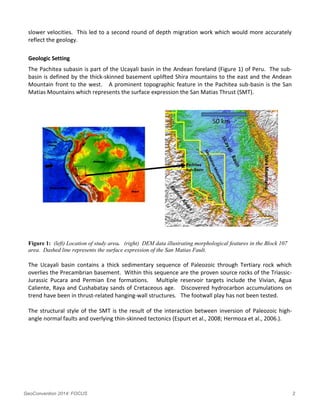
The Pachitea subasin is part of the Ucayali basin in the Andean foreland (Figure 1) of Peru. The sub-
basin is defined by the thick-skinned basement uplifted Shira mountains to the east and the Andean
Mountain front to the west. A prominent topographic feature in the Pachitea sub-basin is the San
Matias Mountains which represents the surface expression the San Matias Thrust (SMT).
Figure 1: (left) Location of study area. (right) DEM data illustrating morphological features in the Block 107
area. Dashed line represents the surface expression of the San Matias Fault.
The Ucayali basin contains a thick sedimentary sequence of Paleozoic through Tertiary rock which
overlies the Precambrian basement. Within this sequence are the proven source rocks of the Triassic-
Jurassic Pucara and Permian Ene formations. Multiple reservoir targets include the Vivian, Agua
Caliente, Raya and Cushabatay sands of Cretaceous age. Discovered hydrocarbon accumulations on
trend have been in thrust-related hanging-wall structures. The footwall play has not been tested.
The structural style of the SMT is the result of the interaction between inversion of Paleozoic high-
angle normal faults and overlying thin-skinned tectonics (Espurt et al., 2008; Hermoza et al., 2006.).
GeoConvention 2014: FOCUS 3
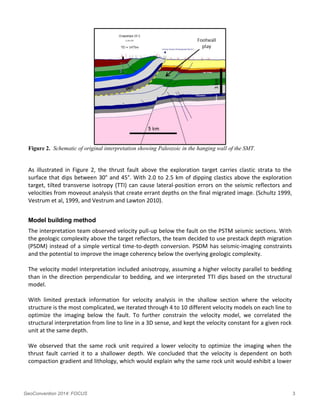
Figure 2. Schematic of original interpretation showing Paleozoic in the hanging wall of the SMT.
As illustrated in Figure 2, the thrust fault above the exploration target carries clastic strata to the
surface that dips between 30° and 45°. With 2.0 to 2.5 km of dipping clastics above the exploration
target, tilted transverse isotropy (TTI) can cause lateral-position errors on the seismic reflectors and
velocities from moveout analysis that create errant depths on the final migrated image. (Schultz 1999,
Vestrum et al, 1999, and Vestrum and Lawton 2010).
Model building method
The interpretation team observed velocity pull-up below the fault on the PSTM seismic sections. With
the geologic complexity above the target reflectors, the team decided to use prestack depth migration
(PSDM) instead of a simple vertical time-to-depth conversion. PSDM has seismic-imaging constraints
and the potential to improve the image coherency below the overlying geologic complexity.
The velocity model interpretation included anisotropy, assuming a higher velocity parallel to bedding
than in the direction perpendicular to bedding, and we interpreted TTI dips based on the structural
model.
With limited prestack information for velocity analysis in the shallow section where the velocity
structure is the most complicated, we iterated through 4 to 10 different velocity models on each line to
optimize the imaging below the fault. To further constrain the velocity model, we correlated the
structural interpretation from line to line in a 3D sense, and kept the velocity constant for a given rock
unit at the same depth.
We observed that the same rock unit required a lower velocity to optimize the imaging when the
thrust fault carried it to a shallower depth. We concluded that the velocity is dependent on both
compaction gradient and lithology, which would explain why the same rock unit would exhibit a lower
GeoConvention 2014: FOCUS 4
seismic-imaging velocity at a lesser depth. Another explanation may be that the lower velocity in the
hanging-wall rock layers could be due to fracturing.
Results
In the initial model-building process, there was concern about how much of the footwall structure was
due to velocity pull-up and how much of the structure was actual structurally thickened reservoir rock.
We tested the velocity model with high velocities in the hanging wall to see how the seismic imaging
and the reflector depths would respond to the higher-velocity scenario. The objective of this model
test was to see how the structure would be shaped if there were higher velocities in the hanging wall
of the fault. We evaluated the results based on the geophysical criterion of how well the seismic
responded to the different velocity models and the geological criterion if the shape of the footwall
structures made geologic sense in each case.
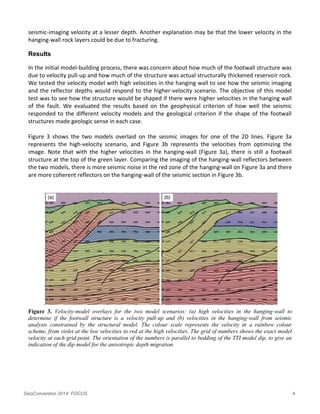
Figure 3 shows the two models overlaid on the seismic images for one of the 2D lines. Figure 3a
represents the high-velocity scenario, and Figure 3b represents the velocities from optimizing the
image. Note that with the higher velocities in the hanging-wall (Figure 3a), there is still a footwall
structure at the top of the green layer. Comparing the imaging of the hanging-wall reflectors between
the two models, there is more seismic noise in the red zone of the hanging-wall on Figure 3a and there
are more coherent reflectors on the hanging-wall of the seismic section in Figure 3b.
Figure 3. Velocity-model overlays for the two model scenarios: (a) high velocities in the hanging-wall to
determine if the footwall structure is a velocity pull-up and (b) velocities in the hanging-wall from seismic
analysis constrained by the structural model. The colour scale represents the velocity in a rainbow colour
scheme, from violet at the low velocities to red at the high velocities. The grid of numbers shows the exact model
velocity at each grid point. The orientation of the numbers is parallel to bedding of the TTI model dip, to give an
indication of the dip model for the anisotropic depth migration.
GeoConvention 2014: FOCUS 5
Conclusions
This area of the Peruvian Andes is geologically complex, yet has strong seismic signal quality. Even in
the footwall of the major thrust, we were able to interpret many structural details on the final seismic
images.
We took an interpretive approach to depth migration, creating a structural model over the entire block
so that the velocity structure could be consistent from line to line, avoiding the pitfall of creating
artificial velocity structures. We tested a variety of models, to avoid interpretation bias to the final
depth structures, and we found that the closure on the footwall structures is robust, and deviating
from our optimized model resulted in degradation of the seismic image.
The final interpretation of the block is integrated with the velocity model interpretation supported by
palynological data from the field and regional seismic correlations.
Acknowledgements
Gran Tierra Energy and Thrust Belt Imaging for permission to publish this work.
References
Espurt, N., Brusset S., Baby P., Hermoza W., Bolanos, R., Uyen, D. and J. Deramond, [2008] Paleozoic
structural controls on shortening transfer in the Subandean foreland thrust system, Ene and southern
Ucayali basins, Peru; Tectonics, Vol. 27, TC3009, doi: 0.1029/2007TC002238, 2008.
Hermoza, W., Baby, P., Espurt, N., Martinez, E. and R. Bolanos [2006] The Ucayali Subandean Bason: a
complex fold and thrust belt and inverted system; IX Simposio Bolivariano, Petroleum Exploration in
the Subandean Basins; Cartegena de las Indias, Columbia, Sept 2006.
Schultz, P. [1999] The Seismic Velocity Model as an Interpetation Asset. Soc. of Expl. Geophys.
Vestrum R.W., Lawton D.C. and Schmid R.S. [1999] Imaging structures below dipping TI media.
Geophysics 64, 1239–1246.
Vestrum, R.W., and Lawton, D.C. [2010] Reflection point sideslip and smear in imaging below dipping
anisotropic media. Geophysical Prospecting, 58, 541–548.

_GC2014_Integration_of_Geologic_Data_into_Structural_Imaging

  • 1.
    GeoConvention 2014: FOCUS1 Integration of geologic data into structural imaging of the Andean subthrust, Peru Margaret A. Stratton *, Gran Tierra Energy; Robert Vestrum, Thrust Belt Imaging and Dennis Ellison, Thrust Belt Imaging Summary The prospectivity of the subthrust structures in the Ucayali basin, Peru, has exploration uncertainty resulting from the velocity structure in the hanging wall of the overthrust. Given the structural uncertainty and the under-constrained velocity model in this complex-structure environment, we decided to reprocess the lines through to anisotropic depth migration. Geologic constraints not used in the original models, resulted in improved imaging of the subthrust features. Through the model testing, we observed that the closure on the subthrust prospects are robust even with a less optimal velocity model. With a depth-migration velocity model that is consistent in 3D across the grid of 2D lines, and a geologically constrained velocity model, we have increased confidence in the mapping of the subthrust structures. Introduction Block 107 in Peru is located within complex fold and thrust system of the Subandean Pachitea sub - basin. Exploration targets on the block focus on a large sub thrust play below the San Matias Fault (SMT). A network of 2D lines cover the block, with the predominant orientation at right angles to the major thrust. Early in the interpretation phase it was recognized that anisotropic pre-stack depth migration would be necessary to correctly image the subthrust structures. The challenge in the depth migration is interpreting the velocity structure in the hanging wall of the fault, to ensure that the time pull-up below the fault is not overcorrected or undercorrected by the depth-migration velocity model. These data have a low signal-to-noise ratio where the geological complexity is the highest. Combined with low fold near the surface, the depth-migration velocity model is underconstrained. Geologic constraints were used to build the velocity model and iteratively tested varying velocity in the different layers of the structure to optimize the imaging. We further constrained the model by interpreting the velocity structure for the 2D lines in 3D, in an effort to minimize velocity variability in the strike direction. Limited well data and geological field work were used in the initial PSDM work. The initial interpretation of the regional detachment, based on field data, carried higher velocity rocks in the hanging-wall thrust which is reflected in the velocity models. Recent palynology work along the SMT and seismic correlations indicated the detachment is in a younger stratigraphic unit with corresponding
  • 2.
    GeoConvention 2014: FOCUS2 slower velocities. This led to a second round of depth migration work which would more accurately reflect the geology. Geologic Setting The Pachitea subasin is part of the Ucayali basin in the Andean foreland (Figure 1) of Peru. The sub- basin is defined by the thick-skinned basement uplifted Shira mountains to the east and the Andean Mountain front to the west. A prominent topographic feature in the Pachitea sub-basin is the San Matias Mountains which represents the surface expression the San Matias Thrust (SMT). Figure 1: (left) Location of study area. (right) DEM data illustrating morphological features in the Block 107 area. Dashed line represents the surface expression of the San Matias Fault. The Ucayali basin contains a thick sedimentary sequence of Paleozoic through Tertiary rock which overlies the Precambrian basement. Within this sequence are the proven source rocks of the Triassic- Jurassic Pucara and Permian Ene formations. Multiple reservoir targets include the Vivian, Agua Caliente, Raya and Cushabatay sands of Cretaceous age. Discovered hydrocarbon accumulations on trend have been in thrust-related hanging-wall structures. The footwall play has not been tested. The structural style of the SMT is the result of the interaction between inversion of Paleozoic high- angle normal faults and overlying thin-skinned tectonics (Espurt et al., 2008; Hermoza et al., 2006.).
  • 3.
    GeoConvention 2014: FOCUS3 Figure 2. Schematic of original interpretation showing Paleozoic in the hanging wall of the SMT. As illustrated in Figure 2, the thrust fault above the exploration target carries clastic strata to the surface that dips between 30° and 45°. With 2.0 to 2.5 km of dipping clastics above the exploration target, tilted transverse isotropy (TTI) can cause lateral-position errors on the seismic reflectors and velocities from moveout analysis that create errant depths on the final migrated image. (Schultz 1999, Vestrum et al, 1999, and Vestrum and Lawton 2010). Model building method The interpretation team observed velocity pull-up below the fault on the PSTM seismic sections. With the geologic complexity above the target reflectors, the team decided to use prestack depth migration (PSDM) instead of a simple vertical time-to-depth conversion. PSDM has seismic-imaging constraints and the potential to improve the image coherency below the overlying geologic complexity. The velocity model interpretation included anisotropy, assuming a higher velocity parallel to bedding than in the direction perpendicular to bedding, and we interpreted TTI dips based on the structural model. With limited prestack information for velocity analysis in the shallow section where the velocity structure is the most complicated, we iterated through 4 to 10 different velocity models on each line to optimize the imaging below the fault. To further constrain the velocity model, we correlated the structural interpretation from line to line in a 3D sense, and kept the velocity constant for a given rock unit at the same depth. We observed that the same rock unit required a lower velocity to optimize the imaging when the thrust fault carried it to a shallower depth. We concluded that the velocity is dependent on both compaction gradient and lithology, which would explain why the same rock unit would exhibit a lower
  • 4.
    GeoConvention 2014: FOCUS4 seismic-imaging velocity at a lesser depth. Another explanation may be that the lower velocity in the hanging-wall rock layers could be due to fracturing. Results In the initial model-building process, there was concern about how much of the footwall structure was due to velocity pull-up and how much of the structure was actual structurally thickened reservoir rock. We tested the velocity model with high velocities in the hanging wall to see how the seismic imaging and the reflector depths would respond to the higher-velocity scenario. The objective of this model test was to see how the structure would be shaped if there were higher velocities in the hanging wall of the fault. We evaluated the results based on the geophysical criterion of how well the seismic responded to the different velocity models and the geological criterion if the shape of the footwall structures made geologic sense in each case. Figure 3 shows the two models overlaid on the seismic images for one of the 2D lines. Figure 3a represents the high-velocity scenario, and Figure 3b represents the velocities from optimizing the image. Note that with the higher velocities in the hanging-wall (Figure 3a), there is still a footwall structure at the top of the green layer. Comparing the imaging of the hanging-wall reflectors between the two models, there is more seismic noise in the red zone of the hanging-wall on Figure 3a and there are more coherent reflectors on the hanging-wall of the seismic section in Figure 3b. Figure 3. Velocity-model overlays for the two model scenarios: (a) high velocities in the hanging-wall to determine if the footwall structure is a velocity pull-up and (b) velocities in the hanging-wall from seismic analysis constrained by the structural model. The colour scale represents the velocity in a rainbow colour scheme, from violet at the low velocities to red at the high velocities. The grid of numbers shows the exact model velocity at each grid point. The orientation of the numbers is parallel to bedding of the TTI model dip, to give an indication of the dip model for the anisotropic depth migration.
  • 5.
    GeoConvention 2014: FOCUS5 Conclusions This area of the Peruvian Andes is geologically complex, yet has strong seismic signal quality. Even in the footwall of the major thrust, we were able to interpret many structural details on the final seismic images. We took an interpretive approach to depth migration, creating a structural model over the entire block so that the velocity structure could be consistent from line to line, avoiding the pitfall of creating artificial velocity structures. We tested a variety of models, to avoid interpretation bias to the final depth structures, and we found that the closure on the footwall structures is robust, and deviating from our optimized model resulted in degradation of the seismic image. The final interpretation of the block is integrated with the velocity model interpretation supported by palynological data from the field and regional seismic correlations. Acknowledgements Gran Tierra Energy and Thrust Belt Imaging for permission to publish this work. References Espurt, N., Brusset S., Baby P., Hermoza W., Bolanos, R., Uyen, D. and J. Deramond, [2008] Paleozoic structural controls on shortening transfer in the Subandean foreland thrust system, Ene and southern Ucayali basins, Peru; Tectonics, Vol. 27, TC3009, doi: 0.1029/2007TC002238, 2008. Hermoza, W., Baby, P., Espurt, N., Martinez, E. and R. Bolanos [2006] The Ucayali Subandean Bason: a complex fold and thrust belt and inverted system; IX Simposio Bolivariano, Petroleum Exploration in the Subandean Basins; Cartegena de las Indias, Columbia, Sept 2006. Schultz, P. [1999] The Seismic Velocity Model as an Interpetation Asset. Soc. of Expl. Geophys. Vestrum R.W., Lawton D.C. and Schmid R.S. [1999] Imaging structures below dipping TI media. Geophysics 64, 1239–1246. Vestrum, R.W., and Lawton, D.C. [2010] Reflection point sideslip and smear in imaging below dipping anisotropic media. Geophysical Prospecting, 58, 541–548.