© SAP AG- Georgia State University
CASE STUDY
	
  
Product
SAP ERP
G.B.I.
Release 6.07
Level
Beginner
Focus
Company Background
Authors
Simha Magal
Stefan Weidner
Jeff Word
Version
2.20
Last Update
July 2014	
  
MOTIVATION
A general understanding of GBI
(the enterprise) prior to embarking
on hands-on exercises and case
studies in the SAP ERP client is
critical for success.
This narrative provides a historical
background for how GBI began
and an overview of its operations
and strategy. This information will
be used extensively throughout the
curriculum material.
NOTES
The Global Bike Inc. (G.B.I.) data set
has exclusively been created for SAP
UA global curricula.
	
  
Global Bike Inc.
Background and overview of GBI strategy and operations.	
  
© SAP AG- Georgia State University Page 2
CASE STUDY
Company History
Task Get to know the company’s history. Time 15 min
Short Description Read the below narrative to learn about the company’s history.
Global Bike Inc. has a pragmatic design philosophy that comes from its
deep roots in both the off-road trail racing and long-distance road racing
sports. Nearly 20 years ago, its founders designed their first bikes out of
necessity—they had races to win and the bikes that were available at the
time did not perform to their extremely high standards. So, they took
matters into their own hands and built legendary bikes that would outlast
and outperform the competition. From these humble origins, Global Bike
Incorporated was born and continues to deliver innovative high-
performance bicycles to the world’s most demanding riders.
This heritage of entrepreneurial spirit and quest for design perfection is still
the cornerstone of GBI’s corporate philosophy. GBI produces bikes for the
most demanding competitors—whether the competition is on pavement or
dirt, for money, fame or just bragging rights.
John Davis earned his racing scars in the mountain racing circuit in
America, where he won numerous downhill and cross-country
championships. Early on, John realized that the mass-produced bicycles
available were inadequate in many ways for the type of racing he was
doing. So, John stripped four of his old bikes down to the bare metal and
rebuilt them into a single “Frankenstein” bike that he rode to win the
national championship. Once news of his Frankenstein bike got out,
John’s friends and even his competitors began asking him to build them a
Frankenstein bike too. While recovering from an injury in 1990, John
started producing the first series of Frankenstein bikes in his garage—each
one custom-built from cannibalized parts from other bikes. As more and
more orders came in, John successfully expanded Frankenstein Bikes from
his garage operations into a full-blown manufacturing facility in Dallas and
began producing custom trail bikes which he sold through a network of
specialized bike dealers throughout the country.
At nearly the same time, halfway around the world in Heidelberg,
Germany, Peter Schwarz was studying engineering and competing in
regional touring races on weekends. In between his races and studies,
Peter worked at a bike shop in Heidelberg, fixing student bikes and tuning
the touring bikes that he and his friends rode for competitions. As Peter’s
reputation as a fierce competitor and mechanical wizard grew, he also
began to design and build road bikes based on an ultra-light composite
frame that he had created for one of his engineering courses. Peter’s
Notes
© SAP AG- Georgia State University Page 3
CASE STUDY
innovative use of carbon composite materials allowed him to build a frame
that was significantly stronger and one tenth the weight of competing
frames. As a student, Peter did not have a great deal of financial resources,
so he partnered with a local company that manufactured his frame designs
as a contract manufacturer. Soon, Peter’s frames were being used by racers
all over Europe and he started Heidelberg Composites to market and design
frames which would be fabricated by a contract manufacturer on a larger
scale. Heidelberg Composites sold its frames to specialized bike stores
throughout Europe and directly to racing teams, eventually becoming the
leader in lightweight touring frames in Europe.
Through a twist of fate, Peter and John met each other in 2000 and
immediately recognized their mutual passion for performance and
complimentary business models. Each had been looking for a partner in
another racing field and each had been looking for a partner in a different
market. They quickly realized that a merger between their two companies
would be extremely synergistic and that the combination of their product
lines and regional distribution channels would generate a great deal of
efficiencies.
So, in 2001, Heidelberg Composites and Frankenstein Bikes merged to
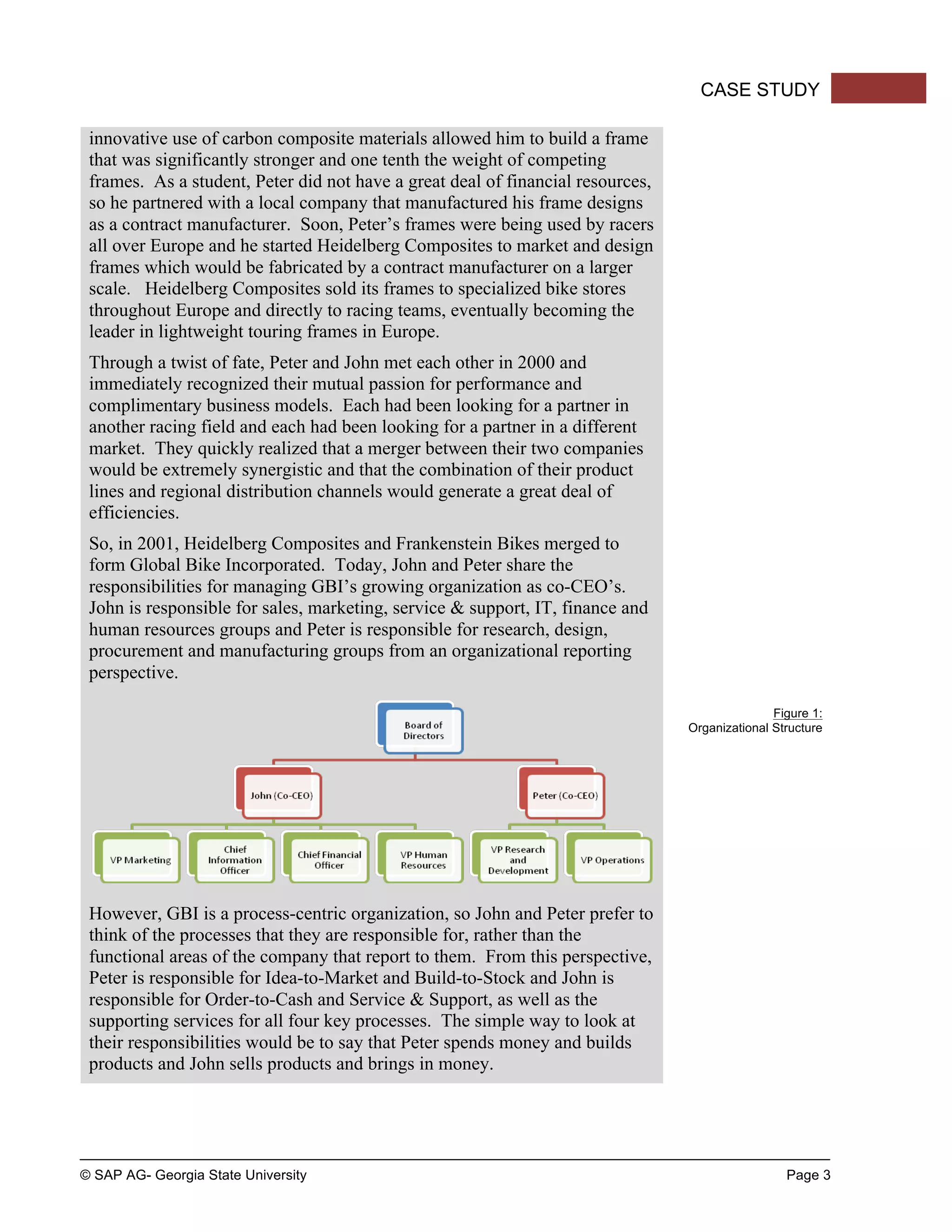
form Global Bike Incorporated. Today, John and Peter share the
responsibilities for managing GBI’s growing organization as co-CEO’s.
John is responsible for sales, marketing, service & support, IT, finance and
human resources groups and Peter is responsible for research, design,
procurement and manufacturing groups from an organizational reporting
perspective.
Figure 1:
Organizational Structure
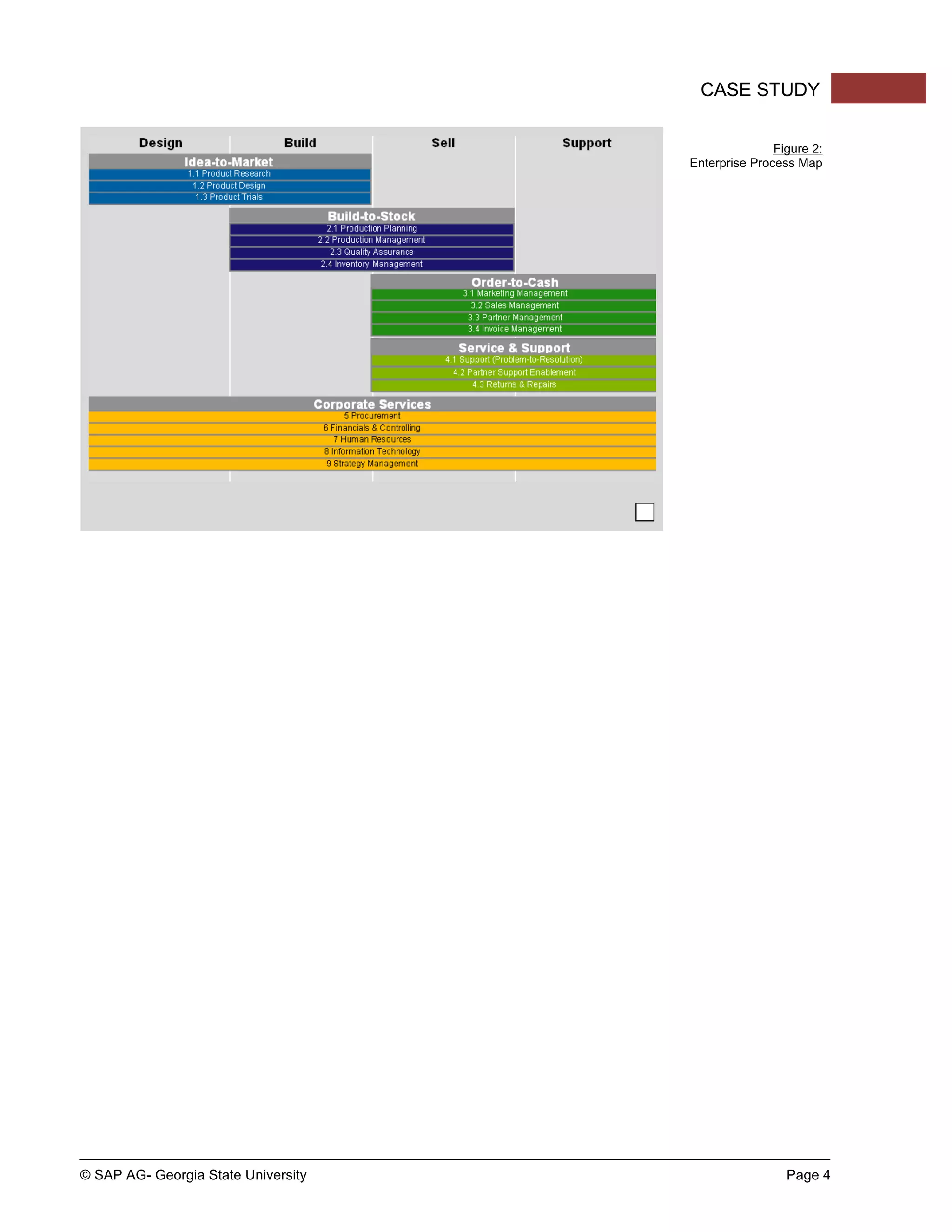
However, GBI is a process-centric organization, so John and Peter prefer to
think of the processes that they are responsible for, rather than the
functional areas of the company that report to them. From this perspective,
Peter is responsible for Idea-to-Market and Build-to-Stock and John is
responsible for Order-to-Cash and Service & Support, as well as the
supporting services for all four key processes. The simple way to look at
their responsibilities would be to say that Peter spends money and builds
products and John sells products and brings in money.
© SAP AG- Georgia State University Page 4
CASE STUDY
Figure 2:
Enterprise Process Map
© SAP AG- Georgia State University Page 5
CASE STUDY
Corporate Overview
Task Develop an organizational chart for GBI’s enterprise structure. Time 15 min
Short Description Read the below narrative to gather all relevant information for sketching
GBI’s current company structure.
Due to several tax and export issues, GBI’s headquarters is located in
Dallas and GBI is registered as a US company, following US GAAP
accounting standards. GBI operates a subsidiary company, GBI Europe,
which is based in Heidelberg and is subject to IFRS accounting standards
and German tax regulations.
Material planning, finance, administration, HR and IT functions are
consolidated at the Dallas headquarters. The Dallas facility manufactures
products for the US and export markets and its warehouse manages product
distribution for the central US and internet retailers. GBI also has
warehouses for shipping and export in both San Diego and Miami. San
Diego handles West Coast distribution and exports for Asia, while Miami
handles East Coast distribution and Latin America exports.
GBI Europe has its headquarters in Heidelberg Germany. The majority of
research and development is housed in the Heidelberg offices. Heidelberg
is also the main manufacturing facility for GBI in Europe. The Heidelberg
warehouse handles all shipping for southern Europe. The Hamburg
warehouse handles all shipping for the UK, Ireland, Middle East and
Africa. GBI sells its bikes throughout the world and employs
approximately 100 people, 2/3rds of the employees are in the US and the
remaining 1/3 in Europe.
Notes
Organizational Chart
© SAP AG- Georgia State University Page 6
CASE STUDY
Product Strategy
Task Get familiar with GBI’s product strategy. Time 15 min
Short Description Read the below narrative about GBI’s product strategy.
GBI is a world class bicycle company serving the professional and
“prosumer” cyclists for touring and off-road racing. GBI’s riders demand
the highest level of quality, toughness and performance from their bikes
and accessories.
Product development is the most critical element of GBI’s past and future
growth. GBI has invested heavily in this area, focusing on innovation,
quality, safety and speed to market. GBI has an extensive innovation
network to source ideas from riders, dealers and professionals to
continuously improve the performance, reliability and quality of its
bicycles.
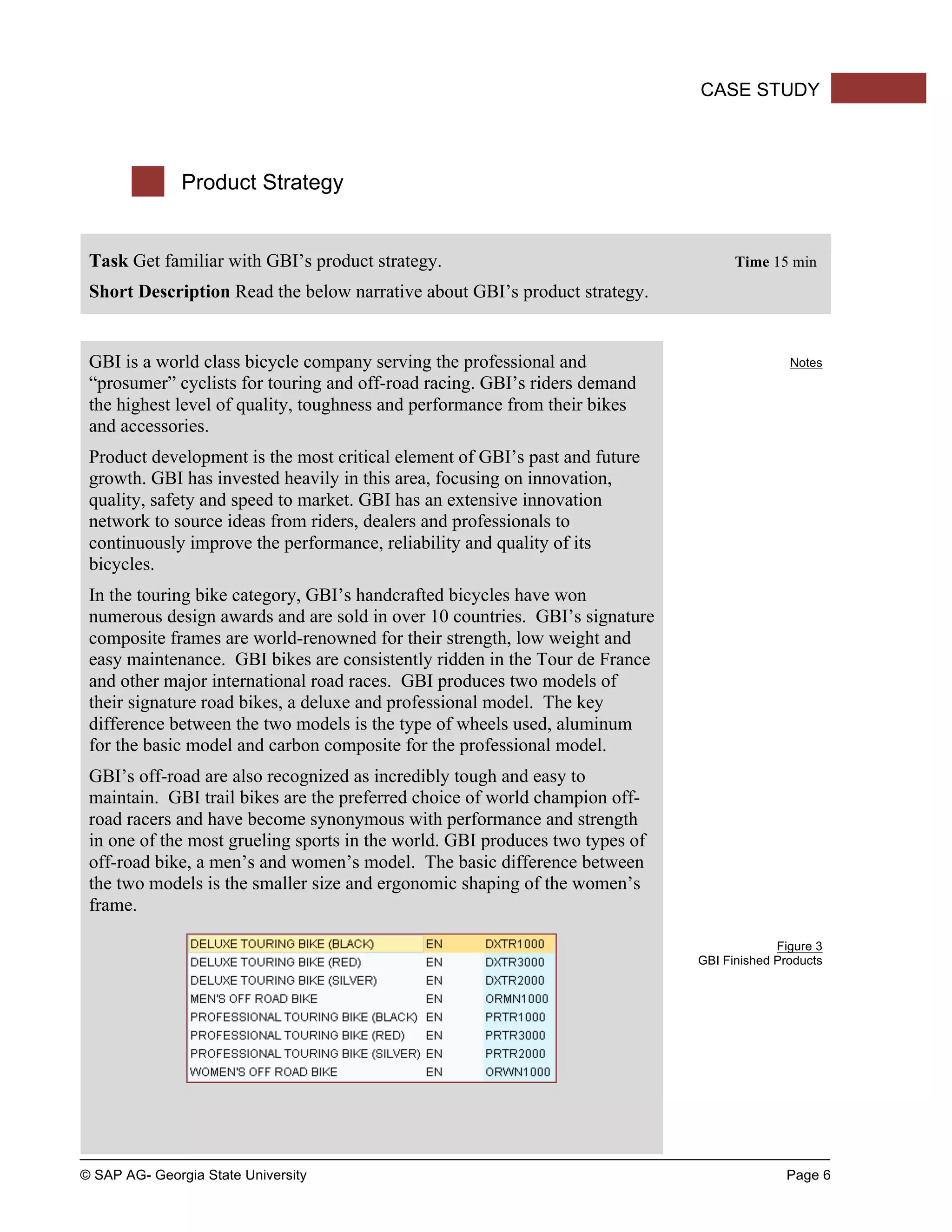
In the touring bike category, GBI’s handcrafted bicycles have won
numerous design awards and are sold in over 10 countries. GBI’s signature
composite frames are world-renowned for their strength, low weight and
easy maintenance. GBI bikes are consistently ridden in the Tour de France
and other major international road races. GBI produces two models of
their signature road bikes, a deluxe and professional model. The key
difference between the two models is the type of wheels used, aluminum
for the basic model and carbon composite for the professional model.
GBI’s off-road are also recognized as incredibly tough and easy to
maintain. GBI trail bikes are the preferred choice of world champion off-
road racers and have become synonymous with performance and strength
in one of the most grueling sports in the world. GBI produces two types of
off-road bike, a men’s and women’s model. The basic difference between
the two models is the smaller size and ergonomic shaping of the women’s
frame.
Notes
Figure 3
GBI Finished Products
© SAP AG- Georgia State University Page 7
CASE STUDY
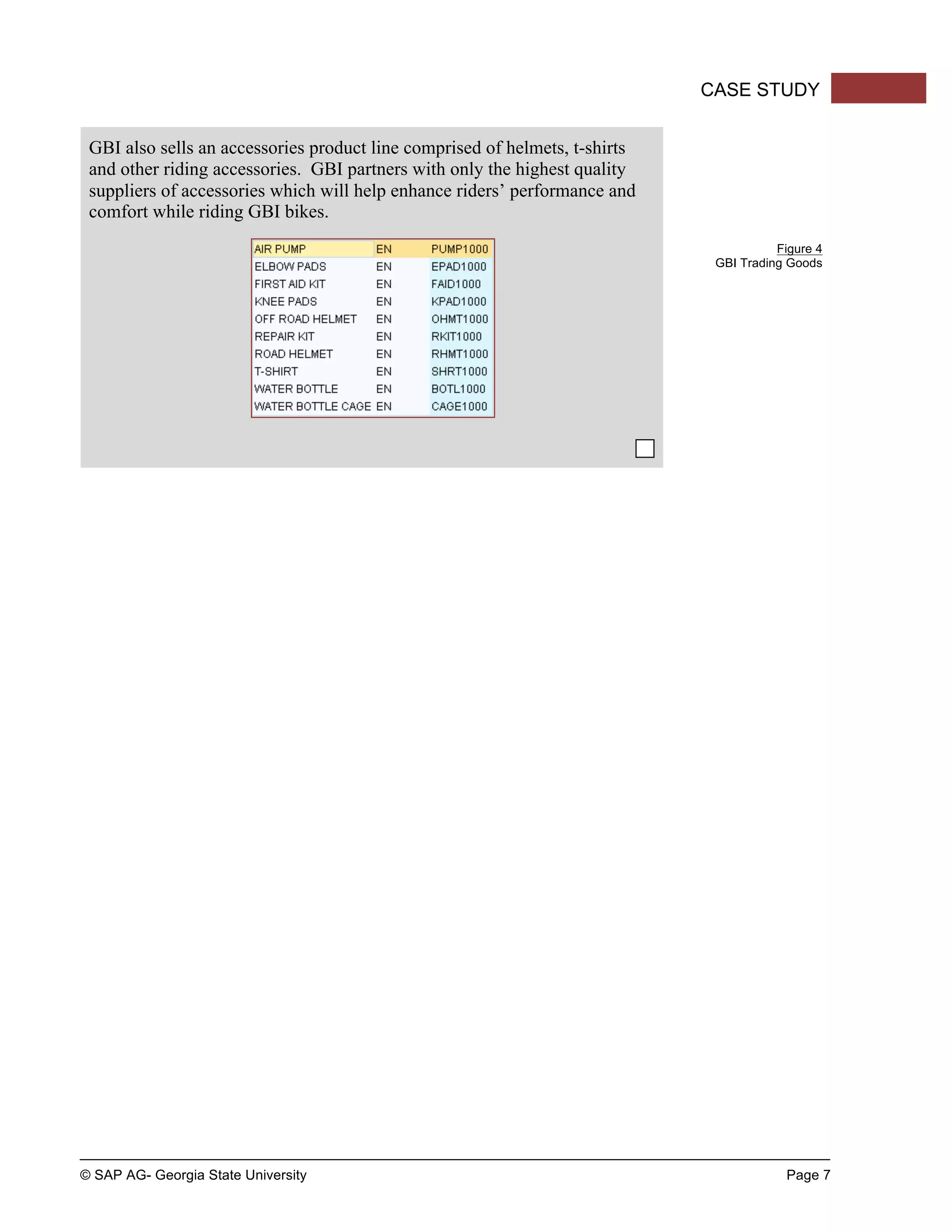
GBI also sells an accessories product line comprised of helmets, t-shirts
and other riding accessories. GBI partners with only the highest quality
suppliers of accessories which will help enhance riders’ performance and
comfort while riding GBI bikes.
Figure 4
GBI Trading Goods
© SAP AG- Georgia State University Page 8
CASE STUDY
Manufacturing Strategy
Task Get familiar with GBI’s manufacturing strategy. Time 10 min
Short Description Read the below narrative about GBI’s manufacturing strategy.
GBI operates two production facilities, Dallas and Heidelberg. Each
facility has three assembly lines and can produce around 1000 bikes per
year. Total production capacity is roughly 6000 bikes per year, but can be
increased by 15%-20% by using overtime hours and part-time workers.
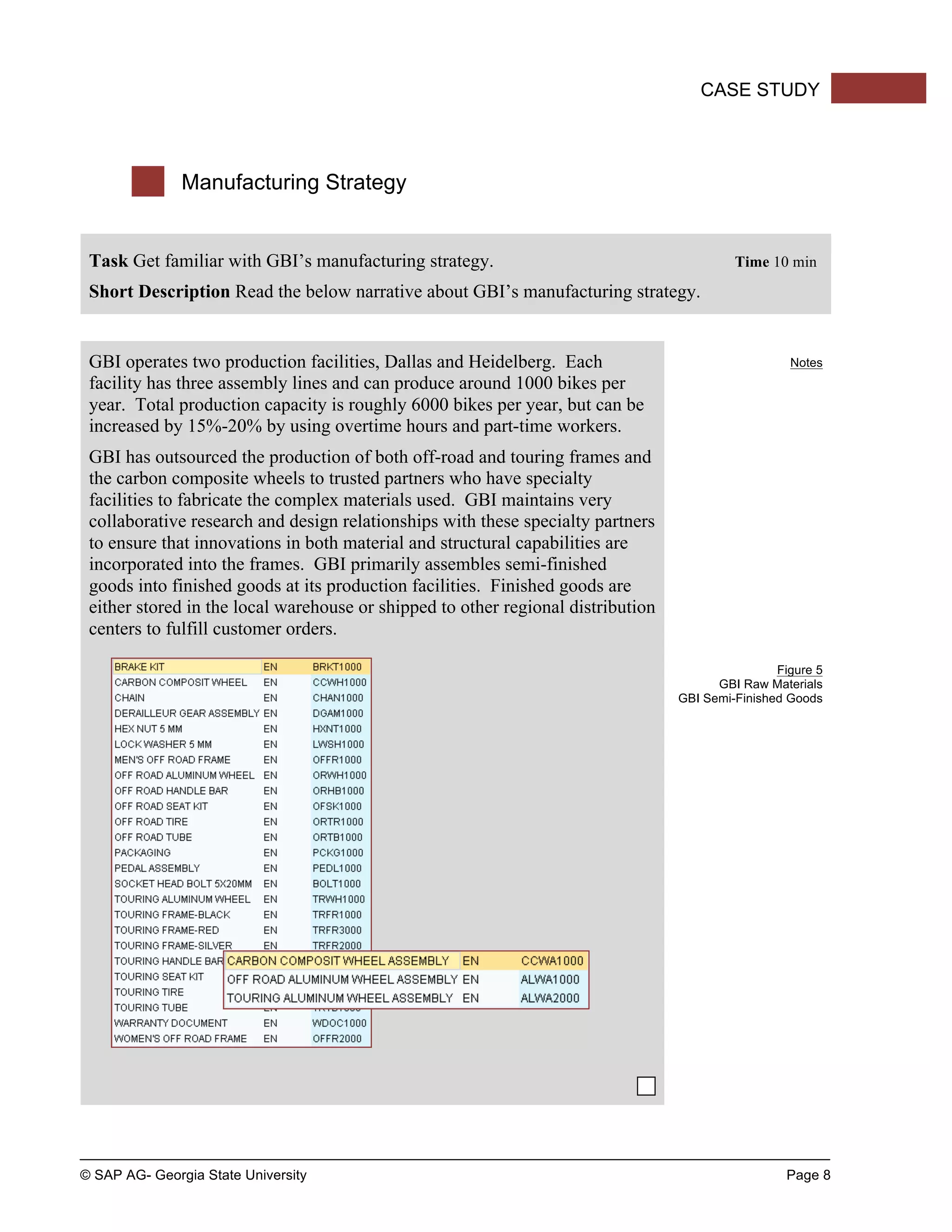
GBI has outsourced the production of both off-road and touring frames and
the carbon composite wheels to trusted partners who have specialty
facilities to fabricate the complex materials used. GBI maintains very
collaborative research and design relationships with these specialty partners
to ensure that innovations in both material and structural capabilities are
incorporated into the frames. GBI primarily assembles semi-finished
goods into finished goods at its production facilities. Finished goods are
either stored in the local warehouse or shipped to other regional distribution
centers to fulfill customer orders.
Notes
Figure 5
GBI Raw Materials
GBI Semi-Finished Goods
© SAP AG- Georgia State University Page 9
CASE STUDY
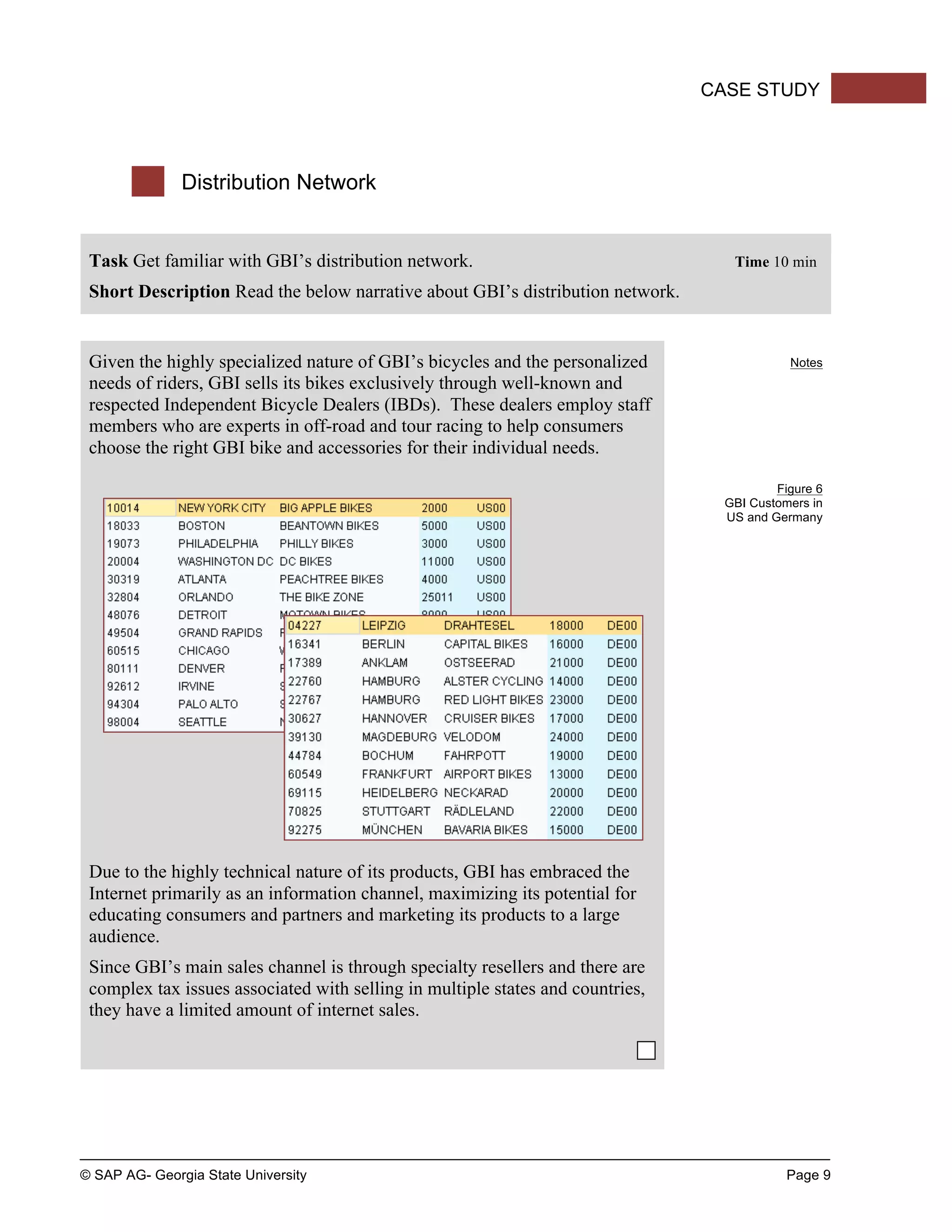
Distribution Network
Task Get familiar with GBI’s distribution network. Time 10 min
Short Description Read the below narrative about GBI’s distribution network.
Given the highly specialized nature of GBI’s bicycles and the personalized
needs of riders, GBI sells its bikes exclusively through well-known and
respected Independent Bicycle Dealers (IBDs). These dealers employ staff
members who are experts in off-road and tour racing to help consumers
choose the right GBI bike and accessories for their individual needs.
Notes
Figure 6
GBI Customers in
US and Germany
Due to the highly technical nature of its products, GBI has embraced the
Internet primarily as an information channel, maximizing its potential for
educating consumers and partners and marketing its products to a large
audience.
Since GBI’s main sales channel is through specialty resellers and there are
complex tax issues associated with selling in multiple states and countries,
they have a limited amount of internet sales.
© SAP AG- Georgia State University Page 10
CASE STUDY
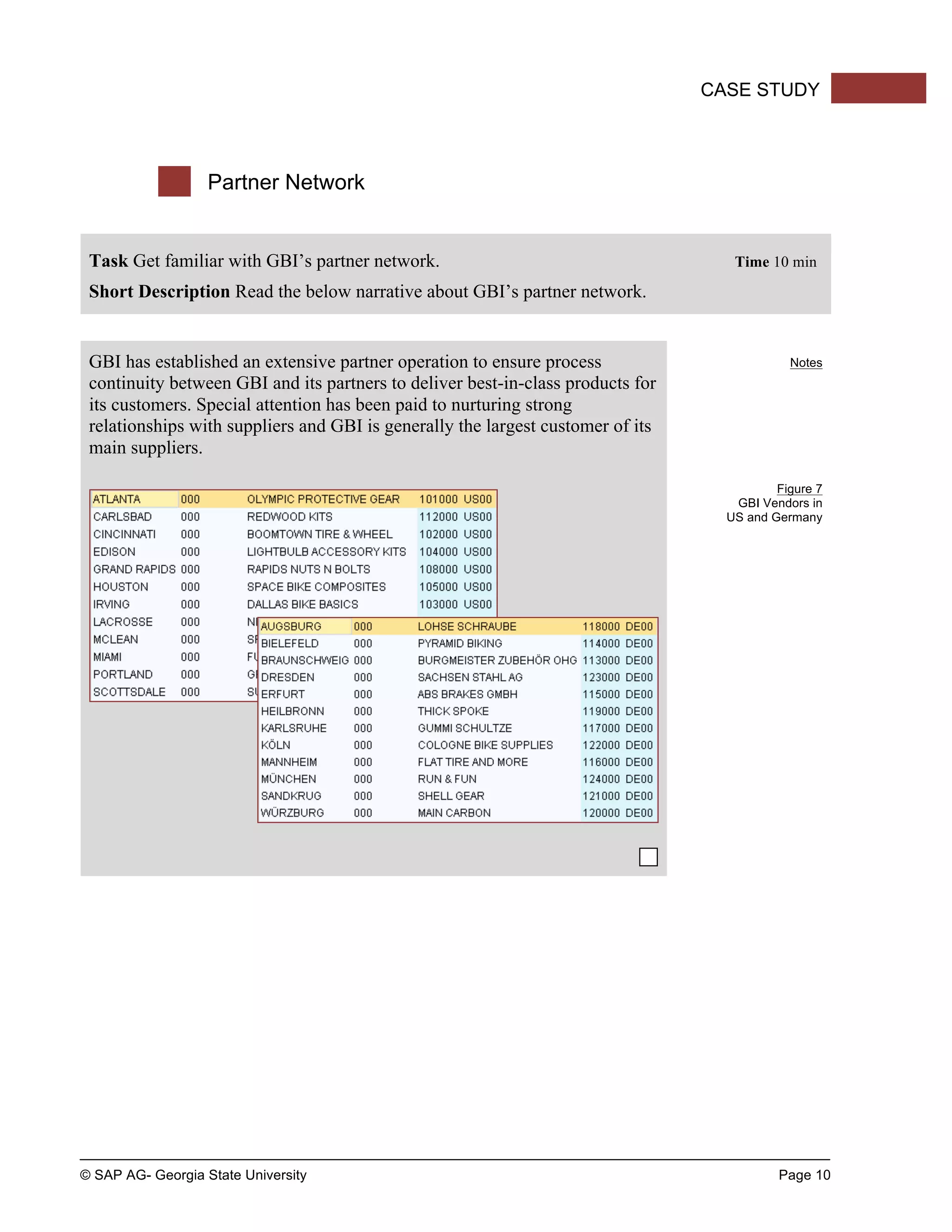
Partner Network
Task Get familiar with GBI’s partner network. Time 10 min
Short Description Read the below narrative about GBI’s partner network.
GBI has established an extensive partner operation to ensure process
continuity between GBI and its partners to deliver best-in-class products for
its customers. Special attention has been paid to nurturing strong
relationships with suppliers and GBI is generally the largest customer of its
main suppliers.
Notes
Figure 7
GBI Vendors in
US and Germany
© SAP AG- Georgia State University Page 11
CASE STUDY
IT Strategy
Task Get familiar with GBI’s IT strategy. Time 5 min
Short Description Read the below narrative about GBI’s information technology stratey.
During 2009, GBI integrated a shared services model for all IT functions,
located in the Dallas office. Along with this move to centralized IT, GBI
also implemented SAP ERP (version 6.0). Prior to this, divisions were
running multiple, independent application environments. All ERP functions
are centralized with the primary objectives to reduce costs and deliver best-
in-class technology to all divisions globally. This centralized approach
offers GBI an advanced business platform under a highly controlled
environment, which enables consistency of operations and process integrity
across the globe.
Notes

GBI Strategy & Operations Overview

  • 1.
    © SAP AG-Georgia State University CASE STUDY   Product SAP ERP G.B.I. Release 6.07 Level Beginner Focus Company Background Authors Simha Magal Stefan Weidner Jeff Word Version 2.20 Last Update July 2014   MOTIVATION A general understanding of GBI (the enterprise) prior to embarking on hands-on exercises and case studies in the SAP ERP client is critical for success. This narrative provides a historical background for how GBI began and an overview of its operations and strategy. This information will be used extensively throughout the curriculum material. NOTES The Global Bike Inc. (G.B.I.) data set has exclusively been created for SAP UA global curricula.   Global Bike Inc. Background and overview of GBI strategy and operations.  
  • 2.
    © SAP AG-Georgia State University Page 2 CASE STUDY Company History Task Get to know the company’s history. Time 15 min Short Description Read the below narrative to learn about the company’s history. Global Bike Inc. has a pragmatic design philosophy that comes from its deep roots in both the off-road trail racing and long-distance road racing sports. Nearly 20 years ago, its founders designed their first bikes out of necessity—they had races to win and the bikes that were available at the time did not perform to their extremely high standards. So, they took matters into their own hands and built legendary bikes that would outlast and outperform the competition. From these humble origins, Global Bike Incorporated was born and continues to deliver innovative high- performance bicycles to the world’s most demanding riders. This heritage of entrepreneurial spirit and quest for design perfection is still the cornerstone of GBI’s corporate philosophy. GBI produces bikes for the most demanding competitors—whether the competition is on pavement or dirt, for money, fame or just bragging rights. John Davis earned his racing scars in the mountain racing circuit in America, where he won numerous downhill and cross-country championships. Early on, John realized that the mass-produced bicycles available were inadequate in many ways for the type of racing he was doing. So, John stripped four of his old bikes down to the bare metal and rebuilt them into a single “Frankenstein” bike that he rode to win the national championship. Once news of his Frankenstein bike got out, John’s friends and even his competitors began asking him to build them a Frankenstein bike too. While recovering from an injury in 1990, John started producing the first series of Frankenstein bikes in his garage—each one custom-built from cannibalized parts from other bikes. As more and more orders came in, John successfully expanded Frankenstein Bikes from his garage operations into a full-blown manufacturing facility in Dallas and began producing custom trail bikes which he sold through a network of specialized bike dealers throughout the country. At nearly the same time, halfway around the world in Heidelberg, Germany, Peter Schwarz was studying engineering and competing in regional touring races on weekends. In between his races and studies, Peter worked at a bike shop in Heidelberg, fixing student bikes and tuning the touring bikes that he and his friends rode for competitions. As Peter’s reputation as a fierce competitor and mechanical wizard grew, he also began to design and build road bikes based on an ultra-light composite frame that he had created for one of his engineering courses. Peter’s Notes
  • 3.
    © SAP AG-Georgia State University Page 3 CASE STUDY innovative use of carbon composite materials allowed him to build a frame that was significantly stronger and one tenth the weight of competing frames. As a student, Peter did not have a great deal of financial resources, so he partnered with a local company that manufactured his frame designs as a contract manufacturer. Soon, Peter’s frames were being used by racers all over Europe and he started Heidelberg Composites to market and design frames which would be fabricated by a contract manufacturer on a larger scale. Heidelberg Composites sold its frames to specialized bike stores throughout Europe and directly to racing teams, eventually becoming the leader in lightweight touring frames in Europe. Through a twist of fate, Peter and John met each other in 2000 and immediately recognized their mutual passion for performance and complimentary business models. Each had been looking for a partner in another racing field and each had been looking for a partner in a different market. They quickly realized that a merger between their two companies would be extremely synergistic and that the combination of their product lines and regional distribution channels would generate a great deal of efficiencies. So, in 2001, Heidelberg Composites and Frankenstein Bikes merged to form Global Bike Incorporated. Today, John and Peter share the responsibilities for managing GBI’s growing organization as co-CEO’s. John is responsible for sales, marketing, service & support, IT, finance and human resources groups and Peter is responsible for research, design, procurement and manufacturing groups from an organizational reporting perspective. Figure 1: Organizational Structure However, GBI is a process-centric organization, so John and Peter prefer to think of the processes that they are responsible for, rather than the functional areas of the company that report to them. From this perspective, Peter is responsible for Idea-to-Market and Build-to-Stock and John is responsible for Order-to-Cash and Service & Support, as well as the supporting services for all four key processes. The simple way to look at their responsibilities would be to say that Peter spends money and builds products and John sells products and brings in money.
  • 4.
    © SAP AG-Georgia State University Page 4 CASE STUDY Figure 2: Enterprise Process Map
  • 5.
    © SAP AG-Georgia State University Page 5 CASE STUDY Corporate Overview Task Develop an organizational chart for GBI’s enterprise structure. Time 15 min Short Description Read the below narrative to gather all relevant information for sketching GBI’s current company structure. Due to several tax and export issues, GBI’s headquarters is located in Dallas and GBI is registered as a US company, following US GAAP accounting standards. GBI operates a subsidiary company, GBI Europe, which is based in Heidelberg and is subject to IFRS accounting standards and German tax regulations. Material planning, finance, administration, HR and IT functions are consolidated at the Dallas headquarters. The Dallas facility manufactures products for the US and export markets and its warehouse manages product distribution for the central US and internet retailers. GBI also has warehouses for shipping and export in both San Diego and Miami. San Diego handles West Coast distribution and exports for Asia, while Miami handles East Coast distribution and Latin America exports. GBI Europe has its headquarters in Heidelberg Germany. The majority of research and development is housed in the Heidelberg offices. Heidelberg is also the main manufacturing facility for GBI in Europe. The Heidelberg warehouse handles all shipping for southern Europe. The Hamburg warehouse handles all shipping for the UK, Ireland, Middle East and Africa. GBI sells its bikes throughout the world and employs approximately 100 people, 2/3rds of the employees are in the US and the remaining 1/3 in Europe. Notes Organizational Chart
  • 6.
    © SAP AG-Georgia State University Page 6 CASE STUDY Product Strategy Task Get familiar with GBI’s product strategy. Time 15 min Short Description Read the below narrative about GBI’s product strategy. GBI is a world class bicycle company serving the professional and “prosumer” cyclists for touring and off-road racing. GBI’s riders demand the highest level of quality, toughness and performance from their bikes and accessories. Product development is the most critical element of GBI’s past and future growth. GBI has invested heavily in this area, focusing on innovation, quality, safety and speed to market. GBI has an extensive innovation network to source ideas from riders, dealers and professionals to continuously improve the performance, reliability and quality of its bicycles. In the touring bike category, GBI’s handcrafted bicycles have won numerous design awards and are sold in over 10 countries. GBI’s signature composite frames are world-renowned for their strength, low weight and easy maintenance. GBI bikes are consistently ridden in the Tour de France and other major international road races. GBI produces two models of their signature road bikes, a deluxe and professional model. The key difference between the two models is the type of wheels used, aluminum for the basic model and carbon composite for the professional model. GBI’s off-road are also recognized as incredibly tough and easy to maintain. GBI trail bikes are the preferred choice of world champion off- road racers and have become synonymous with performance and strength in one of the most grueling sports in the world. GBI produces two types of off-road bike, a men’s and women’s model. The basic difference between the two models is the smaller size and ergonomic shaping of the women’s frame. Notes Figure 3 GBI Finished Products
  • 7.
    © SAP AG-Georgia State University Page 7 CASE STUDY GBI also sells an accessories product line comprised of helmets, t-shirts and other riding accessories. GBI partners with only the highest quality suppliers of accessories which will help enhance riders’ performance and comfort while riding GBI bikes. Figure 4 GBI Trading Goods
  • 8.
    © SAP AG-Georgia State University Page 8 CASE STUDY Manufacturing Strategy Task Get familiar with GBI’s manufacturing strategy. Time 10 min Short Description Read the below narrative about GBI’s manufacturing strategy. GBI operates two production facilities, Dallas and Heidelberg. Each facility has three assembly lines and can produce around 1000 bikes per year. Total production capacity is roughly 6000 bikes per year, but can be increased by 15%-20% by using overtime hours and part-time workers. GBI has outsourced the production of both off-road and touring frames and the carbon composite wheels to trusted partners who have specialty facilities to fabricate the complex materials used. GBI maintains very collaborative research and design relationships with these specialty partners to ensure that innovations in both material and structural capabilities are incorporated into the frames. GBI primarily assembles semi-finished goods into finished goods at its production facilities. Finished goods are either stored in the local warehouse or shipped to other regional distribution centers to fulfill customer orders. Notes Figure 5 GBI Raw Materials GBI Semi-Finished Goods
  • 9.
    © SAP AG-Georgia State University Page 9 CASE STUDY Distribution Network Task Get familiar with GBI’s distribution network. Time 10 min Short Description Read the below narrative about GBI’s distribution network. Given the highly specialized nature of GBI’s bicycles and the personalized needs of riders, GBI sells its bikes exclusively through well-known and respected Independent Bicycle Dealers (IBDs). These dealers employ staff members who are experts in off-road and tour racing to help consumers choose the right GBI bike and accessories for their individual needs. Notes Figure 6 GBI Customers in US and Germany Due to the highly technical nature of its products, GBI has embraced the Internet primarily as an information channel, maximizing its potential for educating consumers and partners and marketing its products to a large audience. Since GBI’s main sales channel is through specialty resellers and there are complex tax issues associated with selling in multiple states and countries, they have a limited amount of internet sales.
  • 10.
    © SAP AG-Georgia State University Page 10 CASE STUDY Partner Network Task Get familiar with GBI’s partner network. Time 10 min Short Description Read the below narrative about GBI’s partner network. GBI has established an extensive partner operation to ensure process continuity between GBI and its partners to deliver best-in-class products for its customers. Special attention has been paid to nurturing strong relationships with suppliers and GBI is generally the largest customer of its main suppliers. Notes Figure 7 GBI Vendors in US and Germany
  • 11.
    © SAP AG-Georgia State University Page 11 CASE STUDY IT Strategy Task Get familiar with GBI’s IT strategy. Time 5 min Short Description Read the below narrative about GBI’s information technology stratey. During 2009, GBI integrated a shared services model for all IT functions, located in the Dallas office. Along with this move to centralized IT, GBI also implemented SAP ERP (version 6.0). Prior to this, divisions were running multiple, independent application environments. All ERP functions are centralized with the primary objectives to reduce costs and deliver best- in-class technology to all divisions globally. This centralized approach offers GBI an advanced business platform under a highly controlled environment, which enables consistency of operations and process integrity across the globe. Notes