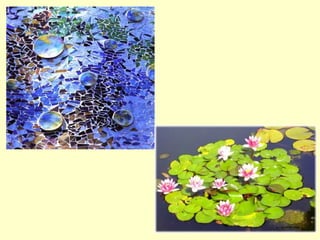
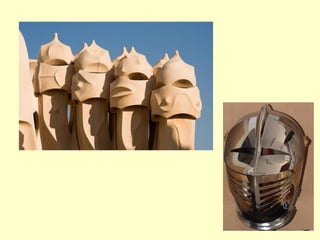
The ”trencadís” (‘broken')


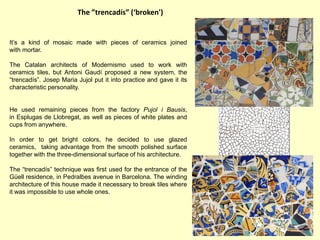
It’s a kind of mosaic made with pieces of ceramics joined
with mortar.

The Catalan architects of Modernismo used to work with
ceramics tiles, but Antoni Gaudí proposed a new system, the
“trencadís”. Josep Maria Jujol put it into practice and gave it its
characteristic personality.


He used remaining pieces from the factory Pujol i Bausis,
in Esplugas de Llobregat, as well as pieces of white plates and
cups from anywhere.

In order to get bright colors, he decided to use glazed
ceramics, taking advantage from the smooth polished surface
together with the three-dimensional surface of his architecture.

The “trencadís” technique was first used for the entrance of the
Güell residence, in Pedralbes avenue in Barcelona. The winding
architecture of this house made it necessary to break tiles where
it was impossible to use whole ones.
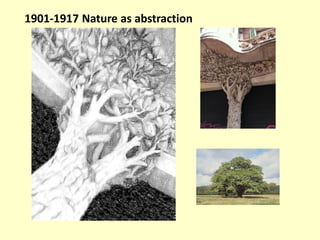
1901-1917 Nature as abstraction
Initially inspired in the baroque, this period was characterized by not
                  only the most lively Modernismo but also the least related to previous
                  architectural styles.

                  This vision can be seen in many of Gaudí’s works since the beginning of
                  the 20thC and it represents an evolution from his earlier learning of
Characteristics
                  gothic architecture.

                  Period of big expressiveness (like in the Nativity facade of La Sagrada
                  Família.

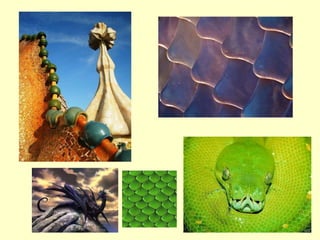
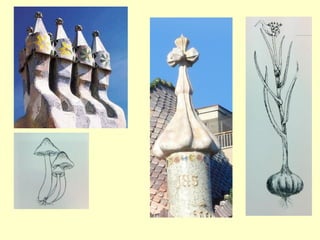
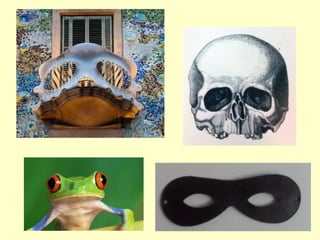
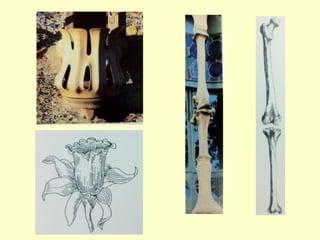
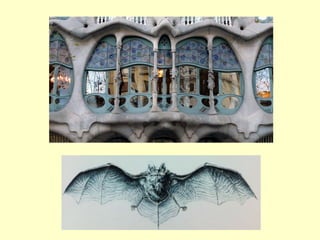
                  Gaudinian morphology : Abstraction of common shapes of nature.
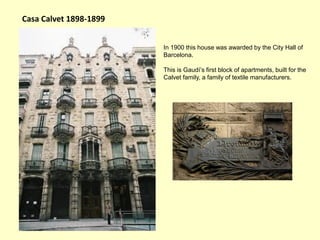
Casa Calvet 1898-1899


                        In 1900 this house was awarded by the City Hall of
                        Barcelona.

                        This is Gaudí’s first block of apartments, built for the
                        Calvet family, a family of textile manufacturers.
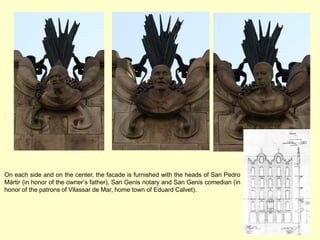
On each side and on the center, the facade is furnished with the heads of San Pedro
Mártir (in honor of the owner’s father), San Genis notary and San Genis comedian (in
honor of the patrons of Vilassar de Mar, home town of Eduard Calvet).
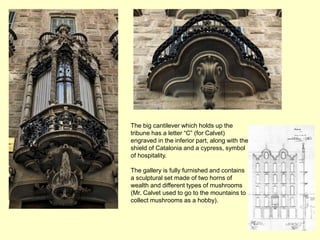
The big cantilever which holds up the
tribune has a letter “C” (for Calvet)
engraved in the inferior part, along with the
shield of Catalonia and a cypress, symbol
of hospitality.

The gallery is fully furnished and contains
a sculptural set made of two horns of
wealth and different types of mushrooms
(Mr. Calvet used to go to the mountains to
collect mushrooms as a hobby).
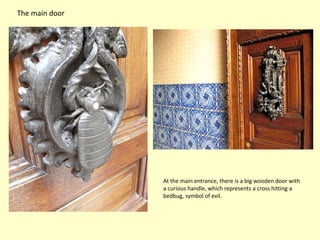
The main door


                At the main entrance, there is a big wooden door with
                a curious handle, which represents a cross hitting a
                bedbug, symbol of evil.
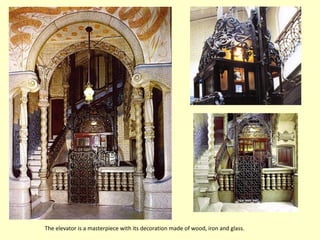
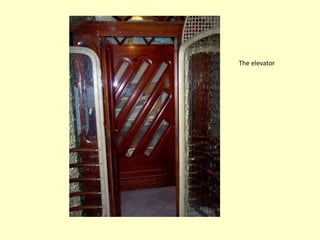
The elevator is a masterpiece with its decoration made of wood, iron and glass.
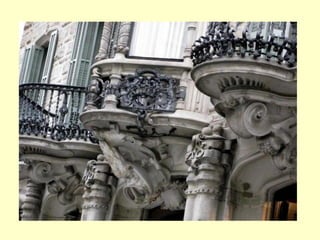
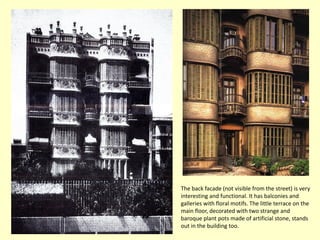
The back facade (not visible from the street) is very
interesting and functional. It has balconies and
galleries with floral motifs. The little terrace on the
main floor, decorated with two strange and
baroque plant pots made of artificial stone, stands
out in the building too.
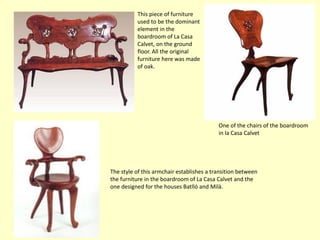
This piece of furniture
          used to be the dominant
          element in the
          boardroom of La Casa
          Calvet, on the ground
          floor. All the original
          furniture here was made
          of oak.


                                           One of the chairs of the boardroom
                                           in la Casa Calvet


The style of this armchair establishes a transition between
the furniture in the boardroom of La Casa Calvet and the
one designed for the houses Batlló and Milà.
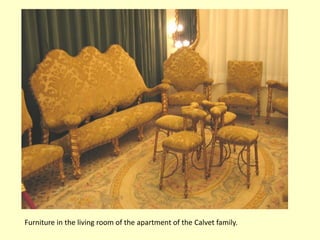
Furniture in the living room of the apartment of the Calvet family.
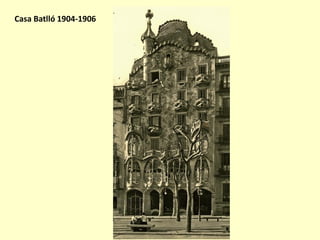
Casa Batlló 1904-1906
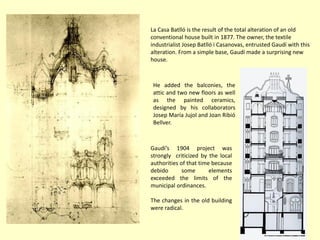
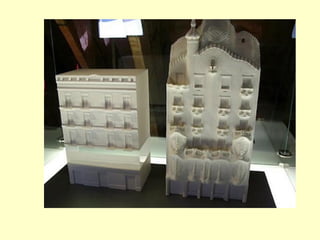
La Casa Batlló is the result of the total alteration of an old
conventional house built in 1877. The owner, the textile
industrialist Josep Batlló i Casanovas, entrusted Gaudí with this
alteration. From a simple base, Gaudí made a surprising new
house.


 He added the balconies, the
 attic and two new floors as well
 as the painted ceramics,
 designed by his collaborators
 Josep María Jujol and Joan Ribió
 Bellver.


Gaudí’s 1904 project was
strongly criticized by the local
authorities of that time because
debido       some       elements
exceeded the limits of the
municipal ordinances.

The changes in the old building
were radical.
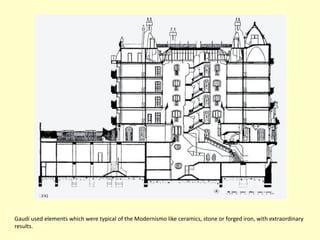
Gaudí used elements which were typical of the Modernismo like ceramics, stone or forged iron, with extraordinary
results.
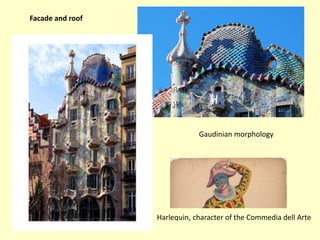
Facade and roof


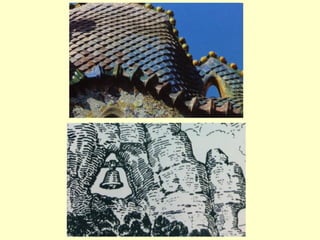
                              Gaudinian morphology


                  Harlequin, character of the Commedia dell Arte
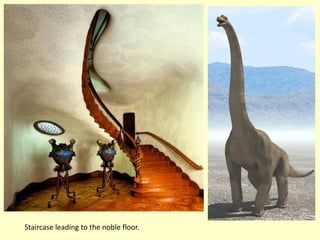
Staircase leading to the noble floor.
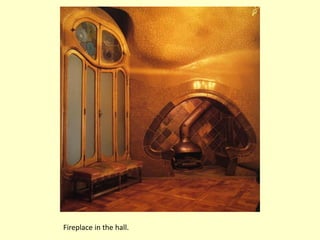
Fireplace in the hall.
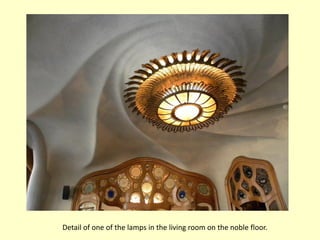
Detail of one of the lamps in the living room on the noble floor.
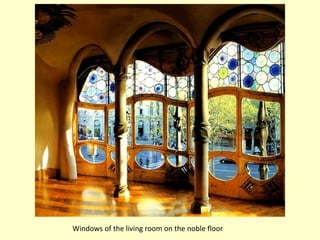
Windows of the living room on the noble floor
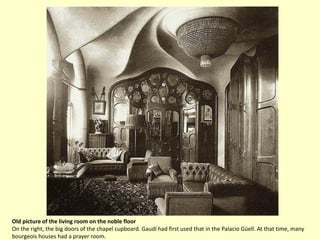
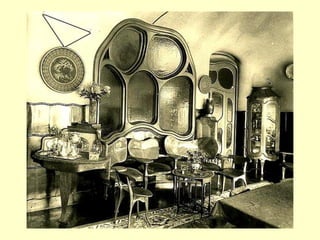
Old picture of the living room on the noble floor
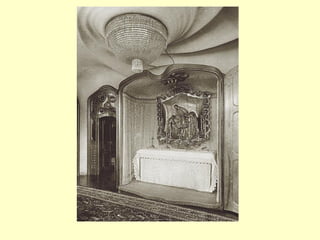
On the right, the big doors of the chapel cupboard. Gaudí had first used that in the Palacio Güell. At that time, many
bourgeois houses had a prayer room.
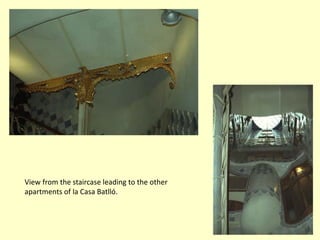
View from the staircase leading to the other
apartments of la Casa Batlló.
The elevator
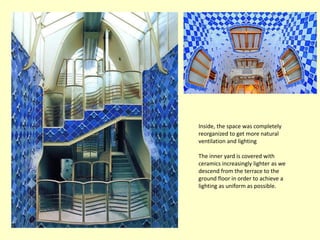
Inside, the space was completely
reorganized to get more natural
ventilation and lighting

The inner yard is covered with
ceramics increasingly lighter as we
descend from the terrace to the
ground floor in order to achieve a
lighting as uniform as possible.
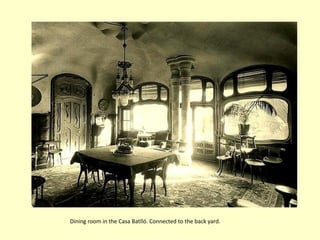
Dining room in the Casa Batlló. Connected to the back yard.
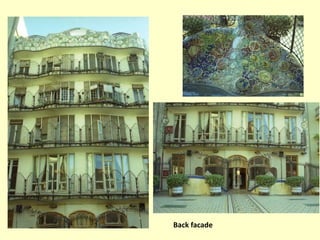
Back facade
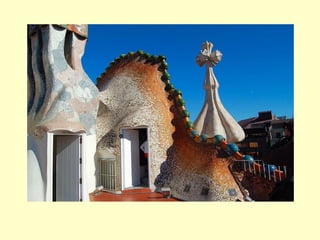
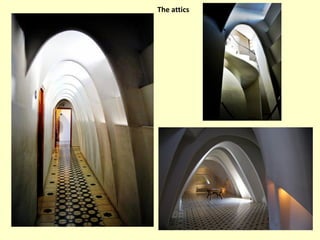
The attics
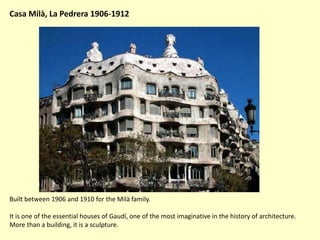
Casa Milà, La Pedrera 1906-1912


Built between 1906 and 1910 for the Milà family.

It is one of the essential houses of Gaudí, one of the most imaginative in the history of architecture.
More than a building, it is a sculpture.
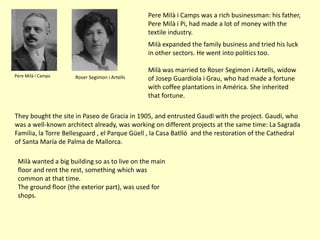
Pere Milà i Camps was a rich businessman: his father,
                                               Pere Milà i Pi, had made a lot of money with the
                                               textile industry.
                                               Milà expanded the family business and tried his luck
                                               in other sectors. He went into politics too.

                                               Milà was married to Roser Segimon i Artells, widow
Pere Milà i Camps    Roser Segimon i Artells   of Josep Guardiola i Grau, who had made a fortune
                                               with coffee plantations in América. She inherited
                                               that fortune.

They bought the site in Paseo de Gracia in 1905, and entrusted Gaudí with the project. Gaudí, who
was a well-known architect already, was working on different projects at the same time: La Sagrada
Familia, la Torre Bellesguard , el Parque Güell , la Casa Batlló and the restoration of the Cathedral
of Santa María de Palma de Mallorca.

 Milà wanted a big building so as to live on the main
 floor and rent the rest, something which was
 common at that time.
 The ground floor (the exterior part), was used for
 shops.
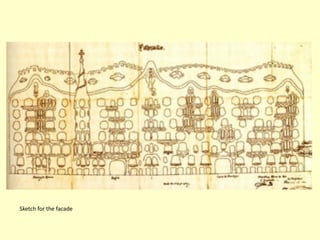
Sketch for the facade
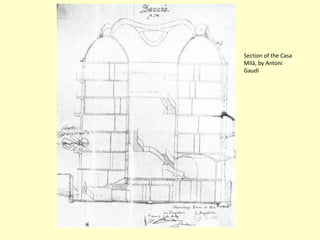
Section of the Casa
Milà, by Antoni
Gaudí
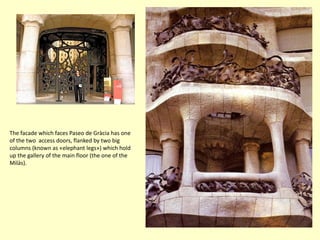
The facade which faces Paseo de Gràcia has one
of the two access doors, flanked by two big
columns (known as «elephant legs») which hold
up the gallery of the main floor (the one of the
Milàs).
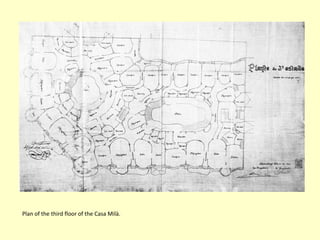
Plan of the third floor of the Casa Milà.
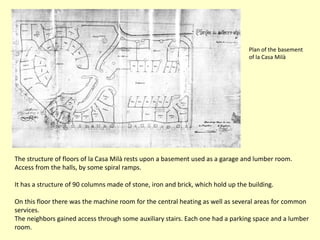
Plan of the basement
                                                                                  of la Casa Milà


The structure of floors of la Casa Milà rests upon a basement used as a garage and lumber room.
Access from the halls, by some spiral ramps.

It has a structure of 90 columns made of stone, iron and brick, which hold up the building.

On this floor there was the machine room for the central heating as well as several areas for common
services.
The neighbors gained access through some auxiliary stairs. Each one had a parking space and a lumber
room.
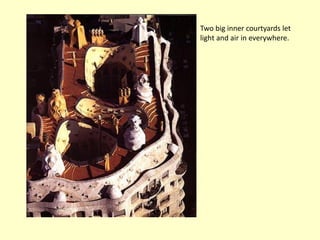
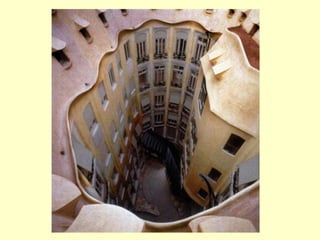
Two big inner courtyards let
light and air in everywhere.
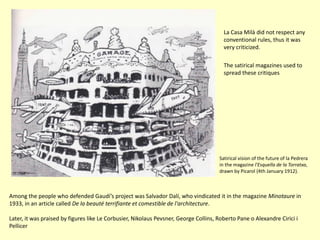
La Casa Milà did not respect any
                                                                                        conventional rules, thus it was
                                                                                        very criticized.

                                                                                        The satirical magazines used to
                                                                                        spread these critiques


                                                                                      Satirical vision of the future of la Pedrera
                                                                                      in the magazine l'Esquella de la Torratxa,
                                                                                      drawn by Picarol (4th January 1912).


Among the people who defended Gaudí’s project was Salvador Dalí, who vindicated it in the magazine Minotaure in
1933, in an article called De la beauté terrifiante et comestible de l'architecture.

Later, it was praised by figures like Le Corbusier, Nikolaus Pevsner, George Collins, Roberto Pane o Alexandre Cirici i
Pellicer
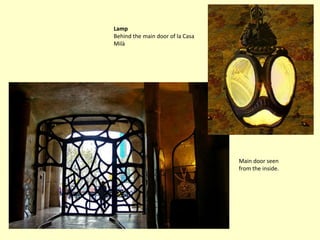
Lamp
Behind the main door of la Casa
Milà


                                  Main door seen
                                  from the inside.
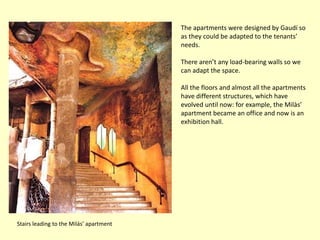
The apartments were designed by Gaudí so
                                         as they could be adapted to the tenants’
                                         needs.

                                         There aren’t any load-bearing walls so we
                                         can adapt the space.

                                         All the floors and almost all the apartments
                                         have different structures, which have
                                         evolved until now: for example, the Milàs’
                                         apartment became an office and now is an
                                         exhibition hall.


Stairs leading to the Milás’ apartment
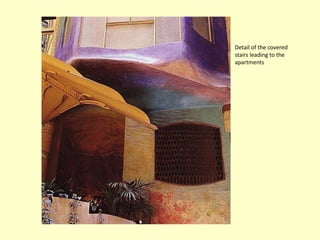
Detail of the covered
stairs leading to the
apartments
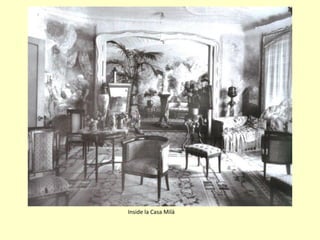
Inside la Casa Milà
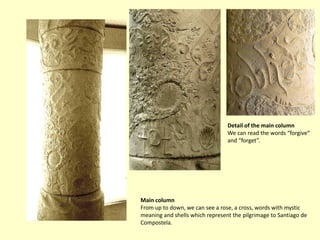
Detail of the main column
                                 We can read the words “forgive“
                                 and “forget”.


Main column
From up to down, we can see a rose, a cross, words with mystic
meaning and shells which represent the pilgrimage to Santiago de
Compostela.
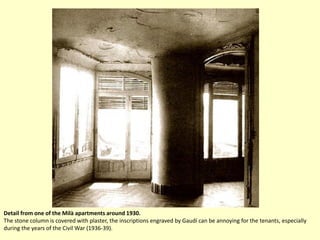
Detail from one of the Milà apartments around 1930.
The stone column is covered with plaster, the inscriptions engraved by Gaudí can be annoying for the tenants, especially
during the years of the Civil War (1936-39).
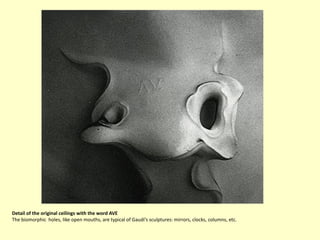
Detail of the original ceilings with the word AVE
The biomorphic holes, like open mouths, are typical of Gaudí’s sculptures: mirrors, clocks, columns, etc.
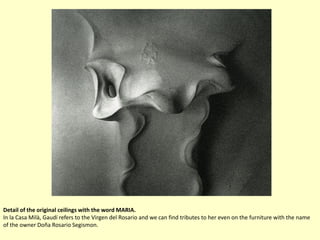
Detail of the original ceilings with the word MARIA.
In la Casa Milà, Gaudí refers to the Virgen del Rosario and we can find tributes to her even on the furniture with the name
of the owner Doña Rosario Segismon.
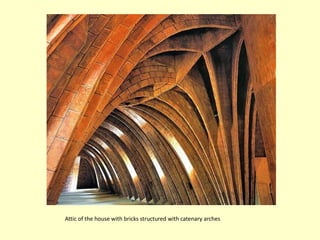
Attic of the house with bricks structured with catenary arches

Gaudí 2 english

  • 1.
    The ”trencadís” (‘broken') It’sa kind of mosaic made with pieces of ceramics joined with mortar. The Catalan architects of Modernismo used to work with ceramics tiles, but Antoni Gaudí proposed a new system, the “trencadís”. Josep Maria Jujol put it into practice and gave it its characteristic personality. He used remaining pieces from the factory Pujol i Bausis, in Esplugas de Llobregat, as well as pieces of white plates and cups from anywhere. In order to get bright colors, he decided to use glazed ceramics, taking advantage from the smooth polished surface together with the three-dimensional surface of his architecture. The “trencadís” technique was first used for the entrance of the Güell residence, in Pedralbes avenue in Barcelona. The winding architecture of this house made it necessary to break tiles where it was impossible to use whole ones.
  • 2.
  • 3.
    Initially inspired inthe baroque, this period was characterized by not only the most lively Modernismo but also the least related to previous architectural styles. This vision can be seen in many of Gaudí’s works since the beginning of the 20thC and it represents an evolution from his earlier learning of Characteristics gothic architecture. Period of big expressiveness (like in the Nativity facade of La Sagrada Família. Gaudinian morphology : Abstraction of common shapes of nature.
  • 4.
    Casa Calvet 1898-1899 In 1900 this house was awarded by the City Hall of Barcelona. This is Gaudí’s first block of apartments, built for the Calvet family, a family of textile manufacturers.
  • 5.
    On each sideand on the center, the facade is furnished with the heads of San Pedro Mártir (in honor of the owner’s father), San Genis notary and San Genis comedian (in honor of the patrons of Vilassar de Mar, home town of Eduard Calvet).
  • 6.
    The big cantileverwhich holds up the tribune has a letter “C” (for Calvet) engraved in the inferior part, along with the shield of Catalonia and a cypress, symbol of hospitality. The gallery is fully furnished and contains a sculptural set made of two horns of wealth and different types of mushrooms (Mr. Calvet used to go to the mountains to collect mushrooms as a hobby).
  • 8.
    The main door At the main entrance, there is a big wooden door with a curious handle, which represents a cross hitting a bedbug, symbol of evil.
  • 9.
    The elevator isa masterpiece with its decoration made of wood, iron and glass.
  • 10.
    The back facade(not visible from the street) is very interesting and functional. It has balconies and galleries with floral motifs. The little terrace on the main floor, decorated with two strange and baroque plant pots made of artificial stone, stands out in the building too.
  • 12.
    This piece offurniture used to be the dominant element in the boardroom of La Casa Calvet, on the ground floor. All the original furniture here was made of oak. One of the chairs of the boardroom in la Casa Calvet The style of this armchair establishes a transition between the furniture in the boardroom of La Casa Calvet and the one designed for the houses Batlló and Milà.
  • 13.
    Furniture in theliving room of the apartment of the Calvet family.
  • 14.
  • 15.
    La Casa Batllóis the result of the total alteration of an old conventional house built in 1877. The owner, the textile industrialist Josep Batlló i Casanovas, entrusted Gaudí with this alteration. From a simple base, Gaudí made a surprising new house. He added the balconies, the attic and two new floors as well as the painted ceramics, designed by his collaborators Josep María Jujol and Joan Ribió Bellver. Gaudí’s 1904 project was strongly criticized by the local authorities of that time because debido some elements exceeded the limits of the municipal ordinances. The changes in the old building were radical.
  • 17.
    Gaudí used elementswhich were typical of the Modernismo like ceramics, stone or forged iron, with extraordinary results.
  • 18.
    Facade and roof Gaudinian morphology Harlequin, character of the Commedia dell Arte
  • 27.
    Staircase leading tothe noble floor.
  • 28.
  • 29.
    Detail of oneof the lamps in the living room on the noble floor.
  • 31.
    Windows of theliving room on the noble floor
  • 32.
    Old picture ofthe living room on the noble floor On the right, the big doors of the chapel cupboard. Gaudí had first used that in the Palacio Güell. At that time, many bourgeois houses had a prayer room.
  • 34.
    View from thestaircase leading to the other apartments of la Casa Batlló.
  • 35.
  • 36.
    Inside, the spacewas completely reorganized to get more natural ventilation and lighting The inner yard is covered with ceramics increasingly lighter as we descend from the terrace to the ground floor in order to achieve a lighting as uniform as possible.
  • 38.
    Dining room inthe Casa Batlló. Connected to the back yard.
  • 39.
  • 40.
  • 41.
    Casa Milà, LaPedrera 1906-1912 Built between 1906 and 1910 for the Milà family. It is one of the essential houses of Gaudí, one of the most imaginative in the history of architecture. More than a building, it is a sculpture.
  • 42.
    Pere Milà iCamps was a rich businessman: his father, Pere Milà i Pi, had made a lot of money with the textile industry. Milà expanded the family business and tried his luck in other sectors. He went into politics too. Milà was married to Roser Segimon i Artells, widow Pere Milà i Camps Roser Segimon i Artells of Josep Guardiola i Grau, who had made a fortune with coffee plantations in América. She inherited that fortune. They bought the site in Paseo de Gracia in 1905, and entrusted Gaudí with the project. Gaudí, who was a well-known architect already, was working on different projects at the same time: La Sagrada Familia, la Torre Bellesguard , el Parque Güell , la Casa Batlló and the restoration of the Cathedral of Santa María de Palma de Mallorca. Milà wanted a big building so as to live on the main floor and rent the rest, something which was common at that time. The ground floor (the exterior part), was used for shops.
  • 43.
  • 44.
    Section of theCasa Milà, by Antoni Gaudí
  • 45.
    The facade whichfaces Paseo de Gràcia has one of the two access doors, flanked by two big columns (known as «elephant legs») which hold up the gallery of the main floor (the one of the Milàs).
  • 46.
    Plan of thethird floor of the Casa Milà.
  • 47.
    Plan of thebasement of la Casa Milà The structure of floors of la Casa Milà rests upon a basement used as a garage and lumber room. Access from the halls, by some spiral ramps. It has a structure of 90 columns made of stone, iron and brick, which hold up the building. On this floor there was the machine room for the central heating as well as several areas for common services. The neighbors gained access through some auxiliary stairs. Each one had a parking space and a lumber room.
  • 48.
    Two big innercourtyards let light and air in everywhere.
  • 50.
    La Casa Milàdid not respect any conventional rules, thus it was very criticized. The satirical magazines used to spread these critiques Satirical vision of the future of la Pedrera in the magazine l'Esquella de la Torratxa, drawn by Picarol (4th January 1912). Among the people who defended Gaudí’s project was Salvador Dalí, who vindicated it in the magazine Minotaure in 1933, in an article called De la beauté terrifiante et comestible de l'architecture. Later, it was praised by figures like Le Corbusier, Nikolaus Pevsner, George Collins, Roberto Pane o Alexandre Cirici i Pellicer
  • 51.
    Lamp Behind the maindoor of la Casa Milà Main door seen from the inside.
  • 53.
    The apartments weredesigned by Gaudí so as they could be adapted to the tenants’ needs. There aren’t any load-bearing walls so we can adapt the space. All the floors and almost all the apartments have different structures, which have evolved until now: for example, the Milàs’ apartment became an office and now is an exhibition hall. Stairs leading to the Milás’ apartment
  • 54.
    Detail of thecovered stairs leading to the apartments
  • 55.
  • 56.
    Detail of themain column We can read the words “forgive“ and “forget”. Main column From up to down, we can see a rose, a cross, words with mystic meaning and shells which represent the pilgrimage to Santiago de Compostela.
  • 57.
    Detail from oneof the Milà apartments around 1930. The stone column is covered with plaster, the inscriptions engraved by Gaudí can be annoying for the tenants, especially during the years of the Civil War (1936-39).
  • 58.
    Detail of theoriginal ceilings with the word AVE The biomorphic holes, like open mouths, are typical of Gaudí’s sculptures: mirrors, clocks, columns, etc.
  • 59.
    Detail of theoriginal ceilings with the word MARIA. In la Casa Milà, Gaudí refers to the Virgen del Rosario and we can find tributes to her even on the furniture with the name of the owner Doña Rosario Segismon.
  • 63.
    Attic of thehouse with bricks structured with catenary arches