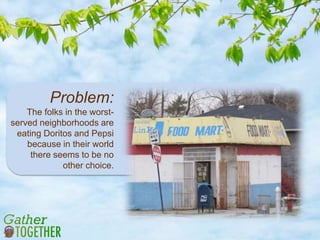
Problem:
The folks in the worst-
served neighborhoods are
eating Doritos and Pepsi
because in their world
there seems to be no
other choice.
Meanwhile,
Fruit trees on public
property in every Chicago
neighborhood are
dropping so much excess
fruit that they’re
considered a nuisance.
Urban culture
has cast wild fruit
as an object of fear
and derision.
The foraging knowledge
of generations past
has been lost.
Food Banks
could help,
but lack local knowledge
of ripening fruit trees,
and cannot risk the legal
liability of vouching for
uninspected food.
Empowering the food-disenfranchised
to take ownership
around neighborhood
nature resources.
Real-time alerts & maps to
gather community around
local trees ripening with
local, fresh, organic food.
In Logan Square,
Christopher House
sends its kids across the street
to Corner Farm Chicago
to learn to pick mulberries.
Then kids want to pick mulberries
everywhere.
Alleys
and local surroundings become
opportunities for real
engagement
 mulberries
The Living Almanac & Openlands map
Financial Sustainability
- Locate a restaurant, grocer or other local sponsor
focused on local / organic / foraged food
- Whole Foods
- Elizabeth
- CSA’s
- Peapod ???
- Build toward relationships with local agencies & NPO’s
Development plan
- Start with the most sustainable tree fruits
- Pilot in Logan Square with the Chicago Fruit&Forage
Mapping Project
- Locate a restaurant, grocer or other local sponsor
- Build relationships with local leaders & food pantries
- Host local “Forage Day”s
- Integrate social media, database, PDF generator
Value added
- Tech facilitation for existing resources
- Science & health education through real-world
engagement with the local neighborhood around food
- Tool for neighborhood orientation / connecting
- A strong motivator for getting outside, conquering
Nature Deficit Disorder, and curing Green-Blindness
- Intergenerational / Community / Local crowdsourcing
The world-changing that accomplishes:
Short-term:
- Real vitamins delivered as nature intended.
- Healthier kids and families.
- The #1 factor in student learning.
The world-changing that accomplishes:
Medium-term:
- Building healthy habits around eating.
- Transforming daily relationship with food, with nature,
with the rhythm of the seasons.
- Curing Green-Blindness.
The world-changing that accomplishes:
Long-term:
- Building a sense of place, of our local environment.
- Promoting a community ethic of self-reliance, curiosity,
engagement, and ownership.
Gatheryourselfpptx final

Gatheryourselfpptx final

  • 1.
    Problem: The folks inthe worst- served neighborhoods are eating Doritos and Pepsi because in their world there seems to be no other choice.
  • 2.
    Meanwhile, Fruit trees onpublic property in every Chicago neighborhood are dropping so much excess fruit that they’re considered a nuisance.
  • 3.
    Urban culture has castwild fruit as an object of fear and derision. The foraging knowledge of generations past has been lost.
  • 4.
    Food Banks could help, butlack local knowledge of ripening fruit trees, and cannot risk the legal liability of vouching for uninspected food.
  • 7.
    Empowering the food-disenfranchised totake ownership around neighborhood nature resources. Real-time alerts & maps to gather community around local trees ripening with local, fresh, organic food.
  • 8.
    In Logan Square, ChristopherHouse sends its kids across the street to Corner Farm Chicago to learn to pick mulberries. Then kids want to pick mulberries everywhere.
  • 9.
    Alleys and local surroundingsbecome opportunities for real engagement  mulberries
  • 10.
    The Living Almanac& Openlands map
  • 11.
    Financial Sustainability - Locatea restaurant, grocer or other local sponsor focused on local / organic / foraged food - Whole Foods - Elizabeth - CSA’s - Peapod ??? - Build toward relationships with local agencies & NPO’s
  • 12.
    Development plan - Startwith the most sustainable tree fruits - Pilot in Logan Square with the Chicago Fruit&Forage Mapping Project - Locate a restaurant, grocer or other local sponsor - Build relationships with local leaders & food pantries - Host local “Forage Day”s - Integrate social media, database, PDF generator
  • 13.
    Value added - Techfacilitation for existing resources - Science & health education through real-world engagement with the local neighborhood around food - Tool for neighborhood orientation / connecting - A strong motivator for getting outside, conquering Nature Deficit Disorder, and curing Green-Blindness - Intergenerational / Community / Local crowdsourcing
  • 14.
    The world-changing thataccomplishes: Short-term: - Real vitamins delivered as nature intended. - Healthier kids and families. - The #1 factor in student learning.
  • 15.
    The world-changing thataccomplishes: Medium-term: - Building healthy habits around eating. - Transforming daily relationship with food, with nature, with the rhythm of the seasons. - Curing Green-Blindness.
  • 16.
    The world-changing thataccomplishes: Long-term: - Building a sense of place, of our local environment. - Promoting a community ethic of self-reliance, curiosity, engagement, and ownership.