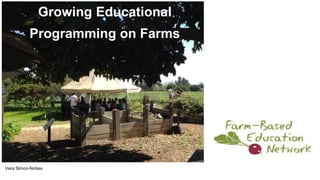
Growing Educational
Programming on Farms
Vera Simon-Nobes
Farm-Based Education Network (FBEN)
The mission of the Farm-Based Education Network is to inspire,
nurture and promote farm-based education.
Members operate on owned, leased, for-profit or not-for-profit…
Vegetables, animals, fiber, timber...
Single staff person to a staff of hundreds…
In 2008, approximately 70% of FBEN members farmed at non-
profit farms.
The FBEN is housed at Shelburne Farms, a nonprofit education
center for sustainability, 1400-acre working farm, and National
Historic landmark on the shores of Lake Champlain in Shelburne,
Vermont.
Hawthorne Valley Farm, Ghent, NY, USA
Farm-Based Education Network
A free member network established to strengthen and support the
work of educators, farmers, and community leaders
2,425 members
1,711unique programs
28countries represented
Stone Barns Center for Food and Agriculture, Pocantico Hills, NY, USA
Common programs among FBEN members...
Public tours
School field trips
Summer camps
Farm dinners
Harvest Festivals
Fresh Roots, Vancouver, BC
handful of sounds
available at:
www.farmbasededucation.org/forum/topics/chan
ging-the-menu-montreal-2015
Why farm-based education?
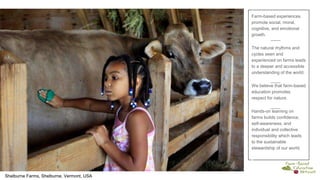
Farm-based experiences
promote social, moral,
cognitive, and emotional
growth.
The natural rhythms and
cycles seen and
experienced on farms leads
to a deeper and accessible
understanding of the world.
We believe that farm-based
education promotes
respect for nature.
Hands-on learning on
farms builds confidence,
self-awareness, and
individual and collective
responsibility which leads
to the sustainable
stewardship of our world.
Shelburne Farms, Shelburne, Vermont, USA
“We have a young goat, Vanilla, who has never been happy with
other goats. She’s content when she lives with pigs, however. We
use her to talk about differences and relationships. We also have
an 11-year-old transgender student [at our school] can really relate
to Vanilla.”
- Maureen Doherty, Green Chimneys Farm and
Wildlife Conservation Center, Brewster, NY.
Green Chimneys Farm and Wildlife Center, Brewster, NY, USA
“My latest joke as a farm-based educator, which is not actually a
joke, is that I tell everyone what I do is farm-based education,
but that what I know inwardly is that it should be called farm-
based healing. I have watched children from traumatized
situations come into the farm in a completely shutdown state,
shields up, nerves raw, eyes downcast, hoods over heads, and
within minutes, I see them transform. They laugh, they chat, and
they smile, all while digging in the dirt, arranging the flowers,
cradling worms in their palms. It’s nothing I do, all I do is lead
them into the garden and show them what to do, the rest
happens naturally, because I believe it is how we are meant to
be.”
- Barbara Sarbin, Director of Educational
Programming, “Something Good in the World”,
Cortland Manor, NY
Something Good in the World, Cold Spring, NY, USA
“The world is the classroom. For example,
when we’re planting garlic, 400 bulbs, 100 foot
rows. Mathematics! They think they didn’t
cared for mathematics, but when there’s a
practical application, they care about it!”
-Charlie Gook, Organic Farmer with
Green Chimneys Farm and
Wildlife Center, Brewster, NY, USA
Green Chimneys, Brewster, NY USA
Steckle Heritage Farm, Kitchener, Ontario
Fun!
Farm-based
learning takes all
shapes and forms!
Many successful
programs include…
1) Role Playing
Shelburne Farms, Shelburne, Vermont, USA
Many successful programs
include…
1) Role Playing
1) Connections to
ecological cycles
LifeLab Garden, Santa Cruz, CA, USA
Hidden Villa Farm, Los Altos, CA, USA
Many successful programs
include…
1) Role Playing
1) Connections to
ecological cycles
1) Relevance to the
wider world
Many successful
programs include…
1) Role Playing
1) Connections to
ecological cycles
1) Relevance to the
wider world
1) Promotion of
responsibility and
care for living
things
“I’m going to take him home and
shelter him. I love sheltering
animals. I care about him. I love
bugs.”
Shelburne Farms, Shelburne, Vermont, USA
Farm-Based Education can serve diverse audiences
Strategies for Connecting with Farmers
-Letter writing
-Locating a farm that is close-by as to limit bus fees
-Tracing a locally sourced product from the school cafeteria back to the farm
-Think inclusively about farm-based learning. Beekeeping, urban farming, potato sorting
factory, timber, hay, grain, wool, etc.
-Interviewing retired community members who may have grown up on farms
-Through literature
-Growing indoors and in the schoolyard in the classroom
-Learn how people farm in other parts of the world
How to find a farmer....
-Canadian Organic Growers - Growing Up Organic
-Collaborative Regional Alliance for Farmer Training
(CRAFT)
- Atlantic Canada Organic Regional Network (ACORN)
-Attend a Farmers’ Market
-Remember farm-based learning can take place at
urban farms and in community gardens, too!
Convincing Others that Farm Field Trips
are Worthwhile
-Wellness
-Community service - support a community
-Teamwork - group weeding, group planting,
group harvesting. Make it competitive!
-Form an ongoing relationship - you can go back multiple
times and always see something new.
-Explore a diversity of occupations.
-Give kids who may not thrive in a traditional classroom an
opportunity to succeed in a new setting.Everdale Summer Campers
Toronto, CA
“Applying for a farm apprenticeship at
EarthDance Farms was possibly the
most selfish thing I’ve done this year. I
wanted to learn how to be a better
gardener and to improve my physical
health... I wanted to do something for
my spirit, which took a beating this
year in the struggle to find my way
through the messiness swirling about
us in Ferguson. [But] nothing prepared
me for the gifts this summer has given
me. The satisfaction of getting covered
in mud, picking a few extra sun gold
tomatoes or leaving with a bag of
vegetables. The excellent management
of the instructors was outweighed by
the power of the experience of working
with the young farmers who do this
with me. Varied as they are in age,
experience, personality, and
aspirations, they hold in common
certain qualities of kindness and
generosity that are a joy to find all in
one place. Their hopes inspire me.”
EarthDance Farm, Ferguson, MO, USA
Growing Educational
Programming on Farms
vera@farmbasededucation.org

Growing Educational Programming on Farms

  • 1.
    Growing Educational Programming onFarms Vera Simon-Nobes
  • 2.
    Farm-Based Education Network(FBEN) The mission of the Farm-Based Education Network is to inspire, nurture and promote farm-based education. Members operate on owned, leased, for-profit or not-for-profit… Vegetables, animals, fiber, timber... Single staff person to a staff of hundreds… In 2008, approximately 70% of FBEN members farmed at non- profit farms. The FBEN is housed at Shelburne Farms, a nonprofit education center for sustainability, 1400-acre working farm, and National Historic landmark on the shores of Lake Champlain in Shelburne, Vermont. Hawthorne Valley Farm, Ghent, NY, USA
  • 3.
    Farm-Based Education Network Afree member network established to strengthen and support the work of educators, farmers, and community leaders 2,425 members 1,711unique programs 28countries represented Stone Barns Center for Food and Agriculture, Pocantico Hills, NY, USA
  • 4.
    Common programs amongFBEN members... Public tours School field trips Summer camps Farm dinners Harvest Festivals Fresh Roots, Vancouver, BC
  • 5.
    handful of sounds availableat: www.farmbasededucation.org/forum/topics/chan ging-the-menu-montreal-2015
  • 6.
  • 7.
    Farm-based experiences promote social,moral, cognitive, and emotional growth. The natural rhythms and cycles seen and experienced on farms leads to a deeper and accessible understanding of the world. We believe that farm-based education promotes respect for nature. Hands-on learning on farms builds confidence, self-awareness, and individual and collective responsibility which leads to the sustainable stewardship of our world. Shelburne Farms, Shelburne, Vermont, USA
  • 8.
    “We have ayoung goat, Vanilla, who has never been happy with other goats. She’s content when she lives with pigs, however. We use her to talk about differences and relationships. We also have an 11-year-old transgender student [at our school] can really relate to Vanilla.” - Maureen Doherty, Green Chimneys Farm and Wildlife Conservation Center, Brewster, NY. Green Chimneys Farm and Wildlife Center, Brewster, NY, USA
  • 9.
    “My latest jokeas a farm-based educator, which is not actually a joke, is that I tell everyone what I do is farm-based education, but that what I know inwardly is that it should be called farm- based healing. I have watched children from traumatized situations come into the farm in a completely shutdown state, shields up, nerves raw, eyes downcast, hoods over heads, and within minutes, I see them transform. They laugh, they chat, and they smile, all while digging in the dirt, arranging the flowers, cradling worms in their palms. It’s nothing I do, all I do is lead them into the garden and show them what to do, the rest happens naturally, because I believe it is how we are meant to be.” - Barbara Sarbin, Director of Educational Programming, “Something Good in the World”, Cortland Manor, NY Something Good in the World, Cold Spring, NY, USA
  • 10.
    “The world isthe classroom. For example, when we’re planting garlic, 400 bulbs, 100 foot rows. Mathematics! They think they didn’t cared for mathematics, but when there’s a practical application, they care about it!” -Charlie Gook, Organic Farmer with Green Chimneys Farm and Wildlife Center, Brewster, NY, USA Green Chimneys, Brewster, NY USA
  • 11.
    Steckle Heritage Farm,Kitchener, Ontario Fun!
  • 12.
    Farm-based learning takes all shapesand forms! Many successful programs include… 1) Role Playing Shelburne Farms, Shelburne, Vermont, USA
  • 13.
    Many successful programs include… 1)Role Playing 1) Connections to ecological cycles LifeLab Garden, Santa Cruz, CA, USA Hidden Villa Farm, Los Altos, CA, USA
  • 14.
    Many successful programs include… 1)Role Playing 1) Connections to ecological cycles 1) Relevance to the wider world
  • 15.
    Many successful programs include… 1)Role Playing 1) Connections to ecological cycles 1) Relevance to the wider world 1) Promotion of responsibility and care for living things “I’m going to take him home and shelter him. I love sheltering animals. I care about him. I love bugs.” Shelburne Farms, Shelburne, Vermont, USA
  • 16.
    Farm-Based Education canserve diverse audiences
  • 17.
    Strategies for Connectingwith Farmers -Letter writing -Locating a farm that is close-by as to limit bus fees -Tracing a locally sourced product from the school cafeteria back to the farm -Think inclusively about farm-based learning. Beekeeping, urban farming, potato sorting factory, timber, hay, grain, wool, etc. -Interviewing retired community members who may have grown up on farms -Through literature -Growing indoors and in the schoolyard in the classroom -Learn how people farm in other parts of the world
  • 18.
    How to finda farmer.... -Canadian Organic Growers - Growing Up Organic -Collaborative Regional Alliance for Farmer Training (CRAFT) - Atlantic Canada Organic Regional Network (ACORN) -Attend a Farmers’ Market -Remember farm-based learning can take place at urban farms and in community gardens, too!
  • 20.
    Convincing Others thatFarm Field Trips are Worthwhile -Wellness -Community service - support a community -Teamwork - group weeding, group planting, group harvesting. Make it competitive! -Form an ongoing relationship - you can go back multiple times and always see something new. -Explore a diversity of occupations. -Give kids who may not thrive in a traditional classroom an opportunity to succeed in a new setting.Everdale Summer Campers Toronto, CA
  • 21.
    “Applying for afarm apprenticeship at EarthDance Farms was possibly the most selfish thing I’ve done this year. I wanted to learn how to be a better gardener and to improve my physical health... I wanted to do something for my spirit, which took a beating this year in the struggle to find my way through the messiness swirling about us in Ferguson. [But] nothing prepared me for the gifts this summer has given me. The satisfaction of getting covered in mud, picking a few extra sun gold tomatoes or leaving with a bag of vegetables. The excellent management of the instructors was outweighed by the power of the experience of working with the young farmers who do this with me. Varied as they are in age, experience, personality, and aspirations, they hold in common certain qualities of kindness and generosity that are a joy to find all in one place. Their hopes inspire me.” EarthDance Farm, Ferguson, MO, USA
  • 22.
    Growing Educational Programming onFarms vera@farmbasededucation.org

Editor's Notes

  • #15 Cleaning, seed evaluation, harvesting
  • #17 -Babies - Charlotte Children’s Center visit -Barbara - Teens who have received shelter services for farm-based healing -Erin - Chef’s at chef camp. Chef’s abilities to use their influence in community
  • #18 -Parent volunteers can help chaperone
  • #19 -Parent volunteers can help chaperone