GATE 2012IIT delhi 12thfebruary
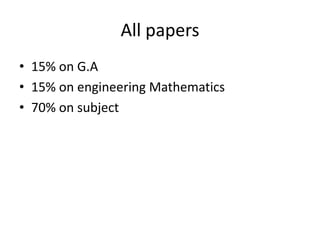
All papers15% on G.A15% on engineering Mathematics70% on subject
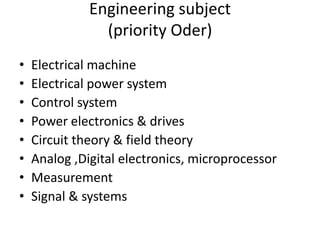
Engineering subject(priority Oder)Electrical machineElectrical power systemControl systemPower electronics & drivesCircuit theory & field theoryAnalog ,Digital electronics, microprocessorMeasurementSignal & systems
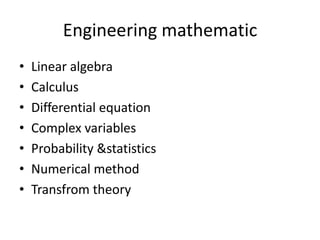
Engineering mathematicLinear algebraCalculusDifferential equationComplex variablesProbability &statisticsNumerical methodTransfrom theory
Linear algebraMatrix Algebra, Systems of linear equations, Eigen values and eigen vectors.
CalculasMean value theorems, Theorems of integral calculus, Evaluation of definite and improper integrals, Partial Derivatives, Maxima and minima, Multiple integrals, Fourier series. Vector identities, Directional derivatives, Line, Surface and Volume integrals, Stokes, Gauss and Green's theorems.
Differential EquationFirst order equation (linear and nonlinear), Higher order linear differential equations with constant coefficients, Method of variation of parameters, Cauchy's and Euler's equations, Initial and boundary value problems, Partial Differential Equations and variable separable method.
Complex varriablesAnalytic functions, Cauchy's integral theorem and integral formula, Taylor's and Laurent' series, Residue theorem, solution integrals.
Probability & StatisticSampling theorems, Conditional probability, Mean, median, mode and standard deviation, Random variables, Discrete and continuous distributions, Poisson, Normal and Binomial distribution, Correlation and regression analysis.
Numerical methodSolutions of non-linear algebraic equations, single and multi-step methods for differential equations.
Transform theoryFourier TransformLaplace TransformZ-transform
Electrical machineTransformer(1 & 3 phase)DC MachineSynchronous MachineInduction MachineServo & Stepper Motors
TransfromersSingle phase transformer - equivalent circuit, phasor diagram, tests, regulation and efficiency; three phase transformers - connections, parallel operation; auto-transformer
Dc Machineenergy conversion principles; types, windings, generator characteristics, armature reaction and commutation, starting and speed control of motors;
Induction motors three phase induction motorsprinciples, types, performance characteristics, starting and speed control; single phase induction motors;
 synchronous machines performance, regulation  parallel operation of generators, motor starting, characteristics and applications;
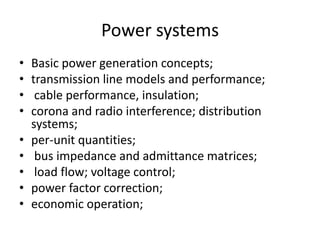
Power systemsBasic power generation concepts; transmission line models and performance; cable performance, insulation; corona and radio interference; distribution systems; per-unit quantities; bus impedance and admittance matrices; load flow; voltage control; power factor correction; economic operation;
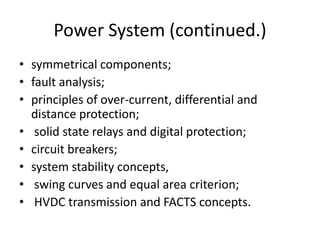
Power System (continued.)symmetrical components; fault analysis; principles of over-current, differential and distance protection; solid state relays and digital protection; circuit breakers;system stability concepts, swing curves and equal area criterion; HVDC transmission and FACTS concepts.
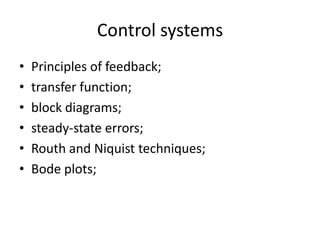
Control systemsPrinciples of feedback; transfer function; block diagrams; steady-state errors; Routh and Niquist techniques; Bode plots;
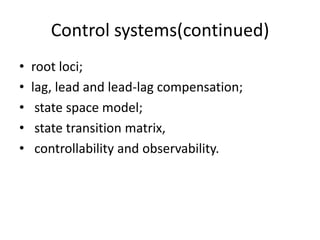
Control systems(continued)root loci; lag, lead and lead-lag compensation; state space model; state transition matrix, controllability and observability.
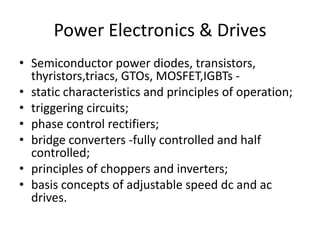
Power Electronics & DrivesSemiconductor power diodes, transistors, thyristors,triacs, GTOs, MOSFET,IGBTs - static characteristics and principles of operation; triggering circuits; phase control rectifiers;bridge converters -fully controlled and half controlled; principles of choppers and inverters; basis concepts of adjustable speed dc and ac drives.
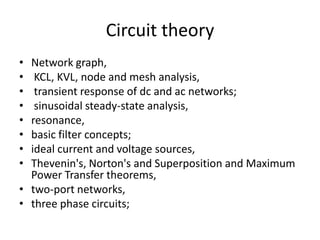
Circuit theory Network graph, KCL, KVL, node and mesh analysis, transient response of dc and ac networks; sinusoidal steady-state analysis, resonance, basic filter concepts; ideal current and voltage sources, Thevenin's, Norton's and Superposition and Maximum Power Transfer theorems, two-port networks, three phase circuits;
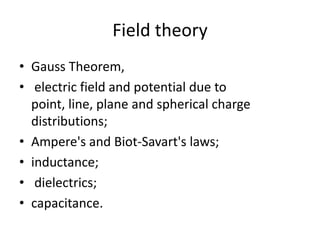
Field theoryGauss Theorem, electric field and potential due to point, line, plane and spherical charge distributions; Ampere's and Biot-Savart's laws; inductance; dielectrics; capacitance.
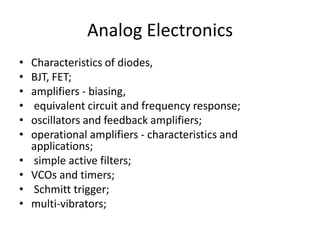
Analog ElectronicsCharacteristics of diodes, BJT, FET; amplifiers - biasing, equivalent circuit and frequency response; oscillators and feedback amplifiers; operational amplifiers - characteristics and applications; simple active filters; VCOs and timers; Schmitt trigger; multi-vibrators;
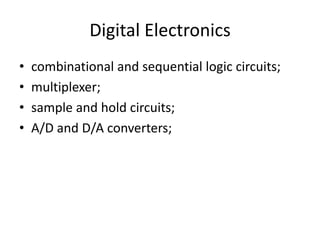
Digital Electronicscombinational and sequential logic circuits; multiplexer;sample and hold circuits; A/D and D/A converters;
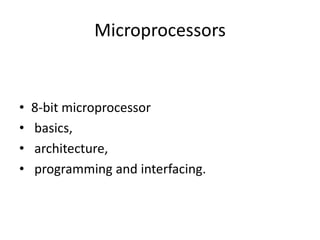
Microprocessors8-bit microprocessor basics, architecture, programming and interfacing.
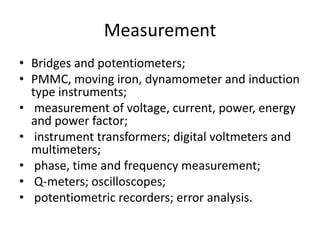
MeasurementBridges and potentiometers; PMMC, moving iron, dynamometer and induction type instruments; measurement of voltage, current, power, energy and power factor; instrument transformers; digital voltmeters and multimeters; phase, time and frequency measurement; Q-meters; oscilloscopes;potentiometric recorders; error analysis.
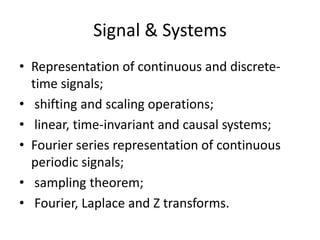
Signal & SystemsRepresentation of continuous and discrete-time signals; shifting and scaling operations; linear, time-invariant and causal systems; Fourier series representation of continuous periodic signals; sampling theorem; Fourier, Laplace and Z transforms.

Gate 2012

  • 1.
    GATE 2012IIT delhi12thfebruary
  • 2.
    All papers15% onG.A15% on engineering Mathematics70% on subject
  • 3.
    Engineering subject(priority Oder)ElectricalmachineElectrical power systemControl systemPower electronics & drivesCircuit theory & field theoryAnalog ,Digital electronics, microprocessorMeasurementSignal & systems
  • 4.
    Engineering mathematicLinear algebraCalculusDifferentialequationComplex variablesProbability &statisticsNumerical methodTransfrom theory
  • 5.
    Linear algebraMatrix Algebra,Systems of linear equations, Eigen values and eigen vectors.
  • 6.
    CalculasMean value theorems,Theorems of integral calculus, Evaluation of definite and improper integrals, Partial Derivatives, Maxima and minima, Multiple integrals, Fourier series. Vector identities, Directional derivatives, Line, Surface and Volume integrals, Stokes, Gauss and Green's theorems.
  • 7.
    Differential EquationFirst orderequation (linear and nonlinear), Higher order linear differential equations with constant coefficients, Method of variation of parameters, Cauchy's and Euler's equations, Initial and boundary value problems, Partial Differential Equations and variable separable method.
  • 8.
    Complex varriablesAnalytic functions,Cauchy's integral theorem and integral formula, Taylor's and Laurent' series, Residue theorem, solution integrals.
  • 9.
    Probability & StatisticSamplingtheorems, Conditional probability, Mean, median, mode and standard deviation, Random variables, Discrete and continuous distributions, Poisson, Normal and Binomial distribution, Correlation and regression analysis.
  • 10.
    Numerical methodSolutions ofnon-linear algebraic equations, single and multi-step methods for differential equations.
  • 11.
  • 12.
    Electrical machineTransformer(1 &3 phase)DC MachineSynchronous MachineInduction MachineServo & Stepper Motors
  • 13.
    TransfromersSingle phase transformer- equivalent circuit, phasor diagram, tests, regulation and efficiency; three phase transformers - connections, parallel operation; auto-transformer
  • 14.
    Dc Machineenergy conversionprinciples; types, windings, generator characteristics, armature reaction and commutation, starting and speed control of motors;
  • 15.
    Induction motors threephase induction motorsprinciples, types, performance characteristics, starting and speed control; single phase induction motors;
  • 16.
    synchronous machinesperformance, regulation parallel operation of generators, motor starting, characteristics and applications;
  • 17.
    Power systemsBasic powergeneration concepts; transmission line models and performance; cable performance, insulation; corona and radio interference; distribution systems; per-unit quantities; bus impedance and admittance matrices; load flow; voltage control; power factor correction; economic operation;
  • 18.
    Power System (continued.)symmetricalcomponents; fault analysis; principles of over-current, differential and distance protection; solid state relays and digital protection; circuit breakers;system stability concepts, swing curves and equal area criterion; HVDC transmission and FACTS concepts.
  • 19.
    Control systemsPrinciples offeedback; transfer function; block diagrams; steady-state errors; Routh and Niquist techniques; Bode plots;
  • 20.
    Control systems(continued)root loci;lag, lead and lead-lag compensation; state space model; state transition matrix, controllability and observability.
  • 21.
    Power Electronics &DrivesSemiconductor power diodes, transistors, thyristors,triacs, GTOs, MOSFET,IGBTs - static characteristics and principles of operation; triggering circuits; phase control rectifiers;bridge converters -fully controlled and half controlled; principles of choppers and inverters; basis concepts of adjustable speed dc and ac drives.
  • 22.
    Circuit theory Networkgraph, KCL, KVL, node and mesh analysis, transient response of dc and ac networks; sinusoidal steady-state analysis, resonance, basic filter concepts; ideal current and voltage sources, Thevenin's, Norton's and Superposition and Maximum Power Transfer theorems, two-port networks, three phase circuits;
  • 23.
    Field theoryGauss Theorem,electric field and potential due to point, line, plane and spherical charge distributions; Ampere's and Biot-Savart's laws; inductance; dielectrics; capacitance.
  • 24.
    Analog ElectronicsCharacteristics ofdiodes, BJT, FET; amplifiers - biasing, equivalent circuit and frequency response; oscillators and feedback amplifiers; operational amplifiers - characteristics and applications; simple active filters; VCOs and timers; Schmitt trigger; multi-vibrators;
  • 25.
    Digital Electronicscombinational andsequential logic circuits; multiplexer;sample and hold circuits; A/D and D/A converters;
  • 26.
    Microprocessors8-bit microprocessor basics,architecture, programming and interfacing.
  • 27.
    MeasurementBridges and potentiometers;PMMC, moving iron, dynamometer and induction type instruments; measurement of voltage, current, power, energy and power factor; instrument transformers; digital voltmeters and multimeters; phase, time and frequency measurement; Q-meters; oscilloscopes;potentiometric recorders; error analysis.
  • 28.
    Signal & SystemsRepresentationof continuous and discrete-time signals; shifting and scaling operations; linear, time-invariant and causal systems; Fourier series representation of continuous periodic signals; sampling theorem; Fourier, Laplace and Z transforms.