Prof. dr. A. Achterberg, Astronomical Dept. , IMAPP, Radboud Universiteit
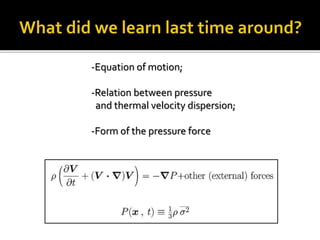
-Equation of motion;
-Relation between pressure
and thermal velocity dispersion;
-Form of the pressure force
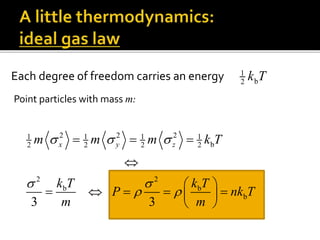
Each degree of freedom carries an energy 1
b
2 k T
2 2 2
1 1 1 1
b
2 2 2 2
2 2
b b
b
3 3
x y z
m m m k T
k T k T
P nk T
m m
  
 
 
  

 
    
 
 
Point particles with mass m:
b
H
H
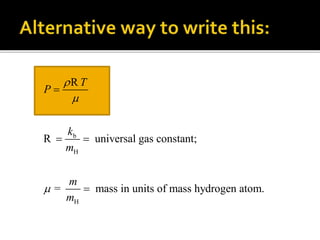
universal gas constant;
= mass in units of mass hydrogen atom.
T
P
k
m
m
m




 

R
R
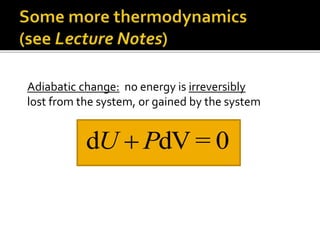
Adiabatic change: no energy is irreversibly
lost from the system, or gained by the system
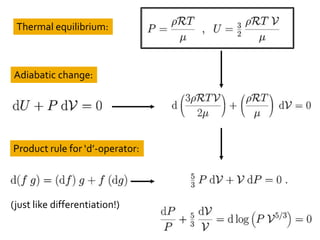
d d = 0
U P
 V
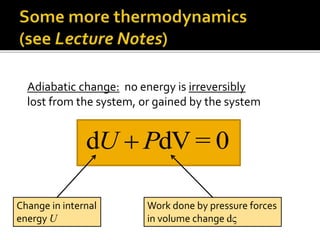
Adiabatic change: no energy is irreversibly
lost from the system, or gained by the system
d d = 0
U P
 V
Change in internal
energy U
Work done by pressure forces
in volume change dV
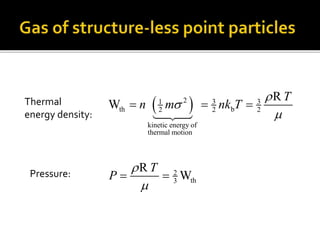
 
2 3 3
1
th b
2 2 2
kinetic energy of
thermal motion
2
th
3
T
n m nk T
T
P





  
 
R
W
R
W
Thermal
energy density:
Pressure:
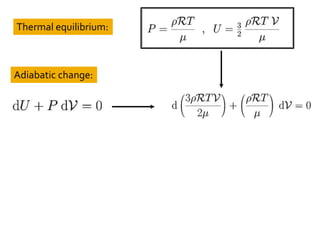
Thermal equilibrium:
Adiabatic change:
Thermal equilibrium:
Adiabatic change:
Product rule for ‘d’-operator:
(just like differentiation!)
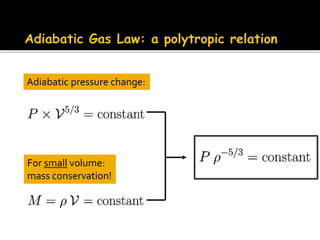
Adiabatic pressure change:
For small volume:
mass conservation!
1
th
'
1 ( 1)
5
, =1:
3
P K
T K
T
P
P T
W







  
 






 






 
 

R
R
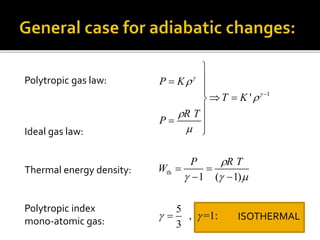
Polytropic gas law:
Ideal gas law:
Thermal energy density:
Polytropic index
mono-atomic gas: ISOTHERMAL
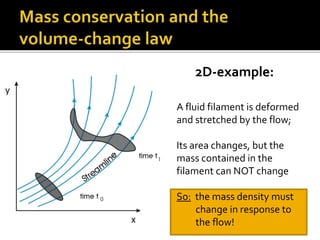
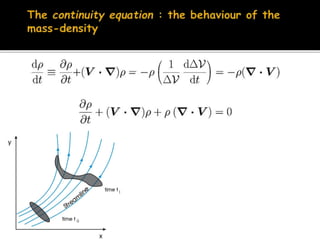
A fluid filament is deformed
and stretched by the flow;
Its area changes, but the
mass contained in the
filament can NOT change
So: the mass density must
change in response to
the flow!
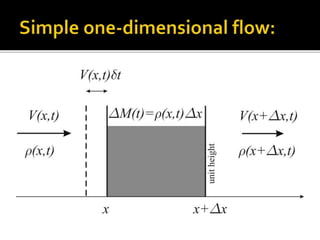
2D-example:
in
out
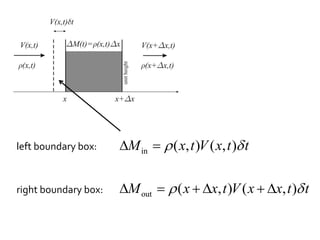
( , ) ( , )
( , ) ( , )
M x t V x t t
M x x t V x x t t
 
 
 
     
left boundary box:
right boundary box:
 
 
 
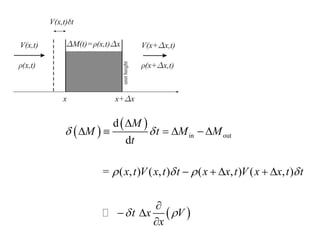
in out
d
d
= ( , ) ( , ) ( , ) ( , )
M
M t M M
t
x t V x t t x x t V x x t t
t x V
x
 
   
 

     
    

 

 
 
 
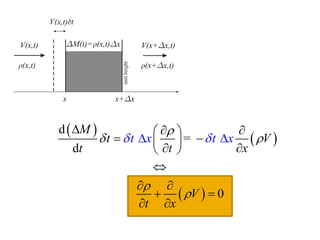
d
=
d
0
M
t V
t t x
t x t x
V
t x

 


 
  
 
 
 
 
 

 






     
 
0
0
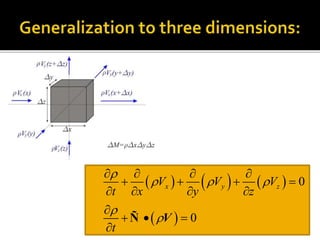
x y z
V V V
t x y z
t

  


   
   
   

  

Ñ V
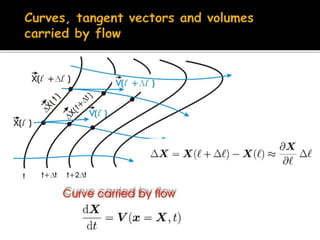
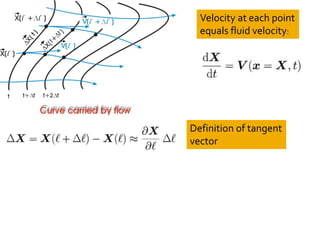
Velocity at each point
equals fluid velocity:
Definition of tangent
vector
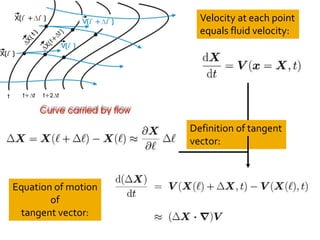
Velocity at each point
equals fluid velocity:
Definition of tangent
vector:
Equation of motion
of
tangent vector:
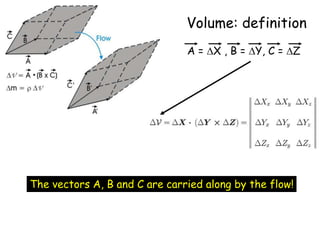
Volume: definition
A = X , B = Y, C = Z
The vectors A, B and C are carried along by the flow!
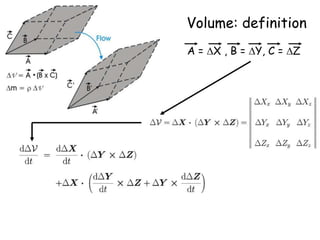
Volume: definition
A = X , B = Y, C = Z
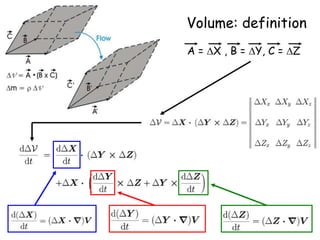
Volume: definition
A = X , B = Y, C = Z
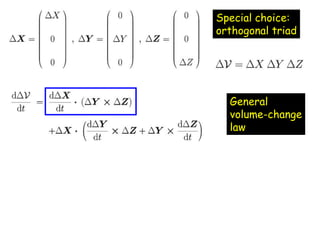
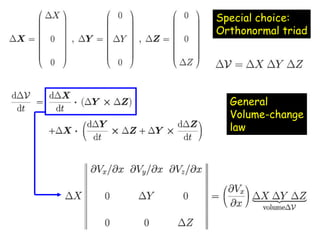
Special choice:
orthogonal triad
General
volume-change
law
Special choice:
Orthonormal triad
General
Volume-change
law
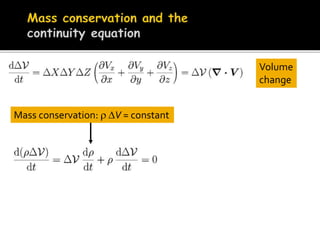
Volume
change
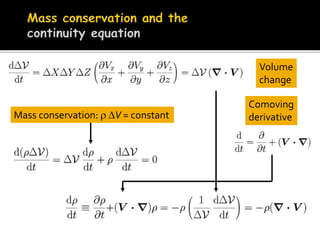
Mass conservation:  V = constant
Volume
change
Mass conservation:  V = constant
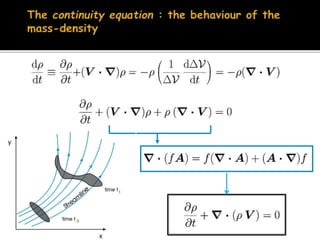
Comoving
derivative
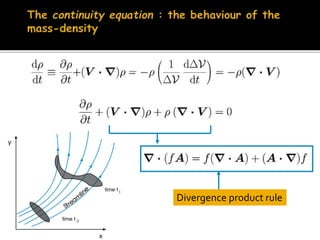
Divergence product rule
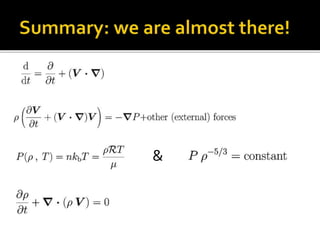
&

Gas Dynamics, Lecture 2.pptx