Download to read offline
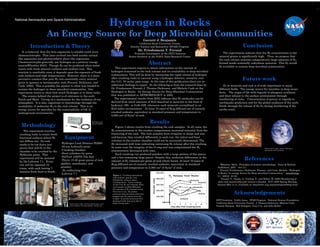

This experiment aims to measure the amount of hydrogen contained in rocks that could serve as an energy source for deep microbial communities. Rock samples of gabbro, anorthosite, and granite will be crushed using a hydraulic press, exposing fresh surfaces where hydrogen molecules can diffuse out. The released hydrogen will be detected using a hydrogen leak detector. Preliminary results from 2002 indicated that crushing andesite released 70 nmol of hydrogen per gram, equivalent to 5,000 cm3 of hydrogen per cubic meter of rock. This suggests rocks contain high concentrations of hydrogen that could sustain microbes in deep subsurface environments.


