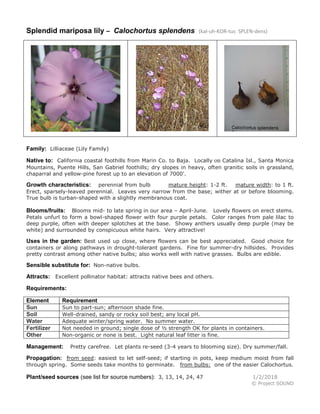
Splendid mariposa lily – Calochortus splendens (kal-uh-KOR-tus SPLEN-dens)
Family: Lilliaceae (Lily Family)
Native to: California coastal foothills from Marin Co. to Baja. Locally on Catalina Isl., Santa Monica
Mountains, Puente Hills, San Gabriel foothills; dry slopes in heavy, often granitic soils in grassland,
chaparral and yellow-pine forest up to an elevation of 7000'.
Growth characteristics: perennial from bulb mature height: 1-2 ft. mature width: to 1 ft.
Erect, sparsely-leaved perennial. Leaves very narrow from the base; wither at or before blooming.
True bulb is turban-shaped with a slightly membranous coat.
Blooms/fruits: Blooms mid- to late spring in our area – April-June. Lovely flowers on erect stems.
Petals unfurl to form a bowl-shaped flower with four purple petals. Color ranges from pale lilac to
deep purple, often with deeper splotches at the base. Showy anthers usually deep purple (may be
white) and surrounded by conspicuous white hairs. Very attractive!
Uses in the garden: Best used up close, where flowers can be best appreciated. Good choice for
containers or along pathways in drought-tolerant gardens. Fine for summer-dry hillsides. Provides
pretty contrast among other native bulbs; also works well with native grasses. Bulbs are edible.
Sensible substitute for: Non-native bulbs.
Attracts: Excellent pollinator habitat: attracts native bees and others.
Requirements:
Element Requirement
Sun Sun to part-sun; afternoon shade fine.
Soil Well-drained, sandy or rocky soil best; any local pH.
Water Adequate winter/spring water. No summer water.
Fertilizer Not needed in ground; single dose of ½ strength OK for plants in containers.
Other Non-organic or none is best. Light natural leaf litter is fine.
Management: Pretty carefree. Let plants re-seed (3-4 years to blooming size). Dry summer/fall.
Propagation: from seed: easiest to let self-seed; if starting in pots, keep medium moist from fall
through spring. Some seeds take months to germinate. from bulbs: one of the easier Calochortus.
Plant/seed sources (see list for source numbers): 3, 13, 14, 24, 47 1/2/2018
© Project SOUND

Gardening sheet calochortus splendens

  • 1.
    Splendid mariposa lily– Calochortus splendens (kal-uh-KOR-tus SPLEN-dens) Family: Lilliaceae (Lily Family) Native to: California coastal foothills from Marin Co. to Baja. Locally on Catalina Isl., Santa Monica Mountains, Puente Hills, San Gabriel foothills; dry slopes in heavy, often granitic soils in grassland, chaparral and yellow-pine forest up to an elevation of 7000'. Growth characteristics: perennial from bulb mature height: 1-2 ft. mature width: to 1 ft. Erect, sparsely-leaved perennial. Leaves very narrow from the base; wither at or before blooming. True bulb is turban-shaped with a slightly membranous coat. Blooms/fruits: Blooms mid- to late spring in our area – April-June. Lovely flowers on erect stems. Petals unfurl to form a bowl-shaped flower with four purple petals. Color ranges from pale lilac to deep purple, often with deeper splotches at the base. Showy anthers usually deep purple (may be white) and surrounded by conspicuous white hairs. Very attractive! Uses in the garden: Best used up close, where flowers can be best appreciated. Good choice for containers or along pathways in drought-tolerant gardens. Fine for summer-dry hillsides. Provides pretty contrast among other native bulbs; also works well with native grasses. Bulbs are edible. Sensible substitute for: Non-native bulbs. Attracts: Excellent pollinator habitat: attracts native bees and others. Requirements: Element Requirement Sun Sun to part-sun; afternoon shade fine. Soil Well-drained, sandy or rocky soil best; any local pH. Water Adequate winter/spring water. No summer water. Fertilizer Not needed in ground; single dose of ½ strength OK for plants in containers. Other Non-organic or none is best. Light natural leaf litter is fine. Management: Pretty carefree. Let plants re-seed (3-4 years to blooming size). Dry summer/fall. Propagation: from seed: easiest to let self-seed; if starting in pots, keep medium moist from fall through spring. Some seeds take months to germinate. from bulbs: one of the easier Calochortus. Plant/seed sources (see list for source numbers): 3, 13, 14, 24, 47 1/2/2018 © Project SOUND