Handheld Augmented
   Board Games
 Game Interaction Storyboards
Settlers of Catan
Task Overview
• T1: Board setup at start of game
• During every player turn:
 • T2: Roll dice and collect resources
 • T3: Trade resources among players
 • T4: Take actions and spend resources
• T5: Special case of T2 in case a 7 is rolled
TI - Setup
• Board setup is performed once at start of
  game
• Two alternatives:
 • Player-chosen lay-out (needs to be input
    into the device)
 • Auto-generated lay-out (needs to be
    rebuilt using the physical tiles)
T1 - Setup (a)


 First, Freddy comes up with a board lay-
out and constructs the isle of Catan using
            the hexagonal tiles.
T1 - Setup (a)


He then places the numbered tokens on
 each land tile, within the hollow frame
                  marker.
T1 - Setup (a)


Finally, he scans the marker on each tile
as well as the numbered token, to input
the board lay-out into the game engine.
T1 - Setup (a)


  He scans the tiles according to a fixed
pattern, to map the physical board lay-out
            to the digital one.
T1 - Setup (b)


Alternatively, Freddy can have the
handheld generate a board lay-out
   (=> no scanning required).
T1 - Setup (b)


He then lays out the board according to
  the lay-out shown on the handheld
T2 - Collect resources

• Performed by each player at the start of his
  turn
• Depending on the result of the dice roll,
  resources are distributed among all players
  automatically
T2 - Collect resources


It’s Freddy’s turn now. To begin, he rolls
                 the dice.
T2 - Collect resources


He rolls a 3. To inform the game engine
 hereof, he scans the result of his roll.
T2 - Collect resources


  Freddy has a settlement adjacent to a
‘hills’ tile with a number 3 token on it, so
   he receives 1 ‘bricks’ resource card.
T3 - Trade resources

• During his turn, a player may trade
  resources with other players
• Another option is to trade resources with
  the bank (not shown here, requires only
  interaction with handheld)
T3 - Trade resources


Freddy is in need of ‘wool’ and has got
  some ‘ore’ to spare, so he verbally
proposes a trade to the other players.
T3 - Trade resources


Jeffrey has agreed to trade wool for ore
with Freddy. They use their handhelds to
         perform the transaction.
T4 - Perform actions
• Now, the player can perform actions with
  his resource and development cards:
 • Build a road or settlement
 • Upgrade a settlement to a village
 • Buy a development card
 • Play a development card bought in an
    earlier turn
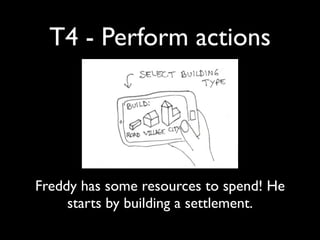
T4 - Perform actions


Freddy has some resources to spend! He
     starts by building a settlement.
T4 - Perform actions


Settlements are built at intersections of 3 hexes. He
 scans the desired position to inform the handheld
   (which can also tell him if he is allowed to build
  there), by scanning the 3 hexes at the same time.
T4 - Perform actions


He then places one of his settlement playing
pieces on the chosen position. The required
  resources have been paid automatically.
T4 - Perform actions


He remembers he bought a development
 card earlier, that allows him to build a
   road for free, so he plays this card.
T4 - Perform actions


  As roads are built on edges between
hexes, he scans the two hexes adjacent to
            the road position.
T4 - Perform actions


He then updates the game board by
placing one of his road pieces on the
          chosen position.
T4 - Perform actions


Finally, he decides to buy another
         development card.
   After this, he ends his turn.
T5 - Move robber
•   If a player rolls 7, no resources are collected,
    but the robber piece is moved:
    •   The tile upon which the robber is placed
        does not provide any resources
    •   Players with more than 7 cards are forced
        to discard half of them
    •   The player that moved the robber steals 1
        reosource from a player with a settlement
        adjacent to the new robber position
T5 - Move robber


On his next turn, Freddy rolled a 7. He
moves the robber piece to a tile next to
               Jeffrey.
T5 - Move robber


He informs the game engine of the new
robber position by scanning the robber
              and its tile.
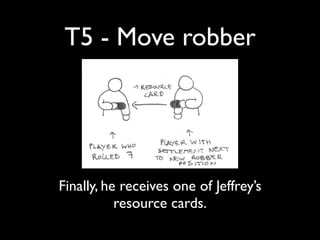
T5 - Move robber


Finally, he receives one of Jeffrey’s
           resource cards.
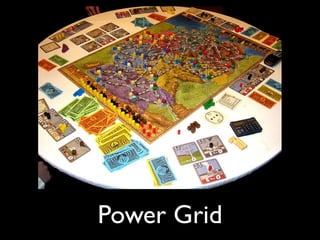
Power Grid
Task Overview
•   Power Grid is played in rounds, each of which
    consists of 5 phases:

    •   Phase 1: Determine player order => automated

    •   Phase 2: Auction power plants => T1

    •   Phase 3: Buying resources => T2

    •   Phase 4: Building => T3

    •   Phase 5: Bureaucracy => T4

•   Ongoing: Check player info => T5
T1 - Auctioning Plants
•   Players buy power plants through auctions

•   One can have up to 3 plants (new plants replace
    older ones)

•   One does not have to buy a plant each turn

•   Each player can start an auction or pass

•   During an auction, each player that did not
    already buy a plant or pass up on the chance to
    select one, can bid or pass

•   Auctioned plants are automatically replaced
    with new ones
T1 - Auctioning Plants


Freddy selects a power plant to auction,
          using his handheld.
T1 - Auctioning Plants


   He enters his starting bid.
T1 - Auctioning Plants


Now the other players get a chance to
  bid on the plant, or pass. Bidding
 continues until one player remains.
T2 - Buying Resources
• Players then buy resources, starting with
  the weakest player
• As resources are bought, prices go up
• Players then assign the resources bought to
  their power plants
• A plant can store up the twice the amount
  of resources required for power
  production
T2 - Buying Resources


Freddy buys the resources for the new
power plant he won during one of the
    auctions in the previous phase.
T2 - Buying Resources


And he assigns them to the new power
                 plant.
T3 - Building
• Players need to connect cities to their grid
  to power them
• They place buildings on the map, this
  represents their grid
• The cost of a building is the base cost to
  build in a city plus the cost to connect it to
  the player’s grid
• The map is graph with nodes and weighted
  edges
T3 - Building


Freddy scans the city he wants to
connect to his grid. His handheld
   indicates the building costs.
T3 - Building


Freddy confirms the build. The costs are
paid automatically. He then places one of
  his house pieces on the chosen city.
T4 - Bureaucracy

• Players declare how much cities they will
  power and which power plants they will
  use
• Income is automatically distributed among
  the players
• Resources are automatically removed from
  the plants and the resource market is
  automatically resupplied
T4 - Bureaucracy


 Freddy selects the plants he is going to
use to power the cities connected to his
                  grid.
T4 - Bureaucracy


Freddy automatically receives the income
 generated by the powering of the cities.
T5 - Player info
• All information is public in Power Grid
• Players may inspect eachothers power
  plants, resources and cash at any time
• This functionality can be proved as info
  screens in the app
• Or one could try to show it using
  augmented reality, using the handheld as
  ‘magic lens’
T5 - Player info


A possible game setup for the augmented
reality case: every player has a handheld,
    player marker and house pieces.
T5 - Player info


 By scanning another player’s marker,
Freddy can get AR information on that
    player’s plants, cities, money, ...
Settlers of Catan: misc
     • Empires of Catan:
      • Settlers of Catan combining several
          boardgame play instances
       • Foreign trade between board gaming
          groups over Internet
       • Alliances of playing sides over internet
          competing locally on boardgame islands
Idea source: http://www.cse.chalmers.se/research/group/
    idc/ituniv/kurser/06/uc/ppt/pervasive_games.pdf
Settlers of Catan: Misc
• Thesis “Joining Bits and Pieces”: proposes
  computer enhanced interactions in games
• Some that could be applied in Catan:
 • Espionage: get (some) info on player’s
    hand
  • Anonymous trading: players indicate what
    they want and what they’ll give =>
    computer tries to match up these
    offerings
Power Grid: Playtest
• First time is hard, since you don’t know any
  tactics/strategy yet
• Bidding is an important part
• Quite some information available and
  required when devising strategy => way
  this will be presented to the player is a vital
  aspect
Power Grid: Playtest

• One player needs to play bank:
 • Return change to players
 • Make sure the correct amount is
    received
• Tedious => automation desirable
Power Grid: Playtest
• When a power plant is bought, a new one
  has to be added to the game
• At various points, power plant cards need
  to be put back in the deck; thrown out of
  the game; reordered according to price
• Automating this would relieve the players
  of this task
Power Grid: Playtest
• Players tend to connect multiple cities in
  one go:
  • Keeping track of current cost while
    adding cities makes things easier
  • Can prevent not having enough money
  • Cities that can still be connected could
    be shown to players
Power Grid: Playtest
• Players tend to plan ahead which cities they
  are going to connect:
  • Actions of other players can interfere
    with this
  • Planning function: already enter which
    cities you would like to connect => if this
    is still possible when it is your turn, this
    plan could be executed immediately;
    otherwise, the player needs to adapt it

Game Interaction Storyboards

  • 1.
    Handheld Augmented Board Games Game Interaction Storyboards
  • 2.
  • 3.
    Task Overview • T1:Board setup at start of game • During every player turn: • T2: Roll dice and collect resources • T3: Trade resources among players • T4: Take actions and spend resources • T5: Special case of T2 in case a 7 is rolled
  • 4.
    TI - Setup •Board setup is performed once at start of game • Two alternatives: • Player-chosen lay-out (needs to be input into the device) • Auto-generated lay-out (needs to be rebuilt using the physical tiles)
  • 5.
    T1 - Setup(a) First, Freddy comes up with a board lay- out and constructs the isle of Catan using the hexagonal tiles.
  • 6.
    T1 - Setup(a) He then places the numbered tokens on each land tile, within the hollow frame marker.
  • 7.
    T1 - Setup(a) Finally, he scans the marker on each tile as well as the numbered token, to input the board lay-out into the game engine.
  • 8.
    T1 - Setup(a) He scans the tiles according to a fixed pattern, to map the physical board lay-out to the digital one.
  • 9.
    T1 - Setup(b) Alternatively, Freddy can have the handheld generate a board lay-out (=> no scanning required).
  • 10.
    T1 - Setup(b) He then lays out the board according to the lay-out shown on the handheld
  • 11.
    T2 - Collectresources • Performed by each player at the start of his turn • Depending on the result of the dice roll, resources are distributed among all players automatically
  • 12.
    T2 - Collectresources It’s Freddy’s turn now. To begin, he rolls the dice.
  • 13.
    T2 - Collectresources He rolls a 3. To inform the game engine hereof, he scans the result of his roll.
  • 14.
    T2 - Collectresources Freddy has a settlement adjacent to a ‘hills’ tile with a number 3 token on it, so he receives 1 ‘bricks’ resource card.
  • 15.
    T3 - Traderesources • During his turn, a player may trade resources with other players • Another option is to trade resources with the bank (not shown here, requires only interaction with handheld)
  • 16.
    T3 - Traderesources Freddy is in need of ‘wool’ and has got some ‘ore’ to spare, so he verbally proposes a trade to the other players.
  • 17.
    T3 - Traderesources Jeffrey has agreed to trade wool for ore with Freddy. They use their handhelds to perform the transaction.
  • 18.
    T4 - Performactions • Now, the player can perform actions with his resource and development cards: • Build a road or settlement • Upgrade a settlement to a village • Buy a development card • Play a development card bought in an earlier turn
  • 19.
    T4 - Performactions Freddy has some resources to spend! He starts by building a settlement.
  • 20.
    T4 - Performactions Settlements are built at intersections of 3 hexes. He scans the desired position to inform the handheld (which can also tell him if he is allowed to build there), by scanning the 3 hexes at the same time.
  • 21.
    T4 - Performactions He then places one of his settlement playing pieces on the chosen position. The required resources have been paid automatically.
  • 22.
    T4 - Performactions He remembers he bought a development card earlier, that allows him to build a road for free, so he plays this card.
  • 23.
    T4 - Performactions As roads are built on edges between hexes, he scans the two hexes adjacent to the road position.
  • 24.
    T4 - Performactions He then updates the game board by placing one of his road pieces on the chosen position.
  • 25.
    T4 - Performactions Finally, he decides to buy another development card. After this, he ends his turn.
  • 26.
    T5 - Moverobber • If a player rolls 7, no resources are collected, but the robber piece is moved: • The tile upon which the robber is placed does not provide any resources • Players with more than 7 cards are forced to discard half of them • The player that moved the robber steals 1 reosource from a player with a settlement adjacent to the new robber position
  • 27.
    T5 - Moverobber On his next turn, Freddy rolled a 7. He moves the robber piece to a tile next to Jeffrey.
  • 28.
    T5 - Moverobber He informs the game engine of the new robber position by scanning the robber and its tile.
  • 29.
    T5 - Moverobber Finally, he receives one of Jeffrey’s resource cards.
  • 30.
  • 31.
    Task Overview • Power Grid is played in rounds, each of which consists of 5 phases: • Phase 1: Determine player order => automated • Phase 2: Auction power plants => T1 • Phase 3: Buying resources => T2 • Phase 4: Building => T3 • Phase 5: Bureaucracy => T4 • Ongoing: Check player info => T5
  • 32.
    T1 - AuctioningPlants • Players buy power plants through auctions • One can have up to 3 plants (new plants replace older ones) • One does not have to buy a plant each turn • Each player can start an auction or pass • During an auction, each player that did not already buy a plant or pass up on the chance to select one, can bid or pass • Auctioned plants are automatically replaced with new ones
  • 33.
    T1 - AuctioningPlants Freddy selects a power plant to auction, using his handheld.
  • 34.
    T1 - AuctioningPlants He enters his starting bid.
  • 35.
    T1 - AuctioningPlants Now the other players get a chance to bid on the plant, or pass. Bidding continues until one player remains.
  • 36.
    T2 - BuyingResources • Players then buy resources, starting with the weakest player • As resources are bought, prices go up • Players then assign the resources bought to their power plants • A plant can store up the twice the amount of resources required for power production
  • 37.
    T2 - BuyingResources Freddy buys the resources for the new power plant he won during one of the auctions in the previous phase.
  • 38.
    T2 - BuyingResources And he assigns them to the new power plant.
  • 39.
    T3 - Building •Players need to connect cities to their grid to power them • They place buildings on the map, this represents their grid • The cost of a building is the base cost to build in a city plus the cost to connect it to the player’s grid • The map is graph with nodes and weighted edges
  • 40.
    T3 - Building Freddyscans the city he wants to connect to his grid. His handheld indicates the building costs.
  • 41.
    T3 - Building Freddyconfirms the build. The costs are paid automatically. He then places one of his house pieces on the chosen city.
  • 42.
    T4 - Bureaucracy •Players declare how much cities they will power and which power plants they will use • Income is automatically distributed among the players • Resources are automatically removed from the plants and the resource market is automatically resupplied
  • 43.
    T4 - Bureaucracy Freddy selects the plants he is going to use to power the cities connected to his grid.
  • 44.
    T4 - Bureaucracy Freddyautomatically receives the income generated by the powering of the cities.
  • 45.
    T5 - Playerinfo • All information is public in Power Grid • Players may inspect eachothers power plants, resources and cash at any time • This functionality can be proved as info screens in the app • Or one could try to show it using augmented reality, using the handheld as ‘magic lens’
  • 46.
    T5 - Playerinfo A possible game setup for the augmented reality case: every player has a handheld, player marker and house pieces.
  • 47.
    T5 - Playerinfo By scanning another player’s marker, Freddy can get AR information on that player’s plants, cities, money, ...
  • 48.
    Settlers of Catan:misc • Empires of Catan: • Settlers of Catan combining several boardgame play instances • Foreign trade between board gaming groups over Internet • Alliances of playing sides over internet competing locally on boardgame islands Idea source: http://www.cse.chalmers.se/research/group/ idc/ituniv/kurser/06/uc/ppt/pervasive_games.pdf
  • 49.
    Settlers of Catan:Misc • Thesis “Joining Bits and Pieces”: proposes computer enhanced interactions in games • Some that could be applied in Catan: • Espionage: get (some) info on player’s hand • Anonymous trading: players indicate what they want and what they’ll give => computer tries to match up these offerings
  • 50.
    Power Grid: Playtest •First time is hard, since you don’t know any tactics/strategy yet • Bidding is an important part • Quite some information available and required when devising strategy => way this will be presented to the player is a vital aspect
  • 51.
    Power Grid: Playtest •One player needs to play bank: • Return change to players • Make sure the correct amount is received • Tedious => automation desirable
  • 52.
    Power Grid: Playtest •When a power plant is bought, a new one has to be added to the game • At various points, power plant cards need to be put back in the deck; thrown out of the game; reordered according to price • Automating this would relieve the players of this task
  • 53.
    Power Grid: Playtest •Players tend to connect multiple cities in one go: • Keeping track of current cost while adding cities makes things easier • Can prevent not having enough money • Cities that can still be connected could be shown to players
  • 54.
    Power Grid: Playtest •Players tend to plan ahead which cities they are going to connect: • Actions of other players can interfere with this • Planning function: already enter which cities you would like to connect => if this is still possible when it is your turn, this plan could be executed immediately; otherwise, the player needs to adapt it