A tale Of Biliary lithiasis
DR Md kamal uddin Sohel
MD(Medicine)
MACP(USA)
MO. Gastroenterology Deptt.
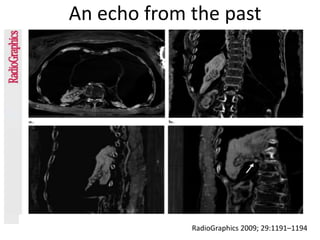
An echo from the past
RadioGraphics 2009; 29:1191–1194
Epidemiology
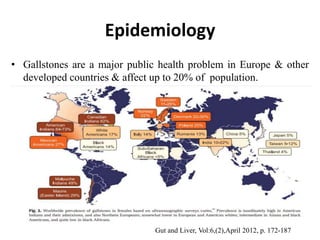
• Gallstones are a major public health problem in Europe & other
developed countries & affect up to 20% of population.
Gut and Liver, Vol:6,(2),April 2012, p. 172-187
Burden
“Hindustan Times” Tuesday, Apr 12, 2022
Remits of today’s talk
 Dx, medical & surgical Mx & prevention of GB stones
 Dx, Endoscopic & surgical Mx of bile duct stones
 Dx & therapy of intrahepatic stones
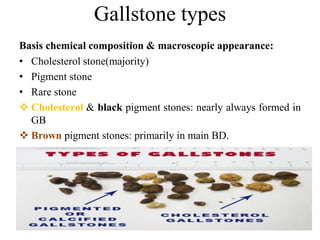
Gallstone types
Basis chemical composition & macroscopic appearance:
• Cholesterol stone(majority)
• Pigment stone
• Rare stone
 Cholesterol & black pigment stones: nearly always formed in
GB
 Brown pigment stones: primarily in main BD.
By location
RISK FACTORS
• Age & gender
• Diet
• Pregnancy & parity
• Rapid weight loss
• TNP
• Biliary sludge
• Drugs: Estrogen, clofibrate ,
octreotide, ceftriaxone
• Lipid abnormalities(TG)
• Obesity(>45 kg/m2)
• DM
• Diseases of ileum
• Spinal cord injury
• Cirrhosis of liver(CTP-c &
alcoholic)
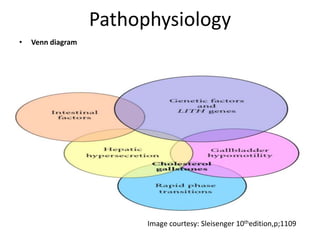
Pathophysiology
• Venn diagram
Image courtesy: Sleisenger 10thedition,p;1109
Dx of GB stones
• 80% of carriers are asymptomatic.
• Symptoms develop with a rate of 1–4%/yr, 20% becoming
symptomatic within 20 yrs of Dx .
• Complications occur with a rate of 1–3%/yr after 1st colic
episode & 0.1–0.3% in asymptomatic pts.
J Hepatol,Vol:xxx,March 2016 p:1-20
Cont….
Complications Of GB stone
• Acute or chronic Cholecystitis
• Biliary pancreatitis
• Cholangitis
• Emphysematous cholecystitis
• Cholecysto-enteric fistula
• Mirrizzi’s syndrome
• Porcelain GB
Sleisenger & Fordtran's gastrointestinal and liver disease: 10th edition
When & what Investigation?
 Pt with recent H/O biliary pain, abdominal USG should be
performed.
 With strong clinical suspicion of GB stones & -ve abdominal
USG, EUS / MRCP may be performed.
 No role of lab test except complcation – cholangitis,
pancreatitis, cholecystitis.
J Hepatol,Vol:xxx,March 2016 p:1-20
Imaging
Acute cholecystitis
Suspected in pt with fever, severe pain in RUQ lasting for several
hrs & RUQ tenderness on palpation (Murphy’s sign).
• Investigation
 WBC count
 CRP
 USG (distended GB, thickened (>4 mm) GB wall,
pericholecystic fluid & a sonographic Murphy’s sign)
 CT scan (GB wall emphysema, abscess formation &
perforation)
 Radioisotope cholescintigraphy (Tc-HIDA scan)
Cont…………..
Cont….
Medical therapy of GB stones
Bile acid dissolution therapy :
Litholysis using bile acids alone /combination with ESWL : not
recommended for GB stones.
Although meta-analysis of studies on litholysis using UDCA showed
success in stones Of
 small(<10 mm)
 non-calcified
 functioning GB
** (63% of pts free from stones after > 6 mons).
J Hepatol,Vol:xxx,March 2016 p:1-20
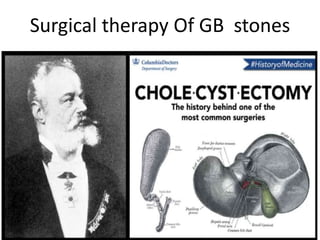
Surgical therapy Of GB stones
Surgical therapy of GB stones
• Symptomatic GB stones: Cholecystectomy - Preferred
option.
• Approximately 1/2 of pts with symptomatic stone have
recurring colic.
• Risk of complications such as acute cholecystitis, biliary
pancreatitis, obstructive jaundice & cholangitis is 0.5–3%/yr.
J Hepatol,Vol:xxx, March 2016 p:1-20
Asymptomatic GB stones
• Routine Rx is not recommended.
• Reassured that life-threatening complications are
uncommon.
• Symptom related to stone develop only minority of pts.
• Most pts in whom complications of gallstone develop have
antecedent biliary pain.
Cont.
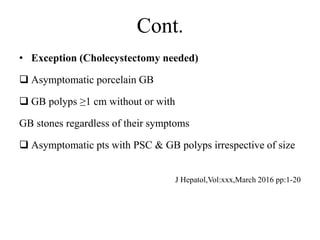
• Exception (Cholecystectomy needed)
 Asymptomatic porcelain GB
 GB polyps ≥1 cm without or with
GB stones regardless of their symptoms
 Asymptomatic pts with PSC & GB polyps irrespective of size
J Hepatol,Vol:xxx,March 2016 pp:1-20
• Cholecysyectomy in asymptomatic GB stone:
• Large stone > 2cm
• Non-functional GB
• Porcelin GB
• Pt with spinal cord inj./sensory neuropathy
affecting abdomen
• Pt with sickle cell anaemia
• Pt with medically complicated disese
(Cirrhosis,Portal HTN,) Harrison
Some recommedation of surgery
 Cholecystectomy : not recommended for asymptomatic stones
during abdominal surgery.
 Early phase after heart/lung transplantation with
symptomatic GB stones, cholecystectomy should be deferred.
 Cholecystectomy in asymptomatic gallstones:
• Hereditary spherocytosis & sickle cell disease during
splenectomy.
• During abdominal surgery for other reasons in sickle cell
disease to avoid diagnostic uncertainty in case of sickle cell
crises.
J Hepatol,Vol:xxx,March 2016 p:1-20
GB stone in pregnancy
• Lap chole can perform in any trimester.
• Asymptomatic GB & bile duct stones who are asymptomatic
after bile duct clearance should undergo cholecystectomy post
partum.
• Better in 2nd trimester : 3rd trimester better to avoid due to
abdominal crowding.
J Hepatol,Vol:xxx,March 2016 p:1-20
Type of cholecystectomy
• Laparoscopic cholecystectomy : Standard method for
symptomatic GB stones (even with CTP- A & B liver
cirrhosis).
• Open cholecystestomy
 Strong suspicion of (advanced) GB carcinoma.
 Mirizzi II (fistula betw GM & hepatic duct)
 Gallstone ileus
J Hepatol,Vol:xxx,March 2016 p:1-20
Future : Man- machine symbiosis
Timing of cholecystectomy
• As early as possible for uncomplicated biliary Colic.
• Early lap chole (preferably within 72 hrs of admission) should be
done in acute cholecystitis.
• Simultaneous GB & bile duct stones : ERCP followed by Early
lap chole (within 72 hrs).
• Elderly with high anaesthetic risk with complications (acute
cholecystitis, gallstone pancreatitis/obstructive jaundice) lap chole
done as soon as general status allows surgery.
J Hepatol,Vol:xxx,March 2016 p:1-20
“It's so much easier to suggest
solutions when you don't know too
much about the problem.” ― Malcolm
Forbes.
Post-cholecystectomy syndrome (PCS)
Extra-biliary disorder:
 Reflux oesophagitis,
 peptic ulceration,
 IBS
 Chronic pancreatitis.
Biliary aetiologies :
• Biliary strictures/leakage
• Retained calculi
• Dropped calculi
• Chronic biloma/abscess
• Long cystic duct remnant
• SOD
• Bile salt-induced
diarrhea/gastritis
*For evaluation: EUS,MRCP
Jaunoo S et al. Inter J of surgery. 2010
Jan 1;8(1):15-7.
GB sludge
• Mixture of particulate solids that have precipitated from bile
consists of cholesterol crystals, Ca bilirubinate pigment & other Ca
salts.
• Resolve spontaneously: 50% , Stone develops: 5-15% cases.
Shaffer EA et al.Current gastroenterology reports. 2001 Mar;3(2):166-73.
Cont……
Shaffer EA et al.Current gastroenterology reports. 2001 Mar;3(2):166-73.
Prevention of GB stone
• Primary prevention
• Lifestyle: Healthy food, regular physical activity & ideal body wt
prevent cholesterol GB stones.
• Physical activity:70% decreased risk of symptomatic GB stones in
both sexes. Effect is seen after 5yrs.
• Diet:
• High fiber & calcium diets.Fruits ,Vegetables & vegetable oils,
• Vit C, Poly- & monounsaturated fats &
• Nut consumption
• ?? Controversial: Caffeine, alcohol,Statin,Ezetimide
J Hepatol,Vol:xxx,March 2016 p:1-20
Primary prevention of GB stones in
high risk groups
• Rapid wt loss temporary UDCA may be recommended until body wt
has stabilized.
• Prophylactic cholecytectomy not routinely indicated during
bariatric surgery.
• Long-term somatostatin/analogues, concomitant UDCA can
consider to prevent cholesterol stone.
• No indication for pharmacological/surgical stone prevention during
HRT, TPN & Prevention of recurrent bile duct stones.
J Hepatol,Vol:xxx,March 2016 p:1-20
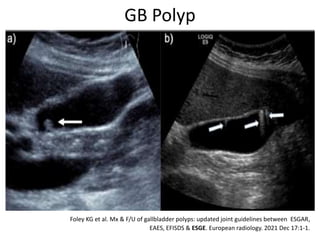
GB Polyp
Foley KG et al. Mx & F/U of gallbladder polyps: updated joint guidelines between ESGAR,
EAES, EFISDS & ESGE. European radiology. 2021 Dec 17:1-1.
Cont…..
Indn of Cholecystectomy:
>1 cm
6-9 mm polyp with 1 of following risk of Mg-:
 Age> 60
 PSC
 Asian
 Sessile polypoid lesion with focal GB wall thickening > 4mm.
6-9 mm /< 5 mm without risk of Mg:
 F/U USG- 6 mons, 1 yr & 2 yrly
 Discontinue F/U > 2 yrs in absence of growth.
Foley KG et al. Mx & F/U of gallbladder polyps: updated joint guidelines between ESGAR,
EAES, EFISDS & ESGE. European radiology. 2021 Dec 17:1-1.
Dx of bile duct stones
• Like GB, stones in BD may remain asymptomatic for yrs.
• 3-10%% of pts with GB stones also have bile duct stone.
• Conversely 95% with BD stone have GB stones.
Common presentation:
 Biliary colic
 Ascending cholangitis
 Obstructive jaundice
 Acute biliary pancreatitis
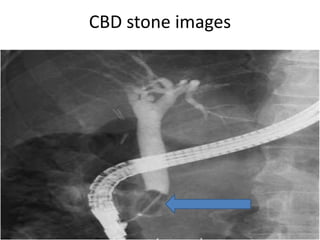
CBD stones should search for pts with jaundice, acute
cholangitis/acute pancreatitis
Cont.
Laboratory Dx & imaging
 Abdominal US (CBD sometimes not dilated)
 EUS (< 5mm stone can detected)
 MRCP
 Liver biochemical test
 ERCP- If concomitant endoscopic therapy is envisaged (high SEN)
** LFTs & Abdominal US – as initial steps (ESGE, Endoscopy,2019)
CBD stone images
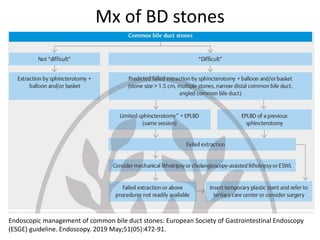
Mx of BD stones
Endoscopic management of common bile duct stones: European Society of Gastrointestinal Endoscopy
(ESGE) guideline. Endoscopy. 2019 May;51(05):472-91.
Rx of BD stones without
Complications
 Choledocholithiasis warrants Rx in nearly all cases.
 Endoscopic sphincterotomy & stone extraction : Recommended Rx
of bile duct stones.
 Balloon & basket catheters : equally effective & safe for CBDs.
 Temporary biliary plastic stent in irretrievable stones.
 Plastic stent should be removed/ exchanged within 3 – 6 mons to
avoid infectious complications.
ESGE guideline. Endoscopy. 2019 May;51(05):472-91.
Cont…
• Intra-operative ERCP / laparoscopic bile duct exploration
with cholecystectomy : alternatives if adequate expertise
available
• Laparoscopic cholecystectomy within 2 wks from ERCP.
• Percutaneous stone extraction with acute cholangitis : ERCP
is not feasible/ successful within recommended timeframes.
• ERCP : Safe & effective in pregnancy
ERCP stone extraction
Courtesy: Dr Royes Uddin ,
Gastroenterolgy dptt.SSMC Mitford Hospital
Cont.
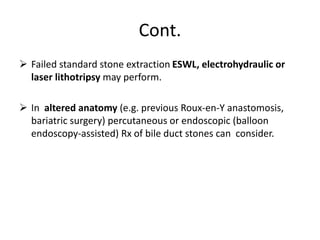
 Failed standard stone extraction ESWL, electrohydraulic or
laser lithotripsy may perform.
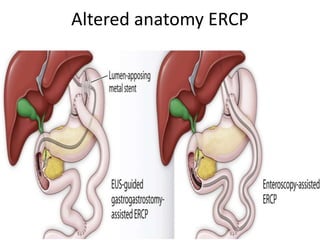
 In altered anatomy (e.g. previous Roux-en-Y anastomosis,
bariatric surgery) percutaneous or endoscopic (balloon
endoscopy-assisted) Rx of bile duct stones can consider.
ESWL by lithotripsy basket
Cholangioscope assisted ESWL
Altered anatomy ERCP
Cont.
 Failed endoscopic therapy : cholecystectomy combined with
BD exploration /intraoperative ERCP(Rendezvous) should
perform.
 Intraoperative detection of BD stones : bile duct
exploration& transcystic stone extraction/ endoscopic
clearance represent alternative Rx options.
 In postoperative Dx of BD stones, endoscopic sphincterotomy
& stone extraction are recommended.
 Simultaneous GB & BD stones : ERCP followed by early lap
chole ( within 72 hrs).
Rx of acute cholangitis
 Immediate broad spectrum antibiotics
 Biliary decompression within 24 hrs.
Endoscopic Rx with sphincterotomy - preferred mode. Or
Biliary stenting with stone removal
If failed - percutaneous bile duct drainage is choice.
Rx of acute biliary pancreatitis
• Biliary pancreatitis with suspected coexistent acute
cholangitis antibiotics should be initiated & ERCP with
sphincterotomy and stone extraction should perform with
timing depends on the severity of cholangitis, better within
24 hr.
• Early ERCP not recommeded in absence of
Cholangitis
Obstructed bile duct
Cont.
 Suspected biliary pancreatitis without cholangitis,
EUS
or
MRCP may prevent potential ERCP & its risks.
 Cholecystectomy during the same hospital admission is the
preferred option in mild acute biliary pancreatitis.
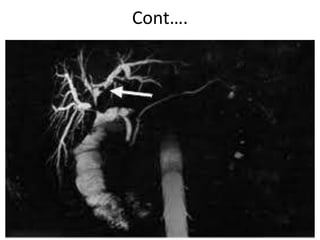
Dx & Rx of intrahepatic BD stones
Hepatolithiasis typically occur in
 Bile duct strictures & after bile duct injury
 primary /secondary sclerosing cholangitis
 recurrent pyogenic cholangitis
Ix:
Abdominal US-1st choice
MRCP - 2nd
J Hepatol,Vol:xxx,March 2016 p:1-20
Cont….
Cont.
Rx options:
Asymptomatic intra-hepatic BD stones do not always need to treat.
 Partial hepatectomy (unilateral disease,biliary stricture &lobar
atrophy )
 Peroral cholangioscopic lithotripsy (POCSL) or
 Percutaneous transhepatic cholangioscopic
Lithotripsy (PTCSL)
# Rx decision should made individually for each pt & inter-
disciplinarily for symptomatic intrahepatic BD stones.
J Hepatol,Vol:xxx,March 2016 p:1-20
Gallstone  management .pptx

Gallstone management .pptx

  • 1.
    A tale OfBiliary lithiasis DR Md kamal uddin Sohel MD(Medicine) MACP(USA) MO. Gastroenterology Deptt.
  • 2.
    An echo fromthe past RadioGraphics 2009; 29:1191–1194
  • 3.
    Epidemiology • Gallstones area major public health problem in Europe & other developed countries & affect up to 20% of population. Gut and Liver, Vol:6,(2),April 2012, p. 172-187
  • 4.
  • 5.
    Remits of today’stalk  Dx, medical & surgical Mx & prevention of GB stones  Dx, Endoscopic & surgical Mx of bile duct stones  Dx & therapy of intrahepatic stones
  • 6.
    Gallstone types Basis chemicalcomposition & macroscopic appearance: • Cholesterol stone(majority) • Pigment stone • Rare stone  Cholesterol & black pigment stones: nearly always formed in GB  Brown pigment stones: primarily in main BD.
  • 7.
  • 8.
    RISK FACTORS • Age& gender • Diet • Pregnancy & parity • Rapid weight loss • TNP • Biliary sludge • Drugs: Estrogen, clofibrate , octreotide, ceftriaxone • Lipid abnormalities(TG) • Obesity(>45 kg/m2) • DM • Diseases of ileum • Spinal cord injury • Cirrhosis of liver(CTP-c & alcoholic)
  • 9.
    Pathophysiology • Venn diagram Imagecourtesy: Sleisenger 10thedition,p;1109
  • 10.
    Dx of GBstones • 80% of carriers are asymptomatic. • Symptoms develop with a rate of 1–4%/yr, 20% becoming symptomatic within 20 yrs of Dx . • Complications occur with a rate of 1–3%/yr after 1st colic episode & 0.1–0.3% in asymptomatic pts. J Hepatol,Vol:xxx,March 2016 p:1-20
  • 11.
  • 12.
    Complications Of GBstone • Acute or chronic Cholecystitis • Biliary pancreatitis • Cholangitis • Emphysematous cholecystitis • Cholecysto-enteric fistula • Mirrizzi’s syndrome • Porcelain GB Sleisenger & Fordtran's gastrointestinal and liver disease: 10th edition
  • 13.
    When & whatInvestigation?  Pt with recent H/O biliary pain, abdominal USG should be performed.  With strong clinical suspicion of GB stones & -ve abdominal USG, EUS / MRCP may be performed.  No role of lab test except complcation – cholangitis, pancreatitis, cholecystitis. J Hepatol,Vol:xxx,March 2016 p:1-20
  • 14.
  • 15.
    Acute cholecystitis Suspected inpt with fever, severe pain in RUQ lasting for several hrs & RUQ tenderness on palpation (Murphy’s sign). • Investigation  WBC count  CRP  USG (distended GB, thickened (>4 mm) GB wall, pericholecystic fluid & a sonographic Murphy’s sign)  CT scan (GB wall emphysema, abscess formation & perforation)  Radioisotope cholescintigraphy (Tc-HIDA scan)
  • 16.
  • 17.
  • 18.
    Medical therapy ofGB stones Bile acid dissolution therapy : Litholysis using bile acids alone /combination with ESWL : not recommended for GB stones. Although meta-analysis of studies on litholysis using UDCA showed success in stones Of  small(<10 mm)  non-calcified  functioning GB ** (63% of pts free from stones after > 6 mons). J Hepatol,Vol:xxx,March 2016 p:1-20
  • 19.
  • 20.
    Surgical therapy ofGB stones • Symptomatic GB stones: Cholecystectomy - Preferred option. • Approximately 1/2 of pts with symptomatic stone have recurring colic. • Risk of complications such as acute cholecystitis, biliary pancreatitis, obstructive jaundice & cholangitis is 0.5–3%/yr. J Hepatol,Vol:xxx, March 2016 p:1-20
  • 21.
    Asymptomatic GB stones •Routine Rx is not recommended. • Reassured that life-threatening complications are uncommon. • Symptom related to stone develop only minority of pts. • Most pts in whom complications of gallstone develop have antecedent biliary pain.
  • 22.
    Cont. • Exception (Cholecystectomyneeded)  Asymptomatic porcelain GB  GB polyps ≥1 cm without or with GB stones regardless of their symptoms  Asymptomatic pts with PSC & GB polyps irrespective of size J Hepatol,Vol:xxx,March 2016 pp:1-20
  • 23.
    • Cholecysyectomy inasymptomatic GB stone: • Large stone > 2cm • Non-functional GB • Porcelin GB • Pt with spinal cord inj./sensory neuropathy affecting abdomen • Pt with sickle cell anaemia • Pt with medically complicated disese (Cirrhosis,Portal HTN,) Harrison
  • 24.
    Some recommedation ofsurgery  Cholecystectomy : not recommended for asymptomatic stones during abdominal surgery.  Early phase after heart/lung transplantation with symptomatic GB stones, cholecystectomy should be deferred.  Cholecystectomy in asymptomatic gallstones: • Hereditary spherocytosis & sickle cell disease during splenectomy. • During abdominal surgery for other reasons in sickle cell disease to avoid diagnostic uncertainty in case of sickle cell crises. J Hepatol,Vol:xxx,March 2016 p:1-20
  • 25.
    GB stone inpregnancy • Lap chole can perform in any trimester. • Asymptomatic GB & bile duct stones who are asymptomatic after bile duct clearance should undergo cholecystectomy post partum. • Better in 2nd trimester : 3rd trimester better to avoid due to abdominal crowding. J Hepatol,Vol:xxx,March 2016 p:1-20
  • 26.
  • 27.
    Type of cholecystectomy •Laparoscopic cholecystectomy : Standard method for symptomatic GB stones (even with CTP- A & B liver cirrhosis). • Open cholecystestomy  Strong suspicion of (advanced) GB carcinoma.  Mirizzi II (fistula betw GM & hepatic duct)  Gallstone ileus J Hepatol,Vol:xxx,March 2016 p:1-20
  • 28.
    Future : Man-machine symbiosis
  • 30.
    Timing of cholecystectomy •As early as possible for uncomplicated biliary Colic. • Early lap chole (preferably within 72 hrs of admission) should be done in acute cholecystitis. • Simultaneous GB & bile duct stones : ERCP followed by Early lap chole (within 72 hrs). • Elderly with high anaesthetic risk with complications (acute cholecystitis, gallstone pancreatitis/obstructive jaundice) lap chole done as soon as general status allows surgery. J Hepatol,Vol:xxx,March 2016 p:1-20
  • 31.
    “It's so mucheasier to suggest solutions when you don't know too much about the problem.” ― Malcolm Forbes.
  • 32.
    Post-cholecystectomy syndrome (PCS) Extra-biliarydisorder:  Reflux oesophagitis,  peptic ulceration,  IBS  Chronic pancreatitis. Biliary aetiologies : • Biliary strictures/leakage • Retained calculi • Dropped calculi • Chronic biloma/abscess • Long cystic duct remnant • SOD • Bile salt-induced diarrhea/gastritis *For evaluation: EUS,MRCP Jaunoo S et al. Inter J of surgery. 2010 Jan 1;8(1):15-7.
  • 33.
    GB sludge • Mixtureof particulate solids that have precipitated from bile consists of cholesterol crystals, Ca bilirubinate pigment & other Ca salts. • Resolve spontaneously: 50% , Stone develops: 5-15% cases. Shaffer EA et al.Current gastroenterology reports. 2001 Mar;3(2):166-73.
  • 34.
    Cont…… Shaffer EA etal.Current gastroenterology reports. 2001 Mar;3(2):166-73.
  • 35.
    Prevention of GBstone • Primary prevention • Lifestyle: Healthy food, regular physical activity & ideal body wt prevent cholesterol GB stones. • Physical activity:70% decreased risk of symptomatic GB stones in both sexes. Effect is seen after 5yrs. • Diet: • High fiber & calcium diets.Fruits ,Vegetables & vegetable oils, • Vit C, Poly- & monounsaturated fats & • Nut consumption • ?? Controversial: Caffeine, alcohol,Statin,Ezetimide J Hepatol,Vol:xxx,March 2016 p:1-20
  • 36.
    Primary prevention ofGB stones in high risk groups • Rapid wt loss temporary UDCA may be recommended until body wt has stabilized. • Prophylactic cholecytectomy not routinely indicated during bariatric surgery. • Long-term somatostatin/analogues, concomitant UDCA can consider to prevent cholesterol stone. • No indication for pharmacological/surgical stone prevention during HRT, TPN & Prevention of recurrent bile duct stones. J Hepatol,Vol:xxx,March 2016 p:1-20
  • 37.
    GB Polyp Foley KGet al. Mx & F/U of gallbladder polyps: updated joint guidelines between ESGAR, EAES, EFISDS & ESGE. European radiology. 2021 Dec 17:1-1.
  • 38.
    Cont….. Indn of Cholecystectomy: >1cm 6-9 mm polyp with 1 of following risk of Mg-:  Age> 60  PSC  Asian  Sessile polypoid lesion with focal GB wall thickening > 4mm. 6-9 mm /< 5 mm without risk of Mg:  F/U USG- 6 mons, 1 yr & 2 yrly  Discontinue F/U > 2 yrs in absence of growth. Foley KG et al. Mx & F/U of gallbladder polyps: updated joint guidelines between ESGAR, EAES, EFISDS & ESGE. European radiology. 2021 Dec 17:1-1.
  • 39.
    Dx of bileduct stones • Like GB, stones in BD may remain asymptomatic for yrs. • 3-10%% of pts with GB stones also have bile duct stone. • Conversely 95% with BD stone have GB stones. Common presentation:  Biliary colic  Ascending cholangitis  Obstructive jaundice  Acute biliary pancreatitis CBD stones should search for pts with jaundice, acute cholangitis/acute pancreatitis
  • 40.
    Cont. Laboratory Dx &imaging  Abdominal US (CBD sometimes not dilated)  EUS (< 5mm stone can detected)  MRCP  Liver biochemical test  ERCP- If concomitant endoscopic therapy is envisaged (high SEN) ** LFTs & Abdominal US – as initial steps (ESGE, Endoscopy,2019)
  • 41.
  • 42.
    Mx of BDstones Endoscopic management of common bile duct stones: European Society of Gastrointestinal Endoscopy (ESGE) guideline. Endoscopy. 2019 May;51(05):472-91.
  • 43.
    Rx of BDstones without Complications  Choledocholithiasis warrants Rx in nearly all cases.  Endoscopic sphincterotomy & stone extraction : Recommended Rx of bile duct stones.  Balloon & basket catheters : equally effective & safe for CBDs.  Temporary biliary plastic stent in irretrievable stones.  Plastic stent should be removed/ exchanged within 3 – 6 mons to avoid infectious complications. ESGE guideline. Endoscopy. 2019 May;51(05):472-91.
  • 44.
    Cont… • Intra-operative ERCP/ laparoscopic bile duct exploration with cholecystectomy : alternatives if adequate expertise available • Laparoscopic cholecystectomy within 2 wks from ERCP. • Percutaneous stone extraction with acute cholangitis : ERCP is not feasible/ successful within recommended timeframes. • ERCP : Safe & effective in pregnancy
  • 45.
    ERCP stone extraction Courtesy:Dr Royes Uddin , Gastroenterolgy dptt.SSMC Mitford Hospital
  • 46.
    Cont.  Failed standardstone extraction ESWL, electrohydraulic or laser lithotripsy may perform.  In altered anatomy (e.g. previous Roux-en-Y anastomosis, bariatric surgery) percutaneous or endoscopic (balloon endoscopy-assisted) Rx of bile duct stones can consider.
  • 47.
  • 48.
  • 49.
  • 50.
    Cont.  Failed endoscopictherapy : cholecystectomy combined with BD exploration /intraoperative ERCP(Rendezvous) should perform.  Intraoperative detection of BD stones : bile duct exploration& transcystic stone extraction/ endoscopic clearance represent alternative Rx options.  In postoperative Dx of BD stones, endoscopic sphincterotomy & stone extraction are recommended.  Simultaneous GB & BD stones : ERCP followed by early lap chole ( within 72 hrs).
  • 51.
    Rx of acutecholangitis  Immediate broad spectrum antibiotics  Biliary decompression within 24 hrs. Endoscopic Rx with sphincterotomy - preferred mode. Or Biliary stenting with stone removal If failed - percutaneous bile duct drainage is choice.
  • 52.
    Rx of acutebiliary pancreatitis • Biliary pancreatitis with suspected coexistent acute cholangitis antibiotics should be initiated & ERCP with sphincterotomy and stone extraction should perform with timing depends on the severity of cholangitis, better within 24 hr. • Early ERCP not recommeded in absence of Cholangitis Obstructed bile duct
  • 53.
    Cont.  Suspected biliarypancreatitis without cholangitis, EUS or MRCP may prevent potential ERCP & its risks.  Cholecystectomy during the same hospital admission is the preferred option in mild acute biliary pancreatitis.
  • 54.
    Dx & Rxof intrahepatic BD stones Hepatolithiasis typically occur in  Bile duct strictures & after bile duct injury  primary /secondary sclerosing cholangitis  recurrent pyogenic cholangitis Ix: Abdominal US-1st choice MRCP - 2nd J Hepatol,Vol:xxx,March 2016 p:1-20
  • 55.
  • 56.
    Cont. Rx options: Asymptomatic intra-hepaticBD stones do not always need to treat.  Partial hepatectomy (unilateral disease,biliary stricture &lobar atrophy )  Peroral cholangioscopic lithotripsy (POCSL) or  Percutaneous transhepatic cholangioscopic Lithotripsy (PTCSL) # Rx decision should made individually for each pt & inter- disciplinarily for symptomatic intrahepatic BD stones. J Hepatol,Vol:xxx,March 2016 p:1-20

Editor's Notes

  • #2 Journal of Hepatology, 65, 1, (2016), pp. 146-181
  • #3 Figure. Axial scan (a) and multiplanar reconstructions (b–d) from multidetector CT of the upper abdomen in the mummy of Kha (SUPPL 8431, CGT 13015; Egyptian Museum, Turin, Italy), dating from the Eighteenth Dynasty. The liver appears as solid dehydrated tissue in a right-sided paravertebral subdiaphragmatic position. In the gallbladder, several hyperattenuating stones are evident. In d, an oblique view, a stone is visible in the infundibulum (arrow).
  • #5 Hindustan Times Tuesday, Apr 12, 2022. 5,070 gallstones removed from Kota man: 30 minutes for surgery, 2 hours to count Doctors say, usually between two and 100 gallstones are removed during a surgery. Mohammad Shabbir underwent a surgery to remove gallbladder stones on February 28
  • #6 Lammert F, Acalovschi M, Ercolani G, van Erpecum KJ, Gurusamy K, van Laarhoven CJ, Portincasa P. EASL Clinical Practice Guidelines on the prevention, diagnosis and treatment of gallstones.
  • #7 On the basis of chemical composition & macroscopic appearance Pigment stone :black pigment & brown pigment stone)
  • #8 By location 3 types: Intra-hepatic stone ( Predominently brown pigment stone) GB stone (mainly cholesterol stones & small group of black pigment stones) Choledocholithiasis (mostly mixed cholesterol stones)
  • #11 The natural history of asymptomatic gallstones suggests that most remain asymptomatic throughout life.
  • #12 3 significant symptoms in gallstones: biliary colic , nausea & vomiting. 50% of pts pain episodes recur after 1st biliary attack. Pain duration > 5 hrs indicates acute cholecystitis. Laboratory tests do not contribute to Dx uncomplicated symptomatic GB stones.
  • #14 No role of lab test except complcation –cholangitis,pancreatitis,cholecystitis
  • #19 Better in stone <5mm diameter
  • #20 1st open cholecystectomy by Dr Carl Johann August Langenbuch (German sugeon) in July 15 1882 at Lazarus in Berlin.
  • #21 UDCA and ESWL but such treatments cannot be recommended because of the low rate of cure, high rate of recurrence of gallstones, and the lack of effectiveness in preventing symptoms and complications after medical treatment.
  • #22 Annual complications is 0.1–0.3%. cholecystectomy of asymptomatic patients with gallbladder stones does not increase their life expectancy, because the risk of surgery (mortality and morbidity) outweighs the probability of complications & costs
  • #23 polyps 6-10 mm and in case of growing polyps-cholecystctmy(w). <5mm asympt –not recommnd(s )
  • #25 Abdominal surgery (bariatric surgery,kidney, lung or pancreas transplantation).
  • #26 Better in 2nd trimester .3rd trimester better to avoid due to abdominal crowding.
  • #28 hospital stay of 3 days shorter and a 3 weeks shorter convalescence period. ‘small-incision cholecystectomy
  • #31 . Delaying - risk of gallstone complications. Early- decreases morbidity during the waiting period for elective laparoscopic cholecystectomy
  • #32 Malcolm Stevenson Forbes (August 19, 1919 – February 24, 1990) was an American entrepreneur most prominently known as the publisher of Forbes magazine,
  • #33 Endoscopic sphincterotomy is not supported for PCS. 10 -40%. hve . presence of bile duct stones should be excluded.RCT- UDCA for a few months, the biliary-type abdominal pain improved or resolved as most r coz by microlithiasis dx by ERCP duodenal bile microspy.
  • #34 D/D of sludge: Tumor, Haemobilia, Pus
  • #37 UDCA at least 500mg /day
  • #38 Fig. 2 Selected images from two different patients show (a) true gallbladder polyp and (b) a pseudo-polyp demonstrating posterior reverber
  • #40 It might be challenging to differentiate the pain from that caused by gallbladder stones Ref:Manes G, Paspatis G, Aabakken L, Anderloni A, Arvanitakis M, Ah-Soune P, Barthet M, Domagk D, Dumonceau JM, Gigot JF, Hritz I. Endoscopic management of common bile duct stones: European Society of Gastrointestinal Endoscopy (ESGE) guideline. Endoscopy. 2019 May;51(05):472-91.
  • #41 Abd Us –ist image inconclusive-EUS ,MRCP ERCP –high sencitivity. US confirmation of small gallstones increases the possibility that they can migrate into the CBD[.
  • #42 Unfortunately, US often fails to confirm the presence of CBDSs because they do not show the characteristic acoustic shading or are located in the distal part of the choledochus, where they can be obscured by gas
  • #43 “Difficult” biliary stones : diameter (> 1.5 cm), multiple, unusual shape (barrel-shaped), or location (intrahepatic, cystic duct), or anatomical factors (narrowing of BD distal to stone, sigmoid-shaped CBD, impaction, shorter length of distal CBD or acute distal CBD angulation < 135°). Dx pitfalls of MRCP: Localized signal void area also found in Surgical clip, Intraductal gas & blood. Ref:Grainger & Allisons “ Diagnostic Radiology” book.
  • #52 Dx= charcot triad- pain fever jaundce. CBC ,CRP ALP ,LFT & US but EUS better than MRCP
  • #54 severe biliary pancreatitis with peripancreatic collections - at least 6 weeks after pancreatitis onset.
  • #55 Ascending cholangitis - acute complication . chronic complications –secondary biliary cirrhosis, segmental or lobar atrophy, liver abscess, and cholangiocarcinoma
  • #57 For planning of Rx, both ERCP and PTC impotant. Last 2 options for diffusely distributed stones