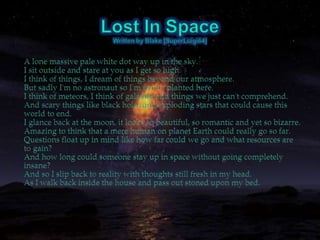
 In the poem Lost In Space, there is a person
who thinks about the events that goes on
outside our home. It explains how humanity is
so small, and yet, they travel so far. We learn
lots of unimaginable things such as black holes
and dark matter. Astronauts either use them to
our advantage or furthermore explore into the
universe. This poem includes end rhymes in
the last words of the verses.
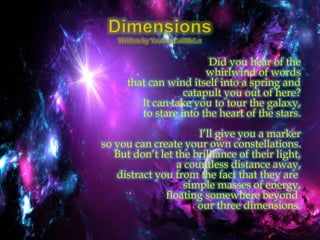
Did you hear of the
whirlwind of words
that can wind itself into a spring and
catapult you out of here?
It can take you to tour the galaxy,
to stare into the heart of the stars.
I’ll give you a marker
so you can create your own constellations.
But don’t let the brilliance of their light,
a countless distance away,
distract you from the fact that they are
simple masses of energy,
floating somewhere beyond
our three dimensions.
I like how the author of Dimensions talks to the
readers and grabs their attention. The author
lets you create your own imagination of a
galaxy. This poem includes imagery and is a
free verse type of poem. The imagery combines
with the presence of the reader, thus grabbing a
stronger attention. There is no rhyming in the
poem, therefore it is a free verse.
Mysteries revealed and mysteries solved
Events past and present
Biology, archeology, astronomy and physics
A world of discovery
Old or new amazing buildings
Spaceships, first man on the moon
The robots who would take over our jobs
Natural disasters such as tornado or flood
Immerse yourself in history
Was, Napoleon Europe's problem child
Was, Sankt Nikolaus a historical person
Can we make a journey through time
The past meets the future
Anne Lise Andreson combines the past, present,
and the inevitable future events into one
universe topic. She includes these different
types of stuff that corresponds to science or the
universe, creating a thoughtful poem. It makes
readers think how these things have, will, or
affect themselves, planets and the universe.
This poem is a blank verse poem because it has
no rhymes or close to rhymes anywhere in the
verses.
Looking beyond the skies, see the stars so far
away.
Shining bright through the night, till one of them
brings us day.
Rigel, Arcturus, and Sirius too.
Which one a red giant? Which one a massive blue?
Through the right set of eyes, you can see them up
close.
Or look to the other moons, the planets,
quite gazed upon the most.
The red world, the ring world, the big orange ball.
The burning world, the ice world. Can you name
them all?
Floating in this emptiness, around the sun we race.
Floating in this black void, this place we call space.
And beyond our own neighborhood there's more
and there's more.
Looking above the clouds, to see what's in store.
Andromeda, the crab nebula,
the famed horse head.
So far apart in this universe,
almost forever we're spread.
There's pulsars, there's quasars, and neutron stars.
Neutrinos, and black holes, and moons covered in
scars.
Comets and asteroids and big clouds of gas.
Some objects that don't seem to move at all,
and some unbelievable fast.
Looking beyond the heavens, there's just so many
things.
From huge supernovae to impossibly small strings.
Every where you turn, there's always much more.
So much do discover, with an infinity to explore.
But the most amazing thing we know,
of to which the universe has given birth.
The most overlooked place of all,
the planet we call earth.
And because we're down here, and we look up
there.
Just maybe, there has to be.
More life somewhere?
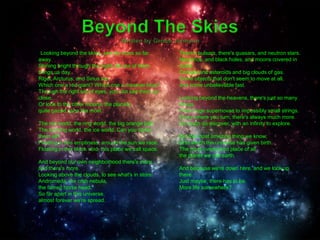
 I like this poem because it names tons of
different stuff in the universe. It tells about the
different types of stars, asteroids, and nebulas.
In addition, it indirectly states that we know
most about our home planet and we want to
know more about other galaxies, in order to
figure out if there is a place similar to Earth and
humans. This poem includes end rhyme and a
rhyme scheme of every other sentence. A
rhymes but B does not.
It’s good to stretch our minds
and study outer space
where trillions of the stars
a smallness does erase.
With light-years in the billions
we cannot realize
the vastness of our space
that all around us lies.
All of this vast space,
in light-years so we say
belongs to only one—
it is God’s domain.
Ruler over space,
creator of it too,
we can see how vast he is
and get another view.
 Carolyn W. states that God has created the
universe and everything inside of it, while
scientists are getting closer to a different
conclusion to the born of the universe. I like
this poem because it says how we cannot
imagine how large space is, only with
extremely large galaxies next to galaxies. This
poem’s mood is kind of saddening because of
the explanation of how “vast” our universe is.
The sun is yet a star
tho we don’t think of it—
the center of our solar
system
we see quite a bit.
The stars are balls of
gas
held by gravity.
They are very hot and
bright
as we all can see.
They are formed in
nebulas
of gas and too of dust
found often in the
galaxies
far away from us.
Gravity attracts
an even greater mass,
where increasing density
heats up the inner gas.
At first it is dull red
but later it does shine
after fusion of the gases
happening over time.
 This poem explains how stars are formed and
how it changes over time. Gravity pulls it
together and keeps it running, slightly
changing color from beginning to end. The
poem is a blank verse, having no rhymes in the
verses.
The Whirlpool Galaxy
is next,
unusual to see
with its spiral arms
outstretched
very openly.
It is a spiral galaxy
like the Milky Way—
15 million light-years
shining far away.
In the middle of it
as a young blue star
glowing very brightly
in the center of the
arms.
Another reaches into
space
to a smaller galaxy
and both of them do
glow,
blue stars quite
intensely.
 I like whirlpool galaxies, because it is colorful
and glowing, as stated in the poem. This poem
has imagery, making readers imagine how
distant, large and glowing the galaxy is. Many
stars shine inside of the galaxies, some
twinkling and some glowing from a range of
red to blue. This poem creates an image of a
peaceful galaxy.
Farther on in space
are many galaxies—
one is Andromeda—
beautiful to see.
They used to think a
cloud of gas
far out into space
but found that it’s a
galaxy
and old ideas erased.
It is a spiral galaxy
shining in the sky.
It’s arms are rather
loose,
spinning in the night.
20,000 light-years
across this galaxy.
300 billion stars
shining oh so brightly.
More than 20 billion
suns
is the light it gives,
shining oh so brightly
in a sky that lives.
Andromeda galaxies are similar to whirlpool
galaxies, just with a fancier name to it.
Andromeda galaxies also glow and are light
years away, having millions of stars and plants
contained. This poem includes personification:
It’s arms are rather loose, spinning in the night.
A 100 billion galaxies
may be in the sky,
stretching over space
that is very wide.
What once was thought a cloud or star
was found a galaxy
and space grew large by leaps and
bounds
with new astronomy.
We can see the galaxies
stretching into space
at least 10 billion light-years,
so very far away.
All the distant galaxies
are moving fast away.
The further they are from us,
the faster move in space.
The universe expanding
and space expanding too.
Will it ever stop?
We really have no clue.
Only God does know
the future of the stars
or galaxies or space
expanding as they are.
All of space is his domain
whether here on earth
where he knows our every thought
or where the stars give birth.
God is vaster than we knew
and more powerful too
that we can ever realize
by thought or wandering thru.
But we know God our Father
can shepherd every one
into his heaven of happiness
when our life is done.
 This poem also explains how vast our universe
is, holding 100 billion galaxies, ruled by God.
Only God knowing the future, the end of
expanding of the universe, the start of another.
This poem has end verse and hyperbole; the
author didn’t count 100 billion galaxies, only
just a small example compared to the larger
scale.
In the midst of all the commotion
The details of our lives; our devotion
Yet still the world turns in one motion
But beyond the chaos
Is such a bliss we miss
Beyond what we see
into the Galaxy
Truth with no bending
Stories without an ending
Balance untainted
Time unwasted
A blink of the cosmic eye
And what does it see?
I'll promise neither you or me.
With gravity at our feet its destiny we
meet
Grounded to the earth like we're blind
from birth
We were never meant to really see
The full beauty of the Galaxies
A spectrum of colors
Rain a bow of feelings
Black holes swallowing
Dark twisted healings
Sun's shining moon
Guide our night to light
Reminding us to fight each fight.
 StephanieNik tells us that we are not meant to
see the full beauty of the galaxies nor see the
bliss in the universe. There are so many
different time structures in each sections of the
galaxies that they all move in different time,
and yet all move at the same time. This poem
has end rhyme in the versus and imagery in the
stars and galaxy’s light shining throughout the
galaxy.
I believe in the abundant stars
the black holes in space
the extinction of all life on Earth
the fatal traveling gamma rays
the speed of things passing around us
But the wishing upon the shooting stars
I believe in the gray rugged mountains
I believe in the luscious green forests
I believe in the sky blue lakes
And I believe in the comfort of others in life.
Just because I am happy
don’t think I am contented
don’t wonder if I have a great life
I still want you to talk to me
Just because I am happy
it doesn’t mean im not acting
it doesn’t mean I want to be here
It doesn’t stop me from breaking down
Just because I am happy
still try to speak to me
cant wait for the next day
Just because I am happy – I want to be with you longer.
This is a llama
Llamas live in Llamagarian Empire
Llamas eat LaffyTaffy, LadyFingers, lambs and
lemongrass
Llamas love to play lacross, play League Of
Legends, lick lollipops and love leopards.
Llamas like to learn latn laugh loudly, and
lament onto the Llamapedia bed.
Llamas tried to lick me like a lollipop at eleven
llamarian years old.
The Large Tsunami
Roaring and crashing throughout
Destruction and death.
Galaxy Poems

Galaxy Poems

  • 3.
     In thepoem Lost In Space, there is a person who thinks about the events that goes on outside our home. It explains how humanity is so small, and yet, they travel so far. We learn lots of unimaginable things such as black holes and dark matter. Astronauts either use them to our advantage or furthermore explore into the universe. This poem includes end rhymes in the last words of the verses.
  • 4.
    Did you hearof the whirlwind of words that can wind itself into a spring and catapult you out of here? It can take you to tour the galaxy, to stare into the heart of the stars. I’ll give you a marker so you can create your own constellations. But don’t let the brilliance of their light, a countless distance away, distract you from the fact that they are simple masses of energy, floating somewhere beyond our three dimensions.
  • 5.
    I like howthe author of Dimensions talks to the readers and grabs their attention. The author lets you create your own imagination of a galaxy. This poem includes imagery and is a free verse type of poem. The imagery combines with the presence of the reader, thus grabbing a stronger attention. There is no rhyming in the poem, therefore it is a free verse.
  • 6.
    Mysteries revealed andmysteries solved Events past and present Biology, archeology, astronomy and physics A world of discovery Old or new amazing buildings Spaceships, first man on the moon The robots who would take over our jobs Natural disasters such as tornado or flood Immerse yourself in history Was, Napoleon Europe's problem child Was, Sankt Nikolaus a historical person Can we make a journey through time The past meets the future
  • 7.
    Anne Lise Andresoncombines the past, present, and the inevitable future events into one universe topic. She includes these different types of stuff that corresponds to science or the universe, creating a thoughtful poem. It makes readers think how these things have, will, or affect themselves, planets and the universe. This poem is a blank verse poem because it has no rhymes or close to rhymes anywhere in the verses.
  • 8.
    Looking beyond theskies, see the stars so far away. Shining bright through the night, till one of them brings us day. Rigel, Arcturus, and Sirius too. Which one a red giant? Which one a massive blue? Through the right set of eyes, you can see them up close. Or look to the other moons, the planets, quite gazed upon the most. The red world, the ring world, the big orange ball. The burning world, the ice world. Can you name them all? Floating in this emptiness, around the sun we race. Floating in this black void, this place we call space. And beyond our own neighborhood there's more and there's more. Looking above the clouds, to see what's in store. Andromeda, the crab nebula, the famed horse head. So far apart in this universe, almost forever we're spread. There's pulsars, there's quasars, and neutron stars. Neutrinos, and black holes, and moons covered in scars. Comets and asteroids and big clouds of gas. Some objects that don't seem to move at all, and some unbelievable fast. Looking beyond the heavens, there's just so many things. From huge supernovae to impossibly small strings. Every where you turn, there's always much more. So much do discover, with an infinity to explore. But the most amazing thing we know, of to which the universe has given birth. The most overlooked place of all, the planet we call earth. And because we're down here, and we look up there. Just maybe, there has to be. More life somewhere?
  • 9.
     I likethis poem because it names tons of different stuff in the universe. It tells about the different types of stars, asteroids, and nebulas. In addition, it indirectly states that we know most about our home planet and we want to know more about other galaxies, in order to figure out if there is a place similar to Earth and humans. This poem includes end rhyme and a rhyme scheme of every other sentence. A rhymes but B does not.
  • 10.
    It’s good tostretch our minds and study outer space where trillions of the stars a smallness does erase. With light-years in the billions we cannot realize the vastness of our space that all around us lies. All of this vast space, in light-years so we say belongs to only one— it is God’s domain. Ruler over space, creator of it too, we can see how vast he is and get another view.
  • 11.
     Carolyn W.states that God has created the universe and everything inside of it, while scientists are getting closer to a different conclusion to the born of the universe. I like this poem because it says how we cannot imagine how large space is, only with extremely large galaxies next to galaxies. This poem’s mood is kind of saddening because of the explanation of how “vast” our universe is.
  • 12.
    The sun isyet a star tho we don’t think of it— the center of our solar system we see quite a bit. The stars are balls of gas held by gravity. They are very hot and bright as we all can see. They are formed in nebulas of gas and too of dust found often in the galaxies far away from us. Gravity attracts an even greater mass, where increasing density heats up the inner gas. At first it is dull red but later it does shine after fusion of the gases happening over time.
  • 13.
     This poemexplains how stars are formed and how it changes over time. Gravity pulls it together and keeps it running, slightly changing color from beginning to end. The poem is a blank verse, having no rhymes in the verses.
  • 14.
    The Whirlpool Galaxy isnext, unusual to see with its spiral arms outstretched very openly. It is a spiral galaxy like the Milky Way— 15 million light-years shining far away. In the middle of it as a young blue star glowing very brightly in the center of the arms. Another reaches into space to a smaller galaxy and both of them do glow, blue stars quite intensely.
  • 15.
     I likewhirlpool galaxies, because it is colorful and glowing, as stated in the poem. This poem has imagery, making readers imagine how distant, large and glowing the galaxy is. Many stars shine inside of the galaxies, some twinkling and some glowing from a range of red to blue. This poem creates an image of a peaceful galaxy.
  • 16.
    Farther on inspace are many galaxies— one is Andromeda— beautiful to see. They used to think a cloud of gas far out into space but found that it’s a galaxy and old ideas erased. It is a spiral galaxy shining in the sky. It’s arms are rather loose, spinning in the night. 20,000 light-years across this galaxy. 300 billion stars shining oh so brightly. More than 20 billion suns is the light it gives, shining oh so brightly in a sky that lives.
  • 17.
    Andromeda galaxies aresimilar to whirlpool galaxies, just with a fancier name to it. Andromeda galaxies also glow and are light years away, having millions of stars and plants contained. This poem includes personification: It’s arms are rather loose, spinning in the night.
  • 18.
    A 100 billiongalaxies may be in the sky, stretching over space that is very wide. What once was thought a cloud or star was found a galaxy and space grew large by leaps and bounds with new astronomy. We can see the galaxies stretching into space at least 10 billion light-years, so very far away. All the distant galaxies are moving fast away. The further they are from us, the faster move in space. The universe expanding and space expanding too. Will it ever stop? We really have no clue. Only God does know the future of the stars or galaxies or space expanding as they are. All of space is his domain whether here on earth where he knows our every thought or where the stars give birth. God is vaster than we knew and more powerful too that we can ever realize by thought or wandering thru. But we know God our Father can shepherd every one into his heaven of happiness when our life is done.
  • 19.
     This poemalso explains how vast our universe is, holding 100 billion galaxies, ruled by God. Only God knowing the future, the end of expanding of the universe, the start of another. This poem has end verse and hyperbole; the author didn’t count 100 billion galaxies, only just a small example compared to the larger scale.
  • 20.
    In the midstof all the commotion The details of our lives; our devotion Yet still the world turns in one motion But beyond the chaos Is such a bliss we miss Beyond what we see into the Galaxy Truth with no bending Stories without an ending Balance untainted Time unwasted A blink of the cosmic eye And what does it see? I'll promise neither you or me. With gravity at our feet its destiny we meet Grounded to the earth like we're blind from birth We were never meant to really see The full beauty of the Galaxies A spectrum of colors Rain a bow of feelings Black holes swallowing Dark twisted healings Sun's shining moon Guide our night to light Reminding us to fight each fight.
  • 21.
     StephanieNik tellsus that we are not meant to see the full beauty of the galaxies nor see the bliss in the universe. There are so many different time structures in each sections of the galaxies that they all move in different time, and yet all move at the same time. This poem has end rhyme in the versus and imagery in the stars and galaxy’s light shining throughout the galaxy.
  • 22.
    I believe inthe abundant stars the black holes in space the extinction of all life on Earth the fatal traveling gamma rays the speed of things passing around us But the wishing upon the shooting stars I believe in the gray rugged mountains I believe in the luscious green forests I believe in the sky blue lakes And I believe in the comfort of others in life.
  • 23.
    Just because Iam happy don’t think I am contented don’t wonder if I have a great life I still want you to talk to me Just because I am happy it doesn’t mean im not acting it doesn’t mean I want to be here It doesn’t stop me from breaking down Just because I am happy still try to speak to me cant wait for the next day Just because I am happy – I want to be with you longer.
  • 24.
    This is allama Llamas live in Llamagarian Empire Llamas eat LaffyTaffy, LadyFingers, lambs and lemongrass Llamas love to play lacross, play League Of Legends, lick lollipops and love leopards. Llamas like to learn latn laugh loudly, and lament onto the Llamapedia bed. Llamas tried to lick me like a lollipop at eleven llamarian years old.
  • 25.
    The Large Tsunami Roaringand crashing throughout Destruction and death.