Generalized Anxiety Disorder in Young Adults
Kendra Medor
Saint John’s University
Medor 2
Running Head: GENERALIZED ANXIETY DISORDER IN YOUNG ADULTS
The aim of this study is to test the hypothesis that Emotion Regulation Therapy
(ERT) is more effective than Applied Relaxation Therapy (ART) in decreasing General Anxiety
Disorder and decreasing behavioral prevention in young adults.
9.0% of people in their lifetime have Generalized Anxiety Disorder in the US population
(Kessler et. al. 2012). Young adults are at high risk for GAD. XX% of young adults has GAD.
XX number of young adults as a whole has GAD. The severity of GAD was measured by a
randomized control trial (RCT) and an open trial indicating anxiety, depression, quality of life
and end-state functioning (Hayes-Skelton et. al. 2013). Consequences of GAD are diminished
quality of life when untreated (Hayes-Skelton et. al. 2013) and co-occurrences of depression
(Fresco et. al. 2013).
Young adults have Generalized Anxiety Disorder because they have problems with
motivational focus, emotional regulation, and contextual learning. I believe young adults are at
high risk for GAD because they can develop this disorder by learned behavior, family history,
and tragic experiences.
Research shows that risk factor behavioral prevention is linked to the development of
Generalized Anxiety Disorder (GAD). Risk factor behavioral prevention can be defined as a
defense mechanism or strategy for patients to avoid social affairs. Hayes-Skelton studied the
relationship of behavioral prevention to GAD by finding intolerance of uncertainty and
interpersonal and emotion-focused aspects of GAD in organizing randomized control trials
learned by known models of GAD. This is related to behavioral prevention because people with
behavior prevention would be uncertain of the outcome of being in social situations. Because of
this mediator, the patient will avoid social affairs to not deal with the end result. They found in
Hayes-Skelton’s article that targeting meta-cognition in GAD produced better outcomes than a
Medor 3
Running Head: GENERALIZED ANXIETY DISORDER IN YOUNG ADULTS
therapy used to treat GAD (applied relaxation). The model showed that people with GAD have a
negative relationship with internalized experiences, feel threatened, and are critical and
judgmental which results them into avoidance.
Fresco studied the relationship of behavioral prevention to GAD. He found that
individuals with GAD have high intensity of emotion, focus on self protection and security, and
have altered beliefs based on life experiences. In relation to behavior prevention, anxiety is an
emotion, which causes a person to become anxious. In treating patients with ERT, which targets
emotions, it will help the patient become less anxious and behave more calm in social situations.
The model used for GAD had findings that supported a role for both motivational dysfunction
and subjective emotional intensity. To reduce GAD symptoms, the study toned down the
emotional aspects of an uncomfortable situation that a patient with GAD would try to avoid.
Instead of avoiding it, the patient will confront it and manipulate the behavior from negative to
positive (prevention vs. promotion).
Other risk factors that have been identified include narrowed attention toward threat,
judgmental reactivity, and experiential avoidance (Hayes-Skelton et. al. 2013).
The results obtained by these authors are findings supporting a role for both motivational
dysfunction and subjective emotional intensity (Fresco et. al. 2013) and the development and
maintenance of psychopathology that underlies in potential roles of experiential avoidance and
ruminative, self-critical processing (Hayes-Skelton et. al. 2013). The relationship of behavioral
prevention to GAD is pretty strong because it affects quality of life and ability in making
necessary life decisions.
Medor 4
Running Head: GENERALIZED ANXIETY DISORDER IN YOUNG ADULTS
Confounding variables found in the articles are the sample group and therapist alliance,
which will be found in the Hayes-Skeleton article and small effective sizes in reference to the
Fresco article about Emotion Regulation Therapy.
The research suggests that ERT is effective to reduce GAD. ERT consists of an
intervention in targeting a mechanism by focusing on patterns of motivational dysfunction while
cultivating emotion regulation skills in patients. ERT is the representation form of researchers’
efforts in better comprehending GAD and reducing torment caused by GAD and its symptoms.
ERT outlines the three main aspects of basic emotional functioning, which is motivational,
regulatory, and contextual learning mechanisms (Fresco et. al. 2013). Motivational mechanisms
are an emotional response towards a situation. Regulatory mechanisms refer to alteration of
curved responses agreeing with the patient’s contextual demands. Lastly, contextual learning
mechanisms are reflecting on promoting behavioral skills.
ART consists of developing relaxation skills primarily through diaphragmatic breathing
and progressive muscle relaxation. ART also applies a brief relaxation exercise in response to
early signs of anxiety. The purpose for this treatment is to decrease anxiety symptoms and
increase the quality of life. ART is straight forward and can be easily learned. This can make it
easier for therapists to deliver ART with skill and faithfulness (Hayes-Skelton et. al. 2013).
In Hayes-Skelton’s study in 2013, she tested this treatment in a sample of 81 randomized
individuals. They compared Acceptance-Based Behavior Therapy (ABBT) and AR. ABBT
strives to help patients expand awareness in a positive way towards internal experiences. This
will decrease experiential avoidance and promotes acceptance and willingness for internal
experiences. ABBT also had patients participate in meaningful activities, such as experiential
exercises and writing and behavioral exercises, and mindfulness exercises (Hayes-Skelton et. al.
Medor 5
Running Head: GENERALIZED ANXIETY DISORDER IN YOUNG ADULTS
2013). AR focuses on building relaxation skills and developing an awareness of early signs of
anxiety and was taught to release-only, cue-controlled, differential, and rapid relaxation with an
added focus on application skills. Patients being treated with AR were put in muscle groups too
(Hayes-Skelton et. al. 2013). They found that even though AR was more enhanced, it still wasn’t
more effective than ABBT. There were some limitations to their study, however. We identified a
threat to internal validity. We also found a threat to external validity. Therapists administrating
both treatments and some having a stronger background in CBT treatments are threats to internal
validity. Inexperienced therapists are also a threat to internal validity. Having a sample group of
predominately white people and mostly female is a threat to external validity. These limitations
are a problem because we will not truly know the capability of these treatments in reducing GAD
symptoms due to the fact that these treatments were administered by inexperienced therapists
and by therapists who had a stronger treatment background that didn’t apply to ABBT and ART.
Due to the fact the sample group was mostly white females, we will not know if the treatment
can be as effective to males and to other ethnic groups as it was for whites and females. This can
be fixed by having a randomized selection of patients with different ethnic backgrounds and
using both genders.
In Fresco’s study in 2013, he tested this treatment in the case of William. They examined
the effect of ERT with William. There are four phases of ERT. The first phase is awareness skills
training, which aims to break the cycle of reactive responding (Fresco et. al. 2013). The first
phase consists of understanding emotions and motivations, knowing how to identify
consequences or cues by improving detecting cues, and escalating mindful-awareness. The
second phase is training to regulate skill. This aims to improve on detecting cues of the anxiety
symptoms and to promote mindfulness. The third phase is promoting contextual learning by
Medor 6
Running Head: GENERALIZED ANXIETY DISORDER IN YOUNG ADULTS
exposure of experiential experiences. This consists of expanding the patient’s behavior range.
Phase four helps patients experience emotions is a calm manner and to expect and accept
unwanted emotions such as anger, sadness etc. Phase four also educates patients that life is
meant to live mindfully of and that life has its bad days besides good days. Patients are taught
how to prepare themselves to experience whatever obstacle enters in their lives and to not avoid
it. In result, they found that ERT was effective. It reoriented William’s life and gained
proficiency to counteract the arising of intense emotions and motivational pulls in ways that do
not ruin their value-informed pursuits (Fresco et. al. 2013). There were some limitations to their
study. We identified a threat to internal validity. A small effective size was a threat to internal
validity. Due to the small effective size of the experiment there wasn’t a sufficient response
towards the treatment. This limitation can be a problem because we will not know if others will
benefit from this treatment .This can be fixed by better understanding the components of ERT,
and having a larger effective size group.
We will test ERT in young adults. This group has behavior prevention. We suspect that
ERT may affect behavior prevention. This is why because through ERT, the patient will
overcome behavior prevention by learning how to regulate their emotions and become more
aware that life has good times and bad times, but will have strategies to get by.
We are contrasting the effects of ERT to control ART. We chose this control because we
see evidence that it provides some benefits, but does not directly address behavior prevention.
This is why because ART did not benefit as much as ABBT even when it was drastically
enhanced (Hayes-Skelton et. al. 2013). ERT on the other hand, allowed therapists to track and
adjust the patient’s impressions as to the degree to which patients demonstrate mindful
Medor 7
Running Head: GENERALIZED ANXIETY DISORDER IN YOUNG ADULTS
awareness of emotions and motivations, demonstrating a capacity to regulate their emotions, and
to articulate and pursue a life that is compatible with their personal values (Fresco et. al. 2013).
ART does not sufficiently fix behavior prevention, but ERT does.
Abstract
The aim of this study is to prove that Emotion Regulation Therapy (ERT) is more
effective that Applied Relaxation Therapy (ART) in decreasing Generalized Anxiety Disorder
symptoms and decreasing behavior prevention in young adults. GAD affects 9.0% of people in
their lifetime in the US population and it results to reduced quality of life. Targeting meta-
cognition in GAD produced better outcomes than a therapy used to treat GAD. In addition to
that, individuals with GAD have high intensity of emotion, focus on self protection and security,
and have altered beliefs based on life experiences. The confounding variables in these studies
were group samples and its size and the length of time. My study will address the theory of the
problem, which is behavioral prevention negatively affects the patient’s motivational focus,
emotional regulation, and contextual learning. The contributions that my study will make is to
provide a large group sample picked at random and providing sufficient information and results
from the active treatments being compared.
Practical Significance: It is important to study the relationship of behavior prevention to
GAD because behavior prevention is causing the individual to have difficulty in controlling their
emotions when it comes to uncomfortable situations. This will result to the individual to avoid
making decisions and have low quality of life. Knowing what works for this condition will solely
help from identifying early symptoms and preventing it or successfully treating the condition
once diagnosed. The most needed effective treatment would be Emotion Regulation Therapy
(ERT). If effective treatments were not available, the individual diagnosed with GAD would
Medor 8
Running Head: GENERALIZED ANXIETY DISORDER IN YOUNG ADULTS
become anxious and live the rest of their life in avoidance to everything relating to their lifestyle.
This study will help explain that ERT will be a good way to treat people diagnosed with GAD
rather than ART. If this hypothesis is correct, than ERT would be a popular treatment to treat
behavior prevention and other underlying mediators in GAD.
Experimental Hypothesis: We hypothesis that ERT will better decrease behavior
prevention in people who have GAD than ART in young adults.
Method
Participants
In this study, there will be a randomized selection of 40 individuals. In order to detect a
significance difference between my treatments, I will need to recruit at least 40 eligible people
due to the results of my power analysis. The participants will be young adults diagnosed with
GAD. To recruit participants, I will go to medical centers and I will use advertisement methods.
Demographics
There will be 12.5% of African Americans, Hispanics, Caucasians, Asian Americans,
Pacific Islanders, Indian Americans, Alaskan Natives, and Multi-racial. Their ages will range
between years 18 to 25 and there will be both male and female participants. I’ve chosen this
sample group because it addresses the threat to internal and external validity obtained from
Fresco and Hayes-Skelton’s article in reference to effective size and sample group. In Fresco’s
study, he tested ERT on the case of William in his article and Hayes-Skelton’s article consisted
of a sample group of predominately white females. The inclusion variables will consist of
diverse ethnic groups and preferably young adults diagnosed with GAD. Exclusion variables will
consist of participants having a high severity condition and participants with co morbid
diagnoses. These inclusions and exclusions will fix and address internal and external validity
Medor 9
Running Head: GENERALIZED ANXIETY DISORDER IN YOUNG ADULTS
problems because there will not be a bias sample group in favoritism in a specific ethnic group,
and gender. It will be able to generalize the results of the treatment by a larger sample size and
diverse ethnic groups.
Measures
The measure being used will be the SIGH-A, which provides a reliable, valid structured
format for administering the Hamilton Anxiety Rating Scale (HARS) (Hayes-Skelton et al.
2013). I’ve chosen this measure because it is commonly used to measure anxiety and it is
reliable. In the sample used in Hayes-Skelton’s study, internal consistencies were .76 at pre both
post and follow-up. Postdoctoral fellows or doctoral students, after training, administered the
measure, and 15% were rated twice for interater reliability, revealing an ICC of .89 (Hayes-
Skelton et al. 2013). This measure has good criterion validity because it had a perfect correlation
of the self report measure measuring anxiety overall. This measure also has good content validity
because the scale measured the dimensions that are in reference of the concept, which is the
severity of anxiety symptoms.
The Behavior Prevention Scale (BPS) will test the severity of behavior prevention
(Medor et al. 2013). I’ve chosen this measure because it is a reliable measure in measuring this
specific mediator linked to GAD. The validity of this scale is predictive because we predict that
behavior prevention will result in an individual to avoid social affairs. This measure has good
criterion validity because it perfectly correlates with another measure relating to behavior
prevention. There is good content validity because this scales includes the dimensions part of the
concept (behavioral prevention), which is social avoidance and anxiety. This measure has a
satisfactory alpha coefficient of .85 (Medor et al. 2013). This proves that this measure is reliable
in measuring behavior prevention in individuals diagnosed with GAD.
Medor 10
Running Head: GENERALIZED ANXIETY DISORDER IN YOUNG ADULTS
Procedure
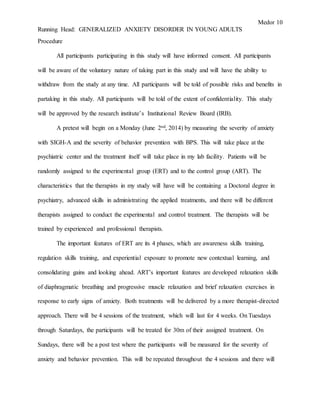
All participants participating in this study will have informed consent. All participants
will be aware of the voluntary nature of taking part in this study and will have the ability to
withdraw from the study at any time. All participants will be told of possible risks and benefits in
partaking in this study. All participants will be told of the extent of confidentiality. This study
will be approved by the research institute’s Institutional Review Board (IRB).
A pretest will begin on a Monday (June 2nd, 2014) by measuring the severity of anxiety
with SIGH-A and the severity of behavior prevention with BPS. This will take place at the
psychiatric center and the treatment itself will take place in my lab facility. Patients will be
randomly assigned to the experimental group (ERT) and to the control group (ART). The
characteristics that the therapists in my study will have will be containing a Doctoral degree in
psychiatry, advanced skills in administrating the applied treatments, and there will be different
therapists assigned to conduct the experimental and control treatment. The therapists will be
trained by experienced and professional therapists.
The important features of ERT are its 4 phases, which are awareness skills training,
regulation skills training, and experiential exposure to promote new contextual learning, and
consolidating gains and looking ahead. ART’s important features are developed relaxation skills
of diaphragmatic breathing and progressive muscle relaxation and brief relaxation exercises in
response to early signs of anxiety. Both treatments will be delivered by a more therapist-directed
approach. There will be 4 sessions of the treatment, which will last for 4 weeks. On Tuesdays
through Saturdays, the participants will be treated for 30m of their assigned treatment. On
Sundays, there will be a post test where the participants will be measured for the severity of
anxiety and behavior prevention. This will be repeated throughout the 4 sessions and there will
Medor 11
Running Head: GENERALIZED ANXIETY DISORDER IN YOUNG ADULTS
be a follow-up 5 weeks after the treatment session has ended where participants again will be
measured of the severity of anxiety and behavior prevention. I will make sure the therapists in
my study will be faithful to the treatments they are assigned to conduct by having supervisors
watch over them, followed by recordings of the daily treatments being administered.
Results
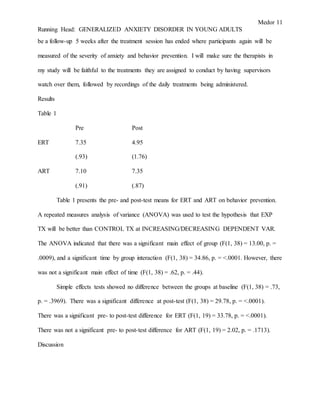
Table 1
Pre Post
ERT 7.35 4.95
(.93) (1.76)
ART 7.10 7.35
(.91) (.87)
Table 1 presents the pre- and post-test means for ERT and ART on behavior prevention.
A repeated measures analysis of variance (ANOVA) was used to test the hypothesis that EXP
TX will be better than CONTROL TX at INCREASING/DECREASING DEPENDENT VAR.
The ANOVA indicated that there was a significant main effect of group (F(1, 38) = 13.00, p. =
.0009), and a significant time by group interaction (F(1, 38) = 34.86, p. = <.0001. However, there
was not a significant main effect of time (F(1, 38) = .62, p. = .44).
Simple effects tests showed no difference between the groups at baseline (F(1, 38) = .73,
p. = .3969). There was a significant difference at post-test (F(1, 38) = 29.78, p. = <.0001).
There was a significant pre- to post-test difference for ERT (F(1, 19) = 33.78, p. = <.0001).
There was not a significant pre- to post-test difference for ART (F(1, 19) = 2.02, p. = .1713).
Discussion
Medor 12
Running Head: GENERALIZED ANXIETY DISORDER IN YOUNG ADULTS
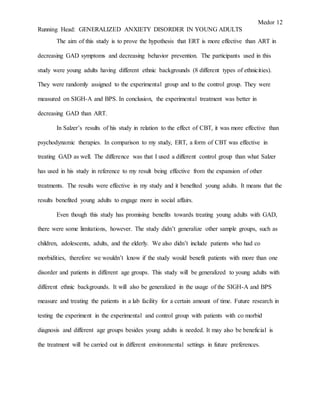
The aim of this study is to prove the hypothesis that ERT is more effective than ART in
decreasing GAD symptoms and decreasing behavior prevention. The participants used in this
study were young adults having different ethnic backgrounds (8 different types of ethnicities).
They were randomly assigned to the experimental group and to the control group. They were
measured on SIGH-A and BPS. In conclusion, the experimental treatment was better in
decreasing GAD than ART.
In Salzer’s results of his study in relation to the effect of CBT, it was more effective than
psychodynamic therapies. In comparison to my study, ERT, a form of CBT was effective in
treating GAD as well. The difference was that I used a different control group than what Salzer
has used in his study in reference to my result being effective from the expansion of other
treatments. The results were effective in my study and it benefited young adults. It means that the
results benefited young adults to engage more in social affairs.
Even though this study has promising benefits towards treating young adults with GAD,
there were some limitations, however. The study didn’t generalize other sample groups, such as
children, adolescents, adults, and the elderly. We also didn’t include patients who had co
morbidities, therefore we wouldn’t know if the study would benefit patients with more than one
disorder and patients in different age groups. This study will be generalized to young adults with
different ethnic backgrounds. It will also be generalized in the usage of the SIGH-A and BPS
measure and treating the patients in a lab facility for a certain amount of time. Future research in
testing the experiment in the experimental and control group with patients with co morbid
diagnosis and different age groups besides young adults is needed. It may also be beneficial is
the treatment will be carried out in different environmental settings in future preferences.

GAD Term Paper Psych Article Draft

  • 1.
    Generalized Anxiety Disorderin Young Adults Kendra Medor Saint John’s University
  • 2.
    Medor 2 Running Head:GENERALIZED ANXIETY DISORDER IN YOUNG ADULTS The aim of this study is to test the hypothesis that Emotion Regulation Therapy (ERT) is more effective than Applied Relaxation Therapy (ART) in decreasing General Anxiety Disorder and decreasing behavioral prevention in young adults. 9.0% of people in their lifetime have Generalized Anxiety Disorder in the US population (Kessler et. al. 2012). Young adults are at high risk for GAD. XX% of young adults has GAD. XX number of young adults as a whole has GAD. The severity of GAD was measured by a randomized control trial (RCT) and an open trial indicating anxiety, depression, quality of life and end-state functioning (Hayes-Skelton et. al. 2013). Consequences of GAD are diminished quality of life when untreated (Hayes-Skelton et. al. 2013) and co-occurrences of depression (Fresco et. al. 2013). Young adults have Generalized Anxiety Disorder because they have problems with motivational focus, emotional regulation, and contextual learning. I believe young adults are at high risk for GAD because they can develop this disorder by learned behavior, family history, and tragic experiences. Research shows that risk factor behavioral prevention is linked to the development of Generalized Anxiety Disorder (GAD). Risk factor behavioral prevention can be defined as a defense mechanism or strategy for patients to avoid social affairs. Hayes-Skelton studied the relationship of behavioral prevention to GAD by finding intolerance of uncertainty and interpersonal and emotion-focused aspects of GAD in organizing randomized control trials learned by known models of GAD. This is related to behavioral prevention because people with behavior prevention would be uncertain of the outcome of being in social situations. Because of this mediator, the patient will avoid social affairs to not deal with the end result. They found in Hayes-Skelton’s article that targeting meta-cognition in GAD produced better outcomes than a
  • 3.
    Medor 3 Running Head:GENERALIZED ANXIETY DISORDER IN YOUNG ADULTS therapy used to treat GAD (applied relaxation). The model showed that people with GAD have a negative relationship with internalized experiences, feel threatened, and are critical and judgmental which results them into avoidance. Fresco studied the relationship of behavioral prevention to GAD. He found that individuals with GAD have high intensity of emotion, focus on self protection and security, and have altered beliefs based on life experiences. In relation to behavior prevention, anxiety is an emotion, which causes a person to become anxious. In treating patients with ERT, which targets emotions, it will help the patient become less anxious and behave more calm in social situations. The model used for GAD had findings that supported a role for both motivational dysfunction and subjective emotional intensity. To reduce GAD symptoms, the study toned down the emotional aspects of an uncomfortable situation that a patient with GAD would try to avoid. Instead of avoiding it, the patient will confront it and manipulate the behavior from negative to positive (prevention vs. promotion). Other risk factors that have been identified include narrowed attention toward threat, judgmental reactivity, and experiential avoidance (Hayes-Skelton et. al. 2013). The results obtained by these authors are findings supporting a role for both motivational dysfunction and subjective emotional intensity (Fresco et. al. 2013) and the development and maintenance of psychopathology that underlies in potential roles of experiential avoidance and ruminative, self-critical processing (Hayes-Skelton et. al. 2013). The relationship of behavioral prevention to GAD is pretty strong because it affects quality of life and ability in making necessary life decisions.
  • 4.
    Medor 4 Running Head:GENERALIZED ANXIETY DISORDER IN YOUNG ADULTS Confounding variables found in the articles are the sample group and therapist alliance, which will be found in the Hayes-Skeleton article and small effective sizes in reference to the Fresco article about Emotion Regulation Therapy. The research suggests that ERT is effective to reduce GAD. ERT consists of an intervention in targeting a mechanism by focusing on patterns of motivational dysfunction while cultivating emotion regulation skills in patients. ERT is the representation form of researchers’ efforts in better comprehending GAD and reducing torment caused by GAD and its symptoms. ERT outlines the three main aspects of basic emotional functioning, which is motivational, regulatory, and contextual learning mechanisms (Fresco et. al. 2013). Motivational mechanisms are an emotional response towards a situation. Regulatory mechanisms refer to alteration of curved responses agreeing with the patient’s contextual demands. Lastly, contextual learning mechanisms are reflecting on promoting behavioral skills. ART consists of developing relaxation skills primarily through diaphragmatic breathing and progressive muscle relaxation. ART also applies a brief relaxation exercise in response to early signs of anxiety. The purpose for this treatment is to decrease anxiety symptoms and increase the quality of life. ART is straight forward and can be easily learned. This can make it easier for therapists to deliver ART with skill and faithfulness (Hayes-Skelton et. al. 2013). In Hayes-Skelton’s study in 2013, she tested this treatment in a sample of 81 randomized individuals. They compared Acceptance-Based Behavior Therapy (ABBT) and AR. ABBT strives to help patients expand awareness in a positive way towards internal experiences. This will decrease experiential avoidance and promotes acceptance and willingness for internal experiences. ABBT also had patients participate in meaningful activities, such as experiential exercises and writing and behavioral exercises, and mindfulness exercises (Hayes-Skelton et. al.
  • 5.
    Medor 5 Running Head:GENERALIZED ANXIETY DISORDER IN YOUNG ADULTS 2013). AR focuses on building relaxation skills and developing an awareness of early signs of anxiety and was taught to release-only, cue-controlled, differential, and rapid relaxation with an added focus on application skills. Patients being treated with AR were put in muscle groups too (Hayes-Skelton et. al. 2013). They found that even though AR was more enhanced, it still wasn’t more effective than ABBT. There were some limitations to their study, however. We identified a threat to internal validity. We also found a threat to external validity. Therapists administrating both treatments and some having a stronger background in CBT treatments are threats to internal validity. Inexperienced therapists are also a threat to internal validity. Having a sample group of predominately white people and mostly female is a threat to external validity. These limitations are a problem because we will not truly know the capability of these treatments in reducing GAD symptoms due to the fact that these treatments were administered by inexperienced therapists and by therapists who had a stronger treatment background that didn’t apply to ABBT and ART. Due to the fact the sample group was mostly white females, we will not know if the treatment can be as effective to males and to other ethnic groups as it was for whites and females. This can be fixed by having a randomized selection of patients with different ethnic backgrounds and using both genders. In Fresco’s study in 2013, he tested this treatment in the case of William. They examined the effect of ERT with William. There are four phases of ERT. The first phase is awareness skills training, which aims to break the cycle of reactive responding (Fresco et. al. 2013). The first phase consists of understanding emotions and motivations, knowing how to identify consequences or cues by improving detecting cues, and escalating mindful-awareness. The second phase is training to regulate skill. This aims to improve on detecting cues of the anxiety symptoms and to promote mindfulness. The third phase is promoting contextual learning by
  • 6.
    Medor 6 Running Head:GENERALIZED ANXIETY DISORDER IN YOUNG ADULTS exposure of experiential experiences. This consists of expanding the patient’s behavior range. Phase four helps patients experience emotions is a calm manner and to expect and accept unwanted emotions such as anger, sadness etc. Phase four also educates patients that life is meant to live mindfully of and that life has its bad days besides good days. Patients are taught how to prepare themselves to experience whatever obstacle enters in their lives and to not avoid it. In result, they found that ERT was effective. It reoriented William’s life and gained proficiency to counteract the arising of intense emotions and motivational pulls in ways that do not ruin their value-informed pursuits (Fresco et. al. 2013). There were some limitations to their study. We identified a threat to internal validity. A small effective size was a threat to internal validity. Due to the small effective size of the experiment there wasn’t a sufficient response towards the treatment. This limitation can be a problem because we will not know if others will benefit from this treatment .This can be fixed by better understanding the components of ERT, and having a larger effective size group. We will test ERT in young adults. This group has behavior prevention. We suspect that ERT may affect behavior prevention. This is why because through ERT, the patient will overcome behavior prevention by learning how to regulate their emotions and become more aware that life has good times and bad times, but will have strategies to get by. We are contrasting the effects of ERT to control ART. We chose this control because we see evidence that it provides some benefits, but does not directly address behavior prevention. This is why because ART did not benefit as much as ABBT even when it was drastically enhanced (Hayes-Skelton et. al. 2013). ERT on the other hand, allowed therapists to track and adjust the patient’s impressions as to the degree to which patients demonstrate mindful
  • 7.
    Medor 7 Running Head:GENERALIZED ANXIETY DISORDER IN YOUNG ADULTS awareness of emotions and motivations, demonstrating a capacity to regulate their emotions, and to articulate and pursue a life that is compatible with their personal values (Fresco et. al. 2013). ART does not sufficiently fix behavior prevention, but ERT does. Abstract The aim of this study is to prove that Emotion Regulation Therapy (ERT) is more effective that Applied Relaxation Therapy (ART) in decreasing Generalized Anxiety Disorder symptoms and decreasing behavior prevention in young adults. GAD affects 9.0% of people in their lifetime in the US population and it results to reduced quality of life. Targeting meta- cognition in GAD produced better outcomes than a therapy used to treat GAD. In addition to that, individuals with GAD have high intensity of emotion, focus on self protection and security, and have altered beliefs based on life experiences. The confounding variables in these studies were group samples and its size and the length of time. My study will address the theory of the problem, which is behavioral prevention negatively affects the patient’s motivational focus, emotional regulation, and contextual learning. The contributions that my study will make is to provide a large group sample picked at random and providing sufficient information and results from the active treatments being compared. Practical Significance: It is important to study the relationship of behavior prevention to GAD because behavior prevention is causing the individual to have difficulty in controlling their emotions when it comes to uncomfortable situations. This will result to the individual to avoid making decisions and have low quality of life. Knowing what works for this condition will solely help from identifying early symptoms and preventing it or successfully treating the condition once diagnosed. The most needed effective treatment would be Emotion Regulation Therapy (ERT). If effective treatments were not available, the individual diagnosed with GAD would
  • 8.
    Medor 8 Running Head:GENERALIZED ANXIETY DISORDER IN YOUNG ADULTS become anxious and live the rest of their life in avoidance to everything relating to their lifestyle. This study will help explain that ERT will be a good way to treat people diagnosed with GAD rather than ART. If this hypothesis is correct, than ERT would be a popular treatment to treat behavior prevention and other underlying mediators in GAD. Experimental Hypothesis: We hypothesis that ERT will better decrease behavior prevention in people who have GAD than ART in young adults. Method Participants In this study, there will be a randomized selection of 40 individuals. In order to detect a significance difference between my treatments, I will need to recruit at least 40 eligible people due to the results of my power analysis. The participants will be young adults diagnosed with GAD. To recruit participants, I will go to medical centers and I will use advertisement methods. Demographics There will be 12.5% of African Americans, Hispanics, Caucasians, Asian Americans, Pacific Islanders, Indian Americans, Alaskan Natives, and Multi-racial. Their ages will range between years 18 to 25 and there will be both male and female participants. I’ve chosen this sample group because it addresses the threat to internal and external validity obtained from Fresco and Hayes-Skelton’s article in reference to effective size and sample group. In Fresco’s study, he tested ERT on the case of William in his article and Hayes-Skelton’s article consisted of a sample group of predominately white females. The inclusion variables will consist of diverse ethnic groups and preferably young adults diagnosed with GAD. Exclusion variables will consist of participants having a high severity condition and participants with co morbid diagnoses. These inclusions and exclusions will fix and address internal and external validity
  • 9.
    Medor 9 Running Head:GENERALIZED ANXIETY DISORDER IN YOUNG ADULTS problems because there will not be a bias sample group in favoritism in a specific ethnic group, and gender. It will be able to generalize the results of the treatment by a larger sample size and diverse ethnic groups. Measures The measure being used will be the SIGH-A, which provides a reliable, valid structured format for administering the Hamilton Anxiety Rating Scale (HARS) (Hayes-Skelton et al. 2013). I’ve chosen this measure because it is commonly used to measure anxiety and it is reliable. In the sample used in Hayes-Skelton’s study, internal consistencies were .76 at pre both post and follow-up. Postdoctoral fellows or doctoral students, after training, administered the measure, and 15% were rated twice for interater reliability, revealing an ICC of .89 (Hayes- Skelton et al. 2013). This measure has good criterion validity because it had a perfect correlation of the self report measure measuring anxiety overall. This measure also has good content validity because the scale measured the dimensions that are in reference of the concept, which is the severity of anxiety symptoms. The Behavior Prevention Scale (BPS) will test the severity of behavior prevention (Medor et al. 2013). I’ve chosen this measure because it is a reliable measure in measuring this specific mediator linked to GAD. The validity of this scale is predictive because we predict that behavior prevention will result in an individual to avoid social affairs. This measure has good criterion validity because it perfectly correlates with another measure relating to behavior prevention. There is good content validity because this scales includes the dimensions part of the concept (behavioral prevention), which is social avoidance and anxiety. This measure has a satisfactory alpha coefficient of .85 (Medor et al. 2013). This proves that this measure is reliable in measuring behavior prevention in individuals diagnosed with GAD.
  • 10.
    Medor 10 Running Head:GENERALIZED ANXIETY DISORDER IN YOUNG ADULTS Procedure All participants participating in this study will have informed consent. All participants will be aware of the voluntary nature of taking part in this study and will have the ability to withdraw from the study at any time. All participants will be told of possible risks and benefits in partaking in this study. All participants will be told of the extent of confidentiality. This study will be approved by the research institute’s Institutional Review Board (IRB). A pretest will begin on a Monday (June 2nd, 2014) by measuring the severity of anxiety with SIGH-A and the severity of behavior prevention with BPS. This will take place at the psychiatric center and the treatment itself will take place in my lab facility. Patients will be randomly assigned to the experimental group (ERT) and to the control group (ART). The characteristics that the therapists in my study will have will be containing a Doctoral degree in psychiatry, advanced skills in administrating the applied treatments, and there will be different therapists assigned to conduct the experimental and control treatment. The therapists will be trained by experienced and professional therapists. The important features of ERT are its 4 phases, which are awareness skills training, regulation skills training, and experiential exposure to promote new contextual learning, and consolidating gains and looking ahead. ART’s important features are developed relaxation skills of diaphragmatic breathing and progressive muscle relaxation and brief relaxation exercises in response to early signs of anxiety. Both treatments will be delivered by a more therapist-directed approach. There will be 4 sessions of the treatment, which will last for 4 weeks. On Tuesdays through Saturdays, the participants will be treated for 30m of their assigned treatment. On Sundays, there will be a post test where the participants will be measured for the severity of anxiety and behavior prevention. This will be repeated throughout the 4 sessions and there will
  • 11.
    Medor 11 Running Head:GENERALIZED ANXIETY DISORDER IN YOUNG ADULTS be a follow-up 5 weeks after the treatment session has ended where participants again will be measured of the severity of anxiety and behavior prevention. I will make sure the therapists in my study will be faithful to the treatments they are assigned to conduct by having supervisors watch over them, followed by recordings of the daily treatments being administered. Results Table 1 Pre Post ERT 7.35 4.95 (.93) (1.76) ART 7.10 7.35 (.91) (.87) Table 1 presents the pre- and post-test means for ERT and ART on behavior prevention. A repeated measures analysis of variance (ANOVA) was used to test the hypothesis that EXP TX will be better than CONTROL TX at INCREASING/DECREASING DEPENDENT VAR. The ANOVA indicated that there was a significant main effect of group (F(1, 38) = 13.00, p. = .0009), and a significant time by group interaction (F(1, 38) = 34.86, p. = <.0001. However, there was not a significant main effect of time (F(1, 38) = .62, p. = .44). Simple effects tests showed no difference between the groups at baseline (F(1, 38) = .73, p. = .3969). There was a significant difference at post-test (F(1, 38) = 29.78, p. = <.0001). There was a significant pre- to post-test difference for ERT (F(1, 19) = 33.78, p. = <.0001). There was not a significant pre- to post-test difference for ART (F(1, 19) = 2.02, p. = .1713). Discussion
  • 12.
    Medor 12 Running Head:GENERALIZED ANXIETY DISORDER IN YOUNG ADULTS The aim of this study is to prove the hypothesis that ERT is more effective than ART in decreasing GAD symptoms and decreasing behavior prevention. The participants used in this study were young adults having different ethnic backgrounds (8 different types of ethnicities). They were randomly assigned to the experimental group and to the control group. They were measured on SIGH-A and BPS. In conclusion, the experimental treatment was better in decreasing GAD than ART. In Salzer’s results of his study in relation to the effect of CBT, it was more effective than psychodynamic therapies. In comparison to my study, ERT, a form of CBT was effective in treating GAD as well. The difference was that I used a different control group than what Salzer has used in his study in reference to my result being effective from the expansion of other treatments. The results were effective in my study and it benefited young adults. It means that the results benefited young adults to engage more in social affairs. Even though this study has promising benefits towards treating young adults with GAD, there were some limitations, however. The study didn’t generalize other sample groups, such as children, adolescents, adults, and the elderly. We also didn’t include patients who had co morbidities, therefore we wouldn’t know if the study would benefit patients with more than one disorder and patients in different age groups. This study will be generalized to young adults with different ethnic backgrounds. It will also be generalized in the usage of the SIGH-A and BPS measure and treating the patients in a lab facility for a certain amount of time. Future research in testing the experiment in the experimental and control group with patients with co morbid diagnosis and different age groups besides young adults is needed. It may also be beneficial is the treatment will be carried out in different environmental settings in future preferences.