Lesson 7: Associated Ratios and the Value of a Ratio
Date: 9/24/13 49
©2013CommonCore,Inc. Some rights reserved.commoncore.org
This work is licensed under a
Creative Commons Attribution-NonCommercial-ShareAlike 3.0 Unported License.
NYS COMMON CORE MATHEMATICS CURRICULUM 6•1Lesson 7
Lesson 7:Associated Ratios and the Value of a Ratio
Student Outcomes
 Students understand the relationship between ratios and fractions. Students describe the fraction associated
with the ratio as the value of the ratio to .
 Students understand that when given a ratio , different ratios can be formed from the numbers and .
For example, , , and are associated with the same ratio relationship.
Classwork
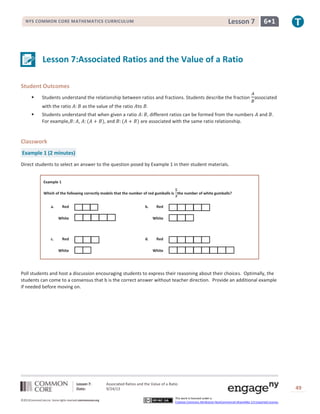
Example 1 (2 minutes)
Direct students to select an answer to the question posed by Example 1 in their student materials.
Example 1
Which of the following correctly models that the number of red gumballs is the number of white gumballs?
a. Red
White
b. Red
White
c. Red
White
d. Red
White
Poll students and host a discussion encouraging students to express their reasoning about their choices. Optimally, the
students can come to a consensus that b is the correct answer without teacher direction. Provide an additional example
if needed before moving on.
Lesson 7: Associated Ratios and the Value of a Ratio
Date: 9/24/13 50
©2013CommonCore,Inc. Some rights reserved.commoncore.org
This work is licensed under a
Creative Commons Attribution-NonCommercial-ShareAlike 3.0 Unported License.
NYS COMMON CORE MATHEMATICS CURRICULUM 6•1Lesson 7
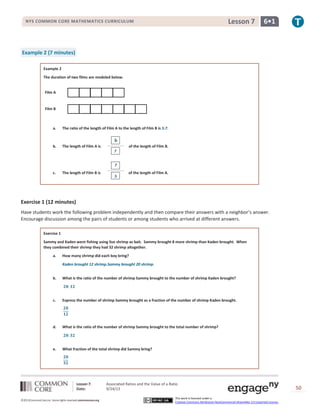
Example 2 (7 minutes)
Example 2
The duration of two films are modeled below.
a. The ratio of the length of Film A to the length of Film B is 5:7.
b. The length of Film A is of the length of Film B.
c. The length of Film B is of the length of Film A.
Exercise 1 (12 minutes)
Have students work the following problem independently and then compare their answers with a neighbor’s answer.
Encourage discussion among the pairs of students or among students who arrived at different answers.
Exercise 1
Sammy and Kaden went fishing using live shrimp as bait. Sammy brought 8 more shrimp than Kaden brought. When
they combined their shrimp they had 32 shrimp altogether.
a. How many shrimp did each boy bring?
Kaden brought 12 shrimp.Sammy brought 20 shrimp.
b. What is the ratio of the number of shrimp Sammy brought to the number of shrimp Kaden brought?
c. Express the number of shrimp Sammy brought as a fraction of the number of shrimp Kaden brought.
d. What is the ratio of the number of shrimp Sammy brought to the total number of shrimp?
e. What fraction of the total shrimp did Sammy bring?
Film A
Film B
55
7
7
5
Lesson 7: Associated Ratios and the Value of a Ratio
Date: 9/24/13 51
©2013CommonCore,Inc. Some rights reserved.commoncore.org
This work is licensed under a
Creative Commons Attribution-NonCommercial-ShareAlike 3.0 Unported License.
NYS COMMON CORE MATHEMATICS CURRICULUM 6•1Lesson 7
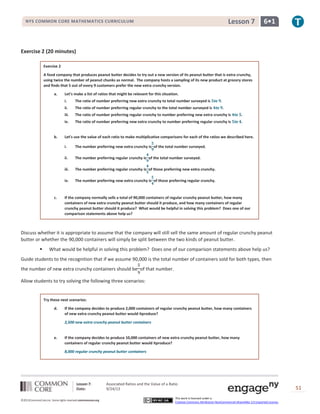
Exercise 2 (20 minutes)
Exercise 2
A food company that produces peanut butter decides to try out a new version of its peanut butter that is extra crunchy,
using twice the number of peanut chunks as normal. The company hosts a sampling of its new product at grocery stores
and finds that 5 out of every 9 customers prefer the new extra crunchy version.
a. Let’s make a list of ratios that might be relevant for this situation.
i. The ratio of number preferring new extra crunchy to total number surveyed is to .
ii. The ratio of number preferring regular crunchy to the total number surveyed is to .
iii. The ratio of number preferring regular crunchy to number preferring new extra crunchy is to .
iv. The ratio of number preferring new extra crunchy to number preferring regular crunchy is to .
b. Let’s use the value of each ratio to make multiplicative comparisons for each of the ratios we described here.
i. The number preferring new extra crunchy is of the total number surveyed.
ii. The number preferring regular crunchy is of the total number surveyed.
iii. The number preferring regular crunchy is of those preferring new extra crunchy.
iv. The number preferring new extra crunchy is of those preferring regular crunchy.
c. If the company normally sells a total of 90,000 containers of regular crunchy peanut butter, how many
containers of new extra crunchy peanut butter should it produce, and how many containers of regular
crunchy peanut butter should it produce? What would be helpful in solving this problem? Does one of our
comparison statements above help us?
Discuss whether it is appropriate to assume that the company will still sell the same amount of regular crunchy peanut
butter or whether the 90,000 containers will simply be split between the two kinds of peanut butter.
 What would be helpful in solving this problem? Does one of our comparison statements above help us?
Guide students to the recognition that if we assume 90,000 is the total number of containers sold for both types, then
the number of new extra crunchy containers should be of that number.
Allow students to try solving the following three scenarios:
Try these next scenarios:
d. If the company decides to produce 2,000 containers of regular crunchy peanut butter, how many containers
of new extra crunchy peanut butter would itproduce?
2,500 new extra crunchy peanut butter containers
e. If the company decides to produce 10,000 containers of new extra crunchy peanut butter, how many
containers of regular crunchy peanut butter would itproduce?
8,000 regular crunchy peanut butter containers
Lesson 7: Associated Ratios and the Value of a Ratio
Date: 9/24/13 52
©2013CommonCore,Inc. Some rights reserved.commoncore.org
This work is licensed under a
Creative Commons Attribution-NonCommercial-ShareAlike 3.0 Unported License.
NYS COMMON CORE MATHEMATICS CURRICULUM 6•1Lesson 7
f. If the company decides to only produce 3,000 containers of new extra crunchy peanut butter, how many
containers of regular crunchy peanut butter would itproduce?
2,400 regular crunchy peanut butter containers
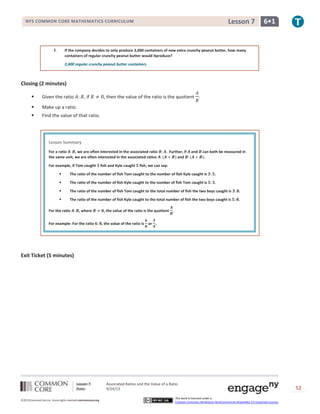
Closing (2 minutes)
 Given the ratio , if , then the value of the ratio is the quotient .
 Make up a ratio.
 Find the value of that ratio.
Exit Ticket (5 minutes)
Lesson Summary
For a ratio , we are often interested in the associated ratio . Further, if and can both be measured in
the same unit, we are often interested in the associated ratios and .
For example, if Tom caught fish and Kyle caught fish, we can say:
 The ratio of the number of fish Tom caught to the number of fish Kyle caught is .
 The ratio of the number of fish Kyle caught to the number of fish Tom caught is .
 The ratio of the number of fish Tom caught to the total number of fish the two boys caught is .
 The ratio of the number of fish Kyle caught to the total number of fish the two boys caught is .
For the ratio , where , the value of the ratio is the quotient .
For example: For the ratio , the value of the ratio is or .
Lesson 7: Associated Ratios and the Value of a Ratio
Date: 9/24/13 53
©2013CommonCore,Inc. Some rights reserved.commoncore.org
This work is licensed under a
Creative Commons Attribution-NonCommercial-ShareAlike 3.0 Unported License.
NYS COMMON CORE MATHEMATICS CURRICULUM 6•1Lesson 7
Name ___________________________________________________ Date____________________
Lesson 7: Associated Ratios and the Value of a Ratio
Exit Ticket
Alyssa’s extended family is staying at the lake house this weekend for a family reunion. She is in charge of making
homemade pancakes for the entire group. The pancake mix requires 2 cups of flour for every 10 pancakes.
a. Write a ratio to show the relationship between the number of cups of flour and the number of pancakes made.
b. Determine the value of the ratio.
c. Use the value of the ratio to fill in the following two multiplicative comparison statements.
The number of pancakes made is ________times the amount of cups of flour needed.
The amount of cups of flour needed is ________of the number of pancakes made.
d. If Alyssa has to make 70 pancakes, how many cups of flour will she have to use?
Lesson 7: Associated Ratios and the Value of a Ratio
Date: 9/24/13 54
©2013CommonCore,Inc. Some rights reserved.commoncore.org
This work is licensed under a
Creative Commons Attribution-NonCommercial-ShareAlike 3.0 Unported License.
NYS COMMON CORE MATHEMATICS CURRICULUM 6•1Lesson 7
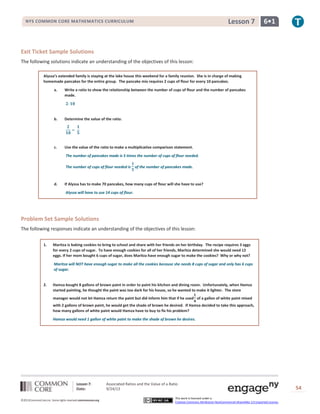
Exit Ticket Sample Solutions
The following solutions indicate an understanding of the objectives of this lesson:
Alyssa’s extended family is staying at the lake house this weekend for a family reunion. She is in charge of making
homemade pancakes for the entire group. The pancake mix requires 2 cups of flour for every 10 pancakes.
a. Write a ratio to show the relationship between the number of cups of flour and the number of pancakes
made.
b. Determine the value of the ratio.
c. Use the value of the ratio to make a multiplicative comparison statement.
The number of pancakes made is 5 times the number of cups of flour needed.
The number of cups of flour needed is of the number of pancakes made.
d. If Alyssa has to make 70 pancakes, how many cups of flour will she have to use?
Alyssa will have to use 14 cups of flour.
Problem Set Sample Solutions
The following responses indicate an understanding of the objectives of this lesson:
1. Maritza is baking cookies to bring to school and share with her friends on her birthday. The recipe requires 3 eggs
for every 2 cups of sugar. To have enough cookies for all of her friends, Maritza determined she would need 12
eggs. If her mom bought 6 cups of sugar, does Maritza have enough sugar to make the cookies? Why or why not?
Maritza will NOT have enough sugar to make all the cookies because she needs 8 cups of sugar and only has 6 cups
of sugar.
2. Hamza bought 8 gallons of brown paint in order to paint his kitchen and dining room. Unfortunately, when Hamza
started painting, he thought the paint was too dark for his house, so he wanted to make it lighter. The store
manager would not let Hamza return the paint but did inform him that if he used of a gallon of white paint mixed
with 2 gallons of brown paint, he would get the shade of brown he desired. If Hamza decided to take this approach,
how many gallons of white paint would Hamza have to buy to fix his problem?
Hamza would need 1 gallon of white paint to make the shade of brown he desires.

G6 m1-a-lesson 7-t

  • 1.
    Lesson 7: AssociatedRatios and the Value of a Ratio Date: 9/24/13 49 ©2013CommonCore,Inc. Some rights reserved.commoncore.org This work is licensed under a Creative Commons Attribution-NonCommercial-ShareAlike 3.0 Unported License. NYS COMMON CORE MATHEMATICS CURRICULUM 6•1Lesson 7 Lesson 7:Associated Ratios and the Value of a Ratio Student Outcomes  Students understand the relationship between ratios and fractions. Students describe the fraction associated with the ratio as the value of the ratio to .  Students understand that when given a ratio , different ratios can be formed from the numbers and . For example, , , and are associated with the same ratio relationship. Classwork Example 1 (2 minutes) Direct students to select an answer to the question posed by Example 1 in their student materials. Example 1 Which of the following correctly models that the number of red gumballs is the number of white gumballs? a. Red White b. Red White c. Red White d. Red White Poll students and host a discussion encouraging students to express their reasoning about their choices. Optimally, the students can come to a consensus that b is the correct answer without teacher direction. Provide an additional example if needed before moving on.
  • 2.
    Lesson 7: AssociatedRatios and the Value of a Ratio Date: 9/24/13 50 ©2013CommonCore,Inc. Some rights reserved.commoncore.org This work is licensed under a Creative Commons Attribution-NonCommercial-ShareAlike 3.0 Unported License. NYS COMMON CORE MATHEMATICS CURRICULUM 6•1Lesson 7 Example 2 (7 minutes) Example 2 The duration of two films are modeled below. a. The ratio of the length of Film A to the length of Film B is 5:7. b. The length of Film A is of the length of Film B. c. The length of Film B is of the length of Film A. Exercise 1 (12 minutes) Have students work the following problem independently and then compare their answers with a neighbor’s answer. Encourage discussion among the pairs of students or among students who arrived at different answers. Exercise 1 Sammy and Kaden went fishing using live shrimp as bait. Sammy brought 8 more shrimp than Kaden brought. When they combined their shrimp they had 32 shrimp altogether. a. How many shrimp did each boy bring? Kaden brought 12 shrimp.Sammy brought 20 shrimp. b. What is the ratio of the number of shrimp Sammy brought to the number of shrimp Kaden brought? c. Express the number of shrimp Sammy brought as a fraction of the number of shrimp Kaden brought. d. What is the ratio of the number of shrimp Sammy brought to the total number of shrimp? e. What fraction of the total shrimp did Sammy bring? Film A Film B 55 7 7 5
  • 3.
    Lesson 7: AssociatedRatios and the Value of a Ratio Date: 9/24/13 51 ©2013CommonCore,Inc. Some rights reserved.commoncore.org This work is licensed under a Creative Commons Attribution-NonCommercial-ShareAlike 3.0 Unported License. NYS COMMON CORE MATHEMATICS CURRICULUM 6•1Lesson 7 Exercise 2 (20 minutes) Exercise 2 A food company that produces peanut butter decides to try out a new version of its peanut butter that is extra crunchy, using twice the number of peanut chunks as normal. The company hosts a sampling of its new product at grocery stores and finds that 5 out of every 9 customers prefer the new extra crunchy version. a. Let’s make a list of ratios that might be relevant for this situation. i. The ratio of number preferring new extra crunchy to total number surveyed is to . ii. The ratio of number preferring regular crunchy to the total number surveyed is to . iii. The ratio of number preferring regular crunchy to number preferring new extra crunchy is to . iv. The ratio of number preferring new extra crunchy to number preferring regular crunchy is to . b. Let’s use the value of each ratio to make multiplicative comparisons for each of the ratios we described here. i. The number preferring new extra crunchy is of the total number surveyed. ii. The number preferring regular crunchy is of the total number surveyed. iii. The number preferring regular crunchy is of those preferring new extra crunchy. iv. The number preferring new extra crunchy is of those preferring regular crunchy. c. If the company normally sells a total of 90,000 containers of regular crunchy peanut butter, how many containers of new extra crunchy peanut butter should it produce, and how many containers of regular crunchy peanut butter should it produce? What would be helpful in solving this problem? Does one of our comparison statements above help us? Discuss whether it is appropriate to assume that the company will still sell the same amount of regular crunchy peanut butter or whether the 90,000 containers will simply be split between the two kinds of peanut butter.  What would be helpful in solving this problem? Does one of our comparison statements above help us? Guide students to the recognition that if we assume 90,000 is the total number of containers sold for both types, then the number of new extra crunchy containers should be of that number. Allow students to try solving the following three scenarios: Try these next scenarios: d. If the company decides to produce 2,000 containers of regular crunchy peanut butter, how many containers of new extra crunchy peanut butter would itproduce? 2,500 new extra crunchy peanut butter containers e. If the company decides to produce 10,000 containers of new extra crunchy peanut butter, how many containers of regular crunchy peanut butter would itproduce? 8,000 regular crunchy peanut butter containers
  • 4.
    Lesson 7: AssociatedRatios and the Value of a Ratio Date: 9/24/13 52 ©2013CommonCore,Inc. Some rights reserved.commoncore.org This work is licensed under a Creative Commons Attribution-NonCommercial-ShareAlike 3.0 Unported License. NYS COMMON CORE MATHEMATICS CURRICULUM 6•1Lesson 7 f. If the company decides to only produce 3,000 containers of new extra crunchy peanut butter, how many containers of regular crunchy peanut butter would itproduce? 2,400 regular crunchy peanut butter containers Closing (2 minutes)  Given the ratio , if , then the value of the ratio is the quotient .  Make up a ratio.  Find the value of that ratio. Exit Ticket (5 minutes) Lesson Summary For a ratio , we are often interested in the associated ratio . Further, if and can both be measured in the same unit, we are often interested in the associated ratios and . For example, if Tom caught fish and Kyle caught fish, we can say:  The ratio of the number of fish Tom caught to the number of fish Kyle caught is .  The ratio of the number of fish Kyle caught to the number of fish Tom caught is .  The ratio of the number of fish Tom caught to the total number of fish the two boys caught is .  The ratio of the number of fish Kyle caught to the total number of fish the two boys caught is . For the ratio , where , the value of the ratio is the quotient . For example: For the ratio , the value of the ratio is or .
  • 5.
    Lesson 7: AssociatedRatios and the Value of a Ratio Date: 9/24/13 53 ©2013CommonCore,Inc. Some rights reserved.commoncore.org This work is licensed under a Creative Commons Attribution-NonCommercial-ShareAlike 3.0 Unported License. NYS COMMON CORE MATHEMATICS CURRICULUM 6•1Lesson 7 Name ___________________________________________________ Date____________________ Lesson 7: Associated Ratios and the Value of a Ratio Exit Ticket Alyssa’s extended family is staying at the lake house this weekend for a family reunion. She is in charge of making homemade pancakes for the entire group. The pancake mix requires 2 cups of flour for every 10 pancakes. a. Write a ratio to show the relationship between the number of cups of flour and the number of pancakes made. b. Determine the value of the ratio. c. Use the value of the ratio to fill in the following two multiplicative comparison statements. The number of pancakes made is ________times the amount of cups of flour needed. The amount of cups of flour needed is ________of the number of pancakes made. d. If Alyssa has to make 70 pancakes, how many cups of flour will she have to use?
  • 6.
    Lesson 7: AssociatedRatios and the Value of a Ratio Date: 9/24/13 54 ©2013CommonCore,Inc. Some rights reserved.commoncore.org This work is licensed under a Creative Commons Attribution-NonCommercial-ShareAlike 3.0 Unported License. NYS COMMON CORE MATHEMATICS CURRICULUM 6•1Lesson 7 Exit Ticket Sample Solutions The following solutions indicate an understanding of the objectives of this lesson: Alyssa’s extended family is staying at the lake house this weekend for a family reunion. She is in charge of making homemade pancakes for the entire group. The pancake mix requires 2 cups of flour for every 10 pancakes. a. Write a ratio to show the relationship between the number of cups of flour and the number of pancakes made. b. Determine the value of the ratio. c. Use the value of the ratio to make a multiplicative comparison statement. The number of pancakes made is 5 times the number of cups of flour needed. The number of cups of flour needed is of the number of pancakes made. d. If Alyssa has to make 70 pancakes, how many cups of flour will she have to use? Alyssa will have to use 14 cups of flour. Problem Set Sample Solutions The following responses indicate an understanding of the objectives of this lesson: 1. Maritza is baking cookies to bring to school and share with her friends on her birthday. The recipe requires 3 eggs for every 2 cups of sugar. To have enough cookies for all of her friends, Maritza determined she would need 12 eggs. If her mom bought 6 cups of sugar, does Maritza have enough sugar to make the cookies? Why or why not? Maritza will NOT have enough sugar to make all the cookies because she needs 8 cups of sugar and only has 6 cups of sugar. 2. Hamza bought 8 gallons of brown paint in order to paint his kitchen and dining room. Unfortunately, when Hamza started painting, he thought the paint was too dark for his house, so he wanted to make it lighter. The store manager would not let Hamza return the paint but did inform him that if he used of a gallon of white paint mixed with 2 gallons of brown paint, he would get the shade of brown he desired. If Hamza decided to take this approach, how many gallons of white paint would Hamza have to buy to fix his problem? Hamza would need 1 gallon of white paint to make the shade of brown he desires.