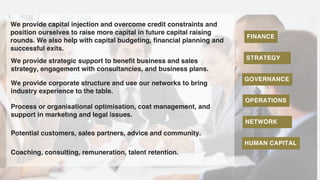
FINANCE
GOVERNANCE
STRATEGY
OPERATIONS
HUMAN CAPITAL
NETWORK
We provide capital injection and overcome credit constraints and
position ourselves to raise more capital in future capital raising
rounds. We also help with capital budgeting, financial planning and
successful exits.
We provide strategic support to benefit business and sales
strategy, engagement with consultancies, and business plans.
We provide corporate structure and use our networks to bring
industry experience to the table.
Process or organisational optimisation, cost management, and
support in marketing and legal issues.
Potential customers, sales partners, advice and community.
Coaching, consulting, remuneration, talent retention.
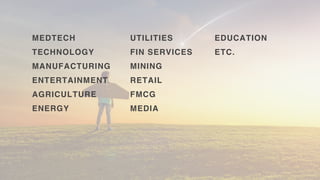
MEDTECH
TECHNOLOGY
MANUFACTURING
AGRICULTURE
ENERGY
UTILITIES
MINING
FIN SERVICES
RETAIL
FMCG
ENTERTAINMENT
MEDIA
EDUCATION
ETC.
// PAST, PRESENT AND FUTURE
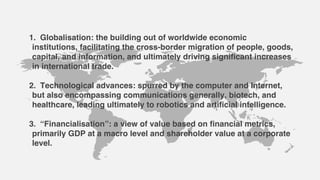
1. Globalisation: the building out of worldwide economic
institutions, facilitating the cross-border migration of people, goods,
capital, and information, and ultimately driving significant increases
in international trade.
2. Technological advances: spurred by the computer and Internet,
but also encompassing communications generally, biotech, and
healthcare, leading ultimately to robotics and artificial intelligence.
3. “Financialisation”: a view of value based on financial metrics,
primarily GDP at a macro level and shareholder value at a corporate
level.
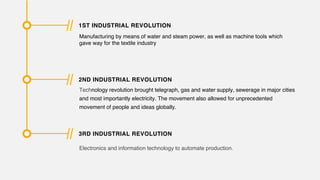
1ST INDUSTRIAL REVOLUTION
Manufacturing by means of water and steam power, as well as machine tools which
gave way for the textile industry
2ND INDUSTRIAL REVOLUTION
Technology revolution brought telegraph, gas and water supply, sewerage in major cities
and most importantly electricity. The movement also allowed for unprecedented
movement of people and ideas globally.
3RD INDUSTRIAL REVOLUTION
Electronics and information technology to automate production.
4TH INDUSTRIAL REVOLUTION (INDUSTRY 4.0)
New technologies that are fusing the physical, digital and biological worlds, impacting
all disciplines, economies and industries.
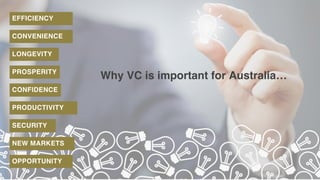
Why VC is important for Australia…PROSPERITY
LONGEVITY
CONFIDENCE
PRODUCTIVITY
CONVENIENCE
SECURITY
NEW MARKETS
OPPORTUNITY
EFFICIENCY
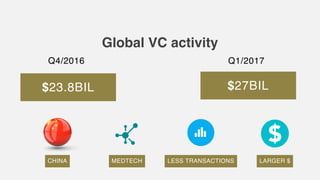
$23.8BIL $27BIL
Q4/2016 Q1/2017
Global VC activity
CHINA MEDTECH LESS TRANSACTIONS LARGER $
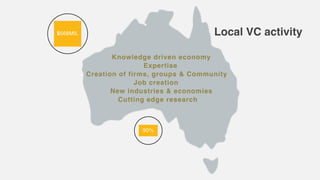
$568MIL
90%
Knowledge driven economy
Expertise
Creation of firms, groups & Community
Job creation
New industries & economies
Cutting edge research
Local VC activity
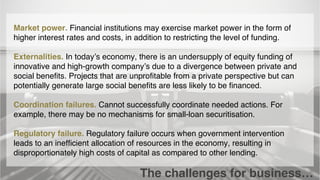
Market power. Financial institutions may exercise market power in the form of
higher interest rates and costs, in addition to restricting the level of funding.
Externalities. In today’s economy, there is an undersupply of equity funding of
innovative and high-growth company’s due to a divergence between private and
social benefits. Projects that are unprofitable from a private perspective but can
potentially generate large social benefits are less likely to be financed.
Coordination failures. Cannot successfully coordinate needed actions. For
example, there may be no mechanisms for small-loan securitisation.
Regulatory failure. Regulatory failure occurs when government intervention
leads to an inefficient allocation of resources in the economy, resulting in
disproportionately high costs of capital as compared to other lending.
The challenges for business…
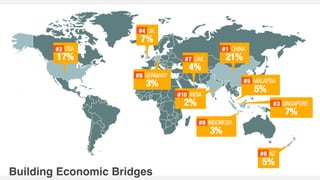
Building Economic Bridges
THANK YOU.
THE FUTURE VC GROUP TEAM
谢谢
DANKIE
ありがとうございました
CẢM ƠN
KE A LEBOGA

Future VC Group

  • 2.
    FINANCE GOVERNANCE STRATEGY OPERATIONS HUMAN CAPITAL NETWORK We providecapital injection and overcome credit constraints and position ourselves to raise more capital in future capital raising rounds. We also help with capital budgeting, financial planning and successful exits. We provide strategic support to benefit business and sales strategy, engagement with consultancies, and business plans. We provide corporate structure and use our networks to bring industry experience to the table. Process or organisational optimisation, cost management, and support in marketing and legal issues. Potential customers, sales partners, advice and community. Coaching, consulting, remuneration, talent retention.
  • 3.
  • 4.
    // PAST, PRESENTAND FUTURE
  • 5.
    1. Globalisation: thebuilding out of worldwide economic institutions, facilitating the cross-border migration of people, goods, capital, and information, and ultimately driving significant increases in international trade. 2. Technological advances: spurred by the computer and Internet, but also encompassing communications generally, biotech, and healthcare, leading ultimately to robotics and artificial intelligence. 3. “Financialisation”: a view of value based on financial metrics, primarily GDP at a macro level and shareholder value at a corporate level.
  • 6.
    1ST INDUSTRIAL REVOLUTION Manufacturingby means of water and steam power, as well as machine tools which gave way for the textile industry 2ND INDUSTRIAL REVOLUTION Technology revolution brought telegraph, gas and water supply, sewerage in major cities and most importantly electricity. The movement also allowed for unprecedented movement of people and ideas globally. 3RD INDUSTRIAL REVOLUTION Electronics and information technology to automate production.
  • 7.
    4TH INDUSTRIAL REVOLUTION(INDUSTRY 4.0) New technologies that are fusing the physical, digital and biological worlds, impacting all disciplines, economies and industries.
  • 8.
    Why VC isimportant for Australia…PROSPERITY LONGEVITY CONFIDENCE PRODUCTIVITY CONVENIENCE SECURITY NEW MARKETS OPPORTUNITY EFFICIENCY
  • 10.
    $23.8BIL $27BIL Q4/2016 Q1/2017 GlobalVC activity CHINA MEDTECH LESS TRANSACTIONS LARGER $
  • 11.
    $568MIL 90% Knowledge driven economy Expertise Creationof firms, groups & Community Job creation New industries & economies Cutting edge research Local VC activity
  • 12.
    Market power. Financialinstitutions may exercise market power in the form of higher interest rates and costs, in addition to restricting the level of funding. Externalities. In today’s economy, there is an undersupply of equity funding of innovative and high-growth company’s due to a divergence between private and social benefits. Projects that are unprofitable from a private perspective but can potentially generate large social benefits are less likely to be financed. Coordination failures. Cannot successfully coordinate needed actions. For example, there may be no mechanisms for small-loan securitisation. Regulatory failure. Regulatory failure occurs when government intervention leads to an inefficient allocation of resources in the economy, resulting in disproportionately high costs of capital as compared to other lending. The challenges for business…
  • 13.
  • 14.
    THANK YOU. THE FUTUREVC GROUP TEAM 谢谢 DANKIE ありがとうございました CẢM ƠN KE A LEBOGA