The Future of Water: Economic Risks and
Sustainable Solutions
Christos Charisiadis – Brine Consulting, cchar@live.com
Water is often seen as an abundant and renewable resource, yet the truth is far more alarming. Water
scarcity, mismanagement, and wasteful practices threaten not just industrial operations and economic
stability but also the livelihoods of billions of people worldwide.
I wrote this white paper because I believe that access to clean water is not only a fundamental right but
also a shared responsibility—a responsibility that transcends industries, governments, and borders. Water
is not infinite; its supply is fragile, and its value is far greater than what we currently perceive.
This paper is a call to action for governments, industries, and investors to rethink the way we value,
manage, and use water. It emphasizes that the cost of inaction—measured in economic losses, social
instability, and environmental collapse—far outweighs the cost of innovation and investment in
sustainable water solutions.
Water moves everything in the world. From agriculture to energy production, from manufacturing to
urban living, it is the lifeblood of our economies. I firmly believe that technological advancements, ethical
management practices, and financial mechanisms can transform the way we handle water—turning crises
into opportunities for growth, innovation, and resilience.
This paper is not just about highlighting problems—it is about proposing solutions. It is about showing
how industries can thrive economically while being environmentally responsible. It is about proving that
profitability and sustainability are not mutually exclusive—they are interdependent.
I invite you to read this white paper not only as an exploration of challenges but as a roadmap for action.
Together, we can build a future where water security is not a crisis to fear but an opportunity to lead.
Brine Consulting - Christos Charisiadis 2024
Disclaimer: This document is based on rough data, simplified assumptions, and theoretical calculations designed to provide an overview of brine
valorization processes. While every effort has been made to ensure the accuracy of the presented information, the findings should be
interpreted as preliminary insights rather than definitive conclusions. The concepts, methodologies, and results discussed are intended to
inform and inspire further exploration, not to serve as a substitute for detailed feasibility studies or tailored project evaluations. Readers are
strongly advised to conduct comprehensive assessments and consult with industry experts before implementing any of the discussed
approaches. The author assumes no responsibility for decisions made based on this document alone.
Christos Charisiadis – Brine Consulting, cchar@live.com
1
Christos Charisiadis – Brine Consulting, cchar@live.com
1. Executive Summary
1.1 Purpose of the Paper
Water is the foundation of economic growth, industrial development, and social well-being. However,
poor water management, wasteful practices, and inadequate infrastructure have exacerbated water
scarcity, creating a crisis that threatens economic stability and global security.
This paper highlights the challenges and opportunities posed by water scarcity, making the case for
sustainable water management strategies that emphasize reuse technologies, materials recovery, and
ethical frameworks supported by blockchain innovations.
Key Objectives of the Paper:
1. Assess the Scale of Water Mismanagement:
o Highlight how non-revenue water (NRW) losses and wasteful industrial practices result
in economic inefficiencies and environmental degradation.
2. Quantify Economic Impacts and Risks:
o Evaluate the financial consequences of water shortages, price increases, and
disruptions across key industries, including agriculture, energy, and manufacturing.
3. Present Sustainable Solutions:
o Propose actionable strategies for adopting reuse technologies, closed-loop systems,
and circular economies to reduce dependency on scarce resources.
4. Demonstrate Feasibility and Profitability:
o Provide numerical examples, cost-benefit analyses, and case studies to prove the ROI
of sustainable water solutions.
5. Deliver Policy Recommendations:
o Advocate for regulatory reforms, market-based pricing, and financing mechanisms to
drive adoption and scale solutions globally.
This paper serves as both a call to action and a blueprint for transformation, equipping governments,
industries, and investors with the tools and insights needed to future-proof water resources while
maximizing profitability.
2
Christos Charisiadis – Brine Consulting, cchar@live.com
1.2 Key Findings
Water Mismanagement and Scarcity Are Global Threats
 By 2030, global water demand is projected to exceed supply by 40% (World Resources Institute).
 Over 700 million people could face displacement due to water stress by 2050, leading to social
instability and economic disruption.
 Non-revenue water (NRW) losses—from leaks and inefficiencies—account for up to 50% of
urban water supplies, costing cities billions annually.
Industries Are Vulnerable to Rising Costs
 Industries consume approximately 20% of global freshwater withdrawals, with sectors like
energy, textiles, and pharmaceuticals most at risk.
 Case studies show that water shortages can cause factory shutdowns, supply chain disruptions,
and cost increases of 50–200%.
 Example – Semiconductor Manufacturing in Taiwan (2021):
o Severe droughts reduced chip production by 20%, causing $50 billion in global losses.
Government Subsidies Distort Water Markets
 Water subsidies, while promoting accessibility, often discourage conservation and delay
infrastructure upgrades.
 Numerical models in this paper show that subsidy removal could lead to 200% cost increases
without efficiency measures.
 Case Study – India’s Agricultural Subsidies:
o Farmers pay only 10% of delivery costs, contributing to 70% groundwater depletion in
some regions.
Proactive Investments Are Profitable
 Water reuse technologies and materials recovery systems deliver payback periods of 2–3 years,
enabling both cost savings and new revenue streams.
 Example – Orange County, California:
3
Christos Charisiadis – Brine Consulting, cchar@live.com
o Recycles 100 million gallons/day of wastewater, saving $300 million/year by avoiding
costly imports.
Blockchain and IoT Enable Transparency and Efficiency
 Blockchain systems provide tamper-proof records, peer-to-peer water trading, and smart
contracts to track usage and enforce compliance.
 Case Study – Australia’s Murray-Darling Basin:
o Implemented blockchain-powered tracking, reducing illegal withdrawals by 22%.
Financing Solutions Are Readily Available
 Green bonds, public-private partnerships (PPPs), and impact investing are scaling solutions
globally.
 Example – Mexico City (2019):
o Raised $50 million through green bonds for wastewater upgrades, delivering ROI in 4
years.
1.3 Recommendations
1. Governments
 Reform Pricing Models: Replace subsidies with tiered pricing and market-driven rates to
encourage conservation.
 Mandate Water Reuse Targets: Enforce 50% reuse mandates in industries and municipalities by
2030.
 Support Innovation: Expand funding through tax incentives, grants, and green bonds for
sustainable technologies.
 Facilitate Public-Private Partnerships (PPPs): Collaborate with the private sector to fund
infrastructure development.
4
Christos Charisiadis – Brine Consulting, cchar@live.com
2. Industries
 Short-Term Actions:
o Conduct water audits, repair leaks, and adopt low-flow fixtures to cut losses.
o Install closed-loop systems and wastewater treatment plants to reduce dependency on
freshwater sources.
 Long-Term Strategies:
o Invest in advanced recycling systems like membrane bioreactors (MBRs) and rainwater
harvesting technologies.
o Integrate blockchain systems for water metering, credits, and compliance.
 Business Model Innovations:
o Transition to Water-as-a-Service (WaaS) outsourcing models.
o Monetize wastewater through nutrient recovery, biogas production, and metal
extraction.
3. Investors and Financial Institutions
 Scale Capital Through Green Bonds: Fund large-scale infrastructure upgrades and emerging
technologies.
 Invest in Startups: Focus on scalable solutions such as AI-based monitoring, blockchain water
credits, and energy-neutral wastewater systems.
4. Communities and Stakeholders
 Raise Awareness: Educate businesses and residents about water conservation and the risks of
scarcity.
 Promote Accountability: Support businesses and governments adopting sustainable practices,
while pushing for transparency and reforms.
5
Christos Charisiadis – Brine Consulting, cchar@live.com
1.4 Final Message
The world faces a defining moment in water management. The economic costs of inaction—measured
in billions of dollars in losses—are avoidable if governments, industries, and investors act decisively.
Technological advancements such as IoT monitoring, AI optimization, blockchain solutions, and reuse
systems have made sustainability profitable and scalable. The financial tools to drive this
transformation—green bonds, PPP models, and impact investing—are already in place.
Water must no longer be treated as cheap and infinite but as a strategic asset requiring careful
stewardship. The time to act is now—to build resilience, future-proof industries, and ensure equitable
access to water for generations to come.
6
Christos Charisiadis – Brine Consulting, cchar@live.com
2. Introduction
Water: The Lifeblood of Economies
Water is the foundation of life on Earth, essential for ecosystems, human survival, and economic
development. Beyond its direct use in drinking and sanitation, water is the silent force that drives
industries, fuels agricultural productivity, and powers energy production. Its availability and efficient
management are crucial to the global economy. Yet, the world faces an alarming water crisis that
threatens economic stability, exacerbates inequalities, and undermines the resilience of businesses.
As industries expand and populations grow, the demand for freshwater is surging, while climate change,
pollution, and mismanagement deplete its availability. The intricate relationship between water and the
economy becomes clearer when industries—dependent on steady, reliable water supplies—face
disruptions, increasing costs, and operational challenges. Addressing water scarcity is no longer a choice
but a necessity for sustaining both economic growth and environmental balance.
The Growing Crisis of Water Scarcity
Over the last century, global freshwater usage has increased sixfold, driven by population growth,
urbanization, and industrial development. Today, more than 2 billion people live in regions experiencing
high water stress, with over 4 billion facing severe water shortages for at least one month annually.
Projections suggest that by 2050, global water demand could rise by 20%–30%, primarily due to
industrial and domestic consumption.
Water scarcity is not evenly distributed. Regions such as sub-Saharan Africa, South Asia, and the Middle
East are disproportionately affected, with vulnerable populations relying on finite resources to sustain
livelihoods. This disparity underscores the critical need for equitable distribution and efficient
management of water resources.
Industries and the Water Nexus
Industries are both significant consumers and potential stewards of water resources. Globally, industrial
water use accounts for approximately 20% of freshwater withdrawals, reaching over 50% in highly
industrialized nations. Industries such as agriculture, energy, textiles, and manufacturing are among the
largest water users, with agriculture alone consuming 70% of available freshwater.
Water-intensive processes—such as cooling in power generation, dyeing in textile production, and
irrigation in agriculture—underscore the dependence of economic output on water availability.
Disruptions to water supply chains lead to production halts, increased costs, and reduced
competitiveness, with ripple effects across economies. For example, the textile industry, a $1.4 trillion
global market, relies on water at every production stage, from growing cotton to dyeing fabrics. Without
adequate water, these industries face existential threats.
Economic Implications of Scarcity
Water scarcity exerts both direct and indirect economic impacts. Directly, businesses face increased
costs for water acquisition, purification, and treatment, as well as penalties for non-compliance with
7
Christos Charisiadis – Brine Consulting, cchar@live.com
environmental regulations. Indirectly, scarcity disrupts supply chains, affects raw material availability,
and heightens competition for resources.
A 2023 study estimated that the global economy could lose $5.6 trillion by 2050 due to water-related
challenges if current trends persist. Industries in water-stressed regions, including India, California, and
parts of the Middle East, are already reporting losses tied to water scarcity. For instance, India's
agricultural sector—a cornerstone of its economy—has seen productivity declines due to inadequate
water access, threatening food security and export revenues.
The Need for Sustainable Water Management
As the economic consequences of water scarcity grow, so does the urgency for businesses,
governments, and communities to adopt sustainable water management practices. Technologies such as
wastewater recycling, smart water meters, and advanced leak detection systems offer innovative
solutions to mitigate water loss. Equally important is the ethical dimension of water stewardship—
ensuring fair allocation, reducing waste, and recognizing water as a shared resource.
Statement
This white paper explores the far-reaching economic impacts of water scarcity and mismanagement,
particularly focusing on industries' roles and responsibilities. It examines critical issues such as non-
revenue water losses, inefficient practices, and inadequate wastewater reuse. The analysis highlights
how escalating water costs—regardless of government subsidization—are inevitable. However, the
extent of these increases depends on the proactive measures industries and policymakers take today. By
addressing these challenges, businesses can not only mitigate risks but also position themselves as
leaders in water stewardship, driving sustainable growth in the decades to come.
8
Christos Charisiadis – Brine Consulting, cchar@live.com
3. The State of Water Mismanagement
Water mismanagement poses one of the greatest risks to economic growth and industrial sustainability
in the 21st century. Despite the availability of technologies and policies designed to conserve and
optimize water usage, industries and municipalities continue to face inefficiencies. This section delves
into the major areas of water mismanagement, including Non-Revenue Water (NRW) losses, wasteful
industrial practices, and wastewater mismanagement. A numerical example is also provided to highlight
the economic consequences of inaction.
3.1 Non-Revenue Water (NRW) Losses
Definition and Scope
Non-Revenue Water (NRW) refers to water that is produced and distributed through supply systems but
is not billed to consumers due to leaks, theft, or inaccurate metering. Globally, NRW accounts for
approximately 126 billion cubic meters of water losses annually, equivalent to nearly $40 billion in
economic losses.
Key Causes of NRW:
 Physical Losses: Leakage due to aging infrastructure, corroded pipes, and poor maintenance.
 Commercial Losses: Unauthorized consumption (theft) and meter inaccuracies.
 Operational Inefficiencies: Poor data management and failure to detect leaks in real time.
Global Examples:
 In developing countries, NRW levels often exceed 40%, compared to 15%–25% in developed
countries.
 In Manila, Philippines, targeted NRW reduction programs led to a 30% drop in losses over 10
years, saving millions in costs.
 In South Africa, water losses due to leaks account for 41% of the total municipal water supply,
costing the economy millions annually.
Economic Impacts:
 Financial losses for utilities, reducing their ability to invest in infrastructure upgrades.
 Higher tariffs imposed on consumers to offset revenue losses.
 Increased energy costs associated with pumping and treating water that never reaches end-
users.
9
Christos Charisiadis – Brine Consulting, cchar@live.com
 Opportunity costs due to water scarcity preventing economic expansion in water-intensive
sectors.
3.2 Wasteful Industrial Practices
Water-Intensive Processes
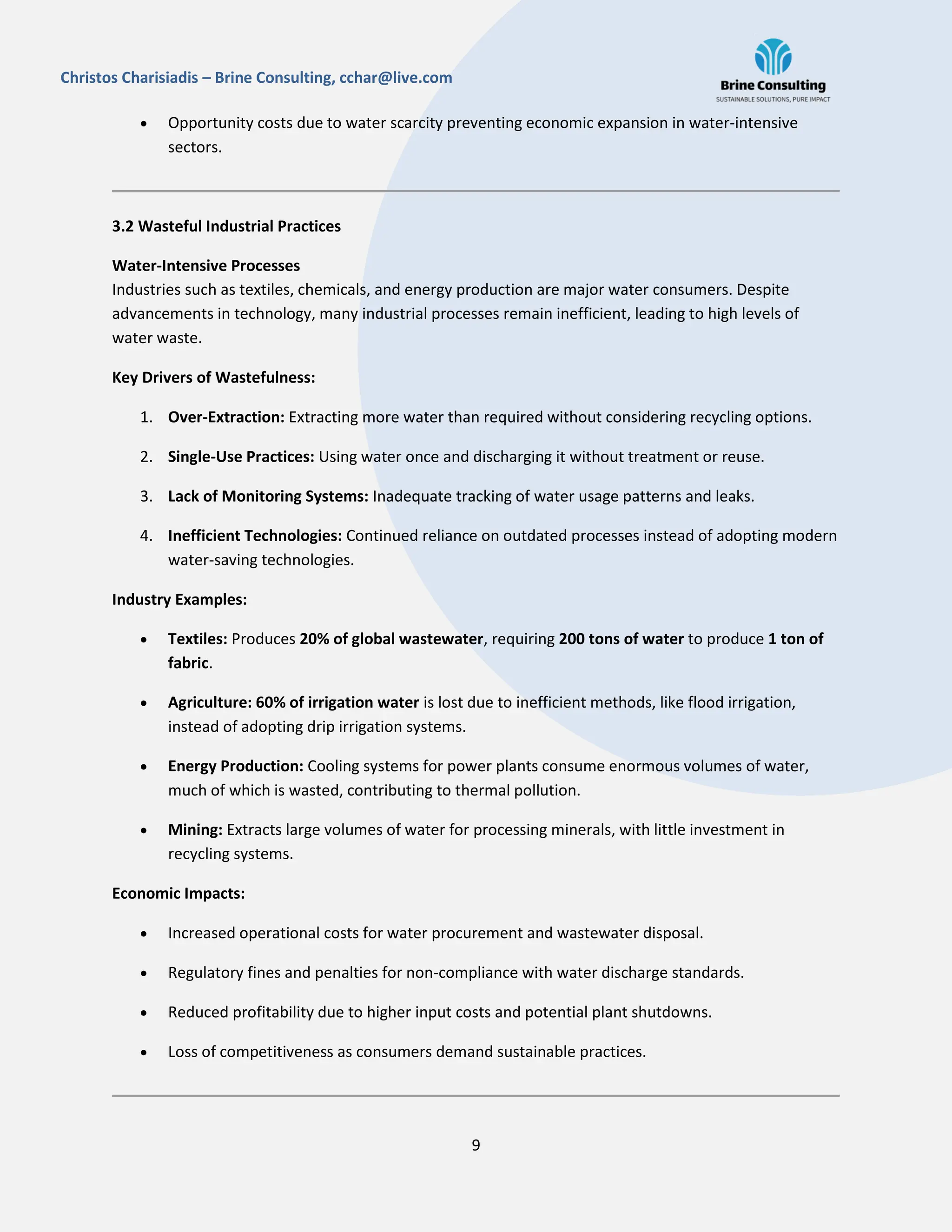
Industries such as textiles, chemicals, and energy production are major water consumers. Despite
advancements in technology, many industrial processes remain inefficient, leading to high levels of
water waste.
Key Drivers of Wastefulness:
1. Over-Extraction: Extracting more water than required without considering recycling options.
2. Single-Use Practices: Using water once and discharging it without treatment or reuse.
3. Lack of Monitoring Systems: Inadequate tracking of water usage patterns and leaks.
4. Inefficient Technologies: Continued reliance on outdated processes instead of adopting modern
water-saving technologies.
Industry Examples:
 Textiles: Produces 20% of global wastewater, requiring 200 tons of water to produce 1 ton of
fabric.
 Agriculture: 60% of irrigation water is lost due to inefficient methods, like flood irrigation,
instead of adopting drip irrigation systems.
 Energy Production: Cooling systems for power plants consume enormous volumes of water,
much of which is wasted, contributing to thermal pollution.
 Mining: Extracts large volumes of water for processing minerals, with little investment in
recycling systems.
Economic Impacts:
 Increased operational costs for water procurement and wastewater disposal.
 Regulatory fines and penalties for non-compliance with water discharge standards.
 Reduced profitability due to higher input costs and potential plant shutdowns.
 Loss of competitiveness as consumers demand sustainable practices.
10
Christos Charisiadis – Brine Consulting, cchar@live.com
3.3 Wastewater Mismanagement
Overview of Wastewater Challenges
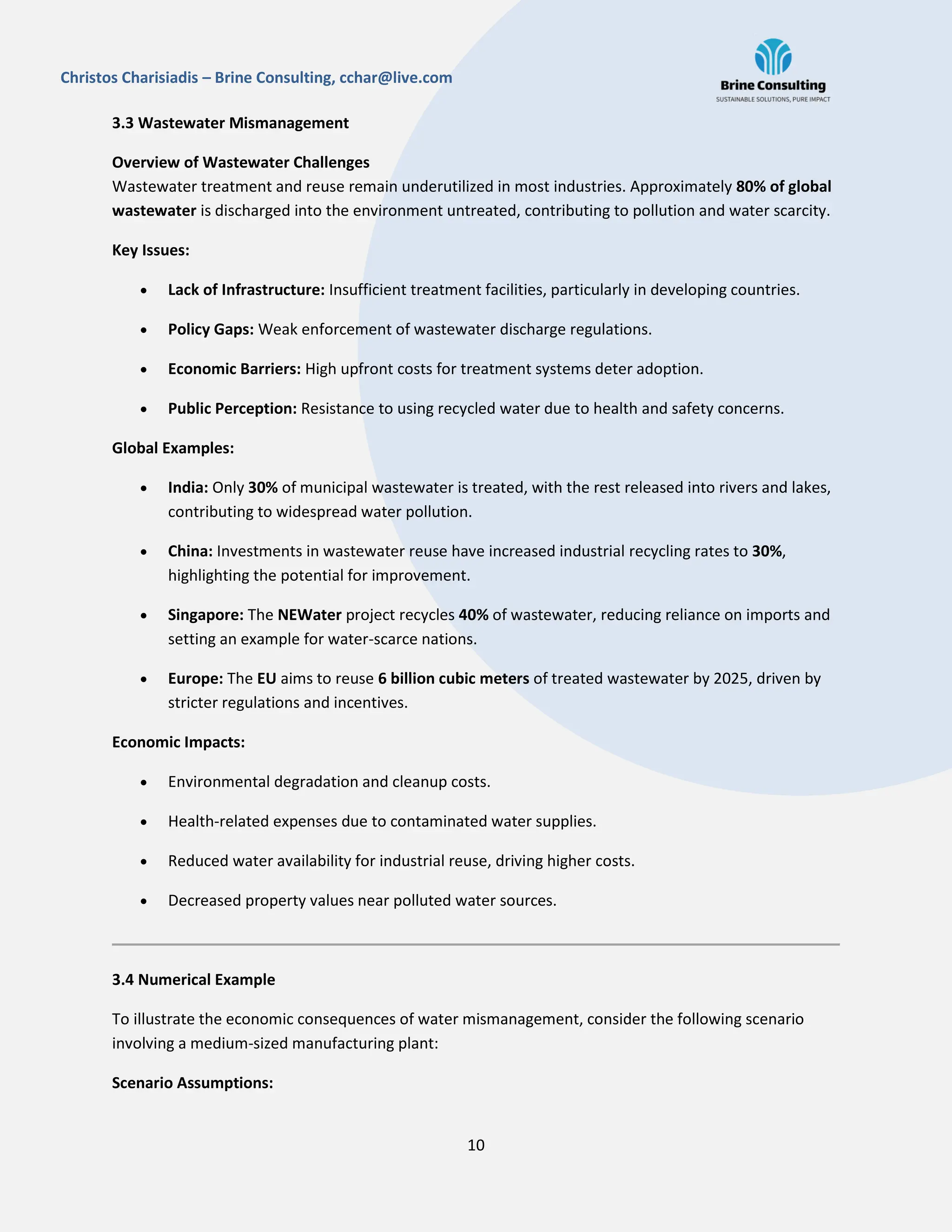
Wastewater treatment and reuse remain underutilized in most industries. Approximately 80% of global
wastewater is discharged into the environment untreated, contributing to pollution and water scarcity.
Key Issues:
 Lack of Infrastructure: Insufficient treatment facilities, particularly in developing countries.
 Policy Gaps: Weak enforcement of wastewater discharge regulations.
 Economic Barriers: High upfront costs for treatment systems deter adoption.
 Public Perception: Resistance to using recycled water due to health and safety concerns.
Global Examples:
 India: Only 30% of municipal wastewater is treated, with the rest released into rivers and lakes,
contributing to widespread water pollution.
 China: Investments in wastewater reuse have increased industrial recycling rates to 30%,
highlighting the potential for improvement.
 Singapore: The NEWater project recycles 40% of wastewater, reducing reliance on imports and
setting an example for water-scarce nations.
 Europe: The EU aims to reuse 6 billion cubic meters of treated wastewater by 2025, driven by
stricter regulations and incentives.
Economic Impacts:
 Environmental degradation and cleanup costs.
 Health-related expenses due to contaminated water supplies.
 Reduced water availability for industrial reuse, driving higher costs.
 Decreased property values near polluted water sources.
3.4 Numerical Example
To illustrate the economic consequences of water mismanagement, consider the following scenario
involving a medium-sized manufacturing plant:
Scenario Assumptions:
11
Christos Charisiadis – Brine Consulting, cchar@live.com
 Daily Water Use: 10,000 cubic meters.
 NRW Loss Rate: 30%.
 Cost of Water: $1 per cubic meter.
 Annual Working Days: 300.
Calculations:
1. Water Loss Per Day: 10,000 x 30% = 3,000 cubic meters.
2. Annual Water Loss: 3,000 x 300 = 900,000 cubic meters.
3. Financial Loss: 900,000 x $1 = $900,000 annually.
Additional Costs:
 Energy costs for pumping lost water: $150,000/year.
 Fines for wastewater discharge violations: $50,000/year.
 Infrastructure repair costs: $100,000/year.
Total Losses: $1.2 million/year.
Alternative Investment:
 Upgrading to smart metering and leak detection systems: $500,000.
 Annual savings after upgrades: $700,000.
 Payback period: Less than 1 year.
Key Takeaways:
 Addressing NRW losses, promoting efficient industrial practices, and investing in wastewater
reuse systems can deliver significant economic and environmental benefits.
 Proactive investments in water management technologies can yield positive ROI within short
payback periods.
 Ignoring water mismanagement perpetuates economic losses, regulatory risks, and
environmental damage.
12
Christos Charisiadis – Brine Consulting, cchar@live.com
4. The Economic Impact of Water Scarcity
Water scarcity has emerged as a defining economic risk of the 21st century. It disrupts industrial
production, undermines food security, inflates operational costs, and contributes to unemployment and
migration. For businesses and policymakers, the economic cost of inaction far outweighs the
investment required for sustainable water management solutions.
Key Projections
 By 2030, the global water demand will outstrip supply by 40% (World Resources Institute).
 Water scarcity could reduce GDP in water-stressed regions by up to 6% by 2050 (World Bank).
 Annual economic losses from water-related risks could reach $5.6 trillion by 2050 (World
Economic Forum).
This section highlights both direct costs to industries and indirect costs to economies, supported by
numerical examples, case studies, and long-term projections to illustrate the high economic stakes of
inaction.
4.1 Direct Costs to Industries
1. Operational and Procurement Costs
Industries reliant on water for manufacturing, processing, cooling, and cleaning face increasing costs
due to rising water prices and scarcity.
Example – Textile Industry:
 Annual Water Demand: 2 million cubic meters.
 Current Cost: $0.75/m³ → $1.5 million/year.
 Price Increase: 100% → $1.50/m³.
 New Costs: $3 million/year.
 Annual Increase: $1.5 million.
Solution – Recycling Systems:
 Investment: $1.2 million.
 Water Savings: 40%.
 New Demand: 1.2 million m³ → $1.8 million/year.
13
Christos Charisiadis – Brine Consulting, cchar@live.com
 Annual Savings: $1.2 million.
 Payback Period: 1 year.
Impact Without Action:
 Higher costs force relocation or closures.
 Fines for over-extraction and wastewater discharge add penalties.
 Export competitiveness declines.
2. Supply Chain Disruptions
Industries Impacted:
 Agriculture: Irrigation accounts for 70% of global freshwater use, leaving crop yields vulnerable
to droughts.
 Energy: Hydropower production falls during droughts, raising energy costs.
 Mining and Construction: Depend heavily on water for mineral processing and site preparation.
Numerical Example – Agriculture:
 Wheat Yield Reduction: 30%.
 Price Impact: Market price rises 25%.
 Cost Increase for Processors:
o 10,000 tons/year at $250 → $2.5 million.
o After price increase: $3.125 million.
o Loss: $625,000/year.
Supply Chain Breakdown in California (2015):
 Agricultural losses: $1.84 billion.
 17,100 jobs lost in farming, packaging, and distribution.
 Food price inflation: 15–30%.
14
Christos Charisiadis – Brine Consulting, cchar@live.com
3. Fines and Regulatory Penalties
Example – Beverage Industry (2019):
 Wastewater Compliance Failure:
o Fine: $200,000/year.
o Treatment Upgrade Cost: $500,000.
o Payback in 2.5 years.
Real-World Example – Bangladesh Textile Sector:
 $10 million fine for untreated wastewater.
 $15 million compliance cost afterward.
4. Capital Expenditures for New Infrastructure
Cost of Water Supply Interventions:
 Desalination Plants: $1,500–$2,000 per acre-foot vs. natural sources at $200/acre-foot.
 Wastewater Recycling Plants: Upfront costs of $1–5 million for medium-sized plants but 70–
80% water savings.
Case Study – Singapore’s NEWater Program:
 Investment: $3 billion.
 Recycling: 40% of water needs met through reuse.
 Savings: $1 billion/year by avoiding imports.
4.2 Indirect Costs to Economies
1. Employment Losses and Social Unrest
India – Agriculture Collapse (2016):
 Farmers abandoned 1 million hectares due to water shortages.
 Migration surged, straining urban resources.
Jordan – Political Unrest (2018):
15
Christos Charisiadis – Brine Consulting, cchar@live.com
 Water scarcity triggered protests against water rationing and price hikes.
2. Inflation and Rising Consumer Prices
Example – Australian Drought (2019):
 Crop yields fell by 25%.
 Food prices rose by 30%.
 Inflation added 0.5% to the national rate.
Numerical Example – Beef Prices:
 Water scarcity reduced cattle grazing land.
 Prices increased by 20% → $4.50/lb to $5.40/lb.
 Restaurant Costs: 1,000 lbs/month → $900/month increase.
3. Health and Migration Costs
Cholera Outbreak in Yemen (2017):
 Water contamination due to lack of wastewater treatment led to 500,000 cases.
 Healthcare costs surged by $300 million/year.
Urban Migration – Middle East:
 2 million people displaced due to drought-induced crop failures.
 City services overburdened, increasing government expenditures.
4.3 Long-Term Projections (2030–2050)
World Bank Estimates:
 GDP Losses by 2050:
o Middle East: 14%.
o South Asia: 6%.
16
Christos Charisiadis – Brine Consulting, cchar@live.com
o Africa: 5%.
Sector-Specific Risks:
 Energy Production:
o Hydropower declines by 20–30%.
o Fuel production costs rise.
 Global Trade Disruptions:
o Shipping delays through drought-hit canals (e.g., Panama Canal).
 Unemployment Impact:
o Over 200 million job losses in agriculture and water-dependent industries.
4.4 Key Takeaways
1. Water Scarcity Is an Economic Risk Multiplier:
o It affects not only industries but also labor markets, inflation, and social stability.
2. Proactive Investments Deliver Strong Returns:
o Water recycling systems and smart meters offer payback periods under 2 years.
3. Economic Resilience Requires Water Efficiency:
o Companies investing in sustainable water management secure long-term profitability.
4. Global Cooperation Is Critical:
o Governments must enforce tiered pricing, subsidies for recycling, and blockchain
solutions to track water usage.
17
Christos Charisiadis – Brine Consulting, cchar@live.com
5. Government Subsidization vs. Economic Realities
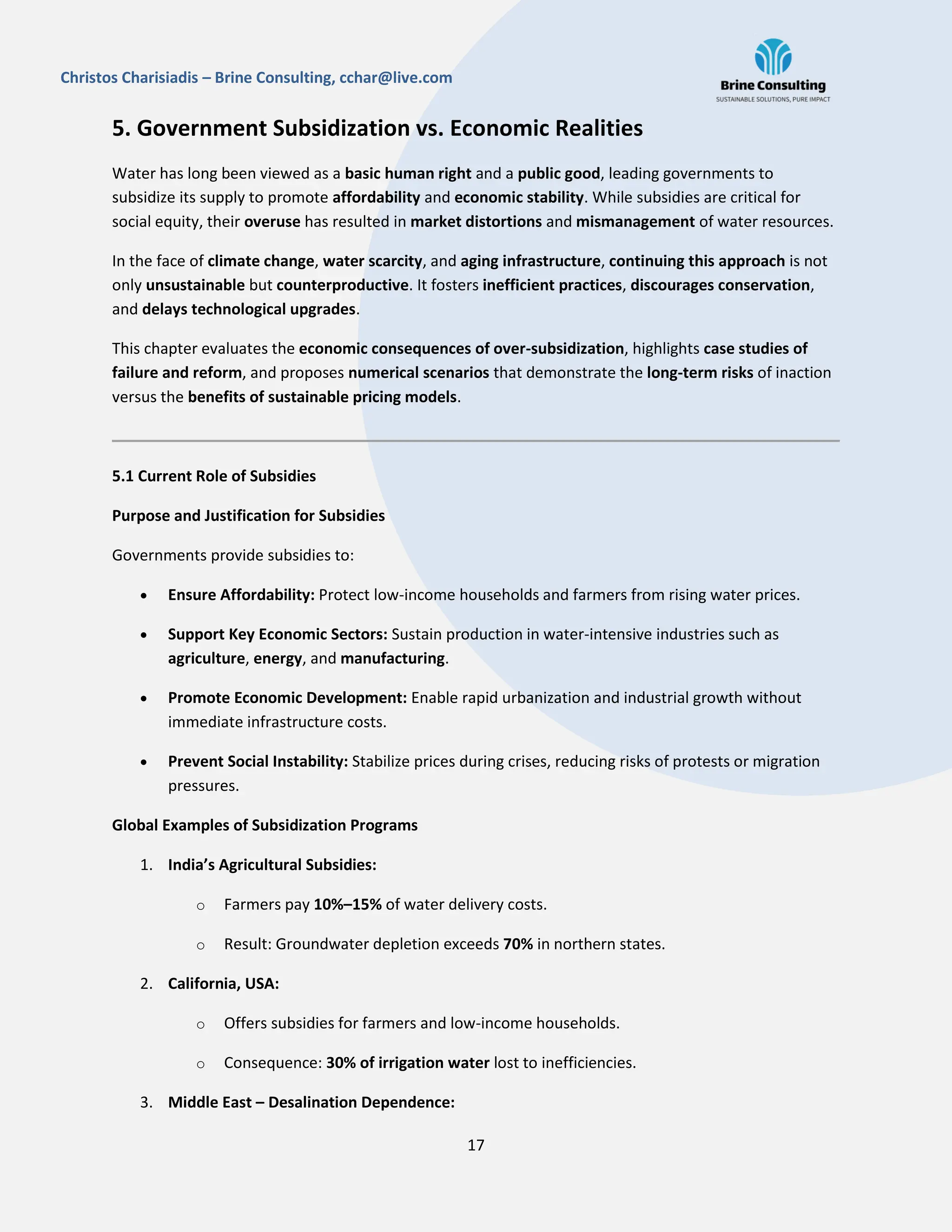
Water has long been viewed as a basic human right and a public good, leading governments to
subsidize its supply to promote affordability and economic stability. While subsidies are critical for
social equity, their overuse has resulted in market distortions and mismanagement of water resources.
In the face of climate change, water scarcity, and aging infrastructure, continuing this approach is not
only unsustainable but counterproductive. It fosters inefficient practices, discourages conservation,
and delays technological upgrades.
This chapter evaluates the economic consequences of over-subsidization, highlights case studies of
failure and reform, and proposes numerical scenarios that demonstrate the long-term risks of inaction
versus the benefits of sustainable pricing models.
5.1 Current Role of Subsidies
Purpose and Justification for Subsidies
Governments provide subsidies to:
 Ensure Affordability: Protect low-income households and farmers from rising water prices.
 Support Key Economic Sectors: Sustain production in water-intensive industries such as
agriculture, energy, and manufacturing.
 Promote Economic Development: Enable rapid urbanization and industrial growth without
immediate infrastructure costs.
 Prevent Social Instability: Stabilize prices during crises, reducing risks of protests or migration
pressures.
Global Examples of Subsidization Programs
1. India’s Agricultural Subsidies:
o Farmers pay 10%–15% of water delivery costs.
o Result: Groundwater depletion exceeds 70% in northern states.
2. California, USA:
o Offers subsidies for farmers and low-income households.
o Consequence: 30% of irrigation water lost to inefficiencies.
3. Middle East – Desalination Dependence:
18
Christos Charisiadis – Brine Consulting, cchar@live.com
o Government-funded plants provide subsidized water at prices far below operational
costs.
o Issue: Energy-intensive processes increase carbon emissions and dependency.
4. Europe’s Wastewater Recycling Grants:
o Supports green practices but relies on government funding, limiting scalability.
Key Problems Caused by Over-Subsidization
1. Distorted Market Signals:
o Artificially low prices make water appear abundant, discouraging conservation.
o Industries overuse water instead of investing in efficiency technologies.
2. Revenue Shortfalls for Utilities:
o Utilities lack funds to repair leaking pipes and upgrade systems.
o Example: U.S. water systems lose 6 billion gallons daily, costing $7.6 billion/year in
wasted resources.
3. Over-Consumption and Groundwater Depletion:
o Cheap water encourages over-extraction, leading to aquifer depletion and ecosystem
collapse.
o Example: In Saudi Arabia, subsidies fueled excessive water pumping, depleting
groundwater by 70% in 30 years.
4. Environmental Degradation:
o Excessive extraction lowers water tables, causing soil salinization and destroying
wetlands.
o Water pollution from untreated wastewater increases cleanup costs.
5. Social Inequities:
o Wealthier industries benefit disproportionately from subsidies, while poorer
communities face water shortages due to lack of infrastructure.
o Example: In India, subsidies favor large-scale farms, leaving smaller farmers dependent
on rain-fed systems.
19
Christos Charisiadis – Brine Consulting, cchar@live.com
5.2 Unavoidable Price Increases
Why Rising Costs Are Inevitable
1. Aging Infrastructure:
o U.S. infrastructure repairs require $1 trillion over the next 25 years.
o Failing infrastructure increases leakage and treatment costs.
2. Climate Change:
o Droughts and irregular rainfall patterns raise costs of storage and transportation.
o Cape Town (2018): Drought forced 200% tariff hikes to fund emergency desalination
plants.
3. Energy Costs:
o Water pumping and purification consume 7% of global energy. Rising fuel prices
increase treatment costs.
4. Urbanization and Population Growth:
o Rapid urban expansion drives 20% annual increases in water demand.
o Costs of building new pipelines and treatment facilities are 10–15 times higher than
existing infrastructure.
Case Studies on Rising Water Prices
1. Cape Town, South Africa (2018):
 Faced with a Day Zero crisis, water tariffs increased 200% to reduce consumption.
 Results: Consumption fell 50%, but businesses absorbed high costs, prompting shifts toward
reuse technologies.
2. Australia (2007–2010):
 Raised agricultural water prices by 50%, leading to investments in drip irrigation and drought-
resistant crops.
 Result: Farmers saved 25% of water without sacrificing yields.
20
Christos Charisiadis – Brine Consulting, cchar@live.com
3. São Paulo, Brazil (2015):
 Severe drought forced emergency rationing.
 Industries spent millions trucking water, doubling production costs.
5.3 Numerical Example
Scenario – Industrial Plant
Water Demand: 5 million cubic meters/year.
Current Subsidy: $0.50/m³ → $2.5 million/year.
Market Rate: $1.50/m³ → $7.5 million/year.
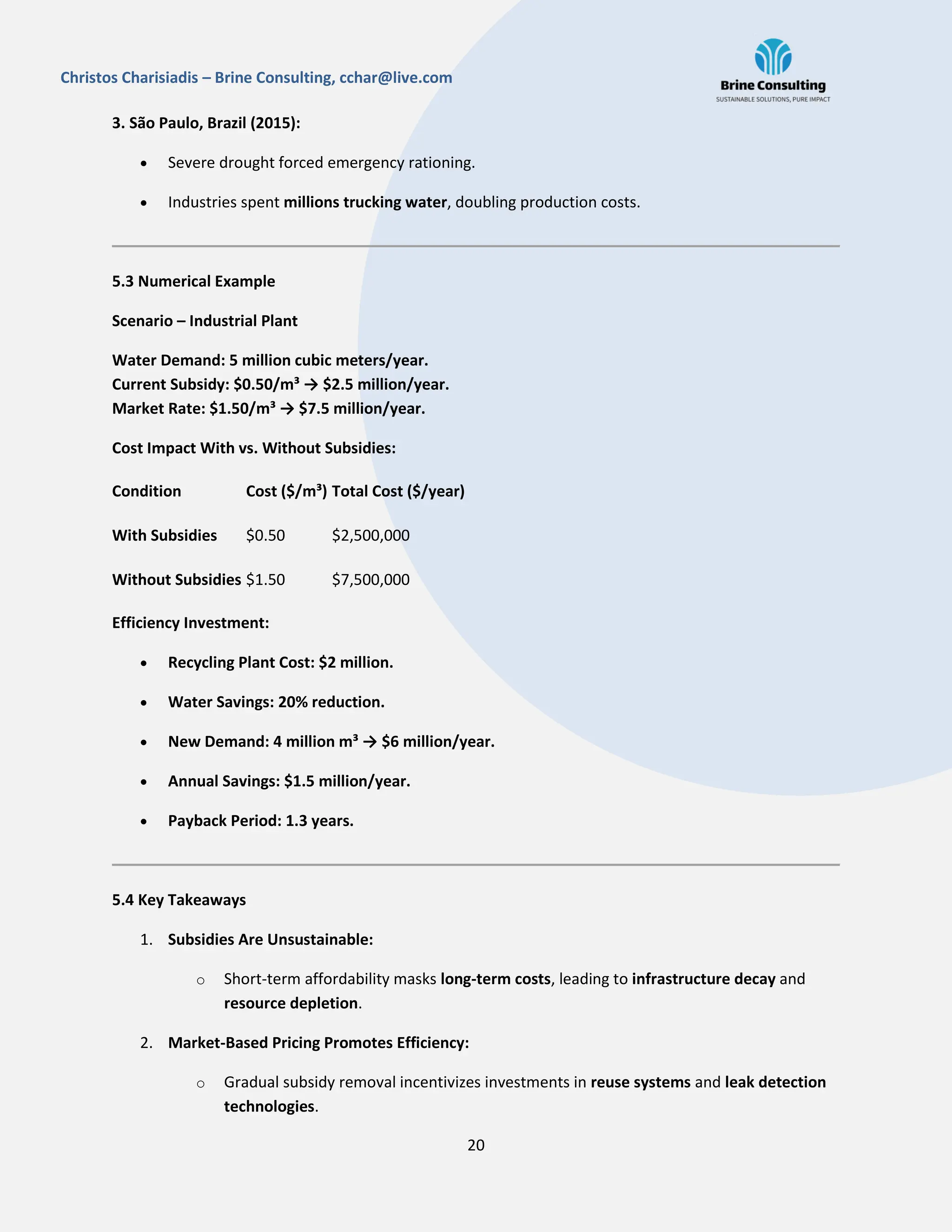
Cost Impact With vs. Without Subsidies:
Condition Cost ($/m³) Total Cost ($/year)
With Subsidies $0.50 $2,500,000
Without Subsidies $1.50 $7,500,000
Efficiency Investment:
 Recycling Plant Cost: $2 million.
 Water Savings: 20% reduction.
 New Demand: 4 million m³ → $6 million/year.
 Annual Savings: $1.5 million/year.
 Payback Period: 1.3 years.
5.4 Key Takeaways
1. Subsidies Are Unsustainable:
o Short-term affordability masks long-term costs, leading to infrastructure decay and
resource depletion.
2. Market-Based Pricing Promotes Efficiency:
o Gradual subsidy removal incentivizes investments in reuse systems and leak detection
technologies.
21
Christos Charisiadis – Brine Consulting, cchar@live.com
3. Investments Yield Long-Term Savings:
o ROI for water recycling systems can be 2–3 years, making sustainability economically
viable.
4. Public-Private Partnerships Are Key:
o Governments must partner with industries to finance upgrades, ensuring affordability
and efficiency.
5. A Smarter Water Economy Is Necessary:
o Pricing reforms, tiered tariffs, and blockchain monitoring systems ensure fair
distribution and conservation incentives.
22
Christos Charisiadis – Brine Consulting, cchar@live.com
6. Ethical Water Management and Blockchain Solutions
Water scarcity and mismanagement are global crises that demand innovative solutions rooted in ethics
and technological advancements. Ethical water management ensures that water resources are fairly
distributed and sustainably utilized, while blockchain technology introduces transparency, traceability,
and efficiency into water monitoring systems.
This chapter explores the principles of ethical water use, the role of corporate social responsibility
(CSR), and how blockchain solutions can revolutionize water trading, accountability, and resource
optimization.
6.1 Ethical Water Management
Principles of Ethical Water Use
1. Fair Distribution and Equitable Access
 Recognizes water as a basic human right and prioritizes universal access.
 Allocates resources fairly between residential, agricultural, and industrial users.
 Ensures marginalized communities have equal access to clean water.
Case Study – Cape Town’s “Day Zero” (2018):
 Introduced a tiered water pricing system during extreme shortages, reducing overuse by 50%
while protecting low-income households.
 Lesson Learned: Targeted policies can enforce fairness and drive conservation without
compromising equity.
2. Environmental Responsibility and Sustainability
 Promotes the protection of ecosystems by minimizing over-extraction and pollution.
 Encourages the adoption of closed-loop water recycling systems, rainwater harvesting, and
advanced irrigation methods.
Example – Singapore’s NEWater Program:
 Treats and reuses 40% of its wastewater, providing clean, potable water and reducing reliance
on external sources.
 Saves millions annually by offsetting the cost of imports and energy-intensive desalination.
23
Christos Charisiadis – Brine Consulting, cchar@live.com
Corporate Social Responsibility (CSR) Initiatives
1. Corporate Investments in Sustainability
 PepsiCo: Reduced water use by 11 billion liters annually through drip irrigation and closed-loop
recycling systems.
 Coca-Cola: Achieved 100% water neutrality, replenishing all water used in its operations.
 Unilever: Cut water use by 49% per production unit since 2008.
2. Certification Programs and Compliance Standards
 Alliance for Water Stewardship (AWS): Provides certification for companies adopting
sustainable water practices.
 ISO 14046 Water Footprint Standard: Measures and reduces water consumption and discharge.
Example – Levi Strauss & Co.:
 Reduced water usage by 96% during denim finishing processes, earning AWS certification and
boosting consumer trust.
6.2 Blockchain in Water Management
What Is Water Blockchain?
Blockchain technology is a distributed digital ledger that enables secure, transparent, and tamper-
proof tracking of data. In water management, it:
 Tracks Water Usage: Monitors extraction, consumption, and waste in real time.
 Automates Contracts: Enforces agreements through smart contracts to reward conservation
and penalize violations.
 Facilitates Trading Systems: Allows industries to trade water credits or sell surplus allocations
to ensure equitable distribution.
Key Benefits of Blockchain Solutions
1. Transparency and Accountability
 Provides tamper-proof data on usage and waste, holding stakeholders accountable.
24
Christos Charisiadis – Brine Consulting, cchar@live.com
 Prevents illegal water extractions and data manipulation.
Case Study – Murray-Darling Basin, Australia:
 Implemented blockchain-powered tracking systems to monitor agricultural water usage.
 Result: Reduced unauthorized withdrawals by 22% and improved compliance.
2. Efficient Trading Platforms
 Establishes water credit markets for peer-to-peer trading based on supply and demand.
 Encourages industries to sell excess water allocations to those in need, creating dynamic
pricing and improving efficiency.
Example – Israel’s Water Trading Market:
 Farmers used blockchain-based smart contracts to sell surplus water quotas, reducing waste
and cutting costs by 15%.
3. Incentive Structures
 Rewards businesses that implement leak detection systems or reuse technologies with
blockchain credits.
 Incentivizes participation in water-saving programs by automating payments and benefits.
Example – IBM and Freshwater Trust (USA):
 Developed blockchain water restoration credits for reforestation projects and watershed
conservation.
 Result: Earned $1.5 million in carbon credits linked to water sustainability projects.
4. Immutable Records
 Provides regulators with tamper-proof data for audits and compliance tracking.
 Stores historical records for risk management and long-term forecasting.
Example – China’s Yangtze River:
 Blockchain tracked pollution discharge permits, reducing violations by 25% in 3 years.
25
Christos Charisiadis – Brine Consulting, cchar@live.com
Real-World Use Cases
1. Singapore – Smart Water Grids (2018):
 Deployed IoT sensors with blockchain integration to detect leaks.
 Result: Saved 5 billion liters annually by cutting losses by 15%.
2. South Africa – Cape Town Trading Platform (2020):
 Piloted a blockchain trading platform allowing businesses to buy and sell water credits.
 Reduced water consumption by 30% in 18 months.
Numerical Example – ROI Analysis
Scenario – Industrial Plant Implements Blockchain and IoT Systems
Initial Costs:
 IoT Meters and Sensors: $200,000.
 Blockchain System Setup: $150,000.
 Total Investment: $350,000.
Annual Savings:
 Leak Reduction (15%): Saved 75,000 m³/year at $1.50/m³ → $112,500/year.
 Compliance Savings: Eliminated $50,000/year in fines.
 Revenue from Water Credits: Sold 10,000 m³ at $2.00/m³ → $20,000/year.
Total Annual Benefit: $182,500.
Payback Period: 1.9 years.
6.3 Key Takeaways
1. Ethical Water Management Ensures Fairness and Sustainability:
o Combines equity, responsibility, and efficiency to safeguard long-term access.
2. Blockchain Provides Transparency and Efficiency:
26
Christos Charisiadis – Brine Consulting, cchar@live.com
o Tracks usage, automates compliance, and supports peer-to-peer trading systems.
3. Investments Deliver Measurable Returns:
o Real-world cases show ROI within 2–3 years, ensuring financial and environmental
benefits.
4. Scalable Solutions for Future Growth:
o Combining blockchain with smart water grids offers a scalable model for global
adoption.
27
Christos Charisiadis – Brine Consulting, cchar@live.com
7. Investing in Water Reuse and Materials Recovery
Water scarcity is no longer a future threat—it is a present reality. As freshwater resources decline and
global demand increases, sustainable water management has become a strategic necessity. Investing in
water reuse and materials recovery offers both economic returns and environmental resilience,
positioning businesses and governments to meet future water challenges while unlocking new revenue
streams.
This chapter explores the global need for such investments, highlights business models, analyzes profit
opportunities, and outlines financing strategies to accelerate adoption.
7.1 The Global Need for Investment in Water Reuse and Recovery
The Growing Demand for Water and Reuse Technologies
Water Scarcity Trends:
 By 2030, global water demand will exceed supply by 40% (World Resources Institute).
 Over 4 billion people already experience severe water scarcity for at least one month per year
(UNESCO).
 Industrial water demand is expected to quadruple by 2050, driven by urbanization and
population growth.
Current Water Mismanagement:
 80% of wastewater globally is discharged untreated, polluting rivers and oceans.
 30–50% of water is lost due to leaks in aging infrastructure.
 Industrial sectors account for 20% of water withdrawals, yet 80% of wastewater remains
unrecycled.
Market Opportunity:
 Global investments in water reuse technologies are projected to reach $117 billion by 2027,
growing at a 9.5% CAGR.
The Economic and Environmental Rationale
Economic Drivers for Reuse and Recovery:
1. Cost Savings: Reduces water procurement costs and eliminates fines for non-compliance.
28
Christos Charisiadis – Brine Consulting, cchar@live.com
2. Revenue Generation: Extracting materials and generating biogas creates new revenue streams.
3. Operational Efficiency: Recycling reduces dependency on external water sources, ensuring
supply security during droughts.
Environmental Benefits:
 Reduces freshwater withdrawals, protecting aquifers and ecosystems.
 Cuts wastewater discharge, minimizing pollution and treatment costs.
 Supports a circular economy by reintegrating materials and water back into supply chains.
Why Investment is Necessary Now
1. Regulatory Pressures:
o EU Water Framework Directive (2030): Requires all industries to meet zero-liquid
discharge (ZLD) targets.
o California’s Water Recycling Act (2025): Mandates 50% wastewater reuse in urban
areas.
2. Financial Incentives:
o Green Bonds and Tax Breaks: Governments are offering low-interest loans and tax
benefits for eco-friendly water infrastructure.
3. Technological Advancements:
o Innovations in membrane bioreactors (MBRs), reverse osmosis, and anaerobic
digestion make reuse systems more affordable and scalable.
7.2 Water Reuse as a Profitable Investment
Key Business Models for Water Reuse
1. Industrial Water Recycling Plants
 Treats process water for reuse in cooling, cleaning, and manufacturing operations.
 Example – PepsiCo:
o Recycled 75% of its water usage globally, saving $20 million/year and earning green
certifications.
29
Christos Charisiadis – Brine Consulting, cchar@live.com
ROI Example:
 Investment: $2 million in advanced recycling systems.
 Annual Savings: $500,000/year due to 20% water reduction.
 Payback Period: 4 years.
2. Municipal Wastewater Reuse Systems
 Treats urban sewage for irrigation, industrial reuse, and potable purposes.
 Case Study – Orange County, California:
o Produces 100 million gallons/day of treated water, reducing groundwater dependence
and securing long-term supply.
Key Impact:
 Saved $300 million in infrastructure expansion costs.
3. Decentralized Water Treatment Facilities
 Small, localized plants for rural areas and industrial parks.
 Reduces transportation and distribution losses by treating water on-site.
Example – India’s Textile Sector:
 Adopted decentralized wastewater treatment to recover 70% of process water and reduce
regulatory fines.
Revenue Streams from Water Reuse
1. Water Sales and Credits:
 Industries with excess recycled water can sell credits to other users.
 Case Study – Israel’s Water Market:
o Treats 86% of wastewater for agriculture, generating $500 million annually in water
credits.
30
Christos Charisiadis – Brine Consulting, cchar@live.com
2. Avoided Costs and Compliance Savings:
 Saves $50,000–$100,000/year in fines for untreated discharge.
 Lowers energy costs through reduced pumping and purification.
7.3 Materials Recovery: Turning Waste into Profit
Extracting Value from Wastewater
1. Nutrient Recovery:
 Recovers phosphorus and nitrogen from wastewater for use as fertilizers.
 Market growth: 5% CAGR, driven by sustainable agriculture.
Example – The Netherlands (2020):
 Recovered 400 tons of phosphorus/year, earning $1 million annually.
2. Energy Generation (Biogas):
 Organic matter converted into biogas using anaerobic digestion.
 Example – Emscher Plant, Germany:
o Supplies 60% of its energy needs through biogas, saving $2 million/year.
3. Metals and Rare Elements:
 Extracts lithium, zinc, and gold from industrial wastewater.
 Example – Switzerland (2018):
o Recovered gold particles worth $2 million/year.
7.4 Financing Strategies and Investment Mechanisms
1. Public-Private Partnerships (PPPs):
 Combines government subsidies with private investment.
31
Christos Charisiadis – Brine Consulting, cchar@live.com
 Example – Chile’s PPP Model attracted $500 million for wastewater plants.
2. Green Bonds and Loans:
 Raised $50 million for Mexico City’s wastewater upgrades.
3. Venture Capital and Impact Investing:
 Funds startups like Aquacycl (energy-neutral treatment) and Ostara (fertilizer recovery).
7.5 Economic and Environmental Benefits
Numerical Example:
Investment: $5 million in industrial recycling.
Savings: 30% water reuse → $4.5 million/year.
Revenue: $1 million/year from recovered materials.
Payback Period: 1.1 years.
7.6 Recommendations for Stakeholders
Governments:
 Introduce reuse mandates and tax incentives.
Investors:
 Prioritize scalable technologies and circular economy startups.
Industries:
 Adopt closed-loop systems and blockchain tracking to optimize efficiency.
32
Christos Charisiadis – Brine Consulting, cchar@live.com
8. Solutions for Sustainable Water Management
Water scarcity, aging infrastructure, and inefficient management demand transformative solutions to
secure future water supplies and ensure economic stability. Sustainable water management requires a
three-pronged approach—leveraging technological innovations, policy reforms, and economic
incentives—to address challenges at local, national, and global levels.
This chapter outlines cutting-edge technologies, policy frameworks, and investment strategies with
case studies and numerical models to demonstrate viability and profitability.
8.1 Technological Innovations
Modern technology offers scalable and cost-effective solutions to conserve, reuse, and monitor water
resources while minimizing waste and energy consumption.
1. Smart Water Grids and IoT Monitoring Systems
Overview:
 IoT Sensors track real-time data on water flows, leaks, and quality across supply systems.
 AI Algorithms predict demand, optimize pumping schedules, and improve resource efficiency.
Case Study – Singapore’s Smart Water Grid (2020):
 IoT-enabled meters detected leaks, cutting losses by 15%.
 5 billion liters/year saved, offsetting costs and ensuring resilience.
Numerical Example – Industrial Plant Implementation:
 Setup Cost: $400,000 (IoT sensors and AI software).
 Leakage Reduction: 200,000 m³/year at $1.50/m³ → $300,000 savings/year.
 Payback Period: 1.3 years.
2. Advanced Filtration and Desalination Technologies
Reverse Osmosis (RO):
 High-efficiency membranes desalinate seawater and treat wastewater for reuse.
33
Christos Charisiadis – Brine Consulting, cchar@live.com
Nanotechnology Filtration:
 Nano-coated membranes reduce energy requirements by 30% compared to traditional systems.
Case Study – Israel’s Ashkelon Desalination Plant:
 Produces 330 million cubic meters/year of drinking water at $0.52/m³—among the lowest
costs globally.
 Provides 60% of Israel’s potable water, reducing reliance on natural freshwater sources.
3. Decentralized Wastewater Treatment Systems
Overview:
 Small, localized facilities treat wastewater on-site, reducing transportation losses and enabling
reuse for irrigation and industry.
Example – India’s Textile Sector:
 Decentralized wastewater plants recycle 70% of process water, cutting operational costs by 30%
and avoiding fines for discharge violations.
4. Artificial Intelligence (AI) for Water Optimization
AI Applications:
 Predictive analytics optimize irrigation schedules and treatment cycles.
 Machine learning detects inefficiencies in pumping stations and distribution networks.
Case Study – IBM Watson (2021):
 Reduced water wastage by 25% in municipal systems, cutting operational costs by $2
million/year.
8.2 Policy Interventions
Governments play a critical role in promoting sustainable water management through legislation,
pricing mechanisms, and incentives.
34
Christos Charisiadis – Brine Consulting, cchar@live.com
1. Water Pricing Reforms
Tiered Tariffs:
 Prices increase with consumption to encourage conservation and penalize waste.
Case Study – Cape Town, South Africa (2018):
 Tiered pricing during drought reduced consumption by 50% and funded emergency desalination
plants.
Numerical Example – Residential Pricing Reform:
 Flat Rate: $1.00/m³.
 Tiered Pricing:
o First 20 m³ at $1.00.
o Excess charged at $2.00/m³.
 Result: Average household saved 25% on water bills by reducing usage.
2. Water Trading Markets and Rights Allocations
Water Trading Systems:
 Establish markets for buying and selling water quotas.
Case Study – Murray-Darling Basin, Australia:
 Blockchain-based trading platform reduced illegal withdrawals by 22% and increased
compliance.
3. Regulations for Wastewater Treatment
 Zero-Liquid Discharge (ZLD): Mandates 100% wastewater reuse in industries.
 Pollution Fines: Enforce compliance and encourage adoption of reuse systems.
Case Study – China’s Yangtze River Basin (2020):
 Blockchain-based permits reduced pollution violations by 25%.
35
Christos Charisiadis – Brine Consulting, cchar@live.com
8.3 Economic and Financial Tools
1. Green Bonds and Sustainability Loans
Overview:
 Funds raised for eco-friendly water projects like desalination plants and reuse systems.
Case Study – Mexico City (2019):
 Raised $50 million for wastewater treatment infrastructure.
2. Public-Private Partnerships (PPPs)
 Attract private capital to fund infrastructure upgrades.
 Example – Chile’s $500 Million PPP Water Plant Project:
o Combined government support and private investment for desalination plants.
3. Water Credit Trading Systems
 Allow industries to sell surplus allocations, encouraging market-driven solutions.
 Case Study – Israel’s Water Trading Platform:
o Generated $500 million/year by enabling peer-to-peer water exchanges.
8.4 Numerical Example – Cost-Benefit Analysis
Scenario – Smart Grid and Water Recycling for Industrial Park
Initial Setup Costs:
 IoT Sensors: $250,000.
 AI Monitoring Systems: $150,000.
 Membrane Filtration Units: $500,000.
 Total Investment: $900,000.
36
Christos Charisiadis – Brine Consulting, cchar@live.com
Savings and Revenue:
 Leak Detection Savings: 300,000 m³/year → $450,000/year.
 Energy Savings (10%): $50,000/year.
 Revenue from Surplus Credits: 100,000 m³ at $1.50 → $150,000/year.
Total Annual Benefit: $650,000.
Payback Period: 1.4 years.
8.5 Key Takeaways
1. Technology Enhances Efficiency and Sustainability:
o Smart grids, AI systems, and desalination technologies offer scalable solutions for
monitoring and reuse.
2. Policy Reforms Promote Conservation and Accountability:
o Tiered pricing, trading markets, and zero-liquid discharge mandates incentivize
responsible practices.
3. Economic Tools Unlock Capital for Growth:
o Green bonds, PPP models, and water credits reduce barriers to financing large-scale
projects.
4. Profitability Is Achievable in Less Than 2 Years:
o Numerical models demonstrate short payback periods and high ROI, proving that
sustainability and profitability align.
37
Christos Charisiadis – Brine Consulting, cchar@live.com
9. Recommendations for Industries
Industries are among the largest consumers of water globally, accounting for approximately 20% of
freshwater withdrawals and generating significant wastewater volumes. As water scarcity intensifies,
industries face operational disruptions, higher costs, and regulatory pressures.
This chapter outlines actionable recommendations for industries, including immediate actions,
medium- to long-term strategies, and business model adaptations to ensure sustainability,
profitability, and compliance in the face of evolving challenges.
9.1 Immediate Actions
Industries must take quick and impactful steps to stabilize water consumption, reduce waste, and
improve efficiency.
1. Conduct Comprehensive Water Audits
 Objective:
o Assess water usage patterns, wastage points, and inefficiencies.
 Implementation:
o Deploy IoT sensors and AI-driven monitoring tools to track usage in real time.
 Expected Outcomes:
o Identify areas for quick fixes, such as leak repairs and pipe replacements.
Example:
 Food Processing Plant Audit (2019):
o Detected 12% leakage losses, resulting in annual savings of $120,000 after repairs.
2. Optimize Existing Processes
 Upgrade equipment to low-flow fixtures and water-efficient cooling systems.
 Introduce closed-loop systems to reuse process water internally.
Case Study – Levi Strauss & Co.:
 Recycled 96% of water during finishing processes, reducing annual water consumption by 1
billion liters.
38
Christos Charisiadis – Brine Consulting, cchar@live.com
3. Prioritize Wastewater Treatment and Reuse
 Install on-site wastewater treatment plants and adopt zero-liquid discharge (ZLD) systems.
 Treat and reuse wastewater for cooling, cleaning, or landscaping.
Example – Textile Factory in India (2020):
 Invested $1.5 million in ZLD systems.
 Payback Period: 2 years through reduced compliance fines and water procurement costs.
4. Implement Smart Monitoring Systems
 Use IoT-based meters and blockchain systems to monitor and track water consumption and
compliance.
Example – IBM’s Smart Water Management (2021):
 Reduced water waste by 25% and compliance costs by 15%.
5. Develop Emergency Preparedness Plans
 Prepare contingency plans for droughts and supply interruptions.
 Stockpile treated water and build reserve capacity.
9.2 Medium- to Long-Term Strategies
Industries need to future-proof operations by adopting scalable technologies, investing in resilience,
and aligning with regulatory trends.
1. Invest in Circular Water Systems
 Objective: Shift to closed-loop water systems to reduce dependency on freshwater sources.
 Technology Options:
o Membrane bioreactors (MBRs) for water recycling.
o Anaerobic digesters to recover biogas.
39
Christos Charisiadis – Brine Consulting, cchar@live.com
Example – Unilever (2021):
 Reduced water footprint by 49% through circular systems across facilities globally.
Financial Impact:
 Investment: $2 million.
 Annual Savings: $600,000/year.
 ROI: 3.3 years.
2. Diversify Water Sources
 Develop rainwater harvesting systems and stormwater capture technologies.
 Invest in desalination units for areas with saline water supplies.
Example – Coca-Cola (2020):
 Installed rainwater harvesting systems at multiple bottling plants.
 Resulted in 10 billion liters/year of replenished water.
3. Align with International Standards and Certifications
 Obtain Alliance for Water Stewardship (AWS) or ISO 14046 certifications.
 Use certifications to enhance credibility with stakeholders and attract investors.
Example – Nestlé’s Water Stewardship Certification:
 Enhanced brand reputation and secured sustainability-linked loans at lower interest rates.
4. Develop Corporate Water Stewardship Programs
 Partner with NGOs and governments to fund watershed restoration projects.
 Engage communities in conservation programs to build local trust.
Case Study – PepsiCo’s Positive Water Impact (2020):
 Invested $20 million in community-based conservation, resulting in a net-positive water impact
across operations.
40
Christos Charisiadis – Brine Consulting, cchar@live.com
5. Integrate Blockchain for Water Management
 Use blockchain platforms to enable real-time monitoring, data security, and water trading
systems.
Example – IBM’s Blockchain Solutions for Water:
 Reduced compliance costs by 20% and improved regulatory transparency.
9.3 Business Model Adaptations
Industries must adapt their business models to accommodate higher water prices, regulations, and
market expectations for sustainability.
1. Transition to Water-as-a-Service (WaaS)
 Outsource water treatment and recycling operations to specialized service providers.
 Pay only for treated water, reducing capital investment risks.
Example – Veolia’s WaaS Model:
 Saved clients up to 30% in water costs through service-based pricing models.
2. Monetize Waste Streams
 Convert wastewater into revenue streams by recovering nutrients, biogas, and metals.
Example – Emscher Plant, Germany:
 Generates $2 million/year from biogas energy production.
3. Explore Water Credit Trading Systems
 Participate in water credit markets to buy or sell surplus allocations.
Case Study – Israel’s Water Credit Market:
 Earned $500 million/year by enabling peer-to-peer water trades.
41
Christos Charisiadis – Brine Consulting, cchar@live.com
9.4 Key Takeaways
1. Immediate Actions Ensure Short-Term Efficiency:
o Audits, process optimizations, and monitoring systems deliver quick results.
2. Medium- to Long-Term Strategies Secure Resilience:
o Investments in circular systems, alternative water sources, and certifications future-
proof operations.
3. Business Models Must Evolve:
o Service-based pricing, waste monetization, and water trading systems turn
sustainability into profitability.
4. Return on Investment (ROI) Is Achievable Within 2–3 Years:
o Case studies and numerical examples prove that sustainability drives both cost savings
and revenue growth.
42
Christos Charisiadis – Brine Consulting, cchar@live.com
10. Conclusion
The challenges surrounding water scarcity, mismanagement, and inefficient industrial practices are no
longer distant possibilities—they are pressing realities that threaten economic stability, industrial
productivity, and environmental sustainability. As highlighted throughout this paper, the economic
consequences of inaction are severe, while the opportunities presented by proactive measures and
technological advancements offer pathways to resilience and profitability.
10.1 Key Takeaways
1. Water Mismanagement is Costly and Unsustainable
 Non-Revenue Water (NRW) losses and wasteful industrial practices contribute to billions of
dollars in economic losses each year.
 Aging infrastructure, inefficient systems, and untreated wastewater deplete resources,
damage ecosystems, and drive up costs.
2. Economic Impacts Will Escalate Without Action
 Rising water costs, supply disruptions, and regulatory fines are already affecting industries
worldwide.
 Examples from Cape Town’s Day Zero, California’s drought tariffs, and India’s agricultural
losses demonstrate that without intervention, these issues will intensify.
3. Subsidies Are Unsustainable in the Long-Term
 While subsidies promote accessibility, they mask the true cost of water, encourage waste, and
delay investments in efficient technologies.
 Transitioning to market-based pricing and tiered tariffs incentivizes conservation and
innovation.
4. Ethical and Technological Solutions Are Key
 Blockchain technologies, IoT monitoring, and AI-driven systems create transparent, efficient,
and traceable water management processes.
 Ethical frameworks ensure fair distribution, social equity, and environmental sustainability.
5. Water Reuse and Materials Recovery Offer Profitability
43
Christos Charisiadis – Brine Consulting, cchar@live.com
 Investments in circular systems, wastewater recycling, and materials recovery deliver high ROI
within 2–3 years while creating new revenue streams from recovered resources such as
phosphorus, biogas, and metals.
6. Financing Solutions Are Available
 Green bonds, PPP models, and impact investing provide the capital required to scale
sustainable water solutions.
 Financial instruments reduce barriers to adoption and support long-term growth.
7. Industries Must Adapt to Survive
 Immediate steps like water audits, leak detection, and process optimization can deliver quick
wins.
 Medium- to long-term strategies, including circular water systems, alternative water sources,
and blockchain integration, ensure future resilience and compliance.
10.2 Urgency for Change
Water scarcity is not a localized issue; it is a global crisis that requires collective action. Projections
indicate that:
 By 2030, the world faces a 40% water deficit under current management practices.
 GDP losses could reach 6% globally by 2050 if water-related risks remain unaddressed.
 Over 700 million people could face displacement due to water shortages, leading to political
instability and economic shocks.
The cost of inaction far exceeds the investment required for proactive measures. Countries and
industries that delay investments in sustainable water practices risk economic decline, supply chain
breakdowns, and reputational damage.
The urgency for change is further amplified by:
 Climate Change Impacts: Increasing droughts, floods, and unpredictable rainfall patterns
disrupt supply chains and infrastructure.
 Urbanization and Population Growth: Rapid urban expansion puts additional stress on already
fragile water systems.
 Consumer Demand for Sustainability: Businesses face mounting pressure from customers,
investors, and regulators to adopt ethical water practices.
44
Christos Charisiadis – Brine Consulting, cchar@live.com
10.3 Final Call to Action
1. Governments
 Reform Water Pricing Systems: Transition to tiered tariffs and market-based mechanisms to
promote efficient use and accountability.
 Enforce Regulations: Implement stricter policies for wastewater discharge, pollution control,
and reuse mandates.
 Support Innovation: Expand funding through green bonds, grants, and tax incentives to
accelerate adoption of technological solutions.
 Encourage Collaboration: Facilitate public-private partnerships (PPPs) to pool resources and
expertise.
2. Industries
 Lead by Example: Integrate ethical water practices into corporate social responsibility (CSR)
programs and obtain certifications like AWS and ISO 14046.
 Invest in Circular Water Systems: Reduce dependency on freshwater sources through closed-
loop recycling and materials recovery systems.
 Adopt Blockchain Solutions: Leverage blockchain for tracking usage, ensuring compliance, and
enabling water credit trading systems.
 Focus on Profitability: Treat water reuse and waste recovery as investment opportunities with
measurable ROI, rather than cost burdens.
 Prepare for Climate Risks: Build resilience through rainwater harvesting, emergency plans, and
diversified water sources.
3. Investors and Financial Institutions
 Prioritize Sustainable Projects: Fund technological innovations in reuse systems, biogas
recovery, and IoT-based monitoring.
 Scale Investments through Green Bonds: Mobilize resources for large-scale infrastructure
upgrades.
45
Christos Charisiadis – Brine Consulting, cchar@live.com
 Support Startups and Innovation: Invest in disruptive technologies like blockchain water
credits and AI-driven analytics.
4. Global Communities
 Raise Awareness: Advocate for water stewardship and push for policy reforms.
 Adopt Responsible Practices: Reduce consumption and promote reuse at household and
community levels.
 Monitor Accountability: Support companies and governments that prioritize water
sustainability while holding others accountable.
Final Message
The world stands at a crossroads—the decisions made today will shape the future of water security for
generations to come. Water is not an infinite resource, and treating it as such has led to depletion,
mismanagement, and inequality.
Industries, governments, and communities must work together to create systems that value water
appropriately, recover materials efficiently, and invest in technologies that safeguard this critical
resource.
By transitioning to ethical practices, adopting cutting-edge technologies, and leveraging financial
mechanisms, we can transform water management into an economic driver and sustainability enabler.
The choice is clear—act now, or face the costly consequences of inaction. The time for change is now—
let us lead the way to a resilient, equitable, and sustainable water future.

Future of Water Christos Charisiadis Brine Consulting.pdf

  • 1.
    The Future ofWater: Economic Risks and Sustainable Solutions Christos Charisiadis – Brine Consulting, cchar@live.com
  • 2.
    Water is oftenseen as an abundant and renewable resource, yet the truth is far more alarming. Water scarcity, mismanagement, and wasteful practices threaten not just industrial operations and economic stability but also the livelihoods of billions of people worldwide. I wrote this white paper because I believe that access to clean water is not only a fundamental right but also a shared responsibility—a responsibility that transcends industries, governments, and borders. Water is not infinite; its supply is fragile, and its value is far greater than what we currently perceive. This paper is a call to action for governments, industries, and investors to rethink the way we value, manage, and use water. It emphasizes that the cost of inaction—measured in economic losses, social instability, and environmental collapse—far outweighs the cost of innovation and investment in sustainable water solutions. Water moves everything in the world. From agriculture to energy production, from manufacturing to urban living, it is the lifeblood of our economies. I firmly believe that technological advancements, ethical management practices, and financial mechanisms can transform the way we handle water—turning crises into opportunities for growth, innovation, and resilience. This paper is not just about highlighting problems—it is about proposing solutions. It is about showing how industries can thrive economically while being environmentally responsible. It is about proving that profitability and sustainability are not mutually exclusive—they are interdependent. I invite you to read this white paper not only as an exploration of challenges but as a roadmap for action. Together, we can build a future where water security is not a crisis to fear but an opportunity to lead. Brine Consulting - Christos Charisiadis 2024 Disclaimer: This document is based on rough data, simplified assumptions, and theoretical calculations designed to provide an overview of brine valorization processes. While every effort has been made to ensure the accuracy of the presented information, the findings should be interpreted as preliminary insights rather than definitive conclusions. The concepts, methodologies, and results discussed are intended to inform and inspire further exploration, not to serve as a substitute for detailed feasibility studies or tailored project evaluations. Readers are strongly advised to conduct comprehensive assessments and consult with industry experts before implementing any of the discussed approaches. The author assumes no responsibility for decisions made based on this document alone.
  • 3.
    Christos Charisiadis –Brine Consulting, cchar@live.com
  • 4.
    1 Christos Charisiadis –Brine Consulting, cchar@live.com 1. Executive Summary 1.1 Purpose of the Paper Water is the foundation of economic growth, industrial development, and social well-being. However, poor water management, wasteful practices, and inadequate infrastructure have exacerbated water scarcity, creating a crisis that threatens economic stability and global security. This paper highlights the challenges and opportunities posed by water scarcity, making the case for sustainable water management strategies that emphasize reuse technologies, materials recovery, and ethical frameworks supported by blockchain innovations. Key Objectives of the Paper: 1. Assess the Scale of Water Mismanagement: o Highlight how non-revenue water (NRW) losses and wasteful industrial practices result in economic inefficiencies and environmental degradation. 2. Quantify Economic Impacts and Risks: o Evaluate the financial consequences of water shortages, price increases, and disruptions across key industries, including agriculture, energy, and manufacturing. 3. Present Sustainable Solutions: o Propose actionable strategies for adopting reuse technologies, closed-loop systems, and circular economies to reduce dependency on scarce resources. 4. Demonstrate Feasibility and Profitability: o Provide numerical examples, cost-benefit analyses, and case studies to prove the ROI of sustainable water solutions. 5. Deliver Policy Recommendations: o Advocate for regulatory reforms, market-based pricing, and financing mechanisms to drive adoption and scale solutions globally. This paper serves as both a call to action and a blueprint for transformation, equipping governments, industries, and investors with the tools and insights needed to future-proof water resources while maximizing profitability.
  • 5.
    2 Christos Charisiadis –Brine Consulting, cchar@live.com 1.2 Key Findings Water Mismanagement and Scarcity Are Global Threats  By 2030, global water demand is projected to exceed supply by 40% (World Resources Institute).  Over 700 million people could face displacement due to water stress by 2050, leading to social instability and economic disruption.  Non-revenue water (NRW) losses—from leaks and inefficiencies—account for up to 50% of urban water supplies, costing cities billions annually. Industries Are Vulnerable to Rising Costs  Industries consume approximately 20% of global freshwater withdrawals, with sectors like energy, textiles, and pharmaceuticals most at risk.  Case studies show that water shortages can cause factory shutdowns, supply chain disruptions, and cost increases of 50–200%.  Example – Semiconductor Manufacturing in Taiwan (2021): o Severe droughts reduced chip production by 20%, causing $50 billion in global losses. Government Subsidies Distort Water Markets  Water subsidies, while promoting accessibility, often discourage conservation and delay infrastructure upgrades.  Numerical models in this paper show that subsidy removal could lead to 200% cost increases without efficiency measures.  Case Study – India’s Agricultural Subsidies: o Farmers pay only 10% of delivery costs, contributing to 70% groundwater depletion in some regions. Proactive Investments Are Profitable  Water reuse technologies and materials recovery systems deliver payback periods of 2–3 years, enabling both cost savings and new revenue streams.  Example – Orange County, California:
  • 6.
    3 Christos Charisiadis –Brine Consulting, cchar@live.com o Recycles 100 million gallons/day of wastewater, saving $300 million/year by avoiding costly imports. Blockchain and IoT Enable Transparency and Efficiency  Blockchain systems provide tamper-proof records, peer-to-peer water trading, and smart contracts to track usage and enforce compliance.  Case Study – Australia’s Murray-Darling Basin: o Implemented blockchain-powered tracking, reducing illegal withdrawals by 22%. Financing Solutions Are Readily Available  Green bonds, public-private partnerships (PPPs), and impact investing are scaling solutions globally.  Example – Mexico City (2019): o Raised $50 million through green bonds for wastewater upgrades, delivering ROI in 4 years. 1.3 Recommendations 1. Governments  Reform Pricing Models: Replace subsidies with tiered pricing and market-driven rates to encourage conservation.  Mandate Water Reuse Targets: Enforce 50% reuse mandates in industries and municipalities by 2030.  Support Innovation: Expand funding through tax incentives, grants, and green bonds for sustainable technologies.  Facilitate Public-Private Partnerships (PPPs): Collaborate with the private sector to fund infrastructure development.
  • 7.
    4 Christos Charisiadis –Brine Consulting, cchar@live.com 2. Industries  Short-Term Actions: o Conduct water audits, repair leaks, and adopt low-flow fixtures to cut losses. o Install closed-loop systems and wastewater treatment plants to reduce dependency on freshwater sources.  Long-Term Strategies: o Invest in advanced recycling systems like membrane bioreactors (MBRs) and rainwater harvesting technologies. o Integrate blockchain systems for water metering, credits, and compliance.  Business Model Innovations: o Transition to Water-as-a-Service (WaaS) outsourcing models. o Monetize wastewater through nutrient recovery, biogas production, and metal extraction. 3. Investors and Financial Institutions  Scale Capital Through Green Bonds: Fund large-scale infrastructure upgrades and emerging technologies.  Invest in Startups: Focus on scalable solutions such as AI-based monitoring, blockchain water credits, and energy-neutral wastewater systems. 4. Communities and Stakeholders  Raise Awareness: Educate businesses and residents about water conservation and the risks of scarcity.  Promote Accountability: Support businesses and governments adopting sustainable practices, while pushing for transparency and reforms.
  • 8.
    5 Christos Charisiadis –Brine Consulting, cchar@live.com 1.4 Final Message The world faces a defining moment in water management. The economic costs of inaction—measured in billions of dollars in losses—are avoidable if governments, industries, and investors act decisively. Technological advancements such as IoT monitoring, AI optimization, blockchain solutions, and reuse systems have made sustainability profitable and scalable. The financial tools to drive this transformation—green bonds, PPP models, and impact investing—are already in place. Water must no longer be treated as cheap and infinite but as a strategic asset requiring careful stewardship. The time to act is now—to build resilience, future-proof industries, and ensure equitable access to water for generations to come.
  • 9.
    6 Christos Charisiadis –Brine Consulting, cchar@live.com 2. Introduction Water: The Lifeblood of Economies Water is the foundation of life on Earth, essential for ecosystems, human survival, and economic development. Beyond its direct use in drinking and sanitation, water is the silent force that drives industries, fuels agricultural productivity, and powers energy production. Its availability and efficient management are crucial to the global economy. Yet, the world faces an alarming water crisis that threatens economic stability, exacerbates inequalities, and undermines the resilience of businesses. As industries expand and populations grow, the demand for freshwater is surging, while climate change, pollution, and mismanagement deplete its availability. The intricate relationship between water and the economy becomes clearer when industries—dependent on steady, reliable water supplies—face disruptions, increasing costs, and operational challenges. Addressing water scarcity is no longer a choice but a necessity for sustaining both economic growth and environmental balance. The Growing Crisis of Water Scarcity Over the last century, global freshwater usage has increased sixfold, driven by population growth, urbanization, and industrial development. Today, more than 2 billion people live in regions experiencing high water stress, with over 4 billion facing severe water shortages for at least one month annually. Projections suggest that by 2050, global water demand could rise by 20%–30%, primarily due to industrial and domestic consumption. Water scarcity is not evenly distributed. Regions such as sub-Saharan Africa, South Asia, and the Middle East are disproportionately affected, with vulnerable populations relying on finite resources to sustain livelihoods. This disparity underscores the critical need for equitable distribution and efficient management of water resources. Industries and the Water Nexus Industries are both significant consumers and potential stewards of water resources. Globally, industrial water use accounts for approximately 20% of freshwater withdrawals, reaching over 50% in highly industrialized nations. Industries such as agriculture, energy, textiles, and manufacturing are among the largest water users, with agriculture alone consuming 70% of available freshwater. Water-intensive processes—such as cooling in power generation, dyeing in textile production, and irrigation in agriculture—underscore the dependence of economic output on water availability. Disruptions to water supply chains lead to production halts, increased costs, and reduced competitiveness, with ripple effects across economies. For example, the textile industry, a $1.4 trillion global market, relies on water at every production stage, from growing cotton to dyeing fabrics. Without adequate water, these industries face existential threats. Economic Implications of Scarcity Water scarcity exerts both direct and indirect economic impacts. Directly, businesses face increased costs for water acquisition, purification, and treatment, as well as penalties for non-compliance with
  • 10.
    7 Christos Charisiadis –Brine Consulting, cchar@live.com environmental regulations. Indirectly, scarcity disrupts supply chains, affects raw material availability, and heightens competition for resources. A 2023 study estimated that the global economy could lose $5.6 trillion by 2050 due to water-related challenges if current trends persist. Industries in water-stressed regions, including India, California, and parts of the Middle East, are already reporting losses tied to water scarcity. For instance, India's agricultural sector—a cornerstone of its economy—has seen productivity declines due to inadequate water access, threatening food security and export revenues. The Need for Sustainable Water Management As the economic consequences of water scarcity grow, so does the urgency for businesses, governments, and communities to adopt sustainable water management practices. Technologies such as wastewater recycling, smart water meters, and advanced leak detection systems offer innovative solutions to mitigate water loss. Equally important is the ethical dimension of water stewardship— ensuring fair allocation, reducing waste, and recognizing water as a shared resource. Statement This white paper explores the far-reaching economic impacts of water scarcity and mismanagement, particularly focusing on industries' roles and responsibilities. It examines critical issues such as non- revenue water losses, inefficient practices, and inadequate wastewater reuse. The analysis highlights how escalating water costs—regardless of government subsidization—are inevitable. However, the extent of these increases depends on the proactive measures industries and policymakers take today. By addressing these challenges, businesses can not only mitigate risks but also position themselves as leaders in water stewardship, driving sustainable growth in the decades to come.
  • 11.
    8 Christos Charisiadis –Brine Consulting, cchar@live.com 3. The State of Water Mismanagement Water mismanagement poses one of the greatest risks to economic growth and industrial sustainability in the 21st century. Despite the availability of technologies and policies designed to conserve and optimize water usage, industries and municipalities continue to face inefficiencies. This section delves into the major areas of water mismanagement, including Non-Revenue Water (NRW) losses, wasteful industrial practices, and wastewater mismanagement. A numerical example is also provided to highlight the economic consequences of inaction. 3.1 Non-Revenue Water (NRW) Losses Definition and Scope Non-Revenue Water (NRW) refers to water that is produced and distributed through supply systems but is not billed to consumers due to leaks, theft, or inaccurate metering. Globally, NRW accounts for approximately 126 billion cubic meters of water losses annually, equivalent to nearly $40 billion in economic losses. Key Causes of NRW:  Physical Losses: Leakage due to aging infrastructure, corroded pipes, and poor maintenance.  Commercial Losses: Unauthorized consumption (theft) and meter inaccuracies.  Operational Inefficiencies: Poor data management and failure to detect leaks in real time. Global Examples:  In developing countries, NRW levels often exceed 40%, compared to 15%–25% in developed countries.  In Manila, Philippines, targeted NRW reduction programs led to a 30% drop in losses over 10 years, saving millions in costs.  In South Africa, water losses due to leaks account for 41% of the total municipal water supply, costing the economy millions annually. Economic Impacts:  Financial losses for utilities, reducing their ability to invest in infrastructure upgrades.  Higher tariffs imposed on consumers to offset revenue losses.  Increased energy costs associated with pumping and treating water that never reaches end- users.
  • 12.
    9 Christos Charisiadis –Brine Consulting, cchar@live.com  Opportunity costs due to water scarcity preventing economic expansion in water-intensive sectors. 3.2 Wasteful Industrial Practices Water-Intensive Processes Industries such as textiles, chemicals, and energy production are major water consumers. Despite advancements in technology, many industrial processes remain inefficient, leading to high levels of water waste. Key Drivers of Wastefulness: 1. Over-Extraction: Extracting more water than required without considering recycling options. 2. Single-Use Practices: Using water once and discharging it without treatment or reuse. 3. Lack of Monitoring Systems: Inadequate tracking of water usage patterns and leaks. 4. Inefficient Technologies: Continued reliance on outdated processes instead of adopting modern water-saving technologies. Industry Examples:  Textiles: Produces 20% of global wastewater, requiring 200 tons of water to produce 1 ton of fabric.  Agriculture: 60% of irrigation water is lost due to inefficient methods, like flood irrigation, instead of adopting drip irrigation systems.  Energy Production: Cooling systems for power plants consume enormous volumes of water, much of which is wasted, contributing to thermal pollution.  Mining: Extracts large volumes of water for processing minerals, with little investment in recycling systems. Economic Impacts:  Increased operational costs for water procurement and wastewater disposal.  Regulatory fines and penalties for non-compliance with water discharge standards.  Reduced profitability due to higher input costs and potential plant shutdowns.  Loss of competitiveness as consumers demand sustainable practices.
  • 13.
    10 Christos Charisiadis –Brine Consulting, cchar@live.com 3.3 Wastewater Mismanagement Overview of Wastewater Challenges Wastewater treatment and reuse remain underutilized in most industries. Approximately 80% of global wastewater is discharged into the environment untreated, contributing to pollution and water scarcity. Key Issues:  Lack of Infrastructure: Insufficient treatment facilities, particularly in developing countries.  Policy Gaps: Weak enforcement of wastewater discharge regulations.  Economic Barriers: High upfront costs for treatment systems deter adoption.  Public Perception: Resistance to using recycled water due to health and safety concerns. Global Examples:  India: Only 30% of municipal wastewater is treated, with the rest released into rivers and lakes, contributing to widespread water pollution.  China: Investments in wastewater reuse have increased industrial recycling rates to 30%, highlighting the potential for improvement.  Singapore: The NEWater project recycles 40% of wastewater, reducing reliance on imports and setting an example for water-scarce nations.  Europe: The EU aims to reuse 6 billion cubic meters of treated wastewater by 2025, driven by stricter regulations and incentives. Economic Impacts:  Environmental degradation and cleanup costs.  Health-related expenses due to contaminated water supplies.  Reduced water availability for industrial reuse, driving higher costs.  Decreased property values near polluted water sources. 3.4 Numerical Example To illustrate the economic consequences of water mismanagement, consider the following scenario involving a medium-sized manufacturing plant: Scenario Assumptions:
  • 14.
    11 Christos Charisiadis –Brine Consulting, cchar@live.com  Daily Water Use: 10,000 cubic meters.  NRW Loss Rate: 30%.  Cost of Water: $1 per cubic meter.  Annual Working Days: 300. Calculations: 1. Water Loss Per Day: 10,000 x 30% = 3,000 cubic meters. 2. Annual Water Loss: 3,000 x 300 = 900,000 cubic meters. 3. Financial Loss: 900,000 x $1 = $900,000 annually. Additional Costs:  Energy costs for pumping lost water: $150,000/year.  Fines for wastewater discharge violations: $50,000/year.  Infrastructure repair costs: $100,000/year. Total Losses: $1.2 million/year. Alternative Investment:  Upgrading to smart metering and leak detection systems: $500,000.  Annual savings after upgrades: $700,000.  Payback period: Less than 1 year. Key Takeaways:  Addressing NRW losses, promoting efficient industrial practices, and investing in wastewater reuse systems can deliver significant economic and environmental benefits.  Proactive investments in water management technologies can yield positive ROI within short payback periods.  Ignoring water mismanagement perpetuates economic losses, regulatory risks, and environmental damage.
  • 15.
    12 Christos Charisiadis –Brine Consulting, cchar@live.com 4. The Economic Impact of Water Scarcity Water scarcity has emerged as a defining economic risk of the 21st century. It disrupts industrial production, undermines food security, inflates operational costs, and contributes to unemployment and migration. For businesses and policymakers, the economic cost of inaction far outweighs the investment required for sustainable water management solutions. Key Projections  By 2030, the global water demand will outstrip supply by 40% (World Resources Institute).  Water scarcity could reduce GDP in water-stressed regions by up to 6% by 2050 (World Bank).  Annual economic losses from water-related risks could reach $5.6 trillion by 2050 (World Economic Forum). This section highlights both direct costs to industries and indirect costs to economies, supported by numerical examples, case studies, and long-term projections to illustrate the high economic stakes of inaction. 4.1 Direct Costs to Industries 1. Operational and Procurement Costs Industries reliant on water for manufacturing, processing, cooling, and cleaning face increasing costs due to rising water prices and scarcity. Example – Textile Industry:  Annual Water Demand: 2 million cubic meters.  Current Cost: $0.75/m³ → $1.5 million/year.  Price Increase: 100% → $1.50/m³.  New Costs: $3 million/year.  Annual Increase: $1.5 million. Solution – Recycling Systems:  Investment: $1.2 million.  Water Savings: 40%.  New Demand: 1.2 million m³ → $1.8 million/year.
  • 16.
    13 Christos Charisiadis –Brine Consulting, cchar@live.com  Annual Savings: $1.2 million.  Payback Period: 1 year. Impact Without Action:  Higher costs force relocation or closures.  Fines for over-extraction and wastewater discharge add penalties.  Export competitiveness declines. 2. Supply Chain Disruptions Industries Impacted:  Agriculture: Irrigation accounts for 70% of global freshwater use, leaving crop yields vulnerable to droughts.  Energy: Hydropower production falls during droughts, raising energy costs.  Mining and Construction: Depend heavily on water for mineral processing and site preparation. Numerical Example – Agriculture:  Wheat Yield Reduction: 30%.  Price Impact: Market price rises 25%.  Cost Increase for Processors: o 10,000 tons/year at $250 → $2.5 million. o After price increase: $3.125 million. o Loss: $625,000/year. Supply Chain Breakdown in California (2015):  Agricultural losses: $1.84 billion.  17,100 jobs lost in farming, packaging, and distribution.  Food price inflation: 15–30%.
  • 17.
    14 Christos Charisiadis –Brine Consulting, cchar@live.com 3. Fines and Regulatory Penalties Example – Beverage Industry (2019):  Wastewater Compliance Failure: o Fine: $200,000/year. o Treatment Upgrade Cost: $500,000. o Payback in 2.5 years. Real-World Example – Bangladesh Textile Sector:  $10 million fine for untreated wastewater.  $15 million compliance cost afterward. 4. Capital Expenditures for New Infrastructure Cost of Water Supply Interventions:  Desalination Plants: $1,500–$2,000 per acre-foot vs. natural sources at $200/acre-foot.  Wastewater Recycling Plants: Upfront costs of $1–5 million for medium-sized plants but 70– 80% water savings. Case Study – Singapore’s NEWater Program:  Investment: $3 billion.  Recycling: 40% of water needs met through reuse.  Savings: $1 billion/year by avoiding imports. 4.2 Indirect Costs to Economies 1. Employment Losses and Social Unrest India – Agriculture Collapse (2016):  Farmers abandoned 1 million hectares due to water shortages.  Migration surged, straining urban resources. Jordan – Political Unrest (2018):
  • 18.
    15 Christos Charisiadis –Brine Consulting, cchar@live.com  Water scarcity triggered protests against water rationing and price hikes. 2. Inflation and Rising Consumer Prices Example – Australian Drought (2019):  Crop yields fell by 25%.  Food prices rose by 30%.  Inflation added 0.5% to the national rate. Numerical Example – Beef Prices:  Water scarcity reduced cattle grazing land.  Prices increased by 20% → $4.50/lb to $5.40/lb.  Restaurant Costs: 1,000 lbs/month → $900/month increase. 3. Health and Migration Costs Cholera Outbreak in Yemen (2017):  Water contamination due to lack of wastewater treatment led to 500,000 cases.  Healthcare costs surged by $300 million/year. Urban Migration – Middle East:  2 million people displaced due to drought-induced crop failures.  City services overburdened, increasing government expenditures. 4.3 Long-Term Projections (2030–2050) World Bank Estimates:  GDP Losses by 2050: o Middle East: 14%. o South Asia: 6%.
  • 19.
    16 Christos Charisiadis –Brine Consulting, cchar@live.com o Africa: 5%. Sector-Specific Risks:  Energy Production: o Hydropower declines by 20–30%. o Fuel production costs rise.  Global Trade Disruptions: o Shipping delays through drought-hit canals (e.g., Panama Canal).  Unemployment Impact: o Over 200 million job losses in agriculture and water-dependent industries. 4.4 Key Takeaways 1. Water Scarcity Is an Economic Risk Multiplier: o It affects not only industries but also labor markets, inflation, and social stability. 2. Proactive Investments Deliver Strong Returns: o Water recycling systems and smart meters offer payback periods under 2 years. 3. Economic Resilience Requires Water Efficiency: o Companies investing in sustainable water management secure long-term profitability. 4. Global Cooperation Is Critical: o Governments must enforce tiered pricing, subsidies for recycling, and blockchain solutions to track water usage.
  • 20.
    17 Christos Charisiadis –Brine Consulting, cchar@live.com 5. Government Subsidization vs. Economic Realities Water has long been viewed as a basic human right and a public good, leading governments to subsidize its supply to promote affordability and economic stability. While subsidies are critical for social equity, their overuse has resulted in market distortions and mismanagement of water resources. In the face of climate change, water scarcity, and aging infrastructure, continuing this approach is not only unsustainable but counterproductive. It fosters inefficient practices, discourages conservation, and delays technological upgrades. This chapter evaluates the economic consequences of over-subsidization, highlights case studies of failure and reform, and proposes numerical scenarios that demonstrate the long-term risks of inaction versus the benefits of sustainable pricing models. 5.1 Current Role of Subsidies Purpose and Justification for Subsidies Governments provide subsidies to:  Ensure Affordability: Protect low-income households and farmers from rising water prices.  Support Key Economic Sectors: Sustain production in water-intensive industries such as agriculture, energy, and manufacturing.  Promote Economic Development: Enable rapid urbanization and industrial growth without immediate infrastructure costs.  Prevent Social Instability: Stabilize prices during crises, reducing risks of protests or migration pressures. Global Examples of Subsidization Programs 1. India’s Agricultural Subsidies: o Farmers pay 10%–15% of water delivery costs. o Result: Groundwater depletion exceeds 70% in northern states. 2. California, USA: o Offers subsidies for farmers and low-income households. o Consequence: 30% of irrigation water lost to inefficiencies. 3. Middle East – Desalination Dependence:
  • 21.
    18 Christos Charisiadis –Brine Consulting, cchar@live.com o Government-funded plants provide subsidized water at prices far below operational costs. o Issue: Energy-intensive processes increase carbon emissions and dependency. 4. Europe’s Wastewater Recycling Grants: o Supports green practices but relies on government funding, limiting scalability. Key Problems Caused by Over-Subsidization 1. Distorted Market Signals: o Artificially low prices make water appear abundant, discouraging conservation. o Industries overuse water instead of investing in efficiency technologies. 2. Revenue Shortfalls for Utilities: o Utilities lack funds to repair leaking pipes and upgrade systems. o Example: U.S. water systems lose 6 billion gallons daily, costing $7.6 billion/year in wasted resources. 3. Over-Consumption and Groundwater Depletion: o Cheap water encourages over-extraction, leading to aquifer depletion and ecosystem collapse. o Example: In Saudi Arabia, subsidies fueled excessive water pumping, depleting groundwater by 70% in 30 years. 4. Environmental Degradation: o Excessive extraction lowers water tables, causing soil salinization and destroying wetlands. o Water pollution from untreated wastewater increases cleanup costs. 5. Social Inequities: o Wealthier industries benefit disproportionately from subsidies, while poorer communities face water shortages due to lack of infrastructure. o Example: In India, subsidies favor large-scale farms, leaving smaller farmers dependent on rain-fed systems.
  • 22.
    19 Christos Charisiadis –Brine Consulting, cchar@live.com 5.2 Unavoidable Price Increases Why Rising Costs Are Inevitable 1. Aging Infrastructure: o U.S. infrastructure repairs require $1 trillion over the next 25 years. o Failing infrastructure increases leakage and treatment costs. 2. Climate Change: o Droughts and irregular rainfall patterns raise costs of storage and transportation. o Cape Town (2018): Drought forced 200% tariff hikes to fund emergency desalination plants. 3. Energy Costs: o Water pumping and purification consume 7% of global energy. Rising fuel prices increase treatment costs. 4. Urbanization and Population Growth: o Rapid urban expansion drives 20% annual increases in water demand. o Costs of building new pipelines and treatment facilities are 10–15 times higher than existing infrastructure. Case Studies on Rising Water Prices 1. Cape Town, South Africa (2018):  Faced with a Day Zero crisis, water tariffs increased 200% to reduce consumption.  Results: Consumption fell 50%, but businesses absorbed high costs, prompting shifts toward reuse technologies. 2. Australia (2007–2010):  Raised agricultural water prices by 50%, leading to investments in drip irrigation and drought- resistant crops.  Result: Farmers saved 25% of water without sacrificing yields.
  • 23.
    20 Christos Charisiadis –Brine Consulting, cchar@live.com 3. São Paulo, Brazil (2015):  Severe drought forced emergency rationing.  Industries spent millions trucking water, doubling production costs. 5.3 Numerical Example Scenario – Industrial Plant Water Demand: 5 million cubic meters/year. Current Subsidy: $0.50/m³ → $2.5 million/year. Market Rate: $1.50/m³ → $7.5 million/year. Cost Impact With vs. Without Subsidies: Condition Cost ($/m³) Total Cost ($/year) With Subsidies $0.50 $2,500,000 Without Subsidies $1.50 $7,500,000 Efficiency Investment:  Recycling Plant Cost: $2 million.  Water Savings: 20% reduction.  New Demand: 4 million m³ → $6 million/year.  Annual Savings: $1.5 million/year.  Payback Period: 1.3 years. 5.4 Key Takeaways 1. Subsidies Are Unsustainable: o Short-term affordability masks long-term costs, leading to infrastructure decay and resource depletion. 2. Market-Based Pricing Promotes Efficiency: o Gradual subsidy removal incentivizes investments in reuse systems and leak detection technologies.
  • 24.
    21 Christos Charisiadis –Brine Consulting, cchar@live.com 3. Investments Yield Long-Term Savings: o ROI for water recycling systems can be 2–3 years, making sustainability economically viable. 4. Public-Private Partnerships Are Key: o Governments must partner with industries to finance upgrades, ensuring affordability and efficiency. 5. A Smarter Water Economy Is Necessary: o Pricing reforms, tiered tariffs, and blockchain monitoring systems ensure fair distribution and conservation incentives.
  • 25.
    22 Christos Charisiadis –Brine Consulting, cchar@live.com 6. Ethical Water Management and Blockchain Solutions Water scarcity and mismanagement are global crises that demand innovative solutions rooted in ethics and technological advancements. Ethical water management ensures that water resources are fairly distributed and sustainably utilized, while blockchain technology introduces transparency, traceability, and efficiency into water monitoring systems. This chapter explores the principles of ethical water use, the role of corporate social responsibility (CSR), and how blockchain solutions can revolutionize water trading, accountability, and resource optimization. 6.1 Ethical Water Management Principles of Ethical Water Use 1. Fair Distribution and Equitable Access  Recognizes water as a basic human right and prioritizes universal access.  Allocates resources fairly between residential, agricultural, and industrial users.  Ensures marginalized communities have equal access to clean water. Case Study – Cape Town’s “Day Zero” (2018):  Introduced a tiered water pricing system during extreme shortages, reducing overuse by 50% while protecting low-income households.  Lesson Learned: Targeted policies can enforce fairness and drive conservation without compromising equity. 2. Environmental Responsibility and Sustainability  Promotes the protection of ecosystems by minimizing over-extraction and pollution.  Encourages the adoption of closed-loop water recycling systems, rainwater harvesting, and advanced irrigation methods. Example – Singapore’s NEWater Program:  Treats and reuses 40% of its wastewater, providing clean, potable water and reducing reliance on external sources.  Saves millions annually by offsetting the cost of imports and energy-intensive desalination.
  • 26.
    23 Christos Charisiadis –Brine Consulting, cchar@live.com Corporate Social Responsibility (CSR) Initiatives 1. Corporate Investments in Sustainability  PepsiCo: Reduced water use by 11 billion liters annually through drip irrigation and closed-loop recycling systems.  Coca-Cola: Achieved 100% water neutrality, replenishing all water used in its operations.  Unilever: Cut water use by 49% per production unit since 2008. 2. Certification Programs and Compliance Standards  Alliance for Water Stewardship (AWS): Provides certification for companies adopting sustainable water practices.  ISO 14046 Water Footprint Standard: Measures and reduces water consumption and discharge. Example – Levi Strauss & Co.:  Reduced water usage by 96% during denim finishing processes, earning AWS certification and boosting consumer trust. 6.2 Blockchain in Water Management What Is Water Blockchain? Blockchain technology is a distributed digital ledger that enables secure, transparent, and tamper- proof tracking of data. In water management, it:  Tracks Water Usage: Monitors extraction, consumption, and waste in real time.  Automates Contracts: Enforces agreements through smart contracts to reward conservation and penalize violations.  Facilitates Trading Systems: Allows industries to trade water credits or sell surplus allocations to ensure equitable distribution. Key Benefits of Blockchain Solutions 1. Transparency and Accountability  Provides tamper-proof data on usage and waste, holding stakeholders accountable.
  • 27.
    24 Christos Charisiadis –Brine Consulting, cchar@live.com  Prevents illegal water extractions and data manipulation. Case Study – Murray-Darling Basin, Australia:  Implemented blockchain-powered tracking systems to monitor agricultural water usage.  Result: Reduced unauthorized withdrawals by 22% and improved compliance. 2. Efficient Trading Platforms  Establishes water credit markets for peer-to-peer trading based on supply and demand.  Encourages industries to sell excess water allocations to those in need, creating dynamic pricing and improving efficiency. Example – Israel’s Water Trading Market:  Farmers used blockchain-based smart contracts to sell surplus water quotas, reducing waste and cutting costs by 15%. 3. Incentive Structures  Rewards businesses that implement leak detection systems or reuse technologies with blockchain credits.  Incentivizes participation in water-saving programs by automating payments and benefits. Example – IBM and Freshwater Trust (USA):  Developed blockchain water restoration credits for reforestation projects and watershed conservation.  Result: Earned $1.5 million in carbon credits linked to water sustainability projects. 4. Immutable Records  Provides regulators with tamper-proof data for audits and compliance tracking.  Stores historical records for risk management and long-term forecasting. Example – China’s Yangtze River:  Blockchain tracked pollution discharge permits, reducing violations by 25% in 3 years.
  • 28.
    25 Christos Charisiadis –Brine Consulting, cchar@live.com Real-World Use Cases 1. Singapore – Smart Water Grids (2018):  Deployed IoT sensors with blockchain integration to detect leaks.  Result: Saved 5 billion liters annually by cutting losses by 15%. 2. South Africa – Cape Town Trading Platform (2020):  Piloted a blockchain trading platform allowing businesses to buy and sell water credits.  Reduced water consumption by 30% in 18 months. Numerical Example – ROI Analysis Scenario – Industrial Plant Implements Blockchain and IoT Systems Initial Costs:  IoT Meters and Sensors: $200,000.  Blockchain System Setup: $150,000.  Total Investment: $350,000. Annual Savings:  Leak Reduction (15%): Saved 75,000 m³/year at $1.50/m³ → $112,500/year.  Compliance Savings: Eliminated $50,000/year in fines.  Revenue from Water Credits: Sold 10,000 m³ at $2.00/m³ → $20,000/year. Total Annual Benefit: $182,500. Payback Period: 1.9 years. 6.3 Key Takeaways 1. Ethical Water Management Ensures Fairness and Sustainability: o Combines equity, responsibility, and efficiency to safeguard long-term access. 2. Blockchain Provides Transparency and Efficiency:
  • 29.
    26 Christos Charisiadis –Brine Consulting, cchar@live.com o Tracks usage, automates compliance, and supports peer-to-peer trading systems. 3. Investments Deliver Measurable Returns: o Real-world cases show ROI within 2–3 years, ensuring financial and environmental benefits. 4. Scalable Solutions for Future Growth: o Combining blockchain with smart water grids offers a scalable model for global adoption.
  • 30.
    27 Christos Charisiadis –Brine Consulting, cchar@live.com 7. Investing in Water Reuse and Materials Recovery Water scarcity is no longer a future threat—it is a present reality. As freshwater resources decline and global demand increases, sustainable water management has become a strategic necessity. Investing in water reuse and materials recovery offers both economic returns and environmental resilience, positioning businesses and governments to meet future water challenges while unlocking new revenue streams. This chapter explores the global need for such investments, highlights business models, analyzes profit opportunities, and outlines financing strategies to accelerate adoption. 7.1 The Global Need for Investment in Water Reuse and Recovery The Growing Demand for Water and Reuse Technologies Water Scarcity Trends:  By 2030, global water demand will exceed supply by 40% (World Resources Institute).  Over 4 billion people already experience severe water scarcity for at least one month per year (UNESCO).  Industrial water demand is expected to quadruple by 2050, driven by urbanization and population growth. Current Water Mismanagement:  80% of wastewater globally is discharged untreated, polluting rivers and oceans.  30–50% of water is lost due to leaks in aging infrastructure.  Industrial sectors account for 20% of water withdrawals, yet 80% of wastewater remains unrecycled. Market Opportunity:  Global investments in water reuse technologies are projected to reach $117 billion by 2027, growing at a 9.5% CAGR. The Economic and Environmental Rationale Economic Drivers for Reuse and Recovery: 1. Cost Savings: Reduces water procurement costs and eliminates fines for non-compliance.
  • 31.
    28 Christos Charisiadis –Brine Consulting, cchar@live.com 2. Revenue Generation: Extracting materials and generating biogas creates new revenue streams. 3. Operational Efficiency: Recycling reduces dependency on external water sources, ensuring supply security during droughts. Environmental Benefits:  Reduces freshwater withdrawals, protecting aquifers and ecosystems.  Cuts wastewater discharge, minimizing pollution and treatment costs.  Supports a circular economy by reintegrating materials and water back into supply chains. Why Investment is Necessary Now 1. Regulatory Pressures: o EU Water Framework Directive (2030): Requires all industries to meet zero-liquid discharge (ZLD) targets. o California’s Water Recycling Act (2025): Mandates 50% wastewater reuse in urban areas. 2. Financial Incentives: o Green Bonds and Tax Breaks: Governments are offering low-interest loans and tax benefits for eco-friendly water infrastructure. 3. Technological Advancements: o Innovations in membrane bioreactors (MBRs), reverse osmosis, and anaerobic digestion make reuse systems more affordable and scalable. 7.2 Water Reuse as a Profitable Investment Key Business Models for Water Reuse 1. Industrial Water Recycling Plants  Treats process water for reuse in cooling, cleaning, and manufacturing operations.  Example – PepsiCo: o Recycled 75% of its water usage globally, saving $20 million/year and earning green certifications.
  • 32.
    29 Christos Charisiadis –Brine Consulting, cchar@live.com ROI Example:  Investment: $2 million in advanced recycling systems.  Annual Savings: $500,000/year due to 20% water reduction.  Payback Period: 4 years. 2. Municipal Wastewater Reuse Systems  Treats urban sewage for irrigation, industrial reuse, and potable purposes.  Case Study – Orange County, California: o Produces 100 million gallons/day of treated water, reducing groundwater dependence and securing long-term supply. Key Impact:  Saved $300 million in infrastructure expansion costs. 3. Decentralized Water Treatment Facilities  Small, localized plants for rural areas and industrial parks.  Reduces transportation and distribution losses by treating water on-site. Example – India’s Textile Sector:  Adopted decentralized wastewater treatment to recover 70% of process water and reduce regulatory fines. Revenue Streams from Water Reuse 1. Water Sales and Credits:  Industries with excess recycled water can sell credits to other users.  Case Study – Israel’s Water Market: o Treats 86% of wastewater for agriculture, generating $500 million annually in water credits.
  • 33.
    30 Christos Charisiadis –Brine Consulting, cchar@live.com 2. Avoided Costs and Compliance Savings:  Saves $50,000–$100,000/year in fines for untreated discharge.  Lowers energy costs through reduced pumping and purification. 7.3 Materials Recovery: Turning Waste into Profit Extracting Value from Wastewater 1. Nutrient Recovery:  Recovers phosphorus and nitrogen from wastewater for use as fertilizers.  Market growth: 5% CAGR, driven by sustainable agriculture. Example – The Netherlands (2020):  Recovered 400 tons of phosphorus/year, earning $1 million annually. 2. Energy Generation (Biogas):  Organic matter converted into biogas using anaerobic digestion.  Example – Emscher Plant, Germany: o Supplies 60% of its energy needs through biogas, saving $2 million/year. 3. Metals and Rare Elements:  Extracts lithium, zinc, and gold from industrial wastewater.  Example – Switzerland (2018): o Recovered gold particles worth $2 million/year. 7.4 Financing Strategies and Investment Mechanisms 1. Public-Private Partnerships (PPPs):  Combines government subsidies with private investment.
  • 34.
    31 Christos Charisiadis –Brine Consulting, cchar@live.com  Example – Chile’s PPP Model attracted $500 million for wastewater plants. 2. Green Bonds and Loans:  Raised $50 million for Mexico City’s wastewater upgrades. 3. Venture Capital and Impact Investing:  Funds startups like Aquacycl (energy-neutral treatment) and Ostara (fertilizer recovery). 7.5 Economic and Environmental Benefits Numerical Example: Investment: $5 million in industrial recycling. Savings: 30% water reuse → $4.5 million/year. Revenue: $1 million/year from recovered materials. Payback Period: 1.1 years. 7.6 Recommendations for Stakeholders Governments:  Introduce reuse mandates and tax incentives. Investors:  Prioritize scalable technologies and circular economy startups. Industries:  Adopt closed-loop systems and blockchain tracking to optimize efficiency.
  • 35.
    32 Christos Charisiadis –Brine Consulting, cchar@live.com 8. Solutions for Sustainable Water Management Water scarcity, aging infrastructure, and inefficient management demand transformative solutions to secure future water supplies and ensure economic stability. Sustainable water management requires a three-pronged approach—leveraging technological innovations, policy reforms, and economic incentives—to address challenges at local, national, and global levels. This chapter outlines cutting-edge technologies, policy frameworks, and investment strategies with case studies and numerical models to demonstrate viability and profitability. 8.1 Technological Innovations Modern technology offers scalable and cost-effective solutions to conserve, reuse, and monitor water resources while minimizing waste and energy consumption. 1. Smart Water Grids and IoT Monitoring Systems Overview:  IoT Sensors track real-time data on water flows, leaks, and quality across supply systems.  AI Algorithms predict demand, optimize pumping schedules, and improve resource efficiency. Case Study – Singapore’s Smart Water Grid (2020):  IoT-enabled meters detected leaks, cutting losses by 15%.  5 billion liters/year saved, offsetting costs and ensuring resilience. Numerical Example – Industrial Plant Implementation:  Setup Cost: $400,000 (IoT sensors and AI software).  Leakage Reduction: 200,000 m³/year at $1.50/m³ → $300,000 savings/year.  Payback Period: 1.3 years. 2. Advanced Filtration and Desalination Technologies Reverse Osmosis (RO):  High-efficiency membranes desalinate seawater and treat wastewater for reuse.
  • 36.
    33 Christos Charisiadis –Brine Consulting, cchar@live.com Nanotechnology Filtration:  Nano-coated membranes reduce energy requirements by 30% compared to traditional systems. Case Study – Israel’s Ashkelon Desalination Plant:  Produces 330 million cubic meters/year of drinking water at $0.52/m³—among the lowest costs globally.  Provides 60% of Israel’s potable water, reducing reliance on natural freshwater sources. 3. Decentralized Wastewater Treatment Systems Overview:  Small, localized facilities treat wastewater on-site, reducing transportation losses and enabling reuse for irrigation and industry. Example – India’s Textile Sector:  Decentralized wastewater plants recycle 70% of process water, cutting operational costs by 30% and avoiding fines for discharge violations. 4. Artificial Intelligence (AI) for Water Optimization AI Applications:  Predictive analytics optimize irrigation schedules and treatment cycles.  Machine learning detects inefficiencies in pumping stations and distribution networks. Case Study – IBM Watson (2021):  Reduced water wastage by 25% in municipal systems, cutting operational costs by $2 million/year. 8.2 Policy Interventions Governments play a critical role in promoting sustainable water management through legislation, pricing mechanisms, and incentives.
  • 37.
    34 Christos Charisiadis –Brine Consulting, cchar@live.com 1. Water Pricing Reforms Tiered Tariffs:  Prices increase with consumption to encourage conservation and penalize waste. Case Study – Cape Town, South Africa (2018):  Tiered pricing during drought reduced consumption by 50% and funded emergency desalination plants. Numerical Example – Residential Pricing Reform:  Flat Rate: $1.00/m³.  Tiered Pricing: o First 20 m³ at $1.00. o Excess charged at $2.00/m³.  Result: Average household saved 25% on water bills by reducing usage. 2. Water Trading Markets and Rights Allocations Water Trading Systems:  Establish markets for buying and selling water quotas. Case Study – Murray-Darling Basin, Australia:  Blockchain-based trading platform reduced illegal withdrawals by 22% and increased compliance. 3. Regulations for Wastewater Treatment  Zero-Liquid Discharge (ZLD): Mandates 100% wastewater reuse in industries.  Pollution Fines: Enforce compliance and encourage adoption of reuse systems. Case Study – China’s Yangtze River Basin (2020):  Blockchain-based permits reduced pollution violations by 25%.
  • 38.
    35 Christos Charisiadis –Brine Consulting, cchar@live.com 8.3 Economic and Financial Tools 1. Green Bonds and Sustainability Loans Overview:  Funds raised for eco-friendly water projects like desalination plants and reuse systems. Case Study – Mexico City (2019):  Raised $50 million for wastewater treatment infrastructure. 2. Public-Private Partnerships (PPPs)  Attract private capital to fund infrastructure upgrades.  Example – Chile’s $500 Million PPP Water Plant Project: o Combined government support and private investment for desalination plants. 3. Water Credit Trading Systems  Allow industries to sell surplus allocations, encouraging market-driven solutions.  Case Study – Israel’s Water Trading Platform: o Generated $500 million/year by enabling peer-to-peer water exchanges. 8.4 Numerical Example – Cost-Benefit Analysis Scenario – Smart Grid and Water Recycling for Industrial Park Initial Setup Costs:  IoT Sensors: $250,000.  AI Monitoring Systems: $150,000.  Membrane Filtration Units: $500,000.  Total Investment: $900,000.
  • 39.
    36 Christos Charisiadis –Brine Consulting, cchar@live.com Savings and Revenue:  Leak Detection Savings: 300,000 m³/year → $450,000/year.  Energy Savings (10%): $50,000/year.  Revenue from Surplus Credits: 100,000 m³ at $1.50 → $150,000/year. Total Annual Benefit: $650,000. Payback Period: 1.4 years. 8.5 Key Takeaways 1. Technology Enhances Efficiency and Sustainability: o Smart grids, AI systems, and desalination technologies offer scalable solutions for monitoring and reuse. 2. Policy Reforms Promote Conservation and Accountability: o Tiered pricing, trading markets, and zero-liquid discharge mandates incentivize responsible practices. 3. Economic Tools Unlock Capital for Growth: o Green bonds, PPP models, and water credits reduce barriers to financing large-scale projects. 4. Profitability Is Achievable in Less Than 2 Years: o Numerical models demonstrate short payback periods and high ROI, proving that sustainability and profitability align.
  • 40.
    37 Christos Charisiadis –Brine Consulting, cchar@live.com 9. Recommendations for Industries Industries are among the largest consumers of water globally, accounting for approximately 20% of freshwater withdrawals and generating significant wastewater volumes. As water scarcity intensifies, industries face operational disruptions, higher costs, and regulatory pressures. This chapter outlines actionable recommendations for industries, including immediate actions, medium- to long-term strategies, and business model adaptations to ensure sustainability, profitability, and compliance in the face of evolving challenges. 9.1 Immediate Actions Industries must take quick and impactful steps to stabilize water consumption, reduce waste, and improve efficiency. 1. Conduct Comprehensive Water Audits  Objective: o Assess water usage patterns, wastage points, and inefficiencies.  Implementation: o Deploy IoT sensors and AI-driven monitoring tools to track usage in real time.  Expected Outcomes: o Identify areas for quick fixes, such as leak repairs and pipe replacements. Example:  Food Processing Plant Audit (2019): o Detected 12% leakage losses, resulting in annual savings of $120,000 after repairs. 2. Optimize Existing Processes  Upgrade equipment to low-flow fixtures and water-efficient cooling systems.  Introduce closed-loop systems to reuse process water internally. Case Study – Levi Strauss & Co.:  Recycled 96% of water during finishing processes, reducing annual water consumption by 1 billion liters.
  • 41.
    38 Christos Charisiadis –Brine Consulting, cchar@live.com 3. Prioritize Wastewater Treatment and Reuse  Install on-site wastewater treatment plants and adopt zero-liquid discharge (ZLD) systems.  Treat and reuse wastewater for cooling, cleaning, or landscaping. Example – Textile Factory in India (2020):  Invested $1.5 million in ZLD systems.  Payback Period: 2 years through reduced compliance fines and water procurement costs. 4. Implement Smart Monitoring Systems  Use IoT-based meters and blockchain systems to monitor and track water consumption and compliance. Example – IBM’s Smart Water Management (2021):  Reduced water waste by 25% and compliance costs by 15%. 5. Develop Emergency Preparedness Plans  Prepare contingency plans for droughts and supply interruptions.  Stockpile treated water and build reserve capacity. 9.2 Medium- to Long-Term Strategies Industries need to future-proof operations by adopting scalable technologies, investing in resilience, and aligning with regulatory trends. 1. Invest in Circular Water Systems  Objective: Shift to closed-loop water systems to reduce dependency on freshwater sources.  Technology Options: o Membrane bioreactors (MBRs) for water recycling. o Anaerobic digesters to recover biogas.
  • 42.
    39 Christos Charisiadis –Brine Consulting, cchar@live.com Example – Unilever (2021):  Reduced water footprint by 49% through circular systems across facilities globally. Financial Impact:  Investment: $2 million.  Annual Savings: $600,000/year.  ROI: 3.3 years. 2. Diversify Water Sources  Develop rainwater harvesting systems and stormwater capture technologies.  Invest in desalination units for areas with saline water supplies. Example – Coca-Cola (2020):  Installed rainwater harvesting systems at multiple bottling plants.  Resulted in 10 billion liters/year of replenished water. 3. Align with International Standards and Certifications  Obtain Alliance for Water Stewardship (AWS) or ISO 14046 certifications.  Use certifications to enhance credibility with stakeholders and attract investors. Example – Nestlé’s Water Stewardship Certification:  Enhanced brand reputation and secured sustainability-linked loans at lower interest rates. 4. Develop Corporate Water Stewardship Programs  Partner with NGOs and governments to fund watershed restoration projects.  Engage communities in conservation programs to build local trust. Case Study – PepsiCo’s Positive Water Impact (2020):  Invested $20 million in community-based conservation, resulting in a net-positive water impact across operations.
  • 43.
    40 Christos Charisiadis –Brine Consulting, cchar@live.com 5. Integrate Blockchain for Water Management  Use blockchain platforms to enable real-time monitoring, data security, and water trading systems. Example – IBM’s Blockchain Solutions for Water:  Reduced compliance costs by 20% and improved regulatory transparency. 9.3 Business Model Adaptations Industries must adapt their business models to accommodate higher water prices, regulations, and market expectations for sustainability. 1. Transition to Water-as-a-Service (WaaS)  Outsource water treatment and recycling operations to specialized service providers.  Pay only for treated water, reducing capital investment risks. Example – Veolia’s WaaS Model:  Saved clients up to 30% in water costs through service-based pricing models. 2. Monetize Waste Streams  Convert wastewater into revenue streams by recovering nutrients, biogas, and metals. Example – Emscher Plant, Germany:  Generates $2 million/year from biogas energy production. 3. Explore Water Credit Trading Systems  Participate in water credit markets to buy or sell surplus allocations. Case Study – Israel’s Water Credit Market:  Earned $500 million/year by enabling peer-to-peer water trades.
  • 44.
    41 Christos Charisiadis –Brine Consulting, cchar@live.com 9.4 Key Takeaways 1. Immediate Actions Ensure Short-Term Efficiency: o Audits, process optimizations, and monitoring systems deliver quick results. 2. Medium- to Long-Term Strategies Secure Resilience: o Investments in circular systems, alternative water sources, and certifications future- proof operations. 3. Business Models Must Evolve: o Service-based pricing, waste monetization, and water trading systems turn sustainability into profitability. 4. Return on Investment (ROI) Is Achievable Within 2–3 Years: o Case studies and numerical examples prove that sustainability drives both cost savings and revenue growth.
  • 45.
    42 Christos Charisiadis –Brine Consulting, cchar@live.com 10. Conclusion The challenges surrounding water scarcity, mismanagement, and inefficient industrial practices are no longer distant possibilities—they are pressing realities that threaten economic stability, industrial productivity, and environmental sustainability. As highlighted throughout this paper, the economic consequences of inaction are severe, while the opportunities presented by proactive measures and technological advancements offer pathways to resilience and profitability. 10.1 Key Takeaways 1. Water Mismanagement is Costly and Unsustainable  Non-Revenue Water (NRW) losses and wasteful industrial practices contribute to billions of dollars in economic losses each year.  Aging infrastructure, inefficient systems, and untreated wastewater deplete resources, damage ecosystems, and drive up costs. 2. Economic Impacts Will Escalate Without Action  Rising water costs, supply disruptions, and regulatory fines are already affecting industries worldwide.  Examples from Cape Town’s Day Zero, California’s drought tariffs, and India’s agricultural losses demonstrate that without intervention, these issues will intensify. 3. Subsidies Are Unsustainable in the Long-Term  While subsidies promote accessibility, they mask the true cost of water, encourage waste, and delay investments in efficient technologies.  Transitioning to market-based pricing and tiered tariffs incentivizes conservation and innovation. 4. Ethical and Technological Solutions Are Key  Blockchain technologies, IoT monitoring, and AI-driven systems create transparent, efficient, and traceable water management processes.  Ethical frameworks ensure fair distribution, social equity, and environmental sustainability. 5. Water Reuse and Materials Recovery Offer Profitability
  • 46.
    43 Christos Charisiadis –Brine Consulting, cchar@live.com  Investments in circular systems, wastewater recycling, and materials recovery deliver high ROI within 2–3 years while creating new revenue streams from recovered resources such as phosphorus, biogas, and metals. 6. Financing Solutions Are Available  Green bonds, PPP models, and impact investing provide the capital required to scale sustainable water solutions.  Financial instruments reduce barriers to adoption and support long-term growth. 7. Industries Must Adapt to Survive  Immediate steps like water audits, leak detection, and process optimization can deliver quick wins.  Medium- to long-term strategies, including circular water systems, alternative water sources, and blockchain integration, ensure future resilience and compliance. 10.2 Urgency for Change Water scarcity is not a localized issue; it is a global crisis that requires collective action. Projections indicate that:  By 2030, the world faces a 40% water deficit under current management practices.  GDP losses could reach 6% globally by 2050 if water-related risks remain unaddressed.  Over 700 million people could face displacement due to water shortages, leading to political instability and economic shocks. The cost of inaction far exceeds the investment required for proactive measures. Countries and industries that delay investments in sustainable water practices risk economic decline, supply chain breakdowns, and reputational damage. The urgency for change is further amplified by:  Climate Change Impacts: Increasing droughts, floods, and unpredictable rainfall patterns disrupt supply chains and infrastructure.  Urbanization and Population Growth: Rapid urban expansion puts additional stress on already fragile water systems.  Consumer Demand for Sustainability: Businesses face mounting pressure from customers, investors, and regulators to adopt ethical water practices.
  • 47.
    44 Christos Charisiadis –Brine Consulting, cchar@live.com 10.3 Final Call to Action 1. Governments  Reform Water Pricing Systems: Transition to tiered tariffs and market-based mechanisms to promote efficient use and accountability.  Enforce Regulations: Implement stricter policies for wastewater discharge, pollution control, and reuse mandates.  Support Innovation: Expand funding through green bonds, grants, and tax incentives to accelerate adoption of technological solutions.  Encourage Collaboration: Facilitate public-private partnerships (PPPs) to pool resources and expertise. 2. Industries  Lead by Example: Integrate ethical water practices into corporate social responsibility (CSR) programs and obtain certifications like AWS and ISO 14046.  Invest in Circular Water Systems: Reduce dependency on freshwater sources through closed- loop recycling and materials recovery systems.  Adopt Blockchain Solutions: Leverage blockchain for tracking usage, ensuring compliance, and enabling water credit trading systems.  Focus on Profitability: Treat water reuse and waste recovery as investment opportunities with measurable ROI, rather than cost burdens.  Prepare for Climate Risks: Build resilience through rainwater harvesting, emergency plans, and diversified water sources. 3. Investors and Financial Institutions  Prioritize Sustainable Projects: Fund technological innovations in reuse systems, biogas recovery, and IoT-based monitoring.  Scale Investments through Green Bonds: Mobilize resources for large-scale infrastructure upgrades.
  • 48.
    45 Christos Charisiadis –Brine Consulting, cchar@live.com  Support Startups and Innovation: Invest in disruptive technologies like blockchain water credits and AI-driven analytics. 4. Global Communities  Raise Awareness: Advocate for water stewardship and push for policy reforms.  Adopt Responsible Practices: Reduce consumption and promote reuse at household and community levels.  Monitor Accountability: Support companies and governments that prioritize water sustainability while holding others accountable. Final Message The world stands at a crossroads—the decisions made today will shape the future of water security for generations to come. Water is not an infinite resource, and treating it as such has led to depletion, mismanagement, and inequality. Industries, governments, and communities must work together to create systems that value water appropriately, recover materials efficiently, and invest in technologies that safeguard this critical resource. By transitioning to ethical practices, adopting cutting-edge technologies, and leveraging financial mechanisms, we can transform water management into an economic driver and sustainability enabler. The choice is clear—act now, or face the costly consequences of inaction. The time for change is now— let us lead the way to a resilient, equitable, and sustainable water future.