
Communication
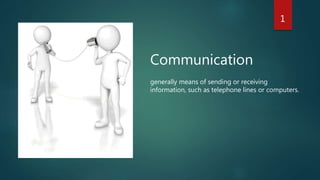
generally means of sending or receiving
information, such as telephone lines or computers.
1
WHAT WE HAVE SEEN SO FAR…
1. TELEGRAM
2. TELEPHONE
3. FAX
4. CELLULAR PHONE (2G)
5. SMARTPHONE (3G/4G)
6. INTERNET…
2
BUT, WHAT IS THE FUTURE?
NOW, IT’S TIME TO SEE WHAT IS IN STORE FOR US….
LET’S CONTINUE TO THE
FUTURE…
3
FUTURE OF COMMUNICATION
SUBMITTED BY
SUNNYMOON RAFI (1509018)
MUNTASEER RAHMAN (1509030)
SUBMITTED TO
Dr. Monir Hossen
Shuvashis Saha
4
Contents 5
1. Internet Of Things (IoT)
2. 5G
3. LiFi Technology
4. Molecular Communication
5. Virtual Presence
6. Augmented Reality
7. Network Based Telepathy
Internet Of Things (IoT)
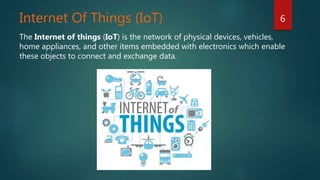
The Internet of things (IoT) is the network of physical devices, vehicles,
home appliances, and other items embedded with electronics which enable
these objects to connect and exchange data.
6
5G
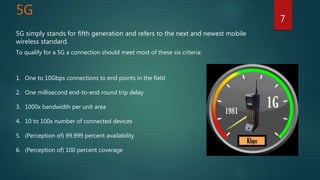
5G simply stands for fifth generation and refers to the next and newest mobile
wireless standard.
To qualify for a 5G a connection should meet most of these six criteria:
1. One to 10Gbps connections to end points in the field
2. One millisecond end-to-end round trip delay
3. 1000x bandwidth per unit area
4. 10 to 100x number of connected devices
5. (Perception of) 99.999 percent availability
6. (Perception of) 100 percent coverage
7
LiFi Technology
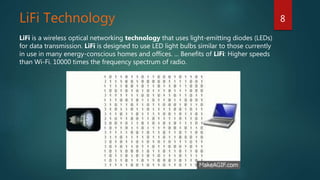
LiFi is a wireless optical networking technology that uses light-emitting diodes (LEDs)
for data transmission. LiFi is designed to use LED light bulbs similar to those currently
in use in many energy-conscious homes and offices. ... Benefits of LiFi: Higher speeds
than Wi-Fi. 10000 times the frequency spectrum of radio.
8
Molecular Communication
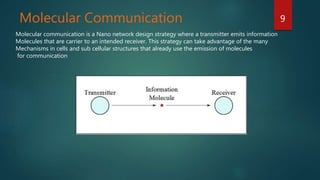
Molecular communication is a Nano network design strategy where a transmitter emits information
Molecules that are carrier to an intended receiver. This strategy can take advantage of the many
Mechanisms in cells and sub cellular structures that already use the emission of molecules
for communication
9
Virtual Presence
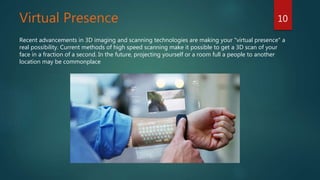
Recent advancements in 3D imaging and scanning technologies are making your "virtual presence" a
real possibility. Current methods of high speed scanning make it possible to get a 3D scan of your
face in a fraction of a second. In the future, projecting yourself or a room full a people to another
location may be commonplace
10
Augmented Reality
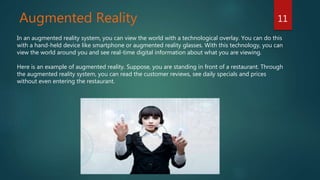
In an augmented reality system, you can view the world with a technological overlay. You can do this
with a hand-held device like smartphone or augmented reality glasses. With this technology, you can
view the world around you and see real-time digital information about what you are viewing.
Here is an example of augmented reality. Suppose, you are standing in front of a restaurant. Through
the augmented reality system, you can read the customer reviews, see daily specials and prices
without even entering the restaurant.
11
Network Based Telepathy
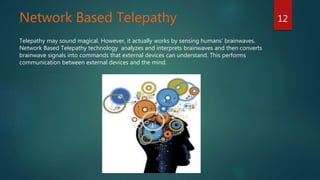
Telepathy may sound magical. However, it actually works by sensing humans’ brainwaves.
Network Based Telepathy technology analyzes and interprets brainwaves and then converts
brainwave signals into commands that external devices can understand. This performs
communication between external devices and the mind.
12
SO,
13
The future of communication is vast and the possibilities are endless.
Lets build the future together…
Thank You
14

Future Of Communication

  • 1.
    Communication generally means ofsending or receiving information, such as telephone lines or computers. 1
  • 2.
    WHAT WE HAVESEEN SO FAR… 1. TELEGRAM 2. TELEPHONE 3. FAX 4. CELLULAR PHONE (2G) 5. SMARTPHONE (3G/4G) 6. INTERNET… 2
  • 3.
    BUT, WHAT ISTHE FUTURE? NOW, IT’S TIME TO SEE WHAT IS IN STORE FOR US…. LET’S CONTINUE TO THE FUTURE… 3
  • 4.
    FUTURE OF COMMUNICATION SUBMITTEDBY SUNNYMOON RAFI (1509018) MUNTASEER RAHMAN (1509030) SUBMITTED TO Dr. Monir Hossen Shuvashis Saha 4
  • 5.
    Contents 5 1. InternetOf Things (IoT) 2. 5G 3. LiFi Technology 4. Molecular Communication 5. Virtual Presence 6. Augmented Reality 7. Network Based Telepathy
  • 6.
    Internet Of Things(IoT) The Internet of things (IoT) is the network of physical devices, vehicles, home appliances, and other items embedded with electronics which enable these objects to connect and exchange data. 6
  • 7.
    5G 5G simply standsfor fifth generation and refers to the next and newest mobile wireless standard. To qualify for a 5G a connection should meet most of these six criteria: 1. One to 10Gbps connections to end points in the field 2. One millisecond end-to-end round trip delay 3. 1000x bandwidth per unit area 4. 10 to 100x number of connected devices 5. (Perception of) 99.999 percent availability 6. (Perception of) 100 percent coverage 7
  • 8.
    LiFi Technology LiFi isa wireless optical networking technology that uses light-emitting diodes (LEDs) for data transmission. LiFi is designed to use LED light bulbs similar to those currently in use in many energy-conscious homes and offices. ... Benefits of LiFi: Higher speeds than Wi-Fi. 10000 times the frequency spectrum of radio. 8
  • 9.
    Molecular Communication Molecular communicationis a Nano network design strategy where a transmitter emits information Molecules that are carrier to an intended receiver. This strategy can take advantage of the many Mechanisms in cells and sub cellular structures that already use the emission of molecules for communication 9
  • 10.
    Virtual Presence Recent advancementsin 3D imaging and scanning technologies are making your "virtual presence" a real possibility. Current methods of high speed scanning make it possible to get a 3D scan of your face in a fraction of a second. In the future, projecting yourself or a room full a people to another location may be commonplace 10
  • 11.
    Augmented Reality In anaugmented reality system, you can view the world with a technological overlay. You can do this with a hand-held device like smartphone or augmented reality glasses. With this technology, you can view the world around you and see real-time digital information about what you are viewing. Here is an example of augmented reality. Suppose, you are standing in front of a restaurant. Through the augmented reality system, you can read the customer reviews, see daily specials and prices without even entering the restaurant. 11
  • 12.
    Network Based Telepathy Telepathymay sound magical. However, it actually works by sensing humans’ brainwaves. Network Based Telepathy technology analyzes and interprets brainwaves and then converts brainwave signals into commands that external devices can understand. This performs communication between external devices and the mind. 12
  • 13.
    SO, 13 The future ofcommunication is vast and the possibilities are endless. Lets build the future together…
  • 14.